
All Topics  
Aristotelian physics


   Email Print
   Bookmark   Link


Aristotelian physics


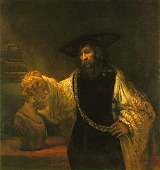
The Greek philosopher Aristotle
Aristotle

Aristotle was a Greeks philosopher, a student of Plato and teacher of Alexander the Great. He wrote on many subjects, including physics, metaphysics, Poetics , theater, music, logic, rhetoric, politics, government, ethics, biology and zoology....
 (384 BC – 322 BC) developed many theories on the nature of physics
Physics

Physics is the natural science which examines basic concepts such as energy, force, and spacetime and all that derives from these, such as mass, charge, matter and its Motion ....
. These involved what Aristotle described as the four elements
Classical element

Many ancient philosophy used a set of archetype classical elements to explain patterns in nature. In this context, the word element refers to a chemical substance that is either a chemical compound or a mixture of chemical compounds , rather than a chemical element of modern physical science....
, as well as a variety of other principles that differ significantly from modern ideas about the laws of physics. He spoke intimately of the relation between these elements, of their dynamics, how they impacted on the earth, and how they were, in many cases, attracted to each other by unspecified forces.


Discussion
Ask a question about 'Aristotelian physics'
Start a new discussion about 'Aristotelian physics'
Answer questions from other users
Full Discussion Forum


Encyclopedia


The Greek philosopher Aristotle
Aristotle

Aristotle was a Greeks philosopher, a student of Plato and teacher of Alexander the Great. He wrote on many subjects, including physics, metaphysics, Poetics , theater, music, logic, rhetoric, politics, government, ethics, biology and zoology....
 (384 BC – 322 BC) developed many theories on the nature of physics
Physics

Physics is the natural science which examines basic concepts such as energy, force, and spacetime and all that derives from these, such as mass, charge, matter and its Motion ....
. These involved what Aristotle described as the four elements
Classical element

Many ancient philosophy used a set of archetype classical elements to explain patterns in nature. In this context, the word element refers to a chemical substance that is either a chemical compound or a mixture of chemical compounds , rather than a chemical element of modern physical science....
, as well as a variety of other principles that differ significantly from modern ideas about the laws of physics. He spoke intimately of the relation between these elements, of their dynamics, how they impacted on the earth, and how they were, in many cases, attracted to each other by unspecified forces. He was also responsible for a related theory of moving energy.

Aristotelian physics

Aristotle taught that the elements
Classical element

Many ancient philosophy used a set of archetype classical elements to explain patterns in nature. In this context, the word element refers to a chemical substance that is either a chemical compound or a mixture of chemical compounds , rather than a chemical element of modern physical science....
 that composed the Earth
Earth

Earth is the third planet from the Sun. Earth is the largest of the terrestrial planets in the Solar System in diameter, mass and density. It is also referred to as the World and Wiktionary:Terra.Note that by International Astronomical Union convention, the term "Terra" is used for naming extensive land masses, rather...
 were different from those that made up the heavens and Outer space
Outer space

Outer space comprises the relatively empty regions of the universe outside the atmospheres of celestial bodies. Outer space is used to distinguish it from airspace and terrestrial locations....
. He also taught that dynamics
Dynamics

Dynamics may refer to:In Physics:*Dynamics , in physics, dynamics refers to time evolution of physical processes*Analytical dynamics refers to the motion of bodies as induced by external forces...
 were mostly determined by the characteristics and nature of the substance
Substance

The word substance originates from Latin substantia, literally meaning "standing under". The word was used to translate the Greek language philosophical term ousia....
s that the object that was moving was composed of.

Elements

Aristotle believed that there were four main elements
Classical element

Many ancient philosophy used a set of archetype classical elements to explain patterns in nature. In this context, the word element refers to a chemical substance that is either a chemical compound or a mixture of chemical compounds , rather than a chemical element of modern physical science....
 or compounds that made up the Earth
Earth

Earth is the third planet from the Sun. Earth is the largest of the terrestrial planets in the Solar System in diameter, mass and density. It is also referred to as the World and Wiktionary:Terra.Note that by International Astronomical Union convention, the term "Terra" is used for naming extensive land masses, rather...
: earth
Earth (classical element)

Earth, home and origin of humanity, has often been worshipped in its own right with its own unique spiritual tradition....
, air
Air (classical element)

In traditional cultures, air is often seen as a universal power or pure substance. Its fundamental importance to life can be seen in words such as aspire, conspire, inspire, perspire, and spirit, all derived from the Latin spirare ....
, water
Water (classical element)

Water has been important to all peoples of the earth, and it is rich in spiritual tradition....
 and fire
Fire (classical element)

Fire has been an important part of many cultures and religions, from pre-history to modern day, and was vital to the development of civilization....
. He also held that all the heavens, and every particle of matter
Matter

In common usage, matter is anything that has both mass and volume . A more rigorous definition is used in science: matter is what atoms and molecules are made of....
 in the universe
Universe

The universe is defined as everything that physically exists: the entirety of space and time, all forms of matter, energy and momentum, and the physical laws and physical constants that govern them....
, was formed out of another, fifth element he called 'aether
Aether

Aether originally was the personification of the "upper sky", space and heaven, in Greek mythology.The term aether, ?ther or ether may also refer to one of the following:...
' (also transliterated as "ether"), which was supposedly weightless and "incorruptible". Aether was also known by the name 'quintessence' - literally, "fifth substance".
Aristotle Physica Page 1
Heavy substances such as iron
Iron

Iron is a chemical element with the symbol Fe and atomic number 26. Iron is a Group 8 element and period 4 element. Iron is lustrous and silvery in color....
 and metals were considered to be primarily consisting of the "element" of earth, with a limited amount of matter
Matter

In common usage, matter is anything that has both mass and volume . A more rigorous definition is used in science: matter is what atoms and molecules are made of....
 from the other elements. Other, less heavy and/or dense objects were thought to be less earthy, and composed of a greater mixture of the other elements. Human
Human

A human being, also human or man, is a member of a species of bipedalism primates in the family Hominidae . Mitochondrial DNA evidence indicates that modern humans originated in east Africa about 200,000 years ago....
s were shaped with all of the substances, with the exception of aether, but the relative proportion of elements was unique to each person, and there was no standard amount of each within the human body.

Dynamics


Aristotle held that each of the four worldly elements would each seek each other and cluster together, and that this seeking of other similar elements would have to be hindered to be stopped, as it was as natural as two magnet
Magnet

A magnet is a material or object that produces a magnetic field. This magnetic field is invisible but is responsible for the most notable property of a magnet: a force that pulls on other ferromagnetic materials and attracts or repels other magnets....
s rejecting each other, or rain falling from the clouds. For instance, because smoke
Smoke

File:Bling-Bling Skywriting David Shankbone.jpgSmoke is the collection of airborne solid and liquid particulates and gases emitted when a material undergoes combustion or pyrolysis, together with the quantity of air that is entrainment or otherwise mixed into the mass....
 was mainly air, it would rise to meet the air in the sky. He also taught that objects and matter could only move so long as a form of energy
Energy

In physics, energy is a scalar physical quantity that describes the amount of Work_ that can be performed by a force. Energy is an attribute of objects and systems that is subject to a conservation law....
 was forcing it in a given direction. Therefore, if all the applied forces on Earth were removed, such as the throwing of a rock, then nothing could move. This idea had flaws that were visible even at the time the concept was formulated. Many people questioned how an object such as an arrow
Arrow

An arrow is a pointed projectile that is shot with a bow . It predates recorded history and is common to most cultures....
 could continue to move forward after it had left the power released by the string, and continue to sail forward. Aristotle proposed an idea that arrows, etc., created a type of vacuum
Vacuum

A vacuum is a volume of space that is essentially empty of matter, such that its gaseous pressure is much less than atmospheric pressure. The word comes from the Latin term for "empty," but in reality, no volume of space can ever be perfectly empty....
 behind them that forced them forward., which was consistent with his interpretation of motion as an interaction of the moving object and the medium through which it moves. Since the turbulent motion of air around an arrow is very complicated, and still not fully understood, any discrepancy with observation could be swept under the rug.

Because Aristotle placed the medium at the center of his theory of motion, he could not make sense of the notion of a void central to the atomic theory of Democritus
Democritus

Democritus was an Ancient Greek philosopher born in Abdera in the north of Greece. He was the most prolific, and ultimately the most influential, of the pre-Socratic philosophers; his atomic theory may be regarded as the culmination of early Greek thought....
. A void is a place free of anything, and since Aristotle asserted that motion required a medium, he came to the conclusion that a void was an incomprehensible idea. Aristotle believed that the motion of an object is inversely proportional to the density of the medium. the more tenuous a medium is, the faster the motion. If an object is moving in void, Aristotle believed that it would be moving infinitely fast, so that matter would instantly fill up any void at the moment it formed.

Gravity


The Aristotelian theory of gravity was a theory that stated that all bodies move towards their natural place. For some objects, Aristotle
Aristotle

Aristotle was a Greeks philosopher, a student of Plato and teacher of Alexander the Great. He wrote on many subjects, including physics, metaphysics, Poetics , theater, music, logic, rhetoric, politics, government, ethics, biology and zoology....
 claimed the natural place to be the center of the earth
Earth

Earth is the third planet from the Sun. Earth is the largest of the terrestrial planets in the Solar System in diameter, mass and density. It is also referred to as the World and Wiktionary:Terra.Note that by International Astronomical Union convention, the term "Terra" is used for naming extensive land masses, rather...
, wherefore they fall towards it. For other objects, the natural place is the heavenly spheres, wherefore gases, steam for example, move away from the centre of the earth and towards heaven and to the moon
Moon

The Moon is Earth's only natural satellite and the List of natural satellites by diameter satellite in the Solar System. The average centre-to-centre distance from the Earth to the Moon is km, about thirty times the diameter of the Earth....
. The speed
Speed

Speed is the rate of Motion , or equivalently the rate of change of distance.Speed is a Scalar quantity with dimensions length/time; the equivalent Vector quantity to speed is velocity....
 of this motion
Motion (physics)

In physics, motion means a constant change in the location of a body. Change in motion is the result of applied force. Motion is typically described in terms of velocity, acceleration, Displacement , and time....
 was thought to be proportional to the mass
Mass

In physical science, mass refers to the degree of acceleration a body acquires when subject to a force: bodies with greater mass are accelerated less by the same force....
 of the object.

Medieval criticisms


During the Middle Ages
Middle Ages

File:Karl 1 mit papst gelasius gregor1 sacramentar v karl d kahlen.jpgThe Middle Ages of European history are a period in history which lasted for roughly a millennium, commonly dated from the fall of the Roman Empire in the 5th century to the beginning of the Early Modern Period in the 16th century, marked by the division of Western Christi...
, the Aristotelian theory of gravity was first criticized and/or modified by John Philoponus
John Philoponus

John Philoponus , also known as John Grammarian of Alexandria, was a Christian and commentaries on Aristotle and the author of a considerable number of philosophical treatises and theological works....
 and later by Muslim physicists
Islamic physics

Islamic physics refers to the study of physics within Islamic science, which flourished during the Islamic Golden Age, variously dated from the 8th century to the 16th century, when experimental physics, mathematical physics and theoretical physics were studied in the Muslim world....
. Ja'far Muhammad ibn Musa ibn Shakir (800-873) of the Banu Musa
Banu Musa

The Banu Musa brothers were three 9th century Persian people scholars, of Baghdad, active in the House of Wisdom:*Abu Ja'far Muhammad ibn Musa ibn Shakir , who specialised in Islamic astronomy, Muslim inventions, geometry and Islamic physics....
 wrote the Astral Motion and The Force of Attraction, where he discovered that there was a force
Force

In physics, a force is that which can cause an object with mass to change its velocity. Force has both Euclidean_vector#Length of a vector and Direction , making it a Vector quantity....
 of attraction
Gravitation

Gravitation is a natural phenomenon that gives weight to objects. In everyday life, attraction due to gravity is the result of the presence of relatively large bodies, such as the Earth and the Moon....
 between heavenly bodies
Astronomical object

s are significant entity, associations or structures which current science has confirmed to exist in outer space. This does not necessarily mean that more current science will not disprove their existence....
, foreshadowing Newton's law of universal gravitation
Newton's law of universal gravitation

Isaac Newton's law of universal gravitation is an empirical physical law describing the gravitational attraction between bodies with mass. It is a part of classical mechanics and was first formulated in Newton's work Philosophiae Naturalis Principia Mathematica, first published on July 5 1687....
.

Ibn al-Haytham (965-1039) also discussed the theory of attraction between mass
Mass

In physical science, mass refers to the degree of acceleration a body acquires when subject to a force: bodies with greater mass are accelerated less by the same force....
es, and it seems that he was aware of the magnitude
Magnitude (mathematics)

The magnitude of a mathematical object is its size: a property by which it can be larger or smaller than other objects of the same kind; in technical terms, an ordering of the class of objects to which it belongs....
 of acceleration
Acceleration

File:Acceleration.JPGFile:Acceleration components.JPGIn physics, and more specifically kinematics, acceleration is the change in velocity over time....
 due to gravity and he discovered that the heavenly bodies "were accountable to the laws of physics
Physical law

A physical law or scientific law is a scientific generalization based on empiricism observations of physical behavior . Laws of nature are observable....
". Abu Rayhan al-Biruni (973-1048) was the first to realize that acceleration
Acceleration

File:Acceleration.JPGFile:Acceleration components.JPGIn physics, and more specifically kinematics, acceleration is the change in velocity over time....
 is connected with non-uniform motion, part of Newton's second law of motion. During his debate with Avicenna
Avicenna

, known as Abu Ali Sina Balkhi or Ibn Sina and commonly known in English by his Latinized name Avicenna , was a Persian people polymath and the foremost Islamic medicine and Early Islamic philosophy of his time....
, al-Biruni also criticized the Aristotelian theory of gravity for denying the existence of levity or gravity in the celestial sphere
Celestial sphere

In astronomy and navigation, the celestial sphere is an imagination rotation sphere of "gigantic radius", concentric spheres and coaxial with the Earth....
s and for its notion of circular motion
Circular motion

In physics, circular motion is rotation along a circle: a circular path or a circular orbit. It can be uniform circular motion, that is, with constant angular rate of rotation, or non-uniform circular motion, that is, with a changing rate of rotation....
 being an innate property
Intrinsic and extrinsic properties

The term intrinsic denotes a property of some thing or action which is essence and specific to that thing or action, and which is wholly independent of any other object, action or consequence....
 of the heavenly bodies
Astronomical object

s are significant entity, associations or structures which current science has confirmed to exist in outer space. This does not necessarily mean that more current science will not disprove their existence....
.

In 1121, al-Khazini
Al-Khazini

Abd al-Rahman al-Khazini was a Greek Muslims Science in medieval Islam, Astronomy in medieval Islam, Physics in medieval Islam, Medicine in medieval Islam, Alchemy and chemistry in medieval Islam, Mathematics in medieval Islam and Early Islamic philosophy from Merv, then in the Greater Khorasan province of Persian Empire but now in Turkmeni...
, in The Book of the Balance of Wisdom, proposed that the gravity and gravitational potential energy of a body varies depending on its distance from the centre of the Earth. Hibat Allah Abu'l-Barakat al-Baghdaadi
Hibat Allah Abu'l-Barakat al-Baghdaadi

Hibat Allah Abu'l-Barakat al-Baghdaadi was a Islamic physics, Islamic philosophy, Islamic psychology and Islamic science of Arab Jews descent from Baghdad, Iraq....
 (1080-1165) wrote a critique of Aristotelian physics entitled al-Mu'tabar, where he negated Aristotle's idea that a constant force
Force

In physics, a force is that which can cause an object with mass to change its velocity. Force has both Euclidean_vector#Length of a vector and Direction , making it a Vector quantity....
 produces uniform motion, as he realized that a force applied continuously produces acceleration
Acceleration

File:Acceleration.JPGFile:Acceleration components.JPGIn physics, and more specifically kinematics, acceleration is the change in velocity over time....
, a fundamental law of classical mechanics
Classical mechanics

Classical mechanics is used for describing the motion of macroscopic objects, from projectiles to parts of machinery, as well as astronomical objects, such as spacecraft, planets, stars, and galaxies....
 and an early foreshadowing of Newton's second law of motion. Like Newton, he described acceleration as the rate of change of velocity
Velocity

In physics, velocity is defined as the Derivative of Position vector. It is a vector physical quantity; both speed and direction are required to define it....
.

In the 14th century, Jean Buridan
Jean Buridan

Jean Buridan was a French priest who sowed the seeds of the Copernican revolution in Europe. Although he was one of the most famous and influential philosophers of the late Middle Ages, he is today among the least well known....
 developed the theory of impetus
Theory of impetus

The theory of impetus was an antiquated auxiliary or secondary theory of Aristotelian physics, put forth initially to explain projectile motion against gravity....
, based on Avicenna
Avicenna

, known as Abu Ali Sina Balkhi or Ibn Sina and commonly known in English by his Latinized name Avicenna , was a Persian people polymath and the foremost Islamic medicine and Early Islamic philosophy of his time....
's theory of mayl and the work of John Philoponus
John Philoponus

John Philoponus , also known as John Grammarian of Alexandria, was a Christian and commentaries on Aristotle and the author of a considerable number of philosophical treatises and theological works....
, as an alternative to the Aristotelian theory of motion. The theory of impetus was a precursor to the concepts of inertia
Inertia

File:192447main 017 law of inertia.oggInertia is the resistance of an object to a change in its state of motion. The principle of inertia is one of the fundamental principles of classical physics which are used to describe the Motion of matter and how it is affected by applied forces....
 and momentum
Momentum

In classical mechanics, momentum is the product of the mass and velocity of an object . For more accurate measures of momentum, see the section Momentum#Modern definitions of momentum on this page....
 in classical mechanics.

In the 16th century, al-Birjandi
Al-Birjandi

Abd al-Ali ibn Muhammad ibn al-Husayn al-Birjandi prominent 16th century Islamic astronomy, Islamic mathematics and Islamic science who lived in Birjand, Iran....
 discussed the possibility of the Earth's rotation. In his analysis of what might occur if the Earth were rotating, he developed a hypothesis similar to Galileo Galilei
Galileo Galilei

Galileo Galilei was a Grand Duchy of Tuscany physicist, mathematician, astronomer, and philosopher who played a major role in the Scientific Revolution....
's notion of "circular inertia
Inertia

File:192447main 017 law of inertia.oggInertia is the resistance of an object to a change in its state of motion. The principle of inertia is one of the fundamental principles of classical physics which are used to describe the Motion of matter and how it is affected by applied forces....
", which he described in the following observational test
Experiment

In scientific inquiry, an experiment is a method of investigating causal relationships among variables. An experiment is a cornerstone of the empiricism approach to acquiring data about the world and is used in both natural sciences and social sciences....
:

Life and death of Aristotelian physics


The reign of Aristotelian notions of physics lasted for almost two millennia, and provide the earliest known speculative theories of physics. After the work of Alhacen, Avicenna
Avicenna

, known as Abu Ali Sina Balkhi or Ibn Sina and commonly known in English by his Latinized name Avicenna , was a Persian people polymath and the foremost Islamic medicine and Early Islamic philosophy of his time....
, Avempace
Ibn Bajjah

Abu-Bakr Muhammad ibn Yahya ibn al-Sayigh , known as Ibn Bajjah , was an Al-Andalus- Arab Muslim polymath: an Islamic astronomy, Logic in Islamic philosophy, Arabic music, Early Islamic philosophy, Islamic medicine, Islamic physics, Islamic psychology, Arabic poetry and Islamic science....
, al-Baghdadi
Hibat Allah Abu'l-Barakat al-Baghdaadi

Hibat Allah Abu'l-Barakat al-Baghdaadi was a Islamic physics, Islamic philosophy, Islamic psychology and Islamic science of Arab Jews descent from Baghdad, Iraq....
, Jean Buridan
Jean Buridan

Jean Buridan was a French priest who sowed the seeds of the Copernican revolution in Europe. Although he was one of the most famous and influential philosophers of the late Middle Ages, he is today among the least well known....
, Galileo, Descartes, Isaac Newton
Isaac Newton

Sir Isaac Newton, Fellow of the Royal Society was an English people physicist, mathematician, Astronomy, Natural philosophy, Alchemy, and Theology and one of the the 100 in human history....
, and many others, it became generally accepted that Aristotelian physics were not correct or viable. Despite this, Aristotle's physics were able to live into the late seventeenth century, and perhaps longer, as they were still taught in universities at the time. Aristotle's model of physics was the main academic impediment for the creation of the science of physics long after Aristotle's death.

In Europe
Europe

Europe is, conventionally, one of the world's seven continents. Comprising the westernmost peninsula of Eurasia, Europe is generally divided from Asia to its east by the water divide of the Ural Mountains, the Ural , the Caspian Sea, and by the Caucasus Mountains to the southeast....
, Aristotle
Aristotle

Aristotle was a Greeks philosopher, a student of Plato and teacher of Alexander the Great. He wrote on many subjects, including physics, metaphysics, Poetics , theater, music, logic, rhetoric, politics, government, ethics, biology and zoology....
's theory was first convincingly discredited by the work of Galileo Galilei
Galileo Galilei

Galileo Galilei was a Grand Duchy of Tuscany physicist, mathematician, astronomer, and philosopher who played a major role in the Scientific Revolution....
. Using a telescope
Telescope

A telescope is an instrument designed for the observation of remote objects by the collection of electromagnetic radiation. The first known practically functioning telescopes were invented in the Netherlands at the beginning of the 17th century....
, Galileo observed that the moon was not entirely smooth, but had craters and mountains, contradicting the Aristotelian idea of an incorruptible perfectly smooth moon. Galileo also criticized this notion theoretically – a perfectly smooth moon would reflect light unevenly like a shiny billiard ball, so that the edges of the moon's disk would have a different brightness than the point where a tangent plane reflects sunlight directly to the eye. A rough moon reflects in all directions equally, leading to a disk of approximately equal brightness which is what is observed . Galileo also observed that Jupiter
Jupiter

Jupiter is the fifth planet from the Sun and the Solar system by size planet within the Solar System. It is two and a half times as massive as all of the other planets in our Solar System combined....
 has moons
Galilean moons

The Galilean moons are the four moons of Jupiter discovered by Galileo Galilei on January 7, 1610. They are the largest of the many moons of Jupiter and derive their names from the lovers of Zeus : Io , Europa , Ganymede and Callisto ....
, objects which revolve around a body other than the Earth. He noted the phases of Venus, convincingly demonstrating that Venus, and by implication Mercury, travels around the sun, not the Earth.

According to legend, Galileo dropped balls of various densities
Density

The density of a material is defined as its mass per unit volume. The symbol of density is ....
 from the Tower of Pisa
Leaning Tower of Pisa

The Leaning Tower of Pisa or simply The Tower of Pisa is the campanile, or freestanding bell tower, of the cathedral of the Italian city of Pisa....
 and found that lighter and heavier ones fell at almost the same speed. In fact, he did quantitative experiments with balls rolling down an inclined plane, a form of falling that is slow enough to be measured without advanced instruments.

Since Aristotle did not believe that motion could be described without a surrounding medium, he couldn't treat air resistance as a complicating factor. A heavier body falls faster than a lighter one of the same shape in a dense medium like water, and this led Aristotle to speculate that the rate of falling is proportional to the mass and inversely proportional to the density of the medium. From his experience with objects falling in water, he concluded that water is approximately ten times denser than air. By weighing a volume of compressed air, Galileo showed that this overestimates the density of air by a factor of forty. From his experiments with inclined planes, he concluded that all bodies fall at the same rate neglecting friction.

Galileo also advanced a theoretical argument to support his conclusion. He asked if two bodies of different masses and different rates of fall are tied by a string, does the combined system fall faster because it is now more massive, or does the lighter body in its slower fall hold back the heavier body? The only convincing answer is neither: all the systems fall at the same rate.

Followers of Aristotle were aware that the motion of falling bodies was not uniform, but picked up speed with time. Since time is an abstract quantity, the peripatetic
Peripatetic

The Peripatetics were members of a school of philosophy in ancient Greece. Their teachings derived from their founder, the greek philosophy Aristotle and Peripatetic is a name given to his followers....
s postulated that the speed was proportional to the distance. Galileo established experimentally that the speed is proportional to the time, but he also gave a theoretical argument that the speed could not possibly be proportional to the distance. In modern terms, if the rate of fall is proportional to the distance, the differential equation for the distance y travelled after time t is

with the condition that . Galileo demonstrated that this system would stay at for all time. If a perturbation set the system into motion somehow, the object would pick up speed exponentially in time, not quadratically .

On the surface of the moon
Moon

The Moon is Earth's only natural satellite and the List of natural satellites by diameter satellite in the Solar System. The average centre-to-centre distance from the Earth to the Moon is km, about thirty times the diameter of the Earth....
, David Scott
David Scott

David Randolph Scott , a former NASA astronaut, was one of the third group of astronauts named by NASA in October 1963. As commander of the Apollo 15 mission, the fourth human lunar landing, he was List of Apollo astronauts#People who have walked on the Moon and the first person to Lunar rover....
 famously repeated Galileo's experiment by dropping a feather and a hammer from each hand at the same time. In the absence of a substantial atmosphere
Atmosphere

An atmosphere is a layer of gases that may surround a material body of sufficient mass, by the gravity of the body, and are retained for a longer duration if gravity is high and the atmosphere's temperature is low....
, the two objects fell and hit the moon's surface at the same time.

With his law of universal gravitation
Newton's law of universal gravitation

Isaac Newton's law of universal gravitation is an empirical physical law describing the gravitational attraction between bodies with mass. It is a part of classical mechanics and was first formulated in Newton's work Philosophiae Naturalis Principia Mathematica, first published on July 5 1687....
 Isaac Newton
Isaac Newton

Sir Isaac Newton, Fellow of the Royal Society was an English people physicist, mathematician, Astronomy, Natural philosophy, Alchemy, and Theology and one of the the 100 in human history....
 was the first to mathematically codify a correct theory of gravity. In this theory, any mass is attracted to any other mass by a force which decreases as the inverse square of their distance. In 1915, Newton's theory was modified, but not invalidated, by Albert Einstein
Albert Einstein

Albert Einstein was a Germany-born theoretical physics. He is best known for his theory of relativity and specifically mass?energy equivalence, expressed by the equation E = mc2....
, who developed a new picture of gravitation
Gravitation

Gravitation is a natural phenomenon that gives weight to objects. In everyday life, attraction due to gravity is the result of the presence of relatively large bodies, such as the Earth and the Moon....
, in the framework of his general theory of relativity
General relativity

General relativity or the general theory of relativity is the Geometry Theoretical physics of gravitation published by Albert Einstein in 1916....
. See gravity for a much more detailed complete discussion.

See also

  • Physics (Aristotle)
    Physics (Aristotle)

    Physics is a key text in the philosophy of Aristotle. It stands at the head of the current Andronicus of Rhodes order, the long series of Aristotle's physical, cosmological and biological works, and is foundational to them....