
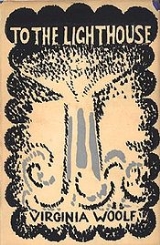
To the Lighthouse is a novel by
Virginia WoolfAdeline Virginia Woolf was an English author, essayist, publisher, and writer of short stories, regarded as one of the foremost modernist literary figures of the twentieth century....
. A novel set on the Ramsays and their visits to the Isle of Skye in
ScotlandScotland is a country that is part of the United Kingdom. Occupying the northern third of the island of Great Britain, it shares a border with England to the south and is bounded by the North Sea to the east, the Atlantic Ocean to the north and west, and the North Channel and Irish Sea to the...
between 1910 and 1920, it skilfully manipulates temporal and psychological elements.
To the Lighthouse follows and extends the tradition of
modernist novelistsModernist literature is sub-genre of Modernism, a predominantly European movement beginning in the early 20th century that was characterized by a self-conscious break with traditional aesthetic forms...
like
Marcel ProustValentin Louis Georges Eugène Marcel Proust was a French novelist, critic, and essayist best known for his monumental À la recherche du temps perdu...
and
James JoyceJames Augustine Aloysius Joyce was an Irish novelist and poet, considered to be one of the most influential writers in the modernist avant-garde of the early 20th century...
, where the plot is secondary to philosophical introspection, and the prose can be winding and hard to follow. The novel includes little
dialogueDialogue is a literary and theatrical form consisting of a written or spoken conversational exchange between two or more people....
and almost no action; most of it is written as thoughts and observations.
The novel recalls childhood emotions and highlights adult relationships. Among the book's many tropes and themes are those of loss, subjectivity, and the problem of perception.
In 1998, the
Modern LibraryThe Modern Library is a publishing company. Founded in 1917 by Albert Boni and Horace Liveright as an imprint of their publishing company Boni & Liveright, it was purchased in 1925 by Bennett Cerf and Donald Klopfer...
named
To the Lighthouse No. 15 on its list of the 100 best English-language novels of the 20th century. In 2005, the novel was chosen by
TIMETime is a part of the measuring system used to sequence events, to compare the durations of events and the intervals between them, and to quantify rates of change such as the motions of objects....
magazine as one of the one hundred best English-language novels from 1923 to present.
Part I: The Window
The novel is set in the Ramsays' summer home in the
HebridesThe Hebrides comprise a widespread and diverse archipelago off the west coast of Scotland. There are two main groups: the Inner and Outer Hebrides. These islands have a long history of occupation dating back to the Mesolithic and the culture of the residents has been affected by the successive...
, on the Isle of Skye. The section begins with Mrs Ramsay assuring James that they should be able to visit the lighthouse on the next day. This prediction is denied by Mr Ramsay, who voices his certainty that the weather will not be clear, an opinion that forces a certain tension between Mr and Mrs Ramsay, and also between Mr Ramsay and James. This particular incident is referred to on various occasions throughout the chapter, especially in the context of Mr and Mrs Ramsay's relationship.
The Ramsays have been joined at the house by a number of friends and colleagues, one of them being Lily Briscoe, who begins the novel as a young, uncertain painter attempting a portrayal of Mrs. Ramsay and James. Briscoe finds herself plagued by doubts throughout the novel, doubts largely fed by the claims of Charles Tansley, another guest, that women can neither paint nor write. Tansley himself is an admirer of Mr Ramsay and his philosophical treatises.
The section closes with a large dinner party. When Augustus Carmichael, a visiting poet, asks for a second serving of soup, Mr Ramsay nearly snaps at him. Mrs Ramsay, who is striving for the perfect dinner party, is herself out of sorts when Paul Rayley and Minta Doyle, two acquaintances whom she has brought together in engagement, arrive late to dinner, as Minta has lost her grandmother’s brooch on the beach.
Part II: Time Passes
The second section gives a sense of time passing, absence, and death. Ten years pass, during which the four-year
First World WarWorld War I , which was predominantly called the World War or the Great War from its occurrence until 1939, and the First World War or World War I thereafter, was a major war centred in Europe that began on 28 July 1914 and lasted until 11 November 1918...
begins and ends. Mrs Ramsay passes away, Prue dies from complications of childbirth, and Andrew is killed in the war. Mr Ramsay is left adrift without his wife to praise and comfort him during his bouts of fear and his anguish regarding the longevity of his philosophical work.
Part III: The Lighthouse
In the final section, “The Lighthouse,” some of the remaining Ramsays and other guests return to their summer home ten years after the events of Part I. Mr Ramsay finally plans on taking the long-delayed trip to the lighthouse with his son James and daughter Cam(illa). The trip almost does not happen, as the children are not ready, but they eventually set off. As they travel, the children are silent in protest at their father for forcing them to come along. However, James keeps the sailing boat steady and rather than receiving the harsh words he has come to expect from his father, he hears praise, providing a rare moment of empathy between father and son; Cam's attitude towards her father changes also, from resentment to eventual admiration.
They are accompanied by the sailor Macalister and his son, who catches fish during the trip. The son cuts a piece of flesh from a fish he has caught to use for bait, throwing the injured fish back into the sea.
While they set sail for the lighthouse, Lily attempts to finally complete the painting she has held in her mind since the start of the novel. She reconsiders her memory of Mrs and Mr Ramsay, balancing the multitude of impressions from ten years ago in an effort to reach towards an objective truth about Mrs Ramsay and life itself. Upon finishing the painting (just as the sailing party reaches the lighthouse) and seeing that it satisfies her, she realizes that the execution of her vision is more important to her than the idea of leaving some sort of legacy in her work.
Complexity of experience
Large parts of Woolf's novel do not concern themselves with the objects of vision, but rather investigate the means of perception, attempting to understand people in the act of looking. In order to be able to understand thought, Woolf's diaries reveal, the author would spend considerable time listening to herself think, observing how and which words and emotions arose in her own mind in response to what she saw.
Modernism
To The Lighthouse and its characters often display elements of the Modernist school of thought. Characters such as Mrs Ramsay disparage Victorian ideals of society and question both the existence of God and the goodness in man. Furthermore, the transience of man is emphasized as a central theme alongside nature as an eternal and sometimes menacing force with the omnipresent potential to consume humanity.
Narration and perspective
The novel lacks an omniscient narrator (except in the second section: Time Passes); instead the plot unfolds through shifting perspectives of each character's
stream of consciousnessStream of consciousness refers to the flow of thoughts in the conscious mind. The full range of thoughts that one can be aware of can form the content of this stream, not just verbal thoughts...
. Shifts can occur even mid-sentence, and in some sense they resemble the rotating beam of the lighthouse itself. Unlike James Joyce, however, Woolf does not tend to use abrupt fragments to represent characters' thought processes; her method is more one of lyrical paraphrase. The lack of an omniscient narrator means that, throughout the novel, no clear guide exists for the reader and that only through character development can we formulate our own opinions and views because much is morally ambiguous.
Whereas in Part I the novel is concerned with illustrating the relationship between the character experiencing and the actual experience and surroundings, the second part, 'Time Passes' having no characters to relate to, presents events differently. Instead, Woolf wrote the section from the perspective of a displaced narrator, unrelated to any people, intending that events be seen related to time. For that reason the narrating voice is unfocused and distorted, providing an example of what Woolf called 'life as it is when we have no part in it.'
Allusions to autobiography and actual geography
Woolf began writing
To the Lighthouse partly as a way of understanding and dealing with unresolved issues concerning both her parents and indeed there are many similarities between the plot and her own life. Her visits with her parents and family to
St IvesSt Ives is a seaside town, civil parish and port in Cornwall, England, United Kingdom. The town lies north of Penzance and west of Camborne on the coast of the Celtic Sea. In former times it was commercially dependent on fishing. The decline in fishing, however, caused a shift in commercial...
,
CornwallCornwall is a unitary authority and ceremonial county of England, within the United Kingdom. It is bordered to the north and west by the Celtic Sea, to the south by the English Channel, and to the east by the county of Devon, over the River Tamar. Cornwall has a population of , and covers an area of...
, where her father rented a house, were perhaps the happiest times of Woolf's life, but when she was thirteen her mother died and, like Mr. Ramsay, her father
Leslie StephenSir Leslie Stephen, KCB was an English author, critic and mountaineer, and the father of Virginia Woolf and Vanessa Bell.-Life:...
plunged into gloom and self-pity. Woolf's sister
Vanessa BellVanessa Bell was an English painter and interior designer, a member of the Bloomsbury group, and the sister of Virginia Woolf.- Biography and art :...
wrote that reading the sections of the novel that describe Mrs Ramsay was like seeing her mother raised from the dead. Their brother Adrian was not allowed to go on an expedition to Godrevy Lighthouse, just as in the novel James looks forward to visiting the lighthouse and is disappointed when the trip is cancelled. Lily Briscoe's meditations on painting are a way for Woolf to explore her own creative process (and also that of her painter sister), since Woolf thought of writing in the same way that Lily thought of painting.
Woolf's father began renting Talland House in St. Ives, in 1882, shortly after Woolf's own birth. The house was used by the family as a family retreat during the summer for the next ten years. The location of the main story in
To the Lighthouse, the house on the Hebridean island, was formed by Woolf in imitation of Talland House. Many actual features from St Ives Bay are carried into the story, including the gardens leading down to the sea, the sea itself, and the lighthouse.
Although in the novel the Ramsays are able to return to the house on Skye after the war, the Stephens had given up Talland house by that time. After the war, Virginia Woolf visited Talland House under its new ownership with her sister Vanessa, and Woolf repeated the journey later, long after her parents were dead.
Publishing history
Upon completing the draft of this, her most autobiographical novel, Woolf described it as 'easily the best of my books' and her husband
LeonardLeonard Sidney Woolf was an English political theorist, author, publisher and civil servant, and husband of author Virginia Woolf.-Early life:...
thought it a masterpiece, 'entirely new...a psychological poem'. They published it together at their Hogarth Press in London in 1927. The first impression of 3000 copies of 320 pages measuring 7.5 inches by 5 inches was bound in blue cloth. The book outsold all Woolf's previous novels, and the proceeds enabled the Woolfs to buy a car.
Film, TV, music, or theatrical adaptations
- To the Lighthouse
To the Lighthouse is a 1983 made-for-television film based on the Virginia Woolf novel, To the Lighthouse....
(1983), starring Rosemary HarrisRosemary Ann Harris is an English actress and a member of the American Theatre Hall of Fame. Throughout her career she has been nominated for an Academy Award, a BAFTA Award and has won a Golden Globe, an Emmy, a Tony Award, an Obie, and five Drama Desk Awards.-Early life:Harris was born in...
, Michael GoughMichael Gough was an English character actor who appeared in over 150 films. He is perhaps best known to international audiences for his roles in the Hammer Horror films from 1958, and for his recurring role as Alfred Pennyworth in all four movies of the Burton/Schumacher Batman franchise,...
, Suzanne BertishSuzanne C. Bertish is an English actress.A former member of the Royal Shakespeare Company, Bertish has appeared in many productions with them, including their marathon eight-and-a-half hour version of Charles Dickens's The Life and Adventures of Nicholas Nickleby, in which she played three roles...
, and Kenneth BranaghKenneth Charles Branagh is an actor and film director from Northern Ireland. He is best known for directing and starring in several film adaptations of William Shakespeare's plays including Henry V , Much Ado About Nothing , Hamlet Kenneth Charles Branagh is an actor and film director from...
.
- To the Lighthouse http://www.berkeleyrep.org/season/0607/1326.asp (play) written by Adele Edling Shank, music composed by Paul Dresher
Paul Joseph Dresher is an American composer. Dresher received his B.A. in music from the University of California, Berkeley and his M.A. in composition from the University of California, San Diego, where he studied with Robert Erickson, Roger Reynolds, Pauline Oliveros, and Bernard Rands.He also...
. The 2007 world premiere at Berkeley Repertory TheatreBerkeley Repertory Theatre is a regional theater company located in Berkeley, California. It was founded in 1968, as the East Bay’s first resident professional theatre. Michael Leibert was the founding artistic director, who was then succeeded by Sharon Ott in 1984. The company runs seven...
was directed by Les Waters.
- Song To The Lighthouse by Patrick Wolf
Patrick Wolf is an English-Irish singer-songwriter from South London. Patrick utilises a wide variety of instruments in his music, most commonly the ukulele, piano and viola...
.
- Toby Litt
Toby Litt is an English writer, born in Bedford in 1968. He studied at Bedford Modern School, read English at Worcester College, Oxford and studied Creative Writing at the University of East Anglia where he was taught by Malcolm Bradbury....
's novel Finding MyselfFinding Myself is a 2003 novel by Toby Litt. The story is a comedy about friendship, love, hate and society in the English seaside town of Southwold, and centers on the main characters, female writer Victoria About and the friends and relatives she has invited for a month.Finding Myself is the...
contains many references of To the Lighthouse. The fictional "author" is inspired by the book to set up her own holiday with friends by the sea, writing her own novel, "From the Lighthouse".
External links
(U.S. text, slightly different from the UK text) only part I.