

Discourse on Method

Encyclopedia
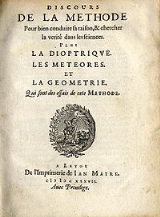
The Discourse on the Method is a philosophical
and autobiographical treatise published by René Descartes
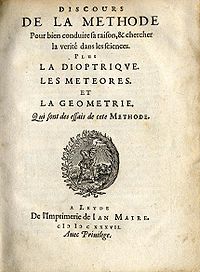
in 1637. Its full name is Discourse on the Method of Rightly Conducting One's Reason and of Seeking Truth in the Sciences (French title: Discours de la méthode pour bien conduire sa raison, et chercher la vérité dans les sciences).
The Discourse on Method is best known as the source of the famous quotation
"Je pense, donc je suis" ("I think, therefore I am"), which occurs in Part IV of the work. (The similar statement in Latin, Cogito ergo sum
, is found in §7 of Principles of Philosophy
.)
 The Discourse on the Method is one of the most influential works in the history of modern philosophy, and important to the evolution of natural sciences. In this work, Descartes tackles the problem of skepticism
, which had previously been studied by Sextus Empiricus
, Al-Ghazali
and Michel de Montaigne
. Descartes modified it to account for a truth he found to be incontrovertible
. Descartes started his line of reasoning by doubting everything, so as to assess the world from a fresh perspective, clear of any preconceived notions.
The book was originally published in Leiden, Netherlands
. Later, it was translated into Latin
and published in 1656 in Amsterdam
. The book was intended as an introduction to three works Dioptrique, Météores and Géométrie. La Géométrie
contains Descartes' first introduction of the Cartesian coordinate system
.
Together with Meditations on First Philosophy
(Meditationes de Prima Philosophia), Principles of Philosophy
(Principia philosophiae) and Rules for the Direction of the Mind
(Regulae ad directionem ingenii), it forms the base of the Epistemology known as Cartesianism
.
In this he followed by Hobbes "But this proveth rather that men are in that point equal, than unequal. For there is not ordinarily a greater sign of the equal distribution of anything than that every man is contented with his share.". He continues with a warning:
Descartes describes his disappointment with his education: as soon as I had finished the entire course of study... I found myself involved in so many doubts and errors, that I was convinced I had advanced no farther... than the discovery at every turn of my own ignorance.. He notes his special delight with mathematics, and compares its strong foundations to the disquisitions of the ancient moralists [which are] towering and magnificent palaces with no better foundation than sand and mud.
Descartes seeks to ascertain the true method by which to arrive at the knowledge of whatever lay within the compass of his powers; he presents four precepts:
"The first was never to accept anything for true which I did not clearly know to be such; that is to say, carefully to avoid precipitancy and prejudice, and to comprise nothing more in my judgment than what was presented to my mind so clearly and distinctly as to exclude all ground of doubt.
The second, to divide each of the difficulties under examination into as many parts as possible, and as might be necessary for its adequate solution.
The third, to conduct my thoughts in such order that, by commencing with objects the simplest and easiest to know, I might ascend by little and little, and, as it were, step by step, to the knowledge of the more complex; assigning in thought a certain order even to those objects which in their own nature do not stand in a relation of antecedence and sequence.
And the last, in every case to make enumerations so complete, and reviews so general, that I might be assured that nothing was omitted."
itself. But Descartes believes three things are not susceptible to doubt and the three support each other to form a stable foundation for the method. He cannot doubt that something has to be there to do the doubting (I think, therefore I am). The method of doubt cannot doubt reason as it is based on reason itself. By reason there exists a God and God is the guarantor that reason is not misguided.
Perhaps the most strained part of the argument is the reasoned proof of the existence of God and indeed Descartes seems to realize this as he supplies three different 'proofs' including what is now referred to as the negotiable ontological proof of the existence of God
.
Describing his work on light, he states that he
His work on such pysico-mechanical laws is, however, projected into a "new world". A theoretical place God created "somewhere in the imaginary spaces [with] matter sufficient to compose... [a "new world" in which He]... agitate[d] variously and confusedly the different parts of this matter, so that there resulted a chaos as disordered as the poets ever feigned, and after that did nothing more than lend his ordinary concurrence to nature, and allow her to act in accordance with the laws which he had established." He does this "to express my judgment regarding... [his subjects] with greater freedom, without being necessitated to adopt or refute the opinions of the learned". Descartes goes on to say that he "was not, however, disposed, from these circumstances, to conclude that this world had been created in the manner I described; for it is much more likely that God made it at the first such as it was to be." Despite this admission, it seems Descartes' project for understanding the world was that of re-creating creation - a cosmological project which aimed, through Descartes particular brand of experimental method, to show not merely the possibility of such a system, but to suggest that this way of looking at the world - one with (as Descartes saw it) no assumptions about God or nature - provided the only basis upon which he could see knowledge progressing (as he states in Book II). Thus, in Descartes work, we can see some of the fundamental assumptions of modern cosmology in evidence - the project of examing the historical construction of the universe through a set of quantitative laws describing interactions which would allow the ordered present to be constructed from a chaotic past.
He goes on to the motion of the blood in the heart and arteries, endorsing the findings of William Harvey
though not by name, ascribing them to "a physician of England", but ascribing the motive power of the circulation to heat rather than muscle power. He describes that these motions seem to be totally independent of what we think, and concludes that our bodies are separate from our souls.
He does not seem to distinguish between mind
, spirit
and soul, which are identified as our faculty for rational thinking. Hence the term "I think, therefore I am"
. All three of these words (particularly "mind" and "soul") can be identified by the single French term âme.
"I remarked, moreover, with respect to experiments, that they become always more necessary the more one is advanced in knowledge; for, at the commencement, it is better to make use only of what is spontaneously presented to our senses"
"First, I have essayed to find in general the principles, or first causes of all that is or can be in the world"
Secure on these foundation stones, Descartes shows the practical application of 'The Method' in Mathematics and the Science.
This method of pro-foundational skepticism is considered by some to be the start of modern philosophy
.
Philosophy
Philosophy is the study of general and fundamental problems, such as those connected with existence, knowledge, values, reason, mind, and language. Philosophy is distinguished from other ways of addressing such problems by its critical, generally systematic approach and its reliance on rational...
and autobiographical treatise published by René Descartes
René Descartes
René Descartes ; was a French philosopher and writer who spent most of his adult life in the Dutch Republic. He has been dubbed the 'Father of Modern Philosophy', and much subsequent Western philosophy is a response to his writings, which are studied closely to this day...
in 1637. Its full name is Discourse on the Method of Rightly Conducting One's Reason and of Seeking Truth in the Sciences (French title: Discours de la méthode pour bien conduire sa raison, et chercher la vérité dans les sciences).
The Discourse on Method is best known as the source of the famous quotation
Quotation
A quotation or quote is the repetition of one expression as part of another one, particularly when the quoted expression is well-known or explicitly attributed by citation to its original source, and it is indicated by quotation marks.A quotation can also refer to the repeated use of units of any...
"Je pense, donc je suis" ("I think, therefore I am"), which occurs in Part IV of the work. (The similar statement in Latin, Cogito ergo sum
Cogito ergo sum
is a philosophical Latin statement proposed by . The simple meaning of the phrase is that someone wondering whether or not they exist is, in and of itself, proof that something, an "I", exists to do the thinking — However this "I" is not the more or less permanent person we call "I"...
, is found in §7 of Principles of Philosophy
Principles of Philosophy
Principles of Philosophy is a book by René Descartes. Written in Latin, it was published in 1644 and dedicated to Elisabeth of Bohemia, with whom Descartes had a long standing friendship. A French version followed in 1647. It set forth the principles of nature—the Laws of Physics--as Descartes...
.)
Skepticism
Skepticism has many definitions, but generally refers to any questioning attitude towards knowledge, facts, or opinions/beliefs stated as facts, or doubt regarding claims that are taken for granted elsewhere...
, which had previously been studied by Sextus Empiricus
Sextus Empiricus
Sextus Empiricus , was a physician and philosopher, and has been variously reported to have lived in Alexandria, Rome, or Athens. His philosophical work is the most complete surviving account of ancient Greek and Roman skepticism....
, Al-Ghazali
Al-Ghazali
Abu Hāmed Mohammad ibn Mohammad al-Ghazzālī , known as Algazel to the western medieval world, born and died in Tus, in the Khorasan province of Persia was a Persian Muslim theologian, jurist, philosopher, and mystic....
and Michel de Montaigne
Michel de Montaigne
Lord Michel Eyquem de Montaigne , February 28, 1533 – September 13, 1592, was one of the most influential writers of the French Renaissance, known for popularising the essay as a literary genre and is popularly thought of as the father of Modern Skepticism...
. Descartes modified it to account for a truth he found to be incontrovertible
Incontrovertible evidence
Incontrovertible evidence is a colloquial term for evidence introduced to prove a fact that is supposed to be so conclusive that there can be no other truth as to the matter; evidence so strong it overpowers contrary evidence, directing a fact-finder to a specific and certain conclusion.Examples: a...
. Descartes started his line of reasoning by doubting everything, so as to assess the world from a fresh perspective, clear of any preconceived notions.
The book was originally published in Leiden, Netherlands
Netherlands
The Netherlands is a constituent country of the Kingdom of the Netherlands, located mainly in North-West Europe and with several islands in the Caribbean. Mainland Netherlands borders the North Sea to the north and west, Belgium to the south, and Germany to the east, and shares maritime borders...
. Later, it was translated into Latin
Latin
Latin is an Italic language originally spoken in Latium and Ancient Rome. It, along with most European languages, is a descendant of the ancient Proto-Indo-European language. Although it is considered a dead language, a number of scholars and members of the Christian clergy speak it fluently, and...
and published in 1656 in Amsterdam
Amsterdam
Amsterdam is the largest city and the capital of the Netherlands. The current position of Amsterdam as capital city of the Kingdom of the Netherlands is governed by the constitution of August 24, 1815 and its successors. Amsterdam has a population of 783,364 within city limits, an urban population...
. The book was intended as an introduction to three works Dioptrique, Météores and Géométrie. La Géométrie
La Géométrie
La Géométrie was published in 1637 as an appendix to Discours de la méthode , written by René Descartes. In the Discourse, he presents his method for obtaining clarity on any subject...
contains Descartes' first introduction of the Cartesian coordinate system
Cartesian coordinate system
A Cartesian coordinate system specifies each point uniquely in a plane by a pair of numerical coordinates, which are the signed distances from the point to two fixed perpendicular directed lines, measured in the same unit of length...
.
Together with Meditations on First Philosophy
Meditations on First Philosophy
Meditations on First Philosophy is a philosophical treatise written by René Descartes and first published in 1641 . The French translation was published in 1647 as Méditations Metaphysiques...
(Meditationes de Prima Philosophia), Principles of Philosophy
Principles of Philosophy
Principles of Philosophy is a book by René Descartes. Written in Latin, it was published in 1644 and dedicated to Elisabeth of Bohemia, with whom Descartes had a long standing friendship. A French version followed in 1647. It set forth the principles of nature—the Laws of Physics--as Descartes...
(Principia philosophiae) and Rules for the Direction of the Mind
Rules for the Direction of the Mind
In 1619, René Descartes began work on an unfinished treatise regarding the proper method for scientific and philosophical thinking entitled Regulae ad directionem ingenii, or Rules for the Direction of the Mind. This work outlined the basis for his later work on complex problems of mathematics,...
(Regulae ad directionem ingenii), it forms the base of the Epistemology known as Cartesianism
Cartesianism
Cartesian means of or relating to the French philosopher and mathematician René Descartes—from his name—Rene Des-Cartes. It may refer to:*Cartesian anxiety*Cartesian circle*Cartesian dualism...
.
Organization
The book is divided into six parts, described in the author's preface as- Various considerations touching the Sciences
- The principal rules of the Method which the Author has discovered
- Certain of the rules of Morals which he has deduced from this Method
- The reasonings by which he establishes the existence of God and of the Human Soul
- The order of the Physical questions which he has investigated, and, in particular, the explication of the motion of the heart and of some other difficulties pertaining to Medicine, as also the difference between the soul of man and that of the brutes
- What the Author believes to be required in order to greater advancement in the investigation of Nature than has yet been made, with the reasons that have induced him to write
Part I: various considerations touching the Sciences
Descartes begins by allowing himself some wit:Good sense is, of all things among men, the most equally distributed; for every one thinks himself so abundantly provided with it, that those even who are the most difficult to satisfy in everything else, do not usually desire a larger measure of this quality than they already possess.
In this he followed by Hobbes "But this proveth rather that men are in that point equal, than unequal. For there is not ordinarily a greater sign of the equal distribution of anything than that every man is contented with his share.". He continues with a warning:
For to be possessed of a vigorous mind is not enough; the prime requisite is rightly to apply it. The greatest minds, as they are capable of the highest excellences, are open likewise to the greatest aberrations; and those who travel very slowly may yet make far greater progress, provided they keep always to the straight road, than those who, while they run, forsake it.
Descartes describes his disappointment with his education: as soon as I had finished the entire course of study... I found myself involved in so many doubts and errors, that I was convinced I had advanced no farther... than the discovery at every turn of my own ignorance.. He notes his special delight with mathematics, and compares its strong foundations to the disquisitions of the ancient moralists [which are] towering and magnificent palaces with no better foundation than sand and mud.
Part II: the principal rules of the Method which the Author has discovered
Descartes was in Germany, attracted thither by the wars in that country, and describes his intent by a "building metaphor". He observes that buildings, cities or nations that have been planned by a single hand are more elegant and commodious than those that have grown organically. He resolves not to build on old foundations, or to lean upon principles which, in his youth, he had taken upon trust.Descartes seeks to ascertain the true method by which to arrive at the knowledge of whatever lay within the compass of his powers; he presents four precepts:
"The first was never to accept anything for true which I did not clearly know to be such; that is to say, carefully to avoid precipitancy and prejudice, and to comprise nothing more in my judgment than what was presented to my mind so clearly and distinctly as to exclude all ground of doubt.
The second, to divide each of the difficulties under examination into as many parts as possible, and as might be necessary for its adequate solution.
The third, to conduct my thoughts in such order that, by commencing with objects the simplest and easiest to know, I might ascend by little and little, and, as it were, step by step, to the knowledge of the more complex; assigning in thought a certain order even to those objects which in their own nature do not stand in a relation of antecedence and sequence.
And the last, in every case to make enumerations so complete, and reviews so general, that I might be assured that nothing was omitted."
Part III: Morals, and Maxims accepted while conducting Method
Descartes uses the analogy of rebuilding a house from secure foundations, and extends the analogy to the idea of needing a temporary abode while his own house is being rebuilt. The following three maxims were adopted by Descartes so that he could effectively function in the "real world" while experimenting with his method of radical doubt. They formed a rudimentary belief system from which to act before he developed a new system based on the truths he discovered using his method.- The first was to obey the laws and customs of my country, adhering firmly to the faith in which, by the grace of God, I had been educated from my childhood and regulating my conduct in every other matter according to the most moderate opinions, and the farthest removed from extremes, which should happen to be adopted in practice with general consent of the most judicious of those among whom I might be living.
- Be as firm and resolute in my actions as I was able
- Endeavor always to conquer myself rather than fortune, and change my desires rather than the order of the world, and in general, accustom myself to the persuasion that, except our own thoughts, there is nothing absolutely in our power; so that when we have done our best in things external to us, our ill-success cannot possibly be failure on our part.
Part IV: Proof of God and the Soul
Applying the method to itself, Descartes challenges his own reasoning and reasonReason
Reason is a term that refers to the capacity human beings have to make sense of things, to establish and verify facts, and to change or justify practices, institutions, and beliefs. It is closely associated with such characteristically human activities as philosophy, science, language, ...
itself. But Descartes believes three things are not susceptible to doubt and the three support each other to form a stable foundation for the method. He cannot doubt that something has to be there to do the doubting (I think, therefore I am). The method of doubt cannot doubt reason as it is based on reason itself. By reason there exists a God and God is the guarantor that reason is not misguided.
Perhaps the most strained part of the argument is the reasoned proof of the existence of God and indeed Descartes seems to realize this as he supplies three different 'proofs' including what is now referred to as the negotiable ontological proof of the existence of God
Ontological argument
The ontological argument for the existence of God is an a priori argument for the existence of God. The ontological argument was first proposed by the eleventh-century monk Anselm of Canterbury, who defined God as the greatest possible being we can conceive...
.
Part V: Physics, the heart, the soul of man and animals
Here he describes how he in other writings discusses the idea of laws of nature, of the sun and stars, the idea of the moon being the cause of ebb and flood, on gravitation and going to discuss light and fire.Describing his work on light, he states that he
expounded at considerable length what the nature of that light must be which is found in the sun and the stars, and how thence in an instant of time it traverses the immense spaces of the heavens.
His work on such pysico-mechanical laws is, however, projected into a "new world". A theoretical place God created "somewhere in the imaginary spaces [with] matter sufficient to compose... [a "new world" in which He]... agitate[d] variously and confusedly the different parts of this matter, so that there resulted a chaos as disordered as the poets ever feigned, and after that did nothing more than lend his ordinary concurrence to nature, and allow her to act in accordance with the laws which he had established." He does this "to express my judgment regarding... [his subjects] with greater freedom, without being necessitated to adopt or refute the opinions of the learned". Descartes goes on to say that he "was not, however, disposed, from these circumstances, to conclude that this world had been created in the manner I described; for it is much more likely that God made it at the first such as it was to be." Despite this admission, it seems Descartes' project for understanding the world was that of re-creating creation - a cosmological project which aimed, through Descartes particular brand of experimental method, to show not merely the possibility of such a system, but to suggest that this way of looking at the world - one with (as Descartes saw it) no assumptions about God or nature - provided the only basis upon which he could see knowledge progressing (as he states in Book II). Thus, in Descartes work, we can see some of the fundamental assumptions of modern cosmology in evidence - the project of examing the historical construction of the universe through a set of quantitative laws describing interactions which would allow the ordered present to be constructed from a chaotic past.
He goes on to the motion of the blood in the heart and arteries, endorsing the findings of William Harvey
William Harvey
William Harvey was an English physician who was the first person to describe completely and in detail the systemic circulation and properties of blood being pumped to the body by the heart...
though not by name, ascribing them to "a physician of England", but ascribing the motive power of the circulation to heat rather than muscle power. He describes that these motions seem to be totally independent of what we think, and concludes that our bodies are separate from our souls.
He does not seem to distinguish between mind
Mind
The concept of mind is understood in many different ways by many different traditions, ranging from panpsychism and animism to traditional and organized religious views, as well as secular and materialist philosophies. Most agree that minds are constituted by conscious experience and intelligent...
, spirit
Spirit
The English word spirit has many differing meanings and connotations, most of them relating to a non-corporeal substance contrasted with the material body.The spirit of a living thing usually refers to or explains its consciousness.The notions of a person's "spirit" and "soul" often also overlap,...
and soul, which are identified as our faculty for rational thinking. Hence the term "I think, therefore I am"
Cogito ergo sum
is a philosophical Latin statement proposed by . The simple meaning of the phrase is that someone wondering whether or not they exist is, in and of itself, proof that something, an "I", exists to do the thinking — However this "I" is not the more or less permanent person we call "I"...
. All three of these words (particularly "mind" and "soul") can be identified by the single French term âme.
Part VI
Descartes begins by noting, without directly referring to it, the recent trial of Galileo for heresy and the condemnation of heliocentrism; and explains that for these reasons he has been slow to publish."I remarked, moreover, with respect to experiments, that they become always more necessary the more one is advanced in knowledge; for, at the commencement, it is better to make use only of what is spontaneously presented to our senses"
"First, I have essayed to find in general the principles, or first causes of all that is or can be in the world"
Secure on these foundation stones, Descartes shows the practical application of 'The Method' in Mathematics and the Science.
Influencing future science
The most important influence, however, was the first precept, which states, in Descartes words,"[To] never to accept anything for true which I did not clearly know to be such".This method of pro-foundational skepticism is considered by some to be the start of modern philosophy
Philosophy
Philosophy is the study of general and fundamental problems, such as those connected with existence, knowledge, values, reason, mind, and language. Philosophy is distinguished from other ways of addressing such problems by its critical, generally systematic approach and its reliance on rational...
.
Quotations
- I know how very liable we are to delusion in what relates to ourselves; and also how much the judgments of our friends are to be suspected when given in our favor.
- Of philosophy I will say nothing, except that when I saw that it had been cultivated for so many ages by the most distinguished men; and that yet there is not a single matter within its sphere which is still not in dispute and nothing, therefore, which is above doubt, I did not presume to anticipate that my success would be greater in it than that of others.
- ....And although my speculations greatly please myself, I believe that others have theirs, which perhaps please them still more.
- ...In what regards manners, everyone is so full of his own wisdom, that there might be as many reformers as heads...
- The first was to include nothing in my judgments than what presented itself to my mind so clearly and distinctly that I had no occasion to doubt it.
- ...I entirely abandoned the study of letters, and resolved no longer to seek any other science than the knowledge of myself, or of the great book of the world...
- The most widely shared thing in the world is good sense, for everyone thinks he is so well provided with it that even those who are the most difficult to satisfy in everything else do not usually desire to have more good sense than they have...