


Color

Encyclopedia

Visual perception
Visual perception is the ability to interpret information and surroundings from the effects of visible light reaching the eye. The resulting perception is also known as eyesight, sight, or vision...
property
Physical property
A physical property is any property that is measurable whose value describes a physical system's state. The changes in the physical properties of a system can be used to describe its transformations ....
corresponding in humans to the categories called red, green, blue and others. Color derives from the spectrum of light (distribution of light
Light
Light or visible light is electromagnetic radiation that is visible to the human eye, and is responsible for the sense of sight. Visible light has wavelength in a range from about 380 nanometres to about 740 nm, with a frequency range of about 405 THz to 790 THz...
power versus wavelength
Wavelength
In physics, the wavelength of a sinusoidal wave is the spatial period of the wave—the distance over which the wave's shape repeats.It is usually determined by considering the distance between consecutive corresponding points of the same phase, such as crests, troughs, or zero crossings, and is a...
) interacting in the eye with the spectral sensitivities of the light receptors. Color categories and physical specifications of color are also associated with objects, materials, light sources, etc., based on their physical properties such as light absorption, reflection, or emission spectra. By defining a color space
Color space
A color model is an abstract mathematical model describing the way colors can be represented as tuples of numbers, typically as three or four values or color components...
, colors can be identified numerically by their coordinates.
Because perception of color stems from the varying spectral sensitivity
Spectral sensitivity
Spectral sensitivity is the relative efficiency of detection, of light or other signal, as a function of the frequency or wavelength of the signal....
of different types of cone cells in the retina
Retina
The vertebrate retina is a light-sensitive tissue lining the inner surface of the eye. The optics of the eye create an image of the visual world on the retina, which serves much the same function as the film in a camera. Light striking the retina initiates a cascade of chemical and electrical...
to different parts of the spectrum, colors may be defined and quantified by the degree to which they stimulate these cells. These physical or physiological quantifications of color, however, do not fully explain the psychophysical
Psychophysics
Psychophysics quantitatively investigates the relationship between physical stimuli and the sensations and perceptions they effect. Psychophysics has been described as "the scientific study of the relation between stimulus and sensation" or, more completely, as "the analysis of perceptual...
perception of color appearance.
The science of color is sometimes called chromatics, colorimetry, or simply color science. It includes the perception of color by the human eye
Human eye
The human eye is an organ which reacts to light for several purposes. As a conscious sense organ, the eye allows vision. Rod and cone cells in the retina allow conscious light perception and vision including color differentiation and the perception of depth...
and brain, the origin of color in materials, color theory
Color theory
In the visual arts, color theory is a body of practical guidance to color mixing and the visual impacts of specific color combinations. Although color theory principles first appeared in the writings of Leone Battista Alberti and the notebooks of Leonardo da Vinci , a tradition of "colory theory"...
in art
Art
Art is the product or process of deliberately arranging items in a way that influences and affects one or more of the senses, emotions, and intellect....
, and the physics
Physics
Physics is a natural science that involves the study of matter and its motion through spacetime, along with related concepts such as energy and force. More broadly, it is the general analysis of nature, conducted in order to understand how the universe behaves.Physics is one of the oldest academic...
of electromagnetic radiation
Electromagnetic radiation
Electromagnetic radiation is a form of energy that exhibits wave-like behavior as it travels through space...
in the visible range (that is, what we commonly refer to simply as light
Light
Light or visible light is electromagnetic radiation that is visible to the human eye, and is responsible for the sense of sight. Visible light has wavelength in a range from about 380 nanometres to about 740 nm, with a frequency range of about 405 THz to 790 THz...
).
Physics
| color | wavelength interval | frequency interval |
|---|---|---|
| red Red Red is any of a number of similar colors evoked by light consisting predominantly of the longest wavelengths of light discernible by the human eye, in the wavelength range of roughly 630–740 nm. Longer wavelengths than this are called infrared , and cannot be seen by the naked eye... |
~ 700–635 nm | ~ 430–480 THz |
| orange Orange (colour) The colour orange occurs between red and yellow in the visible spectrum at a wavelength of about 585–620 nm, and has a hue of 30° in HSV colour space. It is numerically halfway between red and yellow in a gamma-compressed RGB colour space, the expression of which is the RGB colour wheel. The... |
~ 635–590 nm | ~ 480–510 THz |
| yellow Yellow Yellow is the color evoked by light that stimulates both the L and M cone cells of the retina about equally, with no significant stimulation of the S cone cells. Light with a wavelength of 570–590 nm is yellow, as is light with a suitable mixture of red and green... |
~ 590–560 nm | ~ 510–540 THz |
| green Green Green is a color, the perception of which is evoked by light having a spectrum dominated by energy with a wavelength of roughly 520–570 nanometres. In the subtractive color system, it is not a primary color, but is created out of a mixture of yellow and blue, or yellow and cyan; it is considered... |
~ 560–490 nm | ~ 540–610 THz |
| blue Blue Blue is a colour, the perception of which is evoked by light having a spectrum dominated by energy with a wavelength of roughly 440–490 nm. It is considered one of the additive primary colours. On the HSV Colour Wheel, the complement of blue is yellow; that is, a colour corresponding to an equal... |
~ 490–450 nm | ~ 610–670 THz |
| violet Violet (color) As the name of a color, violet is synonymous with a bluish purple, when the word "purple" is used in the common English language sense of any color between blue and red, not including either blue or red... |
~ 450–400 nm | ~ 670–750 THz |
| Color |  (nm) |
 (THz) |
 (μm−1) |
 (eV) |
 (kJ mol−1) |
|---|---|---|---|---|---|
| Infrared Infrared Infrared light is electromagnetic radiation with a wavelength longer than that of visible light, measured from the nominal edge of visible red light at 0.74 micrometres , and extending conventionally to 300 µm... |
>1000 | <300 | <1.00 | <1.24 | <120 |
| Red | 700 | 428 | 1.43 | 1.77 | 171 |
| Orange | 620 | 484 | 1.61 | 2.00 | 193 |
| Yellow | 580 | 517 | 1.72 | 2.14 | 206 |
| Green | 530 | 566 | 1.89 | 2.34 | 226 |
| Blue | 470 | 638 | 2.13 | 2.64 | 254 |
| Violet | 420 | 714 | 2.38 | 2.95 | 285 |
| Near ultraviolet Ultraviolet Ultraviolet light is electromagnetic radiation with a wavelength shorter than that of visible light, but longer than X-rays, in the range 10 nm to 400 nm, and energies from 3 eV to 124 eV... |
300 | 1000 | 3.33 | 4.15 | 400 |
| Far ultraviolet | <200 | >1500 | >5.00 | >6.20 | >598 |
Electromagnetic radiation
Electromagnetic radiation
Electromagnetic radiation is a form of energy that exhibits wave-like behavior as it travels through space...
is characterized by its wavelength
Wavelength
In physics, the wavelength of a sinusoidal wave is the spatial period of the wave—the distance over which the wave's shape repeats.It is usually determined by considering the distance between consecutive corresponding points of the same phase, such as crests, troughs, or zero crossings, and is a...
(or frequency
Frequency
Frequency is the number of occurrences of a repeating event per unit time. It is also referred to as temporal frequency.The period is the duration of one cycle in a repeating event, so the period is the reciprocal of the frequency...
) and its intensity
Luminous intensity
In photometry, luminous intensity is a measure of the wavelength-weighted power emitted by a light source in a particular direction per unit solid angle, based on the luminosity function, a standardized model of the sensitivity of the human eye...
. When the wavelength is within the visible spectrum (the range of wavelengths humans can perceive, approximately from 390 nm
Nanometre
A nanometre is a unit of length in the metric system, equal to one billionth of a metre. The name combines the SI prefix nano- with the parent unit name metre .The nanometre is often used to express dimensions on the atomic scale: the diameter...
to 750 nm), it is known as "visible light".
Most light sources emit light at many different wavelengths; a source's spectrum is a distribution giving its intensity at each wavelength. Although the spectrum of light arriving at the eye from a given direction determines the color sensation in that direction, there are many more possible spectral combinations than color sensations. In fact, one may formally define a color as a class of spectra that give rise to the same color sensation, although such classes would vary widely among different species, and to a lesser extent among individuals within the same species. In each such class the members are called metamers
Metamerism (color)
In colorimetry, metamerism is the matching of apparent color of objects with different spectral power distributions. Colors that match this way are called metamers....
of the color in question.
Spectral colors
The familiar colors of the rainbowRainbow
A rainbow is an optical and meteorological phenomenon that causes a spectrum of light to appear in the sky when the Sun shines on to droplets of moisture in the Earth's atmosphere. It takes the form of a multicoloured arc...
in the spectrum – named using the Latin
Latin
Latin is an Italic language originally spoken in Latium and Ancient Rome. It, along with most European languages, is a descendant of the ancient Proto-Indo-European language. Although it is considered a dead language, a number of scholars and members of the Christian clergy speak it fluently, and...
word for appearance or apparition by Isaac Newton
Isaac Newton
Sir Isaac Newton PRS was an English physicist, mathematician, astronomer, natural philosopher, alchemist, and theologian, who has been "considered by many to be the greatest and most influential scientist who ever lived."...
in 1671 – include all those colors that can be produced by visible light of a single wavelength only, the pure spectral or monochromatic colors
Monochromatic color
Monochromatic colors are all the colors of a single hue. Monochromatic color schemes are derived from a single base hue, and extended using its shades, tones and tints Monochromatic colors are all the colors (tints, tones, and shades) of a single hue. Monochromatic color schemes are derived from a...
. The table at right shows approximate frequencies (in terahertz
Hertz
The hertz is the SI unit of frequency defined as the number of cycles per second of a periodic phenomenon. One of its most common uses is the description of the sine wave, particularly those used in radio and audio applications....
) and wavelengths (in nanometers
Nanometre
A nanometre is a unit of length in the metric system, equal to one billionth of a metre. The name combines the SI prefix nano- with the parent unit name metre .The nanometre is often used to express dimensions on the atomic scale: the diameter...
) for various pure spectral colors. The wavelengths are measured in air or vacuum
Vacuum
In everyday usage, vacuum is a volume of space that is essentially empty of matter, such that its gaseous pressure is much less than atmospheric pressure. The word comes from the Latin term for "empty". A perfect vacuum would be one with no particles in it at all, which is impossible to achieve in...
(see refraction
Refraction
Refraction is the change in direction of a wave due to a change in its speed. It is essentially a surface phenomenon . The phenomenon is mainly in governance to the law of conservation of energy. The proper explanation would be that due to change of medium, the phase velocity of the wave is changed...
).
The color table should not be interpreted as a definitive list – the pure spectral colors form a continuous spectrum
Spectrum
A spectrum is a condition that is not limited to a specific set of values but can vary infinitely within a continuum. The word saw its first scientific use within the field of optics to describe the rainbow of colors in visible light when separated using a prism; it has since been applied by...
, and how it is divided into distinct colors linguistically
Language
Language may refer either to the specifically human capacity for acquiring and using complex systems of communication, or to a specific instance of such a system of complex communication...
is a matter of culture and historical contingency (although people everywhere have been shown to perceive colors in the same way). A common list identifies six main bands: red, orange, yellow, green, blue, and violet. Newton's conception included a seventh color, indigo
Indigo
Indigo is a color named after the purple dye derived from the plant Indigofera tinctoria and related species. The color is placed on the electromagnetic spectrum between about 420 and 450 nm in wavelength, placing it between blue and violet...
, between blue and violet. Optical scientists Hardy and Perrin list indigo as between 446 and 464 nm wavelength.
The intensity of a spectral color, relative to the context in which it is viewed, may alter its perception considerably; for example, a low-intensity orange-yellow is brown
Brown
Brown is a color term, denoting a range of composite colors produced by a mixture of orange, red, rose, or yellow with black or gray. The term is from Old English brún, in origin for any dusky or dark shade of color....
, and a low-intensity yellow-green is olive-green.
For discussion of non-spectral colors, see below.
Color of objects
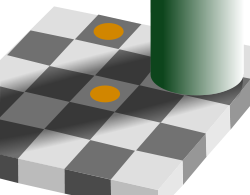
The color of an object depends on both the physics of the object in its environment and the characteristics of the perceiving eye and brain. Physically, objects can be said to have the color of the light leaving their surfaces, which normally depends on the spectrum of the incident illumination and the reflectance properties of the surface, as well as potentially on the angles of illumination and viewing. Some objects not only reflect light, but also transmit light or emit light themselves (see below), which contribute to the color also. And a viewer's perception of the object's color depends not only on the spectrum of the light leaving its surface, but also on a host of contextual cues, so that the color tends to be perceived as relatively constant: that is, relatively independent of the lighting spectrum, viewing angle, etc. This effect is known as color constancyColor constancy
Color constancy is an example of subjective constancy and a feature of the human color perception system which ensures that the perceived color of objects remains relatively constant under varying illumination conditions. A green apple for instance looks green to us at midday, when the main...
.
- Light arriving at an opaqueOpacity (optics)Opacity is the measure of impenetrability to electromagnetic or other kinds of radiation, especially visible light. In radiative transfer, it describes the absorption and scattering of radiation in a medium, such as a plasma, dielectric, shielding material, glass, etc...
surface is either reflectReflection (physics)Reflection is the change in direction of a wavefront at an interface between two differentmedia so that the wavefront returns into the medium from which it originated. Common examples include the reflection of light, sound and water waves...
ed "specularlySpecular reflectionSpecular reflection is the mirror-like reflection of light from a surface, in which light from a single incoming direction is reflected into a single outgoing direction...
" (that is, in the manner of a mirror), scatterScatteringScattering is a general physical process where some forms of radiation, such as light, sound, or moving particles, are forced to deviate from a straight trajectory by one or more localized non-uniformities in the medium through which they pass. In conventional use, this also includes deviation of...
ed (that is, reflected with diffuse scattering), or absorbedAbsorption (electromagnetic radiation)In physics, absorption of electromagnetic radiation is the way by which the energy of a photon is taken up by matter, typically the electrons of an atom. Thus, the electromagnetic energy is transformed to other forms of energy for example, to heat. The absorption of light during wave propagation is...
– or some combination of these. - Opaque objects that do not reflect specularly (which tend to have rough surfaces) have their color determined by which wavelengths of light they scatter more and which they scatter less (with the light that is not scattered being absorbed). If objects scatter all wavelengths, they appear white. If they absorb all wavelengths, they appear black.
- Opaque objects that specularly reflect light of different wavelengths with different efficiencies look like mirrors tinted with colors determined by those differences. An object that reflects some fraction of impinging light and absorbs the rest may look black but also be faintly reflective; examples are black objects coated with layers of enamel or lacquer.
- Objects that transmit lightTransparency and translucencyIn the field of optics, transparency is the physical property of allowing light to pass through a material; translucency only allows light to pass through diffusely. The opposite property is opacity...
are either translucent (scattering the transmitted light) or transparent (not scattering the transmitted light). If they also absorb (or reflect) light of various wavelengths differentially, they appear tinted with a color determined by the nature of that absorption (or that reflectance). - Objects may emit light that they generate themselves, rather than merely reflecting or transmitting light. They may do so because of their elevated temperature (they are then said to be incandescentIncandescenceIncandescence is the emission of light from a hot body as a result of its temperature. The term derives from the Latin verb incandescere, to glow white....
), as a result of certain chemical reactions (a phenomenon called chemoluminescenceChemoluminescenceChemiluminescence is the emission of light with limited emission of heat , as the result of a chemical reaction...
), or for other reasons (see the articles PhosphorescencePhosphorescencePhosphorescence is a specific type of photoluminescence related to fluorescence. Unlike fluorescence, a phosphorescent material does not immediately re-emit the radiation it absorbs. The slower time scales of the re-emission are associated with "forbidden" energy state transitions in quantum...
and List of light sources). - Objects may absorb light and then as a consequence emit light that has different properties. They are then called fluorescentFluorescenceFluorescence is the emission of light by a substance that has absorbed light or other electromagnetic radiation of a different wavelength. It is a form of luminescence. In most cases, emitted light has a longer wavelength, and therefore lower energy, than the absorbed radiation...
(if light is emitted only while light is absorbed) or phosphorescent (if light is emitted even after light ceases to be absorbed; this term is also sometimes loosely applied to light emitted because of chemical reactions).
For further treatment of the color of objects, see structural color, below.
To summarize, the color of an object is a complex result of its surface properties, its transmission properties, and its emission properties, all of which factors contribute to the mix of wavelengths in the light leaving the surface of the object. The perceived color is then further conditioned by the nature of the ambient illumination, and by the color properties of other objects nearby, via the effect known as color constancy
Color constancy
Color constancy is an example of subjective constancy and a feature of the human color perception system which ensures that the perceived color of objects remains relatively constant under varying illumination conditions. A green apple for instance looks green to us at midday, when the main...
and via other characteristics of the perceiving eye and brain.
Perception
Development of theories of color vision
Although AristotleAristotle
Aristotle was a Greek philosopher and polymath, a student of Plato and teacher of Alexander the Great. His writings cover many subjects, including physics, metaphysics, poetry, theater, music, logic, rhetoric, linguistics, politics, government, ethics, biology, and zoology...
and other ancient scientists had already written on the nature of light and color vision
Color vision
Color vision is the capacity of an organism or machine to distinguish objects based on the wavelengths of the light they reflect, emit, or transmit...
, it was not until Newton
Isaac Newton
Sir Isaac Newton PRS was an English physicist, mathematician, astronomer, natural philosopher, alchemist, and theologian, who has been "considered by many to be the greatest and most influential scientist who ever lived."...
that light was identified as the source of the color sensation. In 1810, Goethe
Johann Wolfgang von Goethe
Johann Wolfgang von Goethe was a German writer, pictorial artist, biologist, theoretical physicist, and polymath. He is considered the supreme genius of modern German literature. His works span the fields of poetry, drama, prose, philosophy, and science. His Faust has been called the greatest long...
published his comprehensive Theory of Colors
Theory of Colours
Theory of Colours is a work by Johann Wolfgang von Goethe about the poet's views on the nature of colours and how these are perceived by man, published in 1810...
. In 1801 Thomas Young
Thomas Young (scientist)
Thomas Young was an English polymath. He is famous for having partly deciphered Egyptian hieroglyphics before Jean-François Champollion eventually expanded on his work...
proposed his trichromatic theory, based on the observation that any color could be matched with a combination of three lights. This theory was later refined by James Clerk Maxwell
James Clerk Maxwell
James Clerk Maxwell of Glenlair was a Scottish physicist and mathematician. His most prominent achievement was formulating classical electromagnetic theory. This united all previously unrelated observations, experiments and equations of electricity, magnetism and optics into a consistent theory...
and Hermann von Helmholtz
Hermann von Helmholtz
Hermann Ludwig Ferdinand von Helmholtz was a German physician and physicist who made significant contributions to several widely varied areas of modern science...
. As Helmholtz puts it, "the principles of Newton's law of mixture were experimentally confirmed by Maxwell in 1856. Young's theory of color sensations, like so much else that this marvellous investigator achieved in advance of his time, remained unnoticed until Maxwell directed attention to it."
At the same time as Helmholtz, Ewald Hering
Ewald Hering
Karl Ewald Konstantin Hering was a German physiologist who did much research into color vision and spatial perception...
developed the opponent process
Opponent process
The color opponent process is a color theory that states that the human visual system interprets information about color by processing signals from cones and rods in an antagonistic manner...
theory of color, noting that color blindness
Color blindness
Color blindness or color vision deficiency is the inability or decreased ability to see color, or perceive color differences, under lighting conditions when color vision is not normally impaired...
and afterimages typically come in opponent pairs (red-green, blue-orange, yellow-purple, and black-white). Ultimately these two theories were synthesized in 1957 by Hurvich and Jameson, who showed that retinal processing corresponds to the trichromatic theory, while processing at the level of the lateral geniculate nucleus
Lateral geniculate nucleus
The lateral geniculate nucleus is the primary relay center for visual information received from the retina of the eye. The LGN is found inside the thalamus of the brain....
corresponds to the opponent theory.
In 1931, an international group of experts known as the Commission internationale de l'éclairage (CIE
International Commission on Illumination
The International Commission on Illumination is the international authority on light, illumination, color, and color spaces...
) developed a mathematical color model, which mapped out the space of observable colors and assigned a set of three numbers to each.
Color in the eye
Human eye
The human eye is an organ which reacts to light for several purposes. As a conscious sense organ, the eye allows vision. Rod and cone cells in the retina allow conscious light perception and vision including color differentiation and the perception of depth...
to distinguish colors is based upon the varying sensitivity of different cells in the retina
Retina
The vertebrate retina is a light-sensitive tissue lining the inner surface of the eye. The optics of the eye create an image of the visual world on the retina, which serves much the same function as the film in a camera. Light striking the retina initiates a cascade of chemical and electrical...
to light of different wavelengths. Humans being trichromatic, the retina contains three types of color receptor cells, or cones
Cone cell
Cone cells, or cones, are photoreceptor cells in the retina of the eye that are responsible for color vision; they function best in relatively bright light, as opposed to rod cells that work better in dim light. If the retina is exposed to an intense visual stimulus, a negative afterimage will be...
. One type, relatively distinct from the other two, is most responsive to light that we perceive as violet, with wavelengths around 420 nm
Nanometre
A nanometre is a unit of length in the metric system, equal to one billionth of a metre. The name combines the SI prefix nano- with the parent unit name metre .The nanometre is often used to express dimensions on the atomic scale: the diameter...
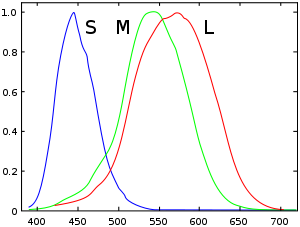
; cones of this type are sometimes called short-wavelength cones, S cones, or blue cones. The other two types are closely related genetically and chemically. One of them, sometimes called long-wavelength cones, L cones, or red cones, is most sensitive to light we perceive as greenish yellow, with wavelengths around 564 nm; the other type, known as middle-wavelength cones, M cones, or green cones is most sensitive to light perceived as green, with wavelengths around 534 nm.
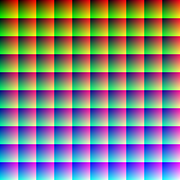
Light, no matter how complex its composition of wavelengths, is reduced to three color components by the eye. For each location in the visual field, the three types of cones yield three signals based on the extent to which each is stimulated. These amounts of stimulation are sometimes called tristimulus values.
The response curve as a function of wavelength for each type of cone is illustrated above. Because the curves overlap, some tristimulus values do not occur for any incoming light combination. For example, it is not possible to stimulate only the mid-wavelength (so-called "green") cones; the other cones will inevitably be stimulated to some degree at the same time. The set of all possible tristimulus values determines the human color space. It has been estimated that humans can distinguish roughly 10 million different colors.
The other type of light-sensitive cell in the eye, the rod
Rod cell
Rod cells, or rods, are photoreceptor cells in the retina of the eye that can function in less intense light than can the other type of visual photoreceptor, cone cells. Named for their cylindrical shape, rods are concentrated at the outer edges of the retina and are used in peripheral vision. On...
, has a different response curve. In normal situations, when light is bright enough to strongly stimulate the cones, rods play virtually no role in vision at all. On the other hand, in dim light, the cones are understimulated leaving only the signal from the rods, resulting in a colorless
Black-and-white
Black-and-white, often abbreviated B/W or B&W, is a term referring to a number of monochrome forms in visual arts.Black-and-white as a description is also something of a misnomer, for in addition to black and white, most of these media included varying shades of gray...
response. (Furthermore, the rods are barely sensitive to light in the "red" range.) In certain conditions of intermediate illumination, the rod response and a weak cone response can together result in color discriminations not accounted for by cone responses alone. These effects, combined, are summarized also in the Kruithof curve
Kruithof curve
Named after the Dutch physicist Arie Andries Kruithof, the Kruithof curve relates the illuminance and colour temperature of visually pleasing light sources...
, that describes the change of color perception and pleasingness of light as function of temperature and intensity.
Color in the brain

Color wheel
A color wheel or color circle is an abstract illustrative organization of color hues around a circle that shows relationships between primary colors, secondary colors, complementary colors, etc....
: it is the collection of colors for which at least one of the two color channels measures a value at one of its extremes.
The exact nature of color perception beyond the processing already described, and indeed the status of color as a feature of the perceived world or rather as a feature of our perception of the world, is a matter of complex and continuing philosophical dispute (see qualia
Qualia
Qualia , singular "quale" , from a Latin word meaning for "what sort" or "what kind," is a term used in philosophy to refer to subjective conscious experiences as 'raw feels'. Examples of qualia are the pain of a headache, the taste of wine, the experience of taking a recreational drug, or the...
).
Color deficiency
If one or more types of a person's color-sensing cones are missing or less responsive than normal to incoming light, that person can distinguish fewer colors and is said to be color deficient or color blindColor blindness
Color blindness or color vision deficiency is the inability or decreased ability to see color, or perceive color differences, under lighting conditions when color vision is not normally impaired...
(though this latter term can be misleading; almost all color deficient individuals can distinguish at least some colors). Some kinds of color deficiency are caused by anomalies in the number or nature of cones in the retina. Others (like central or cortical achromatopsia
Achromatopsia
Achromatopsia , is a medical syndrome that exhibits symptoms relating to at least five separate individual disorders. Although the term may refer to acquired disorders such as color agnosia and cerebral achromatopsia, it typically refers to an autosomal recessive congenital color vision disorder,...
) are caused by neural anomalies in those parts of the brain where visual processing takes place.
Tetrachromacy
While most humans are trichromatic (having three types of color receptors), many animals, known as tetrachromatTetrachromat
Tetrachromacy is the condition of possessing four independent channels for conveying color information, or possessing four different types of cone cells in the eye...
s, have four types. These include some species of spiders, most marsupials, birds, reptiles, and many species of fish
Fish
Fish are a paraphyletic group of organisms that consist of all gill-bearing aquatic vertebrate animals that lack limbs with digits. Included in this definition are the living hagfish, lampreys, and cartilaginous and bony fish, as well as various extinct related groups...
. Other species are sensitive to only two axes of color or do not perceive color at all; these are called dichromats and monochromats respectively. A distinction is made between retinal tetrachromacy (having four pigments in cone cells in the retina, compared to three in trichromats) and functional tetrachromacy (having the ability to make enhanced color discriminations based on that retinal difference). As many as half of all women are retinal tetrachromats. The phenomenon arises when an individual receives two slightly different copies of the gene for either the medium- or long-wavelength cones, which are carried on the x-chromosome. To have two different genes, a person must have two x-chromosomes, which is why the phenomenon only occurs in women. For some of these retinal tetrachromats, color discriminations are enhanced, making them functional tetrachromats.
Synesthesia
In certain forms of synesthesiaSynesthesia
Synesthesia , from the ancient Greek , "together," and , "sensation," is a neurologically based condition in which stimulation of one sensory or cognitive pathway leads to automatic, involuntary experiences in a second sensory or cognitive pathway...
, perceiving letters and numbers (grapheme–color synesthesia
Grapheme-color synesthesia
Grapheme → color synesthesia is a form of synesthesia in which an individual's perception of numbers and letters is associated with the experience of colors. Like all forms of synesthesia, grapheme → color synesthesia is involuntary, consistent, and memorable...
) or hearing musical sounds (music–color synesthesia) will lead to the unusual additional experiences of seeing colors. Behavioral and functional neuroimaging
Functional neuroimaging
Functional neuroimaging is the use of neuroimaging technology to measure an aspect of brain function, often with a view to understanding the relationship between activity in certain brain areas and specific mental functions...
experiments have demonstrated that these color experiences lead to changes in behavioral tasks and lead to increased activation of brain regions involved in color perception, thus demonstrating their reality, and similarity to real color percepts, albeit evoked through a non-standard route.
Afterimages

Afterimage
An afterimage or ghost image or image burn-in is an optical illusion that refers to an image continuing to appear in one's vision after the exposure to the original image has ceased...
s, in which the eye may continue to see a bright figure after looking away from it, but in a complementary color
Complementary color
Complementary colors are pairs of colors that are of “opposite” hue in some color model. The exact hue “complementary” to a given hue depends on the model in question, and perceptually uniform, additive, and subtractive color models, for example, have differing complements for any given color.-...
.
Afterimage effects have also been utilized by artists, including Vincent van Gogh
Vincent van Gogh
Vincent Willem van Gogh , and used Brabant dialect in his writing; it is therefore likely that he himself pronounced his name with a Brabant accent: , with a voiced V and palatalized G and gh. In France, where much of his work was produced, it is...
.
Color constancy
There is an interesting phenomenon which occurs when an artist uses a limited color palette: the eyeHuman eye
The human eye is an organ which reacts to light for several purposes. As a conscious sense organ, the eye allows vision. Rod and cone cells in the retina allow conscious light perception and vision including color differentiation and the perception of depth...
tends to compensate by seeing any gray or neutral color as the color which is missing from the color wheel. For example, in a limited palette consisting of red, yellow, black and white, a mixture of yellow and black will appear as a variety of green, a mixture of red and black will appear as a variety of purple, and pure gray will appear bluish.
The trichromatic theory discussed above is strictly true when the visual system is in a fixed state of adaptation. In reality, the visual system is constantly adapting to changes in the environment and compares the various colors in a scene to reduce the effects of the illumination. If a scene is illuminated with one light, and then with another, as long as the difference between the light sources stays within a reasonable range, the colors in the scene appear relatively constant to us. This was studied by Edwin Land in the 1970s and led to his retinex theory of color constancy
Color constancy
Color constancy is an example of subjective constancy and a feature of the human color perception system which ensures that the perceived color of objects remains relatively constant under varying illumination conditions. A green apple for instance looks green to us at midday, when the main...
.
It should be noted, that both phenomena described above are readily explained and mathematical modeled with modern theories of chromatic adaptation and color appearance (e.g. CIECAM02
CIECAM02
Published in 2002 by the CIE Technical Committee 8-01 , as of 2008 CIECAM02 is the most recent color appearance model ratified by the CIE, and the successor of CIECAM97s.| quote=The CIECAM97s model was adopted by the CIE in 1997 for color imaging applications. It includes forward and reverse modes...
, iCAM
ICAM
ICAM is short for "I couldn't agree more" - also see list of internet slangIt may also refer to:* Integrated Computer-Aided Manufacturing* Intercellular adhesion molecule* Institute for Complex Adaptive Matter...
). There is no need to dismiss the trichromatic theory of vision, but rather it must be enhanced with an understanding of how the visual system adapts (adjusts) to changes in the viewing environment.
Color naming
Colors vary in several different ways, including hueHue
Hue is one of the main properties of a color, defined technically , as "the degree to which a stimulus can be describedas similar to or different from stimuli that are described as red, green, blue, and yellow,"...
(shades of red
Red
Red is any of a number of similar colors evoked by light consisting predominantly of the longest wavelengths of light discernible by the human eye, in the wavelength range of roughly 630–740 nm. Longer wavelengths than this are called infrared , and cannot be seen by the naked eye...
, orange
Orange (colour)
The colour orange occurs between red and yellow in the visible spectrum at a wavelength of about 585–620 nm, and has a hue of 30° in HSV colour space. It is numerically halfway between red and yellow in a gamma-compressed RGB colour space, the expression of which is the RGB colour wheel. The...
, yellow
Yellow
Yellow is the color evoked by light that stimulates both the L and M cone cells of the retina about equally, with no significant stimulation of the S cone cells. Light with a wavelength of 570–590 nm is yellow, as is light with a suitable mixture of red and green...
, green
Green
Green is a color, the perception of which is evoked by light having a spectrum dominated by energy with a wavelength of roughly 520–570 nanometres. In the subtractive color system, it is not a primary color, but is created out of a mixture of yellow and blue, or yellow and cyan; it is considered...
, blue
Blue
Blue is a colour, the perception of which is evoked by light having a spectrum dominated by energy with a wavelength of roughly 440–490 nm. It is considered one of the additive primary colours. On the HSV Colour Wheel, the complement of blue is yellow; that is, a colour corresponding to an equal...
, and violet
Violet (color)
As the name of a color, violet is synonymous with a bluish purple, when the word "purple" is used in the common English language sense of any color between blue and red, not including either blue or red...
), saturation
Saturation (color theory)
In colorimetry and color theory, colorfulness, chroma, and saturation are related but distinct concepts referring to the perceived intensity of a specific color. Colorfulness is the degree of difference between a color and gray. Chroma is the colorfulness relative to the brightness of another color...
, brightness
Brightness
Brightness is an attribute of visual perception in which a source appears to be radiating or reflecting light. In other words, brightness is the perception elicited by the luminance of a visual target...
, and gloss
Gloss (material appearance)
Gloss is an optical property, which is based on the interaction of light with physical characteristics of a surface. It is actually the ability of a surface to reflect light into the specular direction. The factors that affect gloss are the refractive index of the material, the angle of incident...
. Some color words are derived from the name of an object of that color, such as "orange
Orange (fruit)
An orange—specifically, the sweet orange—is the citrus Citrus × sinensis and its fruit. It is the most commonly grown tree fruit in the world....
" or "salmon
Salmon
Salmon is the common name for several species of fish in the family Salmonidae. Several other fish in the same family are called trout; the difference is often said to be that salmon migrate and trout are resident, but this distinction does not strictly hold true...
", while others are abstract, like "red".
Different cultures have different terms for colors, and may also assign some color name
Color name
A color term, also known as a color name, is a word or phrase that refers to a specific color. The color term may refer to human perception of that color , or to an underlying physical property...
s to slightly different parts of the spectrum: for instance, the Chinese character
Chinese character
Chinese characters are logograms used in the writing of Chinese and Japanese , less frequently Korean , formerly Vietnamese , or other languages...
青 (rendered as qīng in Mandarin
Standard Mandarin
Standard Chinese or Modern Standard Chinese, also known as Mandarin or Putonghua, is the official language of the People's Republic of China and Republic of China , and is one of the four official languages of Singapore....
and ao
Ao (color)
Ao is a Japanese color word that includes what English-speakers would call blue and green. For example, in Japan, green traffic lights are described as , and blue skies are described as , as in aozora bunko....
in Japanese
Japanese language
is a language spoken by over 130 million people in Japan and in Japanese emigrant communities. It is a member of the Japonic language family, which has a number of proposed relationships with other languages, none of which has gained wide acceptance among historical linguists .Japanese is an...
) has a meaning that covers both blue and green
Distinguishing blue from green in language
The English language makes a distinction between blue and green, but some languages do not. Of these, quite a number, mostly in Africa, do not distinguish blue from black either, while there are a handful of languages that do not distinguish blue from black but have a separate term for green...
; blue and green are traditionally considered shades of "青." South Korea
South Korea
The Republic of Korea , , is a sovereign state in East Asia, located on the southern portion of the Korean Peninsula. It is neighbored by the People's Republic of China to the west, Japan to the east, North Korea to the north, and the East China Sea and Republic of China to the south...
, on the other hand, differentiates between blue and green by using "綠 (녹)" for green and "靑 (청)" for blue.
In the 1969 study Basic Color Terms: Their Universality and Evolution
Basic Color Terms: Their Universality and Evolution
Basic Color Terms: Their Universality and Evolution is a book by Brent Berlin and Paul Kay. Berlin and Kay's work proposed that the kinds of basic color terms a culture has, such as black, brown or red, are predictable by the number of color terms the culture has.Berlin and Kay posit seven levels...
, Brent Berlin
Brent Berlin
Overton Brent Berlin is an American anthropologist, most noted for his work with linguist Paul Kay on color, Basic Color Terms: Their Universality and Evolution .He originally received his Ph.D...
and Paul Kay
Paul Kay
Paul Kay is an emeritus professor of linguistics at the University of California, Berkeley, United States. He joined the University in 1966 as a member of the Department of Anthropology, transferring to the Department of Linguistics in 1982 and now working at the International Computer Science...
describe a pattern in naming "basic" colors (like "red" but not "red-orange" or "dark red" or "blood red", which are "shades" of red). All languages that have two "basic" color names distinguish dark/cool colors from bright/warm colors. The next colors to be distinguished are usually red and then yellow or green. All languages with six "basic" colors include black, white, red, green, blue and yellow. The pattern holds up to a set of twelve: black, gray, white, pink, red, orange, yellow, green, blue, purple, brown, and azure
Azure (color)
The color bleu de France is displayed at right.Bleu de France is a color that has been associated in heraldry with the Kings of France since the 12th century.-Brandeis blue:...
(distinct from blue in Russian
Russian language
Russian is a Slavic language used primarily in Russia, Belarus, Uzbekistan, Kazakhstan, Tajikistan and Kyrgyzstan. It is an unofficial but widely spoken language in Ukraine, Moldova, Latvia, Turkmenistan and Estonia and, to a lesser extent, the other countries that were once constituent republics...
and Italian
Italian language
Italian is a Romance language spoken mainly in Europe: Italy, Switzerland, San Marino, Vatican City, by minorities in Malta, Monaco, Croatia, Slovenia, France, Libya, Eritrea, and Somalia, and by immigrant communities in the Americas and Australia...
but not English).
Associations
Individual colors have a variety of cultural associations such as national colors (in general described in individual color articles and color symbolismColor symbolism
Color symbolism in art and anthropology refers to the use of color as a symbol in various cultures. There is great diversity in the use of colors and their associations between cultures and even within the same culture in different time periods. In fact, the same color may have very different...
). The field of color psychology
Color psychology
Color psychology is the study of color as a factor in human behavior. This includes very diverse studies, ranging from quantifying individual color preference to investigating the relationship between shirt color and match outcome in English football....
attempts to identify the effects of color on human emotion and activity. Chromotherapy
Chromotherapy
Chromotherapy, sometimes called color therapy, colorology or cromatherapy, is an alternative medicine method. It is said that a therapist trained in chromotherapy can use color and light to balance "energy" wherever a person's body be lacking, be it physical, emotional, spiritual, or mental...
is a form of alternative medicine
Alternative medicine
Alternative medicine is any healing practice, "that does not fall within the realm of conventional medicine." It is based on historical or cultural traditions, rather than on scientific evidence....
attributed to various Eastern traditions. Colors have different associations in different countries and cultures.
Different colors have been demonstrated to have affects on cognition. For example, researchers at the University of Linz in Austria demonstrated that the color red significantly decreases cognitive functioning in men.
Spectral colors and color reproduction
A useful concept in understanding the perceived color of a non-monochromatic light source is the dominant wavelength
Dominant wavelength
In color science, the dominant wavelength and complementary wavelength are ways of describing non-spectral light mixtures in terms of the spectral light that evokes an identical perception of hue....
, which identifies the single wavelength of light that produces a sensation most similar to the light source. Dominant wavelength is roughly akin to hue
Hue
Hue is one of the main properties of a color, defined technically , as "the degree to which a stimulus can be describedas similar to or different from stimuli that are described as red, green, blue, and yellow,"...
.
There are many color perceptions that by definition cannot be pure spectral colors due to desaturation
Saturation (color theory)
In colorimetry and color theory, colorfulness, chroma, and saturation are related but distinct concepts referring to the perceived intensity of a specific color. Colorfulness is the degree of difference between a color and gray. Chroma is the colorfulness relative to the brightness of another color...
or because they are purple
Purple
Purple is a range of hues of color occurring between red and blue, and is classified as a secondary color as the colors are required to create the shade....
s (mixtures of red and violet light, from opposite ends of the spectrum). Some examples of necessarily non-spectral colors are the achromatic colors (black, gray and white) and colors such as pink
Pink
Pink is a mixture of red and white. Commonly used for Valentine's Day and Easter, pink is sometimes referred to as "the color of love." The use of the word for the color known today as pink was first recorded in the late 17th century....
, tan, and magenta
Magenta
Magenta is a color evoked by light stronger in blue and red wavelengths than in yellowish-green wavelengths . In light experiments, magenta can be produced by removing the lime-green wavelengths from white light...
.
Two different light spectra that have the same effect on the three color receptors in the human eye
Human eye
The human eye is an organ which reacts to light for several purposes. As a conscious sense organ, the eye allows vision. Rod and cone cells in the retina allow conscious light perception and vision including color differentiation and the perception of depth...
will be perceived as the same color. This is exemplified by the white light emitted by fluorescent lamps, which typically has a spectrum of a few narrow bands, while daylight has a continuous spectrum. The human eye cannot tell the difference between such light spectra just by looking into the light source, although reflected colors from objects can look different. (This is often exploited e.g. to make fruit
Fruit
In broad terms, a fruit is a structure of a plant that contains its seeds.The term has different meanings dependent on context. In non-technical usage, such as food preparation, fruit normally means the fleshy seed-associated structures of certain plants that are sweet and edible in the raw state,...
or tomato
Tomato
The word "tomato" may refer to the plant or the edible, typically red, fruit which it bears. Originating in South America, the tomato was spread around the world following the Spanish colonization of the Americas, and its many varieties are now widely grown, often in greenhouses in cooler...
es look more intensely red.)
Similarly, most human color perceptions can be generated by a mixture of three colors called primaries. This is used to reproduce color scenes in photography, printing, television and other media. There are a number of methods or color space
Color space
A color model is an abstract mathematical model describing the way colors can be represented as tuples of numbers, typically as three or four values or color components...
s for specifying a color in terms of three particular primary colors. Each method has its advantages and disadvantages depending on the particular application.
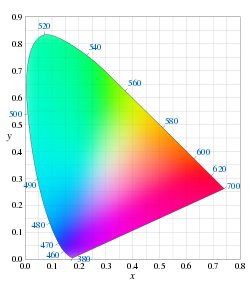
No mixture of colors, though, can produce a fully pure color perceived as completely identical to a spectral color, although one can get very close for the longer wavelengths, where the chromaticity diagram
CIE 1931 color space
In the study of color perception, one of the first mathematically defined color spaces is the CIE 1931 XYZ color space, created by the International Commission on Illumination in 1931....
above has a nearly straight edge. For example, mixing green light (530 nm) and blue light (460 nm) produces cyan light that is slightly desaturated, because response of the red color receptor would be greater to the green and blue light in the mixture than it would be to a pure cyan light at 485 nm that has the same intensity as the mixture of blue and green.
Because of this, and because the primaries in color printing
Color printing
Color printing or Colour printing is the reproduction of an image or text in color...
systems generally are not pure themselves, the colors reproduced are never perfectly saturated colors, and so spectral colors cannot be matched exactly. However, natural scenes rarely contain fully saturated colors, thus such scenes can usually be approximated well by these systems. The range of colors that can be reproduced with a given color reproduction system is called the gamut
Gamut
In color reproduction, including computer graphics and photography, the gamut, or color gamut , is a certain complete subset of colors. The most common usage refers to the subset of colors which can be accurately represented in a given circumstance, such as within a given color space or by a...
. The CIE
International Commission on Illumination
The International Commission on Illumination is the international authority on light, illumination, color, and color spaces...
chromaticity diagram can be used to describe the gamut.
Another problem with color reproduction systems is connected with the acquisition devices, like cameras or scanners. The characteristics of the color sensors in the devices are often very far from the characteristics of the receptors in the human eye. In effect, acquisition of colors that have some special, often very "jagged," spectra caused for example by unusual lighting of the photographed scene can be relatively poor.
Species that have color receptors different from humans, e.g. bird
Bird
Birds are feathered, winged, bipedal, endothermic , egg-laying, vertebrate animals. Around 10,000 living species and 188 families makes them the most speciose class of tetrapod vertebrates. They inhabit ecosystems across the globe, from the Arctic to the Antarctic. Extant birds range in size from...
s that may have four receptors, can differentiate some colors that look the same to a human. In such cases, a color reproduction system 'tuned' to a human with normal color vision may give very inaccurate results for the other observers.
The different color response of different devices can be problematic if not properly managed. For color information stored and transferred in digital form, color management
Color management
In digital imaging systems, color management is the controlled conversion between the color representations of various devices, such as image scanners, digital cameras, monitors, TV screens, film printers, computer printers, offset presses, and corresponding media.The primary goal of color...
techniques, such as those based on ICC profile
ICC profile
In color management, an ICC profile is a set of data that characterizes a color input or output device, or a color space, according to standards promulgated by the International Color Consortium...
s, can help to avoid distortions of the reproduced colors. Color management does not circumvent the gamut
Gamut
In color reproduction, including computer graphics and photography, the gamut, or color gamut , is a certain complete subset of colors. The most common usage refers to the subset of colors which can be accurately represented in a given circumstance, such as within a given color space or by a...
limitations of particular output devices, but can assist in finding good mapping of input colors into the gamut that can be reproduced.
Pigments and reflective media
Pigments are chemicals that selectively absorb and reflect different spectra of light. When a surface is painted with a pigment, light hitting the surface is reflected, minus some wavelengths. This subtraction of wavelengths produces the appearance of different colors. Most paints are a blend of several chemical pigments, intended to produce a reflection of a given color.Pigment manufacturers assume the source light will be white
White
White is a color, the perception of which is evoked by light that stimulates all three types of color sensitive cone cells in the human eye in nearly equal amounts and with high brightness compared to the surroundings. A white visual stimulation will be void of hue and grayness.White light can be...
, or of roughly equal intensity across the spectrum. If the light is not a pure white source (as in the case of nearly all forms of artificial lighting), the resulting spectrum will appear a slightly different color. Red
Red
Red is any of a number of similar colors evoked by light consisting predominantly of the longest wavelengths of light discernible by the human eye, in the wavelength range of roughly 630–740 nm. Longer wavelengths than this are called infrared , and cannot be seen by the naked eye...
paint, viewed under blue
Blue
Blue is a colour, the perception of which is evoked by light having a spectrum dominated by energy with a wavelength of roughly 440–490 nm. It is considered one of the additive primary colours. On the HSV Colour Wheel, the complement of blue is yellow; that is, a colour corresponding to an equal...
light, may appear black
Black
Black is the color of objects that do not emit or reflect light in any part of the visible spectrum; they absorb all such frequencies of light...
. Red paint is red because it reflects only the red components of the spectrum. Blue light, containing none of these, will create no reflection from red paint, creating the appearance of black.
Structural color
Structural colors are colors caused by interference effects rather than by pigments. Color effects are produced when a material is scored with fine parallel lines, formed of one or more parallel thin layers, or otherwise composed of microstructures on the scale of the color's wavelengthWavelength
In physics, the wavelength of a sinusoidal wave is the spatial period of the wave—the distance over which the wave's shape repeats.It is usually determined by considering the distance between consecutive corresponding points of the same phase, such as crests, troughs, or zero crossings, and is a...
. If the microstructures are spaced randomly, light of shorter wavelengths will be scattered preferentially to produce Tyndall effect
Tyndall effect
The Tyndall effect, also known as Tyndall scattering, is light scattering by particles in a colloid or particles in a fine suspension. It is named after the 19th century physicist John Tyndall. It is similar to Rayleigh scattering, in that the intensity of the scattered light depends on the fourth...
colors: the blue of the sky (Rayleigh scattering, caused by structures much smaller than the wavelength of light, in this case air molecules), the luster of opal
Opal
Opal is an amorphous form of silica related to quartz, a mineraloid form, not a mineral. 3% to 21% of the total weight is water, but the content is usually between 6% to 10%. It is deposited at a relatively low temperature and may occur in the fissures of almost any kind of rock, being most...
s, and the blue of human irises. If the microstructures are aligned in arrays, for example the array of pits in a CD, they behave as a diffraction grating
Diffraction grating
In optics, a diffraction grating is an optical component with a periodic structure, which splits and diffracts light into several beams travelling in different directions. The directions of these beams depend on the spacing of the grating and the wavelength of the light so that the grating acts as...
: the grating reflects different wavelengths in different directions due to interference phenomena, separating mixed "white" light into light of different wavelengths. If the structure is one or more thin layers then it will reflect some wavelengths and transmit others, depending on the layers' thickness.
Structural color is studied in the field of thin-film optics
Thin-film optics
Thin-film optics is the branch of optics that deals with very thin structured layers of different materials. In order to exhibit thin-film optics, the thickness of the layers of material must be on the order of the wavelengths of visible light...
. A layman's term that describes particularly the most ordered or the most changeable structural colors is iridescence
Iridescence
Iridescence is generally known as the property of certain surfaces which appear to change color as the angle of view or the angle of illumination changes...
. Structural color is responsible for the blues and greens of the feathers of many birds (the blue jay, for example), as well as certain butterfly wings and beetle shells. Variations in the pattern's spacing often give rise to an iridescent effect, as seen in peacock feathers, soap bubbles, films of oil, and mother of pearl, because the reflected color depends upon the viewing angle. Numerous scientists have carried out research in butterfly wings and beetle shells, including Isaac Newton and Robert Hooke. Since 1942, electron micrography
Electron microscope
An electron microscope is a type of microscope that uses a beam of electrons to illuminate the specimen and produce a magnified image. Electron microscopes have a greater resolving power than a light-powered optical microscope, because electrons have wavelengths about 100,000 times shorter than...
has been used, advancing the development of products that exploit structural color, such as "photonic" cosmetics.
Additional terms
- Colorfulness, chroma, purity, or saturation: how "intense" or "concentrated" a color is. Technical definitions distinguish between colorfulness, chroma, and saturation as distinct perceptual attributes and include purity as a physical quantity. These terms, and others related to light and color are internationally agreed upon and published in the CIE Lighting Vocabulary. More readily available texts on colorimetry also define and explain these terms.
- DichromatismDichromatismDichromatism is a phenomenon where the hue of the colour in materials or solutions are dependent on both the concentration of the absorbing substance and the depth or thickness of the medium traversed...
: a phenomenon where the hue is dependent on concentration and/or thickness of the absorbing substance. - HueHueHue is one of the main properties of a color, defined technically , as "the degree to which a stimulus can be describedas similar to or different from stimuli that are described as red, green, blue, and yellow,"...
: the color's direction from white, for example in a color wheelColor wheelA color wheel or color circle is an abstract illustrative organization of color hues around a circle that shows relationships between primary colors, secondary colors, complementary colors, etc....
or chromaticity diagram. - ShadeTints and shadesIn color theory, a tint is the mixture of a color with white, which increases lightness, and a shade is the mixture of a color with black, which reduces lightness...
: a color made darker by adding black. - TintTints and shadesIn color theory, a tint is the mixture of a color with white, which increases lightness, and a shade is the mixture of a color with black, which reduces lightness...
: a color made lighter by adding white. - Value, brightness, lightness, or luminosity: how light or dark a color is.
See also
- ChromophoreChromophoreA chromophore is the part of a molecule responsible for its color. The color arises when a molecule absorbs certain wavelengths of visible light and transmits or reflects others. The chromophore is a region in the molecule where the energy difference between two different molecular orbitals falls...
- CIECAM02CIECAM02Published in 2002 by the CIE Technical Committee 8-01 , as of 2008 CIECAM02 is the most recent color appearance model ratified by the CIE, and the successor of CIECAM97s.| quote=The CIECAM97s model was adopted by the CIE in 1997 for color imaging applications. It includes forward and reverse modes...
- Color mappingColor mappingColor mapping is a function that maps the colors of one image to the colors of another image. A color mapping may be referred to as the algorithm that results in the mapping function or the algorithm that transforms the image colors...
- Complementary colorComplementary colorComplementary colors are pairs of colors that are of “opposite” hue in some color model. The exact hue “complementary” to a given hue depends on the model in question, and perceptually uniform, additive, and subtractive color models, for example, have differing complements for any given color.-...
- Impossible color
- International Color ConsortiumInternational Color ConsortiumThe International Color Consortium was formed in 1993 by eight industry vendors in order to create a universal color management system that would function transparently across all operating systems and software packages....
- International Commission on IlluminationInternational Commission on IlluminationThe International Commission on Illumination is the international authority on light, illumination, color, and color spaces...
- List of colors (compact version)
- Neutral color
- Pearlescent coating including Metal effect pigments
- PrimaryPrimary colorPrimary colors are sets of colors that can be combined to make a useful range of colors. For human applications, three primary colors are usually used, since human color vision is trichromatic....
, secondarySecondary colorA secondary color is a color made by mixing two primary colors in a given color space. Examples include the following:-Light : red + green = yellowgreen + blue = cyan blue +...
and tertiaryTertiary colorA tertiary color is a color made by mixing one primary color with one secondary color, in a given color space such as RGB or RYB.Unlike primary and secondary colors, these are not represented by one firmly established name each, but the following examples include some typical names.Brown and grey...
colors - RainbowRainbowA rainbow is an optical and meteorological phenomenon that causes a spectrum of light to appear in the sky when the Sun shines on to droplets of moisture in the Earth's atmosphere. It takes the form of a multicoloured arc...
External links and sources
- Bibliography Database on Color Theory, Buenos Aires University
- Why Should Engineers and Scientists Be Worried About Color?
- Robert Ridgway's A Nomenclature of Colors (1886) and Color Standards and Color Nomenclature (1912) - text-searchable digital facsimiles at Linda Hall Library
- Albert Henry MunsellAlbert Henry MunsellAlbert Henry Munsell was an American painter, teacher of art, and the inventor of the Munsell color system.He was born in Boston, Massachusetts, attended and served on the faculty of Massachusetts Normal Art School, and died in nearby Brookline.As a painter, he was noted for seascapes and...
's A Color Notation, (1907) at Project Gutenberg - AIC, International Colour AssociationInternational Colour AssociationThe International Colour Association is a learned society whose aims are to encourage research in all aspects of color, to disseminate the knowledge gained from this research, and to promote its application to the solution of problems in the fields of science, art, design and industry on...