

Ishtar

Encyclopedia
Ishtar is the Assyria
n and Babylonia
n goddess of fertility
, love
, war
, and sex
. She is the counterpart to the Sumerian Inanna
and to the cognate
north-west Semitic
goddess
Astarte
.
involved sacred prostitution; her holy city Uruk
was called the "town of the sacred courtesans"; and she herself was the "courtesan of the gods". Ishtar had many lovers; however, as Guirand notes,
Ishtar was the daughter of Sin
or Anu
. She was particularly worshipped at the Assyrian
cities of Nineveh
and Arbela
(Erbil).
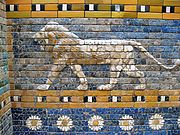
Besides the lions on her gate, her symbol is an eight pointed star.

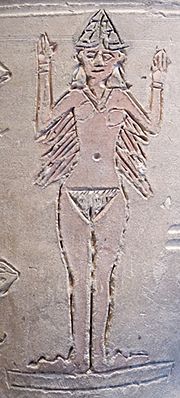
 In the Babylonian pantheon, she "was the divine personification of the planet Venus".
The gatekeeper hurried to tell Ereshkigal
, the Queen of the Underworld. Ereshkigal told the gatekeeper to let Ishtar enter, but "according to the ancient decree".
The gatekeeper lets Ishtar into the underworld, opening one gate at a time. At each gate, Ishtar has to shed one article of clothing. When she finally passes the seventh gate, she is naked. In rage, Ishtar throws herself at Ereshkigal, but Ereshkigal orders her servant Namtar to imprison Ishtar and unleash sixty diseases against her.
After Ishtar descends to the underworld, all sexual activity ceases on earth. The god Papsukal reports the situation to Ea, the king of the gods. Ea creates an intersex
creature called Asu-shu-namir and sends him-her to Ereshkigal, telling him-her to invoke "the name of the great gods" against her and to ask for the bag containing the waters of life. Ereshkigal is enraged when she hears Asu-shu-namir's demand, but she has to give him-her the water of life. Asu-shu-namir sprinkles Ishtar with this water, reviving her. Then Ishtar passes back through the seven gates, getting one article of clothing back at each gate, and is fully clothed as she exits the last gate.
Here there is a break in the text of the myth. The text resumes with the following lines:
Formerly, scholars believed that the myth of Ishtar's descent took place after the death of Ishtar's lover, Tammuz: they thought Ishtar had gone to the underworld to rescue Tammuz. However, the discovery of a corresponding myth about Inanna, the Sumerian counterpart of Ishtar, has thrown some light on the myth of Ishtar's descent, including its somewhat enigmatic ending lines. According to the Inanna myth, Inanna can only return from the underworld if she sends someone back in her place. Demons go with her to make sure she sends someone back. However, each time Inanna runs into someone, she finds him to be a friend and lets him go free. When she finally reaches her home, she finds her husband Dumuzi (Babylonian Tammuz) seated on his throne, not mourning her at all. In anger, Inanna has the demons take Dumuzi back to the underworld as her replacement. Dumuzi's sister Geshtinanna is grief-stricken and volunteers to spend half the year in the underworld, during which time Dumuzi can go free. The Ishtar myth presumably has a comparable ending, Belili being the Babylonian equivalent of Geshtinanna.
contains an episode involving Ishtar which portrays her as bad-tempered, petulant and spoiled by her father.
She asks the hero Gilgamesh
to marry her, but he refuses, citing the fate that has befallen all her many lovers:
Angered by Gilgamesh's refusal, Ishtar goes up to heaven and complains to her father the high god Anu
that Gilgamesh has insulted her. She demands that Anu give her the Bull of Heaven
. Anu points out that it was her fault for provoking Gilgamesh, but she warns that if he refuses, she will do exactly what she told the gatekeeper of the underworld she would do if he didn't let her in:
Anu gives Ishtar the Bull of Heaven, and Ishtar sends it to attack Gilgamesh and his friend Enkidu. Gilgamesh and Enkidu
kill the Bull and offer its heart to the sun-god Shamash
.
While Gilgamesh and Enkidu are resting, Ishtar stands upon the walls of the city (which is Uruk
) and curses Gilgamesh. Enkidu tears off the Bull's right thigh and throws it in Ishtar's face, saying, "If I could lay my hands on you, it is this I should do to you, and lash your entrails to your side." Then Ishtar called together "her people, the dancing and singing girls, the prostitutes of the temple, the courtesans," and had them mourn for the Bull of Heaven.
and Northwestern Semitic Astarte
were love goddesses who were "as cruel as they were wayward". Donald A. Mackenzie
, an early popularizer of mythology, draws a parallel between the love goddess Aphrodite and her "dying god
" lover Adonis
on one hand, and the love goddess Ishtar and her "dying god" lover Tammuz on the other. Some scholars have suggested that
Joseph Campbell
, a more recent scholar of comparative mythology
, equates Ishtar, Inanna, and Aphrodite, and he draws a parallel between the Egyptian goddess Isis
who nurses Horus
, and the Babylonian goddess Ishtar who nurses the god Tammuz.
(1963) and Blood Diner
(1987), although she is referred to as an Egyptian god.
In Red River (manga)
, the character Yuri is said to be Ishtar incarnate.
In the game Catherine
, Ishtar appears as Trisha, The Midnight Venus, and the myth is told in the "Rapunzel" game.
Assyria
Assyria was a Semitic Akkadian kingdom, extant as a nation state from the mid–23rd century BC to 608 BC centred on the Upper Tigris river, in northern Mesopotamia , that came to rule regional empires a number of times through history. It was named for its original capital, the ancient city of Assur...
n and Babylonia
Babylonia
Babylonia was an ancient cultural region in central-southern Mesopotamia , with Babylon as its capital. Babylonia emerged as a major power when Hammurabi Babylonia was an ancient cultural region in central-southern Mesopotamia (present-day Iraq), with Babylon as its capital. Babylonia emerged as...
n goddess of fertility
Fertility
Fertility is the natural capability of producing offsprings. As a measure, "fertility rate" is the number of children born per couple, person or population. Fertility differs from fecundity, which is defined as the potential for reproduction...
, love
Love
Love is an emotion of strong affection and personal attachment. In philosophical context, love is a virtue representing all of human kindness, compassion, and affection. Love is central to many religions, as in the Christian phrase, "God is love" or Agape in the Canonical gospels...
, war
War
War is a state of organized, armed, and often prolonged conflict carried on between states, nations, or other parties typified by extreme aggression, social disruption, and usually high mortality. War should be understood as an actual, intentional and widespread armed conflict between political...
, and sex
Sex
In biology, sex is a process of combining and mixing genetic traits, often resulting in the specialization of organisms into a male or female variety . Sexual reproduction involves combining specialized cells to form offspring that inherit traits from both parents...
. She is the counterpart to the Sumerian Inanna
Inanna
Inanna, also spelled Inana is the Sumerian goddess of sexual love, fertility, and warfare....
and to the cognate
Cognate
In linguistics, cognates are words that have a common etymological origin. This learned term derives from the Latin cognatus . Cognates within the same language are called doublets. Strictly speaking, loanwords from another language are usually not meant by the term, e.g...
north-west Semitic
Semitic
In linguistics and ethnology, Semitic was first used to refer to a language family of largely Middle Eastern origin, now called the Semitic languages...
goddess
Goddess
A goddess is a female deity. In some cultures goddesses are associated with Earth, motherhood, love, and the household. In other cultures, goddesses also rule over war, death, and destruction as well as healing....
Astarte
Astarte
Astarte is the Greek name of a goddess known throughout the Eastern Mediterranean from the Bronze Age to Classical times...
.
Characteristics
Ishtar was above all associated with sexuality: her cultCult (religious practice)
In traditional usage, the cult of a religion, quite apart from its sacred writings , its theology or myths, or the personal faith of its believers, is the totality of external religious practice and observance, the neglect of which is the definition of impiety. Cult in this primary sense is...
involved sacred prostitution; her holy city Uruk
Uruk
Uruk was an ancient city of Sumer and later Babylonia, situated east of the present bed of the Euphrates river, on the ancient dry former channel of the Euphrates River, some 30 km east of modern As-Samawah, Al-Muthannā, Iraq.Uruk gave its name to the Uruk...
was called the "town of the sacred courtesans"; and she herself was the "courtesan of the gods". Ishtar had many lovers; however, as Guirand notes,
Ishtar was the daughter of Sin
Sin (mythology)
Sin or Nanna was the god of the moon in Mesopotamian mythology. Nanna is a Sumerian deity, the son of Enlil and Ninlil, and became identified with Semitic Sin. The two chief seats of Nanna's/Sin's worship were Ur in the south of Mesopotamia and Harran in the north.- Name :The original meaning of...
or Anu
Anu
In Sumerian mythology, Anu was a sky-god, the god of heaven, lord of constellations, king of gods, Consort of Antu, spirits and demons, and dwelt in the highest heavenly regions. It was believed that he had the power to judge those who had committed crimes, and that he had created the stars as...
. She was particularly worshipped at the Assyrian
Assyria
Assyria was a Semitic Akkadian kingdom, extant as a nation state from the mid–23rd century BC to 608 BC centred on the Upper Tigris river, in northern Mesopotamia , that came to rule regional empires a number of times through history. It was named for its original capital, the ancient city of Assur...
cities of Nineveh
Nineveh
Nineveh was an ancient Assyrian city on the eastern bank of the Tigris River, and capital of the Neo Assyrian Empire. Its ruins are across the river from the modern-day major city of Mosul, in the Ninawa Governorate of Iraq....
and Arbela
Arbela
Arbela may refer to:*An important city in ancient Jordan, located on the site of modern Irbid, Jordan*The ancient name of the city of Arbil in northern Iraq*Ancient Jewish settlement in Galilee, near the modern moshav Arbel, Israel....
(Erbil).
Besides the lions on her gate, her symbol is an eight pointed star.
Descent into the underworld
One of the most famous myths about Ishtar describes her descent to the underworld. In this myth, Ishtar approaches the gates of the underworld and demands that the gatekeeper open them:The gatekeeper hurried to tell Ereshkigal
Ereshkigal
In Mesopotamian mythology, Ereshkigal was the goddess of Irkalla, the land of the dead or underworld. Sometimes her name is given as Irkalla, similar to the way the name Hades was used in Greek mythology for both the underworld and its ruler.Ereshkigal was the only one who could pass judgment and...
, the Queen of the Underworld. Ereshkigal told the gatekeeper to let Ishtar enter, but "according to the ancient decree".
The gatekeeper lets Ishtar into the underworld, opening one gate at a time. At each gate, Ishtar has to shed one article of clothing. When she finally passes the seventh gate, she is naked. In rage, Ishtar throws herself at Ereshkigal, but Ereshkigal orders her servant Namtar to imprison Ishtar and unleash sixty diseases against her.
After Ishtar descends to the underworld, all sexual activity ceases on earth. The god Papsukal reports the situation to Ea, the king of the gods. Ea creates an intersex
Intersex
Intersex, in humans and other animals, is the presence of intermediate or atypical combinations of physical features that usually distinguish female from male...
creature called Asu-shu-namir and sends him-her to Ereshkigal, telling him-her to invoke "the name of the great gods" against her and to ask for the bag containing the waters of life. Ereshkigal is enraged when she hears Asu-shu-namir's demand, but she has to give him-her the water of life. Asu-shu-namir sprinkles Ishtar with this water, reviving her. Then Ishtar passes back through the seven gates, getting one article of clothing back at each gate, and is fully clothed as she exits the last gate.
Here there is a break in the text of the myth. The text resumes with the following lines:
Formerly, scholars believed that the myth of Ishtar's descent took place after the death of Ishtar's lover, Tammuz: they thought Ishtar had gone to the underworld to rescue Tammuz. However, the discovery of a corresponding myth about Inanna, the Sumerian counterpart of Ishtar, has thrown some light on the myth of Ishtar's descent, including its somewhat enigmatic ending lines. According to the Inanna myth, Inanna can only return from the underworld if she sends someone back in her place. Demons go with her to make sure she sends someone back. However, each time Inanna runs into someone, she finds him to be a friend and lets him go free. When she finally reaches her home, she finds her husband Dumuzi (Babylonian Tammuz) seated on his throne, not mourning her at all. In anger, Inanna has the demons take Dumuzi back to the underworld as her replacement. Dumuzi's sister Geshtinanna is grief-stricken and volunteers to spend half the year in the underworld, during which time Dumuzi can go free. The Ishtar myth presumably has a comparable ending, Belili being the Babylonian equivalent of Geshtinanna.
Ishtar in the Epic of Gilgamesh
The Epic of GilgameshEpic of Gilgamesh
Epic of Gilgamesh is an epic poem from Mesopotamia and is among the earliest known works of literature. Scholars believe that it originated as a series of Sumerian legends and poems about the protagonist of the story, Gilgamesh king of Uruk, which were fashioned into a longer Akkadian epic much...
contains an episode involving Ishtar which portrays her as bad-tempered, petulant and spoiled by her father.
She asks the hero Gilgamesh
Gilgamesh
Gilgamesh was the fifth king of Uruk, modern day Iraq , placing his reign ca. 2500 BC. According to the Sumerian king list he reigned for 126 years. In the Tummal Inscription, Gilgamesh, and his son Urlugal, rebuilt the sanctuary of the goddess Ninlil, in Tummal, a sacred quarter in her city of...
to marry her, but he refuses, citing the fate that has befallen all her many lovers:
Angered by Gilgamesh's refusal, Ishtar goes up to heaven and complains to her father the high god Anu
Anu
In Sumerian mythology, Anu was a sky-god, the god of heaven, lord of constellations, king of gods, Consort of Antu, spirits and demons, and dwelt in the highest heavenly regions. It was believed that he had the power to judge those who had committed crimes, and that he had created the stars as...
that Gilgamesh has insulted her. She demands that Anu give her the Bull of Heaven
Bull (mythology)
The worship of the Sacred Bull throughout the ancient world is most familiar to the Western world in the biblical episode of the idol of the Golden Calf. The Golden Calf after being made by the Hebrew people in the wilderness of Sinai, were rejected and destroyed by Moses and his tribe after his...
. Anu points out that it was her fault for provoking Gilgamesh, but she warns that if he refuses, she will do exactly what she told the gatekeeper of the underworld she would do if he didn't let her in:
Anu gives Ishtar the Bull of Heaven, and Ishtar sends it to attack Gilgamesh and his friend Enkidu. Gilgamesh and Enkidu
Enkidu
Enkidu is a central figure in the Ancient Mesopotamian Epic of Gilgamesh. Enkidu was first created by Anu, the sky god, to rid Gilgamesh of his arrogance. In the story he is a wild-man raised by animals and ignorant of human society until he is bedded by Shamhat...
kill the Bull and offer its heart to the sun-god Shamash
Shamash
Shamash was a native Mesopotamian deity and the sun god in the Akkadian, Assyrian and Babylonian pantheons. Shamash was the god of justice in Babylonia and Assyria, corresponding to Sumerian Utu...
.
While Gilgamesh and Enkidu are resting, Ishtar stands upon the walls of the city (which is Uruk
Uruk
Uruk was an ancient city of Sumer and later Babylonia, situated east of the present bed of the Euphrates river, on the ancient dry former channel of the Euphrates River, some 30 km east of modern As-Samawah, Al-Muthannā, Iraq.Uruk gave its name to the Uruk...
) and curses Gilgamesh. Enkidu tears off the Bull's right thigh and throws it in Ishtar's face, saying, "If I could lay my hands on you, it is this I should do to you, and lash your entrails to your side." Then Ishtar called together "her people, the dancing and singing girls, the prostitutes of the temple, the courtesans," and had them mourn for the Bull of Heaven.
Comparisons with other deities
Like Ishtar, the Greek AphroditeAphrodite
Aphrodite is the Greek goddess of love, beauty, pleasure, and procreation.Her Roman equivalent is the goddess .Historically, her cult in Greece was imported from, or influenced by, the cult of Astarte in Phoenicia....
and Northwestern Semitic Astarte
Astarte
Astarte is the Greek name of a goddess known throughout the Eastern Mediterranean from the Bronze Age to Classical times...
were love goddesses who were "as cruel as they were wayward". Donald A. Mackenzie
Donald Alexander Mackenzie
Donald Alexander Mackenzie was a Scottish journalist and folklorist and prolific writer on religion, mythology and anthropology in the early 20th century.-Life & Career:...
, an early popularizer of mythology, draws a parallel between the love goddess Aphrodite and her "dying god
Life-death-rebirth deity
A dying god, also known as a dying-and-rising or resurrection deity, is a god who dies and is resurrected or reborn, in either a literal or symbolic sense. Male examples include the ancient Near Eastern and Greek deities Baal, Melqart, Adonis, Eshmun, Attis Tammuz, Asclepius, Orpheus, as well as...
" lover Adonis
Adonis
Adonis , in Greek mythology, the god of beauty and desire, is a figure with Northwest Semitic antecedents, where he is a central figure in various mystery religions. The Greek , Adōnis is a variation of the Semitic word Adonai, "lord", which is also one of the names used to refer to God in the Old...
on one hand, and the love goddess Ishtar and her "dying god" lover Tammuz on the other. Some scholars have suggested that
Joseph Campbell
Joseph Campbell
Joseph John Campbell was an American mythologist, writer and lecturer, best known for his work in comparative mythology and comparative religion. His work is vast, covering many aspects of the human experience...
, a more recent scholar of comparative mythology
Comparative mythology
Comparative mythology is the comparison of myths from different cultures in an attempt to identify shared themes and characteristics. Comparative mythology has served a variety of academic purposes...
, equates Ishtar, Inanna, and Aphrodite, and he draws a parallel between the Egyptian goddess Isis
Isis
Isis or in original more likely Aset is a goddess in Ancient Egyptian religious beliefs, whose worship spread throughout the Greco-Roman world. She was worshipped as the ideal mother and wife as well as the matron of nature and magic...
who nurses Horus
Horus
Horus is one of the oldest and most significant deities in the Ancient Egyptian religion, who was worshipped from at least the late Predynastic period through to Greco-Roman times. Different forms of Horus are recorded in history and these are treated as distinct gods by Egyptologists...
, and the Babylonian goddess Ishtar who nurses the god Tammuz.
In Other Media
Ishtar appears in the movies Blood FeastBlood Feast
Blood Feast is a 1963 American horror film directed by Herschell Gordon Lewis, often considered the first "splatter film". It was produced by David F. Friedman. The screenplay was written by Alison Louise Downe, who had previously appeared in several of Lewis' other films. Lewis also wrote the...
(1963) and Blood Diner
Blood Diner
Blood Diner is a 1987 horror-comedy film, a loose remake of the 1963 film Blood Feast.-Plot:Blood Diner is a dark comedy/horror about two brothers, Michael Tutman and George Tutman becoming brainwashed by their serial killer uncle Anwar Namtut , into completing his task of resurrecting the...
(1987), although she is referred to as an Egyptian god.
In Red River (manga)
Red River (manga)
, also known as Anatolia Story, is a historical fantasy shōjo manga series by Chie Shinohara. It is published in Japan by Shogakukan in Sho-Comi and collected in 28 volumes. It is published in English in North America by VIZ Media, with 25 volumes released as of April 2009 and the remaining 3...
, the character Yuri is said to be Ishtar incarnate.
In the game Catherine
Catherine (video game)
is a horror puzzle-platformer adventure game developed by Atlus Persona Team and published by Atlus for the PlayStation 3 and Xbox 360. The game is Atlus' first internally-developed game for seventh-generation consoles in high definition, and is described as an "adult-oriented" title by the game's...
, Ishtar appears as Trisha, The Midnight Venus, and the myth is told in the "Rapunzel" game.
Further reading
- Powell, Barry. Classical Myth: Sixth Edition. Upper Saddle River, NJ: Prentice Hall, 2008.
- The myth of Ishtar's descent into the underworld being read aloud in Babylonian.