


Wide-angle lens

Encyclopedia
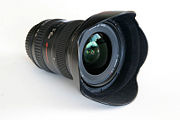
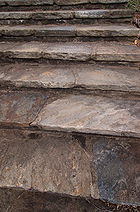
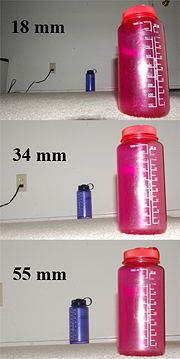
Image circle
The image circle, or circle of illumination, of a lens is the circular area in the image plane formed by the cone of light transmitted by the lens . Within this circle is the smaller circle for which image definition is acceptable, the circle of good definition ; however, some authors make no...
than would be typical for a standard design lens of the same focal length; this enables either large tilt & shift movements with a view camera, or lenses with wide fields of view.
More informally, in photography
Photography
Photography is the art, science and practice of creating durable images by recording light or other electromagnetic radiation, either electronically by means of an image sensor or chemically by means of a light-sensitive material such as photographic film...
and cinematography
Cinematography
Cinematography is the making of lighting and camera choices when recording photographic images for cinema. It is closely related to the art of still photography...
, a wide-angle lens refers to a lens
Photographic lens
A camera lens is an optical lens or assembly of lenses used in conjunction with a camera body and mechanism to make images of objects either on photographic film or on other media capable of storing an image chemically or electronically.While in principle a simple convex lens will suffice, in...
whose focal length
Focal length
The focal length of an optical system is a measure of how strongly the system converges or diverges light. For an optical system in air, it is the distance over which initially collimated rays are brought to a focus...
is substantially shorter than the focal length of a normal lens
Normal lens
In photography and cinematography a normal lens, also called a standard lens, is a lens that reproduces perspective that generally looks "natural" to a human observer under normal viewing conditions, as compared with lenses with longer or shorter focal lengths which produce an expanded or...
for the image size produced by the camera, whether this is dictated by the dimensions of the image frame at the film plane for film cameras (film format
Film format
A film format is a technical definition of a set of standard characteristics regarding image capture on photographic film, for either stills or movies. It can also apply to projected film, either slides or movies. The primary characteristic of a film format is its size and shape.In the case of...
) or dimensions of the photosensor
Digital photography
Digital photography is a form of photography that uses an array of light sensitive sensors to capture the image focused by the lens, as opposed to an exposure on light sensitive film...
for digital cameras.
By convention, in still photography, the normal lens
Normal lens
In photography and cinematography a normal lens, also called a standard lens, is a lens that reproduces perspective that generally looks "natural" to a human observer under normal viewing conditions, as compared with lenses with longer or shorter focal lengths which produce an expanded or...
for a particular format has a focal length approximately equal to the length of the diagonal of the image frame or digital photosensor. In cinematography, a somewhat longer lens is considered "normal".
There is an easy formula for calculating the angle of view
Angle of view
In photography, angle of view describes the angular extent of a given scene that is imaged by a camera. It is used interchangeably with the more general term field of view....
for any lens that produces a rectilinear
Rectilinear lens
In photography, a rectilinear lens is a photographic lens that yields images where straight features, such as the walls of buildings, appear with straight lines, as opposed to being curved. In other words, it is a lens with little or no barrel or pincushion distortion...
image. In addition to giving a wider angle of view, the image produced by a wide-angle lens is more susceptible to perspective distortion
Perspective distortion (photography)
In photography and cinematography, perspective distortion is a warping or transformation of an object and its surrounding area that differs significantly from what the object would look like with a normal focal length, due to the relative scale of nearby and distant features...
than that produced by a normal lens, because they tend to be used much closer to the subject.
Characteristics
Longer lenses magnify the subject more, apparently compressing distance and (when focused on the foreground) blurring the background because of their shallower depth of fieldDepth of field
In optics, particularly as it relates to film and photography, depth of field is the distance between the nearest and farthest objects in a scene that appear acceptably sharp in an image...
. Wider lenses tend to magnify distance between objects while allowing greater depth of field.
Another result of using a wide-angle lens is a greater apparent perspective distortion
Perspective distortion (photography)
In photography and cinematography, perspective distortion is a warping or transformation of an object and its surrounding area that differs significantly from what the object would look like with a normal focal length, due to the relative scale of nearby and distant features...
when the camera is not aligned perpendicularly to the subject: parallel lines converge at the same rate as with a normal lens
Normal lens
In photography and cinematography a normal lens, also called a standard lens, is a lens that reproduces perspective that generally looks "natural" to a human observer under normal viewing conditions, as compared with lenses with longer or shorter focal lengths which produce an expanded or...
, but converge more due to the wider total field. For example, buildings appear to be falling backwards much more severely when the camera is pointed upward from ground level than they would if photographed with a normal lens at the same distance from the subject, because more of the subject building is visible in the wide-angle shot.
Because different lenses generally require a different camera–subject distance to preserve the size of a subject, changing the angle of view
Angle of view
In photography, angle of view describes the angular extent of a given scene that is imaged by a camera. It is used interchangeably with the more general term field of view....
can indirectly distort
Perspective distortion (photography)
In photography and cinematography, perspective distortion is a warping or transformation of an object and its surrounding area that differs significantly from what the object would look like with a normal focal length, due to the relative scale of nearby and distant features...
perspective, changing the apparent relative size of the subject and foreground.
Wide-angle lenses for 35 mm format
For a full-frame 35 mm135 film
The term 135 was introduced by Kodak in 1934 as a designation for cartridge film wide, specifically for still photography. It quickly grew in popularity, surpassing 120 film by the late 1960s to become the most popular photographic film format...
camera
Camera
A camera is a device that records and stores images. These images may be still photographs or moving images such as videos or movies. The term camera comes from the camera obscura , an early mechanism for projecting images...
with a 36 mm by 24 mm format, the diagonal measures 43.3 mm and by custom, the normal lens adopted by most manufacturers is 50 mm. Also by custom, a lens of focal length 35 mm or less is considered wide-angle.
By definition, wide-angle lenses differ from ultra wide angle lens
Ultra wide angle lens
An ultra wide-angle lens is a lens whose focal length is shorter than the short side of film or sensor.Thus the term denotes a different range of lenses, relative to the size of the sensor in the camera in question....
es in that the latter have a focal length shorter than the short side of the film or sensor, which means that in 35mm, a wide-angle lens has a focal length between 35 and 24 mm, while an ultra wide-angle lens has a focal length shorter than 24 mm.
Common wide-angle and ultra wide-angle lenses for a full-frame 35 mm
135 film
The term 135 was introduced by Kodak in 1934 as a designation for cartridge film wide, specifically for still photography. It quickly grew in popularity, surpassing 120 film by the late 1960s to become the most popular photographic film format...
camera
Camera
A camera is a device that records and stores images. These images may be still photographs or moving images such as videos or movies. The term camera comes from the camera obscura , an early mechanism for projecting images...
are 35, 28, 24, 21, 20, 18 and 14 mm.
Many of the lenses in this range will produce a more or less rectilinear
Rectilinear lens
In photography, a rectilinear lens is a photographic lens that yields images where straight features, such as the walls of buildings, appear with straight lines, as opposed to being curved. In other words, it is a lens with little or no barrel or pincushion distortion...
image at the film plane, though some degree of barrel distortion
Barrel distortion
In geometric optics and cathode ray tube displays, distortion is a deviation from rectilinear projection, a projection in which straight lines in a scene remain straight in an image...
is not uncommon here.
Ultra wide-angle lenses that do not produce a rectilinear image (i.e., exhibit barrel distortion) are called fisheye lens
Fisheye lens
In photography, a fisheye lens is a wide-angle lens that takes in a broad, panoramic and hemispherical image. Originally developed for use in meteorology to study cloud formation and called "whole-sky lenses", fisheye lenses quickly became popular in general photography for their unique, distorted...
es. Common focal lengths for these in a 35 mm camera
Camera
A camera is a device that records and stores images. These images may be still photographs or moving images such as videos or movies. The term camera comes from the camera obscura , an early mechanism for projecting images...
are 6 to 8 mm (which produce a circular image). Lenses with focal lengths of 8 to 16 mm may be either rectilinear or fisheye designs.
Wide-angle lenses come in both fixed-focal-length and zoom varieties. For 35 mm cameras, lenses producing rectilinear images can be found at focal lengths as short as 8 mm, including zoom lenses with ranges of 2:1 that begin at 12 mm.
Digital camera considerations
Film format
A film format is a technical definition of a set of standard characteristics regarding image capture on photographic film, for either stills or movies. It can also apply to projected film, either slides or movies. The primary characteristic of a film format is its size and shape.In the case of...
of full-frame 35 mm cameras. For the most part, the dimensions of these photosensors are similar to the APS
Advanced Photo System
Advanced Photo System is a film format for still photography first produced in 1996. It was marketed by Eastman Kodak under the brand name Advantix, by FujiFilm under the name Nexia, by AgfaPhoto under the name Futura and by Konica as Centuria.- Design :The film is 24 mm wide, and has three...
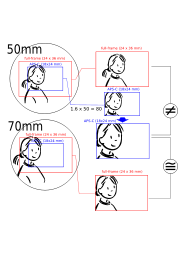
-C image frame size, i.e., approximately 24 mm x 16 mm. Therefore, the angle of view for any given focal length lens will be narrower than it would be in a full-frame camera because the smaller sensor "sees" less of the image projected by the lens. The camera manufacturers provide a crop factor
Crop factor
In digital photography, a crop factor is related to the ratio of the dimensions of a camera's imaging area compared to a reference format; most often, this term is applied to digital cameras, relative to 35 mm film format as a reference. In the case of digital cameras, the imaging device would be a...
(sometimes called a field-of-view factor or a focal-length multiplier) to show how much smaller the sensor is than a full 35 mm film frame. For example, one common factor is 1.5 (Nikon DX format and some others), although many cameras have crop factors of 1.6 (most Canon DSLRs), 1.7 (the Sigma DSLRs) and 2 (the Four-thirds-format cameras). The 1.5 indicates that the angle of view
Angle of view
In photography, angle of view describes the angular extent of a given scene that is imaged by a camera. It is used interchangeably with the more general term field of view....
of a lens on the camera is the same as that of a 1.5 times longer focal length on a 35 mm full-frame camera, which explains why the crop factor is also known as a focal-length multiplier. As example, a 28 mm lens on the DSLR (given a crop factor of 1.5) would produce the angle of view of a 42 mm lens on a full-frame camera. So, to determine the focal length of a lens for a digital camera that will give the equivalent angle of view as one on a full-frame camera, the full-frame lens focal length must be divided by the crop factor. For example, to get the equivalent angle of view of a 30 mm lens on a full-frame 35 mm camera, from a digital camera with a 1.5 crop factor, one would use a 20 mm lens.
Lens manufacturers have responded to this problem by making wide-angle lenses of much shorter focal lengths for these cameras. In doing this, they limit the diameter of the image projected to slightly more than the diagonal measurement of the photosensor. This gives the designers more flexibility in providing the optical corrections necessary to economically produce high quality images at these short focal lengths, especially when the lenses are zoom lenses. Examples are 10 mm minimum focal length zoom lenses from several manufacturers. At 10 mm, these lenses provide the angle of view of a 15 mm lens on a full-frame camera when the crop factor is 1.5.
Construction
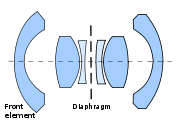
There are two different varieties of wide-angle lens: short-focus lenses and retrofocus lenses.
Short-focus lenses are generally made up of multiple glass elements whose shapes are more or less symmetrical in front of and behind the diaphragm. As the focal length decreases, the distance of the rear element of the lens from the film plane or digital sensor also decreases. This makes short-focus wide-angle lenses undesirable for single-lens reflex camera
Single-lens reflex camera
A single-lens reflex camera is a camera that typically uses a semi-automatic moving mirror system that permits the photographer to see exactly what will be captured by the film or digital imaging system, as opposed to pre-SLR cameras where the view through the viewfinder could be significantly...
s unless they are used with the reflex mirrors locked up. Short-focus lenses are widely used on large format
Large format
Large format refers to any imaging format of 4×5 inches or larger. Large format is larger than "medium format", the 6×6 cm or 6×9 cm size of Hasselblad, Rollei, Kowa, Pentax etc cameras , and much larger than the 24×36 mm frame of 35 mm format.The main advantage...
view camera
View camera
The view camera is a type of camera first developed in the era of the Daguerreotype and still in use today, though with many refinements. It comprises a flexible bellows which forms a light-tight seal between two adjustable standards, one of which holds a lens, and the other a viewfinder or a...
s and rangefinder cameras.
The retrofocus lens solves this proximity problem through an asymmetrical design that allows the rear element to be further away from the film plane than its effective focal length would suggest. (See Angénieux retrofocus
Angenieux retrofocus
The Angénieux retrofocus photographic lens is a wide-angle lens design that uses an inverted telephoto configuration. The popularity of this lens design made the name retrofocus synonymous with this type of lens...
.) For example, it is not uncommon for the rear element of a retrofocus lens of 18 mm to be more than 25 mm from the film plane. This makes it possible to design wide-angle lenses for single-lens reflex camera
Single-lens reflex camera
A single-lens reflex camera is a camera that typically uses a semi-automatic moving mirror system that permits the photographer to see exactly what will be captured by the film or digital imaging system, as opposed to pre-SLR cameras where the view through the viewfinder could be significantly...
s.
See also
- Anamorphic lens
- Angle of viewAngle of viewIn photography, angle of view describes the angular extent of a given scene that is imaged by a camera. It is used interchangeably with the more general term field of view....
for an example of an image taken by a wide-angle lens - Fisheye lensFisheye lensIn photography, a fisheye lens is a wide-angle lens that takes in a broad, panoramic and hemispherical image. Originally developed for use in meteorology to study cloud formation and called "whole-sky lenses", fisheye lenses quickly became popular in general photography for their unique, distorted...
- Image stitchingImage stitchingImage stitching or photo stitching is the process of combining multiple photographic images with overlapping fields of view to produce a segmented panorama or high-resolution image. Commonly performed through the use of computer software, most approaches to image stitching require nearly exact...
- Long focus lens
- Panoramic photographyPanoramic photographyPanoramic photography is a technique of photography, using specialized equipment or software, that captures images with elongated fields of view. It is sometimes known as wide format photography. The term has also been applied to a photograph that is cropped to a relatively wide aspect ratio...
- Photographic lens designPhotographic lens designThe design of photographic lenses for use in still or cine cameras is intended to produce a lens that yields the most acceptable rendition of the subject being photographed within a range of constraints that include cost, weight and materials...
- Scioptric ballScioptric ballThe scioptic ball is a universal joint allowing an optical instrument mounted on a ball to be swiveled to point anywhere in a wide arc. It was inspired by studies of the human eye. It has a number of applications...
- Telephoto lensTelephoto lensIn photography and cinematography, a telephoto lens is a specific type of a long-focus lens in which the physical length of the lens is shorter than the focal length. This is achieved by incorporating a special lens group known as a telephoto group that extends the light path to create a long-focus...