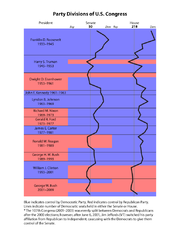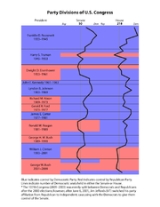
Party divisions of United States Congresses

Encyclopedia
| Party | Senate | House |
|---|---|---|
| Democratic Democratic Party (United States) The Democratic Party is one of two major contemporary political parties in the United States, along with the Republican Party. The party's socially liberal and progressive platform is largely considered center-left in the U.S. political spectrum. The party has the lengthiest record of continuous... |
49 | 55 |
| Republican Republican Party (United States) The Republican Party is one of the two major contemporary political parties in the United States, along with the Democratic Party. Founded by anti-slavery expansion activists in 1854, it is often called the GOP . The party's platform generally reflects American conservatism in the U.S... |
41 | 35 |
| Democratic-Republican | 12 | 13 |
| Federalist Federalist Party (United States) The Federalist Party was the first American political party, from the early 1790s to 1816, the era of the First Party System, with remnants lasting into the 1820s. The Federalists controlled the federal government until 1801... |
3 | 2 |
| Pro-Administration Pro-Administration Party (United States) Pro-Administration "Party" is a term by historians to describe the supporters of the policies of George Washington's administration — especially Treasury Secretary Alexander Hamilton's financial policies — prior to the formation of the Federalist and Democratic-Republican Parties.Almost the entire... |
3 | 2 |
| Whig Whig Party (United States) The Whig Party was a political party of the United States during the era of Jacksonian democracy. Considered integral to the Second Party System and operating from the early 1830s to the mid-1850s, the party was formed in opposition to the policies of President Andrew Jackson and his Democratic... |
2 | 2 |
| National Republican National Republican Party (United States) The National Republicans were a political party in the United States. During the administration of John Quincy Adams , the president's supporters were referred to as Adams Men or Anti-Jackson. When Andrew Jackson was elected President of the United States in 1828, this group went into opposition... |
1 | 1 |
| Anti-Administration Anti-Administration Party (United States) Anti-Administration "Party" was the informal faction comprising the opponents of the policies of Treasury Secretary Alexander Hamilton in the first term of President George Washington. This was not an organized political party but an unorganized faction... |
0 | 1 |
| Split Control | 1 | 1 |
The following table lists the party divisions for each United States Congress
United States Congress
The United States Congress is the bicameral legislature of the federal government of the United States, consisting of the Senate and the House of Representatives. The Congress meets in the United States Capitol in Washington, D.C....
. Numbers in boldface denote the majority party at that particular time, while italicized numbers signify a Congress in which the majority party changed mid-Congress.
| Congress | Years | Senate | House of Representatives | President | ||||||||
|---|---|---|---|---|---|---|---|---|---|---|---|---|
| Total | Anti-Admin Anti-Administration Party (United States) Anti-Administration "Party" was the informal faction comprising the opponents of the policies of Treasury Secretary Alexander Hamilton in the first term of President George Washington. This was not an organized political party but an unorganized faction... |
Pro-Admin Pro-Administration Party (United States) Pro-Administration "Party" is a term by historians to describe the supporters of the policies of George Washington's administration — especially Treasury Secretary Alexander Hamilton's financial policies — prior to the formation of the Federalist and Democratic-Republican Parties.Almost the entire... |
Others | Vacancies | Total | Anti-Admin | Pro-Admin | Others | Vacancies | |||
| 1st 1st United States Congress -House of Representatives:During this congress, five House seats were added for North Carolina and one House seat was added for Rhode Island when they ratified the Constitution.-Senate:* President: John Adams * President pro tempore: John Langdon... |
1789–1791 | 26 | 8 | 18 | — | — | 65 | 28 | 37 | — | — | George Washington George Washington George Washington was the dominant military and political leader of the new United States of America from 1775 to 1799. He led the American victory over Great Britain in the American Revolutionary War as commander-in-chief of the Continental Army from 1775 to 1783, and presided over the writing of... |
| 2nd 2nd United States Congress -House of Representatives:During this congress, two new House seats were added for each of the new states of Vermont and Kentucky. -Leadership:-Senate:*President: John Adams *President pro tempore:** Richard Henry Lee... |
1791–1793 | 30 | 13 | 16 | — | 1 | 69 | 30 | 39 | — | — | |
| 3rd 3rd United States Congress The Third United States Congress was a meeting of the legislative branch of the United States federal government, consisting of the United States Senate and the United States House of Representatives... |
1793–1795 | 30 | 14 | 16 | — | — | 105 | 54 | 51 | — | — | |
| Congress | Years | Total | Democratic-Republicans Democratic-Republican Party (United States) The Democratic-Republican Party or Republican Party was an American political party founded in the early 1790s by Thomas Jefferson and James Madison. Political scientists use the former name, while historians prefer the latter one; contemporaries generally called the party the "Republicans", along... |
Federalists Federalist Party (United States) The Federalist Party was the first American political party, from the early 1790s to 1816, the era of the First Party System, with remnants lasting into the 1820s. The Federalists controlled the federal government until 1801... |
Others | Vacancies | Total | Democratic-Republicans | Federalists | Others | Vacancies | President |
| 4th 4th United States Congress -House of Representatives:- Senate :* President: John Adams * President pro tempore:** Henry Tazewell , first elected December 7, 1795** Samuel Livermore , first elected May 6, 1796** William Bingham , first elected February 16, 1797... |
1795–1797 | 32 | 11 | 21 | — | — | 106 | 59 | 47 | — | — | George Washington George Washington George Washington was the dominant military and political leader of the new United States of America from 1775 to 1799. He led the American victory over Great Britain in the American Revolutionary War as commander-in-chief of the Continental Army from 1775 to 1783, and presided over the writing of... |
| 5th 5th United States Congress The Fifth United States Congress was a meeting of the legislative branch of the United States federal government, consisting of the United States Senate and the United States House of Representatives... |
1797–1799 | 32 | 10 | 22 | — | — | 106 | 49 | 57 | — | — | John Adams John Adams John Adams was an American lawyer, statesman, diplomat and political theorist. A leading champion of independence in 1776, he was the second President of the United States... |
| 6th 6th United States Congress The Sixth United States Congress was a meeting of the legislative branch of the United States federal government, consisting of the United States Senate and the United States House of Representatives. It met at Congress Hall in Philadelphia, Pennsylvania and in Washington, D.C. from March 4, 1799... |
1799–1801 | 32 | 10 | 22 | — | — | 106 | 46 | 60 | — | — | |
| 7th 7th United States Congress - House of Representatives :-Senate:* President: Aaron Burr * President pro tempore:** Abraham Baldwin , first elected December 7, 1801** Stephen R. Bradley , first elected December 14, 1802-House of Representatives:... |
1801–1803 | 34 | 17 | 15 | — | 2 | 107 | 68 | 38 | — | 1 | Thomas Jefferson Thomas Jefferson Thomas Jefferson was the principal author of the United States Declaration of Independence and the Statute of Virginia for Religious Freedom , the third President of the United States and founder of the University of Virginia... |
| 8th 8th United States Congress - Senate :* President: Aaron Burr * President pro tempore: John Brown , October 17, 1803 – February 26, 1804** Jesse Franklin , March 10, 1804 – November 4, 1804** Joseph Anderson , January 15, 1805 – December 1, 1805- House of Representatives :... |
1803–1805 | 34 | 25 | 9 | — | — | 142 | 103 | 39 | — | — | |
| 9th 9th United States Congress - Senate :* President: George Clinton * President pro tempore: Samuel Smith - House of Representatives :* Speaker: Nathaniel Macon -Members:This list is arranged by chamber, then by state... |
1805–1807 | 34 | 27 | 7 | — | — | 142 | 114 | 28 | — | — | |
| 10th 10th United States Congress - House of Representatives :- Senate :*President: George Clinton *President pro tempore: Samuel Smith , elected April 16, 1808** Stephen R. Bradley , elected December 28, 1808** John Milledge , elected January 30, 1809... |
1807–1809 | 34 | 28 | 6 | — | — | 142 | 116 | 26 | — | — | |
| 11th 11th United States Congress - House of Representatives :-Leadership:- Senate :* President: George Clinton * President pro tempore:** John Milledge ** Andrew Gregg , elected June 26, 1809** John Gaillard , elected February 28, 1810... |
1809–1811 | 34 | 27 | 7 | — | — | 142 | 92 | 50 | — | — | James Madison James Madison James Madison, Jr. was an American statesman and political theorist. He was the fourth President of the United States and is hailed as the “Father of the Constitution” for being the primary author of the United States Constitution and at first an opponent of, and then a key author of the United... |
| 12th 12th United States Congress - House of Representatives :During this congress, one new House seat was added for the new state of Louisiana.- Senate :*President: George Clinton *President pro tempore: William H. Crawford -House of Representatives:*Speaker: Henry Clay... |
1811–1813 | 36 | 30 | 6 | — | — | 143 | 107 | 36 | — | — | |
| 13th 13th United States Congress - Senate :* President: Elbridge Gerry , until November 23, 1814, thereafter vacant.* President pro tempore: Joseph B. Varnum , December 6, 1813 – February 3, 1814** John Gaillard , elected November 25, 1814- House of Representatives :... |
1813–1815 | 36 | 28 | 8 | — | — | 182 | 114 | 68 | — | — | |
| 14th 14th United States Congress - Senate :* President: Vacant* President pro tempore: John Gaillard of South Carolina, first elected December 4, 1815- House of Representatives :* Speaker: Henry Clay of Kentucky-Members:This list is arranged by chamber, then by state... |
1815–1817 | 38 | 26 | 12 | — | — | 183 | 119 | 64 | — | — | |
| 15th 15th United States Congress -Leadership:- Senate :* President: Daniel D. Tompkins * President pro tempore:** John Gaillard , elected March 4, 1817** James Barbour , elected February 15, 1819- House of Representatives :*Speaker: Henry Clay -Members:... |
1817–1819 | 42 | 30 | 12 | — | — | 185 | 146 | 39 | — | — | James Monroe James Monroe James Monroe was the fifth President of the United States . Monroe was the last president who was a Founding Father of the United States, and the last president from the Virginia dynasty and the Republican Generation... |
| 16th 16th United States Congress -House of Representatives:During this congress, one House seat was added for the new state of Alabama and one seat was reapportioned from Massachusetts to the new state of Maine. For the beginning of the next congress, six more seats from Massachusetts would be reapportioned to... |
1819–1821 | 46 | 37 | 9 | — | — | 186 | 160 | 26 | — | — | |
| 17th 17th United States Congress The Seventeenth United States Congress was a meeting of the legislative branch of the United States federal government, consisting of the United States Senate and the United States House of Representatives. It met in Washington, D.C. from March 4, 1821 to March 3, 1823, during the fifth and sixth... |
1821–1823 | 48 | 44 | 4 | — | — | 187 | 155 | 32 | — | — | |
| 18th 18th United States Congress The Eighteenth United States Congress was a meeting of the legislative branch of the United States federal government, consisting of the United States Senate and the United States House of Representatives. It met in Washington, D.C. from March 4, 1823 to March 3, 1825, during the seventh and eighth... |
1823–1825 | 48 | 43 | 5 | — | — | 213 | 189 | 24 | — | — | |
| Congress | Years | Total | Democrats Democratic Party (United States) The Democratic Party is one of two major contemporary political parties in the United States, along with the Republican Party. The party's socially liberal and progressive platform is largely considered center-left in the U.S. political spectrum. The party has the lengthiest record of continuous... |
National Republicans National Republican Party (United States) The National Republicans were a political party in the United States. During the administration of John Quincy Adams , the president's supporters were referred to as Adams Men or Anti-Jackson. When Andrew Jackson was elected President of the United States in 1828, this group went into opposition... |
Others | Vacancies | Total | Democrats | National Republicans | Others | Vacancies | President |
| 19th 19th United States Congress -House of Representatives:-Leadership:- Senate :* President: John C. Calhoun * President pro tempore: John Gaillard , until December 4, 1825** Nathaniel Macon , from May 20, 1826- House of Representatives :* Speaker: John W. Taylor -Members:... |
1825–1827 | 48 | 26 | 22 | — | — | 213 | 104 | 109 | — | — | John Quincy Adams John Quincy Adams John Quincy Adams was the sixth President of the United States . He served as an American diplomat, Senator, and Congressional representative. He was a member of the Federalist, Democratic-Republican, National Republican, and later Anti-Masonic and Whig parties. Adams was the son of former... |
| 20th 20th United States Congress -House of Representatives:-Leadership:- Senate :* President: John C. Calhoun * President pro tempore: Samuel Smith - House of Representatives :* Speaker: Andrew Stevenson -Members:This list is arranged by chamber, then by state... |
1827–1829 | 48 | 27 | 21 | — | — | 213 | 113 | 100 | — | — | |
| 21st 21st United States Congress -House of Representatives:-Leadership:- Senate :* President: John C. Calhoun * President pro tempore: Samuel Smith - House of Representatives :* Speaker: Andrew Stevenson -Members:This list is arranged by chamber, then by state... |
1829–1831 | 48 | 25 | 23 | — | — | 213 | 136 | 72 | 5 | — | Andrew Jackson Andrew Jackson Andrew Jackson was the seventh President of the United States . Based in frontier Tennessee, Jackson was a politician and army general who defeated the Creek Indians at the Battle of Horseshoe Bend , and the British at the Battle of New Orleans... |
| 22nd 22nd United States Congress -House of Representatives:-Leadership:- Senate :* President:** John C. Calhoun , resigned December 28, 1832, thereafter vacant.* President pro tempore:** Samuel Smith , first elected December 5, 1831** Littleton W... |
1831–1833 | 48 | 24 | 22 | 2 | — | 213 | 126 | 66 | 21 | — | |
| 23rd 23rd United States Congress -House of Representatives:For the beginning of this congress, the size of the House was increased from 213 seats to 240 seats, following the 1830 United States Census .- Leadership :- Senate :* President: Martin Van Buren... |
1833–1835 | 48 | 20 | 26 | 2 | — | 240 | 143 | 63 | 34 | — | |
| 24th 24th United States Congress -House of Representatives:During this congress one House seat was added for each of the new states of Arkansas and Michigan.-Leadership:- Senate :* President: Martin Van Buren * President pro tempore: William R. King - House of Representatives :... |
1835–1837 | 52 | 26 | 24 | 2 | — | 242 | 143 | 75 | 24 | — | |
| Congress | Years | Total | Democrats Democratic Party (United States) The Democratic Party is one of two major contemporary political parties in the United States, along with the Republican Party. The party's socially liberal and progressive platform is largely considered center-left in the U.S. political spectrum. The party has the lengthiest record of continuous... |
Whigs Whig Party (United States) The Whig Party was a political party of the United States during the era of Jacksonian democracy. Considered integral to the Second Party System and operating from the early 1830s to the mid-1850s, the party was formed in opposition to the policies of President Andrew Jackson and his Democratic... |
Others | Vacancies | Total | Democrats | Whigs | Others | Vacancies | President |
| 25th 25th United States Congress -House of Representatives:-Leadership:- Senate :* President: Richard Mentor Johnson * President pro tempore: William R. King - House of Representatives :* Speaker: James K. Polk -Members:This list is arranged by chamber, then by state... |
1837–1839 | 52 | 35 | 17 | — | — | 242 | 128 | 100 | 14 | — | Martin Van Buren Martin Van Buren Martin Van Buren was the eighth President of the United States . Before his presidency, he was the eighth Vice President and the tenth Secretary of State, under Andrew Jackson .... |
| 26th 26th United States Congress -House of Representatives:- Leadership :- Senate :*President: Richard M. Johnson *President pro tempore: William R. King - House of Representatives :*Speaker: Robert M.T. Hunter -Members:This list is arranged by chamber, then by state... |
1839–1841 | 52 | 30 | 22 | — | — | 242 | 125 | 109 | 8 | — | |
| 27th 27th United States Congress The Twenty-seventh United States Congress was a meeting of the legislative branch of the United States federal government, consisting of the United States Senate and the United States House of Representatives. It met in Washington, D.C. from March 4, 1841 to March 3, 1843, during the one-month... |
1841–1843 | 52 | 22 | 29 | — | 1 | 242 | 98 | 142 | 2 | — | William H. Harrison William Henry Harrison William Henry Harrison was the ninth President of the United States , an American military officer and politician, and the first president to die in office. He was 68 years, 23 days old when elected, the oldest president elected until Ronald Reagan in 1980, and last President to be born before the... |
| 28th 28th United States Congress -House of Representatives:Following the 1840 United States Census, Congress reapportioned the House to include 223 seats . During this congress, one House seat was added for the new state of Florida .- Senate :*President: Vacant... |
1843–1845 | 52 | 23 | 29 | — | — | 223 | 147 | 72 | 4 | — | John Tyler John Tyler John Tyler was the tenth President of the United States . A native of Virginia, Tyler served as a state legislator, governor, U.S. representative, and U.S. senator before being elected Vice President . He was the first to succeed to the office of President following the death of a predecessor... |
| 29th 29th United States Congress -House of Representatives:During this congress, two House seats were added for each of the new states of Texas and Iowa.-Leadership:-Senate:* President: George M. Dallas * President pro tempore: Willie P. Mangum... |
1845–1847 | 58 | 34 | 22 | — | 2 | 228 | 142 | 79 | 7 | — | James K. Polk James K. Polk James Knox Polk was the 11th President of the United States . Polk was born in Mecklenburg County, North Carolina. He later lived in and represented Tennessee. A Democrat, Polk served as the 17th Speaker of the House of Representatives and the 12th Governor of Tennessee... |
| 30th 30th United States Congress The Thirtieth United States Congress was a meeting of the legislative branch of the United States federal government, consisting of the United States Senate and the United States House of Representatives. It met in Washington, D.C. from March 4, 1847 to March 3, 1849, during the last two years of... |
1847–1849 | 60 | 38 | 21 | 1 | — | 220 | 110 | 116 | 4 | — | |
| 31st 31st United States Congress The Thirty-first United States Congress was a meeting of the legislative branch of the United States federal government, consisting of the United States Senate and the United States House of Representatives. It met in Washington, D.C. from March 4, 1849 to March 3, 1851, during the last 17 months... |
1849–1851 | 62 | 35 | 25 | 2 | — | 233 | 113 | 108 | 11 | 1 | Zachary Taylor Zachary Taylor Zachary Taylor was the 12th President of the United States and an American military leader. Initially uninterested in politics, Taylor nonetheless ran as a Whig in the 1848 presidential election, defeating Lewis Cass... |
| 32nd 32nd United States Congress The Thirty-second United States Congress was a meeting of the legislative branch of the United States federal government, consisting of the United States Senate and the United States House of Representatives. It met in Washington, D.C. from March 4, 1851 to March 3, 1853, during the third and... |
1851–1853 | 62 | 36 | 23 | 3 | — | 233 | 127 | 85 | 21 | — | Millard Fillmore Millard Fillmore Millard Fillmore was the 13th President of the United States and the last member of the Whig Party to hold the office of president... |
| 33rd 33rd United States Congress The Thirty-third United States Congress was a meeting of the legislative branch of the United States federal government, consisting of the United States Senate and the United States House of Representatives. It met in Washington, D.C. from March 4, 1853 to March 3, 1855, during the first two years... |
1853–1855 | 62 | 38 | 22 | 2 | — | 234 | 157 | 71 | 6 | — | Franklin Pierce Franklin Pierce Franklin Pierce was the 14th President of the United States and is the only President from New Hampshire. Pierce was a Democrat and a "doughface" who served in the U.S. House of Representatives and the Senate. Pierce took part in the Mexican-American War and became a brigadier general in the Army... |
| Congress | Years | Total | Democrats | Republicans Republican Party (United States) The Republican Party is one of the two major contemporary political parties in the United States, along with the Democratic Party. Founded by anti-slavery expansion activists in 1854, it is often called the GOP . The party's platform generally reflects American conservatism in the U.S... |
Others | Vacancies | Total | Democrats | Republicans | Others | Vacancies | President |
| 34th 34th United States Congress The Thirty-fourth United States Congress was a meeting of the legislative branch of the United States federal government, consisting of the United States Senate and the United States House of Representatives. It met in Washington, D.C. from March 4, 1855 to March 4, 1857, during the last two years... |
1855–1857 | 62 | 39 | 22 | 1 | — | 234 | 83 | 108 | 43 | — | Franklin Pierce Franklin Pierce Franklin Pierce was the 14th President of the United States and is the only President from New Hampshire. Pierce was a Democrat and a "doughface" who served in the U.S. House of Representatives and the Senate. Pierce took part in the Mexican-American War and became a brigadier general in the Army... |
| 35th 35th United States Congress The 35th United States Congress was a meeting of the legislative branch of the United States federal government, consisting of the United States Senate and the United States House of Representatives. It met in Washington, D.C. from March 4, 1857 to March 3, 1859, during the first two years of James... |
1857–1859 | 64 | 39 | 20 | 5 | — | 237 | 131 | 94 | 13 | — | James Buchanan James Buchanan James Buchanan, Jr. was the 15th President of the United States . He is the only president from Pennsylvania, the only president who remained a lifelong bachelor and the last to be born in the 18th century.... |
| 36th 36th United States Congress The Thirty-sixth United States Congress was a meeting of the legislative branch of the United States federal government, consisting of the United States Senate and the United States House of Representatives. It met in Washington, D.C. from March 4, 1859 to March 4, 1861, during the third and fourth... |
1859–1861 | 66 | 38 | 26 | 2 | — | 237 | 101 | 113 | 23 | — | |
| 37th 37th United States Congress The Thirty-seventh United States Congress was a meeting of the legislative branch of the United States federal government, consisting of the United States Senate and the United States House of Representatives. It met in Washington, D.C. from March 4, 1861 to March 4, 1863, during the first two... |
1861–1863 | 50 | 11 | 31 | 7 | 1 | 178 | 42 | 106 | 28 | 2 | Abraham Lincoln Abraham Lincoln Abraham Lincoln was the 16th President of the United States, serving from March 1861 until his assassination in April 1865. He successfully led his country through a great constitutional, military and moral crisis – the American Civil War – preserving the Union, while ending slavery, and... |
| 38th 38th United States Congress -House of Representatives:Before this Congress, the 1860 United States Census and resulting reapportionment changed the size of the House to 241 members... |
1863–1865 | 51 | 12 | 29 | — | — | 183 | 80 | 103 | — | — | |
| 39th 39th United States Congress The Thirty-ninth United States Congress was a meeting of the legislative branch of the United States federal government, consisting of the United States Senate and the United States House of Representatives. It met in Washington, D.C. from March 4, 1865 to March 4, 1867, during the first month of... |
1865–1867 | 52 | 10 | 42 | — | — | 191 | 46 | 145 | — | — | Andrew Johnson Andrew Johnson Andrew Johnson was the 17th President of the United States . As Vice-President of the United States in 1865, he succeeded Abraham Lincoln following the latter's assassination. Johnson then presided over the initial and contentious Reconstruction era of the United States following the American... |
| 40th 40th United States Congress The Fortieth United States Congress was a meeting of the legislative branch of the United States federal government, consisting of the United States Senate and the United States House of Representatives. It met in Washington, D.C. from March 4, 1867 to March 4, 1869, during the third and fourth... |
1867–1869 | 53 | 11 | 42 | — | — | 193 | 49 | 143 | — | 1 | |
| 41st 41st United States Congress -House of Representatives:- Senate :* President : Schuyler Colfax* President pro tempore: Henry B. Anthony - House of Representatives :* Speaker: James G. Blaine -Members:This list is arranged by chamber, then by state... |
1869–1871 | 74 | 11 | 61 | — | 2 | 243 | 73 | 170 | — | — | Ulysses S. Grant Ulysses S. Grant Ulysses S. Grant was the 18th President of the United States as well as military commander during the Civil War and post-war Reconstruction periods. Under Grant's command, the Union Army defeated the Confederate military and ended the Confederate States of America... |
| 42nd 42nd United States Congress The Forty-second United States Congress was a meeting of the legislative branch of the United States federal government, consisting of the United States Senate and the United States House of Representatives. It met in Washington, D.C. from March 4, 1871 to March 3, 1873, during the third and fourth... |
1871–1873 | 74 | 17 | 57 | — | — | 243 | 104 | 136 | 3 | — | |
| 43rd 43rd United States Congress The Forty-third United States Congress was a meeting of the legislative branch of the United States federal government, consisting of the United States Senate and the United States House of Representatives. It met in Washington, D.C. from March 4, 1873 to March 4, 1875, during the fifth and sixth... |
1873–1875 | 74 | 19 | 54 | — | 1 | 293 | 88 | 203 | — | 2 | |
| 44th 44th United States Congress The Forty-fourth United States Congress was a meeting of the legislative branch of the United States federal government, consisting of the United States Senate and the United States House of Representatives. It met in Washington, D.C. from March 4, 1875 to March 4, 1877, during the seventh and... |
1875–1877 | 76 | 29 | 46 | — | 1 | 293 | 181 | 107 | 3 | 2 | |
| 45th 45th United States Congress -House of Representatives:-Leadership:-Senate:*President: William A. Wheeler *President pro tempore: Thomas W. Ferry -House of Representatives:*Speaker: Samuel J. Randall -Members:This list is arranged by chamber, then by state... |
1877–1879 | 76 | 36 | 39 | 1 | — | 293 | 156 | 137 | — | — | Rutherford B. Hayes Rutherford B. Hayes Rutherford Birchard Hayes was the 19th President of the United States . As president, he oversaw the end of Reconstruction and the United States' entry into the Second Industrial Revolution... |
| 46th 46th United States Congress The Forty-sixth United States Congress was a meeting of the legislative branch of the United States federal government, consisting of the United States Senate and the United States House of Representatives. It met in Washington, D.C. from March 4, 1879 to March 4, 1881, during the last two years of... |
1879–1881 | 76 | 43 | 33 | — | — | 293 | 150 | 128 | 14 | 1 | |
| 47th 47th United States Congress The Forty-seventh United States Congress was a meeting of the legislative branch of the United States federal government, consisting of the United States Senate and the United States House of Representatives. It met in Washington, D.C. from March 4, 1881 to March 4, 1883, during the administration... |
1881–1883 | 76 | 37 | 37 | 2 | — | 293 | 130 | 152 | 11 | — | James Garfield |
| 48th 48th United States Congress The Forty-eighth United States Congress was a meeting of the legislative branch of the United States federal government, consisting of the United States Senate and the United States House of Representatives. It met in Washington, D.C. from March 4, 1883 to March 4, 1885, during the last two years... |
1883–1885 | 76 | 36 | 40 | — | — | 325 | 200 | 119 | 6 | — | Chester A. Arthur Chester A. Arthur Chester Alan Arthur was the 21st President of the United States . Becoming President after the assassination of President James A. Garfield, Arthur struggled to overcome suspicions of his beginnings as a politician from the New York City Republican machine, succeeding at that task by embracing... |
| 49th 49th United States Congress The Forty-ninth United States Congress was a meeting of the legislative branch of the United States federal government, consisting of the United States Senate and the United States House of Representatives. It met in Washington, D.C. from March 4, 1885 to March 4, 1887, during the first two years... |
1885–1887 | 76 | 34 | 41 | — | 1 | 325 | 182 | 140 | 2 | 1 | Grover Cleveland Grover Cleveland Stephen Grover Cleveland was the 22nd and 24th president of the United States. Cleveland is the only president to serve two non-consecutive terms and therefore is the only individual to be counted twice in the numbering of the presidents... |
| 50th 50th United States Congress The Fiftieth United States Congress was a meeting of the legislative branch of the United States federal government, consisting of the United States Senate and the United States House of Representatives. It met in Washington, D.C. from March 4, 1887 to March 4, 1889, during the third and fourth... |
1887–1889 | 76 | 37 | 39 | — | — | 325 | 170 | 151 | 4 | — | |
| 51st 51st United States Congress The Fifty-first United States Congress, referred to by some critics as the Billion Dollar Congress, was a meeting of the legislative branch of the United States federal government, consisting of the United States Senate and the United States House of Representatives. It met in Washington, D.C... |
1889–1891 | 84 | 37 | 47 | — | — | 330 | 156 | 173 | 1 | — | Benjamin Harrison Benjamin Harrison Benjamin Harrison was the 23rd President of the United States . Harrison, a grandson of President William Henry Harrison, was born in North Bend, Ohio, and moved to Indianapolis, Indiana at age 21, eventually becoming a prominent politician there... |
| 52nd 52nd United States Congress The Fifty-second United States Congress was a meeting of the legislative branch of the United States federal government, consisting of the United States Senate and the United States House of Representatives. It met in Washington, D.C... |
1891–1893 | 88 | 39 | 47 | 2 | — | 333 | 231 | 88 | 14 | — | |
| 53rd 53rd United States Congress The Fifty-third United States Congress was a meeting of the legislative branch of the United States federal government, consisting of the United States Senate and the United States House of Representatives. It met in Washington, D.C. from March 4, 1893 to March 4, 1895, during the fifth and sixth... |
1893–1895 | 88 | 44 | 38 | 3 | 3 | 356 | 220 | 126 | 10 | — | Grover Cleveland |
| 54th 54th United States Congress - House of Representatives :-Leadership:- Senate :* President: Adlai E. Stevenson * President pro tempore: William P. Frye - Majority leadership :* Republican Conference Chairman: John Sherman- Minority leadership :... |
1895–1897 | 88 | 39 | 44 | 5 | — | 357 | 104 | 246 | 7 | — | |
| 55th 55th United States Congress -House of Representatives:* Republican: 206 * Democratic: 124* Populist: 22* Silver Republican: 3* Silver: 1* Independent Republican: 1TOTAL members: 357-Leadership:-Senate:* President: Garret Hobart * President pro tempore: William P... |
1897–1899 | 90 | 34 | 46 | 10 | — | 357 | 134 | 206 | 16 | 1 | William McKinley William McKinley William McKinley, Jr. was the 25th President of the United States . He is best known for winning fiercely fought elections, while supporting the gold standard and high tariffs; he succeeded in forging a Republican coalition that for the most part dominated national politics until the 1930s... |
| 56th 56th United States Congress -House of Representatives:- Leadership :- Senate :* President: Garret Hobart , until November 21, 1899 , vacant thereafter.* President pro tempore: William P. Frye * Democratic Caucus Chairman: James K. Jones... |
1899–1901 | 90 | 26 | 53 | 11 | — | 357 | 163 | 185 | 9 | — | |
| 57th 57th United States Congress -House of Representatives:*Democratic: 151*Republican: 200 *Populist: 5*Silver : 1TOTAL members: 357-Leadership:-Senate:* President: Theodore Roosevelt , until September 14, 1901, vacant thereafter.... |
1901–1903 | 90 | 29 | 56 | 3 | 2 | 357 | 153 | 198 | 5 | 1 | Theodore Roosevelt Theodore Roosevelt Theodore "Teddy" Roosevelt was the 26th President of the United States . He is noted for his exuberant personality, range of interests and achievements, and his leadership of the Progressive Movement, as well as his "cowboy" persona and robust masculinity... |
| 58th 58th United States Congress - House of Representatives :* Republican : 209 * Democratic : 176* Silver Republican : 1TOTAL members: 386-Senate:* President: Vacant* President pro tempore: William P. Frye -Members:... |
1903–1905 | 90 | 32 | 58 | — | — | 386 | 178 | 207 | — | 1 | |
| 59th 59th United States Congress The Fifty-ninth United States Congress was a meeting of the legislative branch of the United States federal government, composed of the United States Senate and the United States House of Representatives. It met in Washington, DC from March 4, 1905 to March 4, 1907, during the fifth and sixth... |
1905–1907 | 90 | 32 | 58 | — | — | 386 | 136 | 250 | — | — | |
| 60th 60th United States Congress The Sixtieth United States Congress was a meeting of the legislative branch of the United States federal government, composed of the United States Senate and the United States House of Representatives. It met in Washington, DC from March 4, 1907 to March 4, 1909, during the last two years of... |
1907–1909 | 92 | 29 | 61 | — | 2 | 386 | 164 | 222 | — | — | |
| 61st 61st United States Congress The Sixty-first United States Congress was a meeting of the legislative branch of the United States federal government, composed of the United States Senate and the United States House of Representatives. It met in Washington, DC from March 4, 1909 to March 4, 1911, during the first two years of... |
1909–1911 | 92 | 32 | 59 | — | 1 | 391 | 172 | 219 | — | — | William H. Taft William Howard Taft William Howard Taft was the 27th President of the United States and later the tenth Chief Justice of the United States... |
| 62nd 62nd United States Congress - House of Representatives :* Democratic : 230 * Republican : 162* Socialist : 1* Independent : 1TOTAL members: 394-Senate:* President: James S... |
1911–1913 | 92 | 42 | 49 | — | 1 | 391 | 228 | 162 | 1 | — | |
| 63rd 63rd United States Congress - House of Representatives:*Democratic : 291 *Republican : 134*Progressive : 9*Independent : 1TOTAL members: 435-Senate:*President of the Senate: Thomas R. Marshall*President pro tempore: James P. Clarke-Senate:... |
1913–1915 | 96 | 51 | 44 | 1 | — | 435 | 290 | 127 | 18 | — | Woodrow Wilson Woodrow Wilson Thomas Woodrow Wilson was the 28th President of the United States, from 1913 to 1921. A leader of the Progressive Movement, he served as President of Princeton University from 1902 to 1910, and then as the Governor of New Jersey from 1911 to 1913... |
| 64th 64th United States Congress The Sixty-fourth United States Congress was a meeting of the legislative branch of the United States federal government, composed of the United States Senate and the United States House of Representatives. It met in Washington, DC from March 4, 1915 to March 4, 1917, during the third and fourth... |
1915–1917 | 96 | 56 | 39 | 1 | — | 435 | 231 | 193 | 8 | 3 | |
| 65th 65th United States Congress The Sixty-fifth United States Congress was a meeting of the legislative branch of the United States federal government, composed of the United States Senate and the United States House of Representatives. It met in Washington, DC from March 4, 1917 to March 4, 1919, during the fourth and fifth... |
1917–1919 | 96 | 53 | 42 | 1 | — | 435 | 210 | 216 | 9 | — | |
| 66th 66th United States Congress The Sixty-sixth United States Congress was a meeting of the legislative branch of the United States federal government, comprising the United States Senate and the United States House of Representatives. It met in Washington, DC from March 4, 1919 to March 4, 1921, during the last two years of... |
1919–1921 | 96 | 47 | 48 | 1 | — | 435 | 191 | 237 | 7 | — | |
| 67th 67th United States Congress The Sixty-seventh United States Congress was a meeting of the legislative branch of the United States federal government, consisting of the United States Senate and the United States House of Representatives. It met in Washington, D.C. from March 4, 1921 to March 4, 1923, during the first two years... |
1921–1923 | 96 | 37 | 59 | — | — | 435 | 132 | 300 | 1 | 2 | Warren G. Harding Warren G. Harding Warren Gamaliel Harding was the 29th President of the United States . A Republican from Ohio, Harding was an influential self-made newspaper publisher. He served in the Ohio Senate , as the 28th Lieutenant Governor of Ohio and as a U.S. Senator... |
| 68th 68th United States Congress The Sixty-eighth United States Congress was a meeting of the legislative branch of the United States federal government, consisting of the United States Senate and the United States House of Representatives. It met in Washington, D.C. from March 4, 1923 to March 4, 1925, during the last months of... |
1923–1925 | 96 | 43 | 51 | 2 | — | 435 | 207 | 225 | 3 | — | Calvin Coolidge Calvin Coolidge John Calvin Coolidge, Jr. was the 30th President of the United States . A Republican lawyer from Vermont, Coolidge worked his way up the ladder of Massachusetts state politics, eventually becoming governor of that state... |
| 69th 69th United States Congress The Sixty-ninth United States Congress was a meeting of the legislative branch of the United States federal government, consisting of the United States Senate and the United States House of Representatives. It met in Washington, D.C. from March 4, 1925 to March 4, 1927, during the third and fourth... |
1925–1927 | 96 | 40 | 54 | 1 | 1 | 435 | 183 | 247 | 5 | — | |
| 70th 70th United States Congress The Seventieth United States Congress was a meeting of the legislative branch of the United States federal government, consisting of the United States Senate and the United States House of Representatives. It met in Washington, D.C. from March 4, 1927 to March 3, 1929, during the last two years of... |
1927–1929 | 96 | 47 | 48 | 1 | — | 435 | 195 | 237 | 3 | — | |
| 71st 71st United States Congress The Seventy-first United States Congress was a meeting of the legislative branch of the United States federal government, consisting of the United States Senate and the United States House of Representatives. It met in Washington, D.C. from March 4, 1929 to March 4, 1931, during the first two years... |
1929–1931 | 96 | 39 | 56 | 1 | — | 435 | 163 | 267 | 1 | 4 | Herbert Hoover Herbert Hoover Herbert Clark Hoover was the 31st President of the United States . Hoover was originally a professional mining engineer and author. As the United States Secretary of Commerce in the 1920s under Presidents Warren Harding and Calvin Coolidge, he promoted partnerships between government and business... |
| 72nd 72nd United States Congress The Seventy-second United States Congress was a meeting of the legislative branch of the United States federal government, consisting of the United States Senate and the United States House of Representatives. It met in Washington, D.C. from March 4, 1931 to March 4, 1933, during the last two years... |
1931–1933 | 96 | 47 | 48 | 1 | — | 435 | 217 | 217 | 1 | — | |
| 73rd 73rd United States Congress The Seventy-third United States Congress was a meeting of the legislative branch of the United States federal government, composed of the United States Senate and the United States House of Representatives. It met in Washington, DC from March 4, 1933 to January 3, 1935, during the first two years... |
1933–1935 | 96 | 59 | 36 | 1 | — | 435 | 313 | 117 | 5 | — | Franklin D. Roosevelt Franklin D. Roosevelt Franklin Delano Roosevelt , also known by his initials, FDR, was the 32nd President of the United States and a central figure in world events during the mid-20th century, leading the United States during a time of worldwide economic crisis and world war... |
| 74th 74th United States Congress -House:Also 2 Delegates, 3 Resident Commissioners-Senate:*President of the Senate: John N. Garner *President pro tempore: Key Pittman -Majority leadership:*Majority leader: Joseph T. Robinson... |
1935–1937 | 96 | 69 | 25 | 2 | — | 435 | 322 | 103 | 10 | — | |
| 75th 75th United States Congress The Seventy-fifth United States Congress was a meeting of the legislative branch of the United States federal government, composed of the United States Senate and the United States House of Representatives. It met in Washington, DC from January 3, 1937 to January 3, 1939, during the first two years... |
1937–1939 | 96 | 75 | 17 | 4 | — | 435 | 333 | 89 | 13 | — | |
| 76th 76th United States Congress The Seventy-sixth United States Congress was a meeting of the legislative branch of the United States federal government, composed of the United States Senate and the United States House of Representatives. It met in Washington, DC from January 3, 1939 to January 3, 1941, during the seventh and... |
1939–1941 | 96 | 69 | 23 | 4 | — | 435 | 262 | 169 | 4 | — | |
| 77th 77th United States Congress -Major events:* December 7, 1941: Attack on Pearl Harbor* December 8, 1941: Joint Session of Congress met to hear President Roosevelt deliver his "Day of Infamy" speech... |
1941–1943 | 96 | 66 | 28 | 2 | — | 435 | 267 | 162 | 6 | — | |
| 78th 78th United States Congress The Seventy-eighth United States Congress was a meeting of the legislative branch of the United States federal government, composed of the United States Senate and the United States House of Representatives. It met in Washington, DC from January 3, 1943 to January 3, 1945, during the last two years... |
1943–1945 | 96 | 57 | 38 | 1 | — | 435 | 222 | 209 | 4 | — | |
| 79th 79th United States Congress The Seventy-ninth United States Congress was a meeting of the legislative branch of the United States federal government, composed of the United States Senate and the United States House of Representatives. It met in Washington, DC from January 3, 1945 to January 3, 1947, during the last months of... |
1945–1947 | 96 | 57 | 38 | 1 | — | 435 | 243 | 190 | 2 | — | Harry S. Truman Harry S. Truman Harry S. Truman was the 33rd President of the United States . As President Franklin D. Roosevelt's third vice president and the 34th Vice President of the United States , he succeeded to the presidency on April 12, 1945, when President Roosevelt died less than three months after beginning his... |
| 80th 80th United States Congress The Eightieth United States Congress was a meeting of the legislative branch of the United States federal government, composed of the United States Senate and the United States House of Representatives. It met in Washington, DC from January 3, 1947 to January 3, 1949, during the third and fourth... |
1947–1949 | 96 | 45 | 51 | — | — | 435 | 188 | 246 | 1 | — | |
| 81st 81st United States Congress The Eighty-first United States Congress was a meeting of the legislative branch of the United States federal government, composed of the United States Senate and the United States House of Representatives... |
1949–1951 | 96 | 54 | 42 | — | — | 435 | 263 | 171 | 1 | — | |
| 82nd 82nd United States Congress The Eighty-second United States Congress was a meeting of the legislative branch of the United States federal government, composed of the United States Senate and the United States House of Representatives. It met in Washington, DC from January 3, 1951 to January 3, 1953, during the last two years... |
1951–1953 | 96 | 48 | 47 | 1 | — | 435 | 234 | 199 | 2 | — | |
| 83rd 83rd United States Congress The Eighty-third United States Congress was a meeting of the legislative branch of the United States federal government, composed of the United States Senate and the United States House of Representatives. It met in Washington, DC from January 3, 1953 to January 3, 1955, during the first two years... |
1953–1955 | 96 | 46 | 48 | 2 | — | 435 | 213 | 221 | 1 | — | Dwight D. Eisenhower Dwight D. Eisenhower Dwight David "Ike" Eisenhower was the 34th President of the United States, from 1953 until 1961. He was a five-star general in the United States Army... |
| 84th 84th United States Congress The Eighty-fourth United States Congress was a meeting of the legislative branch of the United States federal government, composed of the United States Senate and the United States House of Representatives. It met in Washington, DC from January 3, 1955 to January 3, 1957, during the third and... |
1955–1957 | 96 | 48 | 47 | 1 | — | 435 | 232 | 203 | — | — | |
| 85th 85th United States Congress The Eighty-fifth United States Congress was a meeting of the legislative branch of the United States federal government, composed of the United States Senate and the United States House of Representatives. It met in Washington, DC from January 3, 1957 to January 3, 1959, during the fifth and sixth... |
1957–1959 | 96 | 49 | 47 | — | — | 435 | 234 | 201 | — | — | |
| 86th 86th United States Congress The Eighty-sixth United States Congress was a meeting of the legislative branch of the United States federal government, composed of the United States Senate and the United States House of Representatives. It met in Washington, DC from January 3, 1959 to January 3, 1961, during the last two years... |
1959–1961 | 98 | 64 | 34 | — | — | 437 | 283 | 153 | 1 | — | |
| 87th 87th United States Congress -House of Representatives :-Senate:* President: Richard Nixon , until January 20, 1961** Lyndon Johnson , from January 20, 1961* President pro tempore: Carl Hayden -House of Representatives:... |
1961–1963 | 100 | 64 | 36 | — | — | 437 | 262 | 175 | — | — | John F. Kennedy John F. Kennedy John Fitzgerald "Jack" Kennedy , often referred to by his initials JFK, was the 35th President of the United States, serving from 1961 until his assassination in 1963.... |
| 88th 88th United States Congress The Eighty-eighth United States Congress was a meeting of the legislative branch of the United States federal government, composed of the United States Senate and the United States House of Representatives. It met in Washington, DC from January 3, 1963 to January 3, 1965, during the last year of... |
1963–1965 | 100 | 67 | 33 | — | — | 435 | 258 | 176 | — | 1 | Lyndon B. Johnson Lyndon B. Johnson Lyndon Baines Johnson , often referred to as LBJ, was the 36th President of the United States after his service as the 37th Vice President of the United States... |
| 89th 89th United States Congress -House of Representatives:- Senate :* President of the Senate: Hubert Humphrey , starting January 20, 1965* President pro tempore: Carl Hayden - Majority leadership :* Majority Leader and Democratic Conference Chairman: Mike Mansfield... |
1965–1967 | 100 | 68 | 32 | — | — | 435 | 295 | 140 | — | — | |
| 90th 90th United States Congress The Ninetieth United States Congress was a meeting of the legislative branch of the United States federal government, composed of the United States Senate and the United States House of Representatives. It met in Washington, DC from January 3, 1967 to January 3, 1969, during the last two years of... |
1967–1969 | 100 | 64 | 36 | — | — | 435 | 248 | 187 | — | — | |
| 91st 91st United States Congress The Ninety-first United States Congress was a meeting of the legislative branch of the United States federal government, composed of the United States Senate and the United States House of Representatives. It met in Washington, DC from January 3, 1969 to January 3, 1971, during the first two years... |
1969–1971 | 100 | 58 | 42 | — | — | 435 | 243 | 192 | — | — | Richard Nixon Richard Nixon Richard Milhous Nixon was the 37th President of the United States, serving from 1969 to 1974. The only president to resign the office, Nixon had previously served as a US representative and senator from California and as the 36th Vice President of the United States from 1953 to 1961 under... |
| 92nd 92nd United States Congress The Ninety-second United States Congress was a meeting of the legislative branch of the United States federal government, composed of the United States Senate and the United States House of Representatives... |
1971–1973 | 100 | 54 | 44 | 2 | — | 435 | 255 | 180 | — | — | |
| 93rd 93rd United States Congress The Ninety-third United States Congress was a meeting of the legislative branch of the United States federal government, composed of the United States Senate and the United States House of Representatives. It met in Washington, DC from January 3, 1973 to January 3, 1975, during the end of Richard... |
1973–1975 | 100 | 56 | 42 | 2 | — | 435 | 242 | 192 | 1 | — | Gerald Ford Gerald Ford Gerald Rudolph "Jerry" Ford, Jr. was the 38th President of the United States, serving from 1974 to 1977, and the 40th Vice President of the United States serving from 1973 to 1974... |
| 94th 94th United States Congress The Ninety-fourth United States Congress was a meeting of the legislative branch of the United States federal government, composed of the United States Senate and the United States House of Representatives. It met in Washington, DC from January 3, 1975 to January 3, 1977, during the administration... |
1975–1977 | 100 | 61 | 37 | 2 | — | 435 | 291 | 144 | — | — | |
| 95th 95th United States Congress The Ninety-fifth United States Congress was a meeting of the legislative branch of the United States federal government, composed of the United States Senate and the United States House of Representatives. It met in Washington, DC from January 3, 1977 to January 3, 1979, during the first two years... |
1977–1979 | 100 | 61 | 38 | 1 | — | 435 | 292 | 143 | — | — | Jimmy Carter Jimmy Carter James Earl "Jimmy" Carter, Jr. is an American politician who served as the 39th President of the United States and was the recipient of the 2002 Nobel Peace Prize, the only U.S. President to have received the Prize after leaving office... |
| 96th 96th United States Congress The Ninety-sixth United States Congress was a meeting of the legislative branch of the United States federal government, composed of the United States Senate and the United States House of Representatives. It met in Washington, DC from January 3, 1979 to January 3, 1981, during the last two years... |
1979–1981 | 100 | 58 | 41 | 1 | — | 435 | 277 | 158 | — | — | |
| 97th 97th United States Congress The Ninety-seventh United States Congress was a meeting of the legislative branch of the United States federal government, composed of the United States Senate and the United States House of Representatives. It met in Washington, DC from January 3, 1981 to January 3, 1983, during the final weeks of... |
1981–1983 | 100 | 46 | 53 | 1 | — | 435 | 242 | 192 | 1 | — | Ronald Reagan Ronald Reagan Ronald Wilson Reagan was the 40th President of the United States , the 33rd Governor of California and, prior to that, a radio, film and television actor.... |
| 98th 98th United States Congress The Ninety-eighth United States Congress was a meeting of the legislative branch of the United States federal government, composed of the United States Senate and the United States House of Representatives. It met in Washington, DC from January 3, 1983 to January 3, 1985, during the third and... |
1983–1985 | 100 | 46 | 54 | — | — | 435 | 269 | 166 | — | — | |
| 99th 99th United States Congress The Ninety-ninth United States Congress was a meeting of the legislative branch of the United States federal government, composed of the United States Senate and the United States House of Representatives. It met in Washington, DC from January 3, 1985 to January 3, 1987, during the fifth and sixth... |
1985–1987 | 100 | 47 | 53 | — | — | 435 | 253 | 182 | — | — | |
| 100th 100th United States Congress -House of Representatives:- Senate :* President: George H.W. Bush * President pro tempore: John Stennis - Majority leadership :* Majority Leader, Democratic Conference Chairman, and Democratic Policy Committee Chairman: Robert Byrd... |
1987–1989 | 100 | 55 | 45 | — | — | 435 | 258 | 177 | — | — | |
| 101st 101st United States Congress The One Hundred First United States Congress was a meeting of the legislative branch of the United States federal government, composed of the United States Senate and the United States House of Representatives. It met in Washington, DC from January 3, 1989 to January 3, 1991, during the first two... |
1989–1991 | 100 | 55 | 45 | — | — | 435 | 260 | 175 | — | — | George H. W. Bush George H. W. Bush George Herbert Walker Bush is an American politician who served as the 41st President of the United States . He had previously served as the 43rd Vice President of the United States , a congressman, an ambassador, and Director of Central Intelligence.Bush was born in Milton, Massachusetts, to... |
| 102nd 102nd United States Congress -House of Representatives:- Senate :* President:Dan Quayle * President pro tempore: Robert Byrd - Majority leadership :* Majority Leader: George Mitchell* Majority Whip: Wendell Ford- Minority leadership :... |
1991–1993 | 100 | 56 | 44 | — | — | 435 | 267 | 167 | 1 | — | |
| 103rd 103rd United States Congress - House of Representatives :- Leadership :- Senate :* President: Dan Quayle , until January 20, 1993** Al Gore , from January 20, 1993* President pro tempore: Robert Byrd - Majority leadership :* Majority Leader: George Mitchell... |
1993–1995 | 100 | 57 | 43 | — | — | 435 | 258 | 176 | 1 | — | Bill Clinton Bill Clinton William Jefferson "Bill" Clinton is an American politician who served as the 42nd President of the United States from 1993 to 2001. Inaugurated at age 46, he was the third-youngest president. He took office at the end of the Cold War, and was the first president of the baby boomer generation... |
| 104th 104th United States Congress The One Hundred Fourth United States Congress was a meeting of the legislative branch of the United States federal government, composed of the United States Senate and the United States House of Representatives. It met in Washington, DC from January 3, 1995 to January 3, 1997, during the third and... |
1995–1997 | 100 | 48 | 52 | — | — | 435 | 204 | 230 | 1 | — | |
| 105th 105th United States Congress The One Hundred Fifth United States Congress was a meeting of the legislative branch of the United States federal government, composed of the United States Senate and the United States House of Representatives. It met in Washington, DC from January 3, 1997 to January 3, 1999, during the fifth and... |
1997–1999 | 100 | 45 | 55 | — | — | 435 | 207 | 226 | 2 | — | |
| 106th 106th United States Congress The One Hundred Sixth United States Congress was a meeting of the legislative branch of the United States federal government, composed of the United States Senate and the United States House of Representatives. It met in Washington, DC from January 3, 1999 to January 3, 2001, during the last two... |
1999–2001 | 100 | 45 | 55 | — | — | 435 | 211 | 223 | 1 | — | |
| 107th 107th United States Congress The One Hundred Seventh United States Congress was a meeting of the legislative branch of the United States federal government, composed of the United States Senate and the United States House of Representatives. It met in Washington, D.C. from January 3, 2001 to January 3, 2003, during the final... |
2001–2003 | 100 | 50/50 | 50/49 | 0/1— | — | 435 | 212 | 221 | 2 | — | George W. Bush George W. Bush George Walker Bush is an American politician who served as the 43rd President of the United States, from 2001 to 2009. Before that, he was the 46th Governor of Texas, having served from 1995 to 2000.... |
| 108th 108th United States Congress The One Hundred Eighth United States Congress was the legislative branch of the United States federal government, composed of the United States Senate and the United States House of Representatives from January 3, 2003 to January 3, 2005, during the third and fourth years of George W. Bush's... |
2003–2005 | 100 | 48 | 51 | 1 | — | 435 | 205 | 229 | 1 | — | |
| 109th 109th United States Congress The One Hundred Ninth United States Congress was the legislative branch of the United States, composed of the United States Senate and the United States House of Representatives, from January 3, 2005 to January 3, 2007, during the fifth and sixth years of George W. Bush's presidency. House members... |
2005–2007 | 100 | 44 | 55 | 1 | — | 435 | 202 | 231 | 1 | 1 | |
| 110th 110th United States Congress The One Hundred Tenth United States Congress was the meeting of the legislative branch of the United States federal government, between January 3, 2007, and January 3, 2009, during the last two years of the second term of President George W. Bush. It was composed of the Senate and the House of... |
2007–2009 | 100 | 49 | 49 | 2 | — | 435 | 236 | 199 | — | — | |
| 111th 111th United States Congress The One Hundred Eleventh United States Congress was the meeting of the legislative branch of the United States federal government from January 3, 2009 until January 3, 2011. It began during the last two weeks of the George W. Bush administration, with the remainder spanning the first two years of... |
2009–2011 | 100 | 58/57 | 40/41 | 2 | — | 435 | 257 | 178 | — | - | Barack Obama Barack Obama Barack Hussein Obama II is the 44th and current President of the United States. He is the first African American to hold the office. Obama previously served as a United States Senator from Illinois, from January 2005 until he resigned following his victory in the 2008 presidential election.Born in... |
| 112th 112th United States Congress The One Hundred Twelfth United States Congress is the current meeting of the legislative branch of the United States federal government, composed of the United States Senate and the United States House of Representatives. It convened in Washington, D.C. on January 3, 2011, and will end on January... |
2011–2013 | 100 | 51 | 47 | 2 | — | 435 | 193 | 242 | — | — | |