
| |
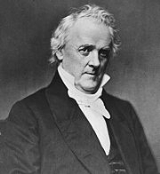
James Buchanan, Jr. (April 23, 1791 – June 1, 1868) was the 15th President of the United States (1857–1861) and the last to be born in the 18th century.
To date he is the only President from Pennsylvania and is the only one never to marry. As president he was a "doughface" (a Northerner with Southern sympathies) who battled Stephen A. Douglas for control of the Democratic Party. As Southern states declared their secession in the lead-up to the American Civil War, he held that secession was illegal but that going to war to stop it was also illegal and hence remained inactive.

Discussion
Ask a question about 'James Buchanan'
Start a new discussion about 'James Buchanan'
Answer questions from other users
|
Recent Posts

Quotations
Liberty must be allowed to work out its natural results; and these will, ere long, astonish the world.
As quoted in Presidential Leadership : Rating the Best and the Worst in the White House (2004) edited by James Taranto and Leonard Leo
What is right and what is practicable are two different things.
As quoted in Presidential Leadership : Rating the Best and the Worst in the White House (2004) edited by James Taranto and Leonard Leo

Encyclopedia
James Buchanan, Jr. (April 23, 1791 – June 1, 1868) was the 15th President of the United States (1857–1861) and the last to be born in the 18th century.
To date he is the only President from Pennsylvania and is the only one never to marry. As president he was a "doughface" (a Northerner with Southern sympathies) who battled Stephen A. Douglas for control of the Democratic Party. As Southern states declared their secession in the lead-up to the American Civil War, he held that secession was illegal but that going to war to stop it was also illegal and hence remained inactive. His inability to avert the Civil War has subsequently been assessed as the worst single failure by any President of the United States. Buchanan has been consistently ranked by scholars as one of the worst Presidents.
Early life James Buchanan was born in a log cabin at Cove Gap, near Mercersburg, Franklin County, Pennsylvania, on April 23, 1791, to James Buchanan and Elizabeth Speer. He was the second of 10 children, two of whom did not survive past infancy. The Buchanan family claims descent from King James I of Scotland.
Buchanan attended the village academy and graduated from Dickinson College in Carlisle, Pennsylvania. At one point, he was expelled from Dickinson for wild behavior and bad conduct but, after pleading for a second chance, he graduated with honors three years later on September 7, 1809. Later that year, he moved to Lancaster, Pennsylvania. In the following three years he studied law and was admitted to the bar in 1812. A dedicated Federalist, he strongly opposed the War of 1812 on the grounds that it was an unnecessary conflict. Nevertheless, when the British invaded neighboring Maryland, he joined a volunteer light dragoon unit and served in the defense of Baltimore.
An active Freemason during his lifetime, he was Master of Masonic Lodge #43 in Lancaster, Pennsylvania, and a District Deputy Grand Master of the Grand Lodge of Pennsylvania.
Political career
Buchanan began his political career in the Pennsylvania House of Representatives from 1814–1816. He was elected to the 17th United States Congress and to the four succeeding Congresses (March 4, 1821 – March 4, 1831). He was chairman of the U.S. House Committee on the Judiciary (Twenty-first Congress). He was not a candidate for renomination in 1830 but served as one of the managers appointed by the House of Representatives in 1830 to conduct the impeachment proceedings against James H. Peck, judge of the United States District Court for the District of Missouri. From 1832 to 1834, Buchanan served as ambassador to Russia.
With his original party of choice, the Federalists, long defunct, Buchanan was elected as a Democrat to the United States Senate to fill a vacancy and served from December 1834; he was reelected in 1837 and 1843 and resigned in 1845. He was chairman of the Committee on Foreign Relations (Twenty-fourth through Twenty-sixth Congresses).
After the death of Supreme Court Justice Henry Baldwin in 1844, Buchanan was nominated by President Polk to serve as a Justice of the Supreme Court. He refused the nomination and the seat was filled by Robert Cooper Grier.
Buchanan served as Secretary of State in the Cabinet of President James K. Polk from 1845 to 1849, during which time he negotiated the 1846 Oregon Treaty establishing the 49th parallel as the northern boundary of the western U.S. No Secretary of State has become President since James Buchanan, although William Howard Taft, the 27th President of the United States, often served as Acting Secretary of State during the Theodore Roosevelt administration.
In 1852, Buchanan was named president of the Board of Trustees of Franklin and Marshall College in his hometown of Lancaster and he served in this capacity until 1866.
He served as minister to the Court of St. James's (Britain) from 1853 to 1856, during which time he helped to draft the Ostend Manifesto, which proposed the purchase of Cuba from Spain in order to extend slavery. The Manifesto was a major blunder for the Pierce administration and greatly weakened support for Manifest Destiny.
Election of 1856
The Democrats nominated Buchanan in 1856 largely because he was in England during the Kansas-Nebraska debate and thus remained untainted by either side of the issue. He was nominated on the 17th ballot and accepted, although he did not want to run.
Former president Millard Fillmore's "Know-Nothing" candidacy helped Buchanan defeat John C. Frémont, the first Republican candidate for president in 1856, and he served from March 4, 1857, to March 4, 1861.
With regard to the growing schism in the country, as President-elect, Buchanan intended to sit out the crisis by maintaining a sectional balance in his appointments and persuading the people to accept constitutional law as the Supreme Court interpreted it. The court was considering the legality of restricting slavery in the territories, and two justices hinted to Buchanan what the decision would be.
Presidency 1857-1861
The Dred Scott case
In his inaugural address, besides promising not to run again, Buchanan referred to the territorial question as "happily, a matter of but little practical importance" since the Supreme Court was about to settle it "speedily and finally". Two days later, Chief Justice Roger B. Taney (a fellow alumnus of Dickinson College) delivered the Dred Scott Decision, asserting that Congress had no constitutional power to exclude slavery in the territories. Much of Taney’s written judgment is widely interpreted as obiter dictum — statements made by a judge that are unnecessary to the outcome of the case, but in this instance they delighted Southerners while creating a furor in the North. Buchanan was widely believed to have been personally involved in the decision, with many Northerners recalling Taney whispering to Buchanan during the inauguration. Buchanan wished to see the territorial question resolved by the Supreme Court. To further this, he personally lobbied his fellow Pennsylvanian Justice Robert Cooper Grier to vote with the majority to uphold the right of owning slave property. Abraham Lincoln denounced him as an accomplice of the Slave Power, which Lincoln saw as a conspiracy of slaveowners to seize control of the federal government and nationalize slavery.
Bleeding Kansas
Buchanan, however, faced further trouble on the territorial question. He threw the full prestige of his administration behind congressional approval of the Lecompton Constitution in Kansas, which would have admitted Kansas as a slave state, going as far as offering patronage appointments and even cash bribes in exchange for votes. The Lecompton government was unpopular among Northerners because it was dominated by slaveholders who had enacted laws curtailing the rights of non-slaveholders. Even though the voters in Kansas had rejected the Lecompton Constitution, Buchanan managed to pass his bill through the House, but it was blocked in the Senate by Northerners led by Stephen A. Douglas. Eventually, Congress voted to call a new vote on the Lecompton Constitution, a move which infuriated Southerners. Buchanan and Douglas engaged in an all-out struggle for control of the party in 1859–60, with Buchanan using his patronage powers and Douglas rallying the grass roots. Buchanan lost control of the greatly weakened party.
Buchanan's personal views
Buchanan personally favored slaveowners' rights and he sympathized with the slave-expansionists who coveted Cuba. Buchanan despised both abolitionists and free-soil Republicans, lumping the two together. He fought the opponents of the Slave Power. In his third annual message Buchanan claimed that the slaves were "treated with kindness and humanity.... Both the philanthropy and the self-interest of the master have combined to produce this humane result" . Shortly after his election, he assured a southern Senator that the "great object" of his administration would be "to arrest, if possible, the agitation of the Slavery question in the North and to destroy sectional parties. Should a kind Providence enable me to succeed in my efforts to restore harmony to the Union, I shall feel that I have not lived in vain". As historian Kenneth Stampp concludes, "Buchanan was the consummate 'doughface,' a northern man with southern principles."
Financial Panic
Economic troubles also plagued Buchanan's administration with the outbreak of the Panic of 1857. The government suddenly faced a shortfall of revenue, partly because of the Democrats' successful push to lower the tariff. At the behest of Treasury Secretary Howell Cobb, Buchanan's administration began issuing deficit financing for the government, a move which flew in the face of two decades of Democratic support for hard money policies and allowed Republicans to attack Buchanan for financial mismanagement.
Utah War
In March 1857, Buchanan received false reports that Governor Brigham Young of the Mormon-dominated Utah Territory was planning a revolt. In November of that year, Buchanan sent the Army to replace Young as Governor with the non-Mormon Alfred Cumming before either confirming the reports or notifying Young that he was about to be replaced. Years of anti-Mormon rhetoric in Washington, combined with denouncements and lurid descriptions of both the Mormon practice of polygamy and the intentions of the President and the Army in eastern newspapers, led the Mormons to expect the worst. Young called up a militia of several thousand men to defend the Territory and sent a small band to harass and delay the Army from entering it. Providentially, the early onset of winter forced the Army to camp in present-day Wyoming, allowing for negotiations between the Territory and the federal government. Poor planning, the Army's inadequate supplies, and the failure of the President to verify the reports of rebellion and warning the territorial government of his intentions led to widespread condemnation of Buchanan from Congress and the press, who labeled the war "Buchanan's Blunder". When Young agreed to be replaced by Cumming and to allow the Army to enter the Utah Territory and establish a base, Buchanan attempted to save face by issuing proclamations detailing his merciful pardoning of the "rebels". These were poorly received by both Congress and the inhabitants of Utah. The troops, in any case, would soon be recalled to the East when the Civil War erupted.
Disintegration
When Republicans won a plurality in the House in 1856, every significant bill they passed fell before Southern votes in the Senate or a Presidential veto. The Federal Government reached a stalemate. Bitter hostility between Republicans and Southern Democrats prevailed on the floor of Congress.
To make matters worse, Buchanan was dogged by the partisan Covode committee, which was investigating the administration for evidence of impeachable offenses.
Sectional strife rose to such a pitch in 1860 that the Democratic Party split. Buchanan played very little part as the national convention, meeting in Charleston, South Carolina, deadlocked. The southern wing walked out of the convention and nominated its own candidate for the presidency, incumbent Vice President John C. Breckinridge, whom Buchanan refused to support. The remainder of the party finally nominated Buchanan's archenemy, Douglas. Consequently, when the Republicans nominated Abraham Lincoln, it was a foregone conclusion that he would be elected even though his name appeared on the ballot only in the free states, Delaware, and a handful of other border states.
In Buchanan's Message to Congress (December 3, 1860), he denied the legal right of states to secede but held that the Federal Government legally could not prevent them. He hoped for compromise, but secessionist leaders did not want it. He then watched silently as South Carolina seceded on December 20, followed by six other cotton states and, by February, they had formed the Confederate States of America. Eight slave states refused to join.
Beginning in late December, Buchanan reorganized his cabinet, ousting Confederate sympathizers and replacing them with hard-line nationalists Jeremiah S. Black, Edwin M. Stanton, Joseph Holt and John A. Dix. These conservative Democrats strongly believed in American nationalism and refused to countenance secession. At one point, Treasury Secretary Dix ordered Treasury agents in New Orleans, "If any man pulls down the American flag, shoot him on the spot".
Before Buchanan left office, all arsenals and forts in the seceded states were lost (except Fort Sumter and two lesser outposts), and a fourth of all federal soldiers surrendered to Texas troops. The government retained control of Fort Sumter, which was located in Charleston harbor, a visible spot in the Confederacy. On January 5, Buchanan sent a civilian steamer Star of the West to carry reinforcements and supplies to Fort Sumter. On January 9, 1861, South Carolina state batteries opened fire on the Star of the West, which returned to New York. Paralyzed, Buchanan made no further moves to prepare for war.
On Buchanan's final day as president, he remarked to the incoming Lincoln, "If you are as happy in entering the White House as I shall feel on returning to Wheatland, you are a happy man."
James Buchanan's presidential cabinet
Judicial appointments
Supreme Court
Buchanan appointed the following Justice to the Supreme Court of the United States:
Other courts
Buchanan appointed only seven other federal judges, all to United States district courts:
| Judge | Court | Began active service | Ended active service | | Asa Biggs | D.N.C. | May 3, 1858 | April 23, 1861 | | John Cadwalader | E.D. Pa. | April 24, 1858 | January 26, 1879 | | Matthew Deady | D. Ore. | March 9, 1859 | March 24, 1893 | | William Giles Jones | S.D. Ala. M.D.Ala. N.D. Ala. | January 30, 1860 | January 12, 1861 | | Wilson McCandless | W.D. Pa. | February 8, 1859 | July 24, 1876 | | Rensselaer Russell Nelson | D. Minn. | May 30, 1858 | May 16, 1896 | | William Davis Shipman | D. Conn. | March 12, 1860 | April 16, 1873 |
States admitted to the Union
Personal relationships
In 1819, Buchanan was engaged to Ann Caroline Coleman, the daughter of a wealthy iron manufacturing businessman and sister-in-law of Philadelphia judge Joseph Hemphill, a colleague of Buchanan's from the House of Representatives. However, Buchanan spent little time with her during the courtship. He was extremely busy with his law firm and political projects at the time, taking him away from Coleman for weeks at a time. Conflicting rumors abounded, suggesting that he was marrying her for her money as his own family was less affluent or that he was involved with other women. Buchanan, for his part, never publicly spoke of his motives or feelings, but letters from Ann revealed she was paying heed to the rumors, and after Buchanan paid a visit to the wife of a friend, she broke off the engagement. Ann died soon after. The records of a Dr. Chapman, who looked after her in her final hours, and who said just after her passing that this was "the first instance he ever knew of hysteria producing death", reveal that he theorized the woman's demise was caused by an overdose of laudanum.
His fiancée's death struck Buchanan. In a letter to her fatherwhich was returned to him unopened — Buchanan said, "It is now no time for explanation, but the time will come when you will discover that she, as well as I, have been much abused. God forgive the authors of it.... I may sustain the shock of her death, but I feel that happiness has fled from me forever." The Coleman family became bitter towards Buchanan and denied him a place at Ann's funeral. Buchanan vowed he would never marry, though he continued to be flirtatious, and some pressed him to seek a wife. In response he said, "Marry he could not, for his affections were buried in the grave." He preserved Ann Coleman's letters, keeping them with him throughout his life, and requested that they be burned upon his death.
For 15 years in Washington, D.C., prior to his presidency, Buchanan lived with his close friend, Alabama Senator William Rufus King. King became Vice President under Franklin Pierce. He took ill and died shortly after Pierce's inauguration, and four years before Buchanan became President. Buchanan and King's close relationship prompted Andrew Jackson to refer to King as "Miss Nancy" and "Aunt Fancy", while Aaron V. Brown spoke of the two as "Buchanan and his wife". Further, some of the contemporary press also speculated about Buchanan and King's relationship. Buchanan and King's nieces destroyed their uncles' correspondence, leaving some questions as to what relationship the two men had, but the length and intimacy of surviving letters illustrate "the affection of a special friendship" and Buchanan wrote of his "communion" with his housemate. Such expression, however, was not necessarily unusual among men at the time. Circumstances surrounding Buchanan and King's close emotional ties have led to speculation that Buchanan was gay. In his book, Lies Across America, James W. Loewen points out that in May 1844, during one of the interruptions in Buchanan and King's relationship that resulted from King's appointment as minister to France, Buchanan wrote to a Mrs. Roosevelt about his social life, "I am now 'solitary and alone', having no companion in the house with me. I have gone a wooing to several gentlemen, but have not succeeded with any one of them. I feel that it is not good for man to be alone, and [I] should not be astonished to find myself married to some old maid who can nurse me when I am sick, provide good dinners for me when I am well, and not expect from me any very ardent or romantic affection." The only President never to marry, Buchanan turned to Harriet Lane, an orphaned niece whom he had earlier adopted, to act as his First Lady.
Legacy
In 1866 Buchanan published Mr Buchanan's Administration on the Eve of the Rebellion — the first presidential memoir.
He died June 1, 1868, at the age of 77 at his home at Wheatland and was interred in Woodward Hill Cemetery in Lancaster.
On the day before his death, he predicted that "history will vindicate my memory". Nevertheless, historians continue to emphasize his failure to deal with secession. Historians in both 2006 and 2009 voted his failure to deal with secession the worst presidential mistake ever made. Historical rankings of United States Presidents by scholars considering presidential achievements, leadership qualities, failures and faults (such as corruption), consistently place Buchanan among the worst presidents in US history.
The policy of appeasement practiced by Buchanan and his predecessor, Franklin Pierce, toward the pro-slavery lobby is often criticized. There is no evidence, however, that a harder line against slavery would have done anything but provoke the Southern states to secede a few years earlier than they eventually did. Whether America's slide toward secession during his administration was Buchanan's fault or simply his bad luck to have presided over it remains a matter for debate.
A bronze and granite memorial residing near the Southeast corner of Washington D.C.'s Meridian Hill Park was designed by architect William Gorden Beecher and sculpted by Maryland artist Hans Schuler. Commissioned in 1916 but not approved by the U.S. Congress until 1918, and not completed and unveiled until June 26, 1930, the memorial features a statue of Buchanan bookended by male and female classical figures representing law and diplomacy, with the engraved text reading: "The incorruptible statesman whose walk was upon the mountain ranges of the law", a quote from a member of Buchanan's cabinet, Jeremiah S. Black. The memorial in the nation's capital , constructed in 1907–08 and dedicated in 1911, on the site of Buchanan's birthplace in StonyBatter, Pennsylvania. Part of an memorial site, the monument is a 250-ton pyramid structure designed to show the original weathered surface of the native rubble and mortar.
Three counties are named in his honor: Buchanan County in Iowa, Missouri, and Virginia.
Bibliography
- Baker, Jean H. James Buchanan. Henry Holt, 2004. 192 pp.
- Binder, Frederick Moore. "James Buchanan: Jacksonian Expansionist" Historian 1992 55(1): 69–84. Issn: 0018-2370 Fulltext: in Ebsco
- Binder, Frederick Moore. James Buchanan and the American Empire. Susquehanna U. Press, 1994. 318 pp.
- Birkner, Michael J., ed. James Buchanan and the Political Crisis of the 1850s. Susquehanna U. Press, 1996. 215 pp.
- Meerse, David. "Buchanan, the Patronage, and the Lecompton Constitution: a Case Study" Civil War History 1995 41(4): 291–312. Issn: 0009-8078
- Nevins, Allan. The Emergence of Lincoln 2 vols. (1960) highly detailed narrative of his presidency
- Nichols, Roy Franklin; The Democratic Machine, 1850–1854 (1923),
- Potter, David Morris. The Impending Crisis, 1848–1861 (1976). ISBN 0-06-013403-8 Pulitzer prize.
- Rhodes, James Ford History of the United States from the Compromise of 1850 to the McKinley-Bryan Campaign of 1896 vol 2. (1892)
- Smith, Elbert B. The Presidency of James Buchanan (1975). ISBN 0-7006-0132-5, standard history of his administration
- Stampp, Kenneth M. America in 1857: A Nation on the Brink (1990). ISBN 0-19-503902-5
- Updike, John Buchanan Dying (1974). ISBN 0-8117-0238-3
Primary sources
External links
Primary sources
|