

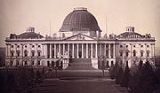
34th United States Congress

Encyclopedia
The Thirty-fourth United States Congress was a meeting of the legislative branch of the United States federal government, consisting of the United States Senate
and the United States House of Representatives
. It met in Washington, D.C.
from March 4, 1855 to March 4, 1857, during the last two years of Franklin Pierce
's presidency
. The apportionment of seats in the House of Representatives
was based on the Seventh Census of the United States in 1850
. The Senate had a Democratic
majority, and the House had a coalition majority of Representatives opposed to the Democrats.

During the elections for this Congress, opponents to the Democrats used the Whig party label inconsistently and not at all in some states. Hence in this Congress, and in accordance with the practice of the Senate and House, representatives not associated with the Democratic Party
or the American Party
are labeled as "Opposition." This is the first example in U.S. history of a form of coalition
government in either house of Congress.
, which indicate the cycle of their election. In this Congress, Class 1 meant their term ended with this Congress, requiring reelection in 1856; Class 2 meant their term began in the last Congress, requiring reelection in 1858; and Class 3 meant their term began in this Congress, requiring reelection in 1860.
(A). Eli S. Shorter (D). James F. Dowdell (D). William R. Smith
(A). George S. Houston
(D). Williamson R. W. Cobb
(D). Sampson W. Harris
(D)
(D). Albert Rust
(D)
.. James W. Denver
(D). Philemon T. Herbert
(D)
(A). John Woodruff
(A). Sidney Dean
(A). William W. Welch
(A)
(D). Martin J. Crawford
(D). Robert P. Trippe
(A). Hiram B. Warner
(D). John H. Lumpkin
(D). Howell Cobb
(D). Nathaniel G. Foster
(A). Alexander Stephens
(D)
(O). James H. Woodworth
(O). Jesse O. Norton
(O). James Knox (O). William A. Richardson
(D), until August 25, 1856
(D). William H. English
(D). George G. Dunn
(O). William Cumback
(O). David P. Holloway
(O). Lucien Barbour
(O). Harvey D. Scott
(O). Daniel Mace
(O). Schuyler Colfax
(O). Samuel Brenton
(O). John U. Pettit
(O)
(D). James Thorington
(O)
(D). John P. Campbell, Jr.
(A). Warner L. Underwood (A). Albert G. Talbott
(D). Joshua Jewitt (D). John M. Elliott
(D). Humphrey Marshall
(A). Alexander K. Marshall (A). Leander Cox
(A). Samuel F. Swope
(A)
(A). Miles Taylor
(D). Thomas G. Davidson
(D). John M. Sandidge
(D)
(O). John J. Perry
(O). Ebenezer Knowlton
(O). Samuel P. Benson
(O). Israel Washburn, Jr.
(O). Thomas J. D. Fuller
(D)
(D). James B. Ricaud
(A). J. Morrison Harris
(A). Henry Winter Davis
(A). Henry W. Hoffman (A). Thomas F. Bowie
(D)
(A). James Buffinton
(A). William S. Damrell
(A). Linus B. Comins
(A). Anson Burlingame
(A). Timothy Davis
(A). Nathaniel P. Banks
(A). Chauncey L. Knapp
(A). Alexander De Witt
(A). Calvin C. Chaffee
(A). Mark Trafton
(A)
(O). Henry Waldron
(O). David S. Walbridge
(O). George W. Peck
(D)
(D). Hendley S. Bennett
(D). William Barksdale
(D). William A. Lake
(A). John A. Quitman
(D)
(O). James J. Lindley (O). Mordecai Oliver
(O). John G. Miller (O)
(A). Aaron H. Cragin
(A)
(O). George R. Robbins
(O). James Bishop
(O). George Vail
(D). Alexander C. M. Pennington (O)
(A). James S. T. Stranahan
(O). Guy R. Pelton
(O). John Kelly
(D). Thomas R. Whitney
(A). John Wheeler
(D). Thomas Child, Jr.
(O). Abram Wakeman
(O). Bayard Clarke
(O). Ambrose S. Murray
(O). Rufus H. King
(O). Killian Miller
(O). Russell Sage
(O). Samuel Dickson (O). Edward Dodd
(O). George A. Simmons
(O). Francis E. Spinner
(D). Thomas R. Horton
(O). Jonas A. Hughston
(O). Orsamus B. Matteson
(O), until February 27, 1857. Henry Bennett
(O). Andrew Z. McCarty
(O). William A. Gilbert
(O), until February 27, 1857. Amos P. Granger
(O). Edwin B. Morgan
(O). Andrew Oliver
(D). John M. Parker
(O). William H. Kelsey
(O). John Williams (D). Benjamin Pringle
(O). Thomas T. Flagler
(O). Solomon G. Haven
(O). Francis S. Edwards
(A), until February 28, 1857
(A). Thomas H. Ruffin
(D). Warren Winslow
(D). Lawrence O'Bryan Branch
(D). Edwin G. Reade
(A). Richard C. Puryear
(A). F. Burton Craige
(D). Thomas L. Clingman
(D)
(O). John Scott Harrison
(O). Lewis D. Campbell
(A). Matthias H. Nichols
(O). Richard Mott
(O). Jonas R. Emrie
(O). Aaron Harlan
(O). Benjamin Stanton
(O). Cooper K. Watson
(O). Oscar F. Moore
(O). Valentine B. Horton
(O). Samuel Galloway
(O). John Sherman
(O). Philemon Bliss
(O). William R. Sapp
(O). Edward Ball
(O). Charles J. Albright
(O). Benjamin F. Leiter
(O). Edward Wade
(O). Joshua R. Giddings
(O). John Bingham
(O)
(D). Job R. Tyson
(O). William Millward
(O). Jacob Broom
(A). John Cadwalader
(D). John Hickman
(D). Samuel C. Bradshaw
(O). J. Glancey Jones
(D). Anthony E. Roberts
(O). John C. Kunkel
(O). James H. Campbell
(O). Henry M. Fuller
(O). Asa Packer
(D). Galusha A. Grow
(D). John J. Pearce
(O). Lemuel Todd
(O). David F. Robison
(O). John R. Edie
(O). John Covode
(O). Jonathan Knight
(O). David Ritchie (O). Samuel A. Purviance
(O). John Allison
(O). David Barclay
(D). John Dick
(O)
(D). William Aiken
(D). Laurence M. Keitt
(D), until July 15, 1856 and from August 6, 1856. Preston Brooks
(D), until July 15, 1856 and from August 1, 1856 until January 28, 1857. James L. Orr
(D). William W. Boyce
(D)
(D). William H. Sneed
(A). Samuel A. Smith
(D). John H. Savage
(D). Charles Ready
(A). George W. Jones
(D). John V. Wright
(D). Felix K. Zollicoffer
(A). Emerson Etheridge
(A). Thomas Rivers
(A)
(A). Peter H. Bell
(D)
(O), until August 23, 1856
(D), until June 23, 1856
(D). Cadwallader C. Washburn
(O). Charles Billinghurst
(O)
(D), until July 23, 1856
| nowrap | New Hampshire
(2)
| Vacant
| style="font-size:80%" | Legislature failed to elect on time.
| nowrap | John Parker Hale (R)
| July 30, 1855
|-
| nowrap | New Hampshire
(3)
| Vacant
| style="font-size:80%" | Charles G. Atherton
died during the previous Congress. Successor was elected.
| nowrap | James Bell
(R)
| July 30, 1855
|-
| nowrap | Alabama
(3)
| Vacant
| style="font-size:80%" | Legislature failed to elect on time.
| nowrap | Benjamin Fitzpatrick
(D)
| November 26, 1855
|-
| nowrap | Pennsylvania
(3)
| Vacant
| style="font-size:80%" | Legislature failed to elect on time.
| nowrap | William Bigler
(D)
| January 14, 1856
|-
| nowrap | Missouri
(3)
| Vacant
| style="font-size:80%" | Elected but did not take seat until after Congress began session.
| nowrap | James S. Green
(D)
| January 12, 1857
|-
| nowrap | California
(3)
| Vacant
| style="font-size:80%" | Legislature failed to elect on time.
| nowrap | William M. Gwin
(D)
| January 13, 1857
|-
| nowrap | Indiana
(3)
| Vacant
| style="font-size:80%" | Legislature failed to elect on time.
| nowrap | Graham N. Fitch
(D)
| February 4, 1857
|-
| nowrap | Delaware
(2)
| nowrap | John M. Clayton
(O / W)
| style="font-size:80%" | Died November 9, 1856. Successor was appointed.
| nowrap | Joseph P. Comegys
(O / W)
| November 19, 1856
|-
| nowrap | Maine
(1)
| nowrap | Hannibal Hamlin
(D)
| style="font-size:80%" | Resigned January 7, 1857 to become Governor of Maine
. Successor was appointed.
| nowrap | Amos Nourse
(R)
| January 16, 1857
|-
| nowrap | Delaware
(2)
| nowrap | Joseph P. Comegys
(O / W)
| style="font-size:80%" | Appointment expired January 14, 1857 upon successor's election.
| nowrap | Martin W. Bates
(D)
| January 14, 1857
|-
| nowrap | Iowa
(3)
| nowrap | James Harlan
(O / FS)
| style="font-size:80%" | Presented his credentials and took his seat December 31, 1855; owing to irregularities in the legislative proceedings the Senate declared the seat vacant in January 1857. He was subsequently re-elected to fill the vacancy
| nowrap | James Harlan
(R)
| January 29, 1857
|}
|-
|
| Vacant
| style="font-size:80%" | Rep-elect Lyman Trumbull
resigned in previous congress after being elected to the US Senate
| | James L. D. Morrison
(D
)
| Seated November 4, 1856
|-
|
| | John G. Miller
(O
)
| style="font-size:80%" | Died May 11, 1856
| | Thomas P. Akers
(KN
)
| Seated August 18, 1856
|-
|
| | Thomas H. Bayly (D
)
| style="font-size:80%" | Died June 23, 1856
| | Muscoe R. H. Garnett
(D
)
| Seated December 1, 1856
|-
|
| | Laurence M. Keitt
(D
)
| style="font-size:80%" | Resigned July 15, 1856 after being censured in his role in the assault on US Senator Charles Sumner
. He was subsequently re-elected to fill the vacancy
| | Laurence M. Keitt
(D
)
| Seated August 6, 1856
|-
|
| | Preston Brooks
(D
)
| style="font-size:80%" | Resigned July 15, 1856 after assaulting US Senator Charles Sumner
. He was subsequently re-elected to fill the vacancy
| | Preston Brooks
(D
)
| Seated August 1, 1856
|-
|
| | James C. Allen
(D
)
| style="font-size:80%" | House declared on July 18, 1856 he was not entitled to seat. He was subsequently re-elected to fill the vacancy
| | James C. Allen
(D
)
| Seated November 4, 1856
|-
|
| | José M. Gallegos
(D
)
| style="font-size:80%" | Contested election July 23, 1856
| | Miguel A. Otero (D
)
| Seated July 23, 1856
|-
|
| | John W. Whitfield
(D
)
| style="font-size:80%" | House declared August 1, 1856 the seat vacant. He was subsequently re-elected to fill the vacancy
| | John W. Whitfield
(D
)
| Seated December 9, 1856
|-
|
| | James Meacham
(O
)
| style="font-size:80%" | Died August 23, 1856
| | George T. Hodges
(R
)
| Seated December 1, 1856
|-
|
| | William A. Richardson
(D
)
| style="font-size:80%" | Resigned August 25, 1856
| | Jacob C. Davis
(D
)
| Seated November 4, 1856
|-
|
| | Preston Brooks
(D
)
| style="font-size:80%" | Died January 28, 1857
| Vacant
| Not filled this term
|-
|
| | Orsamus B. Matteson
(O
)
| style="font-size:80%" | Resigned February 27, 1857
| Vacant
| Not filled this term
|-
|
| | William A. Gilbert
(O
)
| style="font-size:80%" | Resigned February 27, 1857
| Vacant
| Not filled this term
|-
|
| | Francis S. Edwards
(KN
)
| style="font-size:80%" | Resigned February 28, 1857
| Vacant
| Not filled this term
|}
United States Senate
The United States Senate is the upper house of the bicameral legislature of the United States, and together with the United States House of Representatives comprises the United States Congress. The composition and powers of the Senate are established in Article One of the U.S. Constitution. Each...
and the United States House of Representatives
United States House of Representatives
The United States House of Representatives is one of the two Houses of the United States Congress, the bicameral legislature which also includes the Senate.The composition and powers of the House are established in Article One of the Constitution...
. It met in Washington, D.C.
Washington, D.C.
Washington, D.C., formally the District of Columbia and commonly referred to as Washington, "the District", or simply D.C., is the capital of the United States. On July 16, 1790, the United States Congress approved the creation of a permanent national capital as permitted by the U.S. Constitution....
from March 4, 1855 to March 4, 1857, during the last two years of Franklin Pierce
Franklin Pierce
Franklin Pierce was the 14th President of the United States and is the only President from New Hampshire. Pierce was a Democrat and a "doughface" who served in the U.S. House of Representatives and the Senate. Pierce took part in the Mexican-American War and became a brigadier general in the Army...
's presidency
President of the United States
The President of the United States of America is the head of state and head of government of the United States. The president leads the executive branch of the federal government and is the commander-in-chief of the United States Armed Forces....
. The apportionment of seats in the House of Representatives
United States House of Representatives
The United States House of Representatives is one of the two Houses of the United States Congress, the bicameral legislature which also includes the Senate.The composition and powers of the House are established in Article One of the Constitution...
was based on the Seventh Census of the United States in 1850
United States Census, 1850
The United States Census of 1850 was the seventh census of the United States. Conducted by the Bureau of the Census on June 1, 1850, it determined the resident population of the United States to be 23,191,876 — an increase of 35.9 percent over the 17,069,453 persons enumerated during the 1840...
. The Senate had a Democratic
Democratic Party (United States)
The Democratic Party is one of two major contemporary political parties in the United States, along with the Republican Party. The party's socially liberal and progressive platform is largely considered center-left in the U.S. political spectrum. The party has the lengthiest record of continuous...
majority, and the House had a coalition majority of Representatives opposed to the Democrats.
Major events
- March 30, 1855: Elections were held for the first Kansas TerritoryKansas TerritoryThe Territory of Kansas was an organized incorporated territory of the United States that existed from May 30, 1854, until January 29, 1861, when the eastern portion of the territory was admitted to the Union as the State of Kansas....
legislature. MissouriMissouriMissouri is a US state located in the Midwestern United States, bordered by Iowa, Illinois, Kentucky, Tennessee, Arkansas, Oklahoma, Kansas and Nebraska. With a 2010 population of 5,988,927, Missouri is the 18th most populous state in the nation and the fifth most populous in the Midwest. It...
ans crossed the border in large numbers to elect a pro-slavery body. - July 2, 1855: The Kansas territorial legislature convened in PawneePawnee, KansasPawnee is a ghost town in Geary County, Kansas, United States, which served as the first official capital of the Kansas Territory in 1855. Pawnee was the territorial capital for exactly five days – from July 2 to July 6, 1855 – before pro-slavery legislators voted to move the capital to Shawnee...
and began enacting proslavery laws. - November 21, 1855: Large-scale Bleeding KansasBleeding KansasBleeding Kansas, Bloody Kansas or the Border War, was a series of violent events, involving anti-slavery Free-Staters and pro-slavery "Border Ruffian" elements, that took place in the Kansas Territory and the western frontier towns of the U.S. state of Missouri roughly between 1854 and 1858...
violence began with events leading to the Wakarusa WarWakarusa WarThe Wakarusa War was a skirmish that took place in Kansas Territory during November and December 1855 as part of the Bleeding Kansas violence. It centered around Lawrence, Kansas, and the Wakarusa River Valley.- Background :...
between antislavery and proslavery forces. - January 24, 1856: President Franklin PierceFranklin PierceFranklin Pierce was the 14th President of the United States and is the only President from New Hampshire. Pierce was a Democrat and a "doughface" who served in the U.S. House of Representatives and the Senate. Pierce took part in the Mexican-American War and became a brigadier general in the Army...
declared the new Free-State Topeka governmentTopeka ConstitutionThe Topeka Constitutional Convention was held in October 1855 in the town of Topeka, Kansas Territory. The convention was held in the town's Constitution Hall...
in Bleeding KansasBleeding KansasBleeding Kansas, Bloody Kansas or the Border War, was a series of violent events, involving anti-slavery Free-Staters and pro-slavery "Border Ruffian" elements, that took place in the Kansas Territory and the western frontier towns of the U.S. state of Missouri roughly between 1854 and 1858...
to be in rebellion. - January 26, 1856: First Battle of Seattle (1856)Battle of Seattle (1856)The Battle of Seattle was a January 26, 1856 attack by native Americans upon Seattle, Washington. At the time, Seattle was a settlement in the Washington Territory that had recently named itself after Chief Seattle , a leader of the Suquamish and Duwamish peoples of central Puget Sound.Backed by...
: Marines from the USS Decatur drove off American Indian attackers after an all day battle with settlers. - February, 1856: Tintic WarTintic WarThe Tintic War was a short series of skirmishes occurring in February 1856 in the Tintic and Cedar Valleys of Utah, occurring after the conclusion of the Walker War. It was named after a subchief of the Ute and involved several clashes between settlers and natives, mostly over the natives' theft of...
broke out in UtahUtahUtah is a state in the Western United States. It was the 45th state to join the Union, on January 4, 1896. Approximately 80% of Utah's 2,763,885 people live along the Wasatch Front, centering on Salt Lake City. This leaves vast expanses of the state nearly uninhabited, making the population the... - February 18, 1856: The American Party (Know-Nothings) nominated their first PresidentialPresident of the United StatesThe President of the United States of America is the head of state and head of government of the United States. The president leads the executive branch of the federal government and is the commander-in-chief of the United States Armed Forces....
candidate, former President Millard FillmoreMillard FillmoreMillard Fillmore was the 13th President of the United States and the last member of the Whig Party to hold the office of president...
. - May 21, 1856: Lawrence, KansasLawrence, KansasLawrence is the sixth largest city in the U.S. State of Kansas and the county seat of Douglas County. Located in northeastern Kansas, Lawrence is the anchor city of the Lawrence, Kansas, Metropolitan Statistical Area, which encompasses all of Douglas County...
captured and burned by pro-slavery forces (the "Sacking of LawrenceSacking of LawrenceIn the northern spring of 1856, the Sacking of Lawrence helped ratchet up the guerrilla war in Kansas Territory that became known as Bleeding Kansas.-Background:...
"). - May 22, 1856: Representative Preston BrooksPreston BrooksPreston Smith Brooks was a Democratic Congressman from South Carolina. Brooks is primarily remembered for his severe beating of Senator Charles Sumner on the floor of the United States Senate with a gutta-percha cane, delivered in response to an anti-slavery speech in which Sumner compared Brooks'...
of South CarolinaSouth CarolinaSouth Carolina is a state in the Deep South of the United States that borders Georgia to the south, North Carolina to the north, and the Atlantic Ocean to the east. Originally part of the Province of Carolina, the Province of South Carolina was one of the 13 colonies that declared independence...
beat Senator Charles SumnerCharles SumnerCharles Sumner was an American politician and senator from Massachusetts. An academic lawyer and a powerful orator, Sumner was the leader of the antislavery forces in Massachusetts and a leader of the Radical Republicans in the United States Senate during the American Civil War and Reconstruction,...
with a cane in the hall of the Senate, for a speech Sumner had made attacking Southerners who sympathized with the pro-slaverySlaverySlavery is a system under which people are treated as property to be bought and sold, and are forced to work. Slaves can be held against their will from the time of their capture, purchase or birth, and deprived of the right to leave, to refuse to work, or to demand compensation...
violence in KansasKansasKansas is a US state located in the Midwestern United States. It is named after the Kansas River which flows through it, which in turn was named after the Kansa Native American tribe, which inhabited the area. The tribe's name is often said to mean "people of the wind" or "people of the south...
("Bleeding KansasBleeding KansasBleeding Kansas, Bloody Kansas or the Border War, was a series of violent events, involving anti-slavery Free-Staters and pro-slavery "Border Ruffian" elements, that took place in the Kansas Territory and the western frontier towns of the U.S. state of Missouri roughly between 1854 and 1858...
"). Sumner was unable to return to duty for 3 years while he recovered; Brooks became a hero across the South. - May 24, 1856: Pottawatomie MassacrePottawatomie MassacreThe Pottawatomie Massacre occurred during the night of May 24 and the morning of May 25, 1856. In reaction to the sacking of Lawrence by pro-slavery forces, John Brown and a band of abolitionist settlers killed five settlers north of Pottawatomie Creek in Franklin County, Kansas...
- June 2, 1856: Battle of Black JackBattle of Black JackThe Battle of Black Jack took place on June 2, 1856, when anti-slavery forces, led by the noted abolitionist John Brown, attacked the encampment of Henry C. Pate near Baldwin City, Kansas. The battle is cited as one incident of “Bleeding Kansas” and a contributing factor leading up to the American...
- August 30, 1856: Battle of OsawatomieBattle of OsawatomieThe Battle of Osawatomie took place on August 30, 1856 when 250-300 Border Ruffians led by John W. Reid and Rev. Marvin White attacked the city of Osawatomie. John W. Reid was intent on destroying free state settlements and then moving on to Topeka and Lawrence to do more of the same. John Brown...
- November 4, 1856: U.S. presidential election, 1856: DemocratDemocratic Party (United States)The Democratic Party is one of two major contemporary political parties in the United States, along with the Republican Party. The party's socially liberal and progressive platform is largely considered center-left in the U.S. political spectrum. The party has the lengthiest record of continuous...
James BuchananJames BuchananJames Buchanan, Jr. was the 15th President of the United States . He is the only president from Pennsylvania, the only president who remained a lifelong bachelor and the last to be born in the 18th century....
defeated former President Millard FillmoreMillard FillmoreMillard Fillmore was the 13th President of the United States and the last member of the Whig Party to hold the office of president...
, representing a coalition of "Know-Nothings" and WhigsWhig Party (United States)The Whig Party was a political party of the United States during the era of Jacksonian democracy. Considered integral to the Second Party System and operating from the early 1830s to the mid-1850s, the party was formed in opposition to the policies of President Andrew Jackson and his Democratic...
, and John C. FrémontJohn C. FrémontJohn Charles Frémont , was an American military officer, explorer, and the first candidate of the anti-slavery Republican Party for the office of President of the United States. During the 1840s, that era's penny press accorded Frémont the sobriquet The Pathfinder...
of the fledgling Republican PartyRepublican Party (United States)The Republican Party is one of the two major contemporary political parties in the United States, along with the Democratic Party. Founded by anti-slavery expansion activists in 1854, it is often called the GOP . The party's platform generally reflects American conservatism in the U.S...
, to become the 15th President of the United StatesPresident of the United StatesThe President of the United States of America is the head of state and head of government of the United States. The president leads the executive branch of the federal government and is the commander-in-chief of the United States Armed Forces....
. - November 17, 1856: On the Sonoita River in present-day southern ArizonaArizonaArizona ; is a state located in the southwestern region of the United States. It is also part of the western United States and the mountain west. The capital and largest city is Phoenix...
, the United States ArmyUnited States ArmyThe United States Army is the main branch of the United States Armed Forces responsible for land-based military operations. It is the largest and oldest established branch of the U.S. military, and is one of seven U.S. uniformed services...
established Fort BuchananFort Buchanan, ArizonaFort Buchanan, was a United States Army post founded in 1856 three miles west of present day Sonoita, Arizona in what is now called Hog Canyon. The fort was located on the east slope of the canyon and under constant attack by native Americans. It was officially abandoned in 1861 but during the...
to help control new land acquired in the Gadsden PurchaseGadsden PurchaseThe Gadsden Purchase is a region of present-day southern Arizona and southwestern New Mexico that was purchased by the United States in a treaty signed by James Gadsden, the American ambassador to Mexico at the time, on December 30, 1853. It was then ratified, with changes, by the U.S...
. - January 9, 1857: An earthquakeEarthquakeAn earthquake is the result of a sudden release of energy in the Earth's crust that creates seismic waves. The seismicity, seismism or seismic activity of an area refers to the frequency, type and size of earthquakes experienced over a period of time...
with an estimated magnitudeRichter magnitude scaleThe expression Richter magnitude scale refers to a number of ways to assign a single number to quantify the energy contained in an earthquake....
of 7.9 struck near Parkfield, CaliforniaParkfield, CaliforniaParkfield is an unincorporated community in Monterey County, California. It is located on Little Cholame Creek east of Bradley, at an elevation of 1529 feet...
(see Fort Tejon earthquakeFort Tejon earthquakeThe Fort Tejon earthquake occurred at about 8:20 AM on January 9, 1857. It ruptured the San Andreas Fault for a length of about 225 miles , between Parkfield and Wrightwood. The average slip along the fault was 4.5 meters , and a maximum offset of 9 meters was recorded in the Carrizo Plain area...
).
Major legislation
- August 18, 1856: Guano Islands ActGuano Islands ActThe Guano Islands Act is federal legislation passed by the U.S. Congress, on August 18, 1856. It enables citizens of the U.S. to take possession of islands containing guano deposits. The islands can be located anywhere, so long as they are not occupied and not within the jurisdiction of other...
, ch. 164,
Treaties
- January 26, 1855: Point No Point TreatyPoint No Point TreatyThe Point No Point Treaty was signed on January 26, 1855 at Point No Point, on the northern tip of the Kitsap Peninsula. Governor of Washington Territory, Isaac Stevens, convened the treaty council on January 25, with the S'Klallam, the Chimakum, and the Skokomish tribes...
signed in the Washington TerritoryWashington TerritoryThe Territory of Washington was an organized incorporated territory of the United States that existed from February 8, 1853, until November 11, 1889, when the final extent of the territory was admitted to the Union as the State of Washington....
. (Ratified March 8, 1859. Proclaimed April 29, 1859) - July 1, 1855: Quinault TreatyQuinault TreatyThe Quinault Treaty was a treaty agreement between the United States and the Native American Quinault and Quileute tribes located in the western Olympic Peninsula north of Grays Harbor, in the recently-formed Washington Territory...
signed, QuinaultQuinault (tribe)The Quinault are a group of Native American peoples from western Washington in the United States.-Lands:The Quinault Indian Reservation, at , is located on the Pacific coast of Washington, primarily in northwestern Grays Harbor County, with small parts extending north into southwestern Jefferson...
and Quileute ceded their land to the United States. (Ratified March 8, 1859. Proclaimed April 11, 1859)
Party summary
The count below identifies party affiliations at the beginning of the first session of this Congress, and includes members from vacancies and newly admitted states, when they were first seated. Changes resulting from subsequent replacements are shown below in the "Changes in membership" section.During the elections for this Congress, opponents to the Democrats used the Whig party label inconsistently and not at all in some states. Hence in this Congress, and in accordance with the practice of the Senate and House, representatives not associated with the Democratic Party
Democratic Party (United States)
The Democratic Party is one of two major contemporary political parties in the United States, along with the Republican Party. The party's socially liberal and progressive platform is largely considered center-left in the U.S. political spectrum. The party has the lengthiest record of continuous...
or the American Party
Know Nothing
The Know Nothing was a movement by the nativist American political faction of the 1840s and 1850s. It was empowered by popular fears that the country was being overwhelmed by German and Irish Catholic immigrants, who were often regarded as hostile to Anglo-Saxon Protestant values and controlled by...
are labeled as "Opposition." This is the first example in U.S. history of a form of coalition
Coalition
A coalition is a pact or treaty among individuals or groups, during which they cooperate in joint action, each in their own self-interest, joining forces together for a common cause. This alliance may be temporary or a matter of convenience. A coalition thus differs from a more formal covenant...
government in either house of Congress.
Senate
| Affiliation | Party | Total | ||||||
|---|---|---|---|---|---|---|---|---|
| American Know Nothing The Know Nothing was a movement by the nativist American political faction of the 1840s and 1850s. It was empowered by popular fears that the country was being overwhelmed by German and Irish Catholic immigrants, who were often regarded as hostile to Anglo-Saxon Protestant values and controlled by... (Know-nothing) (A) |
Democratic Democratic Party (United States) The Democratic Party is one of two major contemporary political parties in the United States, along with the Republican Party. The party's socially liberal and progressive platform is largely considered center-left in the U.S. political spectrum. The party has the lengthiest record of continuous... (D) |
Opposition coalition Opposition Party (United States) The Opposition Party in the United States is a label with two different applications in Congressional history, as a majority party in Congress 1854-58, and as a Third Party in the South 1858-1860.... (O) |
Vacant | |||||
| Free Soil (FS) |
Republican Republican Party (United States) The Republican Party is one of the two major contemporary political parties in the United States, along with the Democratic Party. Founded by anti-slavery expansion activists in 1854, it is often called the GOP . The party's platform generally reflects American conservatism in the U.S... (R) |
Whig Whig Party (United States) The Whig Party was a political party of the United States during the era of Jacksonian democracy. Considered integral to the Second Party System and operating from the early 1830s to the mid-1850s, the party was formed in opposition to the policies of President Andrew Jackson and his Democratic... (W) |
Other (O/FS/A/D) |
|||||
| End of previous Congress 33rd United States Congress The Thirty-third United States Congress was a meeting of the legislative branch of the United States federal government, consisting of the United States Senate and the United States House of Representatives. It met in Washington, D.C. from March 4, 1853 to March 3, 1855, during the first two years... |
0 | 38 | 4 | 0 | 19 | 0 | 62 | 0 |
| Begin | 1 | 34 | 19 | 1 | 56 | 7 | ||
| End | 39 | 21 | 62 | 0 | ||||
| Final voting share | 1.6% | 62.9% | 33.9% | 1.6% | ||||
| Beginning of next Congress 35th United States Congress The 35th United States Congress was a meeting of the legislative branch of the United States federal government, consisting of the United States Senate and the United States House of Representatives. It met in Washington, D.C. from March 4, 1857 to March 3, 1859, during the first two years of James... |
5 | 40 | 0 | 20 | 0 | 0 | 65 | 1 |
House of Representatives
The parties that opposed the Democrats joined a coalition and formed the majority. The Know-nothings caucused with the Opposition coalition.| Affiliation | Party | Total | |||||||
|---|---|---|---|---|---|---|---|---|---|
| Democratic Democratic Party (United States) The Democratic Party is one of two major contemporary political parties in the United States, along with the Republican Party. The party's socially liberal and progressive platform is largely considered center-left in the U.S. political spectrum. The party has the lengthiest record of continuous... (D) |
American Know Nothing The Know Nothing was a movement by the nativist American political faction of the 1840s and 1850s. It was empowered by popular fears that the country was being overwhelmed by German and Irish Catholic immigrants, who were often regarded as hostile to Anglo-Saxon Protestant values and controlled by... (Know-nothing) (A) |
Opposition Opposition Party (United States) The Opposition Party in the United States is a label with two different applications in Congressional history, as a majority party in Congress 1854-58, and as a Third Party in the South 1858-1860.... (O) |
Republican Republican Party (United States) The Republican Party is one of the two major contemporary political parties in the United States, along with the Democratic Party. Founded by anti-slavery expansion activists in 1854, it is often called the GOP . The party's platform generally reflects American conservatism in the U.S... (R) |
Other | Vacant | ||||
| End of previous Congress 33rd United States Congress The Thirty-third United States Congress was a meeting of the legislative branch of the United States federal government, consisting of the United States Senate and the United States House of Representatives. It met in Washington, D.C. from March 4, 1853 to March 3, 1855, during the first two years... |
156 | 0 | 76 | 0 | 2 | 234 | 0 | ||
| Begin | 79 | 51 | 103 | 0 | 0 | 233 | 1 | ||
| End | 100 | 1 | 230 | 4 | |||||
| Final voting share | 34.3% | 66.7% | 0.0% | ||||||
| Beginning of next Congress 35th United States Congress The 35th United States Congress was a meeting of the legislative branch of the United States federal government, consisting of the United States Senate and the United States House of Representatives. It met in Washington, D.C. from March 4, 1857 to March 3, 1859, during the first two years of James... |
114 | 14 | 0 | 105 | 0 | 233 | 4 | ||
Senate
- President: Vacant
- President pro temporePresident pro tempore of the United States SenateThe President pro tempore is the second-highest-ranking official of the United States Senate. The United States Constitution states that the Vice President of the United States is the President of the Senate and the highest-ranking official of the Senate despite not being a member of the body...
: Jesse D. BrightJesse D. BrightJesse David Bright was the ninth Lieutenant Governor of Indiana and U.S. Senator from Indiana who served as President pro tempore of the Senate on three separate occasions...
(D), until June 9, 1856- Charles E. StuartCharles E. StuartCharles Edward Stuart was a U.S. Representative and U.S. Senator from the state of Michigan.-Biography:Stuart was born in New York, either near Waterloo, New York, or in Columbia County. He studied law, was admitted to the bar in 1832, and commenced practice in Waterloo...
(D, June 9, 1856 – June 10, 1856 - Jesse D. BrightJesse D. BrightJesse David Bright was the ninth Lieutenant Governor of Indiana and U.S. Senator from Indiana who served as President pro tempore of the Senate on three separate occasions...
(D), June 11, 1856 – January 6, 1857 - James M. Mason (D), from January 6, 1857
- Charles E. Stuart
House of Representatives
- SpeakerSpeaker of the United States House of RepresentativesThe Speaker of the United States House of Representatives, or Speaker of the House, is the presiding officer of the United States House of Representatives...
: Nathaniel P. Banks (A)
Members
This list is arranged by chamber, then by state. Senators are listed in order of seniority, and Representatives are listed by district.Senate
Senators were elected by the state legislatures every two years, with one-third beginning new six year terms with each Congress. Preceding the names in the list below are Senate class numbersClasses of United States Senators
The three classes of United States Senators are currently made up of 33 or 34 Senate seats. The purpose of the classes is to determine which Senate seats will be up for election in a given year. The three groups are staggered so that one of them is up for election every two years.A senator's...
, which indicate the cycle of their election. In this Congress, Class 1 meant their term ended with this Congress, requiring reelection in 1856; Class 2 meant their term began in the last Congress, requiring reelection in 1858; and Class 3 meant their term began in this Congress, requiring reelection in 1860.
Alabama
- 2. Clement C. Clay, Jr.Clement Claiborne ClayClement Claiborne Clay was a U.S. senator from the state of Alabama from 1853 to 1861, and a C.S.A. senator from the Alabama from 1861 to 1863...
(D) - 3. Benjamin FitzpatrickBenjamin FitzpatrickBenjamin Fitzpatrick was an American politician, who served as the 11th Governor of the U.S. state of Alabama and as United States Senator from Alabama as a Democrat....
(D), from November 26, 1855
Arkansas
- 2. William K. SebastianWilliam King SebastianWilliam King Sebastian was an American planter, lawyer, and U.S. senator from Helena, Arkansas. He represented Arkansas as a U.S. Senator, Democrat, from 1848 to 1861....
(D) - 3. Robert W. JohnsonRobert Ward JohnsonRobert Ward Johnson was a Democratic United States Senator and Confederate States Senator from the State of Arkansas....
(D)
California
- 1. John B. WellerJohn B. WellerJohn B. Weller was the fifth Governor of California from January 8, 1858 to January 9, 1860 and a Congressman from Ohio, U.S. senator from California, and minister to Mexico.-Life:...
(D) - 3. William M. GwinWilliam M. GwinWilliam McKendree Gwin was an American medical doctor and politician.Born near Gallatin, Tennessee, his father, the Reverend James Gwin, was a pioneer Methodist minister under the Rev. William McKendree, his son's namesake. Rev. James Gwin also served as a soldier on the frontier under General...
(D), from January 13, 1857
Connecticut
- 1. Isaac TouceyIsaac TouceyIsaac Toucey was an American statesman who served as a U.S. Senator, Secretary of the Navy, Attorney General of the United States and the 18th Governor of Connecticut....
(D) - 3. Lafayette S. FosterLafayette S. FosterLafayette Sabine Foster was a nineteenth-century American politician and lawyer from Connecticut...
(O / R)
Delaware
- 1. James A. Bayard, Jr.James A. Bayard, Jr.James Asheton Bayard, Jr. was an American lawyer and politician from Wilmington, in New Castle County, Delaware. He was a member of the Democratic Party, who served as U.S. Senator from Delaware.-Early life and family:...
(D) - 2. John M. ClaytonJohn M. ClaytonJohn Middleton Clayton was an American lawyer and politician from Delaware. He was a member of the Whig Party who served in the Delaware General Assembly, and as U.S. Senator from Delaware and U.S. Secretary of State....
(O / W), until November 9, 1856- Joseph P. ComegysJoseph P. ComegysJoseph Parsons Comegys was a lawyer and politician from Dover, in Kent County, Delaware. He was a member of the Whig Party and later the Democratic Party, who served in the Delaware General Assembly, as a U.S...
(O / W), November 19, 1856 – January 14, 1857 - Martin W. BatesMartin W. BatesMartin Waltham Bates was a lawyer and politician from Dover, in Kent County, Delaware. He was a member of the Federalist Party, and then the Democratic Party, who served in the Delaware General Assembly and as U.S. Senator from Delaware.-Early life and family:Bates was born in Salisbury, Connecticut...
(D), from January 14, 1857
- Joseph P. Comegys
Florida
- 1. Stephen MalloryStephen MalloryStephen Russell Mallory served in the United States Senate as, Senator from Florida from 1850 to the secession of his home state and the outbreak of the American Civil War. For much of that period, he was chairman of the Committee on Naval Affairs...
(D) - 3. David Levy YuleeDavid Levy YuleeDavid Levy Yulee, born David Levy was an American politician and attorney from Florida, a territorial delegate to Congress, the first Jewish member of the United States Senate, and a member of the Confederate Congress during the American Civil War...
(D)
Georgia
- 2. Robert ToombsRobert ToombsRobert Augustus Toombs was an American political leader, United States Senator from Georgia, 1st Secretary of State of the Confederacy, and a Confederate general in the Civil War.-Early life:...
(D) - 3. Alfred Iverson, Sr.Alfred Iverson, Sr.Alfred Iverson, Sr. was a United States Representative and Senator from Georgia. Born in Liberty County, he attended private schools and graduated from the College of New Jersey in 1820. He studied law, was admitted to the bar in 1822 and commenced practice in Clinton, Georgia...
(D)
Illinois
- 2. Stephen A. DouglasStephen A. DouglasStephen Arnold Douglas was an American politician from the western state of Illinois, and was the Northern Democratic Party nominee for President in 1860. He lost to the Republican Party's candidate, Abraham Lincoln, whom he had defeated two years earlier in a Senate contest following a famed...
(D) - 3. Lyman TrumbullLyman TrumbullLyman Trumbull was a United States Senator from Illinois during the American Civil War, and co-author of the Thirteenth Amendment to the United States Constitution.-Education and early career:...
(D)
Indiana
- 1. Jesse D. BrightJesse D. BrightJesse David Bright was the ninth Lieutenant Governor of Indiana and U.S. Senator from Indiana who served as President pro tempore of the Senate on three separate occasions...
(D) - 3. Graham N. FitchGraham N. FitchGraham Newell Fitch was a United States Representative and Senator from Indiana, as well as a brigade commander in the Union Army during the American Civil War.-Early life and career:...
(D), from February 4, 1857
Iowa
- 2. George W. JonesGeorge W. JonesGeorge Wallace Jones , a frontiersman, entrepreneur, attorney, and judge, was among the first two United States Senators to represent the state of Iowa after it was admitted to the Union in 1846...
(D) - 3. James HarlanJames Harlan (senator)James Harlan was a member of the United States Senate and a U.S. Cabinet Secretary.-Biography:Harlan represented the state of Iowa in the United States Senate as a member of the Free Soil Party in 1855. In 1857 the Senate declared the seat vacant because of irregularities in the legislative...
(O / FS), December 31, 1855 – January 12, 1857 - James HarlanJames Harlan (senator)James Harlan was a member of the United States Senate and a U.S. Cabinet Secretary.-Biography:Harlan represented the state of Iowa in the United States Senate as a member of the Free Soil Party in 1855. In 1857 the Senate declared the seat vacant because of irregularities in the legislative...
(R), from January 29, 1857
Kentucky
- 2. John B. ThompsonJohn Burton ThompsonJohn Burton Thompson was a United States Representative and Senator from Kentucky.Born near Harrodsburg, Kentucky, Thompson completed preparatory studies and studied law. He was admitted to the bar and practiced in Harrodsburg, becoming the Commonwealth's Attorney...
(O / W) - 3. John J. CrittendenJohn J. CrittendenJohn Jordan Crittenden was a politician from the U.S. state of Kentucky. He represented the state in both the U.S. House of Representatives and the U.S. Senate and twice served as United States Attorney General in the administrations of William Henry Harrison and Millard Fillmore...
(O / W)
Louisiana
- 2. Judah P. BenjaminJudah P. BenjaminJudah Philip Benjamin was an American politician and lawyer. Born a British subject in the West Indies, he moved to the United States with his parents and became a citizen. He later became a citizen of the Confederate States of America. After the collapse of the Confederacy, Benjamin moved to...
(O / W) - 3. John SlidellJohn SlidellJohn Slidell was an American politician, lawyer and businessman. A native of New York, Slidell moved to Louisiana as a young man and became a staunch defender of southern rights as a U.S. Representative and Senator...
(D)
Maine
- 1. Hannibal HamlinHannibal HamlinHannibal Hamlin was the 15th Vice President of the United States , serving under President Abraham Lincoln during the American Civil War...
(D), until January 7, 1857- Amos NourseAmos NourseAmos Nourse was a medical doctor and U.S. Senator for a very short term from the state of Maine. Born in Bolton, Massachusetts, he graduated from Harvard College in 1812 and from Harvard Medical School in 1817. At first settling in Wiscasset, and subsequently in Hallowell, Maine, he finally...
(R), from January 16, 1857
- Amos Nourse
- 2. William P. FessendenWilliam P. FessendenWilliam Pitt Fessenden was an American politician from the U.S. state of Maine.Fessenden was a Whig and member of the Fessenden political family...
(O / W)
Maryland
- 3. James PearceJames PearceJames Alfred Pearce was an American politician. He was a member of the U.S. House of Representatives, representing the second district of Maryland from 1835–1839 and 1841-1843. He later served as a U.S. Senator from Maryland from 1843 until his death in 1862.Pearce was the son of Gideon Pearce...
(O / W) - 1. Thomas PrattThomas PrattThomas George Pratt was a lawyer and politician from Annapolis, Maryland. He was the 27th Governor of Maryland from 1845 to 1848 and a U.S. Senator from 1850 to 1857.-Early life and career:...
(O / W)
Massachusetts
- 1. Charles SumnerCharles SumnerCharles Sumner was an American politician and senator from Massachusetts. An academic lawyer and a powerful orator, Sumner was the leader of the antislavery forces in Massachusetts and a leader of the Radical Republicans in the United States Senate during the American Civil War and Reconstruction,...
(O / FS) - 2. Henry WilsonHenry WilsonHenry Wilson was the 18th Vice President of the United States and a Senator from Massachusetts...
(O / FS / A / D)
Michigan
- 1. Lewis CassLewis CassLewis Cass was an American military officer and politician. During his long political career, Cass served as a governor of the Michigan Territory, an American ambassador, a U.S. Senator representing Michigan, and co-founder as well as first Masonic Grand Master of the Grand Lodge of Michigan...
(D) - 2. Charles E. StuartCharles E. StuartCharles Edward Stuart was a U.S. Representative and U.S. Senator from the state of Michigan.-Biography:Stuart was born in New York, either near Waterloo, New York, or in Columbia County. He studied law, was admitted to the bar in 1832, and commenced practice in Waterloo...
(D)
Mississippi
- 1. Stephen Adams (D)
- 2. Albert G. BrownAlbert G. BrownAlbert Gallatin Brown was Governor of Mississippi from 1844 to 1848 and a United States Senator from Mississippi from 1854 through 1861. Brown attended Mississippi College. He was a Democrat....
(D)
Missouri
- 1. Henry S. GeyerHenry S. GeyerHenry Sheffie Geyer was a politician, lawyer, and soldier from Missouri. Born in Frederick, Maryland, he was instructed privately, studied law, was admitted to the bar in 1811 and practiced law in Frederick...
(O / W) - 3. James S. GreenJames S. GreenJames Stephen Green was a United States Representative and Senator from Missouri.-Early life and education:...
(D), from January 12, 1857
New Hampshire
- 2. John P. HaleJohn P. HaleJohn Parker Hale was an American politician and lawyer from New Hampshire. He served in the United States House of Representatives from 1843 to 1845 and in the United States Senate from 1847 to 1853 and again from 1855 to 1865. He was the first senator to make a stand against slavery...
(O / R), from July 30, 1855 - 3. James BellJames Bell (New Hampshire)James Bell was a United States Senator from New Hampshire from 1855 until his death in 1857. He was the son of Samuel Bell, the uncle of Samuel Newell Bell and the cousin of Charles Henry Bell....
(O / R), from July 30, 1855
New Jersey
- 1. John R. ThomsonJohn Renshaw ThomsonJohn Renshaw Thomson was an American merchant and politician from New Jersey.-Life:Born in Philadelphia, Pennsylvania, he attended the common schools in Princeton, New Jersey, and the College of New Jersey . In 1817, he went to China and became a merchant in Canton where he was United States...
(D) - 2. William WrightWilliam Wright (politician)William Wright was an American politician who served as Mayor of Newark, New Jersey, represented as a Whig in the United States House of Representatives from 1843 to 1847, and represented New Jersey in the United States Senate as a Democrat from 1853 to 1859, and again from 1863 until his...
(D)
New York
- 3. William H. SewardWilliam H. SewardWilliam Henry Seward, Sr. was the 12th Governor of New York, United States Senator and the United States Secretary of State under Abraham Lincoln and Andrew Johnson...
(R) - 1. Hamilton FishHamilton FishHamilton Fish was an American statesman and politician who served as the 16th Governor of New York, United States Senator and United States Secretary of State. Fish has been considered one of the best Secretary of States in the United States history; known for his judiciousness and reform efforts...
(O / W)
North Carolina
- 2. David S. ReidDavid Settle ReidDavid Settle Reid was the 32nd Governor of the U.S. state of North Carolina from 1851 to 1854 and a U.S. Senator from December 1854 to March 1859. His uncle was Congressman Thomas Settle, and his brother was Hugh Kearns Reid....
(D) - 3. Asa BiggsAsa BiggsAsa Biggs was a North Carolina politician who held a number of positions. He was a U.S. Representative, a U.S. Senator, and federal judge....
(D)
Ohio
- 1. Benjamin WadeBenjamin WadeBenjamin Franklin "Bluff" Wade was a U.S. lawyer and United States Senator. In the Senate, he was associated with the Radical Republicans of that time.-Early life:...
(O / R) - 3. George E. PughGeorge E. PughGeorge Ellis Pugh was a Democratic politician from Ohio. He served in the U.S. Senate.Born in Cincinnati, Ohio, Pugh attended Miami University. He began practicing law in 1843, later serving as a Captain in the 4th Ohio Regiment in the Mexican-American War...
(D)
Pennsylvania
- 1. Richard BrodheadRichard BrodheadRichard Brodhead was an American lawyer and politician from Easton, Pennsylvania. He represented Pennsylvania in both the U.S. House and Senate. He was the father of U.S. Representative Jefferson Davis Brodhead....
(D) - 3. William BiglerWilliam BiglerWilliam Bigler was the 12th Governor of Pennsylvania from 1852 to 1855, and later a U.S. Senator for the Democratic Party....
(D), from January 14, 1856
Rhode Island
- 1. Charles T. JamesCharles Tillinghast JamesCharles Tillinghast James famous consulting mechanical engineer, early proponent of the steam mill, and a United States Democratic Senator from the state of Rhode Island from 1851 to 1857.-Education and Early Experience:...
(D) - 2. Philip AllenPhilip Allen (Rhode Island)Philip Allen was an American politician. He was the 22nd Governor of Rhode Island and a United States Senator ....
(D)
South Carolina
- 3. Andrew ButlerAndrew ButlerAndrew Pickens Butler was an United States Senator and one of the authors of the Kansas-Nebraska Act.-Biography:...
(D) - 2. Josiah J. EvansJosiah J. EvansJosiah James Evans was a United States Senator from South Carolina from 1853 to 1858.Evans was born in Marlborough district in South Carolina and lived most of his life there and in Darlington district, South Carolina. He was a lawyer and judge for many years before becoming a Senator. He died in...
(D)
Tennessee
- 2. John BellJohn Bell (Tennessee politician)John Bell was a U.S. politician, attorney, and plantation owner. A wealthy slaveholder from Tennessee, Bell served in the United States Congress in both the House of Representatives and Senate. He began his career as a Democrat, he eventually fell out with Andrew Jackson and became a Whig...
(O / W) - 1. James C. JonesJames C. JonesJames Chamberlain Jones was the Governor of Tennessee from 1841 to 1845, and a United States Senator from that state from 1851 to 1857...
(O / W)
Texas
- 2. Samuel HoustonSam HoustonSamuel Houston, known as Sam Houston , was a 19th-century American statesman, politician, and soldier. He was born in Timber Ridge in the Shenandoah Valley of Virginia, of Scots-Irish descent. Houston became a key figure in the history of Texas and was elected as the first and third President of...
(A) - 1. Thomas J. RuskThomas Jefferson RuskThomas Jefferson Rusk was an early political and military leader of the Republic of Texas, serving as its first Secretary of War as well as a general at the Battle of San Jacinto. He was later a U.S. politician and served as a Senator from Texas from 1846 until his suicide...
(D)
Vermont
- 1. Solomon FootSolomon FootSolomon Foot was a Vermont lawyer, state representative and later senator who spent more than 25 years in elected office. He graduated from Middlebury College in 1826 and was admitted to the bar in 1831. He served as a state representative briefly in 1833, and also from 1836 to 1838...
(O / R) - 3. Jacob CollamerJacob CollamerJacob Collamer was an American politician from Vermont.-Biography:Jacob Collamer was born in Troy, New York. He graduated from the University of Vermont at Burlington, served in the War of 1812, studied law in St. Albans, Vermont, was admitted to the bar in 1813, and served as an officer in a...
(O / R)
Virginia
- 1. James M. Mason (D)
- 2. Robert M. T. HunterRobert Mercer Taliaferro Hunter-References:* Patrick, Rembert W. . Jefferson Davis and His Cabinet. Baton Rouge: Louisiana State University Press. pp. 90–101.-External links:* – A speech by R. M. T. Hunter before the U.S. House of Representatives, May 8th, 1846...
(D)
Wisconsin
- 1. Henry DodgeHenry DodgeHenry Dodge was a Democratic member of the U.S. House of Representatives and U.S. Senate, Territorial Governor of Wisconsin and a veteran of the Black Hawk War. His son was Augustus C. Dodge with whom he served in the U.S. Senate, the first, and so far only, father-son pair to serve concurrently....
(D) - 3. Charles DurkeeCharles DurkeeCharles Durkee was an American politician and a Congressman and Senator from Wisconsin.-Early life:Durkee was born in Royalton, Vermont. He became a merchant and moved to Wisconsin in 1836...
(O / R)
House of Representatives
The names of members of the House of Representatives are preceded by their district numbers.Alabama
. Percy WalkerPercy Walker
Percy Walker, , a Representative from Alabama; born in Huntsville, Madison County, Alabama, in December 1812; completed preparatory studies; was graduated from the medical department of the University of Pennsylvania at Philadelphia in 1835; commenced the practice of medicine in Mobile, Alabama;...
(A). Eli S. Shorter (D). James F. Dowdell (D). William R. Smith
William Robert Smith
William Robert Smith was a United States representative from Texas and a United States federal judge.Born in Smith County, Texas, Smith graduated from the Sam Houston Normal Institute in Huntsville, Texas in 1883. He read law in 1885 and was admitted to the Texas bar, beginning the practice of law...
(A). George S. Houston
George S. Houston
George Smith Houston was an American Democratic politician who was the 24th Governor of Alabama from 1874 to 1878....
(D). Williamson R. W. Cobb
Williamson Robert Winfield Cobb
Williamson Robert Winfield Cobb was an American politician who served the state of Alabama in the U.S. House of Representatives between 1847 and 1861. He was born in Rhea County, Tennessee on June 8, 1807 to David Cobb and Martha Bryant. He moved with his father, David Cobb, in 1809 to Bellefonte,...
(D). Sampson W. Harris
Sampson Willis Harris
Sampson Willis Harris was an American politician and lawyer in the states of Georgia and Alabama.Harris was born in Elbert County, Georgia. He graduated from the University of Georgia in Athens in 1828, studied law and was admitted to the bar in 1830...
(D)
Arkansas
. Alfred B. GreenwoodAlfred B. Greenwood
Alfred Burton Greenwood was an attorney and a politician; he was elected to the United States and Confederate congresses as a Democrat. In 1859 he was appointed under President James Buchanan as Commissioner of Indian Affairs, and resigned when Arkansas seceded from the Union in 1861.-Career:He...
(D). Albert Rust
Albert Rust
Albert Rust was a member of the United States House of Representatives from Arkansas, and a delegate to the Provisional Confederate Congress...
(D)
California
Both representatives were elected statewide on a general ticketGeneral ticket
General ticket representation is a term used to describe a particular method of electing members of a multi-member state delegation to the United States House of Representatives...
.. James W. Denver
James W. Denver
James William Denver was an American politician, soldier, lawyer, and esteemed actor. He served in the California state government, as an officer in the United States Army in two wars, and as a Democratic member of the United States House of Representatives from California, as well as playing lead...
(D). Philemon T. Herbert
Philemon T. Herbert
Philemon Thomas Herbert was a Democratic U.S. Representative from California. He represented the California Second District in the 34th Congress . He previously served two terms in the California State Assembly, representing Mariposa County. Herbert, originally from Alabama, was a combative...
(D)
Connecticut
. Ezra Clark, Jr.Ezra Clark, Jr.
Ezra Clark, Jr. was a U.S. Representative from Connecticut.Born in Brattleboro, Vermont, Clark moved with his parents to Hartford, Connecticut, in 1819.He attended the public schools....
(A). John Woodruff
John Woodruff (representative)
John Woodruff was a U.S. Representative from Connecticut.Born in West Hartford, Connecticut, Woodruff received a limited schooling.He moved to Catskill, New York, in 1835....
(A). Sidney Dean
Sidney Dean
Sidney Dean was a United States Representative from Connecticut. He was born in Glastonbury, Connecticut where he attended the common schools and Wilbraham and Suffield Academies. He was a minister in the Methodist Episcopal Church from 1843 to 1853, when he retired from the ministry because of...
(A). William W. Welch
William W. Welch
William Wickham Welch was a U.S. Representative from Connecticut.Born in Norfolk, Connecticut, Welch studied medicine.He was graduated from the medical department of Yale College in 1839 and commenced practice in Norfolk....
(A)
Georgia
. James L. SewardJames Lindsay Seward
James Lindsay Seward was an American politician and lawyer.Born in Dublin, Georgia in 1813, Seward moved with his family to Thomas County, Georgia, in 1826...
(D). Martin J. Crawford
Martin Jenkins Crawford
Martin Jenkins Crawford was an antebellum U.S. Representative and a representative to the Provisional Confederate Congress during the American Civil War from the state of Georgia.-Biography:...
(D). Robert P. Trippe
Robert Pleasant Trippe
Robert Pleasant Trippe was an American politician, lawyer and jurist from the state of Georgia.-Biography:...
(A). Hiram B. Warner
Hiram B. Warner
Hiram B. Warner was an American politician, lawyer, educator and jurist from Georgia. He served on the Supreme Court of Georgia and represented Georgia in the U.S. Congress...
(D). John H. Lumpkin
John Henry Lumpkin
John Henry Lumpkin was an American politician, lawyer and jurist.Lumpkin was born in Lexington, Georgia, and attended Franklin College, the initial college of the University of Georgia in Athens, for some time and then attended Yale College in 1831 and 1832...
(D). Howell Cobb
Howell Cobb
Howell Cobb was an American political figure. A Southern Democrat, Cobb was a five-term member of the United States House of Representatives and Speaker of the House from 1849 to 1851...
(D). Nathaniel G. Foster
Nathaniel Greene Foster
Nathaniel Greene Foster was an American politician. lawyer and military officer.Foster was born near Madison in Morgan County, Georgia in 1809. He graduated from the University of Georgia in Athens in 1830 with a Bachelor of Arts degree...
(A). Alexander Stephens
Alexander Stephens
Alexander Hamilton Stephens was an American politician from Georgia. He was Vice President of the Confederate States of America during the American Civil War. He also served as a U.S...
(D)
Illinois
. Elihu B. WashburneElihu B. Washburne
Elihu Benjamin Washburne was one of seven brothers who played a prominent role in the early formation of the United States Republican Party...
(O). James H. Woodworth
James Hutchinson Woodworth
James Hutchinson Woodworth , was a former member of the Illinois State Senate and the Illinois State House of Representatives, served as a Chicago Alderman, was elected to consecutive terms as Mayor of Chicago, Illinois as an Independent Democrat, and served one term in the US House...
(O). Jesse O. Norton
Jesse O. Norton
Jesse Olds Norton was a U.S. Representative from Illinois.Born in Bennington, Vermont, Norton attended Bennington Academy was graduated from Williams College, Williamstown, Massachusetts, in 1835. Norton was a charter member of The Kappa Alpha Society and was awarded membership in Phi Beta Kappa...
(O). James Knox (O). William A. Richardson
William Alexander Richardson
William Alexander Richardson was a prominent Illinois Democrat politician before and during the American Civil War....
(D), until August 25, 1856
-
- Jacob C. DavisJacob C. DavisJacob Cunningham Davis was a U.S. Representative from Illinois and is one of five men tried and acquitted of the murder of Joseph Smith, Jr., founder of the Latter Day Saint movement.-Political life:...
(D), from November 4, 1856. Thomas L. HarrisThomas L. HarrisThomas Langrell Harris was a U.S. Representative from Illinois.-Early life:Born in Norwich, Connecticut, Harris pursued classical studies and was graduated from Washington College, Hartford, Connecticut, in 1841 where he studied law.-Early career:He was admitted to the bar in 1842 and commenced...
(D). James C. AllenJames C. AllenJames Cameron Allen was a U.S. Representative from Illinois.Born in Shelby County, Kentucky, Allen attended the public schools.He moved to Indiana in 1830.He studied law....
(D), until July 18, 1856, and from November 4, 1856. James L. D. MorrisonJames L. D. MorrisonJames Lowery Donaldson Morrison was a U.S. Representative from Illinois.Born in Kaskaskia, Illinois, Morrison was appointed midshipman in the Navy in 1832 and served until December 31, 1839, when he resigned.He studied law....
(D), from November 4, 1856. Samuel S. MarshallSamuel S. MarshallSamuel Scott Marshall was a U.S. Representative from Illinois.Born near Shawneetown, Illinois, Marshall attended public and private schools in McLeansboro, Illinois, and Cumberland College, Kentucky.He studied law....
(D)
- Jacob C. Davis
Indiana
. Smith MillerSmith Miller
Smith Miller was a U.S. Representative from Indiana.Born near Charlotte, North Carolina, Miller moved to Gibson County, Indiana, with his parents who settled in Patoka in 1813.He received a limited schooling....
(D). William H. English
William Hayden English
William Hayden English was an American politician from Indiana.William English was most famous for his role in the passage of the infamous, pro-slavery Lecompton Constitution of Kansas in the U.S. House of Representatives in 1858...
(D). George G. Dunn
George G. Dunn
George Grundy Dunn was a U.S. Representative from Indiana.Born in Washington County, Kentucky, Dunn moved to Monroe County, Indiana.He completed preparatory studies and attended the Indiana University at Bloomington....
(O). William Cumback
William Cumback
William Cumback was a U.S. Representative from Indiana.Born near Mount Carmel, Indiana, Cumback attended the common schools and was graduated from Miami University, Oxford, Ohio.He taught school two years....
(O). David P. Holloway
David P. Holloway
David Pierson Holloway was a U.S. Representative from Indiana.Born in Waynesville, Ohio, Holloway moved with his parents to Cincinnati in 1813.He attended the common schools....
(O). Lucien Barbour
Lucien Barbour
Lucien Barbour was a U.S. Representative from Indiana.Born in Canton, Connecticut, Barbour was graduated from Amherst College in 1837.He moved to Indiana the same year and settled in Madison, Jefferson County.He studied law....
(O). Harvey D. Scott
Harvey D. Scott
Harvey David Scott was a U.S. Representative from Indiana.Born near Ashtabula, Ohio, Scott attended the public schools and the Asbury University at Greencastle, Indiana.He studied law....
(O). Daniel Mace
Daniel Mace
Daniel Mace was a U.S. Representative from Indiana.Born in Pickaway County, Ohio, Mace attended the public schools.He studied law.He was admitted to the bar in 1835 and practiced in LaFayette, Indiana....
(O). Schuyler Colfax
Schuyler Colfax
Schuyler Colfax, Jr. was a United States Representative from Indiana , Speaker of the House of Representatives , and the 17th Vice President of the United States . To date, he is one of only two Americans to have served as both House speaker and vice president.President Ulysses S...
(O). Samuel Brenton
Samuel Brenton
Samuel Brenton was a U.S. Representative from Indiana; born in Gallatin County, Kentucky. Attended the public schools; was ordained to the Methodist ministry in 1830 and served as a minister; located at Danville, Indiana., in 1834 because of ill health, and studied law; member of the Indiana...
(O). John U. Pettit
John U. Pettit
John Upfold Pettit was a U.S. Representative from Indiana.Born in Fabius, New York, Pettit attended Hamilton College in Clinton, New York, and was graduated from Union College, Schenectady, New York, in 1839....
(O)
Iowa
. Augustus HallAugustus Hall
Augustus Hall , a lawyer, was a one-term Democratic U.S. Representative from Iowa's 1st congressional district, and chief justice of the Nebraska Territory.-Biography:...
(D). James Thorington
James Thorington
James Thorington was a frontiersman, lawyer, judge, and one-term U.S. Representative from Iowa's 2nd congressional district.-Biography:...
(O)
Kentucky
. Henry C. BurnettHenry Cornelius Burnett
Henry Cornelius Burnett was a U.S. Representative from the state of Kentucky and a Confederate States Senator. A lawyer by profession, Burnett had held only one public office—circuit court clerk—before being elected to Congress. He represented Kentucky's 1st congressional district during the...
(D). John P. Campbell, Jr.
John P. Campbell, Jr.
John Pierce Campbell, Jr. was a U.S. Representative from Kentucky.Born near Hopkinsville, Kentucky, Campbell pursued an academic course.He studied law....
(A). Warner L. Underwood (A). Albert G. Talbott
Albert G. Talbott
Albert Gallatin Talbott was a United States Representative from Kentucky and the uncle of William Clayton Anderson. He was born near Paris, Kentucky and he moved with his parents to Clark County, Kentucky in 1813 and to Jessamine County, Kentucky in 1818...
(D). Joshua Jewitt (D). John M. Elliott
John Milton Elliott
John Milton Elliott was an American lawyer and politician from Prestonsburg, Kentucky. He represented Kentucky in the United States House of Representatives from 1853 until 1857 and served in the First Confederate Congress during the American Civil War.-Life and career:Elliott was born in Scott...
(D). Humphrey Marshall
Humphrey Marshall (general)
Humphrey Marshall was a four-term antebellum United States Congressman and a brigadier general in the Confederate States Army and a Confederate Congressman during the American Civil War.-Early life and career:...
(A). Alexander K. Marshall (A). Leander Cox
Leander Cox
Leander Martin Cox was a U.S. Representative from Kentucky.Born in Cumberland County, Virginia, Cox completed academic studies.He studied law.He was admitted to the bar and practiced.He moved to Flemingsburg, Kentucky....
(A). Samuel F. Swope
Samuel F. Swope
Samuel Franklin Swope was a 19th century politician and lawyer from Kentucky.Born in Bourbon County, Kentucky, Swope attended the rural schools in Bourbon and Scott Counties and Georgetown College. He studied law and was admitted to the bar on March 1, 1830, commencing practice in Georgetown,...
(A)
Louisiana
. George Eustis, Jr.George Eustis Jr.
George Eustis, Jr. was an American lawyer and politician.-Biography:He was born in New Orleans, Louisiana on September 28, 1828, the eldest son of George Eustis, Sr. and Clarice Allain. His father was a lawyer who served as a Chief Justice of the Louisiana Supreme Court. His brother, James Biddle...
(A). Miles Taylor
Miles Taylor
Miles Taylor was a member of the U. S. House of Representatives representing the state of Louisiana. He served three terms as a Democrat....
(D). Thomas G. Davidson
Thomas G. Davidson
Thomas Green Davidson was a U.S. Representative from Louisiana.Born at Coles Creek, Mississippi, Davidson completed preparatory studies.He studied law....
(D). John M. Sandidge
John M. Sandidge
John Milton Sandidge was a U.S. Representative from Louisiana.Born near Carnesville, Georgia, Sandidge moved to Louisiana and became a planter.He served as colonel in the Mexican War....
(D)
Maine
. John M. WoodJohn M. Wood
John M. Wood was a U.S. Representative from Maine.Born in Minisink, New York, Wood attended the common schools. He engaged in railroad construction in New Jersey and moved to Portland, Maine, in 1846. He was one of the contractors in the construction of the Atlantic & St. Lawrence Railroad, and he...
(O). John J. Perry
John J. Perry
John Jasiel Perry was a U.S. Representative from Maine.Born in Portsmouth, New Hampshire, Perry moved with his parents to Hebron , Maine, in 1812. He attended the common schools and Maine Wesleyan Seminary. He became deputy sheriff of Oxford County and served as member of the state house of...
(O). Ebenezer Knowlton
Ebenezer Knowlton
Ebenezer Knowlton was a U.S. Representative from Maine, Free Will Baptist minister, and co-founder of Bates College in Lewiston, Maine....
(O). Samuel P. Benson
Samuel P. Benson
Samuel Page Benson was a United States Representative from Maine. He was born in Winthrop on November 28, 1804. He received instruction from private teachers and attended the Monmouth Academy of Maine. He graduated from Bowdoin College in 1825. He studied law, was admitted to the bar and commenced...
(O). Israel Washburn, Jr.
Israel Washburn, Jr.
Israel Washburn, Jr. was a United States political figure. Originally a member of the Whig Party, he later became a founding member of the Republican Party....
(O). Thomas J. D. Fuller
Thomas Fuller (Maine)
Thomas James Duncan Fuller was a United States Representative from Maine. He was born in Hardwick, Vermont on March 17, 1808. He attended the common schools....
(D)
Maryland
. James A. StewartJames Augustus Stewart
James Augustus Stewart was an American politician and jurist.Stewart was born at "Tobacco Stick" in Dorchester County, Maryland, and attended the local school. He went on to study law in Baltimore, Maryland, was admitted to the bar in 1829, and commenced practice in Cambridge, Maryland...
(D). James B. Ricaud
James Barroll Ricaud
James Barroll Ricaud was an American politician.Born in Baltimore, Maryland, Ricaud attended the common schools and graduated from Washington College of Chestertown, Maryland, in 1828. He studied law, was admitted to the bar in 1829, and commenced practice in Chestertown...
(A). J. Morrison Harris
James Morrison Harris
James Morrison Harris was a Representative from the third district of Maryland.Born in Baltimore, Maryland, Harris was educated at private institutions in the city. He then entered Lafayette College in Easton, Pennsylvania in 1833 where he studied law...
(A). Henry Winter Davis
Henry Winter Davis
Henry Winter Davis was a United States Representative from the 4th and 3rd congressional districts of Maryland, well known as one of the Radical Republicans during the Civil War.-Early life and career:...
(A). Henry W. Hoffman (A). Thomas F. Bowie
Thomas Fielder Bowie
Thomas Fielder Bowie was an American politician.Born in Nottingham, Maryland near Queen Anne, in Prince George's County, Maryland Bowie attended Charlotte Hall Academy in St. Mary's County, Maryland and Princeton College. In 1826, Bowie was elected to the New York Alpha of Phi Beta Kappa...
(D)
Massachusetts
. Robert B. HallRobert Bernard Hall
Robert Bernard Hall was a member of the United States House of Representatives from Massachusetts. He was born in Boston on January 28, 1812. He entered the Boston Latin School, studied theology in New Haven, Connecticut, and was ordained to the ministry, first as a Congregationalist and then as...
(A). James Buffinton
James Buffinton
James Buffington was a member of the United States House of Representatives from Massachusetts. He was born in Fall River on March 16, 1817. He attended the common schools, and Friends College in Providence, Rhode Island. He studied medicine but never practiced, then engaged in mercantile...
(A). William S. Damrell
William S. Damrell
William Shapleigh Damrell was a member of the United States House of Representatives from Massachusetts. He was born in Portsmouth, New Hampshire on November 29, 1809. He attended public schools, learned the art of printing and became the proprietor of a large printing establishment in Boston...
(A). Linus B. Comins
Linus B. Comins
Linus Bacon Comins was a Massachusetts politician who served as Mayor of Roxbury, Massachusetts and as a member of the United States House of Representatives from Massachusetts from 1855 to 1859.-Early life:...
(A). Anson Burlingame
Anson Burlingame
Anson Burlingame wasan American lawyer, legislator, and diplomat, born in New Berlin, Chenango County, New York. In 1823 his parents took him to Ohio, and about ten years afterwards to Michigan...
(A). Timothy Davis
Timothy Davis (Massachusetts)
Timothy Davis was a member of the United States House of Representatives from Massachusetts.Davis was born in Gloucester, Massachusetts and attended the public schools...
(A). Nathaniel P. Banks
Nathaniel Prentice Banks
Nathaniel Prentice Banks was an American politician and soldier, served as the 24th Governor of Massachusetts, Speaker of the U.S. House of Representatives and as a Union general during the American Civil War....
(A). Chauncey L. Knapp
Chauncey L. Knapp
Chauncey Langdon Knapp was a U.S. Representative from Massachusetts.-Biography:Chauncey Langdon Knapp was born in Berlin, Vermont, February 26, 1809. He finished school, learned the art of printing, and engaged in newspaper work in Montpelier, Vermont. For a number of years, he was co-proprietor...
(A). Alexander De Witt
Alexander De Witt
Alexander DeWitt was a 19th-century American politician from the state of Massachusetts.Born in New Braintree, Massachusetts,DeWitt worked in textile manufacturing in Oxford, Massachusetts. He was elected to the Massachusetts state lower house in 1830, serving until 1836...
(A). Calvin C. Chaffee
Calvin C. Chaffee
Calvin Clifford Chaffee was an American doctor and politician. He was an outspoken opponent of slavery....
(A). Mark Trafton
Mark Trafton
Mark Trafton was a Methodist Episcopal minister who, as a member of the American Party served one term as a U.S...
(A)
Michigan
. William A. HowardWilliam Alanson Howard
William Alanson Howard served as a member of the United States House of Representatives from Michigan from March 4, 1855 to March 3, 1859 and from May 15, 1860 to March 3, 1861. Howard was the Governor of the Dakota Territory from 1878 to 1880.-Biography:William Howard was born at Hinesburg,...
(O). Henry Waldron
Henry Waldron
Henry Waldron was a politician from the U.S. state of Michigan.Waldron was born in Albany, New York. He attended Albany Academy and graduated from Rutgers College in New Brunswick, New Jersey in 1836. He moved to Michigan in 1837 and was employed as a civil engineer in railroad work...
(O). David S. Walbridge
David S. Walbridge
David Safford Walbridge was a politician from the U.S. state of Michigan.Walbridge was born in Bennington, Vermont where he attended the common schools. He moved to New York in 1820 and engaged in mercantile and agricultural pursuits at Geneseo from 1820 to 1826 and at Jamestown from 1826 to 1842...
(O). George W. Peck
George Washington Peck
George Washington Peck was a United States Representative from the state of Michigan.Peck was born in New York City and pursued classical studies, attending Yale College and studying law in New York City. He moved to Michigan in 1839 and settled in Brighton, where he was admitted to the bar in...
(D)
Mississippi
. Daniel B. WrightDaniel B. Wright
Daniel Boone Wright was a U.S. Representative from Mississippi.Born near Mount Pleasant, Tennessee, Wright attended the common schools and was graduated from Cumberland University, Lebanon, Tennessee, in 1837....
(D). Hendley S. Bennett
Hendley S. Bennett
Hendley Stone Bennett was a U.S. Representative from Mississippi.Born near Franklin, Tennessee, Bennett attended the public schools in West Point, Mississippi.He studied law....
(D). William Barksdale
William Barksdale
William Barksdale was a lawyer, newspaper editor, U.S. Congressman, and a Confederate general in the American Civil War...
(D). William A. Lake
William A. Lake
William Augustus Lake was a U.S. Representative from Mississippi.Born near Cambridge, Maryland on January 6, 1808, Lake pursued classical studies and was graduated from Jefferson College, Pennsylvania, in 1827....
(A). John A. Quitman
John A. Quitman
John Anthony Quitman was an American politician and soldier. He served as Governor of Mississippi from 1835 to 1836 as a Whig and again from 1850 to 1851 as a Democrat and one of the leading Fire-Eaters.-Early life:John A. Quitman studied Classics at Hartwick Seminary, graduating in 1816...
(D)
Missouri
. Luther M. Kennett (O). Gilchrist PorterGilchrist Porter
Gilchrist Porter was a U.S. Representative from Missouri.Born in Windsor, near Fredericksburg, Virginia, Porter received a limited schooling.He studied law....
(O). James J. Lindley (O). Mordecai Oliver
Mordecai Oliver
Mordecai Oliver was an attorney and two-term U.S. Representative from Missouri.Born in Anderson County, Kentucky, Oliver attended the common schools and then studied law....
(O). John G. Miller (O)
-
- Thomas P. AkersThomas Peter AkersThomas Peter Akers was an attorney, college professor, and member of the United States House of Representatives from 1856 to 1857. He was born in Knox County, Ohio, where he graduated from college and studied law....
(A), until May 11, 1856. John S. PhelpsJohn S. PhelpsJohn Smith Phelps was a politician, soldier during the American Civil War, and the 23rd Governor of Missouri.-Early life and career:...
(D), from August 18, 1856. Samuel CaruthersSamuel CaruthersSamuel Caruthers was a U.S. Representative from Missouri.Born in Madison County, Missouri, Caruthers was graduated from Cumberland University, Lebanon, Tennessee.He studied law....
(O)
- Thomas P. Akers
New Hampshire
. James Pike (A). Mason TappanMason Tappan
Mason Weare Tappan was a New Hampshire state representative, a U.S. Congressman from 1855 to 1861, a colonel during the American Civil War and the state attorney general....
(A). Aaron H. Cragin
Aaron H. Cragin
Aaron Harrison Cragin was a United States Representative and Senator from New Hampshire. Born in Weston, Vermont, he completed preparatory studies, studied law, was admitted to the bar in Albany, New York in 1847 and commenced practice in Lebanon, New Hampshire...
(A)
New Jersey
. Isaiah D. ClawsonIsaiah D. Clawson
Isaiah Dunn Clawson was an American Opposition Party / Republican Party politician who represented New Jersey's 1st congressional district in the United States House of Representatives from 1855 to 1859....
(O). George R. Robbins
George R. Robbins
George Robbins Robbins was an American Opposition Party/Republican Party politician who represented New Jersey's 2nd congressional district in the United States House of Representatives from 1855 to 1859....
(O). James Bishop
James Bishop (Congressman)
James Bishop was an American Opposition Party politician, who represented in the United States House of Representatives from 1855–1857....
(O). George Vail
George Vail
George Vail was an American Democratic Party politician who represented in the United States House of Representatives from 1853 to 1857. His father Stephen Vail, and his brother Alfred Vail were the driving force behind the success of the Speedwell Iron Works...
(D). Alexander C. M. Pennington (O)
New York
. William ValkWilliam Valk
William Weightman Valk was a soldier in the American Civil War and a U.S. Congressman....
(A). James S. T. Stranahan
James S. T. Stranahan
James Samuel Thomas Stranahan was a United States Representative from New York.-Early years:Born in Peterboro, Madison County, New York to Samuel Stranahan and Marrianne Fitch. He attended the common schools and Cazenovia Seminary. He founded the town of Florence in Oneida County in 1832 and...
(O). Guy R. Pelton
Guy R. Pelton
Guy Ray Pelton was a U.S. Representative from New York.Born near Great Barrington, Massachusetts, Pelton attended the common schools and the Connecticut Literary Institute, Suffield, Connecticut.He taught school....
(O). John Kelly
John Kelly (U.S. politician)
John Kelly of New York City, known as "Honest John", was a boss of Tammany Hall and a U.S. Representative from New York from 1855 to 1858-Career:...
(D). Thomas R. Whitney
Thomas R. Whitney
Thomas Richard Whitney was a nineteenth century politician from New York.Born in New York City, New York, Whitney pursued classical studies and engaged in newspaper work...
(A). John Wheeler
John Wheeler (representative)
John Wheeler was a United States Representative from New York. He was born in Humphreysville , Connecticut on February 11, 1823. He attended the common schools in Cheshire, Connecticut, moved to New York City in 1843 and was engaged in the hotel business with his father.He became a dry-goods...
(D). Thomas Child, Jr.
Thomas Child, Jr.
Thomas Child, Jr. was a U.S. Representative from New York.Born in Bakersfield, Vermont, Child attended the common schools and entered the University of Vermont at Burlington at the age of fourteen....
(O). Abram Wakeman
Abram Wakeman
Abram Wakeman was a U.S. Representative from New York.-Early life:Born in Greenfield Hill, Connecticut, Wakeman completed preparatory studies and graduated from Herkimer Academy, New York. He studied law at Little Falls, New York. He was admitted to the bar and commenced practice in New York...
(O). Bayard Clarke
Bayard Clarke
Bayard Clarke was a United States Representative from New York. Born in New York City, he graduated from Geneva College in 1835. He studied law, was admitted to the bar, and was attaché to General Cass, United States Minister to France from 1836 to 1840...
(O). Ambrose S. Murray
Ambrose S. Murray
Ambrose Spencer Murray was a U.S. Representative from New York, brother of William Murray.Born in Wallkill, New York, Murray attended the common schools. He was employed as a clerk in a mercantile establishment in Middletown, New York from 1824 to 1831. He moved to Goshen, New York, and engaged...
(O). Rufus H. King
Rufus H. King
Rufus H. King was a U.S. Representative from New York.Born in Rensselaerville, New York, King completed preparatory studies and was graduated from Wesleyan University. He studied law...
(O). Killian Miller
Killian Miller
Killian Miller was a U.S. Representative from New York.Born in Claverack, New York, Miller pursued an academic course. He studied law and was admitted to the bar and commenced practice in Livingston, New York in 1806. Miller served as member of the state assembly in 1825 and 1828. He moved to...
(O). Russell Sage
Russell Sage
Russell Sage was a financier, railroad executive and Whig politician from New York, United States. As a frequent partner of Jay Gould in various transactions, he amassed a fortune, which passed to his second wife, Margaret Olivia Slocum Sage, when he died...
(O). Samuel Dickson (O). Edward Dodd
Edward Dodd
Edward Dodd was a U.S. Representative from New York.Born in Salem, New York, Dodd attended the public schools.He engaged in mercantile pursuits.He moved to Argyle, New York, in 1835....
(O). George A. Simmons
George A. Simmons
George Abel Simmons was a U.S. Representative from New York.-Biography:Born in Lyme, New Hampshire, Simmons attended the district school. He was graduated from Dartmouth College, Hanover, New Hampshire, in 1816. He moved to Lansingburgh, New York, and was principal of the local academy. He studied...
(O). Francis E. Spinner
Francis E. Spinner
Francis Elias Spinner was an American politician from New York. He was Treasurer of the United States from 1861 to 1875...
(D). Thomas R. Horton
Thomas R. Horton
Thomas Raymond Horton was a U.S. Representative from New York.Born in Fultonville, New York, Horton attended the public schools. He studied law and was admitted to the bar and practiced. He served as member of the board of trustees of Fultonville in 1848. He served as clerk of the board of...
(O). Jonas A. Hughston
Jonas A. Hughston
Jonas Abbott Hughston was a U.S. Representative from New York.Born in Sidney, New York, Hughston completed preparatory studies.He studied law.He was admitted to the bar in 1839 and commenced practice at Delhi, New York....
(O). Orsamus B. Matteson
Orsamus B. Matteson
Orsamus Benajah Matteson was a U.S. Representative from New York.Born in Verona, New York, Matteson attended the common schools.He studied law in Utica, New York....
(O), until February 27, 1857. Henry Bennett
Henry Bennett (US politician)
Henry Bennett was a United States Representative from New York.Bennett was born in New Lisbon, Otsego County, New York on September 29, 1808 where he attended the public schools. He studied law, was admitted to the bar in 1832 and commenced practice in New Berlin, Chenango County, New York...
(O). Andrew Z. McCarty
Andrew Z. McCarty
Andrew Zimmerman McCarty was a U.S. Representative from New York.Born in Rhinebeck, New York, McCarty studied law. He was admitted to the bar in 1831 and commenced practice in Pulaski, New York. He served as county clerk of Oswego County from 1840-1843...
(O). William A. Gilbert
William A. Gilbert
William Augustus Gilbert was a U.S. Representative from New York.Born in Gilead, Connecticut, Gilbert moved with his parents to Champion, New York.He attended the public schools.He studied law....
(O), until February 27, 1857. Amos P. Granger
Amos P. Granger
Amos Phelps Granger was a U.S. Representative from New York, cousin of Francis Granger.Born in Suffield, Connecticut, Granger attended the public schools. In 1811, he moved to Manlius, New York, where he was president of the town for several years. He served as captain in the War of 1812 at...
(O). Edwin B. Morgan
Edwin Barber Morgan
Edwin Barber Morgan was an entrepreneur and politician from the Finger Lakes region of western New York. He was the first president of Wells Fargo & Company, founder of the United States Express Company, and director of American Express Company...
(O). Andrew Oliver
Andrew Oliver (New York)
Andrew Oliver was a U.S. Representative from New York.Born in Springfield, New York, Oliver was graduated from Union College, Schenectady, New York, in 1835....
(D). John M. Parker
John Mason Parker
John Mason Parker was an American Congressman. He was elected to represent New York's 27th congressional district in the United States House of Representatives.-References:...
(O). William H. Kelsey
William H. Kelsey
William Henry Kelsey was a U.S. Representative from New York.Born in Smyrna, New York, Kelsey attended the common schools.He studied law.He was admitted to the bar in 1843 and commenced practice in Geneseo, New York....
(O). John Williams (D). Benjamin Pringle
Benjamin Pringle
Benjamin Pringle was a United States Representative from New York. Born in Richfield, Otsego County, he completed preparatory studies, studied law, was admitted to the bar in 1830 and practiced for a number of years...
(O). Thomas T. Flagler
Thomas T. Flagler
Thomas Thorn Flagler was a U.S. Representative from New York.Born in Pleasant Valley, New York, Flagler attended the local schools....
(O). Solomon G. Haven
Solomon G. Haven
Solomon George Haven was a U.S. Representative from New York and Mayor of the City of Buffalo, New York, serving in 1846–1847.-Biography:He was born in Guilford, New York on November 27, 1810...
(O). Francis S. Edwards
Francis S. Edwards
Francis Smith Edwards was a U.S. Representative from New York.Born in Windsor, New York, Edwards completed preparatory studies.He attended Hamilton College , but did not graduate....
(A), until February 28, 1857
North Carolina
. Robert T. PaineRobert Treat Paine (North Carolina)
Robert Treat Paine was an American planter, ship builder and lawyer from Edenton, North Carolina. He served as a Colonel of volunteers in the Mexican-American War and represented North Carolina in the U.S. Congress as a Know Nothing. He was educated at Washington College .Paine moved to Texas in...
(A). Thomas H. Ruffin
Thomas Hart Ruffin
Thomas Hart Ruffin was a Congressional Representative from North Carolina; born in Louisburg, North Carolina, September 9, 1820; attended the common schools; graduated from the University of North Carolina Law School, Chapel Hill, North Carolina, 1841; lawyer, private practice; circuit attorney of...
(D). Warren Winslow
Warren Winslow
Warren Winslow was the 33rd Governor of the U.S. state of North Carolina from 1854 to 1855. Winslow graduated from the University of North Carolina....
(D). Lawrence O'Bryan Branch
Lawrence O'Bryan Branch
Lawrence O'Bryan Branch was a North Carolina representative in the U.S. Congress and a Confederate brigadier general in the American Civil War, killed at the Battle of Antietam.-Early life and career:...
(D). Edwin G. Reade
Edwin Godwin Reade
Edwin Godwin Reade was a U.S. Congressman from North Carolina between 1855 and 1857. He later served in the Confederate Congress during the American Civil War.-Biography:...
(A). Richard C. Puryear
Richard Clauselle Puryear
Richard Clauselle Puryear was a U.S. Congressman from North Carolina between the years of 1853 and 1857.Puryear, born in Mecklenburg County, Virginia, moved to Surry County, North Carolina as a child...
(A). F. Burton Craige
Francis Burton Craige
Francis Burton Craige was a Congressional Representative from North Carolina; born near Salisbury, North Carolina, March 13, 1811; attended a private school in Salisbury, and was graduated from the University of North Carolina at Chapel Hill in 1829; editor and proprietor of the Western Carolinian...
(D). Thomas L. Clingman
Thomas Lanier Clingman
Thomas Lanier Clingman , known as the "Prince of Politicians," was a Democratic member of the United States House of Representatives from 1843 to 1845 and from 1847 to 1858, and U.S. senator from the state of North Carolina between 1858 and 1861...
(D)
Ohio
. Timothy C. DayTimothy C. Day
Timothy Crane Day was a U.S. Representative from Ohio.Born in Cincinnati, Ohio, Day attended the public schools.Printer and engraver 1838–1840.He engaged in literary pursuits....
(O). John Scott Harrison
John Scott Harrison
John Scott Harrison was a member of the United States House of Representatives from Ohio and the only man to be both the son and the father of U.S. Presidents. His father, William Henry Harrison was the 9th President in 1841; and, his son, Benjamin Harrison, was the 23rd President from 1889-1893...
(O). Lewis D. Campbell
Lewis D. Campbell
Lewis Davis Campbell was a U.S. Representative for Ohio. Over his successful political career he was elected as a Whig, Know-Nothing, Republican and Democrat.-Early life and career:...
(A). Matthias H. Nichols
Matthias H. Nichols
Matthias H. Nichols was a U.S. Representative from Ohio.Born in Sharptown, New Jersey, Nichols attended the common schools.Learned the trade of a printer.He moved to Ohio in 1842 and settled in Lima.He studied law....
(O). Richard Mott
Richard Mott
Richard Mott was mayor of Toledo, Ohio, and a U.S. Representative from Ohio.-Biography:Born to Quaker parents in Mamaroneck, New York, Mott attended a Quaker boarding school and seminary in Dutchess County, New York. In 1815, he moved with his parents to New York City, in 1818 became a clerk in a...
(O). Jonas R. Emrie
Jonas R. Emrie
Jonas Reece Emrie was a U.S. Representative from Ohio.Born in Hillsboro, Ohio, Emrie pursued preparatory studies.He studied law.He was admitted to the bar and commenced practice in Hillsboro, Ohio....
(O). Aaron Harlan
Aaron Harlan
Aaron Harlan was a U.S. Representative from Ohio, cousin of Andrew Jackson Harlan.Born in Warren County, Ohio, Harlan attended the public schools, and later studied law. He was admitted to the bar and commenced practice in Xenia, Ohio, in 1825. He served as member of the Ohio House of...
(O). Benjamin Stanton
Benjamin Stanton
Benjamin Stanton was a U.S. Representative from Ohio.Born in Mount Pleasant, Ohio, Stanton pursued academic studies, and thereafter learned the tailor's trade. He studied law, was admitted to the bar in 1834 and commenced practice in Bellefontaine, Ohio. He served as member of the Ohio Senate in...
(O). Cooper K. Watson
Cooper K. Watson
Cooper Kinderdine Watson was a U.S. Representative from Ohio.Born in Jefferson County, Kentucky, Watson pursued preparatory studies.He studied law.He was admitted to the bar and commenced practice in Delaware, Ohio....
(O). Oscar F. Moore
Oscar F. Moore
Oscar Fitzallen Moore was a U.S. Representative from Ohio.Born in Lagrange, Ohio, Moore attended the public schools and Wellsburg Academy, and was graduated from Washington College, Washington, Pennsylvania, in 1836.He studied law.He was admitted to the bar in 1838 and commenced practice in...
(O). Valentine B. Horton
Valentine B. Horton
Valentine Baxter Horton was a U.S. Representative from Ohio during the first two years of the American Civil War.-Biography:...
(O). Samuel Galloway
Samuel Galloway
Samuel Galloway was a U.S. Representative from Ohio.Born in Gettysburg, Pennsylvania, Galloway attended local public schools. He moved to Ohio and settled in Highland County in 1830. He graduated from Miami University in Oxford, Ohio, in 1833. Galloway then attended Princeton Theological Seminary...
(O). John Sherman
John Sherman (politician)
John Sherman, nicknamed "The Ohio Icicle" , was a U.S. Representative and U.S. Senator from Ohio during the Civil War and into the late nineteenth century. He served as both Secretary of the Treasury and Secretary of State and was the principal author of the Sherman Antitrust Act...
(O). Philemon Bliss
Philemon Bliss
Philemon Bliss was an Ohio Congressman, the first chief justice of the Supreme Court of Dakota Territory, and a Missouri Supreme Court justice....
(O). William R. Sapp
William R. Sapp
William Robinson Sapp was a U.S. Representative from Ohio, and uncle of U.S. Representative William F. Sapp of Iowa.Born at Cadiz, Ohio, Sapp moved to Knox County, Ohio, where he attended the public schools....
(O). Edward Ball
Edward Ball (congressman)
Edward Ball was a U.S. Representative from Ohio.Born in Fairfax County, Virginia, near Falls Church, Ball attended the village school. He moved to Ohio and located near Zanesville, where he engaged in agricultural pursuits. He served as deputy sheriff of Muskingum County in 1837 and 1838 and...
(O). Charles J. Albright
Charles J. Albright
Charles Jefferson Albright was a U.S. Representative from Ohio.Born in Carlisle, Pennsylvania, Albright moved with his parents in 1824 to Allegheny County, Pennsylvania.He received a limited schooling....
(O). Benjamin F. Leiter
Benjamin F. Leiter
Benjamin Franklin Leiter was a nineteenth century politician, lawyer, teacher and justice of the peace from Ohio....
(O). Edward Wade
Edward Wade
Edward Wade was a U.S. Representative from Ohio, brother of Benjamin Franklin Wade.Born in West Springfield, Massachusetts, Wade received a limited schooling.He moved to Andover, Ohio, in 1821, where he studied law....
(O). Joshua R. Giddings
Joshua Reed Giddings
Joshua Reed Giddings was an American statesman and a prominent opponent of slavery. He represented Ohio in the U.S. House of Representatives from 1838-59. He was at first a member of the Whig Party and was later a Republican.-Life:He was born at Tioga Point, now Athens, Bradford County,...
(O). John Bingham
John Bingham
John Armor Bingham was a Republican congressman from Ohio, America, judge advocate in the trial of the Abraham Lincoln assassination and a prosecutor in the impeachment trials of Andrew Johnson...
(O)
Pennsylvania
. Thomas B. FlorenceThomas Birch Florence
Thomas Birch Florence was a Democratic member of the U.S. House of Representatives from Pennsylvania.Thomas B. Florence born in Philadelphia, Pennsylvania. He learned the hatter's trade and engaged in that business in 1833. He was engaged in the newspaper business...
(D). Job R. Tyson
Job Roberts Tyson
Job Roberts Tyson was a Whig member of the U.S. House of Representatives from Pennsylvania.Job R. Tyson was born in Philadelphia, Pennsylvania. He completed preparatory studies and taught school in Hamburg, Pennsylvania. He studied law, was admitted to the bar in 1827 and commenced practice in...
(O). William Millward
William Millward
William Millward was an Opposition Party and Republican member of the U.S. House of Representatives from Pennsylvania.William Millward was born in the old district of Northern Liberties in Philadelphia, Pennsylvania...
(O). Jacob Broom
Jacob Broom (congressman)
Jacob Broom was an American Party member of the U.S. House of Representatives from Pennsylvania.Jacob Broom was born in Baltimore, Maryland. He moved to Philadelphia with his parents in 1819...
(A). John Cadwalader
John Cadwalader (congressman)
John Cadwalader was an American lawyer, jurist, and politician from Philadelphia, Pennsylvania.-Life:...
(D). John Hickman
John Hickman (congressman)
John Hickman was a Republican, Democratic and Anti-Lecompton Democratic member of the U.S. House of Representatives from Pennsylvania.-Early life:...
(D). Samuel C. Bradshaw
Samuel Carey Bradshaw
Samuel Carey Bradshaw was an Opposition Party member of the U.S. House of Representatives from Pennsylvania.Samuel Carey Bradshaw was born in Plumstead, Pennsylvania...
(O). J. Glancey Jones
Jehu Glancy Jones
Jehu Glancy Jones was a Democratic member of the U.S. House of Representatives from Pennsylvania.J. Glancy Jones was born in Caernarvon Township, Pennsylvania. He attended Kenyon College, studied theology and was ordained to the ministry of the Episcopal Church in 1835 and withdrew in 1841...
(D). Anthony E. Roberts
Anthony Ellmaker Roberts
Anthony Ellmaker Roberts , was an American politician, member of the United States House of Representatives from 1855 to 1859, an abolitionist and close associate of Thaddeus Stevens.-Early life:...
(O). John C. Kunkel
John C. Kunkel
John Crain Kunkel was a Republican member of the U.S. House of Representatives from Pennsylvania. He was the grandson of John Christian Kunkel, great-grandson of John Sergeant, and great-great-grandson of Jonathan Dickinson Sergeant and Robert Whitehill.He was born in Harrisburg, Pennsylvania,...
(O). James H. Campbell
James Hepburn Campbell
James Hepburn Campbell was an Opposition Party and Republican member of the U.S. House of Representatives from Pennsylvania.-Biography:...
(O). Henry M. Fuller
Henry Mills Fuller
Henry Mills Fuller was a Whig and Opposition Party member of the U.S. House of Representatives from Pennsylvania....
(O). Asa Packer
Asa Packer
Asa Packer was an American businessman who pioneered railroad construction, was active in Pennsylvania politics, and founded Lehigh University.-Early life:...
(D). Galusha A. Grow
Galusha A. Grow
Galusha Aaron Grow was a prominent U.S. politician, lawyer, writer and businessman, and was Speaker of the House of Representatives from 1861 to 1863. He was defeated for reelection in 1862...
(D). John J. Pearce
John Jamison Pearce
John Jamison Pearce was a Republican member of the U.S. House of Representatives from Pennsylvania.John J. Pearce was born in Wilkes-Barre, Pennsylvania. He completed preparatory studies and was ordained a minister in the Methodist Episcopal Church when eighteen years of age...
(O). Lemuel Todd
Lemuel Todd
Lemuel Todd was a Republican member of the U.S. House of Representatives from Pennsylvania.-Biography:Lemuel Todd was born in Carlisle, Pennsylvania. He graduated from Dickinson College in Carlisle in 1839...
(O). David F. Robison
David Fullerton Robison
David Fullerton Robison was an Opposition Party member of the U.S. House of Representatives from Pennsylvania.-Early life:...
(O). John R. Edie
John Rufus Edie
John Rufus Edie was an Opposition Party and Republican member of the U.S. House of Representatives from Pennsylvania.-Early life:...
(O). John Covode
John Covode
John Covode was a United States Congressman and abolitionist.-Early life:Covode was born in West Fairfield, Pennsylvania. After serving an apprenticeship to a blacksmith, he became involved in the Westmoreland Coal Company, serving as the first president of the company in 1854...
(O). Jonathan Knight
Jonathan Knight (railroader)
Jonathan Knight was an Opposition Party member of the U.S. House of Representatives from Pennsylvania. He was also a civil engineer, active in designing railroads.-Early life:...
(O). David Ritchie (O). Samuel A. Purviance
Samuel Anderson Purviance
Samuel Anderson Purviance was a Whig, Opposition Party and Republican politician and a member of the U.S. House of Representatives from Pennsylvania....
(O). John Allison
John Allison (Representative)
John Allison was an American politician, most notably serving in the U.S. House as a Representative of Pennsylvania during the 1850s....
(O). David Barclay
David Barclay (congressman)
David Barclay was a Democratic member of the U.S. House of Representatives from Pennsylvania.David Barclay was born in Punxsutawney, Pennsylvania. He attended Washington College in Washington, Pennsylvania...
(D). John Dick
John Dick (US Congressman)
John Dick .He had a varied career before entering Congress, rising to Brigadier General of the Pennsylvania Militia, establishing the J&JR Dick Banking House, and serving as Pennsylvania State Court Judge. Elected to represent two different Pennsylvania Districts in the United States House of...
(O)
Rhode Island
. Nathaniel B. Durfee (A). Benjamin B. Thurston (A)South Carolina
. John McQueenJohn McQueen
John McQueen was a U.S. Representative from South Carolina and a member of the Confederate States Congress during the American Civil War....
(D). William Aiken
William Aiken
William Aiken, Jr. was the 61st Governor of South Carolina. He served from 1844 to 1846.He was the son of William Aiken, the first president of the pioneering South Carolina Canal and Rail Road Company. Unfortunately, William Sr. was killed in a Charleston carriage accident and never saw his...
(D). Laurence M. Keitt
Laurence M. Keitt
Laurence Massillon Keitt was a South Carolina politician who served as a United States Congressman. He is included in several lists of Fire-Eaters—men who adamantly urged the secession of southern states from the United States, and who resisted measures of compromise and reconciliation,...
(D), until July 15, 1856 and from August 6, 1856. Preston Brooks
Preston Brooks
Preston Smith Brooks was a Democratic Congressman from South Carolina. Brooks is primarily remembered for his severe beating of Senator Charles Sumner on the floor of the United States Senate with a gutta-percha cane, delivered in response to an anti-slavery speech in which Sumner compared Brooks'...
(D), until July 15, 1856 and from August 1, 1856 until January 28, 1857. James L. Orr
James Lawrence Orr
James Lawrence Orr was an American politician who served as Speaker of the United States House of Representatives in the United States Congress...
(D). William W. Boyce
William Waters Boyce
William Waters Boyce was an attorney, South Carolina state politician, and a U.S. Congressman. He was also a prominent Confederate States of America politician during the American Civil War....
(D)
Tennessee
. Albert G. WatkinsAlbert Galiton Watkins
Albert Galiton Watkins was an American politician and a member of the United States House of Representatives.-Biography:He was born near Jefferson City, Tennessee on May 5, 1818. He graduated from Holston College in Tennessee and studied law. He was admitted to the bar and began private practice at...
(D). William H. Sneed
William Henry Sneed
William Henry Sneed was an American attorney and politician, active initially in Murfreesboro, Tennessee, and later in Knoxville, Tennessee, during the mid-19th century. He was a member of the United States House of Representatives for Tennessee's 2nd congressional district during the...
(A). Samuel A. Smith
Samuel Axley Smith
Samuel Axley Smith was an American politician and a member of the United States House of Representatives for the 3rd congressional district of Tennessee. He was born in Monroe County, Tennessee on June 26, 1822. He received a limited education, taught school, and studied law. He was admitted to the...
(D). John H. Savage
John Houston Savage
John Houston Savage was an American politician and a member of the United States House of Representatives for the 4th congressional district of Tennessee. He was born in McMinnville, Tennessee on October 9, 1815. He attended the common schools and served as a private in the Seminole War. He studied...
(D). Charles Ready
Charles Ready
Charles Ready was an American politician and a member of the United States House of Representatives for Tennessee's 5th congressional district. He was born in Readyville in Rutherford County, now called Cannon County, on December 22, 1802. He attended the common schools and graduated from...
(A). George W. Jones
George Washington Jones (Tennessee politician)
George Washington Jones was an American politician who represented Tennessee's fifth district in the United States House of Representatives. He served in the Confederate States Congress during the American Civil War....
(D). John V. Wright
John Vines Wright
John Vines Wright was an American politician and a member of the United States House of Representatives for the 7th congressional district of Tennessee.-Biography:Wright was born in Purdy, Tennessee, in McNairy County...
(D). Felix K. Zollicoffer
Felix Zollicoffer
Felix Kirk Zollicoffer was a newspaperman, three-term United States Congressman from Tennessee, officer in the United States Army, and a Confederate brigadier general during the American Civil War...
(A). Emerson Etheridge
Emerson Etheridge
Henry Emerson Etheridge was an American politician and a member of the United States House of Representatives for Tennessee's 9th congressional district.-Biography:...
(A). Thomas Rivers
Thomas Rivers
Thomas Rivers was an American politician and a member of the United States House of Representatives for the 10th congressional district of Tennessee. He was born in Franklin County, Tennessee on September 18, 1819. He received an academic education and attended La Grange College in Alabama. He...
(A)
Texas
. Lemuel D. EvansLemuel D. Evans
Lemuel Dale Evans was a U.S. Representative from Texas.Born in Tennessee, Evans studied law and was admitted to the bar.He moved to Marshall, Texas, in 1843 and engaged in the practice of law....
(A). Peter H. Bell
Peter Hansborough Bell
Peter Hansborough Bell was an American military officer and politician who served as the third Governor of Texas and represented the state for two terms in the United States House of Representatives.-Background:Bell was born March 11, 1810 in Culpeper County, Virginia...
(D)
Vermont
. James MeachamJames Meacham
James Meacham was a United States Representative from Vermont. He was born in Rutland, Vermont. He graduated from Middlebury College in 1832 and taught in the seminary at Castleton, Vermont. In addition, he attended the local academy at St. Albans, Vermont and attended Andover Theological...
(O), until August 23, 1856
-
- George T. HodgesGeorge Tisdale HodgesGeorge Tisdale Hodges was a U.S. Representative from Vermont.Born in Clarendon, Vermont, Hodges attended the common schools.He engaged in business in Rutland, Vermont....
(R), from December 1, 1856. Justin S. Morrill (O). Alvah SabinAlvah SabinAlvah Sabin was a United States Representative from Vermont. He was born in Georgia, Vermont. He attended the common schools and Burlington College. He was also a member of the Vermont militia and served during the War of 1812...
(O)
- George T. Hodges
Virginia
. Thomas H. BaylyThomas H. Bayly
Thomas Henry Bayly was a nineteenth century politician, lawyer and judge from Virginia. He was the son of Thomas M. Bayly.-Biography:...
(D), until June 23, 1856
-
- Muscoe R. H. Garnett (D), from December 1, 1856. John S. Millson (D). John CaskieJohn CaskieJohn Samuels Caskie was a nineteenth century congressman, lawyer and judge from Virginia.Born in Richmond, Virginia, Caskie graduated from the University of Virginia in 1842, studied law and was admitted to the bar in around 1842, commencing practice in Richmond...
(D). William GoodeWilliam GoodeWilliam Osborne Goode was a nineteenth century American politician and lawyer from Virginia.-Personal life:...
(D). Thomas S. Bocock (D). Paulus PowellPaulus PowellPaulus Powell was a nineteenth century politician from Virginia.Born in Amherst County, Virginia, Powell attended private schools as a child and went on to attend Amherst College. He held several local offices and was a member of the Virginia House of Delegates from 1843 to 1849...
(D). William Smith (D). Charles J. FaulknerCharles J. FaulknerCharles James Faulkner was a nineteenth century politician and lawyer from Virginia and West Virginia. He was the father of Charles James Faulkner....
(D). John LetcherJohn LetcherJohn Letcher was an American lawyer, journalist, and politician. He served as a Representative in the United States Congress, was the 34th Governor of Virginia during the American Civil War, and later served in the Virginia General Assembly...
(D). Zedekiah KidwellZedekiah KidwellZedekiah Kidwell was a nineteenth century politician, physician, lawyer, teacher and clerk from Virginia and West Virginia....
(D). John S. CarlileJohn S. CarlileJohn Snyder Carlile was an American merchant, lawyer, and politician, including a United States Senator. A strong supporter of the Union cause during the American Civil War, he represented the loyalist faction of Virginia, which was eventually separated into two distinct states over his...
(A). Henry A. EdmundsonHenry A. EdmundsonHenry Alonzo Edmundson was a nineteenth century congressman and lawyer from Virginia.-Early life:Born in Blacksburg, Virginia, Edmundson attended private schools as a child and went on to graduate from Georgetown University...
(D). LaFayette McMullenLaFayette McMullenLaFayette "Fayette" McMullen was a 19th century politician, driver, teamster and banker from the U.S. state of Virginia and Washington Territory....
(D)
- Muscoe R. H. Garnett (D), from December 1, 1856. John S. Millson (D). John Caskie
Wisconsin
. Daniel Wells, Jr.Daniel Wells, Jr.
Daniel Wells, Jr. was a U.S. Representative from Wisconsin.Born in West Waterville, Maine , Wells attended the public schools.He taught school.He engaged in the mercantile business at Palmyra, Maine....
(D). Cadwallader C. Washburn
Cadwallader C. Washburn
Cadwallader Colden Washburn was an American businessman, politician, and soldier noted for founding what would later become General Mills and working in government for Wisconsin. He was born in Livermore, Maine, one of seven brothers that included Israel Washburn, Jr., Elihu B. Washburne, William D...
(O). Charles Billinghurst
Charles Billinghurst
Charles Billinghurst was a U.S. Representative from Wisconsin.Born in Brighton, New York, Billinghurst attended the common schools.He studied law....
(O)
Non-voting members
. John W. Whitfield (D), until August 1, 1856, and from December 9, 1856. Henry M. Rice (D). Bird B. Chapman (D). José Manuel GallegosJosé Manuel Gallegos
José Manuel Gallegos was a delegate to the US Congress from the Territory of New Mexico.Born in Abiquiú, in what is now Rio Arriba County, New Mexico, Gallegos attended parochial schools...
(D), until July 23, 1856
-
- Miguel A. OteroMiguel Antonio Otero (I)Miguel Antonio Otero was a prominent Spanish politician of the New Mexico Territory and instrumental in the economic development of the territory.- Early life :...
(D), from July 23, 1856. Joseph LaneJoseph LaneJoseph Lane was an American general during the Mexican-American War and a United States Senator from Oregon.-Early life:...
(D). John M. Bernhisel. James P. AndersonJames Patton AndersonJames Patton Anderson was an American physician, lawyer, and politician, most notably serving as a United States Congressman from the Washington Territory, a Mississippi state legislator, and a delegate at the Florida state secession convention to withdraw from the United States.He also served in...
(D)
- Miguel A. Otero
Changes in membership
The count below reflects changes from the beginning of the first session of this Congress.Senate
|-| nowrap | New Hampshire
(2)
| Vacant
| style="font-size:80%" | Legislature failed to elect on time.
| nowrap | John Parker Hale (R)
| July 30, 1855
|-
| nowrap | New Hampshire
(3)
| Vacant
| style="font-size:80%" | Charles G. Atherton
Charles G. Atherton
Charles Gordon Atherton was a Democratic Representative and Senator from New Hampshire.-Biography:The son of Charles Humphrey Atherton and Mary Ann Toppan-Atherton, Charles G. Atherton was born in Amherst, New Hampshire on 4 July 1804...
died during the previous Congress. Successor was elected.
| nowrap | James Bell
James Bell (New Hampshire)
James Bell was a United States Senator from New Hampshire from 1855 until his death in 1857. He was the son of Samuel Bell, the uncle of Samuel Newell Bell and the cousin of Charles Henry Bell....
(R)
| July 30, 1855
|-
| nowrap | Alabama
(3)
| Vacant
| style="font-size:80%" | Legislature failed to elect on time.
| nowrap | Benjamin Fitzpatrick
Benjamin Fitzpatrick
Benjamin Fitzpatrick was an American politician, who served as the 11th Governor of the U.S. state of Alabama and as United States Senator from Alabama as a Democrat....
(D)
| November 26, 1855
|-
| nowrap | Pennsylvania
(3)
| Vacant
| style="font-size:80%" | Legislature failed to elect on time.
| nowrap | William Bigler
William Bigler
William Bigler was the 12th Governor of Pennsylvania from 1852 to 1855, and later a U.S. Senator for the Democratic Party....
(D)
| January 14, 1856
|-
| nowrap | Missouri
(3)
| Vacant
| style="font-size:80%" | Elected but did not take seat until after Congress began session.
| nowrap | James S. Green
James S. Green
James Stephen Green was a United States Representative and Senator from Missouri.-Early life and education:...
(D)
| January 12, 1857
|-
| nowrap | California
(3)
| Vacant
| style="font-size:80%" | Legislature failed to elect on time.
| nowrap | William M. Gwin
William M. Gwin
William McKendree Gwin was an American medical doctor and politician.Born near Gallatin, Tennessee, his father, the Reverend James Gwin, was a pioneer Methodist minister under the Rev. William McKendree, his son's namesake. Rev. James Gwin also served as a soldier on the frontier under General...
(D)
| January 13, 1857
|-
| nowrap | Indiana
(3)
| Vacant
| style="font-size:80%" | Legislature failed to elect on time.
| nowrap | Graham N. Fitch
Graham N. Fitch
Graham Newell Fitch was a United States Representative and Senator from Indiana, as well as a brigade commander in the Union Army during the American Civil War.-Early life and career:...
(D)
| February 4, 1857
|-
| nowrap | Delaware
(2)
| nowrap | John M. Clayton
John M. Clayton
John Middleton Clayton was an American lawyer and politician from Delaware. He was a member of the Whig Party who served in the Delaware General Assembly, and as U.S. Senator from Delaware and U.S. Secretary of State....
(O / W)
| style="font-size:80%" | Died November 9, 1856. Successor was appointed.
| nowrap | Joseph P. Comegys
Joseph P. Comegys
Joseph Parsons Comegys was a lawyer and politician from Dover, in Kent County, Delaware. He was a member of the Whig Party and later the Democratic Party, who served in the Delaware General Assembly, as a U.S...
(O / W)
| November 19, 1856
|-
| nowrap | Maine
(1)
| nowrap | Hannibal Hamlin
Hannibal Hamlin
Hannibal Hamlin was the 15th Vice President of the United States , serving under President Abraham Lincoln during the American Civil War...
(D)
| style="font-size:80%" | Resigned January 7, 1857 to become Governor of Maine
Governor of Maine
The governor of Maine is the chief executive of the State of Maine. Before Maine was admitted to the Union in 1820, Maine was part of Massachusetts and the governor of Massachusetts was chief executive....
. Successor was appointed.
| nowrap | Amos Nourse
Amos Nourse
Amos Nourse was a medical doctor and U.S. Senator for a very short term from the state of Maine. Born in Bolton, Massachusetts, he graduated from Harvard College in 1812 and from Harvard Medical School in 1817. At first settling in Wiscasset, and subsequently in Hallowell, Maine, he finally...
(R)
| January 16, 1857
|-
| nowrap | Delaware
(2)
| nowrap | Joseph P. Comegys
Joseph P. Comegys
Joseph Parsons Comegys was a lawyer and politician from Dover, in Kent County, Delaware. He was a member of the Whig Party and later the Democratic Party, who served in the Delaware General Assembly, as a U.S...
(O / W)
| style="font-size:80%" | Appointment expired January 14, 1857 upon successor's election.
| nowrap | Martin W. Bates
Martin W. Bates
Martin Waltham Bates was a lawyer and politician from Dover, in Kent County, Delaware. He was a member of the Federalist Party, and then the Democratic Party, who served in the Delaware General Assembly and as U.S. Senator from Delaware.-Early life and family:Bates was born in Salisbury, Connecticut...
(D)
| January 14, 1857
|-
| nowrap | Iowa
(3)
| nowrap | James Harlan
James Harlan (senator)
James Harlan was a member of the United States Senate and a U.S. Cabinet Secretary.-Biography:Harlan represented the state of Iowa in the United States Senate as a member of the Free Soil Party in 1855. In 1857 the Senate declared the seat vacant because of irregularities in the legislative...
(O / FS)
| style="font-size:80%" | Presented his credentials and took his seat December 31, 1855; owing to irregularities in the legislative proceedings the Senate declared the seat vacant in January 1857. He was subsequently re-elected to fill the vacancy
| nowrap | James Harlan
James Harlan (senator)
James Harlan was a member of the United States Senate and a U.S. Cabinet Secretary.-Biography:Harlan represented the state of Iowa in the United States Senate as a member of the Free Soil Party in 1855. In 1857 the Senate declared the seat vacant because of irregularities in the legislative...
(R)
| January 29, 1857
|}
House of Representatives
- replacements: 6
- Democrats: 2 seat net loss
- Opposition: 4 seat net gain
- deaths: 4
- resignations: 5
- contested election: 1
- Total seats with changes: 10
|-
|
| Vacant
| style="font-size:80%" | Rep-elect Lyman Trumbull
Lyman Trumbull
Lyman Trumbull was a United States Senator from Illinois during the American Civil War, and co-author of the Thirteenth Amendment to the United States Constitution.-Education and early career:...
resigned in previous congress after being elected to the US Senate
| | James L. D. Morrison
James L. D. Morrison
James Lowery Donaldson Morrison was a U.S. Representative from Illinois.Born in Kaskaskia, Illinois, Morrison was appointed midshipman in the Navy in 1832 and served until December 31, 1839, when he resigned.He studied law....
(D
Democratic Party (United States)
The Democratic Party is one of two major contemporary political parties in the United States, along with the Republican Party. The party's socially liberal and progressive platform is largely considered center-left in the U.S. political spectrum. The party has the lengthiest record of continuous...
)
| Seated November 4, 1856
|-
|
| | John G. Miller
John Gaines Miller
John Gaines Miller was a U.S. Representative from Missouri.Born in Danville, Kentucky, Miller attended the common schools and was graduated from Centre College in Danville.He studied law and was admitted to the bar in 1834....
(O
Opposition Party (United States)
The Opposition Party in the United States is a label with two different applications in Congressional history, as a majority party in Congress 1854-58, and as a Third Party in the South 1858-1860....
)
| style="font-size:80%" | Died May 11, 1856
| | Thomas P. Akers
Thomas Peter Akers
Thomas Peter Akers was an attorney, college professor, and member of the United States House of Representatives from 1856 to 1857. He was born in Knox County, Ohio, where he graduated from college and studied law....
(KN
Know Nothing
The Know Nothing was a movement by the nativist American political faction of the 1840s and 1850s. It was empowered by popular fears that the country was being overwhelmed by German and Irish Catholic immigrants, who were often regarded as hostile to Anglo-Saxon Protestant values and controlled by...
)
| Seated August 18, 1856
|-
|
| | Thomas H. Bayly (D
Democratic Party (United States)
The Democratic Party is one of two major contemporary political parties in the United States, along with the Republican Party. The party's socially liberal and progressive platform is largely considered center-left in the U.S. political spectrum. The party has the lengthiest record of continuous...
)
| style="font-size:80%" | Died June 23, 1856
| | Muscoe R. H. Garnett
Muscoe Russell Hunter Garnett
Muscoe Russell Hunter Garnett , was a nineteenth century politician and lawyer from Virginia.Garnett was the son of James Mercer Garnett and Maria Garnett. He was the grandson of James M. Garnett and nephew of Robert Mercer Taliaferro Hunter. He was born on his family’s "Elmwood" estate...
(D
Democratic Party (United States)
The Democratic Party is one of two major contemporary political parties in the United States, along with the Republican Party. The party's socially liberal and progressive platform is largely considered center-left in the U.S. political spectrum. The party has the lengthiest record of continuous...
)
| Seated December 1, 1856
|-
|
| | Laurence M. Keitt
Laurence M. Keitt
Laurence Massillon Keitt was a South Carolina politician who served as a United States Congressman. He is included in several lists of Fire-Eaters—men who adamantly urged the secession of southern states from the United States, and who resisted measures of compromise and reconciliation,...
(D
Democratic Party (United States)
The Democratic Party is one of two major contemporary political parties in the United States, along with the Republican Party. The party's socially liberal and progressive platform is largely considered center-left in the U.S. political spectrum. The party has the lengthiest record of continuous...
)
| style="font-size:80%" | Resigned July 15, 1856 after being censured in his role in the assault on US Senator Charles Sumner
Charles Sumner
Charles Sumner was an American politician and senator from Massachusetts. An academic lawyer and a powerful orator, Sumner was the leader of the antislavery forces in Massachusetts and a leader of the Radical Republicans in the United States Senate during the American Civil War and Reconstruction,...
. He was subsequently re-elected to fill the vacancy
| | Laurence M. Keitt
Laurence M. Keitt
Laurence Massillon Keitt was a South Carolina politician who served as a United States Congressman. He is included in several lists of Fire-Eaters—men who adamantly urged the secession of southern states from the United States, and who resisted measures of compromise and reconciliation,...
(D
Democratic Party (United States)
The Democratic Party is one of two major contemporary political parties in the United States, along with the Republican Party. The party's socially liberal and progressive platform is largely considered center-left in the U.S. political spectrum. The party has the lengthiest record of continuous...
)
| Seated August 6, 1856
|-
|
| | Preston Brooks
Preston Brooks
Preston Smith Brooks was a Democratic Congressman from South Carolina. Brooks is primarily remembered for his severe beating of Senator Charles Sumner on the floor of the United States Senate with a gutta-percha cane, delivered in response to an anti-slavery speech in which Sumner compared Brooks'...
(D
Democratic Party (United States)
The Democratic Party is one of two major contemporary political parties in the United States, along with the Republican Party. The party's socially liberal and progressive platform is largely considered center-left in the U.S. political spectrum. The party has the lengthiest record of continuous...
)
| style="font-size:80%" | Resigned July 15, 1856 after assaulting US Senator Charles Sumner
Charles Sumner
Charles Sumner was an American politician and senator from Massachusetts. An academic lawyer and a powerful orator, Sumner was the leader of the antislavery forces in Massachusetts and a leader of the Radical Republicans in the United States Senate during the American Civil War and Reconstruction,...
. He was subsequently re-elected to fill the vacancy
| | Preston Brooks
Preston Brooks
Preston Smith Brooks was a Democratic Congressman from South Carolina. Brooks is primarily remembered for his severe beating of Senator Charles Sumner on the floor of the United States Senate with a gutta-percha cane, delivered in response to an anti-slavery speech in which Sumner compared Brooks'...
(D
Democratic Party (United States)
The Democratic Party is one of two major contemporary political parties in the United States, along with the Republican Party. The party's socially liberal and progressive platform is largely considered center-left in the U.S. political spectrum. The party has the lengthiest record of continuous...
)
| Seated August 1, 1856
|-
|
| | James C. Allen
James C. Allen
James Cameron Allen was a U.S. Representative from Illinois.Born in Shelby County, Kentucky, Allen attended the public schools.He moved to Indiana in 1830.He studied law....
(D
Democratic Party (United States)
The Democratic Party is one of two major contemporary political parties in the United States, along with the Republican Party. The party's socially liberal and progressive platform is largely considered center-left in the U.S. political spectrum. The party has the lengthiest record of continuous...
)
| style="font-size:80%" | House declared on July 18, 1856 he was not entitled to seat. He was subsequently re-elected to fill the vacancy
| | James C. Allen
James C. Allen
James Cameron Allen was a U.S. Representative from Illinois.Born in Shelby County, Kentucky, Allen attended the public schools.He moved to Indiana in 1830.He studied law....
(D
Democratic Party (United States)
The Democratic Party is one of two major contemporary political parties in the United States, along with the Republican Party. The party's socially liberal and progressive platform is largely considered center-left in the U.S. political spectrum. The party has the lengthiest record of continuous...
)
| Seated November 4, 1856
|-
|
| | José M. Gallegos
José Manuel Gallegos
José Manuel Gallegos was a delegate to the US Congress from the Territory of New Mexico.Born in Abiquiú, in what is now Rio Arriba County, New Mexico, Gallegos attended parochial schools...
(D
Democratic Party (United States)
The Democratic Party is one of two major contemporary political parties in the United States, along with the Republican Party. The party's socially liberal and progressive platform is largely considered center-left in the U.S. political spectrum. The party has the lengthiest record of continuous...
)
| style="font-size:80%" | Contested election July 23, 1856
| | Miguel A. Otero (D
Democratic Party (United States)
The Democratic Party is one of two major contemporary political parties in the United States, along with the Republican Party. The party's socially liberal and progressive platform is largely considered center-left in the U.S. political spectrum. The party has the lengthiest record of continuous...
)
| Seated July 23, 1856
|-
|
| | John W. Whitfield
John Wilkins Whitfield
John Wilkins Whitfield was a territorial delegate to the United States Congress representing the Kansas Territory from 1854 until 1856. He was late a general in the Confederate Army during the American Civil War....
(D
Democratic Party (United States)
The Democratic Party is one of two major contemporary political parties in the United States, along with the Republican Party. The party's socially liberal and progressive platform is largely considered center-left in the U.S. political spectrum. The party has the lengthiest record of continuous...
)
| style="font-size:80%" | House declared August 1, 1856 the seat vacant. He was subsequently re-elected to fill the vacancy
| | John W. Whitfield
John Wilkins Whitfield
John Wilkins Whitfield was a territorial delegate to the United States Congress representing the Kansas Territory from 1854 until 1856. He was late a general in the Confederate Army during the American Civil War....
(D
Democratic Party (United States)
The Democratic Party is one of two major contemporary political parties in the United States, along with the Republican Party. The party's socially liberal and progressive platform is largely considered center-left in the U.S. political spectrum. The party has the lengthiest record of continuous...
)
| Seated December 9, 1856
|-
|
| | James Meacham
James Meacham
James Meacham was a United States Representative from Vermont. He was born in Rutland, Vermont. He graduated from Middlebury College in 1832 and taught in the seminary at Castleton, Vermont. In addition, he attended the local academy at St. Albans, Vermont and attended Andover Theological...
(O
Opposition Party (United States)
The Opposition Party in the United States is a label with two different applications in Congressional history, as a majority party in Congress 1854-58, and as a Third Party in the South 1858-1860....
)
| style="font-size:80%" | Died August 23, 1856
| | George T. Hodges
George Tisdale Hodges
George Tisdale Hodges was a U.S. Representative from Vermont.Born in Clarendon, Vermont, Hodges attended the common schools.He engaged in business in Rutland, Vermont....
(R
Republican Party (United States)
The Republican Party is one of the two major contemporary political parties in the United States, along with the Democratic Party. Founded by anti-slavery expansion activists in 1854, it is often called the GOP . The party's platform generally reflects American conservatism in the U.S...
)
| Seated December 1, 1856
|-
|
| | William A. Richardson
William Alexander Richardson
William Alexander Richardson was a prominent Illinois Democrat politician before and during the American Civil War....
(D
Democratic Party (United States)
The Democratic Party is one of two major contemporary political parties in the United States, along with the Republican Party. The party's socially liberal and progressive platform is largely considered center-left in the U.S. political spectrum. The party has the lengthiest record of continuous...
)
| style="font-size:80%" | Resigned August 25, 1856
| | Jacob C. Davis
Jacob C. Davis
Jacob Cunningham Davis was a U.S. Representative from Illinois and is one of five men tried and acquitted of the murder of Joseph Smith, Jr., founder of the Latter Day Saint movement.-Political life:...
(D
Democratic Party (United States)
The Democratic Party is one of two major contemporary political parties in the United States, along with the Republican Party. The party's socially liberal and progressive platform is largely considered center-left in the U.S. political spectrum. The party has the lengthiest record of continuous...
)
| Seated November 4, 1856
|-
|
| | Preston Brooks
Preston Brooks
Preston Smith Brooks was a Democratic Congressman from South Carolina. Brooks is primarily remembered for his severe beating of Senator Charles Sumner on the floor of the United States Senate with a gutta-percha cane, delivered in response to an anti-slavery speech in which Sumner compared Brooks'...
(D
Democratic Party (United States)
The Democratic Party is one of two major contemporary political parties in the United States, along with the Republican Party. The party's socially liberal and progressive platform is largely considered center-left in the U.S. political spectrum. The party has the lengthiest record of continuous...
)
| style="font-size:80%" | Died January 28, 1857
| Vacant
| Not filled this term
|-
|
| | Orsamus B. Matteson
Orsamus B. Matteson
Orsamus Benajah Matteson was a U.S. Representative from New York.Born in Verona, New York, Matteson attended the common schools.He studied law in Utica, New York....
(O
Opposition Party (United States)
The Opposition Party in the United States is a label with two different applications in Congressional history, as a majority party in Congress 1854-58, and as a Third Party in the South 1858-1860....
)
| style="font-size:80%" | Resigned February 27, 1857
| Vacant
| Not filled this term
|-
|
| | William A. Gilbert
William A. Gilbert
William Augustus Gilbert was a U.S. Representative from New York.Born in Gilead, Connecticut, Gilbert moved with his parents to Champion, New York.He attended the public schools.He studied law....
(O
Opposition Party (United States)
The Opposition Party in the United States is a label with two different applications in Congressional history, as a majority party in Congress 1854-58, and as a Third Party in the South 1858-1860....
)
| style="font-size:80%" | Resigned February 27, 1857
| Vacant
| Not filled this term
|-
|
| | Francis S. Edwards
Francis S. Edwards
Francis Smith Edwards was a U.S. Representative from New York.Born in Windsor, New York, Edwards completed preparatory studies.He attended Hamilton College , but did not graduate....
(KN
Know Nothing
The Know Nothing was a movement by the nativist American political faction of the 1840s and 1850s. It was empowered by popular fears that the country was being overwhelmed by German and Irish Catholic immigrants, who were often regarded as hostile to Anglo-Saxon Protestant values and controlled by...
)
| style="font-size:80%" | Resigned February 28, 1857
| Vacant
| Not filled this term
|}
Senate
- ChaplainChaplain of the United States SenateThe Chaplain of the United States Senate opens each session of the United States Senate with a prayer, and provides and coordinates religious programs and pastoral care support for Senators, their staffs, and their families. The Chaplain is appointed by a majority vote of the members of the Senate...
: Henry C. Dean (MethodistMethodismMethodism is a movement of Protestant Christianity represented by a number of denominations and organizations, claiming a total of approximately seventy million adherents worldwide. The movement traces its roots to John Wesley's evangelistic revival movement within Anglicanism. His younger brother...
)- Stephen P. HillStephen P. HillStephen P. Hill was a Baptist clergyman who served as Chaplain of the Senate- Early life :Stephen Prescott Hill was born in Salem, Massachusetts, on April 17, 1806. He was educated at Waterville College, Brown University and Newton Theological Seminary . He was ordained on April 2, 1832...
(BaptistBaptistBaptists comprise a group of Christian denominations and churches that subscribe to a doctrine that baptism should be performed only for professing believers , and that it must be done by immersion...
), elected December 8, 1856
- Stephen P. Hill
- SecretarySecretary of the United States SenateThe Secretary of the Senate is an elected officer of the United States Senate. The Secretary supervises an extensive array of offices and services to expedite the day-to-day operations of that body...
: Asbury Dickens - Sergeant at ArmsSergeant at Arms of the United States SenateThe Sergeant at Arms and Doorkeeper of the Senate is the law enforcer for the United States Senate. One of the chief roles of the Sergeant is to hold the gavel used at every session...
: Dunning R. McNair
House of Representatives
- ChaplainChaplain of the United States House of RepresentativesThe election of William Linn as Chaplain of the House on May 1, 1789, continued the tradition established by the Continental Congresses of each day's proceedings opening with a prayer by a chaplain. The early Chaplains alternated duties with their Senate counterparts on a weekly basis, covering the...
: William H. Milburn (MethodistMethodismMethodism is a movement of Protestant Christianity represented by a number of denominations and organizations, claiming a total of approximately seventy million adherents worldwide. The movement traces its roots to John Wesley's evangelistic revival movement within Anglicanism. His younger brother...
) - ClerkClerk of the United States House of RepresentativesThe Clerk of the United States House of Representatives is an officer of the United States House of Representatives, whose primary duty is to act as the chief record-keeper for the House....
: John W. Forney of PennsylvaniaPennsylvaniaThe Commonwealth of Pennsylvania is a U.S. state that is located in the Northeastern and Mid-Atlantic regions of the United States. The state borders Delaware and Maryland to the south, West Virginia to the southwest, Ohio to the west, New York and Ontario, Canada, to the north, and New Jersey to...
- William CullomWilliam CullomWilliam Cullom was an American politician and a member of the United States House of Representatives. He was born on June 4, 1810 near Monticello, Kentucky in Wayne County. He attended the public schools and studied law in Lexington, Kentucky. He was admitted to the bar, and he practiced in the...
of TennesseeTennesseeTennessee is a U.S. state located in the Southeastern United States. It has a population of 6,346,105, making it the nation's 17th-largest state by population, and covers , making it the 36th-largest by total land area...
, elected February 4, 1856
- William Cullom
- DoorkeeperDoorkeeper of the United States House of RepresentativesAn appointed officer of the United States House of Representatives from 1789 to 1995, the Doorkeeper of the United States House of Representatives was chosen by a resolution at the opening of each United States Congress. The Office of the Doorkeeper was based on precedent from the Continental...
: Nathan Darling - Messenger: Thaddeus Morrice
- PostmasterPostmaster of the United States House of RepresentativesThe Postmaster of the United States House of Representatives was an employee of the United States Congress from 1834 to 1993.Before the creation of the office of Postmaster, mail duties were handled by workers in the office of the Doorkeeper, who were paid additional compensation...
: Robert Morris - Sergeant at ArmsSergeant at Arms of the United States House of RepresentativesThe United States House of Representatives Sergeant at Arms is an officer of the House with law enforcement, protocol, and administrative responsibilities. The Sergeant at Arms is elected at the beginning of each Congress by the membership of the chamber...
: Adam J. Glossbrenner