


Federalist Party (United States)

Encyclopedia
The Federalist Party was the first American political party, from the early 1790s to 1816, the era of the First Party System
, with remnants lasting into the 1820s. The Federalists controlled the federal government until 1801. The party was formed by Alexander Hamilton
, who, during George Washington
's first term, built a network of supporters, largely urban bankers and businessmen, to support his fiscal policies. These supporters grew into the Federalist Party committed to a fiscally sound and nationalistic government. The United States' only Federalist president was John Adams
; although George Washington
was broadly sympathetic to the Federalist program, he remained an independent his entire presidency.
The Federalist policies called for a national bank, tariffs, and good relations with Britain as expressed in the Jay Treaty
negotiated in 1794. Their political opponents, the Democratic-Republicans, led by Thomas Jefferson
and James Madison
, denounced most of the Federalist policies, especially the bank, and vehemently attacked the Jay Treaty as a sell-out of republican values
to the British monarchy. The Jay Treaty passed, and indeed the Federalists won most of the major legislative battles in the 1790s. They held a strong base in the nation's cities and in New England. The Democratic-Republicans, with their base in the rural South, won the hard-fought election of 1800; the Federalists never returned to power. The Federalists, too wedded to an upper-class style to win the support of ordinary voters, grew weaker year by year. They recovered some strength by intense opposition to the War of 1812
; they practically vanished during the Era of Good Feelings
that followed the end of the war in 1815.
The Federalists left a lasting imprint as they fashioned a strong new government with a sound financial base, and (in the person of Chief Justice John Marshall
) decisively shaped Supreme Court policies for another three decades.
. Hamilton wanted a strong national government with financial credibility. Hamilton proposed the ambitious Hamiltonian economic program
that involved assumption of the state debts incurred during the American Revolution
, creating a national debt and the means to pay it off, and setting up a national bank. James Madison
, Hamilton's ally in the fight to ratify
the United States Constitution, joined with Thomas Jefferson
in opposing Hamilton's program. Political parties had not been expected when the Constitution was drafted in 1787 and ratified in 1788, even though both Hamilton and Madison played major roles. Parties were considered to be divisive and harmful to republicanism
. No similar parties existed anywhere in the world.
By 1790 Hamilton started building a nationwide coalition. Realizing the need for vocal political support in the states, he formed connections with like-minded nationalists and used his network of treasury agents to link together friends of the government, especially merchants and bankers, in the new nation's dozen major cities. His attempts to manage politics in the national capital to get his plans through Congress, then, "brought strong responses across the country. In the process, what began as a capital faction soon assumed status as a national faction and then, finally, as the new Federalist party."
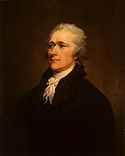 By 1792-94 newspapers started calling Hamilton supporters "Federalists" and their opponents "Democrats", "Republicans", "Jeffersonians" (people who supported Thomas Jefferson, the 3rd president), or "Democratic-Republicans". Jefferson's supporters usually called themselves "Republicans" and their party the "Republican Party." The Federalist party became popular with businessmen and New Englanders; Republicans were mostly farmers who opposed a strong central government . The Congregationalists and the Episcopalians
supported the Federalists; most of the Presbyterians, Baptists, and other minority denominations tended toward the Republican camp. Cities were usually Federalist; frontier regions were heavily Republican. These are generalizations; there are special cases: the
Presbyterians of upland North Carolina, who had immigrated just before the Revolution, and often been Tories, became Federalists. Catholics in Maryland were generally Federalist.
The state networks of both parties began to operate in 1794 or 1795. Patronage now became a factor. The winner-take-all
election system opened a wide gap between winners, who got all the patronage, and losers, who got none. Hamilton had over 2000 Treasury jobs to dispense, while Jefferson had one part-time job in the State Department, which he gave to journalist Philip Freneau to attack the federalists. In New York, however, George Clinton
won the election for governor
and used the vast state patronage fund to help the Republican cause.
Washington tried and failed to moderate the feud between his two top cabinet members. He was re-elected without opposition in 1792. The Democratic-Republicans nominated New York's Governor Clinton to replace Federalist John Adams
as vice president, but Adams won. The balance of power in Congress was close, with some members still undecided between the parties. In early 1793, Jefferson secretly prepared resolutions introduced by William Branch Giles
, Congressman from Virginia, and designed to repudiate Hamilton and weaken the Washington Administration. Hamilton defended his administration of the nation's complicated financial affairs, which none of his critics could decipher until the arrival in Congress of the Republican Albert Gallatin
in 1793.
Federalists counterattacked by claiming the Hamiltonian program had restored national prosperity, as shown in one 1792 anonymous newspaper essay:
Jefferson wrote on February 12, 1798:
Source: Kenneth C. Martis
, The Historical Atlas of Political Parties in the United States Congress, 1789–1989 (1989); the numbers are estimates by historians.
The affiliation of many Congressmen in the earliest years is an assignment by later historians. The parties were slowly coalescing groups; at first there were many independents. Cunningham noted that only about a quarter of the House of Representatives, up until 1794, voted with Madison as much as two-thirds of the time, and another quarter against him two-thirds of the time, leaving almost half as fairly independent.
and the subsequent war between royalist Britain and republican France — decisively shaped American politics in 1793–1800, and threatened to entangle the nation in wars that "mortally threatened its very existence." The French revolutionaries guillotine
d King Louis XVI
in January 1793, leading the British to declare war to restore the monarchy. The King had been decisive in helping America achieve independence. Now he was dead and many of the pro-American aristocrats in France were exiled or executed. Federalists warned that American republicans threatened to replicate the horrors of the French Revolution, and successfully mobilized most conservatives and many clergymen. The Republicans, some of whom had been strong Francophiles, responded with support, even through the Reign of Terror
, when thousands were guillotined. Many of those executed had been friends of the United States, such as the Comte D'Estaing
, whose fleet defeated the British at Yorktown
. (Lafayette
had already fled into exile, and Thomas Paine
went to prison in France.) The Republicans denounced Hamilton, Adams, and even Washington as friends of Britain, as secret monarchists
, and as enemies of the republican values. The level of rhetoric reached a fever pitch.
Paris in 1793 sent a new minister, Edmond-Charles Genêt
(known as Citizen Genêt), who systematically mobilized pro-French sentiment and encouraged Americans to support France's war against Britain and Spain. Genêt funded local Democratic-Republican Societies
that attacked Federalists. He hoped for a favorable new treaty and for repayment of the debts owed to France. Acting aggressively, Genêt outfitted privateers that sailed with American crews under a French flag and attacked British shipping. He tried to organize expeditions of Americans to invade Spanish Louisiana and Spanish Florida. When Secretary of State Jefferson told Genêt he was pushing American friendship past the limit, Genêt threatened to go over the government's head and rouse public opinion on behalf of France. Even Jefferson agreed this was blatant foreign interference in domestic politics. Genêt's extremism seriously embarrassed the Jeffersonians and cooled popular support for promoting the French Revolution and getting involved in its wars. Recalled to Paris for execution, Genêt kept his head and instead went to New York, where he became a citizen and married the daughter of Governor Clinton. Jefferson left office, ending the coalition cabinet and allowing the Federalists to dominate.
The Jay Treaty
in 1794–95 was the effort by Washington and Hamilton to resolve numerous difficulties with Britain. Some of these issues dated to the Revolution; such as boundaries, debts owed in each direction, and the continued presence of British forts in the Northwest Territory
. In addition America hoped to open markets in the British Caribbean and end disputes stemming from the naval war between Britain and France. Most of all the goal was to avert a war with Britain — a war opposed by the Federalists, that some historians claim the Jeffersonians wanted.
As a neutral party, the United States argued, it had the right to carry goods anywhere it wanted. The British nevertheless seized American ships carrying goods from the French West Indies
. The Federalists favored Britain in the war, and by far most of America's foreign trade was with Britain; hence a new treaty was called for. The British agreed to evacuate the western forts, open their West Indies ports to American ships, allow small vessels to trade with the French West Indies, and set up a commission that would adjudicate American claims against Britain for seized ships, and British claims against Americans for debts incurred before 1775. One possible alternative was war with Britain, a war that America was ill-prepared to fight.
The Republicans wanted to pressure Britain to the brink of war (and assumed that America could defeat a weak Britain). Therefore they denounced the Jay Treaty as an insult to American prestige, a repudiation of the French alliance of 1777, and a severe shock to Southern planters who owed those old debts, and who were never to collect for the lost slaves the British captured. Republicans protested against the treaty, but the Federalists controlled the Senate and they ratified it by exactly the necessary ⅔ vote, 20–10, in 1795. The pendulum of public opinion swung toward the Republicans after the Treaty fight, and in the South the Federalists lost most of the support they had among planters.
. Corn, the chief crop on the frontier, was too bulky to ship over the mountains to market, unless it was first distilled into whiskey. This was profitable, as the United States population consumed, per capita, relatively large quantities of liquor. After the excise tax, the backwoodsmen complained the tax fell on them rather than on the consumers. Cash poor, they were outraged that they had been singled out to pay off the "financiers and speculators" back East, and to salary the federal revenue officers who began to swarm the hills looking for illegal stills.
Insurgents in western Pennsylvania shut the courts and hounded federal officials, but Jeffersonian leader Albert Gallatin
mobilized the western moderates, and thus forestalled a serious outbreak. Washington, seeing the need to assert federal supremacy, called out 13,000 state militia, and marched toward Pittsburgh to suppress this Whiskey Rebellion
. The rebellion evaporated in late 1794 as Washington approached, personally leading the army (only two sitting Presidents have directly led American military forces, Washington during the Whiskey Rebellion and Madison in an attempt to save the White House during the War of 1812). The rebels dispersed and there was no fighting. Federalists were relieved that the new government proved capable of overcoming rebellion, while Republicans, with Gallatin their new hero, argued there never was a real rebellion and the whole episode was manipulated in order to accustom Americans to a standing army
.
Angry petitions flowed in from three dozen Democratic-Republican Societies
created by Citizen Genêt. Washington attacked the societies as illegitimate; many disbanded. Federalists now ridiculed Republicans as "democrats" (meaning in favor of mob rule
) or "Jacobins" (a reference to The Terror in France).
Washington refused to run for a third term, establishing a two-term precedent that was to stand until 1940 and eventually to be enshrined in the Constitution as the 22nd Amendment
. Washington warned in his Farewell Address against involvement in European wars, and lamented the rising North-South sectionalism and party spirit in politics that threatened national unity. The party spirit, he lamented:
Washington refused to consider himself a member of any party, although in retrospect he is usually regarded as a Federalist because of greater tendency to side with Hamilton than with Jefferson.
blasted the administration with all the scurrility at their command. Bache in particular targeted Washington himself as the front man for monarchy who must be exposed. To Bache, Washington was a cowardly general and a money-hungry baron who saw the Revolution as a means to advance his fortune and fame, Adams was a failed diplomat who never forgave the French their love of Benjamin Franklin
and who craved a crown for himself and his descendants, and Alexander Hamilton was the most inveterate monarchist of them all. The Federalists, with twice as many newspapers at their command, slashed back with equal vituperation; John Fenno
and "Peter Porcupine" (William Cobbett
) were their nastiest pensmen, and Noah Webster
their most learned; Hamilton subsidized the Federalist editors, wrote for their papers, and in 1801 established his own paper, the New York Evening Post
. Though his reputation waned considerably following his death, Joseph Dennie
ran three of the most popular and influential newspapers of the period, The Farmer's Weekly Museum, the Gazette of the United States
and Port Folio.
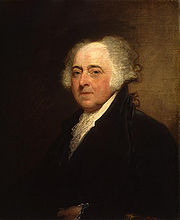 Hamilton distrusted Vice President Adams — who felt the same way about Hamilton — but was unable to block his claims to the succession. The election of 1796 was the first partisan affair in the nation's history, and one of the more scurrilous in terms of newspaper attacks. Adams swept New England and Jefferson the South, with the middle states leaning to Adams. Thus Adams was the winner by a margin of three electoral votes
, and Jefferson, as the runner-up, became Vice President under the system set out in the Constitution prior to the ratification of the 12th Amendment
.
Foreign affairs continued to be the central concern of American politics, for the war raging in Europe threatened to drag in the United States. The new President was a loner, who made decisions without consulting Hamilton or other High Federalists. Benjamin Franklin once quipped that Adams was a man always honest, often brilliant, and sometimes mad. Adams was popular among the Federalist rank and file, but had neglected to build state or local political bases of his own, and neglected to take control of his own cabinet. As a result his cabinet answered more to Hamilton than to himself.
(1797), public opinion ran strongly against the French. An undeclared "Quasi-War
" with France from 1798 to 1800, saw each side attacking and capturing the other's shipping. It was called "quasi" because there was no declaration of war, but escalation was a serious threat. The Federalists, at the peak of their popularity, took advantage by preparing for an invasion by the French Army.
To silence Administration critics, the Federalists passed the Alien and Sedition Acts
in 1798. The Alien Act empowered the President to deport such aliens as he declared to be dangerous. The Sedition Act made it a crime to print false, scandalous, and malicious criticisms of the federal government, but it conspicuously failed to criminalize criticism of Vice President Thomas Jefferson. Several Democratic-Republican newspaper editors were convicted under the Act and fined or jailed, and three Democratic-Republican newspapers were shut down. During this period, Jefferson and Madison secretly wrote the Kentucky and Virginia Resolutions
passed by the two states' legislatures, that declared the Alien and Sedition Acts unconstitutional, and insisted the states had the power to nullify
federal laws.
Undaunted, the Federalists created a navy
, with new frigate
s, and a large new army, with Washington in nominal command and Hamilton in actual command. To pay for it all they raised taxes on land, houses and slaves, leading to serious unrest. In one part of Pennsylvania the Fries' Rebellion
broke out, with people refusing to pay the new taxes. John Fries was sentenced to death for treason, but received a pardon from Adams. In the elections of 1798 the Federalists did very well, but this issue started hurting the Federalists in 1799.
Early in 1799, Adams decided to free himself from Hamilton's overbearing influence, stunning the country and throwing his party into disarray by announcing a new peace mission to France. The mission eventually succeeded, the "Quasi-War" ended, and the new army was largely disbanded. Hamiltonians called Adams a failure, and in turn Adams fired Hamilton's supporters still in the cabinet.
Hamilton and Adams intensely disliked one another, and the Federalists split between supporters of Hamilton ("High Federalists") and supporters of Adams. Hamilton became embittered over his loss of political influence and wrote a scathing criticism of Adams' performance as President of the United States in an effort to throw Federalist support to Charles Cotesworth Pinckney
; inadvertently this split the Federalists and helped give the victory to Jefferson.
had not been enacted, he most likely would have won reelection since many Federalist legislatures removed the right to select electors from their constituents in fear of a Democratic victory. Jefferson was again the opponent and Federalists pulled out all stops in warning that he was a dangerous revolutionary, hostile to religion, who would weaken the government, damage the economy, and get into war with Britain. The Republicans crusaded against the Alien and Sedition laws, and the new taxes, and proved highly effective in mobilizing popular discontent.
The election hinged on New York: its electors
were selected by the legislature, and given the balance of north and south, they would decide the presidential election. Aaron Burr
brilliantly organized his forces in New York City
in the spring elections for the state legislature. By a few hundred votes he carried the city—and thus the state legislature—and guaranteed the election of a Democratic-Republican President. As a reward he was selected by the Republican caucus
in Congress as their vice presidential candidate. Hamilton, knowing the election was lost anyway, went public with a sharp attack on Adams that further divided and weakened the Federalists.
Because the Republicans failed to plan by instructing at least one of their electors to vote for Jefferson but not Burr in the electoral college, Burr and Jefferson received the same vote, 73 each, so it was up to the House of Representatives to break the tie. There the Federalists were strong enough to deadlock the election, with some talk of their throwing their support to elect Burr. Hamilton considered Burr to be a scoundrel and threw his weight into the contest, allowing Jefferson to take office. (This unintended complication led directly to the proposal and ratification of the 12th Amendment
.) "We are all republicans—we are all federalists," proclaimed Jefferson in his inaugural address. His patronage policy was to let the Federalists disappear through attrition. Those Federalists such as John Quincy Adams
(John Adams' own son) and Rufus King
willing to work with him were rewarded with senior diplomatic posts, but there was no punishment of the opposition.
Jefferson had a very successful first term, typified by the Louisiana Purchase
, which was ironically supported by Hamilton but opposed by most Federalists at the time as unconstitutional. Shortly before Hamilton's death, some Federalist leaders (see Essex Junto
) began courting Jefferson's Vice-President and Hamilton's arch-nemesis Aaron Burr in an attempt to swing New York into an independent confederation with the New England states, which along with New York were supposed to secede from the United States after Burr's election to Governor. However, Hamilton's influence cost Burr the governorship of New York, a key in the Essex Junto's plan, just as Hamilton's influence had cost Burr the Presidency nearly 4 years before. Hamilton's thwarting of Aaron Burr's ambitions for the second time was too much for Burr to bear. Hamilton had known of the Essex Junto (whom Hamilton now regarded as apostate Federalists), and Burr's plans and opposed them vehemently. This opposition by Hamilton would lead to his fatal duel with Burr in July, 1804.
The thoroughly disorganized Federalists hardly offered any opposition to Jefferson's reelection in 1804, after his successful first term (by this point, the Federalists were now largely without a strong leader after the untimely death of Alexander Hamilton
and with Aaron Burr now a fugitive of the law). In New England and in some districts in the middle states the Federalists clung to power, but the tendency from 1800 to 1812 was steady slippage almost everywhere, as the Republicans perfected their organization and the Federalists tried to play catch-up. Some younger leaders tried to emulate the Democratic-Republican tactics, but their overall disdain of democracy along with the upper class bias of the party leadership eroded public support. In the South, the Federalists steadily lost ground everywhere.
), and the retirement of Adams, the Federalists were left without a strong leader, beyond John Marshall
, whose appointment to the Supreme Court made him incapable of running for further office. A few younger leaders did appear, notably Daniel Webster
. Federalist policies favored factories, banking, and trade over agriculture, and thus became unpopular in the growing Western states. They were increasingly seen as aristocratic and unsympathetic to democracy. In the South the party had lingering support in Maryland
, but elsewhere was crippled by 1800 and faded away by 1808.
Massachusetts and Connecticut were the party strongholds. One historian explains how well organized the party was in Connecticut:
After 1800 the major Federalist role came in the judiciary. Although Jefferson managed to repeal the Judiciary Act of 1801 and thus dismiss many Federalist judges, their effort to impeach Supreme Court Justice Samuel Chase
in 1804 failed. Led by the last great Federalist, John Marshall
as Chief Justice
from 1801 to 1835, the Supreme Court carved out a unique and powerful role as the protector of the Constitution and promoter of nationalism.
President Jefferson imposed an embargo on Britain in 1807; the Embargo Act of 1807
prevented all American ships from sailing to a foreign port. The idea was that the British were so dependent on American supplies that they would come to terms. For 15 months the Embargo wrecked American export businesses, largely based in the Boston-New York region, causing a sharp depression in the Northeast. Evasion was common and Jefferson and Treasury Secretary Gallatin responded with tightened police controls more severe than anything the Federalists had ever proposed. Public opinion was highly negative, and a surge of support breathed fresh life into the Federalist party. The Republicans (slowly assuming the name "Democratic-Republicans") nominated Madison for the presidency in 1808. Federalists, meeting in the first-ever national convention, considered the option of nominating Vice President George Clinton
as their own candidate, but balked at working with him and again chose Charles Cotesworth Pinckney
, their 1804 candidate. Madison lost New England but swept the rest of the country and carried a Republican Congress. Madison dropped the Embargo, opened up trade again, and offered a carrot and stick approach. If either France or Britain agreed to stop their violations of American neutrality, the U.S. would cut off trade with the other country. Tricked by Napoleon into believing France had acceded to his demands, Madison turned his wrath on Britain, and the War of 1812
began.
, and war was the burning issue. In their second national convention, the Federalists, now the peace party, nominated DeWitt Clinton
, the dissident Democratic-Republican mayor of New York City
, and an articulate opponent of the war. Madison ran for reelection promising a relentless war against Britain and an honorable peace. Clinton, denouncing Madison's weak leadership and incompetent preparations for war, could count on New England and New York. To win he needed the middle states and there the campaign was fought out. Those states were competitive and had the best-developed local parties and most elaborate campaign techniques, including nominating conventions and formal party platform
s. The Tammany Society
in New York City highly favored Madison; the Federalists finally adopted the club idea in 1808. Their Washington Benevolent Societies
were semi-secret membership organizations which played a critical role in every northern state in holding meetings and rallies and mobilizing Federalist votes. New Jersey went for Clinton, but Madison carried Pennsylvania and thus was reelected with 59% of the Electoral votes.
went poorly for the Americans for two years. Even though Britain was concentrating its military efforts on its war with
Napoleon
, the United States still failed to make any headway on land, and was effectively blockaded at sea by the Royal Navy
. The British raided and burned Washington, D.C.
in 1814 and sent a force to capture New Orleans
.
The war was especially unpopular in New England: the New England economy was highly dependent on trade, and the British blockade threatened to destroy it entirely. In 1814, the British finally managed to enforce their blockade on the New England coast, so the Federalists of New England sent delegates to the Hartford Convention
in December 1814.
During the proceedings of the Hartford Convention, secession from the Union was discussed, though the resulting report listed a set of grievances against the Democratic-Republican federal government and proposed a set of Constitutional amendments to address these grievances. They demanded financial assistance from Washington to compensate for lost trade and proposed constitutional amendments requiring a two-thirds vote in Congress before an embargo could be imposed, new states admitted, or war declared. It also indicated that if these proposals were ignored, then another convention should be called and given "such powers and instructions as the exigency of a crisis may require". The Federalist Massachusetts Governor had already secretly sent word to England to broker a separate peace accord. Three Massachusetts "ambassadors" were sent to Washington to negotiate on the basis of this report.
By the time the Federalist "ambassadors" got to Washington, the war was over and news of Andrew Jackson
's stunning victory in the Battle of New Orleans
had raised American morale immensely. The "ambassadors" slunk back to Massachusetts, but not before they had done fatal damage to the Federalist Party. The Federalists were thereafter associated with the disloyalty and parochialism of the Hartford Convention, and destroyed as a political force. They fielded their last presidential candidate (Rufus King
) in 1816, and their last serious vice-presidential candidate (Richard Stockton) in 1820. With its passing partisan hatreds and newspaper feuds on the decline, the nation entered the "Era of Good Feelings
", marked by the absence of all but one political party. After the dissolution of the final Federalist congressional caucus
in 1825, the last traces of Federalist activity came in Delaware
state politics in the late 1820s, where in 1826 Governor Charles Polk, Jr.
was elected, the last significant Federalist office holder in the United States, and as late as 1828 the party won control of the legislature
.
held profoundly conservative views atuned to the American character. As Samuel Eliot Morison
explained, They believed that liberty is inseparable from union, that men are essentially unequal, that vox populi [voice of the people] is seldom if ever vox Dei [the voice of God], and that sinister outside influences are busy undermining American integrity. Historian Patrick Allitt
concludes that Federalists promoted many positions that would form the baseline for later American conservatism, including the rule of law under the Constitution, republican government, peaceful change through elections, judicial supremacy, stable national finances, credible and active diplomacy, and protection of wealth.
The Federalists were dominated by businessmen and merchants in the major cities who supported a strong national government. The party was closely linked to the modernizing, urbanizing, financial policies of Alexander Hamilton. These policies included the funding of the national debt and also assumption of state debts incurred during the Revolutionary War, the incorporation of a national Bank of the United States
, the support of manufactures and industrial development, and the use of a tariff to fund the Treasury. In foreign affairs the Federalists opposed the French Revolution, engaged in the "Quasi War" (an undeclared naval war) with France in 1798–99, sought good relations with Britain and sought a strong army and navy. Ideologically the controversy between Republicans and Federalists stemmed from a difference of principle and style. In terms of style the Federalists distrusted the public, thought the elite should be in charge, and favored national power over state power. Republicans distrusted Britain, bankers, merchants and did not want a powerful national government. The Federalists, notably Hamilton, were distrustful of "the people," the French, and the Republicans. In the end, the nation synthesized the two positions, adopting representative democracy and a strong nation state. Just as importantly, American politics by the 1820s accepted the two-party system whereby rival parties stake their claims before the electorate, and the winner takes control of the government.
As time went on, the Federalists lost appeal with the average voter and were generally not equal to the tasks of party organization; hence, they grew steadily weaker as the political triumphs of the Republican Party grew. For economic and philosophical reasons, the Federalists tended to be pro-British – the United States engaged in more trade with Great Britain
than with any other country – and vociferously opposed Jefferson's Embargo Act of 1807 and the seemingly deliberate provocation of war with Britain by the Madison Administration. During "Mr. Madison's War", as they called it, the Federalists attempted a comeback but the patriotic euphoria that followed the war undercut their pessimistic appeals.
After 1816 the Federalists had no national influence apart from John Marshall
's Supreme Court. They had some local support in New England, New York, eastern Pennsylvania, Maryland and Delaware. After the collapse of the Democratic-Republican Party in the course of the 1824 presidential election, most surviving Federalists (including Daniel Webster
) joined former Democratic-Republicans like Henry Clay
to form the National Republican Party
, which was soon combined with other anti-Jackson groups to form the Whig Party
in 1833. Some former Federalists like James Buchanan
and Roger B. Taney
became Jacksonian Democrats.
The "Old Republicans," led by John Randolph of Roanoke
, refused to form a coalition with the Federalists and instead set up a separate opposition since Jefferson, Madison, Gallatin, Monroe, John C. Calhoun
and Clay had in effect adopted Federalist principles by purchasing the Louisiana Territory, chartering the Second national bank, promoting internal improvements (like roads), raising tariffs to protect factories, and promoting a strong army and navy after the failures of the War of 1812.
The name "Federalist" came increasingly to be used in political rhetoric as a term of abuse, and was denied by the Whigs, who pointed out that their leader Henry Clay was the Democratic-Republican party leader in Congress during the 1810s. Most Northern Whig party members after its dissolution in 1856 would start and join the Republican Party
created in 1856 that survives to this day while some former southern Whigs would join the Democratic Party
.
First Party System
The First Party System is a model of American politics used by political scientists and historians to periodize the political party system existing in the United States between roughly 1792 and 1824. It featured two national parties competing for control of the presidency, Congress, and the states:...
, with remnants lasting into the 1820s. The Federalists controlled the federal government until 1801. The party was formed by Alexander Hamilton
Alexander Hamilton
Alexander Hamilton was a Founding Father, soldier, economist, political philosopher, one of America's first constitutional lawyers and the first United States Secretary of the Treasury...
, who, during George Washington
George Washington
George Washington was the dominant military and political leader of the new United States of America from 1775 to 1799. He led the American victory over Great Britain in the American Revolutionary War as commander-in-chief of the Continental Army from 1775 to 1783, and presided over the writing of...
's first term, built a network of supporters, largely urban bankers and businessmen, to support his fiscal policies. These supporters grew into the Federalist Party committed to a fiscally sound and nationalistic government. The United States' only Federalist president was John Adams
John Adams
John Adams was an American lawyer, statesman, diplomat and political theorist. A leading champion of independence in 1776, he was the second President of the United States...
; although George Washington
George Washington
George Washington was the dominant military and political leader of the new United States of America from 1775 to 1799. He led the American victory over Great Britain in the American Revolutionary War as commander-in-chief of the Continental Army from 1775 to 1783, and presided over the writing of...
was broadly sympathetic to the Federalist program, he remained an independent his entire presidency.
The Federalist policies called for a national bank, tariffs, and good relations with Britain as expressed in the Jay Treaty
Jay Treaty
Jay's Treaty, , also known as Jay's Treaty, The British Treaty, and the Treaty of London of 1794, was a treaty between the United States and Great Britain that is credited with averting war,, resolving issues remaining since the Treaty of Paris of 1783, which ended the American Revolution,, and...
negotiated in 1794. Their political opponents, the Democratic-Republicans, led by Thomas Jefferson
Thomas Jefferson
Thomas Jefferson was the principal author of the United States Declaration of Independence and the Statute of Virginia for Religious Freedom , the third President of the United States and founder of the University of Virginia...
and James Madison
James Madison
James Madison, Jr. was an American statesman and political theorist. He was the fourth President of the United States and is hailed as the “Father of the Constitution” for being the primary author of the United States Constitution and at first an opponent of, and then a key author of the United...
, denounced most of the Federalist policies, especially the bank, and vehemently attacked the Jay Treaty as a sell-out of republican values
Republicanism in the United States
Republicanism is the political value system that has been a major part of American civic thought since the American Revolution. It stresses liberty and inalienable rights as central values, makes the people as a whole sovereign, supports activist government to promote the common good, rejects...
to the British monarchy. The Jay Treaty passed, and indeed the Federalists won most of the major legislative battles in the 1790s. They held a strong base in the nation's cities and in New England. The Democratic-Republicans, with their base in the rural South, won the hard-fought election of 1800; the Federalists never returned to power. The Federalists, too wedded to an upper-class style to win the support of ordinary voters, grew weaker year by year. They recovered some strength by intense opposition to the War of 1812
War of 1812
The War of 1812 was a military conflict fought between the forces of the United States of America and those of the British Empire. The Americans declared war in 1812 for several reasons, including trade restrictions because of Britain's ongoing war with France, impressment of American merchant...
; they practically vanished during the Era of Good Feelings
Era of Good Feelings
The Era of Good Feelings was a period in United States political history in which partisan bitterness abated. It lasted approximately from 1815 to 1825, during the administration of U.S...
that followed the end of the war in 1815.
The Federalists left a lasting imprint as they fashioned a strong new government with a sound financial base, and (in the person of Chief Justice John Marshall
John Marshall
John Marshall was the Chief Justice of the United States whose court opinions helped lay the basis for American constitutional law and made the Supreme Court of the United States a coequal branch of government along with the legislative and executive branches...
) decisively shaped Supreme Court policies for another three decades.
The rise of the Federalist Party
On taking office in 1789 President Washington nominated New York lawyer Alexander Hamilton to the office of Secretary of the TreasuryUnited States Secretary of the Treasury
The Secretary of the Treasury of the United States is the head of the United States Department of the Treasury, which is concerned with financial and monetary matters, and, until 2003, also with some issues of national security and defense. This position in the Federal Government of the United...
. Hamilton wanted a strong national government with financial credibility. Hamilton proposed the ambitious Hamiltonian economic program
Hamiltonian economic program
The Hamiltonian economic program was the set of measures that were proposed by American Founding Father and 1st Secretary of the Treasury Alexander Hamilton in three notable reports and implemented by Congress during George Washington's first administration....
that involved assumption of the state debts incurred during the American Revolution
American Revolution
The American Revolution was the political upheaval during the last half of the 18th century in which thirteen colonies in North America joined together to break free from the British Empire, combining to become the United States of America...
, creating a national debt and the means to pay it off, and setting up a national bank. James Madison
James Madison
James Madison, Jr. was an American statesman and political theorist. He was the fourth President of the United States and is hailed as the “Father of the Constitution” for being the primary author of the United States Constitution and at first an opponent of, and then a key author of the United...
, Hamilton's ally in the fight to ratify
Federalist Papers
The Federalist Papers are a series of 85 articles or essays promoting the ratification of the United States Constitution. Seventy-seven of the essays were published serially in The Independent Journal and The New York Packet between October 1787 and August 1788...
the United States Constitution, joined with Thomas Jefferson
Thomas Jefferson
Thomas Jefferson was the principal author of the United States Declaration of Independence and the Statute of Virginia for Religious Freedom , the third President of the United States and founder of the University of Virginia...
in opposing Hamilton's program. Political parties had not been expected when the Constitution was drafted in 1787 and ratified in 1788, even though both Hamilton and Madison played major roles. Parties were considered to be divisive and harmful to republicanism
Republicanism in the United States
Republicanism is the political value system that has been a major part of American civic thought since the American Revolution. It stresses liberty and inalienable rights as central values, makes the people as a whole sovereign, supports activist government to promote the common good, rejects...
. No similar parties existed anywhere in the world.
By 1790 Hamilton started building a nationwide coalition. Realizing the need for vocal political support in the states, he formed connections with like-minded nationalists and used his network of treasury agents to link together friends of the government, especially merchants and bankers, in the new nation's dozen major cities. His attempts to manage politics in the national capital to get his plans through Congress, then, "brought strong responses across the country. In the process, what began as a capital faction soon assumed status as a national faction and then, finally, as the new Federalist party."
Episcopal Church (United States)
The Episcopal Church is a mainline Anglican Christian church found mainly in the United States , but also in Honduras, Taiwan, Colombia, Ecuador, Haiti, the Dominican Republic, Venezuela, the British Virgin Islands and parts of Europe...
supported the Federalists; most of the Presbyterians, Baptists, and other minority denominations tended toward the Republican camp. Cities were usually Federalist; frontier regions were heavily Republican. These are generalizations; there are special cases: the
Presbyterians of upland North Carolina, who had immigrated just before the Revolution, and often been Tories, became Federalists. Catholics in Maryland were generally Federalist.
The state networks of both parties began to operate in 1794 or 1795. Patronage now became a factor. The winner-take-all
Plurality voting system
The plurality voting system is a single-winner voting system often used to elect executive officers or to elect members of a legislative assembly which is based on single-member constituencies...
election system opened a wide gap between winners, who got all the patronage, and losers, who got none. Hamilton had over 2000 Treasury jobs to dispense, while Jefferson had one part-time job in the State Department, which he gave to journalist Philip Freneau to attack the federalists. In New York, however, George Clinton
George Clinton (vice president)
George Clinton was an American soldier and politician, considered one of the Founding Fathers of the United States. He was the first Governor of New York, and then the fourth Vice President of the United States , serving under Presidents Thomas Jefferson and James Madison. He and John C...
won the election for governor
Governor of New York
The Governor of the State of New York is the chief executive of the State of New York. The governor is the head of the executive branch of New York's state government and the commander-in-chief of the state's military and naval forces. The officeholder is afforded the courtesy title of His/Her...
and used the vast state patronage fund to help the Republican cause.
Washington tried and failed to moderate the feud between his two top cabinet members. He was re-elected without opposition in 1792. The Democratic-Republicans nominated New York's Governor Clinton to replace Federalist John Adams
John Adams
John Adams was an American lawyer, statesman, diplomat and political theorist. A leading champion of independence in 1776, he was the second President of the United States...
as vice president, but Adams won. The balance of power in Congress was close, with some members still undecided between the parties. In early 1793, Jefferson secretly prepared resolutions introduced by William Branch Giles
William Branch Giles
William Branch Giles ; the name is pronounced jyles) was an American statesman, long-term Senator from Virginia, and the 24th Governor of Virginia...
, Congressman from Virginia, and designed to repudiate Hamilton and weaken the Washington Administration. Hamilton defended his administration of the nation's complicated financial affairs, which none of his critics could decipher until the arrival in Congress of the Republican Albert Gallatin
Albert Gallatin
Abraham Alfonse Albert Gallatin was a Swiss-American ethnologist, linguist, politician, diplomat, congressman, and the longest-serving United States Secretary of the Treasury. In 1831, he founded the University of the City of New York...
in 1793.
Federalists counterattacked by claiming the Hamiltonian program had restored national prosperity, as shown in one 1792 anonymous newspaper essay:
To what physical, moral, or political energy shall this flourishing state of things be ascribed? There is but one answer to these inquiries: Public credit is restored and ESTABLISHED. The general government, by uniting and calling into action the pecuniary resources of the states, has created a new capital stock of several millions of dollars, which, with that before existing, is directed into every branch of business, giving life and vigor to industry in its infinitely diversified operation. The enemies of the general government, the funding act and the National Bank may bellow tyranny, aristocracy, and speculators through the Union and repeat the clamorous din as long as they please; but the actual state of agriculture and commerce, the peace, the contentment and satisfaction of the great mass of people, give the lie to their assertions.
Jefferson wrote on February 12, 1798:
- Two political Sects have arisen within the U. S. the one believing that the executive is the branch of our government which the most needs support; the other that like the analogous branch in the English Government, it is already too strong for the republican parts of the Constitution; and therefore in equivocal cases they incline to the legislative powers: the former of these are called federalists, sometimes aristocrats or monocrats, and sometimes tories, after the corresponding sect in the English Government of exactly the same definition: the latter are stiled republicans, whigs, jacobins, anarchists, disorganizers, etc. these terms are in familiar use with most persons."
Party strength in Congress
Many Congressmen were hard to classify in the first few years, but after 1796 there was less uncertainty.| Election year | |||||||||||||||||
|---|---|---|---|---|---|---|---|---|---|---|---|---|---|---|---|---|---|
| House | 1788 United States House election, 1789 The U.S. House elections, 1789 were the first elections for the United States House of Representatives in 1789, which coincided with the election of President George Washington. Some candidates were chosen in 1788, others in 1789. Dates and manners of elections were set by the states... |
1790 United States House election, 1790 The U.S. House election, 1790 was an election for the United States House of Representatives in 1790 which occurred in the middle of President George Washington's first term... |
1792 United States House election, 1792 The U.S. House election, 1792 was an election for the United States House of Representatives in 1792 which coincided with the re-election of President George Washington. While Washington ran for president as an independent, his followers formed the nation's first organized political party, the... |
1794 United States House election, 1794 The U.S. House election, 1794 was an election for the United States House of Representatives to the Fourth United States Congress during President George Washington's second term. Voting in the various states took place between August 1794 and September 1795 . Congress was convened on December 7,... |
1796 United States House election, 1796 The U.S. House election, 1796 was an election for the United States House of Representatives to the Fifth United States Congress. Voting in the various states took place between August 1796 and October 1797 . The first session was convened on May 15, 1797 at the proclamation of the new President... |
1798 United States House election, 1798 Elections to the United States House of Representatives took place in 1798 and 1799. Voting in the various states for Representatives in the Sixth United States Congress took place at times ranging from April 1798 in New York to August 1799 in Tennessee, even after the legal begin of the Congress... |
1800 United States House election, 1800 Elections to the United States House of Representatives were held in 1800, concurrently with the 1800 presidential election, in which Vice President Thomas Jefferson, a Democratic Republican, defeated incumbent President John Adams, a Federalist.... |
1802 United States House election, 1802 The U.S. House election, 1802 was an election to the United States House of Representatives for the Eighth United States Congress. Voting in the various states took place between April 1802 and December 1803 with the Congress, convened by a proclamation of President Jefferson, meeting on October... |
1804 United States House election, 1804 The U.S. House election, 1804 was an election for the United States House of Representatives to the Ninth United States Congress. Voting in the various states took place between April 1804 and August 1805 with the Congress meeting on December 2, 1805.Under the popular reign of Thomas Jefferson,... |
1806 United States House election, 1806 The U.S. House election, 1806 was an election for the United States House of Representatives to the Tenth United States Congress. Voting in the various states took place between April 1806 and August 1807 with the Congress meeting on October 26, 1807.The Democratic-Republicans continued to... |
1808 United States House election, 1808 The U.S. House election, 1808 was an election for the United States House of Representatives to the Eleventh United States Congress. Voting in the various states took place between April 1808 and May 1809 with the Congress meeting on May 22, 1809.Although Democratic-Republicans maintained control... |
1810 United States House election, 1810 The U.S. House election, 1810 was an election for the United States House of Representatives to the Twelfth United States Congress. Voting in the various states took place between April 1810 and August 1811 . Louisiana elected its first representative in September 1812... |
1812 United States House election, 1812 The U.S. House election, 1812 was an election for the United States House of Representatives to the thirteenth Congress. Voting in the various states took place between August 3, 1812 and May 1, 1813... |
1814 United States House election, 1814 The U.S. House election, 1814 was an election for the United States House of Representatives to the Fourteenth United States Congress. Voting in the various states was held between April 1814 and August 10, 1815 . The Congress met on December 4, 1815... |
1816 United States House election, 1816 The U.S. House election, 1816 was an election for the United States House of Representatives to the Fifteenth United States Congress. Voting in the various states took place between April 1816 and August 14, 1817 . The Congress met on December 1, 1817... |
1818 United States House election, 1818 The U.S. House election, 1818 was an election for the United States House of Representatives to the Sixteenth United States Congress. Voting in the various states was held between April 1818 and September 1819... |
1820 United States House election, 1820 The U.S. House election, 1820 was an election for the United States House of Representatives to the seventeenth Congress. Voting in the various states took place between July 3, 1820 and August 10, 1821 . In four states the election coincided with the taking of the 4th Census... |
| Federalist | 37 | 39 | 51 | 47 | 57 | 60 | 38 | 39 | 25 | 24 | 50 | 36 | 68 | 64 | 39 | 26 | 32 |
| Democratic-Republican | 28 | 30 | 54 | 59 | 49 | 46 | 65 | 103 | 116 | 118 | 92 | 107 | 114 | 119 | 146 | 160 | 155 |
| % Democratic-Republican | 43% | 43% | 51% | 56% | 46% | 43% | 63% | 73% | 82% | 83% | 65% | 75% | 63% | 65% | 79% | 86% | 83% |
| Senate | 1788 | 1790 United States House election, 1790 The U.S. House election, 1790 was an election for the United States House of Representatives in 1790 which occurred in the middle of President George Washington's first term... |
1792 United States House election, 1792 The U.S. House election, 1792 was an election for the United States House of Representatives in 1792 which coincided with the re-election of President George Washington. While Washington ran for president as an independent, his followers formed the nation's first organized political party, the... |
1794 United States House election, 1794 The U.S. House election, 1794 was an election for the United States House of Representatives to the Fourth United States Congress during President George Washington's second term. Voting in the various states took place between August 1794 and September 1795 . Congress was convened on December 7,... |
1796 United States House election, 1796 The U.S. House election, 1796 was an election for the United States House of Representatives to the Fifth United States Congress. Voting in the various states took place between August 1796 and October 1797 . The first session was convened on May 15, 1797 at the proclamation of the new President... |
1798 United States House election, 1798 Elections to the United States House of Representatives took place in 1798 and 1799. Voting in the various states for Representatives in the Sixth United States Congress took place at times ranging from April 1798 in New York to August 1799 in Tennessee, even after the legal begin of the Congress... |
1800 United States House election, 1800 Elections to the United States House of Representatives were held in 1800, concurrently with the 1800 presidential election, in which Vice President Thomas Jefferson, a Democratic Republican, defeated incumbent President John Adams, a Federalist.... |
1802 United States House election, 1802 The U.S. House election, 1802 was an election to the United States House of Representatives for the Eighth United States Congress. Voting in the various states took place between April 1802 and December 1803 with the Congress, convened by a proclamation of President Jefferson, meeting on October... |
1804 United States House election, 1804 The U.S. House election, 1804 was an election for the United States House of Representatives to the Ninth United States Congress. Voting in the various states took place between April 1804 and August 1805 with the Congress meeting on December 2, 1805.Under the popular reign of Thomas Jefferson,... |
1806 United States House election, 1806 The U.S. House election, 1806 was an election for the United States House of Representatives to the Tenth United States Congress. Voting in the various states took place between April 1806 and August 1807 with the Congress meeting on October 26, 1807.The Democratic-Republicans continued to... |
1808 United States House election, 1808 The U.S. House election, 1808 was an election for the United States House of Representatives to the Eleventh United States Congress. Voting in the various states took place between April 1808 and May 1809 with the Congress meeting on May 22, 1809.Although Democratic-Republicans maintained control... |
1810 United States House election, 1810 The U.S. House election, 1810 was an election for the United States House of Representatives to the Twelfth United States Congress. Voting in the various states took place between April 1810 and August 1811 . Louisiana elected its first representative in September 1812... |
1812 United States House election, 1812 The U.S. House election, 1812 was an election for the United States House of Representatives to the thirteenth Congress. Voting in the various states took place between August 3, 1812 and May 1, 1813... |
1814 United States House election, 1814 The U.S. House election, 1814 was an election for the United States House of Representatives to the Fourteenth United States Congress. Voting in the various states was held between April 1814 and August 10, 1815 . The Congress met on December 4, 1815... |
1816 United States House election, 1816 The U.S. House election, 1816 was an election for the United States House of Representatives to the Fifteenth United States Congress. Voting in the various states took place between April 1816 and August 14, 1817 . The Congress met on December 1, 1817... |
1818 United States House election, 1818 The U.S. House election, 1818 was an election for the United States House of Representatives to the Sixteenth United States Congress. Voting in the various states was held between April 1818 and September 1819... |
1820 United States House election, 1820 The U.S. House election, 1820 was an election for the United States House of Representatives to the seventeenth Congress. Voting in the various states took place between July 3, 1820 and August 10, 1821 . In four states the election coincided with the taking of the 4th Census... |
| Federalist | 18 | 16 | 16 | 21 | 22 | 22 | 15 | 9 | 7 | 6 | 7 | 6 | 8 | 12 | 12 | 9 | 7 |
| Democratic-Republican | 8 | 13 | 14 | 11 | 10 | 10 | 17 | 25 | 17 | 28 | 27 | 30 | 28 | 26 | 30 | 37 | 44 |
| % Democratic-Republican | 31% | 45% | 47% | 34% | 31% | 31% | 53% | 74% | 71% | 82% | 79% | 83% | 78% | 68% | 71% | 80% | 92% |
Source: Kenneth C. Martis
Kenneth C. Martis
Kenneth C. Martis is an American political geographer notable for his mapping and documentation of the electoral history of the United States. He is a professor in the Department of Geology and Geography at West Virginia University.-Early Life and Education:...
, The Historical Atlas of Political Parties in the United States Congress, 1789–1989 (1989); the numbers are estimates by historians.
The affiliation of many Congressmen in the earliest years is an assignment by later historians. The parties were slowly coalescing groups; at first there were many independents. Cunningham noted that only about a quarter of the House of Representatives, up until 1794, voted with Madison as much as two-thirds of the time, and another quarter against him two-thirds of the time, leaving almost half as fairly independent.
Effects of foreign affairs
International affairs — the French RevolutionFrench Revolution
The French Revolution , sometimes distinguished as the 'Great French Revolution' , was a period of radical social and political upheaval in France and Europe. The absolute monarchy that had ruled France for centuries collapsed in three years...
and the subsequent war between royalist Britain and republican France — decisively shaped American politics in 1793–1800, and threatened to entangle the nation in wars that "mortally threatened its very existence." The French revolutionaries guillotine
Guillotine
The guillotine is a device used for carrying out :executions by decapitation. It consists of a tall upright frame from which an angled blade is suspended. This blade is raised with a rope and then allowed to drop, severing the head from the body...
d King Louis XVI
Louis XVI of France
Louis XVI was a Bourbon monarch who ruled as King of France and Navarre until 1791, and then as King of the French from 1791 to 1792, before being executed in 1793....
in January 1793, leading the British to declare war to restore the monarchy. The King had been decisive in helping America achieve independence. Now he was dead and many of the pro-American aristocrats in France were exiled or executed. Federalists warned that American republicans threatened to replicate the horrors of the French Revolution, and successfully mobilized most conservatives and many clergymen. The Republicans, some of whom had been strong Francophiles, responded with support, even through the Reign of Terror
Reign of Terror
The Reign of Terror , also known simply as The Terror , was a period of violence that occurred after the onset of the French Revolution, incited by conflict between rival political factions, the Girondins and the Jacobins, and marked by mass executions of "enemies of...
, when thousands were guillotined. Many of those executed had been friends of the United States, such as the Comte D'Estaing
Charles Hector, comte d'Estaing
Jean Baptiste Charles Henri Hector, comte d'Estaing was a French general, and admiral. He began his service as a soldier in the War of the Austrian Succession, briefly spending time as a prisoner of war of the British during the Seven Years' War...
, whose fleet defeated the British at Yorktown
Siege of Yorktown
The Siege of Yorktown, Battle of Yorktown, or Surrender of Yorktown in 1781 was a decisive victory by a combined assault of American forces led by General George Washington and French forces led by the Comte de Rochambeau over a British Army commanded by Lieutenant General Lord Cornwallis...
. (Lafayette
Gilbert du Motier, marquis de La Fayette
Marie-Joseph Paul Yves Roch Gilbert du Motier, Marquis de La Fayette , often known as simply Lafayette, was a French aristocrat and military officer born in Chavaniac, in the province of Auvergne in south central France...
had already fled into exile, and Thomas Paine
Thomas Paine
Thomas "Tom" Paine was an English author, pamphleteer, radical, inventor, intellectual, revolutionary, and one of the Founding Fathers of the United States...
went to prison in France.) The Republicans denounced Hamilton, Adams, and even Washington as friends of Britain, as secret monarchists
Monarchism
Monarchism is the advocacy of the establishment, preservation, or restoration of a monarchy as a form of government in a nation. A monarchist is an individual who supports this form of government out of principle, independent from the person, the Monarch.In this system, the Monarch may be the...
, and as enemies of the republican values. The level of rhetoric reached a fever pitch.
Paris in 1793 sent a new minister, Edmond-Charles Genêt
Edmond-Charles Genêt
Edmond-Charles Genêt , also known as Citizen Genêt, was a French ambassador to the United States during the French Revolution.-Early life:Genêt was born in Versailles in 1763...
(known as Citizen Genêt), who systematically mobilized pro-French sentiment and encouraged Americans to support France's war against Britain and Spain. Genêt funded local Democratic-Republican Societies
Democratic-Republican Societies
Democratic-Republican Societies were local political organizations formed in the United States in 1793-94 to promote republicanism and democracy and to fight aristocratic tendencies...
that attacked Federalists. He hoped for a favorable new treaty and for repayment of the debts owed to France. Acting aggressively, Genêt outfitted privateers that sailed with American crews under a French flag and attacked British shipping. He tried to organize expeditions of Americans to invade Spanish Louisiana and Spanish Florida. When Secretary of State Jefferson told Genêt he was pushing American friendship past the limit, Genêt threatened to go over the government's head and rouse public opinion on behalf of France. Even Jefferson agreed this was blatant foreign interference in domestic politics. Genêt's extremism seriously embarrassed the Jeffersonians and cooled popular support for promoting the French Revolution and getting involved in its wars. Recalled to Paris for execution, Genêt kept his head and instead went to New York, where he became a citizen and married the daughter of Governor Clinton. Jefferson left office, ending the coalition cabinet and allowing the Federalists to dominate.
The Jay Treaty
Jay Treaty
Jay's Treaty, , also known as Jay's Treaty, The British Treaty, and the Treaty of London of 1794, was a treaty between the United States and Great Britain that is credited with averting war,, resolving issues remaining since the Treaty of Paris of 1783, which ended the American Revolution,, and...
in 1794–95 was the effort by Washington and Hamilton to resolve numerous difficulties with Britain. Some of these issues dated to the Revolution; such as boundaries, debts owed in each direction, and the continued presence of British forts in the Northwest Territory
Northwest Ordinance
The Northwest Ordinance was an act of the Congress of the Confederation of the United States, passed July 13, 1787...
. In addition America hoped to open markets in the British Caribbean and end disputes stemming from the naval war between Britain and France. Most of all the goal was to avert a war with Britain — a war opposed by the Federalists, that some historians claim the Jeffersonians wanted.
As a neutral party, the United States argued, it had the right to carry goods anywhere it wanted. The British nevertheless seized American ships carrying goods from the French West Indies
French West Indies
The term French West Indies or French Antilles refers to the seven territories currently under French sovereignty in the Antilles islands of the Caribbean: the two overseas departments of Guadeloupe and Martinique, the two overseas collectivities of Saint Martin and Saint Barthélemy, plus...
. The Federalists favored Britain in the war, and by far most of America's foreign trade was with Britain; hence a new treaty was called for. The British agreed to evacuate the western forts, open their West Indies ports to American ships, allow small vessels to trade with the French West Indies, and set up a commission that would adjudicate American claims against Britain for seized ships, and British claims against Americans for debts incurred before 1775. One possible alternative was war with Britain, a war that America was ill-prepared to fight.
The Republicans wanted to pressure Britain to the brink of war (and assumed that America could defeat a weak Britain). Therefore they denounced the Jay Treaty as an insult to American prestige, a repudiation of the French alliance of 1777, and a severe shock to Southern planters who owed those old debts, and who were never to collect for the lost slaves the British captured. Republicans protested against the treaty, but the Federalists controlled the Senate and they ratified it by exactly the necessary ⅔ vote, 20–10, in 1795. The pendulum of public opinion swung toward the Republicans after the Treaty fight, and in the South the Federalists lost most of the support they had among planters.
Whiskey rebellion
The excise tax of 1791 caused grumbling from the frontier including threats of tax resistanceTax resistance
Tax resistance is the refusal to pay tax because of opposition to the government that is imposing the tax or to government policy.Tax resistance is a form of civil disobedience and direct action...
. Corn, the chief crop on the frontier, was too bulky to ship over the mountains to market, unless it was first distilled into whiskey. This was profitable, as the United States population consumed, per capita, relatively large quantities of liquor. After the excise tax, the backwoodsmen complained the tax fell on them rather than on the consumers. Cash poor, they were outraged that they had been singled out to pay off the "financiers and speculators" back East, and to salary the federal revenue officers who began to swarm the hills looking for illegal stills.
Insurgents in western Pennsylvania shut the courts and hounded federal officials, but Jeffersonian leader Albert Gallatin
Albert Gallatin
Abraham Alfonse Albert Gallatin was a Swiss-American ethnologist, linguist, politician, diplomat, congressman, and the longest-serving United States Secretary of the Treasury. In 1831, he founded the University of the City of New York...
mobilized the western moderates, and thus forestalled a serious outbreak. Washington, seeing the need to assert federal supremacy, called out 13,000 state militia, and marched toward Pittsburgh to suppress this Whiskey Rebellion
Whiskey Rebellion
The Whiskey Rebellion, or Whiskey Insurrection, was a tax protest in the United States in the 1790s, during the presidency of George Washington. Farmers who sold their corn in the form of whiskey had to pay a new tax which they strongly resented...
. The rebellion evaporated in late 1794 as Washington approached, personally leading the army (only two sitting Presidents have directly led American military forces, Washington during the Whiskey Rebellion and Madison in an attempt to save the White House during the War of 1812). The rebels dispersed and there was no fighting. Federalists were relieved that the new government proved capable of overcoming rebellion, while Republicans, with Gallatin their new hero, argued there never was a real rebellion and the whole episode was manipulated in order to accustom Americans to a standing army
Standing army
A standing army is a professional permanent army. It is composed of full-time career soldiers and is not disbanded during times of peace. It differs from army reserves, who are activated only during wars or natural disasters...
.
Angry petitions flowed in from three dozen Democratic-Republican Societies
Democratic-Republican Societies
Democratic-Republican Societies were local political organizations formed in the United States in 1793-94 to promote republicanism and democracy and to fight aristocratic tendencies...
created by Citizen Genêt. Washington attacked the societies as illegitimate; many disbanded. Federalists now ridiculed Republicans as "democrats" (meaning in favor of mob rule
Ochlocracy
Ochlocracy or mob rule is government by mob or a mass of people, or the intimidation of legitimate authorities.As a pejorative for majoritarianism, it is akin to the Latin phrase mobile vulgus meaning "the fickle crowd", from which the English term "mob" was originally derived in the...
) or "Jacobins" (a reference to The Terror in France).
Washington refused to run for a third term, establishing a two-term precedent that was to stand until 1940 and eventually to be enshrined in the Constitution as the 22nd Amendment
Twenty-second Amendment to the United States Constitution
The Twenty-second Amendment of the United States Constitution sets a term limit for the President of the United States. The Congress passed the amendment on March 21, 1947...
. Washington warned in his Farewell Address against involvement in European wars, and lamented the rising North-South sectionalism and party spirit in politics that threatened national unity. The party spirit, he lamented:
serves always to distract the Public Councils, and enfeeble the Public Administration. It agitates the Community with ill-founded jealousies and false alarms; kindles the animosity of one part against another, foments occasionally riot and insurrection. It opens the door to foreign influence and corruption, which find a facilitated access to the government itself through the channels of party passions. Thus the policy and the will of one country are subjected to the policy and will of another.
Washington refused to consider himself a member of any party, although in retrospect he is usually regarded as a Federalist because of greater tendency to side with Hamilton than with Jefferson.
Newspaper editors at war
To strengthen their coalitions and hammer away constantly at the opposition, both parties sponsored newspapers in the capital (Philadelphia) and other major cities. On the Republican side, Philip Freneau and Benjamin Franklin BacheBenjamin Franklin Bache (Journalist)
Benjamin Franklin Bache , son of Richard and Sarah Bache and the grandson of Benjamin Franklin, was an American journalist. He headed the openly Jeffersonian publication, the Philadelphia Aurora, which is notable for being some of the impulse behind the Alien and Sedition Acts...
blasted the administration with all the scurrility at their command. Bache in particular targeted Washington himself as the front man for monarchy who must be exposed. To Bache, Washington was a cowardly general and a money-hungry baron who saw the Revolution as a means to advance his fortune and fame, Adams was a failed diplomat who never forgave the French their love of Benjamin Franklin
Benjamin Franklin
Dr. Benjamin Franklin was one of the Founding Fathers of the United States. A noted polymath, Franklin was a leading author, printer, political theorist, politician, postmaster, scientist, musician, inventor, satirist, civic activist, statesman, and diplomat...
and who craved a crown for himself and his descendants, and Alexander Hamilton was the most inveterate monarchist of them all. The Federalists, with twice as many newspapers at their command, slashed back with equal vituperation; John Fenno
John Fenno
John Fenno , was a Federalist Party editor and major figure in the history of American newspapers. His Gazette of the United States played a major role in shaping the beginnings of party politics in the United States in the 1790s.-Biography:Fenno was born in Boston, the son of Ephraim Fenno,...
and "Peter Porcupine" (William Cobbett
William Cobbett
William Cobbett was an English pamphleteer, farmer and journalist, who was born in Farnham, Surrey. He believed that reforming Parliament and abolishing the rotten boroughs would help to end the poverty of farm labourers, and he attacked the borough-mongers, sinecurists and "tax-eaters" relentlessly...
) were their nastiest pensmen, and Noah Webster
Noah Webster
Noah Webster was an American educator, lexicographer, textbook pioneer, English spelling reformer, political writer, editor, and prolific author...
their most learned; Hamilton subsidized the Federalist editors, wrote for their papers, and in 1801 established his own paper, the New York Evening Post
New York Post
The New York Post is the 13th-oldest newspaper published in the United States and is generally acknowledged as the oldest to have been published continuously as a daily, although – as is the case with most other papers – its publication has been periodically interrupted by labor actions...
. Though his reputation waned considerably following his death, Joseph Dennie
Joseph Dennie
Joseph Dennie was an American author and journalist who was one of the foremost men of letters of the Federalist Era. A Federalist, Dennie is best remembered for his series of essays entitled The Lay Preacher and as the founding editor of Port Folio, a journal espousing classical republican values...
ran three of the most popular and influential newspapers of the period, The Farmer's Weekly Museum, the Gazette of the United States
Gazette of the United States
The Gazette of the United States was an early American partisan newspaper first issued on April 15, 1789, as a biweekly publication friendly to the administration of George Washington, and to the policies and members of the emerging Federalist Party...
and Port Folio.
Adams administration, 1797–1801
United States Electoral College
The Electoral College consists of the electors appointed by each state who formally elect the President and Vice President of the United States. Since 1964, there have been 538 electors in each presidential election...
, and Jefferson, as the runner-up, became Vice President under the system set out in the Constitution prior to the ratification of the 12th Amendment
Twelfth Amendment to the United States Constitution
The Twelfth Amendment to the United States Constitution provides the procedure for electing the President and Vice President. It replaced Article II, Section 1, Clause 3, which provided the original procedure by which the Electoral College functioned. Problems with the original procedure arose in...
.
Foreign affairs continued to be the central concern of American politics, for the war raging in Europe threatened to drag in the United States. The new President was a loner, who made decisions without consulting Hamilton or other High Federalists. Benjamin Franklin once quipped that Adams was a man always honest, often brilliant, and sometimes mad. Adams was popular among the Federalist rank and file, but had neglected to build state or local political bases of his own, and neglected to take control of his own cabinet. As a result his cabinet answered more to Hamilton than to himself.
Alien and Sedition Acts
After an American delegation was insulted in Paris in the XYZ affairXYZ Affair
The XYZ Affair was a 1798 diplomatic episode during the administration of John Adams that Americans interpreted as an insult from France. It led to an undeclared naval war called the Quasi-War, which raged at sea from 1798 to 1800...
(1797), public opinion ran strongly against the French. An undeclared "Quasi-War
Quasi-War
The Quasi-War was an undeclared war fought mostly at sea between the United States and French Republic from 1798 to 1800. In the United States, the conflict was sometimes also referred to as the Franco-American War, the Pirate Wars, or the Half-War.-Background:The Kingdom of France had been a...
" with France from 1798 to 1800, saw each side attacking and capturing the other's shipping. It was called "quasi" because there was no declaration of war, but escalation was a serious threat. The Federalists, at the peak of their popularity, took advantage by preparing for an invasion by the French Army.
To silence Administration critics, the Federalists passed the Alien and Sedition Acts
Alien and Sedition Acts
The Alien and Sedition Acts were four bills passed in 1798 by the Federalists in the 5th United States Congress in the aftermath of the French Revolution's reign of terror and during an undeclared naval war with France, later known as the Quasi-War. They were signed into law by President John Adams...
in 1798. The Alien Act empowered the President to deport such aliens as he declared to be dangerous. The Sedition Act made it a crime to print false, scandalous, and malicious criticisms of the federal government, but it conspicuously failed to criminalize criticism of Vice President Thomas Jefferson. Several Democratic-Republican newspaper editors were convicted under the Act and fined or jailed, and three Democratic-Republican newspapers were shut down. During this period, Jefferson and Madison secretly wrote the Kentucky and Virginia Resolutions
Kentucky and Virginia Resolutions
The Kentucky and Virginia Resolutions were political statements drafted in 1798 and 1799, in which the Kentucky and Virginia legislatures took the position that the federal Alien and Sedition Acts were unconstitutional...
passed by the two states' legislatures, that declared the Alien and Sedition Acts unconstitutional, and insisted the states had the power to nullify
Nullification (U.S. Constitution)
Nullification is a legal theory that a State has the right to nullify, or invalidate, any federal law which that state has deemed unconstitutional...
federal laws.
Undaunted, the Federalists created a navy
United States Navy
The United States Navy is the naval warfare service branch of the United States Armed Forces and one of the seven uniformed services of the United States. The U.S. Navy is the largest in the world; its battle fleet tonnage is greater than that of the next 13 largest navies combined. The U.S...
, with new frigate
Frigate
A frigate is any of several types of warship, the term having been used for ships of various sizes and roles over the last few centuries.In the 17th century, the term was used for any warship built for speed and maneuverability, the description often used being "frigate-built"...
s, and a large new army, with Washington in nominal command and Hamilton in actual command. To pay for it all they raised taxes on land, houses and slaves, leading to serious unrest. In one part of Pennsylvania the Fries' Rebellion
John Fries's Rebellion
John Fries's Rebellion, also called the House Tax Rebellion and the Home Tax Rebellion, was an armed tax revolt among Pennsylvania Dutch farmers between 1799 and 1800....
broke out, with people refusing to pay the new taxes. John Fries was sentenced to death for treason, but received a pardon from Adams. In the elections of 1798 the Federalists did very well, but this issue started hurting the Federalists in 1799.
Early in 1799, Adams decided to free himself from Hamilton's overbearing influence, stunning the country and throwing his party into disarray by announcing a new peace mission to France. The mission eventually succeeded, the "Quasi-War" ended, and the new army was largely disbanded. Hamiltonians called Adams a failure, and in turn Adams fired Hamilton's supporters still in the cabinet.
Hamilton and Adams intensely disliked one another, and the Federalists split between supporters of Hamilton ("High Federalists") and supporters of Adams. Hamilton became embittered over his loss of political influence and wrote a scathing criticism of Adams' performance as President of the United States in an effort to throw Federalist support to Charles Cotesworth Pinckney
Charles Cotesworth Pinckney
Charles Cotesworth “C. C.” Pinckney , was an early American statesman of South Carolina, Revolutionary War veteran, and delegate to the Constitutional Convention. He was twice nominated by the Federalist Party as their presidential candidate, but he did not win either election.-Early life and...
; inadvertently this split the Federalists and helped give the victory to Jefferson.
Election of 1800
Adams' peace moves proved popular with the Federalist rank and file, and he seemed to stand a good chance of re-election in 1800. If the Three-Fifths CompromiseThree-fifths compromise
The Three-Fifths Compromise was a compromise between Southern and Northern states reached during the Philadelphia Convention of 1787 in which three-fifths of the enumerated population of slaves would be counted for representation purposes regarding both the distribution of taxes and the...
had not been enacted, he most likely would have won reelection since many Federalist legislatures removed the right to select electors from their constituents in fear of a Democratic victory. Jefferson was again the opponent and Federalists pulled out all stops in warning that he was a dangerous revolutionary, hostile to religion, who would weaken the government, damage the economy, and get into war with Britain. The Republicans crusaded against the Alien and Sedition laws, and the new taxes, and proved highly effective in mobilizing popular discontent.
The election hinged on New York: its electors
United States Electoral College
The Electoral College consists of the electors appointed by each state who formally elect the President and Vice President of the United States. Since 1964, there have been 538 electors in each presidential election...
were selected by the legislature, and given the balance of north and south, they would decide the presidential election. Aaron Burr
Aaron Burr
Aaron Burr, Jr. was an important political figure in the early history of the United States of America. After serving as a Continental Army officer in the Revolutionary War, Burr became a successful lawyer and politician...
brilliantly organized his forces in New York City
New York City
New York is the most populous city in the United States and the center of the New York Metropolitan Area, one of the most populous metropolitan areas in the world. New York exerts a significant impact upon global commerce, finance, media, art, fashion, research, technology, education, and...
in the spring elections for the state legislature. By a few hundred votes he carried the city—and thus the state legislature—and guaranteed the election of a Democratic-Republican President. As a reward he was selected by the Republican caucus
Caucus
A caucus is a meeting of supporters or members of a political party or movement, especially in the United States and Canada. As the use of the term has been expanded the exact definition has come to vary among political cultures.-Origin of the term:...
in Congress as their vice presidential candidate. Hamilton, knowing the election was lost anyway, went public with a sharp attack on Adams that further divided and weakened the Federalists.
Because the Republicans failed to plan by instructing at least one of their electors to vote for Jefferson but not Burr in the electoral college, Burr and Jefferson received the same vote, 73 each, so it was up to the House of Representatives to break the tie. There the Federalists were strong enough to deadlock the election, with some talk of their throwing their support to elect Burr. Hamilton considered Burr to be a scoundrel and threw his weight into the contest, allowing Jefferson to take office. (This unintended complication led directly to the proposal and ratification of the 12th Amendment
Twelfth Amendment to the United States Constitution
The Twelfth Amendment to the United States Constitution provides the procedure for electing the President and Vice President. It replaced Article II, Section 1, Clause 3, which provided the original procedure by which the Electoral College functioned. Problems with the original procedure arose in...
.) "We are all republicans—we are all federalists," proclaimed Jefferson in his inaugural address. His patronage policy was to let the Federalists disappear through attrition. Those Federalists such as John Quincy Adams
John Quincy Adams
John Quincy Adams was the sixth President of the United States . He served as an American diplomat, Senator, and Congressional representative. He was a member of the Federalist, Democratic-Republican, National Republican, and later Anti-Masonic and Whig parties. Adams was the son of former...
(John Adams' own son) and Rufus King
Rufus King
Rufus King was an American lawyer, politician, and diplomat. He was a delegate for Massachusetts to the Continental Congress. He also attended the Constitutional Convention and was one of the signers of the United States Constitution on September 17, 1787, in Philadelphia, Pennsylvania...
willing to work with him were rewarded with senior diplomatic posts, but there was no punishment of the opposition.
Jefferson had a very successful first term, typified by the Louisiana Purchase
Louisiana Purchase
The Louisiana Purchase was the acquisition by the United States of America of of France's claim to the territory of Louisiana in 1803. The U.S...
, which was ironically supported by Hamilton but opposed by most Federalists at the time as unconstitutional. Shortly before Hamilton's death, some Federalist leaders (see Essex Junto
Essex Junto
The Essex Junto was a group of lawyers and merchants from Essex County, Massachusetts. These Federalists supported Alexander Hamilton and the Massachusetts radicals. When Hamilton was offered a place in the plot to secede New England from the Union, he denied the offer. Consequently, the Essex...
) began courting Jefferson's Vice-President and Hamilton's arch-nemesis Aaron Burr in an attempt to swing New York into an independent confederation with the New England states, which along with New York were supposed to secede from the United States after Burr's election to Governor. However, Hamilton's influence cost Burr the governorship of New York, a key in the Essex Junto's plan, just as Hamilton's influence had cost Burr the Presidency nearly 4 years before. Hamilton's thwarting of Aaron Burr's ambitions for the second time was too much for Burr to bear. Hamilton had known of the Essex Junto (whom Hamilton now regarded as apostate Federalists), and Burr's plans and opposed them vehemently. This opposition by Hamilton would lead to his fatal duel with Burr in July, 1804.
The thoroughly disorganized Federalists hardly offered any opposition to Jefferson's reelection in 1804, after his successful first term (by this point, the Federalists were now largely without a strong leader after the untimely death of Alexander Hamilton
Alexander Hamilton
Alexander Hamilton was a Founding Father, soldier, economist, political philosopher, one of America's first constitutional lawyers and the first United States Secretary of the Treasury...
and with Aaron Burr now a fugitive of the law). In New England and in some districts in the middle states the Federalists clung to power, but the tendency from 1800 to 1812 was steady slippage almost everywhere, as the Republicans perfected their organization and the Federalists tried to play catch-up. Some younger leaders tried to emulate the Democratic-Republican tactics, but their overall disdain of democracy along with the upper class bias of the party leadership eroded public support. In the South, the Federalists steadily lost ground everywhere.
Jefferson administration
The Federalists continued for several years to be a major political party in New England and the Northeast, but never regained control of the Presidency or the Congress. With the death of Washington and Hamilton (the latter killed by Burr in a duelDuel
A duel is an arranged engagement in combat between two individuals, with matched weapons in accordance with agreed-upon rules.Duels in this form were chiefly practised in Early Modern Europe, with precedents in the medieval code of chivalry, and continued into the modern period especially among...
), and the retirement of Adams, the Federalists were left without a strong leader, beyond John Marshall
John Marshall
John Marshall was the Chief Justice of the United States whose court opinions helped lay the basis for American constitutional law and made the Supreme Court of the United States a coequal branch of government along with the legislative and executive branches...
, whose appointment to the Supreme Court made him incapable of running for further office. A few younger leaders did appear, notably Daniel Webster
Daniel Webster
Daniel Webster was a leading American statesman and senator from Massachusetts during the period leading up to the Civil War. He first rose to regional prominence through his defense of New England shipping interests...
. Federalist policies favored factories, banking, and trade over agriculture, and thus became unpopular in the growing Western states. They were increasingly seen as aristocratic and unsympathetic to democracy. In the South the party had lingering support in Maryland
Maryland
Maryland is a U.S. state located in the Mid Atlantic region of the United States, bordering Virginia, West Virginia, and the District of Columbia to its south and west; Pennsylvania to its north; and Delaware to its east...
, but elsewhere was crippled by 1800 and faded away by 1808.
Massachusetts and Connecticut were the party strongholds. One historian explains how well organized the party was in Connecticut:
It was only necessary to perfect the working methods of the organized body of office-holders who made up the nucleus of the party. There were the state officers, the assistants, and a large majority of the Assembly. In every county there was a sheriff with his deputies. All of the state, county, and town judges were potential and generally active workers. Every town had several justices of the peace, school directors and, in Federalist towns, all the town officers who were ready to carry on the party's work. Every parish had a "standing agent," whose anathemas were said to convince at least ten voting deacons. Militia officers, state's attorneys, lawyers, professors and schoolteachers were in the van of this "conscript army." In all, about a thousand or eleven hundred dependent officer-holders were described as the inner ring which could always be depended upon for their own and enough more votes within their control to decide an election. This was the Federalist machine.
After 1800 the major Federalist role came in the judiciary. Although Jefferson managed to repeal the Judiciary Act of 1801 and thus dismiss many Federalist judges, their effort to impeach Supreme Court Justice Samuel Chase
Samuel Chase
Samuel Chase was an Associate Justice of the United States Supreme Court and earlier was a signatory to the United States Declaration of Independence as a representative of Maryland. Early in life, Chase was a "firebrand" states-righter and revolutionary...
in 1804 failed. Led by the last great Federalist, John Marshall
John Marshall
John Marshall was the Chief Justice of the United States whose court opinions helped lay the basis for American constitutional law and made the Supreme Court of the United States a coequal branch of government along with the legislative and executive branches...
as Chief Justice
Chief Justice of the United States
The Chief Justice of the United States is the head of the United States federal court system and the chief judge of the Supreme Court of the United States. The Chief Justice is one of nine Supreme Court justices; the other eight are the Associate Justices of the Supreme Court of the United States...
from 1801 to 1835, the Supreme Court carved out a unique and powerful role as the protector of the Constitution and promoter of nationalism.
President Jefferson imposed an embargo on Britain in 1807; the Embargo Act of 1807
Embargo Act of 1807
The Embargo Act of 1807 and the subsequent Nonintercourse Acts were American laws restricting American ships from engaging in foreign trade between the years of 1807 and 1812. The Acts were diplomatic responses by presidents Thomas Jefferson and James Madison designed to protect American interests...
prevented all American ships from sailing to a foreign port. The idea was that the British were so dependent on American supplies that they would come to terms. For 15 months the Embargo wrecked American export businesses, largely based in the Boston-New York region, causing a sharp depression in the Northeast. Evasion was common and Jefferson and Treasury Secretary Gallatin responded with tightened police controls more severe than anything the Federalists had ever proposed. Public opinion was highly negative, and a surge of support breathed fresh life into the Federalist party. The Republicans (slowly assuming the name "Democratic-Republicans") nominated Madison for the presidency in 1808. Federalists, meeting in the first-ever national convention, considered the option of nominating Vice President George Clinton
George Clinton (vice president)
George Clinton was an American soldier and politician, considered one of the Founding Fathers of the United States. He was the first Governor of New York, and then the fourth Vice President of the United States , serving under Presidents Thomas Jefferson and James Madison. He and John C...
as their own candidate, but balked at working with him and again chose Charles Cotesworth Pinckney
Charles Cotesworth Pinckney
Charles Cotesworth “C. C.” Pinckney , was an early American statesman of South Carolina, Revolutionary War veteran, and delegate to the Constitutional Convention. He was twice nominated by the Federalist Party as their presidential candidate, but he did not win either election.-Early life and...
, their 1804 candidate. Madison lost New England but swept the rest of the country and carried a Republican Congress. Madison dropped the Embargo, opened up trade again, and offered a carrot and stick approach. If either France or Britain agreed to stop their violations of American neutrality, the U.S. would cut off trade with the other country. Tricked by Napoleon into believing France had acceded to his demands, Madison turned his wrath on Britain, and the War of 1812
War of 1812
The War of 1812 was a military conflict fought between the forces of the United States of America and those of the British Empire. The Americans declared war in 1812 for several reasons, including trade restrictions because of Britain's ongoing war with France, impressment of American merchant...
began.
Madison administration
Thus the nation was at war during the 1812 presidential electionUnited States presidential election, 1812
The United States presidential election of 1812 took place in the shadow of the War of 1812. It featured an intriguing competition between incumbent Democratic-Republican President James Madison and a dissident Democratic-Republican, DeWitt Clinton, nephew of Madison's late Vice President. The...
, and war was the burning issue. In their second national convention, the Federalists, now the peace party, nominated DeWitt Clinton
DeWitt Clinton
DeWitt Clinton was an early American politician and naturalist who served as United States Senator and the sixth Governor of New York. In this last capacity he was largely responsible for the construction of the Erie Canal...
, the dissident Democratic-Republican mayor of New York City
Mayor of New York City
The Mayor of the City of New York is head of the executive branch of New York City's government. The mayor's office administers all city services, public property, police and fire protection, most public agencies, and enforces all city and state laws within New York City.The budget overseen by the...
, and an articulate opponent of the war. Madison ran for reelection promising a relentless war against Britain and an honorable peace. Clinton, denouncing Madison's weak leadership and incompetent preparations for war, could count on New England and New York. To win he needed the middle states and there the campaign was fought out. Those states were competitive and had the best-developed local parties and most elaborate campaign techniques, including nominating conventions and formal party platform
Party platform
A party platform, or platform sometimes also referred to as a manifesto, is a list of the actions which a political party, individual candidate, or other organization supports in order to appeal to the general public for the purpose of having said peoples' candidates voted into political office or...
s. The Tammany Society
Tammany Hall
Tammany Hall, also known as the Society of St. Tammany, the Sons of St. Tammany, or the Columbian Order, was a New York political organization founded in 1786 and incorporated on May 12, 1789 as the Tammany Society...
in New York City highly favored Madison; the Federalists finally adopted the club idea in 1808. Their Washington Benevolent Societies
Washington Benevolent Societies
The Washington Benevolent Societies were grass-roots political clubs set up 1808-1816 by the Federalist Party in the U.S. to electioneer for votes...
were semi-secret membership organizations which played a critical role in every northern state in holding meetings and rallies and mobilizing Federalist votes. New Jersey went for Clinton, but Madison carried Pennsylvania and thus was reelected with 59% of the Electoral votes.
Opposition to the War of 1812
The War of 1812War of 1812
The War of 1812 was a military conflict fought between the forces of the United States of America and those of the British Empire. The Americans declared war in 1812 for several reasons, including trade restrictions because of Britain's ongoing war with France, impressment of American merchant...
went poorly for the Americans for two years. Even though Britain was concentrating its military efforts on its war with
Napoleonic Wars
The Napoleonic Wars were a series of wars declared against Napoleon's French Empire by opposing coalitions that ran from 1803 to 1815. As a continuation of the wars sparked by the French Revolution of 1789, they revolutionised European armies and played out on an unprecedented scale, mainly due to...
Napoleon
Napoleon I of France
Napoleon Bonaparte was a French military and political leader during the latter stages of the French Revolution.As Napoleon I, he was Emperor of the French from 1804 to 1815...
, the United States still failed to make any headway on land, and was effectively blockaded at sea by the Royal Navy
Royal Navy
The Royal Navy is the naval warfare service branch of the British Armed Forces. Founded in the 16th century, it is the oldest service branch and is known as the Senior Service...
. The British raided and burned Washington, D.C.
Washington, D.C.
Washington, D.C., formally the District of Columbia and commonly referred to as Washington, "the District", or simply D.C., is the capital of the United States. On July 16, 1790, the United States Congress approved the creation of a permanent national capital as permitted by the U.S. Constitution....
in 1814 and sent a force to capture New Orleans
New Orleans, Louisiana
New Orleans is a major United States port and the largest city and metropolitan area in the state of Louisiana. The New Orleans metropolitan area has a population of 1,235,650 as of 2009, the 46th largest in the USA. The New Orleans – Metairie – Bogalusa combined statistical area has a population...
.
The war was especially unpopular in New England: the New England economy was highly dependent on trade, and the British blockade threatened to destroy it entirely. In 1814, the British finally managed to enforce their blockade on the New England coast, so the Federalists of New England sent delegates to the Hartford Convention
Hartford Convention
The Hartford Convention was an event spanning from December 15, 1814–January 4, 1815 in the United States during the War of 1812 in which New England's opposition to the war reached the point where secession from the United States was discussed...
in December 1814.
During the proceedings of the Hartford Convention, secession from the Union was discussed, though the resulting report listed a set of grievances against the Democratic-Republican federal government and proposed a set of Constitutional amendments to address these grievances. They demanded financial assistance from Washington to compensate for lost trade and proposed constitutional amendments requiring a two-thirds vote in Congress before an embargo could be imposed, new states admitted, or war declared. It also indicated that if these proposals were ignored, then another convention should be called and given "such powers and instructions as the exigency of a crisis may require". The Federalist Massachusetts Governor had already secretly sent word to England to broker a separate peace accord. Three Massachusetts "ambassadors" were sent to Washington to negotiate on the basis of this report.
By the time the Federalist "ambassadors" got to Washington, the war was over and news of Andrew Jackson
Andrew Jackson
Andrew Jackson was the seventh President of the United States . Based in frontier Tennessee, Jackson was a politician and army general who defeated the Creek Indians at the Battle of Horseshoe Bend , and the British at the Battle of New Orleans...
's stunning victory in the Battle of New Orleans
Battle of New Orleans
The Battle of New Orleans took place on January 8, 1815 and was the final major battle of the War of 1812. American forces, commanded by Major General Andrew Jackson, defeated an invading British Army intent on seizing New Orleans and the vast territory the United States had acquired with the...
had raised American morale immensely. The "ambassadors" slunk back to Massachusetts, but not before they had done fatal damage to the Federalist Party. The Federalists were thereafter associated with the disloyalty and parochialism of the Hartford Convention, and destroyed as a political force. They fielded their last presidential candidate (Rufus King
Rufus King
Rufus King was an American lawyer, politician, and diplomat. He was a delegate for Massachusetts to the Continental Congress. He also attended the Constitutional Convention and was one of the signers of the United States Constitution on September 17, 1787, in Philadelphia, Pennsylvania...
) in 1816, and their last serious vice-presidential candidate (Richard Stockton) in 1820. With its passing partisan hatreds and newspaper feuds on the decline, the nation entered the "Era of Good Feelings
Era of Good Feelings
The Era of Good Feelings was a period in United States political history in which partisan bitterness abated. It lasted approximately from 1815 to 1825, during the administration of U.S...
", marked by the absence of all but one political party. After the dissolution of the final Federalist congressional caucus
18th United States Congress
The Eighteenth United States Congress was a meeting of the legislative branch of the United States federal government, consisting of the United States Senate and the United States House of Representatives. It met in Washington, D.C. from March 4, 1823 to March 3, 1825, during the seventh and eighth...
in 1825, the last traces of Federalist activity came in Delaware
Delaware
Delaware is a U.S. state located on the Atlantic Coast in the Mid-Atlantic region of the United States. It is bordered to the south and west by Maryland, and to the north by Pennsylvania...
state politics in the late 1820s, where in 1826 Governor Charles Polk, Jr.
Charles Polk, Jr.
Charles Polk, Jr. was an American farmer and politician from Big Stone Beach, in Milford Hundred, Kent County, Delaware...
was elected, the last significant Federalist office holder in the United States, and as late as 1828 the party won control of the legislature
Delaware General Assembly
The Delaware General Assembly is the legislature of the U.S. state of Delaware. It is a bicameral legislature composed of the Delaware Senate with 21 Senators and the Delaware House of Representatives with 41 Representatives...
.
Interpretations
Intellectually, Federalists, while devoted to libertyRepublicanism in the United States
Republicanism is the political value system that has been a major part of American civic thought since the American Revolution. It stresses liberty and inalienable rights as central values, makes the people as a whole sovereign, supports activist government to promote the common good, rejects...
held profoundly conservative views atuned to the American character. As Samuel Eliot Morison
Samuel Eliot Morison
Samuel Eliot Morison, Rear Admiral, United States Naval Reserve was an American historian noted for his works of maritime history that were both authoritative and highly readable. He received his Ph.D. from Harvard University in 1912, and taught history at the university for 40 years...
explained, They believed that liberty is inseparable from union, that men are essentially unequal, that vox populi [voice of the people] is seldom if ever vox Dei [the voice of God], and that sinister outside influences are busy undermining American integrity. Historian Patrick Allitt
Patrick Allitt
Patrick Allitt is an author and historian who has written six books on religious history, education, and politics. He was born in England in 1956, raised in the Derbyshire village of Mickleover, studied at Hertford College, Oxford , then moved to America and gained a Ph.D. in American history at...
concludes that Federalists promoted many positions that would form the baseline for later American conservatism, including the rule of law under the Constitution, republican government, peaceful change through elections, judicial supremacy, stable national finances, credible and active diplomacy, and protection of wealth.
The Federalists were dominated by businessmen and merchants in the major cities who supported a strong national government. The party was closely linked to the modernizing, urbanizing, financial policies of Alexander Hamilton. These policies included the funding of the national debt and also assumption of state debts incurred during the Revolutionary War, the incorporation of a national Bank of the United States
First Bank of the United States
The First Bank of the United States is a National Historic Landmark located in Philadelphia, Pennsylvania within Independence National Historical Park.-Banking History:...
, the support of manufactures and industrial development, and the use of a tariff to fund the Treasury. In foreign affairs the Federalists opposed the French Revolution, engaged in the "Quasi War" (an undeclared naval war) with France in 1798–99, sought good relations with Britain and sought a strong army and navy. Ideologically the controversy between Republicans and Federalists stemmed from a difference of principle and style. In terms of style the Federalists distrusted the public, thought the elite should be in charge, and favored national power over state power. Republicans distrusted Britain, bankers, merchants and did not want a powerful national government. The Federalists, notably Hamilton, were distrustful of "the people," the French, and the Republicans. In the end, the nation synthesized the two positions, adopting representative democracy and a strong nation state. Just as importantly, American politics by the 1820s accepted the two-party system whereby rival parties stake their claims before the electorate, and the winner takes control of the government.
As time went on, the Federalists lost appeal with the average voter and were generally not equal to the tasks of party organization; hence, they grew steadily weaker as the political triumphs of the Republican Party grew. For economic and philosophical reasons, the Federalists tended to be pro-British – the United States engaged in more trade with Great Britain
Great Britain
Great Britain or Britain is an island situated to the northwest of Continental Europe. It is the ninth largest island in the world, and the largest European island, as well as the largest of the British Isles...
than with any other country – and vociferously opposed Jefferson's Embargo Act of 1807 and the seemingly deliberate provocation of war with Britain by the Madison Administration. During "Mr. Madison's War", as they called it, the Federalists attempted a comeback but the patriotic euphoria that followed the war undercut their pessimistic appeals.
After 1816 the Federalists had no national influence apart from John Marshall
John Marshall
John Marshall was the Chief Justice of the United States whose court opinions helped lay the basis for American constitutional law and made the Supreme Court of the United States a coequal branch of government along with the legislative and executive branches...
's Supreme Court. They had some local support in New England, New York, eastern Pennsylvania, Maryland and Delaware. After the collapse of the Democratic-Republican Party in the course of the 1824 presidential election, most surviving Federalists (including Daniel Webster
Daniel Webster
Daniel Webster was a leading American statesman and senator from Massachusetts during the period leading up to the Civil War. He first rose to regional prominence through his defense of New England shipping interests...
) joined former Democratic-Republicans like Henry Clay
Henry Clay
Henry Clay, Sr. , was a lawyer, politician and skilled orator who represented Kentucky separately in both the Senate and in the House of Representatives...
to form the National Republican Party
National Republican Party (United States)
The National Republicans were a political party in the United States. During the administration of John Quincy Adams , the president's supporters were referred to as Adams Men or Anti-Jackson. When Andrew Jackson was elected President of the United States in 1828, this group went into opposition...
, which was soon combined with other anti-Jackson groups to form the Whig Party
Whig Party (United States)
The Whig Party was a political party of the United States during the era of Jacksonian democracy. Considered integral to the Second Party System and operating from the early 1830s to the mid-1850s, the party was formed in opposition to the policies of President Andrew Jackson and his Democratic...
in 1833. Some former Federalists like James Buchanan
James Buchanan
James Buchanan, Jr. was the 15th President of the United States . He is the only president from Pennsylvania, the only president who remained a lifelong bachelor and the last to be born in the 18th century....
and Roger B. Taney
Roger B. Taney
Roger Brooke Taney was the fifth Chief Justice of the United States, holding that office from 1836 until his death in 1864. He was the first Roman Catholic to hold that office or sit on the Supreme Court of the United States. He was also the eleventh United States Attorney General. He is most...
became Jacksonian Democrats.
The "Old Republicans," led by John Randolph of Roanoke
John Randolph of Roanoke
John Randolph , known as John Randolph of Roanoke, was a planter and a Congressman from Virginia, serving in the House of Representatives , the Senate , and also as Minister to Russia...
, refused to form a coalition with the Federalists and instead set up a separate opposition since Jefferson, Madison, Gallatin, Monroe, John C. Calhoun
John C. Calhoun
John Caldwell Calhoun was a leading politician and political theorist from South Carolina during the first half of the 19th century. Calhoun eloquently spoke out on every issue of his day, but often changed positions. Calhoun began his political career as a nationalist, modernizer, and proponent...
and Clay had in effect adopted Federalist principles by purchasing the Louisiana Territory, chartering the Second national bank, promoting internal improvements (like roads), raising tariffs to protect factories, and promoting a strong army and navy after the failures of the War of 1812.
The name "Federalist" came increasingly to be used in political rhetoric as a term of abuse, and was denied by the Whigs, who pointed out that their leader Henry Clay was the Democratic-Republican party leader in Congress during the 1810s. Most Northern Whig party members after its dissolution in 1856 would start and join the Republican Party
Republican Party (United States)
The Republican Party is one of the two major contemporary political parties in the United States, along with the Democratic Party. Founded by anti-slavery expansion activists in 1854, it is often called the GOP . The party's platform generally reflects American conservatism in the U.S...
created in 1856 that survives to this day while some former southern Whigs would join the Democratic Party
Democratic Party (United States)
The Democratic Party is one of two major contemporary political parties in the United States, along with the Republican Party. The party's socially liberal and progressive platform is largely considered center-left in the U.S. political spectrum. The party has the lengthiest record of continuous...
.
See also
- List of political parties in the United States
- Democratic-Republican Party (United States)Democratic-Republican Party (United States)The Democratic-Republican Party or Republican Party was an American political party founded in the early 1790s by Thomas Jefferson and James Madison. Political scientists use the former name, while historians prefer the latter one; contemporaries generally called the party the "Republicans", along...
- First Party SystemFirst Party SystemThe First Party System is a model of American politics used by political scientists and historians to periodize the political party system existing in the United States between roughly 1792 and 1824. It featured two national parties competing for control of the presidency, Congress, and the states:...
- Federalist EraFederalist EraThe Federalist Era was a time period in American history from roughly 1789-1801 when the Federalist Party was dominant in American politics. This period saw the adoption of the United States Constitution and the expansion of the federal government. In addition, the era saw the growth of a strong...
- Essex JuntoEssex JuntoThe Essex Junto was a group of lawyers and merchants from Essex County, Massachusetts. These Federalists supported Alexander Hamilton and the Massachusetts radicals. When Hamilton was offered a place in the plot to secede New England from the Union, he denied the offer. Consequently, the Essex...
- Blue light federalistsBlue light federalistsBlue-light Federalist was a derogatory term used by those who believed certain Federalists to have made friendly signals to British ships in the War of 1812 to warn the British of American blockade runners, the specific event supposedly happening in 1813, in New London, Connecticut, when Commodore...
- Port-FolioPort Folio (magazine)Port Folio was a Philadelphia literary and political magazine, published 1801-1812 by Joseph Dennie and Asbury Dickens. Dennie wrote under the pen name of Oliver Oldschool. Many other contributors to the magazine wrote under pseudonyms, including members of the Federalist Party...