
All Topics  
Millard Fillmore


   Email Print
   Bookmark   Link


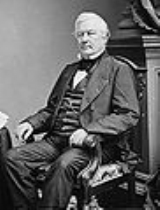
Millard Fillmore


Millard Fillmore (January 7, 1800 – March 8, 1874) was the 13th
List of Presidents of the United States

File:WhiteHouseSouthFacade.JPGThe President of the United States is the head of state and the head of government of the United States. As chief of the executive branch and head of the Federal government of the United States as a whole, the presidency is the highest political office in the United States by influence and recognition....
 President of the United States
President of the United States

The President of the United States is the head of state and head of government of the United States and is the highest political official in the United States by influence and recognition....
, serving from 1850 until 1853, and the last member of the Whig Party
Whig Party (United States)

The Whig Party was a political party of the United States during the era of Jacksonian democracy. Considered integral to the Second Party System and operating from 1833 to 1856, the party was formed in opposition to the policies of President of the United States Andrew Jackson and the Democratic Party ....
 to hold that office. He was the second Vice President
Vice President of the United States

The Vice President of the United States is the holder of a public office in the United States of America created by the Constitution of the United States....
 to assume the Presidency upon the death of a sitting President, succeeding Zachary Taylor
Zachary Taylor

Zachary Taylor was an Military of the United States and the List of Presidents of the United States President of the United States.Known as "Old Rough and Ready", Taylor had a 40-year military career in the United States Army, serving in the War of 1812, Black Hawk War, and Seminole Wars before achieving fame leading U.S....
 who died of what is thought to be acute gastroenteritis
Gastroenteritis

Gastroenteritis is inflammation of the gastrointestinal tract, involving both the stomach and the small intestine and resulting in acute diarrhea....
 . Fillmore was never elected President; after serving out Taylor's term, he failed to gain the nomination for the Presidency of the Whigs
Whig Party (United States)

The Whig Party was a political party of the United States during the era of Jacksonian democracy. Considered integral to the Second Party System and operating from 1833 to 1856, the party was formed in opposition to the policies of President of the United States Andrew Jackson and the Democratic Party ....
 in the 1852 presidential election, and, four years later, in the 1856 presidential election
United States presidential election, 1856

The United States presidential election of 1856 was unusually heated. Republican candidate John Fremont condemned the Kansas-Nebraska Act, and crusaded against the Slave Power and the expansion of slavery, while Democrat James Buchanan warned that the Republicans were extremists whose victory would lead to civil war....
, he again failed to win election as the Know Nothing Party
Know Nothing

The Know Nothing movement was a nativist United States political movement of the 1840s and 1850s. It was empowered by popular fears that the country was being overwhelmed by Irish Catholic immigrants, who were often regarded as hostile to U.S....
 and Whig candidate.

more was born in a log cabin
Log cabin

A log cabin is a small house built from loggings. It is a simple type of log house. A distinction should be drawn between the traditional meanings of "log cabin" and "log house." "Log cabin" generally denotes a simple one, or one-and-one-half story structure, somewhat impermanent, and less finished or less architecturally sophisticated....
 in Cayuga County
Cayuga County, New York

Cayuga County is a county located in the U.S. state of New York. It was named for one of the tribes of Native American in the Iroquois Confederation....
 in the Finger Lakes
Finger Lakes

The Finger Lakes are a chain of lakes in the west-central section of Upstate New York that are a popular tourist destination. There are actually eleven lakes in the region, but only seven of the largest are commonly identified as the Finger Lakes....
 region of New York State, to Nathaniel Fillmore and Phoebe Millard, as the second of nine children and the eldest son.


Discussion
Ask a question about 'Millard Fillmore'
Start a new discussion about 'Millard Fillmore'
Answer questions from other users
Full Discussion Forum


Recent Posts


Quotations


An honorable defeat is better than a dishonorable victory.

I know nothing but my Country, my whole Country, and nothing but my Country.

It is not strange... to mistake change for progress.

May God save the country, for it is evident that the people will not.

The man who can look upon a crisis without being willing to offer himself upon the altar of his country is not fit for public trust.

God knows that I detest slavery, but it is an existing evil, for which we are not responsible, and we must endure it, till we can get rid of it without destroying the last hope of free government in the world.


Encyclopedia


Millard Fillmore (January 7, 1800 – March 8, 1874) was the 13th
List of Presidents of the United States

File:WhiteHouseSouthFacade.JPGThe President of the United States is the head of state and the head of government of the United States. As chief of the executive branch and head of the Federal government of the United States as a whole, the presidency is the highest political office in the United States by influence and recognition....
 President of the United States
President of the United States

The President of the United States is the head of state and head of government of the United States and is the highest political official in the United States by influence and recognition....
, serving from 1850 until 1853, and the last member of the Whig Party
Whig Party (United States)

The Whig Party was a political party of the United States during the era of Jacksonian democracy. Considered integral to the Second Party System and operating from 1833 to 1856, the party was formed in opposition to the policies of President of the United States Andrew Jackson and the Democratic Party ....
 to hold that office. He was the second Vice President
Vice President of the United States

The Vice President of the United States is the holder of a public office in the United States of America created by the Constitution of the United States....
 to assume the Presidency upon the death of a sitting President, succeeding Zachary Taylor
Zachary Taylor

Zachary Taylor was an Military of the United States and the List of Presidents of the United States President of the United States.Known as "Old Rough and Ready", Taylor had a 40-year military career in the United States Army, serving in the War of 1812, Black Hawk War, and Seminole Wars before achieving fame leading U.S....
 who died of what is thought to be acute gastroenteritis
Gastroenteritis

Gastroenteritis is inflammation of the gastrointestinal tract, involving both the stomach and the small intestine and resulting in acute diarrhea....
 . Fillmore was never elected President; after serving out Taylor's term, he failed to gain the nomination for the Presidency of the Whigs
Whig Party (United States)

The Whig Party was a political party of the United States during the era of Jacksonian democracy. Considered integral to the Second Party System and operating from 1833 to 1856, the party was formed in opposition to the policies of President of the United States Andrew Jackson and the Democratic Party ....
 in the 1852 presidential election, and, four years later, in the 1856 presidential election
United States presidential election, 1856

The United States presidential election of 1856 was unusually heated. Republican candidate John Fremont condemned the Kansas-Nebraska Act, and crusaded against the Slave Power and the expansion of slavery, while Democrat James Buchanan warned that the Republicans were extremists whose victory would lead to civil war....
, he again failed to win election as the Know Nothing Party
Know Nothing

The Know Nothing movement was a nativist United States political movement of the 1840s and 1850s. It was empowered by popular fears that the country was being overwhelmed by Irish Catholic immigrants, who were often regarded as hostile to U.S....
 and Whig candidate.

Early life and career

Fillmore was born in a log cabin
Log cabin

A log cabin is a small house built from loggings. It is a simple type of log house. A distinction should be drawn between the traditional meanings of "log cabin" and "log house." "Log cabin" generally denotes a simple one, or one-and-one-half story structure, somewhat impermanent, and less finished or less architecturally sophisticated....
 in Cayuga County
Cayuga County, New York

Cayuga County is a county located in the U.S. state of New York. It was named for one of the tribes of Native American in the Iroquois Confederation....
 in the Finger Lakes
Finger Lakes

The Finger Lakes are a chain of lakes in the west-central section of Upstate New York that are a popular tourist destination. There are actually eleven lakes in the region, but only seven of the largest are commonly identified as the Finger Lakes....
 region of New York State, to Nathaniel Fillmore and Phoebe Millard, as the second of nine children and the eldest son. (As this was three weeks after George Washington
George Washington

George Washington was the leader of the Continental Army in the American Revolutionary War and served as the List of Presidents of the United States President of the United States of the United States of Americas ....
's death, Fillmore was the first U.S. President born after the death of a former president.) Though a Unitarian
Unitarianism

Unitarianism as a theology is the belief in the single personality of God, in contrast to the doctrine of the Trinity . It is the philosophy upon which the modern Unitarian movement was based, and, according to its proponents, is the Early Christianity of Christianity....
 in later life, Fillmore was descended from Scottish
Scottish people

The Scots people are a nation and an ethnic group indigenous to Scotland.Historically, as an ethnic group, they emerged from an amalgamation of Celts, Picts, Gaels and Brythons....
 Presbyterians on his father's side and English dissenters on his mother's. His father apprenticed
Indentured servant

An indentured servant is a form of debt bondage worker. The laborer is under contract of an employer for usually three to seven years, in exchange for their transportation, food, drink, clothing, lodging and other necessities....
 him to a brutal cloth maker in Sparta, New York
Sparta, New York

Sparta is a town in Livingston County, New York, New York, United States. The population was 1,627 at the 2000 census.The Town of Sparta is in the southeast part of the county and is north of Dansville, Livingston County, New York....
, at age fourteen to learn the cloth-making trade. He left after four months but subsequently took another apprenticeship in the same trade at New Hope, New York. He struggled to obtain an education under frontier conditions, attending New Hope Academy for six months in 1819. Later that same year, he began to clerk for Judge Walter Wood of Montville, New York, under whom Fillmore began to study law.

He fell in love with Abigail Powers
Abigail Fillmore

Abigail Powers Fillmore , wife of Millard Fillmore, was First Lady of the United States from 1850 to 1853.Abigail was born in Stillwater, New York, 1798, in Saratoga County, New York....
, whom he met while at New Hope Academy and later married on February 5, 1826 . The couple had two children, Millard Powers Fillmore
Millard Powers Fillmore

Millard Powers Fillmore was one of two children and the only son of President Millard Fillmore and Abigail Fillmore. Known familiarly as "Powers", he was born in Aurora, Erie County, New York....
 and Mary Abigail Fillmore
Mary Abigail Fillmore

Mary Abigail Fillmore was the daughter of President Millard Fillmore and Abigail Powers, and was the White House Hostess from 1850 to 1853 due to her mother's illness....
. After leaving Wood and buying out his apprenticeship, Fillmore moved to Buffalo, New York
Buffalo, New York

Buffalo , is the second largest city in the state of New York. Located in Western New York on the eastern shores of Lake Erie and at the head of the Niagara River, Buffalo is the principal city of the Buffalo-Niagara Falls metropolitan area and the county seat of Erie County, New York....
, where he continued his studies in the law office of Asa Rice and Joseph Clary. He was admitted to the bar
Bar (law)

Bar in law contexts can have multiple meanings, but most originate from the bar in a courtroom. Quite simply, the bar is a wikt:railing or wikt:barrier that separates the front part of a courtroom - which includes a judge's bench and tables where attorneys or barristers conduct matters before the court - from the back part of the courtroom...
 in 1823 and began his law practice in East Aurora
Aurora, Erie County, New York

Aurora is a town in Erie County, New York, New York, United States. The population was 13,996 at the 2000 census.The Town of Aurora is one of the "Southtowns" of Erie County and is also erroneously called East Aurora, the name of its principal village....
. In 1834, he formed a law partnership, Fillmore and Hall (becoming Fillmore, Hall and Haven in 1836), with his good friend Nathan K. Hall
Nathan K. Hall

Nathan Kelsey Hall was an American politician who served in the U.S. House of Representatives and as U.S. Postmaster General.Born in Marcellus, New York, he began his career as a shoemaker and farmer, but then studied law in Buffalo, New York, alongside future U.S....
 (who would later serve in his cabinet as Postmaster General
United States Postmaster General

The United States Postmaster General is the executive head of the United States Postal Service. The office, in one form or another, is older than both the United States Constitution and the United States Declaration of Independence....
). It would become one of western New York
New York

The State of New York is a U.S. state in the Mid-Atlantic States and Northeastern United States regions of the United States and is the nation's List of U.S....
's most prestigious firms. In 1846, he founded the private University of Buffalo, which today is the public State University of New York at Buffalo (SUNY Buffalo), the largest school in the New York state university system.

His military service was limited. He served in the New York militia
New York Guard

The New York Guard is the name of the State Defense Force of New York State. As of June 2008 the New York Guard, a recognized command under the State of New York, Military law, has line item funding in the state?s budget....
 during the Mexican War of 1846 and during the American Civil War
American Civil War

The American Civil War , also known as the War Between the States and several Naming the American Civil War, was a civil war in the United States....
.

Politics

In 1828, Fillmore was elected to the New York State Assembly
New York State Assembly

The New York State Assembly is the lower house of the New York Legislature, the state legislature of the U.S. state of New York. The Assembly is composed of 150 members representing an equal amount of districts, with each district having an average population of 128,652....
 on the Anti-Masonic
Anti-Masonic Party

The Anti-Masonic Party was a 19th century minor political party in the United States. It strongly opposed Freemasonry, and was founded as a single-issue party, aspiring to become a major party....
 ticket, serving for one term, from 1829 to 1831. He was later elected as a Whig
Whig Party (United States)

The Whig Party was a political party of the United States during the era of Jacksonian democracy. Considered integral to the Second Party System and operating from 1833 to 1856, the party was formed in opposition to the policies of President of the United States Andrew Jackson and the Democratic Party ....
 (having followed his mentor Thurlow Weed
Thurlow Weed

Thurlow Weed was a New York political boss. While he never held national office himself, he was the principal political advisor to the prominent New York politician William H....
 into the party) to the 23rd Congress in 1832, serving from 1833 to 1835. He was re-elected in 1836 to the 25th Congress, to the 26th and to the 27th Congresses serving from 1837 to 1843, declining to be a candidate for re-nomination in 1842.

In Congress, he opposed the entrance of Texas
Texas

Texas is a U.S. state located in the South Central United States, nicknamed the Lone Star State. Texas is the second largest U.S. state in both area and population, spanning , and with a growing population of 24.3 million residents....
 as a slave territory
Slave state

A slave state was a U.S. state in which slavery of African Americans was legal. Slavery was one of the Origins of the American Civil War of the American Civil War and was abolished by the Thirteenth Amendment of the United States Constitution in 1865....
. He came in second place in the bid for Speaker of the House of Representatives
Speaker of the United States House of Representatives

The Speaker of the United States House of Representatives is the Speaker of the United States House of Representatives. The current Speaker is Nancy Pelosi, a Democratic Party representing California's 8th congressional district....
 in 1841. He served as chairman of the House Ways and Means Committee
United States House Committee on Ways and Means

The Committee of Ways and Means is the chief tax-writing committee of the United States House of Representatives. Members of the Ways and Means Committee cannot serve on any other House Committees, though they can apply for a waiver from their party's congressional leadership....
 from 1841 to 1843 and was an author of the Tariff of 1842
Tariff of 1842

The Tariff of 1842, or Black Tariff as it became known, was a protectionism tariff schedule adopted in the United States to reverse the effects of the Compromise Tariff of 1833....
, as well as two other bills that President
President of the United States

The President of the United States is the head of state and head of government of the United States and is the highest political official in the United States by influence and recognition....
 John Tyler
John Tyler

John Tyler, Jr. was the List of Presidents of the United States President of the United States and the first ever to obtain that office via presidential succession....
 vetoed.

After leaving Congress, Fillmore was the unsuccessful Whig
Whig Party (United States)

The Whig Party was a political party of the United States during the era of Jacksonian democracy. Considered integral to the Second Party System and operating from 1833 to 1856, the party was formed in opposition to the policies of President of the United States Andrew Jackson and the Democratic Party ....
 candidate for Governor of New York in 1844. He was the first New York State Comptroller
New York State Comptroller

The New York State Comptroller is a state cabinet officer of the U.S. state of New York. The duties of the comptroller include auditing government operations and operating the state's retirement system....
 elected by general ballot, and was in office from 1848 to 1849. As state comptroller, he revised New York's banking system, making it a model for the future National Banking System.

Vice Presidency 1849–1850

At the Whig national convention in 1848, the nomination of Gen. Zachary Taylor
Zachary Taylor

Zachary Taylor was an Military of the United States and the List of Presidents of the United States President of the United States.Known as "Old Rough and Ready", Taylor had a 40-year military career in the United States Army, serving in the War of 1812, Black Hawk War, and Seminole Wars before achieving fame leading U.S....
 for president angered both the supporters of Henry Clay
Henry Clay

Henry Clay, Sr. was a nineteenth-century United States statesman and orator who represented Kentucky in both the United States House of Representatives and United States Senate....
 and the opponents of the extension of slavery into the territories gained in the Mexican–American War
Mexican–American War

The Mexican?American War was an armed conflict between the United States and Mexico from 1846 to 1848 in the wake of the 1845 U.S. Texas Annexation of Republic of Texas....
. A group of practical Whig politicians nominated Fillmore for vice president, believing that he would heal party wounds because he came from a non-slave state even though he was relatively obscure
Dark horse

A "dark horse" is a term used to describe a little-known person or thing who emerges to prominence....
, and because he would help the ticket carry the populous state of New York.

Fillmore was also selected in part to block New York state machine
Political machine

A political machine is a disciplined political organization in which an authoritative boss or small group commands the support of a corps of supporters , who receive rewards for their efforts....
 boss Thurlow Weed
Thurlow Weed

Thurlow Weed was a New York political boss. While he never held national office himself, he was the principal political advisor to the prominent New York politician William H....
 from receiving the vice presidential nomination (and his front man William H. Seward
William H. Seward

William Henry Seward, Sr. was a Governor of New York, United States Senate and the United States Secretary of State under Abraham Lincoln and Andrew Johnson....
 from receiving a position in Taylor's cabinet). Weed ultimately got Seward elected to the senate. This competition between Seward and Fillmore led to Seward's becoming a more vocal part of cabinet meetings and having more of a voice than Fillmore in advising the administration. The battle would continue even after Taylor's death. Taylor and Fillmore disagreed on the slavery issue
History of slavery

The history of slavery covers many different forms of human exploitation across many cultures throughout history. Slavery, generally defined, refers to a situation where one human being is considered to be the property of another, and is therefore obligated to perform tasks for their owner without any choice involved....
 in the new western territories taken from Mexico
Mexico

The United Mexican States , commonly known as Mexico , is a federalism constitutionalism republic in North America. It is bordered on the north by the United States; on the south and west by the Pacific Ocean; on the southeast by Guatemala, Belize, and the Caribbean Sea; and on the east by the Gulf of Mexico....
 in the Mexican-American War. Taylor wanted the new states to be free states, while Fillmore supported slavery in those states as a means of appeasing the South. In his own words: "God knows that I detest slavery, but it is an existing evil... and we must endure it and give it such protection as is guaranteed by the Constitution."

Fillmore presided over the Senate during the months of nerve-wracking debates over the Compromise of 1850
Compromise of 1850

The Compromise of 1850 was a series of bills aimed at resolving the territorial and slavery controversies arising from the Mexican-American War ....
. During one debate, Senator Henry S. Foote
Henry S. Foote

Henry Stuart Foote was a United States Senate from Mississippi from 1847 to 1852 and List of Governors of Mississippi from 1852 to 1854. His emotional leadership on the Senate floor helped secure passage of the Compromise of 1850, which for a time averted a civil war in the United States....
 of Mississippi
Mississippi

Mississippi is a U.S. state located in the Deep South of the United States. Jackson, Mississippi is the state capital and largest city. The state's name comes from the Mississippi River, which flows along its western boundary, and takes its name from the Anishinaabe language word misi-ziibi ....
 pulled a pistol on Senator Thomas Hart Benton
Thomas Hart Benton (senator)

Thomas Hart Benton nicknamed "Old Bullion" , was a United States United States Senate from Missouri and a staunch advocate of westward expansion of the United States....
 of Missouri
Missouri

Missouri is a U.S. state in the Midwestern United States of the United States bordered by Iowa, Illinois, Kentucky, Tennessee, Arkansas, Oklahoma, Kansas and Nebraska....
. Fillmore made no public comment on the merits of the compromise proposals, but a few days before President Taylor's death, Fillmore suggested to the president that, should there be a tie vote on Henry Clay's bill, he would vote in favor of the North.

Presidency 1850–1853


Policies

Upon the unexpected death of President Taylor on July 9, 1850, Fillmore ascended to the presidency. The change in leadership also signaled an abrupt political shift as Fillmore appointed his own cabinet. Taylor, himself, had been about to replace his entire scandal-ridden cabinet at the time of his death, but now, beginning with the appointment of Daniel Webster
Daniel Webster

Daniel Webster was a leading American statesman during the nation's antebellum. He first rose to regional prominence through his defense of New England shipping interests....
 as Secretary of State, Fillmore's cabinet would be dominated by individuals who, with the exception of Treasury Secretary Thomas Corwin, favored what would come to be called the Compromise of 1850
Compromise of 1850

The Compromise of 1850 was a series of bills aimed at resolving the territorial and slavery controversies arising from the Mexican-American War ....
.

As president, Fillmore dealt with increasing party divisions within the Whig party; party harmony became one of his primary objectives. He tried to unite the party by pointing out the differences between the Whigs and the Democrats (by proposing tariff reforms that negatively reflected on the Democratic Party
Democratic Party (United States)

The Democratic Party is one of two major party contemporary political parties in the United States, along with the Republican Party . It is the oldest political party in continuous operation in the United States and it is one of the oldest parties in the world....
). Another primary objective of Fillmore was to preserve the Union from the intensifying slavery debate.

Henry Clay's proposed bill to admit California
California

California is a U.S. state on the West Coast of the United States of the United States, along the Pacific Ocean. It is bordered by Oregon to the north, Nevada to the east, Arizona to the southeast, and to the south the Mexico state of Baja California....
 to the Union still aroused all the violent arguments for and against the extension of slavery without any progress toward settling the major issues (the South continued to threaten secession). Fillmore recognized that Clay's plan was the best way to end the sectional crisis (California free state, harsher fugitive slave law, abolish slave trade in DC). Clay, exhausted, left Washington to recuperate, passing leadership to Senator Stephen A. Douglas
Stephen A. Douglas

Stephen Arnold Douglas was an United States politician from the western state of Illinois, and was the History of the United States Democratic Party nominee for President of the United States in United States presidential election, 1860....
 of Illinois. At this critical juncture, President Fillmore announced his support of the Compromise of 1850.

On August 6, 1850, he sent a message to Congress recommending that Texas be paid to abandon its claims to part of New Mexico
New Mexico

New Mexico is a U. S. State located in the Southwestern United States of the United States. Inhabited by Native Americans in the United States populations for many centuries, it has also has been part of the Spanish Empire viceroyalty of New Spain, part of Mexico, and a U.S....
. This, combined with his mobilization of 750 Federal troops to New Mexico, helped shift a critical number of northern Whigs
Whig Party (United States)

The Whig Party was a political party of the United States during the era of Jacksonian democracy. Considered integral to the Second Party System and operating from 1833 to 1856, the party was formed in opposition to the policies of President of the United States Andrew Jackson and the Democratic Party ....
 in Congress away from their insistence upon the Wilmot Proviso
Wilmot Proviso

The Wilmot Proviso was introduced on August 8, 1846, in the United States United States House of Representatives as a rider on a $2 million appropriations bill intended for the final negotiations to resolve the Mexican-American War....
—the stipulation that all land gained by the Mexican War must be closed to slavery.

Douglas's effective strategy in Congress combined with Fillmore's pressure gave impetus to the Compromise movement. Breaking up Clay's single legislative package, Douglas presented five separate bills to the Senate:
  • Admit California as a free state.
  • Settle the Texas boundary and compensate the state for lost lands.
  • Grant territorial status to New Mexico.
  • Place federal officers at the disposal of slaveholders seeking escapees—the Fugitive Slave Act.
  • Abolish the slave trade, but not slavery, in the District of Columbia
    Washington, D.C.

    Washington, D.C. , formally the District of Columbia and commonly referred to as Washington, the District, or simply D.C., is the Capital of the United States, founded on July 16, 1790....
    .


Each measure obtained a majority, and, by September 20, President Fillmore had signed them into law. Webster wrote, "I can now sleep of nights." Whigs on both sides refused to accept the finality of Fillmore's law (which led to more party division, and a loss of numerous elections), which forced Northern Whigs to say "God Save us from Whig Vice Presidents."

Fillmore's greatest difficulty with the fugitive slave law was how to enforce it without seeming to show favor towards Southern Whigs. His solution was to appease both northern and southern Whigs by calling for the enforcement of the fugitive slave law in the North, and enforcing in the South a law forbidding involvement in Cuba
Cuba

The Republic of Cuba is a country in the Caribbean. It consists of the island of Cuba , the island of Isla de la Juventud, and several adjacent small islands....
 (for the sole purpose of adding it as a slave state).

Another issue that presented itself during Fillmore's presidency was the arrival of Lajos Kossuth
Lajos Kossuth

Lajos Kossuth was a Hungary lawyer, politician and Governor-President of Hungary in 1849. He was widely honored during his lifetime, including in the United Kingdom and the United States, as a freedom fighter....
 (exiled leader of a failed Hungarian
Hungary

Hungary , officially in English the Republic of Hungary , is a landlocked country in the Carpathian Basin of Central Europe, bordered by Austria, Slovakia, Ukraine, Romania, Serbia, Croatia, and Slovenia....
 revolution). Kossuth wanted the United States to abandon its non-intervention policies when it came to European affairs and recognize Hungary's independence. The problem came with the enormous support Kossuth received from German-American immigrants to the United States (who were essential in the re-election of both Whigs and Democrats). Fillmore refused to change American policy, and decided to remain neutral despite the political implications that neutrality would produce.

Fillmore appointed Brigham Young
Brigham Young

Brigham Young was an American leader in the Latter Day Saint movement. He was the President of the Church of The Church of Jesus Christ of Latter-day Saints from 1847 until his death....
 as the first governor of the Utah Territory
Utah Territory

The Territory of Utah was an organized territory of the United States of America that existed from its organic act on September 9, 1850, until the admission of the State of Utah to the United States on January 4, 1896....
 in 1850. Utah now contains a city and county named after Millard Fillmore.

Another important legacy of Fillmore's administration was the sending of Commodore
Commodore (USN)

Commodore is a former Military rank and a current honorary title in the United States Navy and the United States Coast Guard with an intricate history....
 Matthew C. Perry
Matthew Perry (naval officer)

Matthew Calbraith Perry was the Commodore of the United States Navy who compelled the opening of Japan to the West with the Convention of Kanagawa in 1854....
 to open Japan to Western trade, though Perry did not reach Japan until Franklin Pierce
Franklin Pierce

Franklin Pierce was the List of Presidents of the United States President of the United States, serving from 1853 to 1857, an Politics of the United States and lawyer....
 had replaced Fillmore as president. A less dramatic legacy is that Fillmore, a bookworm, found the White House
White House

The White House is the official residence and principal workplace of the President of the United States. Located at 1600 Pennsylvania Avenue in Washington, D.C., it was built between 1792 and 1800 of white-painted Aquia sandstone in the late Georgian architecture and has been the executive residence of every U.S....
 devoid of books and initiated the White House library.

Administration and cabinet

Dscn4470 Buffalofillmorestatue E


Judicial appointments


Supreme Court
Fillmore appointed the following Justices to the Supreme Court of the United States
Supreme Court of the United States

The Supreme Court of the United States is the highest judicial body in the United States, and leads the federal United States federal courts. It consists of the Chief Justice of the United States and eight Associate Justice of the Supreme Court of the United States, who are nominated by the President of the United States and confirmed with th...
:
  • Benjamin Robbins Curtis
    Benjamin Robbins Curtis

    Benjamin Robbins Curtis was an United States Lawyer and Supreme Court of the United States Justice.Curtis was born in 1809 in Watertown, Massachusetts....
     - 1851 (Associate Justice)


Other courts
Fillmore was able to appoint only four other federal judges, all to United States district court
United States district court

The United States district courts are the general trial courts of the United States federal court system. Both Civil law and Criminal law cases are filed in the district court, which is a court of law, Equity , and admiralty....
s:

JudgeCourtBegan active
service
Ended active
service
John Glenn
John Glenn (judge)

John Glenn was a Maryland attorney and federal judge.Born in in Elkton, Maryland, Glenn read law to enter the bar in 1817. He was in private practice in Baltimore, Maryland for a time, and then became the U.S....
D.Md.
United States District Court for the District of Maryland

The United States District Court for the District of Maryland is the United States District Court whose jurisdiction is the state of Maryland....
March 19, 1852July 8, 1853
Nathan Kelsey HallN.D.N.Y.
United States District Court for the Northern District of New York

The United States District Court for the Northern District of New York serves one of the 94 judicial districts in the United States and one of four in the state of New York....
August 31, 1852March 2, 1874
Ogden Hoffman, Jr.
Ogden Hoffman, Jr.

Ogden Hoffman, Jr. was a United States federal judge.Hoffman was born in New York, New York. He received a A.B. from Columbia University in 1840....
N.D.Cal.
United States District Court for the Northern District of California

The United States District Court for the Northern District of California is the United States federal courts United States district court whose jurisdiction comprises following counties: Alameda County, California, Contra Costa County, California, Del Norte County, California, Humboldt County, California, Lake County, California, Marin Coun...
February 27, 1851August 9, 1891
James McHall Jones
James McHall Jones

James McHall Jones was a United States federal judge.Jones was born in Georgetown, Kentucky. He read law in 1843. He was in private practice of law in Plaquemine, Louisiana from 1843 to 1845....
S.D.Cal.
United States District Court for the Southern District of California

The United States District Court for the Southern District of California is the United States District Court whose jurisdiction comprises the following counties in California: Imperial County, California and San Diego County, California....
December 26, 1850December 15, 1851


States admitted to the Union

  • California
    California

    California is a U.S. state on the West Coast of the United States of the United States, along the Pacific Ocean. It is bordered by Oregon to the north, Nevada to the east, Arizona to the southeast, and to the south the Mexico state of Baja California....
     – September 9, 1850


Later life


Fillmore was one of the founders of the University of Buffalo
University at Buffalo, The State University of New York

State University of New York at Buffalo, commonly known as the University at Buffalo or , is a public university research university which has multiple campuses located in Buffalo, New York and Amherst, New York, USA....
. The school was chartered by an act of the New York State Legislature on May 11, 1846, and at first was only a medical school. Fillmore was the first Chancellor
Chancellor (education)

A Chancellor is the head of a university. Other titles are sometimes used, such as President or Rector.In most Commonwealth of Nations nations, the Chancellor is usually a Titular ruler non-resident head, often with a Pro-Chancellor as practical Chairman of the governing body ; the actual chief executive of a university is the V...
, a position he maintained while both Vice President and President. Upon completing his presidency, Fillmore returned to Buffalo, where he continued to serve as chancellor.

After the death of his daughter Mary
Mary Abigail Fillmore

Mary Abigail Fillmore was the daughter of President Millard Fillmore and Abigail Powers, and was the White House Hostess from 1850 to 1853 due to her mother's illness....
, Fillmore went abroad. While touring Europe in 1855, Fillmore was offered an honorary Doctor of Civil Law
Doctor of Civil Law

Some universities, such as the University of Oxford, award Doctor of Civil Law degrees instead of Doctor of Laws degrees.At Oxford, the degree of Doctor of Civil Law by Diploma is customarily conferred on foreign Heads of State, as well as on the Chancellor of the University....
 (D.C.L.) degree by the University of Oxford
University of Oxford

The University of Oxford , located in the city of Oxford, Oxfordshire, England, is the List of oldest universities in continuous operation in the English-speaking world....
. Fillmore turned down the honor, explaining that he had neither the "literary nor scientific attainment" to justify the degree. He is also quoted as having explained that he "lacked the benefit of a classical education" and could not, therefore, understand the Latin
Latin

Latin is an Italic language, historically spoken in Latium and Ancient Rome. Through the Military history of the Roman Empire, Latin spread throughout the Mediterranean and a large part of Europe....
 text of the diploma
Diploma

A diploma is a certificate or deed issued by an educational institution, such as a university, that testifies that the recipient has successfully completed a particular course of study, or confers an academic degree....
, adding that he believed "no man should accept a degree he cannot read."

By 1856, Fillmore's Whig Party had ceased to exist, having fallen apart due to dissension over the slavery issue, and especially the Kansas-Nebraska Act
Kansas-Nebraska Act

The Kansas-Nebraska Act of 1854 created the territories of Kansas Territory and Nebraska Territory, opened new lands, repealed the Missouri Compromise of 1820, and allowed settlers in those territories to determine if they would allow slavery within their boundaries....
 of 1854. Fillmore refused to join the new Republican Party
Republican Party (United States)

The Republican Party is one of the two major party contemporary political parties in the United States, along with the Democratic Party . It is often called the Grand Old Party or the GOP....
, where many former Whigs, including Abraham Lincoln
Abraham Lincoln

Abraham Lincoln was the List of Presidents of the United States President of the United States. He successfully led the country through its greatest internal crisis, the American Civil War, preserving the Union and ending slavery....
, had found refuge. Instead, Fillmore joined the anti-immigrant, anti-Catholic American Party
American Party

A political party by the name of the American Party has existed several times in the United States:* The antebellum American Party grew out of the Know Nothing movement and was based on Nativism ....
, the political organ of the Know-Nothing movement.

He ran in the election of 1856
United States presidential election, 1856

The United States presidential election of 1856 was unusually heated. Republican candidate John Fremont condemned the Kansas-Nebraska Act, and crusaded against the Slave Power and the expansion of slavery, while Democrat James Buchanan warned that the Republicans were extremists whose victory would lead to civil war....
 as the party's presidential candidate, attempting to win a non-consecutive second term as President (a feat accomplished only once in American politics, by Grover Cleveland
Grover Cleveland

Stephen Grover Cleveland was both the List of Presidents of the United States President of the United States. Cleveland is the only President to serve two non-consecutive terms and therefore is the only individual to be counted twice in the numbering of the presidents....
). His running mate was Andrew Jackson Donelson
Andrew Jackson Donelson

Andrew Jackson Donelson was an American diplomat and a candidate for Vice President of the United States.One of the three sons of Samuel and Mary Donelson, Andrew Jackson Donelson was born in Nashville, Tennessee....
, nephew of former president Andrew Jackson
Andrew Jackson

Andrew Jackson was the List of Presidents of the United States President of the United States . He was List of governors of Florida of Florida , commander of the American forces at the Battle of New Orleans , and eponym of the era of Jacksonian democracy....
. Fillmore and Donelson finished third, carrying only the state of Maryland and its eight electoral votes; but he won 21.6% of the popular vote, one of the best showings ever by a Presidential third-party candidate.

On February 10, 1858, after the death of his first wife, Fillmore married Caroline McIntosh
Caroline Fillmore

Caroline Carmichael McIntosh Fillmore was the second wife of thirteenth U.S. President Millard Fillmore. They were married in 1858, five years after his term of office expired....
, a wealthy widow. Their combined wealth allowed them to purchase a big house in Buffalo, New York. The house became the center of hospitality for visitors, until her health began to decline in the 1860s.

Fillmore helped found the Buffalo Historical Society (now the Buffalo and Erie County Historical Society
Buffalo and Erie County Historical Society Building

The Buffalo, New York and Erie County, New York Historical Society is located on Nottingham Court in the city of Buffalo, New York , just east of Elmwood Avenue, north of the New York State Route 198, in the northwest corner of Delaware Park....
) in 1862 and served as its first president.

Throughout the Civil War
American Civil War

The American Civil War , also known as the War Between the States and several Naming the American Civil War, was a civil war in the United States....
, Fillmore opposed President Lincoln
Abraham Lincoln

Abraham Lincoln was the List of Presidents of the United States President of the United States. He successfully led the country through its greatest internal crisis, the American Civil War, preserving the Union and ending slavery....
 and during Reconstruction supported President Johnson
Andrew Johnson

Andrew Johnson was the List of Presidents of the United States President of the United States , succeeding to the Presidency upon Abraham Lincoln assassination of Abraham Lincoln....
. He commanded the Union Continentals, a corps of home guards
Militia

The term militia is commonly used today to refer to a military force composed of ordinary citizens to provide defense, emergency law enforcement, or paramilitary service, in times of emergency without being paid a regular salary or committed to a fixed term of service....
 of males over the age of 45 from the Upstate New York
Upstate New York

Upstate New York is the region of New York north of the core of the New York metropolitan area. It has a population of 7,121,911 out of New York State's total 18,976,457....
 area.

He died at 11:10 p.m. on March 8, 1874, of the after-effects of a stroke
Stroke

A stroke is the rapidly developing loss of brain function due to a disturbance in the blood supply to the brain. According to the National Stroke Association, a "stroke" occurs when a blood clot blocks and artery or a blood vessel breaks, interrupting blood flow to an area of the brain....
. His last words were alleged to be, upon being fed some soup, "the nourishment is palatable." On January 7 each year, a ceremony is held at his grave site in the Forest Lawn Cemetery in Buffalo.

Legacy

Some northern Whigs remained irreconcilable, refusing to forgive Fillmore for having signed the Fugitive Slave Act
Fugitive Slave Law of 1850

The Fugitive Slave Law or Fugitive Slave Act was passed by the United States Congress on September 18, 1850, as part of the Compromise of 1850 between Southern United States slavery interests and northern United States United States Free Soil Party....
. They helped deprive him of the Presidential nomination in 1852. Within a few years it was apparent that although the Compromise had been intended to settle the slavery controversy, it served rather as an uneasy sectional truce. Robert J. Rayback argues that the appearance of a truce, at first, seemed very real as the country entered a period of prosperity that included the South. Although Fillmore, in retirement, continued to feel that conciliation with the South was necessary and considered that the Republican Party was at least partly responsible for the subsequent disunion, he was an outspoken critic of secession and was also critical of President Buchanan
James Buchanan

James Buchanan, Jr. was the List of Presidents of the United States President of the United States and the last to be born in the 18th century....
 for not immediately taking military action when South Carolina seceded.

Benson Lee Grayson suggests that the skillful avoidance of potential problems by the Fillmore administration is too often overlooked. Fillmore's constant attention to Mexico avoided a resumption of the hostilities that had only broken off in 1848 and laid the groundwork for the Gadsen Treaty during Pierce's administration. Meanwhile, the Fillmore administration ironed out a serious dispute with Portugal left over from the Taylor administration, smoothed over a disagreement with Peru, and then peacefully resolved other disputes with England, France, and Spain over Cuba. At the height of this crisis, the Royal Navy had fired on an American ship while at the same time 160 Americans were being held captive in Spain. Fillmore and his State Department were able to resolve these crises without the United States going to war or losing face.

Because the Whig party was so deeply divided, and the two leading national figures in the Whig party (Fillmore and his own Secretary of State, Daniel Webster) refused to combine to secure the nomination, Winfield Scott
Winfield Scott

Winfield Scott was a United States Army general, and unsuccessful List of United States Presidential candidates of the Whig Party in 1852. Known as "Old Fuss and Feathers" and the "Grand Old Man of the Army", he served on active duty as a general longer than any other man in American history and many historians rate him the ablest America...
 received it. Because both the north and the south refused to unite behind Scott, he won only 4 of 31 states, and lost the election to Franklin Pierce.

After Fillmore's defeat the Whig party continued its downward spiral with further party division coming at the hands of the Kansas Nebraska Act, and the emergence of the Know Nothing party.

Most of his correspondence was destroyed in pursuance of a direction in his son's will.

Places named after Fillmore

  • Fillmore Glen State Park
    Fillmore Glen State Park

    Fillmore Glen State Park is located adjacent to the Village of Moravia , New York in Cayuga County, New York.The primary attractions of the park are the hiking trails with views of a stream and several waterfalls, and the swimming pond, made by damming the stream....
    , New York.
  • Fillmore County, Minnesota
    Fillmore County, Minnesota

    Fillmore County is a county located in the U.S. state of Minnesota. As of 2000, the population was 21,122. Its county seat is Preston, Minnesota....
    .
  • Fillmore County, Nebraska
    Fillmore County, Nebraska

    Fillmore County is a county located in the U.S. state of Nebraska. As of 2000, the population was 6,634. Its county seat is Geneva, Nebraska. The county was named for President Millard Fillmore....
    .
  • Millard County, Utah
    Millard County, Utah

    Millard County is a county located in the U.S. state of Utah. In 2000, its population was 12,405; in 2005, the population was estimated to have decreased to 12,284....
     and its county seat, Fillmore, Utah
    Fillmore, Utah

    Fillmore is a city in Millard County, Utah, Utah, United States. The population was 2,253 at the United States Census, 2000. It is the county seat of Millard County, Utah....
    .
  • Fillmore Elementary School, Davenport, IA
  • Millard Fillmore Gates Circle Hospital, Buffalo.
  • Millard Fillmore Suburban Hospital, Williamsville, New York
    Williamsville, New York

    Williamsville is a village in Erie County, New York in the United States. The population was 5,573 at the 2000 census. The village is named after Jonas Williams, an early settler....
    .
  • Millard Fillmore Academic Center at the University at Buffalo's Ellicott Complex.
  • Fillmore Street, in downtown San Francisco, California
    San Francisco, California

    The City and County of San Francisco is the fourth most populous city in California and the List of United States cities by population in the United States, with a 2007 estimated population of 799,183....
    , after which, in turn, the Fillmore Auditorium
    The Fillmore

    The Fillmore is a historic music venue in San Francisco, California, made famous by Bill Graham . Named for its original location at the intersection of Fillmore Street and Geary Boulevard, it lies on the boundary of the Western Addition and the Pacific Heights, San Francisco, California neighborhoods....
     was named.


Trivia

Millard Fillmore Stamp
*The myth that Millard Fillmore installed the White House
White House

The White House is the official residence and principal workplace of the President of the United States. Located at 1600 Pennsylvania Avenue in Washington, D.C., it was built between 1792 and 1800 of white-painted Aquia sandstone in the late Georgian architecture and has been the executive residence of every U.S....
's first bathtub
Bathtub

A bath , bathtub , or tub is a plumbing fixture used for bathing. Most modern bathtubs are made of acrylic glass or fiberglass, but alternatives are available in Vitreous enamel over steel or cast iron, and occasionally wood....
 was started by H. L. Mencken
H. L. Mencken

Henry Louis "H. L." Mencken , was an United States journalist, essayist, magazine editing, satire, acerbic Social criticism of American American way and Culture of the United States, and a student of American English....
 in a joke column published on December 28, 1917 in the New York Evening Mail
New York Evening Mail

The New York Evening Mail was an American daily newspaper published in New York City.The paper was made up of the New York Evening Express, which dated from 1836, and the Daily Advertiser....
.
(See Bathtub hoax
Bathtub hoax

The bathtub hoax was a famous hoax or practical joke perpetrated by the United States journalism H. L. Mencken, involving the publication of a fictitious history of the bathtub....
). In February 2008, a television commercial for a sales event by Kia
KIA

Kia may refer to:* Kia, Kia is a persian name for men with meaning of "The Great King" or somewhere it has been used to name the ruler of Tabarestan , one of the ancient northern Persia's states...
 Motors featured Millard Fillmore, referring to him as "Unheard of", repeats the Bathtub hoax, and presenting a Millard Fillmore bust as a 'Soap-on-a-Rope.'.

  • In gratitude for creating the Utah Territory
    Utah Territory

    The Territory of Utah was an organized territory of the United States of America that existed from its organic act on September 9, 1850, until the admission of the State of Utah to the United States on January 4, 1896....
     in 1850 and appointing Brigham Young
    Brigham Young

    Brigham Young was an American leader in the Latter Day Saint movement. He was the President of the Church of The Church of Jesus Christ of Latter-day Saints from 1847 until his death....
     as governor, Young named the territorial capital "Fillmore" and the surrounding county "Millard".


Electoral history


United States presidential election, 1848

The United States presidential election of 1848 was an open race. President of the United States James K. Polk, having achieved virtually all of his objectives in one term and suffering from declining health that would take his life less than four months after leaving office, kept his promise not to seek re-election....
  • Zachary Taylor
    Zachary Taylor

    Zachary Taylor was an Military of the United States and the List of Presidents of the United States President of the United States.Known as "Old Rough and Ready", Taylor had a 40-year military career in the United States Army, serving in the War of 1812, Black Hawk War, and Seminole Wars before achieving fame leading U.S....
    /Millard Fillmore (Whig) - 1,361,393 (47.3%) and 163 electoral votes (16 states carried)
  • Lewis Cass
    Lewis Cass

    Lewis Cass was an United States military officer and politician. During his long political career, Cass served as a governor of the Michigan Territory, an American ambassador, and a United States Senate representing Michigan....
    /William Orlando Butler
    William Orlando Butler

    William Orlando Butler was a United States political figure and U.S. Army major general from Kentucky. He served as a Democratic Party congressman from Kentucky from 1839 to 1843, and was the Democratic Vice President of the United States nominee under Lewis Cass in U.S....
     (Democrats) - 1,223,460 (42.5%) and 127 electoral votes (15 states carried)
  • Martin Van Buren
    Martin Van Buren

    Martin Van Buren was the List of Presidents of the United States President of the United States from 1837 to 1841. Before his presidency, he served as the List of Vice Presidents of the United States Vice President of the United States and the 10th United States Secretary of State under Andrew Jackson....
    /Charles Francis Adams, Sr.
    Charles Francis Adams, Sr.

    Charles Francis Adams, Sr. , was an United States lawyer, politician, diplomat and writer. He was the son of President John Quincy Adams and Louisa Adams and the grandson of President John Adams and Abigail Adams....
     (Free Soil) - 291,501 (10.1%) and 0 electoral votes


United States presidential election, 1856

The United States presidential election of 1856 was unusually heated. Republican candidate John Fremont condemned the Kansas-Nebraska Act, and crusaded against the Slave Power and the expansion of slavery, while Democrat James Buchanan warned that the Republicans were extremists whose victory would lead to civil war....
  • James Buchanan
    James Buchanan

    James Buchanan, Jr. was the List of Presidents of the United States President of the United States and the last to be born in the 18th century....
    /John C. Breckinridge
    John C. Breckinridge

    John Cabell Breckinridge was a lawyer, United States House of Representatives, United States Senate from Kentucky, the 14th Vice President of the United States, Democratic Party candidate for President of the United States in United States presidential election, 1860, a Confederate States Army General officer in the American Civil War, and...
     (Democrats) - 1,836,072 (45.3%) and 174 electoral votes (19 states carried)
  • John C. Fremont
    John C. Frémont

    John Charles Fr?mont , was an United States military Commissioned officer, List of explorers, the first candidate of the History of United States Republican Party for the office of President of the United States, and the first presidential candidate of a major party to run on a platform in opposition to slavery....
    /William L. Dayton
    William L. Dayton

    William Lewis Dayton was an United States politician.A distant relation of Speaker of the United States House of Representatives and United States Constitution signatory Jonathan Dayton, he was born in Basking Ridge, New Jersey, New Jersey to farmer Joel Dayton and his wife....
     (Republicans) - 1,342,345 (33.1%) and 114 electoral votes (11 states carried)
  • Millard Fillmore/Andrew Jackson Donelson
    Andrew Jackson Donelson

    Andrew Jackson Donelson was an American diplomat and a candidate for Vice President of the United States.One of the three sons of Samuel and Mary Donelson, Andrew Jackson Donelson was born in Nashville, Tennessee....
     (Know-Nothing/Whig) - 873,053 (21.6%) and 8 electoral votes (1 state carried)


Plaques to Fillmore

Image:Fillmore Home 2.jpg|Fillmore's East Aurora house was moved off Main Street. Image:Fillmore House NHL.jpg|The house is designated a National Historic Landmark
National Historic Landmark

A National Historic Landmark is a building, :wiktionary:site, structure, object, or district, that is officially recognized by the Federal government of the United States for its historical significance....
. Image:Fillmore DAR.jpg|The DAR
Daughters of the American Revolution

The Daughters of the American Revolution is a Genealogy-based membership organization of women dedicated to promoting historic preservation, education, and patriotism....
 placed this plaque on the house in 1931. Image:Fillmore plot plaque.jpg|A memorial to Fillmore on the gate surrounding his plot in Buffalo. Image:Fillmore obelisk detail.jpg|Detail of the Fillmore obelisk in Buffalo. Image:Fillmorebirth.jpg|Historical marker denoting Fillmore's birthplace in Summerhill, New York
Summerhill, New York

Summerhill is a town in Cayuga County, New York, New York, United States. The population was 1,098 at the 2000 census. The current town name is that of a location in Ireland....


See also

  • U.S. presidential election, 1848
  • U.S. presidential election, 1856
  • William Gannaway Brownlow
    William Gannaway Brownlow

    William Gannaway Brownlow was List of Governors of Tennessee of Tennessee from 1865 to 1869 and a List of United States Senators from Tennessee from Tennessee from 1869 to 1875....
  • Runaway Officials of 1851
    Runaway Officials of 1851

    The "Runaway Officials of 1851" were a group of three federal officers, Judge Perry Brocchus, Judge Lemuel Brandenbury, and Territorial Secretary Broughton Harris, who were appointed to Utah Territory by President Millard Fillmore in 1851....


External links