

Ocean

Encyclopedia
An ocean was a pseudo-geographical feature in classical antiquity, believed by the ancient Greeks and Romans to be the world-ocean, an enormous river encircling the world....
) is a major body of saline water
Seawater
Seawater is water from a sea or ocean. On average, seawater in the world's oceans has a salinity of about 3.5% . This means that every kilogram of seawater has approximately of dissolved salts . The average density of seawater at the ocean surface is 1.025 g/ml...
, and a principal component of the hydrosphere
Hydrosphere
A hydrosphere in physical geography describes the combined mass of water found on, under, and over the surface of a planet....
. Approximately 71% of the Earth
Earth
Earth is the third planet from the Sun, and the densest and fifth-largest of the eight planets in the Solar System. It is also the largest of the Solar System's four terrestrial planets...
's surface
Surface
In mathematics, specifically in topology, a surface is a two-dimensional topological manifold. The most familiar examples are those that arise as the boundaries of solid objects in ordinary three-dimensional Euclidean space R3 — for example, the surface of a ball...
(~) is covered by ocean, a continuous body of water
World Ocean
The World Ocean, world ocean, or global ocean, is the interconnected system of the Earth's oceanic waters, and comprises the bulk of the hydrosphere, covering almost 71% of the Earth's surface, with a total volume of 1.332 billion cubic kilometres.The unity and continuity of the World Ocean, with...
that is customarily divided into several principal oceans and smaller sea
Sea
A sea generally refers to a large body of salt water, but the term is used in other contexts as well. Most commonly, it means a large expanse of saline water connected with an ocean, and is commonly used as a synonym for ocean...
s.
More than half of this area is over 3,000 metres (9,800 ft) deep. Average oceanic salinity
Salinity
Salinity is the saltiness or dissolved salt content of a body of water. It is a general term used to describe the levels of different salts such as sodium chloride, magnesium and calcium sulfates, and bicarbonates...
is around 35 parts per thousand (‰) (3.5%), and nearly all seawater has a salinity in the range of 30 to 38 ‰. Scientists estimate that 230,000 marine species
Species
In biology, a species is one of the basic units of biological classification and a taxonomic rank. A species is often defined as a group of organisms capable of interbreeding and producing fertile offspring. While in many cases this definition is adequate, more precise or differing measures are...
are currently known, but the total could be up to 10 times that number.
Overview
Though generally described as several 'separate' oceans, these waters comprise one global, interconnected body of salt water sometimes referred to as the World OceanWorld Ocean
The World Ocean, world ocean, or global ocean, is the interconnected system of the Earth's oceanic waters, and comprises the bulk of the hydrosphere, covering almost 71% of the Earth's surface, with a total volume of 1.332 billion cubic kilometres.The unity and continuity of the World Ocean, with...
or global ocean.
Oceanography
Oceanography , also called oceanology or marine science, is the branch of Earth science that studies the ocean...
.
The major oceanic divisions are defined in part by the continent
Continent
A continent is one of several very large landmasses on Earth. They are generally identified by convention rather than any strict criteria, with seven regions commonly regarded as continents—they are : Asia, Africa, North America, South America, Antarctica, Europe, and Australia.Plate tectonics is...
s, various archipelago
Archipelago
An archipelago , sometimes called an island group, is a chain or cluster of islands. The word archipelago is derived from the Greek ἄρχι- – arkhi- and πέλαγος – pélagos through the Italian arcipelago...
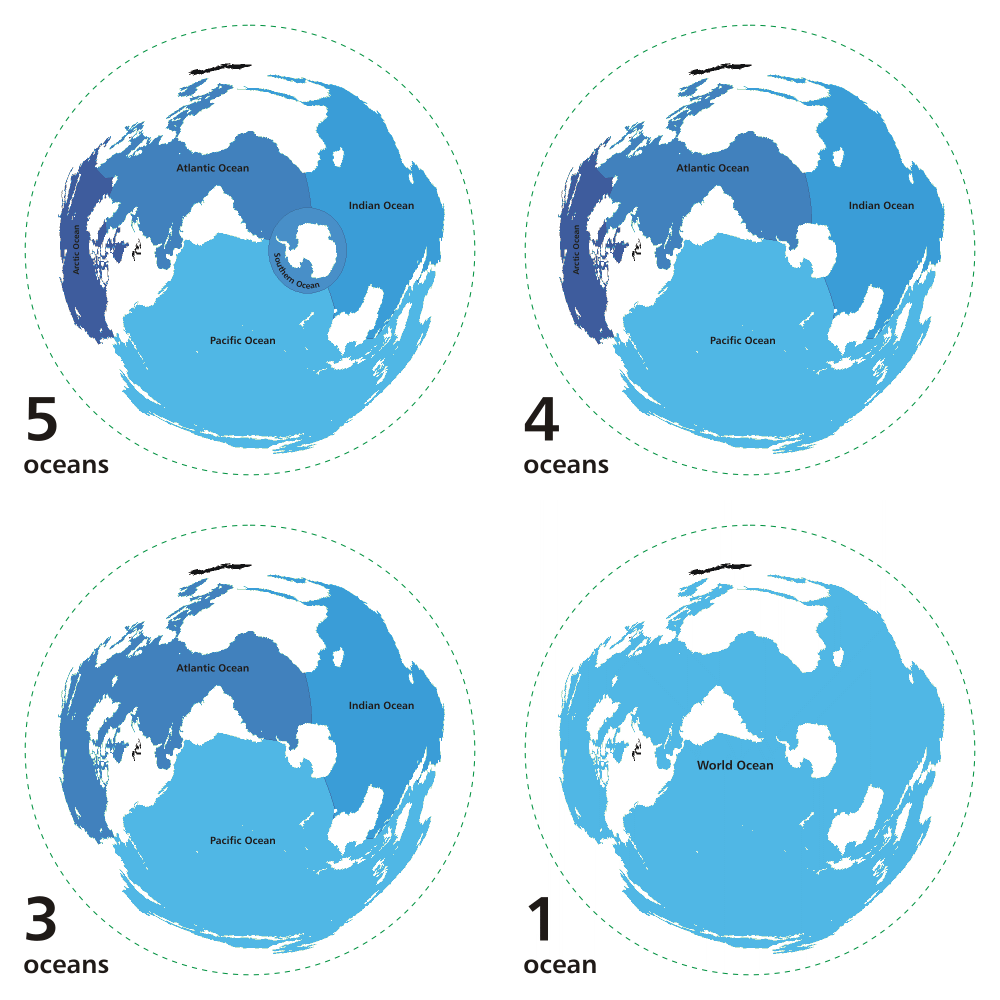
s, and other criteria. These divisions are (in descending order of size):
- Pacific OceanPacific OceanThe Pacific Ocean is the largest of the Earth's oceanic divisions. It extends from the Arctic in the north to the Southern Ocean in the south, bounded by Asia and Australia in the west, and the Americas in the east.At 165.2 million square kilometres in area, this largest division of the World...
, which separates AsiaAsiaAsia is the world's largest and most populous continent, located primarily in the eastern and northern hemispheres. It covers 8.7% of the Earth's total surface area and with approximately 3.879 billion people, it hosts 60% of the world's current human population...
and AustraliaAustraliaAustralia , officially the Commonwealth of Australia, is a country in the Southern Hemisphere comprising the mainland of the Australian continent, the island of Tasmania, and numerous smaller islands in the Indian and Pacific Oceans. It is the world's sixth-largest country by total area...
from the AmericasAmericasThe Americas, or America , are lands in the Western hemisphere, also known as the New World. In English, the plural form the Americas is often used to refer to the landmasses of North America and South America with their associated islands and regions, while the singular form America is primarily... - Atlantic OceanAtlantic OceanThe Atlantic Ocean is the second-largest of the world's oceanic divisions. With a total area of about , it covers approximately 20% of the Earth's surface and about 26% of its water surface area...
, which separates the Americas from EuropeEuropeEurope is, by convention, one of the world's seven continents. Comprising the westernmost peninsula of Eurasia, Europe is generally 'divided' from Asia to its east by the watershed divides of the Ural and Caucasus Mountains, the Ural River, the Caspian and Black Seas, and the waterways connecting...
and AfricaAfricaAfrica is the world's second largest and second most populous continent, after Asia. At about 30.2 million km² including adjacent islands, it covers 6% of the Earth's total surface area and 20.4% of the total land area... - Indian OceanIndian OceanThe Indian Ocean is the third largest of the world's oceanic divisions, covering approximately 20% of the water on the Earth's surface. It is bounded on the north by the Indian Subcontinent and Arabian Peninsula ; on the west by eastern Africa; on the east by Indochina, the Sunda Islands, and...
, which washes upon southern AsiaAsiaAsia is the world's largest and most populous continent, located primarily in the eastern and northern hemispheres. It covers 8.7% of the Earth's total surface area and with approximately 3.879 billion people, it hosts 60% of the world's current human population...
and separates Africa and Australia - Southern OceanSouthern OceanThe Southern Ocean comprises the southernmost waters of the World Ocean, generally taken to be south of 60°S latitude and encircling Antarctica. It is usually regarded as the fourth-largest of the five principal oceanic divisions...
, sometimes considered an extension of the Pacific, Atlantic and Indian Oceans, which encircles Antarctica. - Arctic OceanArctic OceanThe Arctic Ocean, located in the Northern Hemisphere and mostly in the Arctic north polar region, is the smallest and shallowest of the world's five major oceanic divisions...
, sometimes considered a seaSeaA sea generally refers to a large body of salt water, but the term is used in other contexts as well. Most commonly, it means a large expanse of saline water connected with an ocean, and is commonly used as a synonym for ocean...
of the Atlantic, which covers much of the ArcticArcticThe Arctic is a region located at the northern-most part of the Earth. The Arctic consists of the Arctic Ocean and parts of Canada, Russia, Greenland, the United States, Norway, Sweden, Finland, and Iceland. The Arctic region consists of a vast, ice-covered ocean, surrounded by treeless permafrost...
and washes upon northern North AmericaNorth AmericaNorth America is a continent wholly within the Northern Hemisphere and almost wholly within the Western Hemisphere. It is also considered a northern subcontinent of the Americas...
and Eurasia.
The Pacific and Atlantic may be further subdivided by the equator
Equator
An equator is the intersection of a sphere's surface with the plane perpendicular to the sphere's axis of rotation and containing the sphere's center of mass....
into northern and southern portions. Smaller regions of the oceans are called sea
Sea
A sea generally refers to a large body of salt water, but the term is used in other contexts as well. Most commonly, it means a large expanse of saline water connected with an ocean, and is commonly used as a synonym for ocean...
s, gulfs
Headlands and bays
Headlands and bays are two related features of the coastal environment.- Geology and geography :Headlands and bays are often found on the same coastline. A bay is surrounded by land on three sides, whereas a headland is surrounded by water on three sides. Headlands are characterized by high,...
, bay
Bay
A bay is an area of water mostly surrounded by land. Bays generally have calmer waters than the surrounding sea, due to the surrounding land blocking some waves and often reducing winds. Bays also exist as an inlet in a lake or pond. A large bay may be called a gulf, a sea, a sound, or a bight...
s, strait
Strait
A strait or straits is a narrow, typically navigable channel of water that connects two larger, navigable bodies of water. It most commonly refers to a channel of water that lies between two land masses, but it may also refer to a navigable channel through a body of water that is otherwise not...
s and other names.
Geologically, an ocean is an area of oceanic crust
Oceanic crust
Oceanic crust is the part of Earth's lithosphere that surfaces in the ocean basins. Oceanic crust is primarily composed of mafic rocks, or sima, which is rich in iron and magnesium...
covered by water. Oceanic crust is the thin layer of solidified volcanic basalt
Basalt
Basalt is a common extrusive volcanic rock. It is usually grey to black and fine-grained due to rapid cooling of lava at the surface of a planet. It may be porphyritic containing larger crystals in a fine matrix, or vesicular, or frothy scoria. Unweathered basalt is black or grey...
that covers the Earth's mantle
Mantle (geology)
The mantle is a part of a terrestrial planet or other rocky body large enough to have differentiation by density. The interior of the Earth, similar to the other terrestrial planets, is chemically divided into layers. The mantle is a highly viscous layer between the crust and the outer core....
. Continental crust
Continental crust
The continental crust is the layer of igneous, sedimentary, and metamorphic rocks which form the continents and the areas of shallow seabed close to their shores, known as continental shelves. This layer is sometimes called sial due to more felsic, or granitic, bulk composition, which lies in...
is thicker but less dense. From this perspective, the earth has three oceans: the World Ocean, the Caspian Sea
Caspian Sea
The Caspian Sea is the largest enclosed body of water on Earth by area, variously classed as the world's largest lake or a full-fledged sea. The sea has a surface area of and a volume of...
, and Black Sea
Black Sea
The Black Sea is bounded by Europe, Anatolia and the Caucasus and is ultimately connected to the Atlantic Ocean via the Mediterranean and the Aegean seas and various straits. The Bosphorus strait connects it to the Sea of Marmara, and the strait of the Dardanelles connects that sea to the Aegean...
. The latter two were formed by the collision of Cimmeria
Cimmerian Plate
The Cimmerian Plate is an ancient tectonic plate that comprises parts of present-day Anatolia, Iran, Afghanistan, Tibet, Indochina and Malaya regions. The Cimmerian Plate was formerly part of the ancient supercontinent of Pangaea. Pangaea was shaped like a vast "C", facing east, and inside of the...
with Laurasia
Laurasia
In paleogeography, Laurasia was the northernmost of two supercontinents that formed part of the Pangaea supercontinent from approximately...
. The Mediterranean Sea
Mediterranean Sea
The Mediterranean Sea is a sea connected to the Atlantic Ocean surrounded by the Mediterranean region and almost completely enclosed by land: on the north by Anatolia and Europe, on the south by North Africa, and on the east by the Levant...
is at times a discrete ocean, because tectonic plate movement
Plate tectonics
Plate tectonics is a scientific theory that describes the large scale motions of Earth's lithosphere...
has repeatedly broken its connection to the World Ocean through the Strait of Gibraltar
Strait of Gibraltar
The Strait of Gibraltar is a narrow strait that connects the Atlantic Ocean to the Mediterranean Sea and separates Spain in Europe from Morocco in Africa. The name comes from Gibraltar, which in turn originates from the Arabic Jebel Tariq , albeit the Arab name for the Strait is Bab el-Zakat or...
. The Black Sea is connected to the Mediterranean through the Bosporus
Bosporus
The Bosphorus or Bosporus , also known as the Istanbul Strait , is a strait that forms part of the boundary between Europe and Asia. It is one of the Turkish Straits, along with the Dardanelles...
, but the Bosporus is a natural canal
Canal
Canals are man-made channels for water. There are two types of canal:#Waterways: navigable transportation canals used for carrying ships and boats shipping goods and conveying people, further subdivided into two kinds:...
cut through continental rock some 7,000 years ago, rather than a piece of oceanic sea floor like the Strait of Gibraltar.
Despite their names, smaller landlocked
Landlocked
A landlocked country is a country entirely enclosed by land, or whose only coastlines lie on closed seas. There are 48 landlocked countries in the world, including partially recognized states...
bodies of saltwater that are not connected with the World Ocean, such as the Aral Sea
Aral Sea
The Aral Sea was a lake that lay between Kazakhstan in the north and Karakalpakstan, an autonomous region of Uzbekistan, in the south...
, are actually salt lake
Salt lake
A salt lake or saline lake is a landlocked body of water which has a concentration of salts and other dissolved minerals significantly higher than most lakes . In some cases, salt lakes have a higher concentration of salt than sea water, but such lakes would also be termed hypersaline lakes...
s.
Borders of the oceans
For a detailed list of the borders of the oceans, see Borders of the oceansBorders of the oceans
The borders of the oceans are the limits of the several oceans of the Earth. The definition, as well as the number of oceans can vary depending on the adopted criteria.-Overview:...
.
Ocean and life
The ocean has a significant effect on the biosphereBiosphere
The biosphere is the global sum of all ecosystems. It can also be called the zone of life on Earth, a closed and self-regulating system...
. Oceanic evaporation
Evaporation
Evaporation is a type of vaporization of a liquid that occurs only on the surface of a liquid. The other type of vaporization is boiling, which, instead, occurs on the entire mass of the liquid....
, as a phase of the water cycle
Water cycle
The water cycle, also known as the hydrologic cycle or H2O cycle, describes the continuous movement of water on, above and below the surface of the Earth. Water can change states among liquid, vapor, and solid at various places in the water cycle...
, is the source of most rain
Rain
Rain is liquid precipitation, as opposed to non-liquid kinds of precipitation such as snow, hail and sleet. Rain requires the presence of a thick layer of the atmosphere to have temperatures above the melting point of water near and above the Earth's surface...
fall, and ocean temperatures determine climate
Climate
Climate encompasses the statistics of temperature, humidity, atmospheric pressure, wind, rainfall, atmospheric particle count and other meteorological elemental measurements in a given region over long periods...
and wind
Wind
Wind is the flow of gases on a large scale. On Earth, wind consists of the bulk movement of air. In outer space, solar wind is the movement of gases or charged particles from the sun through space, while planetary wind is the outgassing of light chemical elements from a planet's atmosphere into space...
patterns that affect life on land.
Life
Life
Life is a characteristic that distinguishes objects that have signaling and self-sustaining processes from those that do not, either because such functions have ceased , or else because they lack such functions and are classified as inanimate...
within the ocean evolved
Evolution
Evolution is any change across successive generations in the heritable characteristics of biological populations. Evolutionary processes give rise to diversity at every level of biological organisation, including species, individual organisms and molecules such as DNA and proteins.Life on Earth...
3 billion years prior to life on land. Both the depth and distance from shore strongly influence the amount and kinds of plant
Plant
Plants are living organisms belonging to the kingdom Plantae. Precise definitions of the kingdom vary, but as the term is used here, plants include familiar organisms such as trees, flowers, herbs, bushes, grasses, vines, ferns, mosses, and green algae. The group is also called green plants or...
s and animal
Animal
Animals are a major group of multicellular, eukaryotic organisms of the kingdom Animalia or Metazoa. Their body plan eventually becomes fixed as they develop, although some undergo a process of metamorphosis later on in their life. Most animals are motile, meaning they can move spontaneously and...
s that live there.
Physical properties
The area of the World Ocean is 361 million square kilometres (139 million square miles)Its volume is approximately 1.3 billion cubic kilometres (310 million cu mi). This can be thought of as a cube of water with an edge length of 1111 kilometres (690.3 mi). Its average depth is 3790 metres (12,434.4 ft), and its maximum depth is 10923 metres (6.8 mi) Nearly half of the world's marine waters are over 3000 metres (9,842.5 ft) deep. The vast expanses of deep ocean (anything below 200 metres (656.2 ft)) cover about 66% of the Earth's surface. This does not include seas not connected to the World Ocean, such as the Caspian Sea
Caspian Sea
The Caspian Sea is the largest enclosed body of water on Earth by area, variously classed as the world's largest lake or a full-fledged sea. The sea has a surface area of and a volume of...
.
The total mass of the hydrosphere
Hydrosphere
A hydrosphere in physical geography describes the combined mass of water found on, under, and over the surface of a planet....
is about 1.4E+18 metric ton or 1.4×10²¹ kg, which is about 0.023 percent of the Earth's total mass. Less than 3 percent is freshwater
Freshwater
Fresh water is naturally occurring water on the Earth's surface in ice sheets, ice caps, glaciers, bogs, ponds, lakes, rivers and streams, and underground as groundwater in aquifers and underground streams. Fresh water is generally characterized by having low concentrations of dissolved salts and...
; the rest is saltwater
Seawater
Seawater is water from a sea or ocean. On average, seawater in the world's oceans has a salinity of about 3.5% . This means that every kilogram of seawater has approximately of dissolved salts . The average density of seawater at the ocean surface is 1.025 g/ml...
, mostly in the ocean.
Color
A common misconception is that the oceans are blue primarily because the sky is blue. In fact, waterWater
Water is a chemical substance with the chemical formula H2O. A water molecule contains one oxygen and two hydrogen atoms connected by covalent bonds. Water is a liquid at ambient conditions, but it often co-exists on Earth with its solid state, ice, and gaseous state . Water also exists in a...
has a very slight blue color that can only be seen in large volumes. While the sky's reflection does contribute to the blue appearance of the surface, it is not the primary cause. The primary cause is the absorption by the water
Water
Water is a chemical substance with the chemical formula H2O. A water molecule contains one oxygen and two hydrogen atoms connected by covalent bonds. Water is a liquid at ambient conditions, but it often co-exists on Earth with its solid state, ice, and gaseous state . Water also exists in a...
molecules of red photons from the incoming light, the only known example of color in nature resulting from vibrational, rather than electronic, dynamics.
Glow
Sailors and other mariners have reported that the ocean often emits a visible glow, or luminescence, which extends for miles at night. In 2005, scientists announced that for the first time, they had obtained photographic evidence of this glow. It may be caused by bioluminescenceBioluminescence
Bioluminescence is the production and emission of light by a living organism. Its name is a hybrid word, originating from the Greek bios for "living" and the Latin lumen "light". Bioluminescence is a naturally occurring form of chemiluminescence where energy is released by a chemical reaction in...
.
Exploration
The deepest point in the ocean is the Mariana Trench
Mariana Trench
The Mariana Trench or Marianas Trench is the deepest part of the world's oceans. It is located in the western Pacific Ocean, to the east of the Mariana Islands. The trench is about long but has a mean width of only...
, located in the Pacific Ocean near the Northern Mariana Islands
Northern Mariana Islands
The Northern Mariana Islands, officially the Commonwealth of the Northern Mariana Islands , is a commonwealth in political union with the United States, occupying a strategic region of the western Pacific Ocean. It consists of 15 islands about three-quarters of the way from Hawaii to the Philippines...
. Its maximum depth has been estimated to be 10971 metres (35,994.1 ft) (plus or minus 11 meters; see the Mariana Trench
Mariana Trench
The Mariana Trench or Marianas Trench is the deepest part of the world's oceans. It is located in the western Pacific Ocean, to the east of the Mariana Islands. The trench is about long but has a mean width of only...
article for discussion of the various estimates of the maximum depth.) The British naval vessel, Challenger II surveyed the trench in 1951 and named the deepest part of the trench, the "Challenger Deep
Challenger Deep
The Challenger Deep is the deepest known point in the oceans, with a depth of to by direct measurement from submersibles, and slightly more by sonar bathymetry . It is located at the southern end of the Mariana Trench near the Mariana Islands group...
". In 1960, the Trieste
Bathyscaphe Trieste
The Trieste is a Swiss-designed, Italian-built deep-diving research bathyscaphe with a crew of two, which reached a record maximum depth of about , in the deepest known part of the Earth's oceans, the Challenger Deep, in the Mariana Trench near Guam, on January 23, 1960, crewed by Jacques Piccard ...
successfully reached the bottom of the trench, manned by a crew of two men.
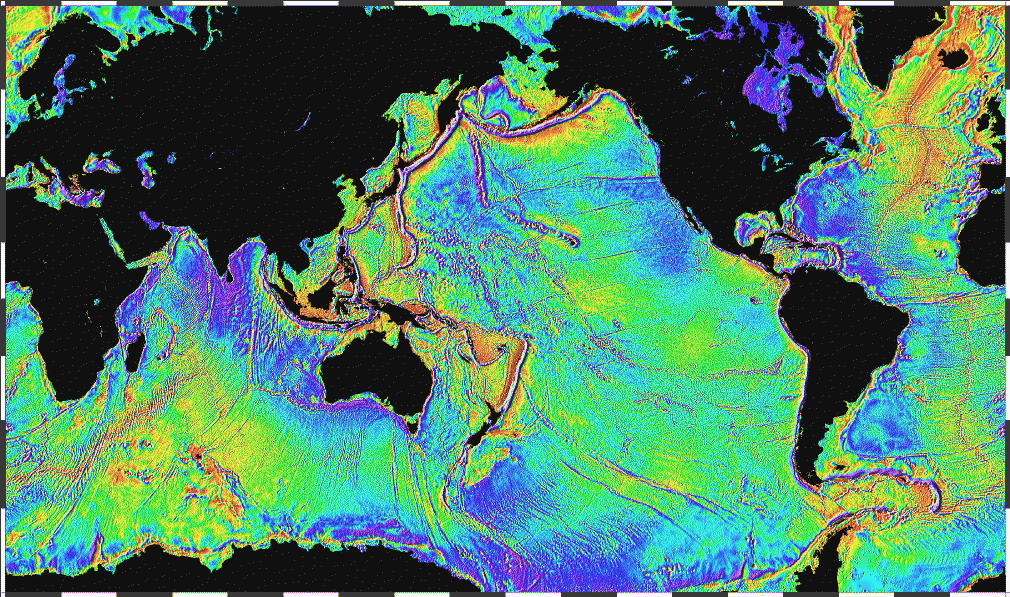
Much of the ocean bottom remains unexplored and unmapped. A global image of many underwater features larger than 10 kilometres (6.2 mi) was created in 1995 based on gravitational distortions of the nearby sea surface.
Regions and depths
Pelagic zone
Any water in a sea or lake that is not close to the bottom or near to the shore can be said to be in the pelagic zone. The word pelagic comes from the Greek πέλαγος or pélagos, which means "open sea". The pelagic zone can be thought of in terms of an imaginary cylinder or water column that goes...
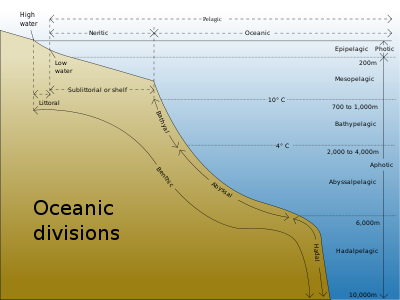
includes all open ocean regions, and can be divided into further regions categorized by depth and light abundance. The photic zone
Photic zone
The photic zone or euphotic zone is the depth of the water in a lake or ocean that is exposed to sufficient sunlight for photosynthesis to occur...
covers the oceans from surface level to 200 metres down. This is the region where photosynthesis can occur and therefore is the most biodiverse. Since plants require photosynthesis, life found deeper than this must either rely on material sinking from above (see marine snow
Marine snow
In the deep ocean, marine snow is a continuous shower of mostly organic detritus falling from the upper layers of the water column. It is a significant means of exporting energy from the light-rich photic zone to the aphotic zone below. The term was first coined by the explorer William Beebe as he...
) or find another energy source; hydrothermal vents are the primary option in what is known as the aphotic zone
Aphotic zone
The aphotic zone is the portion of a lake or ocean where there is little or no sunlight. It is formally defined as the depths beyond which less than 1% of sunlight penetrates. Consequently, bioluminescence is essentially the only light found in this zone...
(depths exceeding 200 m). The pelagic part of the photic zone is known as the epipelagic. The pelagic part of the aphotic zone can be further divided into regions that succeed each other vertically according to temperature.
The mesopelagic
Mesopelagic
The mesopelagic is that part of the pelagic zone that extends from a depth of 200 to 1000 metres below the ocean surface. It lies between the photic epipelagic above and the aphotic bathypelagic below, where there is no light at all...
is the uppermost region. Its lowermost boundary is at a thermocline
Thermocline
A thermocline is a thin but distinct layer in a large body of fluid , in which temperature changes more rapidly with depth than it does in the layers above or below...
of 12 °C (53.6 °F), which, in the tropics generally lies at 700–1000 m (2,296.6–3,280.8 ft). Next is the bathypelagic lying between 10 and 4 °C (50 and 39.2 F), typically between 700–1000 m (2,296.6–3,280.8 ft) and 2000–4000 m (6,561.7–13,123.4 ft) Lying along the top of the abyssal plain
Abyssal plain
An abyssal plain is an underwater plain on the deep ocean floor, usually found at depths between 3000 and 6000 metres. Lying generally between the foot of a continental rise and a mid-ocean ridge, abyssal plains cover more than 50% of the Earth’s surface. They are among the flattest, smoothest...
is the abyssalpelagic
Abyssal zone
The abyssal zone is the abyssopelagic layer or pelagic zone that contains the very deep benthic communities near the bottom of oceans. "Abyss" derives from the Greek word ἄβυσσος, meaning bottomless. At depths of 4,000 to 6,000 metres , this zone remains in perpetual darkness and never receives...
, whose lower boundary lies at about 6000 metres (19,685 ft). The last zone includes the deep trenches, and is known as the hadalpelagic
Hadal zone
The hadal zone , also known as the hadopelagic zone and trench zone, is the delineation for the deepest trenches in the ocean...
. This lies between 6000–11000 m (19,685–36,089.2 ft) and is the deepest oceanic zone.
Along with pelagic aphotic zones there are also benthic aphotic zones. These correspond to the three deepest zones of the deep-sea. The bathyal zone
Bathyal zone
The bathyal zone or bathypelagic – from Greek βαθύς , deep – is that part of the pelagic zone that extends from a depth of 1000 to 4000 metres below the ocean surface. It lies between the mesopelagic above, and the abyssopelagic below. The average temperature hovers at about 39°F...
covers the continental slope down to about 4000 metres (13,123.4 ft). The abyssal zone covers the abyssal plains between 4,000 and 6,000 m. Lastly, the hadal zone corresponds to the hadalpelagic zone which is found in the oceanic trenches.
The pelagic zone can also be split into two subregions, the neritic zone
Neritic zone
The neritic zone, also called coastal waters, the coastal ocean or the sublittoral zone, is the part of the ocean extending from the low tide mark to the edge of the continental shelf, with a relatively shallow depth extending to about 200 meters...
and the oceanic zone
Oceanic zone
The oceanic zone begins in the area off shore where the water measures 200 meters deep or deeper.It is the region of open sea beyond the edge of the continental shelf and includes 65% of the ocean’s completely open water...
. The neritic encompasses the water mass directly above the continental shelves, while the oceanic zone includes all the completely open water.
In contrast, the littoral zone covers the region between low and high tide and represents the transitional area between marine and terrestrial conditions. It is also known as the intertidal zone because it is the area where tide level affects the conditions of the region.
Geology
The ocean floor spreads from mid-ocean ridgeMid-ocean ridge
A mid-ocean ridge is a general term for an underwater mountain system that consists of various mountain ranges , typically having a valley known as a rift running along its spine, formed by plate tectonics. This type of oceanic ridge is characteristic of what is known as an oceanic spreading...
s where two plates
Plate tectonics
Plate tectonics is a scientific theory that describes the large scale motions of Earth's lithosphere...
adjoin. Where two plates move towards each other, one plate subducts
Subduction
In geology, subduction is the process that takes place at convergent boundaries by which one tectonic plate moves under another tectonic plate, sinking into the Earth's mantle, as the plates converge. These 3D regions of mantle downwellings are known as "Subduction Zones"...
under another plate (oceanic or continental) leading to an oceanic trench
Oceanic trench
The oceanic trenches are hemispheric-scale long but narrow topographic depressions of the sea floor. They are also the deepest parts of the ocean floor....
.
Climate effects
Ocean current
An ocean current is a continuous, directed movement of ocean water generated by the forces acting upon this mean flow, such as breaking waves, wind, Coriolis effect, cabbeling, temperature and salinity differences and tides caused by the gravitational pull of the Moon and the Sun...
s greatly affect the Earth's climate
Climate
Climate encompasses the statistics of temperature, humidity, atmospheric pressure, wind, rainfall, atmospheric particle count and other meteorological elemental measurements in a given region over long periods...
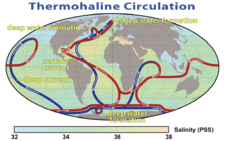
by transferring heat from the tropics to the polar regions, and transferring warm or cold air and precipitation to coastal regions, where winds may carry them inland. Surface heat and freshwater flux
Flux
In the various subfields of physics, there exist two common usages of the term flux, both with rigorous mathematical frameworks.* In the study of transport phenomena , flux is defined as flow per unit area, where flow is the movement of some quantity per time...
es create global density gradient
Density Gradient
Density gradient is a spatial variation in density over an area. The term is used in the natural sciences to describe varying density of matter, but can apply to any quantity whose density can be measured...
s that drive the thermohaline circulation
Thermohaline circulation
The term thermohaline circulation refers to a part of the large-scale ocean circulation that is driven by global density gradients created by surface heat and freshwater fluxes....
part of large-scale ocean circulation. It plays an important role in supplying heat to the polar regions, and thus in sea ice regulation. Changes in the thermohaline circulation are thought to have significant impacts on the Earth's radiation budget. Insofar as the thermohaline circulation governs the rate at which deep waters reach the surface, it may also significantly influence atmospheric carbon dioxide concentrations.
For a discussion of the possibilities of changes to the thermohaline circulation under global warming
Global warming
Global warming refers to the rising average temperature of Earth's atmosphere and oceans and its projected continuation. In the last 100 years, Earth's average surface temperature increased by about with about two thirds of the increase occurring over just the last three decades...
, see shutdown of thermohaline circulation
Shutdown of thermohaline circulation
Shutdown or slowdown of the thermohaline circulation is a postulated effect of global warming.There is some speculation that global warming could, via a shutdown or slowdown of the thermohaline circulation, trigger localised cooling in the North Atlantic and lead to cooling, or lesser warming, in...
.
It is often stated that the thermohaline circulation is the primary reason that the climate of Western Europe is so temperate. An alternate hypothesis claims that this is largely incorrect, and that Europe is warm mostly because it lies downwind of an ocean basin, and because atmospheric waves bring warm air north from the subtropics
Subtropics
The subtropics are the geographical and climatical zone of the Earth immediately north and south of the tropical zone, which is bounded by the Tropic of Cancer and the Tropic of Capricorn, at latitudes 23.5°N and 23.5°S...
.
The Antarctic Circumpolar Current
Antarctic Circumpolar Current
The Antarctic Circumpolar Current is an ocean current that flows from west to east around Antarctica. An alternative name for the ACC is the West Wind Drift. The ACC is the dominant circulation feature of the Southern Ocean and, at approximately 125 Sverdrups, the largest ocean current...
encircles that continent, influencing the area's climate and connecting currents in several oceans.
One of the most dramatic forms of weather
Weather
Weather is the state of the atmosphere, to the degree that it is hot or cold, wet or dry, calm or stormy, clear or cloudy. Most weather phenomena occur in the troposphere, just below the stratosphere. Weather refers, generally, to day-to-day temperature and precipitation activity, whereas climate...
occurs over the oceans: tropical cyclone
Tropical cyclone
A tropical cyclone is a storm system characterized by a large low-pressure center and numerous thunderstorms that produce strong winds and heavy rain. Tropical cyclones strengthen when water evaporated from the ocean is released as the saturated air rises, resulting in condensation of water vapor...
s (also called "typhoons" and "hurricanes" depending upon where the system forms).
Biology
Lifeforms native to oceans include:- RadiataRadiataThe Radiata are the radially symmetric animals of the Eumetazoa subkingdom. The term Radiata has had various meanings in the history of classification...
- FishFishFish are a paraphyletic group of organisms that consist of all gill-bearing aquatic vertebrate animals that lack limbs with digits. Included in this definition are the living hagfish, lampreys, and cartilaginous and bony fish, as well as various extinct related groups...
- CetaceaCetaceaThe order Cetacea includes the marine mammals commonly known as whales, dolphins, and porpoises. Cetus is Latin and is used in biological names to mean "whale"; its original meaning, "large sea animal", was more general. It comes from Ancient Greek , meaning "whale" or "any huge fish or sea...
such as whaleWhaleWhale is the common name for various marine mammals of the order Cetacea. The term whale sometimes refers to all cetaceans, but more often it excludes dolphins and porpoises, which belong to suborder Odontoceti . This suborder also includes the sperm whale, killer whale, pilot whale, and beluga...
s, dolphinDolphinDolphins are marine mammals that are closely related to whales and porpoises. There are almost forty species of dolphin in 17 genera. They vary in size from and , up to and . They are found worldwide, mostly in the shallower seas of the continental shelves, and are carnivores, mostly eating...
s and porpoisePorpoisePorpoises are small cetaceans of the family Phocoenidae; they are related to whales and dolphins. They are distinct from dolphins, although the word "porpoise" has been used to refer to any small dolphin, especially by sailors and fishermen...
s, - CephalopodCephalopodA cephalopod is any member of the molluscan class Cephalopoda . These exclusively marine animals are characterized by bilateral body symmetry, a prominent head, and a set of arms or tentacles modified from the primitive molluscan foot...
s such as octopusOctopusThe octopus is a cephalopod mollusc of the order Octopoda. Octopuses have two eyes and four pairs of arms, and like other cephalopods they are bilaterally symmetric. An octopus has a hard beak, with its mouth at the center point of the arms...
and squidSquidSquid are cephalopods of the order Teuthida, which comprises around 300 species. Like all other cephalopods, squid have a distinct head, bilateral symmetry, a mantle, and arms. Squid, like cuttlefish, have eight arms arranged in pairs and two, usually longer, tentacles... - CrustaceanCrustaceanCrustaceans form a very large group of arthropods, usually treated as a subphylum, which includes such familiar animals as crabs, lobsters, crayfish, shrimp, krill and barnacles. The 50,000 described species range in size from Stygotantulus stocki at , to the Japanese spider crab with a leg span...
s such as lobsterLobsterClawed lobsters comprise a family of large marine crustaceans. Highly prized as seafood, lobsters are economically important, and are often one of the most profitable commodities in coastal areas they populate.Though several groups of crustaceans are known as lobsters, the clawed lobsters are most...
s, clamClamThe word "clam" can be applied to freshwater mussels, and other freshwater bivalves, as well as marine bivalves.In the United States, "clam" can be used in several different ways: one, as a general term covering all bivalve molluscs...
s, shrimpShrimpShrimp are swimming, decapod crustaceans classified in the infraorder Caridea, found widely around the world in both fresh and salt water. Adult shrimp are filter feeding benthic animals living close to the bottom. They can live in schools and can swim rapidly backwards. Shrimp are an important...
and krillKrillKrill is the common name given to the order Euphausiacea of shrimp-like marine crustaceans. Also known as euphausiids, these small invertebrates are found in all oceans of the world... - Marine wormMarine wormAny worm that lives in a marine environment is considered a marine worm. Marine worms are found in several different phyla, including the Platyhelminthes, Nematoda, Annelida , Chaetognatha, Hemichordata, and Phoronida....
s - PlanktonPlanktonPlankton are any drifting organisms that inhabit the pelagic zone of oceans, seas, or bodies of fresh water. That is, plankton are defined by their ecological niche rather than phylogenetic or taxonomic classification...
- Echinoderms such as brittle starBrittle starBrittle stars or ophiuroids are echinoderms in the class Ophiuroidea closely related to starfish. They crawl across the seafloor using their flexible arms for locomotion. The ophiuroids generally have five long slender, whip-like arms which may reach up to in length on the largest specimens...
s, starfish, sea cucumberSea cucumberSea cucumbers are echinoderms from the class Holothuroidea.They are marine animals with a leathery skin and an elongated body containing a single, branched gonad. Sea cucumbers are found on the sea floor worldwide. There are a number of holothurian species and genera, many of which are targeted...
s and sand dollarSand dollarThe term Sand dollar refers to species of extremely flattened, burrowing echinoids belonging to the order Clypeasteroida. Some species within the order, not quite as flat, are known as sea biscuits...
s.
Economy
The oceans are essential to transportation: most of the world's goods move by shipShip
Since the end of the age of sail a ship has been any large buoyant marine vessel. Ships are generally distinguished from boats based on size and cargo or passenger capacity. Ships are used on lakes, seas, and rivers for a variety of activities, such as the transport of people or goods, fishing,...
between the world's seaports.
Oceans are also the major supply source for the fishing industry
Fishing industry
The fishing industry includes any industry or activity concerned with taking, culturing, processing, preserving, storing, transporting, marketing or selling fish or fish products....
. Some of the more major ones are shrimp
Shrimp
Shrimp are swimming, decapod crustaceans classified in the infraorder Caridea, found widely around the world in both fresh and salt water. Adult shrimp are filter feeding benthic animals living close to the bottom. They can live in schools and can swim rapidly backwards. Shrimp are an important...
, fish
Fish
Fish are a paraphyletic group of organisms that consist of all gill-bearing aquatic vertebrate animals that lack limbs with digits. Included in this definition are the living hagfish, lampreys, and cartilaginous and bony fish, as well as various extinct related groups...
, crabs and lobster
Lobster
Clawed lobsters comprise a family of large marine crustaceans. Highly prized as seafood, lobsters are economically important, and are often one of the most profitable commodities in coastal areas they populate.Though several groups of crustaceans are known as lobsters, the clawed lobsters are most...
.
Ancient oceans
Continental driftContinental drift
Continental drift is the movement of the Earth's continents relative to each other. The hypothesis that continents 'drift' was first put forward by Abraham Ortelius in 1596 and was fully developed by Alfred Wegener in 1912...
continually reconfigures the oceans, joining and splitting bodies of water. Ancient oceans include:
- Bridge River OceanBridge River OceanThe Bridge River Ocean was an ancient ocean that existed between North America and the Insular Islands during the Paleozoic time. Like the earlier Slide Mountain Ocean the Bridge River Ocean had a subduction zone on the ocean floor called the Insular Trench...
, the ocean between the ancient Insular IslandsInsular IslandsThe Insular Islands were a giant chain of active volcanic islands somewhere in the Pacific Ocean during the Cretaceous time that rode on top a microplate called the Insular Plate, beginning around 130 million years ago. The Insular Islands were surrounded by two prehistoric oceans; the Panthalassa...
and North AmericaNorth AmericaNorth America is a continent wholly within the Northern Hemisphere and almost wholly within the Western Hemisphere. It is also considered a northern subcontinent of the Americas...
. - Iapetus OceanIapetus OceanThe Iapetus Ocean was an ocean that existed in the Neoproterozoic and Paleozoic eras of the geologic timescale . The Iapetus Ocean was situated in the southern hemisphere, between the paleocontinents of Laurentia, Baltica and Avalonia...
, the southern hemisphere ocean between BalticaBalticaBaltica is a name applied by geologists to a late-Proterozoic, early-Palaeozoic continent that now includes the East European craton of northwestern Eurasia. Baltica was created as an entity not earlier than 1.8 billion years ago. Before this time, the three segments/continents that now comprise...
and AvaloniaAvaloniaAvalonia was a microcontinent in the Paleozoic era. Crustal fragments of this former microcontinent underlie south-west Great Britain, and the eastern coast of North America. It is the source of many of the older rocks of Western Europe, Atlantic Canada, and parts of the coastal United States...
. - PanthalassaPanthalassaPanthalassa , also known as the Panthalassic Ocean, was the vast global ocean that surrounded the supercontinent Pangaea, during the late Paleozoic and the early Mesozoic years. It included the Pacific Ocean to the west and north and the Tethys Ocean to the southeast...
, the vast world ocean that surrounded the PangaeaPangaeaPangaea, Pangæa, or Pangea is hypothesized as a supercontinent that existed during the Paleozoic and Mesozoic eras about 250 million years ago, before the component continents were separated into their current configuration....
supercontinent. - Rheic OceanRheic OceanThe Rheic Ocean was a Paleozoic ocean between the large continent Gondwana to the south and the microcontinents Avalonia and others to the north...
- Slide Mountain OceanSlide Mountain OceanThe Slide Mountain Ocean was an ancient ocean that existed between the Intermontane Islands and North America in the Triassic time beginning around 245 million years ago. Its name origin comes from the Slide Mountain Terrane, a region made of rocks from the floor of the ancient ocean...
, the ocean between the ancient Intermontane IslandsIntermontane IslandsThe Intermontane Islands were a giant chain of active volcanic islands somewhere in the Pacific Ocean during the Triassic time beginning around 245 million years ago. They were 600 to long and rode atop a microplate known as the Intermontane Plate...
and North America. - Tethys OceanTethys OceanThe Tethys Ocean was an ocean that existed between the continents of Gondwana and Laurasia during the Mesozoic era before the opening of the Indian Ocean.-Modern theory:...
, the ocean between the ancient continents of GondwanaGondwanaIn paleogeography, Gondwana , originally Gondwanaland, was the southernmost of two supercontinents that later became parts of the Pangaea supercontinent. It existed from approximately 510 to 180 million years ago . Gondwana is believed to have sutured between ca. 570 and 510 Mya,...
and LaurasiaLaurasiaIn paleogeography, Laurasia was the northernmost of two supercontinents that formed part of the Pangaea supercontinent from approximately...
. - Khanty OceanKhanty OceanKhanty Ocean was an ancient, small ocean that existed near the end of the Precambrian time to the Silurian. It was between Baltica and the Siberian continent, with the bordering oceans of Panthalassa to the north, Proto-Tethys to the northeast, and Paleo-Tethys to the south and east...
, the ocean between Baltica and Siberia. - MiroviaMiroviaMirovia was a hypothesized superocean which may have been a global ocean surrounding the supercontinent Rodinia in the Neoproterozoic Era, about 1 billion to 750 million years ago. The Mirovia may be essentially identical to, or the precursor of, the hypothesized Pan-African Ocean, which followed...
, the ocean that surrounded the RodiniaRodiniaIn geology, Rodinia is the name of a supercontinent, a continent which contained most or all of Earth's landmass. According to plate tectonic reconstructions, Rodinia existed between 1.1 billion and 750 million years ago, in the Neoproterozoic era...
supercontinent. - Paleo-Tethys OceanPaleo-Tethys OceanThe Paleo-Tethys Ocean was an ancient Paleozoic ocean. It was located between the paleocontinent Gondwana and the so called Hunic terranes. These are divided into the European Hunic and Asiatic Hunic...
, the ocean between Gondwana and the Hunic terranes. - Poseidon OceanPoseidon OceanThe Poseidon Ocean is a supposed ocean that existed in the Mesoproterozoic period of the geologic timescale . It began to form when a hotspot collided with lithosphere that was already in an extensional regime that allowed rifting to occur at the onset of hotspot volcanism that created the...
- Proto-Tethys OceanProto-Tethys OceanThe Proto-Tethys Ocean was an ancient ocean that existed from the latest Ediacaran to the Carboniferous . It was an ocean predecessor of the later Paleo-Tethys Ocean. The ocean formed when Pannotia disintegrated, Proto-Laurasia rifted away from a supercontinent that would become Gondwana...
- Pan-African OceanPan-African OceanThe Pan-African Ocean is a hypothesized paleo-ocean whose closure created the supercontinent of Pannotia. The ocean may have existed before the break-up of the supercontinent of Rodinia. The ocean closed before the beginning of the Phanerozoic Eon, when the Panthalassa ocean expanded, and was...
, the ocean that surrounded the PannotiaPannotiaPannotia, first described by Ian W. D. Dalziel in 1997, is a hypothetical supercontinent that existed from the Pan-African orogeny about six hundred million years ago to the end of the Precambrian about five hundred and fifty million years ago. It is also known as the Vendian supercontinent...
supercontinent. - SuperoceanSuperoceanA superocean is an ocean which surrounds a supercontinent. It is less commonly defined as any ocean larger than the current Pacific Ocean. Named global superoceans include Mirovia, which surrounded the supercontinent Rodinia, and Panthalassa, which surrounded the supercontinent Pangaea...
, the ocean that surrounds a global supercontinent. - Ural OceanUral OceanThe Ural Ocean was a small, ancient ocean that was situated between Siberia and Baltica. The ocean formed in the Late Ordovician epoch, when large islands from Siberia collided with Baltica, which was now part of a minor supercontinent of Euramerica. The islands also caused Ural Ocean's precursor,...
, the ocean between SiberiaSiberiaSiberia is an extensive region constituting almost all of Northern Asia. Comprising the central and eastern portion of the Russian Federation, it was part of the Soviet Union from its beginning, as its predecessor states, the Tsardom of Russia and the Russian Empire, conquered it during the 16th...
and BalticaBalticaBaltica is a name applied by geologists to a late-Proterozoic, early-Palaeozoic continent that now includes the East European craton of northwestern Eurasia. Baltica was created as an entity not earlier than 1.8 billion years ago. Before this time, the three segments/continents that now comprise...
.
Extraterrestrial oceans
- See also Extraterrestrial liquid waterExtraterrestrial liquid waterExtraterrestrial liquid water, the presence of water in its liquid state, is a subject of wide interest because it is a commonly suggested prerequisite for the emergence of extraterrestrial life....
Earth is the only known planet
Planet
A planet is a celestial body orbiting a star or stellar remnant that is massive enough to be rounded by its own gravity, is not massive enough to cause thermonuclear fusion, and has cleared its neighbouring region of planetesimals.The term planet is ancient, with ties to history, science,...
with liquid water on its surface and is certainly the only one in our own solar system
Solar System
The Solar System consists of the Sun and the astronomical objects gravitationally bound in orbit around it, all of which formed from the collapse of a giant molecular cloud approximately 4.6 billion years ago. The vast majority of the system's mass is in the Sun...
. However, a layer of liquid water thick enough to decouple the crust from the mantle is thought to be present under the surfaces of the moons Titan
Titan (moon)
Titan , or Saturn VI, is the largest moon of Saturn, the only natural satellite known to have a dense atmosphere, and the only object other than Earth for which clear evidence of stable bodies of surface liquid has been found....
, Europa
Europa (moon)
Europa Slightly smaller than Earth's Moon, Europa is primarily made of silicate rock and probably has an iron core. It has a tenuous atmosphere composed primarily of oxygen. Its surface is composed of ice and is one of the smoothest in the Solar System. This surface is striated by cracks and...
and, with less certainty, Callisto
Callisto (moon)
Callisto named after the Greek mythological figure of Callisto) is a moon of the planet Jupiter. It was discovered in 1610 by Galileo Galilei. It is the third-largest moon in the Solar System and the second largest in the Jovian system, after Ganymede. Callisto has about 99% the diameter of the...
and Ganymede
Ganymede (moon)
Ganymede is a satellite of Jupiter and the largest moon in the Solar System. It is the seventh moon and third Galilean satellite outward from Jupiter. Completing an orbit in roughly seven days, Ganymede participates in a 1:2:4 orbital resonance with the moons Europa and Io, respectively...
. A similar magma
Magma
Magma is a mixture of molten rock, volatiles and solids that is found beneath the surface of the Earth, and is expected to exist on other terrestrial planets. Besides molten rock, magma may also contain suspended crystals and dissolved gas and sometimes also gas bubbles. Magma often collects in...
ocean is thought to be present on Io
Io (moon)
Io ) is the innermost of the four Galilean moons of the planet Jupiter and, with a diameter of , the fourth-largest moon in the Solar System. It was named after the mythological character of Io, a priestess of Hera who became one of the lovers of Zeus....
. Geyser
Geyser
A geyser is a spring characterized by intermittent discharge of water ejected turbulently and accompanied by a vapour phase . The word geyser comes from Geysir, the name of an erupting spring at Haukadalur, Iceland; that name, in turn, comes from the Icelandic verb geysa, "to gush", the verb...
s have been found on Saturn's moon Enceladus
Enceladus (moon)
Enceladus is the sixth-largest of the moons of Saturn. It was discovered in 1789 by William Herschel. Until the two Voyager spacecraft passed near it in the early 1980s very little was known about this small moon besides the identification of water ice on its surface...
, though these may not involve bodies of liquid water. Other icy moons and trans-neptunian object
Trans-Neptunian object
A trans-Neptunian object is any minor planet in the Solar System that orbits the Sun at a greater distance on average than Neptune.The first trans-Neptunian object to be discovered was Pluto in 1930...
s may also have internal oceans, or have once had internal oceans that have now frozen. The planets Uranus
Uranus
Uranus is the seventh planet from the Sun. It has the third-largest planetary radius and fourth-largest planetary mass in the Solar System. It is named after the ancient Greek deity of the sky Uranus , the father of Cronus and grandfather of Zeus...
and Neptune
Neptune
Neptune is the eighth and farthest planet from the Sun in the Solar System. Named for the Roman god of the sea, it is the fourth-largest planet by diameter and the third largest by mass. Neptune is 17 times the mass of Earth and is slightly more massive than its near-twin Uranus, which is 15 times...
may also possess large oceans of liquid water under their thick atmospheres, though their internal structure is not well understood.
There is currently much debate over whether Mars
Mars
Mars is the fourth planet from the Sun in the Solar System. The planet is named after the Roman god of war, Mars. It is often described as the "Red Planet", as the iron oxide prevalent on its surface gives it a reddish appearance...
once had an ocean in its northern hemisphere, and over what happened to it; recent findings by the Mars Exploration Rover
Mars Exploration Rover
NASA's Mars Exploration Rover Mission is an ongoing robotic space mission involving two rovers, Spirit and Opportunity, exploring the planet Mars...
mission indicate Mars had long-term standing water in at least one location, but its extent is not known.
Astronomers believe that Venus
Atmosphere of Venus
The atmosphere of Venus is much denser and hotter than that of Earth. The temperature at the surface is 740 K , while the pressure is 93 bar. The Venusian atmosphere supports opaque clouds made of sulfuric acid, making optical Earth-based and orbital observation of the surface impossible...
had liquid water and perhaps oceans in its very early history. If they existed, all later vanished via resurfacing
Geology of Venus
Venus is a planet with striking surface characteristics. Most of what is known about its surface stems from radar observations, mainly images sent by the Magellan probe between August 16, 1990 and the end of its sixth orbital cycle in September 1994...
.
Liquid hydrocarbons (not water) are thought to be present on the surface of Titan
Titan (moon)
Titan , or Saturn VI, is the largest moon of Saturn, the only natural satellite known to have a dense atmosphere, and the only object other than Earth for which clear evidence of stable bodies of surface liquid has been found....
, though lakes may be a more accurate term. The Cassini–Huygens space mission initially discovered only what appeared to be dry lakebeds and empty river channels, suggesting that Titan had lost what surface liquids it might have had. Cassini's more recent fly-by of Titan offers radar images that strongly suggest hydrocarbon lakes near the colder polar regions. Titan is thought to have a subterranean water ocean under the ice and hydrocarbon mix that forms its outer crust.
Beyond the solar system, the planet Gliese 581 c
Gliese 581 c
Gliese 581 c or Gl 581 c is a planet orbiting the red dwarf star Gliese 581. It is the second planet discovered in the system and the third in order from the star. With a mass at least 5.6 times that of the Earth, it is classified as a super-Earth...
is at the right distance from its sun to support liquid surface water. However, its greenhouse effect
Greenhouse effect
The greenhouse effect is a process by which thermal radiation from a planetary surface is absorbed by atmospheric greenhouse gases, and is re-radiated in all directions. Since part of this re-radiation is back towards the surface, energy is transferred to the surface and the lower atmosphere...
would make it too hot for oceans to exist on the surface. On Gliese 581 d
Gliese 581 d
Gliese 581 d or Gl 581 d is an extrasolar planet orbiting the star Gliese 581 approximately 20 light-years away in the constellation of Libra. It is the third planet discovered in the system and the fifth in order from the star....
the greenhouse effect may bring temperatures suitable for surface oceans. Astronomers dispute whether HD 209458 b
HD 209458 b
HD 209458 b is an extrasolar planet that orbits the Solar analog star HD 209458 in the constellation Pegasus, some 150 light-years from Earth's solar system, with evidence of water vapor....
has water vapour in its atmosphere. Gliese 436 b
Gliese 436 b
Gliese 436 b is a Neptune-sized extrasolar planet orbiting the red dwarf star Gliese 436. It was among the smallest known transiting planets in mass and radius until the much smaller Kepler discoveries started coming in 2010.-Discovery:...
is believed to have "hot ice." Neither of these planets are cool enough for liquid water—but if water molecules exist there, they are also likely to be found on planets at a suitable temperature. GJ 1214 b, detected by transit, found evidence that this planet has oceans made of exotic form of ice VII
Ice VII
Ice VII is a cubic crystalline form of ice. It has a triple point with liquid water and Ice VI at 355 K and 2.216 GPa, with the melt line extending to at least 715 K and 10 GPa. It can also be reached in the solid state by increasing the pressure on ice VI at ambient temperature. Like the majority...
, making up 75% of all the planet's mass.
Culture
The original concept of "ocean" goes back to notions of Mesopotamian and Indo-European mythology, imagining the world to be encircled by a great river. OkeanosOceanus
Oceanus ; , Ōkeanós) was a pseudo-geographical feature in classical antiquity, believed by the ancient Greeks and Romans to be the world-ocean, an enormous river encircling the world....
in Greek
Greek mythology
Greek mythology is the body of myths and legends belonging to the ancient Greeks, concerning their gods and heroes, the nature of the world, and the origins and significance of their own cult and ritual practices. They were a part of religion in ancient Greece...
, reflects the ancient Greek observation that a strong current flowed off Gibraltar
Gibraltar
Gibraltar is a British overseas territory located on the southern end of the Iberian Peninsula at the entrance of the Mediterranean. A peninsula with an area of , it has a northern border with Andalusia, Spain. The Rock of Gibraltar is the major landmark of the region...
and their subsequent assumption that it was a great river. (Compare also Samudra
Samudra
Samudra is a Sanskrit term for "ocean", literally the "gathering together of waters" Samudra is a Sanskrit term for "ocean", literally the "gathering together of waters" Samudra is a Sanskrit term for "ocean", literally the "gathering together of waters" (- meaning "together" and -udra meaning...
from Hindu mythology
Hindu mythology
Hindu religious literature is the large body of traditional narratives related to Hinduism, notably as contained in Sanskrit literature, such as the Sanskrit epics and the Puranas. As such, it is a subset of Nepali and Indian culture...
and Jörmungandr
Jörmungandr
In Norse mythology, Jörmungandr , mostly known as Jormungand, orJörmungand , or Midgard Serpent , or World Serpent, is a sea serpent, and the middle child of the giantess Angrboða and the god Loki...
from Norse mythology
Norse mythology
Norse mythology, a subset of Germanic mythology, is the overall term for the myths, legends and beliefs about supernatural beings of Norse pagans. It flourished prior to the Christianization of Scandinavia, during the Early Middle Ages, and passed into Nordic folklore, with some aspects surviving...
.) The world was imagined to be enclosed by a celestial ocean
Celestial ocean
Several mythologies have the notion of a celestial ocean or river, enveloping the world both above the heavenly sphere and below the underworld.See also:*Oceanus*Uranos*Styx*Rasā*Samudra*Varuna*Sea...
above the heavens, and an ocean of the underworld below.
Artworks which depict maritime themes are known as marine art
Marine art
Marine art or maritime art is any form of figurative art that portrays or draws its main inspiration from the sea. Maritime painting is a genre that depicts ships and the sea—a genre particularly strong from the 17th to 19th centuries...
, a term which particularly applies to common styles of European painting of the 17th to 19th centuries.
Further reading
- Matthias Tomczak and J. Stuart Godfrey. 2003. Regional Oceanography: an Introduction. (see the site)
- "Origins of the oceans and continents". UN Atlas of the Oceans.
- Pope, F. 2009. From eternal darkness springs cast of angels and jellied jewels. in The Times. November 23. 2009 p. 16–17.
External links
- National Oceanic and Atmospheric Administration
- Marine forecasts for any ocean point – Buoyweather is a helpful link for marine safety
- Council on Foreign Relations, Interactive Guide to Oceans Governance
- Smithsonian Ocean Portal