

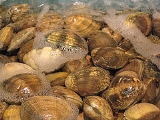
Clam

Encyclopedia
The word "clam" can be applied to freshwater mussel
s, and other freshwater
bivalves, as well as marine bivalves.
In the United States, "clam" can be used in several different ways: one, as a general term covering all bivalve
mollusc
s. The word can also be used in a more limited sense, to mean bivalves that burrow in sediment
, as opposed to ones that attach themselves to the substrate (for example oyster
s and mussel
s), or ones that can swim and are migratory, like scallop
s. In addition "clam" can be used in an even more limited sense, to mean one or more species
of commonly consumed marine bivalves, as in the phrase clam chowder
, meaning shellfish
soup usually made using the hard clam
. Many edible bivalves have a roughly oval shape; however, the edible Pacific razor clam
has an elongated, parallel-sided shell, whose shape suggests that of an old-fashioned straight razor
.
In the United Kingdom, "clam" is one of the common names of various species of marine bivalve mollusc, but it is not used as a general term to cover edible clams that burrow, and it is not used as a general term for all bivalves.
Numerous edible marine bivalve species live buried in sand or mud, and respire by means of siphons, which reach to the surface. In the United States, these clams are collected by "digging for clams" or clam digging
.
In October 2007 an Arctica islandica
clam, caught off the coast of Iceland
, was discovered to be at least 405 years old, and was declared the world's oldest living animal by researchers from Bangor University
, see Ming (clam)
.
In regard to the concept of edible clams, most species of bivalves are at least potentially edible. However some are too small to be useful, and not all species are considered palatable
.
The word "clam" has given rise to the metaphor "clam up", meaning to refuse to talk or answer, based on the clam behavior of quickly closing its shell when threatened. A "clam shell" is the name given to a hinged container consisting of two equal halves that lock together. Clams have also inspired the phrase "happy as a clam", short for "happy as a clam at high tide" (which should be happy because it cannot easily be dug up and eaten).
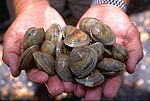 A clam's shell consists of two (usually equal) halves, which are connected by a hinge joint and a ligament which can be external or internal, much like a Venus Flytrap.
In clams, two adductor muscles contract to close the shells. The clam has no head, and usually has no eyes
(scallop
s are a notable exception), but a clam does have kidneys, a heart, a mouth and an anus. For more information see bivalve
and pseudofeces
.
Clams, like most molluscs, also have open circulatory systems, which means that their organs are surrounded by watery blood that contains nutrients and oxygen.
Clams feed on plankton
by filter feeding
. Clams filter feed by drawing in water containing food using an incurrent siphon. The food is then filtered out of the water by the gills and swept toward the mouth on a layer of mucus. The water is then expelled from the animal by an excurrent siphon.
Mercenaria mercenaria. It may also refer to a few other common edible species, such as the soft-shell clam
, Mya arenaria, and the ocean quahog, Arctica islandica
. Another species which is commercially exploited on the Atlantic Coast of the United States is the surf clam Spisula solidissima.
Clams can be eaten raw, steamed, boiled, baked or fried
; the method of preparation depends partly on the size and species of the clam. They can also be made into clam chowder
(a popular soup in the U.S. and Canada) or they can be cooked using hot rocks and seaweed in a New England clam bake
.
(Venerupis decussata
), the Cozza
(Mytilus galloprovincialis) and the Tellina
(Donax trunculus
). A variety of mussel called Dattero di mare
(Lithophaga lithophaga) was also once widely popular as seafood. However, since overfishing drove it to the verge of extinction (it takes 15 to 35 years to reach adult size and could only be harvested by smashing the calcarean rocks that form its habitat), it has been declared an endangered species
by the Italian government since 1998, and its harvest and sale are forbidden.
region, Clams are used to cook curries and side dishes, like Tisaryachi Ekshipi, which is clams with one shell on.In kerala, Clams (known as Erunthu or Kakka) are widely consumed, especially in Curry form. The whole clams are prepared in a green coconut (Not fried) masala, to be had with rice. Mussels(kadukka/Kallumme kaya) are widely consumed, both in curry and fried form.
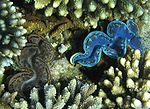 The Maxima clam
Tridacna maxima, a species of giant clam
, is a popular species with saltwater aquarium
hobbyists.
people of ancient Peru
worshiped the sea and its animals. They often depicted clams in their art.
In Jewish tradition all Mollusca
are considered non-kosher
and as such are strictly avoided by observant Jews.
of Eastern North America to manufacture wampum
, a type of shell money.
Not usually considered edible:
Mussel
The common name mussel is used for members of several families of clams or bivalvia mollusca, from saltwater and freshwater habitats. These groups have in common a shell whose outline is elongated and asymmetrical compared with other edible clams, which are often more or less rounded or oval.The...
s, and other freshwater
Freshwater
Fresh water is naturally occurring water on the Earth's surface in ice sheets, ice caps, glaciers, bogs, ponds, lakes, rivers and streams, and underground as groundwater in aquifers and underground streams. Fresh water is generally characterized by having low concentrations of dissolved salts and...
bivalves, as well as marine bivalves.
In the United States, "clam" can be used in several different ways: one, as a general term covering all bivalve
Bivalvia
Bivalvia is a taxonomic class of marine and freshwater molluscs. This class includes clams, oysters, mussels, scallops, and many other families of molluscs that have two hinged shells...
mollusc
Mollusca
The Mollusca , common name molluscs or mollusksSpelled mollusks in the USA, see reasons given in Rosenberg's ; for the spelling mollusc see the reasons given by , is a large phylum of invertebrate animals. There are around 85,000 recognized extant species of molluscs. Mollusca is the largest...
s. The word can also be used in a more limited sense, to mean bivalves that burrow in sediment
Sediment
Sediment is naturally occurring material that is broken down by processes of weathering and erosion, and is subsequently transported by the action of fluids such as wind, water, or ice, and/or by the force of gravity acting on the particle itself....
, as opposed to ones that attach themselves to the substrate (for example oyster
Oyster
The word oyster is used as a common name for a number of distinct groups of bivalve molluscs which live in marine or brackish habitats. The valves are highly calcified....
s and mussel
Mussel
The common name mussel is used for members of several families of clams or bivalvia mollusca, from saltwater and freshwater habitats. These groups have in common a shell whose outline is elongated and asymmetrical compared with other edible clams, which are often more or less rounded or oval.The...
s), or ones that can swim and are migratory, like scallop
Scallop
A scallop is a marine bivalve mollusk of the family Pectinidae. Scallops are a cosmopolitan family, found in all of the world's oceans. Many scallops are highly prized as a food source...
s. In addition "clam" can be used in an even more limited sense, to mean one or more species
Species
In biology, a species is one of the basic units of biological classification and a taxonomic rank. A species is often defined as a group of organisms capable of interbreeding and producing fertile offspring. While in many cases this definition is adequate, more precise or differing measures are...
of commonly consumed marine bivalves, as in the phrase clam chowder
Clam chowder
Clam chowder is any of several chowders containing clams and broth. Along with the clams, diced potato is common, as are onions, which are occasionally sauteed in the drippings from salt pork or bacon. Celery is frequently used. Other vegetables are uncommon, but small carrot strips might...
, meaning shellfish
Shellfish
Shellfish is a culinary and fisheries term for exoskeleton-bearing aquatic invertebrates used as food, including various species of molluscs, crustaceans, and echinoderms. Although most kinds of shellfish are harvested from saltwater environments, some kinds are found only in freshwater...
soup usually made using the hard clam
Hard clam
The hard clam , also known as a quahog , round clam, or hard-shell clam, is an edible marine bivalve mollusk which is native to the eastern shores of North America, from Prince Edward Island to the Yucatán Peninsula...
. Many edible bivalves have a roughly oval shape; however, the edible Pacific razor clam
Pacific razor clam
The Pacific razor clam, Siliqua patula, is a species of large edible marine bivalve mollusc in the family Cultellidae.-Range:Pacific razor clams can be found along the Pacific West Coast from the eastern Aleutian Islands, Alaska, to Pismo Beach, California...
has an elongated, parallel-sided shell, whose shape suggests that of an old-fashioned straight razor
Straight razor
A straight razor is a razor with a blade that can fold into its handle. They are also called open razors and cut-throat razors.Although straight razors were once the principal method of manual shaving, they have been largely overshadowed by the safety razor, incorporating a disposable blade...
.
In the United Kingdom, "clam" is one of the common names of various species of marine bivalve mollusc, but it is not used as a general term to cover edible clams that burrow, and it is not used as a general term for all bivalves.
Numerous edible marine bivalve species live buried in sand or mud, and respire by means of siphons, which reach to the surface. In the United States, these clams are collected by "digging for clams" or clam digging
Clam digging
Clam digging is a common means of harvesting clams from below the surface of the tidal mud flats where they live. It is done both recreationally and commercially...
.
In October 2007 an Arctica islandica
Arctica islandica
Arctica islandica, commonly known as the ocean quahog, is an edible marine bivalve mollusk native to the North Atlantic ocean, which is harvested commercially...
clam, caught off the coast of Iceland
Iceland
Iceland , described as the Republic of Iceland, is a Nordic and European island country in the North Atlantic Ocean, on the Mid-Atlantic Ridge. Iceland also refers to the main island of the country, which contains almost all the population and almost all the land area. The country has a population...
, was discovered to be at least 405 years old, and was declared the world's oldest living animal by researchers from Bangor University
Bangor University
Bangor University is a university based in the city of Bangor in the county of Gwynedd in North Wales-United Kingdom.It was officially known for most of its history as the University College of North Wales...
, see Ming (clam)
Ming (clam)
right|thumb|upright|One [[valve |valve]] of the shell of Ming, a clam estimated to be 405-410 years oldMing is the nickname given to a specimen of an ocean quahog clam, Arctica islandica, family Veneridae, and is the oldest living animal ever discovered.Judging by the annual growth rings on the...
.
In regard to the concept of edible clams, most species of bivalves are at least potentially edible. However some are too small to be useful, and not all species are considered palatable
Palatability
Palatability is the hedonic reward provided by foods or fluids that are agreeable to the "palate" in regard to the homeostatic satisfaction of nutritional, water, or energy needs. The palatability of a food or fluid, unlike its flavor or taste, varies with the state of an individual: it is lower...
.
The word "clam" has given rise to the metaphor "clam up", meaning to refuse to talk or answer, based on the clam behavior of quickly closing its shell when threatened. A "clam shell" is the name given to a hinged container consisting of two equal halves that lock together. Clams have also inspired the phrase "happy as a clam", short for "happy as a clam at high tide" (which should be happy because it cannot easily be dug up and eaten).
Anatomy
In clams, two adductor muscles contract to close the shells. The clam has no head, and usually has no eyes
Mollusc eye
The molluscs have the widest variety of eye morphologies of any phylum, and a large degree of variation in their function. Cephalopods' eyes are as complex as those of vertebrates; scallops have up to 100 simple eyes; and some bivalves have compound eyes....
(scallop
Scallop
A scallop is a marine bivalve mollusk of the family Pectinidae. Scallops are a cosmopolitan family, found in all of the world's oceans. Many scallops are highly prized as a food source...
s are a notable exception), but a clam does have kidneys, a heart, a mouth and an anus. For more information see bivalve
Bivalvia
Bivalvia is a taxonomic class of marine and freshwater molluscs. This class includes clams, oysters, mussels, scallops, and many other families of molluscs that have two hinged shells...
and pseudofeces
Pseudofeces
Pseudofeces or pseudofaeces are a way that filter-feeding bivalve mollusks get rid of suspended particles which have been rejected as unsuitable for food. The rejected particles are wrapped in mucus, and are expelled without having passed through the digestive tract...
.
Clams, like most molluscs, also have open circulatory systems, which means that their organs are surrounded by watery blood that contains nutrients and oxygen.
Clams feed on plankton
Plankton
Plankton are any drifting organisms that inhabit the pelagic zone of oceans, seas, or bodies of fresh water. That is, plankton are defined by their ecological niche rather than phylogenetic or taxonomic classification...
by filter feeding
Filter feeder
Filter feeders are animals that feed by straining suspended matter and food particles from water, typically by passing the water over a specialized filtering structure. Some animals that use this method of feeding are clams, krill, sponges, baleen whales, and many fish and some sharks. Some birds,...
. Clams filter feed by drawing in water containing food using an incurrent siphon. The food is then filtered out of the water by the gills and swept toward the mouth on a layer of mucus. The water is then expelled from the animal by an excurrent siphon.
In North America
In culinary use, within the eastern coast of the United States, the term "clam" most often refers to the hard clamHard clam
The hard clam , also known as a quahog , round clam, or hard-shell clam, is an edible marine bivalve mollusk which is native to the eastern shores of North America, from Prince Edward Island to the Yucatán Peninsula...
Mercenaria mercenaria. It may also refer to a few other common edible species, such as the soft-shell clam
Soft-shell clam
Soft-shell clams, scientific name Mya arenaria, popularly called "steamers", "softshells", "longnecks", "piss clams", "Ipswich clams", or "Essex clams" are a species of edible saltwater clam, a marine bivalve mollusk in the family Myidae....
, Mya arenaria, and the ocean quahog, Arctica islandica
Arctica islandica
Arctica islandica, commonly known as the ocean quahog, is an edible marine bivalve mollusk native to the North Atlantic ocean, which is harvested commercially...
. Another species which is commercially exploited on the Atlantic Coast of the United States is the surf clam Spisula solidissima.
Clams can be eaten raw, steamed, boiled, baked or fried
Fried clams
Fried clams are made by deep frying soft-shell clams that have been dipped in batter.Fried clams are an iconic food, "to New England what barbecue is to the South". They tend to be served at seaside clam shacks . For a lighter meal, a clam roll is made by piling clams into a hot dog bun...
; the method of preparation depends partly on the size and species of the clam. They can also be made into clam chowder
Clam chowder
Clam chowder is any of several chowders containing clams and broth. Along with the clams, diced potato is common, as are onions, which are occasionally sauteed in the drippings from salt pork or bacon. Celery is frequently used. Other vegetables are uncommon, but small carrot strips might...
(a popular soup in the U.S. and Canada) or they can be cooked using hot rocks and seaweed in a New England clam bake
New England clam bake
The New England clam bake is a traditional method of cooking foods, especially seafood such as lobster, mussels, crabs, steamers, and quahogs. The seafood is often supplemented by sausages, potatoes, onions, carrots, corn on the cob, etc...
.
In Italy
In Italy, clams are often an ingredient of mixed seafood dishes, or are eaten together with pasta. The more commonly used varieties of clams in Italian cooking are the VongolaVeneridae
The Veneridae or venerids, also known as the Venus clams, are a very large family of minute to large, saltwater clams, marine bivalve molluscs. There are over 500 living species of venerid bivalves, most of which are edible, and many of which are exploited as a food source.Many of the most...
(Venerupis decussata
Venerupis decussata
Venerupis decussata is a marine bivalve mollusc in the family Veneridae, commonly known as the cross-cut carpet shell.-Taxonomy:The species name Venerupis decussata is considered valid by the World Register of Marine Species with a range limited to the north east Atlantic Ocean...
), the Cozza
Mussel
The common name mussel is used for members of several families of clams or bivalvia mollusca, from saltwater and freshwater habitats. These groups have in common a shell whose outline is elongated and asymmetrical compared with other edible clams, which are often more or less rounded or oval.The...
(Mytilus galloprovincialis) and the Tellina
Tellina
Tellina is a widely distributed genus of marine bivalve molluscs, in the family Tellinidae.- Species :* Tellina aequistriata Say, 1824: striate tellin* Tellina agilis Stimpson, 1857: northern dwarf tellin, northern dwarf-tellin...
(Donax trunculus
Donax
Donax is a genus of small, edible saltwater clams, marine bivalve mollusks. The genus is sometimes known as bean clams; however, Donax species have various common names in different parts of the world....
). A variety of mussel called Dattero di mare
Lithophaga
Lithophaga, the date mussels, are a genus of medium-sized marine bivalve molluscs in the family Mytilidae.The shells of species in this genus are long and narrow with parallel sides. The animals bore into stone or coral rock with the help of pallial gland secretions, hence the systematic name...
(Lithophaga lithophaga) was also once widely popular as seafood. However, since overfishing drove it to the verge of extinction (it takes 15 to 35 years to reach adult size and could only be harvested by smashing the calcarean rocks that form its habitat), it has been declared an endangered species
Endangered species
An endangered species is a population of organisms which is at risk of becoming extinct because it is either few in numbers, or threatened by changing environmental or predation parameters...
by the Italian government since 1998, and its harvest and sale are forbidden.
In India
In the south western coast of India, also known as the KonkanKonkan
The Konkan also called the Konkan Coast or Karavali is a rugged section of the western coastline of India from Raigad to Mangalore...
region, Clams are used to cook curries and side dishes, like Tisaryachi Ekshipi, which is clams with one shell on.In kerala, Clams (known as Erunthu or Kakka) are widely consumed, especially in Curry form. The whole clams are prepared in a green coconut (Not fried) masala, to be had with rice. Mussels(kadukka/Kallumme kaya) are widely consumed, both in curry and fried form.
In aquaria
Maxima clam
The maxima clam , also known as the small giant clam, is a species of bivalve found throughout the Indo-Pacific. They are much sought after in the aquarium trade, as their often striking coloration mimics that of the true giant clam, however the maximas maintain a manageable size, with the shells...
Tridacna maxima, a species of giant clam
Giant clam
The giant clam, Tridacna gigas , is the largest living bivalve mollusc. T. gigas is one of the most endangered clam species. It was mentioned as early as 1825 in scientific reports...
, is a popular species with saltwater aquarium
Aquarium
An aquarium is a vivarium consisting of at least one transparent side in which water-dwelling plants or animals are kept. Fishkeepers use aquaria to keep fish, invertebrates, amphibians, marine mammals, turtles, and aquatic plants...
hobbyists.
In a religious context
The MocheMoche
'The Moche civilization flourished in northern Peru from about 100 AD to 800 AD, during the Regional Development Epoch. While this issue is the subject of some debate, many scholars contend that the Moche were not politically organized as a monolithic empire or state...
people of ancient Peru
Peru
Peru , officially the Republic of Peru , is a country in western South America. It is bordered on the north by Ecuador and Colombia, on the east by Brazil, on the southeast by Bolivia, on the south by Chile, and on the west by the Pacific Ocean....
worshiped the sea and its animals. They often depicted clams in their art.
In Jewish tradition all Mollusca
Mollusca
The Mollusca , common name molluscs or mollusksSpelled mollusks in the USA, see reasons given in Rosenberg's ; for the spelling mollusc see the reasons given by , is a large phylum of invertebrate animals. There are around 85,000 recognized extant species of molluscs. Mollusca is the largest...
are considered non-kosher
Kashrut
Kashrut is the set of Jewish dietary laws. Food in accord with halakha is termed kosher in English, from the Ashkenazi pronunciation of the Hebrew term kashér , meaning "fit" Kashrut (also kashruth or kashrus) is the set of Jewish dietary laws. Food in accord with halakha (Jewish law) is termed...
and as such are strictly avoided by observant Jews.
As currency
Some species of clams, particularly Mercenaria mercenaria, were in the past used by the AlgonquiansAlgonquian peoples
The Algonquian are one of the most populous and widespread North American native language groups, with tribes originally numbering in the hundreds. Today hundreds of thousands of individuals identify with various Algonquian peoples...
of Eastern North America to manufacture wampum
Wampum
Wampum are traditional, sacred shell beads of the Eastern Woodlands tribes of the indigenous people of North America. Wampum include the white shell beads fashioned from the North Atlantic channeled whelk shell; and the white and purple beads made from the quahog, or Western North Atlantic...
, a type of shell money.
Some examples of clams
Edible:- Grooved carpet shellGrooved carpet shellThe grooved carpet shell, Ruditapes decussatus, is a clam or bivalve mollusc in the family Veneridae. It is distributed worldwide and due to its ecological and economic interest has been proposed as a bioindicator....
: Ruditapes decussatus - Hard clamHard clamThe hard clam , also known as a quahog , round clam, or hard-shell clam, is an edible marine bivalve mollusk which is native to the eastern shores of North America, from Prince Edward Island to the Yucatán Peninsula...
or Northern Quahog: Mercenaria mercenaria - Manila clam: Venerupis philippinarumVenerupis philippinarumVenerupis philippinarum is an edible species of saltwater clam, a marine bivalve mollusk in the family Veneridae, the Venus clams.The common names of the species include "Japanese littleneck", "Manila clam", "steamer clam", "Filipino Venus", "Japanese cockle", and "Japanese carpet...
- Soft clamSoft-shell clamSoft-shell clams, scientific name Mya arenaria, popularly called "steamers", "softshells", "longnecks", "piss clams", "Ipswich clams", or "Essex clams" are a species of edible saltwater clam, a marine bivalve mollusk in the family Myidae....
: Mya arenaria - Atlantic surf clamAtlantic surf clamThe Atlantic surf clam, also referred to as the "bar clam," "hen clam," "skimmer," or simply as the "sea clam," is a western Atlantic surf clam, a very large , edible, saltwater clam or marine bivalve mollusk in the family Mactridae...
: Spisula solidissima - Ocean quahog: Arctica islandicaArctica islandicaArctica islandica, commonly known as the ocean quahog, is an edible marine bivalve mollusk native to the North Atlantic ocean, which is harvested commercially...
- Pacific razor clamPacific razor clamThe Pacific razor clam, Siliqua patula, is a species of large edible marine bivalve mollusc in the family Cultellidae.-Range:Pacific razor clams can be found along the Pacific West Coast from the eastern Aleutian Islands, Alaska, to Pismo Beach, California...
: Siliqua patula - PismoPismo Beach, CaliforniaPismo Beach is a city in San Luis Obispo County, California, United States. The population was 7,655 at the 2010 census, down from 8,551 at the 2000 census...
clam: Tivela stultorum (8 inch shell on display at the Pismo Beach Chamber of Commerce) - GeoduckGeoduckThe geoduck , Panopea generosa, is a species of very large saltwater clam, a marine bivalve mollusk in the family Hiatellidae.The shell of this clam is large, about to over in length, but the very long siphons make the clam itself very much longer than this: the "neck" or siphons alone can be ...
: Panopea abruptaPanopea abruptaPanopea abrupta is an extinct species of large marine bivalve mollusc in the family Hiatellidae. Between 1983 and 2010, this species of clam was confused with the Pacific Geoduck, Panopea generosa, in the scientific literature....
or Panope generosa (largest burrowing clam in the world) - Atlantic jackknife clamAtlantic jackknife clamThe Atlantic jackknife , Ensis directus, also known as the bamboo clam, American jackknife clam or razor clam , is a large species of edible marine bivalve mollusc, found on the North American Atlantic coast, from Canada to South Carolina as well as in Europe.This clam lives in sand and mud and is...
: Ensis directus
Not usually considered edible:
- Ark clamArk clamArk clam is the common name for a family of small to large-sized saltwater clams or marine bivalve molluscs in the family Arcidae. Ark clams vary both in shape and size. They number about 200 species worldwide....
s, family Arcidae - Nut clams or pointed nut clams, family NuculidaeNuculidaeNuculidae is a family of small saltwater clams in the order Nuculoida. Species in this family are commonly known as nut clams.The nomenclature of the Western European species in this family is still uncertain. Their systematics has been based mainly on their feces. -Genera:* Acila H. Adams and A...
- Duck clams or trough shells, family MactridaeMactridaeMactridae, also known as trough shells or duck clams, is a family of marine bivalve clams of the order Veneroida.-Characteristics:...
- Marsh clams, family CorbiculidaeCorbiculidaeThe Corbiculidae, common name "basket clams", are a family of aquatic bivalve molluscs in the order Veneroida.Clams in this family release many juveniles into the surrounding waters that have hatched inside the clams . Fertilization is internal...
- File clams, family LimidaeLimidaeLimidae is the only family of bivalve molluscs in the order Limoida.-Genera:* Acesta H. and A. Adams, 1858* Divarilima Powell, 1958* Escalima Iredale, 1929 * Lima Bruguière, 1789 * Limaria Link, 1807 * Limatula S. V. Wood, 1839...
- Giant clamGiant clamThe giant clam, Tridacna gigas , is the largest living bivalve mollusc. T. gigas is one of the most endangered clam species. It was mentioned as early as 1825 in scientific reports...
: Tridacna gigas - Asian or Asiatic clam: genus CorbiculaCorbiculaCorbicula is a genus of freshwater and brackish water clams, aquatic bivalve mollusks in the family Corbiculidae, the basket clams.The genus name is derived from Latin corbis "basket", referring to the shape and ribs of the shell....
- Peppery furrow shellPeppery furrow shellThe peppery furrow shell, Scrobicularia plana, also known as a sand gaper, is the only species currently recognized by ITIS in the genus Scrobicularia; however some sources recognise other species such as Scrobicularia cottardi. It is a bivalve mollusc commonly found on sandy or muddy sea coasts...
: Scrobicularia plana - Pearls: genus Perlus devinus
See also
- Clam bakeNew England clam bakeThe New England clam bake is a traditional method of cooking foods, especially seafood such as lobster, mussels, crabs, steamers, and quahogs. The seafood is often supplemented by sausages, potatoes, onions, carrots, corn on the cob, etc...
- Fried clamsFried clamsFried clams are made by deep frying soft-shell clams that have been dipped in batter.Fried clams are an iconic food, "to New England what barbecue is to the South". They tend to be served at seaside clam shacks . For a lighter meal, a clam roll is made by piling clams into a hot dog bun...
- Clam chowderClam chowderClam chowder is any of several chowders containing clams and broth. Along with the clams, diced potato is common, as are onions, which are occasionally sauteed in the drippings from salt pork or bacon. Celery is frequently used. Other vegetables are uncommon, but small carrot strips might...
- Clam cake
External links
- Exclusive video of Clams
- Nutrition Facts for Clams
- Deep In The Ocean A Clam That Acts Like A Plant Science DailyScience DailyScience Daily is a news website for topical science articles. It features articles on a wide variety of science topics including: astronomy, exoplanets, computer science, nanotechnology, medicine, psychology, sociology, anthropology, biology, geology, climate, space, physics, mathematics,...
March 2, 2007 - How to Shuck Hard Shell Clams
- Hardshell Clams
- Clam Knief