
All Topics  
Pangaea


   Email Print
   Bookmark   Link


Pangaea


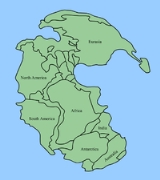
Pangaea, Pangæa or Pangea (from pa?, pan, meaning entire, and Ga?a, Gaea, meaning Earth in Ancient Greek
Ancient Greek

Ancient Greek is the historical stage in the development of the Greek language spanning across the Archaic Greece , Classical Greece , and Hellenistic civilization periods of ancient Greece and the classical antiquity....
) was the supercontinent
Supercontinent

In geology, a supercontinent is a landmass comprising more than one continental core, or craton. The assembly of cratons and terrane that form Eurasia qualifies as a supercontinent today....
 that existed during the Paleozoic
Paleozoic

The Paleozoic or Palaeozoic Era is the earliest of three geology Era of the Phanerozoic Eon . The Paleozoic spanned from roughly , and is subdivided into six period ; from oldest to youngest they are: the Cambrian, Ordovician, Silurian, Devonian period, Carboniferous, and Permian...
 and Mesozoic
Mesozoic

The Mesozoic Era is one of three Geologic time scale of the Phanerozoic eon . The division of time into eras dates back to Giovanni Arduino, in the 18th century, although his original name for the era now called the 'Mesozoic' was 'Secondary' ....
 eras about 250 million years ago, before the component continent
Continent

A continent is one of several large landmasses on Earth. They are generally identified by convention rather than any strict criteria, with seven regions commonly regarded as continents ? they are : Asia, Africa, North America, South America, Antarctica, Europe, and Australia ....
s were separated into their current configuration.

The name was first used by the German originator of the continental drift
Continental drift

Continental drift is the movement of the Earth's continents relative to each other. The hypothesis that continents 'drift' was first put forward by Abraham Ortelius in 1596 and was fully developed by Alfred Wegener in 1912....
 theory, Alfred Wegener
Alfred Wegener

Alfred Lothar Wegener was a Germany scientist, geologist, and meteorologist.He is most notable for his theory of continental drift , proposed in 1915, which hypothesized that the continents were slowly drifting around the Earth....
, in the 1920 edition of his book The Origin of Continents and Oceans (Die Entstehung der Kontinente und Ozeane), in which a postulated supercontinent
Supercontinent

In geology, a supercontinent is a landmass comprising more than one continental core, or craton. The assembly of cratons and terrane that form Eurasia qualifies as a supercontinent today....
 Pangaea played a key role.

lass="link1" onMouseover='showByLink("m3884657",this)' onMouseout='hide("m3884657")'href="http://www.absoluteastronomy.com/topics/Rodinia">Rodinia
Rodinia

In geology, Rodinia is the name of a supercontinent, a continent which contained most or all of Earth's landmass. According to plate tectonic reconstructions, Rodinia existed between 1100 and 750 million years ago, in the Neoproterozoic era ....
, which formed 1.3 billion years ago during the Proterozoic
Proterozoic

The Proterozoic is a eon representing a period before the first abundant complex life on Earth. The Proterozoic Eon extended from 2500 annum to 542.0 ? 1.0 Ma , and is the most recent part of the old, informally named ?Precambrian? time....
, was the supercontinent from which all subsequent continents, sub or super, derived.


Discussion
Ask a question about 'Pangaea'
Start a new discussion about 'Pangaea'
Answer questions from other users
Full Discussion Forum


Recent Posts


Encyclopedia


Pangaea, Pangæa or Pangea (from pa?, pan, meaning entire, and Ga?a, Gaea, meaning Earth in Ancient Greek
Ancient Greek

Ancient Greek is the historical stage in the development of the Greek language spanning across the Archaic Greece , Classical Greece , and Hellenistic civilization periods of ancient Greece and the classical antiquity....
) was the supercontinent
Supercontinent

In geology, a supercontinent is a landmass comprising more than one continental core, or craton. The assembly of cratons and terrane that form Eurasia qualifies as a supercontinent today....
 that existed during the Paleozoic
Paleozoic

The Paleozoic or Palaeozoic Era is the earliest of three geology Era of the Phanerozoic Eon . The Paleozoic spanned from roughly , and is subdivided into six period ; from oldest to youngest they are: the Cambrian, Ordovician, Silurian, Devonian period, Carboniferous, and Permian...
 and Mesozoic
Mesozoic

The Mesozoic Era is one of three Geologic time scale of the Phanerozoic eon . The division of time into eras dates back to Giovanni Arduino, in the 18th century, although his original name for the era now called the 'Mesozoic' was 'Secondary' ....
 eras about 250 million years ago, before the component continent
Continent

A continent is one of several large landmasses on Earth. They are generally identified by convention rather than any strict criteria, with seven regions commonly regarded as continents ? they are : Asia, Africa, North America, South America, Antarctica, Europe, and Australia ....
s were separated into their current configuration.

The name was first used by the German originator of the continental drift
Continental drift

Continental drift is the movement of the Earth's continents relative to each other. The hypothesis that continents 'drift' was first put forward by Abraham Ortelius in 1596 and was fully developed by Alfred Wegener in 1912....
 theory, Alfred Wegener
Alfred Wegener

Alfred Lothar Wegener was a Germany scientist, geologist, and meteorologist.He is most notable for his theory of continental drift , proposed in 1915, which hypothesized that the continents were slowly drifting around the Earth....
, in the 1920 edition of his book The Origin of Continents and Oceans (Die Entstehung der Kontinente und Ozeane), in which a postulated supercontinent
Supercontinent

In geology, a supercontinent is a landmass comprising more than one continental core, or craton. The assembly of cratons and terrane that form Eurasia qualifies as a supercontinent today....
 Pangaea played a key role.

Formation of Pangaea

Rodinia
Rodinia

In geology, Rodinia is the name of a supercontinent, a continent which contained most or all of Earth's landmass. According to plate tectonic reconstructions, Rodinia existed between 1100 and 750 million years ago, in the Neoproterozoic era ....
, which formed 1.3 billion years ago during the Proterozoic
Proterozoic

The Proterozoic is a eon representing a period before the first abundant complex life on Earth. The Proterozoic Eon extended from 2500 annum to 542.0 ? 1.0 Ma , and is the most recent part of the old, informally named ?Precambrian? time....
, was the supercontinent from which all subsequent continents, sub or super, derived. Rodinia does not preclude the possibility of prior supercontinents
Vaalbara

Vaalbara is the Earth's theorized first supercontinent. According to Radiometric dating data of the encompassing cratons that constituted Vaalbara, it is believed to have existed 3.3 billion years ago and possibly as far back as 3.6 Ga....
 as the breakup and formation of supercontinents appears to be cyclical
Supercontinent cycle

The supercontinent cycle describes the quasi-periodic aggregration and dispersal of Earth's continental crust. There are varying opinions as to whether Earth's budget of continental crust is increasing, decreasing, or remaining about constant, but it is agreed that this inventory is constantly being reconfigured....
 through Earth's 4.6 billion years.

Gondwana
Gondwana

Gondwana , originally Gondwanaland is the name given to a southern precursor-supercontinent and then as a remnant separated from Laurasia 180- during the breakup of the Pangaea supercontinent that existed about 500 to 200 Annum ago into two large segments.
 followed with several iterations before the formation of Pangaea, which succeeded Pannotia
Pannotia

Pannotia, first described by Ian W. D. Dalziel in 1997, is a hypothetical supercontinent that existed from the Pan-African orogeny about 600 million years ago to the end of the Precambrian about 540 million years ago....
, before the beginning of the Paleozoic Era (545 Ma) and the Phanerozoic Eon.

The minor supercontinent of Proto-Laurasia drifted away from Gondwana and moved across the Panthalassic Ocean. A new ocean was forming between the two continents, the Proto-Tethys Ocean
Proto-Tethys Ocean

The Proto-Tethys Ocean was an ancient ocean that existed from the latest Ediacaran to the Carboniferous . It was an ocean predecessor of the later Paleo-Tethys Ocean....
. Soon, Proto-Laurasia drifted apart itself to create Laurentia
Laurentia

Laurentia , like all craton land, was created as continents moved about the surface of the Earth , bumping into other continents and drifting away....
, Siberia
Siberia (continent)

Siberia is the craton located in the heart of the region of Siberia. Siberia or "Angaraland" is today the Central Siberian Plateau. It is an extremely ancient craton that formed an independent continent before the Permian...
 and Baltica
Baltica

Baltica redirects here. For the Russian beer, see Baltika BreweriesBaltica is a name applied by geologists to a late-Proterozoic, early-Palaeozoic continent that now includes the East European craton of northwestern Eurasia....
. The rifting also spawned two new oceans, the Iapetus
Iapetus Ocean

The Iapetus Ocean was an ocean that existed in the Neoproterozoic and Paleozoic eras of the geologic timescale . The Iapetus Ocean was situated in the southern hemisphere, between the paleocontinents of Laurentia, Baltica and Avalonia....
 and Khanty Ocean
Khanty Ocean

Khanty Ocean was an ancient, small ocean that existed near the end of the Precambrian time to the Silurian. It was between Baltica and the Siberia , with the bordering oceans of Panthalassa to the north, Proto-Tethys to the northeast, and Paleo-Tethys to the south and east....
s. Baltica remained east of Laurentia, and Siberia sat northeast of Laurentia.

In the Cambrian
Cambrian

The Cambrian is a geologic period that began about Mya at the end of the Proterozoic eon and ended about Ma with the beginning of the Ordovician period ....
 the independent continent of Laurentia
Laurentia

Laurentia , like all craton land, was created as continents moved about the surface of the Earth , bumping into other continents and drifting away....
 on what would become North America
North America

North America is the northern continent of the Americas, situated in the Earth's northern hemisphere and almost totally in the western hemisphere....
 sat on the equator
Equator

The equator is the intersection of the Earth's surface with the Plane perpendicular to the Earth's rotation and containing the Earth's center of mass....
, with three bordering oceans: the Panthalassic Ocean to the north and west, the Iapetus Ocean
Iapetus Ocean

The Iapetus Ocean was an ocean that existed in the Neoproterozoic and Paleozoic eras of the geologic timescale . The Iapetus Ocean was situated in the southern hemisphere, between the paleocontinents of Laurentia, Baltica and Avalonia....
 to the south and the Khanty Ocean
Khanty Ocean

Khanty Ocean was an ancient, small ocean that existed near the end of the Precambrian time to the Silurian. It was between Baltica and the Siberia , with the bordering oceans of Panthalassa to the north, Proto-Tethys to the northeast, and Paleo-Tethys to the south and east....
 to the east. In the Earliest Ordovician
Ordovician

The Ordovician is a geologic period, the second of six of the Paleozoic era , and covers the time between 488.3?1.7 to 443.7?1.5 million years ago ....
, the microcontinent of Avalonia
Avalonia

Avalonia was an ancient microcontinent or terrane whose history formed much of the older rocks of Western Europe, Atlantic Canada, and parts of the coastal United States....
, a landmass that would become the northeastern United States
United States

The United States of America is a Federal government constitutional republic comprising U.S. state and a federal district. The country is situated mostly in central North America, where its Contiguous United States and Washington, D.C., the Capital districts and territories, lie between the Pacific Ocean and Atlantic Oceans, Borders of the U...
, Nova Scotia
Nova Scotia

Nova Scotia is a Canadian Provinces and territories of Canada located on Canada's southeastern coast. It is the most populous province in Atlantic Canada....
 and England
England

native_name =|conventional_long_name = England|common_name = England|image_flag = Flag of England.svg|image_coat = England COA.svg|symbol_type = Royal Coat of Arms...
, broke free from Gondwana and began its journey to Laurentia
Laurentia

Laurentia , like all craton land, was created as continents moved about the surface of the Earth , bumping into other continents and drifting away....
.

Appalachian Orogeny
Baltica
Baltica

Baltica redirects here. For the Russian beer, see Baltika BreweriesBaltica is a name applied by geologists to a late-Proterozoic, early-Palaeozoic continent that now includes the East European craton of northwestern Eurasia....
 collided with Laurentia by the end of the Ordovician and northern Avalonia collided with Baltica and Laurentia. Laurentia, Baltica and Avalonia formed to create a minor supercontinent of Euramerica
Euramerica

Euramerica was a minor supercontinent created in the Devonian as the result of a collision between the Laurentian and Baltica cratons .Euramerica became a part of the major supercontinent Pangaea in the Permian....
 or Laurussia, closing the Iapetus Ocean, while the Rheic Ocean
Rheic Ocean

The Rheic Ocean was a Paleozoic ocean between the large continent Gondwana to the south and the microcontinents Avalonia and others to the north....
 expanded in the southern coast of Avalonia. The collision also resulted in the formation of the northern Appalachians. Siberia
Siberia (continent)

Siberia is the craton located in the heart of the region of Siberia. Siberia or "Angaraland" is today the Central Siberian Plateau. It is an extremely ancient craton that formed an independent continent before the Permian...
 sat near Euramerica, with the Khanty Ocean
Khanty Ocean

Khanty Ocean was an ancient, small ocean that existed near the end of the Precambrian time to the Silurian. It was between Baltica and the Siberia , with the bordering oceans of Panthalassa to the north, Proto-Tethys to the northeast, and Paleo-Tethys to the south and east....
 between the two continents. While all this was happening, Gondwana drifted slowly towards the South Pole. This was the first step of the formation of Pangaea.

The second step in the formation of Pangaea was the collision of Gondwana with Euramerica
Euramerica

Euramerica was a minor supercontinent created in the Devonian as the result of a collision between the Laurentian and Baltica cratons .Euramerica became a part of the major supercontinent Pangaea in the Permian....
. By Silurian
Silurian

The Silurian is a geologic period that extends from the end of the Ordovician period, about 443.7 ? 1.5 annum , to the beginning of the Devonian period, about 416.0 ? 2.8 Mya ....
 time, Baltica had already collided with Laurentia to form Euramerica. Avalonia
Avalonia

Avalonia was an ancient microcontinent or terrane whose history formed much of the older rocks of Western Europe, Atlantic Canada, and parts of the coastal United States....
 hadn't collided with Laurentia
Laurentia

Laurentia , like all craton land, was created as continents moved about the surface of the Earth , bumping into other continents and drifting away....
 yet, and a seaway between them, a remnant of the Iapetus Ocean
Iapetus Ocean

The Iapetus Ocean was an ocean that existed in the Neoproterozoic and Paleozoic eras of the geologic timescale . The Iapetus Ocean was situated in the southern hemisphere, between the paleocontinents of Laurentia, Baltica and Avalonia....
, was still shrinking as Avalonia slowly inched towards Laurentia.

Meanwhile, southern Europe
Southern Europe

The term Southern Europe, at its most general definition, is used to mean 'all countries in the south of Europe'. However, the concept, at different times, has had different meanings, providing additional Policy, Linguistics and Culture context to the definition in addition to the typical Geography, Phytogeography or Clime approach....
 fragmented from Gondwana and started to head towards Euramerica across the newly formed Rheic Ocean
Rheic Ocean

The Rheic Ocean was a Paleozoic ocean between the large continent Gondwana to the south and the microcontinents Avalonia and others to the north....
 and collided with southern Baltica
Baltica

Baltica redirects here. For the Russian beer, see Baltika BreweriesBaltica is a name applied by geologists to a late-Proterozoic, early-Palaeozoic continent that now includes the East European craton of northwestern Eurasia....
 in the Devonian
Devonian

The Devonian is a geologic period of the Paleozoic era spanning from . It is named after Devon, England, where rocks from this period were first studied....
, though this microcontinent was an underwater plate. The Iapetus Ocean's sister ocean, the Khanty Ocean, was also shrinking as an island arc from Siberia collided with eastern Baltica (now part of Euramerica). Behind this island arc was a new ocean, the Ural Ocean
Ural Ocean

Ural Ocean was a small, ancient ocean that was situated between Siberia and Baltica. The ocean formed in the Late Ordovician epoch, when large islands from Siberia collided with Baltica, which was now part of a minor supercontinent of Euramerica....
.

By late Silurian time, North and South China
South China (continent)

South China continent, also known as South China craton , or as Yangtze craton, was an ancient continent that contained today's South China and Southeast China , Indochina, and parts of Southeast Asia ....
 rifted away from Gondwana and started to head northward across the shrinking Proto-Tethys Ocean, and on its southern end the new Paleo-Tethys Ocean
Paleo-Tethys Ocean

The Paleo-Tethys Ocean was an ancient Paleozoic ocean. It was located between the paleocontinent Gondwana and the so called Hunic terranes. These are divided into the European Hunic and Asiatic Hunic ....
 was opening. In the Devonian Period, Gondwana itself headed towards Euramerica, which caused the Rheic Ocean to shrink.

In the Early Carboniferous
Carboniferous

The Carboniferous is a geologic period that extends from the end of the Devonian period, about 359.2 ? 2.5 annum , to the beginning of the Permian period, about 299.0 ? 0.8 Ma ...
, northwest Africa
Africa

Africa is the world's second-largest and second most-populous continent, after Asia. At about 30.2 million km? including adjacent islands, it covers 6% of the Earth's total surface area and 20.4% of the total land area....
 had touched the southeastern coast of Euramerica
Euramerica

Euramerica was a minor supercontinent created in the Devonian as the result of a collision between the Laurentian and Baltica cratons .Euramerica became a part of the major supercontinent Pangaea in the Permian....
, creating the southern portion of the Appalachian Mountains
Appalachian Mountains

The Appalachian Mountains or , often called the Appalachians, are a vast mountain range in eastern North America. Definitions vary on the precise boundaries of the Appalachians....
, and the Meseta Mountains. South America
South America

South America is the southern continent of the Americas, situated entirely in the Western Hemisphere and mostly in the Southern Hemisphere, with a relatively small portion in the Northern Hemisphere....
 moved northward to southern Euramerica, while the eastern portion of Gondwana (India
India

India, officially the Republic of India , is a country in South Asia. It is the List of countries and outlying territories by total area country by geographical area, the List of countries by population country, and the most populous liberal democracy in the world....
, Antarctica
Antarctica

Antarctica is Earth's southernmost continent, overlying the South Pole. It is situated in the Antarctica of the southern hemisphere, almost entirely south of the Antarctic Circle, and is surrounded by the Southern Ocean....
 and Australia
Australia

Australia, officially the Commonwealth of Australia, is a country in the southern hemisphere comprising the Australia of the world's smallest continent, the major island of Tasmania, and numerous list of islands of Australia in the Indian Ocean and Pacific Oceans....
) headed towards the South Pole from the equator
Equator

The equator is the intersection of the Earth's surface with the Plane perpendicular to the Earth's rotation and containing the Earth's center of mass....
.

North China and South China were on independent continents. The Kazakhstania
Kazakhstania

Kazakhstania, also known as the Kazakhstan Block, is a small continental region in the interior of Asia. It consists of that area north and east of the Aral Sea, south of the Siberian craton and west of the Altai Mountains and Lake Balkhash....
 microcontinent had collided with Siberia
Siberia (continent)

Siberia is the craton located in the heart of the region of Siberia. Siberia or "Angaraland" is today the Central Siberian Plateau. It is an extremely ancient craton that formed an independent continent before the Permian...
 (Siberia had been a separate continent for millions of years since the deformation of the supercontinent Pannotia
Pannotia

Pannotia, first described by Ian W. D. Dalziel in 1997, is a hypothetical supercontinent that existed from the Pan-African orogeny about 600 million years ago to the end of the Precambrian about 540 million years ago....
) in the Middle Carboniferous.

Western Kazakhstania
Kazakhstania

Kazakhstania, also known as the Kazakhstan Block, is a small continental region in the interior of Asia. It consists of that area north and east of the Aral Sea, south of the Siberian craton and west of the Altai Mountains and Lake Balkhash....
 collided with Baltica
Baltica

Baltica redirects here. For the Russian beer, see Baltika BreweriesBaltica is a name applied by geologists to a late-Proterozoic, early-Palaeozoic continent that now includes the East European craton of northwestern Eurasia....
 in the Late Carboniferous, closing the Ural Ocean
Ural Ocean

Ural Ocean was a small, ancient ocean that was situated between Siberia and Baltica. The ocean formed in the Late Ordovician epoch, when large islands from Siberia collided with Baltica, which was now part of a minor supercontinent of Euramerica....
 between them, and the western Proto-Tethys in them (Uralian orogeny
Uralian orogeny

The Uralian orogeny refers to the long series of mountain building events that raised the Ural Mountains, starting in the Late Carboniferous and Permian periods of the Palaeozoic Era, ca....
), causing the formation of the Ural Mountains
Ural Mountains

The Ural Mountains are a mountain range that runs roughly north and south through western Russia. They are usually considered as the natural boundary between Europe and Asia....
, and the formation of the supercontinent of Laurasia. This was the last step of the formation of Pangaea.

Meanwhile, South America had collided with southern Laurentia
Laurentia

Laurentia , like all craton land, was created as continents moved about the surface of the Earth , bumping into other continents and drifting away....
, closing the Rheic Ocean
Rheic Ocean

The Rheic Ocean was a Paleozoic ocean between the large continent Gondwana to the south and the microcontinents Avalonia and others to the north....
, and forming the southernmost part of the Appalachians and Ouachita Mountains
Ouachita Mountains

The Ouachita Mountains are a mountain range located in west central Arkansas and Kiamichi country Oklahoma. The range's subterranean roots may extend as far as central Texas, or beyond it to the current location of the Marathon Uplift....
. By this time, Gondwana was positioned near the South Pole, and glaciers were forming in Antarctica, India, Australia, southern Africa and South America. The North China
North China

Northern China or North China is a geographical region of China. The heartland of North China is the North China Plain.It is defined by the People's Republic of China to include the Municipality of China of Beijing and Tianjin, the Provinces of China of Hebei and Shanxi, and Inner Mongolia....
 block collided with Siberia
Siberia

Siberia , is the name given to the vast region constituting almost all of North Asia and for the most part currently serving as the massive central and eastern portion of the Russian Federation, having served in the same capacity previously for the Soviet Union from its beginning, and the Russian Empire beginning in the 16th century....
 by Late Carboniferous time, completely closing the Proto-Tethys Ocean.

By Early Permian
Permian

The PermianThe term "Permian" was introduced into geology in 1841 by Sir Roderick Murchison, president of the Geological Society of London, who identified typical strata in extensive Russian explorations undertaken with Edouard de Verneuil; Murchison asserted in 1841 that he named his "Permian system" after the ancient kingdom...
 time, the Cimmerian plate
Cimmerian Plate

The Cimmerian Plate is an ancient tectonic plate that comprises parts of present-day Anatolia, Iran, Afghanistan, Tibet, Indochina and Malay Peninsula regions....
 rifted away from Gondwana and headed towards Laurasia, with a new ocean forming in its southern end, the Tethys Ocean
Tethys Ocean

The Tethys Ocean was an ocean that existed between the continents of Gondwana and Laurasia during the Mesozoic era before the opening of the Indian Ocean....
, and the closure of the Paleo-Tethys Ocean
Paleo-Tethys Ocean

The Paleo-Tethys Ocean was an ancient Paleozoic ocean. It was located between the paleocontinent Gondwana and the so called Hunic terranes. These are divided into the European Hunic and Asiatic Hunic ....
. Most of the landmasses were all in one. By the Triassic
Triassic

The Triassic is a geologic period that extends from about 251 to 199 annum . As the first period of the Mesozoic Era, the Triassic follows the Permian and is followed by the Jurassic....
 Period, Pangaea rotated a little, in a southwest direction. The Cimmerian plate was still travelling across the shrinking Paleo-Tethys, until the Middle Jurassic
Middle Jurassic

The Middle Jurassic, called the Dogger in the European system of classification, is the second epoch of the Jurassic Period . It lasted from 176-161 million years ago....
 time. The Paleo-Tethys had closed from west to east, creating the Cimmerian Orogeny
Cimmerian Orogeny

The Cimmerian Orogeny, is an orogeny that created mountain ranges that now lie in Central Asia. The orogeny is believed to have begun 200 - 150 million years ago , when the Cimmeria collided with the southern coast of Kazakhstania and North China and South China , closing the ancient Paleo-Tethys Ocean between them....
. Pangaea looked like a C, with an ocean inside the C, the new Tethys Ocean. Pangaea had rifted by the Middle Jurassic, and its deformation is explained below.

Evidence of Pangaea's existence

Fossil
Fossil

Fossils are the preserved remains or trace fossil of animals, plants, and other organisms from the remote past. The totality of fossils, both discovered and undiscovered, and their placement in fossiliferous Rock formations and sedimentary rock layers is known as the fossil record....
 evidence for Pangaea includes the presence of similar and identical species on continents that are now great distances apart. For example, fossils of the therapsid Lystrosaurus
Lystrosaurus

Lystrosaurus was a genus of Late Permian and Early Triassic Period dicynodont therapsids, which lived around 250 million years ago in what is now Antarctica, India and South Africa....
 have been found in Gandu, South Africa
South Africa

The Republic of South Africa, also known by Official names of South Africa, is a country located at the southern tip of the continent of Africa....
, India
India

India, officially the Republic of India , is a country in South Asia. It is the List of countries and outlying territories by total area country by geographical area, the List of countries by population country, and the most populous liberal democracy in the world....
 and Australia
Australia

Australia, officially the Commonwealth of Australia, is a country in the southern hemisphere comprising the Australia of the world's smallest continent, the major island of Tasmania, and numerous list of islands of Australia in the Indian Ocean and Pacific Oceans....
, alongside members of the Glossopteris
Glossopteris

Glossopteris is the largest and best-known genus of the Extinction Order of seed ferns known as Glossopteridales ....
 flora, whose distribution would have ranged from the polar circle to the equator if the continents had been in their present position; similarly, the freshwater reptile Mesosaurus
Mesosaurus

Mesosaurus is an extinct genus of anapsid reptile from the early Permian period. It was about one meter long.The return to the water...
 has only been found in localized regions of the coasts of Brazil
Brazil

Brazil , officially the Federative Republic of Brazil , is a country in South America. It is the List of countries and outlying territories by total area country by geographical area, occupying nearly half of South America, the List of countries by population country, and the fourth most populous democracy in the world....
 and West Africa
West Africa

West Africa or Western Africa is the westernmost region of the African continent. Geopolitically, the United Nations subregion of Western Africa includes the following 16 countries distributed over an area of approximately 5 million square km:...
.

Additional evidence for Pangaea is found in the geology
Geology

Geology is the science and study of the solid and liquid matter that constitute the Earth. The field of geology encompasses the study of the composition, structural geology, physical properties, dynamics, and History of the Earth of Earth materials, and the processes by which they are formed, moved, and changed....
 of adjacent continents, including matching geological trends between the eastern coast of South America
South America

South America is the southern continent of the Americas, situated entirely in the Western Hemisphere and mostly in the Southern Hemisphere, with a relatively small portion in the Northern Hemisphere....
 and the western coast of Africa
Africa

Africa is the world's second-largest and second most-populous continent, after Asia. At about 30.2 million km? including adjacent islands, it covers 6% of the Earth's total surface area and 20.4% of the total land area....
.

The polar ice cap
Polar ice cap

A polar ice cap is a high-latitude region of a planet or natural satellite that is covered in ice. There are no requirements with respect to size or composition for a body of ice to be termed a polar ice cap, nor any geological requirement for it to be over land; only that it must be a body of solid phase matter in the polar region....
 of the Carboniferous
Carboniferous

The Carboniferous is a geologic period that extends from the end of the Devonian period, about 359.2 ? 2.5 annum , to the beginning of the Permian period, about 299.0 ? 0.8 Ma ...
 Period covered the southern end of Pangaea. Glacial deposits, specifically till
Till

Till is unsorted glacier sediment. Glacial drift is a general term for the coarsely graded and extremely heterogeneous sediments of glacial origin....
, of the same age and structure are found on many separate continents which would have been together in the continent of Pangaea.

Rifting and break-up of Pangaea

Pangea Animation 03
There were three major phases in the break-up of Pangaea. The first phase began in the Early
Early Jurassic

The Early Jurassic epoch is the earliest of three epochs of the Jurassic period. The Early Jurassic starts immediately after the Triassic-Jurassic extinction event and ends at the start of the Middle Jurassic ....
-Middle Jurassic
Middle Jurassic

The Middle Jurassic, called the Dogger in the European system of classification, is the second epoch of the Jurassic Period . It lasted from 176-161 million years ago....
, when Pangaea created a rift from the Tethys Ocean in the east and the Pacific in the west. The rifting took place between North America and Africa, and produced multiple failed rifts. The rift resulted in a new ocean, the Atlantic Ocean
Atlantic Ocean

The Atlantic Ocean is the second-largest of the world's oceanic divisions; with a total area of about 106.4 million square kilometres . It covers approximately one-fifth of the Earth's surface....
.

The Atlantic Ocean did not open uniformly; rifting began in the north-central Atlantic. The South Atlantic did not open until the Cretaceous
Cretaceous

The Cretaceous , usually abbreviated K for its German translation Kreide, is a geologic period from circa to million years ago . In the geologic timescale, the Cretaceous follows on the Jurassic period and is followed by the Paleogene period....
. Laurasia started to rotate clockwise and moved northward with North America to the north, and Eurasia
Eurasia

Eurasia is a large landmass covering about 53,990,000 km? or about 10.6% of the Earth's surface . Often considered a single continent, Eurasia comprises the traditional continents of Europe and Asia, concepts which date back to classical antiquity and the borders for which are somewhat arbitrary....
 to the south. The clockwise motion of Laurasia also led to the closing of the Tethys Ocean. Meanwhile, on the other side of Africa, new rifts were also forming along the adjacent margins of east Africa, Antarctica and Madagascar
Madagascar

Madagascar, or Republic of Madagascar , is an island nation in the Indian Ocean off the southeastern coast of Africa. The main island, also called Madagascar, is the List of islands by area, and is home to 5% of the world's plant and animal species, of which more than 80% are Endemism to Madagascar....
 that would lead to the formation of the southwestern Indian Ocean
Indian Ocean

The Indian Ocean is the third largest of the world's oceanic divisions, covering about 20% of the water on the Earth's surface. It is bounded on the north by Asia ; on the west by Africa; on the east by Indochina, the Sunda Islands, and Australia; and on the south by the Southern Ocean ....
 that would also open up in the Cretaceous.

The second major phase in the break-up of Pangaea began in the Early Cretaceous
Early Cretaceous

The Early Cretaceous or the Lower Cretaceous , is the earlier of the two major divisions of the Cretaceous Period . It began about 146 million years ago....
 (150–140 Ma), when the minor supercontinent of Gondwana separated into four multiple continents (Africa, South America, India and Antarctica/Australia). About 200 Ma, the continent of Cimmeria
Cimmerian Plate

The Cimmerian Plate is an ancient tectonic plate that comprises parts of present-day Anatolia, Iran, Afghanistan, Tibet, Indochina and Malay Peninsula regions....
, as mentioned above (see "Formation of Pangaea
Pangaea

Pangaea, Pang?a or Pangea was the supercontinent that existed during the Paleozoic and Mesozoic eras about 250 million years ago, before the component continents were separated into their current configuration....
"), collided with Eurasia. However, a subduction zone was forming, as soon as Cimmeria collided.

This subduction zone was called the Tethyan Trench
Tethyan Trench

The Tethyan Trench was an ancient oceanic trench that existed in the northern part of the Tethys Ocean during the middle Mesozoic to early Cenozoic eras....
. This trench might have subducted what is called the Tethyan mid-ocean ridge
Mid-ocean ridge

A mid-ocean ridge or mid-oceanic ridge is an underwater mountain range, typically having a valley known as a rift running along its spine, formed by plate tectonics....
, a ridge responsible for the Tethys Ocean's expansion. It probably caused Africa, India and Australia to move northward. In the Early Cretaceous, Atlantica
Atlantica

Atlantica was an ancient continent theorised to have formed about two billion years ago. About 200 million years later, it became part of the major supercontinent Columbia ....
, today's South America and Africa, finally separated from eastern Gondwana (Antarctica, India and Australia), causing the opening of a "South Indian Ocean". In the Middle Cretaceous, Gondwana fragmented to open up the South Atlantic Ocean as South America started to move westward away from Africa. The South Atlantic did not develop uniformly; rather, it rifted from south to north.

Also, at the same time, Madagascar
Madagascar

Madagascar, or Republic of Madagascar , is an island nation in the Indian Ocean off the southeastern coast of Africa. The main island, also called Madagascar, is the List of islands by area, and is home to 5% of the world's plant and animal species, of which more than 80% are Endemism to Madagascar....
 and India began to separate from Antarctica and moved northward, opening up the Indian Ocean. Madagascar and India separated from each other 100–90 Ma in the Late Cretaceous. India continued to move northward toward Eurasia at 15 centimeters (6 in) per year (a plate tectonic record), closing the Tethys Ocean, while Madagascar stopped and became locked to the African Plate
African Plate

The African Plate is a tectonic plate which includes the continent of Africa, as well as oceanic crust which lies between the continent and various surrounding ocean ridges....
. New Zealand
New Zealand

New Zealand is an island country in the south-western Pacific Ocean comprising two main landmasses , and numerous Islands of New Zealand, most notably Stewart Island/Rakiura and the Chatham Islands....
, New Caledonia
New Caledonia

New Caledonia , is a "sui generis collectivity" of France located in the subregion of Melanesia in the Oceania. It comprises a main island , the Loyalty Islands, and several smaller islands....
 and the rest of Zealandia
Zealandia (continent)

Zealandia , also known as Tasmantis or the New Zealand continent, is a nearly submerged continent or microcontinent that sank after breaking away from Antarctica between 85 and 130 million years ago, and then from Australia 60-85 million years ago....
 began to separate from Australia, moving eastward towards the Pacific and opening the Coral Sea
Coral Sea

The Coral Sea is a marginal sea off the north-east coast of Australia. It is bounded in the west by the east coast of Queensland, thereby including the Great Barrier Reef, in the east by Vanuatu and by New Caledonia, and in the north approximately by the southern extremity of the Solomon Islands....
 and Tasman Sea
Tasman Sea

The Tasman Sea is the large body of water between Australia and New Zealand, approximately 2000 kilometres across. It extends 2800 km from north to south....
.

The third major and final phase of the break-up of Pangaea occurred in the early Cenozoic
Cenozoic

The Cenozoic Era...
 (Paleocene
Paleocene

The Paleocene or Palaeocene, "early dawn of the recent" is a geologic epoch that lasted from 65.5 ? 0.3 Mega-annum to 55.8 ? 0.2 Ma . It is the first epoch of the Palaeogene Period in the modern Cenozoic era ....
 to Oligocene
Oligocene

The Oligocene is a geologic epoch of the Paleogene Geologic Timescale and extends from about 33.9 million to 23 million years before the present....
). North America/Greenland
Greenland

Greenland is a member country of the Kingdom of Denmark located between the Arctic Ocean and Atlantic Oceans, east of the Canadian Arctic Archipelago....
 broke free from Eurasia, opening the Norwegian Sea
Norwegian Sea

The Norwegian Sea is part of the North Atlantic Ocean northwest of Norway, located between the North Sea and the Greenland Sea.It adjoins the Iceland Sea to the west and the Barents Sea to the northeast....
 about 60–55 Ma. The Atlantic and Indian Oceans continued to expand, closing the Tethys Ocean.

Meanwhile, Australia split from Antarctica and moved rapidly northward, just as India did more than 40 million years earlier, and is currently on a collision course with eastern Asia. Both Australia and India are currently moving in a northeastern direction at 5–6 centimeters (2–3 in) per year. Antarctica has been near or at the South Pole since the formation of Pangaea about 280 Ma. India started to collide with Asia
Asia

Asia is the world's largest and most populous continent. It covers 8.6% of the Earth's total surface area and, with over 4 billion people, it contains more than 60% of the world's current human population....
 beginning about 35 Ma, forming the Himalayan orogeny, and also finally closing the Tethys Seaway
Tethys Ocean

The Tethys Ocean was an ocean that existed between the continents of Gondwana and Laurasia during the Mesozoic era before the opening of the Indian Ocean....
; this collision continues today. The African Plate started to change directions, from west to northwest toward Europe
Europe

Europe is, conventionally, one of the world's seven continents. Comprising the westernmost peninsula of Eurasia, Europe is generally divided from Asia to its east by the water divide of the Ural Mountains, the Ural , the Caspian Sea, and by the Caucasus Mountains to the southeast....
, and South America began to move in a northward direction, separating it from Antarctica and allowing complete oceanic circulation around Antarctica for the first time, causing a rapid cooling of the continent and allowing glacier
Glacier

A glacier is a large, slow-moving mass of ice, formed from compacted layers of snow, that slowly deforms and flows in response to gravity and high pressure....
s to form. Other major events took place during the Cenozoic
Cenozoic

The Cenozoic Era...
, including the opening of the Gulf of California
Gulf of California

The Gulf of California is a body of water that separates the Baja California Peninsula from the Mexico mainland. It is bordered by the States of Mexico of Baja California, Baja California Sur, Sonora, and Sinaloa....
, the uplift of the Alps
Alps

The Alps is the name for one of the great mountain range systems of Europe, stretching from Austria and Slovenia in the east; through Italy, Switzerland, Liechtenstein and Germany; to France in the west....
, and the opening of the Sea of Japan
Sea of Japan

The Sea of Japan is a marginal sea of the western Pacific Ocean, bordered by Japan, South Korea, North Korea and Russia. It is referred to in North Korea as the Korea East Sea and in South Korea as the East Sea....
. The break-up of Pangaea continues today in the Great Rift Valley
Great Rift Valley

The Great Rift Valley is a name given in the late 19th century by British explorer John Walter Gregory to the continuous geographic trough, approximately in length, that runs from northern Syria in Southwest Asia to central Mozambique in East Africa....
.

See also

  • List of supercontinents
    List of supercontinents

    This is a list of supercontinents. The list is written in reverse-chronological order comprising nearly all land at the time....
  • History of Earth
    History of Earth

    The history of the Earth covers approximately Age of the Earth , from Earth?s formation out of the solar nebula to the present. This article presents a broad overview, summarizing the leading, most current scientific theories....
  • Supercontinent cycle
    Supercontinent cycle

    The supercontinent cycle describes the quasi-periodic aggregration and dispersal of Earth's continental crust. There are varying opinions as to whether Earth's budget of continental crust is increasing, decreasing, or remaining about constant, but it is agreed that this inventory is constantly being reconfigured....
  • Plate Tectonics
    Plate tectonics

    Plate tectonics describes the large scale motions of Earth's lithosphere. The theory encompasses the older concepts of continental drift, developed during the first decades of the 20th century by Alfred Wegener, and seafloor spreading, understood during the 1960s....
  • Continental Drift
    Continental drift

    Continental drift is the movement of the Earth's continents relative to each other. The hypothesis that continents 'drift' was first put forward by Abraham Ortelius in 1596 and was fully developed by Alfred Wegener in 1912....


External links

  • In honor of Alfred Wegener
    Alfred Wegener

    Alfred Lothar Wegener was a Germany scientist, geologist, and meteorologist.He is most notable for his theory of continental drift , proposed in 1915, which hypothesized that the continents were slowly drifting around the Earth....
    , at the Alfred Wegener Institute for Polar and Marine Research
    Alfred Wegener Institute for Polar and Marine Research

    The Alfred Wegener Institute of Polar and Marine Research is a science organization located in Bremerhaven, Germany. The institute was founded in 1980 and is named after revolutionary meteorologist climatologist, and geologist Alfred Wegener....
     (AWI) an information system for georeferenced data from earth system research is named An explanation of tectonic forces")