
All Topics  
Abyssal plain


   Email Print
   Bookmark   Link


Abyssal plain


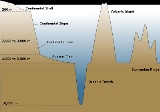
Abyssal plains are flat or very gently sloping areas of the deep ocean
Ocean

An ocean is a major body of Seawater, and a principal component of the hydrosphere. Approximately 71% of the Earth's surface is covered by ocean, a World Ocean that is customarily divided into several principal oceans and smaller seas....
 basin floor. They are among the Earth's flattest and smoothest regions and the least explored. Abyssal plains cover approximately 40% of the ocean floor and reach depths between 2,200 and 5,500 m (7,200 and 18,000 ft). They generally lie between the foot of a continental rise and a mid-oceanic ridge.

The abyssal plain is formed when the lower crust (sima
Sima (geology)

Sima is the name for the lower layer of the Earth's crust . This layer is made of rocks rich in silicates and magnesium minerals. Typically the sima when it comes to the surface is basalt, so sometimes this layer is called the 'basalt layer' of the crust....
), is melted and pushed up by the up-welling mantle, reaches the surface at mid-ocean ridges and forms new oceanic crust.


Discussion
Ask a question about 'Abyssal plain'
Start a new discussion about 'Abyssal plain'
Answer questions from other users
Full Discussion Forum


Encyclopedia


Abyssal plains are flat or very gently sloping areas of the deep ocean
Ocean

An ocean is a major body of Seawater, and a principal component of the hydrosphere. Approximately 71% of the Earth's surface is covered by ocean, a World Ocean that is customarily divided into several principal oceans and smaller seas....
 basin floor. They are among the Earth's flattest and smoothest regions and the least explored. Abyssal plains cover approximately 40% of the ocean floor and reach depths between 2,200 and 5,500 m (7,200 and 18,000 ft). They generally lie between the foot of a continental rise and a mid-oceanic ridge.

The abyssal plain is formed when the lower crust (sima
Sima (geology)

Sima is the name for the lower layer of the Earth's crust . This layer is made of rocks rich in silicates and magnesium minerals. Typically the sima when it comes to the surface is basalt, so sometimes this layer is called the 'basalt layer' of the crust....
), is melted and pushed up by the up-welling mantle, reaches the surface at mid-ocean ridges and forms new oceanic crust. This new oceanic crust is mostly basalt
Basalt

Basalt is a common extrusive volcanic rock. It is usually gray to black and fine-grained due to rapid cooling of lava at the surface of a planet....
 and has a rugged topography
Topography

Topography is the study of Earth's surface shape and features or those ofplanets, Natural satellite, and asteroids. It is also the description of such surface shapes and features ....
. The roughness of this topography is a function of the rate at which the mid-ocean ridge is spreading
Seafloor spreading

Seafloor spreading occurs at mid-ocean ridges, where new oceanic crust is formed through volcano and then gradually moves away from the ridge....
 (the spreading rate). Magnitudes of spreading rates vary quite significantly, and are generally broken down into 3 rates (fast, medium and slow). Typical values for fast-spreading ridges are >100 mm/yr, whilst medium-spreading rates are ~60 mm/yr, and slow-spreading ridges are typically <20 mm/yr. Studies have shown that the slower the spreading rate, the rougher the new oceanic crust will be, and vice versa. It is thought this is due to faulting at the mid-ocean ridge when the new oceanic crust was formed. This oceanic crust eventually becomes overlain with sediments, producing the flat appearance.

Abyssal plains result from the blanketing of an originally uneven surface of oceanic crust
Oceanic crust

Oceanic crust is the part of Earth's lithosphere that surfaces in the ocean basins. Oceanic crust is primarily composed of mafic rocks, or Sima ....
 by fine-grained sediment
Sediment

Sediment is any particulate matter that can be sediment transport by fluid dynamics, and which eventually is deposited.Sediments are most often transported by water transported by wind and glaciers....
s, mainly clay
Clay

Clay is a naturally occurring material composed primarily of fine-grained minerals, which show plasticity through a variable range of water content, and which can be hardened when dried and/or fired....
 and silt
Silt

Silt is soil or Rock derived granular material of a Particle size between sand and clay. Silt may occur as a soil or as suspended sediment in a surface water body....
. Much of this sediment is deposited from turbidity current
Turbidity current

A turbidity current or density current is a current of rapidly moving, sediment-laden water moving down a slope through air, water, or another fluid....
s that have been channeled from the continental margins along submarine canyon
Submarine canyon

A submarine canyon is a steep-sided valley on the sea floor of the continental slope. Many submarine canyons are found as extensions to large rivers; however there are many that have no such association....
s down into deeper water. The remainder of the sediment comprises chiefly dust (clay particles) blown out to sea from land, and the remains of small marine plants and animals (the plankton
Plankton

Plankton consist of any drifting organisms that inhabit the pelagic zone of oceans, seas, or bodies of fresh water. Plankton are defined by their ecological niche rather than their Phylogenetics or taxonomy classification....
), which sink from the upper layer of the ocean, known as Pelagic sediments
Pelagic sediments

Pelagic sediments, also known as marine sediments, are those that accumulate in the abyssal plain of the deep ocean, far away from terrestrial sources that provide terrigenous sediments; the latter are primarily limited to the continental shelf, and deposited by rivers....
. The sediment deposition rate in remote areas is estimated at two to three centimetres per thousand years. In some areas of the plains manganese nodules are common with significant varying concentrations of metals, including iron
Iron

Iron is a chemical element with the symbol Fe and atomic number 26. Iron is a Group 8 element and period 4 element. Iron is lustrous and silvery in color....
, nickel
Nickel

Nickel is a chemical element, with the chemical symbol Ni and atomic number 28. It is a silvery-white lustrous metal with a slight golden tinge....
, cobalt
Cobalt

Cobalt is a hard, lustrous, grey metal, a chemical element with symbol Co and atomic number 27. Although cobalt-based colors and pigments have been used since ancient times, and miners have long used the name kobold ore for some minerals, cobalt was only discovered in 1735 by Georg Brandt....
, and copper
Copper

Copper is a chemical element with the symbol Cu and atomic number 29.It is a ductile metal with very high thermal and electrical conductivity....
. These nodules may provide a significant resource for future mining ventures.

Sediment-covered abyssal plains are less common in the Pacific than in other major ocean basins because sediments from turbidity currents are trapped in submarine trenches that border the Pacific Ocean.

List of abyssal plains


Atlantic Ocean
Atlantic Ocean

The Atlantic Ocean is the second-largest of the world's oceanic divisions; with a total area of about 106.4 million square kilometres . It covers approximately one-fifth of the Earth's surface....

  • Labrador Plain
  • Irminger Plain
  • Iceland Plain
  • Norwegian Plain
  • Cape Verde Plain
  • Sierra Leone Plain
  • Guinea Plain
  • Angola Plain
  • Cape Plain
  • Argentine Plain
  • Brasil Plain
  • Guayana Plain
  • Mexico Plain
  • Sohm Plain


Indian Ocean
Indian Ocean

The Indian Ocean is the third largest of the world's oceanic divisions, covering about 20% of the water on the Earth's surface. It is bounded on the north by Asia ; on the west by Africa; on the east by Indochina, the Sunda Islands, and Australia; and on the south by the Southern Ocean ....

  • Agulhas Plain
  • Natal Plain
  • Madagaskar Plain
  • Somalian Plain


  • Middle-Indian Plain
  • Andamanian Plain
  • Wharton Plain
  • Perth's Plain
  • Crozet's Plain
  • Atlantic-Indian Plain
  • North Australian Plain
  • South Australian Plain


Pacific Ocean
Pacific Ocean

The Pacific Ocean is the largest of the Earth's oceanic divisions. Its name is derived from the Latin name Mare Pacificum, "peaceful sea", bestowed upon it by the Portugal explorer Ferdinand Magellan....

  • Celebes' Plain
  • South Chinese Plain
  • West Carolinian Plain
  • East Carolinian Plain
  • Coral sea Plain
  • Tasmani Plain
  • Southern Fiji Plain
  • Northern Fiji Plain
  • Melanesian Plain
  • East Mariana Plain
  • Northwestern Pacific Plain
  • Japanese Plain
  • Kurillian Plain
  • Middle Pacific Plain
  • Southwestern Pacific Plain
  • Southeastern Pacific Plain
  • Chile Plain
  • Peru Plain
  • Guatemala Plain
  • Papua Plain


Other

  • Euxine abyssal plain
    Euxine abyssal plain

    The Euxine abyssal plain is a physiographic province of the Black Sea, an abyssal plain in its central parts. Its name comes from the Ancient Greek name Euxeinos Pontos of the Black Sea....
    , Black Sea
    Black Sea

    The Black Sea is an inland sea sea bounded by southeastern Europe, the Caucasus and the Anatolia and is ultimately connected to the Atlantic Ocean via the Mediterranean Sea and Aegean Seas and various straits....


See also

  • List of Oceanic Landforms
    List of landforms

    Landforms are categorised by characteristic physical attributes such as elevation, slope, orientation, stratification, rock exposure, and soil type....