

Abyssal zone

Encyclopedia
The abyssal zone is the abyssopelagic layer or pelagic zone
that contains the very deep benthic communities near the bottom of ocean
s. "Abyss" derives from the Greek
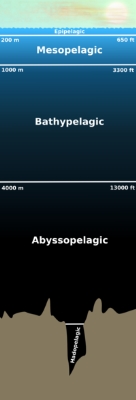
word ἄβυσσος, meaning bottomless. At depths of 4,000 to 6,000 metres (13,123 to 19,685 feet), this zone remains in perpetual darkness and never receives daylight. It is the deeper part of the midnight zone which starts in the bathypelagic
waters above.
Its permanent inhabitants (for example, the black swallower
, tripod fish
, deep-sea anglerfish
and the giant squid
) are able to withstand the immense pressures of the ocean depths, up to 76 megapascals (11,022.9 psi). Many abyssal creatures have underslung jaws to sift through the sand to catch food. The deep trenches or fissures that plunge down thousands of meters (feet) below the ocean floor (for example, the midoceanic trenches such as the Mariana Trench
in the Pacific) are almost unexplored. Only the bathyscaphe
Trieste
, the remote control
submarine
Kaiko
and the Nereus
have been able to descend to these depths. These regions are also characterized by continuous cold and lack of nutrients. The abyssal zone has temperatures around 2°C to 3°C (35°F to 37°F) through the large majority of its mass.
The area below the abyssal zone is the sparsely inhabited Hadal zone
. The zone above is the bathyal zone
. These three zones belong to the deep-sea realm. Above on the continental platform there are respectively the euphotic and dysphotic zones. The abyssal zone lies partially in the dysphotic and partially in the aphotic zone
s.
Pelagic zone
Any water in a sea or lake that is not close to the bottom or near to the shore can be said to be in the pelagic zone. The word pelagic comes from the Greek πέλαγος or pélagos, which means "open sea". The pelagic zone can be thought of in terms of an imaginary cylinder or water column that goes...
that contains the very deep benthic communities near the bottom of ocean
Ocean
An ocean is a major body of saline water, and a principal component of the hydrosphere. Approximately 71% of the Earth's surface is covered by ocean, a continuous body of water that is customarily divided into several principal oceans and smaller seas.More than half of this area is over 3,000...
s. "Abyss" derives from the Greek
Greek language
Greek is an independent branch of the Indo-European family of languages. Native to the southern Balkans, it has the longest documented history of any Indo-European language, spanning 34 centuries of written records. Its writing system has been the Greek alphabet for the majority of its history;...
word ἄβυσσος, meaning bottomless. At depths of 4,000 to 6,000 metres (13,123 to 19,685 feet), this zone remains in perpetual darkness and never receives daylight. It is the deeper part of the midnight zone which starts in the bathypelagic
Bathyal zone
The bathyal zone or bathypelagic – from Greek βαθύς , deep – is that part of the pelagic zone that extends from a depth of 1000 to 4000 metres below the ocean surface. It lies between the mesopelagic above, and the abyssopelagic below. The average temperature hovers at about 39°F...
waters above.
Its permanent inhabitants (for example, the black swallower
Black swallower
The black swallower, Chiasmodon niger, is a species of deep sea fish in the family Chiasmodontidae, notable for its ability to swallow fish larger than itself ....
, tripod fish
Tripod fish
Tripod fish, Bathypterois grallator, are a deep-sea benthic fish found at lower latitudes. They are now relatively well known from photographs and submersible observations...
, deep-sea anglerfish
Anglerfish
Anglerfishes are members of the teleost order Lophiiformes . They are bony fishes named for their characteristic mode of predation, wherein a fleshy growth from the fish's head acts as a lure; this is considered analogous to angling.Some anglerfishes are pelagic , while others are benthic...
and the giant squid
Giant squid
The giant squid is a deep-ocean dwelling squid in the family Architeuthidae, represented by as many as eight species...
) are able to withstand the immense pressures of the ocean depths, up to 76 megapascals (11,022.9 psi). Many abyssal creatures have underslung jaws to sift through the sand to catch food. The deep trenches or fissures that plunge down thousands of meters (feet) below the ocean floor (for example, the midoceanic trenches such as the Mariana Trench
Mariana Trench
The Mariana Trench or Marianas Trench is the deepest part of the world's oceans. It is located in the western Pacific Ocean, to the east of the Mariana Islands. The trench is about long but has a mean width of only...
in the Pacific) are almost unexplored. Only the bathyscaphe
Bathyscaphe
A bathyscaphe is a free-diving self-propelled deep-sea submersible, consisting of a crew cabin similar to a bathysphere, but suspended below a float rather than from a surface cable, as in the classic bathysphere design....
Trieste
Bathyscaphe Trieste
The Trieste is a Swiss-designed, Italian-built deep-diving research bathyscaphe with a crew of two, which reached a record maximum depth of about , in the deepest known part of the Earth's oceans, the Challenger Deep, in the Mariana Trench near Guam, on January 23, 1960, crewed by Jacques Piccard ...
, the remote control
Remote control
A remote control is a component of an electronics device, most commonly a television set, used for operating the television device wirelessly from a short line-of-sight distance.The remote control is usually contracted to remote...
submarine
Submarine
A submarine is a watercraft capable of independent operation below the surface of the water. It differs from a submersible, which has more limited underwater capability...
Kaiko
Kaiko
was a remotely operated underwater vehicle built by the Japan Agency for Marine-Earth Science and Technology for exploration of the deep sea. Kaikō was the second of only three vessels ever to reach the bottom of the Challenger Deep, as of 2010...
and the Nereus
Nereus (underwater vehicle)
Nereus is a hybrid autonomous underwater vehicle built by the Woods Hole Oceanographic Institution . Constructed as a research vehicle to operate at depths of up to , it was designed to explore Challenger Deep, the deepest surveyed point in the global ocean...
have been able to descend to these depths. These regions are also characterized by continuous cold and lack of nutrients. The abyssal zone has temperatures around 2°C to 3°C (35°F to 37°F) through the large majority of its mass.
The area below the abyssal zone is the sparsely inhabited Hadal zone
Hadal zone
The hadal zone , also known as the hadopelagic zone and trench zone, is the delineation for the deepest trenches in the ocean...
. The zone above is the bathyal zone
Bathyal zone
The bathyal zone or bathypelagic – from Greek βαθύς , deep – is that part of the pelagic zone that extends from a depth of 1000 to 4000 metres below the ocean surface. It lies between the mesopelagic above, and the abyssopelagic below. The average temperature hovers at about 39°F...
. These three zones belong to the deep-sea realm. Above on the continental platform there are respectively the euphotic and dysphotic zones. The abyssal zone lies partially in the dysphotic and partially in the aphotic zone
Aphotic zone
The aphotic zone is the portion of a lake or ocean where there is little or no sunlight. It is formally defined as the depths beyond which less than 1% of sunlight penetrates. Consequently, bioluminescence is essentially the only light found in this zone...
s.