

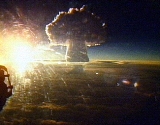
Tsar Bomba

Encyclopedia
Tsar Bomba is the nickname
for the AN602 hydrogen bomb, the most powerful nuclear weapon
ever detonated. It was also referred to as Kuz'kina Mat , in this usage meaning "something that has not been seen before".
Developed by the Soviet Union
, the bomb was originally designed to have a yield
of about 100 MtonTNT, but the yield was reduced to 50 megatons in order to reduce nuclear fallout
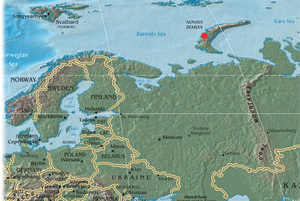
. This attempt was successful, as it was one of the cleanest (relative to its yield) nuclear bombs ever detonated. Only one bomb of this type was ever built and it was tested on October 30, 1961, in the Novaya Zemlya
archipelago
.
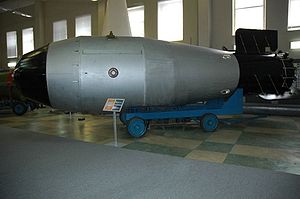
The remaining bomb casings are located at the Russian Atomic Weapon Museum, Sarov
(Arzamas-16), and the Museum of Nuclear Weapons, All-Russian Research Institute of Technical Physics, Snezhinsk (Chelyabinsk-70). Neither of these casings has the same antenna configuration as the device that was tested.
Many names are attributed to the Tsar Bomba in the literature: Project number – Project 7000; Product code – Product code 202 (Izdeliye 202); Article designations – RDS-220 (РДС-220), RDS-202 (РДС-202), RN202 (PH202), AN602 (AH602); Codename – Vanya; Nicknames – Big Ivan, Tsar Bomba, Kuzkina Mat' (Kuzka's Mother). The term "Tsar Bomba" was coined in an analogy with two other massive Russian objects: the Tsar Kolokol (Tsar Bell), the world's largest bell, and the Tsar Pushka
(Tsar Cannon), the world's largest cannon
.
 The Tsar Bomb was a three-stage Teller–Ulam design hydrogen bomb with a yield
of 50 megatons
(Mt). This is equivalent to 1,400 times the combined power of the bombs that destroyed Hiroshima and Nagasaki
, 10 times the combined power of all the explosives used in WWII, or one quarter of the estimated yield of the 1883 eruption of Krakatoa
. A three-stage H-bomb uses a fission bomb primary to compress a thermonuclear secondary, as in most H-bombs, and then uses energy from the resulting explosion to compress a much larger additional thermonuclear stage. There is evidence that the Tsar Bomba had a number of third stages rather than a single very large one.
The initial three-stage design was capable of approximately 100 Mt, but would have caused too much radioactive fallout. To limit fallout, the third stage and possibly the second stage had a lead
tamper
instead of a uranium-238
fusion tamper (which greatly amplifies the reaction by fissioning uranium atoms with fast neutrons from the fusion reaction). This eliminated fast fission
by the fusion-stage neutrons, so that approximately 97% of the total energy resulted from fusion alone (as such, it was one of the "cleanest" nuclear bombs ever created, generating a very low amount of fallout relative to its yield). There was a strong incentive for this modification since most of the fallout from a test of the bomb would have fallen on populated Soviet territory.
The components were designed by a team of physicists headed by Academician Julii Borisovich Khariton and including Andrei Sakharov
, Victor Adamsky, Yuri Babayev, Yuri Smirnov, and Yuri Trutnev
. Shortly after the Tsar Bomba was detonated, Sakharov began speaking out against nuclear weapon
s, which culminated in his becoming a dissident
.
release plane, flown by Major Andrei Durnovtsev
. Taking off from an airfield in the Kola Peninsula
, the release plane was accompanied by a Tu-16 observer plane that took air samples and filmed the test. Both aircraft were painted with a special reflective white paint
to limit heat damage.
The bomb, weighing 27 tonne
s, was so large (8 metres (26.2 ft) long by 2 metres (6.6 ft) in diameter) that the Tu-95V had to have its bomb bay doors and fuselage fuel tank
s removed. The bomb was attached to an 800 kilogram fall-retardation parachute
, which gave the release and observer planes time to fly about 45 kilometres (28 mi) away from ground zero
. When detonation occurred the Tu-95V fell one kilometer from its previous altitude due to the shock wave
of the bomb.
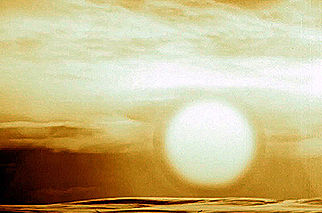 The Tsar Bomb detonated at 11:32 on October 30, 1961 over the Mityushikha Bay nuclear testing range (Sukhoy Nos Zone C), north of the Arctic Circle
on Novaya Zemlya
Island in the Arctic Sea. The bomb was dropped from an altitude of 10.5 kilometres (6.5 mi); it was designed to detonate at a height of 4 kilometres (2.5 mi) over the land surface (4.2 kilometres (2.6 mi) over sea level) by barometric sensors.
The original, November 1961 A.E.C. estimate of the yield was 55–60 Mt, but since 1991 all Russian sources have stated its yield as 50 Mt. Khrushchev
warned in a filmed speech to the Communist Parliament of the existence of a 100 Mt bomb (technically the design was capable of this yield). Although simplistic fireball
calculations predicted the fireball would impact the ground, the bomb's own shock wave reflected back and prevented this. The fireball reached nearly as high as the altitude of the release plane and was seen almost 1000 kilometres (621.4 mi) from ground zero. The subsequent mushroom cloud
was about 64 kilometres (39.8 mi) high (nearly eight times the height of Mount Everest
), which meant that the cloud was well inside the mesosphere
when it peaked. The base of the cloud was 40 kilometres (24.9 mi) wide. All buildings in the village of Severny
(both wooden and brick), located 55 kilometres (34.2 mi) from ground zero within the Sukhoy Nos
test range, were completely destroyed. In districts hundreds of kilometers from ground zero, wooden houses were destroyed, stone ones lost their roofs, windows and doors; and radio communications were interrupted for almost one hour. One participant in the test saw a bright flash through dark goggles and felt the effects of a thermal pulse even at a distance of 270 kilometres (167.8 mi). The heat from the explosion
could have caused third-degree burns
100 km (62.1 mi) away from ground zero
. A shock wave was observed in the air at Dikson settlement
700 kilometres (435 mi) away; windowpanes were partially broken to distances of 900 kilometres (559.2 mi). Atmospheric focusing
caused blast damage at even greater distances, breaking windows in Norway and Finland. The seismic shock
created by the detonation was measurable even on its third passage around the Earth. Its seismic body wave magnitude
was about 5 to 5.25. The energy yield was around 7.1 on the Richter scale but, since the bomb was detonated in air rather than underground, most of the energy was not converted to seismic waves. The TNT equivalent of the 50 Mt test could be represented by a cube of TNT 312 metres on a side, approximately the height of the Eiffel Tower
.
The Tsar Bomba is the single most physically powerful
device ever used by humanity, though its size and weight precluded a successful delivery in case of a real war. By contrast, the largest weapon
ever produced by the United States, the now-decommissioned B41
, had a predicted maximum yield of 25 Mt, and the largest nuclear device ever tested by the US (Castle Bravo
) yielded 15 Mt (this was due to an unexpected runaway lithium-7 reaction; the design yield was approximately 5 Mt). The largest weapons deployed by the Soviet Union were also around 25 Mt, as in the SS-18 Mod. 2 ICBM warheads.
 The weight and size of the Tsar Bomba limited the range and speed of the specially modified bomber carrying it and ruled out its delivery by an ICBM
(although on December 24, 1962, a 50 Mt ICBM warhead developed by Chelyabinsk-70 was detonated at 24.2 Mt to reduce fallout). In terms of physical destructiveness, much of its high yield was inefficiently radiated upwards into space. It has been estimated that detonating the original 100 Mt design would have released fallout amounting to about 25 percent of all fallout emitted since the invention of nuclear weapons. Hence, the Tsar Bomba was an impractically powerful weapon. It was decided that such a test blast would create too great a risk of nuclear fallout and a near certainty that the release plane would be unable to reach safety before detonation.
The Tsar Bomba was the culmination of a series of high-yield
thermonuclear weapons
designed by the USSR and USA during the 1950s (examples include the Mark-17
and B41
). Such bombs were designed because:
Thus certain bombs were designed to destroy an entire large city even if dropped five to ten kilometres from its centre. This objective meant that yield and effectiveness were positively correlated, at least up to a point. However, the advent of ICBMs accurate to 500 metres or better made such a design philosophy obsolete. Subsequent nuclear weapon design in the 1960s and 1970s focused primarily on increased accuracy, miniaturization, and safety. The standard practice for many years has been to employ multiple smaller warhead
s (MIRV
s) to "carpet
" an area, resulting in greater ground damage.
A discussion about the methods of the political use of technology of creation of super-bomb became a reason of ideological divergence of Andrei Sakharov
and Nikita Khrushchev
, so as Nikita Khrushchev
disagreed with the project of placing of a fifty of 500 Mt bombs along the US marine border, to stop an armament race and to continue democratic reforms.
Nickname
A nickname is "a usually familiar or humorous but sometimes pointed or cruel name given to a person or place, as a supposedly appropriate replacement for or addition to the proper name.", or a name similar in origin and pronunciation from the original name....
for the AN602 hydrogen bomb, the most powerful nuclear weapon
Nuclear weapon
A nuclear weapon is an explosive device that derives its destructive force from nuclear reactions, either fission or a combination of fission and fusion. Both reactions release vast quantities of energy from relatively small amounts of matter. The first fission bomb test released the same amount...
ever detonated. It was also referred to as Kuz'kina Mat , in this usage meaning "something that has not been seen before".
Developed by the Soviet Union
Soviet Union
The Soviet Union , officially the Union of Soviet Socialist Republics , was a constitutionally socialist state that existed in Eurasia between 1922 and 1991....
, the bomb was originally designed to have a yield
Nuclear weapon yield
The explosive yield of a nuclear weapon is the amount of energy discharged when a nuclear weapon is detonated, expressed usually in the equivalent mass of trinitrotoluene , either in kilotons or megatons , but sometimes also in terajoules...
of about 100 MtonTNT, but the yield was reduced to 50 megatons in order to reduce nuclear fallout
Nuclear fallout
Fallout is the residual radioactive material propelled into the upper atmosphere following a nuclear blast, so called because it "falls out" of the sky after the explosion and shock wave have passed. It commonly refers to the radioactive dust and ash created when a nuclear weapon explodes...
. This attempt was successful, as it was one of the cleanest (relative to its yield) nuclear bombs ever detonated. Only one bomb of this type was ever built and it was tested on October 30, 1961, in the Novaya Zemlya
Novaya Zemlya
Novaya Zemlya , also known in Dutch as Nova Zembla and in Norwegian as , is an archipelago in the Arctic Ocean in the north of Russia and the extreme northeast of Europe, the easternmost point of Europe lying at Cape Flissingsky on the northern island...
archipelago
Archipelago
An archipelago , sometimes called an island group, is a chain or cluster of islands. The word archipelago is derived from the Greek ἄρχι- – arkhi- and πέλαγος – pélagos through the Italian arcipelago...
.
The remaining bomb casings are located at the Russian Atomic Weapon Museum, Sarov
Sarov
Sarov is a closed town in Nizhny Novgorod Oblast, Russia. Until 1995 it was known as Kremlyov ., while from 1946 to 1991 it was called Arzamas-16 . The town is off limits to foreigners as it is the Russian center for nuclear research. Population: -History:The history of the town can be divided...
(Arzamas-16), and the Museum of Nuclear Weapons, All-Russian Research Institute of Technical Physics, Snezhinsk (Chelyabinsk-70). Neither of these casings has the same antenna configuration as the device that was tested.
Many names are attributed to the Tsar Bomba in the literature: Project number – Project 7000; Product code – Product code 202 (Izdeliye 202); Article designations – RDS-220 (РДС-220), RDS-202 (РДС-202), RN202 (PH202), AN602 (AH602); Codename – Vanya; Nicknames – Big Ivan, Tsar Bomba, Kuzkina Mat' (Kuzka's Mother). The term "Tsar Bomba" was coined in an analogy with two other massive Russian objects: the Tsar Kolokol (Tsar Bell), the world's largest bell, and the Tsar Pushka
Tsar Cannon
The Tsar Cannon is a huge cannon on display on the grounds of the Moscow Kremlin. It was cast in 1586 in Moscow, by the Russian master bronze caster Andrey Chokhov. Mostly of symbolic impact, it was never fired in war...
(Tsar Cannon), the world's largest cannon
Cannon
A cannon is any piece of artillery that uses gunpowder or other usually explosive-based propellents to launch a projectile. Cannon vary in caliber, range, mobility, rate of fire, angle of fire, and firepower; different forms of cannon combine and balance these attributes in varying degrees,...
.
Design
Nuclear weapon yield
The explosive yield of a nuclear weapon is the amount of energy discharged when a nuclear weapon is detonated, expressed usually in the equivalent mass of trinitrotoluene , either in kilotons or megatons , but sometimes also in terajoules...
of 50 megatons
TNT equivalent
TNT equivalent is a method of quantifying the energy released in explosions. The ton of TNT is a unit of energy equal to 4.184 gigajoules, which is approximately the amount of energy released in the detonation of one ton of TNT...
(Mt). This is equivalent to 1,400 times the combined power of the bombs that destroyed Hiroshima and Nagasaki
Atomic bombings of Hiroshima and Nagasaki
During the final stages of World War II in 1945, the United States conducted two atomic bombings against the cities of Hiroshima and Nagasaki in Japan, the first on August 6, 1945, and the second on August 9, 1945. These two events are the only use of nuclear weapons in war to date.For six months...
, 10 times the combined power of all the explosives used in WWII, or one quarter of the estimated yield of the 1883 eruption of Krakatoa
1883 eruption of Krakatoa
The 1883 eruption of Krakatoa began in May 1883 and culminated with the destruction of Krakatoa on 27 August 1883. Minor seismic activity continued to be reported until February 1884, though reports after October 1883 were later dismissed by Rogier Verbeek's investigation.-Early phase:In the years...
. A three-stage H-bomb uses a fission bomb primary to compress a thermonuclear secondary, as in most H-bombs, and then uses energy from the resulting explosion to compress a much larger additional thermonuclear stage. There is evidence that the Tsar Bomba had a number of third stages rather than a single very large one.
The initial three-stage design was capable of approximately 100 Mt, but would have caused too much radioactive fallout. To limit fallout, the third stage and possibly the second stage had a lead
Lead
Lead is a main-group element in the carbon group with the symbol Pb and atomic number 82. Lead is a soft, malleable poor metal. It is also counted as one of the heavy metals. Metallic lead has a bluish-white color after being freshly cut, but it soon tarnishes to a dull grayish color when exposed...
tamper
Teller-Ulam design
The Teller–Ulam design is the nuclear weapon design concept used in most of the world's nuclear weapons. It is colloquially referred to as "the secret of the hydrogen bomb" because it employs hydrogen fusion, though in most applications the bulk of its destructive energy comes from uranium fission,...
instead of a uranium-238
Uranium-238
Uranium-238 is the most common isotope of uranium found in nature. It is not fissile, but is a fertile material: it can capture a slow neutron and after two beta decays become fissile plutonium-239...
fusion tamper (which greatly amplifies the reaction by fissioning uranium atoms with fast neutrons from the fusion reaction). This eliminated fast fission
Fast fission
Fast fission is fission that occurs when a heavy atom absorbs a high-energy neutron, called a fast neutron, and splits. Most fissionable materials need thermal neutrons, which move slower.-Fast reactors vs. thermal reactors:...
by the fusion-stage neutrons, so that approximately 97% of the total energy resulted from fusion alone (as such, it was one of the "cleanest" nuclear bombs ever created, generating a very low amount of fallout relative to its yield). There was a strong incentive for this modification since most of the fallout from a test of the bomb would have fallen on populated Soviet territory.
The components were designed by a team of physicists headed by Academician Julii Borisovich Khariton and including Andrei Sakharov
Andrei Sakharov
Andrei Dmitrievich Sakharov was a Soviet nuclear physicist, dissident and human rights activist. He earned renown as the designer of the Soviet Union's Third Idea, a codename for Soviet development of thermonuclear weapons. Sakharov was an advocate of civil liberties and civil reforms in the...
, Victor Adamsky, Yuri Babayev, Yuri Smirnov, and Yuri Trutnev
Yuri Trutnev (scientist)
Yuri Alexeyevich Trutnev is a Soviet/Russian physicist, member of the Russian Academy of Science, Doctor of Technical Sciences, and Hero of Socialist Labor . He was a co-developer of the Tsar Bomb.- References :...
. Shortly after the Tsar Bomba was detonated, Sakharov began speaking out against nuclear weapon
Nuclear weapon
A nuclear weapon is an explosive device that derives its destructive force from nuclear reactions, either fission or a combination of fission and fusion. Both reactions release vast quantities of energy from relatively small amounts of matter. The first fission bomb test released the same amount...
s, which culminated in his becoming a dissident
Soviet dissidents
Soviet dissidents were citizens of the Soviet Union who disagreed with the policies and actions of their government and actively protested against these actions through either violent or non-violent means...
.
Test
The Tsar Bomb was flown to its test site by a specially modified Tu-95VTupolev Tu-95
The Tupolev Tu-95 is a large, four-engine turboprop-powered strategic bomber and missile platform. First flown in 1952, the Tu-95 entered service with the former Soviet Union in 1956 and is expected to serve the Russian Air Force until at least 2040...
release plane, flown by Major Andrei Durnovtsev
Andrei Durnovtsev
Andrei E. Durnovtsev was a major of the Soviet Air Force. He dropped the Tsar Bomba on October 30, 1961. He flew a specially modified Tu-95V which utilized special white paint to reflect the enormous amount of heat radiation given off by the Tsar Bomba's fusion reaction.-References:...
. Taking off from an airfield in the Kola Peninsula
Kola Peninsula
The Kola Peninsula is a peninsula in the far northwest of Russia. Constituting the bulk of the territory of Murmansk Oblast, it lies almost completely to the north of the Arctic Circle and is washed by the Barents Sea in the north and the White Sea in the east and southeast...
, the release plane was accompanied by a Tu-16 observer plane that took air samples and filmed the test. Both aircraft were painted with a special reflective white paint
Anti-flash white
Anti-flash white is a brilliant white color commonly seen on United States, British and Soviet nuclear bombers. The purpose of the color was to reflect some of the thermal radiation from a nuclear explosion, protecting the aircraft and its occupants....
to limit heat damage.
The bomb, weighing 27 tonne
Tonne
The tonne, known as the metric ton in the US , often put pleonastically as "metric tonne" to avoid confusion with ton, is a metric system unit of mass equal to 1000 kilograms. The tonne is not an International System of Units unit, but is accepted for use with the SI...
s, was so large (8 metres (26.2 ft) long by 2 metres (6.6 ft) in diameter) that the Tu-95V had to have its bomb bay doors and fuselage fuel tank
Fuel tank
A fuel tank is safe container for flammable fluids. Though any storage tank for fuel may be so called, the term is typically applied to part of an engine system in which the fuel is stored and propelled or released into an engine...
s removed. The bomb was attached to an 800 kilogram fall-retardation parachute
Parachute
A parachute is a device used to slow the motion of an object through an atmosphere by creating drag, or in the case of ram-air parachutes, aerodynamic lift. Parachutes are usually made out of light, strong cloth, originally silk, now most commonly nylon...
, which gave the release and observer planes time to fly about 45 kilometres (28 mi) away from ground zero
Ground zero
The term ground zero describes the point on the Earth's surface closest to a detonation...
. When detonation occurred the Tu-95V fell one kilometer from its previous altitude due to the shock wave
Shock wave
A shock wave is a type of propagating disturbance. Like an ordinary wave, it carries energy and can propagate through a medium or in some cases in the absence of a material medium, through a field such as the electromagnetic field...
of the bomb.
Arctic Circle
The Arctic Circle is one of the five major circles of latitude that mark maps of the Earth. For Epoch 2011, it is the parallel of latitude that runs north of the Equator....
on Novaya Zemlya
Novaya Zemlya
Novaya Zemlya , also known in Dutch as Nova Zembla and in Norwegian as , is an archipelago in the Arctic Ocean in the north of Russia and the extreme northeast of Europe, the easternmost point of Europe lying at Cape Flissingsky on the northern island...
Island in the Arctic Sea. The bomb was dropped from an altitude of 10.5 kilometres (6.5 mi); it was designed to detonate at a height of 4 kilometres (2.5 mi) over the land surface (4.2 kilometres (2.6 mi) over sea level) by barometric sensors.
The original, November 1961 A.E.C. estimate of the yield was 55–60 Mt, but since 1991 all Russian sources have stated its yield as 50 Mt. Khrushchev
Nikita Khrushchev
Nikita Sergeyevich Khrushchev led the Soviet Union during part of the Cold War. He served as First Secretary of the Communist Party of the Soviet Union from 1953 to 1964, and as Chairman of the Council of Ministers, or Premier, from 1958 to 1964...
warned in a filmed speech to the Communist Parliament of the existence of a 100 Mt bomb (technically the design was capable of this yield). Although simplistic fireball
Effects of nuclear explosions
The energy released from a nuclear weapon detonated in the troposphere can be divided into four basic categories:*Blast—40-50% of total energy*Thermal radiation—30-50% of total energy...
calculations predicted the fireball would impact the ground, the bomb's own shock wave reflected back and prevented this. The fireball reached nearly as high as the altitude of the release plane and was seen almost 1000 kilometres (621.4 mi) from ground zero. The subsequent mushroom cloud
Mushroom cloud
A mushroom cloud is a distinctive pyrocumulus mushroom-shaped cloud of condensed water vapor or debris resulting from a very large explosion. They are most commonly associated with nuclear explosions, but any sufficiently large blast will produce the same sort of effect. They can be caused by...
was about 64 kilometres (39.8 mi) high (nearly eight times the height of Mount Everest
Mount Everest
Mount Everest is the world's highest mountain, with a peak at above sea level. It is located in the Mahalangur section of the Himalayas. The international boundary runs across the precise summit point...
), which meant that the cloud was well inside the mesosphere
Mesosphere
The mesosphere is the layer of the Earth's atmosphere that is directly above the stratosphere and directly below the thermosphere. In the mesosphere temperature decreases with increasing height. The upper boundary of the mesosphere is the mesopause, which can be the coldest naturally occurring...
when it peaked. The base of the cloud was 40 kilometres (24.9 mi) wide. All buildings in the village of Severny
Severny Island
Severny Island is the northern island of the Novaya Zemlya archipelago, lying north of Russia. It has an area of , making it one of the largest islands in the world. It is separated from Yuzhny Island by the narrow Matochkin Strait...
(both wooden and brick), located 55 kilometres (34.2 mi) from ground zero within the Sukhoy Nos
Sukhoy Nos
Sukhoy Nos is a cape on Severny, the northern island of the archipelago Novaya Zemlya, belonging to the Russian Federation. The site lies near the southern end of the island, very close to the Matochkin Strait, which separates Severny from Yuzhny, the southern island...
test range, were completely destroyed. In districts hundreds of kilometers from ground zero, wooden houses were destroyed, stone ones lost their roofs, windows and doors; and radio communications were interrupted for almost one hour. One participant in the test saw a bright flash through dark goggles and felt the effects of a thermal pulse even at a distance of 270 kilometres (167.8 mi). The heat from the explosion
Explosion
An explosion is a rapid increase in volume and release of energy in an extreme manner, usually with the generation of high temperatures and the release of gases. An explosion creates a shock wave. If the shock wave is a supersonic detonation, then the source of the blast is called a "high explosive"...
could have caused third-degree burns
Burn
A burn is an injury to flesh caused by heat, electricity, chemicals, light, radiation, or friction.Burn may also refer to:*Combustion*Burn , type of watercourses so named in Scotland and north-eastern England...
100 km (62.1 mi) away from ground zero
Ground zero
The term ground zero describes the point on the Earth's surface closest to a detonation...
. A shock wave was observed in the air at Dikson settlement
Dikson (urban-type settlement)
Dikson is an urban locality in Taymyrsky Dolgano-Nenetsky District of Krasnoyarsk Krai, Russia. Population: Dikson is the northernmost port in Russia and one of the northernmost settlements in the world. It is located so far north that one may experience complete darkness with no civil twilight...
700 kilometres (435 mi) away; windowpanes were partially broken to distances of 900 kilometres (559.2 mi). Atmospheric focusing
Atmospheric focusing
Atmospheric focusing is a phenomenon occurring when a large shock wave is produced in the atmosphere, as in a nuclear explosion or large extraterrestrial object impact. The shock wave is refracted horizontally by density variations in the atmosphere so that it can have impacts in localized areas...
caused blast damage at even greater distances, breaking windows in Norway and Finland. The seismic shock
Seismic wave
Seismic waves are waves of energy that travel through the earth, and are a result of an earthquake, explosion, or a volcano that imparts low-frequency acoustic energy. Many other natural and anthropogenic sources create low amplitude waves commonly referred to as ambient vibrations. Seismic waves...
created by the detonation was measurable even on its third passage around the Earth. Its seismic body wave magnitude
Body wave magnitude
Body wave magnitude is a way of determining the size of an earthquake, using the amplitude of the initial P-wave to calculate the magnitude. The P-wave is a type of body wave that is capable of traveling through the earth at a velocity of around 5 to 8 km/s, and is the first wave from an...
was about 5 to 5.25. The energy yield was around 7.1 on the Richter scale but, since the bomb was detonated in air rather than underground, most of the energy was not converted to seismic waves. The TNT equivalent of the 50 Mt test could be represented by a cube of TNT 312 metres on a side, approximately the height of the Eiffel Tower
Eiffel Tower
The Eiffel Tower is a puddle iron lattice tower located on the Champ de Mars in Paris. Built in 1889, it has become both a global icon of France and one of the most recognizable structures in the world...
.
The Tsar Bomba is the single most physically powerful
Power (physics)
In physics, power is the rate at which energy is transferred, used, or transformed. For example, the rate at which a light bulb transforms electrical energy into heat and light is measured in watts—the more wattage, the more power, or equivalently the more electrical energy is used per unit...
device ever used by humanity, though its size and weight precluded a successful delivery in case of a real war. By contrast, the largest weapon
Weapon
A weapon, arm, or armament is a tool or instrument used with the aim of causing damage or harm to living beings or artificial structures or systems...
ever produced by the United States, the now-decommissioned B41
B41 nuclear bomb
The B41 was a thermonuclear weapon deployed by the United States Strategic Air Command in the early 1960s. It was the most powerful nuclear bomb ever developed by the United States with a theoretical maximum yield of 25 megatons...
, had a predicted maximum yield of 25 Mt, and the largest nuclear device ever tested by the US (Castle Bravo
Castle Bravo
Castle Bravo was the code name given to the first U.S. test of a dry fuel thermonuclear hydrogen bomb device, detonated on March 1, 1954 at Bikini Atoll, Marshall Islands, as the first test of Operation Castle. Castle Bravo was the most powerful nuclear device ever detonated by the United States ,...
) yielded 15 Mt (this was due to an unexpected runaway lithium-7 reaction; the design yield was approximately 5 Mt). The largest weapons deployed by the Soviet Union were also around 25 Mt, as in the SS-18 Mod. 2 ICBM warheads.
Analysis
Intercontinental ballistic missile
An intercontinental ballistic missile is a ballistic missile with a long range typically designed for nuclear weapons delivery...
(although on December 24, 1962, a 50 Mt ICBM warhead developed by Chelyabinsk-70 was detonated at 24.2 Mt to reduce fallout). In terms of physical destructiveness, much of its high yield was inefficiently radiated upwards into space. It has been estimated that detonating the original 100 Mt design would have released fallout amounting to about 25 percent of all fallout emitted since the invention of nuclear weapons. Hence, the Tsar Bomba was an impractically powerful weapon. It was decided that such a test blast would create too great a risk of nuclear fallout and a near certainty that the release plane would be unable to reach safety before detonation.
The Tsar Bomba was the culmination of a series of high-yield
Nuclear weapon yield
The explosive yield of a nuclear weapon is the amount of energy discharged when a nuclear weapon is detonated, expressed usually in the equivalent mass of trinitrotoluene , either in kilotons or megatons , but sometimes also in terajoules...
thermonuclear weapons
Nuclear weapon design
Nuclear weapon designs are physical, chemical, and engineering arrangements that cause the physics package of a nuclear weapon to detonate. There are three basic design types...
designed by the USSR and USA during the 1950s (examples include the Mark-17
Mark 17 nuclear bomb
The Mark 17 and Mark 24 were the first mass-produced hydrogen bombs deployed by the United States. The two differed in their "primary" stages. The MK 17/24 bombs were long, diameter. They weighed 21 tons. The Mark 17 had a yield in the range of 25 megatons TNT equivalent...
and B41
B41 nuclear bomb
The B41 was a thermonuclear weapon deployed by the United States Strategic Air Command in the early 1960s. It was the most powerful nuclear bomb ever developed by the United States with a theoretical maximum yield of 25 megatons...
). Such bombs were designed because:
- The nuclear bombs of the day were large and heavy, regardless of yield, and could only be delivered by strategic bomberStrategic bomberA strategic bomber is a heavy bomber aircraft designed to drop large amounts of ordnance onto a distant target for the purposes of debilitating an enemy's capacity to wage war. Unlike tactical bombers, which are used in the battle zone to attack troops and military equipment, strategic bombers are...
s. Hence yield was subject to dramatic economies of scaleEconomies of scaleEconomies of scale, in microeconomics, refers to the cost advantages that an enterprise obtains due to expansion. There are factors that cause a producer’s average cost per unit to fall as the scale of output is increased. "Economies of scale" is a long run concept and refers to reductions in unit...
; - It was feared that many bombers would fail to reach their targets because their size and low speed made detection and interception easy. Hence maximizing the firepower carried by any single bomber was considered vital;
- Prior to satelliteSpy satelliteA spy satellite is an Earth observation satellite or communications satellite deployed for military or intelligence applications....
intelligence, each side lacked precise knowledge of the location of the other's military and industrial facilities; - A bomb dropped without benefit of advanced inertial navigation systemInertial navigation systemAn inertial navigation system is a navigation aid that uses a computer, motion sensors and rotation sensors to continuously calculate via dead reckoning the position, orientation, and velocity of a moving object without the need for external references...
s could easily miss its intended target. Parachute retardation would only worsen the bomb's accuracy.
Thus certain bombs were designed to destroy an entire large city even if dropped five to ten kilometres from its centre. This objective meant that yield and effectiveness were positively correlated, at least up to a point. However, the advent of ICBMs accurate to 500 metres or better made such a design philosophy obsolete. Subsequent nuclear weapon design in the 1960s and 1970s focused primarily on increased accuracy, miniaturization, and safety. The standard practice for many years has been to employ multiple smaller warhead
Warhead
The term warhead refers to the explosive material and detonator that is delivered by a missile, rocket, or torpedo.- Etymology :During the early development of naval torpedoes, they could be equipped with an inert payload that was intended for use during training, test firing and exercises. This...
s (MIRV
Multiple independently targetable reentry vehicle
A multiple independently targetable reentry vehicle warhead is a collection of nuclear weapons carried on a single intercontinental ballistic missile or a submarine-launched ballistic missile . Using a MIRV warhead, a single launched missile can strike several targets, or fewer targets redundantly...
s) to "carpet
Carpet bombing
Carpet bombing is a large aerial bombing done in a progressive manner to inflict damage in every part of a selected area of land. The phrase invokes the image of explosions completely covering an area, in the same way that a carpet covers a floor. Carpet bombing is usually achieved by dropping many...
" an area, resulting in greater ground damage.
A discussion about the methods of the political use of technology of creation of super-bomb became a reason of ideological divergence of Andrei Sakharov
Andrei Sakharov
Andrei Dmitrievich Sakharov was a Soviet nuclear physicist, dissident and human rights activist. He earned renown as the designer of the Soviet Union's Third Idea, a codename for Soviet development of thermonuclear weapons. Sakharov was an advocate of civil liberties and civil reforms in the...
and Nikita Khrushchev
Nikita Khrushchev
Nikita Sergeyevich Khrushchev led the Soviet Union during part of the Cold War. He served as First Secretary of the Communist Party of the Soviet Union from 1953 to 1964, and as Chairman of the Council of Ministers, or Premier, from 1958 to 1964...
, so as Nikita Khrushchev
Nikita Khrushchev
Nikita Sergeyevich Khrushchev led the Soviet Union during part of the Cold War. He served as First Secretary of the Communist Party of the Soviet Union from 1953 to 1964, and as Chairman of the Council of Ministers, or Premier, from 1958 to 1964...
disagreed with the project of placing of a fifty of 500 Mt bombs along the US marine border, to stop an armament race and to continue democratic reforms.
Films
- Footage from a Soviet documentary about the bomb is featured in Trinity and Beyond: The Atomic Bomb MovieTrinity and BeyondTrinity and Beyond: The Atomic Bomb Movie is a 1995 American documentary film directed by Peter Kuran and narrated by William Shatner. Using restored archive footage, the film traces the development of nuclear weapons and their testing, from America's Trinity test of 1945 to the first Chinese...
(Visual Concept Entertainment, 1995), where it is referred to as the Russian monster bomb. The movie states that the Tsar Bomba project broke the voluntary moratoriumMoratorium (law)A moratorium is a delay or suspension of an activity or a law. In a legal context, it may refer to the temporary suspension of a law to allow a legal challenge to be carried out....
on nuclear tests. In fact Soviets restarted their tests and broke the unilateral voluntary moratorium two months before Tsar Bomba, and since the moratorium was unilateral there was no multilateral legal obstacle (earlier the U.S. also declared a one year unilateral moratorium on nuclear tests and as that year expired the US had already announced that it considered itself free to resume testing without further notice but had not resumed tests until the aftermath of Tsar Bomba). - A one hour episode of the PBS documentary series Secrets of the Dead – "World's Biggest Bomb" (2011; Blink Films & WNETWNETWNET, channel 13 is a non-commercial educational public television station licensed to Newark, New Jersey. With its signal covering the New York metropolitan area, WNET is a primary station of the Public Broadcasting Service and a primary provider of PBS programming...
) – chronicles the events leading to the detonations of Castle BravoCastle BravoCastle Bravo was the code name given to the first U.S. test of a dry fuel thermonuclear hydrogen bomb device, detonated on March 1, 1954 at Bikini Atoll, Marshall Islands, as the first test of Operation Castle. Castle Bravo was the most powerful nuclear device ever detonated by the United States ,...
and the Tsar Bomba.
See also
- Father of all bombs
- Mother of all bombsGBU-43/B Massive Ordnance Air Blast bombThe GBU-43/B Massive Ordnance Air Blast bomb is a large-yield conventional bomb developed for the United States military by Albert L. Weimorts, Jr. At the time of development, it was touted as the most powerful non-nuclear weapon ever designed...
- Soviet atomic bomb projectSoviet atomic bomb projectThe Soviet project to develop an atomic bomb , was a clandestine research and development program began during and post-World War II, in the wake of the Soviet Union's discovery of the United States' nuclear project...
- Tsar TankTsar TankThe Tsar Tank , also known as the Netopyr which stands for pipistrellus or Lebedenko Tank , was an unusual Russian armoured vehicle developed by Nikolai Lebedenko , Nikolai Zhukovsky , Boris Stechkin , and Alexander Mikulin...