

Tritium

Encyclopedia
Tritium is a radioactive isotope of hydrogen
. The nucleus
of tritium (sometimes called a triton) contains one proton
and two neutron
s, whereas the nucleus of protium (by far the most abundant hydrogen isotope) contains one proton and no neutrons. Naturally occurring tritium is extremely rare on Earth, where trace amounts are formed by the interaction of the atmosphere with cosmic ray
s. The name of this isotope is formed from the Greek word "tritos" meaning "third."
, the National Institute of Standards and Technology
lists 4,500±8 days (approximately 12.32 years). It decays into helium-3
by beta decay
as in this nuclear equation:
and it releases 18.6 keV
of energy in the process. The electron
's kinetic energy varies, with an average of 5.7 keV, while the remaining energy is carried off by the nearly undetectable electron antineutrino. Beta particles from tritium can penetrate only about 6.0 mm of air, and they are incapable of passing through the dead outermost layer of human skin. The unusually low energy released in the tritium beta decay makes the decay (along with that of rhenium-187
) an appropriate laboratory for absolute neutrino mass measurements (the most recent experiment being KATRIN
).
Tritium is potentially dangerous if inhaled or ingested. It can combine with oxygen
to form tritiated water
molecules, and those can be absorbed through pores in the skin.
The low energy of tritium's radiation makes it difficult to detect tritium-labeled compounds except by using liquid scintillation counting
.
of lithium-6. This is possible with neutrons of any energy, and is an exothermic
reaction yielding 4.8 MeV. In comparison, the fusion of deuterium with tritium releases about 17.6 MeV of energy.
|- style="height:2em;"
| ||+ || ||→ || ||( ||2.05 MeV ||) ||+ || ||( ||2.75 MeV ||)
|}
High-energy neutrons can also produce tritium from lithium-7 in an endothermic
reaction, consuming 2.466 MeV. This was discovered when the 1954 Castle Bravo nuclear test produced an unexpectedly high yield.
|- style="height:2em;"
| ||+ || ||→ || ||+ || ||+ ||
|}
High-energy neutrons irradiating boron
-10 will also occasionally produce tritium.
The more common result of boron-10 neutron capture is and a single alpha particle
.
|- style="height:2em;"
| ||+ || ||→ ||2 ||+ ||
|}
The reactions requiring high neutron energies are not attractive production methods.
nucleus captures a neutron. This reaction has a quite small absorption cross section
, making heavy water
a good neutron moderator
, and relatively little tritium is produced. Even so, cleaning tritium from the moderator may be desirable after several years to reduce the risk of its escaping to the environment. The Ontario Power Generation
's "Tritium Removal Facility" processes up to 2500 LT (2,540,125 kg) of heavy water a year, and it separates out about 2.5 kg (5.5 lb) of tritium, making it available for other uses.
Deuterium's absorption cross section for thermal neutrons is about 0.52 millibarn
s, whereas that of oxygen-16 is about 0.19 millibarns and that of oxygen-17
is about 240 millibarns. makes up about 0.038% of all naturally occurring oxygen
, hence oxygen has an overall absorption cross section of about 0.28 millibarns. Therefore, in deuterium oxide made with natural oxygen, 21% of neutron capture
s are by oxygen
nuclei, a proportion that may rise further since the percentage of increases from neutron captures by . Also, splits when bombarded by the alpha particle
s emitted by decaying uranium
, producing radioactive carbon-14
, a dangerous by-product, by the equation.
of uranium-235
, plutonium-239
, and uranium-233
, with a production of about one per each 10,000 fissions.
This means that the release or recovery of tritium needs to be considered in the operation of nuclear reactor
s, especially in the reprocessing of nuclear fuel
s and in the storage of spent nuclear fuel
. The production of tritium was not a goal, but is rather just a side-effect.
, helium-3
, has a very large cross section for reacting with thermal neutrons, expelling a proton, hence it is rapidly converted back to tritium in nuclear reactor
s.
+ n --> +
s interacting with atmospheric gases. In the most important reaction for natural production, a fast neutron (which must have energy greater than 4.0 MeV
) interacts with atmospheric nitrogen
:
|- style="height:2em;"
| ||+ || ||→ || ||+ ||
|}
The global equilibrium inventory of tritium is approximately constant due to a fixed production rate and losses proportional to the inventory.
report in 1996 about the U.S. Department of Energy, only 225 kg (496 lb) of tritium has been produced in the United States since 1955. Since it continually decays into helium-3, the total amount remaining was about 75 kg (165.3 lb) at the time of the report.
Tritium for American nuclear weapon
s was produced in special heavy water reactor
s at the Savannah River Site
until their close-downs in 1988. With the Strategic Arms Reduction Treaty (START) after the end of the Cold War
, the existing supplies were sufficient for the new, smaller number of nuclear weapons for some time.
The production of tritium was resumed with irradiation
of rods containing lithium
(replacing the usual control rod
s containing boron
, cadmium
, or hafnium
), at the reactors of the commercial Watts Bar Nuclear Generating Station
in 2003–2005 followed by extraction of tritium from the rods at the new Tritium Extraction Facility at the Savannah River Site beginning in November 2006. Tritium leakage from the TPBARs during reactor operations limits the number that can be used in any reactor without exceeding the maximum allowed tritium levels in the coolant.
of 3.0160492. It is a gas (2 or 2) at standard temperature and pressure. It combines with oxygen
to form a liquid called tritiated water
, .
Tritium figures prominently in studies of nuclear fusion
because of its favorable reaction cross section
and the large amount of energy (17.6 MeV) produced through its reaction with deuterium:
|- style="height:2em;"
| ||+ || ||→ || ||+ ||
|}
All atomic nuclei, being composed of protons and neutrons, repel one another because of their positive charge. However, if the atoms have a high enough temperature and pressure (for example, in the core of the Sun), then their random motions can overcome such electrical repulsion (called the Coulomb force
), and they can come close enough for the strong nuclear force to take effect, fusing them into heavier atoms.
The tritium nucleus, containing one proton and two neutrons, has the same charge as the nucleus of ordinary hydrogen, and it experiences the same electrostatic repulsive force when brought close to another atomic nucleus. However, the neutrons in the tritium nucleus increase the attractive strong nuclear force when brought close enough to another atomic nucleus. As a result, tritium can more easily fuse with other light atoms, compared with the ability of ordinary hydrogen to do so.
The same is true, albeit to a lesser extent, of deuterium. This is why brown dwarf
s (so-called failed star
s) cannot utilize ordinary hydrogen, but they do fuse the small minority of deuterium nuclei.
Like hydrogen
, tritium is difficult to confine. Rubber, plastic, and some kinds of steel are all somewhat permeable. This has raised concerns that if tritium were used in large quantities, in particular for fusion reactors, it may contribute to radioactive contamination
, although its short half-life should prevent significant long-term accumulation in the atmosphere.
The high levels of atmospheric nuclear weapons testing that took place prior to the enactment of the Partial Test Ban Treaty
proved to be unexpectedly useful to oceanographers. The high levels of tritium oxide introduced into upper layers of the oceans have been used in the years since then to measure the rate of mixing of the upper layers of the oceans with their lower levels.
s, forming tritiated water
(HTO), and to carbon atoms. Since tritium is a low energy beta emitter
, it is not dangerous externally (its beta particles are unable to penetrate the skin), but it is a radiation hazard when inhaled, ingested via food or water, or absorbed through the skin. HTO has a short biological half-life in the human body of 7 to 14 days, which both reduces the total effects of single-incident ingestion and precludes long-term bioaccumulation
of HTO from the environment.
Tritium has leaked from 48 of 65 nuclear sites in the United States, temporarily increasing the local level of radioactivity by up to 375 times the United States Environmental Protection Agency
(EPA) standards.
vary from country-to-country and from continent-to-continent. Some figures are given below.
The American limit is calculated to yield a dose of 4.0 millirem
s (or 40 microsievert
s in SI units) per year. This is about 1.3% of the natural background radiation (roughly 3000 microsieverts).

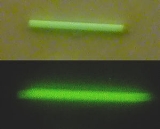
The emitted electrons from the radioactive decay of small amounts of tritium cause phosphor
s to glow so as to make self-powered lighting
devices called betalights, which are now used in firearm night sights, watches (see Luminox
for example), exit sign
s, map lights, and a variety of other devices. This takes the place of radium
, which can cause bone cancer and has been banned in most countries for decades. Commercial demand for tritium is 400 grams per year and the cost is approximately US $30,000 per gram.
the fission primary explosion of a thermonuclear weapon (it can be similarly used for fission bombs), as well as in external neutron initiators.
, a small particle accelerator
drives ions of tritium and deuterium to energies above the 15 kilo-electron-volts or so needed for deuterium-tritium fusion and directs them into a metal target where the tritium and deuterium are adsorbed as hydride
s. High-energy fusion neutrons from the resulting fusion radiate in all directions. Some of these strike plutonium or uranium nuclei in the primary's pit, initiating nuclear chain reaction
. The quantity of neutrons produced is large in absolute numbers, allowing the pit to quickly achieve neutron levels that would otherwise need many more generations of chain reaction, though still small compared to the total number of nuclei in the pit.
" of fissile plutonium or uranium. The early stages of the fission chain reaction supply enough heat and compression to start deuterium-tritium fusion, then both fission and fusion proceed in parallel, the fission assisting the fusion by continuing heating and compression, and the fusion assisting the fission with highly energetic (14.1 MeV
) neutrons. As the fission fuel depletes and also explodes outward, it falls below the density needed to stay critical by itself, but the fusion neutrons make the fission process progress faster and continue longer than it would without boosting. Increased yield comes overwhelmingly from the increase in fission. The energy released by the fusion itself is much smaller because the amount of fusion fuel is so much smaller. The effects of boosting include:
The tritium in a warhead
is continually undergoing radioactive decay, hence becoming unavailable for fusion. Furthermore its decay product
, helium-3, absorbs neutrons if exposed to the ones emitted by nuclear fission. This potentially offsets or reverses the intended effect of the tritium, which was to generate many free neutrons, if too much helium-3 has accumulated from the decay of tritium. Therefore, it is necessary to replenish tritium in boosted bombs periodically. The estimated quantity needed is 4 grams per warhead. To maintain constant levels of tritium, about 0.20 grams per warhead per year must be supplied to the bomb.
One mole
of deuterium-tritium gas would contain about 3.0 grams of tritium and 2.0 grams of deuterium. In comparison, the 4.5 kilograms of plutonium-239
in a nuclear bomb consists of about 20 moles of plutonium.
During the detonation of the primary fission bomb stage, excess neutrons released by the chain reaction split lithium-6 into tritium plus helium-4. In the extreme heat and pressure of the explosion, some of the tritium is then forced into fusion with deuterium, and that reaction releases even more neutrons.
Since this fusion process requires an extremely higher temperature for ignition, and it produces fewer and less energetic neutrons (only fission, deuterium-tritium fusion, and splitting are net neutron producers), lithium deuteride is not used in boosted bombs, but rather, for multistage hydrogen bombs.
in both magnetic confinement and inertial confinement fusion
reactor designs. The experimental fusion reactor ITER
and the National Ignition Facility
(NIF) will use deuterium-tritium fuel. The deuterium-tritium reaction is favorable since it has the largest fusion cross-section
(about 5.0 barns
) and it reaches this maximum cross-section at the lowest energy (about 65 keV
center-of-mass) of any potential fusion fuel.
The Tritium Systems Test Assembly (TSTA)
was a facility at the Los Alamos National Laboratory
dedicated to the development and demonstration of technologies required for fusion-relevant deuterium-tritium processing.
. Before these nuclear tests, there were only about 3 to 4 kilograms of tritium on the Earth's surface; but these amounts rose by 2 or 3 orders of magnitude during the post-test period.
due to recirculation and ventilation in the upper portion of the Atlantic Ocean. To the north, the isosurface deepens and reaches the floor of the abyssal plain
which is directly related to the ventilation of the ocean floor over 10 to 20 year time-scales.
Also evident in the Atlantic Ocean is the tritium profile near Bermuda
between the late 1960s and late 1980s. There is a downward propagation of the tritium maximum from the surface (1960s) to 400 meters (1980s), which corresponds to a deepening rate of approximately 18 meters per year. There are also tritium increases at 1,500 meters depth in the late 1970s and 2,500 meters in the middle of the 1980s, both of which correspond to cooling events in the deep water and associated deep water ventilation.
From a study in 1991, the tritium profile was used as a tool for studying the mixing and spreading of newly formed North Atlantic Deep Water
(NADW), corresponding to tritium increases to 4 TU. This NADW tends to spill over sills that divide the Norwegian Sea
from the North Atlantic Ocean and then flows to the west and equatorward in deep boundary currents. This process was explained via the large-scale tritium distribution in the deep North Atlantic between 1981 and 1983. The sub-polar gyre tends to be freshened (ventilated) by the NADW and is directly related to the high tritium values (> 1.5 TU). Also evident was the decrease in tritium in the deep western boundary current by a factor of 10 from the Labrador Sea
to the Tropics
, which is indicative of loss to ocean interior due to turbulent mixing and recirculation.
, the Fremantle Bay, the Bay of Bengal
, the Penang Bay, and the Strait of Malacca
. Results indicated that the tritium concentration in surface seawater was highest at the Fremantle Bay (approximately 0.40 Bq/liter), which could be accredited to the mixing of runoff of freshwater from nearby lands due to large amounts found in coastal waters. Typically, lower concentrations were found between 35
and 45 degrees south
latitude and near the equator
. Results also indicated that (in general) tritium has decreased over the years (up to 1997) due to the physical decay of bomb tritium in the Indian Ocean
. As for water vapor, the tritium concentration was approximately one order of magnitude greater than surface seawater concentrations (ranging from 0.46 to 1.15 Bq/liter). Therefore, the water vapor tritium is not affected by the surface seawater concentration; thus, the high tritium concentrations in the vapor were concluded to be a direct consequence of the downward movement of natural tritium from the stratosphere to the troposphere (therefore, the ocean air showed a dependence on latitudinal change)
In the North Pacific Ocean, the tritium (introduced as bomb tritium in the Northern Hemisphere) spread in three dimensions. There were subsurface maxima in the middle and low latitude regions, which is indicative of lateral mixing (advection) and diffusion
processes along lines of constant potential density (isopycnal
s) in the upper ocean. Some of these maxima even correlate well with salinity
extrema. In order to obtain the structure for ocean circulation, the tritium concentrations were mapped on 3 surfaces of constant potential density (23.90, 26.02, and 26.81). Results indicated that the tritium was well-mixed (at 6 to 7 TU) on the 26.81 isopycnal in the subarctic cyclonic gyre and there appeared to be a slow exchange of tritium (relative to shallower isopycnals) between this gyre and the anticyclonic gyre to the south; also, the tritium on the 23.90 and 26.02 surfaces appeared to be exchanged at a slower rate between the central gyre of the North Pacific and the equatorial regions.
The depth penetration of bomb tritium can be separated into 3 distinct layers. Layer 1 is the shallowest layer and includes the deepest, ventilated layer in winter; it has received tritium via radioactive fallout and lost some due to advection and/or vertical diffusion and contains approximately 28 % of the total amount of tritium. Layer 2 is below the first layer but above the 26.81 isopycnal and is no longer part of the mixed layer. Its 2 sources are diffusion downward from the mixed layer and lateral expansions outcropping strata (poleward); it contains about 58 % of the total tritium. Layer 3 is representative of waters that are deeper than the outcrop isopycnal and can only receive tritium via vertical diffusion; it contains the remaining 14 % of the total tritium.
. Tritium concentrations can be used to understand the residence times of continental hydrologic systems (as opposed to the usual oceanic hydrologic systems) which include surface waters such as lakes, streams, and rivers. Studying these systems can also provide societies and municipals with information for agricultural purposes and overall river water quality.
In a 2004 study, several rivers were taken into account during the examination of tritium concentrations (starting in the 1960s) throughout the Mississippi River Basin: Ohio River
(largest input to the Mississippi River flow), Missouri River
, and Arkansas River
. The largest tritium concentrations were found in 1963 at all the sampled locations throughout these rivers and correlate well with the peak concentrations in precipitation due to the nuclear bomb tests in 1962. The overall highest concentrations occurred in the Missouri River (1963) and were greater than 1,200 TU while the lowest concentrations were found in the Arkansas River (never greater than 850 TU and less than 10 TU in the mid-1980s).
Several processes can be identified using the tritium data from the rivers: direct runoff and outflow of water from groundwater reservoirs. Using these processes, it becomes possible to model the response of the river basins to the transient tritium tracer. Two of the most common models are the following:
Unfortunately, both models fail to reproduce the tritium in river waters; thus, a two-member mixing model was developed that consists of 2 components: a prompt-flow component (recent precipitation – "piston") and a component where waters reside in the basin for longer than 1 year ("well-mixed reservoir"). Therefore, the basin tritium concentration becomes a function of the residence times within the basin, sinks (radioactive decay) or sources of tritium, and the input function.
For the Ohio River, the tritium data indicated that about 40% of the flow was composed of precipitation with residence times of less than 1 year (in the Ohio basin) and older waters consisted of residence times of about 10 years. Thus, the short residence times (less than 1 year) corresponded to the "prompt-flow" component of the two-member mixing model. As for the Missouri River, results indicated that residence times were approximately 4 years with the prompt-flow component being around 10% (these results are due to the series of dams in the area of the Missouri River).
As for the mass flux of tritium through the main stem of the Mississippi River into the Gulf of Mexico
, data indicated that approximately 780 grams of tritium has flowed out of the River and into the Gulf between 1961 and 1997. And current fluxes through the Mississippi River are about 1 to 2 grams per year as opposed to the pre-bomb period fluxes of roughly 0.4 grams per year.
, using his "spiral" periodic table
, then produced in 1934 from deuterium, another isotope of hydrogen, by Ernest Rutherford
, working with Mark Oliphant
and Paul Harteck
. Rutherford was unable to isolate the tritium, a job that was left to Luis Alvarez
and Robert Cornog
, who correctly deduced that the substance was radioactive. Willard F. Libby discovered that tritium could be used for dating
water, and therefore wine
.
Isotopes of hydrogen
Hydrogen has three naturally occurring isotopes, sometimes denoted 1H, 2H, and 3H. Other, highly unstable nuclei have been synthesized in the laboratory but not observed in nature. The most stable radioisotope is tritium, with a half-life of 12.32 years...
. The nucleus
Atomic nucleus
The nucleus is the very dense region consisting of protons and neutrons at the center of an atom. It was discovered in 1911, as a result of Ernest Rutherford's interpretation of the famous 1909 Rutherford experiment performed by Hans Geiger and Ernest Marsden, under the direction of Rutherford. The...
of tritium (sometimes called a triton) contains one proton
Proton
The proton is a subatomic particle with the symbol or and a positive electric charge of 1 elementary charge. One or more protons are present in the nucleus of each atom, along with neutrons. The number of protons in each atom is its atomic number....
and two neutron
Neutron
The neutron is a subatomic hadron particle which has the symbol or , no net electric charge and a mass slightly larger than that of a proton. With the exception of hydrogen, nuclei of atoms consist of protons and neutrons, which are therefore collectively referred to as nucleons. The number of...
s, whereas the nucleus of protium (by far the most abundant hydrogen isotope) contains one proton and no neutrons. Naturally occurring tritium is extremely rare on Earth, where trace amounts are formed by the interaction of the atmosphere with cosmic ray
Cosmic ray
Cosmic rays are energetic charged subatomic particles, originating from outer space. They may produce secondary particles that penetrate the Earth's atmosphere and surface. The term ray is historical as cosmic rays were thought to be electromagnetic radiation...
s. The name of this isotope is formed from the Greek word "tritos" meaning "third."
Decay
While tritium has several different experimentally determined values of its half-lifeHalf-life
Half-life, abbreviated t½, is the period of time it takes for the amount of a substance undergoing decay to decrease by half. The name was originally used to describe a characteristic of unstable atoms , but it may apply to any quantity which follows a set-rate decay.The original term, dating to...
, the National Institute of Standards and Technology
National Institute of Standards and Technology
The National Institute of Standards and Technology , known between 1901 and 1988 as the National Bureau of Standards , is a measurement standards laboratory, otherwise known as a National Metrological Institute , which is a non-regulatory agency of the United States Department of Commerce...
lists 4,500±8 days (approximately 12.32 years). It decays into helium-3
Helium-3
Helium-3 is a light, non-radioactive isotope of helium with two protons and one neutron. It is rare on Earth, and is sought for use in nuclear fusion research...
by beta decay
Beta decay
In nuclear physics, beta decay is a type of radioactive decay in which a beta particle is emitted from an atom. There are two types of beta decay: beta minus and beta plus. In the case of beta decay that produces an electron emission, it is referred to as beta minus , while in the case of a...
as in this nuclear equation:
| → |
and it releases 18.6 keV
Kev
Kev can refer to:*Kev Hawkins, a fictional character.*Kevin, a given name occasionally shortened to "Kev".*Kiloelectronvolt, a unit of energy who symbol is "KeV".* Krefelder Eislauf-VereinKEV can refer to:...
of energy in the process. The electron
Electron
The electron is a subatomic particle with a negative elementary electric charge. It has no known components or substructure; in other words, it is generally thought to be an elementary particle. An electron has a mass that is approximately 1/1836 that of the proton...
's kinetic energy varies, with an average of 5.7 keV, while the remaining energy is carried off by the nearly undetectable electron antineutrino. Beta particles from tritium can penetrate only about 6.0 mm of air, and they are incapable of passing through the dead outermost layer of human skin. The unusually low energy released in the tritium beta decay makes the decay (along with that of rhenium-187
Isotopes of rhenium
Naturally occurring rhenium is 37.4% 185Re, which is stable, and 62.6% 187Re, which is unstable but has a very long half-life...
) an appropriate laboratory for absolute neutrino mass measurements (the most recent experiment being KATRIN
KATRIN
KATRIN is an experiment to measure the mass of the electron antineutrino with sub-eV precision by examining the spectrum of electrons emitted from the beta decay of tritium...
).
Tritium is potentially dangerous if inhaled or ingested. It can combine with oxygen
Oxygen
Oxygen is the element with atomic number 8 and represented by the symbol O. Its name derives from the Greek roots ὀξύς and -γενής , because at the time of naming, it was mistakenly thought that all acids required oxygen in their composition...
to form tritiated water
Tritiated water
Tritiated water is a form of water where the usual hydrogen atoms are replaced with tritium. In its pure form it may be called tritium oxide or super-heavy water. Pure T2O is corrosive due to self-radiolysis. Diluted, tritiated water is mainly H2O plus some HTO . It is also used as a tracer for...
molecules, and those can be absorbed through pores in the skin.
The low energy of tritium's radiation makes it difficult to detect tritium-labeled compounds except by using liquid scintillation counting
Liquid scintillation counting
Liquid scintillation counting is a standard laboratory method in the life-sciences for measuring radiation from beta-emitting nuclides. Scintillating materials are also used in differently constructed "counters" in many other fields....
.
Lithium
Tritium is produced in nuclear reactors by neutron activationNeutron activation
Neutron activation is the process in which neutron radiation induces radioactivity in materials, and occurs when atomic nuclei capture free neutrons, becoming heavier and entering excited states. The excited nucleus often decays immediately by emitting particles such as neutrons, protons, or alpha...
of lithium-6. This is possible with neutrons of any energy, and is an exothermic
Exothermic
In thermodynamics, the term exothermic describes a process or reaction that releases energy from the system, usually in the form of heat, but also in the form of light , electricity , or sound...
reaction yielding 4.8 MeV. In comparison, the fusion of deuterium with tritium releases about 17.6 MeV of energy.
- {| border="0"
|- style="height:2em;"
| ||+ || ||→ || ||( ||2.05 MeV ||) ||+ || ||( ||2.75 MeV ||)
|}
High-energy neutrons can also produce tritium from lithium-7 in an endothermic
Endothermic
In thermodynamics, the word endothermic describes a process or reaction in which the system absorbs energy from the surroundings in the form of heat. Its etymology stems from the prefix endo- and the Greek word thermasi,...
reaction, consuming 2.466 MeV. This was discovered when the 1954 Castle Bravo nuclear test produced an unexpectedly high yield.
- {| border="0"
|- style="height:2em;"
| ||+ || ||→ || ||+ || ||+ ||
|}
High-energy neutrons irradiating boron
Boron
Boron is the chemical element with atomic number 5 and the chemical symbol B. Boron is a metalloid. Because boron is not produced by stellar nucleosynthesis, it is a low-abundance element in both the solar system and the Earth's crust. However, boron is concentrated on Earth by the...
-10 will also occasionally produce tritium.
The more common result of boron-10 neutron capture is and a single alpha particle
Alpha particle
Alpha particles consist of two protons and two neutrons bound together into a particle identical to a helium nucleus, which is classically produced in the process of alpha decay, but may be produced also in other ways and given the same name...
.
- {| border="0"
|- style="height:2em;"
| ||+ || ||→ ||2 ||+ ||
|}
The reactions requiring high neutron energies are not attractive production methods.
Deuterium
Tritium is also produced in heavy water-moderated reactors whenever a deuteriumDeuterium
Deuterium, also called heavy hydrogen, is one of two stable isotopes of hydrogen. It has a natural abundance in Earth's oceans of about one atom in of hydrogen . Deuterium accounts for approximately 0.0156% of all naturally occurring hydrogen in Earth's oceans, while the most common isotope ...
nucleus captures a neutron. This reaction has a quite small absorption cross section
Cross section (physics)
A cross section is the effective area which governs the probability of some scattering or absorption event. Together with particle density and path length, it can be used to predict the total scattering probability via the Beer-Lambert law....
, making heavy water
Heavy water
Heavy water is water highly enriched in the hydrogen isotope deuterium; e.g., heavy water used in CANDU reactors is 99.75% enriched by hydrogen atom-fraction...
a good neutron moderator
Neutron moderator
In nuclear engineering, a neutron moderator is a medium that reduces the speed of fast neutrons, thereby turning them into thermal neutrons capable of sustaining a nuclear chain reaction involving uranium-235....
, and relatively little tritium is produced. Even so, cleaning tritium from the moderator may be desirable after several years to reduce the risk of its escaping to the environment. The Ontario Power Generation
Ontario Power Generation
Ontario Power Generation is a public company wholly owned by the Government of Ontario. OPG is responsible for approximately 70% of the electricity generation in the Province of Ontario, Canada. Sources of electricity include nuclear, hydroelectric, solar, wind, and fossil fuel...
's "Tritium Removal Facility" processes up to 2500 LT (2,540,125 kg) of heavy water a year, and it separates out about 2.5 kg (5.5 lb) of tritium, making it available for other uses.
Deuterium's absorption cross section for thermal neutrons is about 0.52 millibarn
Barn (unit)
A barn is a unit of area. Originally used in nuclear physics for expressing the cross sectional area of nuclei and nuclear reactions, today it is used in all fields of high energy physics to express the cross sections of any scattering process, and is best understood as a measure of the...
s, whereas that of oxygen-16 is about 0.19 millibarns and that of oxygen-17
Oxygen-17
Oxygen-17 is a low abundant isotope of oxygen . Being the only stable isotope of oxygen possessing a nuclear spin and the unique characteristic of field-independent relaxation it enables NMR studies of metabolic pathways of compounds incorporating oxygen at high magnetic fields Oxygen-17 is a low...
is about 240 millibarns. makes up about 0.038% of all naturally occurring oxygen
Oxygen
Oxygen is the element with atomic number 8 and represented by the symbol O. Its name derives from the Greek roots ὀξύς and -γενής , because at the time of naming, it was mistakenly thought that all acids required oxygen in their composition...
, hence oxygen has an overall absorption cross section of about 0.28 millibarns. Therefore, in deuterium oxide made with natural oxygen, 21% of neutron capture
Neutron capture
Neutron capture is a kind of nuclear reaction in which an atomic nucleus collides with one or more neutrons and they merge to form a heavier nucleus. Since neutrons have no electric charge they can enter a nucleus more easily than positively charged protons, which are repelled...
s are by oxygen
Oxygen
Oxygen is the element with atomic number 8 and represented by the symbol O. Its name derives from the Greek roots ὀξύς and -γενής , because at the time of naming, it was mistakenly thought that all acids required oxygen in their composition...
nuclei, a proportion that may rise further since the percentage of increases from neutron captures by . Also, splits when bombarded by the alpha particle
Alpha particle
Alpha particles consist of two protons and two neutrons bound together into a particle identical to a helium nucleus, which is classically produced in the process of alpha decay, but may be produced also in other ways and given the same name...
s emitted by decaying uranium
Uranium
Uranium is a silvery-white metallic chemical element in the actinide series of the periodic table, with atomic number 92. It is assigned the chemical symbol U. A uranium atom has 92 protons and 92 electrons, of which 6 are valence electrons...
, producing radioactive carbon-14
Carbon-14
Carbon-14, 14C, or radiocarbon, is a radioactive isotope of carbon with a nucleus containing 6 protons and 8 neutrons. Its presence in organic materials is the basis of the radiocarbon dating method pioneered by Willard Libby and colleagues , to date archaeological, geological, and hydrogeological...
, a dangerous by-product, by the equation.
- + → + assorted smalled products
Fission
Tritium is an uncommon product of the nuclear fissionNuclear fission
In nuclear physics and nuclear chemistry, nuclear fission is a nuclear reaction in which the nucleus of an atom splits into smaller parts , often producing free neutrons and photons , and releasing a tremendous amount of energy...
of uranium-235
Uranium-235
- References :* .* DOE Fundamentals handbook: Nuclear Physics and Reactor theory , .* A piece of U-235 the size of a grain of rice can produce energy equal to that contained in three tons of coal or fourteen barrels of oil. -External links:* * * one of the earliest articles on U-235 for the...
, plutonium-239
Plutonium-239
Plutonium-239 is an isotope of plutonium. Plutonium-239 is the primary fissile isotope used for the production of nuclear weapons, although uranium-235 has also been used and is currently the secondary isotope. Plutonium-239 is also one of the three main isotopes demonstrated usable as fuel in...
, and uranium-233
Uranium-233
Uranium-233 is a fissile isotope of uranium, bred from Thorium as part of the thorium fuel cycle. It has been used in a few nuclear reactors and has been proposed for much wider use as a nuclear fuel. It has a half-life of 160,000 years....
, with a production of about one per each 10,000 fissions.
This means that the release or recovery of tritium needs to be considered in the operation of nuclear reactor
Nuclear reactor
A nuclear reactor is a device to initiate and control a sustained nuclear chain reaction. Most commonly they are used for generating electricity and for the propulsion of ships. Usually heat from nuclear fission is passed to a working fluid , which runs through turbines that power either ship's...
s, especially in the reprocessing of nuclear fuel
Nuclear reprocessing
Nuclear reprocessing technology was developed to chemically separate and recover fissionable plutonium from irradiated nuclear fuel. Reprocessing serves multiple purposes, whose relative importance has changed over time. Originally reprocessing was used solely to extract plutonium for producing...
s and in the storage of spent nuclear fuel
Spent nuclear fuel
Spent nuclear fuel, occasionally called used nuclear fuel, is nuclear fuel that has been irradiated in a nuclear reactor...
. The production of tritium was not a goal, but is rather just a side-effect.
Helium-3 and tritium
Tritium's decay productDecay product
In nuclear physics, a decay product is the remaining nuclide left over from radioactive decay. Radioactive decay often involves a sequence of steps...
, helium-3
Helium-3
Helium-3 is a light, non-radioactive isotope of helium with two protons and one neutron. It is rare on Earth, and is sought for use in nuclear fusion research...
, has a very large cross section for reacting with thermal neutrons, expelling a proton, hence it is rapidly converted back to tritium in nuclear reactor
Nuclear reactor
A nuclear reactor is a device to initiate and control a sustained nuclear chain reaction. Most commonly they are used for generating electricity and for the propulsion of ships. Usually heat from nuclear fission is passed to a working fluid , which runs through turbines that power either ship's...
s.
+ n --> +
Cosmic rays
Tritium occurs naturally due to cosmic rayCosmic ray
Cosmic rays are energetic charged subatomic particles, originating from outer space. They may produce secondary particles that penetrate the Earth's atmosphere and surface. The term ray is historical as cosmic rays were thought to be electromagnetic radiation...
s interacting with atmospheric gases. In the most important reaction for natural production, a fast neutron (which must have energy greater than 4.0 MeV
MEV
MeV and meV are multiples and submultiples of the electron volt unit referring to 1,000,000 eV and 0.001 eV, respectively.Mev or MEV may refer to:In entertainment:* Musica Elettronica Viva, an Italian musical group...
) interacts with atmospheric nitrogen
Nitrogen
Nitrogen is a chemical element that has the symbol N, atomic number of 7 and atomic mass 14.00674 u. Elemental nitrogen is a colorless, odorless, tasteless, and mostly inert diatomic gas at standard conditions, constituting 78.08% by volume of Earth's atmosphere...
:
- {| border="0"
|- style="height:2em;"
| ||+ || ||→ || ||+ ||
|}
The global equilibrium inventory of tritium is approximately constant due to a fixed production rate and losses proportional to the inventory.
Production history
According to the Institute for Energy and Environmental ResearchInstitute for Energy and Environmental Research
The Institute for Energy and Environmental Research focuses on the environmental safety of nuclear weapons production, ozone layer depletion, and other issues relating to energy. IEER publishes a variety of books on energy-related issues, conducts workshops for activists on nuclear issues, and...
report in 1996 about the U.S. Department of Energy, only 225 kg (496 lb) of tritium has been produced in the United States since 1955. Since it continually decays into helium-3, the total amount remaining was about 75 kg (165.3 lb) at the time of the report.
Tritium for American nuclear weapon
Nuclear weapon
A nuclear weapon is an explosive device that derives its destructive force from nuclear reactions, either fission or a combination of fission and fusion. Both reactions release vast quantities of energy from relatively small amounts of matter. The first fission bomb test released the same amount...
s was produced in special heavy water reactor
Heavy water reactor
A pressurised heavy water reactor is a nuclear power reactor, commonly using unenriched natural uranium as its fuel, that uses heavy water as its coolant and moderator. The heavy water coolant is kept under pressure in order to raise its boiling point, allowing it to be heated to higher...
s at the Savannah River Site
Savannah River Site
The Savannah River Site is a nuclear reservation in the United States in the state of South Carolina, located on land in Aiken, Allendale and Barnwell Counties adjacent to the Savannah River, southeast of Augusta, Georgia. The site was built during the 1950s to refine nuclear materials for...
until their close-downs in 1988. With the Strategic Arms Reduction Treaty (START) after the end of the Cold War
Cold War
The Cold War was the continuing state from roughly 1946 to 1991 of political conflict, military tension, proxy wars, and economic competition between the Communist World—primarily the Soviet Union and its satellite states and allies—and the powers of the Western world, primarily the United States...
, the existing supplies were sufficient for the new, smaller number of nuclear weapons for some time.
The production of tritium was resumed with irradiation
Irradiation
Irradiation is the process by which an object is exposed to radiation. The exposure can originate from various sources, including natural sources. Most frequently the term refers to ionizing radiation, and to a level of radiation that will serve a specific purpose, rather than radiation exposure to...
of rods containing lithium
Lithium
Lithium is a soft, silver-white metal that belongs to the alkali metal group of chemical elements. It is represented by the symbol Li, and it has the atomic number 3. Under standard conditions it is the lightest metal and the least dense solid element. Like all alkali metals, lithium is highly...
(replacing the usual control rod
Control rod
A control rod is a rod made of chemical elements capable of absorbing many neutrons without fissioning themselves. They are used in nuclear reactors to control the rate of fission of uranium and plutonium...
s containing boron
Boron
Boron is the chemical element with atomic number 5 and the chemical symbol B. Boron is a metalloid. Because boron is not produced by stellar nucleosynthesis, it is a low-abundance element in both the solar system and the Earth's crust. However, boron is concentrated on Earth by the...
, cadmium
Cadmium
Cadmium is a chemical element with the symbol Cd and atomic number 48. This soft, bluish-white metal is chemically similar to the two other stable metals in group 12, zinc and mercury. Similar to zinc, it prefers oxidation state +2 in most of its compounds and similar to mercury it shows a low...
, or hafnium
Hafnium
Hafnium is a chemical element with the symbol Hf and atomic number 72. A lustrous, silvery gray, tetravalent transition metal, hafnium chemically resembles zirconium and is found in zirconium minerals. Its existence was predicted by Dmitri Mendeleev in 1869. Hafnium was the penultimate stable...
), at the reactors of the commercial Watts Bar Nuclear Generating Station
Watts Bar Nuclear Generating Station
The Watts Bar Nuclear Generating Station is a Tennessee Valley Authority nuclear reactor used for electric power generation and tritium production for nuclear weapons. It is located on a 1,770-acre site in Rhea County, Tennessee, near Spring City, between the cities of Chattanooga and Knoxville...
in 2003–2005 followed by extraction of tritium from the rods at the new Tritium Extraction Facility at the Savannah River Site beginning in November 2006. Tritium leakage from the TPBARs during reactor operations limits the number that can be used in any reactor without exceeding the maximum allowed tritium levels in the coolant.
Properties
Tritium has an atomic massAtomic mass
The atomic mass is the mass of a specific isotope, most often expressed in unified atomic mass units. The atomic mass is the total mass of protons, neutrons and electrons in a single atom....
of 3.0160492. It is a gas (2 or 2) at standard temperature and pressure. It combines with oxygen
Oxygen
Oxygen is the element with atomic number 8 and represented by the symbol O. Its name derives from the Greek roots ὀξύς and -γενής , because at the time of naming, it was mistakenly thought that all acids required oxygen in their composition...
to form a liquid called tritiated water
Tritiated water
Tritiated water is a form of water where the usual hydrogen atoms are replaced with tritium. In its pure form it may be called tritium oxide or super-heavy water. Pure T2O is corrosive due to self-radiolysis. Diluted, tritiated water is mainly H2O plus some HTO . It is also used as a tracer for...
, .
Tritium figures prominently in studies of nuclear fusion
Nuclear fusion
Nuclear fusion is the process by which two or more atomic nuclei join together, or "fuse", to form a single heavier nucleus. This is usually accompanied by the release or absorption of large quantities of energy...
because of its favorable reaction cross section
Cross section (physics)
A cross section is the effective area which governs the probability of some scattering or absorption event. Together with particle density and path length, it can be used to predict the total scattering probability via the Beer-Lambert law....
and the large amount of energy (17.6 MeV) produced through its reaction with deuterium:
- {| border="0"
|- style="height:2em;"
| ||+ || ||→ || ||+ ||
|}
All atomic nuclei, being composed of protons and neutrons, repel one another because of their positive charge. However, if the atoms have a high enough temperature and pressure (for example, in the core of the Sun), then their random motions can overcome such electrical repulsion (called the Coulomb force
Coulomb's law
Coulomb's law or Coulomb's inverse-square law, is a law of physics describing the electrostatic interaction between electrically charged particles. It was first published in 1785 by French physicist Charles Augustin de Coulomb and was essential to the development of the theory of electromagnetism...
), and they can come close enough for the strong nuclear force to take effect, fusing them into heavier atoms.
The tritium nucleus, containing one proton and two neutrons, has the same charge as the nucleus of ordinary hydrogen, and it experiences the same electrostatic repulsive force when brought close to another atomic nucleus. However, the neutrons in the tritium nucleus increase the attractive strong nuclear force when brought close enough to another atomic nucleus. As a result, tritium can more easily fuse with other light atoms, compared with the ability of ordinary hydrogen to do so.
The same is true, albeit to a lesser extent, of deuterium. This is why brown dwarf
Brown dwarf
Brown dwarfs are sub-stellar objects which are too low in mass to sustain hydrogen-1 fusion reactions in their cores, which is characteristic of stars on the main sequence. Brown dwarfs have fully convective surfaces and interiors, with no chemical differentiation by depth...
s (so-called failed star
Star
A star is a massive, luminous sphere of plasma held together by gravity. At the end of its lifetime, a star can also contain a proportion of degenerate matter. The nearest star to Earth is the Sun, which is the source of most of the energy on Earth...
s) cannot utilize ordinary hydrogen, but they do fuse the small minority of deuterium nuclei.
Like hydrogen
Hydrogen
Hydrogen is the chemical element with atomic number 1. It is represented by the symbol H. With an average atomic weight of , hydrogen is the lightest and most abundant chemical element, constituting roughly 75% of the Universe's chemical elemental mass. Stars in the main sequence are mainly...
, tritium is difficult to confine. Rubber, plastic, and some kinds of steel are all somewhat permeable. This has raised concerns that if tritium were used in large quantities, in particular for fusion reactors, it may contribute to radioactive contamination
Radioactive contamination
Radioactive contamination, also called radiological contamination, is radioactive substances on surfaces, or within solids, liquids or gases , where their presence is unintended or undesirable, or the process giving rise to their presence in such places...
, although its short half-life should prevent significant long-term accumulation in the atmosphere.
The high levels of atmospheric nuclear weapons testing that took place prior to the enactment of the Partial Test Ban Treaty
Partial Test Ban Treaty
The treaty banning nuclear weapon tests in the atmosphere, in outer space and under water, often abbreviated as the Partial Test Ban Treaty , Limited Test Ban Treaty , or Nuclear Test Ban Treaty is a treaty prohibiting all test detonations of nuclear weapons...
proved to be unexpectedly useful to oceanographers. The high levels of tritium oxide introduced into upper layers of the oceans have been used in the years since then to measure the rate of mixing of the upper layers of the oceans with their lower levels.
Health risks
Tritium is an isotope of hydrogen, which allows it to readily bind to hydroxyl radicalHydroxyl radical
The hydroxyl radical, •OH, is the neutral form of the hydroxide ion . Hydroxyl radicals are highly reactive and consequently short-lived; however, they form an important part of radical chemistry. Most notably hydroxyl radicals are produced from the decomposition of hydroperoxides or, in...
s, forming tritiated water
Tritiated water
Tritiated water is a form of water where the usual hydrogen atoms are replaced with tritium. In its pure form it may be called tritium oxide or super-heavy water. Pure T2O is corrosive due to self-radiolysis. Diluted, tritiated water is mainly H2O plus some HTO . It is also used as a tracer for...
(HTO), and to carbon atoms. Since tritium is a low energy beta emitter
Beta particle
Beta particles are high-energy, high-speed electrons or positrons emitted by certain types of radioactive nuclei such as potassium-40. The beta particles emitted are a form of ionizing radiation also known as beta rays. The production of beta particles is termed beta decay...
, it is not dangerous externally (its beta particles are unable to penetrate the skin), but it is a radiation hazard when inhaled, ingested via food or water, or absorbed through the skin. HTO has a short biological half-life in the human body of 7 to 14 days, which both reduces the total effects of single-incident ingestion and precludes long-term bioaccumulation
Bioaccumulation
Bioaccumulation refers to the accumulation of substances, such as pesticides, or other organic chemicals in an organism. Bioaccumulation occurs when an organism absorbs a toxic substance at a rate greater than that at which the substance is lost...
of HTO from the environment.
Tritium has leaked from 48 of 65 nuclear sites in the United States, temporarily increasing the local level of radioactivity by up to 375 times the United States Environmental Protection Agency
United States Environmental Protection Agency
The U.S. Environmental Protection Agency is an agency of the federal government of the United States charged with protecting human health and the environment, by writing and enforcing regulations based on laws passed by Congress...
(EPA) standards.
Regulatory limits
The legal limits for tritium in drinking waterDrinking water
Drinking water or potable water is water pure enough to be consumed or used with low risk of immediate or long term harm. In most developed countries, the water supplied to households, commerce and industry is all of drinking water standard, even though only a very small proportion is actually...
vary from country-to-country and from continent-to-continent. Some figures are given below.
- Canada: 7,000 becquerelBecquerelThe becquerel is the SI-derived unit of radioactivity. One Bq is defined as the activity of a quantity of radioactive material in which one nucleus decays per second. The Bq unit is therefore equivalent to an inverse second, s−1...
per liter (Bq/L). - United States: 740 Bq/L or 20,000 picocurieCurieThe curie is a unit of radioactivity, defined asThis is roughly the activity of 1 gram of the radium isotope 226Ra, a substance studied by the pioneers of radiology, Marie and Pierre Curie, for whom the unit was named. In addition to the curie, activity can be measured using an SI derived unit,...
per liter (pCi/L) (Safe Drinking Water ActSafe Drinking Water ActThe Safe Drinking Water Act is the principle federal law in the United States intended to ensure safe drinking water for the public. Pursuant to the act, the Environmental Protection Agency is required to set standards for drinking water quality and oversee all states, localities, and water...
) - World Health Organization: 10,000 Bq/L.
- European Union: "investigative" limit of 100 Bq/L.
The American limit is calculated to yield a dose of 4.0 millirem
Röntgen equivalent man
Named after Wilhelm Röntgen , the roentgen equivalent in man or rem is a unit of radiation dose equivalent...
s (or 40 microsievert
Sievert
The sievert is the International System of Units SI derived unit of dose equivalent radiation. It attempts to quantitatively evaluate the biological effects of ionizing radiation as opposed to just the absorbed dose of radiation energy, which is measured in gray...
s in SI units) per year. This is about 1.3% of the natural background radiation (roughly 3000 microsieverts).
Self-powered lighting
The emitted electrons from the radioactive decay of small amounts of tritium cause phosphor
Phosphor
A phosphor, most generally, is a substance that exhibits the phenomenon of luminescence. Somewhat confusingly, this includes both phosphorescent materials, which show a slow decay in brightness , and fluorescent materials, where the emission decay takes place over tens of nanoseconds...
s to glow so as to make self-powered lighting
Self-powered lighting
Tritium illumination is the use of gaseous tritium, a radioactive isotope of hydrogen, to create visible light. Tritium emits electrons through beta decay, and when they interact with a phosphor material, fluorescent light is created, a process called radioluminescence...
devices called betalights, which are now used in firearm night sights, watches (see Luminox
Luminox
Luminox is a brand of watches and clocks that use tritium to illuminate the hands and numerals of its products. Luminox was originally designed for United States Navy SEALs when a procurement officer approached the company to design a watch specifically suited for the needs of this special...
for example), exit sign
Exit sign
An exit sign is a device in a public facility denoting the location of the emergency exit , guiding people to the closest exit in case of fire or other emergency. Most relevant codes require exit signs to be permanently lit...
s, map lights, and a variety of other devices. This takes the place of radium
Radium
Radium is a chemical element with atomic number 88, represented by the symbol Ra. Radium is an almost pure-white alkaline earth metal, but it readily oxidizes on exposure to air, becoming black in color. All isotopes of radium are highly radioactive, with the most stable isotope being radium-226,...
, which can cause bone cancer and has been banned in most countries for decades. Commercial demand for tritium is 400 grams per year and the cost is approximately US $30,000 per gram.
Nuclear weapons
Tritium is widely used in multi-stage hydrogen bombs for boostingBoosted fission weapon
A boosted fission weapon usually refers to a type of nuclear bomb that uses a small amount of fusion fuel to increase the rate, and thus yield, of a fission reaction. The neutrons released by the fusion reactions add to the neutrons released in the fission, as well as inducing the fission reactions...
the fission primary explosion of a thermonuclear weapon (it can be similarly used for fission bombs), as well as in external neutron initiators.
Neutron initiator
Actuated by an ultrafast switch like a krytronKrytron
The krytron is a cold-cathode gas filled tube intended for use as a very high-speed switch, and was one of the earliest developments of the EG&G Corporation. It is somewhat similar to thyratron...
, a small particle accelerator
Particle accelerator
A particle accelerator is a device that uses electromagnetic fields to propel charged particles to high speeds and to contain them in well-defined beams. An ordinary CRT television set is a simple form of accelerator. There are two basic types: electrostatic and oscillating field accelerators.In...
drives ions of tritium and deuterium to energies above the 15 kilo-electron-volts or so needed for deuterium-tritium fusion and directs them into a metal target where the tritium and deuterium are adsorbed as hydride
Hydride
In chemistry, a hydride is the anion of hydrogen, H−, or, more commonly, a compound in which one or more hydrogen centres have nucleophilic, reducing, or basic properties. In compounds that are regarded as hydrides, hydrogen is bonded to a more electropositive element or group...
s. High-energy fusion neutrons from the resulting fusion radiate in all directions. Some of these strike plutonium or uranium nuclei in the primary's pit, initiating nuclear chain reaction
Nuclear chain reaction
A nuclear chain reaction occurs when one nuclear reaction causes an average of one or more nuclear reactions, thus leading to a self-propagating number of these reactions. The specific nuclear reaction may be the fission of heavy isotopes or the fusion of light isotopes...
. The quantity of neutrons produced is large in absolute numbers, allowing the pit to quickly achieve neutron levels that would otherwise need many more generations of chain reaction, though still small compared to the total number of nuclei in the pit.
Boosting
Before detonation, a few grams of tritium-deuterium gas are injected into the hollow "pitPit (nuclear weapon)
The pit is the core of an implosion weapon – the fissile material and any neutron reflector or tamper bonded to it. Some weapons tested during the 1950s used pits made with U-235 alone, or in composite with plutonium, but all-plutonium pits are the smallest in diameter and have been the standard...
" of fissile plutonium or uranium. The early stages of the fission chain reaction supply enough heat and compression to start deuterium-tritium fusion, then both fission and fusion proceed in parallel, the fission assisting the fusion by continuing heating and compression, and the fusion assisting the fission with highly energetic (14.1 MeV
MEV
MeV and meV are multiples and submultiples of the electron volt unit referring to 1,000,000 eV and 0.001 eV, respectively.Mev or MEV may refer to:In entertainment:* Musica Elettronica Viva, an Italian musical group...
) neutrons. As the fission fuel depletes and also explodes outward, it falls below the density needed to stay critical by itself, but the fusion neutrons make the fission process progress faster and continue longer than it would without boosting. Increased yield comes overwhelmingly from the increase in fission. The energy released by the fusion itself is much smaller because the amount of fusion fuel is so much smaller. The effects of boosting include:
- increased yield (for the same amount of fission fuel, compared to detonation without boosting)
- the possibility of variable yieldVariable yieldVariable yield — or dial-a-yield — is an option available on most modern nuclear weapons. It allows the operator to specify a weapon's yield, or explosive power, allowing a single design to be used in different situations...
by varying the amount of fusion fuel - allowing the bomb to require a smaller amount of the very expensive fissile material – and also eliminating the risk of predetonation by nearby nuclear explosions
- allowing the primary to quickly release most of its power before it has expanded to a larger size difficult to retain within a so-called "radiation case" (??).
- not so stringent requirements on the implosion setup, allowing for a smaller and lighter amount of high-explosives to be used
The tritium in a warhead
Warhead
The term warhead refers to the explosive material and detonator that is delivered by a missile, rocket, or torpedo.- Etymology :During the early development of naval torpedoes, they could be equipped with an inert payload that was intended for use during training, test firing and exercises. This...
is continually undergoing radioactive decay, hence becoming unavailable for fusion. Furthermore its decay product
Decay product
In nuclear physics, a decay product is the remaining nuclide left over from radioactive decay. Radioactive decay often involves a sequence of steps...
, helium-3, absorbs neutrons if exposed to the ones emitted by nuclear fission. This potentially offsets or reverses the intended effect of the tritium, which was to generate many free neutrons, if too much helium-3 has accumulated from the decay of tritium. Therefore, it is necessary to replenish tritium in boosted bombs periodically. The estimated quantity needed is 4 grams per warhead. To maintain constant levels of tritium, about 0.20 grams per warhead per year must be supplied to the bomb.
One mole
Mole (unit)
The mole is a unit of measurement used in chemistry to express amounts of a chemical substance, defined as an amount of a substance that contains as many elementary entities as there are atoms in 12 grams of pure carbon-12 , the isotope of carbon with atomic weight 12. This corresponds to a value...
of deuterium-tritium gas would contain about 3.0 grams of tritium and 2.0 grams of deuterium. In comparison, the 4.5 kilograms of plutonium-239
Plutonium-239
Plutonium-239 is an isotope of plutonium. Plutonium-239 is the primary fissile isotope used for the production of nuclear weapons, although uranium-235 has also been used and is currently the secondary isotope. Plutonium-239 is also one of the three main isotopes demonstrated usable as fuel in...
in a nuclear bomb consists of about 20 moles of plutonium.
Tritium in hydrogen bomb secondaries
Since tritium undergoes radioactive decay, and it is also difficult to confine physically, the much-larger secondary charge of heavy hydrogen isotopes needed in a true hydrogen bomb uses solid lithium deuteride as its source of deuterium and tritium, where the lithium is all in the form of the lithium-6 isotope.During the detonation of the primary fission bomb stage, excess neutrons released by the chain reaction split lithium-6 into tritium plus helium-4. In the extreme heat and pressure of the explosion, some of the tritium is then forced into fusion with deuterium, and that reaction releases even more neutrons.
Since this fusion process requires an extremely higher temperature for ignition, and it produces fewer and less energetic neutrons (only fission, deuterium-tritium fusion, and splitting are net neutron producers), lithium deuteride is not used in boosted bombs, but rather, for multistage hydrogen bombs.
Controlled nuclear fusion
Tritium is an important fuel for controlled nuclear fusionNuclear fusion
Nuclear fusion is the process by which two or more atomic nuclei join together, or "fuse", to form a single heavier nucleus. This is usually accompanied by the release or absorption of large quantities of energy...
in both magnetic confinement and inertial confinement fusion
Inertial confinement fusion
Inertial confinement fusion is a process where nuclear fusion reactions are initiated by heating and compressing a fuel target, typically in the form of a pellet that most often contains a mixture of deuterium and tritium....
reactor designs. The experimental fusion reactor ITER
ITER
ITER is an international nuclear fusion research and engineering project, which is currently building the world's largest and most advanced experimental tokamak nuclear fusion reactor at Cadarache in the south of France...
and the National Ignition Facility
National Ignition Facility
The National Ignition Facility, or NIF is a large, laser-based inertial confinement fusion research device located at the Lawrence Livermore National Laboratory in Livermore, California. NIF uses powerful lasers to heat and compress a small amount of hydrogen fuel to the point where nuclear fusion...
(NIF) will use deuterium-tritium fuel. The deuterium-tritium reaction is favorable since it has the largest fusion cross-section
Cross section (physics)
A cross section is the effective area which governs the probability of some scattering or absorption event. Together with particle density and path length, it can be used to predict the total scattering probability via the Beer-Lambert law....
(about 5.0 barns
Barn (unit)
A barn is a unit of area. Originally used in nuclear physics for expressing the cross sectional area of nuclei and nuclear reactions, today it is used in all fields of high energy physics to express the cross sections of any scattering process, and is best understood as a measure of the...
) and it reaches this maximum cross-section at the lowest energy (about 65 keV
Electronvolt
In physics, the electron volt is a unit of energy equal to approximately joule . By definition, it is equal to the amount of kinetic energy gained by a single unbound electron when it accelerates through an electric potential difference of one volt...
center-of-mass) of any potential fusion fuel.
The Tritium Systems Test Assembly (TSTA)
Tritium Systems Test Assembly (TSTA)
The Tritium Systems Test Assembly was a facility at Los Alamos National Laboratory dedicated to the development and demonstration of technologies required for fusion-relevant Deuterium-Tritium processing. The facility design was launched in 1977. It was commissioned in 1982 and first tritium was...
was a facility at the Los Alamos National Laboratory
Los Alamos National Laboratory
Los Alamos National Laboratory is a United States Department of Energy national laboratory, managed and operated by Los Alamos National Security , located in Los Alamos, New Mexico...
dedicated to the development and demonstration of technologies required for fusion-relevant deuterium-tritium processing.
Analytical chemistry
Tritium is sometimes used as a radiolabel. It has the advantage that hydrogen appears in almost all organic chemicals making it easy to find a place to put tritium on the molecule under investigation. It has the disadvantage of producing a comparatively weak signal.Use as an oceanic transient tracer
Aside from chlorofluorocarbons, tritium can act as a transient tracer and has the ability to "outline" the biological, chemical, and physical paths throughout the world oceans because of its evolving distribution. Tritium has thus been used as a tool to examine ocean circulation and ventilation and, for such purposes, is usually measured in Tritium Units where 1 TU is defined as the ratio of 1 tritium atom to 1018 hydrogen atoms. As noted earlier, nuclear weapons testing, primarily in the high-latitude regions of the Northern Hemisphere, throughout the late 1950s and early 1960s introduced large amounts of tritium into the atmosphere, especially the stratosphereStratosphere
The stratosphere is the second major layer of Earth's atmosphere, just above the troposphere, and below the mesosphere. It is stratified in temperature, with warmer layers higher up and cooler layers farther down. This is in contrast to the troposphere near the Earth's surface, which is cooler...
. Before these nuclear tests, there were only about 3 to 4 kilograms of tritium on the Earth's surface; but these amounts rose by 2 or 3 orders of magnitude during the post-test period.
North Atlantic Ocean
While in the stratosphere (post-test period), the tritium interacted with and oxidized to water molecules and was present in much of the rapidly produced rainfall, making tritium a prognostic tool for studying the evolution and structure of the hydrologic cycle as well as the ventilation and formation of water masses in the North Atlantic Ocean. In fact, bomb-tritium data were utilized from the Transient Tracers in the Ocean (TTO) program in order to quantify the replenishment and overturning rates for deep water located in the North Atlantic. Most of the bomb tritiated water (HTO) throughout the atmosphere can enter the ocean through the following processes: a) precipitation, b) vapor exchange, and c) river runoff – these processes make HTO a great tracer for time-scales up to a few decades. Using the data from these processes for the year 1981, the 1 TU isosurface lies between 500 and 1,000 meters deep in the subtropical regions and then extends to 1,500–2,000 meters south of the Gulf StreamGulf Stream
The Gulf Stream, together with its northern extension towards Europe, the North Atlantic Drift, is a powerful, warm, and swift Atlantic ocean current that originates at the tip of Florida, and follows the eastern coastlines of the United States and Newfoundland before crossing the Atlantic Ocean...
due to recirculation and ventilation in the upper portion of the Atlantic Ocean. To the north, the isosurface deepens and reaches the floor of the abyssal plain
Abyssal plain
An abyssal plain is an underwater plain on the deep ocean floor, usually found at depths between 3000 and 6000 metres. Lying generally between the foot of a continental rise and a mid-ocean ridge, abyssal plains cover more than 50% of the Earth’s surface. They are among the flattest, smoothest...
which is directly related to the ventilation of the ocean floor over 10 to 20 year time-scales.
Also evident in the Atlantic Ocean is the tritium profile near Bermuda
Bermuda
Bermuda is a British overseas territory in the North Atlantic Ocean. Located off the east coast of the United States, its nearest landmass is Cape Hatteras, North Carolina, about to the west-northwest. It is about south of Halifax, Nova Scotia, Canada, and northeast of Miami, Florida...
between the late 1960s and late 1980s. There is a downward propagation of the tritium maximum from the surface (1960s) to 400 meters (1980s), which corresponds to a deepening rate of approximately 18 meters per year. There are also tritium increases at 1,500 meters depth in the late 1970s and 2,500 meters in the middle of the 1980s, both of which correspond to cooling events in the deep water and associated deep water ventilation.
From a study in 1991, the tritium profile was used as a tool for studying the mixing and spreading of newly formed North Atlantic Deep Water
North Atlantic Deep Water
North Atlantic Deep Water is a water mass that forms in the North Atlantic Ocean. It is largely formed in the Labrador Sea and in the Greenland Sea by the sinking of highly saline, dense overflow water from the Greenland Sea...
(NADW), corresponding to tritium increases to 4 TU. This NADW tends to spill over sills that divide the Norwegian Sea
Norwegian Sea
The Norwegian Sea is a marginal sea in the North Atlantic Ocean, northwest of Norway. It is located between the North Sea and the Greenland Sea and adjoins the North Atlantic Ocean to the west and the Barents Sea to the northeast. In the southwest, it is separated from the Atlantic Ocean by a...
from the North Atlantic Ocean and then flows to the west and equatorward in deep boundary currents. This process was explained via the large-scale tritium distribution in the deep North Atlantic between 1981 and 1983. The sub-polar gyre tends to be freshened (ventilated) by the NADW and is directly related to the high tritium values (> 1.5 TU). Also evident was the decrease in tritium in the deep western boundary current by a factor of 10 from the Labrador Sea
Labrador Sea
The Labrador Sea is an arm of the North Atlantic Ocean between the Labrador Peninsula and Greenland. The sea is flanked by continental shelves to the southwest, northwest, and northeast. It connects to the north with Baffin Bay through the Davis Strait...
to the Tropics
Tropics
The tropics is a region of the Earth surrounding the Equator. It is limited in latitude by the Tropic of Cancer in the northern hemisphere at approximately N and the Tropic of Capricorn in the southern hemisphere at S; these latitudes correspond to the axial tilt of the Earth...
, which is indicative of loss to ocean interior due to turbulent mixing and recirculation.
Pacific and Indian Oceans
In a 1998 study, tritium concentrations in surface seawater and atmospheric water vapor (10 meters above the surface) were sampled at the following locations: the Sulu SeaSulu Sea
The Sulu Sea is a body of water in the southwestern area of the Philippines, separated from the South China Sea in the northwest by Palawan and from the Celebes Sea in the southeast by the Sulu Archipelago. Borneo is found to the southwest and Visayas to the northeast.Sulu Sea contains a number of...
, the Fremantle Bay, the Bay of Bengal
Bay of Bengal
The Bay of Bengal , the largest bay in the world, forms the northeastern part of the Indian Ocean. It resembles a triangle in shape, and is bordered mostly by the Eastern Coast of India, southern coast of Bangladesh and Sri Lanka to the west and Burma and the Andaman and Nicobar Islands to the...
, the Penang Bay, and the Strait of Malacca
Strait of Malacca
The Strait of Malacca is a narrow, stretch of water between the Malay Peninsula and the Indonesian island of Sumatra. It is named after the Malacca Sultanate that ruled over the archipelago between 1414 to 1511.-Extent:...
. Results indicated that the tritium concentration in surface seawater was highest at the Fremantle Bay (approximately 0.40 Bq/liter), which could be accredited to the mixing of runoff of freshwater from nearby lands due to large amounts found in coastal waters. Typically, lower concentrations were found between 35
35th parallel south
The 35th parallel south is a circle of latitude that is 35 degrees south of the Earth's equatorial plane. It crosses the Atlantic Ocean, the Indian Ocean, Australasia, the Pacific Ocean and South America....
and 45 degrees south
45th parallel south
The 45th parallel south is a circle of latitude that is 45 degrees south of the Earth's equatorial plane. It is the line that marks the theoretical halfway point between the equator and the South Pole...
latitude and near the equator
Equator
An equator is the intersection of a sphere's surface with the plane perpendicular to the sphere's axis of rotation and containing the sphere's center of mass....
. Results also indicated that (in general) tritium has decreased over the years (up to 1997) due to the physical decay of bomb tritium in the Indian Ocean
Indian Ocean
The Indian Ocean is the third largest of the world's oceanic divisions, covering approximately 20% of the water on the Earth's surface. It is bounded on the north by the Indian Subcontinent and Arabian Peninsula ; on the west by eastern Africa; on the east by Indochina, the Sunda Islands, and...
. As for water vapor, the tritium concentration was approximately one order of magnitude greater than surface seawater concentrations (ranging from 0.46 to 1.15 Bq/liter). Therefore, the water vapor tritium is not affected by the surface seawater concentration; thus, the high tritium concentrations in the vapor were concluded to be a direct consequence of the downward movement of natural tritium from the stratosphere to the troposphere (therefore, the ocean air showed a dependence on latitudinal change)
In the North Pacific Ocean, the tritium (introduced as bomb tritium in the Northern Hemisphere) spread in three dimensions. There were subsurface maxima in the middle and low latitude regions, which is indicative of lateral mixing (advection) and diffusion
Diffusion
Molecular diffusion, often called simply diffusion, is the thermal motion of all particles at temperatures above absolute zero. The rate of this movement is a function of temperature, viscosity of the fluid and the size of the particles...
processes along lines of constant potential density (isopycnal
Isopycnal
An isopycnal is a surface of constant potential density of water. In the ocean, as the depth increases, so too does the density. Varying degrees of salinity and temperature act to modify the density of water, and the denser water always lies below the less dense water. Because of the action of...
s) in the upper ocean. Some of these maxima even correlate well with salinity
Salinity
Salinity is the saltiness or dissolved salt content of a body of water. It is a general term used to describe the levels of different salts such as sodium chloride, magnesium and calcium sulfates, and bicarbonates...
extrema. In order to obtain the structure for ocean circulation, the tritium concentrations were mapped on 3 surfaces of constant potential density (23.90, 26.02, and 26.81). Results indicated that the tritium was well-mixed (at 6 to 7 TU) on the 26.81 isopycnal in the subarctic cyclonic gyre and there appeared to be a slow exchange of tritium (relative to shallower isopycnals) between this gyre and the anticyclonic gyre to the south; also, the tritium on the 23.90 and 26.02 surfaces appeared to be exchanged at a slower rate between the central gyre of the North Pacific and the equatorial regions.
The depth penetration of bomb tritium can be separated into 3 distinct layers. Layer 1 is the shallowest layer and includes the deepest, ventilated layer in winter; it has received tritium via radioactive fallout and lost some due to advection and/or vertical diffusion and contains approximately 28 % of the total amount of tritium. Layer 2 is below the first layer but above the 26.81 isopycnal and is no longer part of the mixed layer. Its 2 sources are diffusion downward from the mixed layer and lateral expansions outcropping strata (poleward); it contains about 58 % of the total tritium. Layer 3 is representative of waters that are deeper than the outcrop isopycnal and can only receive tritium via vertical diffusion; it contains the remaining 14 % of the total tritium.
Mississippi River System
The impacts of the nuclear fallout were even felt in the United States throughout the Mississippi River SystemMississippi River System
The Mississippi River System, also referred to as the Western Rivers, is a mostly riverine network which includes the Mississippi River and connecting waterways....
. Tritium concentrations can be used to understand the residence times of continental hydrologic systems (as opposed to the usual oceanic hydrologic systems) which include surface waters such as lakes, streams, and rivers. Studying these systems can also provide societies and municipals with information for agricultural purposes and overall river water quality.
In a 2004 study, several rivers were taken into account during the examination of tritium concentrations (starting in the 1960s) throughout the Mississippi River Basin: Ohio River
Ohio River
The Ohio River is the largest tributary, by volume, of the Mississippi River. At the confluence, the Ohio is even bigger than the Mississippi and, thus, is hydrologically the main stream of the whole river system, including the Allegheny River further upstream...
(largest input to the Mississippi River flow), Missouri River
Missouri River
The Missouri River flows through the central United States, and is a tributary of the Mississippi River. It is the longest river in North America and drains the third largest area, though only the thirteenth largest by discharge. The Missouri's watershed encompasses most of the American Great...
, and Arkansas River
Arkansas River
The Arkansas River is a major tributary of the Mississippi River. The Arkansas generally flows to the east and southeast as it traverses the U.S. states of Colorado, Kansas, Oklahoma, and Arkansas. The river's initial basin starts in the Western United States in Colorado, specifically the Arkansas...
. The largest tritium concentrations were found in 1963 at all the sampled locations throughout these rivers and correlate well with the peak concentrations in precipitation due to the nuclear bomb tests in 1962. The overall highest concentrations occurred in the Missouri River (1963) and were greater than 1,200 TU while the lowest concentrations were found in the Arkansas River (never greater than 850 TU and less than 10 TU in the mid-1980s).
Several processes can be identified using the tritium data from the rivers: direct runoff and outflow of water from groundwater reservoirs. Using these processes, it becomes possible to model the response of the river basins to the transient tritium tracer. Two of the most common models are the following:
- Piston-flow approach – tritium signal appears immediately; and
- Well-mixed reservoir approach – outflow concentration depends upon the residence time of the basin water
Unfortunately, both models fail to reproduce the tritium in river waters; thus, a two-member mixing model was developed that consists of 2 components: a prompt-flow component (recent precipitation – "piston") and a component where waters reside in the basin for longer than 1 year ("well-mixed reservoir"). Therefore, the basin tritium concentration becomes a function of the residence times within the basin, sinks (radioactive decay) or sources of tritium, and the input function.
For the Ohio River, the tritium data indicated that about 40% of the flow was composed of precipitation with residence times of less than 1 year (in the Ohio basin) and older waters consisted of residence times of about 10 years. Thus, the short residence times (less than 1 year) corresponded to the "prompt-flow" component of the two-member mixing model. As for the Missouri River, results indicated that residence times were approximately 4 years with the prompt-flow component being around 10% (these results are due to the series of dams in the area of the Missouri River).
As for the mass flux of tritium through the main stem of the Mississippi River into the Gulf of Mexico
Gulf of Mexico
The Gulf of Mexico is a partially landlocked ocean basin largely surrounded by the North American continent and the island of Cuba. It is bounded on the northeast, north and northwest by the Gulf Coast of the United States, on the southwest and south by Mexico, and on the southeast by Cuba. In...
, data indicated that approximately 780 grams of tritium has flowed out of the River and into the Gulf between 1961 and 1997. And current fluxes through the Mississippi River are about 1 to 2 grams per year as opposed to the pre-bomb period fluxes of roughly 0.4 grams per year.
History
Tritium was first predicted in the late 1920s by Walter RussellWalter Russell
Walter Bowman Russell was an American artist and mystic known for his achievements as a painter, sculptor, author and builder and less well known as a natural philosopher and for his unified theory in physics and cosmogony. He posited that the universe was founded on a unifying principle of...
, using his "spiral" periodic table
Alternative periodic tables
Alternative periodic tables are tabulations of chemical elements differing significantly in their organization from the traditional depiction of the Periodic System. Several have been devised, often purely for didactic reasons, as not all correlations between the chemical elements are effectively...
, then produced in 1934 from deuterium, another isotope of hydrogen, by Ernest Rutherford
Ernest Rutherford
Ernest Rutherford, 1st Baron Rutherford of Nelson OM, FRS was a New Zealand-born British chemist and physicist who became known as the father of nuclear physics...
, working with Mark Oliphant
Mark Oliphant
Sir Marcus 'Mark' Laurence Elwin Oliphant, AC, KBE, FRS was an Australian physicist and humanitarian who played a fundamental role in the first experimental demonstration of nuclear fusion and also the development of the atomic bomb.During his retirement, Oliphant was appointed as the Governor of...
and Paul Harteck
Paul Harteck
Paul Karl Maria Harteck was a German physical chemist. He was arrested by the allied British and American Armed Forces and incarcerated at Farm Hall for six months in 1945 under Operation Epsilon.-Education:Harteck studied chemistry at the University of Vienna and the Humboldt University of Berlin...
. Rutherford was unable to isolate the tritium, a job that was left to Luis Alvarez
Luis Alvarez
Luis W. Alvarez was an American experimental physicist and inventor, who spent nearly all of his long professional career on the faculty of the University of California, Berkeley...
and Robert Cornog
Robert Cornog
Robert Alden Cornog , was a physicist and engineer who helped develop the atomic bomb and missile systems from the Snark to the Minuteman....
, who correctly deduced that the substance was radioactive. Willard F. Libby discovered that tritium could be used for dating
Radiometric dating
Radiometric dating is a technique used to date materials such as rocks, usually based on a comparison between the observed abundance of a naturally occurring radioactive isotope and its decay products, using known decay rates...
water, and therefore wine
Wine
Wine is an alcoholic beverage, made of fermented fruit juice, usually from grapes. The natural chemical balance of grapes lets them ferment without the addition of sugars, acids, enzymes, or other nutrients. Grape wine is produced by fermenting crushed grapes using various types of yeast. Yeast...
.
External links
- Annotated bibliography for tritium from the Alsos Digital Library
- NLM Hazardous Substances Databank – Tritium, Radioactive
- Nuclear Data Evaluation Lab
- Tritium on Ice: The Dangerous New Alliance of Nuclear Weapons and Nuclear Power by Kenneth D. Bergeron
- Tritium production and recovery in the United States in FY2011