

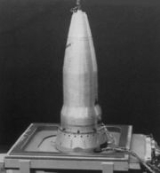
Reliable Replacement Warhead

Encyclopedia
The Reliable Replacement Warhead (RRW) was a proposed new American nuclear warhead design and bomb family that was intended to be simple, reliable and to provide a long-lasting, low maintenance future nuclear force for the United States. Initiated by Congress in 2004, it became a centerpiece of the plans of the National Nuclear Security Administration
(NNSA) to remake the nuclear weapons complex.
In 2008, the U.S. Congress denied funding for the program, and in 2009 the Obama administration called for work on the program to cease.
, the United States
, in an effort to achieve and maintain an advantage in the nuclear arms race
, invested large amounts of money and technical resources into nuclear weapons design, testing, and maintenance. Many of the weapons designed required high upkeep costs, justified primarily by their Cold War context and the specific and technically sophisticated applications they were created for. With the end of the Cold War, however, nuclear testing
has ceased in the United States, and new warhead development has been significantly reduced. As a result, the need for high technical performance of warheads has decreased considerably, and the need for a longer lasting and reliable stockpile has taken a high priority.
Prior nuclear weapons produced by the U.S. had historically become extremely compact, low weight, highly integrated, and low-margin designs which used exotic materials. In many cases the components were either toxic and/or unstable. A number of older US designs used high explosive types which degraded over time, some of which became dangerously unstable in short lifetimes (PBX 9404 and LX-09).
Some of these explosives have cracked in warheads in storage, resulting in dangerous storage and disassembly conditions.
Most experts believe that the insensitive explosives (PBX 9502, LX-17) currently in use are highly stable and may even become more stable over time.
The use of beryllium
and highly toxic beryllium oxide
material as neutron reflector layers was a major health hazard to bomb manufacturer and maintenance staff. The long term stability of plutonium
metal, which may lose strength, crack, or otherwise degrade over time is also a concern. (See Nuclear weapons design and Teller-Ulam design
for technical context.)
The question of whether the plutonium-gallium alloy
used in the cores of the weapons suffered from aging has been a major topic of research at the weapons laboratories in recent decades. Though many at the labs still insist on scientific uncertainty on the question, a study commissioned by the National Nuclear Security Administration
to the independent JASON
group concluded in November 2006 that "most plutonium pits have a credible lifetime of at least 100 years." The oldest pits currently in the US arsenal are still less than 50 years old.
NNSA officials believe the program is needed to maintain nuclear weapons expertise in order to rapidly adapt, repair, or modify existing weapons or develop new weapons as requirements evolve. They see the ability to adapt to changing military needs rather than maintain additional forces for unexpected contingencies as a key program driver. However, Congress has rejected the notion that the RRW is needed to meet new military requirements. In providing funds for 2006, the Appropriations Committee specified, "any weapons design under the RRW program must stay within the military requirements of the existing deployed stockpile and any new weapon design must stay within the design parameters validated by past nuclear tests."
According to a Task Force of the Secretary of Energy's Advisory Board (SEAB), the RRW program and weapon designs should have the following characteristics:
However, the full SEAB disavowed the Task Force's recommendations regarding the RRW, because the Task Force did not consider the program's potentially adverse impacts on U.S. nonproliferation objectives, which were beyond its expertise.
The RRW program has not to date publicly announced that it has developed any new nuclear weapon designs which are intended to be placed into production. Presumably, once that occurs, the weapons will receive numbers in the US warhead designation sequence, which currently runs from the Mark 1 nuclear bomb (aka Little Boy
) to the W91
nuclear warhead, which was cancelled in the 1990s. RRW designs would presumably receive designations after that number, though new RNEP nuclear bunker buster
weapons could conceivably be type-standardized and numbered prior to any RRW reaching that point, if the RNEP program does proceed.
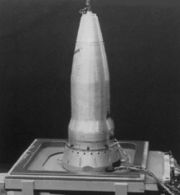 On March 2, 2007, the NNSA announced that the Lawrence Livermore National Laboratory
RRW design had been selected for the initial RRW production version.
One of the selection reasons given was that the LLNL proposed design was more closely tied to historical underground tested warhead designs. It was described by Thomas P. D'Agostino, acting head of the National Nuclear Security Administration
, as having been based on a design which was test fired in the 1980s, but never entered service.
LLNL staff have previously hinted in the press that LLNL was considering a design entry based on the tested but never deployed W89
design.
This warhead had been proposed as a W88
warhead replacement as early as 1991. The W89 design was already equipped with all then-current safety features, including insensitive high explosives, fire-resistant pits, and advanced detonator safety systems. The W89 was also reportedly designed using recycled pits from the earlier W68
nuclear weapon program, recoated in vanadium
to provide the temperature resistance. The W89 warhead was test fired in the 1980s. It had entered Phase 2A technical definition and cost study in November, 1986, and Phase 3 development engineering and was assigned the numerical designation W89 in January 1988.
The W89 warhead design was a 13.3 inches (337.8 mm) by 40.8 inches (1,036.3 mm) weapon, with a weight of 324 pounds and yield of 200 kilotons. As noted above, major safety features inherent in the tested W89 design include:
Modifications for the RRW design would probably have included replacing beryllium
neutron reflector layers with another material, and increased performance margins throughout the design, possibly including more fissile material in the pit and a thicker radiation case or hohlraum
(see Teller-Ulam design#Basic design).
, announced that two competing designs for the Reliable Replacement Warhead were being finalized by Lawrence Livermore National Laboratory
and Los Alamos National Laboratory
, and that a selection of one of those designs would be made by November 2006, to allow the RRW development program to be included in the Fiscal 2008 US government budget.
The article confirmed prior descriptions of the RRW, describing the weapons in the following terms:
Based on prior weapons programs, the RRW should be assigned a numerical weapon designation when the design selection is made.
On December 1, 2006, the NNSA announced that it had decided to move forwards with the RRW program after analyzing the initial LLNL and LANL RRW proposals. At that time, NNSA's Nuclear Weapons Council had not selected which of the two designs to proceed forwards with.
And (pp 94)
Funding is listed as $25 million for FY 2006, $28 million for FY 2007, and $89 million for FY 2008.
As defined in an earlier UC report, nuclear weapons engineering phases are:
The FY08 RRW budget therefore indicates that one of the RRW designs has been approved and is entering the design definition and cost study phase. The document does not state which of the RRW designs has been selected.
Historically, the weapon's nuclear series identification is assigned at the entrance to phase 3, and if the design proceeds forwards to complete phase 2 and enter phase 3 this can be expected in 1–2 years.
The design is intended for first production unit (FPU) delivery by the end of 2012.
On March 2, 2007, the NNSA announced that the Lawrence Livermore National Laboratory
RRW design had been selected for the initial RRW production version.
, H.R. 4986, Section 3111, forbids the expenditure of funds for the RRW program beyond Phase 2A; in effect, this prevents the RRW program from going forward without explicit Congressional authorization. Section 3121 Subsection 1 requires the study of the reuse of previously manufactured plutonium cores in any RRW warheads, so as to avoid the manufacture of additional plutonium cores. Section 3124 reaffirms the commitment of the U.S. to the Treaty on the Non-Proliferation of Nuclear Weapons and encourages the mutual reduction in armament of the U.S. and Russia through negotiation.
and Ambassador James Goodby, "It takes an extraordinary flight of imagination to postulate a modern new arsenal composed of such untested designs that would be more reliable, safe and effective than the current U.S. arsenal based on more than 1,000 tests since 1945."
The RRW program is contrary to the "general and complete disarmament" of atomic weapons required by the Nuclear Non-Proliferation Treaty
, which the USA has signed. The US government has always maintained, however, that no nuclear power signed the NPT with the intention of not producing new warheads if needed for national security, and has also at times implied that more reliable warheads would allow the government to reduce its total stockpile.
Critics maintain that this innocuous-sounding program could significantly damage US national security. Critics believe an expansive RRW program would anger US allies as well as hostile nations. They worry it would disrupt the global cooperation in nonproliferation that is vital to diplomacy with emerging nuclear powers such as Iran
and North Korea
and to controlling clandestine trafficking in nuclear materials and equipment.
Additionally, critics question whether or not the RRW program would force the United States to once again resume nuclear testing
, as the US is unlikely to consider the new warheads "reliable" enough unless they have been tested at least once.
National Nuclear Security Administration
The United States National Nuclear Security Administration is part of the United States Department of Energy. It works to improve national security through the military application of nuclear energy...
(NNSA) to remake the nuclear weapons complex.
In 2008, the U.S. Congress denied funding for the program, and in 2009 the Obama administration called for work on the program to cease.
Background
During the Cold WarCold War
The Cold War was the continuing state from roughly 1946 to 1991 of political conflict, military tension, proxy wars, and economic competition between the Communist World—primarily the Soviet Union and its satellite states and allies—and the powers of the Western world, primarily the United States...
, the United States
United States
The United States of America is a federal constitutional republic comprising fifty states and a federal district...
, in an effort to achieve and maintain an advantage in the nuclear arms race
Nuclear arms race
The nuclear arms race was a competition for supremacy in nuclear warfare between the United States, the Soviet Union, and their respective allies during the Cold War...
, invested large amounts of money and technical resources into nuclear weapons design, testing, and maintenance. Many of the weapons designed required high upkeep costs, justified primarily by their Cold War context and the specific and technically sophisticated applications they were created for. With the end of the Cold War, however, nuclear testing
Nuclear testing
Nuclear weapons tests are experiments carried out to determine the effectiveness, yield and explosive capability of nuclear weapons. Throughout the twentieth century, most nations that have developed nuclear weapons have tested them...
has ceased in the United States, and new warhead development has been significantly reduced. As a result, the need for high technical performance of warheads has decreased considerably, and the need for a longer lasting and reliable stockpile has taken a high priority.
Prior nuclear weapons produced by the U.S. had historically become extremely compact, low weight, highly integrated, and low-margin designs which used exotic materials. In many cases the components were either toxic and/or unstable. A number of older US designs used high explosive types which degraded over time, some of which became dangerously unstable in short lifetimes (PBX 9404 and LX-09).
Some of these explosives have cracked in warheads in storage, resulting in dangerous storage and disassembly conditions.
Most experts believe that the insensitive explosives (PBX 9502, LX-17) currently in use are highly stable and may even become more stable over time.
The use of beryllium
Beryllium
Beryllium is the chemical element with the symbol Be and atomic number 4. It is a divalent element which occurs naturally only in combination with other elements in minerals. Notable gemstones which contain beryllium include beryl and chrysoberyl...
and highly toxic beryllium oxide
Beryllium oxide
Beryllium oxide , also known as beryllia, is an inorganic compound with the formula BeO. This colourless solid is a notable electrical insulator with a higher thermal conductivity than any other non-metal except diamond, and actually exceeds that of some metals. As an amorphous solid, beryllium...
material as neutron reflector layers was a major health hazard to bomb manufacturer and maintenance staff. The long term stability of plutonium
Plutonium
Plutonium is a transuranic radioactive chemical element with the chemical symbol Pu and atomic number 94. It is an actinide metal of silvery-gray appearance that tarnishes when exposed to air, forming a dull coating when oxidized. The element normally exhibits six allotropes and four oxidation...
metal, which may lose strength, crack, or otherwise degrade over time is also a concern. (See Nuclear weapons design and Teller-Ulam design
Teller-Ulam design
The Teller–Ulam design is the nuclear weapon design concept used in most of the world's nuclear weapons. It is colloquially referred to as "the secret of the hydrogen bomb" because it employs hydrogen fusion, though in most applications the bulk of its destructive energy comes from uranium fission,...
for technical context.)
The question of whether the plutonium-gallium alloy
Plutonium-gallium alloy
Plutonium-gallium alloy is an alloy of plutonium and gallium, used in nuclear weapon pits – the component of a nuclear weapon where the fission chain reaction is started....
used in the cores of the weapons suffered from aging has been a major topic of research at the weapons laboratories in recent decades. Though many at the labs still insist on scientific uncertainty on the question, a study commissioned by the National Nuclear Security Administration
National Nuclear Security Administration
The United States National Nuclear Security Administration is part of the United States Department of Energy. It works to improve national security through the military application of nuclear energy...
to the independent JASON
Jason
Jason was a late ancient Greek mythological hero from the late 10th Century BC, famous as the leader of the Argonauts and their quest for the Golden Fleece. He was the son of Aeson, the rightful king of Iolcus...
group concluded in November 2006 that "most plutonium pits have a credible lifetime of at least 100 years." The oldest pits currently in the US arsenal are still less than 50 years old.
Concept
The concept underlying the RRW program is that the US weapons laboratories can design new nuclear weapons that are highly reliable and easy and safe to manufacture, monitor, and test. If that proves to be possible, designers could adapt a common set of core design components to various use requirements, such as different sized missile warheads, different nuclear bomb types, etc.NNSA officials believe the program is needed to maintain nuclear weapons expertise in order to rapidly adapt, repair, or modify existing weapons or develop new weapons as requirements evolve. They see the ability to adapt to changing military needs rather than maintain additional forces for unexpected contingencies as a key program driver. However, Congress has rejected the notion that the RRW is needed to meet new military requirements. In providing funds for 2006, the Appropriations Committee specified, "any weapons design under the RRW program must stay within the military requirements of the existing deployed stockpile and any new weapon design must stay within the design parameters validated by past nuclear tests."
According to a Task Force of the Secretary of Energy's Advisory Board (SEAB), the RRW program and weapon designs should have the following characteristics:
- Support an adaptable 1,700-2,200 weapon sustained force level (3.1)
- Resolve an issue with the weapons stockpile within 12 months
- Adapt a weapon to a new requirement in 18 months
- Design a new weapon within 36 months
- Be ready for full production within 48 months
- Be capable of conducting an underground nuclear test within 18 months
- Produce all new weapons using Insensitive High Explosive (see TATBTATBTATB, or triaminotrinitrobenzene, is an aromatic explosive, based on the basic six-carbon benzene ring structure with three nitro functional groups and three amine groups attached, alternating around the ring....
and Plastic bonded explosive) and replace all existing weapons which use other explosives (3.1.2) - Produce new weapons with the full spectrum of security and use control safety features available today, some of which are intrinsic to the basic design of a weapon and cannot possibly be retrofitted into the design of an existing weapon (3.1.3)
- Designs which trade off higher weight and larger volume to maximise: (3.1.4)
- Certification without nuclear testing
- Inexpensive manufacture and disassembly
- Ease of maintenance, surveillance, and disposition
- Modularity (primaries, secondaries, non-nuclear) across systems
- Maximizing component reuse and minimizing life-cycle costs
- Comparable or improved levels of reliability to existing designs, using larger margins and simpler components (3.1.5)
- Lower cost (3.1.6)
- Designs which can be designed and certified without necessarily undergoing nuclear testing (3.1.7)
- Consolidation of many nuclear weapon production and maintenance functions to one site (4.1)
- (in passing) Designs avoiding the use of beryllium or beryllium Oxide in the weapon fission reflector (4.6)
However, the full SEAB disavowed the Task Force's recommendations regarding the RRW, because the Task Force did not consider the program's potentially adverse impacts on U.S. nonproliferation objectives, which were beyond its expertise.
The RRW program has not to date publicly announced that it has developed any new nuclear weapon designs which are intended to be placed into production. Presumably, once that occurs, the weapons will receive numbers in the US warhead designation sequence, which currently runs from the Mark 1 nuclear bomb (aka Little Boy
Little Boy
"Little Boy" was the codename of the atomic bomb dropped on Hiroshima on August 6, 1945 by the Boeing B-29 Superfortress Enola Gay, piloted by Colonel Paul Tibbets of the 393rd Bombardment Squadron, Heavy, of the United States Army Air Forces. It was the first atomic bomb to be used as a weapon...
) to the W91
W91
The W91 was an American thermonuclear warhead intended for use on the SRAM-T variant of the AGM-131 SRAM II air to ground missile.What was to become the W91 design entered into a Phase 2 design competition between the various nuclear weapons laboratories in November 1988...
nuclear warhead, which was cancelled in the 1990s. RRW designs would presumably receive designations after that number, though new RNEP nuclear bunker buster
Nuclear bunker buster
Bunker-busting nuclear weapons, also known as earth-penetrating weapons , are a type of nuclear weapon designed to penetrate into soil, rock, or concrete to deliver a nuclear warhead to a target. These weapons would be used to destroy hardened, underground military bunkers buried deep in the ground...
weapons could conceivably be type-standardized and numbered prior to any RRW reaching that point, if the RNEP program does proceed.
Selected design
Lawrence Livermore National Laboratory
The Lawrence Livermore National Laboratory , just outside Livermore, California, is a Federally Funded Research and Development Center founded by the University of California in 1952...
RRW design had been selected for the initial RRW production version.
One of the selection reasons given was that the LLNL proposed design was more closely tied to historical underground tested warhead designs. It was described by Thomas P. D'Agostino, acting head of the National Nuclear Security Administration
National Nuclear Security Administration
The United States National Nuclear Security Administration is part of the United States Department of Energy. It works to improve national security through the military application of nuclear energy...
, as having been based on a design which was test fired in the 1980s, but never entered service.
LLNL staff have previously hinted in the press that LLNL was considering a design entry based on the tested but never deployed W89
W89
The W89 was an American thermonuclear warhead design intended for use on the AGM-131 SRAM II air to ground nuclear missile.What was to become the W89 design was awarded to the Lawrence Livermore National Laboratory in the mid-1980s. It entered Phase 2A technical definition and cost study in...
design.
This warhead had been proposed as a W88
W88
The W88 is a United States thermonuclear warhead, with an estimated yield of 475 kiloton , and is small enough to fit on MIRVed missiles. The W88 was designed at the Los Alamos National Laboratory in the 1970s. In 1999 the director of Los Alamos who had presided over its design described it as...
warhead replacement as early as 1991. The W89 design was already equipped with all then-current safety features, including insensitive high explosives, fire-resistant pits, and advanced detonator safety systems. The W89 was also reportedly designed using recycled pits from the earlier W68
W68
The W68 warhead was the warhead used on the UGM-73 Poseidon SLBM missile. It was developed in the late 1960s at Lawrence Livermore National Laboratory.-Specifications:The W68 weighs...
nuclear weapon program, recoated in vanadium
Vanadium
Vanadium is a chemical element with the symbol V and atomic number 23. It is a hard, silvery gray, ductile and malleable transition metal. The formation of an oxide layer stabilizes the metal against oxidation. The element is found only in chemically combined form in nature...
to provide the temperature resistance. The W89 warhead was test fired in the 1980s. It had entered Phase 2A technical definition and cost study in November, 1986, and Phase 3 development engineering and was assigned the numerical designation W89 in January 1988.
The W89 warhead design was a 13.3 inches (337.8 mm) by 40.8 inches (1,036.3 mm) weapon, with a weight of 324 pounds and yield of 200 kilotons. As noted above, major safety features inherent in the tested W89 design include:
- Insensitive and fire-resistant LX-17 Polymer-bonded explosivePolymer-bonded explosiveA polymer-bonded explosive, also called PBX or plastic-bonded explosive, is an explosive material in which explosive powder is bound together in a matrix using small quantities of a synthetic polymer...
, a type of high explosive using TATBTATBTATB, or triaminotrinitrobenzene, is an aromatic explosive, based on the basic six-carbon benzene ring structure with three nitro functional groups and three amine groups attached, alternating around the ring....
as its main explosive ingredient (see Insensitive munitionsInsensitive munitionsInsensitive munitions are munitions that are chemically stable enough to withstand mechanical shocks, fire, and impact by shrapnel, but that can still explode as intended to destroy their targets.-Description:...
) - Fire-resistant pit
- Type D Permissive Action LinkPermissive Action LinkA Permissive Action Link is a security device for nuclear weapons. Its purpose is to prevent unauthorized arming or detonation of the nuclear weapon.The United States Department of Defense definition is:...
- Strong link weak linkStrong link weak linkA Strong link/weak link and Exclusion zone nuclear detonation mechanism is a type of safety mechanism employed in the arming and firing mechanisms of modern nuclear weapons. It is a form of automatic safety interlock...
detonation chain safety mechanisms - Two-point explosive lens assembly
Modifications for the RRW design would probably have included replacing beryllium
Beryllium
Beryllium is the chemical element with the symbol Be and atomic number 4. It is a divalent element which occurs naturally only in combination with other elements in minerals. Notable gemstones which contain beryllium include beryl and chrysoberyl...
neutron reflector layers with another material, and increased performance margins throughout the design, possibly including more fissile material in the pit and a thicker radiation case or hohlraum
Hohlraum
In radiation thermodynamics, a hohlraum is a cavity whose walls are in radiative equilibrium with the radiant energy within the cavity. This idealized cavity can be approximated in practice by making a small perforation in the wall of a hollow container of any opaque material...
(see Teller-Ulam design#Basic design).
2006
In an April 15, 2006 article by Walter Pincus in the Washington Post, Linton F. Brooks, administrator of the US National Nuclear Safety Administration, the US nuclear weapon design agency within the United States Department of EnergyUnited States Department of Energy
The United States Department of Energy is a Cabinet-level department of the United States government concerned with the United States' policies regarding energy and safety in handling nuclear material...
, announced that two competing designs for the Reliable Replacement Warhead were being finalized by Lawrence Livermore National Laboratory
Lawrence Livermore National Laboratory
The Lawrence Livermore National Laboratory , just outside Livermore, California, is a Federally Funded Research and Development Center founded by the University of California in 1952...
and Los Alamos National Laboratory
Los Alamos National Laboratory
Los Alamos National Laboratory is a United States Department of Energy national laboratory, managed and operated by Los Alamos National Security , located in Los Alamos, New Mexico...
, and that a selection of one of those designs would be made by November 2006, to allow the RRW development program to be included in the Fiscal 2008 US government budget.
The article confirmed prior descriptions of the RRW, describing the weapons in the following terms:
- The next-generation warheads will be larger and more stable than the existing ones but slightly less powerful, according to government officials. They might contain "use controls" that would enable the military to disable the weapons by remote control if they are stolen by terrorists.
Based on prior weapons programs, the RRW should be assigned a numerical weapon designation when the design selection is made.
On December 1, 2006, the NNSA announced that it had decided to move forwards with the RRW program after analyzing the initial LLNL and LANL RRW proposals. At that time, NNSA's Nuclear Weapons Council had not selected which of the two designs to proceed forwards with.
2007
According to the FY 2008 NNSA budget (pp 88), the RRW program is described as:-
- The NWC approved the RRW Feasibility Study that began in May 2005 and completed in November 2006. The goal of the RRW study was to identify designs that will sustain long term confidence in a safe, secure and reliable stockpile and enable transformation to a responsive nuclear weapon infrastructure. The joint DOE/DoD RRW POG was tasked to oversee a laboratory design competition for a RRW warhead with FPU goal of FY 2012. The POG assessed the technical feasibility including certification without nuclear testing, design definition, manufacturing, and an initial cost assessment to determine whether the proposed candidates met the RRW study objectives and requirements. The POG presented the RRW study results to the NWC in November 2006 and the NWC decided that the RRW for submarine launched ballistic missiles is feasible and should proceed to complete a Phase 2A design definition and cost study. In addition, the NWC determined that the RRW is to be adopted as the strategy for maintaining a long term safe, secure and reliable nuclear deterrent and as such also directed the initiation of a conceptual study for an additional RRW design. The next steps include detailed design and preliminary cost estimates of the RRW to confirm that the RRW design provides surety enhancements, can be certified without nuclear testing, is cost-effective, and will support both stockpile and infrastructure transformation. Once this acquisition planning is completed and if the NWC decides to proceed to engineering and production development, outyear funding (FY 2009 - FY 2012) to support an executable program will be submitted.
And (pp 94)
-
- Reliable Replacement Warhead
- The increase funds the startup of activities in support of a NWC decision to have RRW proceed to engineering and production development. Activities include design, engineering and certification work such as finalization of requirements, material studies, technology demonstrations, detailed design and concurrent engineering with the production plants, and modeling, simulation and analysis in support of certification without additional nuclear testing.
Funding is listed as $25 million for FY 2006, $28 million for FY 2007, and $89 million for FY 2008.
As defined in an earlier UC report, nuclear weapons engineering phases are:
-
-
- phase 2 = competitive feasibility study; phase 2A = design definition and cost study by the lab to which DOE awarded the project; phase 3 = development engineering (at beginning of this phase warhead is assigned a #); phase 4 = production engineering; phase 5 = first production; phase 6 = quantity production and stockpiling. Note: Projects entering phase 1 (concept study) and phase 7 (=retirement) have not been included.
-
The FY08 RRW budget therefore indicates that one of the RRW designs has been approved and is entering the design definition and cost study phase. The document does not state which of the RRW designs has been selected.
Historically, the weapon's nuclear series identification is assigned at the entrance to phase 3, and if the design proceeds forwards to complete phase 2 and enter phase 3 this can be expected in 1–2 years.
The design is intended for first production unit (FPU) delivery by the end of 2012.
On March 2, 2007, the NNSA announced that the Lawrence Livermore National Laboratory
Lawrence Livermore National Laboratory
The Lawrence Livermore National Laboratory , just outside Livermore, California, is a Federally Funded Research and Development Center founded by the University of California in 1952...
RRW design had been selected for the initial RRW production version.
2008
The National Defense Authorization Act for Fiscal Year 2008National Defense Authorization Act for Fiscal Year 2008
The National Defense Authorization Act for Fiscal Year 2008 is a United States law to authorize funding for the defense of the United States and its interests abroad, for military construction, and for national security-related energy programs. In the signing statement, President George W...
, H.R. 4986, Section 3111, forbids the expenditure of funds for the RRW program beyond Phase 2A; in effect, this prevents the RRW program from going forward without explicit Congressional authorization. Section 3121 Subsection 1 requires the study of the reuse of previously manufactured plutonium cores in any RRW warheads, so as to avoid the manufacture of additional plutonium cores. Section 3124 reaffirms the commitment of the U.S. to the Treaty on the Non-Proliferation of Nuclear Weapons and encourages the mutual reduction in armament of the U.S. and Russia through negotiation.
2009
President Obama's 2009 Department of Energy budget calls for development work on the Reliable Replacement Warhead project to cease.Criticisms of the program
Opponents of the RRW program believe it has nothing to do with making US weapons safer or more reliable, but is merely an excuse for designing new weapons and maintaining jobs at the weapons laboratories. They note that the Secretaries of Defense and Energy have certified that the existing nuclear weapons stockpile is safe and reliable in each of the last nine years. The existing stockpile was extensively tested before the US entered the moratorium on nuclear weapons tests. According to Sidney DrellSidney Drell
Sidney David Drell is an American theoretical physicist and arms control expert. He is a professor emeritus at the Stanford Linear Accelerator Center and a senior fellow at Stanford University's Hoover Institution. Drell is a noted contributor in the field of quantum electrodynamics and particle...
and Ambassador James Goodby, "It takes an extraordinary flight of imagination to postulate a modern new arsenal composed of such untested designs that would be more reliable, safe and effective than the current U.S. arsenal based on more than 1,000 tests since 1945."
The RRW program is contrary to the "general and complete disarmament" of atomic weapons required by the Nuclear Non-Proliferation Treaty
Nuclear Non-Proliferation Treaty
The Treaty on the Non-Proliferation of Nuclear Weapons, commonly known as the Non-Proliferation Treaty or NPT, is a landmark international treaty whose objective is to prevent the spread of nuclear weapons and weapons technology, to promote cooperation in the peaceful uses of nuclear energy and to...
, which the USA has signed. The US government has always maintained, however, that no nuclear power signed the NPT with the intention of not producing new warheads if needed for national security, and has also at times implied that more reliable warheads would allow the government to reduce its total stockpile.
Critics maintain that this innocuous-sounding program could significantly damage US national security. Critics believe an expansive RRW program would anger US allies as well as hostile nations. They worry it would disrupt the global cooperation in nonproliferation that is vital to diplomacy with emerging nuclear powers such as Iran
Iran
Iran , officially the Islamic Republic of Iran , is a country in Southern and Western Asia. The name "Iran" has been in use natively since the Sassanian era and came into use internationally in 1935, before which the country was known to the Western world as Persia...
and North Korea
North Korea
The Democratic People’s Republic of Korea , , is a country in East Asia, occupying the northern half of the Korean Peninsula. Its capital and largest city is Pyongyang. The Korean Demilitarized Zone serves as the buffer zone between North Korea and South Korea...
and to controlling clandestine trafficking in nuclear materials and equipment.
Additionally, critics question whether or not the RRW program would force the United States to once again resume nuclear testing
Nuclear testing
Nuclear weapons tests are experiments carried out to determine the effectiveness, yield and explosive capability of nuclear weapons. Throughout the twentieth century, most nations that have developed nuclear weapons have tested them...
, as the US is unlikely to consider the new warheads "reliable" enough unless they have been tested at least once.
External links
- Pit Lifetime
- United States Nuclear Weapons Program: The Role of the Reliable Replacement Warhead
- Reliable Replacement Warhead page at globalsecurity.org
- DOE argument for the RRW
- "Concerns about the Reliable Replacement Warheads Program"
- "Nuclear Weapons: The Reliable Replacement Warhead" Congressional Research Service, updated March 9, 2006
- "Nuclear Weapons: The Reliable Replacement Warhead" Congressional Research Service, updated February 8, 2007, via Federation of American Scientists
- "Nuclear weapons: The next nuke" By Geoff Brumfiel, Nature, July 6, 2006 (subscription required)