

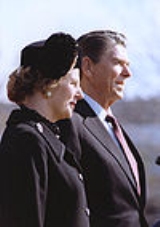
Neoliberalism

Encyclopedia
Neoliberalism is a market-driven approach to economic and social policy based on neoclassical theories of economics
that emphasizes the efficiency of private enterprise, liberalized trade
and relatively open markets, and therefore seeks to maximize the role of the private sector
in determining the political and economic priorities of the country. The label "neoliberalism" was created by its ideological opponents, but has also been used by proponents of neoliberal policies.
's "Washington Consensus
", a list of policy proposals that appeared to have gained consensus approval among the Washington-based international economic organizations (like the International Monetary Fund
(IMF) and World Bank
). Williamson's list included ten points:
refers to the economic system that dominated the non-communist global economy from the end of World War II
to the 1970s. David Harvey
argues that at the end of World War II, the primary objective was to develop an economic plan that would not lead to a repeat of the Great Depression
during the 1930s. Harvey notes that under this new system free trade was regulated "under a system of fixed exchange rates anchored by the US dollar's convertibility into gold at a fixed price. Fixed exchange rates were incompatible with free flows of capital." Harvey argues that embedded liberalism led to the surge of economic prosperity that came to define the 1950s and 1960s.
Across much of the world, the work of John Maynard Keynes
, which sought to formulate the means by which governments could stabilize and fine-tune free markets, became a highly influential approach. Within the developing world, several developments – among them decolonization
, a desire for national independence and the destruction of the pre-war global economy, and the view that countries could not effectively industrialize under free market systems (e.g., the Singer–Prebisch thesis) – encouraged economic policies that were influenced by communist, socialist and import substitution
precepts.
The period of government interventionism in the 1950s and 1960s was characterized by exceptional economic prosperity, as economic growth
was generally high, was contained, and economic distribution
was comparatively equalized. This era is known as les Trente Glorieuses
("The Glorious Thirty [years]") or "Golden Age", a reference to many countries having experienced particularly high levels of prosperity between (roughly) World War II
and 1973.
notes that the system of embedded liberalism
began to break down towards the end of the 1960s. The 1970s were defined by an increased accumulation of capital, unemployment, inflation (or stagflation
as it was dubbed), and a variety of fiscal crises. He notes that "the embedded liberalism that had delivered high rates of growth to at least the advanced capitalist countries after 1945 was clearly exhausted and no longer working." A number of theories concerning new systems began to develop, which led to extensive debate between those who advocated "social democracy and central planning on the one hand" and those "concerned with liberating corporate and business power and re-establishing market freedoms" on the other. Harvey notes that, by 1980, the latter group had emerged as the leader, advocating and creating a global economic system that would become known as neoliberalism.
Some argue that the strains which occurred were located in the international financial system, and culminated in the dissolution of the Bretton Woods system
, which some argue had set the stage for the Stagflation crisis
that would, to some extent, discredit Keynesianism in the English-speaking world. In addition, some argue that the postwar economic system was premised on a society that excluded women and minorities from economic opportunities, and the political and economic integration given to these groups strained the postwar system.
under the direction of Ante Markovic
(until the country's collapse in the early 1990s), and the People's Republic of China
under the direction of Deng Xiaoping
.
Changes occurred from the 1970s to the 1980s. Started off with most of the democratic world governments focused primarily on the primacy of economic individual rights, rules of law and roles of the governments in moderating relative free trade. It was almost considered national self determination at the time.
Stances of organized labour shifted when governments of Ronald Reagan and Margaret Thatcher took strong stances to break down trade barriers entirely to reduce government power; thus allowing the market to be more important. Therefore industries will increasingly shift globally with integrated knowledge boosting the economy.
school of thought within the academic community of economists, with a strong focus around the faculty of University of Chicago
.
The school emphasizes non-intervention from government and rejects regulation in laissez-faire
free markets as inefficient. It is associated with neoclassical price theory
and libertarianism
and the rejection of Keynesianism in favor of monetarism
until the 1980s, when it turned to rational expectations
. The school has impacted the field of finance
by the development of the efficient market hypothesis
. In terms of methodology the stress is on "positive economics"– that is, empirically based studies using statistics to prove theory.
Approximately 70% of the professors in the economics department have been considered part of the school of thought. The University of Chicago department, widely considered one of the world’s foremost economics departments, has fielded more Nobel Prize
winners and John Bates Clark medalists
in economics than any other university.
Those who attend to the Chicago School prefer some form of competition law
, school vouchers, a central bank
, intellectual property
and prefer Milton Friedman
's negative income tax
as a replacement to the existing system.
and the Liberal Party
since 1983. The governments of Bob Hawke
and Paul Keating
from 1983 to 1996 pursued economic liberalisation and a program of micro-economic reform. These governments privatized government corporations , deregulated factor markets, floated the Australian dollar, and reduced trade protection.
Keating, as federal treasurer, implemented a compulsory superannuation guarantee
system in 1992 to increase national savings and reduce future government liability for old age pensions. The financing of universities was deregulated, requiring students to contribute to university fees
through a repayable loan system known as the Higher Education Contribution Scheme (HECS) and encouraging universities to increase income by admitting full-fee-paying students, including foreign students. The admitting of domestic full-fee-paying students to public universities was stopped in 2009 by the Rudd Labor Government.
When the Liberal Party returned to power in March 1996 under prime minister John Howard
, the programme of economic liberalisation was continued with the privatisation of more government corporations, notably the sale of the telecommunications provider Telstra
, and the Reserve Bank of Australia was made independent of the government in determining monetary policy. A 10% Goods and Services Tax GST
(similar to European VAT
) was introduced with the aim of combining and simplifying the previous duties and taxes to make the system more efficient. A series of reforms were enacted to deregulate the labour market.
, the issues identified with neoliberalism (reducing taxes and welfare spending, minimizing of government and reform of public healthcare and education, among others) are often associated with Brian Mulroney
, Jean Chrétien
, Mike Harris
, Ralph Klein, Gordon Campbell and Stephen Harper
.
Ralph Klein, who supports and has supported extraction of Alberta
's vast oil and natural gas reserves, is credited by the Pembina Institute
as generating a relatively small amount of provincial revenue compared to the increase in oil sand production. Between 1995 and 2004, production grew by 133%, but government revenue shrank by 30%, leaving large fortunes in the hands of corporations.
Under Mike Harris
in Ontario during the 1990s, industry and social responsibilities were transferred to the cities. Toronto
during this time was forced to amalgamate and enter a period of development. The Amalgamation of Toronto
was intended as a cost saving measure and, in 2000, Michael R. Garrett noted a yearly savings of $136.2 million (CDN) However, in 2007, Barry Hertz reported in the conservative national newspaper National Post that cost savings never materialized. He also noted that government staff had grown, with the city employing 4,015 more people in 2007 than it did in 1998.
Canadian politics were also affected. Trade tariffs were ended, allowing less restrictions on trade. Government sizes were decreased limiting their power towards industries. The federal government rules during that time and municipalities had no power.
used the term "Miracle of Chile
" in reference to Augusto Pinochet
's support for liberal economic
changes in Chile
carried out by the "Chicago Boys
". Their implemented economic model had three main objectives: economic liberalization, privatization of state owned companies, and stabilization of inflation. These market-oriented economic policies were continued and strengthened by successive governments after Pinochet stepped down. At the time, Milton Friedman stated that the Chilean experiment was "comparable to the economic miracle of post-war Germany."
Some of Pinochet's neoliberal policies were continued after the termination of his 17-year-long dictatorship, though with more social policies to counter the great social-economic inequality. According to the Heritage Foundation
and the Wall Street Journal, in 2007 Chile was the world's 11th "most free" economy, and 3rd in the Americas.
According to the United Nations Development Report of 2009 Chile has high competitiveness
, quality of life
, political stability, globalization
, economic freedom
, low perception of corruption
and comparatively low poverty
rates.
According to the International Monetary Fund
Chile "ranks high regionally" in freedom of the press
, human development
and democratic development. Also according to the IMF Chile has the region's highest GDP to popular ratio (at market price
s and purchasing power parity
) and also has a high degree of income inequality, as measured by the Gini index.
The experience of Chile in the 1970s and 1980s, and especially the export of the Chilean pension model by former Labor Minister José Piñera
, has influenced the policies of the Communist Party of China
and has been invoked as a model by economic reformers in other countries, such as Boris Yeltsin
in Russia and almost all Eastern Europe
an post-Communist societies.
Mining of copper
in Chile is publicly owned (see Chilean nationalization of copper
). Chile is the world's top producer of copper, which is by far the largest Chilean export good (accounting for over 40% of export revenue).
 Milton Friedman
described Hong Kong
as a laissez-faire
state and he credits that policy for the rapid move from poverty to prosperity in 50 years. Hong Kong's GDP grew under British colonial control between 1897 and 1997, while possessing central banking, school regulations, environmental regulations and government ownership of housingall examples of economic intervention. These regulations were however light in comparison to many other countries, and in terms of economic regulation Friedman's analysis of Hong Kong as a 'laissez-faire' state seems justified: Hong Kong has no capital gains tax, no interest tax, no sales tax and only a 15% flat income tax. It also has no tariffs or other legal restrictions on international free trade, no minimum wage laws (until 2010), and no price or wage controls. Further it extends no unemployment benefits, enacts no labour legislation, provides no social security and no national health insurance.
A 1994 World Bank
report stated that Hong Kong's GDP per capita grew in real terms at an annual rate of 6.5% from 1965 to 1989, a consistent growth percentage over a span of almost 25 years By 1990 Hong Kong's per capita income
officially surpassed that of the ruling United Kingdom. In 1960 the average per capita income in Hong Kong was 28% of that in Great Britain; by 1996, it had risen to 137% of that in Britain.
Since 1995 Hong Kong has been ranked as having the world's most liberal capital markets by the Heritage Foundation
and Wall Street Journal. The Fraser Institute
concurred in 2007.
_during_arrival_ceremony_on_south_lawn_of_white_house.jpg) The largest privatization
The largest privatization
in history was that of Japan Post
. It was the nation's largest employer and one third of all Japanese government employees worked for Japan Post.
In September 2003, Koizumi's cabinet proposed splitting Japan Post into four separate companies: a bank, an insurance company, a postal service company, and a fourth company to handle the post offices as retail storefronts of the other three. After privatization was rejected by upper house, Koizumi scheduled nationwide elections
to be held on September 11, 2005. He declared the election to be a referendum on postal privatization. Koizumi subsequently won this election, gaining the necessary supermajority
and a mandate for reform, and in October 2005, the bill was passed to privatize Japan Post in 2007.
The reforms brought about by NAFTA resulted in a huge opening of the Mexican economy and “ increased the political and economic costs of trade policy reversals and restrained trade policy with other countries to compatibility with (if not subservience to) NAFTA,” (Mena, 48). Tariffs were reduced across most sectors of the economy. They also opened the door for factories along the border of the US and Mexico. Maquiladoras account for most of the Mexican export market. A reform of the 1973 Foreign Investment Law, “Foreign Investment is not allowed in oil production or refining.” (Mena, p. 49).
Mexico benefited greatly from its relationship with the UR and the WTO. There were low tariffs on Mexican goods and Mexico was not bound to alter its tariffs for UR members. “Mexico’s preferences on non-agricultural subsidies were largely borne out in the URAs,” (Ortiz Mena, 60). Mexico continues to have restrictions on foreign ownership and has been criticized for not signing the Agreement on Government Procurement
. NGOs are also critical of the reforms that had been made.
After joining NAFTA, Mexico entered into over thirty free trade agreements (FTA). Mexico also signed FTAs with the European Union (EU), European Free Trade Agreement (EFTA), and Japan. As a result of these agreements, exports increased, manufactured goods became more important, and Mexico became the US’s second largest trading partner.
The Mexican government feels that the benefits of liberalism have been slowed due to a lack of implementations of URA policies by developed countries. The government fears that environmental and labor issues might affect the trade agenda. They are looking to the developed nations to help with a clean transition to the post-Doha work program. There are eleven areas that Mexico will focus on in the future: agriculture, export subsidies, TRIM, Service, IPR, dispute settlements, FDI, competition policy, government procurement, industrial goods, and labor and environment. Also, Mexico seeks to improve access for its important exports by complying fully with URAs.
was created by analogy with Reaganomics
to describe the economic policies followed by New Zealand Finance Minister
Roger Douglas
from his appointment in 1984.
The policies included cutting agricultural subsidies and trade barriers, privatising public assets and the control of inflation
through measures rooted in monetarism
, and were regarded in some quarters of Douglas's New Zealand Labour Party
as a betrayal of traditional Labour ideals. The Labour Party subsequently retreated from pure Rogernomics, which became a core doctrine of the more right-wing ACT party. Roger Douglas planned to create a 15% flat tax in New Zealand, and to privatise schools, roads and hospitals, which was moderated by the Labour cabinet at the time, although the resultant reforms were still generally considered radical in a global context. After Douglas left the Labour party, he went on to co-found ACT in 1993, which regards itself as the new liberal party of New Zealand.
Since 1984, government subsidies including those for agriculture have been eliminated; import regulations have been liberalised; exchange rates have been freely floated; controls on interest rates, wages, and prices have been removed; and marginal rates of taxation reduced. Tight monetary policy and major efforts to reduce the government budget deficit brought the inflation rate down from an annual rate of more than 18% in 1987. The Deregulation of government-owned enterprises in the 1980s and 1990s reduced government's role in the economy and permitted the retirement of some public debt, but simultaneously massively increased the necessity for greater welfare spending
and has led to considerably higher rates of unemployment
than were standard in New Zealand in earlier decades. However, unemployment in New Zealand lowered again by 2006-2007, hovering around 3.5% to 4%.
Deregulation created a very business-friendly regulatory framework. A survey 2008 study ranked it 99.9% in "Business freedom", and 80% overall in "Economic freedom", noting amongst other things that it only takes 12 days to establish a business in New Zealand on average, compared with a worldwide average of 43 days. Other indicators measured were property rights, labour market conditions, government controls and corruption, the last being considered "next to non-existent" in the Heritage Foundation
and Wall Street Journal study.
In its Doing Business 2008 survey, the World Bank (which in that year rated New Zealand as the second-most business-friendly country worldwide), gave New Zealand rank 13 out of 178 in the business-friendliness of its hiring laws.
New Zealanders have a high level of life satisfaction as measured by international surveys; this is despite lower GDP per-head levels than many other OECD countries. The country was ranked 20th on the 2006 Human Development Index
, which also accounts for non-economic factors such as literacy and public health, and 15th in The Economist
's 2005 worldwide quality-of-life index. The country was further ranked 1st in life satisfaction and 5th in overall prosperity in the 2007 Legatum Institute prosperity index. In addition, the 2007 Mercer Quality of Living Survey
ranked Auckland 5th place and Wellington 12th place in the world on its list.
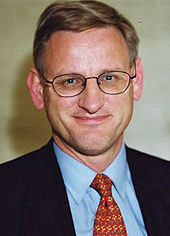 Scandinavian countries have embraced many neoliberal policies.
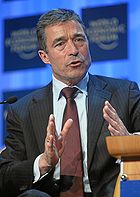 Anders Fogh Rasmussen
, former Prime Minister of Denmark
and leader of Venstre
, has written books advocating minimal state influence on market activities. Denmark
is a European leader on economic freedom indices.
Denmark has ranked as the world's 11th "most free" economy, of 162 countries, in an index created by the Wall Street Journal and Heritage Foundation
, the Index of Economic Freedom
2008.
In Sweden, Carl Bildt
's government program was one of liberalizing the Swedish economy, privatizing public services and making the country a member of the European Union. Carl Bildt signed the accession treaty at the European Union summit of Corfu
, Greece
on June 23, 1994. Economic changes were enacted, such as voucher schools, liberalized markets for telecommunications and energy as well as the privatization of publicly owned companies. The Bildt government made it possible for counties to privatizate health care (although few did), contributing to liberalizing the Swedish economy. Privatization of state owned companies and deregulation
of business were also carried out by the following social democratic
governments.
Iceland
began implementing neoliberal economic policies beginning in the late 1980s. As measured by the Economic Freedom of the World, it had the 53rd "freest economy" in 1975 and it was one of the poorest countries in Europe. In 2004, it had the 9th freest economy and it was one of the richest. However, by 2009, the country was facing severe financial problems, a consequence that a number of observers have attributed to Iceland's extensive deregulation.
 Coming to power in 1979, Margaret Thatcher
's political and economic philosophy emphasised reduced state intervention
, freer
market
s, and more entrepreneur
ialism. She once slammed a copy of Friedrich Hayek
's The Constitution of Liberty
down on a table during a Shadow Cabinet
meeting, saying, "This is what we believe." Thinkers closely associated with Thatcherism
include Keith Joseph
, Friedrich Hayek
and Milton Friedman
.
Thatcher's political and economic philosophy emphasised reduced state intervention as well as free market
s and "entrepreneur
ialism". She vowed to end excessive government interference in the economy and attempted to do this through privatizing nationally-owned enterprises. After the James Callaghan
government had concluded that the Keynesian approach to demand-side management failed, Thatcher felt that the economy was not self-righting and that new fiscal judgements had to be made to concentrate on inflation. She began her economic reforms by increasing interest rates to slow the growth of the money supply and thus lower inflation. In accordance with her "less government intervention" views she introduced public spending cuts particularly on housing and industry subsidies. She also placed limits on the printing of money and legal restrictions on trade unions.
By January 1982 the inflation rate had fallen to 8.6% from earlier peaks of 18%. By 1983 overall economic growth was stronger, while inflation and mortgage rates were at their lowest levels since 1970. The term "Thatcherism
" came to refer to her policies as well as aspects of her ethical outlook and personal style, including moral absolutism
, nationalism, focus on individuals rather than society as a whole and an uncompromising approach to achieving political goals.
After the 1983 election, the Conservative majority expanded, Thatcher continued to enact her economic policies. The UK government sold most of the state's large utilities. The policy of privatisation
was a main component of Thatcherism. When Thatcher was forced to resign as British Prime Minister in 1990 British economic growth was on average higher than the other large EU economies (Germany, France and Italy). However this was accompanied by poor social conditions compared with the rest of the EU.
The price of these economic policies was a temporary and dramatic increase in unemployment that embarrassed the Thatcher government so much that the definition of unemployment was changed 31 times in order to come up with lower figures. Despite this, the official rate of unemployment in the United Kingdom increased to 9.1% in the years 1979-89 after it had been 3.4% between 1973–79 and 1.9% between 1960-73.
In 2001 Peter Mandelson
, a Member of Parliament belonging to the British Labour Party
and closely associated with Tony Blair, declared that "we are all Thatcherites now." In reference to contemporary British political culture it could be said that a "post-Thatcherite consensus" exists with regard to economic policy. In the 1980s the now defunct Social Democratic Party
adhered to a "tough and tender" approach in which Thatcherite reforms were coupled with extra welfare provision. Neil Kinnock
, leader of the Labour Party from 1983–1992, initiated Labour's rightward shift across the political spectrum by concurring largely with the economic policies of the Thatcher governments. The New Labour government of Tony Blair has been described as "neo-Thatcherite" by some since many of their economic policies mimicked those of Thatcher.
The coalition government of Cameron and Clegg, that came into office in 2010 has been described as Neoliberal, with neoliberal 'Orange Book' Liberal Democrats playing key ministerial roles.
, and are often associated with supply-side economics
(the notion that, in order to lower prices and cultivate economic prosperity, policies should appeal to producers rather than consumers).
During Reagan's tenure, GDP grew at an annual rate of 2.7% per year. Per capita GDP in real terms was $31,877 in 1989 a rise of 24% from the $25,640 in 1981. Unemployment dropped from its high in the 1983 recession but it averaged higher than the previous decade and the subsequent decade. Also, inflation significantly decreased. Average real wages were stagnant, however, as inequality began to grow for the first time since the 1920s. Some, like William Niskanen, would point out two facts in response, the first being that average compensation for workers (that is wages+fringe benefits) went up through the 80s, and that every quintile of society performed better during the 80s. He neglects to mention that inequality increased significantly, beginning a trend that continued through to 2007. [See the work of Emanuel Saez] The policies were derided by some as "Trickle-down economics
", due to the significant cuts in the upper tax brackets. There was a massive increase in Cold War
related defense spending that caused large budget deficits, the U.S. trade deficit expansion, and contributed to the Savings and Loan crisis
, In order to cover new federal budget deficits, the United States borrowed heavily both domestically and abroad, raising the national debt from $700 billion to $3 trillion, and the United States moved from being the world's largest international creditor to the world's largest debtor nation.
Peter Gowan
has argued that the United States has been the main force behind the adoption of neoliberal policies in the rest of the world. The basic argument is that since the dollar is the international reserve currency, American banks are at a competitive advantage with respect to non-American banks, which cannot directly lend in dollars, so that their operations involve more foreign exchange risk. (Since the dollar is the international exchange currency, most international reserves are held as dollars, and the price of commodities such as oil are set in dollars, it is in general less risky to hold dollars than to hold other currencies, in the short term, at least.) Thus, once the United States liberalized its financial markets and controls over its banking industry, other countries were forced to follow suit.
Other changes are not so apparent, and are debated in the literature:
A study based on the transformations of urban life and systems as a result of neoliberalism in six countries of Latin America was published by Alejandro Portes and Bryan Roberts. This comparative study included census data analysis, surveying, and fieldwork focused in Argentina, Brazil, Chile, Mexico, Peru, and Uruguay. Predictions of the neoliberalism were extended to these six countries in four areas: urban systems and primacy, urban unemployment and informal employment, urban inequality and poverty, and urban crime and victimization. Data collected support a relationship between the economic policies of neoliberalism and the resulting patterns of urbanization.
In the area of urban systems and primacy two tendencies were revealed in the data. The first was continuing growth in total size of urban populations while the second tendency was the decline in size of the principal city with decreased migration flows to these cities. Therefore, when calculating the urban growth rate each of these countries all showed minimal or a significant decline in growth. Portes and Roberts theorize that the changes are due to the “loss of attraction of major cities...due to a complex set of factors, but is undoubtedly a related to the end of the ISI era”. Although the relationship between the open-market and the transformation of urban systems has not been proven to be a perfect one-to-one relationship, the evidence supports the acceleration or initiation of these two tendencies following neoliberal changes.
There was also a variation in the inequality and poverty in the six countries. While the majority of the population within these countries suffered from poverty, the "upper classes" received the benefits of the neoliberal system. According to Portes and Roberts, “the ‘privileged decile’ received average incomes equivalent to fourteen times the average Latin American poverty-line income”. According to the authors, a direct result of the income inequality is that each country struggled with increased crime and victimization in both urban and suburban settings. However, due to corruption within the police force it is not possible to accurately extrapolate a trend in the data of crime and victimization.
(1962), Friedman developed the argument that economic freedom, while itself an extremely important component of total freedom, is also a necessary condition for political freedom. He commented that centralized control of economic activities was always accompanied with political repression.
In his view, the voluntary character of all transactions in a free market economy and wide diversity that it permits are fundamental threats to repressive political leaders and greatly diminish power to coerce. Through elimination of centralized control of economic activities, economic power is separated from political power, and the one can serve as counterbalance to the other. Friedman feels that competitive capitalism is especially important to minority groups, since impersonal market forces protect people from discrimination in their economic activities for reasons unrelated to their productivity.
It is important to take into account, however, that an early neoliberal regime was attempted in Chile under what some would consider a military dictatorship and severe social repression. However, despite what most would consider a highly objectionable context for implementation of economic liberty, Chile now enjoys the highest rate of GDP per capita in Latin America; this lends strong credence to the assertion that economic freedom is more important to prosperity than are democratic institutions. Also, increased economic freedom put pressure on the dictatorship over time and increased political freedom.In The Road to Serfdom
, Hayek argued that "Economic control is not merely control of a sector of human life which can be separated from the rest; it is the control of the means for all our ends."
Prasad's analysis suggests that neoliberalism has been a corrective to policies that favored the working class over capitalist interests, and it was championed by autonomous state actors.
s and other barriers to free trade
; reducing regulations of labor markets and financial markets and focusing macroeconomic policies on controlling inflation rather than stimulating the growth of jobs," reports economist Robert Pollin (2003). Arising out of a rejection of the class compromises embedded in previous liberal
political-economic policies, including Keynesian and Active Labour Market Policies (ALMPs), economic neoliberalism usually brings about strong economic inequality
. While proponents of neoliberal shifts, such as George H.W. Bush and Bill Clinton
argue that over time all levels of income are better off, some claim that empirical evidence has shown this not to be the case.
, and profiteering in the health industry. However, countries have applied neoliberal policies at varying levels of intensity; for example, the OECD (Organisation for Economic Cooperation and Development) has calculated that only 6% of Swedish workers are beset with wages it considers low, and that Swedish wages are overall lower due to their lack of neoliberal policies John Schmitt and Ben Zipperer (2006) of the CEPR have analyzed the effects of intensive Anglo-American neoliberal policies in comparison to continental European neoliberalism, concluding "The U.S. economic and social model is associated with substantial levels of social exclusion, including high levels of income inequality, high relative and absolute poverty rates, poor and unequal educational outcomes, poor health outcomes, and high rates of crime and incarceration. At the same time, the available evidence provides little support for the view that U.S.-style labor-market flexibility dramatically improves labor-market outcomes. Despite popular prejudices to the contrary, the U.S. economy consistently affords a lower level of economic mobility
than all the continental European countries for which data is available."
Notable critics of neoliberalism in theory or practice include economists Joseph Stiglitz, Amartya Sen
, and Robert Pollin
, linguist Noam Chomsky
, geographer David Harvey
, and the alter-globalization
movement in general, including groups such as ATTAC. Critics of neoliberalism argue that not only is neoliberalism's critique of socialism (as unfreedom) wrong, but neoliberalism cannot deliver the liberty that is supposed to be one of its strong points. Daniel Brook's "The Trap" (2007), Robert Frank's "Falling Behind" (2007), Robert Chernomas and Ian Hudson's "Social Murder" (2007), and Richard G. Wilkinson's "The Impact of Inequality" (2005) all claim high inequality is spurred by neoliberal policies and produces profound political, social, economic, health, and environmental constraints and problems. The economists and policy analysts at the Canadian Centre for Policy Alternatives
(CCPA) offer inequality-reducing social democratic
policy alternatives to neoliberal policies. In addition, a significant opposition to neoliberalism has grown in Latin America. Prominent Latin American opponents include the Zapatista Army of National Liberation
rebellion, the Brazilian MST
, and the socialist governments of Venezuela
, Bolivia
and Cuba
.
According to , neoliberalism under the U.S. Bill Clinton administration
– steered by Alan Greenspan
and Robert Rubin
– was the temporary and unstable policy inducement of economic growth via government-supported financial and housing market speculation
, featuring both low unemployment and low inflation. He claims that this unusual coincidence was made possible by the disorganization and dispossession of the American working class
. Santa Cruz history of consciousness professor Angela Davis
and Princeton sociologist Bruce Western have claimed that the high rate (compared to Europe) of incarceration
in the U.S. – specifically 1 in 37 American adults is in the prison system – heavily promoted by the Clinton administration, is the neoliberal U.S. policy tool for keeping unemployment statistics low, while stimulating economic growth through the maintenance of a contemporary slave population and the promotion of prison construction and "militarized policing." The Clinton Administration also embraced neoliberalism by pursuing international trade agreements that would benefit the corporate sector globally (normalization of trade with China
for example). Domestically, Clinton fostered such neoliberal reforms as the corporate takeover of health care in the form of the HMO
, the reduction of welfare subsidies, and the implementation of "Workfare
".
One Euro-Latin American perspective critical of neoliberalism focuses upon the way in which neoliberalism becomes habitually embedded in the economic system itself. For example, Dutch author Paul Treanor argues that the ideas derived from neoliberalism (and neoliberalism itself) are a philosophy and not just an “economic structure.” For example, a neoliberal perceives the world in a “term of market metaphors” and when members of a society commonly refer to countries as companies, that civilization would then be deemed a neoliberal instead of a liberal culture. Yet Treanor also recognizes continuity between historical liberal and contemporary neoliberal cultures. “When this is a view of nation states, it is as much a form of neo-nationalism as neoliberalism. It also looks back to the pre-liberal economic theory — mercantilism — which saw the countries of Europe as competing units. The mercantilists treated those kingdoms as large-scale versions of a private household, rather than as firms. Nevertheless, their view of world trade as a competition between nation-sized units would be acceptable to modern neoliberals.”
Two of Treanor's collaborators, Elizabeth Martínez and Arnoldo García, find that neoliberalism is a collection of economic policies that has spread its ideals from country to country over the last 25 years. They claim that neoliberalism clearly treats its poorest citizens badly, by allowing for the increased disparity of the distribution of wealth ("the rich get richer, while the poor get richer at a slower rate"). Highlighting ideology, Martínez and García explain the difference between neoliberalism and liberalism by pointing to liberalism's association with class compromising ideology, stating that “"Liberalism" can refer to political, economic, or even religious ideas. In the U.S. political liberalism has been a strategy to prevent social conflict. It is presented to poor and working people as progressive compared to conservative or Right-wing.” However, they further argue that this liberal social contract was broken by the elite political movement which included neoliberalism in the U.S.
was under the guidance of the International Monetary Fund (IMF), the World Bank (WB), and U.S. Treasury. Although heavily indebted, the IMF continued to lend Argentina loans, and public debt sky rocketed as loans were postponed. Argentina commenced a neoliberal restructuring process. This small case study exemplifies how neoliberal policies directed with a top-down approach under the guidance of the 'Washington Consensus' were inefficient and only caused further damage to the Argentine economy. The unofficial mantra of the 'Washington Consensus' was "stabilize, privatize, and liberalize". A number of labour market reforms were enacted, including the establishment of new regulations for public employment, the decentralizarion of social services, the deregulation of the private economy along with weakened labor laws, the partial privatization of the social security system, and the flexibilization of the labor market. During this time Argentina’s foreign debt grew substantially from US $57.6 billion in 1990 to US $144.5 billion in 2001. This debt accumulation, coupled with the immediate devaluation of the Argentine peso, led to hyperinflation, high unemployment rates, a large informal labour sector, an increase in poverty levels, and basic educational and health service cuts. A reduction in public salaries and numerous lay-offs stemming from privatization resulted in the loss of income of masses of workers, effectively creating a "new poor" among lower- to middle-class Argentines. At the same time that Argentina's economy grew increasingly uncompetitive as a result of convertibility, international debt continued to rise and government corruption became rampant, deregulation resulted in the flight of capital and heightened levels of anxiety among the public.
Neoclassical economics
Neoclassical economics is a term variously used for approaches to economics focusing on the determination of prices, outputs, and income distributions in markets through supply and demand, often mediated through a hypothesized maximization of utility by income-constrained individuals and of profits...
that emphasizes the efficiency of private enterprise, liberalized trade
Free trade
Under a free trade policy, prices emerge from supply and demand, and are the sole determinant of resource allocation. 'Free' trade differs from other forms of trade policy where the allocation of goods and services among trading countries are determined by price strategies that may differ from...
and relatively open markets, and therefore seeks to maximize the role of the private sector
Private sector
In economics, the private sector is that part of the economy, sometimes referred to as the citizen sector, which is run by private individuals or groups, usually as a means of enterprise for profit, and is not controlled by the state...
in determining the political and economic priorities of the country. The label "neoliberalism" was created by its ideological opponents, but has also been used by proponents of neoliberal policies.
Policy implications
Neoliberalism seeks to transfer control of the economy from public to the private sector, under the belief that it will produce a more efficient government and improve the economic health of the nation. The definitive statement of the concrete policies advocated by neoliberalism is often taken to be John WilliamsonJohn Williamson
John Williamson is the name of:* Jack Williamson , American science fiction writer* John H. Williamson , American, North Carolina politician and newspaper publisher* John N. Williamson , American, U.S...
's "Washington Consensus
Washington Consensus
The term Washington Consensus was coined in 1989 by the economist John Williamson to describe a set of ten relatively specific economic policy prescriptions that he considered constituted the "standard" reform package promoted for crisis-wracked developing countries...
", a list of policy proposals that appeared to have gained consensus approval among the Washington-based international economic organizations (like the International Monetary Fund
International Monetary Fund
The International Monetary Fund is an organization of 187 countries, working to foster global monetary cooperation, secure financial stability, facilitate international trade, promote high employment and sustainable economic growth, and reduce poverty around the world...
(IMF) and World Bank
World Bank
The World Bank is an international financial institution that provides loans to developing countries for capital programmes.The World Bank's official goal is the reduction of poverty...
). Williamson's list included ten points:
- Fiscal policyFiscal policyIn economics and political science, fiscal policy is the use of government expenditure and revenue collection to influence the economy....
Governments should not run large deficits that have to be paid back by future citizens, and such deficits can only have a short term effect on the level of employment in the economy. Constant deficits will lead to higher inflation and lower productivity, and should be avoided. Deficits should only be used for occasional stabilization purposes. - Redirection of public spending from subsidies (especially what neoliberals call "indiscriminate subsidies") and other spending neoliberals deem wasteful toward broad-based provision of key pro-growth, pro-poor services like primary education, primary health care and infrastructureInfrastructureInfrastructure is basic physical and organizational structures needed for the operation of a society or enterprise, or the services and facilities necessary for an economy to function...
investment - Tax reformTax reformTax reform is the process of changing the way taxes are collected or managed by the government.Tax reformers have different goals. Some seek to reduce the level of taxation of all people by the government. Some seek to make the tax system more progressive or less progressive. Some seek to simplify...
– broadening the tax base and adopting moderate marginal tax rates to encourage innovation and efficiency; - Interest rateInterest rateAn interest rate is the rate at which interest is paid by a borrower for the use of money that they borrow from a lender. For example, a small company borrows capital from a bank to buy new assets for their business, and in return the lender receives interest at a predetermined interest rate for...
s that are market determined and positive (but moderate) in real terms; - Floating exchange rateExchange rateIn finance, an exchange rate between two currencies is the rate at which one currency will be exchanged for another. It is also regarded as the value of one country’s currency in terms of another currency...
s; - Trade liberalization – liberalization of imports, with particular emphasis on elimination of quantitative restrictions (licensing, etc.); any trade protection to be provided by low and relatively uniform tariffTariffA tariff may be either tax on imports or exports , or a list or schedule of prices for such things as rail service, bus routes, and electrical usage ....
s; thus encouraging competition and long term growth - LiberalizationLiberalizationIn general, liberalization refers to a relaxation of previous government restrictions, usually in areas of social or economic policy. In some contexts this process or concept is often, but not always, referred to as deregulation...
of the "capital account" of the balance of payments, that is, allowing people the opportunity to invest funds overseas and allowing foreign funds to be invested in the home country - PrivatizationPrivatizationPrivatization is the incidence or process of transferring ownership of a business, enterprise, agency or public service from the public sector to the private sector or to private non-profit organizations...
of state enterprises; Promoting market provision of goods and services which the government cannot provide as effectively or efficiently, such as telecommunications, where having many service providers promotes choice and competition. - DeregulationDeregulationDeregulation is the removal or simplification of government rules and regulations that constrain the operation of market forces.Deregulation is the removal or simplification of government rules and regulations that constrain the operation of market forces.Deregulation is the removal or...
– abolition of regulations that impede market entry or restrict competition, except for those justified on safety, environmental and consumer protection grounds, and prudent oversight of financial institutionFinancial institutionIn financial economics, a financial institution is an institution that provides financial services for its clients or members. Probably the most important financial service provided by financial institutions is acting as financial intermediaries...
s; - Legal security for property rights; and,
- Financialisation of capital.
Embedded liberalism
The term embedded liberalismEmbedded liberalism
The term embedded liberalism refers to the economic system which dominated worldwide from the end of World War II to the 1970s. The term itself is credited to John Ruggie, an American political scientist....
refers to the economic system that dominated the non-communist global economy from the end of World War II
World War II
World War II, or the Second World War , was a global conflict lasting from 1939 to 1945, involving most of the world's nations—including all of the great powers—eventually forming two opposing military alliances: the Allies and the Axis...
to the 1970s. David Harvey
David Harvey (geographer)
David Harvey is the Distinguished Professor of Anthropology at the Graduate Center of the City University of New York . A leading social theorist of international standing, he received his PhD in Geography from University of Cambridge in 1961. Widely influential, he is among the top 20 most cited...
argues that at the end of World War II, the primary objective was to develop an economic plan that would not lead to a repeat of the Great Depression
Great Depression
The Great Depression was a severe worldwide economic depression in the decade preceding World War II. The timing of the Great Depression varied across nations, but in most countries it started in about 1929 and lasted until the late 1930s or early 1940s...
during the 1930s. Harvey notes that under this new system free trade was regulated "under a system of fixed exchange rates anchored by the US dollar's convertibility into gold at a fixed price. Fixed exchange rates were incompatible with free flows of capital." Harvey argues that embedded liberalism led to the surge of economic prosperity that came to define the 1950s and 1960s.
Across much of the world, the work of John Maynard Keynes
John Maynard Keynes
John Maynard Keynes, Baron Keynes of Tilton, CB FBA , was a British economist whose ideas have profoundly affected the theory and practice of modern macroeconomics, as well as the economic policies of governments...
, which sought to formulate the means by which governments could stabilize and fine-tune free markets, became a highly influential approach. Within the developing world, several developments – among them decolonization
Decolonization
Decolonization refers to the undoing of colonialism, the unequal relation of polities whereby one people or nation establishes and maintains dependent Territory over another...
, a desire for national independence and the destruction of the pre-war global economy, and the view that countries could not effectively industrialize under free market systems (e.g., the Singer–Prebisch thesis) – encouraged economic policies that were influenced by communist, socialist and import substitution
Import substitution
Import substitution industrialization or "Import-substituting Industrialization" is a trade and economic policy that advocates replacing imports with domestic production. It is based on the premise that a country should attempt to reduce its foreign dependency through the local production of...
precepts.
The period of government interventionism in the 1950s and 1960s was characterized by exceptional economic prosperity, as economic growth
Economic growth
In economics, economic growth is defined as the increasing capacity of the economy to satisfy the wants of goods and services of the members of society. Economic growth is enabled by increases in productivity, which lowers the inputs for a given amount of output. Lowered costs increase demand...
was generally high, was contained, and economic distribution
Distribution of wealth
The distribution of wealth is a comparison of the wealth of various members or groups in a society. It differs from the distribution of income in that it looks at the distribution of ownership of the assets in a society, rather than the current income of members of that society.-Definition of...
was comparatively equalized. This era is known as les Trente Glorieuses
Trente Glorieuses
Les Trente Glorieuses refers to the thirty years from 1945-1975 following the end of the Second World War in France. The name was first used by the French demographer Jean Fourastié...
("The Glorious Thirty [years]") or "Golden Age", a reference to many countries having experienced particularly high levels of prosperity between (roughly) World War II
World War II
World War II, or the Second World War , was a global conflict lasting from 1939 to 1945, involving most of the world's nations—including all of the great powers—eventually forming two opposing military alliances: the Allies and the Axis...
and 1973.
Collapse of embedded liberalism
David HarveyDavid Harvey (geographer)
David Harvey is the Distinguished Professor of Anthropology at the Graduate Center of the City University of New York . A leading social theorist of international standing, he received his PhD in Geography from University of Cambridge in 1961. Widely influential, he is among the top 20 most cited...
notes that the system of embedded liberalism
Embedded liberalism
The term embedded liberalism refers to the economic system which dominated worldwide from the end of World War II to the 1970s. The term itself is credited to John Ruggie, an American political scientist....
began to break down towards the end of the 1960s. The 1970s were defined by an increased accumulation of capital, unemployment, inflation (or stagflation
Stagflation
In economics, stagflation is a situation in which the inflation rate is high and the economic growth rate slows down and unemployment remains steadily high...
as it was dubbed), and a variety of fiscal crises. He notes that "the embedded liberalism that had delivered high rates of growth to at least the advanced capitalist countries after 1945 was clearly exhausted and no longer working." A number of theories concerning new systems began to develop, which led to extensive debate between those who advocated "social democracy and central planning on the one hand" and those "concerned with liberating corporate and business power and re-establishing market freedoms" on the other. Harvey notes that, by 1980, the latter group had emerged as the leader, advocating and creating a global economic system that would become known as neoliberalism.
Some argue that the strains which occurred were located in the international financial system, and culminated in the dissolution of the Bretton Woods system
Nixon Shock
The Nixon Shock was a series of economic measures taken by U.S. President Richard Nixon in 1971 including unilaterally cancelling the direct convertibility of the United States dollar to gold that essentially ended the existing Bretton Woods system of international financial exchange.-Background:By...
, which some argue had set the stage for the Stagflation crisis
Stagflation
In economics, stagflation is a situation in which the inflation rate is high and the economic growth rate slows down and unemployment remains steadily high...
that would, to some extent, discredit Keynesianism in the English-speaking world. In addition, some argue that the postwar economic system was premised on a society that excluded women and minorities from economic opportunities, and the political and economic integration given to these groups strained the postwar system.
Global spread
Chronic economic crisis throughout the 1980s, and the collapse of the Communist bloc at the end of the 1980s, helped foster political opposition to state interventionism in favor of free market reform policies. From the 1980s onward, a number of communist and socialist countries initiated various neoliberal market reforms, such as the Socialist Federal Republic of YugoslaviaSocialist Federal Republic of Yugoslavia
The Socialist Federal Republic of Yugoslavia was the Yugoslav state that existed from the abolition of the Yugoslav monarchy until it was dissolved in 1992 amid the Yugoslav Wars. It was a socialist state and a federation made up of six socialist republics: Bosnia and Herzegovina, Croatia,...
under the direction of Ante Markovic
Ante Markovic
Ante Marković was a statesman of the former Yugoslavia. He was the last prime minister of the Socialist Federal Republic of Yugoslavia.- Early life :...
(until the country's collapse in the early 1990s), and the People's Republic of China
People's Republic of China
China , officially the People's Republic of China , is the most populous country in the world, with over 1.3 billion citizens. Located in East Asia, the country covers approximately 9.6 million square kilometres...
under the direction of Deng Xiaoping
Deng Xiaoping
Deng Xiaoping was a Chinese politician, statesman, and diplomat. As leader of the Communist Party of China, Deng was a reformer who led China towards a market economy...
.
Changes occurred from the 1970s to the 1980s. Started off with most of the democratic world governments focused primarily on the primacy of economic individual rights, rules of law and roles of the governments in moderating relative free trade. It was almost considered national self determination at the time.
Stances of organized labour shifted when governments of Ronald Reagan and Margaret Thatcher took strong stances to break down trade barriers entirely to reduce government power; thus allowing the market to be more important. Therefore industries will increasingly shift globally with integrated knowledge boosting the economy.
Chicago School
The Chicago school of economics describes a neoclassicalNeoclassical economics
Neoclassical economics is a term variously used for approaches to economics focusing on the determination of prices, outputs, and income distributions in markets through supply and demand, often mediated through a hypothesized maximization of utility by income-constrained individuals and of profits...
school of thought within the academic community of economists, with a strong focus around the faculty of University of Chicago
University of Chicago
The University of Chicago is a private research university in Chicago, Illinois, USA. It was founded by the American Baptist Education Society with a donation from oil magnate and philanthropist John D. Rockefeller and incorporated in 1890...
.
The school emphasizes non-intervention from government and rejects regulation in laissez-faire
Laissez-faire
In economics, laissez-faire describes an environment in which transactions between private parties are free from state intervention, including restrictive regulations, taxes, tariffs and enforced monopolies....
free markets as inefficient. It is associated with neoclassical price theory
Neoclassical economics
Neoclassical economics is a term variously used for approaches to economics focusing on the determination of prices, outputs, and income distributions in markets through supply and demand, often mediated through a hypothesized maximization of utility by income-constrained individuals and of profits...
and libertarianism
Libertarianism
Libertarianism, in the strictest sense, is the political philosophy that holds individual liberty as the basic moral principle of society. In the broadest sense, it is any political philosophy which approximates this view...
and the rejection of Keynesianism in favor of monetarism
Monetarism
Monetarism is a tendency in economic thought that emphasizes the role of governments in controlling the amount of money in circulation. It is the view within monetary economics that variation in the money supply has major influences on national output in the short run and the price level over...
until the 1980s, when it turned to rational expectations
Rational expectations
Rational expectations is a hypothesis in economics which states that agents' predictions of the future value of economically relevant variables are not systematically wrong in that all errors are random. An alternative formulation is that rational expectations are model-consistent expectations, in...
. The school has impacted the field of finance
Finance
"Finance" is often defined simply as the management of money or “funds” management Modern finance, however, is a family of business activity that includes the origination, marketing, and management of cash and money surrogates through a variety of capital accounts, instruments, and markets created...
by the development of the efficient market hypothesis
Efficient market hypothesis
In finance, the efficient-market hypothesis asserts that financial markets are "informationally efficient". That is, one cannot consistently achieve returns in excess of average market returns on a risk-adjusted basis, given the information available at the time the investment is made.There are...
. In terms of methodology the stress is on "positive economics"– that is, empirically based studies using statistics to prove theory.
Approximately 70% of the professors in the economics department have been considered part of the school of thought. The University of Chicago department, widely considered one of the world’s foremost economics departments, has fielded more Nobel Prize
Nobel Prize
The Nobel Prizes are annual international awards bestowed by Scandinavian committees in recognition of cultural and scientific advances. The will of the Swedish chemist Alfred Nobel, the inventor of dynamite, established the prizes in 1895...
winners and John Bates Clark medalists
John Bates Clark Medal
The John Bates Clark Medal is awarded by the American Economic Association to "that American economist under the age of forty who is adjudged to have made a significant contribution to economic thought and knowledge"...
in economics than any other university.
Those who attend to the Chicago School prefer some form of competition law
Competition law
Competition law, known in the United States as antitrust law, is law that promotes or maintains market competition by regulating anti-competitive conduct by companies....
, school vouchers, a central bank
Central bank
A central bank, reserve bank, or monetary authority is a public institution that usually issues the currency, regulates the money supply, and controls the interest rates in a country. Central banks often also oversee the commercial banking system of their respective countries...
, intellectual property
Intellectual property
Intellectual property is a term referring to a number of distinct types of creations of the mind for which a set of exclusive rights are recognized—and the corresponding fields of law...
and prefer Milton Friedman
Milton Friedman
Milton Friedman was an American economist, statistician, academic, and author who taught at the University of Chicago for more than three decades...
's negative income tax
Negative income tax
In economics, a negative income tax is a progressive income tax system where people earning below a certain amount receive supplemental pay from the government instead of paying taxes to the government. Such a system has been discussed by economists but never fully implemented...
as a replacement to the existing system.
Australia
In Australia, neoliberal economic policies have been embraced by governments of both the Labor PartyAustralian Labor Party
The Australian Labor Party is an Australian political party. It has been the governing party of the Commonwealth of Australia since the 2007 federal election. Julia Gillard is the party's federal parliamentary leader and Prime Minister of Australia...
and the Liberal Party
Liberal Party of Australia
The Liberal Party of Australia is an Australian political party.Founded a year after the 1943 federal election to replace the United Australia Party, the centre-right Liberal Party typically competes with the centre-left Australian Labor Party for political office...
since 1983. The governments of Bob Hawke
Bob Hawke
Robert James Lee "Bob" Hawke AC GCL was the 23rd Prime Minister of Australia from March 1983 to December 1991 and therefore longest serving Australian Labor Party Prime Minister....
and Paul Keating
Paul Keating
Paul John Keating was the 24th Prime Minister of Australia, serving from 1991 to 1996. Keating was elected as the federal Labor member for Blaxland in 1969 and came to prominence as the reformist treasurer of the Hawke Labor government, which came to power at the 1983 election...
from 1983 to 1996 pursued economic liberalisation and a program of micro-economic reform. These governments privatized government corporations , deregulated factor markets, floated the Australian dollar, and reduced trade protection.
Keating, as federal treasurer, implemented a compulsory superannuation guarantee
Superannuation in Australia
Superannuation is a retirement program in Australia. It has a compulsory element whereby employers are required by law to pay an additional amount based on a proportion of an employee's salaries and wages into a complying superannuation fund.An individual's superannuation fund can be accessed...
system in 1992 to increase national savings and reduce future government liability for old age pensions. The financing of universities was deregulated, requiring students to contribute to university fees
Tertiary education fees in Australia
As a general rule, all students who attend Australian tertiary education institutions are charged higher education fees. However, several measures are in place to relieve the costs of tertiary education in Australia....
through a repayable loan system known as the Higher Education Contribution Scheme (HECS) and encouraging universities to increase income by admitting full-fee-paying students, including foreign students. The admitting of domestic full-fee-paying students to public universities was stopped in 2009 by the Rudd Labor Government.
When the Liberal Party returned to power in March 1996 under prime minister John Howard
John Howard
John Winston Howard AC, SSI, was the 25th Prime Minister of Australia, from 11 March 1996 to 3 December 2007. He was the second-longest serving Australian Prime Minister after Sir Robert Menzies....
, the programme of economic liberalisation was continued with the privatisation of more government corporations, notably the sale of the telecommunications provider Telstra
Telstra
Telstra Corporation Limited is an Australian telecommunications and media company, building and operating telecommunications networks and marketing voice, mobile, internet access and pay television products and services....
, and the Reserve Bank of Australia was made independent of the government in determining monetary policy. A 10% Goods and Services Tax GST
Goods and Services Tax (Australia)
The GST is a broad sales tax of 10% on most goods and services transactions in Australia. It is a value added tax, not a sales tax, in that it is refunded to all parties in the chain of production other than the final consumer....
(similar to European VAT
Vat
Vat or VAT may refer to:* A type of container such as a barrel, storage tank, or tub, often constructed of welded sheet stainless steel, and used for holding, storing, and processing liquids such as milk, wine, and beer...
) was introduced with the aim of combining and simplifying the previous duties and taxes to make the system more efficient. A series of reforms were enacted to deregulate the labour market.
Canada
In CanadaCanada
Canada is a North American country consisting of ten provinces and three territories. Located in the northern part of the continent, it extends from the Atlantic Ocean in the east to the Pacific Ocean in the west, and northward into the Arctic Ocean...
, the issues identified with neoliberalism (reducing taxes and welfare spending, minimizing of government and reform of public healthcare and education, among others) are often associated with Brian Mulroney
Brian Mulroney
Martin Brian Mulroney, was the 18th Prime Minister of Canada from September 17, 1984, to June 25, 1993 and was leader of the Progressive Conservative Party of Canada from 1983 to 1993. His tenure as Prime Minister was marked by the introduction of major economic reforms, such as the Canada-U.S...
, Jean Chrétien
Jean Chrétien
Joseph Jacques Jean Chrétien , known commonly as Jean Chrétien is a former Canadian politician who was the 20th Prime Minister of Canada. He served in the position for over ten years, from November 4, 1993 to December 12, 2003....
, Mike Harris
Mike Harris
Michael Deane "Mike" Harris was the 22nd Premier of Ontario from June 26, 1995 to April 15, 2002. He is most noted for the "Common Sense Revolution", his Progressive Conservative government's program of deficit reduction in combination with lower taxes and cuts to government...
, Ralph Klein, Gordon Campbell and Stephen Harper
Stephen Harper
Stephen Joseph Harper is the 22nd and current Prime Minister of Canada and leader of the Conservative Party. Harper became prime minister when his party formed a minority government after the 2006 federal election...
.
Ralph Klein, who supports and has supported extraction of Alberta
Alberta
Alberta is a province of Canada. It had an estimated population of 3.7 million in 2010 making it the most populous of Canada's three prairie provinces...
's vast oil and natural gas reserves, is credited by the Pembina Institute
Pembina Institute
The Pembina Institute is a Canadian not-for-profit think tank focused on developing innovative sustainable energy solutions. Founded in 1985, the Institute has offices in Calgary, Drayton Valley, Edmonton, Ottawa, Toronto, Vancouver, and Yellowknife....
as generating a relatively small amount of provincial revenue compared to the increase in oil sand production. Between 1995 and 2004, production grew by 133%, but government revenue shrank by 30%, leaving large fortunes in the hands of corporations.
Under Mike Harris
Mike Harris
Michael Deane "Mike" Harris was the 22nd Premier of Ontario from June 26, 1995 to April 15, 2002. He is most noted for the "Common Sense Revolution", his Progressive Conservative government's program of deficit reduction in combination with lower taxes and cuts to government...
in Ontario during the 1990s, industry and social responsibilities were transferred to the cities. Toronto
Toronto
Toronto is the provincial capital of Ontario and the largest city in Canada. It is located in Southern Ontario on the northwestern shore of Lake Ontario. A relatively modern city, Toronto's history dates back to the late-18th century, when its land was first purchased by the British monarchy from...
during this time was forced to amalgamate and enter a period of development. The Amalgamation of Toronto
Amalgamation of Toronto
The amalgamation of Toronto was the creation of the current political borders of Toronto, Ontario, Canada after amalgamating, annexing, and merging with surrounding municipalities since the 18th century...
was intended as a cost saving measure and, in 2000, Michael R. Garrett noted a yearly savings of $136.2 million (CDN) However, in 2007, Barry Hertz reported in the conservative national newspaper National Post that cost savings never materialized. He also noted that government staff had grown, with the city employing 4,015 more people in 2007 than it did in 1998.
Canadian politics were also affected. Trade tariffs were ended, allowing less restrictions on trade. Government sizes were decreased limiting their power towards industries. The federal government rules during that time and municipalities had no power.
Chile
Milton FriedmanMilton Friedman
Milton Friedman was an American economist, statistician, academic, and author who taught at the University of Chicago for more than three decades...
used the term "Miracle of Chile
Miracle of Chile
The "Miracle of Chile" was a term used by free market Nobel Prize winning economist Milton Friedman to describe liberal and free market reorientation of the economy of Chile in the 1980s, 1990s and the purported benefits of his style of economic liberalism...
" in reference to Augusto Pinochet
Augusto Pinochet
Augusto José Ramón Pinochet Ugarte, more commonly known as Augusto Pinochet , was a Chilean army general and dictator who assumed power in a coup d'état on 11 September 1973...
's support for liberal economic
Economic liberalism
Economic liberalism is the ideological belief in giving all people economic freedom, and as such granting people with more basis to control their own lives and make their own mistakes. It is an economic philosophy that supports and promotes individual liberty and choice in economic matters and...
changes in Chile
Chile
Chile ,officially the Republic of Chile , is a country in South America occupying a long, narrow coastal strip between the Andes mountains to the east and the Pacific Ocean to the west. It borders Peru to the north, Bolivia to the northeast, Argentina to the east, and the Drake Passage in the far...
carried out by the "Chicago Boys
Chicago Boys
The Chicago Boys were a group of young Chilean economists most of whom trained at the University of Chicago under Milton Friedman and Arnold Harberger, or at its affiliate in the economics department at the Catholic University of Chile...
". Their implemented economic model had three main objectives: economic liberalization, privatization of state owned companies, and stabilization of inflation. These market-oriented economic policies were continued and strengthened by successive governments after Pinochet stepped down. At the time, Milton Friedman stated that the Chilean experiment was "comparable to the economic miracle of post-war Germany."
Some of Pinochet's neoliberal policies were continued after the termination of his 17-year-long dictatorship, though with more social policies to counter the great social-economic inequality. According to the Heritage Foundation
Heritage Foundation
The Heritage Foundation is a conservative American think tank based in Washington, D.C. Heritage's stated mission is to "formulate and promote conservative public policies based on the principles of free enterprise, limited government, individual freedom, traditional American values, and a strong...
and the Wall Street Journal, in 2007 Chile was the world's 11th "most free" economy, and 3rd in the Americas.
According to the United Nations Development Report of 2009 Chile has high competitiveness
Competitiveness
Competitiveness is a comparative concept of the ability and performance of a firm, sub-sector or country to sell and supply goods and/or services in a given market...
, quality of life
Quality of life
The term quality of life is used to evaluate the general well-being of individuals and societies. The term is used in a wide range of contexts, including the fields of international development, healthcare, and politics. Quality of life should not be confused with the concept of standard of...
, political stability, globalization
Globalization
Globalization refers to the increasingly global relationships of culture, people and economic activity. Most often, it refers to economics: the global distribution of the production of goods and services, through reduction of barriers to international trade such as tariffs, export fees, and import...
, economic freedom
Economic freedom
Economic freedom is a term used in economic and policy debates. As with freedom generally, there are various definitions, but no universally accepted concept of economic freedom...
, low perception of corruption
Corruption Perceptions Index
Since 1995, Transparency International publishes the Corruption Perceptions Index annually ranking countries "by their perceived levels of corruption, as determined by expert assessments and opinion surveys." The CPI generally defines corruption as "the misuse of public power for private...
and comparatively low poverty
Poverty
Poverty is the lack of a certain amount of material possessions or money. Absolute poverty or destitution is inability to afford basic human needs, which commonly includes clean and fresh water, nutrition, health care, education, clothing and shelter. About 1.7 billion people are estimated to live...
rates.
According to the International Monetary Fund
International Monetary Fund
The International Monetary Fund is an organization of 187 countries, working to foster global monetary cooperation, secure financial stability, facilitate international trade, promote high employment and sustainable economic growth, and reduce poverty around the world...
Chile "ranks high regionally" in freedom of the press
Freedom of the press
Freedom of the press or freedom of the media is the freedom of communication and expression through vehicles including various electronic media and published materials...
, human development
Human development (humanity)
Human development in the scope of humanity, specifically international development, is an international and economic development paradigm that is about much more than the rise or fall of national incomes. People are the real wealth of nations...
and democratic development. Also according to the IMF Chile has the region's highest GDP to popular ratio (at market price
Market price
In economics, market price is the economic price for which a good or service is offered in the marketplace. It is of interest mainly in the study of microeconomics...
s and purchasing power parity
Purchasing power parity
In economics, purchasing power parity is a condition between countries where an amount of money has the same purchasing power in different countries. The prices of the goods between the countries would only reflect the exchange rates...
) and also has a high degree of income inequality, as measured by the Gini index.
The experience of Chile in the 1970s and 1980s, and especially the export of the Chilean pension model by former Labor Minister José Piñera
José Piñera
José Piñera is the architect of Chile's private pension system based on personal retirement accounts. Piñera has been called "the world's foremost advocate of privatizing public pension systems" as well as "the Pension Reform Pied Piper"...
, has influenced the policies of the Communist Party of China
Communist Party of China
The Communist Party of China , also known as the Chinese Communist Party , is the founding and ruling political party of the People's Republic of China...
and has been invoked as a model by economic reformers in other countries, such as Boris Yeltsin
Boris Yeltsin
Boris Nikolayevich Yeltsin was the first President of the Russian Federation, serving from 1991 to 1999.Originally a supporter of Mikhail Gorbachev, Yeltsin emerged under the perestroika reforms as one of Gorbachev's most powerful political opponents. On 29 May 1990 he was elected the chairman of...
in Russia and almost all Eastern Europe
Eastern Europe
Eastern Europe is the eastern part of Europe. The term has widely disparate geopolitical, geographical, cultural and socioeconomic readings, which makes it highly context-dependent and even volatile, and there are "almost as many definitions of Eastern Europe as there are scholars of the region"...
an post-Communist societies.
Mining of copper
Copper
Copper is a chemical element with the symbol Cu and atomic number 29. It is a ductile metal with very high thermal and electrical conductivity. Pure copper is soft and malleable; an exposed surface has a reddish-orange tarnish...
in Chile is publicly owned (see Chilean nationalization of copper
Chilean nationalization of copper
The nationalization of the Chilean copper industry commonly described as the Chilenización del cobre or "Chileanisation of copper," was the progressive process by which the Chilean government acquired control of the major foreign-owned section of the Chilean copper mining industry. It involved the...
). Chile is the world's top producer of copper, which is by far the largest Chilean export good (accounting for over 40% of export revenue).
Hong Kong
Milton Friedman
Milton Friedman was an American economist, statistician, academic, and author who taught at the University of Chicago for more than three decades...
described Hong Kong
Hong Kong
Hong Kong is one of two Special Administrative Regions of the People's Republic of China , the other being Macau. A city-state situated on China's south coast and enclosed by the Pearl River Delta and South China Sea, it is renowned for its expansive skyline and deep natural harbour...
as a laissez-faire
Laissez-faire
In economics, laissez-faire describes an environment in which transactions between private parties are free from state intervention, including restrictive regulations, taxes, tariffs and enforced monopolies....
state and he credits that policy for the rapid move from poverty to prosperity in 50 years. Hong Kong's GDP grew under British colonial control between 1897 and 1997, while possessing central banking, school regulations, environmental regulations and government ownership of housingall examples of economic intervention. These regulations were however light in comparison to many other countries, and in terms of economic regulation Friedman's analysis of Hong Kong as a 'laissez-faire' state seems justified: Hong Kong has no capital gains tax, no interest tax, no sales tax and only a 15% flat income tax. It also has no tariffs or other legal restrictions on international free trade, no minimum wage laws (until 2010), and no price or wage controls. Further it extends no unemployment benefits, enacts no labour legislation, provides no social security and no national health insurance.
A 1994 World Bank
World Bank Group
The World Bank Group is a family of five international organizations that makes leveraged loans, generally to poor countries.The Bank came into formal existence on 27 December 1945 following international ratification of the Bretton Woods agreements, which emerged from the United Nations Monetary...
report stated that Hong Kong's GDP per capita grew in real terms at an annual rate of 6.5% from 1965 to 1989, a consistent growth percentage over a span of almost 25 years By 1990 Hong Kong's per capita income
Per capita income
Per capita income or income per person is a measure of mean income within an economic aggregate, such as a country or city. It is calculated by taking a measure of all sources of income in the aggregate and dividing it by the total population...
officially surpassed that of the ruling United Kingdom. In 1960 the average per capita income in Hong Kong was 28% of that in Great Britain; by 1996, it had risen to 137% of that in Britain.
Since 1995 Hong Kong has been ranked as having the world's most liberal capital markets by the Heritage Foundation
Heritage Foundation
The Heritage Foundation is a conservative American think tank based in Washington, D.C. Heritage's stated mission is to "formulate and promote conservative public policies based on the principles of free enterprise, limited government, individual freedom, traditional American values, and a strong...
and Wall Street Journal. The Fraser Institute
Fraser Institute
The Fraser Institute is a Canadian think tank. It has been described as politically conservative and right-wing libertarian and espouses free market principles...
concurred in 2007.
Japan
Privatization
Privatization is the incidence or process of transferring ownership of a business, enterprise, agency or public service from the public sector to the private sector or to private non-profit organizations...
in history was that of Japan Post
Japan Post
was a government-owned corporation in Japan, that existed from 2003–2007, offering postal and package delivery services, banking services, and life insurance. It had over 400,000 employees and ran 24,700 post offices throughout Japan and was the nation's largest employer. One third of all Japanese...
. It was the nation's largest employer and one third of all Japanese government employees worked for Japan Post.
In September 2003, Koizumi's cabinet proposed splitting Japan Post into four separate companies: a bank, an insurance company, a postal service company, and a fourth company to handle the post offices as retail storefronts of the other three. After privatization was rejected by upper house, Koizumi scheduled nationwide elections
Japan general election, 2005
A general election in Japan was held on 11 September 2005 for all 480 seats of the House of Representatives of Japan, the lower house of the Diet of Japan, almost two years before the end of the term taken from the last election in 2003...
to be held on September 11, 2005. He declared the election to be a referendum on postal privatization. Koizumi subsequently won this election, gaining the necessary supermajority
Supermajority
A supermajority or a qualified majority is a requirement for a proposal to gain a specified level or type of support which exceeds a simple majority . In some jurisdictions, for example, parliamentary procedure requires that any action that may alter the rights of the minority has a supermajority...
and a mandate for reform, and in October 2005, the bill was passed to privatize Japan Post in 2007.
Mexico
Mexico is presently the eighth largest trading nation. Mexico joined GATT, or General Agreement on Tariffs and Trade in 1986 and has been a part of the North America Free Trade Agreement (NAFTA) since 1990. Another trading partnership Mexico entered into was the Uruguay Round (UR).The reforms brought about by NAFTA resulted in a huge opening of the Mexican economy and “ increased the political and economic costs of trade policy reversals and restrained trade policy with other countries to compatibility with (if not subservience to) NAFTA,” (Mena, 48). Tariffs were reduced across most sectors of the economy. They also opened the door for factories along the border of the US and Mexico. Maquiladoras account for most of the Mexican export market. A reform of the 1973 Foreign Investment Law, “Foreign Investment is not allowed in oil production or refining.” (Mena, p. 49).
Mexico benefited greatly from its relationship with the UR and the WTO. There were low tariffs on Mexican goods and Mexico was not bound to alter its tariffs for UR members. “Mexico’s preferences on non-agricultural subsidies were largely borne out in the URAs,” (Ortiz Mena, 60). Mexico continues to have restrictions on foreign ownership and has been criticized for not signing the Agreement on Government Procurement
Agreement on Government Procurement
The Agreement on Government Procurement is legally binding and plurilateral agreement in the World Trade Organization focusing on the subject of government and local government agencies procurement. The procurement in the Agreement includes goods, ranging from commodities to high technology...
. NGOs are also critical of the reforms that had been made.
After joining NAFTA, Mexico entered into over thirty free trade agreements (FTA). Mexico also signed FTAs with the European Union (EU), European Free Trade Agreement (EFTA), and Japan. As a result of these agreements, exports increased, manufactured goods became more important, and Mexico became the US’s second largest trading partner.
The Mexican government feels that the benefits of liberalism have been slowed due to a lack of implementations of URA policies by developed countries. The government fears that environmental and labor issues might affect the trade agenda. They are looking to the developed nations to help with a clean transition to the post-Doha work program. There are eleven areas that Mexico will focus on in the future: agriculture, export subsidies, TRIM, Service, IPR, dispute settlements, FDI, competition policy, government procurement, industrial goods, and labor and environment. Also, Mexico seeks to improve access for its important exports by complying fully with URAs.
New Zealand
The term RogernomicsRogernomics
The term Rogernomics, a portmanteau of "Roger" and "economics", was coined by journalists at the New Zealand Listener by analogy with Reaganomics to describe the economic policies followed by Roger Douglas after his appointment in 1984 as Minister of Finance in the Fourth Labour Government...
was created by analogy with Reaganomics
Reaganomics
Reaganomics refers to the economic policies promoted by the U.S. President Ronald Reagan during the 1980s, also known as supply-side economics and called trickle-down economics, particularly by critics...
to describe the economic policies followed by New Zealand Finance Minister
Minister of Finance (New Zealand)
The Minister of Finance is a senior figure within the government of New Zealand. The position is often considered to be the most important Cabinet role after that of the Prime Minister....
Roger Douglas
Roger Douglas
Sir Roger Owen Douglas , is a New Zealand politician who formerly served as a senior New Zealand Labour Party Cabinet minister. He became arguably best-known for his prominent role in the radical economic restructuring undertaken by the Fourth Labour Government during the 1980s...
from his appointment in 1984.
The policies included cutting agricultural subsidies and trade barriers, privatising public assets and the control of inflation
Inflation
In economics, inflation is a rise in the general level of prices of goods and services in an economy over a period of time.When the general price level rises, each unit of currency buys fewer goods and services. Consequently, inflation also reflects an erosion in the purchasing power of money – a...
through measures rooted in monetarism
Monetarism
Monetarism is a tendency in economic thought that emphasizes the role of governments in controlling the amount of money in circulation. It is the view within monetary economics that variation in the money supply has major influences on national output in the short run and the price level over...
, and were regarded in some quarters of Douglas's New Zealand Labour Party
New Zealand Labour Party
The New Zealand Labour Party is a New Zealand political party. It describes itself as centre-left and socially progressive and has been one of the two primary parties of New Zealand politics since 1935....
as a betrayal of traditional Labour ideals. The Labour Party subsequently retreated from pure Rogernomics, which became a core doctrine of the more right-wing ACT party. Roger Douglas planned to create a 15% flat tax in New Zealand, and to privatise schools, roads and hospitals, which was moderated by the Labour cabinet at the time, although the resultant reforms were still generally considered radical in a global context. After Douglas left the Labour party, he went on to co-found ACT in 1993, which regards itself as the new liberal party of New Zealand.
Since 1984, government subsidies including those for agriculture have been eliminated; import regulations have been liberalised; exchange rates have been freely floated; controls on interest rates, wages, and prices have been removed; and marginal rates of taxation reduced. Tight monetary policy and major efforts to reduce the government budget deficit brought the inflation rate down from an annual rate of more than 18% in 1987. The Deregulation of government-owned enterprises in the 1980s and 1990s reduced government's role in the economy and permitted the retirement of some public debt, but simultaneously massively increased the necessity for greater welfare spending
Welfare state
A welfare state is a "concept of government in which the state plays a key role in the protection and promotion of the economic and social well-being of its citizens. It is based on the principles of equality of opportunity, equitable distribution of wealth, and public responsibility for those...
and has led to considerably higher rates of unemployment
Unemployment
Unemployment , as defined by the International Labour Organization, occurs when people are without jobs and they have actively sought work within the past four weeks...
than were standard in New Zealand in earlier decades. However, unemployment in New Zealand lowered again by 2006-2007, hovering around 3.5% to 4%.
Deregulation created a very business-friendly regulatory framework. A survey 2008 study ranked it 99.9% in "Business freedom", and 80% overall in "Economic freedom", noting amongst other things that it only takes 12 days to establish a business in New Zealand on average, compared with a worldwide average of 43 days. Other indicators measured were property rights, labour market conditions, government controls and corruption, the last being considered "next to non-existent" in the Heritage Foundation
Heritage Foundation
The Heritage Foundation is a conservative American think tank based in Washington, D.C. Heritage's stated mission is to "formulate and promote conservative public policies based on the principles of free enterprise, limited government, individual freedom, traditional American values, and a strong...
and Wall Street Journal study.
In its Doing Business 2008 survey, the World Bank (which in that year rated New Zealand as the second-most business-friendly country worldwide), gave New Zealand rank 13 out of 178 in the business-friendliness of its hiring laws.
New Zealanders have a high level of life satisfaction as measured by international surveys; this is despite lower GDP per-head levels than many other OECD countries. The country was ranked 20th on the 2006 Human Development Index
Human Development Index
The Human Development Index is a composite statistic used to rank countries by level of "human development" and separate "very high human development", "high human development", "medium human development", and "low human development" countries...
, which also accounts for non-economic factors such as literacy and public health, and 15th in The Economist
The Economist
The Economist is an English-language weekly news and international affairs publication owned by The Economist Newspaper Ltd. and edited in offices in the City of Westminster, London, England. Continuous publication began under founder James Wilson in September 1843...
's 2005 worldwide quality-of-life index. The country was further ranked 1st in life satisfaction and 5th in overall prosperity in the 2007 Legatum Institute prosperity index. In addition, the 2007 Mercer Quality of Living Survey
World's Most Livable Cities
The world's most liveable cities is an informal name given to any list of cities as they rank on a reputable annual survey of living conditions. Two examples are the Mercer Quality of Living Survey and The Economists World's Most Livable Cities .Liveability rankings are designed for use by...
ranked Auckland 5th place and Wellington 12th place in the world on its list.
Scandinavia
Anders Fogh Rasmussen
Anders Fogh Rasmussen is a Danish politician, and the 12th and current Secretary General of NATO. Rasmussen served as Prime Minister of Denmark from 27 November 2001 to 5 April 2009....
, former Prime Minister of Denmark
Prime Minister of Denmark
The Prime Minister of Denmark is the head of government in Danish politics. The Prime Minister is traditionally the leader of a political coalition in the Folketing and presides over the cabinet....
and leader of Venstre
Venstre (Denmark)
VenstreThe party name is officially not translated into any other language, but is in English often referred to as the Liberal Party. Similar rules apply for the name of the party's youth wing Venstres Ungdom. , full name Venstre, Danmarks Liberale Parti , is the largest political party in Denmark...
, has written books advocating minimal state influence on market activities. Denmark
Denmark
Denmark is a Scandinavian country in Northern Europe. The countries of Denmark and Greenland, as well as the Faroe Islands, constitute the Kingdom of Denmark . It is the southernmost of the Nordic countries, southwest of Sweden and south of Norway, and bordered to the south by Germany. Denmark...
is a European leader on economic freedom indices.
Denmark has ranked as the world's 11th "most free" economy, of 162 countries, in an index created by the Wall Street Journal and Heritage Foundation
Heritage Foundation
The Heritage Foundation is a conservative American think tank based in Washington, D.C. Heritage's stated mission is to "formulate and promote conservative public policies based on the principles of free enterprise, limited government, individual freedom, traditional American values, and a strong...
, the Index of Economic Freedom
Index of Economic Freedom
The Index of Economic Freedom is a series of 10 economic measurements created by The Heritage Foundation and The Wall Street Journal. Its stated objective is to measure the degree of economic freedom in the world's nations....
2008.
In Sweden, Carl Bildt
Carl Bildt
, Honorary KCMG is a Swedish politician, diplomat and nobleman. Formerly Prime Minister of Sweden from 1991 to 1994 and leader of the liberal conservative Moderate Party from 1986 to 1999, Bildt has served as Swedish Minister for Foreign Affairs since 6 October 2006...
's government program was one of liberalizing the Swedish economy, privatizing public services and making the country a member of the European Union. Carl Bildt signed the accession treaty at the European Union summit of Corfu
Corfu
Corfu is a Greek island in the Ionian Sea. It is the second largest of the Ionian Islands, and, including its small satellite islands, forms the edge of the northwestern frontier of Greece. The island is part of the Corfu regional unit, and is administered as a single municipality. The...
, Greece
Greece
Greece , officially the Hellenic Republic , and historically Hellas or the Republic of Greece in English, is a country in southeastern Europe....
on June 23, 1994. Economic changes were enacted, such as voucher schools, liberalized markets for telecommunications and energy as well as the privatization of publicly owned companies. The Bildt government made it possible for counties to privatizate health care (although few did), contributing to liberalizing the Swedish economy. Privatization of state owned companies and deregulation
Deregulation
Deregulation is the removal or simplification of government rules and regulations that constrain the operation of market forces.Deregulation is the removal or simplification of government rules and regulations that constrain the operation of market forces.Deregulation is the removal or...
of business were also carried out by the following social democratic
Swedish Social Democratic Party
The Swedish Social Democratic Workers' Party, , contesting elections as 'the Workers' Party – the Social Democrats' , or sometimes referred to just as 'the Social Democrats' and most commonly as Sossarna ; is the oldest and largest political party in Sweden. The party was founded in 1889...
governments.
Iceland
Iceland
Iceland , described as the Republic of Iceland, is a Nordic and European island country in the North Atlantic Ocean, on the Mid-Atlantic Ridge. Iceland also refers to the main island of the country, which contains almost all the population and almost all the land area. The country has a population...
began implementing neoliberal economic policies beginning in the late 1980s. As measured by the Economic Freedom of the World, it had the 53rd "freest economy" in 1975 and it was one of the poorest countries in Europe. In 2004, it had the 9th freest economy and it was one of the richest. However, by 2009, the country was facing severe financial problems, a consequence that a number of observers have attributed to Iceland's extensive deregulation.
South Africa
South Africa’s GDP has grown since the beginning of the new government system in 1994, which ended the rule of apartheid in South Africa. While some see the implementation of neoliberal policies inside South Africa as having spurred the country's growth rate, others cite policies such as maintaining high interests rates to quell inflation as actually hurting economic growth. Meanwhile, the implementation of GEAR (Growth Employment and Redistribution Strategy) policies have caused a decline in employment that started after the new government in 1994, which caused an increase in South Africa's poverty level.United Kingdom
Margaret Thatcher
Margaret Hilda Thatcher, Baroness Thatcher, was Prime Minister of the United Kingdom from 1979 to 1990...
's political and economic philosophy emphasised reduced state intervention
Interventionism (politics)
Interventionism is a term for a policy of non-defensive activity undertaken by a nation-state, or other geo-political jurisdiction of a lesser or greater nature, to manipulate an economy or society...
, freer
Economic liberalization
Economic liberalization is a very broad term that usually refers to fewer government regulations and restrictions in the economy in exchange for greater participation of private entities; the doctrine is associated with classical liberalism...
market
Free market
A free market is a competitive market where prices are determined by supply and demand. However, the term is also commonly used for markets in which economic intervention and regulation by the state is limited to tax collection, and enforcement of private ownership and contracts...
s, and more entrepreneur
Entrepreneur
An entrepreneur is an owner or manager of a business enterprise who makes money through risk and initiative.The term was originally a loanword from French and was first defined by the Irish-French economist Richard Cantillon. Entrepreneur in English is a term applied to a person who is willing to...
ialism. She once slammed a copy of Friedrich Hayek
Friedrich Hayek
Friedrich August Hayek CH , born in Austria-Hungary as Friedrich August von Hayek, was an economist and philosopher best known for his defense of classical liberalism and free-market capitalism against socialist and collectivist thought...
's The Constitution of Liberty
The Constitution of Liberty
The Constitution of Liberty is a book by Austrian economist and Nobel Prize recipient Friedrich A. Hayek. The book was first published in 1960 by the University of Chicago Press and it is an interpretation of civilization as being made possible by the fundamental principles of liberty, which the...
down on a table during a Shadow Cabinet
Shadow Cabinet
The Shadow Cabinet is a senior group of opposition spokespeople in the Westminster system of government who together under the leadership of the Leader of the Opposition form an alternative cabinet to the government's, whose members shadow or mark each individual member of the government...
meeting, saying, "This is what we believe." Thinkers closely associated with Thatcherism
Thatcherism
Thatcherism describes the conviction politics, economic and social policy, and political style of the British Conservative politician Margaret Thatcher, who was leader of her party from 1975 to 1990...
include Keith Joseph
Keith Joseph
Keith St John Joseph, Baron Joseph, Bt, CH, PC , was a British barrister and politician. A member of the Conservative Party, he served in the Cabinet under three Prime Ministers , and is widely regarded to have been the "power behind the throne" in the creation of what came to be known as...
, Friedrich Hayek
Friedrich Hayek
Friedrich August Hayek CH , born in Austria-Hungary as Friedrich August von Hayek, was an economist and philosopher best known for his defense of classical liberalism and free-market capitalism against socialist and collectivist thought...
and Milton Friedman
Milton Friedman
Milton Friedman was an American economist, statistician, academic, and author who taught at the University of Chicago for more than three decades...
.
Thatcher's political and economic philosophy emphasised reduced state intervention as well as free market
Free market
A free market is a competitive market where prices are determined by supply and demand. However, the term is also commonly used for markets in which economic intervention and regulation by the state is limited to tax collection, and enforcement of private ownership and contracts...
s and "entrepreneur
Entrepreneur
An entrepreneur is an owner or manager of a business enterprise who makes money through risk and initiative.The term was originally a loanword from French and was first defined by the Irish-French economist Richard Cantillon. Entrepreneur in English is a term applied to a person who is willing to...
ialism". She vowed to end excessive government interference in the economy and attempted to do this through privatizing nationally-owned enterprises. After the James Callaghan
James Callaghan
Leonard James Callaghan, Baron Callaghan of Cardiff, KG, PC , was a British Labour politician, who was Prime Minister of the United Kingdom from 1976 to 1979 and Leader of the Labour Party from 1976 to 1980...
government had concluded that the Keynesian approach to demand-side management failed, Thatcher felt that the economy was not self-righting and that new fiscal judgements had to be made to concentrate on inflation. She began her economic reforms by increasing interest rates to slow the growth of the money supply and thus lower inflation. In accordance with her "less government intervention" views she introduced public spending cuts particularly on housing and industry subsidies. She also placed limits on the printing of money and legal restrictions on trade unions.
By January 1982 the inflation rate had fallen to 8.6% from earlier peaks of 18%. By 1983 overall economic growth was stronger, while inflation and mortgage rates were at their lowest levels since 1970. The term "Thatcherism
Thatcherism
Thatcherism describes the conviction politics, economic and social policy, and political style of the British Conservative politician Margaret Thatcher, who was leader of her party from 1975 to 1990...
" came to refer to her policies as well as aspects of her ethical outlook and personal style, including moral absolutism
Moral absolutism
Moral absolutism is an ethical view that certain actions are absolutely right or wrong, regardless of other contexts such as their consequences or the intentions behind them. Thus stealing, for instance, might be considered to be always immoral, even if done to promote some other good , and even if...
, nationalism, focus on individuals rather than society as a whole and an uncompromising approach to achieving political goals.
After the 1983 election, the Conservative majority expanded, Thatcher continued to enact her economic policies. The UK government sold most of the state's large utilities. The policy of privatisation
Privatization
Privatization is the incidence or process of transferring ownership of a business, enterprise, agency or public service from the public sector to the private sector or to private non-profit organizations...
was a main component of Thatcherism. When Thatcher was forced to resign as British Prime Minister in 1990 British economic growth was on average higher than the other large EU economies (Germany, France and Italy). However this was accompanied by poor social conditions compared with the rest of the EU.
The price of these economic policies was a temporary and dramatic increase in unemployment that embarrassed the Thatcher government so much that the definition of unemployment was changed 31 times in order to come up with lower figures. Despite this, the official rate of unemployment in the United Kingdom increased to 9.1% in the years 1979-89 after it had been 3.4% between 1973–79 and 1.9% between 1960-73.
In 2001 Peter Mandelson
Peter Mandelson
Peter Benjamin Mandelson, Baron Mandelson, PC is a British Labour Party politician, who was the Member of Parliament for Hartlepool from 1992 to 2004, served in a number of Cabinet positions under both Tony Blair and Gordon Brown, and was a European Commissioner...
, a Member of Parliament belonging to the British Labour Party
Labour Party (UK)
The Labour Party is a centre-left democratic socialist party in the United Kingdom. It surpassed the Liberal Party in general elections during the early 1920s, forming minority governments under Ramsay MacDonald in 1924 and 1929-1931. The party was in a wartime coalition from 1940 to 1945, after...
and closely associated with Tony Blair, declared that "we are all Thatcherites now." In reference to contemporary British political culture it could be said that a "post-Thatcherite consensus" exists with regard to economic policy. In the 1980s the now defunct Social Democratic Party
Social Democratic Party (UK)
The Social Democratic Party was a political party in the United Kingdom that was created on 26 March 1981 and existed until 1988. It was founded by four senior Labour Party 'moderates', dubbed the 'Gang of Four': Roy Jenkins, David Owen, Bill Rodgers and Shirley Williams...
adhered to a "tough and tender" approach in which Thatcherite reforms were coupled with extra welfare provision. Neil Kinnock
Neil Kinnock
Neil Gordon Kinnock, Baron Kinnock is a Welsh politician belonging to the Labour Party. He served as a Member of Parliament from 1970 until 1995 and as Labour Leader and Leader of Her Majesty's Loyal Opposition from 1983 until 1992 - his leadership of the party during nearly nine years making him...
, leader of the Labour Party from 1983–1992, initiated Labour's rightward shift across the political spectrum by concurring largely with the economic policies of the Thatcher governments. The New Labour government of Tony Blair has been described as "neo-Thatcherite" by some since many of their economic policies mimicked those of Thatcher.
The coalition government of Cameron and Clegg, that came into office in 2010 has been described as Neoliberal, with neoliberal 'Orange Book' Liberal Democrats playing key ministerial roles.
United States
The Administration of Ronald Reagan, from 1981 to 1989, made a range of decisions that served to liberalize (in contemporary US terminology, this is more likely to be described as conservative economics rather than liberal; in the sense of this article, liberalize refers to an economic system involving few regulations) the American economy. These policies are often described as ReaganomicsReaganomics
Reaganomics refers to the economic policies promoted by the U.S. President Ronald Reagan during the 1980s, also known as supply-side economics and called trickle-down economics, particularly by critics...
, and are often associated with supply-side economics
Supply-side economics
Supply-side economics is a school of macroeconomic thought that argues that economic growth can be most effectively created by lowering barriers for people to produce goods and services, such as lowering income tax and capital gains tax rates, and by allowing greater flexibility by reducing...
(the notion that, in order to lower prices and cultivate economic prosperity, policies should appeal to producers rather than consumers).
During Reagan's tenure, GDP grew at an annual rate of 2.7% per year. Per capita GDP in real terms was $31,877 in 1989 a rise of 24% from the $25,640 in 1981. Unemployment dropped from its high in the 1983 recession but it averaged higher than the previous decade and the subsequent decade. Also, inflation significantly decreased. Average real wages were stagnant, however, as inequality began to grow for the first time since the 1920s. Some, like William Niskanen, would point out two facts in response, the first being that average compensation for workers (that is wages+fringe benefits) went up through the 80s, and that every quintile of society performed better during the 80s. He neglects to mention that inequality increased significantly, beginning a trend that continued through to 2007. [See the work of Emanuel Saez] The policies were derided by some as "Trickle-down economics
Trickle-down economics
"Trickle-down economics" and "the trickle-down theory" are terms used in United States politics to refer to the idea that tax breaks or other economic benefits provided by government to businesses and the wealthy will benefit poorer members of society by improving the economy as a whole...
", due to the significant cuts in the upper tax brackets. There was a massive increase in Cold War
Cold War
The Cold War was the continuing state from roughly 1946 to 1991 of political conflict, military tension, proxy wars, and economic competition between the Communist World—primarily the Soviet Union and its satellite states and allies—and the powers of the Western world, primarily the United States...
related defense spending that caused large budget deficits, the U.S. trade deficit expansion, and contributed to the Savings and Loan crisis
Savings and Loan crisis
The savings and loan crisis of the 1980s and 1990s was the failure of about 747 out of the 3,234 savings and loan associations in the United States...
, In order to cover new federal budget deficits, the United States borrowed heavily both domestically and abroad, raising the national debt from $700 billion to $3 trillion, and the United States moved from being the world's largest international creditor to the world's largest debtor nation.
Peter Gowan
Peter Gowan
Peter Gowan was a Professor of International Relations at London Metropolitan University, activist, published author and public speaker...
has argued that the United States has been the main force behind the adoption of neoliberal policies in the rest of the world. The basic argument is that since the dollar is the international reserve currency, American banks are at a competitive advantage with respect to non-American banks, which cannot directly lend in dollars, so that their operations involve more foreign exchange risk. (Since the dollar is the international exchange currency, most international reserves are held as dollars, and the price of commodities such as oil are set in dollars, it is in general less risky to hold dollars than to hold other currencies, in the short term, at least.) Thus, once the United States liberalized its financial markets and controls over its banking industry, other countries were forced to follow suit.
Reach and effects
Neoliberal movements ultimately changed the world's economies in many ways, but some analysts argue that the extent to which the world has liberalized may often be overstated. Some of the past thirty years' changes are clear and unambiguous, like:- Growth in international trade and cross-border capital flows
- Elimination of trade barriers
- Cutbacks in public sector employment
- The privatizationPrivatizationPrivatization is the incidence or process of transferring ownership of a business, enterprise, agency or public service from the public sector to the private sector or to private non-profit organizations...
of previously public-owned enterprises - The transfer of the share of countries' economic wealth to the top economic percentiles of the population.
Other changes are not so apparent, and are debated in the literature:
- Reduction in the size of governments. Governments do not appear to have shrunk wholesale. With the exception of exceptionally high-spending governments, government expenditures (as a percentage of GDP) appears to have stayed the same since 1980. Most of the cuts to government spending appear to have been a temporary phenomenon that took place during the 1990s.
Effects in Latin American urbanization
Between the 1930s and the late 1970s most countries in Latin America used the import substitution industrialization model (ISI) to build industry and reduce the dependency on imports from foreign countries. The result of ISI in these countries included rapid urbanization of one or two major cities, a growing urban population of the working class, and frequent protests by trade unions and left-wing parties. In response to the economic crisis, the leaders of these countries quickly adopted and implemented new neoliberal policies due to prospect theory.A study based on the transformations of urban life and systems as a result of neoliberalism in six countries of Latin America was published by Alejandro Portes and Bryan Roberts. This comparative study included census data analysis, surveying, and fieldwork focused in Argentina, Brazil, Chile, Mexico, Peru, and Uruguay. Predictions of the neoliberalism were extended to these six countries in four areas: urban systems and primacy, urban unemployment and informal employment, urban inequality and poverty, and urban crime and victimization. Data collected support a relationship between the economic policies of neoliberalism and the resulting patterns of urbanization.
In the area of urban systems and primacy two tendencies were revealed in the data. The first was continuing growth in total size of urban populations while the second tendency was the decline in size of the principal city with decreased migration flows to these cities. Therefore, when calculating the urban growth rate each of these countries all showed minimal or a significant decline in growth. Portes and Roberts theorize that the changes are due to the “loss of attraction of major cities...due to a complex set of factors, but is undoubtedly a related to the end of the ISI era”. Although the relationship between the open-market and the transformation of urban systems has not been proven to be a perfect one-to-one relationship, the evidence supports the acceleration or initiation of these two tendencies following neoliberal changes.
There was also a variation in the inequality and poverty in the six countries. While the majority of the population within these countries suffered from poverty, the "upper classes" received the benefits of the neoliberal system. According to Portes and Roberts, “the ‘privileged decile’ received average incomes equivalent to fourteen times the average Latin American poverty-line income”. According to the authors, a direct result of the income inequality is that each country struggled with increased crime and victimization in both urban and suburban settings. However, due to corruption within the police force it is not possible to accurately extrapolate a trend in the data of crime and victimization.
Political freedom
In Capitalism and FreedomCapitalism and Freedom
Capitalism and Freedom is a book by Milton Friedman originally published in 1962 by the University of Chicago Press which discusses the role of economic capitalism in liberal society. It sold over 400,000 copies in the first 18 years and more than half a million since 1962. It has been translated...
(1962), Friedman developed the argument that economic freedom, while itself an extremely important component of total freedom, is also a necessary condition for political freedom. He commented that centralized control of economic activities was always accompanied with political repression.
In his view, the voluntary character of all transactions in a free market economy and wide diversity that it permits are fundamental threats to repressive political leaders and greatly diminish power to coerce. Through elimination of centralized control of economic activities, economic power is separated from political power, and the one can serve as counterbalance to the other. Friedman feels that competitive capitalism is especially important to minority groups, since impersonal market forces protect people from discrimination in their economic activities for reasons unrelated to their productivity.
It is important to take into account, however, that an early neoliberal regime was attempted in Chile under what some would consider a military dictatorship and severe social repression. However, despite what most would consider a highly objectionable context for implementation of economic liberty, Chile now enjoys the highest rate of GDP per capita in Latin America; this lends strong credence to the assertion that economic freedom is more important to prosperity than are democratic institutions. Also, increased economic freedom put pressure on the dictatorship over time and increased political freedom.In The Road to Serfdom
The Road to Serfdom
The Road to Serfdom is a book written by the Austrian-born economist and philosopher Friedrich von Hayek between 1940–1943, in which he "warned of the danger of tyranny that inevitably results from government control of economic decision-making through central planning," and in which he argues...
, Hayek argued that "Economic control is not merely control of a sector of human life which can be separated from the rest; it is the control of the means for all our ends."
State-centric approach
The state-centric approach to neoliberalism is not critical, but it concurs with the critical approach that neoliberal ideas are really just laissez-faire liberal prescriptions that overthrew Keynesianism. State-centric theorists hold that neoliberalism is "the attempt to reduce the role of the state in the market through tax cuts, decreases in social spending, deregulation, and privatization." However, the state-centric approach argues that state actors were the political entrepreneurs who formulated neoliberalism – rather than, as critics of neoliberalism would claim, capitalist political organizations, and economists and economic departments, think tanks, and politicians all supported by class-conscious capitalists. State-centric theorists argue that neoliberalism spread because it fit the voters' preferences best; they disagree in this with the critical approach, which maintains that neoliberal framing and policies were propagated by well-heeled, highly organized political machines that insisted to the public, "There is no alternative". State-centric sociologist Monica Prasad (2006) further argues that neoliberalism became dominant where the (federal) tax structure was progressive, where industrial policy was "adversarial" to business, and where welfare was associated with the poor. She asserts this was the case in the U.S. and UK, relative to France and Germany. However, in France and Germany, taxation by the national government was regressive, industrial policy favored business, and the welfare state was widely recognized to benefit the middle class; consequently neoliberalism was not widely favored by either business or the middle classes in these two countries.Prasad's analysis suggests that neoliberalism has been a corrective to policies that favored the working class over capitalist interests, and it was championed by autonomous state actors.
Opposition
Opponents of neoliberalism argue the following points:- Globalization and liberalization subvert nations' ability for self-determination.
- Neoliberalism as a form of capitalism increases productivity but erodes the conditions in which production occurs long term, i.e. resources/nature, requiring expansion into new areas. It is therefore not sustainable within the world's limited geographical space.
- Exploitation: critics consider neo-liberal economics to promote exploitation.
- Negative economic consequences: Critics argue that neo-liberal policies produce inequality.
- Increase in corporate power: some anti-corporate organizations believe neoliberalism, unlike liberalism, changes economic and government policies to increase the power of corporations and large business, and a shift to benefit the upper classes over the lower classes.
- There are terrains of struggles for neoliberalism locally and socially. Urban citizens are increasingly deprived of the power to shape the basic conditions of daily life.
- Trade-led, unregulated economic activity and lax state regulation of pollution may lead to environmental impacts or degradation.
- It is claimed that deregulation of the labor market produces flexibilization and casualization of labor, greater informal employment, and a considerable increase in industrial accidents and occupational diseases.
Anglo-American
"The standard neoliberal policy package includes cutting back on taxes and government spending; eliminating tariffTariff
A tariff may be either tax on imports or exports , or a list or schedule of prices for such things as rail service, bus routes, and electrical usage ....
s and other barriers to free trade
Free trade
Under a free trade policy, prices emerge from supply and demand, and are the sole determinant of resource allocation. 'Free' trade differs from other forms of trade policy where the allocation of goods and services among trading countries are determined by price strategies that may differ from...
; reducing regulations of labor markets and financial markets and focusing macroeconomic policies on controlling inflation rather than stimulating the growth of jobs," reports economist Robert Pollin (2003). Arising out of a rejection of the class compromises embedded in previous liberal
Liberalism
Liberalism is the belief in the importance of liberty and equal rights. Liberals espouse a wide array of views depending on their understanding of these principles, but generally, liberals support ideas such as constitutionalism, liberal democracy, free and fair elections, human rights,...
political-economic policies, including Keynesian and Active Labour Market Policies (ALMPs), economic neoliberalism usually brings about strong economic inequality
Economic inequality
Economic inequality comprises all disparities in the distribution of economic assets and income. The term typically refers to inequality among individuals and groups within a society, but can also refer to inequality among countries. The issue of economic inequality is related to the ideas of...
. While proponents of neoliberal shifts, such as George H.W. Bush and Bill Clinton
Bill Clinton
William Jefferson "Bill" Clinton is an American politician who served as the 42nd President of the United States from 1993 to 2001. Inaugurated at age 46, he was the third-youngest president. He took office at the end of the Cold War, and was the first president of the baby boomer generation...
argue that over time all levels of income are better off, some claim that empirical evidence has shown this not to be the case.
Criticism from left
Critics on the left sometimes refer to neoliberalism as the "American Model," and they make the claim that it promotes low wages and high inequality. According to the economists Howell and Diallo (2007), neoliberal policies have contributed to a U.S. economy in which 30% of workers earn "low wages" (less than two-thirds the median wage for full-time workers), and 35% of the labor force is "underemployed"; only 40% of the working-age population in the U.S. is adequately employed. The Center for Economic Policy Research's (CEPR) Dean Baker (2006) has argued that the driving force behind rising inequality in the U.S. has been a series of deliberate, neoliberal policy choices including anti-inflationary bias, anti-unionismTrade union
A trade union, trades union or labor union is an organization of workers that have banded together to achieve common goals such as better working conditions. The trade union, through its leadership, bargains with the employer on behalf of union members and negotiates labour contracts with...
, and profiteering in the health industry. However, countries have applied neoliberal policies at varying levels of intensity; for example, the OECD (Organisation for Economic Cooperation and Development) has calculated that only 6% of Swedish workers are beset with wages it considers low, and that Swedish wages are overall lower due to their lack of neoliberal policies John Schmitt and Ben Zipperer (2006) of the CEPR have analyzed the effects of intensive Anglo-American neoliberal policies in comparison to continental European neoliberalism, concluding "The U.S. economic and social model is associated with substantial levels of social exclusion, including high levels of income inequality, high relative and absolute poverty rates, poor and unequal educational outcomes, poor health outcomes, and high rates of crime and incarceration. At the same time, the available evidence provides little support for the view that U.S.-style labor-market flexibility dramatically improves labor-market outcomes. Despite popular prejudices to the contrary, the U.S. economy consistently affords a lower level of economic mobility
Economic mobility
Economic mobility is the ability of an individual or family to improve their economic status, in relation to income and social status, within his or her lifetime or between generations...
than all the continental European countries for which data is available."
Notable critics of neoliberalism in theory or practice include economists Joseph Stiglitz, Amartya Sen
Amartya Sen
Amartya Sen, CH is an Indian economist who was awarded the 1998 Nobel Prize in Economic Sciences for his contributions to welfare economics and social choice theory, and for his interest in the problems of society's poorest members...
, and Robert Pollin
Robert Pollin
Robert N. Pollin is an American economist and activist. He is a professor of economics at the University of Massachusetts-Amherst and founding co-director of its Political Economy Research Institute ....
, linguist Noam Chomsky
Noam Chomsky
Avram Noam Chomsky is an American linguist, philosopher, cognitive scientist, and activist. He is an Institute Professor and Professor in the Department of Linguistics & Philosophy at MIT, where he has worked for over 50 years. Chomsky has been described as the "father of modern linguistics" and...
, geographer David Harvey
David Harvey (geographer)
David Harvey is the Distinguished Professor of Anthropology at the Graduate Center of the City University of New York . A leading social theorist of international standing, he received his PhD in Geography from University of Cambridge in 1961. Widely influential, he is among the top 20 most cited...
, and the alter-globalization
Alter-globalization
Alter-globalization is the name of a social movement that supports global cooperation and interaction, but which opposes the negative effects of economic globalization, feeling that it often works to the detriment of, or does not...
movement in general, including groups such as ATTAC. Critics of neoliberalism argue that not only is neoliberalism's critique of socialism (as unfreedom) wrong, but neoliberalism cannot deliver the liberty that is supposed to be one of its strong points. Daniel Brook's "The Trap" (2007), Robert Frank's "Falling Behind" (2007), Robert Chernomas and Ian Hudson's "Social Murder" (2007), and Richard G. Wilkinson's "The Impact of Inequality" (2005) all claim high inequality is spurred by neoliberal policies and produces profound political, social, economic, health, and environmental constraints and problems. The economists and policy analysts at the Canadian Centre for Policy Alternatives
Canadian Centre for Policy Alternatives
The Canadian Centre for Policy Alternatives is an independent, non-partisan, policy research institute in Canada that leans to the political left. It concentrates on economic policy, international trade, environmental justice and social policy. It is especially known for publishing an alternative...
(CCPA) offer inequality-reducing social democratic
Social democracy
Social democracy is a political ideology of the center-left on the political spectrum. Social democracy is officially a form of evolutionary reformist socialism. It supports class collaboration as the course to achieve socialism...
policy alternatives to neoliberal policies. In addition, a significant opposition to neoliberalism has grown in Latin America. Prominent Latin American opponents include the Zapatista Army of National Liberation
Zapatista Army of National Liberation
The Zapatista Army of National Liberation is a revolutionary leftist group based in Chiapas, the southernmost state of Mexico....
rebellion, the Brazilian MST
Landless Workers' Movement
Landless Workers' Movement is a social movement in Brazil; it is the second largest social movement in Latin America with an estimated 1.5 million landless members in 23 out of Brazil's 26 states. The MST states it carries out land reform in a country it sees as mired by unjust land distribution...
, and the socialist governments of Venezuela
Venezuela
Venezuela , officially called the Bolivarian Republic of Venezuela , is a tropical country on the northern coast of South America. It borders Colombia to the west, Guyana to the east, and Brazil to the south...
, Bolivia
Bolivia
Bolivia officially known as Plurinational State of Bolivia , is a landlocked country in central South America. It is the poorest country in South America...
and Cuba
Cuba
The Republic of Cuba is an island nation in the Caribbean. The nation of Cuba consists of the main island of Cuba, the Isla de la Juventud, and several archipelagos. Havana is the largest city in Cuba and the country's capital. Santiago de Cuba is the second largest city...
.
According to , neoliberalism under the U.S. Bill Clinton administration
Presidency of Bill Clinton
The United States Presidency of Bill Clinton, also known as the Clinton Administration, was the executive branch of the federal government of the United States from January 20, 1993 to January 20, 2001. Clinton was the first Democratic president since Franklin D. Roosevelt to win a second full term...
– steered by Alan Greenspan
Alan Greenspan
Alan Greenspan is an American economist who served as Chairman of the Federal Reserve of the United States from 1987 to 2006. He currently works as a private advisor and provides consulting for firms through his company, Greenspan Associates LLC...
and Robert Rubin
Robert Rubin
Robert Edward Rubin served as the 70th United States Secretary of the Treasury during both the first and second Clinton administrations. Before his government service, he spent 26 years at Goldman Sachs eventually serving as a member of the Board, and Co-Chairman from 1990-1992...
– was the temporary and unstable policy inducement of economic growth via government-supported financial and housing market speculation
Speculation
In finance, speculation is a financial action that does not promise safety of the initial investment along with the return on the principal sum...
, featuring both low unemployment and low inflation. He claims that this unusual coincidence was made possible by the disorganization and dispossession of the American working class
Working class
Working class is a term used in the social sciences and in ordinary conversation to describe those employed in lower tier jobs , often extending to those in unemployment or otherwise possessing below-average incomes...
. Santa Cruz history of consciousness professor Angela Davis
Angela Davis
Angela Davis is an American political activist, scholar, and author. Davis was most politically active during the late 1960s through the 1970s and was associated with the Communist Party USA, the Civil Rights Movement and the Black Panther Party...
and Princeton sociologist Bruce Western have claimed that the high rate (compared to Europe) of incarceration
Incarceration
Incarceration is the detention of a person in prison, typically as punishment for a crime .People are most commonly incarcerated upon suspicion or conviction of committing a crime, and different jurisdictions have differing laws governing the function of incarceration within a larger system of...
in the U.S. – specifically 1 in 37 American adults is in the prison system – heavily promoted by the Clinton administration, is the neoliberal U.S. policy tool for keeping unemployment statistics low, while stimulating economic growth through the maintenance of a contemporary slave population and the promotion of prison construction and "militarized policing." The Clinton Administration also embraced neoliberalism by pursuing international trade agreements that would benefit the corporate sector globally (normalization of trade with China
People's Republic of China
China , officially the People's Republic of China , is the most populous country in the world, with over 1.3 billion citizens. Located in East Asia, the country covers approximately 9.6 million square kilometres...
for example). Domestically, Clinton fostered such neoliberal reforms as the corporate takeover of health care in the form of the HMO
Health maintenance organization
A health maintenance organization is an organization that provides managed care for health insurance contracts in the United States as a liaison with health care providers...
, the reduction of welfare subsidies, and the implementation of "Workfare
Workfare
Workfare is an alternative model to conventional social welfare systems. The term was first introduced by civil rights leader James Charles Evers in 1968; however, it was popularized by Richard Nixon in a televised speech August 1969...
".
European and Latin American opposition
Neoliberalism and globalization are considered related to one another. While generally theorists describe neoliberalism as the contemporary version of capitalist expansionism,some theorists argue that the terms "globalization" and "neoliberalism" must be rigorously separated and that culture should be the primary lens through which the concepts are understood. “Free markets and global free trade are not new, and this use of the word (neoliberalism) ignores developments in the advanced economies...Neoliberalism is not just economics: it is a social and moral philosophy, in some aspects qualitatively different from liberalism.”One Euro-Latin American perspective critical of neoliberalism focuses upon the way in which neoliberalism becomes habitually embedded in the economic system itself. For example, Dutch author Paul Treanor argues that the ideas derived from neoliberalism (and neoliberalism itself) are a philosophy and not just an “economic structure.” For example, a neoliberal perceives the world in a “term of market metaphors” and when members of a society commonly refer to countries as companies, that civilization would then be deemed a neoliberal instead of a liberal culture. Yet Treanor also recognizes continuity between historical liberal and contemporary neoliberal cultures. “When this is a view of nation states, it is as much a form of neo-nationalism as neoliberalism. It also looks back to the pre-liberal economic theory — mercantilism — which saw the countries of Europe as competing units. The mercantilists treated those kingdoms as large-scale versions of a private household, rather than as firms. Nevertheless, their view of world trade as a competition between nation-sized units would be acceptable to modern neoliberals.”
Two of Treanor's collaborators, Elizabeth Martínez and Arnoldo García, find that neoliberalism is a collection of economic policies that has spread its ideals from country to country over the last 25 years. They claim that neoliberalism clearly treats its poorest citizens badly, by allowing for the increased disparity of the distribution of wealth ("the rich get richer, while the poor get richer at a slower rate"). Highlighting ideology, Martínez and García explain the difference between neoliberalism and liberalism by pointing to liberalism's association with class compromising ideology, stating that “"Liberalism" can refer to political, economic, or even religious ideas. In the U.S. political liberalism has been a strategy to prevent social conflict. It is presented to poor and working people as progressive compared to conservative or Right-wing.” However, they further argue that this liberal social contract was broken by the elite political movement which included neoliberalism in the U.S.
Argentine economic collapse
Decades of poor governance, a spend-thrift military dictatorship, labour market reforms, and neoliberal structural adjustment programs eventually led to the 1999-2002 Argentine economic crisis. During the Menem administration, ArgentinaArgentina
Argentina , officially the Argentine Republic , is the second largest country in South America by land area, after Brazil. It is constituted as a federation of 23 provinces and an autonomous city, Buenos Aires...
was under the guidance of the International Monetary Fund (IMF), the World Bank (WB), and U.S. Treasury. Although heavily indebted, the IMF continued to lend Argentina loans, and public debt sky rocketed as loans were postponed. Argentina commenced a neoliberal restructuring process. This small case study exemplifies how neoliberal policies directed with a top-down approach under the guidance of the 'Washington Consensus' were inefficient and only caused further damage to the Argentine economy. The unofficial mantra of the 'Washington Consensus' was "stabilize, privatize, and liberalize". A number of labour market reforms were enacted, including the establishment of new regulations for public employment, the decentralizarion of social services, the deregulation of the private economy along with weakened labor laws, the partial privatization of the social security system, and the flexibilization of the labor market. During this time Argentina’s foreign debt grew substantially from US $57.6 billion in 1990 to US $144.5 billion in 2001. This debt accumulation, coupled with the immediate devaluation of the Argentine peso, led to hyperinflation, high unemployment rates, a large informal labour sector, an increase in poverty levels, and basic educational and health service cuts. A reduction in public salaries and numerous lay-offs stemming from privatization resulted in the loss of income of masses of workers, effectively creating a "new poor" among lower- to middle-class Argentines. At the same time that Argentina's economy grew increasingly uncompetitive as a result of convertibility, international debt continued to rise and government corruption became rampant, deregulation resulted in the flight of capital and heightened levels of anxiety among the public.
See also
- Classical liberalismClassical liberalismClassical liberalism is the philosophy committed to the ideal of limited government, constitutionalism, rule of law, due process, and liberty of individuals including freedom of religion, speech, press, assembly, and free markets....
- GlobalizationGlobalizationGlobalization refers to the increasingly global relationships of culture, people and economic activity. Most often, it refers to economics: the global distribution of the production of goods and services, through reduction of barriers to international trade such as tariffs, export fees, and import...
- Inverted totalitarianismInverted totalitarianismInverted totalitarianism is a term coined by political philosopher Sheldon Wolin to describe an "ideal type" government. Wolin uses the term to describe the government of the United States as it has evolved since World War II...
- LibertarianismLibertarianismLibertarianism, in the strictest sense, is the political philosophy that holds individual liberty as the basic moral principle of society. In the broadest sense, it is any political philosophy which approximates this view...
- OrdoliberalismOrdoliberalismOrdoliberalism is a school of liberalism that emphasised the need for the state to ensure that the free market produces results close to its theoretical potential . The theory was developed by German economists and legal scholars such as Walter Eucken, Franz Böhm, Hans Grossmann-Doerth and Leonhard...
- Keynesianism
- Third WayThird way (centrism)The Third Way refers to various political positions which try to reconcile right-wing and left-wing politics by advocating a varying synthesis of right-wing economic and left-wing social policies. Third Way approaches are commonly viewed from within the first- and second-way perspectives as...
- The Trap (television documentary series)
- MarxismMarxismMarxism is an economic and sociopolitical worldview and method of socioeconomic inquiry that centers upon a materialist interpretation of history, a dialectical view of social change, and an analysis and critique of the development of capitalism. Marxism was pioneered in the early to mid 19th...
- Cold War propaganda
Further reading
- [Ankerl, Guy]. Beyond Monopoly Capitalism and Monopoly Socialism. Schenkman, Cambridge, 1978, ISBN 0-87073-938-7
- Bowles, Samuel, David M. Gordon, and Thomas E. Weisskopf. 1989. "Business Ascendancy and economic Impasse: A Structural Retrospective on Conservative Economics, 1979-87." Journal of Economic Perspectives 3(1):107-134.
- Brown, Wendy. "Neoloberalism and the End of Liberal Democracy" in Edgework: critical essays on knowledge and politics Princeton University Press, 2005, ch 3.
- Campbell, John L., and Ove K. Pedersen, eds. The Rise of Neoliberalism and Institutional Analysis Princeton University Press, 2001. 288 pp.
- Crouch, Colin. The Strange Non-death of Neo-liberalism, Polity Press, 2011. ISBN 0-74565-221-2 (Reviewed in The Montreal Review)
- Ferris, Timothy. The Science of Liberty (2010) HarperCollins 384 pages
- Foucault, Michel. The Birth of Biopolitics Lectures at the College de France, 1978-1979. London: Palgrave, 2008.
- Griffiths, Simon, and Kevin Hickson, eds. British Party Politics and Ideology after New Labour (2009) Palgrave Macmillan 256 pages
- Hayek, Friedrich August Von. The Constitution of Liberty (1960)
- Larner, Wendy. "Neo-liberalism: policy, ideology, governmentality," Studies in political economy 63 (2000) online
- Prasad, Monica. The Politics of Free Markets: The Rise of Neoliberal Economic Policies in Britain, France, Germany and the United States. University of Chicago Press. 2006. 328 pages
- Steger, Manfred B., and Ravi K. Roy, Neoliberalism: A Very Short Introduction (2010)
- Wang, Hui, and Karl, Rebecca E. "1989 and the Historical Roots of Neoliberalism in China," positions: east Asia cultures critique, Volume 12, Number 1, Spring 2004, pp. 7–70
External links
- Theorising Neoliberalism by Chris HarmanChris HarmanChris Harman was a British journalist and political activist, and a member of the Central Committee of the Socialist Workers Party...
in International Socialism journal - What is Neoliberalism? by Dag Einar Thorsen of the University of OsloUniversity of OsloThe University of Oslo , formerly The Royal Frederick University , is the oldest and largest university in Norway, situated in the Norwegian capital of Oslo. The university was founded in 1811 and was modelled after the recently established University of Berlin...
- The Last Development Crusade
- "Monetarism" at The New School's Economics Department's History of Economic Thought website.
- IDENTITIES: How Governed, Who Pays?
- Neoliberalism and the State with John Shields and Bryan Evans, Ryerson University, Toronto.
- The Essence of Neoliberalism Pierre BourdieuPierre BourdieuPierre Bourdieu was a French sociologist, anthropologist, and philosopher.Starting from the role of economic capital for social positioning, Bourdieu pioneered investigative frameworks and terminologies such as cultural, social, and symbolic capital, and the concepts of habitus, field or location,...
- A Look at Argentina’s 2001 Economic Rebellion - video report by Democracy Now!Democracy Now!Democracy Now! and its staff have received several journalism awards, including the Gracie Award from American Women in Radio & Television; the George Polk Award for its 1998 radio documentary Drilling and Killing: Chevron and Nigeria's Oil Dictatorship, on the Chevron Corporation and the deaths of...
- The Scorecard on Development, 1960-2010: Closing the Gap? - Center for Economic and Policy ResearchCenter for Economic and Policy ResearchThe Center for Economic and Policy Research is a progressive economic policy think-tank based in Washington, DC, founded in 1999. CEPR works on Social Security, the US housing bubble, developing country economies , and gaps in the social policy fabric of the US economy.According to its own...
report, April 2011
Online lectures
- The Neoliberal City, David Harvey at the University Channel