

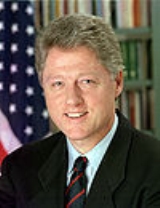
Presidency of Bill Clinton

Encyclopedia
The United States Presidency
of Bill Clinton
, also known as the Clinton Administration, was the executive branch
of the federal government of the United States
from January 20, 1993 to January 20, 2001. Clinton was the first Democratic president since Franklin D. Roosevelt
to win a second full term. Clinton was also the first president since FDR and the last until current President Barack Obama
to have not served in the military in any capacity; of his predecessors, all served in some capacity during World War II, apart from Harry Truman, who served in World War I, and Jimmy Carter
, who served six years in the Navy
upon graduating from the Naval Academy
.
The administration faced political opposition in 1994 when Republicans took control of both houses of Congress
but Clinton was reelected in 1996
, after a failed attempt at health care reform. The administration had a mixed record on taxes but produced the first federal budget surpluses since 1969, for fiscal years 1998, 1999, 2000, and 2001, leading to a decrease in the public debt (though the gross federal debt continued to increase). Clinton supported the North American Free Trade Agreement
, which he signed into law in 1994. His presidency saw the passage of welfare reform in Personal Responsibility and Work Opportunity Act
which ended Aid to Families with Dependent Children
and reduced much needed welfare programs. This received support from both political parties. He also signed the reversal of the Glass-Steagall Act
which was designed to prevent financial institutions from getting too big to fail. He also signed the Commodity Futures Modernization Act
which legalized over-the-counter derivatives. Clinton saw the escalation of the War on Drugs
prompting a swell in the prison population from 1.4 to 2 million.
Socially, the administration began with efforts by Clinton to allow gays and lesbians to serve openly in the military, which culminated in a compromise known as "Don't ask, don't tell
", theoretically allowing gays and lesbians to serve in the military if they did not disclose their sexual orientation (the policy was repealed in 2010
). However Bill Clinton signed the Defense of Marriage Act
, considered by many to be a blow to the LGBT rights movement. A couple of measures were introduced to improve the effectiveness of the social safety net, including an increase in the number of child care places, a significant expansion of the EITC
program, and the introduction of new programs such as SCHIP, and a child tax credit.
The administration took office less than two years after the fall of the Soviet Union
, and the administration's foreign policy addressed conflicts in Somalia, Rwanda, Bosnia and Herzegovina, Kosovo, and Haiti through militarism and economic exploitation. The Clinton presidency also saw the passage and signing of the Iraq Liberation Act
of 1998 which was a bipartisan measure expressing support for regime change
in Iraq. On three separate occasions, in 1996, 1998, and 2000, the administration unsuccessfully attempted to capture or assassinate Osama Bin Laden
, who was eventually killed by U.S. special forces
in 2011.
Clinton considered himself a "New Democrat" and was a founding member of the Democratic Leadership Council
, a centrist
group of Democrats
, who promoted moderate policies. Clinton left office with the highest end of office approval rating of any president since World War II, but he was the first US president to be impeached
since Andrew Johnson
, and only the second in US history, as a result of the Lewinsky scandal
, though like Johnson, he was acquitted by the Senate.
In his first address to the nation on February 15, 1993, Clinton announced his intention to raise taxes to cap the budget deficit.
On February 17, 1993, in a nationally televised address to a joint session of Congress, Clinton unveiled his economic plan. The plan focused on deficit reduction rather than a middle class tax cut, which had been high on his campaign agenda. (Clinton was pressured by his advisers, including Robert Rubin formerly of Goldman Sachs, to raise taxes on the theory that a smaller federal budget deficit would reduce bond interest rates.)
The transition period and the first few weeks of the administration in the White House
were full of difficulties and drama. In particular, finding someone for the high-profile United States Attorney General
position proved problematic.
Clinton had vowed to assemble an administration that "looked like America", and it was widely assumed that one of the major cabinet posts would go to a woman; Clinton soon decided the Attorney General position would be that, something women's political action groups were also requesting. Many administration officials reported later that Clinton initially considered nominating the First Lady Hillary Clinton, a prominent attorney, professor, activist, and executive, for Attorney General; however anti-nepotism laws put in place in 1967 after president John F. Kennedy
successfully appointed his brother Robert F. Kennedy
attorney general prohibited this.) Clinton chose little-known corporate lawyer Zoë Baird
for the slot, but in what became known as the Nannygate
matter, in January 1993 it was revealed that she had hired two illegal immigrants, a Peru
vian couple to work in her home. Baird's case provoked common resentment among a large group of people, who flooded the United States Congress
and radio programs demanding to know how Clinton could name as the nation's senior law officer a woman who had ignored the law.
Baird, seeing the problems the issue was causing for Clinton, withdrew her nomination and Clinton next chose Kimba Wood
, who was quickly forced to withdraw due to somewhat similar problems. This led to over a thousand presidential appointment positions being subjected to heightened scrutiny for household help hiring practices, and a consequent significant slowdown in getting new administration positions filled. Janet Reno
was nominated for Attorney General a few weeks later, and was confirmed on March 11, 1993.
Clinton's attempt to fulfill his campaign promise of allowing openly gay men and lesbians
serving in the armed forces was the subject of criticism.
His handling of the issue garnered criticism from both the left (for being too tentative in promoting gay rights) and the right (for being too insensitive to military life). After much debate, the Congress—which has sole power under the U.S. Constitution to regulate the armed forces—implemented the "Don't ask, don't tell
" policy, stating that homosexual men and women may serve in the military as long as their sexuality is kept secret. By 1999, Clinton said what he would "like to do is focus on making the policy we announced back in 1993 work the way it's intended to, because it's out of whack now, and I don't think any serious person could say it's not."
Some gay rights advocates criticized Clinton for not going far enough and accused him of making his campaign promise simply to get votes and contributions.
These advocates felt Clinton should have integrated the military by executive order, noting that President Harry S. Truman
ended segregation of the armed forces in that manner. However on January 27, a small delegation had visited the White House and told Clinton that if he tried to force a change by executive order, Congress would pass a bill, with a veto-proof majority, writing the existing policy into law.
Clinton's defenders argued that this would make it potentially harder to integrate the military in the future. Critics, however, said that the issue was one that should be experimented on in society as a whole, not in the military. The military's goal was not to be a "social Petri dish," but to defend the nation.
Nannygate, gays in the military, the dropping of a promised middle-class tax cut, and a couple of other issues all thus contributed to a difficult introduction of the Clinton presidency. Clinton experienced the highest disapproval ratings at the start of any presidency since such polling began. His "presidential honeymoon" period was thus extremely brief.
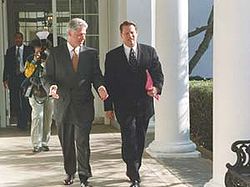 Shortly after taking office, Clinton signed the Family and Medical Leave Act of 1993
, which required large employers to allow their employees to take unpaid leave because of pregnancy or serious medical condition. A few weeks later, Clinton had to deal with the aftermath of the World Trade Center bombing.
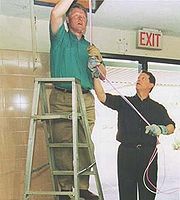 The Clinton-Gore administration launched the first official White House
website on October 21, 1994.
It would be followed by three more versions, resulting in the final edition launched in 2000.
The White House website was part of a general movement by this administration towards web based communication: "Clinton and Gore were responsible for pressing almost all federal agencies, the U.S. court system and the U.S. military onto the Internet, thus opening up America's government to more of America's citizens than ever before. On July 17, 1996. President Clinton issued Executive Order 13011 – Federal Information Technology, ordering the heads of all federal agencies to fully utilize information technology to make the information of the agency easily accessible to the public."
On March 9, 1996, Clinton and Gore participated in NetDay
'96, spending the day at Ygnacio Valley High School
, as part of the drive to connect California public schools to the Internet. In a speech given at YVH, Clinton stated that he was excited to see that his challenge the previous September to "Californians to connect at least 20% of your schools to the Information Superhighway
by the end of this school year" was met. Clinton also described this event as part of a time of "absolutely astonishing transformation; a moment of great possibility. All of you know that the information and technology explosion will offer to you and to the young people of the future more opportunities and challenges than any generation of Americans has ever seen."
Clinton promoted another controversial issue during this period: one regarding free trade. In 1993, Clinton supported the North American Free Trade Agreement
for ratification by the U.S. Senate. Despite being negotiated by his Republican predecessor, Clinton (along with most of his Democratic Leadership Committee allies) strongly supported free trade measures. Opposition came from both anti-trade Republicans, protectionist Democrats and supporters of Ross Perot. Ultimately, the treaty was ratified.
 Clinton signed the Brady Bill, which imposed a five-day waiting period on handgun purchases.
One of the prominent items on Clinton's legislative agenda, however, was a health care reform plan
, the result of a taskforce headed by First Lady Hillary Rodham Clinton
, aimed at achieving universal coverage via a national healthcare plan. Though initially well-received in political circles, it was ultimately doomed by well-organized opposition from conservatives, the American Medical Association
, and the health insurance industry. Despite his party holding a majority in the House and Senate, the effort to create a national healthcare system ultimately died under heavy public pressure. It was the first major legislative defeat of Clinton's administration.
Two months later, after two years of Democratic party control under Clinton's leadership, the mid-term elections in 1994 proved disastrous for the Democrats. This was the first time the democratic party had lost control of both houses of Congress in 40 years.
One of Clinton's major policy initiatives in his first term was on the American economy. Clinton's economic plan included a major expansion of the existing Earned Income Tax Credit
, aimed at working class families just above the poverty line, which helped ensure that it made sense for them to work rather than seek welfare. John F Harris, argues that "this would be prove to be one of the most important and tangible progressive achievements of the Clinton years".
A major problem with the economy at the time was the issue of the massive deficit and the problem of government spending. In order to address these issues, in August 1993, Clinton signed the Omnibus Budget Reconciliation Act of 1993
which passed Congress without a single Republican vote. It raised taxes on the wealthiest 1.2% of taxpayers, while cutting taxes on 15 million low-income families and making tax cuts available to 90% of small businesses.
Additionally, it mandated that the budget be balanced over a number of years and the deficit be reduced.
This was to be achieved through the implementation of spending restraints.
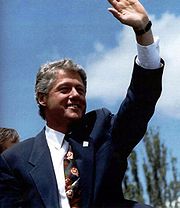 In the 1996 presidential election
a few months later, Clinton was re-elected, receiving 49.2% of the popular vote over Republican Bob Dole
(40.7% of the popular vote) and Reform candidate Ross Perot
(8.4% of the popular vote), becoming the first Democrat to win reelection to the presidency since Franklin Roosevelt. The Republicans lost a few seats in the House and gained a few in the Senate, but overall retained control of the Congress.
In 1997, Clinton finally had a chance to sign a major health care bill into law. The State Children's Health Insurance Program
, passed through the efforts of First Lady Hillary Rodham Clinton (who wrote and chaired the task force on the unsuccessful universal plan in the first two years of the Clinton Administration), Senator Ted Kennedy
, and Senator Orrin Hatch
, expanded coverage to approximately six-million children. Also, through the First Lady's work, childhood immunizations reached over 90% and funding for research on Gulf War Syndrome
, breast cancer, prostate cancer
, and asthma
was increased.
Throughout 1998 there was a controversy over Clinton's relationship with a young White House intern, Monica Lewinsky
. Clinton initially denied the affair while testifying in the Paula Jones sexual harassment lawsuit. The opposing lawyers asked the president about it during his deposition. He stated "I have never had sexual relations with Monica Lewinsky. I've never had an affair with her." Four days later he also said, "There is not a sexual relationship, an improper sexual relationship, or any other kind of improper relationship."
Clinton then appeared on national television on January 26 and stated: "Listen to me, I'm going to say this again. I did not have sexual relations with that woman, Miss Lewinsky." However, after it was revealed that investigators had obtained a semen-stained dress as well as testimony from Lewinsky, Clinton changed tactics and admitted that an improper relationship with Lewinsky had taken place: "Indeed I did have a relationship with Miss Lewinsky that was not appropriate. In fact, it was wrong. It constituted a critical lapse in judgment and a personal failure on my part for which I am solely and completely responsible."
Faced with overwhelming evidence, he apologized to the nation, agreed to pay a $25,000 court fine, settled his sexual harassment lawsuit with Paula Jones
for $850,000 and was temporarily disbarred, for a period of five years, from practicing law in Arkansas and before the U.S. Supreme Court. He was not tried for perjury in a court. However, he did admit to "testifying falsely" in a carefully worded statement as part of a deal to avoid indictment for perjury.
In a lame duck
session after the 1998 elections, the Republican-controlled House voted to impeach Clinton. The next year, the Senate voted to acquit Clinton, and he remained in office.
The Digital Millennium Copyright Act
, enacted by Clinton on October 21, 1998, served as the first significant amendment to the Copyright Act since 1976. The DMCA provided a framework for sound recording copyright owners
and recording artists to seek public performance royalties under statute, which proved to be a landmark achievement for the recording industry.
 After initial successes following the election of Yitzhak Rabin
in Israel and the signing of the Oslo Accords
in 1993, the Middle East peace process deteriorated over time, breaking down completely with the start of the Second Intifada, and the election of Ariel Sharon
. In the closing year of his Administration, Clinton again attempted to address the Arab-Israeli conflict. Clinton brought newly elected Israeli Prime Minister Ehud Barak
and Palestinian Authority Chairman Yasser Arafat
together at the 2000 Camp David Summit. These negotiations proved unsuccessful, however.
The Elián González affair took prominent stage during early 2000. When his family fled from communist Cuba, the boy survived a boat wreck but his mother died, setting off an international legal fight for where the boy should stay. Eventually the administration, via Janet Reno
, had González returned to Cuba.
Clinton issued 141 pardons and 36 commutations on his last day in office on January 20, 2001. Most of the controversy surrounded Marc Rich
and allegations that Hillary Clinton's brother, Hugh Rodham
, accepted payments in return for influencing the president's decision-making regarding the pardons. Some of Clinton's pardons remain a point of controversy. While the administration saw the expansion of the federal death penalty, which Clinton supported, and the end of his tenure he became the first president since John F. Kennedy
(who had commuted the military death sentence of seaman Jimmie Henderson) to issue a presidential commutation of a death sentence when he commuted the sentence of David Ronald Chandler to life imprisonment without parole, and ordered a review of a possibly racial disparity in the application of the federal death penalty.
Before George W. Bush
took office on January 20, 2001, White House staff caused $15,000 worth of damage to the White House, ripping phone cords from the walls, defacing bathrooms, leaving obscene voicemail messages, and removing the "W" keys from the keyboards.
Clinton remained popular with the public throughout his two terms as President, ending his presidential career with a 65% approval rating, the highest end-of-term approval rating of any President since Dwight D. Eisenhower
. In addition to his political skills, Clinton also benefited from a boom of the US economy. Under Clinton, the United States had a projected federal budget surplus for the first time since 1969 in the 1998 federal budget; the budgets for 1999, 2000, and 2001 also had surpluses. As a result of this, the public debt decreased, though the gross federal debt continued to increase.
, opined that:
In proposing a plan to cut the deficit, Clinton submitted a budget that would cut the deficit by $500 billion over five years by reducing $255 billion of spending and raising taxes on the wealthiest 1.2% of Americans. It also imposed a new energy tax on all Americans and subjected about a quarter of those receiving Social Security payments to higher taxes on their benefits.
Republican Congressional leaders launched an aggressive opposition against the bill, claiming that the tax increase would only make matters worse. Republicans were united in this opposition, as it were, and every Republican in both houses of Congress voted against the proposal. In fact, it took Vice President Gore's tie-breaking vote in the Senate to pass the bill. After extensive lobbying by the Clinton Administration, the House narrowly voted in favor of the bill by a vote of 218 to 216. The budget package expanded the Earned Income Tax Credit
(EITC) as relief to low-income families. It reduced the amount they paid in federal income and Federal Insurance Contributions Act tax
(FICA), providing $21 billion in relief for 15 million low-income families. Improved economic conditions and policies served to encourage investors in the bond market, leading to a decline in long-term interest rates. Clinton's final four budgets were balanced budget
s with surpluses, beginning with the 1998 budget, which was the first balanced budget since 1969. The surplus money was used to pay down the public debt by $452 billion, though the gross federal debt continued to increase. The economy continued to grow, and in February 2000 it broke the record for the longest uninterrupted economic expansion in U.S. history, which began during George H. W. Bush
's presidency.
After Republicans won control of Congress in 1994, Clinton vehemently fought their proposed tax cuts, believing that they favored the wealthy and would weaken economic growth. In August 1997, however, Clinton and Congressional Republicans were finally able to reach a compromise on a bill that reduced capital gain and estate taxes and gave taxpayers a credit of $500 per child and tax credits for college tuition and expenses. The bill also called for a new individual retirement account (IRA) called the Roth IRA
to allow people to invest taxed income for retirement without having to pay taxes upon withdrawal. Additionally, the law raised the national minimum for cigarette taxes. The next year, Congress approved Clinton's proposal to make college more affordable by expanding federal student financial aid through Pell Grants, and lowering interest rates on student loans.
Clinton also battled Congress nearly every session on the federal budget, in an attempt to secure spending on education, government entitlements, the environment, and AmeriCorps
–the national service program that was passed by the Democratic Congress in the early days of the Clinton administration. The two sides, however, could not find a compromise and the budget battle came to a stalemate in 1995 over proposed cuts in Medicare
, Medicaid
, education, and the environment. After Clinton vetoed numerous Republican spending bills, Republicans in Congress twice refused to pass temporary spending authorizations, forcing the federal government to partially shut down because agencies had no budget on which to operate.
In April 1996, Clinton and Congress finally agreed on a budget that provided money for government agencies until the end of the fiscal year in October. The budget included some of the spending cuts that the Republicans supported (decreasing the cost of cultural, labor, and housing programs) but also preserved many programs that Clinton wanted, including educational and environmental ones.
 The Clinton presidency claims responsibility for the following:
The three-nation NAFTA was signed by President George H. W. Bush during December 1992, pending its ratification by the legislatures of the three countries. Clinton did not alter the original agreement, but complemented it with the North American Agreement on Environmental Cooperation and the North American Agreement on Labor Cooperation, making NAFTA the first "green" trade treaty and the first trade treaty concerned with each country's labor laws, albeit with very weak sanctions. NAFTA provided for gradually reduced tariffs and the creation of a free-trading bloc of North American countries–the United States, Canada, and Mexico
. Opponents of NAFTA, led by Ross Perot, claimed it would force American companies to move their workforces to Mexico, where they could produce goods with cheaper labor and ship them back to the United States at lower prices. Clinton, however, argued that NAFTA would increase U.S. exports and create new jobs. Clinton while signing the NAFTA bill stated: "…NAFTA means jobs.
American jobs, and good-paying American jobs. If I didn't believe
that, I wouldn't support this agreement.”
He convinced many Democrats to join most Republicans in supporting trade agreement and in 1993 the Congress passed the treaty.
Clinton also held meetings with leaders of Pacific Rim
nations to discuss lowering trade barriers. In November 1993 he hosted a meeting of the Asia-Pacific Economic Cooperation
(APEC) in Seattle, Washington, which was attended by the leaders of 12 Pacific Rim nations. In 1994, Clinton arranged an agreement in Indonesia
with Pacific Rim nations to gradually remove trade barriers and open their markets.
Officials in the Clinton administration also participated in the final round of trade negotiations sponsored by the General Agreement on Tariffs and Trade
(GATT), an international trade organization. The negotiations had been ongoing since 1986. In a rare move, Clinton convened Congress to ratify the trade agreement in the winter of 1994, during which the treaty was approved. As part of the GATT agreement, a new international trade body, the World Trade Organization
(WTO), replaced GATT in 1995. The new WTO had stronger authority to enforce trade agreements and covered a wider range of trade than did GATT.
Clinton faced his first defeat on trade legislation during his second term. In November 1997, the Republican-controlled Congress delayed voting on a bill to restore a presidential trade authority that had expired in 1994. The bill would have given the president the authority to negotiate trade agreements which the Congress was not authorized to modify–known as "fast-track negotiating" because it streamlines the treaty process. Clinton was unable to generate sufficient support for the legislation, even among the Democratic Party.
Clinton faced yet another trade setback in December 1999, when the WTO met in Seattle for a new round of trade negotiations. Clinton hoped that new agreements on issues such as agriculture and intellectual property could be proposed at the meeting, but the talks fell through. Anti-WTO protesters in the streets of Seattle disrupted the meetings and the international delegates attending the meetings were unable to compromise mainly because delegates from smaller, poorer countries resisted Clinton's efforts to discuss labor and environmental standards.
That same year, Clinton signed a landmark trade agreement with the People's Republic of China. The agreement–the result of more than a decade of negotiations–would lower many trade barriers between the two countries, making it easier to export U.S. products such as automobiles, banking services, and motion pictures. However, the agreement could only take effect if China was accepted into the WTO and was granted permanent "normal trade relations" status by the U.S. Congress. Under the pact, the United States would support China's membership in the WTO. Many Democrats as well as Republicans were reluctant to grant permanent status to China because they were concerned about human rights in the country and the impact of Chinese imports on U.S. industries and jobs. Congress, however, voted in 2000 to grant permanent normal trade relations with China. Several economic studies have since been released that indicate the increase in trade resulting lowered American prices and increased the U.S. GDP by 0.7% throughout the following decade.
The Clinton administration negotiated a total of about 300 trade agreements with other countries. Clinton's last treasury secretary, Lawrence Summers
, stated that the lowered tariffs that resulted from Clinton's trade policies, which reduced prices to consumers and kept inflation low, were technically "the largest tax cut in the history of the world."
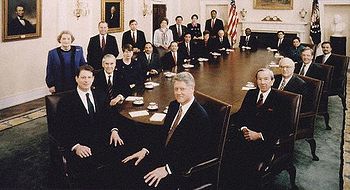
:
in the Clinton-Gore administration.
President of the United States
The President of the United States of America is the head of state and head of government of the United States. The president leads the executive branch of the federal government and is the commander-in-chief of the United States Armed Forces....
of Bill Clinton
Bill Clinton
William Jefferson "Bill" Clinton is an American politician who served as the 42nd President of the United States from 1993 to 2001. Inaugurated at age 46, he was the third-youngest president. He took office at the end of the Cold War, and was the first president of the baby boomer generation...
, also known as the Clinton Administration, was the executive branch
Executive (government)
Executive branch of Government is the part of government that has sole authority and responsibility for the daily administration of the state bureaucracy. The division of power into separate branches of government is central to the idea of the separation of powers.In many countries, the term...
of the federal government of the United States
Federal government of the United States
The federal government of the United States is the national government of the constitutional republic of fifty states that is the United States of America. The federal government comprises three distinct branches of government: a legislative, an executive and a judiciary. These branches and...
from January 20, 1993 to January 20, 2001. Clinton was the first Democratic president since Franklin D. Roosevelt
Franklin D. Roosevelt
Franklin Delano Roosevelt , also known by his initials, FDR, was the 32nd President of the United States and a central figure in world events during the mid-20th century, leading the United States during a time of worldwide economic crisis and world war...
to win a second full term. Clinton was also the first president since FDR and the last until current President Barack Obama
Barack Obama
Barack Hussein Obama II is the 44th and current President of the United States. He is the first African American to hold the office. Obama previously served as a United States Senator from Illinois, from January 2005 until he resigned following his victory in the 2008 presidential election.Born in...
to have not served in the military in any capacity; of his predecessors, all served in some capacity during World War II, apart from Harry Truman, who served in World War I, and Jimmy Carter
Jimmy Carter
James Earl "Jimmy" Carter, Jr. is an American politician who served as the 39th President of the United States and was the recipient of the 2002 Nobel Peace Prize, the only U.S. President to have received the Prize after leaving office...
, who served six years in the Navy
United States Navy
The United States Navy is the naval warfare service branch of the United States Armed Forces and one of the seven uniformed services of the United States. The U.S. Navy is the largest in the world; its battle fleet tonnage is greater than that of the next 13 largest navies combined. The U.S...
upon graduating from the Naval Academy
United States Naval Academy
The United States Naval Academy is a four-year coeducational federal service academy located in Annapolis, Maryland, United States...
.
The administration faced political opposition in 1994 when Republicans took control of both houses of Congress
Republican Revolution
The Republican Revolution or Revolution of '94 is what the media dubbed Republican Party success in the 1994 U.S. midterm elections, which resulted in a net gain of 54 seats in the House of Representatives, and a pickup of eight seats in the Senate...
but Clinton was reelected in 1996
United States presidential election, 1996
The United States presidential election of 1996 was a contest between the Democratic national ticket of President Bill Clinton of Arkansas and Vice President Al Gore of Tennessee and the Republican national ticket of former Senator Bob Dole of Kansas for President and former Housing Secretary Jack...
, after a failed attempt at health care reform. The administration had a mixed record on taxes but produced the first federal budget surpluses since 1969, for fiscal years 1998, 1999, 2000, and 2001, leading to a decrease in the public debt (though the gross federal debt continued to increase). Clinton supported the North American Free Trade Agreement
North American Free Trade Agreement
The North American Free Trade Agreement or NAFTA is an agreement signed by the governments of Canada, Mexico, and the United States, creating a trilateral trade bloc in North America. The agreement came into force on January 1, 1994. It superseded the Canada – United States Free Trade Agreement...
, which he signed into law in 1994. His presidency saw the passage of welfare reform in Personal Responsibility and Work Opportunity Act
Personal Responsibility and Work Opportunity Act
The Personal Responsibility and Work Opportunity Reconciliation Act of 1996 is a United States federal law considered to be a fundamental shift in both the method and goal of federal cash assistance to the poor. The bill added a workforce development component to welfare legislation, encouraging...
which ended Aid to Families with Dependent Children
Aid to Families with Dependent Children
Aid to Families with Dependent Children was a federal assistance program in effect from 1935 to 1996, which was administered by the United States Department of Health and Human Services...
and reduced much needed welfare programs. This received support from both political parties. He also signed the reversal of the Glass-Steagall Act
Glass-Steagall Act
The Banking Act of 1933, , was a law that established the Federal Deposit Insurance Corporation in the United States and introduced banking reforms, some of which were designed to control speculation. It is most commonly known as the Glass–Steagall Act, after its legislative sponsors, Senator...
which was designed to prevent financial institutions from getting too big to fail. He also signed the Commodity Futures Modernization Act
Commodity Futures Modernization Act of 2000
The Commodity Futures Modernization Act of 2000 is United States federal legislation that officially ensured the deregulation of financial products known as over-the-counter derivatives. It was signed into law on December 21, 2000 by President Bill Clinton...
which legalized over-the-counter derivatives. Clinton saw the escalation of the War on Drugs
War on Drugs
The War on Drugs is a campaign of prohibition and foreign military aid and military intervention being undertaken by the United States government, with the assistance of participating countries, intended to both define and reduce the illegal drug trade...
prompting a swell in the prison population from 1.4 to 2 million.
Socially, the administration began with efforts by Clinton to allow gays and lesbians to serve openly in the military, which culminated in a compromise known as "Don't ask, don't tell
Don't ask, don't tell
"Don't ask, don't tell" was the official United States policy on homosexuals serving in the military from December 21, 1993 to September 20, 2011. The policy prohibited military personnel from discriminating against or harassing closeted homosexual or bisexual service members or applicants, while...
", theoretically allowing gays and lesbians to serve in the military if they did not disclose their sexual orientation (the policy was repealed in 2010
Don't Ask, Don't Tell Repeal Act of 2010
The Don't Ask, Don't Tell Repeal Act of 2010 is a landmark federal statute that establishes a legal process for ending the Don't ask, don't tell policy , which since 1993 prevented openly gay and lesbian people from serving in the United States Armed Forces.The Act did not immediately repeal the...
). However Bill Clinton signed the Defense of Marriage Act
Defense of Marriage Act
The Defense of Marriage Act is a United States federal law whereby the federal government defines marriage as a legal union between one man and one woman. Under the law, no U.S. state may be required to recognize as a marriage a same-sex relationship considered a marriage in another state...
, considered by many to be a blow to the LGBT rights movement. A couple of measures were introduced to improve the effectiveness of the social safety net, including an increase in the number of child care places, a significant expansion of the EITC
EITC
EITC may refer to:*Earned Income Tax Credit*East India Trading Company*Educational Improvement Tax Credit, a Pennsylvania school choice legislative initiative*Eastern Idaho Technical College, a public college in Idaho Falls, Idaho, USA...
program, and the introduction of new programs such as SCHIP, and a child tax credit.
The administration took office less than two years after the fall of the Soviet Union
Dissolution of the Soviet Union
The dissolution of the Soviet Union was the disintegration of the federal political structures and central government of the Union of Soviet Socialist Republics , resulting in the independence of all fifteen republics of the Soviet Union between March 11, 1990 and December 25, 1991...
, and the administration's foreign policy addressed conflicts in Somalia, Rwanda, Bosnia and Herzegovina, Kosovo, and Haiti through militarism and economic exploitation. The Clinton presidency also saw the passage and signing of the Iraq Liberation Act
Iraq Liberation Act
The Iraq Liberation Act of 1998 is a United States Congressional statement of policy calling for regime change in Iraq. It was signed into law by President Bill Clinton, and states that it is the policy of the United States to support democratic movements within Iraq...
of 1998 which was a bipartisan measure expressing support for regime change
Regime change
"Regime change" is the replacement of one regime with another. Use of the term dates to at least 1925.Regime change can occur through conquest by a foreign power, revolution, coup d'état or reconstruction following the failure of a state...
in Iraq. On three separate occasions, in 1996, 1998, and 2000, the administration unsuccessfully attempted to capture or assassinate Osama Bin Laden
Osama bin Laden
Osama bin Mohammed bin Awad bin Laden was the founder of the militant Islamist organization Al-Qaeda, the jihadist organization responsible for the September 11 attacks on the United States and numerous other mass-casualty attacks against civilian and military targets...
, who was eventually killed by U.S. special forces
Death of Osama bin Laden
Osama bin Laden, then head of the Islamist militant group al-Qaeda, was killed in Pakistan on May 2, 2011, shortly after 1 a.m. local time by a United States special forces military unit....
in 2011.
Clinton considered himself a "New Democrat" and was a founding member of the Democratic Leadership Council
Democratic Leadership Council
The Democratic Leadership Council was a non-profit 501 corporation that, upon its formation, argued the United States Democratic Party should shift away from the leftward turn it took in the late 1960s, 1970s, and 1980s...
, a centrist
Centrism
In politics, centrism is the ideal or the practice of promoting policies that lie different from the standard political left and political right. Most commonly, this is visualized as part of the one-dimensional political spectrum of left-right politics, with centrism landing in the middle between...
group of Democrats
Democratic Party (United States)
The Democratic Party is one of two major contemporary political parties in the United States, along with the Republican Party. The party's socially liberal and progressive platform is largely considered center-left in the U.S. political spectrum. The party has the lengthiest record of continuous...
, who promoted moderate policies. Clinton left office with the highest end of office approval rating of any president since World War II, but he was the first US president to be impeached
Impeachment
Impeachment is a formal process in which an official is accused of unlawful activity, the outcome of which, depending on the country, may include the removal of that official from office as well as other punishment....
since Andrew Johnson
Andrew Johnson
Andrew Johnson was the 17th President of the United States . As Vice-President of the United States in 1865, he succeeded Abraham Lincoln following the latter's assassination. Johnson then presided over the initial and contentious Reconstruction era of the United States following the American...
, and only the second in US history, as a result of the Lewinsky scandal
Lewinsky scandal
The Lewinsky scandal was a political sex scandal emerging in 1998 from a sexual relationship between United States President Bill Clinton and a 25-year-old White House intern, Monica Lewinsky. The news of this extra-marital affair and the resulting investigation eventually led to the impeachment of...
, though like Johnson, he was acquitted by the Senate.
First Term (1993–1997)
1993 saw the start of America's first Democratic Presidency in a dozen years.In his first address to the nation on February 15, 1993, Clinton announced his intention to raise taxes to cap the budget deficit.
On February 17, 1993, in a nationally televised address to a joint session of Congress, Clinton unveiled his economic plan. The plan focused on deficit reduction rather than a middle class tax cut, which had been high on his campaign agenda. (Clinton was pressured by his advisers, including Robert Rubin formerly of Goldman Sachs, to raise taxes on the theory that a smaller federal budget deficit would reduce bond interest rates.)
The transition period and the first few weeks of the administration in the White House
White House
The White House is the official residence and principal workplace of the president of the United States. Located at 1600 Pennsylvania Avenue NW in Washington, D.C., the house was designed by Irish-born James Hoban, and built between 1792 and 1800 of white-painted Aquia sandstone in the Neoclassical...
were full of difficulties and drama. In particular, finding someone for the high-profile United States Attorney General
United States Attorney General
The United States Attorney General is the head of the United States Department of Justice concerned with legal affairs and is the chief law enforcement officer of the United States government. The attorney general is considered to be the chief lawyer of the U.S. government...
position proved problematic.
Clinton had vowed to assemble an administration that "looked like America", and it was widely assumed that one of the major cabinet posts would go to a woman; Clinton soon decided the Attorney General position would be that, something women's political action groups were also requesting. Many administration officials reported later that Clinton initially considered nominating the First Lady Hillary Clinton, a prominent attorney, professor, activist, and executive, for Attorney General; however anti-nepotism laws put in place in 1967 after president John F. Kennedy
John F. Kennedy
John Fitzgerald "Jack" Kennedy , often referred to by his initials JFK, was the 35th President of the United States, serving from 1961 until his assassination in 1963....
successfully appointed his brother Robert F. Kennedy
Robert F. Kennedy
Robert Francis "Bobby" Kennedy , also referred to by his initials RFK, was an American politician, a Democratic senator from New York, and a noted civil rights activist. An icon of modern American liberalism and member of the Kennedy family, he was a younger brother of President John F...
attorney general prohibited this.) Clinton chose little-known corporate lawyer Zoë Baird
Zoë Baird
Zoë Eliot Baird is an American lawyer who is president of the Markle Foundation. She is most known for her role in the Nannygate matter of 1993.-Biography:...
for the slot, but in what became known as the Nannygate
Nannygate
Nannygate was a 1993 political controversy in the United States wherein the nomination of Zoë Baird, and near-nomination of Kimba Wood, for U.S. Attorney General were withdrawn due to the hiring of illegal aliens as nannies or the failure to pay taxes for them...
matter, in January 1993 it was revealed that she had hired two illegal immigrants, a Peru
Peru
Peru , officially the Republic of Peru , is a country in western South America. It is bordered on the north by Ecuador and Colombia, on the east by Brazil, on the southeast by Bolivia, on the south by Chile, and on the west by the Pacific Ocean....
vian couple to work in her home. Baird's case provoked common resentment among a large group of people, who flooded the United States Congress
United States Congress
The United States Congress is the bicameral legislature of the federal government of the United States, consisting of the Senate and the House of Representatives. The Congress meets in the United States Capitol in Washington, D.C....
and radio programs demanding to know how Clinton could name as the nation's senior law officer a woman who had ignored the law.
Baird, seeing the problems the issue was causing for Clinton, withdrew her nomination and Clinton next chose Kimba Wood
Kimba Wood
Kimba Maureen Wood is a United States federal judge for the United States District Court for the Southern District of New York.-Early life and education:...
, who was quickly forced to withdraw due to somewhat similar problems. This led to over a thousand presidential appointment positions being subjected to heightened scrutiny for household help hiring practices, and a consequent significant slowdown in getting new administration positions filled. Janet Reno
Janet Reno
Janet Wood Reno is a former Attorney General of the United States . She was nominated by President Bill Clinton on February 11, 1993, and confirmed on March 11...
was nominated for Attorney General a few weeks later, and was confirmed on March 11, 1993.
Clinton's attempt to fulfill his campaign promise of allowing openly gay men and lesbians
Homosexuality
Homosexuality is romantic or sexual attraction or behavior between members of the same sex or gender. As a sexual orientation, homosexuality refers to "an enduring pattern of or disposition to experience sexual, affectional, or romantic attractions" primarily or exclusively to people of the same...
serving in the armed forces was the subject of criticism.
His handling of the issue garnered criticism from both the left (for being too tentative in promoting gay rights) and the right (for being too insensitive to military life). After much debate, the Congress—which has sole power under the U.S. Constitution to regulate the armed forces—implemented the "Don't ask, don't tell
Don't ask, don't tell
"Don't ask, don't tell" was the official United States policy on homosexuals serving in the military from December 21, 1993 to September 20, 2011. The policy prohibited military personnel from discriminating against or harassing closeted homosexual or bisexual service members or applicants, while...
" policy, stating that homosexual men and women may serve in the military as long as their sexuality is kept secret. By 1999, Clinton said what he would "like to do is focus on making the policy we announced back in 1993 work the way it's intended to, because it's out of whack now, and I don't think any serious person could say it's not."
Some gay rights advocates criticized Clinton for not going far enough and accused him of making his campaign promise simply to get votes and contributions.
These advocates felt Clinton should have integrated the military by executive order, noting that President Harry S. Truman
Harry S. Truman
Harry S. Truman was the 33rd President of the United States . As President Franklin D. Roosevelt's third vice president and the 34th Vice President of the United States , he succeeded to the presidency on April 12, 1945, when President Roosevelt died less than three months after beginning his...
ended segregation of the armed forces in that manner. However on January 27, a small delegation had visited the White House and told Clinton that if he tried to force a change by executive order, Congress would pass a bill, with a veto-proof majority, writing the existing policy into law.
Clinton's defenders argued that this would make it potentially harder to integrate the military in the future. Critics, however, said that the issue was one that should be experimented on in society as a whole, not in the military. The military's goal was not to be a "social Petri dish," but to defend the nation.
Nannygate, gays in the military, the dropping of a promised middle-class tax cut, and a couple of other issues all thus contributed to a difficult introduction of the Clinton presidency. Clinton experienced the highest disapproval ratings at the start of any presidency since such polling began. His "presidential honeymoon" period was thus extremely brief.
Family and Medical Leave Act of 1993
The Family and Medical Leave Act of 1993 is a United States federal law requiring covered employers to provide employees job-protected unpaid leave for qualified medical and family reasons. These reasons include personal or family illness, military service, family military leave, pregnancy,...
, which required large employers to allow their employees to take unpaid leave because of pregnancy or serious medical condition. A few weeks later, Clinton had to deal with the aftermath of the World Trade Center bombing.
White House
The White House is the official residence and principal workplace of the president of the United States. Located at 1600 Pennsylvania Avenue NW in Washington, D.C., the house was designed by Irish-born James Hoban, and built between 1792 and 1800 of white-painted Aquia sandstone in the Neoclassical...
website on October 21, 1994.
It would be followed by three more versions, resulting in the final edition launched in 2000.
The White House website was part of a general movement by this administration towards web based communication: "Clinton and Gore were responsible for pressing almost all federal agencies, the U.S. court system and the U.S. military onto the Internet, thus opening up America's government to more of America's citizens than ever before. On July 17, 1996. President Clinton issued Executive Order 13011 – Federal Information Technology, ordering the heads of all federal agencies to fully utilize information technology to make the information of the agency easily accessible to the public."
On March 9, 1996, Clinton and Gore participated in NetDay
NetDay
NetDay was an event established in 1995 that "called on high-tech companies to commit resources to schools, libraries, and clinics worldwide so that they could connect to the Internet". It was developed by John Gage and activist Michael Kaufman...
'96, spending the day at Ygnacio Valley High School
Ygnacio Valley High School
Ygnacio Valley High School is a public secondary school located in Concord, California. It draws students from Concord as well as from the neighboring communities of Walnut Creek and Pleasant Hill. The school opened in 1962, and its first senior class graduated in 1964...
, as part of the drive to connect California public schools to the Internet. In a speech given at YVH, Clinton stated that he was excited to see that his challenge the previous September to "Californians to connect at least 20% of your schools to the Information Superhighway
Information superhighway
The information superhighway or infobahnwas a popular term used through the 1990s to refer to digital communication systems and the Internet telecommunications network. It is associated with United States Senator and later Vice-President Al Gore....
by the end of this school year" was met. Clinton also described this event as part of a time of "absolutely astonishing transformation; a moment of great possibility. All of you know that the information and technology explosion will offer to you and to the young people of the future more opportunities and challenges than any generation of Americans has ever seen."
Clinton promoted another controversial issue during this period: one regarding free trade. In 1993, Clinton supported the North American Free Trade Agreement
North American Free Trade Agreement
The North American Free Trade Agreement or NAFTA is an agreement signed by the governments of Canada, Mexico, and the United States, creating a trilateral trade bloc in North America. The agreement came into force on January 1, 1994. It superseded the Canada – United States Free Trade Agreement...
for ratification by the U.S. Senate. Despite being negotiated by his Republican predecessor, Clinton (along with most of his Democratic Leadership Committee allies) strongly supported free trade measures. Opposition came from both anti-trade Republicans, protectionist Democrats and supporters of Ross Perot. Ultimately, the treaty was ratified.
One of the prominent items on Clinton's legislative agenda, however, was a health care reform plan
Clinton health care plan
The Clinton health care plan was a 1993 healthcare reform package proposed by the administration of President Bill Clinton and closely associated with the chair of the task force devising the plan, First Lady of the United States Hillary Rodham Clinton....
, the result of a taskforce headed by First Lady Hillary Rodham Clinton
Hillary Rodham Clinton
Hillary Diane Rodham Clinton is the 67th United States Secretary of State, serving in the administration of President Barack Obama. She was a United States Senator for New York from 2001 to 2009. As the wife of the 42nd President of the United States, Bill Clinton, she was the First Lady of the...
, aimed at achieving universal coverage via a national healthcare plan. Though initially well-received in political circles, it was ultimately doomed by well-organized opposition from conservatives, the American Medical Association
American Medical Association
The American Medical Association , founded in 1847 and incorporated in 1897, is the largest association of medical doctors and medical students in the United States.-Scope and operations:...
, and the health insurance industry. Despite his party holding a majority in the House and Senate, the effort to create a national healthcare system ultimately died under heavy public pressure. It was the first major legislative defeat of Clinton's administration.
Two months later, after two years of Democratic party control under Clinton's leadership, the mid-term elections in 1994 proved disastrous for the Democrats. This was the first time the democratic party had lost control of both houses of Congress in 40 years.
One of Clinton's major policy initiatives in his first term was on the American economy. Clinton's economic plan included a major expansion of the existing Earned Income Tax Credit
Earned income tax credit
The United States federal earned income tax credit or earned income credit is a refundable tax credit primarily for individuals and families who have low to moderate earned income. Greater tax credit is given to those who also have qualifying children...
, aimed at working class families just above the poverty line, which helped ensure that it made sense for them to work rather than seek welfare. John F Harris, argues that "this would be prove to be one of the most important and tangible progressive achievements of the Clinton years".
A major problem with the economy at the time was the issue of the massive deficit and the problem of government spending. In order to address these issues, in August 1993, Clinton signed the Omnibus Budget Reconciliation Act of 1993
Omnibus Budget Reconciliation Act of 1993
The Omnibus Budget Reconciliation Act of 1993 was federal law that was enacted by the 103rd United States Congress and signed into law by President Bill Clinton. It has also been referred to, unofficially, as the Deficit Reduction Act of 1993...
which passed Congress without a single Republican vote. It raised taxes on the wealthiest 1.2% of taxpayers, while cutting taxes on 15 million low-income families and making tax cuts available to 90% of small businesses.
Additionally, it mandated that the budget be balanced over a number of years and the deficit be reduced.
This was to be achieved through the implementation of spending restraints.
Second Term (1997–2001)
United States presidential election, 1996
The United States presidential election of 1996 was a contest between the Democratic national ticket of President Bill Clinton of Arkansas and Vice President Al Gore of Tennessee and the Republican national ticket of former Senator Bob Dole of Kansas for President and former Housing Secretary Jack...
a few months later, Clinton was re-elected, receiving 49.2% of the popular vote over Republican Bob Dole
Bob Dole
Robert Joseph "Bob" Dole is an American attorney and politician. Dole represented Kansas in the United States Senate from 1969 to 1996, was Gerald Ford's Vice Presidential running mate in the 1976 presidential election, and was Senate Majority Leader from 1985 to 1987 and in 1995 and 1996...
(40.7% of the popular vote) and Reform candidate Ross Perot
Ross Perot
Henry Ross Perot is a U.S. businessman best known for running for President of the United States in 1992 and 1996. Perot founded Electronic Data Systems in 1962, sold the company to General Motors in 1984, and founded Perot Systems in 1988...
(8.4% of the popular vote), becoming the first Democrat to win reelection to the presidency since Franklin Roosevelt. The Republicans lost a few seats in the House and gained a few in the Senate, but overall retained control of the Congress.
In 1997, Clinton finally had a chance to sign a major health care bill into law. The State Children's Health Insurance Program
State Children's Health Insurance Program
The State Children's Health Insurance Program – later known more simply as the Children's Health Insurance Program – is a program administered by the United States Department of Health and Human Services that provides matching funds to states for health insurance to families with children...
, passed through the efforts of First Lady Hillary Rodham Clinton (who wrote and chaired the task force on the unsuccessful universal plan in the first two years of the Clinton Administration), Senator Ted Kennedy
Ted Kennedy
Edward Moore "Ted" Kennedy was a United States Senator from Massachusetts and a member of the Democratic Party. Serving almost 47 years, he was the second most senior member of the Senate when he died and is the fourth-longest-serving senator in United States history...
, and Senator Orrin Hatch
Orrin Hatch
Orrin Grant Hatch is the senior United States Senator for Utah and is a member of the Republican Party. Hatch served as the chairman or ranking member of the Senate Judiciary Committee from 1993 to 2005...
, expanded coverage to approximately six-million children. Also, through the First Lady's work, childhood immunizations reached over 90% and funding for research on Gulf War Syndrome
Gulf War syndrome
Gulf War syndrome or Gulf War illness describes a medical condition that affected veterans and civilians who were near conflicts during or downwind of chemical weapons depot demolition, after the 1991 Gulf War. A wide range of acute and chronic symptoms have included fatigue, musculoskeletal...
, breast cancer, prostate cancer
Prostate cancer
Prostate cancer is a form of cancer that develops in the prostate, a gland in the male reproductive system. Most prostate cancers are slow growing; however, there are cases of aggressive prostate cancers. The cancer cells may metastasize from the prostate to other parts of the body, particularly...
, and asthma
Asthma
Asthma is the common chronic inflammatory disease of the airways characterized by variable and recurring symptoms, reversible airflow obstruction, and bronchospasm. Symptoms include wheezing, coughing, chest tightness, and shortness of breath...
was increased.
Throughout 1998 there was a controversy over Clinton's relationship with a young White House intern, Monica Lewinsky
Monica Lewinsky
Monica Samille Lewinsky is an American woman with whom United States President Bill Clinton admitted to having had an "improper relationship" while she worked at the White House in 1995 and 1996...
. Clinton initially denied the affair while testifying in the Paula Jones sexual harassment lawsuit. The opposing lawyers asked the president about it during his deposition. He stated "I have never had sexual relations with Monica Lewinsky. I've never had an affair with her." Four days later he also said, "There is not a sexual relationship, an improper sexual relationship, or any other kind of improper relationship."
Clinton then appeared on national television on January 26 and stated: "Listen to me, I'm going to say this again. I did not have sexual relations with that woman, Miss Lewinsky." However, after it was revealed that investigators had obtained a semen-stained dress as well as testimony from Lewinsky, Clinton changed tactics and admitted that an improper relationship with Lewinsky had taken place: "Indeed I did have a relationship with Miss Lewinsky that was not appropriate. In fact, it was wrong. It constituted a critical lapse in judgment and a personal failure on my part for which I am solely and completely responsible."
Faced with overwhelming evidence, he apologized to the nation, agreed to pay a $25,000 court fine, settled his sexual harassment lawsuit with Paula Jones
Paula Jones
Paula Corbin Jones is a former Arkansas state employee who sued U.S. President Bill Clinton for sexual harassment. The lawsuit was dismissed before trial on the grounds that Jones failed to demonstrate any damages...
for $850,000 and was temporarily disbarred, for a period of five years, from practicing law in Arkansas and before the U.S. Supreme Court. He was not tried for perjury in a court. However, he did admit to "testifying falsely" in a carefully worded statement as part of a deal to avoid indictment for perjury.
In a lame duck
Lame duck (politics)
A lame duck is an elected official who is approaching the end of his or her tenure, and especially an official whose successor has already been elected.-Description:The status can be due to*having lost a re-election bid...
session after the 1998 elections, the Republican-controlled House voted to impeach Clinton. The next year, the Senate voted to acquit Clinton, and he remained in office.
The Digital Millennium Copyright Act
Digital Millennium Copyright Act
The Digital Millennium Copyright Act is a United States copyright law that implements two 1996 treaties of the World Intellectual Property Organization . It criminalizes production and dissemination of technology, devices, or services intended to circumvent measures that control access to...
, enacted by Clinton on October 21, 1998, served as the first significant amendment to the Copyright Act since 1976. The DMCA provided a framework for sound recording copyright owners
Record label
In the music industry, a record label is a brand and a trademark associated with the marketing of music recordings and music videos. Most commonly, a record label is the company that manages such brands and trademarks, coordinates the production, manufacture, distribution, marketing and promotion,...
and recording artists to seek public performance royalties under statute, which proved to be a landmark achievement for the recording industry.
Yitzhak Rabin
' was an Israeli politician, statesman and general. He was the fifth Prime Minister of Israel, serving two terms in office, 1974–77 and 1992 until his assassination in 1995....
in Israel and the signing of the Oslo Accords
Oslo Accords
The Oslo Accords, officially called the Declaration of Principles on Interim Self-Government Arrangements or Declaration of Principles , was an attempt to resolve the ongoing Palestinian-Israeli conflict...
in 1993, the Middle East peace process deteriorated over time, breaking down completely with the start of the Second Intifada, and the election of Ariel Sharon
Ariel Sharon
Ariel Sharon is an Israeli statesman and retired general, who served as Israel’s 11th Prime Minister. He has been in a permanent vegetative state since suffering a stroke on 4 January 2006....
. In the closing year of his Administration, Clinton again attempted to address the Arab-Israeli conflict. Clinton brought newly elected Israeli Prime Minister Ehud Barak
Ehud Barak
Ehud Barak is an Israeli politician who served as Prime Minister from 1999 until 2001. He was leader of the Labor Party until January 2011 and holds the posts of Minister of Defense and Deputy Prime Minister in Binyamin Netanyahu's government....
and Palestinian Authority Chairman Yasser Arafat
Yasser Arafat
Mohammed Yasser Abdel Rahman Abdel Raouf Arafat al-Qudwa al-Husseini , popularly known as Yasser Arafat or by his kunya Abu Ammar , was a Palestinian leader and a Laureate of the Nobel Prize. He was Chairman of the Palestine Liberation Organization , President of the Palestinian National Authority...
together at the 2000 Camp David Summit. These negotiations proved unsuccessful, however.
The Elián González affair took prominent stage during early 2000. When his family fled from communist Cuba, the boy survived a boat wreck but his mother died, setting off an international legal fight for where the boy should stay. Eventually the administration, via Janet Reno
Janet Reno
Janet Wood Reno is a former Attorney General of the United States . She was nominated by President Bill Clinton on February 11, 1993, and confirmed on March 11...
, had González returned to Cuba.
Clinton issued 141 pardons and 36 commutations on his last day in office on January 20, 2001. Most of the controversy surrounded Marc Rich
Marc Rich
Marc Rich is an international commodities trader and entrepreneur. He is best known for founding the commodities company Glencore. He was indicted in the United States on federal charges of illegally making oil deals with Iran during the late 1970s-early 1980s Iran hostage crisis and tax evasion...
and allegations that Hillary Clinton's brother, Hugh Rodham
Hugh Rodham
Hugh Edwin Rodham ) is an American lawyer, businessman and Democratic Party politician who is the brother of former New York Senator and First Lady and current Secretary of State Hillary Rodham Clinton.- Early life and education :...
, accepted payments in return for influencing the president's decision-making regarding the pardons. Some of Clinton's pardons remain a point of controversy. While the administration saw the expansion of the federal death penalty, which Clinton supported, and the end of his tenure he became the first president since John F. Kennedy
John F. Kennedy
John Fitzgerald "Jack" Kennedy , often referred to by his initials JFK, was the 35th President of the United States, serving from 1961 until his assassination in 1963....
(who had commuted the military death sentence of seaman Jimmie Henderson) to issue a presidential commutation of a death sentence when he commuted the sentence of David Ronald Chandler to life imprisonment without parole, and ordered a review of a possibly racial disparity in the application of the federal death penalty.
Before George W. Bush
George W. Bush
George Walker Bush is an American politician who served as the 43rd President of the United States, from 2001 to 2009. Before that, he was the 46th Governor of Texas, having served from 1995 to 2000....
took office on January 20, 2001, White House staff caused $15,000 worth of damage to the White House, ripping phone cords from the walls, defacing bathrooms, leaving obscene voicemail messages, and removing the "W" keys from the keyboards.
Clinton remained popular with the public throughout his two terms as President, ending his presidential career with a 65% approval rating, the highest end-of-term approval rating of any President since Dwight D. Eisenhower
Dwight D. Eisenhower
Dwight David "Ike" Eisenhower was the 34th President of the United States, from 1953 until 1961. He was a five-star general in the United States Army...
. In addition to his political skills, Clinton also benefited from a boom of the US economy. Under Clinton, the United States had a projected federal budget surplus for the first time since 1969 in the 1998 federal budget; the budgets for 1999, 2000, and 2001 also had surpluses. As a result of this, the public debt decreased, though the gross federal debt continued to increase.
Major legislation signed
- February 5, 1993: Family and Medical Leave Act of 1993Family and Medical Leave Act of 1993The Family and Medical Leave Act of 1993 is a United States federal law requiring covered employers to provide employees job-protected unpaid leave for qualified medical and family reasons. These reasons include personal or family illness, military service, family military leave, pregnancy,...
- August 10, 1993: Omnibus Budget Reconciliation Act of 1993Omnibus Budget Reconciliation Act of 1993The Omnibus Budget Reconciliation Act of 1993 was federal law that was enacted by the 103rd United States Congress and signed into law by President Bill Clinton. It has also been referred to, unofficially, as the Deficit Reduction Act of 1993...
- November 30, 1993: Brady Handgun Violence Prevention ActBrady Handgun Violence Prevention ActThe Brady Handgun Violence Prevention Act is an Act of the United States Congress that, for the first time, instituted federal background checks on firearm purchasers in the United States....
- September 13, 1994: Violent Crime Control and Law Enforcement ActViolent Crime Control and Law Enforcement ActThe Violent Crime Control and Law Enforcement Act, , , was an act of Congress dealing with crime and law enforcement that became law in 1994. It is the largest crime bill in the history of the US at 356 pages and will provide for 100,000 new police officers, $9.7 billion in funding for prisons and...
- October 25, 1994: Communications Assistance for Law Enforcement ActCommunications Assistance for Law Enforcement ActThe Communications Assistance for Law Enforcement Act is a United States wiretapping law passed in 1994, during the presidency of Bill Clinton...
- December 19, 1995: Lobbying Disclosure Act of 1995Lobbying Disclosure Act of 1995The Lobbying and Disclosure Act of 1995 was legislation aimed at bringing a level of accountability to federal lobbying practices in the United States. The law was amended substantially by the Honest Leadership and Open Government Act of 2007...
- December 29, 1995: Interstate Commerce Commission Termination ActInterstate Commerce Commission Termination ActThe Interstate Commerce Commission Termination Act is a United States federal law enacted in 1995 that abolished the Interstate Commerce Commission and simultaneously created its successor agency, the Surface Transportation Board.-External links:...
- February 8, 1996: Telecommunications Act of 1996Telecommunications Act of 1996The Telecommunications Act of 1996 was the first major overhaul of United States telecommunications law in nearly 62 years, amending the Communications Act of 1934. This Act, signed by President Bill Clinton, was a major stepping stone towards the future of telecommunications, since this was the...
- April 24, 1996: Antiterrorism and Effective Death Penalty Act of 1996Antiterrorism and Effective Death Penalty Act of 1996The Antiterrorism and Effective Death Penalty Act of 1996, Pub. L. No. 104-132, 110 Stat. 1214, is an act of Congress signed into law on April 24, 1996...
- August 20, 1996: Small Business Job Protection Act of 1996Small Business Job Protection Act of 1996The Small Business Job Protection Act of 1996 is a United States federal law. Rep. Bill Archer sponsored the bill and it was signed into law on August 20, 1996 by President Bill Clinton.The stated intent of the bill is:...
- August 21, 1996: Health Insurance Portability and Accountability ActHealth Insurance Portability and Accountability ActThe Health Insurance Portability and Accountability Act of 1996 was enacted by the U.S. Congress and signed by President Bill Clinton in 1996. It was originally sponsored by Sen. Edward Kennedy and Sen. Nancy Kassebaum . Title I of HIPAA protects health insurance coverage for workers and their...
- August 26, 1996: Personal Responsibility and Work Opportunity Reconciliation Act
- September 21, 1996: Defense of Marriage ActDefense of Marriage ActThe Defense of Marriage Act is a United States federal law whereby the federal government defines marriage as a legal union between one man and one woman. Under the law, no U.S. state may be required to recognize as a marriage a same-sex relationship considered a marriage in another state...
- September 26, 1996: Mental Health Parity ActMental Health Parity ActThe Mental Health Parity Act is legislation signed into United States law on September 26, 1996 that requires that annual or lifetime dollar limits on mental health benefits be no lower than any such dollar limits for medical and surgical benefits offered by a group health plan or health insurance...
- August 5, 1997: Balanced Budget Act of 1997Balanced Budget Act of 1997The Balanced Budget Act of 1997, , was signed into law on August 5, 1997. It was an omnibus legislative package enacted using the budget reconciliation process and designed to balance the federal budget by 2002....
- August 5, 1997: Taxpayer Relief Act of 1997Taxpayer Relief Act of 1997The Taxpayer Relief Act of 1997 reduced several federal taxes in the United States.Subject to certain phase-in rules, the top capital gains rate fell from 28% to 20%. The 15% bracket was lowered to 10%....
- August 7, 1998: Workforce Investment Act of 1998Workforce Investment Act of 1998The Workforce Investment Act of 1998 is a United States federal law passed August 7, 1998.-Purpose:The law was enacted to replace the Job Training Partnership Act and certain other Federal job training law with new workforce investment systems...
- October 31, 1998: Iraq Liberation ActIraq Liberation ActThe Iraq Liberation Act of 1998 is a United States Congressional statement of policy calling for regime change in Iraq. It was signed into law by President Bill Clinton, and states that it is the policy of the United States to support democratic movements within Iraq...
- November 3, 1998: Securities Litigation Uniform Standards ActSecurities Litigation Uniform Standards ActThe Securities Litigation Uniform Standards Act of 1998 is a federal legislative act in the United States regarding private class action lawsuits for securities fraud...
- November 12, 1999: Gramm–Leach–Bliley Act
- December 21, 2000: Commodity Futures Modernization Act of 2000Commodity Futures Modernization Act of 2000The Commodity Futures Modernization Act of 2000 is United States federal legislation that officially ensured the deregulation of financial products known as over-the-counter derivatives. It was signed into law on December 21, 2000 by President Bill Clinton...
Major legislation vetoed
- Private Securities Litigation Reform ActPrivate Securities Litigation Reform ActThe United States Private Securities Litigation Reform Act of 1995, Pub. L. 104-67, 109 Stat. 737 implemented several substantive changes affecting certain cases brought under the federal securities laws, including changes related to pleading, discovery, liability, class representation, and...
. The veto was overridden.
Initiatives
- Healthcare reform
- Tried to get Ehud BarakEhud BarakEhud Barak is an Israeli politician who served as Prime Minister from 1999 until 2001. He was leader of the Labor Party until January 2011 and holds the posts of Minister of Defense and Deputy Prime Minister in Binyamin Netanyahu's government....
of IsraelIsraelThe State of Israel is a parliamentary republic located in the Middle East, along the eastern shore of the Mediterranean Sea...
and Yasser ArafatYasser ArafatMohammed Yasser Abdel Rahman Abdel Raouf Arafat al-Qudwa al-Husseini , popularly known as Yasser Arafat or by his kunya Abu Ammar , was a Palestinian leader and a Laureate of the Nobel Prize. He was Chairman of the Palestine Liberation Organization , President of the Palestinian National Authority...
of the Palestinian National AuthorityPalestinian National AuthorityThe Palestinian Authority is the administrative organization established to govern parts of the West Bank and Gaza Strip...
, to agree to a final settlement agreementIsraeli-Palestinian conflictThe Israeli–Palestinian conflict is the ongoing conflict between Israelis and Palestinians. The conflict is wide-ranging, and the term is also used in reference to the earlier phases of the same conflict, between Jewish and Zionist yishuv and the Arab population living in Palestine under Ottoman or...
. - Initiated the Don't ask, don't tellDon't ask, don't tell"Don't ask, don't tell" was the official United States policy on homosexuals serving in the military from December 21, 1993 to September 20, 2011. The policy prohibited military personnel from discriminating against or harassing closeted homosexual or bisexual service members or applicants, while...
policy toward gays in the military, 1993. - Reversed a ban on senior Sinn FéinSinn FéinSinn Féin is a left wing, Irish republican political party in Ireland. The name is Irish for "ourselves" or "we ourselves", although it is frequently mistranslated as "ourselves alone". Originating in the Sinn Féin organisation founded in 1905 by Arthur Griffith, it took its current form in 1970...
politicians entering the U.S. - Proposed a national challenge to end the racial divide in America, the One America InitiativeOne America InitiativeOn June 14, 1997, U.S. President William Jefferson Clinton announced One America in the 21st Century: The President's Initiative on Race. This initiative, established with , was a critical element in President Clinton's effort to prepare his country to embrace diversity...
. - To prepare the United States for the possibility of decreasing greenhouse gasGreenhouse gasA greenhouse gas is a gas in an atmosphere that absorbs and emits radiation within the thermal infrared range. This process is the fundamental cause of the greenhouse effect. The primary greenhouse gases in the Earth's atmosphere are water vapor, carbon dioxide, methane, nitrous oxide, and ozone...
emissions, President Clinton proposed a $6.3 billion Initiative on Global Climate Change . - Partnership for Prosperity and Security in the CaribbeanPartnership for Prosperity and Security in the CaribbeanThe Partnership for Prosperity and Security in the Caribbean is a regional-level dialogue with the stated purpose of providing greater cooperation on security and economic issues...
(PPS)
The economy
Clinton's presidency included a great period of economic growth in America's history. David Greenberg, a professor of history and media studies at Rutgers UniversityRutgers University
Rutgers, The State University of New Jersey , is the largest institution for higher education in New Jersey, United States. It was originally chartered as Queen's College in 1766. It is the eighth-oldest college in the United States and one of the nine Colonial colleges founded before the American...
, opined that:
- The Clinton years were unquestionably a time of progress, especially on the economy [...] Clinton's 1992 slogan, 'Putting people first,' and his stress on 'the economy, stupid,' pitched an optimistic if still gritty populism at a middle class that had suffered under Ronald Reagan and George H.W. Bush. [...] By the end of the Clinton presidency, the numbers were uniformly impressive. Besides the record-high surpluses and the record-low poverty rates, the economy could boast the longest economic expansion in history; the lowest unemployment since the early 1970s; and the lowest poverty rates for single mothers, black Americans, and the aged.
In proposing a plan to cut the deficit, Clinton submitted a budget that would cut the deficit by $500 billion over five years by reducing $255 billion of spending and raising taxes on the wealthiest 1.2% of Americans. It also imposed a new energy tax on all Americans and subjected about a quarter of those receiving Social Security payments to higher taxes on their benefits.
Republican Congressional leaders launched an aggressive opposition against the bill, claiming that the tax increase would only make matters worse. Republicans were united in this opposition, as it were, and every Republican in both houses of Congress voted against the proposal. In fact, it took Vice President Gore's tie-breaking vote in the Senate to pass the bill. After extensive lobbying by the Clinton Administration, the House narrowly voted in favor of the bill by a vote of 218 to 216. The budget package expanded the Earned Income Tax Credit
Earned income tax credit
The United States federal earned income tax credit or earned income credit is a refundable tax credit primarily for individuals and families who have low to moderate earned income. Greater tax credit is given to those who also have qualifying children...
(EITC) as relief to low-income families. It reduced the amount they paid in federal income and Federal Insurance Contributions Act tax
Federal Insurance Contributions Act tax
Federal Insurance Contributions Act tax is a United States payroll tax imposed by the federal government on both employees and employers to fund Social Security and Medicare —federal programs that provide benefits for retirees, the disabled, and children of deceased workers...
(FICA), providing $21 billion in relief for 15 million low-income families. Improved economic conditions and policies served to encourage investors in the bond market, leading to a decline in long-term interest rates. Clinton's final four budgets were balanced budget
Balanced budget
A balanced budget is when there is neither a budget deficit or a budget surplus – when revenues equal expenditure – particularly by a government. More generally, it refers to when there is no deficit, but possibly a surplus...
s with surpluses, beginning with the 1998 budget, which was the first balanced budget since 1969. The surplus money was used to pay down the public debt by $452 billion, though the gross federal debt continued to increase. The economy continued to grow, and in February 2000 it broke the record for the longest uninterrupted economic expansion in U.S. history, which began during George H. W. Bush
George H. W. Bush
George Herbert Walker Bush is an American politician who served as the 41st President of the United States . He had previously served as the 43rd Vice President of the United States , a congressman, an ambassador, and Director of Central Intelligence.Bush was born in Milton, Massachusetts, to...
's presidency.
After Republicans won control of Congress in 1994, Clinton vehemently fought their proposed tax cuts, believing that they favored the wealthy and would weaken economic growth. In August 1997, however, Clinton and Congressional Republicans were finally able to reach a compromise on a bill that reduced capital gain and estate taxes and gave taxpayers a credit of $500 per child and tax credits for college tuition and expenses. The bill also called for a new individual retirement account (IRA) called the Roth IRA
Roth IRA
A Roth IRA is a special type of retirement plan under US law that is generally not taxed, provided certain conditions are met. The tax law of the United States allows a tax reduction on a limited amount of saving for retirement. The Roth IRA is named for its chief legislative sponsor, Senator...
to allow people to invest taxed income for retirement without having to pay taxes upon withdrawal. Additionally, the law raised the national minimum for cigarette taxes. The next year, Congress approved Clinton's proposal to make college more affordable by expanding federal student financial aid through Pell Grants, and lowering interest rates on student loans.
Clinton also battled Congress nearly every session on the federal budget, in an attempt to secure spending on education, government entitlements, the environment, and AmeriCorps
AmeriCorps
AmeriCorps is a U.S. federal government program that was created under President Bill Clinton by the National and Community Service Trust Act of 1993 and later expanded by 50 percent under President George W. Bush...
–the national service program that was passed by the Democratic Congress in the early days of the Clinton administration. The two sides, however, could not find a compromise and the budget battle came to a stalemate in 1995 over proposed cuts in Medicare
Medicare (United States)
Medicare is a social insurance program administered by the United States government, providing health insurance coverage to people who are aged 65 and over; to those who are under 65 and are permanently physically disabled or who have a congenital physical disability; or to those who meet other...
, Medicaid
Medicaid
Medicaid is the United States health program for certain people and families with low incomes and resources. It is a means-tested program that is jointly funded by the state and federal governments, and is managed by the states. People served by Medicaid are U.S. citizens or legal permanent...
, education, and the environment. After Clinton vetoed numerous Republican spending bills, Republicans in Congress twice refused to pass temporary spending authorizations, forcing the federal government to partially shut down because agencies had no budget on which to operate.
In April 1996, Clinton and Congress finally agreed on a budget that provided money for government agencies until the end of the fiscal year in October. The budget included some of the spending cuts that the Republicans supported (decreasing the cost of cultural, labor, and housing programs) but also preserved many programs that Clinton wanted, including educational and environmental ones.
- Average economic growth of 4.0% per year, compared to average growth of 2.8% during the previous years. The economy grew for 116 consecutive months, the most in history.
- Creation of more than 22.5 million jobs—the most jobs ever created under a single administration, and more than were created in the previous 12 years. Of the total new jobs, 20.7 million, or 92%, were in the private sector.
- Economic gains spurred an increase in family incomes for all Americans. Since 1993, real median family income increased by $6,338, from $42,612 in 1993 to $48,950 in 1999 (in 1999 dollars).
- Overall unemployment dropped to the lowest level in more than 30 years, down from 6.9% in 1993 to just 4.0% in January 2001. The unemployment rate was below 5% for 40 consecutive months. Unemployment for African Americans fell from 14.2% in 1992 to 7.3% in 2000, the lowest rate on record. Unemployment for Hispanics fell from 11.8% in October 1992 to 5.0% in 2000, also the lowest rate on record.
- Inflation dropped to its lowest rate since the Kennedy Administration, averaging 2.5%, and fell from 4.7% during the previous administration.
- The homeownership rate reached 67.7% near the end of the Clinton administration, the highest rate on record. In contrast, the homeownership rate fell from 65.6% in the first quarter of 1981 to 63.7% in the first quarter of 1993.
- The poverty rate also declined from 15.1% in 1993 to 11.8% in 1999, the largest six-year drop in poverty in nearly 30 years. This left 7 million fewer people in poverty than there were in 1993.
- The surplus in fiscal year 2000 was $237 billion—the third consecutive surplus and the largest surplus ever.
- Clinton worked with the Republican-led Congress to enact welfare reform. As a result, welfare rolls dropped dramatically and were the lowest since 1969. Between January 1993 and September 1999, the number of welfare recipients dropped by 7.5 million (a 53% decline) to 6.6 million. In comparison, between 1981–1992, the number of welfare recipients increased by 2.5 million (a 22% increase) to 13.6 million people.
Trade
Clinton made it one of his goals as president to pass trade legislation that lowered the barriers to trade with other nations. He broke with many of his supporters, including labor unions, and those in his own party to support free-trade legislation. Opponents argued that lowering tariffs and relaxing rules on imports would cost American jobs because people would buy cheaper products from other countries. Clinton countered that free trade would help America because it would allow the U.S. to boost its exports and grow the economy. Clinton also believed that free trade could help move foreign nations to economic and political reform.The three-nation NAFTA was signed by President George H. W. Bush during December 1992, pending its ratification by the legislatures of the three countries. Clinton did not alter the original agreement, but complemented it with the North American Agreement on Environmental Cooperation and the North American Agreement on Labor Cooperation, making NAFTA the first "green" trade treaty and the first trade treaty concerned with each country's labor laws, albeit with very weak sanctions. NAFTA provided for gradually reduced tariffs and the creation of a free-trading bloc of North American countries–the United States, Canada, and Mexico
Mexico
The United Mexican States , commonly known as Mexico , is a federal constitutional republic in North America. It is bordered on the north by the United States; on the south and west by the Pacific Ocean; on the southeast by Guatemala, Belize, and the Caribbean Sea; and on the east by the Gulf of...
. Opponents of NAFTA, led by Ross Perot, claimed it would force American companies to move their workforces to Mexico, where they could produce goods with cheaper labor and ship them back to the United States at lower prices. Clinton, however, argued that NAFTA would increase U.S. exports and create new jobs. Clinton while signing the NAFTA bill stated: "…NAFTA means jobs.
American jobs, and good-paying American jobs. If I didn't believe
that, I wouldn't support this agreement.”
He convinced many Democrats to join most Republicans in supporting trade agreement and in 1993 the Congress passed the treaty.
Clinton also held meetings with leaders of Pacific Rim
Pacific Rim
The Pacific Rim refers to places around the edge of the Pacific Ocean. The term "Pacific Basin" includes the Pacific Rim and islands in the Pacific Ocean...
nations to discuss lowering trade barriers. In November 1993 he hosted a meeting of the Asia-Pacific Economic Cooperation
Asia-Pacific Economic Cooperation
Asia-Pacific Economic Cooperation is a forum for 21 Pacific Rim countries that seeks to promote free trade and economic cooperation throughout the Asia-Pacific region...
(APEC) in Seattle, Washington, which was attended by the leaders of 12 Pacific Rim nations. In 1994, Clinton arranged an agreement in Indonesia
Indonesia
Indonesia , officially the Republic of Indonesia , is a country in Southeast Asia and Oceania. Indonesia is an archipelago comprising approximately 13,000 islands. It has 33 provinces with over 238 million people, and is the world's fourth most populous country. Indonesia is a republic, with an...
with Pacific Rim nations to gradually remove trade barriers and open their markets.
Officials in the Clinton administration also participated in the final round of trade negotiations sponsored by the General Agreement on Tariffs and Trade
General Agreement on Tariffs and Trade
The General Agreement on Tariffs and Trade was negotiated during the UN Conference on Trade and Employment and was the outcome of the failure of negotiating governments to create the International Trade Organization . GATT was signed in 1947 and lasted until 1993, when it was replaced by the World...
(GATT), an international trade organization. The negotiations had been ongoing since 1986. In a rare move, Clinton convened Congress to ratify the trade agreement in the winter of 1994, during which the treaty was approved. As part of the GATT agreement, a new international trade body, the World Trade Organization
World Trade Organization
The World Trade Organization is an organization that intends to supervise and liberalize international trade. The organization officially commenced on January 1, 1995 under the Marrakech Agreement, replacing the General Agreement on Tariffs and Trade , which commenced in 1948...
(WTO), replaced GATT in 1995. The new WTO had stronger authority to enforce trade agreements and covered a wider range of trade than did GATT.
Clinton faced his first defeat on trade legislation during his second term. In November 1997, the Republican-controlled Congress delayed voting on a bill to restore a presidential trade authority that had expired in 1994. The bill would have given the president the authority to negotiate trade agreements which the Congress was not authorized to modify–known as "fast-track negotiating" because it streamlines the treaty process. Clinton was unable to generate sufficient support for the legislation, even among the Democratic Party.
Clinton faced yet another trade setback in December 1999, when the WTO met in Seattle for a new round of trade negotiations. Clinton hoped that new agreements on issues such as agriculture and intellectual property could be proposed at the meeting, but the talks fell through. Anti-WTO protesters in the streets of Seattle disrupted the meetings and the international delegates attending the meetings were unable to compromise mainly because delegates from smaller, poorer countries resisted Clinton's efforts to discuss labor and environmental standards.
That same year, Clinton signed a landmark trade agreement with the People's Republic of China. The agreement–the result of more than a decade of negotiations–would lower many trade barriers between the two countries, making it easier to export U.S. products such as automobiles, banking services, and motion pictures. However, the agreement could only take effect if China was accepted into the WTO and was granted permanent "normal trade relations" status by the U.S. Congress. Under the pact, the United States would support China's membership in the WTO. Many Democrats as well as Republicans were reluctant to grant permanent status to China because they were concerned about human rights in the country and the impact of Chinese imports on U.S. industries and jobs. Congress, however, voted in 2000 to grant permanent normal trade relations with China. Several economic studies have since been released that indicate the increase in trade resulting lowered American prices and increased the U.S. GDP by 0.7% throughout the following decade.
The Clinton administration negotiated a total of about 300 trade agreements with other countries. Clinton's last treasury secretary, Lawrence Summers
Lawrence Summers
Lawrence Henry Summers is an American economist. He served as the 71st United States Secretary of the Treasury from 1999 to 2001 under President Bill Clinton. He was Director of the White House United States National Economic Council for President Barack Obama until November 2010.Summers is the...
, stated that the lowered tariffs that resulted from Clinton's trade policies, which reduced prices to consumers and kept inflation low, were technically "the largest tax cut in the history of the world."
Cabinet
Supreme Court appointments
Clinton appointed the following justices to the Supreme CourtSupreme Court of the United States
The Supreme Court of the United States is the highest court in the United States. It has ultimate appellate jurisdiction over all state and federal courts, and original jurisdiction over a small range of cases...
:
- Ruth Bader GinsburgRuth Bader GinsburgRuth Joan Bader Ginsburg is an Associate Justice of the Supreme Court of the United States. Ginsburg was appointed by President Bill Clinton and took the oath of office on August 10, 1993. She is the second female justice and the first Jewish female justice.She is generally viewed as belonging to...
– 1993, making Clinton the second president to appoint a female justice after Ronald Reagan, who appointed Sandra Day O'Connor in 1981. (Clinton was, however, the first Democratic president to appoint a female justice.) - Stephen BreyerStephen BreyerStephen Gerald Breyer is an Associate Justice of the U.S. Supreme Court. Appointed by President Bill Clinton in 1994, and known for his pragmatic approach to constitutional law, Breyer is generally associated with the more liberal side of the Court....
– 1994
Courts of Appeals appointments
- Kermit LipezKermit LipezKermit Victor Lipez is a federal judge on the United States Court of Appeals for the First Circuit. He is the only active judge from Maine currently serving on that court.-Judicial service:...
– 1997, 1st CircuitUnited States Court of Appeals for the First CircuitThe United States Court of Appeals for the First Circuit is a federal court with appellate jurisdiction over the district courts in the following districts:* District of Maine* District of Massachusetts... - Sandra Lea LynchSandra Lea LynchSandra Lea Lynch is the chief judge of the United States Court of Appeals for the First Circuit. She is the first woman to have served on that Court, and on June 16, 2008, became its first female chief judge.-Federal Judicial Service:...
– 1995, 1st CircuitUnited States Court of Appeals for the First CircuitThe United States Court of Appeals for the First Circuit is a federal court with appellate jurisdiction over the district courts in the following districts:* District of Maine* District of Massachusetts... - Chester J. StraubChester J. StraubChester John Straub is a Senior Circuit Judge of the United States Court of Appeals for the Second Circuit headquartered in New York City.-Life:...
– 1998, 2d CircuitUnited States Court of Appeals for the Second CircuitThe United States Court of Appeals for the Second Circuit is one of the thirteen United States Courts of Appeals... - Fred I. ParkerFred I. ParkerFred I. Parker was a federal judge in the United States.- Early life and education :A native of Boston, Parker attended the University of Massachusetts and Georgetown University Law Center...
– 1994, 2d CircuitUnited States Court of Appeals for the Second CircuitThe United States Court of Appeals for the Second Circuit is one of the thirteen United States Courts of Appeals... - Sonia SotomayorSonia SotomayorSonia Maria Sotomayor is an Associate Justice of the Supreme Court of the United States, serving since August 2009. Sotomayor is the Court's 111th justice, its first Hispanic justice, and its third female justice....
– 1998, 2d CircuitUnited States Court of Appeals for the Second CircuitThe United States Court of Appeals for the Second Circuit is one of the thirteen United States Courts of Appeals... - Thomas L. AmbroThomas L. AmbroThomas L. Ambro is a judge on the United States Court of Appeals for the Third Circuit.He was appointed to the Third Circuit by President Bill Clinton on September 29, 1999, to fill a seat vacated by Walter King Stapleton...
– 1999, 3rd CircuitUnited States Court of Appeals for the Third CircuitThe United States Court of Appeals for the Third Circuit is a federal court with appellate jurisdiction over the district courts for the following districts:* District of Delaware* District of New Jersey... - Maryanne Trump BarryMaryanne Trump BarryMaryanne Trump Barry is a senior judge on the United States Court of Appeals for the Third Circuit. She is the daughter of real estate developer Fred Trump and Mary MacLeod Trump, the older sister of real estate/entertainment magnate Donald Trump and the mother of Dr...
– 1999, 3d CircuitUnited States Court of Appeals for the Third CircuitThe United States Court of Appeals for the Third Circuit is a federal court with appellate jurisdiction over the district courts for the following districts:* District of Delaware* District of New Jersey... - Marjorie O. Rendell – 1997, 3d CircuitUnited States Court of Appeals for the Third CircuitThe United States Court of Appeals for the Third Circuit is a federal court with appellate jurisdiction over the district courts for the following districts:* District of Delaware* District of New Jersey...
- James A. Beaty, Jr.James A. Beaty, Jr.James A. Beaty, Jr. is a United States federal judge serving on the U.S. District Court for the Middle District of North Carolina, and a former nominee to the U.S. Court of Appeals for the Fourth Circuit....
– 1995, 4th CircuitUnited States Court of Appeals for the Fourth CircuitThe United States Court of Appeals for the Fourth Circuit is a federal court located in Richmond, Virginia, with appellate jurisdiction over the district courts in the following districts:*District of Maryland*Eastern District of North Carolina... - J. Rich Leonard – 1995, 4th CircuitUnited States Court of Appeals for the Fourth CircuitThe United States Court of Appeals for the Fourth Circuit is a federal court located in Richmond, Virginia, with appellate jurisdiction over the district courts in the following districts:*District of Maryland*Eastern District of North Carolina...
- Roger L. Gregory – Recess appointmentRecess appointmentA recess appointment is the appointment, by the President of the United States, of a senior federal official while the U.S. Senate is in recess. The U.S. Constitution requires that the most senior federal officers must be confirmed by the Senate before assuming office, but while the Senate is in...
, 4th CircuitUnited States Court of Appeals for the Fourth CircuitThe United States Court of Appeals for the Fourth Circuit is a federal court located in Richmond, Virginia, with appellate jurisdiction over the district courts in the following districts:*District of Maryland*Eastern District of North Carolina... - M. Blane MichaelM. Blane MichaelMartin Blane Michael was a Circuit Judge on the United States Court of Appeals for the Fourth Circuit. He was nominated by President Bill Clinton on August 6, 1993, to a seat vacated by James Marshall Sprouse...
– 1993, 4th CircuitUnited States Court of Appeals for the Fourth CircuitThe United States Court of Appeals for the Fourth Circuit is a federal court located in Richmond, Virginia, with appellate jurisdiction over the district courts in the following districts:*District of Maryland*Eastern District of North Carolina... - Fortunato BenavidesFortunato BenavidesFortunato Pedro "Pete" Benavides , is a U.S. circuit judge sitting on the United States Court of Appeals for the Fifth Circuit. His chambers are in Austin, Texas.-Early life and education:...
– 1994, 5th CircuitUnited States Court of Appeals for the Fifth CircuitThe United States Court of Appeals for the Fifth Circuit is a federal court with appellate jurisdiction over the district courts in the following districts:* Eastern District of Louisiana* Middle District of Louisiana... - Karen Nelson MooreKaren Nelson MooreKaren Nelson Moore is a federal judge on the United States Court of Appeals for the Sixth Circuit. Her chambers are located in Cleveland, Ohio.-Education and legal training:...
– 1995, 6th CircuitUnited States Court of Appeals for the Sixth CircuitThe United States Court of Appeals for the Sixth Circuit is a federal court with appellate jurisdiction over the district courts in the following districts:* Eastern District of Kentucky* Western District of Kentucky... - Ronald Lee GilmanRonald Lee GilmanRonald Lee Gilman is a judge and a member of the United States Court of Appeals for the Sixth Circuit. He was nominated to the position by Bill Clinton on July 16, 1997 after the seat had been vacated by Herbert Theodore Milburn...
– 1997, 6th CircuitUnited States Court of Appeals for the Sixth CircuitThe United States Court of Appeals for the Sixth Circuit is a federal court with appellate jurisdiction over the district courts in the following districts:* Eastern District of Kentucky* Western District of Kentucky... - Diane Pamela WoodDiane Pamela WoodDiane Pamela Wood is a federal judge on the United States Court of Appeals for the Seventh Circuit, and a Senior Lecturer at the University of Chicago Law School....
– 1995, 7th CircuitUnited States Court of Appeals for the Seventh CircuitThe United States Court of Appeals for the Seventh Circuit is a federal court with appellate jurisdiction over the courts in the following districts:* Central District of Illinois* Northern District of Illinois... - Michael Daly HawkinsMichael Daly HawkinsMichael Daly Hawkins serves as a senior judge on the United States Court of Appeals for the Ninth Circuit, and is resident in Phoenix, Arizona at the Sandra Day O'Connor United States Courthouse.- Early life and education :...
– 1994, 9th CircuitUnited States Court of Appeals for the Ninth CircuitThe United States Court of Appeals for the Ninth Circuit is a U.S. federal court with appellate jurisdiction over the district courts in the following districts:* District of Alaska* District of Arizona... - Sidney Runyan ThomasSidney Runyan ThomasSidney Runyan Thomas is a federal judge on the United States Court of Appeals for the Ninth Circuit.Judge Thomas was interviewed by President Barack Obama for possible nomination to replace retiring Justice John Paul Stevens on the Supreme Court.-Early life and education:Judge Thomas was born in...
– 1996, 9th CircuitUnited States Court of Appeals for the Ninth CircuitThe United States Court of Appeals for the Ninth Circuit is a U.S. federal court with appellate jurisdiction over the district courts in the following districts:* District of Alaska* District of Arizona... - M. Margaret McKeownM. Margaret McKeownMary Margaret McKeown, usually styled as M. Margaret McKeown is a federal judge on the United States Court of Appeals for the Ninth Circuit, and is based in San Diego, California. McKeown, a native of Casper, Wyoming, has served on the Ninth Circuit since her confirmation in 1998...
– 1998, 9th CircuitUnited States Court of Appeals for the Ninth CircuitThe United States Court of Appeals for the Ninth Circuit is a U.S. federal court with appellate jurisdiction over the district courts in the following districts:* District of Alaska* District of Arizona... - William A. FletcherWilliam A. FletcherWilliam A. Fletcher is a United States federal appeals court judge who has sat on the Ninth Circuit Court of Appeals since 1998.-Education and legal training:...
– 1998, 9th CircuitUnited States Court of Appeals for the Ninth CircuitThe United States Court of Appeals for the Ninth Circuit is a U.S. federal court with appellate jurisdiction over the district courts in the following districts:* District of Alaska* District of Arizona... - Richard PaezRichard PaezRichard Anthony Paez is a federal judge on the United States Court of Appeals for the Ninth Circuit.- Early life and education :Paez hails from Utah. He received his Bachelor of Arts degree from Brigham Young University in 1969...
– 2000, 9th CircuitUnited States Court of Appeals for the Ninth CircuitThe United States Court of Appeals for the Ninth Circuit is a U.S. federal court with appellate jurisdiction over the district courts in the following districts:* District of Alaska* District of Arizona... - Raymond C. FisherRaymond C. FisherRaymond C. Fisher is a federal appeals judge who has served on the United States Court of Appeals for the Ninth Circuit since 1999.-Education and legal training:Fisher attended University High School, earned his B.A...
– 1999, 9th CircuitUnited States Court of Appeals for the Ninth CircuitThe United States Court of Appeals for the Ninth Circuit is a U.S. federal court with appellate jurisdiction over the district courts in the following districts:* District of Alaska* District of Arizona... - Ronald M. GouldRonald M. GouldRonald Murray Gould is an American federal appeals judge who has served on the Ninth Circuit Court of Appeals since 1999.-Education and legal training:...
– 1999, 9th CircuitUnited States Court of Appeals for the Ninth CircuitThe United States Court of Appeals for the Ninth Circuit is a U.S. federal court with appellate jurisdiction over the district courts in the following districts:* District of Alaska* District of Arizona... - Marsha S. Berzon – 2000, 9th CircuitUnited States Court of Appeals for the Ninth CircuitThe United States Court of Appeals for the Ninth Circuit is a U.S. federal court with appellate jurisdiction over the district courts in the following districts:* District of Alaska* District of Arizona...
- Richard TallmanRichard TallmanRichard C. Tallman is a federal judge for the United States Court of Appeals for the Ninth Circuit.- Early life and education :...
– 2000, 9th CircuitUnited States Court of Appeals for the Ninth CircuitThe United States Court of Appeals for the Ninth Circuit is a U.S. federal court with appellate jurisdiction over the district courts in the following districts:* District of Alaska* District of Arizona... - Robert Harlan HenryRobert Harlan HenrySee also Robert Henry Robert Harlan Henry is a former U.S. judge and politician from Oklahoma, and President of Oklahoma City University since July, 2010.-Biography:...
– 1994, 10th CircuitUnited States Court of Appeals for the Tenth CircuitThe United States Court of Appeals for the Tenth Circuit is a federal court with appellate jurisdiction over the district courts in the following districts:* District of Colorado* District of Kansas...
District Court appointments
(An incomplete list)- Barrington Daniels Parker, Jr.Barrington Daniels Parker, Jr.Barrington Daniels Parker, Jr. is a federal judge on the United States Court of Appeals for the Second Circuit.- Background :...
– 1994, Southern District of New YorkUnited States District Court for the Southern District of New YorkThe United States District Court for the Southern District of New York is a federal district court. Appeals from the Southern District of New York are taken to the United States Court of Appeals for the Second Circuit The United States District Court for the Southern District of New York (in case...
, 2nd CircuitUnited States Court of Appeals for the Second CircuitThe United States Court of Appeals for the Second Circuit is one of the thirteen United States Courts of Appeals... - Tucker L. MelanconTucker L. MelanconTucker L. Melancon is an American judge who serves on the United States District Court for the Western District of Louisiana in Lafayette, Louisiana. He joined the court in 1994 after being nominated by President Bill Clinton. He is serving on senior status.-Education and career:Melancon graduated...
– 1993, Western District of LouisianaUnited States District Court for the Western District of LouisianaThe United States District Court for the Western District of Louisiana is a United States federal court with jurisdiction over approximately two thirds of the state of Louisiana, with courts in Alexandria, Lafayette, Lake Charles, Monroe and Shreveport...
, 5th CircuitUnited States Court of Appeals for the Fifth CircuitThe United States Court of Appeals for the Fifth Circuit is a federal court with appellate jurisdiction over the district courts in the following districts:* Eastern District of Louisiana* Middle District of Louisiana... - Mary Ann Vial Lemmon – 1995, Eastern District of LouisianaUnited States District Court for the Eastern District of LouisianaThe U.S. District Court for the Eastern District of Louisiana is a federal trial court based in New Orleans. Like all U.S...
, 5th CircuitUnited States Court of Appeals for the Fifth CircuitThe United States Court of Appeals for the Fifth Circuit is a federal court with appellate jurisdiction over the district courts in the following districts:* Eastern District of Louisiana* Middle District of Louisiana... - Michael D. Schattman – 1995, Northern District of TexasUnited States District Court for the Northern District of TexasThe United States District Court for the Northern District of Texas is a United States district court. Its first judge, Andrew Phelps McCormick, was appointed to the court on April 10, 1879. The court convenes in Dallas, Texas with divisions in Fort Worth, Amarillo, Abilene, Lubbock, San Angelo...
, 5th CircuitUnited States Court of Appeals for the Fifth CircuitThe United States Court of Appeals for the Fifth Circuit is a federal court with appellate jurisdiction over the district courts in the following districts:* Eastern District of Louisiana* Middle District of Louisiana... - Edmund A. Sargus, Jr. – 1995, Southern District of OhioUnited States District Court for the Southern District of OhioThe United States District Court for the Southern District of Ohio is one of two United States district courts in Ohio and includes forty-eight of the state's eighty-eight counties. Appeals from the court are taken to the United States Court of Appeals for the Sixth Circuit at Cincinnati The...
, 6th CircuitUnited States Court of Appeals for the Sixth CircuitThe United States Court of Appeals for the Sixth Circuit is a federal court with appellate jurisdiction over the district courts in the following districts:* Eastern District of Kentucky* Western District of Kentucky... - W. Craig Broadwater – 1995, Northern District of West VirginiaUnited States District Court for the Northern District of West VirginiaThe United States District Court for the Northern District of West Virginia is a federal court in the Fourth Circuit The United States District Court for the Northern District of West Virginia (in case citations, N.D. W.Va.) is a federal court in the Fourth Circuit The United States District Court...
- Dean D. Pregerson – 1995, Central District of CaliforniaUnited States District Court for the Central District of CaliforniaThe United States District Court for the Central District of California serves over 18 million people in southern and central California, making it the largest federal judicial district by population...
, 9th CircuitUnited States Court of Appeals for the Ninth CircuitThe United States Court of Appeals for the Ninth Circuit is a U.S. federal court with appellate jurisdiction over the district courts in the following districts:* District of Alaska* District of Arizona... - Annabelle Rodriguez – 1995, District of Puerto RicoUnited States District Court for the District of Puerto RicoThe United States District Court for the District of Puerto Rico is the federal district court whose jurisdiction comprises the Commonwealth of Puerto Rico. The court is based in San Juan. The main building is the Clemente Ruiz Nazario U.S. Courthouse located in the Hato Rey district of San Juan...
White House – Senior Staff
Senior Staff of the Executive Office of the PresidentExecutive Office of the President of the United States
The Executive Office of the President consists of the immediate staff of the President of the United States, as well as multiple levels of support staff reporting to the President. The EOP is headed by the White House Chief of Staff, currently William M. Daley...
in the Clinton-Gore administration.
- Assistants to the President
See also
Presidency of Bill Clinton (articles)- Impeachment of Bill ClintonImpeachment of Bill ClintonBill Clinton, President of the United States, was impeached by the House of Representatives on charges of perjury and obstruction of justice on December 19, 1998, but acquitted by the Senate on February 12, 1999. Two other impeachment articles, a second perjury charge and a charge of abuse of...
- Lewinsky scandalLewinsky scandalThe Lewinsky scandal was a political sex scandal emerging in 1998 from a sexual relationship between United States President Bill Clinton and a 25-year-old White House intern, Monica Lewinsky. The news of this extra-marital affair and the resulting investigation eventually led to the impeachment of...
- Whitewater scandal
- Environmental policy of the United States#The Clinton Administration (1992-2000)