
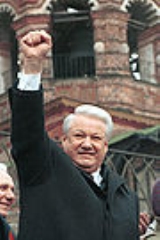
Boris Nikolayevich Yeltsin was the
first President of the Russian Federation, serving from 1991 to 1999.
Originally a supporter of
Mikhail GorbachevMikhail Sergeyevich Gorbachev is a former Soviet statesman, having served as General Secretary of the Communist Party of the Soviet Union from 1985 until 1991, and as the last head of state of the USSR, having served from 1988 until its dissolution in 1991...
, Yeltsin emerged under the
perestroikaPerestroika was a political movement within the Communist Party of the Soviet Union during 1980s, widely associated with the Soviet leader Mikhail Gorbachev...
reforms as one of Gorbachev's most powerful political opponents. On 29 May 1990 he was elected the chairman of the Russian Supreme Soviet. On 12 June 1991 he was elected by popular vote to the newly created post of President of the
Russian Soviet Federative Socialist RepublicThe Russian Soviet Federative Socialist Republic , commonly referred to as Soviet Russia, Bolshevik Russia, or simply Russia, was the largest, most populous and economically developed republic in the former Soviet Union....
(SFSR), at that time one of the 15 constituent republics of the Soviet Union. He won 57% of the vote in a six-candidate contest and became the second democratically elected leader of Russia in history. Upon the resignation of
Mikhail GorbachevMikhail Sergeyevich Gorbachev is a former Soviet statesman, having served as General Secretary of the Communist Party of the Soviet Union from 1985 until 1991, and as the last head of state of the USSR, having served from 1988 until its dissolution in 1991...
and the final
dissolution of the Soviet UnionThe dissolution of the Soviet Union was the disintegration of the federal political structures and central government of the Union of Soviet Socialist Republics , resulting in the independence of all fifteen republics of the Soviet Union between March 11, 1990 and December 25, 1991...
on 25 December 1991, Yeltsin remained in office as the President of the Russian Federation, the USSR's successor state. Yeltsin was reelected in the 1996 election; in the second round of the election Yeltsin defeated
Gennady ZyuganovGennady Andreyevich Zyuganov is a Russian politician, First Secretary of the Communist Party of the Russian Federation , Chairman of the Union of Communist Parties - Communist Party of the Soviet Union , deputy of the State Duma , and a member of Parliamentary Assembly of the Council of Europe...
from the revived
Communist PartyThe Communist Party of the Russian Federation is a Russian political party. It is the second major political party in the Russian Federation.-History:...
by a margin of 13%. However, Yeltsin never recovered his early popularity after a series of economic and political crises in Russia in the 1990s.
He vowed to transform Russia's
socialist command economyThe economy of the Union of Soviet Socialist Republics was based on a system of state ownership of the means of production, collective farming, industrial manufacturing and centralized administrative planning...
into a free
market economyA market economy is an economy in which the prices of goods and services are determined in a free price system. This is often contrasted with a state-directed or planned economy. Market economies can range from hypothetically pure laissez-faire variants to an assortment of real-world mixed...
and implemented
economic shock therapyIn economics, shock therapy refers to the sudden release of price and currency controls, withdrawal of state subsidies, and immediate trade liberalization within a country, usually also including large scale privatization of previously public owned assets....
, price liberalization and
privatization programsRussian privatization was the reform consisting in privatization of state-owned industrial assets that took place in Russia in the 1990s, during the presidency of Boris Yeltsin, immediately after the dissolution of the Soviet Union, where private ownership of enterprises had been illegal for a long...
. Due to the method of privatization, a good deal of the national wealth fell into the hands of a small group of oligarchs. Much of the Yeltsin era was marked by widespread corruption, inflation,
economic collapseThere is no precise definition of an economic collapse. While some might consider a a severe, prolonged depression with high bankruptcy rates and high unemployment an economic collapse, others would additionally look for a breakdown in normal commerce, such as hyperinfalation, or even a sharp...
and enormous political and social problems that affected Russia and the other former states of the USSR. Within the first few years of his presidency, many of Yeltsin's political supporters turned against him and Vice President
Alexander RutskoyAlexander Vladimirovich Rutskoy is a Russian politician and a former Soviet military officer. Rutskoy served as the only Vice President of Russia from 10 July 1991 to 4 October 1993, and as the governor of Kursk Oblast from 1996 to 2000...
denounced the reforms as "economic genocide".
Ongoing confrontations with the Supreme Soviet climaxed in the
October 1993 Russian constitutional crisisThe constitutional crisis of 1993 was a political stand-off between the Russian president and the Russian parliament that was resolved by using military force. The relations between the president and the parliament had been deteriorating for a while...
in which Yeltsin illegally ordered the dissolution of the parliament, which then attempted to remove Yeltsin from office. The military eventually sided with Yeltsin and besieged and shelled the Russian White House, resulting in the deaths of 187 people. Yeltsin then scrapped the
existing constitutionThe Constitution of the Russian Soviet Federative Socialist Republic of 12 April 1978 was formally its supreme law.- History :At its Extraordinary Session of 12 April 1978, the Supreme Soviet of the Russian SFSR adopted a new republican Constitution, to replace the old Russian Constitution of 1937,...
, temporarily banned political opposition and deepened his economic experimentation. He then introduced a
new constitutionThe current Constitution of the Russian Federation was adopted by national referendum on 12 December 1993. Russia's constitution came into force on 25 December 1993, at the moment of its official publication...
with stronger presidential power and it was approved by
referendumA referendum was held in Russia on 12 December, 1993. It was initiated by President Boris Yeltsin after the fall of the Supreme Soviet. This was in a direct violation of the corresponding law № 241-1 «On the referendums of the Russian SFSR»...
on 12 December 1993 with 58.5% of voters in favour.
On 31 December 1999, Yeltsin made a surprise announcement of his resignation, leaving the presidency in the hands of his chosen successor, then-Prime Minister
Vladimir PutinVladimir Vladimirovich Putin served as the second President of the Russian Federation and is the current Prime Minister of Russia, as well as chairman of United Russia and Chairman of the Council of Ministers of the Union of Russia and Belarus. He became acting President on 31 December 1999, when...
. Yeltsin left office widely unpopular with the Russian population. By some estimates, his approval ratings when leaving office were as low as 2%.
Early life
Boris Yeltsin was born in the village of Butka, in
Talitsky DistrictTalitsky District is an administrative district , one of the 30 in Sverdlovsk Oblast, Russia.The district contains 1 town and 18 selsovets under its jurisdiction....
of
Sverdlovsk OblastSverdlovsk Oblast is a federal subject of Russia located in the Urals Federal District. Its administrative center is the city of Yekaterinburg formerly known as Sverdlovsk. Population: -Geography:...
, Russian SFSR on 1 February 1931 . In 1932 after the state took away the entire harvest from the recently collectivised Butka peasants the Yeltsin family moved as far away as they could, to Kazan which was over 1,100 kilometres from Butka, where Boris` father, Nikolay Yeltsin, got work on a construction site. In 1934 Nikolai Yeltsin was convicted of
anti-Soviet agitationArticle 58 of the Russian SFSR Penal Code was put in force on 25 February 1927 to arrest those suspected of counter-revolutionary activities. It was revised several times...
and sentenced to hard labour in a
gulagThe Gulag was the government agency that administered the main Soviet forced labor camp systems. While the camps housed a wide range of convicts, from petty criminals to political prisoners, large numbers were convicted by simplified procedures, such as NKVD troikas and other instruments of...
for three years. Following his release in 1936 after serving two years, Nikolai took his family to live in
BereznikiBerezniki is a city in Perm Krai, Russia, situated on the banks of the Kama River, in the Ural mountains. Population: The name Berezniki is derived from a birch forest originally situated on the city's location....
in
Perm KraiPerm Krai is a federal subject of Russia that came into existence on December 1, 2005 as a result of the 2004 referendum on the merger of Perm Oblast and Komi-Permyak Autonomous Okrug. The city of Perm became the administrative center of the new federal subject...
where his brother Ivan a blacksmith had been exiled the year before for failing to deliver his grain quota. Nikolai remained unemployed for a period of time and then worked again in construction. His mother, Klavdiya Vasilyevna Yeltsina, worked as a seamstress.
Boris Yeltsin studied at
Pushkin High SchoolPushkin High School is a comprehensive school in the city of Berezniki in Perm Krai oblast, Russia. Former Russian president Boris Yeltsin was educated there.There is also a high school by the same name in the city of Syktyvkar in Komi, Russia....
in
BereznikiBerezniki is a city in Perm Krai, Russia, situated on the banks of the Kama River, in the Ural mountains. Population: The name Berezniki is derived from a birch forest originally situated on the city's location....
in
Perm KraiPerm Krai is a federal subject of Russia that came into existence on December 1, 2005 as a result of the 2004 referendum on the merger of Perm Oblast and Komi-Permyak Autonomous Okrug. The city of Perm became the administrative center of the new federal subject...
. He was fond of sports (in particular
skiingSkiing is a recreational activity using skis as equipment for traveling over snow. Skis are used in conjunction with boots that connect to the ski with use of a binding....
, gymnastics, volleyball, track and field,
boxingBoxing, also called pugilism, is a combat sport in which two people fight each other using their fists. Boxing is supervised by a referee over a series of between one to three minute intervals called rounds...
and
wrestlingWrestling is a form of grappling type techniques such as clinch fighting, throws and takedowns, joint locks, pins and other grappling holds. A wrestling bout is a physical competition, between two competitors or sparring partners, who attempt to gain and maintain a superior position...
) despite losing the thumb and index finger of his left hand when he and some friends sneaked into a
Red ArmyThe Workers' and Peasants' Red Army started out as the Soviet Union's revolutionary communist combat groups during the Russian Civil War of 1918-1922. It grew into the national army of the Soviet Union. By the 1930s the Red Army was among the largest armies in history.The "Red Army" name refers to...
supply depot, stole several grenades, and tried to dissect them.
In 1949 Yeltsin was admitted to the
Ural State Technical UniversityUral State Technical University is a higher education institute in Yekaterinburg, Sverdlovsk Oblast, Russian Federation. It is the biggest technical institution of higher education in Russia, with close ties to local industry in the Urals...
in
SverdlovskYekaterinburg is a major city in the central part of Russia, the administrative center of Sverdlovsk Oblast. Situated on the eastern side of the Ural mountain range, it is the main industrial and cultural center of the Urals Federal District with a population of 1,350,136 , making it Russia's...
, majoring in construction, and he graduated in 1955. The subject of his degree paper was "Television Tower".
From 1955 to 1957 he worked as a foreman with the building trust Uraltyazhtrubstroy. From 1957 to 1963 he worked in Sverdlovsk, and was promoted from construction site superintendent to chief of the Construction Directorate with the Yuzhgorstroy Trust. In 1963 he became chief engineer, and in 1965 head of the Sverdlovsk House-Building Combine, responsible for sewerage and technical plumbing. He joined the ranks of the
CPSUThe Communist Party of the Soviet Union was the only legal, ruling political party in the Soviet Union and one of the largest communist organizations in the world...
nomenklaturaThe nomenklatura were a category of people within the Soviet Union and other Eastern Bloc countries who held various key administrative positions in all spheres of those countries' activity: government, industry, agriculture, education, etc., whose positions were granted only with approval by the...
in 1968 when he was appointed head of construction with the Sverdlovsk Regional Party Committee. In 1975 he became secretary of the regional committee in charge of the region's industrial development. In 1976 the Politburo of the CPSU promoted him to the post of the first secretary of the CPSU Committee of
Sverdlovsk OblastSverdlovsk Oblast is a federal subject of Russia located in the Urals Federal District. Its administrative center is the city of Yekaterinburg formerly known as Sverdlovsk. Population: -Geography:...
(effectively he became the head of one of the most important industrial regions in the USSR), he remained in this position until 1985.
Communist Party Member
Yeltsin was a member of the
Communist Party of the Soviet UnionThe Communist Party of the Soviet Union was the only legal, ruling political party in the Soviet Union and one of the largest communist organizations in the world...
(CPSU) from 17 March 1961 to 13 July 1990, and a
nomenklaturaThe nomenklatura were a category of people within the Soviet Union and other Eastern Bloc countries who held various key administrative positions in all spheres of those countries' activity: government, industry, agriculture, education, etc., whose positions were granted only with approval by the...
member from 1968.
In 1977 as a party official in
SverdlovskYekaterinburg is a major city in the central part of Russia, the administrative center of Sverdlovsk Oblast. Situated on the eastern side of the Ural mountain range, it is the main industrial and cultural center of the Urals Federal District with a population of 1,350,136 , making it Russia's...
, Yeltsin was—on orders from Moscow—ordered to execute the order to destroy the
Ipatiev HouseIpatiev House was a merchant's house in Yekaterinburg where the former Emperor Nicholas II of Russia, his family and members of his household were executed following the Bolshevik Revolution...
where the
last Russian tsarNicholas II was the last Emperor of Russia, Grand Prince of Finland, and titular King of Poland. His official short title was Nicholas II, Emperor and Autocrat of All the Russias and he is known as Saint Nicholas the Passion-Bearer by the Russian Orthodox Church.Nicholas II ruled from 1894 until...
had been killed by
BolshevikThe Bolsheviks, originally also Bolshevists , derived from bol'shinstvo, "majority") were a faction of the Marxist Russian Social Democratic Labour Party which split apart from the Menshevik faction at the Second Party Congress in 1903....
troops. The
Ipatiev HouseIpatiev House was a merchant's house in Yekaterinburg where the former Emperor Nicholas II of Russia, his family and members of his household were executed following the Bolshevik Revolution...
was demolished in one night, 27 July 1977. Also during Yeltsin's time in Sverdlovsk, a CPSU palace was built which was named "White Tooth" by the residents. During this time, Yeltsin developed connections with key people in the Soviet power structure. In January 1981 Yeltsin was awarded the
Order of LeninThe Order of Lenin , named after the leader of the Russian October Revolution, was the highest decoration bestowed by the Soviet Union...
, the Soviet Union`s highest medal, for 'the service to the Communist Party and the Soviet State and in connection with the 50th birthday'. In March 1981 Yeltsin was `elected` Full Member of the
Central Committee of the Communist Party of the Soviet UnionThe Central Committee of the Communist Party of the Soviet Union , abbreviated in Russian as ЦК, "Tse-ka", earlier was also called as the Central Committee of the All-Union Communist Party ...
.
Moscow
On 11 March 1985
Mikhail GorbachevMikhail Sergeyevich Gorbachev is a former Soviet statesman, having served as General Secretary of the Communist Party of the Soviet Union from 1985 until 1991, and as the last head of state of the USSR, having served from 1988 until its dissolution in 1991...
was elected General Secretary of the CPSU by the
PolitburoThe Politburo , known as the Presidium from 1952 to 1966, functioned as the central policymaking and governing body of the Communist Party of the Soviet Union.-Duties and responsibilities:The...
after the death of
Konstantin ChernenkoKonstantin Ustinovich Chernenko was a Soviet politician and the fifth General Secretary of the Communist Party of the Soviet Union. He led the Soviet Union from 13 February 1984 until his death thirteen months later, on 10 March 1985...
. Gorbachev's primary goal was to revive the Soviet economy however he soon realized that fixing the Soviet economy would be nearly impossible without reforming the political and social structure of the Communist nation. To begin these reforms he immediately began gathering in Moscow a younger and more energetic governing team of Communist Party members. On 4 April 1985 Yeltsin received a call from Gorbachev's leading protege
Yegor LigachevYegor Kuzmich Ligachev is a Russian politician who was a high-ranking official in the Communist Party of the Soviet Union . Originally a protege of Mikhail Gorbachev, Ligachev became a challenger to his leadership.-Early life:...
summoning him to Moscow to take up position as Head of the Construction Department of the Party`s Central Committee. Less than three months later he was promoted to be Secretary for Construction of the Central Committee a position within the powerful CPSU Central Committee Secretariat.
On 23 December 1985
Mikhail GorbachevMikhail Sergeyevich Gorbachev is a former Soviet statesman, having served as General Secretary of the Communist Party of the Soviet Union from 1985 until 1991, and as the last head of state of the USSR, having served from 1988 until its dissolution in 1991...
appointed Yeltsin
First Secretary of the Moscow Communist PartyThe First Secretary of the Moscow gorkom of the Communist Party of the Soviet Union was the position of highest authority in the city of Moscow roughly equating to that of mayor. The position was created on November 10, 1917, following the October Revolution and abolished on August 24, 1991...
effectively `Mayor' of the Soviet capital, and as a result on 18 February 1986 Yeltsin was invited to become a Candidate (ie.non-voting) Member of the
PolitburoThe Politburo , known as the Presidium from 1952 to 1966, functioned as the central policymaking and governing body of the Communist Party of the Soviet Union.-Duties and responsibilities:The...
. As a politburo member Yeltsin was also given a country house (
dachaDacha is a Russian word for seasonal or year-round second homes often located in the exurbs of Soviet and post-Soviet cities. Cottages or shacks serving as family's main or only home are not considered dachas, although many purpose-built dachas are recently being converted for year-round residence...
), his was previously occupied by Gorbachev who now moved to a much bigger and more luxurious purpose built dacha nearby. During this period Yeltsin portrayed himself as a reformer and
populistPopulism can be defined as an ideology, political philosophy, or type of discourse. Generally, a common theme compares "the people" against "the elite", and urges social and political system changes. It can also be defined as a rhetorical style employed by members of various political or social...
(for example, he took a
trolleybusA trolleybus is an electric bus that draws its electricity from overhead wires using spring-loaded trolley poles. Two wires and poles are required to complete the electrical circuit...
to work), firing and reshuffling his staff several times. His became popular among Moscow residents for firing corrupt Moscow party officials.
Rebel
On 10 September 1987, after a lecture from hard-liner
Yegor LigachevYegor Kuzmich Ligachev is a Russian politician who was a high-ranking official in the Communist Party of the Soviet Union . Originally a protege of Mikhail Gorbachev, Ligachev became a challenger to his leadership.-Early life:...
at the Politburo for allowing two small unsanctioned demonstrations on Moscow streets, Yeltsin wrote a letter of resignation to Gorbachev who was holidaying on the Black Sea . When Gorbachev received the letter he was stunned - nobody in Soviet history had voluntarily resigned from the ranks of the Politburo. Gorbachev phoned Yeltsin and asked him to reconsider. On 21 October 1987 at the plenary meeting of the Central Committee of the
CPSUThe Communist Party of the Soviet Union was the only legal, ruling political party in the Soviet Union and one of the largest communist organizations in the world...
, Yeltsin, frustrated that Gorbachev had not addressed any of the issues outlined in his resignation letter asked to speak. He expressed his discontent with both the slow pace of reform in society, the servility shown to the General Secretary, and opposition to him from Ligachev making his position untenable, before requesting to resign from the Politburo, adding that the City Committee would decide whether he should resign from the post of
First Secretary of the Moscow Communist PartyThe First Secretary of the Moscow gorkom of the Communist Party of the Soviet Union was the position of highest authority in the city of Moscow roughly equating to that of mayor. The position was created on November 10, 1917, following the October Revolution and abolished on August 24, 1991...
. This was sensational. Besides the fact that nobody had ever quit the Politburo, no one in the party had ever had the audacity to address a leader of the party in such a manner in front of the Central Committee since Leon Trotsky in the 1920s. In his reply, Gorbachev accused Yeltsin of "political immaturity" and "absolute irresponsibility". Nobody in the Central Committee backed Yeltsin.
Within days news of Yeltsin's actions leaked and rumours of his 'secret speech' at the Central Committee spread throughout Moscow. Soon fabricated
samizdatSamizdat was a key form of dissident activity across the Soviet bloc in which individuals reproduced censored publications by hand and passed the documents from reader to reader...
versions began to circulate - this was the beginning of Yeltsin's rise as a rebel and growth in popularity as an anti-establishment figure. Gorbachev called a meeting of the Moscow City Party Committee for the 11 November 1987 to launch another crushing attack on Yeltsin and confirm his dismissal. On 09 November 1987 Yeltsin apparently tried to kill himself and was rushed to hospital bleeding profusely from self-inflicted cuts to his chest. Gorbachev ordered the injured Yeltsin from his hospital bed to the Moscow party plenum two days later where he was ritually denounced by the party faithful in what was reminiscent of a Stalinist show trial before he he was fired from the post of
First Secretary of the Moscow Communist PartyThe First Secretary of the Moscow gorkom of the Communist Party of the Soviet Union was the position of highest authority in the city of Moscow roughly equating to that of mayor. The position was created on November 10, 1917, following the October Revolution and abolished on August 24, 1991...
. Yeltsin would never forgive Gorbachev for this 'immoral and inhuman' treatment. .
Yeltsin was demoted to the position of First Deputy Commissioner for the State Committee for Construction. At the next meeting of the Central Committee on 14 February 1988 Yeltsin was removed from his position as a Candidate member the Politburo. He was perturbed and humiliated but began plotting his revenge. His opportunity came with Gorbachev's establishment of the Congress of People's Deputies. He recovered, and started intensively criticizing Gorbachev, highlighting the slow pace of reform in the Soviet Union as his major argument.
Yeltsin's criticism of the Politburo and Gorbachev led to a smear campaign against him, in which examples of Yeltsin's awkward behavior were used against him. An article published in
PravdaPravda was a leading newspaper of the Soviet Union and an official organ of the Central Committee of the Communist Party between 1912 and 1991....
described him as being drunk at a lecture during his visit to the United States, an allegation which appeared to be confirmed by a TV account of his speech. However, popular dissatisfaction with the regime was very strong, and these attempts to smear Yeltsin only added to his popularity. In another incident, Yeltsin fell from a bridge. Commenting on this event, Yeltsin hinted that he was helped to fall from the bridge by the enemies of
perestroikaPerestroika was a political movement within the Communist Party of the Soviet Union during 1980s, widely associated with the Soviet leader Mikhail Gorbachev...
, but his opponents suggested that he was simply drunk.
On 26 March 1989, Yeltsin
was electedIn 1989, elections were held for the Congress of People's Deputies of the Soviet Union. The main elections were held on 26 March and a second round on 9 April...
to the
Congress of People's Deputies of the Soviet UnionThe Congress of People's Deputies of the Soviet Union was the highest body of state authority of the Soviet Union from 1989 to 1991.-Background:...
as the delegate from Moscow district with a hugely decisive 92% of the vote and on 29 May 1989 was elected by the Congress of People's Deputies to a seat on the Supreme Soviet of the Soviet Union. On 19 July 1989 Yeltsin announced the formation of the radical pro-reform faction in the Congress of People's Deputies: the Inter-Regional Group of Deputies, and on 29 July 1989 was elected one of the five co-Chairman of the Inter-Regional Group.
President of the RSFSR
On 4 March 1990 Yeltsin was elected to the Congress of People's Deputies of Russia representing Sverdlovsk with 72% of the vote. On 29 May 1990, he was elected chairman of the Presidium of the Supreme Soviet of the
Russian Soviet Federative Socialist RepublicThe Russian Soviet Federative Socialist Republic , commonly referred to as Soviet Russia, Bolshevik Russia, or simply Russia, was the largest, most populous and economically developed republic in the former Soviet Union....
(RSFSR), in spite of the fact that Gorbachev personally pleaded with the Russian deputies not to select Yeltsin. He was supported by both democratic and conservative members of the Supreme Soviet, which sought power in the developing political situation in the country. A part of this power struggle was the opposition between power structures of the
Soviet UnionThe Soviet Union , officially the Union of Soviet Socialist Republics , was a constitutionally socialist state that existed in Eurasia between 1922 and 1991....
and the
RSFSRThe Russian Soviet Federative Socialist Republic , commonly referred to as Soviet Russia, Bolshevik Russia, or simply Russia, was the largest, most populous and economically developed republic in the former Soviet Union....
. In an attempt to gain more power, on 12 June 1990, the Congress of People's Deputies of the RSFSR adopted a declaration of sovereignty. On 12 July 1990, Yeltsin resigned from the CPSU in a dramatic speech before party members at the 28th Congress of the Communist Party of the Soviet Union, some of whom responded by shouting "Shame!"
On 12 June 1991, Yeltsin won 57% of the popular vote in the democratic
presidential elections for the Russian republicPresidential elections were held in the Russian Federation on 12 June 1991. It was the first presidential election in the country's history. Boris Yeltsin was elected President of the Russian SFSR. His running-mate, Alexander Rutskoi, became Vice-President....
, defeating Gorbachev's preferred candidate,
Nikolai RyzhkovNikolai Ivanovich Ryzhkov was a Soviet official who became a Russian politician following the dissolution of the Soviet Union. He served as the last Chairman of the Council of Ministers or Premier of the Soviet Union from 1985 to 1991...
who got just 16% of the vote. In his election campaign, Yeltsin criticized the "dictatorship of the center", but did not suggest the introduction of a market economy. Instead, he said that he would put his head on the railtrack in the event of increased prices. Yeltsin took office on 10 July, and reappointed
Ivan SilayevIvan Stepanovich Silayev is a former Soviet official who became a Russian politician following the dissolution of the Soviet Union. He served as Premier of the Soviet Union through the offices of Chairman of the Interstate Economic Committee and Chairman of the Committee on the Operational...
as Chairman of the
Council of Ministers – GovernmentThe Government of the Russian Soviet Federative Socialist Republic was known officially as the Council of People's Commissars , Council of Ministers and Council of Ministers – Government -Council of People's Commissars:...
of the
Russian SFSRThe Russian Soviet Federative Socialist Republic , commonly referred to as Soviet Russia, Bolshevik Russia, or simply Russia, was the largest, most populous and economically developed republic in the former Soviet Union....
.
On 18 August 1991, a
coup against GorbachevThe 1991 Soviet coup d'état attempt , also known as the August Putsch or August Coup , was an attempt by a group of members of the Soviet Union's government to take control of the country from Soviet president Mikhail Gorbachev...
was launched by the government members opposed to perestroika. Gorbachev was held in
CrimeaCrimea , or the Autonomous Republic of Crimea , is a sub-national unit, an autonomous republic, of Ukraine. It is located on the northern coast of the Black Sea, occupying a peninsula of the same name...
while Yeltsin raced to the White House of Russia (residence of the Supreme Soviet of the RSFSR) in Moscow to defy the coup, making a memorable speech from atop the turret of a tank onto which he had climbed. The White House was surrounded by the military but the troops defected in the face of mass popular demonstrations. By 21 August most of the coup leaders had fled Moscow and Gorbachev was "rescued" from
CrimeaCrimea , or the Autonomous Republic of Crimea , is a sub-national unit, an autonomous republic, of Ukraine. It is located on the northern coast of the Black Sea, occupying a peninsula of the same name...
and then returned to Moscow. Yeltsin was subsequently hailed by his supporters around the world for rallying mass opposition to the coup.
Although restored to his position, Gorbachev's powers were now fatally compromised. Neither union nor Russian power structures heeded his commands as support had swung over to Yeltsin. Through the fall of 1991, the Russian government took over the union government, ministry by ministry.
On 6 November 1991, Yeltsin issued a decree banning the Communist Party throughout the RSFSR.
In early December 1991, Ukraine voted for independence from the Soviet Union. A week later, on 8 December, Yeltsin met Ukrainian president
Leonid KravchukLeonid Makarovych Kravchuk is a Ukrainian politician, the first President of Ukraine serving from December 5, 1991 until his resignation on July 19, 1994, a former Chairman of the Verkhovna Rada and People's Deputy of Ukraine serving in the Social Democratic Party of Ukraine faction.After a...
and the leader of Belarus,
Stanislav ShushkevichStanislau Stanislavavich Shushkevich is a Belarusian politician and scientist. From September 28, 1991 to January 26, 1994 he was the first leader and head of state of independent Belarus after the dissolution of the Soviet Union...
, in Belovezhskaya Pushcha, where the three presidents announced the dissolution of the
Soviet UnionThe Soviet Union , officially the Union of Soviet Socialist Republics , was a constitutionally socialist state that existed in Eurasia between 1922 and 1991....
and that they would establish a voluntary
Commonwealth of Independent StatesThe Commonwealth of Independent States is a regional organization whose participating countries are former Soviet Republics, formed during the breakup of the Soviet Union....
(CIS) in its place. According to
Mikhail GorbachevMikhail Sergeyevich Gorbachev is a former Soviet statesman, having served as General Secretary of the Communist Party of the Soviet Union from 1985 until 1991, and as the last head of state of the USSR, having served from 1988 until its dissolution in 1991...
, the president of the
Soviet UnionThe Soviet Union , officially the Union of Soviet Socialist Republics , was a constitutionally socialist state that existed in Eurasia between 1922 and 1991....
at that time, Yeltsin kept the plans of the Belovezhskaya meeting in strict secrecy and the main goal of the dissolution of the Soviet Union was to get rid of Gorbachev, who by that time had started to recover his position after the events of August.
Mikhail GorbachevMikhail Sergeyevich Gorbachev is a former Soviet statesman, having served as General Secretary of the Communist Party of the Soviet Union from 1985 until 1991, and as the last head of state of the USSR, having served from 1988 until its dissolution in 1991...
has also accused Yeltsin of violating the people's will expressed in the referendum in which the majority voted to keep the
Soviet UnionThe Soviet Union , officially the Union of Soviet Socialist Republics , was a constitutionally socialist state that existed in Eurasia between 1922 and 1991....
.
On 24 December, the Russian Federation took the Soviet Union's seat in the United Nations. The next day, President Gorbachev resigned and
the Soviet Union ceased to existThe dissolution of the Soviet Union was the disintegration of the federal political structures and central government of the Union of Soviet Socialist Republics , resulting in the independence of all fifteen republics of the Soviet Union between March 11, 1990 and December 25, 1991...
, thereby ending the world's largest and most influential socialist state. Economic relations between the former Soviet republics were severely compromised. Millions of ethnic Russians found themselves in the newly formed foreign countries.
Radical reforms
Just days after the dissolution of the Soviet Union, Boris Yeltsin resolved to embark on a program of radical economic reform, with the aim of restructuring Russia's economic system—converting the world's largest command economy into a free-market one. During early discussions of this transition, Yeltsin's advisers debated issues of speed and sequencing, with an apparent division between those favoring a rapid approach and those favoring a gradual or slower approach.
In late 1991 Yeltsin turned to the advice of Western economists, and Western institutions such as the
International Monetary FundThe International Monetary Fund is an organization of 187 countries, working to foster global monetary cooperation, secure financial stability, facilitate international trade, promote high employment and sustainable economic growth, and reduce poverty around the world...
, the
World BankThe World Bank is an international financial institution that provides loans to developing countries for capital programmes.The World Bank's official goal is the reduction of poverty...
, and the U.S. Treasury Department, who had developed a standard policy recipe for transition economies in the late 1980s. This policy recipe came to be known as the "
Washington ConsensusThe term Washington Consensus was coined in 1989 by the economist John Williamson to describe a set of ten relatively specific economic policy prescriptions that he considered constituted the "standard" reform package promoted for crisis-wracked developing countries...
" or "
shock therapyIn economics, shock therapy refers to the sudden release of price and currency controls, withdrawal of state subsidies, and immediate trade liberalization within a country, usually also including large scale privatization of previously public owned assets....
", a combination of measures intended to liberalize prices and stabilize the state's budget. Such measures had been attempted in Poland, and advocates of "shock therapy" felt the same could be done in Russia. Some Russian policymakers were skeptical that this was the way to go, but the approach was favored by Yeltsin's deputy,
Yegor GaidarYegor Timurovich Gaidar was a Soviet and Russian economist, politician and author, and was the Acting Prime Minister of Russia from 15 June 1992 to 14 December 1992....
, a 35-year-old Russian economist inclined toward radical reform.
On 2 January 1992, Yeltsin, acting as his own
prime ministerThe Chairman of the Government of the Russian Federation The use of the term "Prime Minister" is strictly informal and is not allowed for by the Russian Constitution and other laws....
, ordered the liberalization of foreign trade, prices, and currency. At the same time, Yeltsin followed a policy of 'macroeconomic stabilization,' a harsh austerity regime designed to control inflation. Under Yeltsin's stabilization program, interest rates were raised to extremely high levels to tighten money and restrict credit. To bring state spending and revenues into balance, Yeltsin raised new taxes heavily, cut back sharply on government subsidies to industry and construction, and made steep cuts to state welfare spending.
In early 1992, prices skyrocketed throughout Russia, and deep credit crunch shut down many industries and brought about a protracted depression. The reforms devastated the living standards of much of the population, especially the groups dependent on Soviet-era state subsidies and welfare entitlement programs. Through the 1990s, Russia's GDP fell by 50 percent, vast sectors of the economy were wiped out, inequality and unemployment grew dramatically, while incomes fell.
HyperinflationIn economics, hyperinflation is inflation that is very high or out of control. While the real values of the specific economic items generally stay the same in terms of relatively stable foreign currencies, in hyperinflationary conditions the general price level within a specific economy increases...
, caused by the Central Bank of Russia's loose monetary policy, wiped out a lot of personal savings, and tens of millions of
RussiansThe Russian people are an East Slavic ethnic group native to Russia, speaking the Russian language and primarily living in Russia and neighboring countries....
were plunged into poverty.
Some economists argue that in the 1990s Russia suffered an economic downturn more severe than the United States or Germany had undergone six decades earlier in the
Great DepressionThe Great Depression was a severe worldwide economic depression in the decade preceding World War II. The timing of the Great Depression varied across nations, but in most countries it started in about 1929 and lasted until the late 1930s or early 1940s...
. Russian commentators and even some Western economists, such as
Marshall GoldmanMarshall Goldman is an expert on the economy of the former Soviet Union. Goldman is a Professor of Economics at Wellesley College and Associate Director of the Harvard Russian Research Center. Goldman received his Ph.D. in Russian studies from Harvard University in 1961.Goldman is well known for...
, widely blamed Yeltsin's Western-backed economic program for the country's disastrous economic performance in the 1990s. Many politicians began to quickly distance themselves from the program. In February 1992, Russia's vice president,
Alexander RutskoyAlexander Vladimirovich Rutskoy is a Russian politician and a former Soviet military officer. Rutskoy served as the only Vice President of Russia from 10 July 1991 to 4 October 1993, and as the governor of Kursk Oblast from 1996 to 2000...
denounced the Yeltsin program as "economic genocide." By 1993 conflict over the reform direction escalated between Yeltsin on the one side, and the opposition to radical economic reform in Russia's parliament on the other.
Confrontation with parliament
Also throughout 1992, Yeltsin wrestled with the
Supreme Soviet of RussiaThe Supreme Soviet of the Russian SFSR , later Supreme Soviet of the Russian Federation was the supreme government institution of the Russian SFSR in 1938–1990; in 1990–1993 it was a permanent parliament, elected by the Congress of People's Deputies of the Russian Federation.The Supreme Soviet of...
and the Congress of People's Deputies for control over government, government policy, government banking and property. In the course of 1992, the speaker of the Russian Supreme Soviet,
Ruslan KhasbulatovRuslan Imranovich Khasbulatov is a Russian economist and politician of Chechen descent who played a central role in the events leading to the 1993 constitutional crisis in the Russian Federation.-Early life:...
, came out in opposition to the reforms, despite claiming to support Yeltsin's overall goals. In December 1992, the 7th Congress of People's Deputies succeeded in turning down the Yeltsin-backed candidacy of Yegor Gaidar for the position of
Russian prime ministerThe Chairman of the Government of the Russian Federation The use of the term "Prime Minister" is strictly informal and is not allowed for by the Russian Constitution and other laws....
. An agreement was brokered by
Valery ZorkinValery Dmitrievich Zorkin is the first and the current Chairman of the Constitutional Court of the Russian Federation.Zorkin was born on 18 February 1943 in a rural area of the Maritime Province. In 1964, he matriculated from the Law Department of the Moscow University, in which he lectured until...
, chairman of the Constitutional Court, which included the following provisions: a national referendum on the new constitution; parliament and Yeltsin would choose a new head of government, to be confirmed by the Supreme Soviet; and the parliament was to cease making constitutional amendments that change the balance of power between the legislative and executive branches. Eventually, on 14 December,
Viktor ChernomyrdinViktor Stepanovich Chernomyrdin was the founder and the first chairman of the Gazprom energy company, the longest serving Prime Minister of Russia and Acting President of Russia for a day in 1996. He was a key figure in Russian politics in the 1990s, and a great contributor to the Russian...
, widely seen as a compromise figure, was confirmed in the office.
The conflict escalated soon, however, with the parliament changing its prior decision to hold a referendum.
Yeltsin, in his turn, announced in a televised address to the nation on 20 March 1993, that he was going to assume certain "special powers" in order to implement his program of reforms. In response, the hastily called 9th Congress of People's Deputies attempted to remove Yeltsin from presidency through impeachment on 26 March 1993. Yeltsin's opponents gathered more than 600 votes for impeachment, but fell 72 votes short of the required two-thirds majority.
During the summer of 1993, a situation of
dual powerDual power is a concept that has taken on a broad meaning in the hands of anarchists and Libertarian socialists who use it to refer to the concept of gradual revolution through the creation of "alternative-institutions" and "counter-institutions" in place of and in opposition to state and corporate...
developed in Russia. Since July, two separate administrations of the
Chelyabinsk Oblast
functioned side by side, after Yeltsin refused to accept the newly elected pro-parliament head of the region. The Supreme Soviet pursued its own foreign policies, passing a declaration on the status of
SevastopolSevastopol is a city on rights of administrative division of Ukraine, located on the Black Sea coast of the Crimea peninsula. It has a population of 342,451 . Sevastopol is the second largest port in Ukraine, after the Port of Odessa....
.
In August, a commentator reflected on the situation as follows: "The President issues decrees as if there were no Supreme Soviet, and the Supreme Soviet suspends decrees as if there were no President." (Izvestiya, 13 August 1993).
On 21 September 1993 Yeltsin announced in a televised address his decision to disband the Supreme Soviet and Congress of People's Deputies by decree.
In his address Yeltsin declared his intent to rule by decree until the election of the new parliament and a referendum on a new constitution, triggering the
constitutional crisis of October 1993The constitutional crisis of 1993 was a political stand-off between the Russian president and the Russian parliament that was resolved by using military force. The relations between the president and the parliament had been deteriorating for a while...
. On the night after Yeltsin's televised address, the Supreme Soviet declared Yeltsin removed from presidency, by virtue of his breaching the constitution, and Vice-President Alexander Rutskoy was sworn in as the acting president.
Between 21–24 September Yeltsin was confronted by significant popular unrest, encouraging the defenders of the parliament. Moscow saw what amounted to a spontaneous mass uprising of anti-Yeltsin demonstrators numbering in the tens of thousands marching in the streets resolutely seeking to aid forces defending the parliament building. The demonstrators were protesting the new and terrible living conditions under Yeltsin. Since 1989 GDP had declined by half. Corruption was rampant, violent crime was skyrocketing, medical services were collapsing, food and fuel were increasingly scarce and life expectancy was falling for all but a tiny handful of the population; moreover, Yeltsin was increasingly getting the blame.
By early October, Yeltsin had secured the support of Russia's army and ministry of interior forces. In a massive show of force, Yeltsin called up tanks to shell the Russian White House, Russia's parliament building. The attack on Russia's parliament building left 500 people dead and injured 1000 more.
As Supreme Soviet was dissolved, in December 1993 elections to the newly established parliament, the
State DumaThe State Duma , common abbreviation: Госду́ма ) in the Russian Federation is the lower house of the Federal Assembly of Russia , the upper house being the Federation Council of Russia. The Duma headquarters is located in central Moscow, a few steps from Manege Square. Its members are referred to...
, were held. Candidates associated with Yeltsin's economic policies were overwhelmed by a huge anti-Yeltsin vote, the bulk of which was divided between the
Communist PartyThe Communist Party of the Russian Federation is a Russian political party. It is the second major political party in the Russian Federation.-History:...
and ultra-nationalists. The referendum, however, held at the same time, approved the new constitution, which significantly expanded the powers of the president, giving Yeltsin a right to appoint the members of the government, to dismiss the
prime ministerA prime minister is the most senior minister of cabinet in the executive branch of government in a parliamentary system. In many systems, the prime minister selects and may dismiss other members of the cabinet, and allocates posts to members within the government. In most systems, the prime...
and, in some cases, to dissolve the Duma.
Chechnya
In December 1994, Yeltsin ordered the military invasion of
ChechnyaThe Chechen Republic , commonly referred to as Chechnya , also spelled Chechnia or Chechenia, sometimes referred to as Ichkeria , is a federal subject of Russia . It is located in the southeastern part of Europe in the Northern Caucasus mountains. The capital of the republic is the city of Grozny...
in an attempt to restore Moscow's control over the republic. Nearly two years later Yeltsin withdrew federal forces from the devastated Chechnya under a 1996 peace agreement brokered by Alexander Lebed, then Yeltsin's security chief. The peace deal allowed Chechnya greater autonomy but not full independence.
The decision to launch the war in Chechnya dismayed many in the West. TIME magazine wrote:
"Then, what was to be made of Boris Yeltsin? Clearly he could no longer be regarded as the democratic hero of Western myth. But had he become an old- style communist boss, turning his back on the democratic reformers he once championed and throwing in his lot with militarists and ultranationalists? Or was he a befuddled, out-of-touch chief being manipulated, knowingly or unwittingly, by– well, by whom exactly? If there was to be a dictatorial coup, would Yeltsin be its victim or its leader?"
Privatization and the rise of "the oligarchs"
Following the dissolution of the Soviet Union, Yeltsin promoted
privatizationRussian privatization was the reform consisting in privatization of state-owned industrial assets that took place in Russia in the 1990s, during the presidency of Boris Yeltsin, immediately after the dissolution of the Soviet Union, where private ownership of enterprises had been illegal for a long...
as a way of spreading ownership of shares in former state enterprises as widely as possible to create political support for his economic reforms. In the West, privatization was viewed as the key to the transition from Communism in Eastern Europe, ensuring a quick dismantling of the Soviet-era command economy to make way for 'free market reforms.' In the early 1990s,
Anatoly ChubaisAnatoly Borisovich Chubais is a Russian politician and business manager who was responsible for privatization in Russia as an influential member of Boris Yeltsin's administration. From 1998 to 2008 he was the head of the state owned electrical power monopoly RAO UES. The 2004 survey by...
, Yeltsin's deputy for economic policy, emerged as a leading advocate of privatization in Russia.
In late 1992, Yeltsin launched a program of free vouchers as a way to give mass privatization a jump-start. Under the program, all Russian citizens were issued vouchers, each with a nominal value of around 10,000 rubles, for purchase of shares of select state enterprises. Although each citizen initially received a voucher of equal face value, within months most of them converged in the hands of intermediaries who were ready to buy them for cash right away.
In 1995, as Yeltsin struggled to finance Russia's growing foreign debt and gain support from the Russian business elite for his bid in the early-1996 presidential elections, the Russian president prepared for a new wave of privatization offering stock shares in some of Russia's most valuable state enterprises in exchange for bank loans. The program was promoted as a way of simultaneously speeding up privatization and ensuring the government a much-needed infusion of cash for its operating needs.
However, the deals were effectively giveaways of valuable state assets to a small group of tycoons in finance, industry, energy, telecommunications, and the media who came to be known as "
oligarchsBusiness oligarch is a near-synonym of the term "business magnate", borrowed by the English speaking and western media from post-Soviet parlance to describe the huge, fast-acquired wealth of some businessmen of the former Soviet republics during the privatization in Russia and other post-Soviet...
" in the mid-1990s. This was due to the fact that ordinary people sold their vouchers for cash. The vouchers were bought out by a small group of investors. By mid-1996, substantial ownership shares over major firms were acquired at very low prices by a handful of people. Boris Berezovsky, who controlled major stakes in several banks and the national media, emerged as one of Yeltsin's most prominent backers. Along with Berezovsky,
Mikhail KhodorkovskyMikhail Borisovich Khodorkovsky is a Russian prisoner, considered by some - such as Amnesty International - to have been imprisoned for political reasons, jailed until 2016 and a former Russian oligarch and businessman...
,
Vladimir PotaninVladimir Olegovich Potanin is a Russian businessman and oligarch. His partner has been for many years Mikhail Prokhorov...
,
Vladimir BogdanovVladimir Leonidovich Bogdanov is a Russian oil tycoon.Since 1993, he is the President of Surgutneftegaz, one of the largest Russian oil companies....
,
Rem ViakhirevRem Viakhirev , is a Russian businessman. From 1992 until May 2001 he was chairman of Gazprom.In May 2001 Viakhirev had to resign as chairman. His successor is Alexei Miller.- External links :* *...
,
Vagit AlekperovVagit Alekperov ; is an Azerbaijani businessman and currently a President of the leading Russian oil company LUKOIL.He is currently rated by Forbes magazine as the eighth richest person in Russia with $13.9 billion of net worth and the 50th richest person in the world.-Biography:He was born in...
,
Alexander SmolenskyAlexander Pavlovich Smolensky was the founder and president of one of the largest private banks in Russia - Bank Stolichny which collapsed in the 1998 Russian financial crisis wiping out its investors' savings. When asked what he owed his investors he replied: "dead donkey ears"...
, Victor Vekselberg,
Mikhail FridmanMikhail Maratovich Fridman is a Jewish Russian businessman. Mr. Fridman graduated from Moscow Institute of Steel and Alloys in 1986. In 1988 Fridman started his career in trading and financial services before founding Alfa Group Consortium in 1989...
and a few years later
Roman AbramovichRoman Arkadyevich Abramovich is a Russian businessman and the main owner of the private investment company Millhouse LLC.In 2003, Abramovich was named Person of the Year by Expert, a Russian business magazine. He shared this title with Mikhail Khodorkovsky...
, were habitually mentioned in the media as Russia's oligarchs.
KAL 007
On 5 December 1991,
Senator Jesse HelmsJesse Alexander Helms, Jr. was a five-term Republican United States Senator from North Carolina who served as chairman of the Senate Foreign Relations Committee from 1995 to 2001...
, ranking member of the Minority on the U.S. Senate Committee on Foreign Relations, wrote to Boris Yeltsin concerning U.S. servicemen who were POWs or MIAs. "The status of thousands and thousands of American servicemen who are held by Soviet and other Communist forces, and who were never repatriated after every major war this century, is of grave concern to the American people."
Yeltsin would ultimately respond with a statement made on 15 June 1992, while being interviewed aboard his presidential jet on his way to the United States, "Our archives have shown that it is true — some of them were transferred to the territory of the U.S.S.R. and were kept in labor camps... We can only surmise that some of them may still be alive.".
On 10 December 1991, just five days after Senator Helms had written Yeltsin concerning American servicemen, he again wrote to Yeltsin, this time concerning Korean Air Lines Flight 007 (KAL 007) requesting information concerning possible survivors, including Congressman from Georgia
Larry McDonaldLawrence Patton McDonald, M.D. was an American politician and a member of the United States House of Representatives, representing the seventh congressional district of Georgia as a Democrat...
, and their whereabouts.
"One of the greatest tragedies of the Cold War was the shoot-down of the Korean Airlines Flight 007 by the Armed Forces of what was then the Soviet Union on 1 September 1983... The KAL-007 tragedy was one of the most tense incidences of the entire Cold War. However, now that relations between our two nations have improved substantially, I believe that it is time to resolve the mysteries surrounding this event. Clearing the air on this issue could help further to improve relations." In March 1992, Yeltsin would hand over KAL 007's Black Box without its tapes to Korean President
Roh Tae-WooRoh Tae-woo , is a former ROK Army general and politician. He was the 13th president of South Korea .Roh befriended Chun Doo-hwan while in high school in Daegu. In his younger life, Roh was a keen rugby union player....
at the end of the plenary session of the Korean National Assembly with this statement, "We apologize for the tragedy and are trying to settle some unsolved issues."
Yeltsin would ultimately respond on 8 January 1992 by handing over to the
International Civil Aviation OrganizationThe International Civil Aviation Organization , pronounced , , is a specialized agency of the United Nations. It codifies the principles and techniques of international air navigation and fosters the planning and development of international air transport to ensure safe and orderly growth...
(ICAO) of the United Nations what the Russians had for so many years denied possessing: the tapes of the KAL 007's "Black Box" (its
DigitalA digital system is a data technology that uses discrete values. By contrast, non-digital systems use a continuous range of values to represent information...
Flight Data RecorderA flight data recorder is an electronic device employed to record any instructions sent to any electronic systems on an aircraft. It is a device used to record specific aircraft performance parameters...
and
Cockpit Voice RecorderA cockpit voice recorder , often referred to as a "black box", is a flight recorder used to record the audio environment in the flight deck of an aircraft for the purpose of investigation of accidents and incidents...
).
The openness of Yeltsin about POW/MIA and KAL 007 matters may also have signaled his willingness for more openness to the West. In 1992, which he labelled the "window of opportunity", he was willing to discuss biological weapons with the U.S. and admitted that the
Sverdlovsk anthrax leakThe Sverdlovsk anthrax leak is an incident when spores of anthrax were accidentally released from a military facility in the city of Sverdlovsk 1450 km east of Moscow on April 2, 1979. This accident is sometimes called "biological Chernobyl"...
of 2 April 1979 had been caused as a result of a mishap at a military facility. The Russian government had maintained that the cause was contaminated meat. The true number of victims in the anthrax outbreak at Sverdlovsk, about 850 miles (1,368 km) east of Moscow, is not known.
1996 presidential election
In February 1996, Yeltsin announced that he would seek a second term in the
spring 1996 Russian presidential electionPresidential elections were held in Russia in 1996. Incumbent Russian President Boris Yeltsin was seeking a four-year term after officially winning the 1991 presidential election. The first round was held on 16 June 1996...
. The announcement followed weeks of speculation that Yeltsin was at the end of his political career because of his health problems and growing unpopularity in Russia. At the time Yeltsin was recuperating from a series of heart attacks. Domestic and international observers also noted his occasionally erratic behaviour. When campaigning opened at the beginning of 1996, Yeltsin's popularity was close to zero. Meanwhile, the opposition
Communist Party of the Russian FederationThe Communist Party of the Russian Federation is a Russian political party. It is the second major political party in the Russian Federation.-History:...
had already gained ground in parliamentary voting on 17 December 1995, and its candidate,
Gennady ZyuganovGennady Andreyevich Zyuganov is a Russian politician, First Secretary of the Communist Party of the Russian Federation , Chairman of the Union of Communist Parties - Communist Party of the Soviet Union , deputy of the State Duma , and a member of Parliamentary Assembly of the Council of Europe...
, had a strong grass roots organization, especially in the rural areas and small towns, and appealed effectively to memories of the old days of Soviet prestige on the international stage and the socialist domestic order.
Panic struck the Yeltsin team when opinion polls suggested that the ailing president could not win; some members of his entourage urged him to cancel presidential elections and effectively rule as dictator from then on. Instead, Yeltsin changed his campaign team, assigning a key role to his daughter,
Tatyana DyachenkoTatyana Borisovna Yumasheva is a daughter of former Russian President Boris Yeltsin. She was trained in computer science.She worked at the Salyut Design Bureau and later at Khrunichev State Research and Production Space Center until 1994....
, and appointing Chubais as campaign manager. Chubais, acting as both Yeltsin's campaign manager and adviser on Russia's privatisation programme, used his control of the privatisation programme as an instrument of Yeltsin's reelection campaign.
In the spring of 1996, Chubais and Yeltsin recruited a team of a handful of financial and media oligarchs to bankroll the Yeltsin campaign and guaranteed favorable media coverage the president on national television and in leading newspapers. In return, Chubais allowed well-connected Russian business leaders to acquire majority stakes in some of Russia's most valuable state-owned assets. The media painted a picture of a fateful choice for Russia, between Yeltsin and a "return to totalitarianism." The oligarchs even played up the threat of civil war if a Communist were elected president.

Yeltsin campaigned energetically, dispelling concerns about his health, and maintained a high media profile. To boost his popularity, Yeltsin promised to abandon some of his more unpopular economic reforms, boost welfare spending, end the war in Chechnya, and pay wage and pension arrears. Yeltsin's campaign also got a boost from the announcement of a $10 billion loan to the Russian government from the International Monetary Fund.
Zyuganov, who lacked Yeltsin's resources and financial backing, saw his strong initial lead whittled away. After the first round on 16 June Yeltsin appointed a highly popular candidate Alexander Lebed, who came in third in the first round, Secretary of the
Security Council of RussiaThe Security Council of the Russian Federation is a consultative body of the Russian President that works out the President's decisions on national security affairs...
, sacked at the latter's behest defence minister
Pavel GrachevPavel Sergeyevich Grachev , sometimes transliterated as Grachov, is a retired Russian Army General and the former Defence Minister of the Russian Federation; in 1988 he was declared the Hero of the Soviet Union...
and on 20 June sacked a number of his
siloviki, one of them being his chief of presidential security
Alexander KorzhakovAlexander Vasilyevich Korzhakov , was a KGB general who served as Boris Yeltsin's bodyguard, confidant, and adviser for 11 years. Member of State Duma at 1997. He was the head of the Presidential Security Service in 1993-1996, State Duma deputy, and retired Lieutenant-general...
, viewed by many as Yeltsin's éminence grise.
In the run-off on 3 July, with a turnout of 68.9%, Yeltsin won 53.8% of the vote and Zyuganov 40.3%, with the rest (5.9%) voting "against all".
Yeltsin's second term
In July 1996, Yeltsin was re-elected as president with financial support from influential business oligarchs who owed their wealth to their connections with Yeltsin's administration. Despite only gaining 35% of the first round vote in the 1996 elections, Yeltsin defeated his communist rival
Gennady ZyuganovGennady Andreyevich Zyuganov is a Russian politician, First Secretary of the Communist Party of the Russian Federation , Chairman of the Union of Communist Parties - Communist Party of the Soviet Union , deputy of the State Duma , and a member of Parliamentary Assembly of the Council of Europe...
with 54% in the runoff election. Later that year, Yeltsin underwent an emergency quintuple heart bypass surgery and remained in the hospital for months.
During Yeltsin's presidency, Russia received US$40 billion in funds from the
International Monetary FundThe International Monetary Fund is an organization of 187 countries, working to foster global monetary cooperation, secure financial stability, facilitate international trade, promote high employment and sustainable economic growth, and reduce poverty around the world...
and other international lending organizations. However, his opponents allege that most of these funds were stolen by people from Yeltsin's circle and placed in foreign banks.
In 1998, a political and economic crisis emerged when Yeltsin's government defaulted on its debts, causing financial markets to panic and the
rubleThe ruble or rouble is the currency of the Russian Federation and the two partially recognized republics of Abkhazia and South Ossetia. Formerly, the ruble was also the currency of the Russian Empire and the Soviet Union prior to their breakups. Belarus and Transnistria also use currencies with...
to collapse in the 1998 financial crisis.
During the 1999
Kosovo warThe term Kosovo War or Kosovo conflict was two sequential, and at times parallel, armed conflicts in Kosovo province, then part of FR Yugoslav Republic of Serbia; from early 1998 to 1999, there was an armed conflict initiated by the ethnic Albanian "Kosovo Liberation Army" , who sought independence...
, Yeltsin strongly opposed the
NATO military campaign against Yugoslavia, and warned of possible Russian intervention if NATO deployed ground troops to Kosovo. In televised comments he stated: "I told NATO, the Americans, the Germans: Don't push us toward military action. Otherwise there will be a European war for sure and possibly world war."
On 15 May 1999, Yeltsin survived another attempt of
impeachmentImpeachment is a formal process in which an official is accused of unlawful activity, the outcome of which, depending on the country, may include the removal of that official from office as well as other punishment....
, this time by the
democraticThe Russian United Democratic Party "Yabloko" The Russian United Democratic Party "Yabloko" The Russian United Democratic Party "Yabloko" (Russian: Росси́йская объединённая демократи́ческая па́ртия «Я́блоко» Rossiyskaya obyedinyonnaya demokraticheskaya partiya "Yabloko"; is a Russian social...
and
communistThe Communist Party of the Russian Federation is a Russian political party. It is the second major political party in the Russian Federation.-History:...
opposition in the
State DumaThe State Duma , common abbreviation: Госду́ма ) in the Russian Federation is the lower house of the Federal Assembly of Russia , the upper house being the Federation Council of Russia. The Duma headquarters is located in central Moscow, a few steps from Manege Square. Its members are referred to...
. He was charged with several unconstitutional activities, including the signing of the
Belavezha AccordsThe Belavezha Accords is the agreement which declared the Soviet Union effectively dissolved and established the Commonwealth of Independent States in its place...
, dissolving the
Soviet UnionThe Soviet Union , officially the Union of Soviet Socialist Republics , was a constitutionally socialist state that existed in Eurasia between 1922 and 1991....
in December 1991, the coup-d'état in October 1993, and initiating the war in
ChechnyaThe Chechen Republic , commonly referred to as Chechnya , also spelled Chechnia or Chechenia, sometimes referred to as Ichkeria , is a federal subject of Russia . It is located in the southeastern part of Europe in the Northern Caucasus mountains. The capital of the republic is the city of Grozny...
in 1994. None of these charges received the two-thirds majority of the Duma which was required to initiate the process of
impeachmentImpeachment is a formal process in which an official is accused of unlawful activity, the outcome of which, depending on the country, may include the removal of that official from office as well as other punishment....
of the president.
On 9 August 1999 Yeltsin fired his prime minister,
Sergei StepashinSergei Vadimovich Stepashin is a Russian politician, current Chairman of the Accounts Chamber of the Russian Federation and former Prime Minister of Russia. He was appointed federal security minister by President Boris Yeltsin in 1994...
, and for the fourth time, fired his entire cabinet. In Stepashin's place he appointed
Vladimir PutinVladimir Vladimirovich Putin served as the second President of the Russian Federation and is the current Prime Minister of Russia, as well as chairman of United Russia and Chairman of the Council of Ministers of the Union of Russia and Belarus. He became acting President on 31 December 1999, when...
, relatively unknown at that time, and announced his wish to see Putin as his successor.
In late 1999 Yeltsin and President Clinton openly disagreed on the war in Chechnya. At the November meeting of the Organization for Security and Cooperation in Europe, Clinton pointed his finger at Yeltsin and demanded he halt bombing attacks that had resulted in many civilian casualties. Yeltsin immediately left the conference.
In December while visiting China to seek support on Chechnya, Yeltsin replied to Clinton’s criticism of a Russian ultimatum to citizens of Grozny. He bluntly pronounced: "Yesterday, Clinton permitted himself to put pressure on Russia. It seems he has for a minute, for a second, for half a minute, forgotten that Russia has a full arsenal of nuclear weapons. He has forgotten about that." Clinton dismissed Yeltsin's comments stating: "I didn't think he'd forgotten that America was a great power when he disagreed with what I did in Kosovo." It fell to Vladimir Putin to downplay Yeltsin's comments and present reassurances about U.S. and Russian relations.
Resignation
On 31 December 1999, in a surprise announcement aired at 12:00 am (midnight) on Russian television and taped in the morning of the same day, Yeltsin said he had resigned and Prime Minister
Vladimir PutinVladimir Vladimirovich Putin served as the second President of the Russian Federation and is the current Prime Minister of Russia, as well as chairman of United Russia and Chairman of the Council of Ministers of the Union of Russia and Belarus. He became acting President on 31 December 1999, when...
had taken over as acting president, with elections due to take place on 26 March 2000. Yeltsin asked for forgiveness for what he acknowledged were errors of his rule, and said Russia needed to enter the new century with new political leaders. Yeltsin said: "I want to beg forgiveness for your dreams that never came true. And also I would like to beg forgiveness not to have justified your hopes."
Yeltsin's alcoholism and neurological disorder
According to numerous reports, Yeltsin struggled with alcoholism. The subject made headlines abroad during Yeltsin's visit to the U.S. in 1989 for a series of lectures on social and political life in the Soviet Union. That trip was described by a report in the Italian newspaper
La Repubblicala Repubblica is an Italian daily general-interest newspaper. Founded in 1976 in Rome by the journalist Eugenio Scalfari, as of 2008 is the second largest circulation newspaper, behind the Corriere della Sera.-Foundation:...
. The article reported that Yeltsin often appeared drunk in public. The article was reprinted by
PravdaPravda was a leading newspaper of the Soviet Union and an official organ of the Central Committee of the Communist Party between 1912 and 1991....
. Yeltsin's alleged alcoholism was also the subject of media discussion following his meeting with U.S. Deputy Secretary of State
Strobe TalbottNelson Strobridge "Strobe" Talbott III is an American foreign policy analyst associated with Yale University and the Brookings Institution, a former journalist associated with Time magazine and diplomat who served as the Deputy Secretary of State from 1994 to 2001.-Early life:Born in Dayton, Ohio...
following Clinton's inauguration in 1993 and after his flight stop-over at
Shannon AirportShannon Airport, is one of the Republic of Ireland's three primary airports along with Dublin and Cork. In 2010 around 1,750,000 passengers passed through the airport, making it the third busiest airport in the Republic of Ireland after Dublin and Cork, and the fifth busiest airport on the island...
, Ireland in September 1994 when the waiting Irish Taoiseach (prime minister)
Albert ReynoldsAlbert Reynolds , served as Taoiseach of Ireland, serving one term in office from 1992 until 1994. He has been nominated for the Nobel Peace Prize...
was told that Yeltsin was unwell and would not be leaving the aircraft. Reynolds tried to make excuses for him in an effort to offset his own humiliation in vainly waiting outside the plane to meet him. Speaking to the media in March 2010, Yeltsin's daughter Tatyana Yumasheva, claimed that her father suffered a heart attack on the flight from the United States to Moscow and was therefore not in the position to leave the plane.
According to former Deputy Prime Minister of Russia
Boris NemtsovBoris Efimovich Nemtsov is a Russian politician who was Deputy Prime Minister of Russia from 1997 to 1998. He was a co-founder of the Russian political party Union of Right Forces and is an outspoken critic of Vladimir Putin.-Early life:...
, the bizarre behavior of Yeltsin resulted from "strong drugs" given to him by Kremlin's doctors, which were incompatible even with a small amount of alcohol. This was discussed by journalist
Yelena TregubovaYelena Viktorovna Tregubova is a Russian journalist, a critic of the president Vladimir Putin and his environment.- Biography :Tregubova studied journalism at Moscow State University in the 1990s...
from the "Kremlin's pool" in connection with an episode during Yeltsin's visit to
StockholmStockholm is the capital and the largest city of Sweden and constitutes the most populated urban area in Scandinavia. Stockholm is the most populous city in Sweden, with a population of 851,155 in the municipality , 1.37 million in the urban area , and around 2.1 million in the metropolitan area...
in 1997 when Yeltsin suddenly started talking nonsense (he allegedly told his bemused audience that Swedish meatballs reminded him of
Björn BorgBjörn Rune Borg is a former world no. 1 tennis player from Sweden. Between 1974 and 1981 he won 11 Grand Slam singles titles. He won five consecutive Wimbledon singles titles and six French Open singles titles...
's face), lost his balance, and almost fell down on the podium after drinking a single glass of Champagne. Yeltsin, in his memoirs, claimed no recollection of the event but did make a passing reference to the incident when he met Borg a year later at The World Circle Kabaddi Cup in Hamilton, Ontario, where the pair had been invited to present the trophy. Similarly, Yeltsin made a hasty withdrawal from the funeral of King
Hussein of JordanHussein bin Talal was the third King of Jordan from the abdication of his father, King Talal, in 1952, until his death. Hussein's rule extended through the Cold War and four decades of Arab-Israeli conflict...
in February 1999.
After Yeltsin's death, a Dutch neurosurgeon revealed that his team was secretly flown to Moscow to operate on Yeltsin in 1999. Yeltsin suffered from an unspecified neurological disorder that affected his sense of balance, causing him to wobble as if in a drunken state; the goal of the operation was to reduce the pain.
According to author and historian
Taylor BranchTaylor Branch is an American author and historian best known for his award-winning trilogy of books chronicling the life of Martin Luther King, Jr. and some of the history of the American civil rights movement...
's interviews with
Bill ClintonWilliam Jefferson "Bill" Clinton is an American politician who served as the 42nd President of the United States from 1993 to 2001. Inaugurated at age 46, he was the third-youngest president. He took office at the end of the Cold War, and was the first president of the baby boomer generation...
, on a 1995 visit to Washington D.C., Yeltsin was found on Pennsylvania Avenue, drunk, in his underwear and trying to hail a cab in order to find pizza.
Life after resignation
Yeltsin's personal and health problems received a great deal of attention in the global press. As the years went on, he was often viewed as an increasingly unstable leader, rather than the inspiring figure as whom he was once seen. The possibility that he might die in office was often discussed.
Starting in the last years of his presidential term, Yeltsin's primary residence was the
Gorki-9 presidential dacha west of Moscow. He made frequent stays at the nearby government sanatorium in
BarvikhaBarvikha is a village in Odintsovsky District of Moscow Oblast, Russia. It is the site of the Barvikha Sanatorium, the health resort of the President of Russia...
.
Yeltsin maintained a low profile after his resignation, making almost no public statements or appearances. However, on 13 September 2004, following the
Beslan school hostage crisisThe Beslan school hostage crisis of early September 2004 was a three-day hostage-taking of over 1,100 people which ended in the deaths of over 380...
and nearly concurrent terrorist attacks in Moscow, Putin launched an initiative to replace the election of regional governors with a system whereby they would be directly appointed by the president and approved by regional legislatures. Yeltsin, together with
Mikhail GorbachevMikhail Sergeyevich Gorbachev is a former Soviet statesman, having served as General Secretary of the Communist Party of the Soviet Union from 1985 until 1991, and as the last head of state of the USSR, having served from 1988 until its dissolution in 1991...
, publicly criticized Putin's plan as a step away from democracy in Russia and a return to the centrally run political apparatus of the Soviet era.
In September 2005, Yeltsin underwent a hip operation in Moscow after breaking his
femurThe femur , or thigh bone, is the most proximal bone of the leg in tetrapod vertebrates capable of walking or jumping, such as most land mammals, birds, many reptiles such as lizards, and amphibians such as frogs. In vertebrates with four legs such as dogs and horses, the femur is found only in...
in a fall while vacationing on the Italian island of
SardiniaSardinia is the second-largest island in the Mediterranean Sea . It is an autonomous region of Italy, and the nearest land masses are the French island of Corsica, the Italian Peninsula, Sicily, Tunisia and the Spanish Balearic Islands.The name Sardinia is from the pre-Roman noun *sard[],...
.
On 1 February 2006, Yeltsin celebrated his 75th birthday. He used this occasion as an opportunity to criticize a "monopolistic" U.S. foreign policy, and to state that
Vladimir PutinVladimir Vladimirovich Putin served as the second President of the Russian Federation and is the current Prime Minister of Russia, as well as chairman of United Russia and Chairman of the Council of Ministers of the Union of Russia and Belarus. He became acting President on 31 December 1999, when...
was the right choice for Russia. He also disputed accusations of corruption.
Death
Boris Yeltsin died of
congestive heart failureHeart failure often called congestive heart failure is generally defined as the inability of the heart to supply sufficient blood flow to meet the needs of the body. Heart failure can cause a number of symptoms including shortness of breath, leg swelling, and exercise intolerance. The condition...
on 23 April 2007 at the age of 76. According to experts quoted by
Komsomolskaya PravdaKomsomolskaya Pravda is a daily Russian tabloid newspaper, founded on March 13th, 1925. It is published by "Izdatelsky Dom Komsomolskaya Pravda" .- History :...
, the onset of Yeltsin's condition was due to his visit to Jordan between 25 March and 2 April. He was buried in the
Novodevichy CemeteryNovodevichy Cemetery is the most famous cemetery in Moscow, Russia. It is next to the 16th-century Novodevichy Convent, which is the city's third most popular tourist site. It should not be confused with the Novodevichy Cemetery in Saint Petersburg....
on 25 April 2007, following a period during which his body had
lain in stateLying in state is a term used to describe the tradition in which a coffin is placed on view to allow the public at large to pay their respects to the deceased. It traditionally takes place in the principal government building of a country or city...
in the
Cathedral of Christ the SaviourThe Cathedral of Christ the Saviour is a Church in Moscow, Russia, on the northern bank of the Moskva River, a few blocks south-west of the Kremlin...
in Moscow.
Yeltsin was the first Russian statesman in 113 years to be buried in a church ceremony, after Emperor
Alexander IIIAlexander Alexandrovich Romanov , historically remembered as Alexander III or Alexander the Peacemaker reigned as Emperor of Russia from until his death on .-Disposition:...
. He was also the first leader in Russian and Soviet history to die quietly in retirement having overseen a peaceful transfer to his successor,
LeninVladimir Ilyich Lenin was a Russian Marxist revolutionary and communist politician who led the October Revolution of 1917. As leader of the Bolsheviks, he headed the Soviet state during its initial years , as it fought to establish control of Russia in the Russian Civil War and worked to create a...
not having appointed a successor upon his death and
KhrushchevNikita Sergeyevich Khrushchev led the Soviet Union during part of the Cold War. He served as First Secretary of the Communist Party of the Soviet Union from 1953 to 1964, and as Chairman of the Council of Ministers, or Premier, from 1958 to 1964...
being ousted.
President Putin declared the day of his funeral a national
day of mourningThe Day of Mourning was a day of protest held by Aboriginal Australians on 26 January 1938, the sesquicentenary of British colonisation of Australia...
, with flags flown at half-staff and all entertainment programs suspended for the day.
Yeltsin is survived by his wife,
Naina Iosifovna YeltsinaNaina Iosifovna Yeltsina is the widow of the first President of the Russian Federation, Boris Yeltsin.Naina Yeltsina was born in the Orenburg Oblast in 1932. After graduating from the construction faculty at the Ural Polytechnic Institute in Sverdlovsk in 1955, she worked with various projects at...
, whom he married in 1956, and their two daughters Yelena and
TatyanaTatyana Borisovna Yumasheva is a daughter of former Russian President Boris Yeltsin. She was trained in computer science.She worked at the Salyut Design Bureau and later at Khrunichev State Research and Production Space Center until 1994....
, born in 1957 and 1959 respectively.
Russian president
Vladimir PutinVladimir Vladimirovich Putin served as the second President of the Russian Federation and is the current Prime Minister of Russia, as well as chairman of United Russia and Chairman of the Council of Ministers of the Union of Russia and Belarus. He became acting President on 31 December 1999, when...
said, declaring 25 April 2007, a day of national mourning, that:
Yeltsin's "presidency has inscribed him forever in Russian and in world history." ... "A new democratic Russia was born during his time: a free, open and peaceful country. A state in which the power truly does belong to the people." ... "the first President of Russia’s strength consisted in the mass support of Russian citizens for his ideas and aspirations. Thanks to the will and direct initiative of President Boris Yeltsin a new constitution, one which declared human rights a supreme value, was adopted. It gave people the opportunity to freely express their thoughts, to freely choose power in Russia, to realise their creative and entrepreneurial plans. This Constitution permitted us to begin building a truly effective Federation." ... "We knew (Yeltsin) as a brave and a warm-hearted, spiritual person. He was an upstanding and courageous national leader. And he was always very honest and frank while defending his position." ... "(Yeltsin) assumed full responsibility for everything he called for, for everything he aspired to. For everything he tried to do and did do for the sake of Russia, for the sake of millions of Russians. And he invariably took upon himself, let it in his heart, all the trials and tribulations of Russia, peoples’ difficulties and problems."
Shortly after the news broke, former Soviet leader
Mikhail GorbachevMikhail Sergeyevich Gorbachev is a former Soviet statesman, having served as General Secretary of the Communist Party of the Soviet Union from 1985 until 1991, and as the last head of state of the USSR, having served from 1988 until its dissolution in 1991...
issued a statement, saying:
"I offer my deepest condolences to the family of a man on whose shoulders rested many great deeds for the good of the country and serious mistakes—a tragic fate".
Memorial
In April 2008, a new memorial to Yeltsin was dedicated in Moscow's
Novodevichy cemeteryNovodevichy Cemetery is the most famous cemetery in Moscow, Russia. It is next to the 16th-century Novodevichy Convent, which is the city's third most popular tourist site. It should not be confused with the Novodevichy Cemetery in Saint Petersburg....
, to mixed reactions.
At the memorial service, a military chorus performed Russia's national anthem — an anthem that was changed shortly after the end of Yeltsin's term, to
follow the musicThe National Anthem of the Russian Federation is the name of the official national anthem of Russia. Its musical composition and lyrics were adopted from the anthem of the Soviet Union, composed by Alexander Alexandrov, and lyricists Sergey Mikhalkov and Gabriel El-Registan. The Soviet anthem was...
of the
old Soviet anthemThe National Anthem of the Soviet Union or the State Anthem of the USSR was introduced during World War II on March 15, 1944, replacing The Internationale as the official national anthem of the Soviet Union as well as the national anthem of the Russian SFSR...
, with lyrics reflecting Russia's new status.
See also
- CPSU
- Dissolution of the Soviet Union
The dissolution of the Soviet Union was the disintegration of the federal political structures and central government of the Union of Soviet Socialist Republics , resulting in the independence of all fifteen republics of the Soviet Union between March 11, 1990 and December 25, 1991...
- History of the Soviet Union
The history of the Soviet Union has roots in the Russian Revolution of 1917. The Bolsheviks, led by Vladimir Lenin, emerged as the main political force in the capital of the former Russian Empire, though they had to fight a long and brutal civil war against the Mensheviks, or Whites...
- Mikhael Gorbachev
- President of Russia
- Yeltsinism
Yeltsinism is a term sometimes used to denote the political and economic policies of Boris Yeltsin, after he became the effective ruler of Russia following the dissolution of the Soviet Union in December 1991. The term "Yeltsinism" is most often used with a negative connotation...
Further Reading
- Aron, Leon. Boris Yeltsin : A Revolutionary Life. Harper Collins (2000). ISBN 0-00-653041-9
- O'Clery, Conor
Conor O'Clery is an Irish journalist and writer. He was born in Belfast and educated at Queen's University Belfast. He worked for The Irish Times for over 30 years in various positions, including news editor and foreign correspondent based in London, Moscow, Washington, D.C., Beijing and New York...
. Moscow December 25 1991: The Last Day of the Soviet Union. Transworld Ireland (2011). ISBN 978-1-848-27112-8
External links