

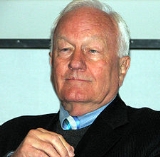
Roger Douglas

Encyclopedia
Sir Roger Owen Douglas (born 5 December 1937), is a New Zealand politician who formerly served as a senior New Zealand Labour Party
Cabinet
minister. He became arguably best-known for his prominent role in the radical economic restructuring undertaken by the Fourth Labour Government
during the 1980s ("Rogernomics
"). In 1993, he founded the Association of Consumers and Taxpayers (the forerunner of the ACT New Zealand Party) with Derek Quigley
. He returned to Parliament as an ACT Party backbencher
in 2008.
movement, and actively engaged in politics. His maternal grandfather Bill Anderton
, who was Labour
Member of Parliament for Eden
from 1935 to 1946 and for Auckland Central
from 1946 to 1960, was a cabinet minister in the Second Labour Government
. His father Norman Douglas
, a union secretary, was MP for Auckland Central from 1960 to 1975. His brother Malcolm Douglas
was briefly Labour MP for Hunua
1978–79.
Douglas received his secondary education at Auckland Grammar School
, and gained a degree in accountancy
from the University of Auckland
.
politics as a member of the Manukau City Council, Douglas began his career in national politics in 1969
when he won election to parliament as the Labour
Member of Parliament for Manukau
. He gave his maiden speech in the Address-in-Reply debate on 7 April 1970. He devoted the greater part of his speech to the case against foreign investment in the domestic economy. He became involved in the party's policies on industry and economics. He served as the MP for Manukau from 1969 to 1978, and then for Manurewa
from 1978 to 1990.
won the 1972
election, and the Labour parliamentary caucus elevated Douglas, then aged 34, to Cabinet rank. His father, and parliamentary colleague, Norman Douglas, failed to win a place in the ballot for Cabinet, and did not hide his bitter disappointment. On the day of the ballot, Kirk was so concerned by the extremity of Norman Douglas’s reaction, and its effects on his son, that he called Douglas’s mother to enlist her help. Kirk told his secretary, “It should have been the best day of Roger’s life but instead it was the worst”.
During the Third Labour Government
, Douglas served as Postmaster-General and Minister of Broadcasting until the unexpected death of Kirk in 1974. Kirk’s successor Bill Rowling
appointed Douglas Minister of Housing. He remained Minister of Broadcasting until 1975, when the portfolio was disestablished. Douglas was Minister of Housing and Minister of Customs until Labour's defeat by the National Party
under Robert Muldoon
in the 1975
election.
Douglas was the most junior member of Cabinet, but soon earned a reputation for hard work and competence. His appointment as Minister of Housing in 1974 marked him publicly as a talent in the Cabinet. It was a significant and, in political terms, a sensitive portfolio.
As Minister of Broadcasting, Douglas devised an administrative framework to allow for the introduction of a second television channel. It replaced the monopoly New Zealand Broadcasting Corporation
with two competing publicly-owned television channels, Television One, and Television Two (later called South Pacific Television
) a corporation to manage public radio, Radio New Zealand
, and a new Broadcasting Council. After public consultation, the scheme was implemented on 1 April 1975. However, the government of Robert Muldoon
merged the three broadcasters into a single Broadcasting Corporation of New Zealand in 1977, with the two television channels being merged into Television New Zealand
in 1980.
Douglas was an early and enthusiastic promoter of the government’s plans for a compulsory contributory superannuation scheme that would supplement the old age pension. In 1972, while still in opposition, he introduced a private member’s bill that provided for a form of compulsory superannuation. In Cabinet, Rowling, who was then Minister of Finance
, and Douglas were largely responsible for a 1973 White Paper
setting out the government's proposals for superannuation. As well as augmenting individual provision for retirement, the scheme was intended to be a source of capital for investment in the domestic economy. The scheme became law in the form of the New Zealand Superannuation Act 1974.
Douglas was among the designers of the Dependent Minders’ Allowance, which was part of Labour’s platform in the 1975 election. Originally intended as a means of compensating women whose absence from the workforce reduced their superannuation contributions, the scheme offered a cash payment to women on the birth of their first and second children, or the first two children born after the election. It was immediately dubbed the “Baby Bonus” by Muldoon.
, who entered parliament in 1977, Douglas was critical of Labour’s performance in government between 1972 and 1975. Labour’s defeat in the 1975 election was the greatest electoral reversal since 1928. A Labour majority of 23 seats in a Parliament of 87 members became a National majority of the same number. The Third Labour Government attempted to cushion economic contraction by borrowing abroad, but while it held unemployment to the level it had inherited, the rate of inflation trebled to an annual rate of 15 per cent and a surplus in the balance of payments became a deficit. Labour lost credibility as an economic manager by 1975. A series of scandals and misadventures, incompetence among some ministers, and Rowling’s inability to counter Muldoon’s populism
contributed to the defeat. The nature of the defeat widened a division that already existed between the older and younger members of the Labour caucus.
In opposition after 1975, Douglas became successively Labour's spokesperson on housing, special projects, consumer affairs and transport. In 1980, he published a series of proposals for future economic development under the title an "Alternative Budget". The proposals were not Labour policy and their publication was seen by the party leader Rowling as a challenge to his authority. Rowling demoted Douglas from the parliamentary front bench and he lost his responsibility for transport. In 1981 he became spokesperson for trade and industry.
Douglas argued that the Labour Party’s approach to economic policy was fragmented and based on unrealistic promises. He also believed that the party leadership should be revitalised, and supported David Lange’s unsuccessful bid for the leadership in 1980. In informal Labour caucus politics, Douglas became a member of the so-called "Fish and Chip Brigade", which included Rowling's leading caucus opponents. He identified his closest colleagues as Richard Prebble
, Mike Moore, and Michael Bassett
.
The failure of Lange’s leadership bid, his continuing dissatisfaction with Labour’s approach to economic policy, and his difficult relationship with leading figures in the party led Douglas to declare his intention to retire from Parliament at the 1981 general election. Lange was among those who persuaded him to reconsider. Lange saw Douglas as a moderniser. He saw Douglas as sometimes obstinate and limited, but in Lange’s view he had drive, and the ability to break from the traditions that had kept Labour so long in opposition. In 1983, when Lange became leader of the Labour Party, he made Douglas the Labour spokesperson for finance.
At the end of 1983, the Caucus Economic Committee adopted a paper that Douglas named the economic policy package. The committee’s support was not unanimous. The paper polarised opinion in the caucus. Several members of the caucus presented an alternative draft economic policy to the Labour Party’s Policy Council. The Policy Council was divided. Its members could not agree on the party’s economic platform. When disagreement became increasingly a matter of public knowledge, and the 1984 general election drew closer, the party’s deputy leader Geoffrey Palmer drafted a compromise proposal that combined elements of both sides of the argument. Lange doubted that Palmer’s paper satisfied either side. When Muldoon unexpectedly called an early election, the Palmer document became part of Labour’s election policy platform.
A critical element of Douglas’s economic policy package, but not the Labour Party’s policy document, was a 20 per cent devaluation of the New Zealand dollar. This was a sensitive subject. If it was widely known that an incoming government would devalue the dollar, dealers would seek profit by selling the dollar at its higher price before the election, and buying it back at its lower price afterwards. The difference, which might amount to hundreds of millions of dollars if there was a run on the currency, would be met by the taxpayer. Soon after Muldoon
called the election, Douglas held a public meeting in his electorate and distributed copies of his economic policy package, which made the case for a 20 per cent devaluation. Muldoon obtained a copy and released it to the news media, intending to embarrass the Labour Party. Douglas acknowledged that devaluation was not part of Labour policy and accepted responsibility for the mistake. Although Lange believed that the error cast doubt on Douglas’s judgement, he did not accept Douglas’s resignation because he did not wish to appoint a new finance spokesperson so close to the election.
returned to power in the election of 1984
and formed the Fourth Labour Government
. Lange became Prime Minister and Douglas became Minister of Finance
. At Douglas's request, Lange appointed two senior ministers as associate finance ministers: David Caygill
, who was also Minister of Trade and Industry, and Richard Prebble
, who was also Minister of Transport.
Soon after the election, the outgoing government carried out the devaluation that Douglas supported. The heads of Treasury and the Reserve Bank advised that devaluation was the only way to stop the run on the dollar that followed the announcement of an early election.
The unsettled political climate around the early election and the currency crisis and its resolution through the devaluation he supported gave Douglas a powerful position in the cabinet. Lange said in 1986 that the economic and political climate in 1984 gave Douglas influence he would not have had if the government had been elected in November 1984 and presented its first budget in June 1985. ‘When the crisis hit in July 1984, it was Roger Douglas who, above all, had thought through the economic issues – so when the cabinet needed to fall back on an economic philosophy, it was Douglas who had one.’
Labour promised during the election campaign to ‘open the books’, largely as a challenge to Muldoon’s supposedly secretive and ad hoc approach to economic management. Douglas responded by agreeing to the publication of Treasury’s briefing to the incoming government, which appeared under the title Economic Management.
Douglas took a limited part in the Economic Summit Conference that began on 11 September 1984 because he was already at work on his first budget. He saw the summit as preparing the country to accept change, but noted the possibility that it might heighten expectations of continued consensus and involvement. He said later that he had taken up the finance portfolio with a plan for economic restructuring already in mind, and described the budget he delivered in November 1984 as ‘an amalgam of what I had originally envisaged and fresh options presented in briefing papers and in debate with fellow ministers and Treasury officials.’
The budget was a radical departure from Labour’s established approach to economic management. Douglas answered criticism that the government’s intentions had not been made clear to the electorate by saying that he had spelled out his whole programme to the Policy Council, which had understood and endorsed his intentions. The detail was not made available to the public because it did not have the capacity to absorb it in the short time available.
The 1984 budget owed almost nothing to Labour’s manifesto. Its content closely matched the Treasury view set out in Economic Management. Douglas’s identification with Treasury was complete by 1985. Treasury initiatives adopted by the government that were not signalled before the 1984 election included the introduction of a comprehensive tax on consumption (GST), the floating of the dollar (which Douglas opposed until 1984) and the corporatisation of the government’s trading activities, announced at the end of 1985.
Treasury’s view of economic policy was neo-classical and monetarist, and used commercial criteria as the basis for decision-making. Douglas did not concede that his advocacy of these views placed him on the far right of politics. He maintained that the government’s social goals were the same as those of the First Labour Government
, but that changed circumstances required Labour to use different economic means to achieve its ends. He defended Treasury from the charge that its advice was at odds with Labour policy by arguing that its role was to give advice based on the interests of the nation as a whole. Treasury had no duty to help a government implement its manifesto. In constitutional terms, its responsibility was to advise its minister in a way that was free of party politics or ideology.
Douglas was reappointed to the finance portfolio after Labour’s victory in the 1987 general election
and remained finance minister until December 1988. His second term in office was marked by conflict with the prime minister David Lange
.
, with a substantial majority in the legislature (58.8% of the seats). Some argue that Labour's re-election stemmed primarily from the weakness of the opposition National Party and from public support for Labour's other policies (such as its stand against nuclear weapon
s). Douglas, along with his supporters Richard Prebble
and David Caygill
, maintained majority backing from the Cabinet to continue with their reforms, up until the conflict between Lange and Douglas. Shortly after the election and the "Black Monday
" stock-market crash
, Prime Minister Lange
moved to stop the changes. A protracted conflict between Lange and Douglas broke out in Cabinet
. Eventually Lange dismissed Richard Prebble in November 1988 and, following Douglas' announcement of a new flat-tax
system and a guaranteed minimum income
scheme, forced Douglas to resign his ministerial positions at the end of 1988.
election, which Labour
lost. His policies, however, continued under the aegis of Ruth Richardson
, the Minister of Finance
in the new Fourth National Government of New Zealand
in a style that became known as Ruthanasia
).
Douglas became a Knight Bachelor
as The Honourable Sir Roger Douglas in 1990.
By and large, subsequent governments have retained or reinforced the policies promoted by Douglas in the years 1984 to 1987 – including low levels of import-protection, "credible" monetary and fiscal policies, deregulated financial markets and limited subsidies and other interventions in the economy. The Heritage Foundation
/ Wall Street Journal 2006 Index of Economic Freedom
ranks New Zealand 9th-highest in the world, (equal with the United States and Australia).
. Douglas and Quigley intended the Association to serve as a pressure-group promoting the Douglas economic policies. Shortly afterwards, in 1996, the country switched to using the MMP electoral system. MMP gave smaller groups a much better chance of entering Parliament, and encouraged the Association to establish the ACT New Zealand Party. Douglas served as the party's first leader, but soon stood aside for Richard Prebble
(his old ally from their days in the Labour
caucus).
Douglas remained a strong supporter of the ACT party, although he became somewhat unhappy with the party's alleged lack of focus on pure economic policy. In particular, Douglas criticised what he saw as populism
within the party, claiming that some of its MPs seem more committed to grabbing headlines than to developing policy. When in April 2004 Prebble announced his decision to retire, Douglas spoke out in favour of Stephen Franks
and Ken Shirley
as possible successors – the other main contender in the leadership race, Rodney Hide
, had a reputation for advocating the style that Douglas condemned. Hide won the leadership and headed the ACT party until his resignation in April 2011.
On 2 December 2004, both Douglas and Quigley announced that they would step down as patrons of ACT. They stated as the reason that they wished to have more freedom to disagree with the party publicly.
On 21 February 2008, Douglas renewed his involvement with the ACT party by signing a letter inviting supporters to the 2008 ACT conference, and appearing in television and newspaper interviews endorsing ACT for the 2008 general election
. At ACT's 2008 annual conference in Auckland
, Douglas announced his intention to stand for Parliament again, as an ACT candidate. The announcement that he would run in the newly-created electorate of Hunua
came on 8 June 2008.
The ACT Party assigned Douglas the number three slot on its party list.
Douglas did not win the Hunua seat, but ACT's 3.65% share of the party vote gave it five seats, so he re-entered Parliament as a list MP. Prime Minister-elect John Key
had previously said that he would not give Douglas a Cabinet
position, but Douglas indicated a wish for a review of this stance.
In February 2010 Douglas' Minimum Wage (Mitigation of Youth Unemployment) Amendment Bill was drawn from the member's ballot. It was defeated at its first reading in April 2010.
In April 2010, Douglas's Tariff Act 1988 Repeal Bill, which would repeal all tariff
s on goods imported into New Zealand, was drawn from the member's ballot. It was defeated at its first reading.
In June 2010, Douglas' Education (Board of Trustee Freedom) Amendment Bill was drawn from the member's ballot. It is currently waiting for its first reading.
On 18 February 2011, Douglas announced that he will quit politics at the end of the 49th New Zealand Parliament
.
" after Sir Roger Douglas.
which he briefly served as Executive Chairman. He also serves as the managing director of his own group, Roger Douglas Associates.
New Zealand Labour Party
The New Zealand Labour Party is a New Zealand political party. It describes itself as centre-left and socially progressive and has been one of the two primary parties of New Zealand politics since 1935....
Cabinet
New Zealand Cabinet
The Cabinet of New Zealand functions as the policy and decision-making body of the executive branch within the New Zealand government system...
minister. He became arguably best-known for his prominent role in the radical economic restructuring undertaken by the Fourth Labour Government
Fourth Labour Government of New Zealand
The Fourth Labour Government of New Zealand was the government of New Zealand from 26 July 1984 to 2 November 1990. It enacted major social and economic reforms, including reformation of the tax system. The economic reforms were known as Rogernomics after Finance Minister Roger Douglas...
during the 1980s ("Rogernomics
Rogernomics
The term Rogernomics, a portmanteau of "Roger" and "economics", was coined by journalists at the New Zealand Listener by analogy with Reaganomics to describe the economic policies followed by Roger Douglas after his appointment in 1984 as Minister of Finance in the Fourth Labour Government...
"). In 1993, he founded the Association of Consumers and Taxpayers (the forerunner of the ACT New Zealand Party) with Derek Quigley
Derek Quigley
Derek Francis Quigley, QSO is a former New Zealand politician. He was a prominent member of the National Party during the late 1970s and early 1980s, and was known for his support of free market economics and trade liberalization...
. He returned to Parliament as an ACT Party backbencher
Backbencher
In Westminster parliamentary systems, a backbencher is a Member of Parliament or a legislator who does not hold governmental office and is not a Front Bench spokesperson in the Opposition...
in 2008.
Early life
Douglas was born on 5 December 1937. His family had strong ties with the trade-unionTrade union
A trade union, trades union or labor union is an organization of workers that have banded together to achieve common goals such as better working conditions. The trade union, through its leadership, bargains with the employer on behalf of union members and negotiates labour contracts with...
movement, and actively engaged in politics. His maternal grandfather Bill Anderton
Bill Anderton
William Theophilus Anderton was a New Zealand politician of the Labour Party.-Early life:Anderton was born in West Bromwich in the West Midlands of England. He married Annie Gertrude Mason in 1913, and they had two daughters and one son. He served in the British Army in WWI...
, who was Labour
New Zealand Labour Party
The New Zealand Labour Party is a New Zealand political party. It describes itself as centre-left and socially progressive and has been one of the two primary parties of New Zealand politics since 1935....
Member of Parliament for Eden
Eden (New Zealand electorate)
Eden is a former New Zealand Parliamentary electorate, in the city of Auckland.-Population Centres:The electorate is urban, and comprises a number of inner-city suburbs in the central-south part of Auckland.-History:...
from 1935 to 1946 and for Auckland Central
Auckland Central
Auckland Central is a New Zealand electoral division returning one member to the New Zealand House of Representatives. Its current representative is Nikki Kaye, a member of the National Party; she has represented the seat since 2008....
from 1946 to 1960, was a cabinet minister in the Second Labour Government
Second Labour Government of New Zealand
The Second Labour Government of New Zealand was the government of New Zealand from 1957 to 1960. It was most notable for raising taxes on alcohol, cigarettes and petrol, a move which was probably responsible for the government lasting for only one term....
. His father Norman Douglas
Norman Douglas (New Zealand)
Norman Vazey Douglas, QSO was a New Zealand trade unionist and left-wing politician. He joined the New Zealand Labour Party in 1932, but when John A. Lee was expelled from the party in 1940, Douglas followed to join the new Democratic Labour Party...
, a union secretary, was MP for Auckland Central from 1960 to 1975. His brother Malcolm Douglas
Malcolm Douglas
Malcolm Douglas was a New Zealand politician of the Labour Party.He represented the Hunua electorate from 25 November 1978 after the 1978 general election, until 24 May 1979, when he was unseated by a decision of the Electoral Court in favour of Winston Peters...
was briefly Labour MP for Hunua
Hunua
The Hunua electorate existed three times for the New Zealand House of Representatives beginning in 1978, based at the south end of the Auckland urban area, and named for the Hunua Ranges. It covered different geographical areas over those periods...
1978–79.
Douglas received his secondary education at Auckland Grammar School
Auckland Grammar School
Auckland Grammar School is a state secondary school for years 9 to 13 boys in Auckland, New Zealand. It had a roll of 2,483 in 2008, including a number of boarders who live in nearby Tibbs' House, making it one of the largest schools in New Zealand...
, and gained a degree in accountancy
Accountancy
Accountancy is the process of communicating financial information about a business entity to users such as shareholders and managers. The communication is generally in the form of financial statements that show in money terms the economic resources under the control of management; the art lies in...
from the University of Auckland
University of Auckland
The University of Auckland is a university located in Auckland, New Zealand. It is the largest university in the country and the highest ranked in the 2011 QS World University Rankings, having been ranked worldwide...
.
Labour Party
After some experience in local bodyLocal government
Local government refers collectively to administrative authorities over areas that are smaller than a state.The term is used to contrast with offices at nation-state level, which are referred to as the central government, national government, or federal government...
politics as a member of the Manukau City Council, Douglas began his career in national politics in 1969
New Zealand general election, 1969
The 1969 New Zealand general election was a nationwide vote to determine the shape of the New Zealand Parliament's 36th term. It saw the governing National Party win a fourth consecutive term, under Prime Minister Keith Holyoake.-The Election:...
when he won election to parliament as the Labour
New Zealand Labour Party
The New Zealand Labour Party is a New Zealand political party. It describes itself as centre-left and socially progressive and has been one of the two primary parties of New Zealand politics since 1935....
Member of Parliament for Manukau
Manukau (New Zealand electorate)
Manukau is a former New Zealand Parliamentary electorate in the south Auckland Region. It existed from 1881 to 1978, with a break from 1938 to 1957. It was represented by nine Members of Parliament...
. He gave his maiden speech in the Address-in-Reply debate on 7 April 1970. He devoted the greater part of his speech to the case against foreign investment in the domestic economy. He became involved in the party's policies on industry and economics. He served as the MP for Manukau from 1969 to 1978, and then for Manurewa
Manurewa (New Zealand electorate)
Manurewa is a New Zealand Parliamentary electorate.It is currently held by George Hawkins MP.-Population Centres:The electorate includes the following population centres:...
from 1978 to 1990.
Cabinet Minister, 1972–75
Labour under Norman KirkNorman Kirk
Norman Eric Kirk was the 29th Prime Minister of New Zealand from 1972 until his sudden death in 1974. He led the Parliamentary wing of the New Zealand Labour Party from 1965 to 1974. He was the fourth Labour Prime Minister of New Zealand, but the first to be born in New Zealand...
won the 1972
New Zealand general election, 1972
The New Zealand general election of 1972 was held to elect MPs to the 37th session of the New Zealand Parliament. The Labour Party, led by Norman Kirk, defeated the governing National Party.-Background:...
election, and the Labour parliamentary caucus elevated Douglas, then aged 34, to Cabinet rank. His father, and parliamentary colleague, Norman Douglas, failed to win a place in the ballot for Cabinet, and did not hide his bitter disappointment. On the day of the ballot, Kirk was so concerned by the extremity of Norman Douglas’s reaction, and its effects on his son, that he called Douglas’s mother to enlist her help. Kirk told his secretary, “It should have been the best day of Roger’s life but instead it was the worst”.
During the Third Labour Government
Third Labour Government of New Zealand
The Third Labour Government of New Zealand was the government of New Zealand from 1972 to 1975. During its time in office, it carried out a wide range of reforms in areas such as overseas trade, farming, public works, energy generation, local government, health, the arts, sport and recreation,...
, Douglas served as Postmaster-General and Minister of Broadcasting until the unexpected death of Kirk in 1974. Kirk’s successor Bill Rowling
Bill Rowling
Sir Wallace Edward Rowling, KCMG , often known as Bill Rowling, was the 30th Prime Minister of New Zealand. He was in office for just over a year, having been appointed Prime Minister following the death of the highly popular Norman Kirk...
appointed Douglas Minister of Housing. He remained Minister of Broadcasting until 1975, when the portfolio was disestablished. Douglas was Minister of Housing and Minister of Customs until Labour's defeat by the National Party
New Zealand National Party
The New Zealand National Party is the largest party in the New Zealand House of Representatives and in November 2008 formed a minority government with support from three minor parties.-Policies:...
under Robert Muldoon
Robert Muldoon
Sir Robert David "Rob" Muldoon, GCMG, CH served as the 31st Prime Minister of New Zealand from 1975 to 1984, as leader of the governing National Party. Muldoon had been a prominent member of the National party and MP for the Tamaki electorate for some years prior to becoming leader of the party...
in the 1975
New Zealand general election, 1975
The 1975 New Zealand general election was held to elect MPs to the 38th session of the New Zealand Parliament. It was the first election in New Zealand where 18-20 year olds and all permanent residents of New Zealand were eligible to vote, although only citizens were able to be...
election.
Douglas was the most junior member of Cabinet, but soon earned a reputation for hard work and competence. His appointment as Minister of Housing in 1974 marked him publicly as a talent in the Cabinet. It was a significant and, in political terms, a sensitive portfolio.
As Minister of Broadcasting, Douglas devised an administrative framework to allow for the introduction of a second television channel. It replaced the monopoly New Zealand Broadcasting Corporation
New Zealand Broadcasting Corporation
The New Zealand Broadcasting Corporation was established by the New Zealand government in 1962. It was dissolved on 1 April 1975, and replaced by three separate organisations: Radio New Zealand, Television One, and Television Two, later known as South Pacific Television....
with two competing publicly-owned television channels, Television One, and Television Two (later called South Pacific Television
South Pacific Television
South Pacific Television was a television channel in New Zealand, which operated between 1976 and 1980.- The Early Days :The channel, then known as TV 2, first went to air on June 30, 1975...
) a corporation to manage public radio, Radio New Zealand
Radio New Zealand
Radio New Zealand is a New Zealand public service radio broadcaster and Crown entity formed by the Radio New Zealand Act 1995. It operates news, current affairs and arts network Radio New Zealand National and classical music and jazz network Radio New Zealand Concert with full government funding...
, and a new Broadcasting Council. After public consultation, the scheme was implemented on 1 April 1975. However, the government of Robert Muldoon
Robert Muldoon
Sir Robert David "Rob" Muldoon, GCMG, CH served as the 31st Prime Minister of New Zealand from 1975 to 1984, as leader of the governing National Party. Muldoon had been a prominent member of the National party and MP for the Tamaki electorate for some years prior to becoming leader of the party...
merged the three broadcasters into a single Broadcasting Corporation of New Zealand in 1977, with the two television channels being merged into Television New Zealand
Television New Zealand
Television New Zealand, more commonly referred to, and stylized as TVNZ, is a government-owned corporation television network broadcasting in New Zealand and parts of the Pacific. It operates TV1, TV2, TVNZ7, TVNZ Heartland, TVNZ U and new media services....
in 1980.
Douglas was an early and enthusiastic promoter of the government’s plans for a compulsory contributory superannuation scheme that would supplement the old age pension. In 1972, while still in opposition, he introduced a private member’s bill that provided for a form of compulsory superannuation. In Cabinet, Rowling, who was then Minister of Finance
Minister of Finance (New Zealand)
The Minister of Finance is a senior figure within the government of New Zealand. The position is often considered to be the most important Cabinet role after that of the Prime Minister....
, and Douglas were largely responsible for a 1973 White Paper
White paper
A white paper is an authoritative report or guide that helps solve a problem. White papers are used to educate readers and help people make decisions, and are often requested and used in politics, policy, business, and technical fields. In commercial use, the term has also come to refer to...
setting out the government's proposals for superannuation. As well as augmenting individual provision for retirement, the scheme was intended to be a source of capital for investment in the domestic economy. The scheme became law in the form of the New Zealand Superannuation Act 1974.
Douglas was among the designers of the Dependent Minders’ Allowance, which was part of Labour’s platform in the 1975 election. Originally intended as a means of compensating women whose absence from the workforce reduced their superannuation contributions, the scheme offered a cash payment to women on the birth of their first and second children, or the first two children born after the election. It was immediately dubbed the “Baby Bonus” by Muldoon.
Opposition, 1975–84
Like his colleague David LangeDavid Lange
David Russell Lange, ONZ, CH , served as the 32nd Prime Minister of New Zealand from 1984 to 1989. He headed New Zealand's fourth Labour Government, one of the most reforming administrations in his country's history, but one which did not always conform to traditional expectations of a...
, who entered parliament in 1977, Douglas was critical of Labour’s performance in government between 1972 and 1975. Labour’s defeat in the 1975 election was the greatest electoral reversal since 1928. A Labour majority of 23 seats in a Parliament of 87 members became a National majority of the same number. The Third Labour Government attempted to cushion economic contraction by borrowing abroad, but while it held unemployment to the level it had inherited, the rate of inflation trebled to an annual rate of 15 per cent and a surplus in the balance of payments became a deficit. Labour lost credibility as an economic manager by 1975. A series of scandals and misadventures, incompetence among some ministers, and Rowling’s inability to counter Muldoon’s populism
Populism
Populism can be defined as an ideology, political philosophy, or type of discourse. Generally, a common theme compares "the people" against "the elite", and urges social and political system changes. It can also be defined as a rhetorical style employed by members of various political or social...
contributed to the defeat. The nature of the defeat widened a division that already existed between the older and younger members of the Labour caucus.
In opposition after 1975, Douglas became successively Labour's spokesperson on housing, special projects, consumer affairs and transport. In 1980, he published a series of proposals for future economic development under the title an "Alternative Budget". The proposals were not Labour policy and their publication was seen by the party leader Rowling as a challenge to his authority. Rowling demoted Douglas from the parliamentary front bench and he lost his responsibility for transport. In 1981 he became spokesperson for trade and industry.
Douglas argued that the Labour Party’s approach to economic policy was fragmented and based on unrealistic promises. He also believed that the party leadership should be revitalised, and supported David Lange’s unsuccessful bid for the leadership in 1980. In informal Labour caucus politics, Douglas became a member of the so-called "Fish and Chip Brigade", which included Rowling's leading caucus opponents. He identified his closest colleagues as Richard Prebble
Richard Prebble
Richard William Prebble CBE, born 7 February 1948, was for many years a member of the New Zealand Parliament. Initially a member of the Labour Party, he joined the newly formed ACT New Zealand party under Roger Douglas in 1996.-Early and personal life:...
, Mike Moore, and Michael Bassett
Michael Bassett
Michael Edward Rainton Bassett, QSO is a former Labour Party member of the New Zealand House of Representatives and cabinet minister in the reformist fourth Labour government...
.
The failure of Lange’s leadership bid, his continuing dissatisfaction with Labour’s approach to economic policy, and his difficult relationship with leading figures in the party led Douglas to declare his intention to retire from Parliament at the 1981 general election. Lange was among those who persuaded him to reconsider. Lange saw Douglas as a moderniser. He saw Douglas as sometimes obstinate and limited, but in Lange’s view he had drive, and the ability to break from the traditions that had kept Labour so long in opposition. In 1983, when Lange became leader of the Labour Party, he made Douglas the Labour spokesperson for finance.
At the end of 1983, the Caucus Economic Committee adopted a paper that Douglas named the economic policy package. The committee’s support was not unanimous. The paper polarised opinion in the caucus. Several members of the caucus presented an alternative draft economic policy to the Labour Party’s Policy Council. The Policy Council was divided. Its members could not agree on the party’s economic platform. When disagreement became increasingly a matter of public knowledge, and the 1984 general election drew closer, the party’s deputy leader Geoffrey Palmer drafted a compromise proposal that combined elements of both sides of the argument. Lange doubted that Palmer’s paper satisfied either side. When Muldoon unexpectedly called an early election, the Palmer document became part of Labour’s election policy platform.
A critical element of Douglas’s economic policy package, but not the Labour Party’s policy document, was a 20 per cent devaluation of the New Zealand dollar. This was a sensitive subject. If it was widely known that an incoming government would devalue the dollar, dealers would seek profit by selling the dollar at its higher price before the election, and buying it back at its lower price afterwards. The difference, which might amount to hundreds of millions of dollars if there was a run on the currency, would be met by the taxpayer. Soon after Muldoon
Robert Muldoon
Sir Robert David "Rob" Muldoon, GCMG, CH served as the 31st Prime Minister of New Zealand from 1975 to 1984, as leader of the governing National Party. Muldoon had been a prominent member of the National party and MP for the Tamaki electorate for some years prior to becoming leader of the party...
called the election, Douglas held a public meeting in his electorate and distributed copies of his economic policy package, which made the case for a 20 per cent devaluation. Muldoon obtained a copy and released it to the news media, intending to embarrass the Labour Party. Douglas acknowledged that devaluation was not part of Labour policy and accepted responsibility for the mistake. Although Lange believed that the error cast doubt on Douglas’s judgement, he did not accept Douglas’s resignation because he did not wish to appoint a new finance spokesperson so close to the election.
Minister of Finance, 1984–88
LabourNew Zealand Labour Party
The New Zealand Labour Party is a New Zealand political party. It describes itself as centre-left and socially progressive and has been one of the two primary parties of New Zealand politics since 1935....
returned to power in the election of 1984
New Zealand general election, 1984
The 1984 New Zealand general election was a nationwide vote to determine the shape of the 41st New Zealand Parliament. It marked the beginning of the Fourth Labour Government, with David Lange's Labour Party defeating long-serving Prime Minister Robert Muldoon of the National Party. It was also the...
and formed the Fourth Labour Government
Fourth Labour Government of New Zealand
The Fourth Labour Government of New Zealand was the government of New Zealand from 26 July 1984 to 2 November 1990. It enacted major social and economic reforms, including reformation of the tax system. The economic reforms were known as Rogernomics after Finance Minister Roger Douglas...
. Lange became Prime Minister and Douglas became Minister of Finance
Minister of Finance (New Zealand)
The Minister of Finance is a senior figure within the government of New Zealand. The position is often considered to be the most important Cabinet role after that of the Prime Minister....
. At Douglas's request, Lange appointed two senior ministers as associate finance ministers: David Caygill
David Caygill
David Caygill, CBE is a former New Zealand politician. After being New Zealand's youngest city councillor at 22 , he was an MP from 1978 to 1996, representing the Labour Party...
, who was also Minister of Trade and Industry, and Richard Prebble
Richard Prebble
Richard William Prebble CBE, born 7 February 1948, was for many years a member of the New Zealand Parliament. Initially a member of the Labour Party, he joined the newly formed ACT New Zealand party under Roger Douglas in 1996.-Early and personal life:...
, who was also Minister of Transport.
Soon after the election, the outgoing government carried out the devaluation that Douglas supported. The heads of Treasury and the Reserve Bank advised that devaluation was the only way to stop the run on the dollar that followed the announcement of an early election.
The unsettled political climate around the early election and the currency crisis and its resolution through the devaluation he supported gave Douglas a powerful position in the cabinet. Lange said in 1986 that the economic and political climate in 1984 gave Douglas influence he would not have had if the government had been elected in November 1984 and presented its first budget in June 1985. ‘When the crisis hit in July 1984, it was Roger Douglas who, above all, had thought through the economic issues – so when the cabinet needed to fall back on an economic philosophy, it was Douglas who had one.’
Labour promised during the election campaign to ‘open the books’, largely as a challenge to Muldoon’s supposedly secretive and ad hoc approach to economic management. Douglas responded by agreeing to the publication of Treasury’s briefing to the incoming government, which appeared under the title Economic Management.
Douglas took a limited part in the Economic Summit Conference that began on 11 September 1984 because he was already at work on his first budget. He saw the summit as preparing the country to accept change, but noted the possibility that it might heighten expectations of continued consensus and involvement. He said later that he had taken up the finance portfolio with a plan for economic restructuring already in mind, and described the budget he delivered in November 1984 as ‘an amalgam of what I had originally envisaged and fresh options presented in briefing papers and in debate with fellow ministers and Treasury officials.’
The budget was a radical departure from Labour’s established approach to economic management. Douglas answered criticism that the government’s intentions had not been made clear to the electorate by saying that he had spelled out his whole programme to the Policy Council, which had understood and endorsed his intentions. The detail was not made available to the public because it did not have the capacity to absorb it in the short time available.
The 1984 budget owed almost nothing to Labour’s manifesto. Its content closely matched the Treasury view set out in Economic Management. Douglas’s identification with Treasury was complete by 1985. Treasury initiatives adopted by the government that were not signalled before the 1984 election included the introduction of a comprehensive tax on consumption (GST), the floating of the dollar (which Douglas opposed until 1984) and the corporatisation of the government’s trading activities, announced at the end of 1985.
Treasury’s view of economic policy was neo-classical and monetarist, and used commercial criteria as the basis for decision-making. Douglas did not concede that his advocacy of these views placed him on the far right of politics. He maintained that the government’s social goals were the same as those of the First Labour Government
First Labour Government of New Zealand
The First Labour Government of New Zealand was the government of New Zealand from 1935 to 1949. It set the tone of New Zealand's economic and welfare policies until the 1980s, establishing a welfare state, a system of Keynesian economic management, and high levels of state intervention...
, but that changed circumstances required Labour to use different economic means to achieve its ends. He defended Treasury from the charge that its advice was at odds with Labour policy by arguing that its role was to give advice based on the interests of the nation as a whole. Treasury had no duty to help a government implement its manifesto. In constitutional terms, its responsibility was to advise its minister in a way that was free of party politics or ideology.
Douglas was reappointed to the finance portfolio after Labour’s victory in the 1987 general election
New Zealand general election, 1987
The 1987 New Zealand general election was a nationwide vote to determine the shape of the 43rd sitting of the New Zealand Parliament. The governing New Zealand Labour Party, led by Prime Minister David Lange, was re-elected for a second term, although the Opposition National Party made gains...
and remained finance minister until December 1988. His second term in office was marked by conflict with the prime minister David Lange
David Lange
David Russell Lange, ONZ, CH , served as the 32nd Prime Minister of New Zealand from 1984 to 1989. He headed New Zealand's fourth Labour Government, one of the most reforming administrations in his country's history, but one which did not always conform to traditional expectations of a...
.
Lange and Douglas, 1984–89
Despite implementing substantial reforms – particularly economic reforms – which made it unpopular amongst some New Zealanders, the Labour government won re-election in 1987New Zealand general election, 1987
The 1987 New Zealand general election was a nationwide vote to determine the shape of the 43rd sitting of the New Zealand Parliament. The governing New Zealand Labour Party, led by Prime Minister David Lange, was re-elected for a second term, although the Opposition National Party made gains...
, with a substantial majority in the legislature (58.8% of the seats). Some argue that Labour's re-election stemmed primarily from the weakness of the opposition National Party and from public support for Labour's other policies (such as its stand against nuclear weapon
Nuclear weapon
A nuclear weapon is an explosive device that derives its destructive force from nuclear reactions, either fission or a combination of fission and fusion. Both reactions release vast quantities of energy from relatively small amounts of matter. The first fission bomb test released the same amount...
s). Douglas, along with his supporters Richard Prebble
Richard Prebble
Richard William Prebble CBE, born 7 February 1948, was for many years a member of the New Zealand Parliament. Initially a member of the Labour Party, he joined the newly formed ACT New Zealand party under Roger Douglas in 1996.-Early and personal life:...
and David Caygill
David Caygill
David Caygill, CBE is a former New Zealand politician. After being New Zealand's youngest city councillor at 22 , he was an MP from 1978 to 1996, representing the Labour Party...
, maintained majority backing from the Cabinet to continue with their reforms, up until the conflict between Lange and Douglas. Shortly after the election and the "Black Monday
Black Monday (1987)
In finance, Black Monday refers to Monday October 19, 1987, when stock markets around the world crashed, shedding a huge value in a very short time. The crash began in Hong Kong and spread west to Europe, hitting the United States after other markets had already declined by a significant margin...
" stock-market crash
Stock market crash
A stock market crash is a sudden dramatic decline of stock prices across a significant cross-section of a stock market, resulting in a significant loss of paper wealth. Crashes are driven by panic as much as by underlying economic factors...
, Prime Minister Lange
David Lange
David Russell Lange, ONZ, CH , served as the 32nd Prime Minister of New Zealand from 1984 to 1989. He headed New Zealand's fourth Labour Government, one of the most reforming administrations in his country's history, but one which did not always conform to traditional expectations of a...
moved to stop the changes. A protracted conflict between Lange and Douglas broke out in Cabinet
New Zealand Cabinet
The Cabinet of New Zealand functions as the policy and decision-making body of the executive branch within the New Zealand government system...
. Eventually Lange dismissed Richard Prebble in November 1988 and, following Douglas' announcement of a new flat-tax
Flat tax
A flat tax is a tax system with a constant marginal tax rate. Typically the term flat tax is applied in the context of an individual or corporate income that will be taxed at one marginal rate...
system and a guaranteed minimum income
Guaranteed minimum income
Guaranteed minimum income is a system of social welfare provision that guarantees that all citizens or families have an income sufficient to live on, provided they meet certain conditions. Eligibility is typically determined by citizenship, a means test and either availability for the labour...
scheme, forced Douglas to resign his ministerial positions at the end of 1988.
Later career
On 3 August 1989 the Labour caucus voted to return Douglas to Cabinet. Lange, who saw the vote as a choice between him and Douglas, resigned his office almost immediately afterwards. Lange’s successor Geoffrey Palmer did not restore Douglas to the finance portfolio, then held by David Caygill, but appointed him Minister of Police and Minister of Immigration. Douglas did not stand for Parliament at the 1990New Zealand general election, 1990
The 1990 New Zealand general election was held on 27 October to determine the composition of the 43rd New Zealand parliament. The governing Labour Party was defeated, ending its controversial two terms in office...
election, which Labour
New Zealand Labour Party
The New Zealand Labour Party is a New Zealand political party. It describes itself as centre-left and socially progressive and has been one of the two primary parties of New Zealand politics since 1935....
lost. His policies, however, continued under the aegis of Ruth Richardson
Ruth Richardson
Ruth Richardson served as New Zealand's Minister of Finance from 1990 to 1993, and is known for her strong pursuit of free-market economic reforms .-Early life:...
, the Minister of Finance
Minister of Finance (New Zealand)
The Minister of Finance is a senior figure within the government of New Zealand. The position is often considered to be the most important Cabinet role after that of the Prime Minister....
in the new Fourth National Government of New Zealand
Fourth National Government of New Zealand
The Fourth National Government of New Zealand was the government of New Zealand from 2 November 1990 to 27 November 1999. Following in the footsteps of the previous Labour government, the fourth National government embarked on an extensive programme of spending cuts...
in a style that became known as Ruthanasia
Ruthanasia
Ruthanasia, a portmanteau of "Ruth" and "euthanasia", is the pejorative name given to the period of free-market economic reform conducted during the first term of the fourth National government in New Zealand, from 1990 to 1993...
).
Douglas became a Knight Bachelor
Knight Bachelor
The rank of Knight Bachelor is a part of the British honours system. It is the most basic rank of a man who has been knighted by the monarch but not as a member of one of the organised Orders of Chivalry...
as The Honourable Sir Roger Douglas in 1990.
By and large, subsequent governments have retained or reinforced the policies promoted by Douglas in the years 1984 to 1987 – including low levels of import-protection, "credible" monetary and fiscal policies, deregulated financial markets and limited subsidies and other interventions in the economy. The Heritage Foundation
Heritage Foundation
The Heritage Foundation is a conservative American think tank based in Washington, D.C. Heritage's stated mission is to "formulate and promote conservative public policies based on the principles of free enterprise, limited government, individual freedom, traditional American values, and a strong...
/ Wall Street Journal 2006 Index of Economic Freedom
Index of Economic Freedom
The Index of Economic Freedom is a series of 10 economic measurements created by The Heritage Foundation and The Wall Street Journal. Its stated objective is to measure the degree of economic freedom in the world's nations....
ranks New Zealand 9th-highest in the world, (equal with the United States and Australia).
ACT New Zealand
In 1993 Douglas co-founded the Association of Consumers and Taxpayers with Derek QuigleyDerek Quigley
Derek Francis Quigley, QSO is a former New Zealand politician. He was a prominent member of the National Party during the late 1970s and early 1980s, and was known for his support of free market economics and trade liberalization...
. Douglas and Quigley intended the Association to serve as a pressure-group promoting the Douglas economic policies. Shortly afterwards, in 1996, the country switched to using the MMP electoral system. MMP gave smaller groups a much better chance of entering Parliament, and encouraged the Association to establish the ACT New Zealand Party. Douglas served as the party's first leader, but soon stood aside for Richard Prebble
Richard Prebble
Richard William Prebble CBE, born 7 February 1948, was for many years a member of the New Zealand Parliament. Initially a member of the Labour Party, he joined the newly formed ACT New Zealand party under Roger Douglas in 1996.-Early and personal life:...
(his old ally from their days in the Labour
New Zealand Labour Party
The New Zealand Labour Party is a New Zealand political party. It describes itself as centre-left and socially progressive and has been one of the two primary parties of New Zealand politics since 1935....
caucus).
Douglas remained a strong supporter of the ACT party, although he became somewhat unhappy with the party's alleged lack of focus on pure economic policy. In particular, Douglas criticised what he saw as populism
Populism
Populism can be defined as an ideology, political philosophy, or type of discourse. Generally, a common theme compares "the people" against "the elite", and urges social and political system changes. It can also be defined as a rhetorical style employed by members of various political or social...
within the party, claiming that some of its MPs seem more committed to grabbing headlines than to developing policy. When in April 2004 Prebble announced his decision to retire, Douglas spoke out in favour of Stephen Franks
Stephen Franks
Stephen Franks in Wellington, New Zealand is a commercial lawyer. At one time, he was Chairman and Partner of the large firm Chapman Tripp. Franks has been a member of two political parties. He previously served as a List MP for the right wing Act New Zealand...
and Ken Shirley
Ken Shirley
Kenneth Lex Shirley , generally called Ken Shirley, was a New Zealand politician. He was a member of the ACT New Zealand party, although was previously a member and Cabinet minister of the Labour Party.-Member of Parliament:...
as possible successors – the other main contender in the leadership race, Rodney Hide
Rodney Hide
Rodney Hide is a New Zealand politician who was leader of the political party ACT New Zealand from 2004 to 2011. From 2005 to 2011 he represented the electorate of Epsom as its Member of Parliament. Rodney Hide was Minister of Local Government, Associate Minister of Commerce and Minister of...
, had a reputation for advocating the style that Douglas condemned. Hide won the leadership and headed the ACT party until his resignation in April 2011.
On 2 December 2004, both Douglas and Quigley announced that they would step down as patrons of ACT. They stated as the reason that they wished to have more freedom to disagree with the party publicly.
On 21 February 2008, Douglas renewed his involvement with the ACT party by signing a letter inviting supporters to the 2008 ACT conference, and appearing in television and newspaper interviews endorsing ACT for the 2008 general election
New Zealand general election, 2008
The 2008 New Zealand general election was held on 8 November 2008 to determine the composition of the 49th New Zealand parliament. The conservative National Party, headed by its Parliamentary leader John Key, won a plurality of votes and seats, ending 9 years of government dominated by the social...
. At ACT's 2008 annual conference in Auckland
Auckland
The Auckland metropolitan area , in the North Island of New Zealand, is the largest and most populous urban area in the country with residents, percent of the country's population. Auckland also has the largest Polynesian population of any city in the world...
, Douglas announced his intention to stand for Parliament again, as an ACT candidate. The announcement that he would run in the newly-created electorate of Hunua
Hunua
The Hunua electorate existed three times for the New Zealand House of Representatives beginning in 1978, based at the south end of the Auckland urban area, and named for the Hunua Ranges. It covered different geographical areas over those periods...
came on 8 June 2008.
The ACT Party assigned Douglas the number three slot on its party list.
Douglas did not win the Hunua seat, but ACT's 3.65% share of the party vote gave it five seats, so he re-entered Parliament as a list MP. Prime Minister-elect John Key
John Key
John Phillip Key is the 38th Prime Minister of New Zealand, in office since 2008. He has led the New Zealand National Party since 2006....
had previously said that he would not give Douglas a Cabinet
New Zealand Cabinet
The Cabinet of New Zealand functions as the policy and decision-making body of the executive branch within the New Zealand government system...
position, but Douglas indicated a wish for a review of this stance.
In February 2010 Douglas' Minimum Wage (Mitigation of Youth Unemployment) Amendment Bill was drawn from the member's ballot. It was defeated at its first reading in April 2010.
In April 2010, Douglas's Tariff Act 1988 Repeal Bill, which would repeal all tariff
Tariff
A tariff may be either tax on imports or exports , or a list or schedule of prices for such things as rail service, bus routes, and electrical usage ....
s on goods imported into New Zealand, was drawn from the member's ballot. It was defeated at its first reading.
In June 2010, Douglas' Education (Board of Trustee Freedom) Amendment Bill was drawn from the member's ballot. It is currently waiting for its first reading.
On 18 February 2011, Douglas announced that he will quit politics at the end of the 49th New Zealand Parliament
49th New Zealand Parliament
The 49th New Zealand Parliament was elected at the 2008 election. It consists of 122 members, including an overhang of two seats caused by the Māori Party having won two more electorate seats than its share of the party vote would otherwise have given it. The Parliament will serve from 2008 until...
.
The Roger Award
In 1997, in a back-handed compliment, the founders of the annual award for "The Worst Transnational Corporation operating in New Zealand", as voted by "four or five eminent judges – academics, community leaders, artists, even sportspeople", named it the "Roger AwardRoger Award
The Roger Award For The Worst Transnational Corporation Operating in New Zealand is an annual media campaign run since 1997 by two activist organisations, Campaign Against Foreign Control of Aotearoa and GATT Watchdog...
" after Sir Roger Douglas.
Outside politics
During his absence from national politics Douglas held senior positions at a number of prominent companies such as BILRon Brierley
Sir Ronald Alfred "Ron" Brierley is a New Zealand investor and corporate raider, chairman and director of a number of companies in Australia, New Zealand and the UK. He founded "R. A. Brierley Investments" in March 1961 with no capital...
which he briefly served as Executive Chairman. He also serves as the managing director of his own group, Roger Douglas Associates.