

Nemertea

Encyclopedia
Nemertea is a phylum
of invertebrate
animal
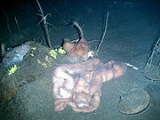
s also known as "ribbon worms" or "proboscis worms". Alternative names for the phylum have included Nemertini, Nemertinea and Rhynchocoela. Although most are less than 20 centimetres (7.9 in) long, one specimen has been estimated at 54 metres (177.2 ft), which would make it the longest animal ever found. Most are very slim, usually only a few millimeters wide, although a few have relatively short but wide bodies. Many have patterns of yellow, orange, red and green coloration.
The foregut, stomach and intestine run a little below the midline of the body, the anus
is at the tip of the tail, and the mouth is under the front. A little above the gut is the rhynchocoel, a cavity which mostly runs above the midline and ends a little short of the rear of the body. All species have a proboscis
which lies in the rhynchocoel when inactive but everts (turns inside-out) to emerge just above the mouth and capture the animal's prey with poisons. A very stretchy muscle in the back of the rhynchocoel pulls the proboscis in when an attack ends. A few species with stubby bodies filter feed and have suckers at the front and back ends, with which they attach to a host
.
The brain is a ring of four ganglia, positioned around the rhynchocoel near its front end. At least a pair of ventral nerve cord
s connect to the brain and run along the length of the body. Most nemerteans have various chemoreceptors, and on their heads some species have a number of pigment-cup ocelli, which can detect light but not form an image. Nemerteans respire
through the skin. They have at least two lateral vessels which are joined at the ends to form a loop, and these and the rhynchocoel are filled with fluid. There is no heart, and the flow of fluid depends on contraction of muscles in the vessels and the body wall. To filter out soluble waste products, flame cell
s are embedded in the front part of the two lateral fluid vessels, and remove the wastes through a network of pipes to the outside.
All nemerteans move slowly, using their external cilia to glide on surfaces on a trail of slime
, while larger species use muscular waves to crawl, and some swim by dorso-ventral undulations. A few live in the open ocean while the rest find or make hiding places on the bottom. About a dozen species inhabit freshwater, mainly in the tropics and subtropics, and another dozen species live on land in cool, damp places. Most nemerteans are carnivores, feeding on annelid
s, clam
s and crustacean
s. A few species are scavenger
s, and a few species live commensally inside the mantle
cavity of molluscs. Some species have devastated commercial fishing of clams and crabs. Nemerteans have few predators. Two species are sold as fish bait.
In most species the sexes are separate, but all the freshwater species are hermaphroditic. Nemerteans often have numerous temporary gonad
s (ovaries
or testes), and build temporary gonoducts (ducts from which the ova or sperm are emitted), one per gonad, when the ova and sperm are ready. The eggs are generally fertilised externally. Some species shed them into the water, and others protect their eggs in various ways. The fertilized egg divides by spiral cleavage and grows by determinate development, in which the fate of a cell can usually be predicted from its predecessors in the process of division. The embryos of most taxa
develop either directly to form juveniles (like the adult but smaller) or to form planuliform
larvae, in which the larva's long axis is the same as the juvenile's. However, some form a pilidium larva, in which the developing juvenile has a gut which lies across the larva's body, and usually eats the remains of the larva when it emerges. The bodies of some species fragment readily, and even parts near the tail can grow full bodies.
It has been suggested that three fossil
species may be nemerteans, but none is confirmed. Traditional taxonomy
divides the phylum in two classes
, Anopla
("unarmed" – their probosces do not have a little dagger) with two orders
, and Enopla
("armed" with a dagger) with two orders. However, it is now accepted that Anopla are polyphyletic (combine two or more separate groups), as one order is more closely related to Enopla than to the other order of Anopla. The phylum Nemertea is monophyletic, whose synapomorphies
include the rhynchocoel and eversible proboscis. Traditional taxonomy says that nemerteans are closely related to flatworm
s and that both are relatively "primitive" acoelomates. Now both phyla are regarded as members of the Lophotrochozoa
, a very large "super-phylum" that also includes molluscs, annelid
s, brachiopod
s, bryozoa
and many other protostome
s.
wrote of a marine worm which was apparently 17.76 metres (58.3 ft) long ("40 cubits"), about the width of a child's arm, and whose touch made a hand swell. William Borlase
wrote in 1758 of a "sea long worm", and in 1770 Gunnerus
wrote a formal description of this animal, which he called Ascaris longissima. Its current name, Lineus longissimus
, was first used in 1806 by Sowerby. In 1995, a total of 1,149 species had been described and grouped into 250 genera.
Nemertea are named after the Greek sea-nymph
Nemertes, one of the daughters of Nereus
and Doris
. Alternative names for the phylum have included Nemertini, Nemertinea and Rhynchocoela. The Nemertodermatida
are a separate phylum, whose closest relatives appear to be the Acoela
.
The typical nemertean body is very slim in proportion to its length. The smallest are a few millimeters long, most are less than 20 centimetres (7.9 in), and several exceed 1 metres (3.3 ft). The longest animal ever found, at 54 metres (177.2 ft) long, may a specimen of Lineus longissimus
, although L. longissimus is usually only a few millimeters wide. The bodies of most nemerteans can stretch a lot, up to 10 times their resting length in some species, but reduce their length to 50% and increase their width to 300% when disturbed. A few have relatively short but wide bodies, for example Malacobdella grossa is up to 3.5 centimetres (1.4 in) long and 1 centimetre (0.393700787401575 in) wide, and some of these are much less stretchy. Smaller nemerteans are approximately cylindrical, but larger species are flattened dorso-ventrally (between back and belly). Many have visible patterns in various combinations of yellow, orange, red and green.
The outermost layer of the body has no cuticle
but consists of a ciliated and gland
ular epithelium
containing rhabdite
s, which form the mucus
in which the cilia glide. Each ciliated cell has many cilia and microvilli. The outermost layer rests on a thickened basement membrane
, the dermis
. Next to the dermis are at least three layers of muscles, some circular and some longitudinal. The combinations of muscle types vary between the different classes
, but these are not associated with differences in movement. Nemerteans also have dorso-ventral muscles, which flatten the animals, especially in the larger species. Inside the concentric tubes of these layers is mesenchyme
, a kind of connective tissue
. In pelagic
species this tissue is gelatinous and buoyant.
The mouth is ventral and a little behind the front of the body. The foregut, stomach and intestine run a little below the midline of the body and the anus
is at the tip of the tail. Above the gut and separated from the gut by mesenchyme is the rhynchocoel, a cavity which mostly runs above the midline and ends a little short of the rear of the body. The rhynchocoel of class Anopla
has an orifice a little to the front of the mouth, but still under the front of the body. In the other class, Enopla
, the mouth and the front of the rhynchocoel share an orifice. The rhynchocoel is a coelom
, as it is lined by epithelium
.
is an infolding of the body wall, and sits in the rhynchocoel when inactive. When muscles in the wall of the rhynchocoel compress the fluid in the rhynchocoel, the pressure makes the proboscis jump inside-out to attack the animal's prey along a canal called the rhynchodeum and through an orifice, the proboscis pore. The proboscis has a muscle which attaches to the back of the rhynchocoel, and which can stretch up to 30 times its inactive length and then retract the proboscis.
The proboscis of the class
Anopla
("unarmed") exits from an orifice which is separate from the mouth, coils around the prey and immobilizes it by sticky, toxic secretions. The Anopla can attack as soon as they move into the range of the proboscis. Some Anopla have branched probosces which Ruppert, Fox and Barnes describe as "a mass of sticky spaghetti". The animal then draws its prey into its mouth.
In most of the class Enopla
("armed"), the proboscis exits from a common orifice of the rhynchocoel and mouth. A typical member of this class has a stylet, a calcareous
barb, with which the animal stabs the prey many times to inject toxins and digestive secretions. The prey is then swallowed whole or, after partial digestion, its tissues are sucked into the mouth. The stylet is attached about one-third of distance from the end of the everted proboscis, which extends only enough to expose the stylet. On either side of the active stylet are sacs containing back-up stylets to replace the active one as the animal grows or an active one is lost. Instead of one stylet, the Polystilifera have a pad that bears many tiny stylets, and these animals have separate orifices for the proboscis and mouth, unlike other Enopla. The Enopla can only attack after contacting the prey.
Some nemerteans, such as L. longissimus, absorb organic food in solution through their skins, which may make the long, slim bodies an advantage. Suspension feeding is found only among the specialized symbiotic bdellonemerteans, which have a proboscis but no stylet, and use suckers to attach themselves to bivalves.
rather than diffusion
to move substances through their bodies. The circulatory system consists of the rhynchocoel and peripheral vessels, while blood of other invertebrates is contained in the main body cavity. The fluid in the rhynchocoel moves substances to and from the proboscis, and functions as a fluid skeleton
in everting the proboscis and in burrowing. The vessels circulate fluid round the whole body and the rhynchocoel provides it own local circulation. The circulatory vessels are a system of coeloms.
In the simplest type of circulatory system, two lateral vessels are joined at the ends to form a loop. However, many species have additional long-wise and cross-wise vessels. There is no heart nor pumping vessels, and the flow of fluid depends on contraction of both the vessels and the body wall's muscles. In some species, circulation is intermittent, and fluid ebbs and flows in the long-wise vessels. The fluid in the vessels is usually colorless, but in some species it contains cells that are yellow, orange, green or red. The red type contain hemoglobin
and carry oxygen, but the function of the other pigments is unknown.
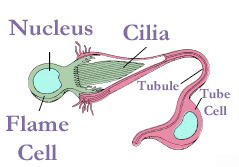 Nemertea use organs called protonephridia to excrete soluble waste products, especially nitrogen
ous by-products of cellular metabolism
. In nemertean protonephridia, flame cell
s which filter out the wastes are embedded in the front part of the two lateral fluid vessels. The flame cells remove the wastes into two collecting ducts, one on either side, and each duct has one or more nephridiopore
s through which the wastes exit. Semiterrestrial and freshwater nemerteans have many more flame cells than marines, sometimes thousands. The reason may be that osmoregulation
is more difficult in non-marine environments.
consists of a brain
and paired ventral nerve cord
s that connect to the brain and run along the length of the body. The brain is a ring of four ganglia, masses of nerve cells, positioned round the rhynchocoel near its front end – while the brains of most protostome
invertebrates encircle the foregut. Most nemertean species have just one pair of nerve cords, many species have additional paired cords, and some species also have a dorsal cord. In some species the cords lie within the skin, but in most they are deeper, inside the muscle layers. The central nervous system is often red or pink because it contains hemoglobin
. This stores oxygen
for peak activity or when the animal experiences anoxia
, for example while burrowing in oxygen-free sediment
s.
Some species have paired cerebral organs, sacs whose only only openings are to the outside. Others species have unpaired evertible organs on the front of their heads. Some have slits along the side of the head or grooves obliquely across the head, and these may be associated with paired cerebral organs. All of these are thought to be chemoreceptors, and the cerebral organs may also aiding osmoregulation
. Small pits in the epidermis appear to be sensors. On their head some species have a number of pigment-cup ocelli, which can detect light but not form an image. Most nemerteans have two to six ocelli, although some have hundreds. A few tiny species that live between grains of sand have statocyst
s, which sense balance.
Paranemertes peregrina, which feeds on polychaetes, can follow the prey's trails of mucus, and find its burrow by backtracking along its own trail of mucus.
, some of which is produced by glands in the head. Larger species use muscular waves to crawl, and some aquatic species swim by dorso-ventral undulations. Some species burrow by means of muscular peristalsis
, and have powerful muscles. Some species of the suborder
Monostilifera, whose proboscis have one active stylet, move by extending the proboscis, sticking it to an object and pulling the animal towards the object.
, and most species are gonochoric (the sexes are separate), but all the freshwater forms are hermaphroditic.
Nemerteans often have numerous temporary gonad
s (ovaries or testes), forming a row down each side of the body in the mesenchyme
. Temporary gonoducts (ducts from which the ova
or sperm
are emitted), one per gonad, are built when the ova and sperm are ready. The eggs are generally fertilised externally. Some species shed them into the water, some lay them in a burrow or tube, and some protect them by cocoons or gelatinous strings. Some bathypelagic (deep sea) species have internal fertilization
, and some of these are viviparous, growing their embryo
s in the female's body.
The zygote
(fertilised egg) divides by spiral cleavage and grows by determinate development, in which the fate of a cell can usually be predicted from its predecessors in the process of division. The embryos of most taxa develop either directly to form juveniles
(like the adult but smaller) or to form planuliform
larva
e, in which the larva's long axis is the same as the juvenile's. The planuliform larva stage may be short-lived and lecithotrophic ("yolky") before becoming a juvenile, or may be planktotrophic, swimming for some time and eating prey larger than microscopic particles. However, many members of the order Heteronemertea
and the palaeonemertea
n family
Hubrechtidae form a pilidium larva, which can capture unicellular algae
and which Maslakova describes as like a deerstalker
cap with the ear flaps pulled down. It has a gut which lies across the body, a mouth between the "ear flaps", but no anus. A small number of imaginal disc
s form, encircling the archenteron
(developing gut) and coalesce to form the juvenile. When it is fully formed, the juvenile bursts out of the larva body and usually eats it during this catastrophic metamorphosis
.
The species Paranemertes peregrina has been reported as having a life span of around 18 months.
or sessile
animals. Some live deep in the open oceans, and have gelatinous bodies. Others build semi-permanent burrows lined with mucus
or produce cellophane
-like tubes. Mainly in the tropics and subtropics, about 12 species appear in freshwater, and about a dozen species live on land in cool, damp places, for example under rotting logs.
The terrestrial Argonemertes dendyi is a native of Australia
but has been found in the British Isles
, in Sao Miguel
in the Azores
, in Gran Canaria
, and in a lava
tube cave at Kaumana on the Island of Hawaii
. It can build a cocoon, which allows it to avoid desiccation while being transported, and it may be able to build populations quickly in new areas as it is a protandrous hermaphrodite
, in other words each individual starts as a male but later becomes a female. Another terrestrial genus
, Geonemertes, is mostly found in Australasia
but has species in the Seychelles
, widely across the Indo-Pacific
, in Tristan da Cunha
in the South Atlantic, in Frankfurt
, in the Canary Islands
, in Madeira
and in the Azores.
Most are carnivore
s, feeding on annelid
s, clam
s and crustacean
s, and may kill annelids of about their own size. They sometimes take fish, both living and dead. Insects and myriapods are the only known prey of the two terrestrial species of Argonemertes.
A few nemerteans are scavenger
s, and these generally have good distance chemoreception ("smell") and are not selective about their prey. A few species live commensally inside the mantle
cavity of molluscs and feed on micro-organisms filtered out by the host.
Near San Francisco the nemertean Carcinonemertes errans has consumed about 55% of the total egg production of its host, the Dungeness crab
Metacarcinus magister. C. errans is considered a significant factor in the collapse of the dungeness crab fishery. Other coastal nemerteans have devastated clam
beds.
The few predators on nemerteans include bottom-feeding fish, some sea birds, a few invertebrates including horseshoe crab
s, and other nemerteans. Nemerteans' skins secrete toxins that deter many predators, but some crabs may clean nemerteans with one claw before eating them. The American Cerbratulus lacteus and the South African Polybrachiorhynchus dayi, both called "tapeworms" in their respective localities, are sold as fish bait.
, none have been found. As nemertea are otherwise completely soft-bodied, one would expect fossils of them to be extremely rare.
The Middle Cambrian fossil Amiskwia
from the Burgess Shale
has been classed as a nemertean, based on a resemblance to some unusual deep-sea swimming nemerteans, but few paleontologists accept this classification as the Burgess Shale fossils show no evidence of rhynchocoel nor intestinal caeca. In some ways Vetustovermis planus
from the early Cambrian
Maotianshan Shale resembles some planktonic nemerteans. However, the fossil shows no sign of a proboscis, and has spine-like protective structures and stalked eyes, which no known nemertean has.
It has been suggested that Archisymplectes, one of the Pennsylvanian
-age animals from Mazon Creek in northern and central Illinois
, may be a nemertean. This fossil, however, only preserves the outline of the "worm", and there is no evidence of a proboscis, so there is no certainty that it represents a nemertean.
(meaning that the phylum includes all and only descendants of one ancestor that was also a member of the phylum). The synapomorphies
(trait shared by an ancestor and all its descendants, but not by other groups) include the eversible proboscis located in the rhynchocoel.
While Ruppert, Fox and Barnes (2004) treat the Palaeonemertea as monophyletic, Thollesson and Norenburg (2003) regard them as paraphyletic and basal
(contains the ancestors of the more recent clades). The Anopla
("unarmed") are polyphyletic (which means the class includes groups from different parts of the family tree), while Enopla
("armed") are monophyletic. Ruppert, Fox and Barnes (2004) treat the Bdellonemertea as a clade
separate from the Hoplonemertea, while Thollesson and Norenburg (2003) believe the Bdellonemertea are a part of the Monostilifera (with one active stylet), which are within the Hoplonemertea – which implies that "Enopla" and "Hoplonemertea" are synonyms for the same branch of the tree. The Polystilifera (with many tiny stylets) are monophyletic.
analyses emphasised as shared features: multiciliated (with multiple cilia per cell), glandular epidermis; rod-shaped secretory bodies or rhabdites; frontal glands or organs; protonephridia; and acoelomate body organization. However, multiciliated epidermal cells and epidermal gland cells are also found in Ctenophora, Echiura
, Sipuncula
, Annelida, Mollusca and other taxa
. The rhabdites of nemertea have a different structure from those of flatworms at the microscopic scale. The frontal glands or organs of flatworms vary a lot in structure, and similar structures appear in small marine annelids and entoproct larvae. The protonephridia of nemertea and flatworms are different in structure, and in position – the flame cell
s of nemertea are usually in the walls of the fluid vessels and are served by "drains" from which the wastes exit by a small number of tubes through the skin, while the flame cells of flatworms are scattered throughout the body. Rigorous comparisons show no synapomorphies of nemertean and platyhelminth nephridia.
According to more recent analyses, in the development of nemertean embryos, ectomesoderm (outer part of the mesoderm, which is the layer in which most of the internal organs are built) is derived from cells labelled 3a and 3b, and endomesoderm (inner part of the mesoderm) is derived from the 4d cell. Some of the ectomesoderm in annelids, echiurans and molluscs is derived from cells 3a and 3b, while the ectomesoderm of polyclad flatworm
s is derived from the 2b cell and acoel flatworms produce no ectomesoderm. In nemerteans the space between the epidermis and the gut is mainly primarily by well-developed muscles embedded in noncellular connective tissue
. This structure is similar to that found in larger flatworms such as polyclads and triclads, but a similar structure of body-wall muscles embedded in noncellular connective tissue is widespread among the Spiralia
(animals in which the early cell divisions make a spiral pattern) such as sipuncula
ns, echiura
ns and many annelids.
Nemerteans' affinities with Annelida (including Echiura, Pogonophora
, Vestimentifera and perhaps Sipuncula) and Mollusca make the ribbon-worms members of Lophotrochozoa
, which include about half of the extant animal phyla. Lophotrochozoa groups: those animals that feed using a lophophore
(Brachiopoda, Bryozoa
, Phoronida, Entoprocta
); phyla in which most members' embryos develop into trochophore
larvae (for example Annelida and Mollusca); and some other phyla (such as Platyhelminthes, Sipuncula, Nemertea, Gastrotricha, Gnathostomulida, Micrognathozoa, Nemertea, Phoronida, Platyhelminthes and Rotifera). These groupings are based on molecular phylogeny
, which compares sections of organisms DNA
and RNA
. While analyses by molecular phylogeny are confident that members of Lophotrochozoa are more closely related to each other than of non-members, the relationships between members are mostly unclear.
Most protostome
phyla outside the Lophotrochozoa are members of Ecdysozoa
("animals that molt
"), which include Arthropod
a, Nematoda and Priapulida
. Most other bilaterian phyla are in the Deuterostomia, which include Echinodermata and Chordata
. The Acoelomorpha
, which are neither protostomes nor deuterostomes, are regarded as basal
bilaterians.
Phylum
In biology, a phylum The term was coined by Georges Cuvier from Greek φῦλον phylon, "race, stock," related to φυλή phyle, "tribe, clan." is a taxonomic rank below kingdom and above class. "Phylum" is equivalent to the botanical term division....
of invertebrate
Invertebrate
An invertebrate is an animal without a backbone. The group includes 97% of all animal species – all animals except those in the chordate subphylum Vertebrata .Invertebrates form a paraphyletic group...
animal
Animal
Animals are a major group of multicellular, eukaryotic organisms of the kingdom Animalia or Metazoa. Their body plan eventually becomes fixed as they develop, although some undergo a process of metamorphosis later on in their life. Most animals are motile, meaning they can move spontaneously and...
s also known as "ribbon worms" or "proboscis worms". Alternative names for the phylum have included Nemertini, Nemertinea and Rhynchocoela. Although most are less than 20 centimetres (7.9 in) long, one specimen has been estimated at 54 metres (177.2 ft), which would make it the longest animal ever found. Most are very slim, usually only a few millimeters wide, although a few have relatively short but wide bodies. Many have patterns of yellow, orange, red and green coloration.
The foregut, stomach and intestine run a little below the midline of the body, the anus
Anus
The anus is an opening at the opposite end of an animal's digestive tract from the mouth. Its function is to control the expulsion of feces, unwanted semi-solid matter produced during digestion, which, depending on the type of animal, may be one or more of: matter which the animal cannot digest,...
is at the tip of the tail, and the mouth is under the front. A little above the gut is the rhynchocoel, a cavity which mostly runs above the midline and ends a little short of the rear of the body. All species have a proboscis
Proboscis
A proboscis is an elongated appendage from the head of an animal, either a vertebrate or an invertebrate. In simpler terms, a proboscis is the straw-like mouth found in several varieties of species.-Etymology:...
which lies in the rhynchocoel when inactive but everts (turns inside-out) to emerge just above the mouth and capture the animal's prey with poisons. A very stretchy muscle in the back of the rhynchocoel pulls the proboscis in when an attack ends. A few species with stubby bodies filter feed and have suckers at the front and back ends, with which they attach to a host
Host (biology)
In biology, a host is an organism that harbors a parasite, or a mutual or commensal symbiont, typically providing nourishment and shelter. In botany, a host plant is one that supplies food resources and substrate for certain insects or other fauna...
.
The brain is a ring of four ganglia, positioned around the rhynchocoel near its front end. At least a pair of ventral nerve cord
Ventral nerve cord
The ventral nerve cord makes up the nervous system of some phyla of the invertebrates, particularly within the nematodes, annelids and the arthropods. It usually consists of cerebral ganglia anteriorly with the nerve cords running down the ventral plane of the organism...
s connect to the brain and run along the length of the body. Most nemerteans have various chemoreceptors, and on their heads some species have a number of pigment-cup ocelli, which can detect light but not form an image. Nemerteans respire
Respiration (physiology)
'In physiology, respiration is defined as the transport of oxygen from the outside air to the cells within tissues, and the transport of carbon dioxide in the opposite direction...
through the skin. They have at least two lateral vessels which are joined at the ends to form a loop, and these and the rhynchocoel are filled with fluid. There is no heart, and the flow of fluid depends on contraction of muscles in the vessels and the body wall. To filter out soluble waste products, flame cell
Flame cell
right|frameA flame cell is a specialized excretory cell found in the simplest freshwater invertebrates, including flatworms , rotifers and nemerteans; these are the simplest animals to have a dedicated excretory system. Flame cells function like a kidney, removing waste materials...
s are embedded in the front part of the two lateral fluid vessels, and remove the wastes through a network of pipes to the outside.
All nemerteans move slowly, using their external cilia to glide on surfaces on a trail of slime
Mucus
In vertebrates, mucus is a slippery secretion produced by, and covering, mucous membranes. Mucous fluid is typically produced from mucous cells found in mucous glands. Mucous cells secrete products that are rich in glycoproteins and water. Mucous fluid may also originate from mixed glands, which...
, while larger species use muscular waves to crawl, and some swim by dorso-ventral undulations. A few live in the open ocean while the rest find or make hiding places on the bottom. About a dozen species inhabit freshwater, mainly in the tropics and subtropics, and another dozen species live on land in cool, damp places. Most nemerteans are carnivores, feeding on annelid
Annelid
The annelids , formally called Annelida , are a large phylum of segmented worms, with over 17,000 modern species including ragworms, earthworms and leeches...
s, clam
Clam
The word "clam" can be applied to freshwater mussels, and other freshwater bivalves, as well as marine bivalves.In the United States, "clam" can be used in several different ways: one, as a general term covering all bivalve molluscs...
s and crustacean
Crustacean
Crustaceans form a very large group of arthropods, usually treated as a subphylum, which includes such familiar animals as crabs, lobsters, crayfish, shrimp, krill and barnacles. The 50,000 described species range in size from Stygotantulus stocki at , to the Japanese spider crab with a leg span...
s. A few species are scavenger
Scavenger
Scavenging is both a carnivorous and herbivorous feeding behavior in which individual scavengers search out dead animal and dead plant biomass on which to feed. The eating of carrion from the same species is referred to as cannibalism. Scavengers play an important role in the ecosystem by...
s, and a few species live commensally inside the mantle
Mantle (mollusc)
The mantle is a significant part of the anatomy of molluscs: it is the dorsal body wall which covers the visceral mass and usually protrudes in the form of flaps well beyond the visceral mass itself.In many, but by no means all, species of molluscs, the epidermis of the mantle secretes...
cavity of molluscs. Some species have devastated commercial fishing of clams and crabs. Nemerteans have few predators. Two species are sold as fish bait.
In most species the sexes are separate, but all the freshwater species are hermaphroditic. Nemerteans often have numerous temporary gonad
Gonad
The gonad is the organ that makes gametes. The gonads in males are the testes and the gonads in females are the ovaries. The product, gametes, are haploid germ cells. For example, spermatozoon and egg cells are gametes...
s (ovaries
Ovary
The ovary is an ovum-producing reproductive organ, often found in pairs as part of the vertebrate female reproductive system. Ovaries in anatomically female individuals are analogous to testes in anatomically male individuals, in that they are both gonads and endocrine glands.-Human anatomy:Ovaries...
or testes), and build temporary gonoducts (ducts from which the ova or sperm are emitted), one per gonad, when the ova and sperm are ready. The eggs are generally fertilised externally. Some species shed them into the water, and others protect their eggs in various ways. The fertilized egg divides by spiral cleavage and grows by determinate development, in which the fate of a cell can usually be predicted from its predecessors in the process of division. The embryos of most taxa
Taxon
|thumb|270px|[[African elephants]] form a widely-accepted taxon, the [[genus]] LoxodontaA taxon is a group of organisms, which a taxonomist adjudges to be a unit. Usually a taxon is given a name and a rank, although neither is a requirement...
develop either directly to form juveniles (like the adult but smaller) or to form planuliform
Planula
A planula is the free-swimming, flattened, ciliated, bilaterally symmetric larval form of various cnidarian species. The planula forms from the fertilized egg of a medusa, as the case in scyphozoans and some hydrozoans, or from a polyp, as in the case of anthozoans...
larvae, in which the larva's long axis is the same as the juvenile's. However, some form a pilidium larva, in which the developing juvenile has a gut which lies across the larva's body, and usually eats the remains of the larva when it emerges. The bodies of some species fragment readily, and even parts near the tail can grow full bodies.
It has been suggested that three fossil
Fossil
Fossils are the preserved remains or traces of animals , plants, and other organisms from the remote past...
species may be nemerteans, but none is confirmed. Traditional taxonomy
Taxonomy
Taxonomy is the science of identifying and naming species, and arranging them into a classification. The field of taxonomy, sometimes referred to as "biological taxonomy", revolves around the description and use of taxonomic units, known as taxa...
divides the phylum in two classes
Class (biology)
In biological classification, class is* a taxonomic rank. Other well-known ranks are life, domain, kingdom, phylum, order, family, genus, and species, with class fitting between phylum and order...
, Anopla
Anopla
Anopla are a class of marine worms of the phylum Nemertea, characterized by the absence of stylets on the proboscis, the mouth being below or behind the brain, and by having separate openings for the mouth and proboscis. The other class of Nemertea are the Enopla. Although Anopla is a...
("unarmed" – their probosces do not have a little dagger) with two orders
Order (biology)
In scientific classification used in biology, the order is# a taxonomic rank used in the classification of organisms. Other well-known ranks are life, domain, kingdom, phylum, class, family, genus, and species, with order fitting in between class and family...
, and Enopla
Enopla
Enopla is one of the classes of the worm phylum Nemertea, characterized by the presence of a peculiar armature of spines or plates in the proboscis.-Evolution and systematics:...
("armed" with a dagger) with two orders. However, it is now accepted that Anopla are polyphyletic (combine two or more separate groups), as one order is more closely related to Enopla than to the other order of Anopla. The phylum Nemertea is monophyletic, whose synapomorphies
Synapomorphy
In cladistics, a synapomorphy or synapomorphic character is a trait that is shared by two or more taxa and their most recent common ancestor, whose ancestor in turn does not possess the trait. A synapomorphy is thus an apomorphy visible in multiple taxa, where the trait in question originates in...
include the rhynchocoel and eversible proboscis. Traditional taxonomy says that nemerteans are closely related to flatworm
Flatworm
The flatworms, known in scientific literature as Platyhelminthes or Plathelminthes are a phylum of relatively simple bilaterian, unsegmented, soft-bodied invertebrate animals...
s and that both are relatively "primitive" acoelomates. Now both phyla are regarded as members of the Lophotrochozoa
Lophotrochozoa
The Lophotrochozoa are a major grouping of protostome animals. The taxon was discovered based on molecular data. Molecular evidence such as a result of studies of the evolution of small-subunit ribosomal RNA supports the monophyly of the phyla listed in the infobox shown at right.-Terminology:The...
, a very large "super-phylum" that also includes molluscs, annelid
Annelid
The annelids , formally called Annelida , are a large phylum of segmented worms, with over 17,000 modern species including ragworms, earthworms and leeches...
s, brachiopod
Brachiopod
Brachiopods are a phylum of marine animals that have hard "valves" on the upper and lower surfaces, unlike the left and right arrangement in bivalve molluscs. Brachiopod valves are hinged at the rear end, while the front can be opened for feeding or closed for protection...
s, bryozoa
Bryozoa
The Bryozoa, also known as Ectoprocta or commonly as moss animals, are a phylum of aquatic invertebrate animals. Typically about long, they are filter feeders that sieve food particles out of the water using a retractable lophophore, a "crown" of tentacles lined with cilia...
and many other protostome
Protostome
Protostomia are a clade of animals. Together with the deuterostomes and a few smaller phyla, they make up the Bilateria, mostly comprising animals with bilateral symmetry and three germ layers...
s.
History
In 1555 Olaus MagnusOlaus Magnus
Olaus Magnus was a Swedish ecclesiastic and writer, who did pioneering work for the interest of Nordic people. He was reported as born in October 1490 in Östergötland, and died on August 1, 1557. Magnus, Latin for the Swedish Stor “great”, is a Latin family name taken personally, and not a...
wrote of a marine worm which was apparently 17.76 metres (58.3 ft) long ("40 cubits"), about the width of a child's arm, and whose touch made a hand swell. William Borlase
William Borlase
William Borlase , Cornish antiquary, geologist and naturalist, was born at Pendeen in Cornwall, of an ancient family . From 1722 he was Rector of Ludgvan and died there in 1772.-Life and works:...
wrote in 1758 of a "sea long worm", and in 1770 Gunnerus
Johan Ernst Gunnerus
Johan Ernst Gunnerus was a Norwegian bishop and botanist. Gunnerus was born at Christiania. He was bishop of the Diocese of Nidaros from 1758 until his death and also a professor of theology at the University of Copenhagen....
wrote a formal description of this animal, which he called Ascaris longissima. Its current name, Lineus longissimus
Lineus longissimus
The bootlace worm is one of the longest known animals, with specimens up to long and up to wide being reported. Its mucus is toxic.-Taxonomy:The bootlace worm is in the phylum Nemertea or ribbon worms...
, was first used in 1806 by Sowerby. In 1995, a total of 1,149 species had been described and grouped into 250 genera.
Nemertea are named after the Greek sea-nymph
Nymph
A nymph in Greek mythology is a female minor nature deity typically associated with a particular location or landform. Different from gods, nymphs are generally regarded as divine spirits who animate nature, and are usually depicted as beautiful, young nubile maidens who love to dance and sing;...
Nemertes, one of the daughters of Nereus
Nereus
In Greek mythology, Nereus was the eldest son of Pontus and Gaia , a Titan who with Doris fathered the Nereids, with whom Nereus lived in the Aegean Sea. In the Iliad the Old Man of the Sea is the father of Nereids, though Nereus is not directly named...
and Doris
Doris (mythology)
Doris , an Oceanid, was a sea nymph in Greek mythology, whose name represented the bounty of the sea. She was the daughter of Oceanus and Tethys and the wife of Nereus. She was also aunt to Atlas, the titan who was made to carry the sky upon his shoulders, whose mother Clymene was a sister of Doris...
. Alternative names for the phylum have included Nemertini, Nemertinea and Rhynchocoela. The Nemertodermatida
Nemertodermatida
Nemertodermatida is a group of bilaterians.But see: et al. 2011: Acoelomorph flatworms are deuterostomes related to Xenoturbella. Nature, 470: 255–258....
are a separate phylum, whose closest relatives appear to be the Acoela
Acoela
Acoela is an order of animals treated either as a group of flatworms or as one of the two classes of the phylum Acoelomorpha, containing the majority of that phylum's species. It contains about 20 families....
.
Body structure and major cavities
Nemerteans are very unusual animals.The typical nemertean body is very slim in proportion to its length. The smallest are a few millimeters long, most are less than 20 centimetres (7.9 in), and several exceed 1 metres (3.3 ft). The longest animal ever found, at 54 metres (177.2 ft) long, may a specimen of Lineus longissimus
Lineus longissimus
The bootlace worm is one of the longest known animals, with specimens up to long and up to wide being reported. Its mucus is toxic.-Taxonomy:The bootlace worm is in the phylum Nemertea or ribbon worms...
, although L. longissimus is usually only a few millimeters wide. The bodies of most nemerteans can stretch a lot, up to 10 times their resting length in some species, but reduce their length to 50% and increase their width to 300% when disturbed. A few have relatively short but wide bodies, for example Malacobdella grossa is up to 3.5 centimetres (1.4 in) long and 1 centimetre (0.393700787401575 in) wide, and some of these are much less stretchy. Smaller nemerteans are approximately cylindrical, but larger species are flattened dorso-ventrally (between back and belly). Many have visible patterns in various combinations of yellow, orange, red and green.
The outermost layer of the body has no cuticle
Cuticle
A cuticle , or cuticula, is a term used for any of a variety of tough but flexible, non-mineral outer coverings of an organism, or parts of an organism, that provide protection. Various types of "cuticles" are non-homologous; differing in their origin, structure, function, and chemical composition...
but consists of a ciliated and gland
Gland
A gland is an organ in an animal's body that synthesizes a substance for release of substances such as hormones or breast milk, often into the bloodstream or into cavities inside the body or its outer surface .- Types :...
ular epithelium
Epithelium
Epithelium is one of the four basic types of animal tissue, along with connective tissue, muscle tissue and nervous tissue. Epithelial tissues line the cavities and surfaces of structures throughout the body, and also form many glands. Functions of epithelial cells include secretion, selective...
containing rhabdite
Rhabdite
Rhabdites are rodlike structures in the cells of the epidermis or underlying parenchyma in certain turbellarians, and in the epidermis of nemerteans. They are discharged in mucous secretions. They are a defensive mechanism, they'll dissolve in water, and they are distasteful to most animal who...
s, which form the mucus
Mucus
In vertebrates, mucus is a slippery secretion produced by, and covering, mucous membranes. Mucous fluid is typically produced from mucous cells found in mucous glands. Mucous cells secrete products that are rich in glycoproteins and water. Mucous fluid may also originate from mixed glands, which...
in which the cilia glide. Each ciliated cell has many cilia and microvilli. The outermost layer rests on a thickened basement membrane
Basement membrane
The basement membrane is a thin sheet of fibers that underlies the epithelium, which lines the cavities and surfaces of organs including skin, or the endothelium, which lines the interior surface of blood vessels.- Composition :...
, the dermis
Dermis
The dermis is a layer of skin between the epidermis and subcutaneous tissues, and is composed of two layers, the papillary and reticular dermis...
. Next to the dermis are at least three layers of muscles, some circular and some longitudinal. The combinations of muscle types vary between the different classes
Class (biology)
In biological classification, class is* a taxonomic rank. Other well-known ranks are life, domain, kingdom, phylum, order, family, genus, and species, with class fitting between phylum and order...
, but these are not associated with differences in movement. Nemerteans also have dorso-ventral muscles, which flatten the animals, especially in the larger species. Inside the concentric tubes of these layers is mesenchyme
Mesenchyme
Mesenchyme, or mesenchymal connective tissue, is a type of undifferentiated loose connective tissue that is derived mostly from mesoderm, although some are derived from other germ layers; e.g. some mesenchyme is derived from neural crest cells and thus originates from the ectoderm...
, a kind of connective tissue
Connective tissue
"Connective tissue" is a fibrous tissue. It is one of the four traditional classes of tissues . Connective Tissue is found throughout the body.In fact the whole framework of the skeleton and the different specialized connective tissues from the crown of the head to the toes determine the form of...
. In pelagic
Pelagic zone
Any water in a sea or lake that is not close to the bottom or near to the shore can be said to be in the pelagic zone. The word pelagic comes from the Greek πέλαγος or pélagos, which means "open sea". The pelagic zone can be thought of in terms of an imaginary cylinder or water column that goes...
species this tissue is gelatinous and buoyant.
The mouth is ventral and a little behind the front of the body. The foregut, stomach and intestine run a little below the midline of the body and the anus
Anus
The anus is an opening at the opposite end of an animal's digestive tract from the mouth. Its function is to control the expulsion of feces, unwanted semi-solid matter produced during digestion, which, depending on the type of animal, may be one or more of: matter which the animal cannot digest,...
is at the tip of the tail. Above the gut and separated from the gut by mesenchyme is the rhynchocoel, a cavity which mostly runs above the midline and ends a little short of the rear of the body. The rhynchocoel of class Anopla
Anopla
Anopla are a class of marine worms of the phylum Nemertea, characterized by the absence of stylets on the proboscis, the mouth being below or behind the brain, and by having separate openings for the mouth and proboscis. The other class of Nemertea are the Enopla. Although Anopla is a...
has an orifice a little to the front of the mouth, but still under the front of the body. In the other class, Enopla
Enopla
Enopla is one of the classes of the worm phylum Nemertea, characterized by the presence of a peculiar armature of spines or plates in the proboscis.-Evolution and systematics:...
, the mouth and the front of the rhynchocoel share an orifice. The rhynchocoel is a coelom
Coelom
The coelom is a fluid-filled cavity formed within the mesoderm. Coeloms developed in triploblasts but were subsequently lost in several lineages. Loss of coelom is correlated with reduction in body size...
, as it is lined by epithelium
Epithelium
Epithelium is one of the four basic types of animal tissue, along with connective tissue, muscle tissue and nervous tissue. Epithelial tissues line the cavities and surfaces of structures throughout the body, and also form many glands. Functions of epithelial cells include secretion, selective...
.
Proboscis and feeding
The proboscisProboscis
A proboscis is an elongated appendage from the head of an animal, either a vertebrate or an invertebrate. In simpler terms, a proboscis is the straw-like mouth found in several varieties of species.-Etymology:...
is an infolding of the body wall, and sits in the rhynchocoel when inactive. When muscles in the wall of the rhynchocoel compress the fluid in the rhynchocoel, the pressure makes the proboscis jump inside-out to attack the animal's prey along a canal called the rhynchodeum and through an orifice, the proboscis pore. The proboscis has a muscle which attaches to the back of the rhynchocoel, and which can stretch up to 30 times its inactive length and then retract the proboscis.
The proboscis of the class
Class (biology)
In biological classification, class is* a taxonomic rank. Other well-known ranks are life, domain, kingdom, phylum, order, family, genus, and species, with class fitting between phylum and order...
Anopla
Anopla
Anopla are a class of marine worms of the phylum Nemertea, characterized by the absence of stylets on the proboscis, the mouth being below or behind the brain, and by having separate openings for the mouth and proboscis. The other class of Nemertea are the Enopla. Although Anopla is a...
("unarmed") exits from an orifice which is separate from the mouth, coils around the prey and immobilizes it by sticky, toxic secretions. The Anopla can attack as soon as they move into the range of the proboscis. Some Anopla have branched probosces which Ruppert, Fox and Barnes describe as "a mass of sticky spaghetti". The animal then draws its prey into its mouth.
In most of the class Enopla
Enopla
Enopla is one of the classes of the worm phylum Nemertea, characterized by the presence of a peculiar armature of spines or plates in the proboscis.-Evolution and systematics:...
("armed"), the proboscis exits from a common orifice of the rhynchocoel and mouth. A typical member of this class has a stylet, a calcareous
Calcareous
Calcareous is an adjective meaning mostly or partly composed of calcium carbonate, in other words, containing lime or being chalky. The term is used in a wide variety of scientific disciplines.-In zoology:...
barb, with which the animal stabs the prey many times to inject toxins and digestive secretions. The prey is then swallowed whole or, after partial digestion, its tissues are sucked into the mouth. The stylet is attached about one-third of distance from the end of the everted proboscis, which extends only enough to expose the stylet. On either side of the active stylet are sacs containing back-up stylets to replace the active one as the animal grows or an active one is lost. Instead of one stylet, the Polystilifera have a pad that bears many tiny stylets, and these animals have separate orifices for the proboscis and mouth, unlike other Enopla. The Enopla can only attack after contacting the prey.
Some nemerteans, such as L. longissimus, absorb organic food in solution through their skins, which may make the long, slim bodies an advantage. Suspension feeding is found only among the specialized symbiotic bdellonemerteans, which have a proboscis but no stylet, and use suckers to attach themselves to bivalves.
Respiration and circulatory system
Nemerteans lack specialized gills, and respiration occurs over the surface of the body, which is long and sometimes flattened. Like other animals with thick body walls, they use fluid circulationCirculatory system
The circulatory system is an organ system that passes nutrients , gases, hormones, blood cells, etc...
rather than diffusion
Diffusion
Molecular diffusion, often called simply diffusion, is the thermal motion of all particles at temperatures above absolute zero. The rate of this movement is a function of temperature, viscosity of the fluid and the size of the particles...
to move substances through their bodies. The circulatory system consists of the rhynchocoel and peripheral vessels, while blood of other invertebrates is contained in the main body cavity. The fluid in the rhynchocoel moves substances to and from the proboscis, and functions as a fluid skeleton
Skeleton
The skeleton is the body part that forms the supporting structure of an organism. There are two different skeletal types: the exoskeleton, which is the stable outer shell of an organism, and the endoskeleton, which forms the support structure inside the body.In a figurative sense, skeleton can...
in everting the proboscis and in burrowing. The vessels circulate fluid round the whole body and the rhynchocoel provides it own local circulation. The circulatory vessels are a system of coeloms.
In the simplest type of circulatory system, two lateral vessels are joined at the ends to form a loop. However, many species have additional long-wise and cross-wise vessels. There is no heart nor pumping vessels, and the flow of fluid depends on contraction of both the vessels and the body wall's muscles. In some species, circulation is intermittent, and fluid ebbs and flows in the long-wise vessels. The fluid in the vessels is usually colorless, but in some species it contains cells that are yellow, orange, green or red. The red type contain hemoglobin
Hemoglobin
Hemoglobin is the iron-containing oxygen-transport metalloprotein in the red blood cells of all vertebrates, with the exception of the fish family Channichthyidae, as well as the tissues of some invertebrates...
and carry oxygen, but the function of the other pigments is unknown.
Excretion
Nitrogen
Nitrogen is a chemical element that has the symbol N, atomic number of 7 and atomic mass 14.00674 u. Elemental nitrogen is a colorless, odorless, tasteless, and mostly inert diatomic gas at standard conditions, constituting 78.08% by volume of Earth's atmosphere...
ous by-products of cellular metabolism
Metabolism
Metabolism is the set of chemical reactions that happen in the cells of living organisms to sustain life. These processes allow organisms to grow and reproduce, maintain their structures, and respond to their environments. Metabolism is usually divided into two categories...
. In nemertean protonephridia, flame cell
Flame cell
right|frameA flame cell is a specialized excretory cell found in the simplest freshwater invertebrates, including flatworms , rotifers and nemerteans; these are the simplest animals to have a dedicated excretory system. Flame cells function like a kidney, removing waste materials...
s which filter out the wastes are embedded in the front part of the two lateral fluid vessels. The flame cells remove the wastes into two collecting ducts, one on either side, and each duct has one or more nephridiopore
Nephridiopore
Nephridiopore is part of the nephridia, an excretory organ found in many organisms, such as flatworms or annelids. Nephridia are analogous to nephrons or uriniferous tubules found in the kidney of humans....
s through which the wastes exit. Semiterrestrial and freshwater nemerteans have many more flame cells than marines, sometimes thousands. The reason may be that osmoregulation
Osmoregulation
Osmoregulation is the active regulation of the osmotic pressure of an organism's fluids to maintain the homeostasis of the organism's water content; that is it keeps the organism's fluids from becoming too diluted or too concentrated. Osmotic pressure is a measure of the tendency of water to move...
is more difficult in non-marine environments.
Nervous system and senses
The central nervous systemCentral nervous system
The central nervous system is the part of the nervous system that integrates the information that it receives from, and coordinates the activity of, all parts of the bodies of bilaterian animals—that is, all multicellular animals except sponges and radially symmetric animals such as jellyfish...
consists of a brain
Brain
The brain is the center of the nervous system in all vertebrate and most invertebrate animals—only a few primitive invertebrates such as sponges, jellyfish, sea squirts and starfishes do not have one. It is located in the head, usually close to primary sensory apparatus such as vision, hearing,...
and paired ventral nerve cord
Ventral nerve cord
The ventral nerve cord makes up the nervous system of some phyla of the invertebrates, particularly within the nematodes, annelids and the arthropods. It usually consists of cerebral ganglia anteriorly with the nerve cords running down the ventral plane of the organism...
s that connect to the brain and run along the length of the body. The brain is a ring of four ganglia, masses of nerve cells, positioned round the rhynchocoel near its front end – while the brains of most protostome
Protostome
Protostomia are a clade of animals. Together with the deuterostomes and a few smaller phyla, they make up the Bilateria, mostly comprising animals with bilateral symmetry and three germ layers...
invertebrates encircle the foregut. Most nemertean species have just one pair of nerve cords, many species have additional paired cords, and some species also have a dorsal cord. In some species the cords lie within the skin, but in most they are deeper, inside the muscle layers. The central nervous system is often red or pink because it contains hemoglobin
Hemoglobin
Hemoglobin is the iron-containing oxygen-transport metalloprotein in the red blood cells of all vertebrates, with the exception of the fish family Channichthyidae, as well as the tissues of some invertebrates...
. This stores oxygen
Oxygen
Oxygen is the element with atomic number 8 and represented by the symbol O. Its name derives from the Greek roots ὀξύς and -γενής , because at the time of naming, it was mistakenly thought that all acids required oxygen in their composition...
for peak activity or when the animal experiences anoxia
Hypoxia (medical)
Hypoxia, or hypoxiation, is a pathological condition in which the body as a whole or a region of the body is deprived of adequate oxygen supply. Variations in arterial oxygen concentrations can be part of the normal physiology, for example, during strenuous physical exercise...
, for example while burrowing in oxygen-free sediment
Sediment
Sediment is naturally occurring material that is broken down by processes of weathering and erosion, and is subsequently transported by the action of fluids such as wind, water, or ice, and/or by the force of gravity acting on the particle itself....
s.
Some species have paired cerebral organs, sacs whose only only openings are to the outside. Others species have unpaired evertible organs on the front of their heads. Some have slits along the side of the head or grooves obliquely across the head, and these may be associated with paired cerebral organs. All of these are thought to be chemoreceptors, and the cerebral organs may also aiding osmoregulation
Osmoregulation
Osmoregulation is the active regulation of the osmotic pressure of an organism's fluids to maintain the homeostasis of the organism's water content; that is it keeps the organism's fluids from becoming too diluted or too concentrated. Osmotic pressure is a measure of the tendency of water to move...
. Small pits in the epidermis appear to be sensors. On their head some species have a number of pigment-cup ocelli, which can detect light but not form an image. Most nemerteans have two to six ocelli, although some have hundreds. A few tiny species that live between grains of sand have statocyst
Statocyst
The statocyst is a balance sensory receptor present in some aquatic invertebrates, including bivalves, cnidarians, echinoderms, cephalopods, and crustaceans. A similar structure is also found in Xenoturbella. The statocyst consists of a sac-like structure containing a mineralised mass and numerous...
s, which sense balance.
Paranemertes peregrina, which feeds on polychaetes, can follow the prey's trails of mucus, and find its burrow by backtracking along its own trail of mucus.
Movement
All nemerteans move slowly. Most nemerteans use their external cilia to glide on surfaces on a trail of slimeMucus
In vertebrates, mucus is a slippery secretion produced by, and covering, mucous membranes. Mucous fluid is typically produced from mucous cells found in mucous glands. Mucous cells secrete products that are rich in glycoproteins and water. Mucous fluid may also originate from mixed glands, which...
, some of which is produced by glands in the head. Larger species use muscular waves to crawl, and some aquatic species swim by dorso-ventral undulations. Some species burrow by means of muscular peristalsis
Peristalsis
Peristalsis is a radially symmetrical contraction and relaxation of muscles which propagates in a wave down the muscular tube, in an anterograde fashion. In humans, peristalsis is found in the contraction of smooth muscles to propel contents through the digestive tract. Earthworms use a similar...
, and have powerful muscles. Some species of the suborder
Order (biology)
In scientific classification used in biology, the order is# a taxonomic rank used in the classification of organisms. Other well-known ranks are life, domain, kingdom, phylum, class, family, genus, and species, with order fitting in between class and family...
Monostilifera, whose proboscis have one active stylet, move by extending the proboscis, sticking it to an object and pulling the animal towards the object.
Reproduction and life cycle
Larger species often break up when stimulated, and the fragments often grow into full individuals. Some species fragment routinely and even parts near the tail can grow full bodies. All reproduce sexuallySexual reproduction
Sexual reproduction is the creation of a new organism by combining the genetic material of two organisms. There are two main processes during sexual reproduction; they are: meiosis, involving the halving of the number of chromosomes; and fertilization, involving the fusion of two gametes and the...
, and most species are gonochoric (the sexes are separate), but all the freshwater forms are hermaphroditic.
Nemerteans often have numerous temporary gonad
Gonad
The gonad is the organ that makes gametes. The gonads in males are the testes and the gonads in females are the ovaries. The product, gametes, are haploid germ cells. For example, spermatozoon and egg cells are gametes...
s (ovaries or testes), forming a row down each side of the body in the mesenchyme
Mesenchyme
Mesenchyme, or mesenchymal connective tissue, is a type of undifferentiated loose connective tissue that is derived mostly from mesoderm, although some are derived from other germ layers; e.g. some mesenchyme is derived from neural crest cells and thus originates from the ectoderm...
. Temporary gonoducts (ducts from which the ova
Ovum
An ovum is a haploid female reproductive cell or gamete. Both animals and embryophytes have ova. The term ovule is used for the young ovum of an animal, as well as the plant structure that carries the female gametophyte and egg cell and develops into a seed after fertilization...
or sperm
Sperm
The term sperm is derived from the Greek word sperma and refers to the male reproductive cells. In the types of sexual reproduction known as anisogamy and oogamy, there is a marked difference in the size of the gametes with the smaller one being termed the "male" or sperm cell...
are emitted), one per gonad, are built when the ova and sperm are ready. The eggs are generally fertilised externally. Some species shed them into the water, some lay them in a burrow or tube, and some protect them by cocoons or gelatinous strings. Some bathypelagic (deep sea) species have internal fertilization
Internal fertilization
In mammals, internal fertilization is done through copulation, which involves the insertion of the penis into the vagina. Some other higher vertebrate animals reproduce internally, but their fertilization is cloacal.The union of spermatozoa of the parent organism. At some point, the growing egg or...
, and some of these are viviparous, growing their embryo
Embryo
An embryo is a multicellular diploid eukaryote in its earliest stage of development, from the time of first cell division until birth, hatching, or germination...
s in the female's body.
The zygote
Zygote
A zygote , or zygocyte, is the initial cell formed when two gamete cells are joined by means of sexual reproduction. In multicellular organisms, it is the earliest developmental stage of the embryo...
(fertilised egg) divides by spiral cleavage and grows by determinate development, in which the fate of a cell can usually be predicted from its predecessors in the process of division. The embryos of most taxa develop either directly to form juveniles
Juvenile (organism)
A juvenile is an individual organism that has not yet reached its adult form, sexual maturity or size. Juveniles sometimes look very different from the adult form, particularly in terms of their colour...
(like the adult but smaller) or to form planuliform
Planula
A planula is the free-swimming, flattened, ciliated, bilaterally symmetric larval form of various cnidarian species. The planula forms from the fertilized egg of a medusa, as the case in scyphozoans and some hydrozoans, or from a polyp, as in the case of anthozoans...
larva
Larva
A larva is a distinct juvenile form many animals undergo before metamorphosis into adults. Animals with indirect development such as insects, amphibians, or cnidarians typically have a larval phase of their life cycle...
e, in which the larva's long axis is the same as the juvenile's. The planuliform larva stage may be short-lived and lecithotrophic ("yolky") before becoming a juvenile, or may be planktotrophic, swimming for some time and eating prey larger than microscopic particles. However, many members of the order Heteronemertea
Heteronemertea
Heteronemertea is a monophyletic order of about 500 species of nemertean worm. It contains genera such as Lineus and Cerebratulus, and includes the largest and most muscular nemerteans....
and the palaeonemertea
Palaeonemertea
Palaeonemertea is an order of primitive nemertean worm. It may be para- or polyphyletic, consisting of three to five clades and totalling about 100 species....
n family
Family (biology)
In biological classification, family is* a taxonomic rank. Other well-known ranks are life, domain, kingdom, phylum, class, order, genus, and species, with family fitting between order and genus. As for the other well-known ranks, there is the option of an immediately lower rank, indicated by the...
Hubrechtidae form a pilidium larva, which can capture unicellular algae
Algae
Algae are a large and diverse group of simple, typically autotrophic organisms, ranging from unicellular to multicellular forms, such as the giant kelps that grow to 65 meters in length. They are photosynthetic like plants, and "simple" because their tissues are not organized into the many...
and which Maslakova describes as like a deerstalker
Deerstalker
A deerstalker is a type of hat that is typically worn in rural areas, often for hunting, especially deer stalking. Because of the hat's popular association with Sherlock Holmes, it is also a stereotypical hat of a detective.-Construction:...
cap with the ear flaps pulled down. It has a gut which lies across the body, a mouth between the "ear flaps", but no anus. A small number of imaginal disc
Imaginal disc
An imaginal disc is one of the parts of a holometabolous insect larva that will become a portion of the outside of the adult insect during the pupal transformation. Contained within the body of the larva, there are pairs of discs that will form, for instance, the wings or legs or antennae or other...
s form, encircling the archenteron
Archenteron
The primitive gut that forms during gastrulation in the developing blastula is known as the archenteron. It develops into the digestive tract of an animal....
(developing gut) and coalesce to form the juvenile. When it is fully formed, the juvenile bursts out of the larva body and usually eats it during this catastrophic metamorphosis
Metamorphosis
Metamorphosis is a biological process by which an animal physically develops after birth or hatching, involving a conspicuous and relatively abrupt change in the animal's body structure through cell growth and differentiation...
.
The species Paranemertes peregrina has been reported as having a life span of around 18 months.
Ecological significance
Most nemerteans are marine animals that burrow in sediments, lurk in crevices between shells, stones or the holdfasts of algaeAlgae
Algae are a large and diverse group of simple, typically autotrophic organisms, ranging from unicellular to multicellular forms, such as the giant kelps that grow to 65 meters in length. They are photosynthetic like plants, and "simple" because their tissues are not organized into the many...
or sessile
Sessility (zoology)
In zoology, sessility is a characteristic of animals which are not able to move about. They are usually permanently attached to a solid substrate of some kind, such as a part of a plant or dead tree trunk, a rock, or the hull of a ship in the case of barnacles. Corals lay down their own...
animals. Some live deep in the open oceans, and have gelatinous bodies. Others build semi-permanent burrows lined with mucus
Mucus
In vertebrates, mucus is a slippery secretion produced by, and covering, mucous membranes. Mucous fluid is typically produced from mucous cells found in mucous glands. Mucous cells secrete products that are rich in glycoproteins and water. Mucous fluid may also originate from mixed glands, which...
or produce cellophane
Cellophane
Cellophane is a thin, transparent sheet made of regenerated cellulose. Its low permeability to air, oils, greases, bacteria and water makes it useful for food packaging...
-like tubes. Mainly in the tropics and subtropics, about 12 species appear in freshwater, and about a dozen species live on land in cool, damp places, for example under rotting logs.
The terrestrial Argonemertes dendyi is a native of Australia
Australia
Australia , officially the Commonwealth of Australia, is a country in the Southern Hemisphere comprising the mainland of the Australian continent, the island of Tasmania, and numerous smaller islands in the Indian and Pacific Oceans. It is the world's sixth-largest country by total area...
but has been found in the British Isles
British Isles
The British Isles are a group of islands off the northwest coast of continental Europe that include the islands of Great Britain and Ireland and over six thousand smaller isles. There are two sovereign states located on the islands: the United Kingdom of Great Britain and Northern Ireland and...
, in Sao Miguel
São Miguel Island
São Miguel Island , nicknamed "The Green Island", is the largest and most populous island in the Portuguese Azores archipelago. The island covers and has around 140,000 inhabitants, 45,000 of these people located in the largest city in the archipelago: Ponta Delgada.-History:In 1427, São Miguel...
in the Azores
Azores
The Archipelago of the Azores is composed of nine volcanic islands situated in the middle of the North Atlantic Ocean, and is located about west from Lisbon and about east from the east coast of North America. The islands, and their economic exclusion zone, form the Autonomous Region of the...
, in Gran Canaria
Gran Canaria
Gran Canaria is the second most populous island of the Canary Islands, with a population of 838,397 which constitutes approximately 40% of the population of the archipelago...
, and in a lava
Lava
Lava refers both to molten rock expelled by a volcano during an eruption and the resulting rock after solidification and cooling. This molten rock is formed in the interior of some planets, including Earth, and some of their satellites. When first erupted from a volcanic vent, lava is a liquid at...
tube cave at Kaumana on the Island of Hawaii
Hawaii (island)
The Island of Hawaii, also called the Big Island or Hawaii Island , is a volcanic island in the North Pacific Ocean...
. It can build a cocoon, which allows it to avoid desiccation while being transported, and it may be able to build populations quickly in new areas as it is a protandrous hermaphrodite
Hermaphrodite
In biology, a hermaphrodite is an organism that has reproductive organs normally associated with both male and female sexes.Many taxonomic groups of animals do not have separate sexes. In these groups, hermaphroditism is a normal condition, enabling a form of sexual reproduction in which both...
, in other words each individual starts as a male but later becomes a female. Another terrestrial genus
Genus
In biology, a genus is a low-level taxonomic rank used in the biological classification of living and fossil organisms, which is an example of definition by genus and differentia...
, Geonemertes, is mostly found in Australasia
Australasia
Australasia is a region of Oceania comprising Australia, New Zealand, the island of New Guinea, and neighbouring islands in the Pacific Ocean. The term was coined by Charles de Brosses in Histoire des navigations aux terres australes...
but has species in the Seychelles
Seychelles
Seychelles , officially the Republic of Seychelles , is an island country spanning an archipelago of 115 islands in the Indian Ocean, some east of mainland Africa, northeast of the island of Madagascar....
, widely across the Indo-Pacific
Indo-Pacific
The Indo-Pacific is a biogeographic region of the Earth's seas, comprising the tropical waters of the Indian Ocean, the western and central Pacific Ocean, and the seas connecting the two in the general area of Indonesia...
, in Tristan da Cunha
Tristan da Cunha
Tristan da Cunha is a remote volcanic group of islands in the south Atlantic Ocean and the main island of that group. It is the most remote inhabited archipelago in the world, lying from the nearest land, South Africa, and from South America...
in the South Atlantic, in Frankfurt
Frankfurt
Frankfurt am Main , commonly known simply as Frankfurt, is the largest city in the German state of Hesse and the fifth-largest city in Germany, with a 2010 population of 688,249. The urban area had an estimated population of 2,300,000 in 2010...
, in the Canary Islands
Canary Islands
The Canary Islands , also known as the Canaries , is a Spanish archipelago located just off the northwest coast of mainland Africa, 100 km west of the border between Morocco and the Western Sahara. The Canaries are a Spanish autonomous community and an outermost region of the European Union...
, in Madeira
Madeira
Madeira is a Portuguese archipelago that lies between and , just under 400 km north of Tenerife, Canary Islands, in the north Atlantic Ocean and an outermost region of the European Union...
and in the Azores.
Most are carnivore
Carnivore
A carnivore meaning 'meat eater' is an organism that derives its energy and nutrient requirements from a diet consisting mainly or exclusively of animal tissue, whether through predation or scavenging...
s, feeding on annelid
Annelid
The annelids , formally called Annelida , are a large phylum of segmented worms, with over 17,000 modern species including ragworms, earthworms and leeches...
s, clam
Clam
The word "clam" can be applied to freshwater mussels, and other freshwater bivalves, as well as marine bivalves.In the United States, "clam" can be used in several different ways: one, as a general term covering all bivalve molluscs...
s and crustacean
Crustacean
Crustaceans form a very large group of arthropods, usually treated as a subphylum, which includes such familiar animals as crabs, lobsters, crayfish, shrimp, krill and barnacles. The 50,000 described species range in size from Stygotantulus stocki at , to the Japanese spider crab with a leg span...
s, and may kill annelids of about their own size. They sometimes take fish, both living and dead. Insects and myriapods are the only known prey of the two terrestrial species of Argonemertes.
A few nemerteans are scavenger
Scavenger
Scavenging is both a carnivorous and herbivorous feeding behavior in which individual scavengers search out dead animal and dead plant biomass on which to feed. The eating of carrion from the same species is referred to as cannibalism. Scavengers play an important role in the ecosystem by...
s, and these generally have good distance chemoreception ("smell") and are not selective about their prey. A few species live commensally inside the mantle
Mantle (mollusc)
The mantle is a significant part of the anatomy of molluscs: it is the dorsal body wall which covers the visceral mass and usually protrudes in the form of flaps well beyond the visceral mass itself.In many, but by no means all, species of molluscs, the epidermis of the mantle secretes...
cavity of molluscs and feed on micro-organisms filtered out by the host.
Near San Francisco the nemertean Carcinonemertes errans has consumed about 55% of the total egg production of its host, the Dungeness crab
Dungeness crab
The Dungeness crab, Metacarcinus magister , is a species of crab that inhabits eelgrass beds and water bottoms on the west coast of North America. It typically grows to across the carapace and is a popular seafood...
Metacarcinus magister. C. errans is considered a significant factor in the collapse of the dungeness crab fishery. Other coastal nemerteans have devastated clam
Clam
The word "clam" can be applied to freshwater mussels, and other freshwater bivalves, as well as marine bivalves.In the United States, "clam" can be used in several different ways: one, as a general term covering all bivalve molluscs...
beds.
The few predators on nemerteans include bottom-feeding fish, some sea birds, a few invertebrates including horseshoe crab
Horseshoe crab
The Atlantic horseshoe crab, Limulus polyphemus, is a marine chelicerate arthropod. Despite its name, it is more closely related to spiders, ticks, and scorpions than to crabs. Horseshoe crabs are most commonly found in the Gulf of Mexico and along the northern Atlantic coast of North America...
s, and other nemerteans. Nemerteans' skins secrete toxins that deter many predators, but some crabs may clean nemerteans with one claw before eating them. The American Cerbratulus lacteus and the South African Polybrachiorhynchus dayi, both called "tapeworms" in their respective localities, are sold as fish bait.
Taxonomy
- ClassClass (biology)In biological classification, class is* a taxonomic rank. Other well-known ranks are life, domain, kingdom, phylum, order, family, genus, and species, with class fitting between phylum and order...
AnoplaAnoplaAnopla are a class of marine worms of the phylum Nemertea, characterized by the absence of stylets on the proboscis, the mouth being below or behind the brain, and by having separate openings for the mouth and proboscis. The other class of Nemertea are the Enopla. Although Anopla is a...
("unarmed"). Includes animals with proboscis without stylet, and a mouth underneath and behind the brain.- OrderOrder (biology)In scientific classification used in biology, the order is# a taxonomic rank used in the classification of organisms. Other well-known ranks are life, domain, kingdom, phylum, class, family, genus, and species, with order fitting in between class and family...
Paleonemertea. Comprises 100 marine species. Their body wall has outer circular and inner length-wise muscles. In addition, Carinoma tremaphoros has circular and inner length-wise muscles in the epidermisEpidermis (zoology)The Epidermis is an epithelium that covers the body of an eumetazoan . Eumetazoa have a cavity lined with a similar epithelium, the gastrodermis, which forms a boundary with the epidermis at the mouth.Sponges have no epithelium, and therefore no epidermis or gastrodermis...
; the extra muscle layers seem to be needed for burrowing by peristalsisPeristalsisPeristalsis is a radially symmetrical contraction and relaxation of muscles which propagates in a wave down the muscular tube, in an anterograde fashion. In humans, peristalsis is found in the contraction of smooth muscles to propel contents through the digestive tract. Earthworms use a similar...
. - Order HeteronemerteaHeteronemerteaHeteronemertea is a monophyletic order of about 500 species of nemertean worm. It contains genera such as Lineus and Cerebratulus, and includes the largest and most muscular nemerteans....
. Comprises about 400 species. The majority are marine, but three are freshwater. Their body-wall muscles are disposed in four layers, alternately circular and length-wise starting from the outermost layer. The order includes the strongest swimmers. Two generaGenusIn biology, a genus is a low-level taxonomic rank used in the biological classification of living and fossil organisms, which is an example of definition by genus and differentia...
have branched probosces.
- Order
- Class EnoplaEnoplaEnopla is one of the classes of the worm phylum Nemertea, characterized by the presence of a peculiar armature of spines or plates in the proboscis.-Evolution and systematics:...
("armed"). All have stylets except order Bdellonemertea. Their mouth is located underneath and ahead of the brain. Their main nerve cords run inside body-wall muscles.- Order Bdellonemertea. Includes seven species, of which six live as commensals in the mantleMantle (mollusc)The mantle is a significant part of the anatomy of molluscs: it is the dorsal body wall which covers the visceral mass and usually protrudes in the form of flaps well beyond the visceral mass itself.In many, but by no means all, species of molluscs, the epidermis of the mantle secretes...
of large clamClamThe word "clam" can be applied to freshwater mussels, and other freshwater bivalves, as well as marine bivalves.In the United States, "clam" can be used in several different ways: one, as a general term covering all bivalve molluscs...
s and one in that of a freshwater snail. The hosts filter feed and all the hosts steal food from them. These nemerteans have short, wide bodies and have no stylets but have a sucking pharynxPharynxThe human pharynx is the part of the throat situated immediately posterior to the mouth and nasal cavity, and anterior to the esophagus and larynx. The human pharynx is conventionally divided into three sections: the nasopharynx , the oropharynx , and the laryngopharynx...
and a posterior stucker, with which they move like inchworms. - Order Hoplonemertea. Comprises 650 species. They live in benthic and pelagic sea water, in freshwater and on land. They feed by commensalism and parasitismParasitismParasitism is a type of symbiotic relationship between organisms of different species where one organism, the parasite, benefits at the expense of the other, the host. Traditionally parasite referred to organisms with lifestages that needed more than one host . These are now called macroparasites...
, and are armed with stylet(s)- Suborder Monostilifera. Includes 500 species with a single central stylet. Some use the stylet for locomotion as well as for capturing prey.
- Suborder Polystilifera. Includes about 100 pelagic and 50 benthic species. Their have pads bear many tiny stylets.
- Order Bdellonemertea. Includes seven species, of which six live as commensals in the mantle
Fossil record
Although one might expect stylets to be fossilized since they are made of the mineral calcium phosphateCalcium phosphate
Calcium phosphate is the name given to a family of minerals containing calcium ions together with orthophosphates , metaphosphates or pyrophosphates and occasionally hydrogen or hydroxide ions ....
, none have been found. As nemertea are otherwise completely soft-bodied, one would expect fossils of them to be extremely rare.
The Middle Cambrian fossil Amiskwia
Amiskwia
Amiskwia is a large, soft-bodied invertebrate of unknown affinity known from fossils of the Middle Cambrian Lagerstätten both in the Burgess shale formation in British Columbia and the Maotianshan shales of Yunnan Province, China....
from the Burgess Shale
Burgess Shale
The Burgess Shale Formation, located in the Canadian Rockies of British Columbia, is one of the world's most celebrated fossil fields, and the best of its kind. It is famous for the exceptional preservation of the soft parts of its fossils...
has been classed as a nemertean, based on a resemblance to some unusual deep-sea swimming nemerteans, but few paleontologists accept this classification as the Burgess Shale fossils show no evidence of rhynchocoel nor intestinal caeca. In some ways Vetustovermis planus
Vetustovermis planus
Vetustovermis is a soft-bodied middle Cambrian animal, possibly a cephalopod. The single reported fossil specimen is from the South Australian Emu Bay shale....
from the early Cambrian
Cambrian
The Cambrian is the first geological period of the Paleozoic Era, lasting from Mya ; it is succeeded by the Ordovician. Its subdivisions, and indeed its base, are somewhat in flux. The period was established by Adam Sedgwick, who named it after Cambria, the Latin name for Wales, where Britain's...
Maotianshan Shale resembles some planktonic nemerteans. However, the fossil shows no sign of a proboscis, and has spine-like protective structures and stalked eyes, which no known nemertean has.
It has been suggested that Archisymplectes, one of the Pennsylvanian
Pennsylvanian
The Pennsylvanian is, in the ICS geologic timescale, the younger of two subperiods of the Carboniferous Period. It lasted from roughly . As with most other geochronologic units, the rock beds that define the Pennsylvanian are well identified, but the exact date of the start and end are uncertain...
-age animals from Mazon Creek in northern and central Illinois
Illinois
Illinois is the fifth-most populous state of the United States of America, and is often noted for being a microcosm of the entire country. With Chicago in the northeast, small industrial cities and great agricultural productivity in central and northern Illinois, and natural resources like coal,...
, may be a nemertean. This fossil, however, only preserves the outline of the "worm", and there is no evidence of a proboscis, so there is no certainty that it represents a nemertean.
Within Nemertea
There is no doubt that the phylum Nemertea is monophyleticMonophyly
In common cladistic usage, a monophyletic group is a taxon which forms a clade, meaning that it contains all the descendants of the possibly hypothetical closest common ancestor of the members of the group. The term is synonymous with the uncommon term holophyly...
(meaning that the phylum includes all and only descendants of one ancestor that was also a member of the phylum). The synapomorphies
Synapomorphy
In cladistics, a synapomorphy or synapomorphic character is a trait that is shared by two or more taxa and their most recent common ancestor, whose ancestor in turn does not possess the trait. A synapomorphy is thus an apomorphy visible in multiple taxa, where the trait in question originates in...
(trait shared by an ancestor and all its descendants, but not by other groups) include the eversible proboscis located in the rhynchocoel.
While Ruppert, Fox and Barnes (2004) treat the Palaeonemertea as monophyletic, Thollesson and Norenburg (2003) regard them as paraphyletic and basal
Basal (phylogenetics)
In phylogenetics, a basal clade is the earliest clade to branch in a larger clade; it appears at the base of a cladogram.A basal group forms an outgroup to the rest of the clade, such as in the following example:...
(contains the ancestors of the more recent clades). The Anopla
Anopla
Anopla are a class of marine worms of the phylum Nemertea, characterized by the absence of stylets on the proboscis, the mouth being below or behind the brain, and by having separate openings for the mouth and proboscis. The other class of Nemertea are the Enopla. Although Anopla is a...
("unarmed") are polyphyletic (which means the class includes groups from different parts of the family tree), while Enopla
Enopla
Enopla is one of the classes of the worm phylum Nemertea, characterized by the presence of a peculiar armature of spines or plates in the proboscis.-Evolution and systematics:...
("armed") are monophyletic. Ruppert, Fox and Barnes (2004) treat the Bdellonemertea as a clade
Clade
A clade is a group consisting of a species and all its descendants. In the terms of biological systematics, a clade is a single "branch" on the "tree of life". The idea that such a "natural group" of organisms should be grouped together and given a taxonomic name is central to biological...
separate from the Hoplonemertea, while Thollesson and Norenburg (2003) believe the Bdellonemertea are a part of the Monostilifera (with one active stylet), which are within the Hoplonemertea – which implies that "Enopla" and "Hoplonemertea" are synonyms for the same branch of the tree. The Polystilifera (with many tiny stylets) are monophyletic.
Relationships with other phyla
English-language writings have conventionally treated nemertean as "primitive" acoelomate bilaterians that are most closely related to flatworms (Platyhelminthes). These pre-cladisticsCladistics
Cladistics is a method of classifying species of organisms into groups called clades, which consist of an ancestor organism and all its descendants . For example, birds, dinosaurs, crocodiles, and all descendants of their most recent common ancestor form a clade...
analyses emphasised as shared features: multiciliated (with multiple cilia per cell), glandular epidermis; rod-shaped secretory bodies or rhabdites; frontal glands or organs; protonephridia; and acoelomate body organization. However, multiciliated epidermal cells and epidermal gland cells are also found in Ctenophora, Echiura
Echiura
The Echiura, or spoon worms, are a small group of marine animals. They are often considered to be a group of annelids, although they lack the segmented structure found in other members of that group, and so may also be treated as a separate phylum...
, Sipuncula
Sipuncula
The Sipuncula or Sipunculida is a group containing 144-320 species of bilaterally symmetrical, unsegmented marine worms...
, Annelida, Mollusca and other taxa
Taxon
|thumb|270px|[[African elephants]] form a widely-accepted taxon, the [[genus]] LoxodontaA taxon is a group of organisms, which a taxonomist adjudges to be a unit. Usually a taxon is given a name and a rank, although neither is a requirement...
. The rhabdites of nemertea have a different structure from those of flatworms at the microscopic scale. The frontal glands or organs of flatworms vary a lot in structure, and similar structures appear in small marine annelids and entoproct larvae. The protonephridia of nemertea and flatworms are different in structure, and in position – the flame cell
Flame cell
right|frameA flame cell is a specialized excretory cell found in the simplest freshwater invertebrates, including flatworms , rotifers and nemerteans; these are the simplest animals to have a dedicated excretory system. Flame cells function like a kidney, removing waste materials...
s of nemertea are usually in the walls of the fluid vessels and are served by "drains" from which the wastes exit by a small number of tubes through the skin, while the flame cells of flatworms are scattered throughout the body. Rigorous comparisons show no synapomorphies of nemertean and platyhelminth nephridia.
According to more recent analyses, in the development of nemertean embryos, ectomesoderm (outer part of the mesoderm, which is the layer in which most of the internal organs are built) is derived from cells labelled 3a and 3b, and endomesoderm (inner part of the mesoderm) is derived from the 4d cell. Some of the ectomesoderm in annelids, echiurans and molluscs is derived from cells 3a and 3b, while the ectomesoderm of polyclad flatworm
Flatworm
The flatworms, known in scientific literature as Platyhelminthes or Plathelminthes are a phylum of relatively simple bilaterian, unsegmented, soft-bodied invertebrate animals...
s is derived from the 2b cell and acoel flatworms produce no ectomesoderm. In nemerteans the space between the epidermis and the gut is mainly primarily by well-developed muscles embedded in noncellular connective tissue
Connective tissue
"Connective tissue" is a fibrous tissue. It is one of the four traditional classes of tissues . Connective Tissue is found throughout the body.In fact the whole framework of the skeleton and the different specialized connective tissues from the crown of the head to the toes determine the form of...
. This structure is similar to that found in larger flatworms such as polyclads and triclads, but a similar structure of body-wall muscles embedded in noncellular connective tissue is widespread among the Spiralia
Spiralia
Spiralia is a grouping of animals."Lophotrochozoan" and "spiralian" are sometimes considered equivalent.It receives its name from the spiral cleavage found in most members....
(animals in which the early cell divisions make a spiral pattern) such as sipuncula
Sipuncula
The Sipuncula or Sipunculida is a group containing 144-320 species of bilaterally symmetrical, unsegmented marine worms...
ns, echiura
Echiura
The Echiura, or spoon worms, are a small group of marine animals. They are often considered to be a group of annelids, although they lack the segmented structure found in other members of that group, and so may also be treated as a separate phylum...
ns and many annelids.
Nemerteans' affinities with Annelida (including Echiura, Pogonophora
Siboglinidae
Siboglinidae, also known as the beard worms, is a family of polychaete annelid worms whose members made up the former phyla Pogonophora and Vestimentifera. They are composed of about 100 species of vermiform creatures and live in thin tubes buried in sediments at ocean depths from 100 to 10,000 m...
, Vestimentifera and perhaps Sipuncula) and Mollusca make the ribbon-worms members of Lophotrochozoa
Lophotrochozoa
The Lophotrochozoa are a major grouping of protostome animals. The taxon was discovered based on molecular data. Molecular evidence such as a result of studies of the evolution of small-subunit ribosomal RNA supports the monophyly of the phyla listed in the infobox shown at right.-Terminology:The...
, which include about half of the extant animal phyla. Lophotrochozoa groups: those animals that feed using a lophophore
Lophophore
The lophophore is a characteristic feeding organ possessed by four major groups of animals: the Brachiopoda, Bryozoa, Entoprocta, and Phoronida. All lophophores are found in aquatic organisms.-Characteristics:...
(Brachiopoda, Bryozoa
Bryozoa
The Bryozoa, also known as Ectoprocta or commonly as moss animals, are a phylum of aquatic invertebrate animals. Typically about long, they are filter feeders that sieve food particles out of the water using a retractable lophophore, a "crown" of tentacles lined with cilia...
, Phoronida, Entoprocta
Entoprocta
Entoprocta, whose name means "anus inside", is a phylum of mostly sessile aquatic animals, ranging from long. Mature individuals are goblet-shaped, on relatively long stalks. They have a "crown" of solid tentacles whose cilia generate water currents that draw food particles towards the mouth, and...
); phyla in which most members' embryos develop into trochophore
Trochophore
A trochophore is a type of free-swimming planktonic marine larva with several bands of cilia.By moving their cilia rapidly, a water eddy is created. In this way they control the direction of their movement...
larvae (for example Annelida and Mollusca); and some other phyla (such as Platyhelminthes, Sipuncula, Nemertea, Gastrotricha, Gnathostomulida, Micrognathozoa, Nemertea, Phoronida, Platyhelminthes and Rotifera). These groupings are based on molecular phylogeny
Molecular phylogeny
Molecular phylogenetics is the analysis of hereditary molecular differences, mainly in DNA sequences, to gain information on an organism's evolutionary relationships. The result of a molecular phylogenetic analysis is expressed in a phylogenetic tree...
, which compares sections of organisms DNA
DNA
Deoxyribonucleic acid is a nucleic acid that contains the genetic instructions used in the development and functioning of all known living organisms . The DNA segments that carry this genetic information are called genes, but other DNA sequences have structural purposes, or are involved in...
and RNA
RNA
Ribonucleic acid , or RNA, is one of the three major macromolecules that are essential for all known forms of life....
. While analyses by molecular phylogeny are confident that members of Lophotrochozoa are more closely related to each other than of non-members, the relationships between members are mostly unclear.
Most protostome
Protostome
Protostomia are a clade of animals. Together with the deuterostomes and a few smaller phyla, they make up the Bilateria, mostly comprising animals with bilateral symmetry and three germ layers...
phyla outside the Lophotrochozoa are members of Ecdysozoa
Ecdysozoa
Ecdysozoa is a group of protostome animals, including Arthropoda , Nematoda, and several smaller phyla. They were first defined by Aguinaldo et al. in 1997, based mainly on trees constructed using 18S ribosomal RNA genes...
("animals that molt
Ecdysis
Ecdysis is the moulting of the cuticula in many invertebrates. This process of moulting is the defining feature of the clade Ecdysozoa, comprising the arthropods, nematodes, velvet worms, horsehair worms, rotifers, tardigrades and Cephalorhyncha...
"), which include Arthropod
Arthropod
An arthropod is an invertebrate animal having an exoskeleton , a segmented body, and jointed appendages. Arthropods are members of the phylum Arthropoda , and include the insects, arachnids, crustaceans, and others...
a, Nematoda and Priapulida
Priapulida
Priapulida is a phylum of marine worms. They are named for their extensible spiny proboscis, which, in some species, may have a shape like that of a human penis...
. Most other bilaterian phyla are in the Deuterostomia, which include Echinodermata and Chordata
Chordate
Chordates are animals which are either vertebrates or one of several closely related invertebrates. They are united by having, for at least some period of their life cycle, a notochord, a hollow dorsal nerve cord, pharyngeal slits, an endostyle, and a post-anal tail...
. The Acoelomorpha
Acoelomorpha
The Acoelomorpha are a disputed phylum of animals with planula-like features that were considered to belong to the phylum Platyhelminthes. In 2004 molecular studies demonstrated that they are a separate phylum, although their position in the tree of life is contentious; most researchers believe...
, which are neither protostomes nor deuterostomes, are regarded as basal
Anatomical terms of location
Standard anatomical terms of location are designations employed in science that deal with the anatomy of animals to avoid ambiguities that might otherwise arise. They are not language-specific, and thus require no translation...
bilaterians.
See also
- Emplectonema neesiiEmplectonema neesiiEmplectonema neesii is a species of ribbon worm in the phylum Nemertea. It is found on the middle and lower regions of the shore, under stones and in shingle and is common round the coasts of Britain and Ireland.-Description:...
- Lineus longissimusLineus longissimusThe bootlace worm is one of the longest known animals, with specimens up to long and up to wide being reported. Its mucus is toxic.-Taxonomy:The bootlace worm is in the phylum Nemertea or ribbon worms...
- Parborlasia corrugatusParborlasia corrugatusParborlasia corrugatus is a proboscis worm in the family Cerebratulidae. This species of proboscis or ribbon worm can grow to in length, and lives primarily in marine environments down to . It is a widely distributed scavenger and predator.-Description:...