

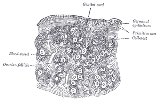
Ovary

Overview
- "Ovaria" redirects here. This is also a proposed sectionSection (botany)In botany, a section is a taxonomic rank below the genus, but above the species. The subgenus, if present, is higher than the section, and the rank of series, if present, is below the section. Sections are typically used to help organise very large genera, which may have hundreds of species...
and a synonymSynonymSynonyms are different words with almost identical or similar meanings. Words that are synonyms are said to be synonymous, and the state of being a synonym is called synonymy. The word comes from Ancient Greek syn and onoma . The words car and automobile are synonyms...
of SolanumSolanumSolanum, the nightshades, horsenettles and relatives, is a large and diverse genus of annual and perennial plants. They grow as forbs, vines, subshrubs, shrubs, and small trees, and often have attractive fruit and flowers. Many formerly independent genera like Lycopersicon or Cyphomandra are...
.
The ovary is an ovum
Ovum
An ovum is a haploid female reproductive cell or gamete. Both animals and embryophytes have ova. The term ovule is used for the young ovum of an animal, as well as the plant structure that carries the female gametophyte and egg cell and develops into a seed after fertilization...
-producing reproductive organ, often found in pairs as part of the vertebrate
Vertebrate
Vertebrates are animals that are members of the subphylum Vertebrata . Vertebrates are the largest group of chordates, with currently about 58,000 species described. Vertebrates include the jawless fishes, bony fishes, sharks and rays, amphibians, reptiles, mammals, and birds...
female
Female
Female is the sex of an organism, or a part of an organism, which produces non-mobile ova .- Defining characteristics :The ova are defined as the larger gametes in a heterogamous reproduction system, while the smaller, usually motile gamete, the spermatozoon, is produced by the male...
reproductive system
Reproductive system
The reproductive system or genital system is a system of organs within an organism which work together for the purpose of reproduction. Many non-living substances such as fluids, hormones, and pheromones are also important accessories to the reproductive system. Unlike most organ systems, the sexes...
. Ovaries in anatomically female individuals are analogous to testes
Testicle
The testicle is the male gonad in animals. Like the ovaries to which they are homologous, testes are components of both the reproductive system and the endocrine system...
in anatomically male individuals, in that they are both gonad
Gonad
The gonad is the organ that makes gametes. The gonads in males are the testes and the gonads in females are the ovaries. The product, gametes, are haploid germ cells. For example, spermatozoon and egg cells are gametes...
s and endocrine glands.
Ovaries are oval shaped. The ovary (for a given side) is located in the lateral wall of the pelvis in a region called the ovarian fossa
Ovarian fossa
The ovary lies in a shallow depression, named the ovarian fossa, on the lateral wall of the pelvis.This fossa has the following boundaries:* superiorly: by the external iliac vessels* anteriorly and inferiorly: by the broad ligament of the uterus...
.
Unanswered Questions
