
|
|
|
|
Connective tissue
|
| |
|
| |
Connective tissue is a form of fibrous tissue.
It is one of the four types of tissue in traditional classifications (the others being epithelial, muscle, and nervous tissue).
Collagen is the main protein of connective tissue in animals and the most abundant protein in mammals, making up about 25% of the total protein content.
s largely a category of exclusion rather than one with a precise definition, but all or most tissues in this category are similarly:
Blood, cartilage, and bone are usually considered connective tissue, but, because they differ so substantially from the other tissues in this class, the phrase "connective tissue proper" is commonly used to exclude those three.

Discussion
Ask a question about 'Connective tissue'
Start a new discussion about 'Connective tissue'
Answer questions from other users
|
Encyclopedia
Connective tissue is a form of fibrous tissue.
It is one of the four types of tissue in traditional classifications (the others being epithelial, muscle, and nervous tissue).
Collagen is the main protein of connective tissue in animals and the most abundant protein in mammals, making up about 25% of the total protein content.
Terminology
It is largely a category of exclusion rather than one with a precise definition, but all or most tissues in this category are similarly:
- Involved in structure and support.
- Derived from mesoderm, usually.
- Characterized largely by the traits of non-living tissue.
Blood, cartilage, and bone are usually considered connective tissue, but, because they differ so substantially from the other tissues in this class, the phrase "connective tissue proper" is commonly used to exclude those three. There is also variation in the classification of embryonic connective tissues; on this page they will be treated as a third and separate category.
Classification
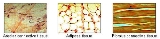
Connective tissue can be classified into three categories: proper, embryonic, and specialized.
Connective tissue proper Connective tissue proper includes the following five types: loose connective, dense connective, elastic, reticular, and adipose. They are called "proper" because they are the types usually meant when using the phrase "connective tissue".
Embryonic connective tissues
The two types of embryonic connective tissues are mesenchymal and mucous. They are of minimal importance in the adult.
Specialized connective tissues
The category "specialized connective tissue" consists of bone, cartilage, and blood. Although these items are connective tissue, they are often considered separately.
The following two can be classified as "supportive connective tissue":
- Bone (osseous tissue) makes up virtually the entire skeleton in adult vertebrates.
- Cartilage makes up virtually the entire skeleton in chondrichthyes. In most other vertebrates, it is found primarily in joints, where it provides cushioning. The extracellular matrix of cartilage is composed primarily of collagen.
Alternate systems
The old classification system for connective tissue is proper versus specialized. There has been a new classifications system proposed, however, and it is as follows:
Loose connective tissue
- Areolar
- Adipose
- Reticular
Dense connective tissue
- Regular
- Irregular
- Elastic
Cartilage
- Hyaline
- Fibrocartilage
- Elastic
Other
Fiber types
Fiber types as follows:
Disorders of connective tissue
Various connective tissue conditions have been identified; these can be both inherited and environmental.
- Marfan syndrome - a genetic disease causing abnormal fibrillin.
- Scurvy - caused by a dietary deficiency in vitamin C, leading to abnormal collagen.
- Ehlers-Danlos syndrome - deficient type III collagen- a genetic disease causing progressive deterioration of collagens, with different EDS types affecting different sites in the body, such as joints, heart valves, organ walls, arterial walls, etc.
- Loeys-Dietz syndrome - a genetic disease related to Marfan syndrome, with an emphasis on vascular deterioration.
- Pseudoxanthoma elasticum - an autosomal recessive hereditary disease, caused by calcification and fragmentation of elastic fibres, affecting the skin, the eyes and the cardiovascular system.
- Systemic lupus erythematosus - a chronic, multisystem, inflammatory disorder of probable autoimmune etiology, occurring predominantly in young women.
- Osteogenesis imperfecta (brittle bone disease) - caused by insufficient production of good quality collagen to produce healthy, strong bones.
- Fibrodysplasia ossificans progressiva - disease of the connective tissue, caused by a defective gene which turns connective tissue into bone.
- Spontaneous pneumothorax - collapsed lung, believed to be related to subtle abnormalities in connective tissue.
- Sarcoma - a neoplastic process originating within connective tissue.
Staining of connective tissue
For microscopic viewing, the majority of the connective tissue staining techniques color tissue fibers in contrasting shades. Collagen may be differentially stained by any of the following techniques:
- Van Gieson's stain
- Masson's Trichrome stain
- Mallory's Aniline Blue stain
- Azocarmine stain
- Krajian's Aniline Blue stain
External links
|
| |
|
|