


Epithelium

Encyclopedia
Epithelium is one of the four basic types of animal
tissue
, along with connective tissue
, muscle tissue
and nervous tissue
. Epithelial tissues line the cavities and surfaces of structures throughout the body, and also form many glands. Functions of epithelial cells include secretion, selective absorption, protection, transcellular transport and detection of sensation. In Greek "Epi" means, "on, upon," and "Theli" meaning "tissue."
Epithelial layers are avascular, so they must receive nourishment via diffusion of substances from the underlying connective tissue, through the basement membrane. Epithelia can also be organized into clusters of cells that function as exocrine and endocrine glands. Exocrine and endocrine epithelial cells are highly vascular.
, which acts as a scaffolding
on which epithelium can grow and regenerate after injuries. Epithelial tissue is innervated, but avascular. Thus epithelial tissue must be nourished by substances diffusing from the blood vessels in the underlying tissue. The basement membrane acts as a selectively permeable membrane that determines which substances will be able to enter the epithelium.
.
Cell junctions are the contact points between plasma membrane and tissue cells. There are mainly 5 different types of cell junctions. They are tight junctions, adherens junctions, desmosomes, hemidesmosomes, and gap junctions.
Tight junctions are a pair of trans-membranar protein fused on outer plasma membrane.
Adherens junctions are a plaque (protein layer on the inside plasma membrane) which attaches both protein and microfilaments.
Desmosomes attach to the microfilaments of cytoskeleton made up of keratin protein.
Hemidesmosomes resemble desmsomes on a section. They are made up of the integrin (a transmembraner protein) instead of cadherin. They attach the epithelial cell to the basement membrane.
Gap junctions connect the cytoplasm of two cells and are made up of proteins called connexins (six of which come together to make a connexon).
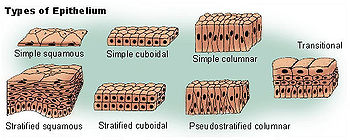 Tissues are generally classified by the morphology of their cells, and the number of layers they are composed of. Epithelial tissue that is only one cell thick is known as simple epithelium. If it is two or more cells thick, it is known as stratified epithelium
. However, when taller simple epithelial cells (see columnar, below) are viewed in cross section with several nuclei appearing at different heights, they can be confused with stratified epithelia. This kind of epithelium is therefore described as "pseudostratified"
epithelium.
. It is generally found where absorption and filtration occur. The thinness of the epithelial barrier facilitates these processes.
Simple epithelial tissues are generally classified by the shape of their cells. The four major classes of simple epithelium are: (1) simple squamous; (2) simple cuboidal; (3) simple columnar; (4) pseudostratified.
(1) simple squamous; which is found lining areas where passive diffusion of gases occur. e.g walls of capillaries, linings of the pericardial, pleural,and peritoneal cavities, as well as the linings of the alveoli of the lungs.
(2) simple cuboidal: these cells may have secretory, absorptive, or excretory functions. examples include small collecting ducts of kidney,pancreas and salivary gland.
(3) simple columnar; found in areas with extremely high secretive (as in wall of the stomach), or absorptive (as in small intestine) areas. they possess cellular extensions (e.g microvilli in the small intestine, or cilia found almost exclusively in the female reproductive tract).
(4) pseudostratified epithelia; they are also called respiratory epithelium. this is due to their almost exclusive confinement to the larger respiratory airways i.e the nasal cavity, trachea, bronchi e.t.c.
Stratified epithelial tissue also differs from simple epithelial tissue in that stratified epithelial tissues do not contain junctional complexes, and have their cells bound together only by desmosomes.
Stratified epithelia (of columnar, cuboidal or squamous type) can have the following specializations:
, desiccation, toxins, and physical trauma
; (2) the regulation and exchange of chemicals between the underlying tissues and a body cavity
; (3) the secretion of hormones into the blood vascular system, and/or (3) the secretion of sweat, mucus, enzymes, and other products that are delivered by ducts glandular epithelium.
and exocrine glands. Endocrine glands secrete their product into the extracellular space where it is rapidly taken up by the blood vascular system. the exocrine glands secrete their products into a duct that then delivers the product to the lumen of an organ or onto the free surface of the epithelium.
ted, and they commonly exist as a sheet of polarised cells forming a tube or tubule with cilia projecting into the lumen
." Primary cilia
on epithelial cells provide chemosensation, thermosensation and mechanosensation
of the extracellular environment by playing "a sensory role mediating specific signalling cues, including soluble factors in the external cell environment, a secretory
role in which a soluble protein is released to have an effect downstream of the fluid flow, and mediation of fluid flow if the cilia are motile."
However, it is important to note that pathologists do not consider endothelium
and mesothelium
(both derived from mesoderm) to be true epithelium. This is because such tissues present very different pathology. For that reason, pathologists label cancers in endothelium and mesothelium sarcoma
s, whereas true epithelial cancers are called carcinoma
s. Also, the filaments that support these mesoderm-derived tissues are very distinct. Outside of the field of pathology, it is, in general, accepted that the epithelium arises from all three germ layers.
group are almost exclusively found in epithelial cells, and so are often used for this purpose.
) and the inside cavities and lumen
of bodies. The outermost layer of our skin
is composed of dead stratified squamous
, keratinized epithelial cells.
Tissues that line the inside of the mouth, the esophagus and part of the rectum are composed of nonkeratinized stratified squamous epithelium. Other surfaces that separate body cavities from the outside environment are lined by simple squamous, columnar, or pseudostratified epithelial cells. Other epithelial cells line the insides of the lung
s, the gastrointestinal tract, the reproductive and urinary tracts, and make up the exocrine
and endocrine
glands. The outer surface of the cornea
is covered with fast-growing, easily-regenerated epithelial cells. Endothelium
(the inner lining of blood vessel
s, the heart
, and lymphatic vessels
) is a specialized form of epithelium. Another type, mesothelium
, forms the walls of the pericardium
, pleurae
, and peritoneum
.
[editing help required: the internal wiki-link 'gastric epithelium' in the column 'Subtype' of the table below is a circular reference back to this page.]
Animal
Animals are a major group of multicellular, eukaryotic organisms of the kingdom Animalia or Metazoa. Their body plan eventually becomes fixed as they develop, although some undergo a process of metamorphosis later on in their life. Most animals are motile, meaning they can move spontaneously and...
tissue
Tissue (biology)
Tissue is a cellular organizational level intermediate between cells and a complete organism. A tissue is an ensemble of cells, not necessarily identical, but from the same origin, that together carry out a specific function. These are called tissues because of their identical functioning...
, along with connective tissue
Connective tissue
"Connective tissue" is a fibrous tissue. It is one of the four traditional classes of tissues . Connective Tissue is found throughout the body.In fact the whole framework of the skeleton and the different specialized connective tissues from the crown of the head to the toes determine the form of...
, muscle tissue
Muscle
Muscle is a contractile tissue of animals and is derived from the mesodermal layer of embryonic germ cells. Muscle cells contain contractile filaments that move past each other and change the size of the cell. They are classified as skeletal, cardiac, or smooth muscles. Their function is to...
and nervous tissue
Nervous tissue
Nervous tissue is one of four major classes of vertebrate tissue.Nervous tissue is the main component of the nervous system - the brain, spinal cord, and nerves-which regulates and controls body functions...
. Epithelial tissues line the cavities and surfaces of structures throughout the body, and also form many glands. Functions of epithelial cells include secretion, selective absorption, protection, transcellular transport and detection of sensation. In Greek "Epi" means, "on, upon," and "Theli" meaning "tissue."
Epithelial layers are avascular, so they must receive nourishment via diffusion of substances from the underlying connective tissue, through the basement membrane. Epithelia can also be organized into clusters of cells that function as exocrine and endocrine glands. Exocrine and endocrine epithelial cells are highly vascular.
General structure
Cells in epithelium are very densely packed together like bricks in a wall, leaving very little intercellular space. The cells form continuous sheets which are attached to each other at many locations by tight junctions and desmosomes. The epithelial tissues cover the interior and exterior part of our skin.Basement membrane
All epithelial cells rest on a basement membraneBasement membrane
The basement membrane is a thin sheet of fibers that underlies the epithelium, which lines the cavities and surfaces of organs including skin, or the endothelium, which lines the interior surface of blood vessels.- Composition :...
, which acts as a scaffolding
Scaffolding
Scaffolding is a temporary structure used to support people and material in the construction or repair of buildings and other large structures. It is usually a modular system of metal pipes or tubes, although it can be from other materials...
on which epithelium can grow and regenerate after injuries. Epithelial tissue is innervated, but avascular. Thus epithelial tissue must be nourished by substances diffusing from the blood vessels in the underlying tissue. The basement membrane acts as a selectively permeable membrane that determines which substances will be able to enter the epithelium.
Cell junctions
Cell junctions are especially abundant in epithelial tissues. They consist of protein complexes and provide contact between neighbouring cells, between a cell and the extracellular matrix, or they build up the paracellular barrier of epithelia and control the paracellular transportParacellular transport
Paracellular transport refers to the transfer of substances between cells of an epithelium.It is in contrast to "transcellular transport", where the substances travel through the cell, passing through both the apical membrane and basolateral membrane....
.
Cell junctions are the contact points between plasma membrane and tissue cells. There are mainly 5 different types of cell junctions. They are tight junctions, adherens junctions, desmosomes, hemidesmosomes, and gap junctions.
Tight junctions are a pair of trans-membranar protein fused on outer plasma membrane.
Adherens junctions are a plaque (protein layer on the inside plasma membrane) which attaches both protein and microfilaments.
Desmosomes attach to the microfilaments of cytoskeleton made up of keratin protein.
Hemidesmosomes resemble desmsomes on a section. They are made up of the integrin (a transmembraner protein) instead of cadherin. They attach the epithelial cell to the basement membrane.
Gap junctions connect the cytoplasm of two cells and are made up of proteins called connexins (six of which come together to make a connexon).
Classification of epithelial tissue
Stratified epithelium
Stratified epithelium can refer to:* Stratified squamous epithelium* Stratified cuboidal epithelium* Stratified columnar epithelia...
. However, when taller simple epithelial cells (see columnar, below) are viewed in cross section with several nuclei appearing at different heights, they can be confused with stratified epithelia. This kind of epithelium is therefore described as "pseudostratified"
Pseudostratified epithelium
A pseudostratified epithelium is a type of epithelium that, though comprising only a single layer of cells, has its cell nuclei positioned in a manner suggestive of stratified epithelia...
epithelium.
Simple epithelium
Simple epithelium is one cell thick, that is, every cell is in direct contact with the underlying basement membraneBasement membrane
The basement membrane is a thin sheet of fibers that underlies the epithelium, which lines the cavities and surfaces of organs including skin, or the endothelium, which lines the interior surface of blood vessels.- Composition :...
. It is generally found where absorption and filtration occur. The thinness of the epithelial barrier facilitates these processes.
Simple epithelial tissues are generally classified by the shape of their cells. The four major classes of simple epithelium are: (1) simple squamous; (2) simple cuboidal; (3) simple columnar; (4) pseudostratified.
(1) simple squamous; which is found lining areas where passive diffusion of gases occur. e.g walls of capillaries, linings of the pericardial, pleural,and peritoneal cavities, as well as the linings of the alveoli of the lungs.
(2) simple cuboidal: these cells may have secretory, absorptive, or excretory functions. examples include small collecting ducts of kidney,pancreas and salivary gland.
(3) simple columnar; found in areas with extremely high secretive (as in wall of the stomach), or absorptive (as in small intestine) areas. they possess cellular extensions (e.g microvilli in the small intestine, or cilia found almost exclusively in the female reproductive tract).
(4) pseudostratified epithelia; they are also called respiratory epithelium. this is due to their almost exclusive confinement to the larger respiratory airways i.e the nasal cavity, trachea, bronchi e.t.c.
Stratified epithelium
Stratified epithelium differs from simple epithelium in that it is multilayered. It is therefore found where body linings have to withstand mechanical or chemical insult such that layers can be abraded and lost without exposing subepithelial layers. Cells flatten as the layers become more apical, though in their most basal layers the cells can be squamous, cuboidal or columnar.Stratified epithelial tissue also differs from simple epithelial tissue in that stratified epithelial tissues do not contain junctional complexes, and have their cells bound together only by desmosomes.
Stratified epithelia (of columnar, cuboidal or squamous type) can have the following specializations:
| Specialization | Description |
|---|---|
| Keratin Keratin Keratin refers to a family of fibrous structural proteins. Keratin is the key of structural material making up the outer layer of human skin. It is also the key structural component of hair and nails... ized |
In this particular case, the most apical layers (exterior) of cells are dead and lose their nucleus and cytoplasm, instead contain a tough, resistant protein called keratin. This specialization makes the epithelium waterproof, so is found in the mammalian skin. The lining of the esophagus is an example of a non-keratinized or "moist" stratified epithelium. |
| Transitional | Transitional epithelia are found in tissues that stretch and it can appear to be stratified cuboidal when the tissue is not stretched or stratified squamous when the organ is distended and the tissue stretches. It is sometimes called the urothelium since it is almost exclusively found in the bladder, ureters and urethra. |
Functions
The primary functions of epithelial tissues are: (1) to protect the tissues that lie beneath it from radiationRadiation
In physics, radiation is a process in which energetic particles or energetic waves travel through a medium or space. There are two distinct types of radiation; ionizing and non-ionizing...
, desiccation, toxins, and physical trauma
Trauma (medicine)
Trauma refers to "a body wound or shock produced by sudden physical injury, as from violence or accident." It can also be described as "a physical wound or injury, such as a fracture or blow." Major trauma can result in secondary complications such as circulatory shock, respiratory failure and death...
; (2) the regulation and exchange of chemicals between the underlying tissues and a body cavity
Body cavity
By the broadest definition, a body cavity is any fluid-filled space in a multicellular organism. However, the term usually refers to the space located between an animal’s outer covering and the outer lining of the gut cavity, where internal organs develop...
; (3) the secretion of hormones into the blood vascular system, and/or (3) the secretion of sweat, mucus, enzymes, and other products that are delivered by ducts glandular epithelium.
Secretory epithelia
As stated above, secretion is one major function of epithelial cells. Glands are formed from the invagination / infolding of epithelial cells and subsequent growth in the underlying connective tissue. There are two major classifications of glands: endocrine glandsEndocrine glands
Endocrine glands are glands of the endocrine system that secrete their products, hormones, directly into the blood rather than through a duct. The main endocrine glands include the pituitary gland, pancreas, ovaries, testes, thyroid gland, and adrenal glands. The hypothalamus is a neuroendocrine...
and exocrine glands. Endocrine glands secrete their product into the extracellular space where it is rapidly taken up by the blood vascular system. the exocrine glands secrete their products into a duct that then delivers the product to the lumen of an organ or onto the free surface of the epithelium.
Sensing the extracellular environment
"Some epithelial cells are ciliaCilium
A cilium is an organelle found in eukaryotic cells. Cilia are slender protuberances that project from the much larger cell body....
ted, and they commonly exist as a sheet of polarised cells forming a tube or tubule with cilia projecting into the lumen
Lumen (anatomy)
A lumen in biology is the inside space of a tubular structure, such as an artery or intestine...
." Primary cilia
Cilium
A cilium is an organelle found in eukaryotic cells. Cilia are slender protuberances that project from the much larger cell body....
on epithelial cells provide chemosensation, thermosensation and mechanosensation
Mechanosensation
Mechanosensation is a response mechanism to mechanical stimuli. The physiological foundation for the senses of touch, hearing and balance, and pain is the conversion of mechanical stimuli into neuronal signals: mechanosensation. Mechanoreceptors of the skin, called cutaneous mechanoreceptors, are...
of the extracellular environment by playing "a sensory role mediating specific signalling cues, including soluble factors in the external cell environment, a secretory
Secretion
Secretion is the process of elaborating, releasing, and oozing chemicals, or a secreted chemical substance from a cell or gland. In contrast to excretion, the substance may have a certain function, rather than being a waste product...
role in which a soluble protein is released to have an effect downstream of the fluid flow, and mediation of fluid flow if the cilia are motile."
Embryological development
In general, there are epithelial tissues deriving from all of the embryological germ layers:- from ectodermEctodermThe "ectoderm" is one of the three primary germ cell layers in the very early embryo. The other two layers are the mesoderm and endoderm , with the ectoderm as the most exterior layer...
(e.g., the epidermis); - from endodermEndodermEndoderm is one of the three primary germ cell layers in the very early embryo. The other two layers are the ectoderm and mesoderm , with the endoderm as the intermost layer...
(e.g., the lining of the gastrointestinal tract); - from mesodermMesodermIn all bilaterian animals, the mesoderm is one of the three primary germ cell layers in the very early embryo. The other two layers are the ectoderm and endoderm , with the mesoderm as the middle layer between them.The mesoderm forms mesenchyme , mesothelium, non-epithelial blood corpuscles and...
(e.g., the inner linings of body cavities).
However, it is important to note that pathologists do not consider endothelium
Endothelium
The endothelium is the thin layer of cells that lines the interior surface of blood vessels, forming an interface between circulating blood in the lumen and the rest of the vessel wall. These cells are called endothelial cells. Endothelial cells line the entire circulatory system, from the heart...
and mesothelium
Mesothelium
The mesothelium is a membrane that forms the lining of several body cavities: the pleura , peritoneum and pericardium . Mesothelial tissue also surrounds the male internal reproductive organs and covers the internal reproductive organs of women...
(both derived from mesoderm) to be true epithelium. This is because such tissues present very different pathology. For that reason, pathologists label cancers in endothelium and mesothelium sarcoma
Sarcoma
A sarcoma is a cancer that arises from transformed cells in one of a number of tissues that develop from embryonic mesoderm. Thus, sarcomas include tumors of bone, cartilage, fat, muscle, vascular, and hematopoietic tissues...
s, whereas true epithelial cancers are called carcinoma
Carcinoma
Carcinoma is the medical term for the most common type of cancer occurring in humans. Put simply, a carcinoma is a cancer that begins in a tissue that lines the inner or outer surfaces of the body, and that generally arises from cells originating in the endodermal or ectodermal germ layer during...
s. Also, the filaments that support these mesoderm-derived tissues are very distinct. Outside of the field of pathology, it is, in general, accepted that the epithelium arises from all three germ layers.
Growing in culture
When growing epithelium in culture, one can determine whether or not a particular cell is epithelial by examining its morphological characteristics. Epithelial cells tend to cluster together, and have a "characteristic tight pavementlike appearance". But this is not always the case, such as when the cells are derived from a tumor. In these cases, it is often necessary to use certain biochemical markers to make a positive identification. The intermediate filament proteins in the cytokeratinCytokeratin
Cytokeratins are proteins of keratin-containing intermediate filaments found in the intracytoplasmic cytoskeleton of epithelial tissue. The term "cytokeratin" began to be used in the late 1970s when the protein subunits of keratin intermediate filaments inside cells were first being identified and...
group are almost exclusively found in epithelial cells, and so are often used for this purpose.
Location
Epithelium lines both the outside (skinSkin
-Dermis:The dermis is the layer of skin beneath the epidermis that consists of connective tissue and cushions the body from stress and strain. The dermis is tightly connected to the epidermis by a basement membrane. It also harbors many Mechanoreceptors that provide the sense of touch and heat...
) and the inside cavities and lumen
Lumen (anatomy)
A lumen in biology is the inside space of a tubular structure, such as an artery or intestine...
of bodies. The outermost layer of our skin
Skin
-Dermis:The dermis is the layer of skin beneath the epidermis that consists of connective tissue and cushions the body from stress and strain. The dermis is tightly connected to the epidermis by a basement membrane. It also harbors many Mechanoreceptors that provide the sense of touch and heat...
is composed of dead stratified squamous
Squamous epithelium
In anatomy, squamous epithelium is an epithelium characterised by its most superficial layer consisting of flat, scale-like cells called squamous epithelial cells...
, keratinized epithelial cells.
Tissues that line the inside of the mouth, the esophagus and part of the rectum are composed of nonkeratinized stratified squamous epithelium. Other surfaces that separate body cavities from the outside environment are lined by simple squamous, columnar, or pseudostratified epithelial cells. Other epithelial cells line the insides of the lung
Lung
The lung is the essential respiration organ in many air-breathing animals, including most tetrapods, a few fish and a few snails. In mammals and the more complex life forms, the two lungs are located near the backbone on either side of the heart...
s, the gastrointestinal tract, the reproductive and urinary tracts, and make up the exocrine
Exocrine gland
Exocrine glands are a type of ductal glands that secrete their products into ducts that lead directly into the external environment...
and endocrine
Endocrine system
In physiology, the endocrine system is a system of glands, each of which secretes a type of hormone directly into the bloodstream to regulate the body. The endocrine system is in contrast to the exocrine system, which secretes its chemicals using ducts. It derives from the Greek words "endo"...
glands. The outer surface of the cornea
Cornea
The cornea is the transparent front part of the eye that covers the iris, pupil, and anterior chamber. Together with the lens, the cornea refracts light, with the cornea accounting for approximately two-thirds of the eye's total optical power. In humans, the refractive power of the cornea is...
is covered with fast-growing, easily-regenerated epithelial cells. Endothelium
Endothelium
The endothelium is the thin layer of cells that lines the interior surface of blood vessels, forming an interface between circulating blood in the lumen and the rest of the vessel wall. These cells are called endothelial cells. Endothelial cells line the entire circulatory system, from the heart...
(the inner lining of blood vessel
Blood vessel
The blood vessels are the part of the circulatory system that transports blood throughout the body. There are three major types of blood vessels: the arteries, which carry the blood away from the heart; the capillaries, which enable the actual exchange of water and chemicals between the blood and...
s, the heart
Heart
The heart is a myogenic muscular organ found in all animals with a circulatory system , that is responsible for pumping blood throughout the blood vessels by repeated, rhythmic contractions...
, and lymphatic vessels
Lymphatic system
The lymphoid system is the part of the immune system comprising a network of conduits called lymphatic vessels that carry a clear fluid called lymph unidirectionally toward the heart. Lymphoid tissue is found in many organs, particularly the lymph nodes, and in the lymphoid follicles associated...
) is a specialized form of epithelium. Another type, mesothelium
Mesothelium
The mesothelium is a membrane that forms the lining of several body cavities: the pleura , peritoneum and pericardium . Mesothelial tissue also surrounds the male internal reproductive organs and covers the internal reproductive organs of women...
, forms the walls of the pericardium
Pericardium
The pericardium is a double-walled sac that contains the heart and the roots of the great vessels.-Layers:...
, pleurae
Pleural cavity
In human anatomy, the pleural cavity is the potential space between the two pleura of the lungs. The pleura is a serous membrane which folds back onto itself to form a two-layered, membrane structure. The thin space between the two pleural layers is known as the pleural cavity; it normally...
, and peritoneum
Peritoneum
The peritoneum is the serous membrane that forms the lining of the abdominal cavity or the coelom — it covers most of the intra-abdominal organs — in amniotes and some invertebrates...
.
[editing help required: the internal wiki-link 'gastric epithelium' in the column 'Subtype' of the table below is a circular reference back to this page.]