

Cuticle

Encyclopedia
A cuticle or cuticula, is a term used for any of a variety of tough but flexible, non-mineral outer coverings of an organism, or parts of an organism, that provide protection. Various types of "cuticles" are non-homologous
; differing in their origin, structure, function, and chemical composition. The word derives from Latin
"cuticula", diminutive of "cutis", meaning "skin".
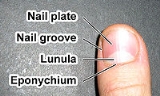
, cuticle (also called eponychium
) refers to several structures. It refers to the dead layers of epidermal cells
or keratinocytes that produce the horn
protein
keratin
, to the strip of dead skin
cells at the base and sides of the fingernail, to the eponychium
, and also to the superficial layer of overlapping cells covering the hair
shaft (cuticula pili) that locks the hair into its follicle
(See also Cuticle (hair)
).
, the invertebrate
cuticle or cuticula is a multi-layered structure outside the epidermis of many invertebrates, notably roundworm
s and arthropod
s, in which it forms an exoskeleton
(see arthropod exoskeleton
).
The main structural components of the nematode cuticle are protein
s, highly cross-linked collagen
s and specialised insoluble proteins known as "cuticlins", together with glycoprotein
s and lipid
s.
The main structural component of arthropod cuticle is chitin
, a polysaccharide
composed of N-acetylglucosamine
units, together with proteins, lipids, and catecholamines The proteins and chitin are cross-linked by catecholamines such as N-acetyldopamine, contributing to their rigidity. The rigidity is a function of the types of proteins and the quantity of chitin and catecholamines. The more acidic the protein is, the softer the cuticle. It is believed that the epidermal cells and hemocytes (cells in the hemolymph) produce protein and also monitors the timing and amount of protein to be incorporated into the cuticle.
 Some plants, particularly those adapted to life in damp or aquatic environments, have an almost magical resistance to wetting. A well-known example is the Sacred Lotus
. This spectacular adaptation is not purely the physical and chemical effect of a waxy coating however; it depends largely on the microscopic shape of the surface. When a hydrophobic surface is sculpted into microscopic, regular, elevated areas, sometimes in fractal
patterns, too high and too closely spaced for the surface tension of the liquid to permit any flow into the space between the plateaus, then the area of contact between liquid and solid surfaces may be reduced to less than a tenth of what a continuous surface might permit. The effect is to reduce wetting of the surface spectacularly..
In botany
, plant cuticle
s are protective, hydrophobic, wax
y coverings produced by the epidermal cells of leaves, young shoots and all other aerial plant organs. Cuticles minimize water loss and effectively reduce pathogen entry due to their waxy secretion.
The main structural components of plant cuticle
s are the unique polymer
s cutin
and/or cutan
, impregnated with wax
.
The cuticles of plants function as permeability barriers for water and water-soluble materials. The cuticle both prevents plant surfaces from becoming wet
and helps to prevent plants from drying out. Xerophytic plants such as cactus
have very thick cuticles to help them survive in their arid climates. Plants that live in range of sea's spray also may have thicker cuticles that protect them from the toxic effects of salt
.
" is one term used for the outer layer of tissue
of a mushroom
's basidiocarp
or "fruit body". The alternative term "pileipellis
", Latin for "skin" of a "cap" (meaning "mushroom") might be technically preferable, but is perhaps too cumbersome for popular use. It is the part removed in "peeling" mushrooms. On the other hand, some morphological
terminology in mycology makes finer distinctions, such as described in the article on the "pileipellis
". Be that as it may, the pileipellis (or "peel") is distinct from the trama
, the inner fleshy tissue of a mushroom or similar fruiting body, and also from the spore
-bearing tissue layer, the hymenium
.
Homology (biology)
Homology forms the basis of organization for comparative biology. In 1843, Richard Owen defined homology as "the same organ in different animals under every variety of form and function". Organs as different as a bat's wing, a seal's flipper, a cat's paw and a human hand have a common underlying...
; differing in their origin, structure, function, and chemical composition. The word derives from Latin
Latin
Latin is an Italic language originally spoken in Latium and Ancient Rome. It, along with most European languages, is a descendant of the ancient Proto-Indo-European language. Although it is considered a dead language, a number of scholars and members of the Christian clergy speak it fluently, and...
"cuticula", diminutive of "cutis", meaning "skin".
Human anatomy
In human anatomyHuman anatomy
Human anatomy is primarily the scientific study of the morphology of the human body. Anatomy is subdivided into gross anatomy and microscopic anatomy. Gross anatomy is the study of anatomical structures that can be seen by the naked eye...
, cuticle (also called eponychium
Eponychium
In human anatomy, the eponychium [Greek epi + onychion ], also known as the cuticle, is the thickened layer of skin surrounding fingernails and toenails. Beneath the cuticle is a thin layer of a membrane known as the pterygium. The function is to protect the area between the nail and epidermis...
) refers to several structures. It refers to the dead layers of epidermal cells
Cell (biology)
The cell is the basic structural and functional unit of all known living organisms. It is the smallest unit of life that is classified as a living thing, and is often called the building block of life. The Alberts text discusses how the "cellular building blocks" move to shape developing embryos....
or keratinocytes that produce the horn
Horn (anatomy)
A horn is a pointed projection of the skin on the head of various animals, consisting of a covering of horn surrounding a core of living bone. True horns are found mainly among the ruminant artiodactyls, in the families Antilocapridae and Bovidae...
protein
Protein
Proteins are biochemical compounds consisting of one or more polypeptides typically folded into a globular or fibrous form, facilitating a biological function. A polypeptide is a single linear polymer chain of amino acids bonded together by peptide bonds between the carboxyl and amino groups of...
keratin
Keratin
Keratin refers to a family of fibrous structural proteins. Keratin is the key of structural material making up the outer layer of human skin. It is also the key structural component of hair and nails...
, to the strip of dead skin
Skin
-Dermis:The dermis is the layer of skin beneath the epidermis that consists of connective tissue and cushions the body from stress and strain. The dermis is tightly connected to the epidermis by a basement membrane. It also harbors many Mechanoreceptors that provide the sense of touch and heat...
cells at the base and sides of the fingernail, to the eponychium
Eponychium
In human anatomy, the eponychium [Greek epi + onychion ], also known as the cuticle, is the thickened layer of skin surrounding fingernails and toenails. Beneath the cuticle is a thin layer of a membrane known as the pterygium. The function is to protect the area between the nail and epidermis...
, and also to the superficial layer of overlapping cells covering the hair
Hair
Hair is a filamentous biomaterial, that grows from follicles found in the dermis. Found exclusively in mammals, hair is one of the defining characteristics of the mammalian class....
shaft (cuticula pili) that locks the hair into its follicle
Hair follicle
A hair follicle is a skin organ that produces hair. Hair production occurs in phases, including a growth phase , and cessation phase , and a rest phase . Stem cells are principally responsible for the production of hair....
(See also Cuticle (hair)
Cuticle (hair)
The hair cuticle is the outermost part of the hair shaft. It is a hard shingle-like layer of overlapping cells, some five to twelve deep. It is formed from dead cells which form scales that gives the hair shaft strength and do the best job of providing protection for it...
).
Invertebrate zoology
In zoologyZoology
Zoology |zoölogy]]), is the branch of biology that relates to the animal kingdom, including the structure, embryology, evolution, classification, habits, and distribution of all animals, both living and extinct...
, the invertebrate
Invertebrate
An invertebrate is an animal without a backbone. The group includes 97% of all animal species – all animals except those in the chordate subphylum Vertebrata .Invertebrates form a paraphyletic group...
cuticle or cuticula is a multi-layered structure outside the epidermis of many invertebrates, notably roundworm
Nematode
The nematodes or roundworms are the most diverse phylum of pseudocoelomates, and one of the most diverse of all animals. Nematode species are very difficult to distinguish; over 28,000 have been described, of which over 16,000 are parasitic. It has been estimated that the total number of nematode...
s and arthropod
Arthropod
An arthropod is an invertebrate animal having an exoskeleton , a segmented body, and jointed appendages. Arthropods are members of the phylum Arthropoda , and include the insects, arachnids, crustaceans, and others...
s, in which it forms an exoskeleton
Exoskeleton
An exoskeleton is the external skeleton that supports and protects an animal's body, in contrast to the internal skeleton of, for example, a human. In popular usage, some of the larger kinds of exoskeletons are known as "shells". Examples of exoskeleton animals include insects such as grasshoppers...
(see arthropod exoskeleton
Arthropod exoskeleton
Arthropods are covered with a tough or resistant exoskeleton, which may be mineralised or constructed of a tough polymer such as chitin. This external skeleton is moulted as the organism grows.- Microscopic structure :...
).
The main structural components of the nematode cuticle are protein
Protein
Proteins are biochemical compounds consisting of one or more polypeptides typically folded into a globular or fibrous form, facilitating a biological function. A polypeptide is a single linear polymer chain of amino acids bonded together by peptide bonds between the carboxyl and amino groups of...
s, highly cross-linked collagen
Collagen
Collagen is a group of naturally occurring proteins found in animals, especially in the flesh and connective tissues of mammals. It is the main component of connective tissue, and is the most abundant protein in mammals, making up about 25% to 35% of the whole-body protein content...
s and specialised insoluble proteins known as "cuticlins", together with glycoprotein
Glycoprotein
Glycoproteins are proteins that contain oligosaccharide chains covalently attached to polypeptide side-chains. The carbohydrate is attached to the protein in a cotranslational or posttranslational modification. This process is known as glycosylation. In proteins that have segments extending...
s and lipid
Lipid
Lipids constitute a broad group of naturally occurring molecules that include fats, waxes, sterols, fat-soluble vitamins , monoglycerides, diglycerides, triglycerides, phospholipids, and others...
s.
The main structural component of arthropod cuticle is chitin
Chitin
Chitin n is a long-chain polymer of a N-acetylglucosamine, a derivative of glucose, and is found in many places throughout the natural world...
, a polysaccharide
Polysaccharide
Polysaccharides are long carbohydrate molecules, of repeated monomer units joined together by glycosidic bonds. They range in structure from linear to highly branched. Polysaccharides are often quite heterogeneous, containing slight modifications of the repeating unit. Depending on the structure,...
composed of N-acetylglucosamine
N-Acetylglucosamine
N-Acetylglucosamine is a monosaccharide derivative of glucose. It is an amide between glucosamine and acetic acid...
units, together with proteins, lipids, and catecholamines The proteins and chitin are cross-linked by catecholamines such as N-acetyldopamine, contributing to their rigidity. The rigidity is a function of the types of proteins and the quantity of chitin and catecholamines. The more acidic the protein is, the softer the cuticle. It is believed that the epidermal cells and hemocytes (cells in the hemolymph) produce protein and also monitors the timing and amount of protein to be incorporated into the cuticle.
Botany
Nelumbo nucifera
Nelumbo nucifera, known by a number of names including Indian Lotus, Sacred Lotus, Bean of India, or simply Lotus, is a plant in the monogeneric family Nelumbonaceae...
. This spectacular adaptation is not purely the physical and chemical effect of a waxy coating however; it depends largely on the microscopic shape of the surface. When a hydrophobic surface is sculpted into microscopic, regular, elevated areas, sometimes in fractal
Fractal
A fractal has been defined as "a rough or fragmented geometric shape that can be split into parts, each of which is a reduced-size copy of the whole," a property called self-similarity...
patterns, too high and too closely spaced for the surface tension of the liquid to permit any flow into the space between the plateaus, then the area of contact between liquid and solid surfaces may be reduced to less than a tenth of what a continuous surface might permit. The effect is to reduce wetting of the surface spectacularly..
In botany
Botany
Botany, plant science, or plant biology is a branch of biology that involves the scientific study of plant life. Traditionally, botany also included the study of fungi, algae and viruses...
, plant cuticle
Plant cuticle
Plant cuticles are a protective waxy covering produced only by the epidermal cells of leaves, young shoots and all other aerial plant organs without periderm...
s are protective, hydrophobic, wax
Wax
thumb|right|[[Cetyl palmitate]], a typical wax ester.Wax refers to a class of chemical compounds that are plastic near ambient temperatures. Characteristically, they melt above 45 °C to give a low viscosity liquid. Waxes are insoluble in water but soluble in organic, nonpolar solvents...
y coverings produced by the epidermal cells of leaves, young shoots and all other aerial plant organs. Cuticles minimize water loss and effectively reduce pathogen entry due to their waxy secretion.
The main structural components of plant cuticle
Plant cuticle
Plant cuticles are a protective waxy covering produced only by the epidermal cells of leaves, young shoots and all other aerial plant organs without periderm...
s are the unique polymer
Polymer
A polymer is a large molecule composed of repeating structural units. These subunits are typically connected by covalent chemical bonds...
s cutin
Cutin
Cutin is one of two waxy polymers that are the main components of the plant cuticle, which covers all aerial surfaces of plants. The other major cuticle polymer is cutan, which is much more readily preserved in the fossil record,...
and/or cutan
Cutan
Cutan is one of two polymers which occur in the cuticle of some plants. The other and better-known polymer is Cutin. Cutan is believed to be a hydrocarbon polymer, whereas cutin is a polyester, but the structure and synthesis of cutan are not yet fully understood...
, impregnated with wax
Wax
thumb|right|[[Cetyl palmitate]], a typical wax ester.Wax refers to a class of chemical compounds that are plastic near ambient temperatures. Characteristically, they melt above 45 °C to give a low viscosity liquid. Waxes are insoluble in water but soluble in organic, nonpolar solvents...
.
The cuticles of plants function as permeability barriers for water and water-soluble materials. The cuticle both prevents plant surfaces from becoming wet
Wetting
Wetting is the ability of a liquid to maintain contact with a solid surface, resulting from intermolecular interactions when the two are brought together. The degree of wetting is determined by a force balance between adhesive and cohesive forces.Wetting is important in the bonding or adherence of...
and helps to prevent plants from drying out. Xerophytic plants such as cactus
Cactus
A cactus is a member of the plant family Cactaceae. Their distinctive appearance is a result of adaptations to conserve water in dry and/or hot environments. In most species, the stem has evolved to become photosynthetic and succulent, while the leaves have evolved into spines...
have very thick cuticles to help them survive in their arid climates. Plants that live in range of sea's spray also may have thicker cuticles that protect them from the toxic effects of salt
Salt
In chemistry, salts are ionic compounds that result from the neutralization reaction of an acid and a base. They are composed of cations and anions so that the product is electrically neutral...
.
Mycology
"CuticleCuticle
A cuticle , or cuticula, is a term used for any of a variety of tough but flexible, non-mineral outer coverings of an organism, or parts of an organism, that provide protection. Various types of "cuticles" are non-homologous; differing in their origin, structure, function, and chemical composition...
" is one term used for the outer layer of tissue
Tissue (biology)
Tissue is a cellular organizational level intermediate between cells and a complete organism. A tissue is an ensemble of cells, not necessarily identical, but from the same origin, that together carry out a specific function. These are called tissues because of their identical functioning...
of a mushroom
Mushroom
A mushroom is the fleshy, spore-bearing fruiting body of a fungus, typically produced above ground on soil or on its food source. The standard for the name "mushroom" is the cultivated white button mushroom, Agaricus bisporus; hence the word "mushroom" is most often applied to those fungi that...
's basidiocarp
Basidiocarp
In fungi, a basidiocarp, basidiome or basidioma , is the sporocarp of a basidiomycete, the multicellular structure on which the spore-producing hymenium is borne. Basidiocarps are characteristic of the hymenomycetes; rusts and smuts do not produce such structures...
or "fruit body". The alternative term "pileipellis
Pileipellis
thumb|300px||right|The cuticle of some mushrooms, such as [[Russula mustelina]] shown here, can be peeled from the cap, and may be useful as an identification feature....
", Latin for "skin" of a "cap" (meaning "mushroom") might be technically preferable, but is perhaps too cumbersome for popular use. It is the part removed in "peeling" mushrooms. On the other hand, some morphological
Morphology (biology)
In biology, morphology is a branch of bioscience dealing with the study of the form and structure of organisms and their specific structural features....
terminology in mycology makes finer distinctions, such as described in the article on the "pileipellis
Pileipellis
thumb|300px||right|The cuticle of some mushrooms, such as [[Russula mustelina]] shown here, can be peeled from the cap, and may be useful as an identification feature....
". Be that as it may, the pileipellis (or "peel") is distinct from the trama
Trama
Trama may refer to:* Trama , a genus of aphid* Trama , a mushroom's "flesh"* Trama , a Peruvian band* Spanish and Portuguese for plot* a medium access control protocol for sensor networks ....
, the inner fleshy tissue of a mushroom or similar fruiting body, and also from the spore
Spore
In biology, a spore is a reproductive structure that is adapted for dispersal and surviving for extended periods of time in unfavorable conditions. Spores form part of the life cycles of many bacteria, plants, algae, fungi and some protozoa. According to scientist Dr...
-bearing tissue layer, the hymenium
Hymenium
The hymenium is the tissue layer on the hymenophore of a fungal fruiting body where the cells develop into basidia or asci, which produce spores. In some species all of the cells of the hymenium develop into basidia or asci, while in others some cells develop into sterile cells called cystidia or...
.