


Trochophore

Encyclopedia
Plankton
Plankton are any drifting organisms that inhabit the pelagic zone of oceans, seas, or bodies of fresh water. That is, plankton are defined by their ecological niche rather than phylogenetic or taxonomic classification...
ic marine larva
Larva
A larva is a distinct juvenile form many animals undergo before metamorphosis into adults. Animals with indirect development such as insects, amphibians, or cnidarians typically have a larval phase of their life cycle...
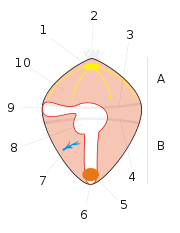
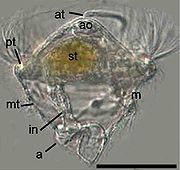
with several bands of cilia.
By moving their cilia rapidly, a water eddy is created. In this way they control the direction of their movement. Additionally, in this way they bring their food closer, in order to capture it more easily.
Occurrence
Trochophores exist as a larval form within the trochozoan clade, which include the entoproctsEntoprocta
Entoprocta, whose name means "anus inside", is a phylum of mostly sessile aquatic animals, ranging from long. Mature individuals are goblet-shaped, on relatively long stalks. They have a "crown" of solid tentacles whose cilia generate water currents that draw food particles towards the mouth, and...
, molluscs, annelid
Annelid
The annelids , formally called Annelida , are a large phylum of segmented worms, with over 17,000 modern species including ragworms, earthworms and leeches...
s, echiura
Echiura
The Echiura, or spoon worms, are a small group of marine animals. They are often considered to be a group of annelids, although they lack the segmented structure found in other members of that group, and so may also be treated as a separate phylum...
ns, sipuncula
Sipuncula
The Sipuncula or Sipunculida is a group containing 144-320 species of bilaterally symmetrical, unsegmented marine worms...
ns and nemertea
Nemertea
Nemertea is a phylum of invertebrate animals also known as "ribbon worms" or "proboscis worms". Alternative names for the phylum have included Nemertini, Nemertinea and Rhynchocoela. Although most are less than long, one specimen has been estimated at , which would make it the longest animal ever...
ns. Together, these phyla make up part of the Lophotrochozoa
Lophotrochozoa
The Lophotrochozoa are a major grouping of protostome animals. The taxon was discovered based on molecular data. Molecular evidence such as a result of studies of the evolution of small-subunit ribosomal RNA supports the monophyly of the phyla listed in the infobox shown at right.-Terminology:The...
; it is possible that trochophore larvae were present in the life cycle of the group's common ancestor.
Life cycle
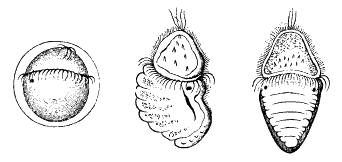
Serpulidae
Serpulidae is a family of sessile, tube-building annelid worms in the class Polychaeta. The members of this family differ from the sabellid tube worms in that they have a specialized operculum that blocks the entrance of their tubes when they withdraw into the tubes. In addition, serpulids secrete...
) showing the trochophore in images D-F.
D - early trochophore
E - complete trochophore
F - late trochophore
G - metatrochophore
Metatrochophore
A metatrochophore is a type of larva developed from the trochophore larva of a polychaete annelid.Metatrochophores have a number of features trochophores don't, including eyespots and segments....
