

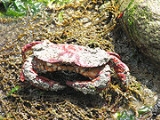
Dungeness crab

Encyclopedia
The Dungeness crab, Metacarcinus magister (formerly Cancer magister), is a species of crab
that inhabits eelgrass
beds and water bottoms on the west coast
of North America
. It typically grows to 20 cm (7.9 in) across the carapace
and is a popular seafood. Its common name
comes from the port of Dungeness, Washington
.
 The carapace
width of mature Dungeness crabs may reach 25 centimetres (9.8 in) in some areas off the coast of Washington, but are typically under 20 centimetres (7.9 in). They are a popular delicacy
, and are the most commercially important crab in the Pacific Northwest
, as well as the western states generally. The annual Dungeness Crab and Seafood Festival is held in Port Angeles each October.
Dungeness crabs have a wide, long, hard shell
, which they must periodically moult to grow; this process is called ecdysis
. They have five pairs of legs, which are similarly armoured, the foremost pair of which ends in claw
s that the crab uses both as defence and to tear apart large food items. The crab uses its smaller appendage
s to pass the food particles into its mouth. Once inside the crab's stomach, food is further digested by the "gastric mill", a collection of tooth-like structures. Metacarcinus magister prefers to eat clam
s, other crustacean
s and small fish
, but is also an effective scavenger
. Dungeness crabs can also bury themselves completely in the sand if threatened.
between May and August, and mating occurs immediately after the female has moulted and before the new exoskeleton
hardens. Males are attracted to potential mates by pheromone
s present in the urine of female Dungeness crabs. Upon locating an available female, the male initiates a protective pre-mating embrace that lasts for several days. In this embrace, the female is tucked underneath the male, oriented such that their abdomens touch and their heads face each other. Mating occurs only after the female has moulted, and the female signals her readiness to moult by urinating on or near the antennae of the male. The female extrudes the eggs
from her body several months later; however, they remain attached under her abdomen
for three to five months until they hatch. Young crabs are free-swimming after hatching, and go through five larval stages
before reaching maturity after about ten moults or two years.
, which is located approximately five miles north of Sequim
and 15 miles (24.1 km) east of Port Angeles
. Its range extends from Alaska
's Aleutian Islands to Point Conception
, California
.
Dungeness crab have recently been found in the Atlantic Ocean
, far from their known range, raising concern about their possible effects on the local wildlife.
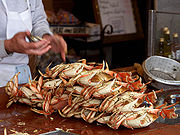 About one-quarter of the crab's weight is meat. The flesh has what is considered to be a delicate flavour that is slightly sweet. Dungeness crabs can typically be purchased either live or cooked. Larger crabs are valued for the higher meat-to-shell ratio. Live crabs are cooked simply by dropping into boiling salt water, waiting for a boil to return and then allowing it to continue for 15 minutes. After which time the crabs are removed and placed into cold water and then cleaned. Two common tools for removing crab meat from the shell are a crab cracker
and a shrimp fork. Sometimes, a cleaver
, mallet or small hammer is used for cracking.
has given the Dungeness crab a sustainable seafood
rating of 'Best Choice'.
, and citing its importance to the Oregon economy, the Oregon State Legislature
designated the Dungeness crab as the state crustacean of Oregon.
Crab
True crabs are decapod crustaceans of the infraorder Brachyura, which typically have a very short projecting "tail" , or where the reduced abdomen is entirely hidden under the thorax...
that inhabits eelgrass
Zostera
Zostera is a small genus of widely distributed seagrass, commonly called marine eelgrass or simply eelgrass . The genus Zostera contains sixteen species.-Ecology:Zostera is found on sandy substrates or in estuaries submerged or partially floating...
beds and water bottoms on the west coast
West Coast of the United States
West Coast or Pacific Coast are terms for the westernmost coastal states of the United States. The term most often refers to the states of California, Oregon, and Washington. Although not part of the contiguous United States, Alaska and Hawaii do border the Pacific Ocean but can't be included in...
of North America
North America
North America is a continent wholly within the Northern Hemisphere and almost wholly within the Western Hemisphere. It is also considered a northern subcontinent of the Americas...
. It typically grows to 20 cm (7.9 in) across the carapace
Carapace
A carapace is a dorsal section of the exoskeleton or shell in a number of animal groups, including arthropods such as crustaceans and arachnids, as well as vertebrates such as turtles and tortoises. In turtles and tortoises, the underside is called the plastron.-Crustaceans:In crustaceans, the...
and is a popular seafood. Its common name
Common name
A common name of a taxon or organism is a name in general use within a community; it is often contrasted with the scientific name for the same organism...
comes from the port of Dungeness, Washington
Dungeness, Washington
Dungeness is an unincorporated community in Clallam County, Washington, United States, located north of Sequim. Dungeness crab is named after the town of Dungeness, which is located on the Strait of Juan de Fuca...
.
Description
Carapace
A carapace is a dorsal section of the exoskeleton or shell in a number of animal groups, including arthropods such as crustaceans and arachnids, as well as vertebrates such as turtles and tortoises. In turtles and tortoises, the underside is called the plastron.-Crustaceans:In crustaceans, the...
width of mature Dungeness crabs may reach 25 centimetres (9.8 in) in some areas off the coast of Washington, but are typically under 20 centimetres (7.9 in). They are a popular delicacy
Delicacy
A delicacy is a food item that is considered highly desirable in certain cultures. Often this is because of unusual flavors or characteristics or because it is rare....
, and are the most commercially important crab in the Pacific Northwest
Pacific Northwest
The Pacific Northwest is a region in northwestern North America, bounded by the Pacific Ocean to the west and, loosely, by the Rocky Mountains on the east. Definitions of the region vary and there is no commonly agreed upon boundary, even among Pacific Northwesterners. A common concept of the...
, as well as the western states generally. The annual Dungeness Crab and Seafood Festival is held in Port Angeles each October.
Dungeness crabs have a wide, long, hard shell
Carapace
A carapace is a dorsal section of the exoskeleton or shell in a number of animal groups, including arthropods such as crustaceans and arachnids, as well as vertebrates such as turtles and tortoises. In turtles and tortoises, the underside is called the plastron.-Crustaceans:In crustaceans, the...
, which they must periodically moult to grow; this process is called ecdysis
Ecdysis
Ecdysis is the moulting of the cuticula in many invertebrates. This process of moulting is the defining feature of the clade Ecdysozoa, comprising the arthropods, nematodes, velvet worms, horsehair worms, rotifers, tardigrades and Cephalorhyncha...
. They have five pairs of legs, which are similarly armoured, the foremost pair of which ends in claw
Claw
A claw is a curved, pointed appendage, found at the end of a toe or finger in most mammals, birds, and some reptiles. However, the word "claw" is also often used in reference to an invertebrate. Somewhat similar fine hooked structures are found in arthropods such as beetles and spiders, at the end...
s that the crab uses both as defence and to tear apart large food items. The crab uses its smaller appendage
Appendage
In invertebrate biology, an appendage is an external body part, or natural prolongation, that protrudes from an organism's body . It is a general term that covers any of the homologous body parts that may extend from a body segment...
s to pass the food particles into its mouth. Once inside the crab's stomach, food is further digested by the "gastric mill", a collection of tooth-like structures. Metacarcinus magister prefers to eat clam
Clam
The word "clam" can be applied to freshwater mussels, and other freshwater bivalves, as well as marine bivalves.In the United States, "clam" can be used in several different ways: one, as a general term covering all bivalve molluscs...
s, other crustacean
Crustacean
Crustaceans form a very large group of arthropods, usually treated as a subphylum, which includes such familiar animals as crabs, lobsters, crayfish, shrimp, krill and barnacles. The 50,000 described species range in size from Stygotantulus stocki at , to the Japanese spider crab with a leg span...
s and small fish
Fish
Fish are a paraphyletic group of organisms that consist of all gill-bearing aquatic vertebrate animals that lack limbs with digits. Included in this definition are the living hagfish, lampreys, and cartilaginous and bony fish, as well as various extinct related groups...
, but is also an effective scavenger
Scavenger
Scavenging is both a carnivorous and herbivorous feeding behavior in which individual scavengers search out dead animal and dead plant biomass on which to feed. The eating of carrion from the same species is referred to as cannibalism. Scavengers play an important role in the ecosystem by...
. Dungeness crabs can also bury themselves completely in the sand if threatened.
Life cycle and ecology
Mature female crabs generally moultEcdysis
Ecdysis is the moulting of the cuticula in many invertebrates. This process of moulting is the defining feature of the clade Ecdysozoa, comprising the arthropods, nematodes, velvet worms, horsehair worms, rotifers, tardigrades and Cephalorhyncha...
between May and August, and mating occurs immediately after the female has moulted and before the new exoskeleton
Exoskeleton
An exoskeleton is the external skeleton that supports and protects an animal's body, in contrast to the internal skeleton of, for example, a human. In popular usage, some of the larger kinds of exoskeletons are known as "shells". Examples of exoskeleton animals include insects such as grasshoppers...
hardens. Males are attracted to potential mates by pheromone
Pheromone
A pheromone is a secreted or excreted chemical factor that triggers a social response in members of the same species. Pheromones are chemicals capable of acting outside the body of the secreting individual to impact the behavior of the receiving individual...
s present in the urine of female Dungeness crabs. Upon locating an available female, the male initiates a protective pre-mating embrace that lasts for several days. In this embrace, the female is tucked underneath the male, oriented such that their abdomens touch and their heads face each other. Mating occurs only after the female has moulted, and the female signals her readiness to moult by urinating on or near the antennae of the male. The female extrudes the eggs
Egg (biology)
An egg is an organic vessel in which an embryo first begins to develop. In most birds, reptiles, insects, molluscs, fish, and monotremes, an egg is the zygote, resulting from fertilization of the ovum, which is expelled from the body and permitted to develop outside the body until the developing...
from her body several months later; however, they remain attached under her abdomen
Abdomen
In vertebrates such as mammals the abdomen constitutes the part of the body between the thorax and pelvis. The region enclosed by the abdomen is termed the abdominal cavity...
for three to five months until they hatch. Young crabs are free-swimming after hatching, and go through five larval stages
Crustacean larvae
Crustaceans may pass through a number of larval and immature stages between hatching from their eggs and reaching their adult form. Each of the stages is separated by a moult, in which the hard exoskeleton is shed to allow the animal to grow...
before reaching maturity after about ten moults or two years.
Distribution
The Dungeness crab is named after Dungeness, WashingtonDungeness, Washington
Dungeness is an unincorporated community in Clallam County, Washington, United States, located north of Sequim. Dungeness crab is named after the town of Dungeness, which is located on the Strait of Juan de Fuca...
, which is located approximately five miles north of Sequim
Sequim, Washington
Sequim is a city in Clallam County, Washington, United States. The 2010 US Census counted a population of 6,606. Sequim is located along the Dungeness River near the base of the Olympic Mountains...
and 15 miles (24.1 km) east of Port Angeles
Port Angeles, Washington
Port Angeles is a city in and the county seat of Clallam County, Washington, United States. The population was 19,038 at the 2010 census. The area's harbor was dubbed Puerto de Nuestra Señora de los Ángeles by Spanish explorer Francisco de Eliza in 1791, but by the mid-19th century the name had...
. Its range extends from Alaska
Alaska
Alaska is the largest state in the United States by area. It is situated in the northwest extremity of the North American continent, with Canada to the east, the Arctic Ocean to the north, and the Pacific Ocean to the west and south, with Russia further west across the Bering Strait...
's Aleutian Islands to Point Conception
Point Conception
Point Conception is a headland along the Pacific coast of U.S. state of California, located in southwestern Santa Barbara County. It is the point where the Santa Barbara Channel meets the Pacific Ocean, and as the corner between the mostly north-south trending portion of coast to the north and the...
, California
California
California is a state located on the West Coast of the United States. It is by far the most populous U.S. state, and the third-largest by land area...
.
Dungeness crab have recently been found in the Atlantic Ocean
Atlantic Ocean
The Atlantic Ocean is the second-largest of the world's oceanic divisions. With a total area of about , it covers approximately 20% of the Earth's surface and about 26% of its water surface area...
, far from their known range, raising concern about their possible effects on the local wildlife.
Harvesting
Crab cracker
A crab cracker is a specialized food utensil, similar in construction to certain types of nutcrackers, used to crack the hard shells of crabs and lobsters by pulling the two handles together to access the flesh inside, while preparing or eating them....
and a shrimp fork. Sometimes, a cleaver
Cleaver (knife)
A cleaver is a large knife that varies in its shape but usually resembles a rectangular-bladed hatchet. It is used mostly for hacking through bones as a kitchen knife or butcher knife, and can also be used for crushing via its broad side, typically garlic....
, mallet or small hammer is used for cracking.
Sustainability
Seafood WatchSeafood Watch
Seafood Watch is one of the best known sustainable seafood advisory lists, and has influenced similar programs around the world. It is a program designed to raise consumer awareness about the importance of buying seafood from sustainable sources...
has given the Dungeness crab a sustainable seafood
Sustainable seafood
Sustainable seafood is seafood from either fished or farmed sources that can maintain or increase production in the future without jeopardizing the ecosystems from which it was acquired...
rating of 'Best Choice'.
"State crustacean" designation in Oregon
In 2009, based on lobbying from schoolchildren at Sunset Primary School in West Linn, OregonWest Linn, Oregon
West Linn is a city in Clackamas County, Oregon, United States. Now a prosperous southern suburb of Portland, West Linn has a history of early development, prompted by the opportunity to harvest energy from nearby Willamette Falls. It was named after Senator Dr. Lewis Fields Linn of Ste...
, and citing its importance to the Oregon economy, the Oregon State Legislature
Oregon Legislative Assembly
The Oregon Legislative Assembly is the state legislature for the U.S. state of Oregon. The Legislative Assembly is bicameral, consisting of an upper and lower house: the Senate, whose 30 members are elected to serve four-year terms; and the House of Representatives, with 60 members elected to...
designated the Dungeness crab as the state crustacean of Oregon.