
All Topics  
Horseshoe crab

 
Horseshoe Crab

   Email Print
   Bookmark   Link


Horseshoe crab


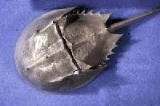
The horseshoe crab or Atlantic horseshoe crab (Limulus polyphemus) is a marine chelicerate arthropod
Arthropod

Arthropods are animals belonging to the Scientific classification Arthropoda , and include the insects, arachnids, crustaceans, and others....
. Despite its name, it is more closely related to spider
Spider

Spiders are air-breathing chelicerate arthropods that have eight legs, and chelicerae modified into fangs that inject venom. In their bodies the usual arthropod segments are fused into two Tagma , the cephalothorax and abdomen, joined by a small, cylindrical pedicel....
s, ticks, and scorpion
Scorpion

Scorpions are any arachnid of the order Scorpionida. They are members of the order Scorpiones within the class Arachnida. There are about 2,000 species of scorpions, found widely distributed south of about Latitude, except New Zealand and Antarctica....
s than to crab
Crab

Crabs are Decapoda crustaceans of the infraorder Brachyura, which typically have a very short projecting "tail" , or where the reduced abdomen is entirely hidden under the thorax....
s. Horseshoe crabs are most commonly found in the Gulf of Mexico
Gulf of Mexico

The Gulf of Mexico is the ninth largest body of water in the world. Considered a smaller part of the Atlantic Ocean, it is an oceanic basin largely surrounded by the North American continent and the island of Cuba....
 and along the northern Atlantic
Atlantic Ocean

The Atlantic Ocean is the second-largest of the world's oceanic divisions; with a total area of about 106.4 million square kilometres . It covers approximately one-fifth of the Earth's surface....
 coast of North America. A main area of annual migration is Delaware Bay
Delaware Bay

Delaware Bay is a large estuary outlet of the Delaware River on the Northeast seaboard of the United States whose fresh water mixes for many miles with the waters of the Atlantic Ocean....
, although stray individuals are occasionally found in Europe
Europe

Europe is, conventionally, one of the world's seven continents. Comprising the westernmost peninsula of Eurasia, Europe is generally divided from Asia to its east by the water divide of the Ural Mountains, the Ural , the Caspian Sea, and by the Caucasus Mountains to the southeast....
.

The other three species in the family Limulidae
Limulidae

Limulidae is the only recent family of the order Xiphosurida and contains all the 4 living species of horseshoe crabs. Horseshoe crabs fossils have been first seen in the late Devonian....
 are also called horseshoe crabs.


Discussion
Ask a question about 'Horseshoe crab'
Start a new discussion about 'Horseshoe crab'
Answer questions from other users
Full Discussion Forum


Recent Posts


Encyclopedia


The horseshoe crab or Atlantic horseshoe crab (Limulus polyphemus) is a marine chelicerate arthropod
Arthropod

Arthropods are animals belonging to the Scientific classification Arthropoda , and include the insects, arachnids, crustaceans, and others....
. Despite its name, it is more closely related to spider
Spider

Spiders are air-breathing chelicerate arthropods that have eight legs, and chelicerae modified into fangs that inject venom. In their bodies the usual arthropod segments are fused into two Tagma , the cephalothorax and abdomen, joined by a small, cylindrical pedicel....
s, ticks, and scorpion
Scorpion

Scorpions are any arachnid of the order Scorpionida. They are members of the order Scorpiones within the class Arachnida. There are about 2,000 species of scorpions, found widely distributed south of about Latitude, except New Zealand and Antarctica....
s than to crab
Crab

Crabs are Decapoda crustaceans of the infraorder Brachyura, which typically have a very short projecting "tail" , or where the reduced abdomen is entirely hidden under the thorax....
s. Horseshoe crabs are most commonly found in the Gulf of Mexico
Gulf of Mexico

The Gulf of Mexico is the ninth largest body of water in the world. Considered a smaller part of the Atlantic Ocean, it is an oceanic basin largely surrounded by the North American continent and the island of Cuba....
 and along the northern Atlantic
Atlantic Ocean

The Atlantic Ocean is the second-largest of the world's oceanic divisions; with a total area of about 106.4 million square kilometres . It covers approximately one-fifth of the Earth's surface....
 coast of North America. A main area of annual migration is Delaware Bay
Delaware Bay

Delaware Bay is a large estuary outlet of the Delaware River on the Northeast seaboard of the United States whose fresh water mixes for many miles with the waters of the Atlantic Ocean....
, although stray individuals are occasionally found in Europe
Europe

Europe is, conventionally, one of the world's seven continents. Comprising the westernmost peninsula of Eurasia, Europe is generally divided from Asia to its east by the water divide of the Ural Mountains, the Ural , the Caspian Sea, and by the Caucasus Mountains to the southeast....
.

The other three species in the family Limulidae
Limulidae

Limulidae is the only recent family of the order Xiphosurida and contains all the 4 living species of horseshoe crabs. Horseshoe crabs fossils have been first seen in the late Devonian....
 are also called horseshoe crabs. The Japanese horseshoe crab (Tachypleus tridentatus
Tachypleus tridentatus

Tachypleus tridentatus, commonly known as the Japanese horseshoe crab or the Chinese horseshoe crab, is a species in the family Limulidae....
) is found in the Seto Inland Sea, and is considered an endangered species because of loss of habitat. Two other species occur along the east coast of India
India

India, officially the Republic of India , is a country in South Asia. It is the List of countries and outlying territories by total area country by geographical area, the List of countries by population country, and the most populous liberal democracy in the world....
: Tachypleus gigas
Tachypleus gigas

Tachypleus gigas is a species in the family Limulidae. It is found in India, Indonesia, Malaysia, the Philippines, Singapore, and Thailand....
 and Carcinoscorpius rotundicauda
Carcinoscorpius rotundicauda

Carcinoscorpius rotundicauda is a species in the family Limulidae. It is found in India, Indonesia, Malaysia, the Philippines, Singapore, and Thailand....
. All four are quite similar in form and behavior.

The extinct diminutive horseshoe crab, Lunataspis aurora
Lunataspis

Lunataspis aurora is the oldest known Xiphosuran and an ancestor of the modern horseshoe crab. Fossils found in northern Manitoba, Canada in 2005 have dated Lunataspis back to the Late Ordovician....
, from head to tail-tip, has been identified in 445-million-year-old Ordovician
Ordovician

The Ordovician is a geologic period, the second of six of the Paleozoic era , and covers the time between 488.3?1.7 to 443.7?1.5 million years ago ....
 strata in Manitoba
Manitoba

Manitoba is a prairie provinces in Canada, which has an area of 647,797 square kilometres and a population of 1,207,959 , with more than half located within the Winnipeg Capital Region ....
.

Names

This group of animals is also known as horsefoot, king crab, or saucepan. Some people call the horseshoe crab a "helmet crab", but this common name is more frequently applied to a true crab, a malacostracan, of the species Telmessus cheiragonus. King crab is also more usually applied to a group of decapod crustaceans.

Limulus means "odd" and polyphemus refers to the giant in greek mythology
Polyphemus

Polyphemus , the gigantic one-eyed son of Poseidon and Thoosa, is a character in Greek mythology, one of the Cyclops. His name means "famous". Polyphemus plays a pivotal role in Homer's Odyssey....
. It is based on the misleading idea that the animal had a single eye.

Former scientific names include Limulus cyclops, Xiphosura americana and Polyphemus occidentalis.

Shell description

In areas where Limulus is common, the shells, exoskeleton
Exoskeleton

An exoskeleton is an external skeleton that supports and protects an animal's body, in contrast to the internal endoskeleton of, for example, a human skeleton....
s or exuviae (molted shells) of horseshoe crabs frequently wash up on beaches, either as whole shells, or as disarticulated pieces.

The shell of these animals consists of three parts. The carapace
Carapace

A carapace is a Dorsum section of the exoskeleton or shell in a number of animal groups, including arthropods such as crustaceans and arachnids as well as vertebrates such as chelonians, order Testudines, turtles and tortoises....
 is the smooth frontmost part of the crab which contains the eye
Eye

Eyes are Organ that detect light, and send signals along the optic nerve to the visual system and other areas of the brain. Complex optical systems with resolving power have come in ten fundamentally different forms, and 96% of animal species possess a complex optical system....
s (five pairs), one pair of small pincer
Pincer

Pincer may refer to:*Pincer *Pincer , part of an animalSee also*Pincer movement...
s/chelicerae
Chelicerae

The Chelicerae are mouth parts of the Chelicerata, an arthropod subphylum that includes arachnids, Merostomata , and Pycnogonida . Chelicerae are pointed appendages which are used to grasp food, and are found in place of the chewing mandibles most other arthropods have....
 used to move food towards the mouth, five pairs of walking legs (the first four with claws, the last with a leaflike structure used for pushing), the mouth in between the legs, the brain
Brain

The brain is the center of the nervous system in all vertebrate, and most invertebrate, animals. Some primitive animals such as cnidarian and echinoderm have a decentralized nervous system without a brain, while sponges lack any nervous system at all....
, and the heart
Heart

The heart is a muscle organ in all vertebrates responsible for pumping blood through the blood vessels by repeated, rhythmic contractions, or a similar structure in annelids, mollusks, and arthropods....
. The abdomen
Abdomen

In vertebrates such as mammals the abdomen constitutes the part of the body between the thorax and pelvis. The region enclosed by the abdomen is termed the abdominal cavity....
 is the middle portion where the gills are attached as well as the genital operculum
Operculum

In biology, operculum has been used to describe several different anatomical features, in animals, in humans and even in plants. The following list gives some of the uses of the term:...
. The last section is the telson
Telson

The telson is the last division of the body of a crustacean. It is not considered a true segment because it does not arise in the embryo from teloblast areas as do real segments....
 (i.e., tail or caudal spine) which is used to steer in the water and also to flip itself over if stuck upside down.

The horseshoe crab can grow up to in length (including tail); the female is typically 25 to 30 percent larger than the male.

Anatomy and physiology

Limuluskils4
Horseshoe Crab Female
Horseshoe crabs possess five pairs of book gills, located just behind their appendage
Appendage

An appendage in the broadest sense is an additional or subsidiary part existing on, or added to, something which can generally still function if the appendage has never existed or is later provided or grown, or will still perform a primary function if the appendage is removed....
s, that allow them to breathe underwater, and can also allow them to breathe on land for short periods of time, provided the gills remain moist.

Although most arthropod
Arthropod

Arthropods are animals belonging to the Scientific classification Arthropoda , and include the insects, arachnids, crustaceans, and others....
s have mandibles, the horseshoe crab is jawless. The mouth is located in the middle of the underside of the cephalothorax
Cephalothorax

The cephalothorax is an Anatomy term used in arachnids and malacostracan crustaceans for the first major body section. The remainder of the body is the abdomen , which may also bear lateral appendages as well as the tail, if present....
, with chelicerae
Chelicerae

The Chelicerae are mouth parts of the Chelicerata, an arthropod subphylum that includes arachnids, Merostomata , and Pycnogonida . Chelicerae are pointed appendages which are used to grasp food, and are found in place of the chewing mandibles most other arthropods have....
 located at each side of the mouth. In the female, the four large legs are all alike, and end in pincers. In the male, the first of the four large legs is modified, with a bulbous claw that serves to lock the male to the female while she deposits the eggs and he waits to fertilize them.

The Horseshoe Crab has blue blood, as it uses copper rather than iron as the base of its system.

Limulus has been extensively used in research into the physiology of vision
Visual system

The visual system is the part of the central nervous system which allows organisms to visual perception.It interprets the information from visible light to build a representation of the world surrounding the body....
. It has four compound eyes, and each ommatidium feeds into a single nerve
Nerve

A nerve is an enclosed, cable-like bundle of Peripheral nervous system axons . A nerve provides a common pathway for the electrochemical nerve impulses that are transmitted along each of the axons....
 fibre. Furthermore the nerves are large and relatively accessible. This made it possible for electrophysiologists
Electrophysiology

Electrophysiology is the study of the electrical properties of biological cell s and tissues. It involves measurements of voltage change or electric current on a wide variety of scales from single ion channel proteins to whole organs like the heart....
 to record the nervous response to light stimulation easily, and to observe visual phenomena like lateral inhibition
Lateral inhibition

In neurobiology, lateral inhibition is the capacity of an excited neuron to reduce the activity of its neighbors....
 working at the cellular level. More recently, behavioral experiments have investigated the functions of visual perception in Limulus. Habituation
Habituation

In psychology, habituation is the psychological process in humans and animals in which there is a decrease in behavior response to a stimulus after repeated exposure to that stimulus over a duration of time....
 and classical conditioning
Classical conditioning

Classical Conditioning is a form of associative learning that was first demonstrated by Ivan Pavlov . The typical procedure for inducing classical conditioning involves presentations of a neutral stimulus along with a stimulus of some significance....
 to light stimuli have been demonstrated, as has the use of brightness and shape information by males when recognizing potential mates.

Limulus has two large compound eyes on the sides of its head, which have monochromatic vision.Peak absorption is at 525nm The individual ommatidia are complex, consisting of upwards of 300 cells; they number around a thousand, and are somewhat messily arranged, not falling into the ordered hexagonal pattern seen in more derived arthropods. An additional simple eye is positioned at the rear of each of these structures. In addition to these obvious structures, it also has two smaller ocelli situated in the middle-front of its carapace, which may superficially be mistaken for nostrils. A further simple eye is located beneath these, on the underside of the carapace. A further pair of simple eyes are positioned just in front of the mouth. The simple eyes are probably important during the embryonic or larval stages of the organism, and even unhatched embryos seem to be able to sense light levels from within their buried eggs. The less sensitive compound eyes, and the median ocelli, become the dominant sight organisms during adulthood.

The individual ommatidia of the compound eyes of Limulus Among other senses, they have a small sense organ which senses on the triangular area formed by the exoskeleton beneath the body near the ventral eyes.

Horseshoe Crab Male Pedipalp

Life cycle and behaviour


Before becoming mature around age 9, they have to shed their shells some 17 times. They can live for as long as 31 years.

The crabs feed on mollusks, annelid
Annelid

The annelids, collectively called Annelida , are a large Scientific classification of animals comprising the segmented worms, with about 15,000 modern species including the well-known earthworms and leeches....
 worms, other benthic invertebrate
Invertebrate

An invertebrate is an animal lacking a vertebral column. The group includes 98% of all animal species ? all animals except those in the Chordate subphylum vertebrate ....
s, and bits of fish. Lacking jaws, it grinds up the food with bristles on its legs and a gizzard
Gizzard

The gizzard, also referred to as the ventriculus, gastric mill, and gigerium, is an organ found in the digestive tract of some animals, including birds, reptiles, earthworms and some fish....
 that contains sand and gravel.

They spend the winters on the continental shelf
Continental shelf

The continental shelf is the extended perimeter of each continent and associated coastal plain, and was part of the continent during the glacial periods, but is undersea during Ice age such as the current epoch by relatively shallow seas and Bay....
 and emerge at the shoreline in late spring to spawn, with the males arriving first. The smaller male grabs on to the back of a female with a "boxing glove" like structure on his front claws, often holding on for months at a time. After the female has laid a batch of eggs in a nest at a depth of 15-20 cm in the sand, the male fertilizes them with his sperm. Egg quantity is dependent on female body size and ranges from 15,000-64,000 eggs per female.

"Development begins when the first egg cover splits and new membrane, secreted by the embryo, forms a transparent spherical capsule" (Sturtevant). The larvae form and then swim for about five to seven days. After swimming they settle, and begin the first molt. This occurs approximately twenty days after the formation of the egg capsule. As young horseshoe crabs grow, they move to deeper waters, where molting continues. They reach sexual maturity in approximately eleven years and may live another 10-14 years beyond that.

Evolution

Horseshoe crabs are stem group chelicerates, thus distant relatives of spiders. They were traditionally grouped with the extinct eurypterids
Eurypterus

Eurypterus is an extinct genus of sea scorpion of the late Silurian period, inhabiting muddy Upland and lowland #Lowlands about 420 million years ago, in what is now the United States....
 (sea scorpions) as the Merostomata
Merostomata

Merostomata is a class of marine Chelicerata which includes horseshoe crabs and eurypterids. It includes only four living species but dozens of fossil species mainly from the Paleozoic....
. They may have evolved in the shallow seas of the Paleozoic
Paleozoic

The Paleozoic or Palaeozoic Era is the earliest of three geology Era of the Phanerozoic Eon . The Paleozoic spanned from roughly , and is subdivided into six period ; from oldest to youngest they are: the Cambrian, Ordovician, Silurian, Devonian period, Carboniferous, and Permian...
 Era (570-248 million years ago) with other primitive arthropods like the trilobite
Trilobite

Trilobites are extinction marine arthropods that form the class Trilobita. They appeared in the Early Cambrian period and flourished throughout the lower Paleozoic era before beginning a drawn-out decline to extinction when, during the Late Devonian extinction, all trilobite orders, with the sole exception of Proetida, died out....
s. The four species of horseshoe crab are the only remaining members of the Xiphosura, one of the oldest classes of marine arthropods. Horseshoe crabs are often referred to as living fossil
Living fossil

Living fossil is an informal term for any living species of organism which appears to be the same as a species otherwise only known from fossils and which has no close living relatives....
s, as they have changed little in the last 445 million years.

Regeneration

Horseshoe crabs possess the rare ability to regrow lost limbs, in a manner similar to sea stars.

Blood

The blood of horseshoe crabs (as well as that of most molluscs, including cephalopods and gastropods) contains the copper-containing protein hemocyanin
Hemocyanin

Hemocyanins are respiratory proteins in the form of metalloproteins containing two copper atoms that reversibly bind a single oxygen molecule ....
 at concentrations of about 50 g per litre. These creatures do not have hemoglobin
Hemoglobin

Hemoglobin is the iron-containing oxygen-transport metalloprotein in the red blood cells of vertebrates, and the tissues of some invertebrates....
 (iron-containing protein) which is the basis of oxygen transport in vertebrate
Vertebrate

Vertebrates are members of the subphylum Vertebrata, chordates with Vertebras or Vertebral columns. The grouping sometimes includes the hagfish, which have no vertebrae, but are genetically quite closely related to lampreys, which do have vertebrae....
s. Hemocyanin is colourless when deoxygenated and dark blue when oxygenated. The blood in the circulation of these creatures, which generally live in cold environments with low oxygen tensions, is grey-white to pale yellow, and it turns dark blue when exposed to the oxygen in the air, as seen when they bleed. This is due to change in color of hemocyanin when it is oxygenated. Hemocyanin carries oxygen in extracellular fluid, which is in contrast to the intracellular oxygen transport in vertebrate
Vertebrate

Vertebrates are members of the subphylum Vertebrata, chordates with Vertebras or Vertebral columns. The grouping sometimes includes the hagfish, which have no vertebrae, but are genetically quite closely related to lampreys, which do have vertebrae....
s by hemoglobin in red blood cell
Red blood cell

Red blood cells are the most common type of blood cell and the vertebrate body's principal means of delivering oxygen to the body tissues via the blood....
s.

The blood of horseshoe crabs contains one type of blood cell, the amebocyte
Amebocyte

An amebocyte or amoebocyte is a mobile biological cell in the body of invertebrates such as echinoderms, mollusks or sponges. Similar to some of the white blood cells of vertebrates, in many species amebocytes are found in the blood or body fluid and play a role in the defense of the organism against pathogens....
s. These play an important role in the defense against pathogens. Amebocytes contain granules with a clotting factor known as coagulogen; this is released outside the cell when bacterial endotoxin
Endotoxin

Endotoxins are toxins associated with certain bacteria. Classically, an "endotoxin" is a toxin which, unlike an "exotoxin", is not secreted in soluble form by live bacteria, but is a structural component in the bacteria which is released mainly when bacteria are lysis....
 is encountered. The resulting coagulation
Coagulation

Coagulation is a complex process by which blood forms clots. It is an important part of hemostasis , wherein a damaged blood vessel wall is covered by a platelet and fibrin-containing clot to stop hemorrhage and begin repair of the damaged vessel....
 is thought to contain bacterial infections in the animal's semi-closed circulatory system
Circulatory system

The circulatory system is an organ that moves nutrients, gases, and wastes to and from cells to help fight diseases and help stabilize body temperature and pH to maintain homeostasis....
.

Enzymes from horseshoe crab blood are used by astronauts in the International Space Station
International Space Station

The International Space Station is a research facility Assembly of the International Space Station in outer space. On-orbit construction of the station began in 1998, and is scheduled to be complete by 2011, with operations continuing until around 2015....
 to test surfaces for unwanted bacteria
Bacteria

The Bacteria are a large group of unicellular microorganisms. Typically a few micrometres in length, bacteria have a wide range of shapes, ranging from spheres to rods and spirals....
 and fungus
Fungus

A fungus is a Eukaryote organism that is a member of the Kingdom Fungi . The fungi are a monophyletic group, also called the Eumycota , that is phylogeny distinct from the morphologically similar slime molds and water molds ....
 

Medical research and testing

Horseshoe crabs are valuable as a species to the medical research community, and in medical testing. The above-mentioned clotting reaction is used in the Limulus Amebocyte Lysate
Limulus Amebocyte Lysate

Limulus amebocyte lysate is an aqueous extract of blood cells from the horseshoe crab, Limulus polyphemus. LAL reacts with bacterial endotoxin or lipopolysaccharide , which is a membrane component of Gram negative bacteria....
 (LAL) test to detect bacterial endotoxin
Endotoxin

Endotoxins are toxins associated with certain bacteria. Classically, an "endotoxin" is a toxin which, unlike an "exotoxin", is not secreted in soluble form by live bacteria, but is a structural component in the bacteria which is released mainly when bacteria are lysis....
s in pharmaceuticals and to test for several bacterial diseases. LAL is obtained from the animals' blood.

Horseshoe crabs are also used in finding remedies for diseases that have developed resistances to penicillin
Penicillin

Penicillin is a group of antibiotics derived from Penicillium fungi. They are Beta-lactam antibiotics used in the treatment of bacterial infections caused by susceptible, usually Gram-positive, organisms....
 and other drugs.

Horseshoe crabs are returned to the ocean after bleeding. Studies show that blood volume returns to normal in about a week, though blood cell count can take two to three months to fully rebound. A single horseshoe crab can be worth $2,500 over its lifetime for periodic blood extractions.

Conservation

Limulus polyphemus is not presently endangered
Endangered species

An endangered species is a population of an organism which is at risk of becoming extinct because it is either few in numbers, or threatened by changing environmental or predation parameters....
, but harvesting and habitat destruction
Habitat destruction

Habitat destruction is the process in which natural habitat is rendered functionally unable to support the species originally present. In this process, plants and animals which previously used the site are displaced or destroyed, reducing biodiversity....
 have reduced its numbers at some locations and caused some concern for this animal's future. Since the 1970s, the horseshoe crab population has been decreasing in some areas, due to several factors, including the use of the crab as bait in whelk
Whelk

A whelk is one of several species of large sea snails, marine gastropod mollusks found in temperate waters.In North America, the word whelk is used for "busycon whelks", several species of large, usually edible Busycon snails, marine gastropod mollusks in the family Melongenidae....
 and conch
Conch

A conch is one of a number of different species of medium-sized to large saltwater snails or their shells.True conchs are Marine gastropod molluscs in the family Strombidae, and the genus Strombus....
 trapping.

Conservationists have also voiced concerns about the declining population of shorebirds
Wader

Waders, called shorebirds in North America , are members of the order Charadriiformes, excluding the more marine web-footed seabird groups....
, such as Red Knot
Red Knot

The Red Knot, Calidris canutus , is a medium sized wader which breeds in tundra and the Arctic Cordillera in the far north of Canada, Europe, and Russia....
s, which rely heavily on the horseshoe crabs' eggs for food during their Spring migration
Bird migration

Bird migration refers to the regular seasonal journeys undertaken by many species of birds. Bird movements include those made in response to changes in food availability, habitat or weather....
. Precipitous declines in the population of the Red Knot
Red Knot

The Red Knot, Calidris canutus , is a medium sized wader which breeds in tundra and the Arctic Cordillera in the far north of Canada, Europe, and Russia....
s have been observed in recent years. Predators of horseshoe crabs, such as the currently threatened Atlantic Loggerhead Turtle, have also suffered as crab populations diminish.

In 1995, the nonprofit Ecological Research and Development Group (ERDG) was founded with the aim of preserving the four remaining species of horseshoe crab. Since its inception, the ERDG has made significant contributions to horseshoe crab conservation. ERDG founder Glenn Gauvry designed a mesh bag for whelk/conch traps, to prevent other species from removing the bait. This has led to a decrease in the amount of bait needed by approximately 50%. In the state of Virginia
Virginia

The Commonwealth of Virginia is an United States U.S. state on the East Coast of the United States of the Southern United States. The state is known as the "Old Dominion" and sometimes as "Mother of Presidents", because it is the birthplace of Lists of United States Presidents by place of birth#By state....
, these mesh bags are mandatory in whelk/conch fishery. The Atlantic States Marine Fisheries Commission
Atlantic States Marine Fisheries Commission

The Atlantic States Marine Fisheries Commission manages marine, shell, and anadromous fishery resources along the Atlantic coast within state waters....
  in 2006 considered several conservation options, among them being a two-year ban on harvesting the animals affecting both Delaware and New Jersey shores of Delaware Bay
Delaware Bay

Delaware Bay is a large estuary outlet of the Delaware River on the Northeast seaboard of the United States whose fresh water mixes for many miles with the waters of the Atlantic Ocean....
. In June 2007, Delaware Superior Court Judge Richard Stokes has allowed limited harvesting of 100,000 males. He ruled that while the crab population was seriously depleted by over-harvesting through 1998, it has since stabilized and that this limited take of males will not adversely affect either Horseshoe Crab or Red Knot populations. In opposition, Delaware environmental secretary John Hughes concluded that a decline in the Red Knot bird population was so significant that extreme measures were needed to ensure a supply of crab eggs when the birds arrived. Harvesting of the crabs was banned in New Jersey March 25, 2008.

Every year approximately 10% of the horseshoe crab breeding population dies when rough surf flips the creatures onto their backs, a position from which they often cannot right themselves. In response, the ERDG launched a "Just Flip 'Em" campaign, in the hopes that beachgoers will simply turn the crabs back over.

A large-scale project to tag and count horseshoe crabs along the north-American coast was underway in the spring and summer of 2008, termed .

External links