
All Topics  
Peristalsis

 
Peristalsis

   Email Print
   Bookmark   Link


Peristalsis


Peristalsis is the rhythmic contraction of smooth muscles to propel contents through the digestive tract. The word is derived from New Latin
New Latin

The term New Latin or Neo-Latin is used to describe a form the Latin language used after the end of the Medieval Latin period to c. 1900, and in a very limited fashion, down to the present day....
 and comes from the Greek
Greek language

Greek is an Indo-European languages native to the southern Balkan peninsula, the language of the Greek people. It forms an independent branch within Indo-European....
 peristaltikos, peristaltic, from peristellein, "to wrap around," and stellein, "to place."

In much of the gastrointestinal tract
Gastrointestinal tract

The digestive tract is the system of Organ s within multicellular animals that takes in food, digestion it to extract energy and nutrients, and expels the remaining waste....
, smooth muscle
Smooth muscle

Smooth muscle is a type of non-striated muscle, found within the tunica media layer of large and small arteries and veins, the urinary bladder, uterus, male and female reproductive tracts, gastrointestinal tract, respiratory tract, the ciliary muscle, and iris of the eye....
s contract in sequence to produce a peristaltic wave which forces a ball of food
Food

Food is any substance, usually composed of carbohydrates, fats, proteins and water, that can be Eating or Drinking by an animal or human for nutrition or pleasure....
 (called a bolus
Bolus (digestion)

In digestion, a bolus is a mass of food that has been Mastication and swallowed. Once a bolus reaches the stomach, digestion begins.* Compare to chyme....
 while in the esophagus
Esophagus

The esophagus or oesophagus , sometimes known as the gullet, is an Organ in vertebrates which consists of a Muscle tube through which food passes from the pharynx to the stomach....
 and gastrointestinal tract and chyme
Chyme

Chyme is the semifluid mass of partly digested food expelled by the stomach into the duodenum. In other words, chyme is half digested food. Also known as Chymus, it is the liquid substance found in the stomach before passing through the pyloric valve and entering the duodenum....
 in the stomach
Stomach

In most mammals, the stomach is a hollow muscular organ of the gastrointestinal tract involved in the second phase of digestion, following mastication....
) along the gastrointestinal tract.


Discussion
Ask a question about 'Peristalsis'
Start a new discussion about 'Peristalsis'
Answer questions from other users
Full Discussion Forum


Recent Posts


Encyclopedia


>>
Peristaltic


Peristalsis is the rhythmic contraction of smooth muscles to propel contents through the digestive tract. The word is derived from New Latin
New Latin

The term New Latin or Neo-Latin is used to describe a form the Latin language used after the end of the Medieval Latin period to c. 1900, and in a very limited fashion, down to the present day....
 and comes from the Greek
Greek language

Greek is an Indo-European languages native to the southern Balkan peninsula, the language of the Greek people. It forms an independent branch within Indo-European....
 peristaltikos, peristaltic, from peristellein, "to wrap around," and stellein, "to place."

In much of the gastrointestinal tract
Gastrointestinal tract

The digestive tract is the system of Organ s within multicellular animals that takes in food, digestion it to extract energy and nutrients, and expels the remaining waste....
, smooth muscle
Smooth muscle

Smooth muscle is a type of non-striated muscle, found within the tunica media layer of large and small arteries and veins, the urinary bladder, uterus, male and female reproductive tracts, gastrointestinal tract, respiratory tract, the ciliary muscle, and iris of the eye....
s contract in sequence to produce a peristaltic wave which forces a ball of food
Food

Food is any substance, usually composed of carbohydrates, fats, proteins and water, that can be Eating or Drinking by an animal or human for nutrition or pleasure....
 (called a bolus
Bolus (digestion)

In digestion, a bolus is a mass of food that has been Mastication and swallowed. Once a bolus reaches the stomach, digestion begins.* Compare to chyme....
 while in the esophagus
Esophagus

The esophagus or oesophagus , sometimes known as the gullet, is an Organ in vertebrates which consists of a Muscle tube through which food passes from the pharynx to the stomach....
 and gastrointestinal tract and chyme
Chyme

Chyme is the semifluid mass of partly digested food expelled by the stomach into the duodenum. In other words, chyme is half digested food. Also known as Chymus, it is the liquid substance found in the stomach before passing through the pyloric valve and entering the duodenum....
 in the stomach
Stomach

In most mammals, the stomach is a hollow muscular organ of the gastrointestinal tract involved in the second phase of digestion, following mastication....
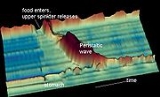
) along the gastrointestinal tract. Peristaltic movement is initiated by circular smooth muscles contracting behind the chewed material to prevent it from moving back into the mouth, followed by a contraction of longitudinal smooth muscles which pushes the digested food forward.

In the esophagus

After food is chewed into a bolus, it is swallowed
Swallowing

"Gulp" redirects here. For other uses, see Gulp .Swallowing, known scientifically as deglutition, is the process in the human or animal body that makes something pass from the mouth, to the pharynx, into the esophagus, with the shutting of the epiglottis....
 to move it into the esophagus. Smooth muscles will contract behind the bolus to prevent it from being squeezed back into the mouth, then rhythmic, unidirectional waves of contractions will work to rapidly force the food into the stomach. This process works in one direction only and its sole purpose is to move food from the mouth into the stomach.

In the esophagus, two types of peristalsis occur.
  • First, there is a primary peristaltic wave; once the bolus enters the esophagus during swallowing
    Swallowing

    "Gulp" redirects here. For other uses, see Gulp .Swallowing, known scientifically as deglutition, is the process in the human or animal body that makes something pass from the mouth, to the pharynx, into the esophagus, with the shutting of the epiglottis....
    . The primary peristaltic wave forces the bolus down the esophagus and into the stomach in a wave lasting about 8-9 seconds. The wave travels down to the stomach even if the bolus of food descends at a greater rate than the wave itself, and will continue even if for some reason the bolus gets stuck further up the esophagus.


  • In the event that the bolus gets stuck or moves slower than the primary peristaltic wave (as can happen when it is poorly lubricated), stretch receptors in the esophageal lining are stimulated and a local reflex response causes a secondary peristaltic wave around the bolus, forcing it further down the esophagus, and these secondary waves will continue indefinitely until the bolus enters the stomach.


In the small intestine

Once processed and digested by the stomach, the milky chyme is squeezed through the pyloric valve into the small intestine
Small intestine

In vertebrates, including mammals, reptiles, birds, and bony fish, the small intestine is the part of the gastrointestinal tract following the stomach, and is where the vast majority of digestion takes place....
. Once past the stomach a typical peristaltic wave will only last for a few seconds, traveling at only a few centimeters per second. Its primary purpose is to mix the chyme in the intestine rather than to move it forward in the intestine. Through this process of mixing and continued digestion and absorption of nutrients, the chyme gradually works its way through the small intestine to the large intestine
Large intestine

The large intestine is the last part of the digestive system?the final stage of the alimentary canal?in vertebrate animals. Its function is to absorb water from the remaining indigestible food matter, and then to pass this useless feces from the body....
.

During vomiting
Vomiting

Vomiting is the forceful expulsion of the contents of one's stomach through the mouth and sometimes the nose. Undesired vomiting may result from many causes, ranging from gastritis or poisoning to brain tumors, or elevated intracranial pressure....
 the propulsion of food up the esophagus and out the mouth comes from contraction of the abdominal muscles
Human abdomen

The human abdomen is the part of the body between the pelvis and the chest. Anatomically, the abdomen stretches from the thorax at the thoracic diaphragm to the pelvis at the pelvic brim....
; peristalsis does not reverse in the esophagus.

As opposed to the more continuous peristalsis of the small intestines, fecal
Feces

Feces, faeces, or f?ces is a waste product from an animal's gastrointestinal tract expelled through the anus during defecation....
 contents are propelled into the large intestine by periodic mass movements. These mass movements occur one to three times per day in the large intestines and colon, and help propel the contents from the large intestine through the colon to the rectum.

See also

  • Peristaltic pump
    Peristaltic pump

    A peristaltic pump is a type of positive displacement pump used for pumping a variety of fluids. The fluid is contained within a flexible tube fitted inside a circular pump casing ....
     - Mechanical device that uses peristaltic action to drive fluids


External links

  • *