

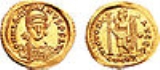
Marcian

Encyclopedia
Marcian was Byzantine Emperor from 450 to 457. Marcian's rule marked a recovery of the Eastern Empire, which the Emperor protected from external menaces and reformed economically and financially. On the other side, the isolationistic policies of Marcian left the Western Roman Empire
without help against barbarian attacks, which materialized in the Italian campaigns of Attila and in the Vandal
sack of Rome (455)
.
or Thracia
. The son of a soldier, he spent his early life as an obscure soldier, member of a military unit located at Philippopolis. Marcian was dispatched with his unit for a war against the Sassanids (probably the Roman-Sassanid war of 421–422), but along the road East he fell ill in Lycia
; at this time he might have already been tribunus and commander of his unit.
After recovering from his illness, he went to Constantinople
, where he served for fifteen years as domesticus
under the generals Ardaburius and Aspar
. In 431/434, while fighting in Africa under Aspar, Marcian was taken prisoner by the Vandals
; according to a later legend, he was brought before King Geiseric (428–477), who knew by an omen that Marcian was to be Emperor and was released on his oath never to take up arms against the Vandals.
Through the influence of these generals he became a captain of the guards, and was later raised to the rank of senator. On the death of Theodosius II
(450) he was chosen as consort by the latter's sister and successor, Pulcheria
, and called upon to govern a Roman Empire greatly humbled and impoverished by the ravages of the Huns
.
(434–453), which the latter had been accustomed to receiving from Theodosius II in order to refrain from attacks on the Eastern Empire. Aware that he could never capture the eastern capital of Constantinople
, Attila turned to the west and waged his famous campaigns in Gaul 451 and Italy
(452) while leaving Marcian's dominions alone.
Marcian reformed the finances, checked extravagance, and repopulated the devastated districts. He repelled attacks upon Syria
and Egypt
(452), and quelled disturbances on the Armenia
n frontier (456). The other notable event of his reign is the Council of Chalcedon
(451), in which Marcian endeavored to mediate between the rival schools of theology
.
_turkey.jpg) Marcian generally ignored the affairs of the Western Roman Empire
Marcian generally ignored the affairs of the Western Roman Empire
, leaving that tottering half of the empire to its fate. He did nothing to aid the west during Attila's campaigns, and, living up to his promise, ignored the depredations of Geiseric even when the Vandals sacked Rome in 455. It has recently been argued, however, that Marcian was more actively involved in aiding the Western Empire than historians had previously believed and that Marcian's fingerprints can be discerned in the events leading up to, and including, Attila's death.
Shortly before Attila's death in 453, conflict had begun again between him and Marcian. However, the powerful Hun king died before all-out war broke out. In a dream, Marcian claimed he saw Attila's bow broken before him, and a few days later, he got word that his great enemy was dead.
Marcian died on January 27, 457 of disease, possibly gangrene contracted during a long religious journey. He was buried in the church of the Holy Apostles
in Constantinople, together with Pulcheria.
Despite his short reign and his writing off of the west Marcian is considered one of the best of the early Eastern Roman Emperors. The Eastern Orthodox Church recognizes him and his wife Pulcheria as saint
s, with their feast day on February 17.
was the only known daughter of Marcian, and she was married to Anthemius
, later Western Roman Emperor. The identity of her mother is unknown.
Pulcheria
was his second wife. Pulcheria had taken a religious vow
of chastity
. The second marriage was a mere political alliance, establishing Marcian as a member of the Theodosian dynasty
by marriage. The marriage of Marcian to Pulcheria was never consummate
d, consequently Euphemia never had younger half-siblings.
in the film Sign of the Pagan (1954).
Western Roman Empire
The Western Roman Empire was the western half of the Roman Empire after its division by Diocletian in 285; the other half of the Roman Empire was the Eastern Roman Empire, commonly referred to today as the Byzantine Empire....
without help against barbarian attacks, which materialized in the Italian campaigns of Attila and in the Vandal
Vandals
The Vandals were an East Germanic tribe that entered the late Roman Empire during the 5th century. The Vandals under king Genseric entered Africa in 429 and by 439 established a kingdom which included the Roman Africa province, besides the islands of Sicily, Corsica, Sardinia and the Balearics....
sack of Rome (455)
Sack of Rome (455)
The sack of 455 was the second of three barbarian sacks of Rome; it was executed by the Vandals, who were then at war with the usurping Western Roman Emperor Petronius Maximus....
.
Rise to power
Marcian was born in 392 in IllyricumPraetorian prefecture of Illyricum
The praetorian prefecture of Illyricum was one of four praetorian prefectures into which the Late Roman Empire was divided.The administrative centre of the prefecture was Sirmium , and, after 379, Thessalonica...
or Thracia
Thracia (Roman province)
Thracia was the name of a province of the Roman empire. It was established in AD 46, when the former Roman client state of Thrace was annexed by order of emperor Claudius ....
. The son of a soldier, he spent his early life as an obscure soldier, member of a military unit located at Philippopolis. Marcian was dispatched with his unit for a war against the Sassanids (probably the Roman-Sassanid war of 421–422), but along the road East he fell ill in Lycia
Lycia
Lycia Lycian: Trm̃mis; ) was a region in Anatolia in what are now the provinces of Antalya and Muğla on the southern coast of Turkey. It was a federation of ancient cities in the region and later a province of the Roman Empire...
; at this time he might have already been tribunus and commander of his unit.
After recovering from his illness, he went to Constantinople
Constantinople
Constantinople was the capital of the Roman, Eastern Roman, Byzantine, Latin, and Ottoman Empires. Throughout most of the Middle Ages, Constantinople was Europe's largest and wealthiest city.-Names:...
, where he served for fifteen years as domesticus
Domesticus (Roman Empire)
A domesticus was a member of the protectores domestici, an elite guard unit of the Late Roman army, who served as bodyguards and staff officers to the emperor. As its name testifies, these were troops considered as belonging to the household of the emperor...
under the generals Ardaburius and Aspar
Aspar
Flavius Ardabur Aspar was an Alan patrician and magister militum of the Eastern Roman Empire. Aspar's family exerted a great influence on the Eastern Roman Emperors for half a century, from the 420s to his death in 471, over Theodosius II, Marcian and Leo I, who, in the end, had him killed.Alans...
. In 431/434, while fighting in Africa under Aspar, Marcian was taken prisoner by the Vandals
Vandals
The Vandals were an East Germanic tribe that entered the late Roman Empire during the 5th century. The Vandals under king Genseric entered Africa in 429 and by 439 established a kingdom which included the Roman Africa province, besides the islands of Sicily, Corsica, Sardinia and the Balearics....
; according to a later legend, he was brought before King Geiseric (428–477), who knew by an omen that Marcian was to be Emperor and was released on his oath never to take up arms against the Vandals.
Through the influence of these generals he became a captain of the guards, and was later raised to the rank of senator. On the death of Theodosius II
Theodosius II
Theodosius II , commonly surnamed Theodosius the Younger, or Theodosius the Calligrapher, was Byzantine Emperor from 408 to 450. He is mostly known for promulgating the Theodosian law code, and for the construction of the Theodosian Walls of Constantinople...
(450) he was chosen as consort by the latter's sister and successor, Pulcheria
Pulcheria
Aelia Pulcheria was the daughter of Eastern Roman Emperor Arcadius and Empress Aelia Eudoxia. She was the second child born to Arcadius and Eudoxia. Her oldest sister was Flaccilla born in 397, but is assumed she had died young. Her younger siblings were Theodosius II, the future emperor and...
, and called upon to govern a Roman Empire greatly humbled and impoverished by the ravages of the Huns
Huns
The Huns were a group of nomadic people who, appearing from east of the Volga River, migrated into Europe c. AD 370 and established the vast Hunnic Empire there. Since de Guignes linked them with the Xiongnu, who had been northern neighbours of China 300 years prior to the emergence of the Huns,...
.
Rule
Upon becoming Emperor, Marcian repudiated the embarrassing payments of tribute to Attila the HunAttila the Hun
Attila , more frequently referred to as Attila the Hun, was the ruler of the Huns from 434 until his death in 453. He was leader of the Hunnic Empire, which stretched from the Ural River to the Rhine River and from the Danube River to the Baltic Sea. During his reign he was one of the most feared...
(434–453), which the latter had been accustomed to receiving from Theodosius II in order to refrain from attacks on the Eastern Empire. Aware that he could never capture the eastern capital of Constantinople
Constantinople
Constantinople was the capital of the Roman, Eastern Roman, Byzantine, Latin, and Ottoman Empires. Throughout most of the Middle Ages, Constantinople was Europe's largest and wealthiest city.-Names:...
, Attila turned to the west and waged his famous campaigns in Gaul 451 and Italy
Italy
Italy , officially the Italian Republic languages]] under the European Charter for Regional or Minority Languages. In each of these, Italy's official name is as follows:;;;;;;;;), is a unitary parliamentary republic in South-Central Europe. To the north it borders France, Switzerland, Austria and...
(452) while leaving Marcian's dominions alone.
Marcian reformed the finances, checked extravagance, and repopulated the devastated districts. He repelled attacks upon Syria
Syria (Roman province)
Syria was a Roman province, annexed in 64 BC by Pompey, as a consequence of his military presence after pursuing victory in the Third Mithridatic War. It remained under Roman, and subsequently Byzantine, rule for seven centuries, until 637 when it fell to the Islamic conquests.- Principate :The...
and Egypt
Aegyptus
- Aegyptus, King of Egypt and Arabia :In Greek mythology, Aegyptus is a descendant of the heifer maiden, Io, and the river-god Nilus, and was a king in Egypt. Aegyptos was the son of Belus and Achiroe, a naiad daughter of Nile. Aegyptus fathered fifty sons, who were all but one murdered by the...
(452), and quelled disturbances on the Armenia
Armenia
Armenia , officially the Republic of Armenia , is a landlocked mountainous country in the Caucasus region of Eurasia...
n frontier (456). The other notable event of his reign is the Council of Chalcedon
Council of Chalcedon
The Council of Chalcedon was a church council held from 8 October to 1 November, 451 AD, at Chalcedon , on the Asian side of the Bosporus. The council marked a significant turning point in the Christological debates that led to the separation of the church of the Eastern Roman Empire in the 5th...
(451), in which Marcian endeavored to mediate between the rival schools of theology
Theology
Theology is the systematic and rational study of religion and its influences and of the nature of religious truths, or the learned profession acquired by completing specialized training in religious studies, usually at a university or school of divinity or seminary.-Definition:Augustine of Hippo...
.
Western Roman Empire
The Western Roman Empire was the western half of the Roman Empire after its division by Diocletian in 285; the other half of the Roman Empire was the Eastern Roman Empire, commonly referred to today as the Byzantine Empire....
, leaving that tottering half of the empire to its fate. He did nothing to aid the west during Attila's campaigns, and, living up to his promise, ignored the depredations of Geiseric even when the Vandals sacked Rome in 455. It has recently been argued, however, that Marcian was more actively involved in aiding the Western Empire than historians had previously believed and that Marcian's fingerprints can be discerned in the events leading up to, and including, Attila's death.
Shortly before Attila's death in 453, conflict had begun again between him and Marcian. However, the powerful Hun king died before all-out war broke out. In a dream, Marcian claimed he saw Attila's bow broken before him, and a few days later, he got word that his great enemy was dead.
Marcian died on January 27, 457 of disease, possibly gangrene contracted during a long religious journey. He was buried in the church of the Holy Apostles
Church of the Holy Apostles
The Church of the Holy Apostles , also known as the Imperial Polyandreion, was a Christian church built in Constantinople, capital of the Eastern Roman Empire, in 550. It was second only to the Church of the Holy Wisdom among the great churches of the capital...
in Constantinople, together with Pulcheria.
Despite his short reign and his writing off of the west Marcian is considered one of the best of the early Eastern Roman Emperors. The Eastern Orthodox Church recognizes him and his wife Pulcheria as saint
Saint
A saint is a holy person. In various religions, saints are people who are believed to have exceptional holiness.In Christian usage, "saint" refers to any believer who is "in Christ", and in whom Christ dwells, whether in heaven or in earth...
s, with their feast day on February 17.
Marriages
Marcia EuphemiaMarcia Euphemia
Aelia Marcia/Marciana Euphemia was the wife of Anthemius, Western Roman Emperor.-Family:Marcia/Marciana Euphemia was the only known daughter of Marcian, Byzantine Emperor. The identity of her mother is unknown. Her stepmother was Pulcheria, second wife of her father. Pulcheria had taken a...
was the only known daughter of Marcian, and she was married to Anthemius
Anthemius
Procopius Anthemius was Western Roman Emperor from 467 to 472. Perhaps the last capable Western Roman Emperor, Anthemius attempted to solve the two primary military challenges facing the remains of the Western Roman Empire: the resurgent Visigoths, under Euric, whose domain straddled the Pyrenees;...
, later Western Roman Emperor. The identity of her mother is unknown.
Pulcheria
Pulcheria
Aelia Pulcheria was the daughter of Eastern Roman Emperor Arcadius and Empress Aelia Eudoxia. She was the second child born to Arcadius and Eudoxia. Her oldest sister was Flaccilla born in 397, but is assumed she had died young. Her younger siblings were Theodosius II, the future emperor and...
was his second wife. Pulcheria had taken a religious vow
Religious vows
Religious vows are the public vows made by the members of religious communities pertaining to their conduct, practices and views.In the Buddhist tradition, in particular within the Mahayana and Vajrayana tradition, many different kinds of religious vows are taken by the lay community as well as by...
of chastity
Chastity
Chastity refers to the sexual behavior of a man or woman acceptable to the moral standards and guidelines of a culture, civilization, or religion....
. The second marriage was a mere political alliance, establishing Marcian as a member of the Theodosian dynasty
Theodosian dynasty
The Theodosian dynasty was a Roman family that rose to eminence in the waning days of the Roman Empire.-History:Its founding father was Flavius Theodosius , a great general who had saved Britannia from the Great Conspiracy...
by marriage. The marriage of Marcian to Pulcheria was never consummate
Consummate
Consummation or consummation of a marriage, in many traditions and statutes of civil or religious law, is the first act of sexual intercourse between two individuals, following their marriage to each other...
d, consequently Euphemia never had younger half-siblings.
Depiction in fiction
Marcian was played by the Hollywood star Jeff ChandlerJeff Chandler (actor)
Jeff Chandler was an American film actor and singer in the 1950s.-Early life:Chandler was born Ira Grossel to a Jewish family in Brooklyn, New York, the only child of Anna and Phillip Grossel. He attended Erasmus Hall High School, the alma mater of many stage and film personalities...
in the film Sign of the Pagan (1954).