

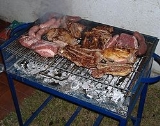
Latin American cuisine

Encyclopedia
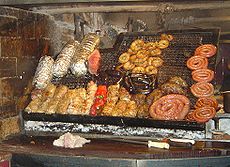
Latin America
Latin America is a region of the Americas where Romance languages – particularly Spanish and Portuguese, and variably French – are primarily spoken. Latin America has an area of approximately 21,069,500 km² , almost 3.9% of the Earth's surface or 14.1% of its land surface area...
. Latin America is a highly diverse area of land that holds various cuisines that vary from nation to nation.
Some items typical of Latin American cuisine include maize
Maize
Maize known in many English-speaking countries as corn or mielie/mealie, is a grain domesticated by indigenous peoples in Mesoamerica in prehistoric times. The leafy stalk produces ears which contain seeds called kernels. Though technically a grain, maize kernels are used in cooking as a vegetable...
-based dishes (tortilla
Tortilla
In Mexico and Central America, a tortilla is a type of thin, unleavened flat bread, made from finely ground maize...
s, tamale
Tamale
A tamale — or more correctly tamal — is a traditional Latin American dish made of masa , which is steamed or boiled in a leaf wrapper. The wrapping is discarded before eating...
s, pupusa
Pupusa
A pupusa is a traditional Salvadoran dish made of thick, hand-made corn tortilla that is usually filled with a blend of the following: cheese , cooked pork meat ground to a paste consistency...
s) and various salsas
Salsa (sauce)
Salsa may refer to any type of sauce. In American English, it usually refers to the spicy, often tomato based, hot sauces typical of Mexican and Central American cuisine, particularly those used as dips. In British English, the word typically refers to salsa cruda, which is common in Mexican ,...
and other condiments (guacamole
Guacamole
Guacamole , is an avocado-based dip that originated in Mexico. It is traditionally made by mashing ripe avocados with a molcajete with sea salt. Some recipes call for limited tomato, spicy Asian spices such as white onion, lime juice, and/or additional seasonings.-History:Guacamole was made by...
, pico de gallo
Pico de gallo
In Mexican cuisine, pico de gallo , also called salsa fresca, is a fresh, uncooked condiment made from chopped tomato, white onion, and chilis...
, mole
Mole (sauce)
Mole is the generic name for a number of sauces used in Mexican cuisine, as well as for dishes based on these sauces...
, chimichurri
Chimichurri
Chimichurri or Chimmichurri is a variant of green sauce, though there is a red version as well , also used as a marinade, for grilled meat...
, and pebre
Pebre
Pebre is a Chilean condiment made of coriander, chopped onion, olive oil, garlic and ground or pureed spicy aji peppers. Pebre is most commonly spooned on meat, usually from a barbecue. If you add chopped tomatoes it is called Chancho en piedra....
). These spices are generally what give the Latin American cuisines a distinct flavor; yet, each country of Latin America tends to use a different spice and those that share spices tend to use them at different quantities. Thus, this leads for a variety across the land. Sofrito
Sofrito
Sofrito is a combination of aromatic ingredients which have been cut in very small pieces, and slowly sauteed or braised in cooking oil for 15-30 minutes....
, a culinary term that originally referred to a specific combination of sauteed or braised aromatics, exists in Latin American cuisine. It refers to a sauce of tomatoes, roasted bell peppers, garlic, onions and herbs.
Latin American beverages are just as distinct as their foods. Some of the beverages can even date back to the times of the Native Americans. Some popular beverages include mate
Mate (beverage)
Mate , also known as chimarrão or cimarrón, is a traditional South American infused drink, particularly in Argentina, Uruguay, Paraguay, southern states of Brazil, south of Chile, the Bolivian Chaco, and to some extent, Syria and Lebanon...
, pisco
Pisco
Pisco is a colorless or yellowish-to-amber colored grape brandy produced in winemaking regions of Chile and Peru. Pisco was developed by Spanish settlers in the 16th century as an alternative to orujo, a pomace brandy that was being imported from Spain...
, horchata
Horchata
Horchata or orxata is the name of several kinds of traditional beverage, made of ground almonds, sesame seeds, rice, barley, or tigernuts .-Etymology:...
, chicha
Chicha
For the musical genre, see Peruvian cumbiaChicha is a term used in some regions of Latin America for several varieties of fermented and non-fermented beverages, rather often to those derived from maize and similar non-alcoholic beverages...
, atole
Atole
Atole is a traditional masa-based Mexican and Central American hot drink. Chocolate atole is known as champurrado or atole...
, cacao
Hot chocolate
Hot chocolate is a heated beverage typically consisting of shaved chocolate, melted chocolate or cocoa powder, heated milk or water, and sugar...
and aguas frescas
Aguas frescas
Ades, punches, fruit drinks and other non-alcoholic flavored coolers, known as aguas frescas in some parts of Latin America, are a combination of either fruits, cereals, or seeds with sugar and water, blended to make a beverage. Aguas frescas are popular in Mexico, Central America, the Caribbean,...
.
Desserts in Latin America are generally very sweet in taste. They include dulce de leche
Dulce de leche
Dulce de leche is a thick,creamy, caramel-like milk-based sauce or spread.Literally translated, dulce de leche means "sweet from milk". It is prepared by slowly heating sweetened milk to create a product that derives its taste from caramelised sugar. It is a popular sweet in Latin America, where...
, alfajor
Alfajor
An alfajor or alajú is a traditional Arabic confection found in some regions of Spain and then made with variations in countries of Latin America including Argentina, Chile, Uruguay, Peru, and Mexico, after being taken there by the colonists. The archetypal alfajor entered Iberia during the period...
, Rice pudding
Rice pudding
Rice pudding is a dish made from rice mixed with water or milk and sometimes other ingredients such as cinnamon and raisins. Different variants are used for either desserts or dinners. When used as a dessert, it is commonly combined with a sweetener such as sugar.-Rice pudding around the world:Rice...
, tres leches cake
Tres leches cake
A tres leches cake, or pastel de tres leches , or pan tres leches , is a sponge cake—in some recipes, a butter cake—soaked in three kinds of milk: evaporated milk, condensed milk, and heavy cream.When butter is not used, the tres leches is a very light cake, with many air bubbles...
, Teja
Teja (confectionery)
A teja is a popular dumpling-shaped confection from the Ica Region of Peru. It contains manjar blanco filling and either dry fruits or nuts...
and flan
Flan
Crème caramel , flan , or caramel custard is a custard dessert with a layer of soft caramel on top, as opposed to crème brûlée, which is custard with a hard caramel top...
.
Native American influence
Information about Native American cuisine comes from a great variety of sources. Modern day native peoples retain a rich body of traditional foods, some of which have become iconic of present-day Native American social gatherings (for example, frybreadFrybread
Frybread is a Native American food found throughout the United States. Frybread is a flat dough fried or deep-fried in oil, shortening, or lard. The dough is generally leavened by yeast or baking powder....
). Foods like cornbread
Cornbread
Cornbread is a generic name for any number of quick breads containing cornmeal and leavened by baking powder.-History:Native Americans were using ground corn for food thousands of years before European explorers arrived in the New World...
are known to have been adopted into the cuisine of the United States from Native American groups. In other cases, documents from the early periods of contact with European, African, and Asian peoples allow the recovery of food practices which passed out of popularity in the historic period (for example, Black Drink
Black drink
Black drink was the name given by colonists to a ritual beverage called Asi, brewed by Native Americans in the Southeastern United States...
). Archaeological
Archaeology
Archaeology, or archeology , is the study of human society, primarily through the recovery and analysis of the material culture and environmental data that they have left behind, which includes artifacts, architecture, biofacts and cultural landscapes...
techniques, particularly in the subdisciplines of zooarchaeology
Zooarchaeology
Zooarchaeology, also known as Archaeozoology, is the study of animal remains from archaeological sites. The remains consist primarily of the hard parts of the body such as bones, teeth, and shells...
and paleoethnobotany
Paleoethnobotany
Paleoethnobotany, also known as archaeobotany in European academic circles, is the archaeological sub-field that studies plant remains from archaeological sites...
, have allowed for the understanding of other culinary practices or preferred foods which did not survive into the written historic record.lol
African influence
Africans brought and preserved many of their traditions and cooking techniques. They were often given less desired cuts of meat, including shoulder and intestines. MenudoMenudo (soup)
The soup Menudo is a traditional Mexican dish, made with beef stomach in a clear broth or with a red chili base . Usually, lime, chopped onions, and chopped cilantro are added, as well as crushed oregano and crushed red chili peppers...
, for example, was derived from the habit of the Spaniards of giving the slaves cows' intestines. Slaves developed a way to clean the offal
Offal
Offal , also called, especially in the United States, variety meats or organ meats, refers to the internal organs and entrails of a butchered animal. The word does not refer to a particular list of edible organs, which varies by culture and region, but includes most internal organs other than...
and season it to taste. Slaves in the southern United States also did the same thing to the pig's intestines given to them. In South America, the scraps of food the landlords did not eat, and by mixing what they got they usually ended coming up with new plates that nowadays have been adopted into the cuisine of their respective nation (Such being the case with the Peruvian tacu-tacu).
European influence
Europeans brought their culinary traditions, but quickly adapted several of the fruits and vegetables native to the Americas into their own cuisines. Europe itself had been influenced by other cultures, such as with the Moors in Spain, and thus their food was already a mix of their world. The European influence for Latin American cuisine mainly comes from SpainSpanish cuisine
Spanish cuisine consists of a variety of dishes, which stem from differences in geography, culture and climate. It is heavily influenced by seafood available from the waters that surround the country, and reflects the country's deep maritime roots...
, Portugal
Portuguese cuisine
Portuguese cuisine is characterised by rich, filling and full-flavored dishes and is closely related to Mediterranean cuisine. The influence of Portugal's former colonial possessions is also notable, especially in the wide variety of spices used. These spices include piri piri and black pepper, as...
, Italy
Italian cuisine
Italian cuisine has developed through centuries of social and political changes, with roots as far back as the 4th century BCE. Italian cuisine in itself takes heavy influences, including Etruscan, ancient Greek, ancient Roman, Byzantine, Jewish and Arab cuisines...
and to a lesser extent France
French cuisine
French cuisine is a style of food preparation originating from France that has developed from centuries of social change. In the Middle Ages, Guillaume Tirel , a court chef, authored Le Viandier, one of the earliest recipe collections of Medieval France...
, although some influences from cuisines as diverse as British, German and Eastern European are also evident in some countries' cuisines.
Asian influence
A wave of immigrants from Asia, such as China and Japan, also influenced the cuisine of Latin America. The Chinese brought with them their own spices and food-styles, something that the people of Latin America accepted into their tables. Not only that, but several Asian restaurants also adapted a whole lot of Latin American food-styles into their own. This case can clearly be seen in the Peruvian chifaChifa
Chifa is a term used in Peru to refer to a style of Chinese cooking in which ingredients which are available in Peru have been substituted for those originally used in China. Chinese immigrants came to Peru mainly from the southern province of Guangdong and particularly its capital city Guangzhou...
.
Caribbean
Caribbean cuisine is a fusion of African, Dutch, Amerindian, French, Indian, and Spanish cuisine. These traditions were brought from the many homelands of this region's population. In addition, the population has created from this vast wealth of tradition many styles that are unique to the region.Seafood is one of the most common cuisine types in the islands, though this is certainly due in part to their location. Each island will likely have its own specialty. Some prepare lobster, while others prefer certain types of fish. For example, the island of Barbados is known for its "flying fish."
Another Caribbean mainstay is rice, but you'll find the rice on each island may be a little different. Some season their rice, or add peas and other touches - like coconut. Sometimes the rice is yellow, but other times it is part of a dish. Though it comes in many forms, it is a common side dish throughout the region.
Cuisine of Cuba
Cuba
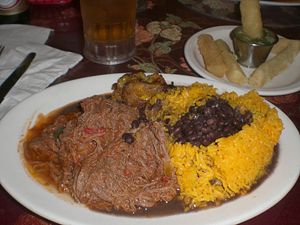
The Republic of Cuba is an island nation in the Caribbean. The nation of Cuba consists of the main island of Cuba, the Isla de la Juventud, and several archipelagos. Havana is the largest city in Cuba and the country's capital. Santiago de Cuba is the second largest city...
n cuisine is a distinctive fusion of Spanish, African and Caribbean cuisines. Cuban recipes share their basic spice palette and preparation techniques with Spanish and African cooking, with some Caribbean influence in the use of local foods such as tropical fruits, fish, etc. A small but noteworthy Chinese influence can also be accounted for, mainly in the Havana area.
Cuban cuisine has almost nothing in common with Mexican cuisine, which is a surprise for many visitors from the United States or Europe. It also differs from other Latin American cuisines and food traditions of the United States.
Cuisine of the Dominican Republic
The cuisine of the Dominican Republic is primarily a mixture of Spanish and African cuisines, as well as some Taino Indian influence. The country that is now the Dominican Republic was formerly a Spanish colony. Many Spanish traits are still present in the culture, the cuisine included. Traditional dishes in the Dominican Republic remain essentially Spanish, but ingredients and flavors have changed to reflect the ingredients available in the average Dominican household.Dominican cuisine differs in some respects from other parts of the West Indies and spicing of dishes is much more on the mild side. What Dominicans tend to eat depends highly on where they live, either near the sea or in the mountains, but rice is a main course in the meals.
Cuisine of Haiti
HaitiHaiti
Haiti , officially the Republic of Haiti , is a Caribbean country. It occupies the western, smaller portion of the island of Hispaniola, in the Greater Antillean archipelago, which it shares with the Dominican Republic. Ayiti was the indigenous Taíno or Amerindian name for the island...
an cuisine is a mixture of various cuisines, predominately of a similar nature with fellow Latin American countries. It employs similar techniques with the rest of the Caribbean with influences from French, Spanish, and African cuisines, and a few derivatives from native Taino cooking. Though similar to other cuisine in the region, it carries a uniqueness native only to the country and an appeal to many visitors in the island. Haitian cuisine uses vegetables and meats extensively and peppers and similar herbs are often used for strengthening flavor.
Cuisine of Puerto Rico
Spain
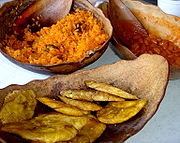
Spain , officially the Kingdom of Spain languages]] under the European Charter for Regional or Minority Languages. In each of these, Spain's official name is as follows:;;;;;;), is a country and member state of the European Union located in southwestern Europe on the Iberian Peninsula...
), Africa
Africa
Africa is the world's second largest and second most populous continent, after Asia. At about 30.2 million km² including adjacent islands, it covers 6% of the Earth's total surface area and 20.4% of the total land area...
and the Amerindian Taínos
Taíno people
The Taínos were pre-Columbian inhabitants of the Bahamas, Greater Antilles, and the northern Lesser Antilles. It is thought that the seafaring Taínos are relatives of the Arawak people of South America...
. In the latter part of the 19th century the cuisine of Puerto Rico was greatly influenced by the United States
United States
The United States of America is a federal constitutional republic comprising fifty states and a federal district...
in the ingredients used in its preparation. Puerto Rican cuisine has transcended the boundaries of the island and can be found in several countries outside the archipelago.
North America
North American cuisine is a term used for foods native to or popular in countries of North America, as with Canadian cuisine, Cuisine of the United States, and Cuisine of Mexico. It has influences from many international cuisines, including Native American cuisine and European cuisine.The cuisines of nearby Central America and the Caribbean region — sometimes grouped with the North American continent — may be considered part of North American cuisine in the technical sense that they are not assigned to their own continents.
Cuisine of Belize
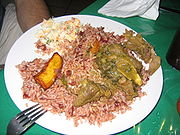
Belize
Belize is a constitutional monarchy and the northernmost country in Central America. Belize has a diverse society, comprising many cultures and languages. Even though Kriol and Spanish are spoken among the population, Belize is the only country in Central America where English is the official...
ans of all ethnicities eat a wide variety of foods. Breakfast consists of bread, flour tortilla
Tortilla
In Mexico and Central America, a tortilla is a type of thin, unleavened flat bread, made from finely ground maize...
s, or fry jacks that are often homemade. They are eaten with various cheeses, refried beans
Refried beans
Refried beans is a dish of cooked and mashed beans and is a traditional staple of Mexican and Tex-Mex cuisine, although each cuisine has a somewhat different approach when making the dish.-Ingredients and preparation:...
, various forms of eggs or cereal, topped off by milk for younger ones and coffee or tea for adults. Eating breakfast is called "drinking tea". Midday meals vary, from lighter foods such as rice and beans
Rice and beans
Rice and beans is a very popular dish in Latin America, the Caribbean, and in communities of Latino, Caribbean or Sephardic...
with or without coconut milk
Coconut milk
Coconut milk is the water that comes from the grated meat of a coconut. The colour and rich taste of the milk can be attributed to the high oil content. In many parts of the world, the term coconut milk is also used to refer to coconut water, the naturally occurring liquid found inside the hollow...
, tamale
Tamale
A tamale — or more correctly tamal — is a traditional Latin American dish made of masa , which is steamed or boiled in a leaf wrapper. The wrapping is discarded before eating...
s, panades, (fried maize shells with beans or fish) and meat pies, escabeche
Escabeche
Escabeche is a typical Mediterranean cuisine which refers to both a dish of poached or fried fish that is marinated in an acidic mixture before serving, and to the marinade itself...
(onion soup), chirmole (soup), stew chicken and garnaches (fried tortillas with beans, cheese, and sauce) to various constituted dinners featuring some type of rice and beans, meat and salad or coleslaw
Coleslaw
Coleslaw, sometimes simply called slaw in some American dialects, is a salad consisting primarily of shredded raw cabbage. It may also include shredded carrots and other ingredients such as fruits and vegetables, apples, onions, green onions, peppers and various spices.-History:The term "coleslaw"...
. In the rural areas meals may be more simplified than in the cities; the Maya use recaudo, corn
Maize
Maize known in many English-speaking countries as corn or mielie/mealie, is a grain domesticated by indigenous peoples in Mesoamerica in prehistoric times. The leafy stalk produces ears which contain seeds called kernels. Though technically a grain, maize kernels are used in cooking as a vegetable...
or maize for most of their meals, and the Garifuna are fond of seafood, cassava
Cassava
Cassava , also called yuca or manioc, a woody shrub of the Euphorbiaceae native to South America, is extensively cultivated as an annual crop in tropical and subtropical regions for its edible starchy tuberous root, a major source of carbohydrates...
(particularly made into hudut) and vegetables. The nation abounds with restaurants and fast food establishments selling food fairly cheaply. Local fruits are quite common, but raw vegetables from the markets less so. Mealtime is a communion for families and schools and some businesses close at midday for lunch, reopening later in the afternoon. Conversation during meals, unless the topic is important, is considered impolite.
Cuisine of Costa Rica
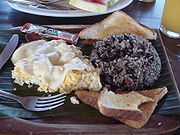
Other Costa Rican food staples include corn tortillas, white cheese and picadillos. Tortillas are used to accompany most meals. Costa Ricans will often fill their tortillas with whatever they are eating and eat it in the form of a gallo (direct translation: rooster, however, it resembles a soft Mexican taco). White cheese is non-processed cheese that is made by adding salt to milk in production. Picadillos are meat and vegetable combinations where one or more vegetables are diced, mixed with beef and garnished with spices. Common vegetables used in picadillos are potatoes, green beans, squash, ayote, chayote and arracache. Often, picadillos are eaten in the form of gallos.
Cuisine of El Salvador
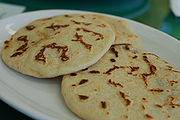
El Salvador's most notable dish is the pupusa
Pupusa
A pupusa is a traditional Salvadoran dish made of thick, hand-made corn tortilla that is usually filled with a blend of the following: cheese , cooked pork meat ground to a paste consistency...
, a thick hand-made corn flour or rice flour tortilla stuffed with cheese, chicharrón (fried pork rinds), refried beans, and/or loroco (a vine flower bud native to Central America). There are also vegetarian options, often with ayote (a type of squash), or garlic. Some adventurous restaurants even offer pupusas stuffed with shrimp or spinach.
Two other typical Salvadoran dishes are yuca frita and panes rellenos. Yuca frita, which is deep fried cassava root served with curtido (a pickled cabbage, onion and carrot topping) and pork rinds with pescaditas (fried baby sardines). The Yuca is sometimes served boiled instead of fried. Panes con Pavo (turkey sandwiches) are warm turkey submarines. The turkey is marinated and then roasted with Pipil spices and handpulled. This sandwich is traditionally served with turkey, tomato, and watercress along with cucumber, onion, lettuce, mayonnaise, and mustard. A lot of Salvadoran food is served with french bread, or pan frances in spanish.
Cuisine of Guatemala
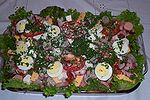
Guatemala
Guatemala is a country in Central America bordered by Mexico to the north and west, the Pacific Ocean to the southwest, Belize to the northeast, the Caribbean to the east, and Honduras and El Salvador to the southeast...
reflects the multicultural nature of Guatemala, in that it involves food that differs in taste depending on the region. Guatemala has 22 departments (or divisions), each of which has very different typical foodstuffs. Guatemalan cuisine is widely known for its candy originating from Antigua Guatemala.
There are also foods that it is traditional to eat on certain days of the week - for example, by tradition it is known that on Thursday, the typical food is "paches" which is like a tamale made with a base of potato, and on Saturday it is traditional to eat tamales.
Cuisine of Honduras
Honduras
Honduras is a republic in Central America. It was previously known as Spanish Honduras to differentiate it from British Honduras, which became the modern-day state of Belize...
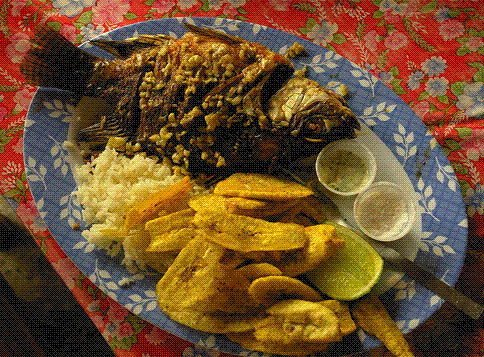
Cuisine combines the food of the indigenous Maya-Lenca population with Spanish and Mexican food. Its most notable feature is that it uses more coconut
Coconut
The coconut palm, Cocos nucifera, is a member of the family Arecaceae . It is the only accepted species in the genus Cocos. The term coconut can refer to the entire coconut palm, the seed, or the fruit, which is not a botanical nut. The spelling cocoanut is an old-fashioned form of the word...
than any other Central America
Central America
Central America is the central geographic region of the Americas. It is the southernmost, isthmian portion of the North American continent, which connects with South America on the southeast. When considered part of the unified continental model, it is considered a subcontinent...
n cuisine in both sweet and savory dishes. Regional specialties include fried fish
Fish
Fish are a paraphyletic group of organisms that consist of all gill-bearing aquatic vertebrate animals that lack limbs with digits. Included in this definition are the living hagfish, lampreys, and cartilaginous and bony fish, as well as various extinct related groups...
, carne asada
Carne asada
In Mexican cuisine, "Carne asada" is an item that consists of thin beef steak. The meat can be marinated by rubbing with olive oil and salt or with spice rubs such as lemon and pepper or garlic salt, lime, or Worcestershire sauce, before being cooked on a grill. The meat can be served alone or...
, and baleada
Baleada
Baleadas are one of Honduras's most original and popular foods. A baleada is a wheat flour tortilla, often quite thick, folded in half and filled with mashed fried beans. They originate in El Progreso This is the no-frills baleada. People may also add other ingredients...
s.
In addition to the baleadas, the following are also popular: meat roasted with chismol carne asada
Carne asada
In Mexican cuisine, "Carne asada" is an item that consists of thin beef steak. The meat can be marinated by rubbing with olive oil and salt or with spice rubs such as lemon and pepper or garlic salt, lime, or Worcestershire sauce, before being cooked on a grill. The meat can be served alone or...
, chicken with rice and corn, fried fish (Yojoa style) with pickled onions and jalapeños. In the coastal areas and in the Bay Islands, seafood and some meats are prepared in many ways, some of which include coconut
Coconut
The coconut palm, Cocos nucifera, is a member of the family Arecaceae . It is the only accepted species in the genus Cocos. The term coconut can refer to the entire coconut palm, the seed, or the fruit, which is not a botanical nut. The spelling cocoanut is an old-fashioned form of the word...
milk.
Among the soups the Hondurans enjoy are: conch
Conch
A conch is a common name which is applied to a number of different species of medium-sized to large sea snails or their shells, generally those which are large and have a high spire and a siphonal canal....
soup, bean
Bean
Bean is a common name for large plant seeds of several genera of the family Fabaceae used for human food or animal feed....
soup, Mondongo Soup, or soup of intestine, seafood
Seafood
Seafood is any form of marine life regarded as food by humans. Seafoods include fish, molluscs , crustaceans , echinoderms . Edible sea plants, such as some seaweeds and microalgae, are also seafood, and are widely eaten around the world, especially in Asia...
soups, beef
Beef
Beef is the culinary name for meat from bovines, especially domestic cattle. Beef can be harvested from cows, bulls, heifers or steers. It is one of the principal meats used in the cuisine of the Middle East , Australia, Argentina, Brazil, Europe and the United States, and is also important in...
soups, all of which are mixed with plaintains, yucca
Yucca
Yucca is a genus of perennial shrubs and trees in the family Asparagaceae, subfamily Agavoideae. Its 40-50 species are notable for their rosettes of evergreen, tough, sword-shaped leaves and large terminal panicles of white or whitish flowers. They are native to the hot and dry parts of North...
, cabbage among other things, and complemented with corn
Maize
Maize known in many English-speaking countries as corn or mielie/mealie, is a grain domesticated by indigenous peoples in Mesoamerica in prehistoric times. The leafy stalk produces ears which contain seeds called kernels. Though technically a grain, maize kernels are used in cooking as a vegetable...
tortillas.
Other typical dishes are the montucas or corn tamale
Tamale
A tamale — or more correctly tamal — is a traditional Latin American dish made of masa , which is steamed or boiled in a leaf wrapper. The wrapping is discarded before eating...
, stuffed tortillas, tamales wrapped up with banana
Banana
Banana is the common name for herbaceous plants of the genus Musa and for the fruit they produce. Bananas come in a variety of sizes and colors when ripe, including yellow, purple, and red....
leaves, among other types of food. Also part of the Honduran typical dishes are abundant selection of tropical fruits such as: papaya
Papaya
The papaya , papaw, or pawpaw is the fruit of the plant Carica papaya, the sole species in the genus Carica of the plant family Caricaceae...
, pineapple
Pineapple
Pineapple is the common name for a tropical plant and its edible fruit, which is actually a multiple fruit consisting of coalesced berries. It was given the name pineapple due to its resemblance to a pine cone. The pineapple is by far the most economically important plant in the Bromeliaceae...
, plums, epazotes, passion fruits, and bananas which are prepared in many ways while they are still green.
Cuisine of Mexico
Mexican cuisine
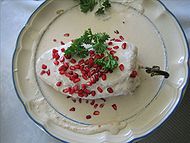
Mexican cuisine, a style of food that originates in Mexico, is known for its varied flavors, colourful decoration and variety of spices and ingredients, most of which are native to the country. The cuisine of Mexico has evolved through thousands of years of blending indigenous cultures, with later...
is known for its intense and varied flavors, colorful decoration, and variety of spices. Mexican culture and food is one of the richest in the world, both with respect to diverse and appealing tastes and textures; and in terms of proteins, vitamins, and minerals.
Most of today's Mexican cuisine is based on pre-Hispanic traditions, including the Aztecs, Maya
Maya peoples
The Maya people constitute a diverse range of the Native American people of southern Mexico and northern Central America. The overarching term "Maya" is a collective designation to include the peoples of the region who share some degree of cultural and linguistic heritage; however, the term...
, and the Indigenous peoples of Mexico
Indigenous peoples of Mexico
Mexico, in the second article of its Constitution, is defined as a "pluricultural" nation in recognition of the diverse ethnic groups that constitute it, and in which the indigenous peoples are the original foundation...
combined with culinary trends introduced by Spanish colonists.
Mexican cuisine varies by region, because of local climate and geography and ethnic differences among the indigenous inhabitants and because these different populations were influenced by the Spaniards in varying degrees.
A distinction must be made between truly authentic Mexican cuisine
Mexican cuisine
Mexican cuisine, a style of food that originates in Mexico, is known for its varied flavors, colourful decoration and variety of spices and ingredients, most of which are native to the country. The cuisine of Mexico has evolved through thousands of years of blending indigenous cultures, with later...
, and U.S. Southwestern cuisine like Tex-Mex
Tex-Mex
Tex-Mex is a regional American cuisine that blends food products available in the United States and the culinary creations of Mexican-Americans influenced by the cuisines of Mexico.Tex Mex may also refer to:...
(regional Texan and Mexican fusion), and Cal-Mex (regional Californian and Mexican fusion) since they are commonly mistaken for Mexican cuisine. Also, Another style of cuisine that is commonly mistaken for Mexican cuisine is New Mexican cuisine
New Mexican cuisine
New Mexican cuisine is a regional cuisine found in New Mexico, reflecting the regional climate and long history as part of the Native American, Mexican, Spanish and United States cultures. This form of southwest cuisine is most popular in New Mexico, Colorado, Utah, and California...
, which is found in New Mexico, USA.
Cuisine of Nicaragua
The Cuisine of NicaraguaNicaragua
Nicaragua is the largest country in the Central American American isthmus, bordered by Honduras to the north and Costa Rica to the south. The country is situated between 11 and 14 degrees north of the Equator in the Northern Hemisphere, which places it entirely within the tropics. The Pacific Ocean...
is a fusion of Spanish, Caribbean and pre-Columbian dishes of the indigenous peoples. When the Spaniards first arrived in Nicaragua
Nicaragua
Nicaragua is the largest country in the Central American American isthmus, bordered by Honduras to the north and Costa Rica to the south. The country is situated between 11 and 14 degrees north of the Equator in the Northern Hemisphere, which places it entirely within the tropics. The Pacific Ocean...
they found that the indigenous peoples had incorporated foods available in the area into their cuisine
Cuisine
Cuisine is a characteristic style of cooking practices and traditions, often associated with a specific culture. Cuisines are often named after the geographic areas or regions that they originate from...
. Despite the blending and incorporation of pre-Columbian and Spanish influenced cuisine, traditional cuisine changes from the Pacific to the Caribbean coast. While the Pacific coast's main staple revolves around fruits and corn, the Caribbean coast makes use of seafood
Seafood
Seafood is any form of marine life regarded as food by humans. Seafoods include fish, molluscs , crustaceans , echinoderms . Edible sea plants, such as some seaweeds and microalgae, are also seafood, and are widely eaten around the world, especially in Asia...
and the coconut
Coconut
The coconut palm, Cocos nucifera, is a member of the family Arecaceae . It is the only accepted species in the genus Cocos. The term coconut can refer to the entire coconut palm, the seed, or the fruit, which is not a botanical nut. The spelling cocoanut is an old-fashioned form of the word...
.
As in many other Latin America
Latin America
Latin America is a region of the Americas where Romance languages – particularly Spanish and Portuguese, and variably French – are primarily spoken. Latin America has an area of approximately 21,069,500 km² , almost 3.9% of the Earth's surface or 14.1% of its land surface area...
n countries, corn
Maize
Maize known in many English-speaking countries as corn or mielie/mealie, is a grain domesticated by indigenous peoples in Mesoamerica in prehistoric times. The leafy stalk produces ears which contain seeds called kernels. Though technically a grain, maize kernels are used in cooking as a vegetable...
is a main staple. Corn is used in many of the widely consumed dishes, such as nacatamal
Nacatamal
A nacatamal is a Nicaraguan dish similar to the tamal and yet unlike the tamales typical of Mexico, Honduras, Guatemala, El Salvador and elsewhere in Latin America, the nacatamal is unique to Nicaragua both in its name and its culinary combination...
, and indio viejo. Corn is also an ingredient for drinks such as pinolillo
Pinolillo
Pinolillo is a sweet cornmeal and cacao-based traditional drink in Nicaragua. It is made of ground toasted corn and a bit of cacao. It can be mixed with water or milk, served sweetened or unsweetened. If unsweetened, it is rather bitter. It can also be used in cooking some local dishes, such as...
and chicha
Chicha
For the musical genre, see Peruvian cumbiaChicha is a term used in some regions of Latin America for several varieties of fermented and non-fermented beverages, rather often to those derived from maize and similar non-alcoholic beverages...
as well as in sweets and desserts. Nicaraguans do not limit their cuisine to corn, locally grown vegetables and fruits have been in use since before the arrival of the Spaniards and their influence on Nicaraguan cuisine. Many of Nicaragua's dishes include fruits and vegetables such as jocote
Jocote
Spondias purpurea is a species of flowering plant in the cashew family, Anacardiaceae, that is native to tropical regions of the Americas. It is most commonly known as Jocote, which derives from the Nahuatl word xocotl, meaning "fruit." Other common names include Red Mombin, Purple Mombin, Hog...
, grosella, mimbro, mango
Mango
The mango is a fleshy stone fruit belonging to the genus Mangifera, consisting of numerous tropical fruiting trees in the flowering plant family Anacardiaceae. The mango is native to India from where it spread all over the world. It is also the most cultivated fruit of the tropical world. While...
, papaya
Papaya
The papaya , papaw, or pawpaw is the fruit of the plant Carica papaya, the sole species in the genus Carica of the plant family Caricaceae...
, tamarind
Tamarind
Tamarind is a tree in the family Fabaceae. The genus Tamarindus is monotypic .-Origin:...
, pipian, banana
Banana
Banana is the common name for herbaceous plants of the genus Musa and for the fruit they produce. Bananas come in a variety of sizes and colors when ripe, including yellow, purple, and red....
, avocado
Avocado
The avocado is a tree native to Central Mexico, classified in the flowering plant family Lauraceae along with cinnamon, camphor and bay laurel...
, yuca
Cassava
Cassava , also called yuca or manioc, a woody shrub of the Euphorbiaceae native to South America, is extensively cultivated as an annual crop in tropical and subtropical regions for its edible starchy tuberous root, a major source of carbohydrates...
, and herbs such as culantro
Coriander
Coriander is an annual herb in the family Apiaceae. Coriander is native to southern Europe and North Africa to southwestern Asia. It is a soft, hairless plant growing to tall. The leaves are variable in shape, broadly lobed at the base of the plant, and slender and feathery higher on the...
, oregano
Oregano
Oregano – scientifically named Origanum vulgare by Carolus Linnaeus – is a common species of Origanum, a genus of the mint family . It is native to warm-temperate western and southwestern Eurasia and the Mediterranean region.Oregano is a perennial herb, growing from 20–80 cm tall,...
and achiote
Achiote
Achiote is a shrub or small tree from the tropical region of the Americas. The name derives from the Nahuatl word for the shrub, achiotl. It is also known as Aploppas, and its original Tupi name urucu. It is cultivated there and in Southeast Asia, where it was introduced by the Spanish in the...
.
Gallopinto is Nicaragua's national dish
National dish
A national dish is a dish, food or a drink that is considered to represent a particular country, nation or region.A dish can become a national dish for a variety of reasons. It can be the national dish because it is a staple daily food for the majority of the population. It can also be the national...
, consisting of red bean
Bean
Bean is a common name for large plant seeds of several genera of the family Fabaceae used for human food or animal feed....
s and rice
Rice
Rice is the seed of the monocot plants Oryza sativa or Oryza glaberrima . As a cereal grain, it is the most important staple food for a large part of the world's human population, especially in East Asia, Southeast Asia, South Asia, the Middle East, and the West Indies...
. The dish has several variations including the addition of coconut oil
Coconut oil
Coconut oil is an edible oil extracted from the kernel or meat of matured coconuts harvested from the coconut palm . Throughout the tropical world, it has provided the primary source of fat in the diets of millions of people for generations. It has various applications in food, medicine, and industry...
and/or grated coconut
Coconut
The coconut palm, Cocos nucifera, is a member of the family Arecaceae . It is the only accepted species in the genus Cocos. The term coconut can refer to the entire coconut palm, the seed, or the fruit, which is not a botanical nut. The spelling cocoanut is an old-fashioned form of the word...
which is primarily prepared on Nicaragua's Caribbean
Caribbean
The Caribbean is a crescent-shaped group of islands more than 2,000 miles long separating the Gulf of Mexico and the Caribbean Sea, to the west and south, from the Atlantic Ocean, to the east and north...
coast. It is thought to have originated in Nicaragua, however, there is some controversy about the origins of this dish.
Cuisine of Panama
PanamaPanama
Panama , officially the Republic of Panama , is the southernmost country of Central America. Situated on the isthmus connecting North and South America, it is bordered by Costa Rica to the northwest, Colombia to the southeast, the Caribbean Sea to the north and the Pacific Ocean to the south. The...
nian cuisine has its own unique and rich cuisine. As a land bridge between two continents, Panama is blessed by nature with an unusual variety of tropical fruits, vegetables and herbs that are used in native cooking. Also, as a crossroads of the world, Panamanian cuisine is influenced by its diverse population of Hispanic, native Indian, European, African, Colombian, Jamaican, and Chinese migration. They also drink chicha, a very common drink found in Panama.
South America
The richest products of South AmericaSouth America
South America is a continent situated in the Western Hemisphere, mostly in the Southern Hemisphere, with a relatively small portion in the Northern Hemisphere. The continent is also considered a subcontinent of the Americas. It is bordered on the west by the Pacific Ocean and on the north and east...
come from the middle of the continent, the Amazonia. In countries like Peru
Peru
Peru , officially the Republic of Peru , is a country in western South America. It is bordered on the north by Ecuador and Colombia, on the east by Brazil, on the southeast by Bolivia, on the south by Chile, and on the west by the Pacific Ocean....
there is a strong influence of the Inca and their cuisine. Potato
Potato
The potato is a starchy, tuberous crop from the perennial Solanum tuberosum of the Solanaceae family . The word potato may refer to the plant itself as well as the edible tuber. In the region of the Andes, there are some other closely related cultivated potato species...
es are frequently grown as a result of this, and also plants such as quinoa
Quinoa
Quinoa , a species of goosefoot , is a grain-like crop grown primarily for its edible seeds. It is a pseudocereal rather than a true cereal, or grain, as it is not a member of the grass family...
. Lima
Lima
Lima is the capital and the largest city of Peru. It is located in the valleys of the Chillón, Rímac and Lurín rivers, in the central part of the country, on a desert coast overlooking the Pacific Ocean. Together with the seaport of Callao, it forms a contiguous urban area known as the Lima...
itself was declared the "Gastronomic Capital of the Americas" in 2006.
Costa Rica lies on the Pacific Ocean
Pacific Ocean
The Pacific Ocean is the largest of the Earth's oceanic divisions. It extends from the Arctic in the north to the Southern Ocean in the south, bounded by Asia and Australia in the west, and the Americas in the east.At 165.2 million square kilometres in area, this largest division of the World...
, which provides a large array of seafood
Seafood
Seafood is any form of marine life regarded as food by humans. Seafoods include fish, molluscs , crustaceans , echinoderms . Edible sea plants, such as some seaweeds and microalgae, are also seafood, and are widely eaten around the world, especially in Asia...
. Many plain
Plain
In geography, a plain is land with relatively low relief, that is flat or gently rolling. Prairies and steppes are types of plains, and the archetype for a plain is often thought of as a grassland, but plains in their natural state may also be covered in shrublands, woodland and forest, or...
s are also on this continent, which are rich for growing food in abundance. In the Patagonia
Patagonia
Patagonia is a region located in Argentina and Chile, integrating the southernmost section of the Andes mountains to the southwest towards the Pacific ocean and from the east of the cordillera to the valleys it follows south through Colorado River towards Carmen de Patagones in the Atlantic Ocean...
south of Chile
Chile
Chile ,officially the Republic of Chile , is a country in South America occupying a long, narrow coastal strip between the Andes mountains to the east and the Pacific Ocean to the west. It borders Peru to the north, Bolivia to the northeast, Argentina to the east, and the Drake Passage in the far...
and Argentina
Argentina
Argentina , officially the Argentine Republic , is the second largest country in South America by land area, after Brazil. It is constituted as a federation of 23 provinces and an autonomous city, Buenos Aires...
, many people produce lamb and venison
Venison
Venison is the meat of a game animal, especially a deer but also other animals such as antelope, wild boar, etc.-Etymology:The word derives from the Latin vēnor...
. King crab
King crab
King crabs, also called stone crabs, are a superfamily of crab-like decapod crustaceans chiefly found in cold seas. Because of their large size and the taste of their meat, many species are widely caught and sold as food, the most common being the red king crab, Paralithodes camtschaticus.King...
is typically caught at the southern end of the continent. Antarctic krill
Antarctic krill
Antarctic krill, Euphausia superba, is a species of krill found in the Antarctic waters of the Southern Ocean. It is a shrimp-like crustacean that lives in large schools, called swarms, sometimes reaching densities of 10,000–30,000 individual animals per cubic metre...
has been recently discovered and is now considered a fine dish. Tuna
Tuna
Tuna is a salt water fish from the family Scombridae, mostly in the genus Thunnus. Tuna are fast swimmers, and some species are capable of speeds of . Unlike most fish, which have white flesh, the muscle tissue of tuna ranges from pink to dark red. The red coloration derives from myoglobin, an...
and tropical fish
Tropical fish
Tropical fish include fish found in tropical environments around the world, including both freshwater and salt water species.Tropical fish are popular as aquarium fish, due to their often bright coloration...
are caught all around the continent, but Easter Island
Easter Island
Easter Island is a Polynesian island in the southeastern Pacific Ocean, at the southeasternmost point of the Polynesian triangle. A special territory of Chile that was annexed in 1888, Easter Island is famous for its 887 extant monumental statues, called moai, created by the early Rapanui people...
is where they are found in abundance. Lobster
Lobster
Clawed lobsters comprise a family of large marine crustaceans. Highly prized as seafood, lobsters are economically important, and are often one of the most profitable commodities in coastal areas they populate.Though several groups of crustaceans are known as lobsters, the clawed lobsters are most...
is also caught in great quantities from the Juan Fernández Islands
Juan Fernández Islands
The Juan Fernández Islands are a sparsely inhabited island group reliant on tourism and fishing in the South Pacific Ocean, situated about off the coast of Chile, and is composed of three main volcanic islands; Robinson Crusoe Island, Alejandro Selkirk Island and Santa Clara Island, the first...
.
Cuisine of Argentina
Argentina
Argentina , officially the Argentine Republic , is the second largest country in South America by land area, after Brazil. It is constituted as a federation of 23 provinces and an autonomous city, Buenos Aires...
is strongly influenced by Italian and Spanish cuisines and cooking techniques. Indigenous gastronomies derived from groups such as the Quechua, Mapuche
Mapuche
The Mapuche are a group of indigenous inhabitants of south-central Chile and southwestern Argentina. They constitute a wide-ranging ethnicity composed of various groups who shared a common social, religious and economic structure, as well as a common linguistic heritage. Their influence extended...
, and Guarani have also played a role.
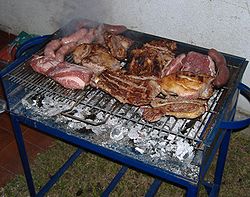
Another determining factor in Argentine cuisine is that Argentina is one of the world's major food producers. It is a major producer of meat (especially beef), wheat, corn, milk, beans, and since the 1970s, soybeans. Given the country's vast production of beef, red meat is an especially common part of the Argentine diet. Due to the very large number of Argentines of Italian ancestry, pizza and especially pasta are also very popular, but there are food traditions from other European nations as well, including the English afternoon tea.
Cuisine of Brazil
Brazil
Brazil , officially the Federative Republic of Brazil , is the largest country in South America. It is the world's fifth largest country, both by geographical area and by population with over 192 million people...
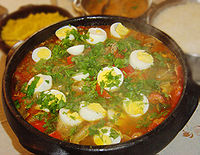
, like Brazil itself, varies greatly by region. Brazilian cuisine can be divided into several distinct locations. From the north of Brazil through the Amazonian jungle, and directly down the Brazilian coastline.
This diversity reflects the country's mix of native Amerindians, Portuguese, Africans, Italians, Spaniards, Germans, Syrians, Lebanese and Japanese among others. This has created a national cooking style marked by the preservation of regional differences.
Cuisine of Chile
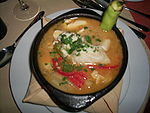
Spanish cuisine
Spanish cuisine consists of a variety of dishes, which stem from differences in geography, culture and climate. It is heavily influenced by seafood available from the waters that surround the country, and reflects the country's deep maritime roots...
with indigenous ingredients.
European immigrants also brought with them various styles and traditions in cooking, heavily influencing the cuisine of Chile, including Italian, German, and French influences as well as the English afternoon tea. These mixtures have created a unique fusion. Seafood is widely used and an array of produce which historically has grown throughout the region have been implemented into Chilean gastronomy. Many recipes are accompanied and enhanced by Chilean wine
Chilean wine
Chilean wine is wine made in the South American country of Chile. The region has a long viticultural history for a New World wine region dating to the 16th century when the Spanish conquistadors brought Vitis vinifera vines with them as they colonized the region. In the mid-19th century, French...
such as Curanto
Curanto
Curanto is a traditional food of Chiloé Archipelago that has spread to the southern areas of Chile and recently Argentina. It is traditionally prepared in a hole, about a meter and a half deep, which is dug in the ground...
.
Cuisine of Colombia
The cuisine of ColombiaColombia
Colombia, officially the Republic of Colombia , is a unitary constitutional republic comprising thirty-two departments. The country is located in northwestern South America, bordered to the east by Venezuela and Brazil; to the south by Ecuador and Peru; to the north by the Caribbean Sea; to the...
consists of a large variety of dishes that take into account the difference in regional climates. For example, in the city of Medellín the typical dish is the bandeja paisa
Bandeja paisa
Bandeja paisa, also known as bandeja de arriero, bandeja montañera, or bandeja antioqueña, is a typical fusion cuisine Colombian dish...
. It includes beans, rice, ground meat or carne asada, chorizo
Chorizo
Chorizo is a term encompassing several types of pork sausages originating from the Iberian Peninsula.In English, it is usually pronounced , , or , but sometimes ....
, fried egg, arepa and chicharrón. It is usually accompanied by avocado, tomato and sauces.
Inland, the plates resemble the mix of cultures, inherited mainly from Amerindian and European cuisine, and the produce of the land mainly agriculture, cattle, river fishing and other animals' raising. Such is the case of the sancocho soup in Valledupar, the arepas (a corn based bread like patty). Local species of animals like the guaratinaja, part of the wayuu Amerindian culture.
Cuisine of Ecuador
Pork
Pork is the culinary name for meat from the domestic pig , which is eaten in many countries. It is one of the most commonly consumed meats worldwide, with evidence of pig husbandry dating back to 5000 BC....
, chicken
Chicken
The chicken is a domesticated fowl, a subspecies of the Red Junglefowl. As one of the most common and widespread domestic animals, and with a population of more than 24 billion in 2003, there are more chickens in the world than any other species of bird...
, beef, and cuy (guinea pig
Guinea pig
The guinea pig , also called the cavy, is a species of rodent belonging to the family Caviidae and the genus Cavia. Despite their common name, these animals are not in the pig family, nor are they from Guinea...
) are popular in the mountain regions and are served with a variety of grains (especially rice
Rice
Rice is the seed of the monocot plants Oryza sativa or Oryza glaberrima . As a cereal grain, it is the most important staple food for a large part of the world's human population, especially in East Asia, Southeast Asia, South Asia, the Middle East, and the West Indies...
and corn
Maize
Maize known in many English-speaking countries as corn or mielie/mealie, is a grain domesticated by indigenous peoples in Mesoamerica in prehistoric times. The leafy stalk produces ears which contain seeds called kernels. Though technically a grain, maize kernels are used in cooking as a vegetable...
or potato
Potato
The potato is a starchy, tuberous crop from the perennial Solanum tuberosum of the Solanaceae family . The word potato may refer to the plant itself as well as the edible tuber. In the region of the Andes, there are some other closely related cultivated potato species...
es). A popular street food in mountain regions is hornado
Hornado
Hornado is roast pig, cooked whole, in Ecuadorian cuisine. It is often served in highland markets. Hornado is generally accompanied by llapingacho, mote , and vegetables.-External links:*...
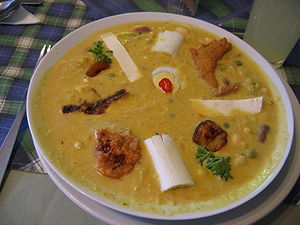
, consisting of potatoes served with roasted pig. Fanesca
Fanesca
Fanesca is a soup traditional to Ecuador. Its components and preparation vary from one region of the country to another, if not from one family to another. It is typically prepared and served only in the week before Easter...
, a fish soup including several types of bean, is often eaten during Lent
Lent
In the Christian tradition, Lent is the period of the liturgical year from Ash Wednesday to Easter. The traditional purpose of Lent is the preparation of the believer – through prayer, repentance, almsgiving and self-denial – for the annual commemoration during Holy Week of the Death and...
and Easter
Easter
Easter is the central feast in the Christian liturgical year. According to the Canonical gospels, Jesus rose from the dead on the third day after his crucifixion. His resurrection is celebrated on Easter Day or Easter Sunday...
. During the week before the commemoration of the deceased or "día de los muertos", the fruit beverage "Colada Morada
Colada morada
Colada morada is a typical Ecuadorian beverage prepared with black corn flour and fruits such as naranjilla, babaco, pineapple, blackberries, strawberries, and blueberries...
" is typical, accompanied by "Guaguas de Pan", which is stuffed bread shaped like children.
Most regions in Ecuador follow the traditional 3 course meal of sopa/soup and segundo/second dish which includes rice and a protein such as meat, poultry, pig or fish. Then desert and a coffee are customary. Dinner is usually lighter and sometimes just coffee or agua de remedio/herbal tea with bread.
Some of the typical dishes in the coastal region are: ceviche
Ceviche
Ceviche is a seafood dish popular in the coastal regions of the Americas, especially Central and South America. The dish is typically made from fresh raw fish marinated in citrus juices such as lemon or lime and spiced with chilli peppers. Additional seasonings such as onion, salt,...
, pan de almidón, corviche, guatita, papas con quero, encebollado
Encebollado
Encebollado is a typical dish from the south Ecuadorian coast, most likely from the provinces of Guayas and Manabi. In simple terms, the "encebollado" is a fish stew containing incurtida cassava and red onion. Juice of onion is made with tomato, condiments such as "pepper" and other species...
and empanada
Empanada
An empanada is a stuffed bread or pastry baked or fried in many countries in Latin America, Southern Europe and parts of Southeast Asia. The name comes from the verb empanar, meaning to wrap or coat in bread. Empanada is made by folding a dough or bread patty around the stuffing...
s; in the mountain region: hornado
Hornado
Hornado is roast pig, cooked whole, in Ecuadorian cuisine. It is often served in highland markets. Hornado is generally accompanied by llapingacho, mote , and vegetables.-External links:*...
, fritada
Fritada
Fritada is a typical dish in Ecuadorian cuisine. Its main ingredient is fried pork. It is a traditional dish, and its origins date back to the colonial era, to the beginning of the 19th century. The pork is cooked in boiling water with various spices and then is fried with pork fat in a brass pan...
, humita
Humita
Humita is a Native American dish from pre-Hispanic times, and a traditional food in Argentina, Bolivia, Chile, Ecuador and Peru. It consists of masa harina and corn, slowly cooked in oil....
s, tamale
Tamale
A tamale — or more correctly tamal — is a traditional Latin American dish made of masa , which is steamed or boiled in a leaf wrapper. The wrapping is discarded before eating...
s, llapingachos
Llapingachos
Llapingacho is a famous dish in Ecuador. They are potato patties or thick pancakes stuffed with cheese and cooked on a hot griddle until crispy brown....
, lomo saltado
Lomo saltado
Lomo saltado is a Peruvian dish that has Asian influences consisting of strips of sirloin marinated in vinegar, soy sauce and spices, then stir fried with red onions, parsley and tomatoes. It is traditionally served over white rice with homemade french fries that look more like potato wedges. Its...
, and churrasco
Churrasco
Churrasco is a Portuguese and Spanish term referring to beef or grilled meat more generally, differing across Latin America and Europe, but a prominent feature in the cuisines of Argentina, Brazil, Chile, Nicaragua, Uruguay, and other Latin American countries...
.
Cuisine of Paraguay

Sopa paraguaya
Sopa paraguaya is a traditional Paraguayan food. Literally meaning "Paraguayan soup", sopa paraguaya is similar to corn bread. Corn flour, pig fat, cheese and milk or whey are common ingredients. It is a spongy cake rich in caloric and protein content....
.
Cuisine of Peru
Maize
Maize known in many English-speaking countries as corn or mielie/mealie, is a grain domesticated by indigenous peoples in Mesoamerica in prehistoric times. The leafy stalk produces ears which contain seeds called kernels. Though technically a grain, maize kernels are used in cooking as a vegetable...
, tomato
Tomato
The word "tomato" may refer to the plant or the edible, typically red, fruit which it bears. Originating in South America, the tomato was spread around the world following the Spanish colonization of the Americas, and its many varieties are now widely grown, often in greenhouses in cooler...
, potato
Potato
The potato is a starchy, tuberous crop from the perennial Solanum tuberosum of the Solanaceae family . The word potato may refer to the plant itself as well as the edible tuber. In the region of the Andes, there are some other closely related cultivated potato species...
es, uchu or Ají
Aji
Aji may refer to:*Ağrı Airport , near the city of Ağrı in the Ağrı Province, Turkey*Ají pepper*Aji , a condiment*Aji , a historical title and rank in the Ryukyu Islands*Aji , in Tieling County, Liaoning, China...
(Capsicum
Capsicum
Capsicum is a genus of flowering plants in the nightshade family, Solanaceae. Its species are native to the Americas where they have been cultivated for thousands of years, but they are now also cultivated worldwide, used as spices, vegetables, and medicines - and have become are a key element in...
pubescens), oca
Oca
Oxalis tuberosa is an herbaceous perennial plant that overwinters as underground stem tubers. These tubers are known as oca, oka, or New Zealand Yam. The plant was brought into cultivation in the central and southern Andes for its tubers, which are used as a root vegetable...
, ulluco
Ulluco
Ulluco is a plant grown primarily as a root vegetable, secondarily as a leaf vegetable.The ulluco is one of the most widely grown and economically important root crops in the Andean region of South America, second only to the potato...
, avocado
Avocado
The avocado is a tree native to Central Mexico, classified in the flowering plant family Lauraceae along with cinnamon, camphor and bay laurel...
, fruits like chirimoya, lúcuma
Lúcuma
The lúcuma is a subtropical fruit native to the Peru's Andean region. Lucuma has been found on ceramics at burial sites of the indigenous people of coastal Peru...
and pineapple
Pineapple
Pineapple is the common name for a tropical plant and its edible fruit, which is actually a multiple fruit consisting of coalesced berries. It was given the name pineapple due to its resemblance to a pine cone. The pineapple is by far the most economically important plant in the Bromeliaceae...
, and animals like taruca
Taruca
The Taruca , or North Andean Deer, is a species of deer that ranges across the Andes of Peru and Bolivia and the north of Chile and the northwest of Argentina...
(Hippocamelus antisensis), llama
Llama
The llama is a South American camelid, widely used as a meat and pack animal by Andean cultures since pre-Hispanic times....
and guinea pig
Guinea pig
The guinea pig , also called the cavy, is a species of rodent belonging to the family Caviidae and the genus Cavia. Despite their common name, these animals are not in the pig family, nor are they from Guinea...
(called cuy). The combination of Inca
Andean cuisine
Andean cuisine is the cuisine that originated in ancient cultures in the Andes and is now widespread in the Andean states . Accounts of pre-Hispanic cuisine in the Andes dates back to the first horticulturists from the valley of Lauricocha; archaeologists have suggested that they domesticated...
and Spanish
Spanish cuisine
Spanish cuisine consists of a variety of dishes, which stem from differences in geography, culture and climate. It is heavily influenced by seafood available from the waters that surround the country, and reflects the country's deep maritime roots...
culinary traditions, resulted in new meals and ways of preparing them. The arrival of Africans and Chinese immigrants in the 19th century also resulted in the development of Creole cuisine in the city of Lima
Lima
Lima is the capital and the largest city of Peru. It is located in the valleys of the Chillón, Rímac and Lurín rivers, in the central part of the country, on a desert coast overlooking the Pacific Ocean. Together with the seaport of Callao, it forms a contiguous urban area known as the Lima...
, where the vast majority of these immigrants settled.
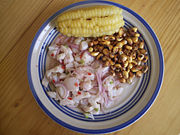
Some typical Peruvian dishes are ceviche
Ceviche
Ceviche is a seafood dish popular in the coastal regions of the Americas, especially Central and South America. The dish is typically made from fresh raw fish marinated in citrus juices such as lemon or lime and spiced with chilli peppers. Additional seasonings such as onion, salt,...
(fish
Fish
Fish are a paraphyletic group of organisms that consist of all gill-bearing aquatic vertebrate animals that lack limbs with digits. Included in this definition are the living hagfish, lampreys, and cartilaginous and bony fish, as well as various extinct related groups...
and shellfish
Shellfish
Shellfish is a culinary and fisheries term for exoskeleton-bearing aquatic invertebrates used as food, including various species of molluscs, crustaceans, and echinoderms. Although most kinds of shellfish are harvested from saltwater environments, some kinds are found only in freshwater...
marinated in citrus
Citrus
Citrus is a common term and genus of flowering plants in the rue family, Rutaceae. Citrus is believed to have originated in the part of Southeast Asia bordered by Northeastern India, Myanmar and the Yunnan province of China...
juice), the chupe de camarones (a soup
Soup
Soup is a generally warm food that is made by combining ingredients such as meat and vegetables with stock, juice, water, or another liquid. Hot soups are additionally characterized by boiling solid ingredients in liquids in a pot until the flavors are extracted, forming a broth.Traditionally,...
made of shrimp
Shrimp
Shrimp are swimming, decapod crustaceans classified in the infraorder Caridea, found widely around the world in both fresh and salt water. Adult shrimp are filter feeding benthic animals living close to the bottom. They can live in schools and can swim rapidly backwards. Shrimp are an important...
(Cryphiops caementarius)), anticuchos
Anticuchos
Anticuchos are popular and inexpensive dishes that originated in Peru, and popular also in other Andean states consisting of small pieces of grilled skewered meat....
(cow's heart roasted en brochette
Brochette
In cooking, en brochette refers to food cooked, and sometimes served, on brochettes, or skewers. The French term generally applies to French cuisine, while other terms like shish kebab, satay, or souvlaki describe the same technique in other cuisines...
), the olluco con charqui (a casserole dish made of ulluco
Ulluco
Ulluco is a plant grown primarily as a root vegetable, secondarily as a leaf vegetable.The ulluco is one of the most widely grown and economically important root crops in the Andean region of South America, second only to the potato...
and charqui
Charqui
Charqui or charque, is a form of jerky common in South America made from dried and salted meat, originally llama where this animal roamed, nowadays mostly beef. Llama is still widely used in Bolivia. This curing was done so the meat could be stored for a long period. This was a very popular way to...
), the Andean pachamanca
Pachamanca
Pachamanca is a traditional Peruvian dish based on the baking, with the aid of hot stones , of lamb, mutton, pork, chicken or guinea pig, marinated in spices...
(meats, tubers and broad beans
Vicia faba
This article refers to the Broad Bean plant. For Broadbean the company, see Broadbean, Inc.Vicia faba, the Broad Bean, Fava Bean, Field Bean, Bell Bean or Tic Bean, is a species of bean native to north Africa and southwest Asia, and extensively cultivated elsewhere. A variety is provisionally...
cooked in a stone oven), the lomo saltado
Lomo saltado
Lomo saltado is a Peruvian dish that has Asian influences consisting of strips of sirloin marinated in vinegar, soy sauce and spices, then stir fried with red onions, parsley and tomatoes. It is traditionally served over white rice with homemade french fries that look more like potato wedges. Its...
(meat fried lightly with tomato and onion, served with french fries
French fries
French fries , chips, fries, or French-fried potatoes are strips of deep-fried potato. North Americans tend to refer to any pieces of deep-fried potatoes as fries or French fries, while in the United Kingdom, Australia, Ireland and New Zealand, long, thinly cut slices of deep-fried potatoes are...
and rice
Rice
Rice is the seed of the monocot plants Oryza sativa or Oryza glaberrima . As a cereal grain, it is the most important staple food for a large part of the world's human population, especially in East Asia, Southeast Asia, South Asia, the Middle East, and the West Indies...
) that has a Chinese influence, and the picante de cuy (a casserole dish made of fried guinea pig with some spices). Peruvian food can be accompanied by typical drinks like the chicha de jora (a chicha
Chicha
For the musical genre, see Peruvian cumbiaChicha is a term used in some regions of Latin America for several varieties of fermented and non-fermented beverages, rather often to those derived from maize and similar non-alcoholic beverages...
made of tender corn dried by the sun). There are also chichas made of purple corn or peanut
Peanut
The peanut, or groundnut , is a species in the legume or "bean" family , so it is not a nut. The peanut was probably first cultivated in the valleys of Peru. It is an annual herbaceous plant growing tall...
.
Cuisine of Uruguay
The cuisine of UruguayUruguay
Uruguay ,officially the Oriental Republic of Uruguay,sometimes the Eastern Republic of Uruguay; ) is a country in the southeastern part of South America. It is home to some 3.5 million people, of whom 1.8 million live in the capital Montevideo and its metropolitan area...
is traditionally based on its European and Mediterranean roots, especially from Italy, Spain, France, Portugal, Germany and Britain. Many foods from those countries such as pasta, sausages, and desserts are common in the nation's diet. The Uruguayan barbecue, asado, is one of the most exquisite and famous in the world. A sweet paste, Dulce de Leche is the national obsession, used to fill cookies, cakes, pancakes, milhojas, and alfajores.
Cuisine of Venezuela
See also
- Spanish cuisineSpanish cuisineSpanish cuisine consists of a variety of dishes, which stem from differences in geography, culture and climate. It is heavily influenced by seafood available from the waters that surround the country, and reflects the country's deep maritime roots...
- Native American cuisineNative American cuisineNative American cuisine includes all food practices of the indigenous peoples of the Americas. Information about Native American cuisine comes from a great variety of sources. Modern-day native peoples retain a rich body of traditional foods, some of which have become iconic of present-day Native...
- Aztec cuisineAztec cuisineThe most important staple of Aztec cuisine was maize , a crop that was so important to Aztec society that it played a central part in their mythology. Just like wheat in Europe or rice in most of East Asia, it was the food without which a meal was not a meal...
- Inca cuisine
- Maya cuisine
- Aztec cuisine
- North American cuisineNorth American cuisineNorth American cuisine is a term used for foods native to or popular in countries of North America, such as Canadian cuisine, American cuisine, Mexican cuisine and Central American cuisine...
- South American cuisineSouth American cuisineThe Amazonia region of South America provides a plethora of fresh fish and tropical fruits. In Peru the Inca Empire and Incan cuisine contribute to the nation's overall cuisine. Potatoes are common, and also plants such as quinoa. The Pacific Ocean, provides a large amount of seafood. Many plains...
- Latin American cultureLatin American cultureLatin American culture is the formal or informal expression of the peoples of Latin America, and includes both high culture and popular culture as well as religion and other customary practices....