

Latin American culture

Encyclopedia
Latin American culture is the formal or informal expression of the peoples of Latin America, and includes both high culture
(literature, high art) and popular culture
(music, folk art and dance) as well as religion and other customary practices.
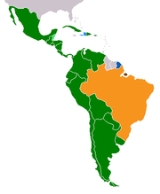
Definitions of Latin America vary. From a cultural perspective,*
Latin America generally includes those parts of the Americas where Spanish, French or Portuguese prevail:[Mexico, most of Central America, South America. There is also an important Latin American cultural presence in the United States (e.g. California and the Southwest, and cities such as New York and Miami). There is also increasing attention to the relations between Latin America and the Caribbean as a whole. See further discussion of definitions at Latin America.
The richness of Latin American culture is the product of many influences, including:
In this sense, it might be strictly more accurate to speak of "Indo-Afro-Latin American culture."
, Guatemala
and Bolivia
. In the rest of the continent, most of the Native American descendants are of mixed race ancestry.
Since the 16th century a large number of Iberian
colonists left for Latin America: the Portuguese to Brazil and the Spaniards to the rest of the region. An intensive race mixing between the Europeans and the Amerindians occurred and their descendants (known as mestizo
s) make up the majority of the population in several Latin American countries, such as Mexico
, Colombia
, Ecuador
, El Salvador
and Honduras
.
Starting in the late 16th century, a large number of African slaves were brought to Latin America, the majority of whom were sent to the Caribbean and Brazil. Nowadays, Blacks
make up the majority of the population in most Caribbean countries. Many of the African slaves in Latin America mixed with the Europeans and their descendants (known as Mulattoes) make up the majority of the population in some countries, such as the Dominican Republic
, and large percentages in Brazil, Colombia, etc. Mixes between the Blacks and Amerindians also occurred, and their descendants are known as Zambo
s. Many Latin American countries also have a substantial tri-racial population, which ancestry is a mix of Amerindians, Whites and Blacks.
Large amounts of European immigrants arrived in Latin America in the late 19th and early 20th centuries, most of them settling in the Southern Cone
(Argentina
, Chile
, Uruguay
, and southern Brazil). Nowadays the Southern Cone has a large majority of people of European descent and in all more than 80% of Latin America's white population, which is in turn more than 90% composed of the top five groups of immigrants, which were: Italians
, Spaniards
, Portuguese
, Germans
and, to a much smaller extent, Irish
, Poles
, Russians, Welsh
, Ukrainians
, French
, etc.
In this same period, many immigrants came from the Middle East and Asia, including Indians, Lebanese
, Syria
ns, and, more recently, Koreans
, Chinese
and Japanese
(mainly in Brazil).
After the Southern Cone, northern South America since the nineteenth century to more than half of the twentieth century was also lower but especially important European immigration to Venezuela
and Colombia
. The immigrants came from Spain in the case of Colombia and Venezuela, followed by Italy and Portugal in the case of Venezuel) and a group of Arabs who make up small minorities especially important in Colombia.
This racial diversity has profoundly influenced religion, music and politics. This opaque cultural heritage is (arguably improperly) called Latin or Latino
in United States' English. Outside of the U.S., and in many languages (especially romance ones) "Latino" just means "Latin
", referring to cultures and peoples that can trace their heritage back to the ancient Roman Empire
. Latin American is the proper term.
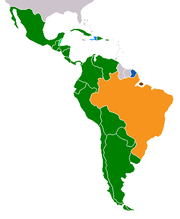
is spoken primarily in Brazil, where it is both the official and the national language. French is also spoken in smaller countries, in the Caribbean, and French Guiana
.
Several nations, especially in the Caribbean, have their own Creole languages, derived from European languages and various African tongues. Native American languages are spoken in many Latin American nations, mainly Peru
, Panama
, Ecuador
, Guatemala
, Bolivia
, Paraguay
, and Mexico
. Nahuatl
is one of the most spoken indigenous languages with more than a million speakers in Mexico, which is officially confirmed by a government's census. Although Mexico has almost 80 native languages across the country, the government nor the constitution specify an official language (not even Spanish), also, some regions of the nation do not speak any modern way of language and still preserve their ancient dialect without knowing any other language. Guaraní
is, along with Spanish, the official language of Paraguay, and is spoken by a majority of the population. But sometimes people choose not to speak it just because they feel like it.
Other European languages spoken include Italian in Brazil and Argentina, German in southern Brazil, southern Chile and Argentina, and Welsh in southern Argentina.
. Latin America, and in particular Brazil, are active in developing the quasi-socialist Roman Catholic movement known as Liberation Theology
. Practitioners of the Protestant, Pentecostal, Evangelical
, Mormon
, Buddhist
, Jewish, Islam
ic, Hindu
, Bahá'í
, and indigenous denominations and religions exist. Various Afro-Latin American
traditions, such as Santería
, and Macumba
, a tribal- voodoo religion, are also practiced. Evangelicalism
in particular is increasing in popularity.
From the early twentieth century, the art of Latin America was greatly inspired by the Constructivist Movement. The Constructivist Movement was founded in Russia around 1913 by Vladimir Tatlin
. The Movement quickly spread from Russia to Europe and then into Latin America. Joaquín Torres García
and Manuel Rendón have been credited with bringing the Constructivist Movement into Latin America from Europe.
An important artistic movement generated in Latin America is Muralism represented by Diego Rivera
, David Alfaro Siqueiros
, José Clemente Orozco
, Rufino Tamayo
and many others in Mexico and Santiago Martinez Delgado
and Pedro Nel Gómez
in Colombia. Some of the most impressive muralist works can be found in Mexico, Colombia, New York, San Francisco, Los Angeles and Philadelphia.
Mexican painter Frida Kahlo
remains by far the most known and famous Latin American artist. She painted about her own life and the Mexican culture in a style combining Realism
, Symbolism
and Surrealism
. Kahlo's work commands the highest selling price of all Latin American paintings.
. Oral accounts of mythological and religious beliefs were also sometimes recorded after the arrival of European colonizers, as was the case with the Popol Vuh
. Moreover, a tradition of oral narrative survives to this day, for instance among the Quechua-speaking population of Peru and the Quiché of Guatemala.
From the very moment of Europe's "discovery" of the continent, early explorers and conquistadores produced written accounts and crónicas
of their experience—such as Columbus
's letters or Bernal Díaz del Castillo
's description of the conquest of Mexico. During the colonial period, written culture was often in the hands of the church, within which context Sor Juana Inés de la Cruz wrote memorable poetry and philosophical essays. Towards the end of the 18th Century and the beginning of the 19th, a distinctive criollo
literary tradition emerged, including the first novels such as Lizardi's El Periquillo Sarniento
(1816).
The 19th Century was a period of "foundational fictions" (in critic Doris Sommer's words), novels in the Romantic
or Naturalist
traditions that attempted to establish a sense of national identity, and which often focussed on the indigenous question or the dichotomy of "civilization or barbarism" (for which see, say, Domingo Sarmiento
's Facundo
(1845), Juan León Mera
's Cumandá
(1879), or Euclides da Cunha
's Os Sertões
(1902)).
At the turn of the 20th century, modernismo
emerged, a poetic movement whose founding text was Rubén Darío
's Azul
(1888). This was the first Latin American literary movement to influence literary culture outside of the region, and was also the first truly Latin American literature, in that national differences were no longer so much at issue. José Martí
, for instance, though a Cuban patriot, also lived in Mexico and the United States and wrote for journals in Argentina and elsewhere.
However, what really put Latin American literature on the global map was no doubt the literary boom
of the 1960s and 1970s, distinguished by daring and experimental novels (such as Julio Cortázar
's Rayuela (1963)) that were frequently published in Spain and quickly translated into English. The Boom's defining novel was Gabriel García Márquez
's Cien años de soledad
(1967), which led to the association of Latin American literature with magic realism
, though other important writers of the period such as Mario Vargas Llosa
and Carlos Fuentes
do not fit so easily within this framework. Arguably, the Boom's culmination was Augusto Roa Bastos
's monumental Yo, el supremo (1974). In the wake of the Boom, influential precursors such as Juan Rulfo
, Alejo Carpentier
, and above all Jorge Luis Borges
were also rediscovered.
Contemporary literature in the region is vibrant and varied, ranging from the best-selling Paulo Coelho
and Isabel Allende
to the more avant-garde and critically acclaimed work of writers such as Giannina Braschi
, Diamela Eltit
, Ricardo Piglia
, Roberto Bolaño
or Daniel Sada
. There has also been considerable attention paid to the genre of testimony, texts produced in collaboration with subaltern subjects such as Rigoberta Menchú
. Finally, a new breed of chroniclers is represented by the more journalistic Carlos Monsiváis
and Pedro Lemebel
.
The region boasts five Nobel Prizewinners
: in addition to the Colombian García Márquez (1982), also the Chilean poet Gabriela Mistral
(1945), the Guatemalan novelist Miguel Ángel Asturias
(1967), the Chilean poet Pablo Neruda
(1971), and the Mexican poet and essayist Octavio Paz
(1990).
music of northern Mexico to the sophisticated habanera
of Cuba, from the symphonies of Heitor Villa-Lobos
to the simple and moving Andean flute
. Music has played an important part in Latin America's turbulent recent history, for example the nueva canción
movement. Latin music is very diverse, with the only truly unifying thread being the use of the Spanish language or, in Brazil, its close cousin the Portuguese language.
Latin America can be divided into several musical areas
. Andean music
, for example, includes the countries of western South America, typically Peru
, Bolivia
, Argentina
, Ecuador
, Chile
and Venezuela
; Central American music
includes Nicaragua
, El Salvador
, Belize
, Guatemala
, Honduras
, and Costa Rica
. Caribbean music
includes the Caribbean coast of Colombia
, Panama
, and many Spanish and French-speaking islands in the Caribbean, including Haiti
, the Dominican Republic
, Cuba
, Puerto Rico
, and the less noted Martinique
and Guadeloupe
, though the Francophone islands are often mistakenly not considered Latin. Brazil perhaps constitutes its own musical area, both because of its large size and incredible diversity as well as its unique history as a Portuguese colony. Although Spain isn't a part of Latin America, Spanish music
(and Portuguese music) and Latin American music strongly cross-fertilized each other, but Latin music also absorbed influences from English and American music, and particularly, African music.
One of the main characteristics of Latin American music is its diversity, from the lively rhythms of Central America and the Caribbean to the more austere sounds of southern South America. Another feature of Latin American music is its original blending of the variety of styles that arrived in The Americas and became influential, from the early Spanish and European Baroque to the different beats of the African rhythms.
Latino-Caribbean music, such as salsa
, merengue
, bachata, etc., are styles of music that have been strongly influenced by African rhythms and melodies.
Other musical genres of Latin American include the Argentine and Uruguayan tango
, the Colombian cumbia
and vallenato
, Mexican bolero
, ranchera
, Nicaraguan palo de mayo
, Uruguayan Candombe
, the Panamanian cumbia
, tamborito
, saloma and pasillo
, and the various styles of music from Pre-Columbian traditions that are widespread in the Andean region. In Brazil, samba
, American jazz
, European classical music and choro
combined into the bossa nova
music. Recently the Haiti
an kompa
has become increasingly popular.
The classical composer Heitor Villa-Lobos
(1887–1959) worked on the recording of native musical traditions within his homeland of Brazil. The traditions of his homeland heavily influenced his classical works. Also notable is the much recent work of the Cuban Leo Brouwer
and guitar work of the Venezuelan Antonio Lauro
and the Paraguayan Agustín Barrios
.
Arguably, the main contribution to music entered through folklore, where the true soul of the Latin American and Caribbean countries is expressed. Musicians such as Atahualpa Yupanqui
, Violeta Parra
, Víctor Jara
, Mercedes Sosa
, Jorge Negrete
, Caetano Veloso
, Yma Sumac
and others gave magnificent examples of the heights that this soul can reach, for example:the Uruguayan born and first Latin American musician to win an OSCAR prize, Jorge Drexler.
Latin pop
, including many forms of rock, is popular in Latin America today (see Spanish language rock and roll).
Latin American cinema flourished after the introduction of sound, which added a linguistic barrier to the export of Hollywood film south of the border. The 1950s and 1960s saw a movement towards Third Cinema
, led by the Argentine filmmakers Fernando Solanas
and Octavio Getino
. More recently, a new style of directing and stories filmed as been tagged as "New Latin American Cinema."
Mexican movies from the Golden Era
in the 1940s are significant examples of Latin American cinema, with a huge industry comparable to the Hollywood of those years. More recently movies such as Amores Perros
(2000) and Y tu mamá también
(2001) have been successful in creating universal stories about contemporary subjects, and were internationally recognised. Nonetheless, the country has also witnsessed the rise of experimental filmmakers such as Carlos Reygadas
and Fernando Eimbicke who focus on more universal themes and characters. Other important Mexican directors are Arturo Ripstein
and Guillermo del Toro
.
Argentine cinema
was a big industry in the first half of the 20th century. After a series of military governments that shackled culture in general, the industry re-emerged after the 1976–1983 military dictatorship to produce the Academy Award
winner The Official Story
in 1985. The Argentine economic crisis
affected the production of films in the late 1990s and early 2000s, but many Argentine movies produced during those years were internationally acclaimed, including Plata Quemada
(2000), Nueve reinas
(2000), El abrazo partido
(2004) and Roma
(2004).
In Brazil
, the Cinema Novo
movement created a particular way of making movies with critical and intellectual screenplays, a clearer photography related to the light of the outdoors in a tropical landscape, and a political message. The modern Brazilian film industry has become more profitable inside the country, and some of its productions have received prizes and recognition in Europe and the United States. Movies like Central do Brasil
(1999) and Cidade de Deus (2003) have fans around the world, and its directors have taken part in American and European film projects.
Cuban cinema
has enjoyed much official support since the Cuban revolution, and important film-makers include Tomás Gutiérrez Alea
.
and the more popular Latin dances were created and embraced into the culture in the early and middle 1900s and has since been able to retain its significance both in and outside the Americas. The mariachi
bands of Mexico stirred up quick paced rhythms and playful movements at the same time that Cuba embraced similar musical and dance styles. Traditional dances were blended with new, modern ways of moving, evolving into a blended, more contemporary forms.
Ballroom studios teach lessons on many Latin American dances. One can even find the cha-cha
being done in honky-tonk country bars. Miami has been a large contributor of the United States’ involvement in Latin dancing. With such a huge Puerto Rican
and Cuban population one can find Latin dancing and music in the streets at any time of day or night.
Some of the dances of Latin America are derived from and named for the type of music they are danced to. For example, mambo
, salsa, cha-cha-cha
, rumba
, merengue
, samba, flamenco
, bachata, and, probably most recognizable, the tango
are among the most popular. Each of the types of music has specific steps that go with the music, the counts, the rhythms, and the style.
Modern Latin American dancing is very energetic. These dances primarily are performed with a partner as a social dance
, but solo variations exist. The dances emphasize passionate hip movements and the connection between partners. Many of the dances are done in a close embrace while others are more traditional and similar to ballroom dancing, holding a stronger frame between the partners.
The Europeans used this to their advantage. For the first fifty years after the Conquest the missionaries used theatre widely to spread the Christian doctrine to a population accustomed to the visual and oral quality of spectacle and thus maintaining a form of cultural hegemony
. It was more effective to use the indigenous forms of communication than to put an end to the ‘pagan’ practices, the conquerors took out the content of the spectacles, retained the trappings, and used them to convey their own message.
Pre-Hispanic rituals were how the indigenous came in contact with the divine. Spaniards used plays to Christianize and colonize the indigenous peoples of the Americas in the sixteenth century. Theatre was a potent tool in manipulating a population already accustomed to spectacle. Theatre became a tool for political hold on Latin America by colonialist theatre by using indigenous performance practices to manipulate the population.
Theatre provided a way for the indigenous people were forced to participate in the drama of their own defeat. In 1599, the Jesuits even used cadavers of Native Americans to portray the dead in the staging of the final judgment.
While the plays were promoting a new sacred order, their first priority was to support the new secular, political order. Theatre under the colonizers primarily at the service of the administration.
After disease, exploitation, and murder occurred to the native population, the indigenous consciousness and identity in theatre disappeared, though pieces did have indigenous elements to them. The theatre that progressed in Latin America is argued to be theatre that the conquerors brought to the Americas, not the theatre of the Americas.
Progression in Postcolonial Latin American Theatre
Internal strife and external interference have been the drive behind Latin American history which applies the same to theatre.
1959–1968: dramaturgical structures and structures of social projects leaned more toward constructing a more native Latin American base called the "Nuestra America"
1968–1974: Theatre tries to claim a more homogenous definition which brings in more European models. At this point, Latin American Theatre tried to connect to its historical roots.
1974–1984: The search for expression rooted in the history of Latin America became victims of exile and death.
Some items typical of Latin American cuisine include maize
-based dishes (tortilla
s, tamale
s, pupusa
s) and various salsas
and other condiments (guacamole
, pico de gallo
, mole
). These spices are generally what give the Latin American cuisines a distinct flavor; yet, each country of Latin America tends to use a different spice and those that share spices tend to use them at different quantities. Thus, this leads for a variety across the land. Meat is also greatly consumed and constitutes one of the main dishes in many Latin American countries where they're considered specialties, referred to as Asado
or Churrasco
.
Latin American beverages are just as distinct as their foods. Some of the beverages can even date back to the times of the Native Americans. Some popular beverages include mate
, Pisco Sour
, horchata
, chicha
, atole
, cacao
and aguas frescas
.
Desserts in Latin America include dulce de leche
, alfajor
, arroz con leche
, tres leches cake
, Teja
and flan
.
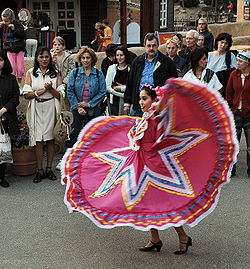 Traditionally, Mexicans have struggled with the creation of a united identity. The issue is the main topic of Mexican Nobel Prize
winner Octavio Paz
's book The Labyrinth of Solitude
. Mexico is a large country with a large population, therefore having many cultural traits found only in some parts of the country. The north of Mexico is the least culturally diverse due to its very low Native American
population and high density of those of European descent. Northern Mexicans are also more americanized due to the common border with the United States. Central and southern Mexico is where many well-known traditions find their origin, therefore the people from this area are in a way the most traditional, but their collective personality can't be generalized. People from Puebla
, for instance, are thought to be conservative and reserved, and just a few kilometers away, the people from Veracruz
have the fame of being very outgoing and liberal. Chilangos (Mexico City natives) are believed to be a bit aggressive, v,vand self-centered. The regiomontanos (from Monterrey) are thought to be rather proud, regardless of their social status. Almost every Mexican state has its own accent, making it fairly easy to distinguish the origin of someone by their use of language.
The derogatory term naco
was forged by the middle and upper class Mexicans to refer to the native or mestizo population. The term allegedly comes from the word totonaco, which is one of the ethnic groups in Valle de Mexico. Its use has been made popular even among the poorest classes. Mexicans differ in opinion about the meaning of the word. Some would use it for a person who dresses in a tacky or tasteless manner, some use it to refer to the natives, some to the poor classes, and other for people with less education or culture and other ideology. The term fresa
is in some terms the opposite of naco, and it is not always derogatory and means always some relative high economical status of the person termed in that way. Traditionally, people with more European looks and belonging to the middle or high classes are called fresas.
Dancing and singing are commonly part of family gatherings, bringing the old and young together, no matter what kind of music is being played, like cumbia
, salsa, merengue
or the more Mexican banda
. Dancing is a strong part of the culture.
Mexicans in places like Guadalajara
, Puebla
, Monterrey
, Mexico City
, and most middle sized cities, enjoy a great variety of options for leisure. Shopping centers are a favorite among families, since there has been an increasing number of new malls that cater to people of all ages and interests. A large number of them, have multiplex cinemas, international and local restaurants, food courts, cafes, bars, bookstores and most of the international renowned clothing brands are found too. Mexicans are prone to travel within their own country, making short weekend trips to a neighbouring city or town.
The standard of living in Mexico is higher than most of other countries in Latin America attracting migrants in search for better opportunities. With the recent economic growth, many high income families live in single houses, commonly found within a gated community, called "fraccionamiento". The reason these places are the most popular among the middle and upper classes is that they offer a sense of security and provide social status. Swimming pools or golf clubs, and/or some other commodities are found in these fraccionamientos. Poorer Mexicans, by contrast, live a harsh life, although they share the importance they grant to family, friends and cultural habits.
Two of the major television networks based in Mexico are Televisa
and TV Azteca
. Soap opera
s (telenovela
s) are translated to many languages and seen all over the world with renown names like Verónica Castro
, Lucía Méndez
, Lucero, and Thalía
. Even Gael García Bernal
and Diego Luna
from Y tu mamá también
and current Zegna model act in some of them. Some of their TV shows are modeled after American counterparts like Family Feud
(100 Mexicanos Dijeron or "A hundred Mexicans said" in Spanish), Big Brother
, American Idol
, Saturday Night Live
and others. Nationwide news shows like Las Noticias por Adela on Televisa resemble a hybrid between Donahue
and Nightline. Local news shows are modeled after American counterparts like the Eyewitness News
and Action News
formats.
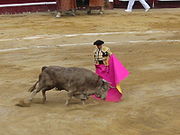
Mexico's national sports are charreria and bullfighting
. Ancient Mexicans played a ball game which still exists in Northwest Mexico (Sinaloa, the game is called Ulama), though it is not a popular sport any more. Most Mexicans enjoy watching bullfights. Almost all large cities have bullrings. Mexico city
has the largest bullring in the world, which seats 55,000 people. But the favorite sport remains football (soccer)
while baseball
is also popular especially in the northern states because of the American influence, and a number of Mexicans have become stars in the US Major Leagues. Professional wrestling is shown on shows like Lucha Libre
. American football
is practiced at the major universities like UNAM
. Basketball
has also been gaining popularity, with a number of Mexican players having been drafted to play in the National Basketball Association
.
reflects strong Mayan
and Spanish influences and continues to be defined as a contrast between poor Mayan villagers in the rural highlands, and the urbanized and wealthy mestizos population who occupy the cities and surrounding agricultural plains.
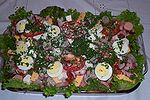 The cuisine of Guatemala
reflects the multicultural nature of Guatemala, in that it involves food that differs in taste depending on the region. Guatemala has 22 departments (or divisions), each of which has very different food varieties. For example Antigua Guatemala
is well known for its candy which makes use of many local ingredients fruits, seeds and nuts along with honey, condensed milk and other traditional sweeteners. Antigua's candy is very popular when tourists visit the country for the first time, and is a great choice in the search for new and interesting flavors.
Many traditional foods are based on Maya cuisine and prominently feature corn, chiles and beans as key ingredients. Various dishes may have the same name as a dish from a neighboring country, but may in fact be quite different for example the enchilada
or quesadilla
, which are nothing like their Mexican counterparts.
The music of Guatemala
is diverse. Guatemala's national instrument is the marimba
, an idiophone
from the family of the xylophones, which is played all over the country, even in the remotest corners. Towns also have wind and percussion bands -week processions, as well as on other occasions. The Garifuna people of Afro-Caribbean descent, who are spread thinly on the northeastern Caribbean coast, have their own distinct varieties of popular and folk music. Cumbia
, from the Colombian variety, is also very popular especially among the lower classes. Dozens of Rock bands have emerged in the last two decades, making rock music quite popular among young people.
Guatemala also has an almost five-century-old tradition of art music, spanning from the first liturgical chant and polyphony introduced in 1524 to contemporary art music. Much of the music composed in Guatemala from the 16th century to the 19th century has only recently been unearthed by scholars and is being revived by performers.
Guatemalan literature
is famous around the world whether in the indigenous languages present in the country or in Spanish. Though there was likely literature in Guatemala before the arrival of the Spanish, all the texts that exist today were written after their arrival.
The Popol Vuh is the most significant work of Guatemalan literature in the Quiché language, and one of the most important of Pre-Columbian American literature. It is a compendium of Mayan stories and legends, aimed to preserve Mayan traditions. The first known version of this text dates from the 16th century and is written in Quiché transcribed in Latin characters. It was translated into Spanish by the Dominican priest Francisco Ximénez
in the beginning of the 18th century. Due to its combination of historical, mythical, and religious elements, it has been called the Mayan Bible. It is a vital document for understanding the culture of pre-Columbian America.
The Rabinal Achí
is a dramatic work consisting of dance and text that is preserved as it was originally represented. It is thought to date from the 15th century and narrates the mythical and dynastic origins of the Kek'chi' people, and their relationships with neighboring peoples. The Rabinal Achí is performed during the Rabinal festival of January 25, the day of Saint Paul. It was declared a masterpiece of oral tradition of humanity by UNESCO
in 2005.
The 16th century saw the first native-born Guatemalan writers that wrote in Spanish. Major writers of this era include Sor Juana de Maldonado, considered the first poet playwright of colonial Central America, and the historian Francisco Antonio de Fuentes y Guzmán
. The Jesuit Rafael Landívar (1731–1793) is considered as the first great Guatemalan poet. He was forced into exile by Carlos III
. He traveled to Mexico and later to Italy, where he did. He originally wrote his Rusticatio Mexicana and his poems praising the bishop Figueredo y Victoria in Latin.
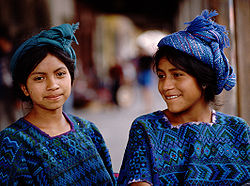 The Maya peoples
are known for their brightly colored yarn-based textiles, which are woven into capes, shirts, blouses, huipil
es and dresses. Each village has its own distinctive pattern, making it possible to distinguish a person's home town on sight. Women's clothing consists of a shirt and a long skirt.
Roman Catholicism combined with the indigenous Maya religion
are the unique syncretic religion which prevailed throughout the country and still does in the rural regions. Beginning from negligible roots prior to 1960, however, Protestant Pentecostalism has grown to become the predominant religion of Guatemala City
and other urban centers and down to mid-sized towns.
The unique religion is reflected in the local saint, Maximón
, who is associated with the subterranean force of masculine fertility and prostitution. Always depicted in black, he wears a black hat and sits on a chair, often with a cigar placed in his mouth and a gun in his hand, with offerings of tobacco, alcohol and Coca-cola at his feet. The locals know him as San Simon of Guatemala.
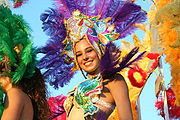 Nicaraguan culture
has several distinct strands. The Pacific coast has strong folklore, music and religious traditions, deeply influenced by European
culture but enriched with Amerindian sounds and flavors. The Pacific coast of the country was colonized by Spain and has a similar culture to other Spanish-speaking Latin American countries. The Caribbean coast of the country, on the other hand, was once a British protectorate
. English is still predominant in this region and spoken domestically along with Spanish and indigenous languages. Its culture is similar to that of Caribbean nations that were or are British possessions, such as Jamaica
, Belize
, The Cayman Islands
, etc.
Nicaraguan music
is a mixture of indigenous and European, especially Spanish and to a lesser extent German, influences. The latter was a result of the German migration to the central-north regions of Las Segovias where Germans settled and brought with them polka music which influenced and evolved into Nicaraguan mazurka, polka and waltz. The Germans that migrated to Nicaragua are speculated to have been from the regions of Germany which were annexed to present-day Poland following the Second World War; hence the genres of mazurka, polka in addition to the waltz. One of the more famous composers of classical music and Nicaraguan waltz was Jose de la Cruz Mena who was actually not from the northern regions of Nicaragua but rather from the city of Leon in Nicaragua.
More nationally identified however, are musical instruments such as the marimba
which is also common across Central America. The marimba of Nicaragua is uniquely played by a sitting performer holding the instrument on his knees. It is usually accompanied by a bass fiddle
, guitar
and guitarrilla (a small guitar like a mandolin
). This music is played at social functions as a sort of background music. The marimba is made with hardwood plates, placed over bamboo or metal tubes of varying lengths. It is played with two or four hammer
s. The Caribbean coast of Nicaragua is known for a lively, sensual form of dance music
called Palo de Mayo
. It is especially loud and celebrated during the Palo de Mayo festival in May The Garifuna community exists in Nicaragua and is known for its popular music called Punta
.
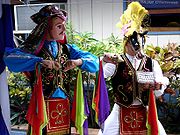 Literature of Nicaragua
can be traced to pre-Columbian
times with the myths and oral literature
that formed the cosmogonic view of the world that indigenous people had. Some of these stories are still know in Nicaragua. Like many Latin American countries, the Spanish conquerors have had the most effect on both the culture and the literature. Nicaraguan literature is among the most important in Spanish language, with world-famous writers such as Rubén Darío
who is regarded as the most important literary figure in Nicaragua, referred to as the "Father of Modernism" for leading the modernismo
literary movement at the end of the 19th century.
El Güegüense
is a satirical drama and was the first literary work of post-Columbian Nicaragua. It is regarded as one of Latin America's most distinctive colonial-era expressions and as Nicaragua's signature folkloric masterpiece combining music, dance and theater. The theatrical play was written by an anonymous author in the 16th century, making it one of the oldest indigenous theatrical/dance works of the Western Hemisphere. The story was published in a book in 1942 after many centuries.
in the pre-Columbian era. As such, many of the traditions date back to Incan traditions.
During the independization of the Americas many countries including Venezuela, Colombia, and Ecuador formed what was known as Gran Colombia
, a federal republic that later dissolved, however the people in these countries believe each other to be their brothers and sisters and as such share many traditions and festivals. Peru and Bolivia were also one single country until Bolivia declared its independence, nevertheless both nations are close neighbors that have somewhat similar cultures.
Bolivia and Peru both still have significant Native American populations (primarily Quechua and Aymara) which mixed Spanish cultural elements with their ancestors' traditions. The Spanish-speaking population mainly follows the Western customs. Important archaeological ruins, gold and silver ornaments, stone monuments, ceramics, and weavings remain from several important pre-Columbian cultures. Major Bolivian ruins include Tiwanaku, Samaipata, Incallajta, and Iskanwaya.
The majority of the Ecuadorian population is mestizo, a mixture of both European and Amerindian ancestry, and much like their ancestry, the national culture is also a blend of these two sources, along with influences from slaves from Africa. 95% of Ecuadorians are Roman Catholic, although their Christian beliefs are mixed with ancient indigenous customs.
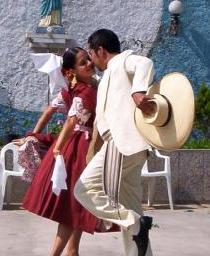 Peruvian culture is primarily rooted in Amerindian and Spanish traditions, though it has also been influenced by various African, Asian, and European ethnic groups.
Peruvian artistic traditions date back to the elaborate pottery, textiles, jewelry, and sculpture of Pre-Inca cultures. The Incas maintained these crafts and made architectural
achievements including the construction of Machu Picchu
. Baroque
art dominated in colonial times, though it was modified by native traditions. During this period, most art focused on religious subjects; the numerous churches of the era and the paintings of the Cuzco School
are representative. Arts stagnated after independence until the emergence of Indigenismo
in the early 20th century. Since the 1950s, Peruvian art has been eclectic
and shaped by both foreign and local art currents.
Peruvian literature
has its roots in the oral traditions of pre-Columbian
civilizations. Spaniards introduced writing in the 16th century, and colonial literary expression included chronicle
s and religious literature
. After independence, Costumbrism and Romanticism
became the most common literary genres, as exemplified in the works of Ricardo Palma
. In the early 20th century, the Indigenismo movement produced such writers as Ciro Alegría
, José María Arguedas
, and César Vallejo
. During the second half of the century, Peruvian literature became more widely known because of authors such as Mario Vargas Llosa
, a leading member of the Latin American Boom
.
Peruvian cuisine
is a blend of Amerindian and Spanish food with strong influences from African, Arab, Italian, Chinese, and Japanese cooking. Common dishes include anticuchos
, ceviche
, humita
s, and pachamanca
. Because of the variety of climates within Peru, a wide range of plants and animals are available for cooking. Peruvian cuisine has recently received acclaim due to its diversity of ingredients and techniques.
Peruvian music has Andean, Spanish and African roots. In pre-Hispanic times, musical expressions varied widely from region to region; the quena
and the tinya
were two common instruments. Spanish conquest brought the introduction of new instruments such as the guitar and the harp, as well as the development of crossbred instruments like the charango
. African contributions to Peruvian music include its rhythms and the cajón
, a percussion instrument. Peruvian folk dances include the marinera
, tondero
and huayno
.
The culture of Colombia lies at the crossroads of Latin America. Thanks partly to geography, Colombian culture has been heavily fragmented into five major cultural regions. Rural to urban migration and globalization have changed how many Colombians live and express themselves as large cities become melting pots of people (many of whom are refugees) from the various provinces.
According to a study in late 2004 by the Erasmus University in Rotterdam, Colombians are one of the happiest people in the world; this despite its four-decade long armed conflict involving the government, paramilitaries, drug lords, corruption and guerrillas like the FARC and ELN. Colombians are sometimes called locombians for this paradox and for their joie de vivre.
Many aspects of Colombian culture can be traced back to the culture of Spain
of the sixteenth century and its collision with Colombia's native civilizations (see: Muisca
, Tayrona). The Spanish brought Catholicism
, African slaves, the feudal encomienda
system, and a caste
system that favored European-born whites. After independence from Spain, the criollos
struggled to establish a pluralistic political system between conservative and liberal ideals.
 Ethno-racial groups maintained their ancestral heritage culture: whites tried to keep themselves, despite the growing number of illegitimate children of mixed African or indigenous ancestry. These people were labeled with any number of descriptive names, derived from the casta system, such as mulato
and moreno
. During this time it was normal for white individuals to marry a sibling or close cousin to maintain their inheritance within the family. Blacks and indigenous people of Colombia also mixed to form zambos creating a new ethno-racial group in society. This mix also created a fusion of cultures. Carnivals
for example became an opportunity for all classes and colors to congregate without prejudice. The introduction of the bill of rights of men and the abolishment of slavery (1850) eased the segregationist tensions between the races, but the dominance of the whites prevailed and prevails to some extent to this day.
The industrial revolution arrived relatively late at the beginning of the 20th Century with the establishment of the Republic of Colombia. Colombians had a period of almost 50 years of relative peace interrupted only by a short armed conflict
with Peru
over the town of Leticia in 1932.
Bogotá, the principal city, was the World Book Capital
in 2007, in 2008 by the Iberoamerican Theatrum Festival Bogotá has been proclaimed as the world capital of theatre.
Venezuela
n culture has been shaped by indigenous
, African and especially European Spanish. Before this period, indigenous culture was expressed in art (petroglyph
s), craft
s, architecture (shabono
s), and social organization. Aboriginal culture was subsequently assimilated by Spaniards; over the years, the hybrid culture had diversified by region.
At present the Indian influence is limited to a few words of vocabulary and gastronomy. The African influence in the same way, in addition to musical instruments like the drum. The Spanish influence was more important and in particular came from the regions of Andalusia and Extremadura, places of origin of most settlers in the Caribbean during the colonial era. As an example of this can include buildings, part of the music, the Catholic religion and language. Spanish influences are evident bullfights and certain features of the cuisine. Venezuela also enriched by other streams of Indian and European origin in the nineteenth century, especially France. In the last stage of the great cities and regions entered the U.S. oil source and demonstrations of the new immigration of Spanish, Italian and Portuguese, increasing the already complex cultural mosaic. For example the United States comes the influence of the taste of baseball and modern architectural structures
Venezuelan art
is gaining prominence. Initially dominated by religious motifs, it began emphasizing historical and heroic representations in the late 19th century, a move led by Martín Tovar y Tovar
. Modernism
took over in the 20th century. Notable Venezuelan artists include Arturo Michelena
, Cristóbal Rojas
, Armando Reverón
, Manuel Cabré
, the kinetic art
ists Jesús-Rafael Soto and Carlos Cruz-Diez
. Since the middle of the 20th century artists such as Jacobo Borges
, Régulo Perez, Pedro León Zapata, Mario Abreu, Pancho Quilici, Carmelo Niño and Angel Peña emerged. They created a new plastic language. The 80s produced artist as Carlos Zerpa, Ernesto León. Miguel Von Dangel, Mateo Manaure, Zacarías García and Manuel Quintana Castillo. In more recent times, Venezuela produced a new a diverse generation of innovating painters. Some of them are: Alejandro Bello, Edgard Álvarez Estrada, Gloria Fiallo, Felipe Herrera, Alberto Guacache and Morella Jurado.
Venezuelan literature
originated soon after the Spanish conquest
of the mostly pre-literate indigenous societies; it was dominated by Spanish influences. Following the rise of political literature during the War of Independence, Venezuelan Romanticism
, notably expounded by Juan Vicente González, emerged as the first important genre in the region. Although mainly focused on narrative
writing, Venezuelan literature was advanced by poets such as Andrés Eloy Blanco
and Fermín Toro
. Major writers and novelists include Rómulo Gallegos
, Teresa de la Parra
, Arturo Uslar Pietri
, Adriano González León
, Miguel Otero Silva
, and Mariano Picón Salas
. The great poet and humanist Andrés Bello
was also an educator and intellectual. Others, such as Laureano Vallenilla Lanz
and José Gil Fortoul
, contributed to Venezuelan Positivism
.
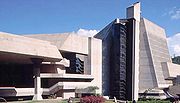 Carlos Raúl Villanueva
was the most important Venezuelan architect of the modern era; he designed the Central University of Venezuela
, (a World Heritage Site
) and its Aula Magna. Other notable architectural works include the Capitol, the Baralt Theatre
, the Teresa Carreño Cultural Complex
, and the General Rafael Urdaneta Bridge
.
Baseball
and football
are Venezuela's most popular sports, and the Venezuela national football team
, is passionately followed. Famous Venezuelan baseball players include Luis Aparicio
(inducted into the Baseball Hall of Fame), David (Dave) Concepción
, Oswaldo (Ozzie) Guillén
(current White Sox manager, World Series champion in 2005), Freddy Garcia
, Andrés Galarraga
, Omar Vizquel
(an eleven-time Gold Glove winner), Luis Sojo
, Miguel Cabrera
, Bobby Abreu
, Félix Hernández
, Magglio Ordóñez
, Ugueth Urbina
, and Johan Santana
(a two-time unanimously selected Cy Young Award
winner).
In the 19th century, Brazilian theatre began with romanticism along with a fervor for political independence. During this time, racial issues were discussed in contradictory terms, but even so there were some significant plays, including a series of popular comedies by Martins Penna, Franqa Junior, and Arthur Azevedo.
In the 20th century, the two most important production centers for professional theatre were São Paulo and Rio de Janeiro. They were centers of industrial and economic development. Even with the development of these two theatres, World War I brought an end to tours by European theatres so there were no productions in Brazil during this time.
In November 1927, Alvaro Moreyra founded the Toy Theatre (Teatro de Brinquedo). Like this company, it was in the late 1920s when the first stable theatre companies formed around well-known actors. These actors were able to practice authentic Brazilian gestures gradually freed from Portuguese influence. Except for some political criticism in the low comedies, the dramas of this period were not popular. Occasionally the question of dependence on Europe or North America was raised. Even with more Latin American influence of theatre starting to filter in, its theatre still was under heavy influence of Europe.
The Brazilian Comedy Theatre (Teatro Brasileiro de Comtdia) was created in 1948
Oswald de Andrade wrote three plays; The King of the Candle (O Rei da Vela, 1933), The Man and the Horse (O Homem e o Cavalo, 1934). and The Dead Woman (A Morta, 1937). They were an attempt to deal with political themes, nationalism, and anti-imperialism. His theatre was inspired by Meyerhold's and Brecht's theories, with a political sarcasm like Mayakovsky.
1943 at The Comedians: Polish director and refugee from the Nazis, Zbigniew Ziembinsky, staged in expressionist style Nelson Rodrigues' A Bride's Gown (Vestido de Noiva). With this production, Brazilian theatre moved into the modem period.
World War II saw Brazil gain several foreign directors, especially from Italy, who wanted to make a theatre free from nationalistic overtones. Paradoxically, this led to a second renewal which engaged popular forms and sentiments; a renewal that was decidedly nationalistic with social and even communist leanings.
During this time, the Stanislavsky system of acting was most popular and widely used. Stanislavski himself came to Brazil via Eugenio Kusnet, a Russian actor who had met him at the Moscow Art Theatre.
The next phase was from 1958 to the signing of the Institutional Act Number Five in 1968. It marked the end of freedom and democracy. These ten years were the most productive of the century. During these years dramaturgy matured through the plays of Guarnieri, Vianinha, Boal, Dias Gomes, and Chico de Assis, as did mis-en-scene in the work of Boal, Jost Celso Martinez Correa, Flivio Rangel, and Antunes Filho. During this decade a generation accepted theatre as an activity with social responsibility.
At its height, this phase of Brazilian theatre was characterized by an affirmation of national values. Actors and directors became political activists who risked their jobs and lives daily.
Through this growth of Latin America politically and the influence of European theatre, an identity of what is theatre in Latin America stemmed out of it.
High culture
High culture is a term, now used in a number of different ways in academic discourse, whose most common meaning is the set of cultural products, mainly in the arts, held in the highest esteem by a culture...
(literature, high art) and popular culture
Popular culture
Popular culture is the totality of ideas, perspectives, attitudes, memes, images and other phenomena that are deemed preferred per an informal consensus within the mainstream of a given culture, especially Western culture of the early to mid 20th century and the emerging global mainstream of the...
(music, folk art and dance) as well as religion and other customary practices.
Definitions of Latin America vary. From a cultural perspective,*
Latin America generally includes those parts of the Americas where Spanish, French or Portuguese prevail:[Mexico, most of Central America, South America. There is also an important Latin American cultural presence in the United States (e.g. California and the Southwest, and cities such as New York and Miami). There is also increasing attention to the relations between Latin America and the Caribbean as a whole. See further discussion of definitions at Latin America.
The richness of Latin American culture is the product of many influences, including:
- Pre-Columbian cultures, whose importance is today particularly notable in countries such as Mexico, Guatemala, Ecuador, Peru, Bolivia and Paraguay.
- European colonial culture, owing to the region's history of colonization by Spain, Portugal, and France. European influence is particularly marked in so-called high culture, such as literature, painting, and music. Moreover, this imperial history left an enduring mark of their influence in their languages, which are spoken throughout Central (including the Caribbean), South and North America (Mexico and many parts of the United States).
- Nineteenth- and twentieth-century immigration (e.g. from Italy, Germany, and Eastern Europe) also transformed especially countries such as Argentina, Uruguay, Brazil (particular the southeast and southern regions), Chile and Venezuela.
- ChineseOverseas ChineseOverseas Chinese are people of Chinese birth or descent who live outside the Greater China Area . People of partial Chinese ancestry living outside the Greater China Area may also consider themselves Overseas Chinese....
, Korean and JapaneseJapanese diasporaThe Japanese diaspora, and its individual members known as , are Japanese emigrants from Japan and their descendants that reside in a foreign country...
immigration influenced the culture in Brazil, Cuba, Guatemala, Mexico, Panama and Peru - The introduction of slaves from Africa, which has influenced for instance dance and religion, especially in countries such as Dominican Republic, Brazil, Panama, Peru, Venezuela, Colombia and Cuba.
In this sense, it might be strictly more accurate to speak of "Indo-Afro-Latin American culture."
Ethnic groups
Latin America has a very diverse population with many ethnic groups and different ancestries. Only in three countries, do the Amerindians make up the majority of the population. This is the case of PeruPeru
Peru , officially the Republic of Peru , is a country in western South America. It is bordered on the north by Ecuador and Colombia, on the east by Brazil, on the southeast by Bolivia, on the south by Chile, and on the west by the Pacific Ocean....
, Guatemala
Guatemala
Guatemala is a country in Central America bordered by Mexico to the north and west, the Pacific Ocean to the southwest, Belize to the northeast, the Caribbean to the east, and Honduras and El Salvador to the southeast...
and Bolivia
Bolivia
Bolivia officially known as Plurinational State of Bolivia , is a landlocked country in central South America. It is the poorest country in South America...
. In the rest of the continent, most of the Native American descendants are of mixed race ancestry.
Since the 16th century a large number of Iberian
Iberian Peninsula
The Iberian Peninsula , sometimes called Iberia, is located in the extreme southwest of Europe and includes the modern-day sovereign states of Spain, Portugal and Andorra, as well as the British Overseas Territory of Gibraltar...
colonists left for Latin America: the Portuguese to Brazil and the Spaniards to the rest of the region. An intensive race mixing between the Europeans and the Amerindians occurred and their descendants (known as mestizo
Mestizo
Mestizo is a term traditionally used in Latin America, Philippines and Spain for people of mixed European and Native American heritage or descent...
s) make up the majority of the population in several Latin American countries, such as Mexico
Mexico
The United Mexican States , commonly known as Mexico , is a federal constitutional republic in North America. It is bordered on the north by the United States; on the south and west by the Pacific Ocean; on the southeast by Guatemala, Belize, and the Caribbean Sea; and on the east by the Gulf of...
, Colombia
Colombia
Colombia, officially the Republic of Colombia , is a unitary constitutional republic comprising thirty-two departments. The country is located in northwestern South America, bordered to the east by Venezuela and Brazil; to the south by Ecuador and Peru; to the north by the Caribbean Sea; to the...
, Ecuador
Ecuador
Ecuador , officially the Republic of Ecuador is a representative democratic republic in South America, bordered by Colombia on the north, Peru on the east and south, and by the Pacific Ocean to the west. It is one of only two countries in South America, along with Chile, that do not have a border...
, El Salvador
El Salvador
El Salvador or simply Salvador is the smallest and the most densely populated country in Central America. The country's capital city and largest city is San Salvador; Santa Ana and San Miguel are also important cultural and commercial centers in the country and in all of Central America...
and Honduras
Honduras
Honduras is a republic in Central America. It was previously known as Spanish Honduras to differentiate it from British Honduras, which became the modern-day state of Belize...
.
Starting in the late 16th century, a large number of African slaves were brought to Latin America, the majority of whom were sent to the Caribbean and Brazil. Nowadays, Blacks
Black people
The term black people is used in systems of racial classification for humans of a dark skinned phenotype, relative to other racial groups.Different societies apply different criteria regarding who is classified as "black", and often social variables such as class, socio-economic status also plays a...
make up the majority of the population in most Caribbean countries. Many of the African slaves in Latin America mixed with the Europeans and their descendants (known as Mulattoes) make up the majority of the population in some countries, such as the Dominican Republic
Dominican Republic
The Dominican Republic is a nation on the island of La Hispaniola, part of the Greater Antilles archipelago in the Caribbean region. The western third of the island is occupied by the nation of Haiti, making Hispaniola one of two Caribbean islands that are shared by two countries...
, and large percentages in Brazil, Colombia, etc. Mixes between the Blacks and Amerindians also occurred, and their descendants are known as Zambo
Zambo
Zambo or Cafuzo are racial terms used in the Spanish and Portuguese Empires and occasionally today to identify individuals in the Americas who are of mixed African and Amerindian ancestry...
s. Many Latin American countries also have a substantial tri-racial population, which ancestry is a mix of Amerindians, Whites and Blacks.
Large amounts of European immigrants arrived in Latin America in the late 19th and early 20th centuries, most of them settling in the Southern Cone
Southern Cone
Southern Cone is a geographic region composed of the southernmost areas of South America, south of the Tropic of Capricorn. Although geographically this includes part of Southern and Southeast of Brazil, in terms of political geography the Southern cone has traditionally comprised Argentina,...
(Argentina
Argentina
Argentina , officially the Argentine Republic , is the second largest country in South America by land area, after Brazil. It is constituted as a federation of 23 provinces and an autonomous city, Buenos Aires...
, Chile
Chile
Chile ,officially the Republic of Chile , is a country in South America occupying a long, narrow coastal strip between the Andes mountains to the east and the Pacific Ocean to the west. It borders Peru to the north, Bolivia to the northeast, Argentina to the east, and the Drake Passage in the far...
, Uruguay
Uruguay
Uruguay ,officially the Oriental Republic of Uruguay,sometimes the Eastern Republic of Uruguay; ) is a country in the southeastern part of South America. It is home to some 3.5 million people, of whom 1.8 million live in the capital Montevideo and its metropolitan area...
, and southern Brazil). Nowadays the Southern Cone has a large majority of people of European descent and in all more than 80% of Latin America's white population, which is in turn more than 90% composed of the top five groups of immigrants, which were: Italians
Italian people
The Italian people are an ethnic group that share a common Italian culture, ancestry and speak the Italian language as a mother tongue. Within Italy, Italians are defined by citizenship, regardless of ancestry or country of residence , and are distinguished from people...
, Spaniards
Spanish people
The Spanish are citizens of the Kingdom of Spain. Within Spain, there are also a number of vigorous nationalisms and regionalisms, reflecting the country's complex history....
, Portuguese
Portuguese people
The Portuguese are a nation and ethnic group native to the country of Portugal, in the west of the Iberian peninsula of south-west Europe. Their language is Portuguese, and Roman Catholicism is the predominant religion....
, Germans
Germans
The Germans are a Germanic ethnic group native to Central Europe. The English term Germans has referred to the German-speaking population of the Holy Roman Empire since the Late Middle Ages....
and, to a much smaller extent, Irish
Irish people
The Irish people are an ethnic group who originate in Ireland, an island in northwestern Europe. Ireland has been populated for around 9,000 years , with the Irish people's earliest ancestors recorded having legends of being descended from groups such as the Nemedians, Fomorians, Fir Bolg, Tuatha...
, Poles
Poles
thumb|right|180px|The state flag of [[Poland]] as used by Polish government and diplomatic authoritiesThe Polish people, or Poles , are a nation indigenous to Poland. They are united by the Polish language, which belongs to the historical Lechitic subgroup of West Slavic languages of Central Europe...
, Russians, Welsh
Welsh people
The Welsh people are an ethnic group and nation associated with Wales and the Welsh language.John Davies argues that the origin of the "Welsh nation" can be traced to the late 4th and early 5th centuries, following the Roman departure from Britain, although Brythonic Celtic languages seem to have...
, Ukrainians
Ukrainians
Ukrainians are an East Slavic ethnic group native to Ukraine, which is the sixth-largest nation in Europe. The Constitution of Ukraine applies the term 'Ukrainians' to all its citizens...
, French
French people
The French are a nation that share a common French culture and speak the French language as a mother tongue. Historically, the French population are descended from peoples of Celtic, Latin and Germanic origin, and are today a mixture of several ethnic groups...
, etc.
In this same period, many immigrants came from the Middle East and Asia, including Indians, Lebanese
Lebanese people
The Lebanese people are a nation and ethnic group of Levantine people originating in what is today the country of Lebanon, including those who had inhabited Mount Lebanon prior to the creation of the modern Lebanese state....
, Syria
Syria
Syria , officially the Syrian Arab Republic , is a country in Western Asia, bordering Lebanon and the Mediterranean Sea to the West, Turkey to the north, Iraq to the east, Jordan to the south, and Israel to the southwest....
ns, and, more recently, Koreans
Korean people
The Korean people are an ethnic group originating in the Korean peninsula and Manchuria. Koreans are one of the most ethnically and linguistically homogeneous groups in the world.-Names:...
, Chinese
People's Republic of China
China , officially the People's Republic of China , is the most populous country in the world, with over 1.3 billion citizens. Located in East Asia, the country covers approximately 9.6 million square kilometres...
and Japanese
Japanese people
The are an ethnic group originating in the Japanese archipelago and are the predominant ethnic group of Japan. Worldwide, approximately 130 million people are of Japanese descent; of these, approximately 127 million are residents of Japan. People of Japanese ancestry who live in other countries...
(mainly in Brazil).
After the Southern Cone, northern South America since the nineteenth century to more than half of the twentieth century was also lower but especially important European immigration to Venezuela
Venezuela
Venezuela , officially called the Bolivarian Republic of Venezuela , is a tropical country on the northern coast of South America. It borders Colombia to the west, Guyana to the east, and Brazil to the south...
and Colombia
Colombia
Colombia, officially the Republic of Colombia , is a unitary constitutional republic comprising thirty-two departments. The country is located in northwestern South America, bordered to the east by Venezuela and Brazil; to the south by Ecuador and Peru; to the north by the Caribbean Sea; to the...
. The immigrants came from Spain in the case of Colombia and Venezuela, followed by Italy and Portugal in the case of Venezuel) and a group of Arabs who make up small minorities especially important in Colombia.
This racial diversity has profoundly influenced religion, music and politics. This opaque cultural heritage is (arguably improperly) called Latin or Latino
Latino
The demonyms Latino and Latina , are defined in English language dictionaries as:* "a person of Latin-American descent."* "A Latin American."* "A person of Hispanic, especially Latin-American, descent, often one living in the United States."...
in United States' English. Outside of the U.S., and in many languages (especially romance ones) "Latino" just means "Latin
Latin
Latin is an Italic language originally spoken in Latium and Ancient Rome. It, along with most European languages, is a descendant of the ancient Proto-Indo-European language. Although it is considered a dead language, a number of scholars and members of the Christian clergy speak it fluently, and...
", referring to cultures and peoples that can trace their heritage back to the ancient Roman Empire
Roman Empire
The Roman Empire was the post-Republican period of the ancient Roman civilization, characterised by an autocratic form of government and large territorial holdings in Europe and around the Mediterranean....
. Latin American is the proper term.
Language
Spanish is the predominant language in the majority of the countries. PortuguesePortuguese language
Portuguese is a Romance language that arose in the medieval Kingdom of Galicia, nowadays Galicia and Northern Portugal. The southern part of the Kingdom of Galicia became independent as the County of Portugal in 1095...
is spoken primarily in Brazil, where it is both the official and the national language. French is also spoken in smaller countries, in the Caribbean, and French Guiana
French Guiana
French Guiana is an overseas region of France, consisting of a single overseas department located on the northern Atlantic coast of South America. It has borders with two nations, Brazil to the east and south, and Suriname to the west...
.
Several nations, especially in the Caribbean, have their own Creole languages, derived from European languages and various African tongues. Native American languages are spoken in many Latin American nations, mainly Peru
Peru
Peru , officially the Republic of Peru , is a country in western South America. It is bordered on the north by Ecuador and Colombia, on the east by Brazil, on the southeast by Bolivia, on the south by Chile, and on the west by the Pacific Ocean....
, Panama
Panama
Panama , officially the Republic of Panama , is the southernmost country of Central America. Situated on the isthmus connecting North and South America, it is bordered by Costa Rica to the northwest, Colombia to the southeast, the Caribbean Sea to the north and the Pacific Ocean to the south. The...
, Ecuador
Ecuador
Ecuador , officially the Republic of Ecuador is a representative democratic republic in South America, bordered by Colombia on the north, Peru on the east and south, and by the Pacific Ocean to the west. It is one of only two countries in South America, along with Chile, that do not have a border...
, Guatemala
Guatemala
Guatemala is a country in Central America bordered by Mexico to the north and west, the Pacific Ocean to the southwest, Belize to the northeast, the Caribbean to the east, and Honduras and El Salvador to the southeast...
, Bolivia
Bolivia
Bolivia officially known as Plurinational State of Bolivia , is a landlocked country in central South America. It is the poorest country in South America...
, Paraguay
Paraguay
Paraguay , officially the Republic of Paraguay , is a landlocked country in South America. It is bordered by Argentina to the south and southwest, Brazil to the east and northeast, and Bolivia to the northwest. Paraguay lies on both banks of the Paraguay River, which runs through the center of the...
, and Mexico
Mexico
The United Mexican States , commonly known as Mexico , is a federal constitutional republic in North America. It is bordered on the north by the United States; on the south and west by the Pacific Ocean; on the southeast by Guatemala, Belize, and the Caribbean Sea; and on the east by the Gulf of...
. Nahuatl
Nahuatl
Nahuatl is thought to mean "a good, clear sound" This language name has several spellings, among them náhuatl , Naoatl, Nauatl, Nahuatl, Nawatl. In a back formation from the name of the language, the ethnic group of Nahuatl speakers are called Nahua...
is one of the most spoken indigenous languages with more than a million speakers in Mexico, which is officially confirmed by a government's census. Although Mexico has almost 80 native languages across the country, the government nor the constitution specify an official language (not even Spanish), also, some regions of the nation do not speak any modern way of language and still preserve their ancient dialect without knowing any other language. Guaraní
Guaraní language
Guaraní, specifically the primary variety known as Paraguayan Guaraní , is an indigenous language of South America that belongs to the Tupí–Guaraní subfamily of the Tupian languages. It is one of the official languages of Paraguay , where it is spoken by the majority of the population, and half of...
is, along with Spanish, the official language of Paraguay, and is spoken by a majority of the population. But sometimes people choose not to speak it just because they feel like it.
Other European languages spoken include Italian in Brazil and Argentina, German in southern Brazil, southern Chile and Argentina, and Welsh in southern Argentina.
Religion
The primary religion throughout Latin America is Christianity, mostly Roman CatholicismCatholicism
Catholicism is a broad term for the body of the Catholic faith, its theologies and doctrines, its liturgical, ethical, spiritual, and behavioral characteristics, as well as a religious people as a whole....
. Latin America, and in particular Brazil, are active in developing the quasi-socialist Roman Catholic movement known as Liberation Theology
Liberation theology
Liberation theology is a Christian movement in political theology which interprets the teachings of Jesus Christ in terms of a liberation from unjust economic, political, or social conditions...
. Practitioners of the Protestant, Pentecostal, Evangelical
Evangelicalism
Evangelicalism is a Protestant Christian movement which began in Great Britain in the 1730s and gained popularity in the United States during the series of Great Awakenings of the 18th and 19th century.Its key commitments are:...
, Mormon
Mormon
The term Mormon most commonly denotes an adherent, practitioner, follower, or constituent of Mormonism, which is the largest branch of the Latter Day Saint movement in restorationist Christianity...
, Buddhist
Buddhism
Buddhism is a religion and philosophy encompassing a variety of traditions, beliefs and practices, largely based on teachings attributed to Siddhartha Gautama, commonly known as the Buddha . The Buddha lived and taught in the northeastern Indian subcontinent some time between the 6th and 4th...
, Jewish, Islam
Islam
Islam . The most common are and . : Arabic pronunciation varies regionally. The first vowel ranges from ~~. The second vowel ranges from ~~~...
ic, Hindu
Hinduism
Hinduism is the predominant and indigenous religious tradition of the Indian Subcontinent. Hinduism is known to its followers as , amongst many other expressions...
, Bahá'í
Bahá'í Faith
The Bahá'í Faith is a monotheistic religion founded by Bahá'u'lláh in 19th-century Persia, emphasizing the spiritual unity of all humankind. There are an estimated five to six million Bahá'ís around the world in more than 200 countries and territories....
, and indigenous denominations and religions exist. Various Afro-Latin American
Afro-Latin American
An Afro-Latin American is a Latin American person of at least partial Black African ancestry; the term may also refer to historical or cultural elements in Latin America thought to emanate from this community...
traditions, such as Santería
Santería
Santería is a syncretic religion of West African and Caribbean origin influenced by Roman Catholic Christianity, also known as Regla de Ocha, La Regla Lucumi, or Lukumi. Its liturgical language, a dialect of Yoruba, is also known as Lucumi....
, and Macumba
Macumba
Macumba is a word of African origins. Various explanations of its meaning include "a musical instrument", the name of a Central African deity, and simply "magic". It was the name used for all Bantu religious practices mainly in Bahia Afro-Brazilian in the 19th Century...
, a tribal- voodoo religion, are also practiced. Evangelicalism
Evangelicalism
Evangelicalism is a Protestant Christian movement which began in Great Britain in the 1730s and gained popularity in the United States during the series of Great Awakenings of the 18th and 19th century.Its key commitments are:...
in particular is increasing in popularity.
Visual art
Beyond the rich tradition of indigenous art, the development of Latin American visual art owed much to the influence of Spanish, Portuguese and French Baroque painting, which in turn often followed the trends of the Italian Masters. In general, this artistic Eurocentrism began to fade in the early twentieth century, as Latin-Americans began to acknowledge the uniqueness of their condition and started to follow their own path.From the early twentieth century, the art of Latin America was greatly inspired by the Constructivist Movement. The Constructivist Movement was founded in Russia around 1913 by Vladimir Tatlin
Vladimir Tatlin
Vladimir Yevgrafovich Tatlin was a Russian and Soviet painter and architect. With Kazimir Malevich he was one of the two most important figures in the Russian avant-garde art movement of the 1920s, and he later became the most important artist in the Constructivist movement...
. The Movement quickly spread from Russia to Europe and then into Latin America. Joaquín Torres García
Joaquín Torres García
Joaquín Torres García , was a Uruguayan plastic artist and art theorist, also known as the founder of Constructive Universalism...
and Manuel Rendón have been credited with bringing the Constructivist Movement into Latin America from Europe.
An important artistic movement generated in Latin America is Muralism represented by Diego Rivera
Diego Rivera
Diego María de la Concepción Juan Nepomuceno Estanislao de la Rivera y Barrientos Acosta y Rodríguez was a prominent Mexican painter born in Guanajuato, Guanajuato, an active communist, and husband of Frida Kahlo . His large wall works in fresco helped establish the Mexican Mural Movement in...
, David Alfaro Siqueiros
David Alfaro Siqueiros
José David Alfaro Siqueiros was a social realist painter, known for his large murals in fresco that helped establish the Mexican Mural Renaissance, together with works by Diego Rivera and José Clemente Orozco, and also a member of the Mexican Communist Party who participated in an...
, José Clemente Orozco
José Clemente Orozco
José Clemente Orozco was a Mexican social realist painter, who specialized in bold murals that established the Mexican Mural Renaissance together with murals by Diego Rivera, David Alfaro Siqueiros, and others...
, Rufino Tamayo
Rufino Tamayo
Rufino Tamayo was a Mexican painter of Zapotec heritage, born in Oaxaca de Juárez, Mexico. Tamayo was active in the mid-20th century in Mexico and New York, painting figurative abstraction with surrealist influences....
and many others in Mexico and Santiago Martinez Delgado
Santiago Martínez Delgado
Santiago Martínez Delgado was a Colombian painter, sculptor, art historian and writer. He established a reputation as a prominent muralist during the 1940s and is also known for his watercolors, oil paintings, illustrations and woodcarvings....
and Pedro Nel Gómez
Pedro Nel Gómez
Pedro Nel Gómez was a Colombian engineer, architect, painter, and sculptor. He started the Colombian Muralist Movement with Santiago Martinez Delgado, strongly influenced by the Mexican movement. With the fresco mural technique, Pedro Nel Gómez created 2,200 square meters of murals in public...
in Colombia. Some of the most impressive muralist works can be found in Mexico, Colombia, New York, San Francisco, Los Angeles and Philadelphia.
Mexican painter Frida Kahlo
Frida Kahlo
Frida Kahlo de Rivera was a Mexican painter, born in Coyoacán, and perhaps best known for her self-portraits....
remains by far the most known and famous Latin American artist. She painted about her own life and the Mexican culture in a style combining Realism
Realism (arts)
Realism in the visual arts and literature refers to the general attempt to depict subjects "in accordance with secular, empirical rules", as they are considered to exist in third person objective reality, without embellishment or interpretation...
, Symbolism
Symbolism (arts)
Symbolism was a late nineteenth-century art movement of French, Russian and Belgian origin in poetry and other arts. In literature, the style had its beginnings with the publication Les Fleurs du mal by Charles Baudelaire...
and Surrealism
Surrealism
Surrealism is a cultural movement that began in the early 1920s, and is best known for the visual artworks and writings of the group members....
. Kahlo's work commands the highest selling price of all Latin American paintings.
Literature
Pre-Columbian cultures were primarily oral, though the Aztecs and Mayans, for instance, produced elaborate codicesAztec codices
Aztec codices are books written by pre-Columbian and colonial-era Aztecs. These codices provide some of the best primary sources for Aztec culture....
. Oral accounts of mythological and religious beliefs were also sometimes recorded after the arrival of European colonizers, as was the case with the Popol Vuh
Popol Vuh
Popol Vuh is a corpus of mytho-historical narratives of the Post Classic Quiché kingdom in Guatemala's western highlands. The title translates as "Book of the Community," "Book of Counsel," or more literally as "Book of the People."...
. Moreover, a tradition of oral narrative survives to this day, for instance among the Quechua-speaking population of Peru and the Quiché of Guatemala.
From the very moment of Europe's "discovery" of the continent, early explorers and conquistadores produced written accounts and crónicas
Crónicas
Crónicas is a 2004 Ecuadorian thriller film, written and directed by Sebastián Cordero. The film was produced by Guillermo Del Toro, director of Pan's Labyrinth, and Alfonso Cuarón, director of Y Tu Mama Tambien...
of their experience—such as Columbus
Christopher Columbus
Christopher Columbus was an explorer, colonizer, and navigator, born in the Republic of Genoa, in northwestern Italy. Under the auspices of the Catholic Monarchs of Spain, he completed four voyages across the Atlantic Ocean that led to general European awareness of the American continents in the...
's letters or Bernal Díaz del Castillo
Bernal Díaz del Castillo
Bernal Díaz del Castillo was a conquistador, who wrote an eyewitness account of the conquest of Mexico by the Spaniards for Hernán Cortés, himself serving as a rodelero under Cortés.-Early life:...
's description of the conquest of Mexico. During the colonial period, written culture was often in the hands of the church, within which context Sor Juana Inés de la Cruz wrote memorable poetry and philosophical essays. Towards the end of the 18th Century and the beginning of the 19th, a distinctive criollo
Criollo (people)
The Criollo class ranked below that of the Iberian Peninsulares, the high-born permanent residence colonists born in Spain. But Criollos were higher status/rank than all other castes—people of mixed descent, Amerindians, and enslaved Africans...
literary tradition emerged, including the first novels such as Lizardi's El Periquillo Sarniento
El Periquillo Sarniento
The Mangy Parrot: The Life and Times of Periquillo Sarniento Written by himself for his Children by Mexican author José Joaquín Fernández de Lizardi, is generally considered the first novel written and published in Latin America. El Periquillo was written in 1816, though due to government...
(1816).
The 19th Century was a period of "foundational fictions" (in critic Doris Sommer's words), novels in the Romantic
Romanticism
Romanticism was an artistic, literary and intellectual movement that originated in the second half of the 18th century in Europe, and gained strength in reaction to the Industrial Revolution...
or Naturalist
Naturalism (literature)
Naturalism was a literary movement taking place from the 1880s to 1940s that used detailed realism to suggest that social conditions, heredity, and environment had inescapable force in shaping human character...
traditions that attempted to establish a sense of national identity, and which often focussed on the indigenous question or the dichotomy of "civilization or barbarism" (for which see, say, Domingo Sarmiento
Domingo Faustino Sarmiento
Domingo Faustino Sarmiento was an Argentine activist, intellectual, writer, statesman and the seventh President of Argentina. His writing spanned a wide range of genres and topics, from journalism to autobiography, to political philosophy and history...
's Facundo
Facundo
Facundo: Civilization and Barbarism is a book written in 1845 by Domingo Faustino Sarmiento, a writer and journalist who became the seventh president of Argentina...
(1845), Juan León Mera
Juan León Mera
Juan León Mera Martínez was an Ecuadorian poet, novelist, journalist, critic, politician and satirist....
's Cumandá
Cumandá
Cumandá is a location in the Chimborazo Province, Ecuador. It is the seat of the Cumandá Canton.- References :* * - External links :*...
(1879), or Euclides da Cunha
Euclides da Cunha
Euclides da Cunha was a Brazilian writer, sociologist and engineer. His most important work is Os Sertões , a non-fictional account of the military expeditions promoted by the Brazilian government against the rebellious village of Canudos, known as the War of Canudos...
's Os Sertões
Os Sertões
Os Sertões is a book written by the Brazilian author Euclides da Cunha, widely considered one of the greatest achievements of Brazilian and even World literature...
(1902)).
At the turn of the 20th century, modernismo
Modernismo
Modernismo is Spanish for modernism, however the term Modernism also indicates a more specific art movement:* Modernismo refers to a Spanish-American literary movement, best exemplified by Rubén Darío...
emerged, a poetic movement whose founding text was Rubén Darío
Rubén Darío
Félix Rubén García Sarmiento , known as Rubén Darío, was a Nicaraguan poet who initiated the Spanish-American literary movement known as modernismo that flourished at the end of the 19th century...
's Azul
Azul
Azul means "blue" in Portuguese and Spanish and may refer to:* Azul..., a poetry collection by Rubén Darío* Azul Azul, a Bolivian pop-dance music group* Azul, Buenos Aires Province, a town in Argentina...
(1888). This was the first Latin American literary movement to influence literary culture outside of the region, and was also the first truly Latin American literature, in that national differences were no longer so much at issue. José Martí
José Martí
José Julián Martí Pérez was a Cuban national hero and an important figure in Latin American literature. In his short life he was a poet, an essayist, a journalist, a revolutionary philosopher, a translator, a professor, a publisher, and a political theorist. He was also a part of the Cuban...
, for instance, though a Cuban patriot, also lived in Mexico and the United States and wrote for journals in Argentina and elsewhere.
However, what really put Latin American literature on the global map was no doubt the literary boom
Latin American Boom
The Latin American Boom was a literary movement of the 1960s and 1970s when the work of a group of relatively young Latin American novelists became widely circulated in Europe and throughout the world...
of the 1960s and 1970s, distinguished by daring and experimental novels (such as Julio Cortázar
Julio Cortázar
Julio Cortázar, born Jules Florencio Cortázar, was an Argentine writer. Cortázar, known as one of the founders of the Latin American Boom, influenced an entire generation of Spanish speaking readers and writers in the Americas and Europe.-Early life:Cortázar's parents, Julio José Cortázar and...
's Rayuela (1963)) that were frequently published in Spain and quickly translated into English. The Boom's defining novel was Gabriel García Márquez
Gabriel García Márquez
Gabriel José de la Concordia García Márquez is a Colombian novelist, short-story writer, screenwriter and journalist, known affectionately as Gabo throughout Latin America. He is considered one of the most significant authors of the 20th century. He was awarded the Nobel Prize in Literature in...
's Cien años de soledad
One Hundred Years of Solitude
One Hundred Years of Solitude , by Gabriel García Márquez, is a novel which tells the multi-generational story of the Buendía family, whose patriarch, José Arcadio Buendía, founds the town of Macondo, the metaphoric Colombia...
(1967), which led to the association of Latin American literature with magic realism
Magic realism
Magic realism or magical realism is an aesthetic style or genre of fiction in which magical elements blend with the real world. The story explains these magical elements as real occurrences, presented in a straightforward manner that places the "real" and the "fantastic" in the same stream of...
, though other important writers of the period such as Mario Vargas Llosa
Mario Vargas Llosa
Jorge Mario Pedro Vargas Llosa, 1st Marquis of Vargas Llosa is a Peruvian-Spanish writer, politician, journalist, essayist, and Nobel Prize laureate. Vargas Llosa is one of Latin America's most significant novelists and essayists, and one of the leading authors of his generation...
and Carlos Fuentes
Carlos Fuentes
Carlos Fuentes Macías is a Mexican writer and one of the best-known living novelists and essayists in the Spanish-speaking world. He has influenced contemporary Latin American literature, and his works have been widely translated into English and other languages.-Biography:Fuentes was born in...
do not fit so easily within this framework. Arguably, the Boom's culmination was Augusto Roa Bastos
Augusto Roa Bastos
Augusto Roa Bastos, was a noted Paraguayan novelist and short story writer, and one of the most important Latin American writers of the 20th century. As a teenager he fought in the Chaco War between Paraguay and Bolivia, and he later worked as a journalist, screenwriter and professor...
's monumental Yo, el supremo (1974). In the wake of the Boom, influential precursors such as Juan Rulfo
Juan Rulfo
Juan Rulfo was a Mexican author and photographer. One of Latin America's most esteemed authors, Rulfo's reputation rests on two slim books, the novel Pedro Páramo , and El Llano en llamas...
, Alejo Carpentier
Alejo Carpentier
Alejo Carpentier y Valmont was a Cuban novelist, essayist, and musicologist who greatly influenced Latin American literature during its famous "boom" period. Born in Lausanne, Switzerland, Carpentier grew up in Havana, Cuba; and despite his European birthplace, Carpentier strongly self-identified...
, and above all Jorge Luis Borges
Jorge Luis Borges
Jorge Francisco Isidoro Luis Borges Acevedo , known as Jorge Luis Borges , was an Argentine writer, essayist, poet and translator born in Buenos Aires. In 1914 his family moved to Switzerland where he attended school, receiving his baccalauréat from the Collège de Genève in 1918. The family...
were also rediscovered.
Contemporary literature in the region is vibrant and varied, ranging from the best-selling Paulo Coelho
Paulo Coelho
Paulo Coelho is a Brazilian lyricist and novelist.-Biography:Paulo Coelho was born in Rio de Janeiro, Brazil. He attended a Jesuit school. As a teenager, Coelho wanted to become a writer. Upon telling his mother this, she responded with "My dear, your father is an engineer. He's a logical,...
and Isabel Allende
Isabel Allende
Isabel Allende Llona is a Chilean writer with American citizenship. Allende, whose works sometimes contain aspects of the "magic realist" tradition, is famous for novels such as The House of the Spirits and City of the Beasts , which have been commercially successful...
to the more avant-garde and critically acclaimed work of writers such as Giannina Braschi
Giannina Braschi
Giannina Braschi is a Puerto Rican writer. She is credited with writing the first Spanglish novel YO-YO BOING! and the poetry trilogy Empire of Dreams , which chronicles the Latin American immigrant's experiences in the United States...
, Diamela Eltit
Diamela Eltit
Diamela Eltit is a writer and a Spanish professor from Chile. She currently holds a teaching appointment at New York University, where she teaches creative writing....
, Ricardo Piglia
Ricardo Piglia
Ricardo Piglia is one of the foremost contemporary Argentine writers, known for his fiction, including several collections of short stories; the novels Artificial Respiration , The Absent City , Burnt Money ; and criticism including Criticism and Fiction , Brief Forms and...
, Roberto Bolaño
Roberto Bolaño
Roberto Bolaño Ávalos was a Chilean novelist and poet. In 1999 he won the Rómulo Gallegos Prize for his novel Los detectives salvajes , and in 2008 he was posthumously awarded the National Book Critics Circle Award for Fiction for his novel 2666, which was described by board member Marcela Valdes...
or Daniel Sada
Daniel Sada
Daniel Sada was a Mexican poet journalist and author whose work has being hailed as one of the most important contributions to the Spanish language. He has organised many poetry workshops in Mexico City and several other cities...
. There has also been considerable attention paid to the genre of testimony, texts produced in collaboration with subaltern subjects such as Rigoberta Menchú
Rigoberta Menchú
Rigoberta Menchú Tum is an indigenous Guatemalan, of the K'iche' ethnic group. Menchú has dedicated her life to publicizing the plight of Guatemala's indigenous peoples during and after the Guatemalan Civil War , and to promoting indigenous rights in the country...
. Finally, a new breed of chroniclers is represented by the more journalistic Carlos Monsiváis
Carlos Monsiváis
Carlos Monsiváis Aceves was a Mexican writer, critic, political activist, and journalist. of French decent He also wrote political opinion columns in leading newspapers and was considered to be an opinion leader within the country's progressive sectors. His generation of writers includes Elena...
and Pedro Lemebel
Pedro Lemebel
Pedro Lemebel is an openly gay Chilean essayist, chronicler, and novelist. He is known for his cutting critique of authoritarianism and for his humorous depiction of Chilean popular culture, from a queer perspective.-List of works:...
.
The region boasts five Nobel Prizewinners
Nobel Prize in Literature
Since 1901, the Nobel Prize in Literature has been awarded annually to an author from any country who has, in the words from the will of Alfred Nobel, produced "in the field of literature the most outstanding work in an ideal direction"...
: in addition to the Colombian García Márquez (1982), also the Chilean poet Gabriela Mistral
Gabriela Mistral
Gabriela Mistral was the pseudonym of Lucila de María del Perpetuo Socorro Godoy Alcayaga, a Chilean poet, educator, diplomat, and feminist who was the first Latin American to win the Nobel Prize in Literature, in 1945...
(1945), the Guatemalan novelist Miguel Ángel Asturias
Miguel Ángel Asturias
Miguel Ángel Asturias Rosales was a Nobel Prize–winning Guatemalan poet, novelist, playwright, journalist and diplomat...
(1967), the Chilean poet Pablo Neruda
Pablo Neruda
Pablo Neruda was the pen name and, later, legal name of the Chilean poet, diplomat and politician Neftalí Ricardo Reyes Basoalto. He chose his pen name after Czech poet Jan Neruda....
(1971), and the Mexican poet and essayist Octavio Paz
Octavio Paz
Octavio Paz Lozano was a Mexican writer, poet, and diplomat, and the winner of the 1990 Nobel Prize for Literature.-Early life and writings:...
(1990).
Music
Latin American music comes in many varieties, from the simple, rural conjuntoConjunto
Conjunto literally translates as "group," and is regionally accepted in Texas as defining a genre of music that was born out of south Texas at the end of the 19th Century, after German settlers introduced the button accordion. The bajo sexto has come to accompany the button accordion and is...
music of northern Mexico to the sophisticated habanera
Habanera (music)
The habanera is a genre of Cuban popular dance music of the 19th century. It is a creolized form which developed from the contradanza. It has a characteristic "Habanera rhythm", and is performed with sung lyrics...
of Cuba, from the symphonies of Heitor Villa-Lobos
Heitor Villa-Lobos
Heitor Villa-Lobos was a Brazilian composer, described as "the single most significant creative figure in 20th-century Brazilian art music". Villa-Lobos has become the best-known and most significant Latin American composer to date. He wrote numerous orchestral, chamber, instrumental and vocal works...
to the simple and moving Andean flute
Quena
The quena is the traditional flute of the Andes. Usually made of bamboo or wood, it has 6 finger holes and one thumb hole and is open on both ends. To produce sound, the player closes the top end of the pipe with the flesh between his chin and lower lip, and blows a stream of air downward, along...
. Music has played an important part in Latin America's turbulent recent history, for example the nueva canción
Nueva canción
Nueva canción is a movement and genre within Latin American and Iberian music of folk music, folk-inspired music and socially committed music...
movement. Latin music is very diverse, with the only truly unifying thread being the use of the Spanish language or, in Brazil, its close cousin the Portuguese language.
Latin America can be divided into several musical areas
Cultural area
A cultural area or culture area is a region with one relatively homogeneous human activity or complex of activities . These areas are primarily geographical, not historical , and they are not considered equivalent to Kulturkreis .-Development:A culture area is a concept in cultural anthropology...
. Andean music
Andean music
Andean music comes from the general area inhabited by Quechuas, Aymaras and other peoples that lived roughly in the area of the Inca Empire prior to European contact. It includes folklore music of parts of Argentina, Bolivia, Ecuador, Chile, Colombia, Peru and Venezuela...
, for example, includes the countries of western South America, typically Peru
Peru
Peru , officially the Republic of Peru , is a country in western South America. It is bordered on the north by Ecuador and Colombia, on the east by Brazil, on the southeast by Bolivia, on the south by Chile, and on the west by the Pacific Ocean....
, Bolivia
Bolivia
Bolivia officially known as Plurinational State of Bolivia , is a landlocked country in central South America. It is the poorest country in South America...
, Argentina
Argentina
Argentina , officially the Argentine Republic , is the second largest country in South America by land area, after Brazil. It is constituted as a federation of 23 provinces and an autonomous city, Buenos Aires...
, Ecuador
Ecuador
Ecuador , officially the Republic of Ecuador is a representative democratic republic in South America, bordered by Colombia on the north, Peru on the east and south, and by the Pacific Ocean to the west. It is one of only two countries in South America, along with Chile, that do not have a border...
, Chile
Chile
Chile ,officially the Republic of Chile , is a country in South America occupying a long, narrow coastal strip between the Andes mountains to the east and the Pacific Ocean to the west. It borders Peru to the north, Bolivia to the northeast, Argentina to the east, and the Drake Passage in the far...
and Venezuela
Venezuela
Venezuela , officially called the Bolivarian Republic of Venezuela , is a tropical country on the northern coast of South America. It borders Colombia to the west, Guyana to the east, and Brazil to the south...
; Central American music
Central American music
Central America is dominated by the popular Latin music, or Black Caribbean trends, including salsa, cumbia, mariachi, reggae, calypso and nueva canción. The countries of Central America have produced their own distinct forms of these genres such as Panamanian salsa, among others...
includes Nicaragua
Nicaragua
Nicaragua is the largest country in the Central American American isthmus, bordered by Honduras to the north and Costa Rica to the south. The country is situated between 11 and 14 degrees north of the Equator in the Northern Hemisphere, which places it entirely within the tropics. The Pacific Ocean...
, El Salvador
El Salvador
El Salvador or simply Salvador is the smallest and the most densely populated country in Central America. The country's capital city and largest city is San Salvador; Santa Ana and San Miguel are also important cultural and commercial centers in the country and in all of Central America...
, Belize
Belize
Belize is a constitutional monarchy and the northernmost country in Central America. Belize has a diverse society, comprising many cultures and languages. Even though Kriol and Spanish are spoken among the population, Belize is the only country in Central America where English is the official...
, Guatemala
Guatemala
Guatemala is a country in Central America bordered by Mexico to the north and west, the Pacific Ocean to the southwest, Belize to the northeast, the Caribbean to the east, and Honduras and El Salvador to the southeast...
, Honduras
Honduras
Honduras is a republic in Central America. It was previously known as Spanish Honduras to differentiate it from British Honduras, which became the modern-day state of Belize...
, and Costa Rica
Costa Rica
Costa Rica , officially the Republic of Costa Rica is a multilingual, multiethnic and multicultural country in Central America, bordered by Nicaragua to the north, Panama to the southeast, the Pacific Ocean to the west and the Caribbean Sea to the east....
. Caribbean music
Caribbean music
The music of the Caribbean is a diverse grouping of musical genres. They are each syntheses of African, European, Indian and native influences, largely created by descendants of African slaves...
includes the Caribbean coast of Colombia
Colombia
Colombia, officially the Republic of Colombia , is a unitary constitutional republic comprising thirty-two departments. The country is located in northwestern South America, bordered to the east by Venezuela and Brazil; to the south by Ecuador and Peru; to the north by the Caribbean Sea; to the...
, Panama
Panama
Panama , officially the Republic of Panama , is the southernmost country of Central America. Situated on the isthmus connecting North and South America, it is bordered by Costa Rica to the northwest, Colombia to the southeast, the Caribbean Sea to the north and the Pacific Ocean to the south. The...
, and many Spanish and French-speaking islands in the Caribbean, including Haiti
Haiti
Haiti , officially the Republic of Haiti , is a Caribbean country. It occupies the western, smaller portion of the island of Hispaniola, in the Greater Antillean archipelago, which it shares with the Dominican Republic. Ayiti was the indigenous Taíno or Amerindian name for the island...
, the Dominican Republic
Dominican Republic
The Dominican Republic is a nation on the island of La Hispaniola, part of the Greater Antilles archipelago in the Caribbean region. The western third of the island is occupied by the nation of Haiti, making Hispaniola one of two Caribbean islands that are shared by two countries...
, Cuba
Cuba
The Republic of Cuba is an island nation in the Caribbean. The nation of Cuba consists of the main island of Cuba, the Isla de la Juventud, and several archipelagos. Havana is the largest city in Cuba and the country's capital. Santiago de Cuba is the second largest city...
, Puerto Rico
Puerto Rico
Puerto Rico , officially the Commonwealth of Puerto Rico , is an unincorporated territory of the United States, located in the northeastern Caribbean, east of the Dominican Republic and west of both the United States Virgin Islands and the British Virgin Islands.Puerto Rico comprises an...
, and the less noted Martinique
Martinique
Martinique is an island in the eastern Caribbean Sea, with a land area of . Like Guadeloupe, it is an overseas region of France, consisting of a single overseas department. To the northwest lies Dominica, to the south St Lucia, and to the southeast Barbados...
and Guadeloupe
Guadeloupe
Guadeloupe is an archipelago located in the Leeward Islands, in the Lesser Antilles, with a land area of 1,628 square kilometres and a population of 400,000. It is the first overseas region of France, consisting of a single overseas department. As with the other overseas departments, Guadeloupe...
, though the Francophone islands are often mistakenly not considered Latin. Brazil perhaps constitutes its own musical area, both because of its large size and incredible diversity as well as its unique history as a Portuguese colony. Although Spain isn't a part of Latin America, Spanish music
Music of Spain
The Music of Spain has a long history and has played an important part in the development of western music. It has had a particularly strong influence upon Latin American music. The music of Spain is often associated abroad with traditions like flamenco and the classical guitar but Spanish music...
(and Portuguese music) and Latin American music strongly cross-fertilized each other, but Latin music also absorbed influences from English and American music, and particularly, African music.
One of the main characteristics of Latin American music is its diversity, from the lively rhythms of Central America and the Caribbean to the more austere sounds of southern South America. Another feature of Latin American music is its original blending of the variety of styles that arrived in The Americas and became influential, from the early Spanish and European Baroque to the different beats of the African rhythms.
Latino-Caribbean music, such as salsa
Salsa music
Salsa music is a genre of music, generally defined as a modern style of playing Cuban Son, Son Montuno, and Guaracha with touches from other genres of music...
, merengue
Merengue music
Merengue is a type of music and dance from the Dominican Republic. It is popular in the Dominican Republic and all over Latin America. Its name is Spanish, taken from the name of the meringue, a dessert made from whipped egg whites and sugar...
, bachata, etc., are styles of music that have been strongly influenced by African rhythms and melodies.
Other musical genres of Latin American include the Argentine and Uruguayan tango
Tango music
Tango is a style of ballroom dance music in 2/4 or 4/4 time that originated among European immigrant populations of Argentina and Uruguay . It is traditionally played by a sextet, known as the orquesta típica, which includes two violins, piano, double bass, and two bandoneons...
, the Colombian cumbia
Cumbia
Cumbia is a music genre popular across Latin America. The cumbia originated in the Caribbean coast of Colombia, where it is associated with an eponymous dance and has since spread as far as Mexico and Argentina...
and vallenato
Vallenato
Vallenato, along with cumbia, is currently a popular folk music of Colombia. It primarily comes from the Colombia's Caribbean region. Vallenato literally means "born in the valley". The valley influencing this name is located between the Sierra Nevada de Santa Marta and the Serranía de Perijá in...
, Mexican bolero
Bolero
Bolero is a form of slow-tempo Latin music and its associated dance and song. There are Spanish and Cuban forms which are both significant and which have separate origins.The term is also used for some art music...
, ranchera
Ranchera
Ranchera is a genre of the traditional music of Mexico originally sung by only one performer with a guitar. It dates to the years of the Mexican Revolution in the early 20th century. It later became closely associated with the mariachi groups which evolved in Jalisco. Ranchera today is also played...
, Nicaraguan palo de mayo
Palo de Mayo
Palo de Mayo is a type of Afro-Caribbean dance with sensual movements that forms part of the culture of several communities in the RAAS region in Nicaragua, as well as Belize, the Bay Islands of Honduras and Bocas del Toro in Panama. It is also the name given to the month long May Day festival...
, Uruguayan Candombe
Candombe
Candombe is a musical genre that has its roots in the African Bantu, and is proper of Uruguay, Argentina and Brazil .Uruguayan Candombe is the most practiced and spread internationally and has been recognized by UNESCO as Intangible Cultural Heritage of Humanity...
, the Panamanian cumbia
Cumbia
Cumbia is a music genre popular across Latin America. The cumbia originated in the Caribbean coast of Colombia, where it is associated with an eponymous dance and has since spread as far as Mexico and Argentina...
, tamborito
Tamborito
El Tamborito, literally translated to “the Little Drum”, is a genre of Panamanian folkloric music and dance dating back as early as the 17th century. The Tamborito is the national song and dance of Panama. The dance is a romantic, couple’s dance, often involving a small percussion ensemble, and in...
, saloma and pasillo
Pasillo
Pasillo is a South American genre of music extremely popular in the territories that composed 19th century Gran Colombia: Colombia; Ecuador, where it is considered the national musical style; and to a lesser extent in the mountainous regions of Venezuela and Panamá...
, and the various styles of music from Pre-Columbian traditions that are widespread in the Andean region. In Brazil, samba
Samba
Samba is a Brazilian dance and musical genre originating in Bahia and with its roots in Brazil and Africa via the West African slave trade and African religious traditions. It is recognized around the world as a symbol of Brazil and the Brazilian Carnival...
, American jazz
Jazz
Jazz is a musical style that originated at the beginning of the 20th century in African American communities in the Southern United States. It was born out of a mix of African and European music traditions. From its early development until the present, jazz has incorporated music from 19th and 20th...
, European classical music and choro
Choro
Choro , traditionally called chorinho , is a Brazilian popular music instrumental style. Its origins are in 19th century Rio de Janeiro. In spite of the name, the style often has a fast and happy rhythm, characterized by virtuosity, improvisation, subtile modulations and full of syncopation and...
combined into the bossa nova
Bossa nova
Bossa nova is a style of Brazilian music. Bossa nova acquired a large following in the 1960s, initially consisting of young musicians and college students...
music. Recently the Haiti
Haiti
Haiti , officially the Republic of Haiti , is a Caribbean country. It occupies the western, smaller portion of the island of Hispaniola, in the Greater Antillean archipelago, which it shares with the Dominican Republic. Ayiti was the indigenous Taíno or Amerindian name for the island...
an kompa
Kompa
Compas is a musical genre derivative of the Haitian Méringue, the national music of Haiti that people have been dancing and playing since the 1800s. written as Compas Direct in French, and Kompa or konpa in Haitian Creole. Worldwide, several festivals annually feature Compas music and other aspects...
has become increasingly popular.
The classical composer Heitor Villa-Lobos
Heitor Villa-Lobos
Heitor Villa-Lobos was a Brazilian composer, described as "the single most significant creative figure in 20th-century Brazilian art music". Villa-Lobos has become the best-known and most significant Latin American composer to date. He wrote numerous orchestral, chamber, instrumental and vocal works...
(1887–1959) worked on the recording of native musical traditions within his homeland of Brazil. The traditions of his homeland heavily influenced his classical works. Also notable is the much recent work of the Cuban Leo Brouwer
Leo Brouwer
Juan Leovigildo Brouwer Mezquida is a Cuban composer, conductor and guitarist. He is the grandson of Cuban composer Ernestina Lecuona Casado.-Biography:...
and guitar work of the Venezuelan Antonio Lauro
Antonio Lauro
Antonio Lauro was a Venezuelan musician, considered to be one of the foremost South American composers for the Guitar in the 20th century.- Biography :Antonio Lauro was born in Ciudad Bolívar, Venezuela...
and the Paraguayan Agustín Barrios
Agustín Barrios
Agustín Pío Barrios , an eminent Paraguayan guitarist and composer, was born in the department of Misiones, Paraguay and died in San Salvador, El Salvador...
.
Arguably, the main contribution to music entered through folklore, where the true soul of the Latin American and Caribbean countries is expressed. Musicians such as Atahualpa Yupanqui
Atahualpa Yupanqui
Atahualpa Yupanqui was an Argentine singer, songwriter, guitarist, and writer. He is considered the most important Argentine folk musician of the 20th century....
, Violeta Parra
Violeta Parra
Violeta del Carmen Parra Sandoval was a notable Chilean composer, songwriter, folklorist, ethnomusicologist and visual artist...
, Víctor Jara
Víctor Jara
Víctor Lidio Jara Martínez was a Chilean teacher, theatre director, poet, singer-songwriter, political activist and member of the Communist Party of Chile...
, Mercedes Sosa
Mercedes Sosa
Haydée Mercedes Sosa, known as La Negra, was an Argentine singer who was popular throughout South America and some countries outside the continent. With her roots in Argentine folk music, Sosa became one of the preeminent exponents of nueva canción. She gave voice to songs written by both...
, Jorge Negrete
Jorge Negrete
Jorge Alberto Negrete Moreno is considered one of the most popular Mexican singers and actors of all time....
, Caetano Veloso
Caetano Veloso
Caetano Emanuel Viana Teles Veloso , better known as Caetano Veloso, is a Brazilian composer, singer, guitarist, writer, and political activist. Veloso first became known for his participation in the Brazilian musical movement Tropicalismo which encompassed theatre, poetry and music in the 1960s,...
, Yma Sumac
Yma Súmac
Yma Sumac was a noted Peruvian soprano. In the 1950s, she was one of the most famous proponents of exotica music. She became an international success based on her extreme vocal range, which was said to be "well over four octaves" and was sometimes claimed to span even five octaves at her peak.Yma...
and others gave magnificent examples of the heights that this soul can reach, for example:the Uruguayan born and first Latin American musician to win an OSCAR prize, Jorge Drexler.
Latin pop
Latin pop
Latin pop generally refers to pop music that has what may be perceived a Latin American influence...
, including many forms of rock, is popular in Latin America today (see Spanish language rock and roll).
Film
Latin American film is both rich and diverse. But the main centers of production have been Mexico, Argentina, Brazil, and Cuba.Latin American cinema flourished after the introduction of sound, which added a linguistic barrier to the export of Hollywood film south of the border. The 1950s and 1960s saw a movement towards Third Cinema
Third Cinema
Third Cinema is a Latin American film movement that started in the 1960s-70s which decries neocolonialism, the capitalist system, and the Hollywood model of cinema as mere entertainment to make money...
, led by the Argentine filmmakers Fernando Solanas
Fernando Solanas
Fernando Ezequiel 'Pino' Solanas is an Argentine film director, screenwriter and politician....
and Octavio Getino
Octavio Getino
Octavio Getino is an Argentine film director who is best known for co-founding, along with Fernando Solanas, the Grupo Cine Liberación and the school of Third Cinema....
. More recently, a new style of directing and stories filmed as been tagged as "New Latin American Cinema."
Mexican movies from the Golden Era
Golden age of the cinema of Mexico
The Golden Age of Mexican cinema is a period between 1936 and 1969 where the quality and economic success of the cinema of Mexico reached its peak....
in the 1940s are significant examples of Latin American cinema, with a huge industry comparable to the Hollywood of those years. More recently movies such as Amores Perros
Amores perros
Amores perros is a 2000 neorealist Mexican film, directed by Alejandro González Iñárritu. Amores Perros is the first movie in Iñárritu's trilogy of death, and was followed by 21 Grams and Babel. It is a triptych; an anthology film, sometimes referred to as the "Mexican Pulp Fiction," containing...
(2000) and Y tu mamá también
Y tu mamá también
Y tu mamá también is a 2001 Mexican comedy-drama film directed by Alfonso Cuarón, and co-written by Cuarón and his brother Carlos. The film is a coming-of-age story about two teenage boys taking a road trip with a woman in her late twenties; it stars Mexican actors Diego Luna and Gael García...
(2001) have been successful in creating universal stories about contemporary subjects, and were internationally recognised. Nonetheless, the country has also witnsessed the rise of experimental filmmakers such as Carlos Reygadas
Carlos Reygadas
Carlos Reygadas is a Mexican filmmaker known for his three films Batalla en el Cielo, Japón and Silent Light . After Batalla en el Cielo, he was known for his raw depiction of sex in his films and the use of old or ugly-seeming characters...
and Fernando Eimbicke who focus on more universal themes and characters. Other important Mexican directors are Arturo Ripstein
Arturo Ripstein
Arturo Ripstein y Rosen is a Mexican film director.-Life and career:Ripstein got his break into movies working as an uncredited assistant director for Luis Buñuel. In 1965, he directed his first feature, Tiempo de Morir...
and Guillermo del Toro
Guillermo del Toro
Guillermo del Toro is a Mexican director, producer, screenwriter, novelist and designer. He is mostly known for his acclaimed films, Blade II, Pan's Labyrinth and the Hellboy film franchise. He is a frequent collaborator with Ron Perlman, Federico Luppi and Doug Jones...
.
Argentine cinema
Cinema of Argentina
The cinema of Argentina has a tradition dating back to the late nineteenth century, and continues to play a role in the culture of Argentina....
was a big industry in the first half of the 20th century. After a series of military governments that shackled culture in general, the industry re-emerged after the 1976–1983 military dictatorship to produce the Academy Award
Academy Awards
An Academy Award, also known as an Oscar, is an accolade bestowed by the American Academy of Motion Picture Arts and Sciences to recognize excellence of professionals in the film industry, including directors, actors, and writers...
winner The Official Story
The Official Story
The Official Story is a 1985 Argentine drama film directed by Luis Puenzo, and written by Puenzo and Aída Bortnik. It stars Norma Aleandro, Héctor Alterio, and Chunchuna Villafañe, among others. In the United Kingdom, it was released as The Official Version.The film is about an upper middle class...
in 1985. The Argentine economic crisis
Argentine economic crisis (1999-2002)
The Argentine economic crisis was a financial situation, tied to poilitical unrest, that affected Argentina's economy during the late 1990s and early 2000s...
affected the production of films in the late 1990s and early 2000s, but many Argentine movies produced during those years were internationally acclaimed, including Plata Quemada
Plata Quemada
Plata quemada is an Argentine film directed by Marcelo Piñeyro, and written by Piñeyro and Marcelo Figueras.The film won, among other awards, the Goya Award for Best Spanish Language Foreign Film in 2001....
(2000), Nueve reinas
Nueve reinas
Nine Queens is an Argentine crime drama film written and directed by Fabián Bielinsky. The picture features Gastón Pauls, Ricardo Darín, Leticia Brédice, and Tomás Fonzi, among others.The film was nominated for 28 awards and won 21 of them....
(2000), El abrazo partido
El abrazo partido
Lost Embrace is an Argentine, French, Italian, and Spanish comedy drama film, directed by Daniel Burman and written by Burman and Marcelo Birmajer...
(2004) and Roma
Roma (2004 film)
Roma is an Argentine and Spanish film released in 2004 directed by Adolfo Aristarain. The picture stars Juan Diego Botto, Susú Pecoraro and José Sacristán.-Plot:...
(2004).
In Brazil
Cinema of Brazil
Brazilian cinema was introduced early in the 20th century but took some time to consolidate itself as a popular form of entertainment. The film industry of Brazil has gone through periods of ups and downs, a reflection of its dependency on State funding and incentives.- Early days :A couple of...
, the Cinema Novo
Cinema Novo
Cinema Novo was practised by Brazilian filmmakers in the 1950s and 1960s. In Portugal, Novo Cinema flourished after the 1960s, where it lasted, inspired by Italian Neo-Realism and the French movement of the New wave, the direct cinema techniques, and by the ideals the Carnation Revolution up to...
movement created a particular way of making movies with critical and intellectual screenplays, a clearer photography related to the light of the outdoors in a tropical landscape, and a political message. The modern Brazilian film industry has become more profitable inside the country, and some of its productions have received prizes and recognition in Europe and the United States. Movies like Central do Brasil
Central do Brasil (film)
Central Station is a 1998 Brazilian/French drama film set in Brazil. It tells the story of a young boy's friendship with a jaded middle-aged woman. The film was adapted by Marcos Bernstein and João Emanuel Carneiro from a story by Walter Salles and it was directed by the latter. It features...
(1999) and Cidade de Deus (2003) have fans around the world, and its directors have taken part in American and European film projects.
Cuban cinema
Cinema of Cuba
Cinema arrived in Cuba at the beginning of the 20th century. Before the Cuban Revolution of 1959, about 80 full-length films were produced in Cuba. Most of these films were melodramas...
has enjoyed much official support since the Cuban revolution, and important film-makers include Tomás Gutiérrez Alea
Tomás Gutiérrez Alea
Tomás Gutiérrez Alea was a Cuban filmmaker. He wrote and directed more than 20 features, documentaries, and short films, which are known for his sharp insight into post-Revolutionary Cuba, and possess a delicate balance between dedication to the revolution and criticism of the social, economic,...
.
Modern dance
Latin America has a strong tradition of evolving dance styles. Some of its dance and music is considered to emphasize sexuality, and have become popular outside of their countries of origin. SalsaSalsa (dance)
Salsa is a syncretic dance form with origins in Cuba as the meeting point of Spanish and African cultures.Salsa is normally a partner dance, although there are recognized solo forms such as solo dancing "suelta" and "Rueda de Casino" where multiple couples exchange partners in a circle...
and the more popular Latin dances were created and embraced into the culture in the early and middle 1900s and has since been able to retain its significance both in and outside the Americas. The mariachi
Mariachi
Mariachi is a genre of music that originated in the State of Jalisco, in Mexico. It is an integration of stringed instruments highly influenced by the cultural impacts of the historical development of Western Mexico. Throughout the history of mariachi, musicians have experimented with brass, wind,...
bands of Mexico stirred up quick paced rhythms and playful movements at the same time that Cuba embraced similar musical and dance styles. Traditional dances were blended with new, modern ways of moving, evolving into a blended, more contemporary forms.
Ballroom studios teach lessons on many Latin American dances. One can even find the cha-cha
Cha-cha-cha (dance)
The Cha-cha-cha is the name of a dance of Cuban origin.It is danced to the music of the same name introduced by Cuban composer and violinist Enrique Jorrín in 1953...
being done in honky-tonk country bars. Miami has been a large contributor of the United States’ involvement in Latin dancing. With such a huge Puerto Rican
Puerto Rico
Puerto Rico , officially the Commonwealth of Puerto Rico , is an unincorporated territory of the United States, located in the northeastern Caribbean, east of the Dominican Republic and west of both the United States Virgin Islands and the British Virgin Islands.Puerto Rico comprises an...
and Cuban population one can find Latin dancing and music in the streets at any time of day or night.
Some of the dances of Latin America are derived from and named for the type of music they are danced to. For example, mambo
Mambo (dance)
Mambo .In the late 1940s, Perez Prado came up with the dance for the mambo music and became the first person to market his music as "mambo". After Havana, Prado moved his music to Mexico, where his music and the dance was adopted. The original mambo dance was characterized by freedom and...
, salsa, cha-cha-cha
Cha-cha-cha (dance)
The Cha-cha-cha is the name of a dance of Cuban origin.It is danced to the music of the same name introduced by Cuban composer and violinist Enrique Jorrín in 1953...
, rumba
Rumba (dance)
Rumba is a dance term with two quite different meanings.In some contexts, "rumba" is used as shorthand for Afro-Cuban rumba, a group of dances related to the rumba genre of Afro-Cuban music. The most common Afro-Cuban rumba is the guaguancó...
, merengue
Merengue (dance)
Merengue El camino1ro de Secundaria-In popular culture:* Merengue was mentioned as a song performed between Babs and Charlie in the song by Steely Dan....
, samba, flamenco
Flamenco
Flamenco is a genre of music and dance which has its foundation in Andalusian music and dance and in whose evolution Andalusian Gypsies played an important part....
, bachata, and, probably most recognizable, the tango
Tango (dance)
Tango dance originated in the area of the Rio de la Plata , and spread to the rest of the world soon after....
are among the most popular. Each of the types of music has specific steps that go with the music, the counts, the rhythms, and the style.
Modern Latin American dancing is very energetic. These dances primarily are performed with a partner as a social dance
Social dance
Social dance is a major category or classification of danceforms or dance styles, where sociability and socializing are the primary focuses of the dancing...
, but solo variations exist. The dances emphasize passionate hip movements and the connection between partners. Many of the dances are done in a close embrace while others are more traditional and similar to ballroom dancing, holding a stronger frame between the partners.
Theatre
Theatre in Latin America existed before the Europeans came to the continent. The natives of Latin America had their own rituals, festivals, and ceremonies. They involved dance, singing of poetry, song, theatrical skits, mime, acrobatics, and magic shows. The performers were trained; they wore costumes, masks, makeup, wigs. Platforms had been erected to enhance visibility. The ‘sets’ were decorated with branches from trees and other natural objects.The Europeans used this to their advantage. For the first fifty years after the Conquest the missionaries used theatre widely to spread the Christian doctrine to a population accustomed to the visual and oral quality of spectacle and thus maintaining a form of cultural hegemony
Cultural hegemony
Cultural hegemony is the philosophic and sociological theory, by the Marxist philosopher Antonio Gramsci, that a culturally diverse society can be dominated by one social class, by manipulating the societal culture so that its ruling-class worldview is imposed as the societal norm, which then is...
. It was more effective to use the indigenous forms of communication than to put an end to the ‘pagan’ practices, the conquerors took out the content of the spectacles, retained the trappings, and used them to convey their own message.
Pre-Hispanic rituals were how the indigenous came in contact with the divine. Spaniards used plays to Christianize and colonize the indigenous peoples of the Americas in the sixteenth century. Theatre was a potent tool in manipulating a population already accustomed to spectacle. Theatre became a tool for political hold on Latin America by colonialist theatre by using indigenous performance practices to manipulate the population.
Theatre provided a way for the indigenous people were forced to participate in the drama of their own defeat. In 1599, the Jesuits even used cadavers of Native Americans to portray the dead in the staging of the final judgment.
While the plays were promoting a new sacred order, their first priority was to support the new secular, political order. Theatre under the colonizers primarily at the service of the administration.
After disease, exploitation, and murder occurred to the native population, the indigenous consciousness and identity in theatre disappeared, though pieces did have indigenous elements to them. The theatre that progressed in Latin America is argued to be theatre that the conquerors brought to the Americas, not the theatre of the Americas.
Progression in Postcolonial Latin American Theatre
Internal strife and external interference have been the drive behind Latin American history which applies the same to theatre.
1959–1968: dramaturgical structures and structures of social projects leaned more toward constructing a more native Latin American base called the "Nuestra America"
1968–1974: Theatre tries to claim a more homogenous definition which brings in more European models. At this point, Latin American Theatre tried to connect to its historical roots.
1974–1984: The search for expression rooted in the history of Latin America became victims of exile and death.
Cuisine
Latin American cuisine is a phrase that refers to typical foods, beverages, and cooking styles common to many of the countries and cultures in Latin America. It should be noted that Latin America is a very diverse area of land that holds various cuisines that vary from nation to nation.Some items typical of Latin American cuisine include maize
Maize
Maize known in many English-speaking countries as corn or mielie/mealie, is a grain domesticated by indigenous peoples in Mesoamerica in prehistoric times. The leafy stalk produces ears which contain seeds called kernels. Though technically a grain, maize kernels are used in cooking as a vegetable...
-based dishes (tortilla
Tortilla
In Mexico and Central America, a tortilla is a type of thin, unleavened flat bread, made from finely ground maize...
s, tamale
Tamale
A tamale — or more correctly tamal — is a traditional Latin American dish made of masa , which is steamed or boiled in a leaf wrapper. The wrapping is discarded before eating...
s, pupusa
Pupusa
A pupusa is a traditional Salvadoran dish made of thick, hand-made corn tortilla that is usually filled with a blend of the following: cheese , cooked pork meat ground to a paste consistency...
s) and various salsas
Salsa (sauce)
Salsa may refer to any type of sauce. In American English, it usually refers to the spicy, often tomato based, hot sauces typical of Mexican and Central American cuisine, particularly those used as dips. In British English, the word typically refers to salsa cruda, which is common in Mexican ,...
and other condiments (guacamole
Guacamole
Guacamole , is an avocado-based dip that originated in Mexico. It is traditionally made by mashing ripe avocados with a molcajete with sea salt. Some recipes call for limited tomato, spicy Asian spices such as white onion, lime juice, and/or additional seasonings.-History:Guacamole was made by...
, pico de gallo
Pico de gallo
In Mexican cuisine, pico de gallo , also called salsa fresca, is a fresh, uncooked condiment made from chopped tomato, white onion, and chilis...
, mole
Mole (sauce)
Mole is the generic name for a number of sauces used in Mexican cuisine, as well as for dishes based on these sauces...
). These spices are generally what give the Latin American cuisines a distinct flavor; yet, each country of Latin America tends to use a different spice and those that share spices tend to use them at different quantities. Thus, this leads for a variety across the land. Meat is also greatly consumed and constitutes one of the main dishes in many Latin American countries where they're considered specialties, referred to as Asado
Asado
Asado is a term used both for a range of barbecue techniques and the social event of having or attending a barbecue in Argentina, Uruguay, Paraguay, Chile and southern Brazil. In the former countries asado is also the standard word for barbecue. An asado usually consists of beef alongside various...
or Churrasco
Churrasco
Churrasco is a Portuguese and Spanish term referring to beef or grilled meat more generally, differing across Latin America and Europe, but a prominent feature in the cuisines of Argentina, Brazil, Chile, Nicaragua, Uruguay, and other Latin American countries...
.
Latin American beverages are just as distinct as their foods. Some of the beverages can even date back to the times of the Native Americans. Some popular beverages include mate
Mate (beverage)
Mate , also known as chimarrão or cimarrón, is a traditional South American infused drink, particularly in Argentina, Uruguay, Paraguay, southern states of Brazil, south of Chile, the Bolivian Chaco, and to some extent, Syria and Lebanon...
, Pisco Sour
Pisco Sour
A Pisco Sour is a cocktail containing pisco, lemon or lime juice, egg whites, simple syrup, and bitters- Culture :The national origin of the pisco sour is debated. Both Chile and Peru lay claim to the drink. In both countries, the variety of lime used is what North Americans would call Persian lime...
, horchata
Horchata
Horchata or orxata is the name of several kinds of traditional beverage, made of ground almonds, sesame seeds, rice, barley, or tigernuts .-Etymology:...
, chicha
Chicha
For the musical genre, see Peruvian cumbiaChicha is a term used in some regions of Latin America for several varieties of fermented and non-fermented beverages, rather often to those derived from maize and similar non-alcoholic beverages...
, atole
Atole
Atole is a traditional masa-based Mexican and Central American hot drink. Chocolate atole is known as champurrado or atole...
, cacao
Hot chocolate
Hot chocolate is a heated beverage typically consisting of shaved chocolate, melted chocolate or cocoa powder, heated milk or water, and sugar...
and aguas frescas
Aguas frescas
Ades, punches, fruit drinks and other non-alcoholic flavored coolers, known as aguas frescas in some parts of Latin America, are a combination of either fruits, cereals, or seeds with sugar and water, blended to make a beverage. Aguas frescas are popular in Mexico, Central America, the Caribbean,...
.
Desserts in Latin America include dulce de leche
Dulce de leche
Dulce de leche is a thick,creamy, caramel-like milk-based sauce or spread.Literally translated, dulce de leche means "sweet from milk". It is prepared by slowly heating sweetened milk to create a product that derives its taste from caramelised sugar. It is a popular sweet in Latin America, where...
, alfajor
Alfajor
An alfajor or alajú is a traditional Arabic confection found in some regions of Spain and then made with variations in countries of Latin America including Argentina, Chile, Uruguay, Peru, and Mexico, after being taken there by the colonists. The archetypal alfajor entered Iberia during the period...
, arroz con leche
Rice pudding
Rice pudding is a dish made from rice mixed with water or milk and sometimes other ingredients such as cinnamon and raisins. Different variants are used for either desserts or dinners. When used as a dessert, it is commonly combined with a sweetener such as sugar.-Rice pudding around the world:Rice...
, tres leches cake
Tres leches cake
A tres leches cake, or pastel de tres leches , or pan tres leches , is a sponge cake—in some recipes, a butter cake—soaked in three kinds of milk: evaporated milk, condensed milk, and heavy cream.When butter is not used, the tres leches is a very light cake, with many air bubbles...
, Teja
Teja (confectionery)
A teja is a popular dumpling-shaped confection from the Ica Region of Peru. It contains manjar blanco filling and either dry fruits or nuts...
and flan
Flan
Crème caramel , flan , or caramel custard is a custard dessert with a layer of soft caramel on top, as opposed to crème brûlée, which is custard with a hard caramel top...
.
Mexico
Nobel Prize
The Nobel Prizes are annual international awards bestowed by Scandinavian committees in recognition of cultural and scientific advances. The will of the Swedish chemist Alfred Nobel, the inventor of dynamite, established the prizes in 1895...
winner Octavio Paz
Octavio Paz
Octavio Paz Lozano was a Mexican writer, poet, and diplomat, and the winner of the 1990 Nobel Prize for Literature.-Early life and writings:...
's book The Labyrinth of Solitude
The Labyrinth of Solitude
The Labyrinth of Solitude , one of Octavio Paz’s most famous works, is a collection of nine essays: ‘The Pachuco and other extremes’, ‘Mexican Mask’, ‘The Day of the Dead’, ‘The Sons of La Malinche’, ‘The Conquest and Colonialism’, ‘From Independence to the Revolution’, ‘The Mexican Intelligence’,...
. Mexico is a large country with a large population, therefore having many cultural traits found only in some parts of the country. The north of Mexico is the least culturally diverse due to its very low Native American
Indigenous peoples of the Americas
The indigenous peoples of the Americas are the pre-Columbian inhabitants of North and South America, their descendants and other ethnic groups who are identified with those peoples. Indigenous peoples are known in Canada as Aboriginal peoples, and in the United States as Native Americans...
population and high density of those of European descent. Northern Mexicans are also more americanized due to the common border with the United States. Central and southern Mexico is where many well-known traditions find their origin, therefore the people from this area are in a way the most traditional, but their collective personality can't be generalized. People from Puebla
Puebla
Puebla officially Estado Libre y Soberano de Puebla is one of the 31 states which, with the Federal District, comprise the 32 Federal Entities of Mexico. It is divided in 217 municipalities and its capital city is Puebla....
, for instance, are thought to be conservative and reserved, and just a few kilometers away, the people from Veracruz
Veracruz
Veracruz, formally Veracruz de Ignacio de la Llave officially Estado Libre y Soberano de Veracruz de Ignacio de la Llave , is one of the 31 states that, along with the Federal District, comprise the 32 federative entities of Mexico. It is divided in 212 municipalities and its capital city is...
have the fame of being very outgoing and liberal. Chilangos (Mexico City natives) are believed to be a bit aggressive, v,vand self-centered. The regiomontanos (from Monterrey) are thought to be rather proud, regardless of their social status. Almost every Mexican state has its own accent, making it fairly easy to distinguish the origin of someone by their use of language.
The derogatory term naco
Naco (slang)
Naco is a pejorative word often used in Mexican Spanish to describe the bad-mannered and poorly educated people of lower social classes. It is equivalent to 'white trash' in American English and culture...
was forged by the middle and upper class Mexicans to refer to the native or mestizo population. The term allegedly comes from the word totonaco, which is one of the ethnic groups in Valle de Mexico. Its use has been made popular even among the poorest classes. Mexicans differ in opinion about the meaning of the word. Some would use it for a person who dresses in a tacky or tasteless manner, some use it to refer to the natives, some to the poor classes, and other for people with less education or culture and other ideology. The term fresa
Fresa
Fresa is a slang term often used in Mexico for a cultural stereotype of superficiality to youngsters of whom many come from a high class and educated family....
is in some terms the opposite of naco, and it is not always derogatory and means always some relative high economical status of the person termed in that way. Traditionally, people with more European looks and belonging to the middle or high classes are called fresas.
Dancing and singing are commonly part of family gatherings, bringing the old and young together, no matter what kind of music is being played, like cumbia
Cumbia
Cumbia is a music genre popular across Latin America. The cumbia originated in the Caribbean coast of Colombia, where it is associated with an eponymous dance and has since spread as far as Mexico and Argentina...
, salsa, merengue
Merengue music
Merengue is a type of music and dance from the Dominican Republic. It is popular in the Dominican Republic and all over Latin America. Its name is Spanish, taken from the name of the meringue, a dessert made from whipped egg whites and sugar...
or the more Mexican banda
Banda music
Banda is a brass-based form of traditional music. Bandas play a wide variety of songs, including rancheras, corridos, cumbias, baladas, and boleros. Bandas are most widely known for their rancheras, but they also play modern Mexican pop, rock, and cumbias...
. Dancing is a strong part of the culture.
Mexicans in places like Guadalajara
Guadalajara, Jalisco
Guadalajara is the capital of the Mexican state of Jalisco, and the seat of the municipality of Guadalajara. The city is located in the central region of Jalisco in the western-pacific area of Mexico. With a population of 1,564,514 it is Mexico's second most populous municipality...
, Puebla
Puebla, Puebla
The city and municipality of Puebla is the capital of the state of Puebla, and one of the five most important colonial cities in Mexico. Being a planned city, it is located to the east of Mexico City and west of Mexico's main port, Veracruz, on the main route between the two.The city was founded...
, Monterrey
Monterrey
Monterrey , is the capital city of the northeastern state of Nuevo León in the country of Mexico. The city is anchor to the third-largest metropolitan area in Mexico and is ranked as the ninth-largest city in the nation. Monterrey serves as a commercial center in the north of the country and is the...
, Mexico City
Mexico City
Mexico City is the Federal District , capital of Mexico and seat of the federal powers of the Mexican Union. It is a federal entity within Mexico which is not part of any one of the 31 Mexican states but belongs to the federation as a whole...
, and most middle sized cities, enjoy a great variety of options for leisure. Shopping centers are a favorite among families, since there has been an increasing number of new malls that cater to people of all ages and interests. A large number of them, have multiplex cinemas, international and local restaurants, food courts, cafes, bars, bookstores and most of the international renowned clothing brands are found too. Mexicans are prone to travel within their own country, making short weekend trips to a neighbouring city or town.
The standard of living in Mexico is higher than most of other countries in Latin America attracting migrants in search for better opportunities. With the recent economic growth, many high income families live in single houses, commonly found within a gated community, called "fraccionamiento". The reason these places are the most popular among the middle and upper classes is that they offer a sense of security and provide social status. Swimming pools or golf clubs, and/or some other commodities are found in these fraccionamientos. Poorer Mexicans, by contrast, live a harsh life, although they share the importance they grant to family, friends and cultural habits.
Two of the major television networks based in Mexico are Televisa
Televisa
Televisa is a Mexican multimedia conglomerate, the largest mass media company in Latin America and in the Spanish-speaking world. It is a major international entertainment business, with much of its programming airing in the United States on Univision, with which it has an exclusive contract...
and TV Azteca
TV Azteca
Azteca, is the second largest Mexican television entertainment. It was established in 1983 as the state-owned Instituto Mexicano de la Televisión , a holding of the national TV networks channel 13 and 7 and was privatized under its current name in 1993 and now is part of Grupo Salinas...
. Soap opera
Soap opera
A soap opera, sometimes called "soap" for short, is an ongoing, episodic work of dramatic fiction presented in serial format on radio or as television programming. The name soap opera stems from the original dramatic serials broadcast on radio that had soap manufacturers, such as Procter & Gamble,...
s (telenovela
Telenovela
A telenovela is a limited-run serial dramatic programming popular in Latin American, Portuguese, and Spanish television programming. The word combines tele, short for televisión or televisão , and novela, a Spanish or Portuguese word for "novel"...
s) are translated to many languages and seen all over the world with renown names like Verónica Castro
Verónica Castro
Verónica Castro is a Mexican actress, singer and television host. She is the mother of singer Cristian Castro and filmmaker Michelle Sáinz Castro and the sister of actress Beatriz Castro,and telenovela producer José Alberto Castro....
, Lucía Méndez
Lucía Méndez
Lucía Leticia Méndez Pérez is a Mexican telenovela and film actress, top model and singer that has sold over 10 million records world wide.- Early success :...
, Lucero, and Thalía
Thalía
Ariadna Thalía Sodi Miranda , known simply by the mononym Thalía , is a Mexican singer and actress. She has sold over 40 million albums worldwide...
. Even Gael García Bernal
Gael García Bernal
Gael García Bernal is a Mexican film actor and director.-Early life:García Bernal was born in Guadalajara, Mexico, the son of Patricia Bernal, an actress and former model, and José Ángel García, an actor and director. His stepfather is Sergio Yazbek, whom his mother married when García Bernal was...
and Diego Luna
Diego Luna
Diego Luna is a Mexican actor known for his childhood telenovela work, a starring role in the film Y tu mamá también, and supporting roles in American films. He is also known for his roles in Rudo y Cursi and Milk. Luna also had minor roles in Frida and Before Night Falls...
from Y tu mamá también
Y tu mamá también
Y tu mamá también is a 2001 Mexican comedy-drama film directed by Alfonso Cuarón, and co-written by Cuarón and his brother Carlos. The film is a coming-of-age story about two teenage boys taking a road trip with a woman in her late twenties; it stars Mexican actors Diego Luna and Gael García...
and current Zegna model act in some of them. Some of their TV shows are modeled after American counterparts like Family Feud
100 mexicanos dijeron
100 mexicanos dijeron is a Mexican version of the Goodson-Todman game show from the 1970s, Family Feud, produced in Mexico City by the Canal de las Estrellas. Its host is Marco Antonio Regil. The program is also seen in the United States on the Telefutura television network...
(100 Mexicanos Dijeron or "A hundred Mexicans said" in Spanish), Big Brother
Big Brother (TV series)
Big Brother is a television show in which a group of people live together in a large house, isolated from the outside world but continuously watched by television cameras. Each series lasts for around three months, and there are usually fewer than 15 participants. The housemates try to win a cash...
, American Idol
American Idol
American Idol, titled American Idol: The Search for a Superstar for the first season, is a reality television singing competition created by Simon Fuller and produced by FremantleMedia North America and 19 Entertainment...
, Saturday Night Live
Saturday Night Live
Saturday Night Live is a live American late-night television sketch comedy and variety show developed by Lorne Michaels and Dick Ebersol. The show premiered on NBC on October 11, 1975, under the original title of NBC's Saturday Night.The show's sketches often parody contemporary American culture...
and others. Nationwide news shows like Las Noticias por Adela on Televisa resemble a hybrid between Donahue
The Phil Donahue Show
The Phil Donahue Show, also known as Donahue, is an American television talk show that ran for 26 years on national television. Its run was preceded by three years of local broadcast in Dayton, Ohio, and it was broadcast nationwide between 1967 and 1996.In 2002, Donahue was ranked #29 on TV Guide's...
and Nightline. Local news shows are modeled after American counterparts like the Eyewitness News
Eyewitness News
Eyewitness News is a style of news broadcasting used by local television stations in different markets across the United States. It refers to a particular style of television newscast with an emphasis on visual elements and action video...
and Action News
Action News
Action News is a local television newscast format in the United States. It was conceived in Philadelphia, Pennsylvania, at WFIL-TV by then-news director Mel Kampmann in 1970 as a response to the "Eyewitness News" format used on rival station KYW-TV...
formats.
Mexico's national sports are charreria and bullfighting
Bullfighting
Bullfighting is a traditional spectacle of Spain, Portugal, southern France and some Latin American countries , in which one or more bulls are baited in a bullring for sport and entertainment...
. Ancient Mexicans played a ball game which still exists in Northwest Mexico (Sinaloa, the game is called Ulama), though it is not a popular sport any more. Most Mexicans enjoy watching bullfights. Almost all large cities have bullrings. Mexico city
Mexico City
Mexico City is the Federal District , capital of Mexico and seat of the federal powers of the Mexican Union. It is a federal entity within Mexico which is not part of any one of the 31 Mexican states but belongs to the federation as a whole...
has the largest bullring in the world, which seats 55,000 people. But the favorite sport remains football (soccer)
Football (soccer)
Association football, more commonly known as football or soccer, is a sport played between two teams of eleven players with a spherical ball...
while baseball
Baseball
Baseball is a bat-and-ball sport played between two teams of nine players each. The aim is to score runs by hitting a thrown ball with a bat and touching a series of four bases arranged at the corners of a ninety-foot diamond...
is also popular especially in the northern states because of the American influence, and a number of Mexicans have become stars in the US Major Leagues. Professional wrestling is shown on shows like Lucha Libre
Lucha libre
Lucha libre is a term used in Mexico, and other Spanish-speaking countries, for a form of professional wrestling that has developed within those countries...
. American football
American football
American football is a sport played between two teams of eleven with the objective of scoring points by advancing the ball into the opposing team's end zone. Known in the United States simply as football, it may also be referred to informally as gridiron football. The ball can be advanced by...
is practiced at the major universities like UNAM
Unam
UNAM or UNaM may refer to:* National University of Misiones, a National University in Posadas, Argentina*National Autonomous University of Mexico , the large public autonomous university based in Mexico City...
. Basketball
Basketball
Basketball is a team sport in which two teams of five players try to score points by throwing or "shooting" a ball through the top of a basketball hoop while following a set of rules...
has also been gaining popularity, with a number of Mexican players having been drafted to play in the National Basketball Association
National Basketball Association
The National Basketball Association is the pre-eminent men's professional basketball league in North America. It consists of thirty franchised member clubs, of which twenty-nine are located in the United States and one in Canada...
.
Central America
Guatemala
The culture of GuatemalaCulture of Guatemala
The culture of Guatemala reflects strong Mayan and Spanish influences and continues to be defined as a contrast between poor Mayan villagers in the rural highlands, and the urbanized and relatively wealthy mestizos population who occupy the cities and surrounding agricultural plains.- Cuisine :The...
reflects strong Mayan
Maya civilization
The Maya is a Mesoamerican civilization, noted for the only known fully developed written language of the pre-Columbian Americas, as well as for its art, architecture, and mathematical and astronomical systems. Initially established during the Pre-Classic period The Maya is a Mesoamerican...
and Spanish influences and continues to be defined as a contrast between poor Mayan villagers in the rural highlands, and the urbanized and wealthy mestizos population who occupy the cities and surrounding agricultural plains.
Cuisine of Guatemala
Guatemalan cuisine reflects the multicultural nature of Guatemala, in that it involves food that differs in taste depending on the region. Guatemala has 22 departments , each of which has very different food varieties...
reflects the multicultural nature of Guatemala, in that it involves food that differs in taste depending on the region. Guatemala has 22 departments (or divisions), each of which has very different food varieties. For example Antigua Guatemala
Antigua Guatemala
Antigua Guatemala is a city in the central highlands of Guatemala famous for its well-preserved Spanish Mudéjar-influenced Baroque architecture as well as a number of spectacular ruins of colonial churches...
is well known for its candy which makes use of many local ingredients fruits, seeds and nuts along with honey, condensed milk and other traditional sweeteners. Antigua's candy is very popular when tourists visit the country for the first time, and is a great choice in the search for new and interesting flavors.
Many traditional foods are based on Maya cuisine and prominently feature corn, chiles and beans as key ingredients. Various dishes may have the same name as a dish from a neighboring country, but may in fact be quite different for example the enchilada
Enchilada
An enchilada is a corn tortilla rolled around a filling and covered with a chili pepper sauce. Enchiladas can be filled with a variety of ingredients, including meat, cheese, beans, potatoes, vegetables, seafood or combinations.-Etymology:...
or quesadilla
Quesadilla
A quesadilla is a flour or corn tortilla filled with a savoury mixture containing cheese and other ingredients, then folded in half to form a half-moon shape. This dish originated in Mexico, and the name is derived from the Spanish word queso ....
, which are nothing like their Mexican counterparts.
The music of Guatemala
Music of Guatemala
The music of Guatemala is diverse. Music is played all over the country, even in the remotest corners. Towns also have wind and percussion bands -week processions, as well as on other occasions. The Garifuna people of Afro-Caribbean descent, who are spread thinly on the northeastern Caribbean...
is diverse. Guatemala's national instrument is the marimba
Marimba
The marimba is a musical instrument in the percussion family. It consists of a set of wooden keys or bars with resonators. The bars are struck with mallets to produce musical tones. The keys are arranged as those of a piano, with the accidentals raised vertically and overlapping the natural keys ...
, an idiophone
Idiophone
An idiophone is any musical instrument which creates sound primarily by way of the instrument's vibrating, without the use of strings or membranes. It is the first of the four main divisions in the original Hornbostel-Sachs scheme of musical instrument classification...
from the family of the xylophones, which is played all over the country, even in the remotest corners. Towns also have wind and percussion bands -week processions, as well as on other occasions. The Garifuna people of Afro-Caribbean descent, who are spread thinly on the northeastern Caribbean coast, have their own distinct varieties of popular and folk music. Cumbia
Cumbia
Cumbia is a music genre popular across Latin America. The cumbia originated in the Caribbean coast of Colombia, where it is associated with an eponymous dance and has since spread as far as Mexico and Argentina...
, from the Colombian variety, is also very popular especially among the lower classes. Dozens of Rock bands have emerged in the last two decades, making rock music quite popular among young people.
Guatemala also has an almost five-century-old tradition of art music, spanning from the first liturgical chant and polyphony introduced in 1524 to contemporary art music. Much of the music composed in Guatemala from the 16th century to the 19th century has only recently been unearthed by scholars and is being revived by performers.
Guatemalan literature
Guatemalan literature
Guatemalan literature is literature written by Guatemalan authors, whether in the indigenous languages present in the country or in Spanish. Though there was likely literature in Guatemala before the arrival of the Spanish, all the texts that exist today were written after their arrival.-Literature...
is famous around the world whether in the indigenous languages present in the country or in Spanish. Though there was likely literature in Guatemala before the arrival of the Spanish, all the texts that exist today were written after their arrival.
The Popol Vuh is the most significant work of Guatemalan literature in the Quiché language, and one of the most important of Pre-Columbian American literature. It is a compendium of Mayan stories and legends, aimed to preserve Mayan traditions. The first known version of this text dates from the 16th century and is written in Quiché transcribed in Latin characters. It was translated into Spanish by the Dominican priest Francisco Ximénez
Francisco Ximénez
Francisco Ximénez was a Dominican priest who is known for his conservation of an indigenous Maya narrative known today as Popol Vuh. There is, as Woodruff has noted, little biographical data about Ximénez...
in the beginning of the 18th century. Due to its combination of historical, mythical, and religious elements, it has been called the Mayan Bible. It is a vital document for understanding the culture of pre-Columbian America.
The Rabinal Achí
Rabinal Achí
The Rabinal Achí is a Maya theatrical play performed in Rabinal, Baja Verapaz, Guatemala. Its original name is Xajooj Tun meaning, Tun Dance. Rabinal Achí is a dynastic Maya drama from the fifteenth century and a rare example of pre-Hispanic traditions...
is a dramatic work consisting of dance and text that is preserved as it was originally represented. It is thought to date from the 15th century and narrates the mythical and dynastic origins of the Kek'chi' people, and their relationships with neighboring peoples. The Rabinal Achí is performed during the Rabinal festival of January 25, the day of Saint Paul. It was declared a masterpiece of oral tradition of humanity by UNESCO
UNESCO
The United Nations Educational, Scientific and Cultural Organization is a specialized agency of the United Nations...
in 2005.
The 16th century saw the first native-born Guatemalan writers that wrote in Spanish. Major writers of this era include Sor Juana de Maldonado, considered the first poet playwright of colonial Central America, and the historian Francisco Antonio de Fuentes y Guzmán
Francisco Antonio de Fuentes y Guzmán
Francisco Antonio de Fuentes y Guzmán was a Guatemalan historian and poet. His only surviving work is La Recordación Florida.-Biography:...
. The Jesuit Rafael Landívar (1731–1793) is considered as the first great Guatemalan poet. He was forced into exile by Carlos III
Carlos III
Carlos III may refer to:*Charles III of Spain, King of Spain from 1759 to 1788.*Universidad Carlos III de Madrid, a Spanish university bearing his name....
. He traveled to Mexico and later to Italy, where he did. He originally wrote his Rusticatio Mexicana and his poems praising the bishop Figueredo y Victoria in Latin.
Maya peoples
The Maya people constitute a diverse range of the Native American people of southern Mexico and northern Central America. The overarching term "Maya" is a collective designation to include the peoples of the region who share some degree of cultural and linguistic heritage; however, the term...
are known for their brightly colored yarn-based textiles, which are woven into capes, shirts, blouses, huipil
Huipíl
A huipil is a form of Maya textile and tunic or blouse worn by indigenous Mayan, Zapotec, and other women in central to southern Mexico, Guatemala, Belize, El Salvador, and western Honduras, in the northern part of Central America. Some are also worn by men, particularly in Guatemala...
es and dresses. Each village has its own distinctive pattern, making it possible to distinguish a person's home town on sight. Women's clothing consists of a shirt and a long skirt.
Roman Catholicism combined with the indigenous Maya religion
Maya religion
The traditional Maya religion of western Honduras, Guatemala, Belize, and Mexico is a southeastern variant of Mesoamerican religion. As is the case with many other contemporary Mesoamerican religions, it results from centuries of symbiosis with Roman Catholicism...
are the unique syncretic religion which prevailed throughout the country and still does in the rural regions. Beginning from negligible roots prior to 1960, however, Protestant Pentecostalism has grown to become the predominant religion of Guatemala City
Guatemala City
Guatemala City , is the capital and largest city of the Republic of Guatemala and Central America...
and other urban centers and down to mid-sized towns.
The unique religion is reflected in the local saint, Maximón
Maximón
Maximón is a folk saint venerated in various forms by Maya people of several towns in the highlands of Western Guatemala.The origins of his cult are not very well understood by outsiders to the different Mayan religions, but Maximón is believed to be a form of the pre-Columbian Maya god Mam,...
, who is associated with the subterranean force of masculine fertility and prostitution. Always depicted in black, he wears a black hat and sits on a chair, often with a cigar placed in his mouth and a gun in his hand, with offerings of tobacco, alcohol and Coca-cola at his feet. The locals know him as San Simon of Guatemala.
Nicaragua
Culture of Nicaragua
British possessions. The people of Nicaragua are mostly mestizos, and Spanish is invariably their first language. Nicaraguans are prone to refer to themselves as Nicas, Nicoyas & Pinoleros.-Culture:...
has several distinct strands. The Pacific coast has strong folklore, music and religious traditions, deeply influenced by European
Iberian Peninsula
The Iberian Peninsula , sometimes called Iberia, is located in the extreme southwest of Europe and includes the modern-day sovereign states of Spain, Portugal and Andorra, as well as the British Overseas Territory of Gibraltar...
culture but enriched with Amerindian sounds and flavors. The Pacific coast of the country was colonized by Spain and has a similar culture to other Spanish-speaking Latin American countries. The Caribbean coast of the country, on the other hand, was once a British protectorate
Protectorate
In history, the term protectorate has two different meanings. In its earliest inception, which has been adopted by modern international law, it is an autonomous territory that is protected diplomatically or militarily against third parties by a stronger state or entity...
. English is still predominant in this region and spoken domestically along with Spanish and indigenous languages. Its culture is similar to that of Caribbean nations that were or are British possessions, such as Jamaica
Jamaica
Jamaica is an island nation of the Greater Antilles, in length, up to in width and 10,990 square kilometres in area. It is situated in the Caribbean Sea, about south of Cuba, and west of Hispaniola, the island harbouring the nation-states Haiti and the Dominican Republic...
, Belize
Belize
Belize is a constitutional monarchy and the northernmost country in Central America. Belize has a diverse society, comprising many cultures and languages. Even though Kriol and Spanish are spoken among the population, Belize is the only country in Central America where English is the official...
, The Cayman Islands
Cayman Islands
The Cayman Islands is a British Overseas Territory and overseas territory of the European Union located in the western Caribbean Sea. The territory comprises the three islands of Grand Cayman, Cayman Brac, and Little Cayman, located south of Cuba and northwest of Jamaica...
, etc.
Nicaraguan music
Music of Nicaragua
Music of Nicaragua is a mixture of indigenous and European, especially Spanish, influences. Musical instruments include the marimba and others that are common across Central America...
is a mixture of indigenous and European, especially Spanish and to a lesser extent German, influences. The latter was a result of the German migration to the central-north regions of Las Segovias where Germans settled and brought with them polka music which influenced and evolved into Nicaraguan mazurka, polka and waltz. The Germans that migrated to Nicaragua are speculated to have been from the regions of Germany which were annexed to present-day Poland following the Second World War; hence the genres of mazurka, polka in addition to the waltz. One of the more famous composers of classical music and Nicaraguan waltz was Jose de la Cruz Mena who was actually not from the northern regions of Nicaragua but rather from the city of Leon in Nicaragua.
More nationally identified however, are musical instruments such as the marimba
Marimba
The marimba is a musical instrument in the percussion family. It consists of a set of wooden keys or bars with resonators. The bars are struck with mallets to produce musical tones. The keys are arranged as those of a piano, with the accidentals raised vertically and overlapping the natural keys ...
which is also common across Central America. The marimba of Nicaragua is uniquely played by a sitting performer holding the instrument on his knees. It is usually accompanied by a bass fiddle
Fiddle
The term fiddle may refer to any bowed string musical instrument, most often the violin. It is also a colloquial term for the instrument used by players in all genres, including classical music...
, guitar
Guitar
The guitar is a plucked string instrument, usually played with fingers or a pick. The guitar consists of a body with a rigid neck to which the strings, generally six in number, are attached. Guitars are traditionally constructed of various woods and strung with animal gut or, more recently, with...
and guitarrilla (a small guitar like a mandolin
Mandolin
A mandolin is a musical instrument in the lute family . It descends from the mandore, a soprano member of the lute family. The mandolin soundboard comes in many shapes—but generally round or teardrop-shaped, sometimes with scrolls or other projections. A mandolin may have f-holes, or a single...
). This music is played at social functions as a sort of background music. The marimba is made with hardwood plates, placed over bamboo or metal tubes of varying lengths. It is played with two or four hammer
Hammer
A hammer is a tool meant to deliver an impact to an object. The most common uses are for driving nails, fitting parts, forging metal and breaking up objects. Hammers are often designed for a specific purpose, and vary widely in their shape and structure. The usual features are a handle and a head,...
s. The Caribbean coast of Nicaragua is known for a lively, sensual form of dance music
Dance music
Dance music is music composed specifically to facilitate or accompany dancing. It can be either a whole musical piece or part of a larger musical arrangement...
called Palo de Mayo
Palo de Mayo
Palo de Mayo is a type of Afro-Caribbean dance with sensual movements that forms part of the culture of several communities in the RAAS region in Nicaragua, as well as Belize, the Bay Islands of Honduras and Bocas del Toro in Panama. It is also the name given to the month long May Day festival...
. It is especially loud and celebrated during the Palo de Mayo festival in May The Garifuna community exists in Nicaragua and is known for its popular music called Punta
Punta
Punta is a Garifuna music and dance style performed at celebrations and festive occasions. Contemporary punta, including Belizean punta rock, arose in the last thirty years of the twentieth century in Belize, Honduras and Guatemala. It also has a following in Nicaragua, El Salvador, Southern Mexico...
.
Literature of Nicaragua
Nicaraguan literature can be traced to pre-Columbian times with the myths and oral literature that formed the cosmogonic view of the world that indigenous people had. Some of these stories are still known in Nicaragua. Like many Latin American countries, the Spanish conquerors have had the most...
can be traced to pre-Columbian
Pre-Columbian
The pre-Columbian era incorporates all period subdivisions in the history and prehistory of the Americas before the appearance of significant European influences on the American continents, spanning the time of the original settlement in the Upper Paleolithic period to European colonization during...
times with the myths and oral literature
Oral literature
Oral literature corresponds in the sphere of the spoken word to literature as literature operates in the domain of the written word. It thus forms a generally more fundamental component of culture, but operates in many ways as one might expect literature to do...
that formed the cosmogonic view of the world that indigenous people had. Some of these stories are still know in Nicaragua. Like many Latin American countries, the Spanish conquerors have had the most effect on both the culture and the literature. Nicaraguan literature is among the most important in Spanish language, with world-famous writers such as Rubén Darío
Rubén Darío
Félix Rubén García Sarmiento , known as Rubén Darío, was a Nicaraguan poet who initiated the Spanish-American literary movement known as modernismo that flourished at the end of the 19th century...
who is regarded as the most important literary figure in Nicaragua, referred to as the "Father of Modernism" for leading the modernismo
Modernismo
Modernismo is Spanish for modernism, however the term Modernism also indicates a more specific art movement:* Modernismo refers to a Spanish-American literary movement, best exemplified by Rubén Darío...
literary movement at the end of the 19th century.
El Güegüense
El Güegüense
El Güegüense is a satirical drama and was the first literary work of post-Columbian Nicaragua. It is regarded as one of Latin America's most distinctive colonial-era expressions and as Nicaragua's signature folkloric masterpiece combining music, dance and theater...
is a satirical drama and was the first literary work of post-Columbian Nicaragua. It is regarded as one of Latin America's most distinctive colonial-era expressions and as Nicaragua's signature folkloric masterpiece combining music, dance and theater. The theatrical play was written by an anonymous author in the 16th century, making it one of the oldest indigenous theatrical/dance works of the Western Hemisphere. The story was published in a book in 1942 after many centuries.
The Andes
The Andes Region comprises roughly much of what is now Venezuela, Colombia, Peru, Ecuador, and Bolivia, and was the seat of the Inca EmpireInca Empire
The Inca Empire, or Inka Empire , was the largest empire in pre-Columbian America. The administrative, political and military center of the empire was located in Cusco in modern-day Peru. The Inca civilization arose from the highlands of Peru sometime in the early 13th century...
in the pre-Columbian era. As such, many of the traditions date back to Incan traditions.
During the independization of the Americas many countries including Venezuela, Colombia, and Ecuador formed what was known as Gran Colombia
Gran Colombia
Gran Colombia is a name used today for the state that encompassed much of northern South America and part of southern Central America from 1819 to 1831. This short-lived republic included the territories of present-day Colombia, Venezuela, Ecuador, Panama, northern Peru and northwest Brazil. The...
, a federal republic that later dissolved, however the people in these countries believe each other to be their brothers and sisters and as such share many traditions and festivals. Peru and Bolivia were also one single country until Bolivia declared its independence, nevertheless both nations are close neighbors that have somewhat similar cultures.
Bolivia and Peru both still have significant Native American populations (primarily Quechua and Aymara) which mixed Spanish cultural elements with their ancestors' traditions. The Spanish-speaking population mainly follows the Western customs. Important archaeological ruins, gold and silver ornaments, stone monuments, ceramics, and weavings remain from several important pre-Columbian cultures. Major Bolivian ruins include Tiwanaku, Samaipata, Incallajta, and Iskanwaya.
The majority of the Ecuadorian population is mestizo, a mixture of both European and Amerindian ancestry, and much like their ancestry, the national culture is also a blend of these two sources, along with influences from slaves from Africa. 95% of Ecuadorians are Roman Catholic, although their Christian beliefs are mixed with ancient indigenous customs.
Peru
Peruvian artistic traditions date back to the elaborate pottery, textiles, jewelry, and sculpture of Pre-Inca cultures. The Incas maintained these crafts and made architectural
Architecture of Peru
Peruvian architecture is the architecture carried out during any time in what is now modern-day Peru, and by Peruvian architects worldwide. Its diversity and long history spans from ancient Peru, the Inca Empire, Colonial Peru to the present day....
achievements including the construction of Machu Picchu
Machu Picchu
Machu Picchu is a pre-Columbian 15th-century Inca site located above sea level. It is situated on a mountain ridge above the Urubamba Valley in Peru, which is northwest of Cusco and through which the Urubamba River flows. Most archaeologists believe that Machu Picchu was built as an estate for...
. Baroque
Baroque
The Baroque is a period and the style that used exaggerated motion and clear, easily interpreted detail to produce drama, tension, exuberance, and grandeur in sculpture, painting, literature, dance, and music...
art dominated in colonial times, though it was modified by native traditions. During this period, most art focused on religious subjects; the numerous churches of the era and the paintings of the Cuzco School
Cuzco School
The Cuzco School was a Roman Catholic artistic tradition based in Cusco, Peru during the Colonial period, in the 16th, 17th and 18th centuries...
are representative. Arts stagnated after independence until the emergence of Indigenismo
Indigenismo
Indigenismo is a Latin American idea and movement pressing for a greater social and political role for the Indigenous peoples of the Americas, and the revindication of indigenous rights and including compensation for past wrongdoings of the colonial and republican states...
in the early 20th century. Since the 1950s, Peruvian art has been eclectic
Eclecticism in art
Eclecticism is a kind of mixed style in the fine arts: "the borrowing of a variety of styles from different sources and combining them" . Significantly, Eclecticism hardly ever constituted a specific style in art: it is characterized by the fact that it was not a particular style...
and shaped by both foreign and local art currents.
Peruvian literature
Peruvian literature
The term Peruvian literature not only refers to literature produced in the independent Republic of Peru, but also to literature produced in the Viceroyalty of Peru during the country's colonial period, and to oral artistic forms created by diverse ethnic groups that existed in the area during the...
has its roots in the oral traditions of pre-Columbian
Pre-Columbian
The pre-Columbian era incorporates all period subdivisions in the history and prehistory of the Americas before the appearance of significant European influences on the American continents, spanning the time of the original settlement in the Upper Paleolithic period to European colonization during...
civilizations. Spaniards introduced writing in the 16th century, and colonial literary expression included chronicle
Chronicle
Generally a chronicle is a historical account of facts and events ranged in chronological order, as in a time line. Typically, equal weight is given for historically important events and local events, the purpose being the recording of events that occurred, seen from the perspective of the...
s and religious literature
Christian literature
Christian Literature is writing that deals with Christian themes and incorporates the Christian world view. This constitutes a huge body of extremely varied writing.-Scripture:...
. After independence, Costumbrism and Romanticism
Romanticism
Romanticism was an artistic, literary and intellectual movement that originated in the second half of the 18th century in Europe, and gained strength in reaction to the Industrial Revolution...
became the most common literary genres, as exemplified in the works of Ricardo Palma
Ricardo Palma
Manuel Ricardo Palma Soriano was a Peruvian author, scholar, librarian and politician. His magnum opus is the Tradiciones peruanas.- Biography :...
. In the early 20th century, the Indigenismo movement produced such writers as Ciro Alegría
Ciro Alegría
Ciro Alegría Bazán was a Peruvian journalist, politician, and novelist.-Biography:Born in Huamachuco District, he exposed the problematic of the native Peruvians, learning about their way of life. This understanding of how they were oppressed was the focus for his novels...
, José María Arguedas
José María Arguedas
José María Arguedas Altamirano was a Peruvian novelist, poet, and anthropologist who wrote mainly in Spanish, although some of his poetry is in Quechua...
, and César Vallejo
César Vallejo
César Abraham Vallejo Mendoza was a Peruvian poet. Although he published only three books of poetry during his lifetime, he is considered one of the great poetic innovators of the 20th century in any language. Thomas Merton called him "the greatest universal poet since Dante"...
. During the second half of the century, Peruvian literature became more widely known because of authors such as Mario Vargas Llosa
Mario Vargas Llosa
Jorge Mario Pedro Vargas Llosa, 1st Marquis of Vargas Llosa is a Peruvian-Spanish writer, politician, journalist, essayist, and Nobel Prize laureate. Vargas Llosa is one of Latin America's most significant novelists and essayists, and one of the leading authors of his generation...
, a leading member of the Latin American Boom
Latin American Boom
The Latin American Boom was a literary movement of the 1960s and 1970s when the work of a group of relatively young Latin American novelists became widely circulated in Europe and throughout the world...
.
Peruvian cuisine
Peruvian cuisine
Peruvian cuisine reflects local cooking practices and ingredients—and, through immigration, influences from Spain, China, Italy, West Africa, and Japan. Due to a lack of ingredients from their home countries, immigrants to Peru modified their traditional cuisines by using ingredients...
is a blend of Amerindian and Spanish food with strong influences from African, Arab, Italian, Chinese, and Japanese cooking. Common dishes include anticuchos
Anticuchos
Anticuchos are popular and inexpensive dishes that originated in Peru, and popular also in other Andean states consisting of small pieces of grilled skewered meat....
, ceviche
Ceviche
Ceviche is a seafood dish popular in the coastal regions of the Americas, especially Central and South America. The dish is typically made from fresh raw fish marinated in citrus juices such as lemon or lime and spiced with chilli peppers. Additional seasonings such as onion, salt,...
, humita
Humita
Humita is a Native American dish from pre-Hispanic times, and a traditional food in Argentina, Bolivia, Chile, Ecuador and Peru. It consists of masa harina and corn, slowly cooked in oil....
s, and pachamanca
Pachamanca
Pachamanca is a traditional Peruvian dish based on the baking, with the aid of hot stones , of lamb, mutton, pork, chicken or guinea pig, marinated in spices...
. Because of the variety of climates within Peru, a wide range of plants and animals are available for cooking. Peruvian cuisine has recently received acclaim due to its diversity of ingredients and techniques.
Peruvian music has Andean, Spanish and African roots. In pre-Hispanic times, musical expressions varied widely from region to region; the quena
Quena
The quena is the traditional flute of the Andes. Usually made of bamboo or wood, it has 6 finger holes and one thumb hole and is open on both ends. To produce sound, the player closes the top end of the pipe with the flesh between his chin and lower lip, and blows a stream of air downward, along...
and the tinya
Tinya
The Tinya is a percussion instrument, a small hand-made drum of leather which is used in the traditional music of the Andean region, particularly Peru. The drum dates to the pre-Columbian era, and is used in traditional Peruvian dances, notably the Los Danzantes de Levanto where it is played by one...
were two common instruments. Spanish conquest brought the introduction of new instruments such as the guitar and the harp, as well as the development of crossbred instruments like the charango
Charango
The charango is a small Andean stringed instrument of the lute family, 66 cm long, traditionally made with the shell of the back of an armadillo. Primarily played in traditional Andean music, and is sometimes used by other Latin American musicians. Many contemporary charangos are now made with...
. African contributions to Peruvian music include its rhythms and the cajón
Cajón
A cajón is a box-shaped percussion instrument originally from Peru, played by slapping the front face with the hands.-Origins and evolution:...
, a percussion instrument. Peruvian folk dances include the marinera
Marinera
Marinera is a coastal dance of Peru, generally called the "National Dance of Peru." Marinera is a graceful and romantic couple's dance that uses handkerchiefs as props. The dance is an elegant and stylized reenactment of a courtship, and it shows a blend of the different cultures of Peru...
, tondero
Tondero
Tondero is a dance and guitar rhythm from the Peruvian north coast .-Geographical origin of tondero and cumananas:The Tondero is a Peruvian dance and rhythm born in the north coast adjacent to the eastern valleys of the Sierra or “yungas” of Piura, Sechura and Lambayeque...
and huayno
Huayno
Huayno is a genre of popular Andean Music and dance from Andean countries. It is especially common in Peru. It originated in Serrania, Peru as a combination of traditional rural folk music and popular urban dance music...
.
Colombia
The culture of Colombia lies at the crossroads of Latin America. Thanks partly to geography, Colombian culture has been heavily fragmented into five major cultural regions. Rural to urban migration and globalization have changed how many Colombians live and express themselves as large cities become melting pots of people (many of whom are refugees) from the various provinces.
According to a study in late 2004 by the Erasmus University in Rotterdam, Colombians are one of the happiest people in the world; this despite its four-decade long armed conflict involving the government, paramilitaries, drug lords, corruption and guerrillas like the FARC and ELN. Colombians are sometimes called locombians for this paradox and for their joie de vivre.
Many aspects of Colombian culture can be traced back to the culture of Spain
Culture of Spain
The culture of Spain is based on a variety of influences.The Visigothic Kingdom left a sense of a united Christian Hispania that was going to be welded in the Reconquista. Muslim influences were strong during the period of 711 AD to the 15th century, especially linguistically...
of the sixteenth century and its collision with Colombia's native civilizations (see: Muisca
Muisca
Muisca was the Chibcha-speaking tribe that formed the Muisca Confederation of the central highlands of present-day Colombia. They were encountered by the Spanish Empire in 1537, at the time of the conquest...
, Tayrona). The Spanish brought Catholicism
Catholicism
Catholicism is a broad term for the body of the Catholic faith, its theologies and doctrines, its liturgical, ethical, spiritual, and behavioral characteristics, as well as a religious people as a whole....
, African slaves, the feudal encomienda
Encomienda
The encomienda was a system that was employed mainly by the Spanish crown during the colonization of the Americas to regulate Native American labor....
system, and a caste
Casta
Casta is a Portuguese and Spanish term used in seventeenth and eighteenth centuries mainly in Spanish America to describe as a whole the mixed-race people which appeared in the post-Conquest period...
system that favored European-born whites. After independence from Spain, the criollos
Criollo (people)
The Criollo class ranked below that of the Iberian Peninsulares, the high-born permanent residence colonists born in Spain. But Criollos were higher status/rank than all other castes—people of mixed descent, Amerindians, and enslaved Africans...
struggled to establish a pluralistic political system between conservative and liberal ideals.
Mulato
The mulato pepper is a mild to medium chile pepper, closely related to the poblano , and usually sold dried. Mexican mulato chiles are part of the famous "trilogy" used in mole as well as other Mexican sauces and stews. The mulato's color while growing is dark green, maturing to red or brown...
and moreno
Moreno
-Places:*Moreno, Pernambuco, city in the Brazilian state of Pernambuco*Perito Moreno Glacier, glacier in Patagonia, Argentina*Perito Moreno National Park, on the northwest of the Santa Cruz Province, Argentina...
. During this time it was normal for white individuals to marry a sibling or close cousin to maintain their inheritance within the family. Blacks and indigenous people of Colombia also mixed to form zambos creating a new ethno-racial group in society. This mix also created a fusion of cultures. Carnivals
Carnival in Colombia
The carnival in Colombia was introduced by the Spanish. The Colombian carnival has incorporated elements from European culture, and has managed to syncretise, or re-interpret, traditions that belonged to the African and Amerindian cultures of Colombia...
for example became an opportunity for all classes and colors to congregate without prejudice. The introduction of the bill of rights of men and the abolishment of slavery (1850) eased the segregationist tensions between the races, but the dominance of the whites prevailed and prevails to some extent to this day.
The industrial revolution arrived relatively late at the beginning of the 20th Century with the establishment of the Republic of Colombia. Colombians had a period of almost 50 years of relative peace interrupted only by a short armed conflict
Colombia-Peru War
The Colombia–Peru War was an armed conflict between the Republic of Colombia and the Republic of Peru.-Civilian takeover:...
with Peru
Peru
Peru , officially the Republic of Peru , is a country in western South America. It is bordered on the north by Ecuador and Colombia, on the east by Brazil, on the southeast by Bolivia, on the south by Chile, and on the west by the Pacific Ocean....
over the town of Leticia in 1932.
Bogotá, the principal city, was the World Book Capital
World Book Capital
World Book Capital is a title bestowed by UNESCO to a city in recognition of the quality of its programs to promote books and reading and the dedication of all players in the book industry....
in 2007, in 2008 by the Iberoamerican Theatrum Festival Bogotá has been proclaimed as the world capital of theatre.
Venezuela
Venezuela
Venezuela
Venezuela , officially called the Bolivarian Republic of Venezuela , is a tropical country on the northern coast of South America. It borders Colombia to the west, Guyana to the east, and Brazil to the south...
n culture has been shaped by indigenous
Indigenous peoples
Indigenous peoples are ethnic groups that are defined as indigenous according to one of the various definitions of the term, there is no universally accepted definition but most of which carry connotations of being the "original inhabitants" of a territory....
, African and especially European Spanish. Before this period, indigenous culture was expressed in art (petroglyph
Petroglyph
Petroglyphs are pictogram and logogram images created by removing part of a rock surface by incising, picking, carving, and abrading. Outside North America, scholars often use terms such as "carving", "engraving", or other descriptions of the technique to refer to such images...
s), craft
Craft
A craft is a branch of a profession that requires some particular kind of skilled work. In historical sense, particularly as pertinent to the Medieval history and earlier, the term is usually applied towards people occupied in small-scale production of goods.-Development from the past until...
s, architecture (shabono
Shabono
A shabono is a hut used by the Yanomami Amerindians of extreme southern Venezuela and extreme northern Brazil....
s), and social organization. Aboriginal culture was subsequently assimilated by Spaniards; over the years, the hybrid culture had diversified by region.
At present the Indian influence is limited to a few words of vocabulary and gastronomy. The African influence in the same way, in addition to musical instruments like the drum. The Spanish influence was more important and in particular came from the regions of Andalusia and Extremadura, places of origin of most settlers in the Caribbean during the colonial era. As an example of this can include buildings, part of the music, the Catholic religion and language. Spanish influences are evident bullfights and certain features of the cuisine. Venezuela also enriched by other streams of Indian and European origin in the nineteenth century, especially France. In the last stage of the great cities and regions entered the U.S. oil source and demonstrations of the new immigration of Spanish, Italian and Portuguese, increasing the already complex cultural mosaic. For example the United States comes the influence of the taste of baseball and modern architectural structures
Venezuelan art
Art of Venezuela
Venezuelan art has a long and eventful history. Venezuela's museums and galleries are well on the way to forming a new discourse in which the public can experience and interact. Capturing a the Venezuelan public view and interact with the installations and collections within a museum setting,...
is gaining prominence. Initially dominated by religious motifs, it began emphasizing historical and heroic representations in the late 19th century, a move led by Martín Tovar y Tovar
Martín Tovar y Tovar
Martín Tovar y Tovar was one of the most important and high-profile Venezuelan painters of the 19th century. Tovar y Tovar's most famous work is his famous and well-known depiction of the Battle of Carabobo...
. Modernism
Modernism
Modernism, in its broadest definition, is modern thought, character, or practice. More specifically, the term describes the modernist movement, its set of cultural tendencies and array of associated cultural movements, originally arising from wide-scale and far-reaching changes to Western society...
took over in the 20th century. Notable Venezuelan artists include Arturo Michelena
Arturo Michelena
Arturo Michelena was a Venezuelan painter born in Valencia, Carabobo State. He began to paint at a young age under his father's tutelage. Traveled to Paris where he studied in the famous Académie Julian...
, Cristóbal Rojas
Cristóbal Rojas
Cristóbal Rojas was one of the most important and high-profile Venezuelan painters of the 19th century...
, Armando Reverón
Armando Reverón
Armando Julio Reverón was a modernist painter of the late 19th and early 20th century in Venezuela. Most of his work was inspired by the coast, landscape and people of Macuto, located in the central coast of Venezuela, and was characterized by his view and expression of the bright luminosity of...
, Manuel Cabré
Manuel Cabré
Manuel Cabré was a noted Spanish-Venezuelan landscape painter who is remembered as "the painter of El Ávila" .-Biography:...
, the kinetic art
Kinetic art
Kinetic art is art that contains moving parts or depends on motion for its effect. The moving parts are generally powered by wind, a motor or the observer. Kinetic art encompasses a wide variety of overlapping techniques and styles.-Kinetic sculpture:...
ists Jesús-Rafael Soto and Carlos Cruz-Diez
Carlos Cruz-Díez
Carlos Cruz-Diez is a Venezuelan kinetic and op artist. He lives in Paris. He has spent his professional career working and teaching between both Paris and Caracas. His work is represented in museums and public art sites internationally...
. Since the middle of the 20th century artists such as Jacobo Borges
Jacobo Borges
Jacobo Borges is a contemporary, neo-figurative Latin- American artist. His curiosity for exploring different mediums made him a painter, drawer, film director, stage designer and plastic artist...
, Régulo Perez, Pedro León Zapata, Mario Abreu, Pancho Quilici, Carmelo Niño and Angel Peña emerged. They created a new plastic language. The 80s produced artist as Carlos Zerpa, Ernesto León. Miguel Von Dangel, Mateo Manaure, Zacarías García and Manuel Quintana Castillo. In more recent times, Venezuela produced a new a diverse generation of innovating painters. Some of them are: Alejandro Bello, Edgard Álvarez Estrada, Gloria Fiallo, Felipe Herrera, Alberto Guacache and Morella Jurado.
Venezuelan literature
Venezuelan literature
Venezuelan literature can be traced to pre-Hispanic times with the myths and oral literature that formed the cosmogonic view of the world that indigenous people had. Some of these stories are still known in Venezuela. Like many Latin American countries, the Spanish conquerors have had the greatest...
originated soon after the Spanish conquest
Spanish colonization of the Americas
Colonial expansion under the Spanish Empire was initiated by the Spanish conquistadores and developed by the Monarchy of Spain through its administrators and missionaries. The motivations for colonial expansion were trade and the spread of the Christian faith through indigenous conversions...
of the mostly pre-literate indigenous societies; it was dominated by Spanish influences. Following the rise of political literature during the War of Independence, Venezuelan Romanticism
Romanticism
Romanticism was an artistic, literary and intellectual movement that originated in the second half of the 18th century in Europe, and gained strength in reaction to the Industrial Revolution...
, notably expounded by Juan Vicente González, emerged as the first important genre in the region. Although mainly focused on narrative
Narrative
A narrative is a constructive format that describes a sequence of non-fictional or fictional events. The word derives from the Latin verb narrare, "to recount", and is related to the adjective gnarus, "knowing" or "skilled"...
writing, Venezuelan literature was advanced by poets such as Andrés Eloy Blanco
Andrés Eloy Blanco
Andrés Eloy Blanco Meaño was an important Venezuelan poet, politician, member of the Generación del 28, and one of the founders of Acción Democrática ....
and Fermín Toro
Fermín Toro
Fermín Toro y Blanco was a politician, diplomat and author. His remains were located at the Panteón Nacional on 23 April 1876...
. Major writers and novelists include Rómulo Gallegos
Rómulo Gallegos
Rómulo Ángel del Monte Carmelo Gallegos Freire was a Venezuelan novelist and politician. For a period of some nine months during 1948, he was the first cleanly elected president in his country's history....
, Teresa de la Parra
Teresa de la Parra
-Life:She was born Ana Teresa Parra Sanojo in Paris, the daughter of Rafael Parra Hernáiz, Venezuelan Ambassador in Berlin, and Isabel Sanojo de Parra.As a member of a wealthy family, Ana Teresa spent part of her childhood at her father's hacienda, Tazón...
, Arturo Uslar Pietri
Arturo Uslar Pietri
Arturo Uslar Pietri , was a Venezuelan intellectual, lawyer, journalist, writer, television producer and politician.- Life :...
, Adriano González León
Adriano González León
Adriano González León was a Venezuelan writer who is known in his country for the novel País Portátil , widely regarded as the premier Venezuelan novel of the latter half of the 20th century, and for his many years of hosting a television program dedicated to promoting literary appreciation among...
, Miguel Otero Silva
Miguel Otero Silva
Miguel Otero Silva , was a Venezuelan writer, journalist, humorist and politician. Remaining a figure of great reference in Venezuelan literature, his literary and journalistic works were strictly related to the social and political history of Venezuela.-Life:Born in Barcelona, Anzoátegui State,...
, and Mariano Picón Salas
Mariano Picón Salas
Mariano Federico Picón Salas, an influential Venezuelan diplomatic, cultural critic and writer of the 20th century, was born in Mérida on January 26, 1901 and died in Caracas on January 1, 1965. Among his books, his collection of essays on history, literary criticism and cultural history are...
. The great poet and humanist Andrés Bello
Andrés Bello
Andrés de Jesús María y José Bello López was a Venezuelan humanist, poet, lawmaker, philosopher, educator and philologist, whose political and literary works constitute an important part of Spanish American culture...
was also an educator and intellectual. Others, such as Laureano Vallenilla Lanz
Laureano Vallenilla Lanz
Laureano Vallenilla Lanz was a Venezuelan intellectual and sociologist. Vallenilla Lanz held a number of positions under the dictatorship of Juan Vicente Gómez and is well-known as an apologist for his regime...
and José Gil Fortoul
José Gil Fortoul
José Gil Fortoul was a writer, historian, politician and member of Venezuelan positivism, appointed as Provisional President in 1913...
, contributed to Venezuelan Positivism
Positivism
Positivism is a a view of scientific methods and a philosophical approach, theory, or system based on the view that, in the social as well as natural sciences, sensory experiences and their logical and mathematical treatment are together the exclusive source of all worthwhile information....
.
Carlos Raúl Villanueva
Carlos Raúl Villanueva was the most prominent Venezuelan architect of the 20th century and one of the great Modernists. He played a major role in the development and modernization of Caracas, Maracay and other cities across the country...
was the most important Venezuelan architect of the modern era; he designed the Central University of Venezuela
Central University of Venezuela
The Central University of Venezuela is a premier public University of Venezuela located in Caracas...
, (a World Heritage Site
World Heritage Site
A UNESCO World Heritage Site is a place that is listed by the UNESCO as of special cultural or physical significance...
) and its Aula Magna. Other notable architectural works include the Capitol, the Baralt Theatre
Baralt Theatre
El Teatro Baralt is an important Venezuelan cultural institution dating from the first half of the 19th century, and headquartered in downtown Maracaibo, at the north-western corner of Plaza Bolivar, at the intersection of the streets Urdaneta and Venezuela...
, the Teresa Carreño Cultural Complex
Teresa Carreño Cultural Complex
The Teresa Carreño Cultural Complex , also known as Teresa Carreño Theater , is the most important theatre of Caracas and Venezuela, where performances include symphonic and popular concerts, opera, ballet and plays...
, and the General Rafael Urdaneta Bridge
General Rafael Urdaneta Bridge
The General Rafael Urdaneta Bridge is located at the outlet of Lake Maracaibo, in western Venezuela. The bridge connects Maracaibo with much of the rest of the country...
.
Baseball
Baseball
Baseball is a bat-and-ball sport played between two teams of nine players each. The aim is to score runs by hitting a thrown ball with a bat and touching a series of four bases arranged at the corners of a ninety-foot diamond...
and football
Football (soccer)
Association football, more commonly known as football or soccer, is a sport played between two teams of eleven players with a spherical ball...
are Venezuela's most popular sports, and the Venezuela national football team
Venezuela national football team
The Venezuela national football team is the national football team of Venezuela and is controlled by the Federación Venezolana de Fútbol. It is nicknamed La Vinotinto , because of the traditional burgundy color of their shirts....
, is passionately followed. Famous Venezuelan baseball players include Luis Aparicio
Luis Aparicio
Luis Ernesto Aparicio Montiel is a former shortstop in professional baseball. His career in Major League Baseball spanned three decades, from through . Aparicio played for the Chicago White Sox , Baltimore Orioles and Boston Red Sox . He batted and threw right-handed...
(inducted into the Baseball Hall of Fame), David (Dave) Concepción
Dave Concepción
David Ismael Concepción Benitez , better known as Dave Concepción, is a former shortstop in Major League Baseball. He was born in Ocumare de la Costa, Aragua State, Venezuela...
, Oswaldo (Ozzie) Guillén
Ozzie Guillén
Oswaldo José "Ozzie" Guillén Barrios is a Venezuelan-American former Major League Baseball player and current manager of the Miami Marlins. He managed the Chicago White Sox from 2004 to 2011 before asking for his release at the end of the 2011 season....
(current White Sox manager, World Series champion in 2005), Freddy Garcia
Freddy García
Freddy Antonio García , nicknamed "The Chief", is a Venezuelan Major League Baseball right-handed pitcher who is currently a free agent...
, Andrés Galarraga
Andrés Galarraga
Andrés José Padovani Galarraga is a former Major League Baseball first baseman who played for the Montreal Expos , St. Louis Cardinals , Colorado Rockies , Atlanta Braves , Texas Rangers , San Francisco Giants and Anaheim Angels...
, Omar Vizquel
Omar Vizquel
Omar Enrique Vizquel González , nicknamed "Little O", is a Venezuelan Major League Baseball shortstop and third baseman. Vizquel has played for the Seattle Mariners , the Cleveland Indians , the San Francisco Giants , the Texas Rangers and the Chicago White Sox...
(an eleven-time Gold Glove winner), Luis Sojo
Luis Sojo
Luis Beltrán Sojo Sojo is a former Major League Baseball infielder and right-handed batter who played with the Toronto Blue Jays , California Angels , Seattle Mariners , New York Yankees and Pittsburgh Pirates...
, Miguel Cabrera
Miguel Cabrera
José Miguel Cabrera Torres nicknamed "Miggy", is a Venezuelan professional baseball first baseman with the Detroit Tigers of Major League Baseball. He bats and throws right-handed....
, Bobby Abreu
Bobby Abreu
Bob Kelly "Bobby" Abreu , nicknamed "El Comedulce" and also "La Luche", is a Major League Baseball left fielder for the Los Angeles Angels of Anaheim....
, Félix Hernández
Félix Hernández
Félix Abraham Hernández , nicknamed "King Félix", is a Major League Baseball starting pitcher for the Seattle Mariners....
, Magglio Ordóñez
Magglio Ordóñez
Magglio José Ordóñez Delgado is a Venezuelan Major League Baseball right fielder. He has played for the Chicago White Sox and Detroit Tigers . Ordóñez is six feet, one inch tall and weighs .-Professional career:...
, Ugueth Urbina
Ugueth Urbina
Ugueth Urtaín Urbina Villarreal is a former relief pitcher in Major League Baseball. A two-time All-Star, Urbina led the National League in saves with 41 in the 1999 season and helped the Florida Marlins win the 2003 World Series...
, and Johan Santana
Johan Santana
Johan Alexander Santana Araque is a Major League Baseball left-handed starting pitcher who is currently playing for the New York Mets. He is a native of Venezuela....
(a two-time unanimously selected Cy Young Award
Cy Young Award
The Cy Young Award is an honor given annually in baseball to the best pitchers in Major League Baseball , one each for the American League and National League . The award was first introduced in 1956 by Baseball Commissioner Ford Frick in honor of Hall of Fame pitcher Cy Young, who died in 1955...
winner).
Brazil
TheatreIn the 19th century, Brazilian theatre began with romanticism along with a fervor for political independence. During this time, racial issues were discussed in contradictory terms, but even so there were some significant plays, including a series of popular comedies by Martins Penna, Franqa Junior, and Arthur Azevedo.
In the 20th century, the two most important production centers for professional theatre were São Paulo and Rio de Janeiro. They were centers of industrial and economic development. Even with the development of these two theatres, World War I brought an end to tours by European theatres so there were no productions in Brazil during this time.
In November 1927, Alvaro Moreyra founded the Toy Theatre (Teatro de Brinquedo). Like this company, it was in the late 1920s when the first stable theatre companies formed around well-known actors. These actors were able to practice authentic Brazilian gestures gradually freed from Portuguese influence. Except for some political criticism in the low comedies, the dramas of this period were not popular. Occasionally the question of dependence on Europe or North America was raised. Even with more Latin American influence of theatre starting to filter in, its theatre still was under heavy influence of Europe.
The Brazilian Comedy Theatre (Teatro Brasileiro de Comtdia) was created in 1948
Oswald de Andrade wrote three plays; The King of the Candle (O Rei da Vela, 1933), The Man and the Horse (O Homem e o Cavalo, 1934). and The Dead Woman (A Morta, 1937). They were an attempt to deal with political themes, nationalism, and anti-imperialism. His theatre was inspired by Meyerhold's and Brecht's theories, with a political sarcasm like Mayakovsky.
1943 at The Comedians: Polish director and refugee from the Nazis, Zbigniew Ziembinsky, staged in expressionist style Nelson Rodrigues' A Bride's Gown (Vestido de Noiva). With this production, Brazilian theatre moved into the modem period.
World War II saw Brazil gain several foreign directors, especially from Italy, who wanted to make a theatre free from nationalistic overtones. Paradoxically, this led to a second renewal which engaged popular forms and sentiments; a renewal that was decidedly nationalistic with social and even communist leanings.
During this time, the Stanislavsky system of acting was most popular and widely used. Stanislavski himself came to Brazil via Eugenio Kusnet, a Russian actor who had met him at the Moscow Art Theatre.
The next phase was from 1958 to the signing of the Institutional Act Number Five in 1968. It marked the end of freedom and democracy. These ten years were the most productive of the century. During these years dramaturgy matured through the plays of Guarnieri, Vianinha, Boal, Dias Gomes, and Chico de Assis, as did mis-en-scene in the work of Boal, Jost Celso Martinez Correa, Flivio Rangel, and Antunes Filho. During this decade a generation accepted theatre as an activity with social responsibility.
At its height, this phase of Brazilian theatre was characterized by an affirmation of national values. Actors and directors became political activists who risked their jobs and lives daily.
Through this growth of Latin America politically and the influence of European theatre, an identity of what is theatre in Latin America stemmed out of it.
The Southern Cone
See also
- Culture of South AmericaCulture of South AmericaThe Cultures of South America draw on diverse cultural traditions. These include the native cultures of the peoples that inhabited the continents prior to the arrival of the Europeans; European cultures, brought mainly by the Spanish, the Portuguese and the French; African cultures, whose presence...
- Hispanic culture
- Culture by regionCulture by regionCultures of the world is the aggregate of regional variations in culture, both by nation and ethnic group and more broadly, by larger regional variations. Similarities in culture often occur in geographically nearby peoples...
- Arts by regionArts by region-Africa:ArtAfrican art reflects the diversity of African cultures. The oldest existing art from Africa are 6,000-year old carvings found in Niger, while the Great Pyramid of Giza in Egypt was the world's tallest architectural accomplishment for 4,000 years until the creation of the Eiffel Tower...
External links
- Latin American Culture Library of Congress
- Mexican Celebrations ERIC
- Latino History and Culture Smithsonian Institution
- Archaeology of Ecuador
- Sounds and Colours Magazine exploring Latin American music and culture
- Latineos Latin America, Caribbean, arts and culture