
|
|
|
|
Tortilla
|
| |
|
| |
This aticle contains information about corn tortilla.
For fluor tortilla, see: Flour tortilla (Mexico)
For spanish tortilla, see: Tortilla_de_patatas
In Mexico and Central America, a corn tortilla is a type of thin, unleavened flat bread, made from finely ground maize (corn). In Mexico, there are three colors of corn dough for making tortillas: white corn, yellow corn and blue corn.
A similar bread from South America is called arepa (though arepas are typically much thicker than tortillas).

Discussion
Ask a question about 'Tortilla'
Start a new discussion about 'Tortilla'
Answer questions from other users
|
Encyclopedia
This aticle contains information about corn tortilla.
For fluor tortilla, see: Flour tortilla (Mexico)
For spanish tortilla, see: Tortilla_de_patatas
In Mexico and Central America, a corn tortilla is a type of thin, unleavened flat bread, made from finely ground maize (corn). In Mexico, there are three colors of corn dough for making tortillas: white corn, yellow corn and blue corn.
A similar bread from South America is called arepa (though arepas are typically much thicker than tortillas). This form of bread predates the arrival of Europeans to America, and was called "tortilla" by the Spanish from its resemblance to the traditional Spanish round unleavened cakes and omelettes (originally made without potatoes which are native to South America). The Aztecs and other Nahuatl-speakers called their tortillas by the name "tlaxcalli"; these have become the prototypical tortillas. The maize version is the original North American tortilla and is regarded by many as the "authentic" tortilla. Wheat flour tortillas originated in regions of Mexico unsuited for growing corn.
Tortilla making
The traditional tortilla has been made of corn or maize since Pre-Columbian times. It is made by curing maize in lime water in a process known as nixtamalization which causes the skin of the corn kernels to peel off (the waste material is typically fed to poultry), then grinding and pre-cooking it, kneading it into a dough called masa nixtamalera, pressing it flat into thin patties, and cooking it on a very hot comal (originally a flat terra cotta griddle, now usually made instead of light sheet-metal).
Soaking the maize in lime water is important because it liberates the vitamin niacin and the amino acid tryptophan. When maize was brought back to Europe, Africa and Asia from the New World, people left out this crucial step. People whose diet consisted mostly of corn meal often became sick — because of the lack of niacin and tryptophan — with the disease pellagra, which was common in Spain, Northern Italy, and the southern United States.
In Mexico, particularly in the towns and cities, corn tortillas are often made nowadays by machine and are very thin and uniform, but in many places in the country they are still made by hand, even when the nixtamal is ground into masa by machine. In Belize, El Salvador, Guatemala, or Honduras they are still often made by hand and are thicker. Corn tortillas are customarily served and eaten warm; when cool, they often acquire a rubbery texture. The largest tortilla producer in the world is a Mexican company called Gruma, headquartered in Monterrey.
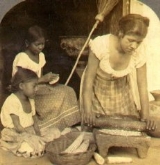
Traditionally throughout Mesoamerica from Pre-Columbian times into the mid 20th century, the masa was prepared by women using a mano (a cylinder shaped stone like a rolling pin) and metate (a stone base with a slightly concave top for holding the corn). This method is still used in some places in Mexico.
The wheat flour tortilla was an innovation after wheat was brought to the New World from Spain while this region was the colony of New Spain. It is made with an unleavened, water based dough, pressed and cooked like corn tortillas. These tortillas are very similar to the unleavened bread popular in Arab, eastern Mediterranean and southern Asian countries, though thinner and smaller in diameter. In China, there is the laobing, a pizza-shaped thick "pancake" that is similar to the tortilla. The Indian Roti, which is made essentially from wheat flour is another example.
Tortillas vary in size from about 6 to over 30 cm (2.4 to over 12 in), depending on the region of the country and the dish for which it is intended.
Among tortilla variants (without being, strictly speaking, tortillas) there are pupusas, "pishtones, gorditas, sopes, and tlacoyos. These filled snacks can be found in Mexico, Belize, Guatemala, El Salvador and Honduras. They are smaller, thicker versions to which beans, chicharrón, nopales or other ingredients have been added. They are customarily cooked on a greased pan.
In Nicaragua, tortillas are called Güirilas. They are made from young white corn. Güirilas are thick, sweet and filling. They are enjoyed as a snack by itself, with crumbled cheese, or accompanying a dish.
In Argentina, Bolivia and southern Chile, the size of the tortillas is smaller. They are generally saltier, made from wheat or corn flour, and roasted in the ashes of a traditional adobe oven. This kind of tortilla is called Sopaipilla (not to be confused with a puffy fry bread of the same name common in New Mexico, United States). In Chile and Argentina it may also be sweetened after being cooked by boiling in sugar water.
In commercial production and even in some larger restaurants, automatic machines make tortillas from dough.
A simple corn tortilla recipe for 20 tortillas:
-Put 2 cups of masa corn flour in a large bowl
-Add 1 1/2 to 2 cups of warm water to the masa flour
-Work the masa with hands to make the dough for several minutes
-Press the dough. If the dough seems too dry or too wet, add a little more water or masa
-Take a piece of the masa dough and shape it into a ball
-Open a tortilla press and lay one piece of plastic bag on the press
-Place the masa ball in the center
-Place another piece of plastic over the masa ball
-Press down, until the dough has spread to a diameter of 5 inches
-Heat a skillet on high heat
-Hold a tortilla in a hand, removing the plastic
-Allow the tortilla to rest half on a hand, and half hanging down, and gently lay the tortilla down on to the skillet
See also
Etymology "Little sandwich"
Torta, sandwich, plus the diminutive -illa.
External links
|
| |
|
|