
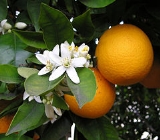
Citrus is a common term and
genusIn biology, a genus is a low-level taxonomic rank used in the biological classification of living and fossil organisms, which is an example of definition by genus and differentia...
(Citrus) of
flowering plantThe flowering plants , also known as Angiospermae or Magnoliophyta, are the most diverse group of land plants. Angiosperms are seed-producing plants like the gymnosperms and can be distinguished from the gymnosperms by a series of synapomorphies...
s in the
rueRue is a genus of strongly scented evergreen subshrubs 20–60 cm tall, in the family Rutaceae, native to the Mediterranean region, Macaronesia and southwest Asia. There are perhaps 8 to 40 species in the genus...
family,
RutaceaeRutaceae, commonly known as the rue or citrus family, is a family of flowering plants, usually placed in the order Sapindales.Species of the family generally have flowers that divide into four or five parts, usually with strong scents...
. Citrus is believed to have originated in the part of
Southeast AsiaSoutheast Asia, South-East Asia, South East Asia or Southeastern Asia is a subregion of Asia, consisting of the countries that are geographically south of China, east of India, west of New Guinea and north of Australia. The region lies on the intersection of geological plates, with heavy seismic...
bordered by Northeastern
IndiaIndia , officially the Republic of India , is a country in South Asia. It is the seventh-largest country by geographical area, the second-most populous country with over 1.2 billion people, and the most populous democracy in the world...
,
MyanmarBurma , officially the Republic of the Union of Myanmar , is a country in Southeast Asia. Burma is bordered by China on the northeast, Laos on the east, Thailand on the southeast, Bangladesh on the west, India on the northwest, the Bay of Bengal to the southwest, and the Andaman Sea on the south....
(Burma) and the
YunnanYunnan is a province of the People's Republic of China, located in the far southwest of the country spanning approximately and with a population of 45.7 million . The capital of the province is Kunming. The province borders Burma, Laos, and Vietnam.Yunnan is situated in a mountainous area, with...
province of
ChinaChinese civilization may refer to:* China for more general discussion of the country.* Chinese culture* Greater China, the transnational community of ethnic Chinese.* History of China* Sinosphere, the area historically affected by Chinese culture...
. Citrus fruit has been cultivated in an ever-widening area since ancient times; the best-known examples are the
orangeAn orange—specifically, the sweet orange—is the citrus Citrus × sinensis and its fruit. It is the most commonly grown tree fruit in the world....
s,
lemonThe lemon is both a small evergreen tree native to Asia, and the tree's ellipsoidal yellow fruit. The fruit is used for culinary and non-culinary purposes throughout the world – primarily for its juice, though the pulp and rind are also used, mainly in cooking and baking...
s,
grapefruitThe grapefruit , is a subtropical citrus tree known for its sour fruit, an 18th-century hybrid first bred in Barbados. When found, it was named the "forbidden fruit"; it has also been misidentified with the pomelo or shaddock , one of the parents of this hybrid, the other being sweet orange The...
, and
limesLime is a term referring to a number of different citrus fruits, both species and hybrids, which are typically round, green to yellow in color, 3–6 cm in diameter, and containing sour and acidic pulp. Limes are a good source of vitamin C. Limes are often used to accent the flavors of foods and...
.
The generic name originated in
LatinLatin is an Italic language originally spoken in Latium and Ancient Rome. It, along with most European languages, is a descendant of the ancient Proto-Indo-European language. Although it is considered a dead language, a number of scholars and members of the Christian clergy speak it fluently, and...
, where it specifically referred to the plant now known as
CitronNot to be confused with Cintron.The citron is a fragrant citrus fruit, botanically classified as Citrus medica by both the Swingle and Tanaka systems...
(
C. medica). It was derived from the
ancient GreekAncient Greek is the stage of the Greek language in the periods spanning the times c. 9th–6th centuries BC, , c. 5th–4th centuries BC , and the c. 3rd century BC – 6th century AD of ancient Greece and the ancient world; being predated in the 2nd millennium BC by Mycenaean Greek...
word for
cedarCedrus libani is a species of cedar native to the mountains of the Mediterranean region.There are two distinct types that are considered to be different subspecies or varieties. Lebanon cedar or Cedar of Lebanon Cedrus libani is a species of cedar native to the mountains of the Mediterranean...
, kεδρος (
kedros). Some believe this was because
Hellenistic JewsHellenistic Judaism was a movement which existed in the Jewish diaspora that sought to establish a Hebraic-Jewish religious tradition within the culture and language of Hellenism...
usedThe four species are four plants mentioned in the Torah as being relevant to Sukkot. Karaite Jews build their Sukkot out of branches from the four specified plants , while Talmudic Jews take three types of branches and one type of fruit which are held together and waved in a special ceremony...
the fruits of
C. medica during
SukkotSukkot is a Biblical holiday celebrated on the 15th day of the month of Tishrei . It is one of the three biblically mandated festivals Shalosh regalim on which Hebrews were commanded to make a pilgrimage to the Temple in Jerusalem.The holiday lasts seven days...
(Feast of the Tabernacles) in place of a cedar cone, while others state it was due to similarities in the smell of citrus leaves and fruit with that of cedar. Collectively,
Citrus fruits and plants are also known by the
RomanceThe Romance languages are a branch of the Indo-European language family, more precisely of the Italic languages subfamily, comprising all the languages that descend from Vulgar Latin, the language of ancient Rome...
loanwordA loanword is a word borrowed from a donor language and incorporated into a recipient language. By contrast, a calque or loan translation is a related concept where the meaning or idiom is borrowed rather than the lexical item itself. The word loanword is itself a calque of the German Lehnwort,...
agrumes (literally "sour fruits").
The
taxonomyTaxonomy is the science of identifying and naming species, and arranging them into a classification. The field of taxonomy, sometimes referred to as "biological taxonomy", revolves around the description and use of taxonomic units, known as taxa...
and
systematicsBiological systematics is the study of the diversification of terrestrial life, both past and present, and the relationships among living things through time. Relationships are visualized as evolutionary trees...
of the genus are complex and the precise number of natural
speciesIn biology, a species is one of the basic units of biological classification and a taxonomic rank. A species is often defined as a group of organisms capable of interbreeding and producing fertile offspring. While in many cases this definition is adequate, more precise or differing measures are...
is unclear, as many of the named species are clonally propagated hybrids, and there is
geneticGenetics , a discipline of biology, is the science of genes, heredity, and variation in living organisms....
evidence that even some wild, true-breeding species are of hybrid origin. Cultivated
Citrus may be derived from as few as four ancestral species. Natural and cultivated origin hybrids include commercially important
fruitIn broad terms, a fruit is a structure of a plant that contains its seeds.The term has different meanings dependent on context. In non-technical usage, such as food preparation, fruit normally means the fleshy seed-associated structures of certain plants that are sweet and edible in the raw state,...
such as the oranges, grapefruit, lemons, some limes, and some tangerines.
Research suggests that the closely related genus
FortunellaCumquats or kumquats are a group of small fruit-bearing trees in the flowering plant family Rutaceae, either forming the genus Fortunella, or placed within Citrus sensu lato...
(kumquats), and perhaps also
Poncirus and the Australian
Microcitrus and
Eremocitrus, should be included in
Citrus; most botanists now classify
Microcitrus and
Eremocitrus as part of the genus
Citrus. Two additional genera:
TriphasiaTriphasia is a small genus of three species in the family Rutaceae, related to Citrus. The genus is native to southeastern Asia and New Guinea....
and
ClymeniaClymenia is a small genus of flowering plants in the family Rutaceae. The rare Clymenia polyandra, occasionally referred to by the archaic Citrus polyandra, is the lone known member of the genus....
are likewise very closely related, and bear hesperidium fruits, but are not considered part of the
Citrus genus. At least one,
Clymenia, will hybridize with kumquats and some limes.
Description
These plants are large
shrubA shrub or bush is distinguished from a tree by its multiple stems and shorter height, usually under 5–6 m tall. A large number of plants may become either shrubs or trees, depending on the growing conditions they experience...
s or small trees, reaching 5–15 m tall, with spiny shoots and alternately arranged
evergreenIn botany, an evergreen plant is a plant that has leaves in all seasons. This contrasts with deciduous plants, which completely lose their foliage during the winter or dry season.There are many different kinds of evergreen plants, both trees and shrubs...
leavesA leaf is an organ of a vascular plant, as defined in botanical terms, and in particular in plant morphology. Foliage is a mass noun that refers to leaves as a feature of plants....
with an entire margin. The
flowerA flower, sometimes known as a bloom or blossom, is the reproductive structure found in flowering plants . The biological function of a flower is to effect reproduction, usually by providing a mechanism for the union of sperm with eggs...
s are solitary or in small corymbs, each flower 2–4 cm diameter, with five (rarely four) white petals and numerous stamens; they are often very strongly scented. The
fruitIn broad terms, a fruit is a structure of a plant that contains its seeds.The term has different meanings dependent on context. In non-technical usage, such as food preparation, fruit normally means the fleshy seed-associated structures of certain plants that are sweet and edible in the raw state,...
is a
hesperidiumA hesperidium is a modified fruit with a tough, leathery rind. The peel contains volatile oil glands in pits. The fleshy interior is composed of separate sections, called carpels, filled with fluid-filled vesicles that are actually specialized hair cells.The outer ovary wall becomes the thick...
, a specialised berry, globose to elongated, 4–30 cm long and 4–20 cm diameter, with a leathery rind surrounding segments or "liths" filled with pulp
vesicleThe juice vesicles of a citrus fruit are the membranous content of the fruit’s endocarp. The vesicles contain the juice of the fruit. The pulp is usually removed from the juice by filtering it out...
s. The genus is commercially important as many species are cultivated for their fruit, which is eaten fresh, pressed for
juiceJuice is the liquid that is naturally contained in fruit or vegetable tissue.Juice is prepared by mechanically squeezing or macerating fruit or vegetable flesh without the application of heat or solvents. For example, orange juice is the liquid extract of the fruit of the orange tree...
, or preserved in
marmaladeMarmalade is a fruit preserve made from the juice and peel of citrus fruits, boiled with sugar and water. The benchmark citrus fruit for marmalade production in Britain is the "Seville orange" from Spain, Citrus aurantium var...
s and
picklesPickling, also known as brining or corning is the process of preserving food by anaerobic fermentation in brine to produce lactic acid, or marinating and storing it in an acid solution, usually vinegar . The resulting food is called a pickle. This procedure gives the food a salty or sour taste...
.
Citrus fruits are notable for their fragrance, partly due to flavonoids and limonoids (which in turn are
terpeneTerpenes are a large and diverse class of organic compounds, produced by a variety of plants, particularly conifers, though also by some insects such as termites or swallowtail butterflies, which emit terpenes from their osmeterium. They are often strong smelling and thus may have had a protective...
s) contained in the rind, and most are juice-laden. The juice contains a high quantity of
citric acidCitric acid is a weak organic acid. It is a natural preservative/conservative and is also used to add an acidic, or sour, taste to foods and soft drinks...
giving them their characteristic sharp flavour.
They are also good sources of
vitamin CVitamin C or L-ascorbic acid or L-ascorbate is an essential nutrient for humans and certain other animal species. In living organisms ascorbate acts as an antioxidant by protecting the body against oxidative stress...
and
flavonoidFlavonoids , are a class of plant secondary metabolites....
s. The flavonoids include various
flavanoneThe flavanones are a type of flavonoids. They are generally glycosylated by a disaccharide at position seven to give flavanone glycosides.-List of flavanones:* Butin* Eriodictyol* Hesperetin* Hesperidin* Homoeriodictyol* Isosakuranetin* Naringenin...
s and flavones.
Cultivation
Citrus trees hybridise very readily – depending on the
pollenPollen is a fine to coarse powder containing the microgametophytes of seed plants, which produce the male gametes . Pollen grains have a hard coat that protects the sperm cells during the process of their movement from the stamens to the pistil of flowering plants or from the male cone to the...
source, plants grown from a
Persian LimePersian lime , also known as Tahiti lime or Bearss lime , is a citrus fruit sold simply as a "lime" in the United States...
's seeds can produce fruit similar to grapefruit. Thus all commercial citrus cultivation uses trees produced by
graftingGrafting is a horticultural technique whereby tissues from one plant are inserted into those of another so that the two sets of vascular tissues may join together. This vascular joining is called inosculation...
the desired fruiting
cultivarA cultivar'Cultivar has two meanings as explained under Formal definition. When used in reference to a taxon, the word does not apply to an individual plant but to all those plants sharing the unique characteristics that define the cultivar. is a plant or group of plants selected for desirable...
s onto rootstocks selected for disease resistance and hardiness.
The colour of citrus fruits only develops in climates with a (
diurnalDiurnal temperature variation is a meteorological term that relates to the variation in temperature that occurs from the highs of the day to the cool of nights.-Temperature lag:Temperature lag is an important factor in diurnal temperature variation...
) cool winter. In tropical regions with no winter at all, citrus fruits remain green until maturity, hence the tropical "green oranges". The
Persian LimePersian lime , also known as Tahiti lime or Bearss lime , is a citrus fruit sold simply as a "lime" in the United States...
in particular is extremely sensitive to cool conditions, thus it is not usually exposed to cool enough conditions to develop a mature colour. If they are left in a cool place over winter, the fruits will change colour to yellow.
The terms "ripe" and "mature" are usually used synonymously, but they mean different things. A mature fruit is one that has completed its growth phase.
RipeningRipening is a process in fruits that causes them to become more palatable. In general, a fruit becomes sweeter, less green, and softer as it ripens. Even though the acidity of fruit increases as it ripens, the higher acidity level does not make the fruit seem tarter, which can lead to the...
is the term used to describe the changes that occur within the fruit after it is mature to the beginning of decay. These changes usually involve starches converting to sugars, a decrease in acids and a softening and change in the fruit's colour.
Citrus fruits are non-
climactericThe climacteric is a stage of fruit ripening associated with ethylene production and cell respiration rise. Apples, bananas, melons, apricots, tomatoes are climacteric fruit. Citrus, grapes, strawberries are non-climacteric...
and respiration slowly declines and the production and release of ethylene is gradual. The fruits do not go through a ripening process in the sense that they become "tree ripe." Some fruits, for example cherries, physically mature and then continue to ripen on the tree. Other fruits, like pears, are picked when mature but before they ripen, then continue to ripen off the tree. Citrus fruits pass from immaturity to maturity to over-maturity while still on the tree. Once they are separated from the tree, they will not increase in sweetness or continue to ripen. The only way change may happen after being picked is that they will eventually start to decay.
With oranges, colour cannot be used as an indicator of ripeness because sometimes the rinds turn orange long before the oranges are ready to eat. Tasting them is the only way to know whether or not they are ready to eat.
Citrus trees are not generally frost hardy.
Mandarin OrangeThe orange, also known as the ' or mandarine , is a small citrus tree with fruit resembling other oranges. Mandarin oranges are usually eaten plain or in fruit salads...
s (
C. reticulata) tend to be the hardiest of the common
Citrus species and can withstand short periods down to as cold as −10 °C, but realistically temperatures not falling below −2 °C are required for successful cultivation. Tangerines, tangors and
yuzuThe yuzu is a citrus fruit and plant originating in East Asia. It is believed to be a hybrid of sour mandarin and Ichang papeda...
can be grown outside even in regions with more marked sub-zero degrees in winter, although this may affect fruit quality. A few hardy hybrids can withstand temperatures well below freezing, but do not produce quality fruit. Lemons can be commercially grown in cooler-summer/moderate-winter coastal Southern California, because sweetness is neither attained nor expected in retail lemon fruit. The related
Trifoliate OrangeTrifoliate Orange, Poncirus trifoliata , is a member of the family Rutaceae, closely related to Citrus, and sometimes included in that genus, being sufficiently closely related to allow it to be used as a rootstock for Citrus...
(
Citrus trifoliata) can survive below −20 °C; its fruit are astringent and inedible unless cooked but a few better-tasting cultivars and hybrids have been developed (see
citrangeThe citrange is a hybrid of the sweet orange and the trifoliate orange. The purpose of this cross was to attempt to create a cold-hardy citrus tree with delicious fruit. However, citranges are generally bitter....
s).
The trees thrive in a consistently sunny, humid environment with fertile soil and adequate rainfall or irrigation. Abandoned trees in valleys may suffer, yet survive, the dry summer of Central California's Inner Coast Ranges. At any age citrus grows well enough with infrequent irrigation in partial shade, but the fruit crop is smaller. Though broadleaved, they are evergreen and do not drop leaves except when stressed. The
stemsA stem is one of two main structural axes of a vascular plant. The stem is normally divided into nodes and internodes, the nodes hold buds which grow into one or more leaves, inflorescence , conifer cones, roots, other stems etc. The internodes distance one node from another...
of many varieties have large sharp thorns. The trees flower in the spring, and fruit is set shortly afterward. Fruit begins to ripen in fall or early winter months, depending on cultivar, and develops increasing sweetness afterward. Some cultivars of tangerines ripen by winter. Some, such as the grapefruit, may take up to eighteen months to ripen.
Major commercial citrus growing areas include southern China, the
Mediterranean BasinIn biogeography, the Mediterranean Basin refers to the lands around the Mediterranean Sea that have a Mediterranean climate, with mild, rainy winters and hot, dry summers, which supports characteristic Mediterranean forests, woodlands, and scrub vegetation...
(including southern Spain),
South AfricaThe Republic of South Africa is a country in southern Africa. Located at the southern tip of Africa, it is divided into nine provinces, with of coastline on the Atlantic and Indian oceans...
,
AustraliaAustralia , officially the Commonwealth of Australia, is a country in the Southern Hemisphere comprising the mainland of the Australian continent, the island of Tasmania, and numerous smaller islands in the Indian and Pacific Oceans. It is the world's sixth-largest country by total area...
, the southernmost
United StatesThe United States of America is a federal constitutional republic comprising fifty states and a federal district...
and parts of
South AmericaSouth America is a continent situated in the Western Hemisphere, mostly in the Southern Hemisphere, with a relatively small portion in the Northern Hemisphere. The continent is also considered a subcontinent of the Americas. It is bordered on the west by the Pacific Ocean and on the north and east...
. In the United States,
FloridaFlorida is a state in the southeastern United States, located on the nation's Atlantic and Gulf coasts. It is bordered to the west by the Gulf of Mexico, to the north by Alabama and Georgia and to the east by the Atlantic Ocean. With a population of 18,801,310 as measured by the 2010 census, it...
,
CaliforniaCalifornia is a state located on the West Coast of the United States. It is by far the most populous U.S. state, and the third-largest by land area...
,
ArizonaArizona ; is a state located in the southwestern region of the United States. It is also part of the western United States and the mountain west. The capital and largest city is Phoenix...
, and
TexasTexas is the second largest U.S. state by both area and population, and the largest state by area in the contiguous United States.The name, based on the Caddo word "Tejas" meaning "friends" or "allies", was applied by the Spanish to the Caddo themselves and to the region of their settlement in...
are major producers, while smaller plantings are present in other
Sun BeltThe Sun Belt or Spanish Belt is a region of the United States generally considered to stretch across the South and Southwest . Another rough boundary of the region is the area south of the 36th parallel, north latitude. It is the largest region which the U.S government does not recognize officially...
states.
As ornamental plants
Citrus trees grown in tubs and wintered under cover were a feature of Renaissance gardens, once glass-making technology enabled sufficient expanses of clear glass to be produced. An
orangeryAn orangery was a building in the grounds of fashionable residences from the 17th to the 19th centuries and given a classicising architectural form. The orangery was similar to a greenhouse or conservatory...
was a feature of royal and aristocratic residences through the 17th and 18th centuries. The
Orangerie at the
Palace of the LouvreThe Musée du Louvre – in English, the Louvre Museum or simply the Louvre – is one of the world's largest museums, the most visited art museum in the world and a historic monument. A central landmark of Paris, it is located on the Right Bank of the Seine in the 1st arrondissement...
, 1617, inspired imitations that were not eclipsed until the development of the modern greenhouse in the 1840s. In the United States the earliest surviving orangery is at the
Tayloe House, Mount Airy, VirginiaMount Airy, near Warsaw in Richmond County, Virginia, built in 1758-62, is a mid-Georgian plantation house, the first built in the manner of a neo-Palladian villa. It was constructed for Colonel John Tayloe II, perhaps the richest Virginia planter of his generation...
. George Washington had an orangery at
Mount VernonThe name Mount Vernon is a dedication to the English Vice-Admiral Edward Vernon. It was first applied to Mount Vernon, the Virginia estate of George Washington, the first President of the United States...
.
Some modern hobbyists still grow dwarf citrus in containers or greenhouses in areas where it is too cold to grow it outdoors. Consistent climate, sufficient sunlight, and proper watering are crucial if the trees are to thrive and produce fruit. Compared to many of the usual "green shrubs", citrus trees better tolerate poor container care. For cooler winter areas,
limeLime is a term referring to a number of different citrus fruits, both species and hybrids, which are typically round, green to yellow in color, 3–6 cm in diameter, and containing sour and acidic pulp. Limes are a good source of vitamin C. Limes are often used to accent the flavors of foods and...
s and
lemonThe lemon is both a small evergreen tree native to Asia, and the tree's ellipsoidal yellow fruit. The fruit is used for culinary and non-culinary purposes throughout the world – primarily for its juice, though the pulp and rind are also used, mainly in cooking and baking...
s should not be grown, since they are more sensitive to winter cold than other citrus fruits. Hybrids with
kumquatCumquats or kumquats are a group of small fruit-bearing trees in the flowering plant family Rutaceae, either forming the genus Fortunella, or placed within Citrus sensu lato...
s (×
Citrofortunella-Citrus × microcarpa — ×Citrofortunella hybrids:These plants are hardier and more compact than most citrus plants. They produce small acidic fruit and make good ornamental plants...
) have good cold resistance.
Pests and diseases
Citrus plants are very liable to infestation by
aphidAphids, also known as plant lice and in Britain and the Commonwealth as greenflies, blackflies or whiteflies, are small sap sucking insects, and members of the superfamily Aphidoidea. Aphids are among the most destructive insect pests on cultivated plants in temperate regions...
s,
whiteflyThe whiteflies, comprising only the family Aleyrodidae, are small hemipterans. More than 1550 species have been described. Whiteflies typically feed on the underside of plant leaves.-Agricultural threat:...
and
scale insectThe scale insects are small insects of the order Hemiptera, generally classified as the superfamily Coccoidea. There are about 8,000 species of scale insects.-Ecology:...
s (e.g. California red scale). Also rather important are the viral infections to which some of these ectoparasites serve as vectors such as the aphid-transmitted
Citrus tristeza virusCitrus tristeza virus is a viral species of the Closterovirus genus that causes the most economically damaging disease to its namesake plant genus, Citrus. The disease has led to the death of millions of Citrus trees all over the world and has rendered other millions useless for production...
which when unchecked by proper methods of control is devastating to citrine plantations.
European brown snails (
Helix aspersaHelix aspersa, known by the common name garden snail, is a species of land snail, a pulmonate gastropod that is one of the best-known of all terrestrial molluscs. The species has been placed in the genus Helix, in all sources between 1774 and 1988 and in most sources until recently...
) can be a problem in California, though laying female
Khaki CampbellA Khaki Campbell is a breed of domesticated duck that originated in England and is kept for its high level of egg production. The breed was developed by Adele Campbell of England at the end of the 19th century. The "Khaki" portion of the name refers to the duck's typical color.-Description:Adult...
and other
MallardThe Mallard , or Wild Duck , is a dabbling duck which breeds throughout the temperate and subtropical Americas, Europe, Asia, and North Africa, and has been introduced to New Zealand and Australia....
-based
duckDuck is the common name for a large number of species in the Anatidae family of birds, which also includes swans and geese. The ducks are divided among several subfamilies in the Anatidae family; they do not represent a monophyletic group but a form taxon, since swans and geese are not considered...
s can be used for control.
The foliage is also used as a food plant by the
larvaA larva is a distinct juvenile form many animals undergo before metamorphosis into adults. Animals with indirect development such as insects, amphibians, or cnidarians typically have a larval phase of their life cycle...
e of
LepidopteraLepidoptera is a large order of insects that includes moths and butterflies . It is one of the most widespread and widely recognizable insect orders in the world, encompassing moths and the three superfamilies of butterflies, skipper butterflies, and moth-butterflies...
(
butterflyA butterfly is a mainly day-flying insect of the order Lepidoptera, which includes the butterflies and moths. Like other holometabolous insects, the butterfly's life cycle consists of four parts: egg, larva, pupa and adult. Most species are diurnal. Butterflies have large, often brightly coloured...
and
mothA moth is an insect closely related to the butterfly, both being of the order Lepidoptera. Moths form the majority of this order; there are thought to be 150,000 to 250,000 different species of moth , with thousands of species yet to be described...
) species such as the Geometridae
Common EmeraldThe Common Emerald is a moth of the family Geometridae. The species is found throughout the Nearctic and Palearctic regions and the Near East. In the British Isles it is not found in Scotland but is a common species elsewhere...
(
Hemithea aestivaria) and
Double-striped PugThe Double-striped Pug is a moth of the family Geometridae. It is a widespread and common species, being found throughout the Palearctic region, the Near East and North Africa....
(
Gymnoscelis rufifasciata), the
ArctiidaeArctiidae is a large and diverse family of moths with around 11,000 species found all over the world, including 6,000 neotropical species. This family includes the groups commonly known as tiger moths , which usually have bright colours, footmen , lichen moths and wasp moths...
Giant Leopard MothThe Giant Leopard Moth or Eyed Tiger Moth is a moth of the family Arctiidae. It is distributed throughout the Southern and Eastern United States from New England to Mexico. The obsolete name Ecpantheria scribonia is still occasionally encountered.This species has a wingspan of 3 inches...
(
Hypercompe scribonia),
H. eridanus,
H. icasia and
H. indecisa, many species in the family Papilionidae (swallowtail butterflies), and the Black-lyre Leafroller Moth (
"Cnephasia" jactatana), a tortrix moth.
Since 2000, the Citrus Leafminer (
Phyllocnistis citrella) has been a pest in California, boring meandering patterns through leaves.
In eastern Australia, the Bronze-orange Bug (
Musgraveia sulciventris) can be a major pest of citrus trees, particularly grapefruit. In heavy infestations it can cause flower and fruit drop and general tree stress.
Production
According to UN 2007 data,
BrazilBrazil , officially the Federative Republic of Brazil , is the largest country in South America. It is the world's fifth largest country, both by geographical area and by population with over 192 million people...
,
ChinaChinese civilization may refer to:* China for more general discussion of the country.* Chinese culture* Greater China, the transnational community of ethnic Chinese.* History of China* Sinosphere, the area historically affected by Chinese culture...
, the
United StatesThe United States of America is a federal constitutional republic comprising fifty states and a federal district...
,
MexicoThe United Mexican States , commonly known as Mexico , is a federal constitutional republic in North America. It is bordered on the north by the United States; on the south and west by the Pacific Ocean; on the southeast by Guatemala, Belize, and the Caribbean Sea; and on the east by the Gulf of...
,
IndiaIndia , officially the Republic of India , is a country in South Asia. It is the seventh-largest country by geographical area, the second-most populous country with over 1.2 billion people, and the most populous democracy in the world...
,
SpainSpain , officially the Kingdom of Spain languages]] under the European Charter for Regional or Minority Languages. In each of these, Spain's official name is as follows:;;;;;;), is a country and member state of the European Union located in southwestern Europe on the Iberian Peninsula...
and
PakistanPakistan , officially the Islamic Republic of Pakistan is a sovereign state in South Asia. It has a coastline along the Arabian Sea and the Gulf of Oman in the south and is bordered by Afghanistan and Iran in the west, India in the east and China in the far northeast. In the north, Tajikistan...
are the world's largest citrus-producing countries. Of these, Brazil, the US, and Mexico are the world's largest producers of oranges, whilst China produces most of the world's mandarins, and India is the world's largest producer of lemons and limes.
Culinary
Many citrus fruits, such as
orangesAn orange—specifically, the sweet orange—is the citrus Citrus × sinensis and its fruit. It is the most commonly grown tree fruit in the world....
,
tangerine__notoc__The tangerine is an orange-colored citrus fruit which is closely related to the Mandarin orange . Taxonomically, it should probably be formally named as a subspecies or variety of Citrus reticulata; further work seems to be required to ascertain its correct scientific name...
s,
grapefruitThe grapefruit , is a subtropical citrus tree known for its sour fruit, an 18th-century hybrid first bred in Barbados. When found, it was named the "forbidden fruit"; it has also been misidentified with the pomelo or shaddock , one of the parents of this hybrid, the other being sweet orange The...
s, and
clementineA clementine is a variety of mandarin orange , so named in 1902. The exterior is a deep orange colour with a smooth, glossy appearance. Clementines can be separated into seven to fourteen segments. They tend to be very easy to peel, like a tangerine, but are almost always seedless...
s, are generally eaten fresh. They are typically peeled and can be easily split into segments. Grapefruit is more commonly halved and eaten out of the skin with a spoon. There are special spoons (grapefruit spoons) with serrated tips designed for this purpose. Orange and grapefruit juices are also very popular
breakfastBreakfast is the first meal taken after rising from a night's sleep, most often eaten in the early morning before undertaking the day's work...
beverages. More acidic citrus, such as lemons and
limesLime is a term referring to a number of different citrus fruits, both species and hybrids, which are typically round, green to yellow in color, 3–6 cm in diameter, and containing sour and acidic pulp. Limes are a good source of vitamin C. Limes are often used to accent the flavors of foods and...
, are generally not eaten on their own.
Meyer LemonCitrus × meyeri, the Meyer lemon, is a citrus fruit native to China thought to be a cross between a true lemon and either a mandarin or common orange. It was introduced to the United States in 1908 as S.P.I...
s can be eaten 'out of hand' with the fragant skin; they are both sweet and sour.
LemonadeLemonade is a lemon-flavored drink, typically made from lemons, water and sugar.The term can refer to three different types of beverage:...
or
limeadeLimeade is a beverage similar to lemonade, but is made with lime juice or lime flavour instead of those of the lemon. Rose's lime juice, a concentrated drink patented in 1867, is one of the best-known brands. A.G. Barr plc of Glasgow produce a limeade as does Newman's Own since 2004...
are popular beverages prepared by diluting the juices of these fruits and adding sugar. Lemons and limes are also used as garnishes or in cooked dishes. Their juice is used as an ingredient in a variety of dishes; it can commonly be found in salad dressings and squeezed over cooked meat or vegetables. A variety of flavours can be derived from different parts and treatments of citrus fruits. The
rindPeel, also known as rind or skin, is the outer protective layer of a fruit or vegetable which could be peeled off. The rind is usually the botanical exocarp, but the term exocarp does also include the hard cases of nuts, which are not named peels since they are not peeled off by hand or peeler, but...
and
oilAn essential oil is a concentrated hydrophobic liquid containing volatile aroma compounds from plants. Essential oils are also known as volatile oils, ethereal oils or aetherolea, or simply as the "oil of" the plant from which they were extracted, such as oil of clove...
of the fruit is generally very bitter, especially when cooked, and so is often combined with sugar. The fruit pulp can vary from sweet and tart to extremely sour.
MarmaladeMarmalade is a fruit preserve made from the juice and peel of citrus fruits, boiled with sugar and water. The benchmark citrus fruit for marmalade production in Britain is the "Seville orange" from Spain, Citrus aurantium var...
, a condiment derived from cooked orange and lemon, can be especially bitter, but is usually sweetened to cut the bitterness and produce a jam-like result. Lemon or lime is commonly used as a garnish for water, soft drinks, or cocktails. Citrus juices, rinds, or slices are used in a variety of mixed drinks. The colourful outer skin of some citrus fruits, known as
zestZest is a food ingredient that is prepared by scraping or cutting from the outer, colorful skin of citrus fruits such as lemon, orange, citron, and lime. Zest is used to add flavor to foods....
, is used as a flavouring in cooking; the white inner portion of the peel, the pith, is usually avoided due to its bitterness. The zest of a citrus fruit, typically lemon or an orange, can also be soaked in water in a
coffee filterA coffee filter is a coffee-brewing utensil, usually made of disposable paper. A stainless steel filter is used to prepare Indian filter coffee, the form of coffee common in India....
, and drunk.
Medical
Citrus juice also has medical uses; lemon juice is used to relieve the pain of
bee stingA bee sting is strictly a sting from a bee . In the vernacular it can mean a sting of a bee, wasp, hornet, or yellow jacket. Some people may even call the bite of a horse-fly a bee sting...
s. Oranges were historically used for their high content of
vitamin CVitamin C or L-ascorbic acid or L-ascorbate is an essential nutrient for humans and certain other animal species. In living organisms ascorbate acts as an antioxidant by protecting the body against oxidative stress...
, which prevents
scurvyScurvy is a disease resulting from a deficiency of vitamin C, which is required for the synthesis of collagen in humans. The chemical name for vitamin C, ascorbic acid, is derived from the Latin name of scurvy, scorbutus, which also provides the adjective scorbutic...
. Scurvy is caused by vitamin C deficiency, and can be prevented by having 10 milligrams of vitamin C a day. An early sign of scurvy is fatigue. If ignored, later symptoms are bleeding and bruising easily. British sailors were given a ration of citrus fruits on long voyages to prevent the onset of scurvy, hence the British nickname of
LimeyLimey is an old slang nickname, often pejorative, for the British, originally referring to their sailors. The term is believed to derive from Lime , referring to the Royal Navy and Merchant Navy practice of supplying lime juice to British sailors to prevent scurvy...
.
PectinPectin is a structural heteropolysaccharide contained in the primary cell walls of terrestrial plants. It was first isolated and described in 1825 by Henri Braconnot...
is a structural heteropolysaccharide contained in the primary cell walls of plants. The extract of it from Citrus Fruits is used in medicine such as
TylenolTylenol is a North American brand of drugs advertised for reducing pain, reducing fever, and relieving the symptoms of allergies, cold, cough, and flu. The active ingredient of its original, flagship product, paracetamol , is marketed as an analgesic and antipyretic...
for the gelling effect of it when broken down. Limes and lemons as well as oranges and grapefruits are among the highest in this level.
After consumption, the peel is sometimes used as a facial cleanser. A peel of lemons or orange is commonly used as a means to moisten
medical cannabisMedical cannabis refers to the use of parts of the herb cannabis as a physician-recommended form of medicine or herbal therapy, or to synthetic forms of specific cannabinoids such as THC as a physician-recommended form of medicine...
when stored with it.
Before the development of
fermentationIndustrial fermentation is the intentional use of fermentation by microorganisms such as bacteria and fungi to make products useful to humans. Fermented products have applications as food as well as in general industry.- Food fermentation :...
-based processes, lemons were the primary commercial source of
citric acidCitric acid is a weak organic acid. It is a natural preservative/conservative and is also used to add an acidic, or sour, taste to foods and soft drinks...
.
Citrus fruit juices, such as orange, lime and lemon, may be useful for lowering the risk factors for specific types of
kidney stoneA kidney stone, also known as a renal calculus is a solid concretion or crystal aggregation formed in the kidneys from dietary minerals in the urine...
s. Orange juice may help prevent
calcium oxalateCalcium oxalate is a chemical compound that forms needle-shaped crystals, known in plants as raphides. A major constituent of human kidney stones, the chemical is also found in beerstone, a scale that forms on containers used in breweries...
stone formation. Lemons have the highest concentration of citrate of any citrus fruit, and daily consumption of
lemonadeLemonade is a lemon-flavored drink, typically made from lemons, water and sugar.The term can refer to three different types of beverage:...
has been shown to decrease the rate of stone formation.
Citrus fruits have been observed to be used by
CapuchinThe Order of Friars Minor Capuchin is an Order of friars in the Catholic Church, among the chief offshoots of the Franciscans. The worldwide head of the Order, called the Minister General, is currently Father Mauro Jöhri.-Origins :...
(
Cebus capucinus) monkeys in
Costa RicaCosta Rica , officially the Republic of Costa Rica is a multilingual, multiethnic and multicultural country in Central America, bordered by Nicaragua to the north, Panama to the southeast, the Pacific Ocean to the west and the Caribbean Sea to the east....
as topical balms to protect against insects as well as an astringent and anti-fungal
agentChemical warfare involves using the toxic properties of chemical substances as weapons. This type of warfare is distinct from Nuclear warfare and Biological warfare, which together make up NBC, the military acronym for Nuclear, Biological, and Chemical...
.
List of citrus fruits
The genus
Citrus has been suggested to originate in
Southeast AsiaSoutheast Asia, South-East Asia, South East Asia or Southeastern Asia is a subregion of Asia, consisting of the countries that are geographically south of China, east of India, west of New Guinea and north of Australia. The region lies on the intersection of geological plates, with heavy seismic...
. Prior to human cultivation, it consisted of just a few species, namely:
- Citrus aurantifolia – Key Lime
The Key lime is a citrus species with a globose fruit, 2.5–5 cm in diameter , that is yellow when ripe but usually picked green commercially. It is smaller, seedier, has a higher acidity, a stronger aroma, and a thinner rind than that of the Persian lime...
, Omani Lime, from India
- Citrus maxima – Pomelo
The pomelo is a citrus fruit native to Southeast Asia. It is usually pale green to yellow when ripe, with sweet white flesh and very thick albedo . It is the largest citrus fruit, 15–25 cm in diameter, and usually weighing 1–2 kg...
(pummelo, shaddock), from the Malay ArchipelagoThe Malay Archipelago refers to the archipelago between mainland Southeastern Asia and Australia. The name was derived from the anachronistic concept of a Malay race....
- Citrus medica – Citron
Not to be confused with Cintron.The citron is a fragrant citrus fruit, botanically classified as Citrus medica by both the Swingle and Tanaka systems...
, from India
- Citrus reticulata – Mandarin orange
The orange, also known as the ' or mandarine , is a small citrus tree with fruit resembling other oranges. Mandarin oranges are usually eaten plain or in fruit salads...
, from ChinaChinese civilization may refer to:* China for more general discussion of the country.* Chinese culture* Greater China, the transnational community of ethnic Chinese.* History of China* Sinosphere, the area historically affected by Chinese culture...
- Citrus trifoliata – Trifoliate Orange
Trifoliate Orange, Poncirus trifoliata , is a member of the family Rutaceae, closely related to Citrus, and sometimes included in that genus, being sufficiently closely related to allow it to be used as a rootstock for Citrus...
, from Korea and adjacent China (often separated as Poncirus)
- Australian lime
Australian limes are species of the plant genus Citrus that are native to Australia. These species were formerly included in the genera Microcitrus and Eremocitrus...
s
- Citrus australasica – Finger Lime
The Finger Lime plant, Citrus australasica is a thorny understorey shrub or small tree of lowland subtropical rainforest and dry rainforest in the coastal border region of Queensland and New South Wales, Australia....
(sometimes separated in Microcitrus)
- Citrus australis
Round lime , also known as Australian lime or Australian round lime, is a large shrub or small tree of a height of up to 12m. It grows in the Beenleigh area, Queensland, Australia....
– Australian Round Lime (sometimes separated in Microcitrus)
- Citrus glauca – Desert Lime
Citrus glauca is also known as Desert Lime. It is a thorny shrub or small tree endemic to semi-arid regions of Queensland, New South Wales, and South Australia...
(sometimes separated in Eremocitrus)
- and 3 other Microcitrus
- Kumquat
Cumquats or kumquats are a group of small fruit-bearing trees in the flowering plant family Rutaceae, either forming the genus Fortunella, or placed within Citrus sensu lato...
s, 4-5 species from East Asia ranging into Southeast Asia (often separated as Fortunella)
- Papeda
Citrus subg. Papeda indicates the subgenus Papeda of the genus Citrus, with citrus species native to Asia.The papeda group includes some of the most tropical, and also some of the most frost-tolerant citrus plants. They are cultivated far less often than other citrus, though they will all...
s, including
- Citrus halimii
Citrus halimii is a citrus tree and fruit, belonging to the papeda subgroup of citrus plants. It was first discovered and catalogued in 1973.- Distribution :Citrus halimii is quite rare and poorly studied...
– limau kadangsa, limau kedut kera, from ThailandThailand , officially the Kingdom of Thailand , formerly known as Siam , is a country located at the centre of the Indochina peninsula and Southeast Asia. It is bordered to the north by Burma and Laos, to the east by Laos and Cambodia, to the south by the Gulf of Thailand and Malaysia, and to the...
and MalayaThe Malay Peninsula or Thai-Malay Peninsula is a peninsula in Southeast Asia. The land mass runs approximately north-south and, at its terminus, is the southern-most point of the Asian mainland...
- Citrus indica – Indian Wild Orange, from the Indian subcontinent
The Indian subcontinent, also Indian Subcontinent, Indo-Pak Subcontinent or South Asian Subcontinent is a region of the Asian continent on the Indian tectonic plate from the Hindu Kush or Hindu Koh, Himalayas and including the Kuen Lun and Karakoram ranges, forming a land mass which extends...
- Citrus macroptera
Citrus macroptera commonly called "Melanesian papeda", "wild orange", "cabuyao" or "satkara" is a semi-wild species of citrus native to Malesia and Melanesia.- Description :...
from Indochina and Melanesia
- "Khasi Papeda" – Citrus latipes
Citrus latipes, commonly called "Khasi papeda", is sometimes mistakenly identified as Kaffir lime . Native to northeastern India, the khasi papeda is a small, thorny tree that closely resembles both kaffir limes and ichang papedas...
from AssamAssam , also, rarely, Assam Valley and formerly the Assam Province , is a northeastern state of India and is one of the most culturally and geographically distinct regions of the country...
, MeghalayaMeghalaya is a state in north-eastern India. The word "Meghalaya" literally means the Abode of Clouds in Sanskrit and other Indic languages. Meghalaya is a hilly strip in the eastern part of the country about 300 km long and 100 km wide, with a total area of about 8,700 sq mi . The...
, Burma
Hybrids and cultivars
Sorted by parentage. As each is the product of (at least) two parent species, they are listed multiple times.
Citrus maxima
-based
- Amanatsu
is a yellowish orange citrus fruit, a group of cultivars of natsumikan , which were discovered in 1740 in the Yamaguchi prefecture of Japan. Natsumikan is about the size of grapefruit and oblate in shape. The fruit contains 12 segments and about 30 seeds.Natsumikan is grown commercially in Japan,...
, natsumikan –
Citrus × natsudaidai
(C. maxima
× unknown)
Cam sànhThe cam sành , Citrus reticulata × maxima) is a cultivar of citrus fruit similar to an orange, originating in Vietnam...
(C. reticulata
× C. × sinensis
)
GrapefruitThe grapefruit , is a subtropical citrus tree known for its sour fruit, an 18th-century hybrid first bred in Barbados. When found, it was named the "forbidden fruit"; it has also been misidentified with the pomelo or shaddock , one of the parents of this hybrid, the other being sweet orange The...
– Citrus × paradisi
(C. maxima × C. × sinensis
)
Imperial LemonThe Imperial lemon is thought to be a lemon × grapefruit hybrid. Its fruit is slightly larger than a lemon and has a more rounded shape....
(C. × limon × C. × paradisi
)
KinnowThe kinnow is a variety of citrus fruit cultivated extensively in India and Pakistani Punjab Province. It is a hybrid of two citrus cultivars — "King" x "Willow Leaf" — first developed by H. B. Frost at the Citrus Research Centre of the University of California, Riverside, USA...
(C. × nobilis × C. × deliciosa
)
Kiyomiis a Japanese citrus fruit that is a hybrid of a Miyagawa Wase mikan and a Trovita orange. The new breed was the first tangor created in Japan in 1949. It was named Kiyomi after the temple and the lagoon near its experiment station in Shizuoka city and registered as "Tangor Nōrin No.1" in...
(C. sinensis × C. × unshiu
)
LemonThe lemon is both a small evergreen tree native to Asia, and the tree's ellipsoidal yellow fruit. The fruit is used for culinary and non-culinary purposes throughout the world – primarily for its juice, though the pulp and rind are also used, mainly in cooking and baking...
(probably C. maxima × C. medica
)
Minneola Tangelo (C. reticulata × C. × paradisi
)
OrangeloAn orangelo is a hybrid citrus fruit believed to have originated in Puerto Rico. The fruit, a cross between a grapefruit and an orange, had spontaneously appeared in the shade-providing trees grown on coffee plantations in the Puerto Rican highlands.In 1956, Carlos G...
, Chironja (C. × paradisi × C. × sinensis
)
OroblancoAn oroblanco or sweetie is a cross between an acidless pomelo and a white grapefruit. It is slightly larger in size than a grapefruit but has fewer seeds and is sweeter. When ripe, its thick rind is bright green or golden in color. The Oroblanco fruit has a similar taste to the scent of its flowers...
, Sweetie (C. maxima × C. × paradisi
)
Sweet Orange – Citrus × sinensis
(probably C. maxima
× C. × reticulata
)
TangeloThe tangelo , Citrus × tangelo, is also widely known as the honeybell. Tangelo is a citrus fruit that is a hybrid of a tangerine and either a pomelo or a grapefruit. The fruits are the size of an adult fist and have a tangerine taste, but are very juicy, to the point of not providing much flesh...
– Citrus × tangelo
(C. reticulata × C. maxima
or C. × paradisi
)
TangorThe tangor is a citrus fruit hybrid of the mandarin orange and the sweet orange...
– Citrus × nobilis
(C. reticulata × C. × sinensis
)
Ugli (C. reticulata × C. maxima
or C. × paradisi
)
Citrus medica-based
- Buddha's Hand
Buddha's hand, Citrus medica var. sarcodactylis , is a fragrant citron variety whose fruit is segmented into finger-like sections. The origin of Buddha's hand plant is traced back to Northeastern India or China.-Description:Citrus medica var...
– Citrus medica var. sarcodactylus
- Citron
Not to be confused with Cintron.The citron is a fragrant citrus fruit, botanically classified as Citrus medica by both the Swingle and Tanaka systems...
varieties with sour pulpThe juice vesicles of a citrus fruit are the membranous content of the fruit’s endocarp. The vesicles contain the juice of the fruit. The pulp is usually removed from the juice by filtering it out...
: Diamante citronThe Diamante citron is a variety of citron named after the city of Diamante which is its most known cultivation point. Diamante is located in the province of Cosenza, Calabria, on the south-western coast of Italy...
, Florentine citronThe citron of Florence is a very fragrant citrus fruit, which is named after its most known origin of cultivation.-History:It was first carefully described by Johann Christoph Volkamer in his Hesperides as well as by others....
, Greek citronThe Greek citron variety of citrus medica was botanically classified by Adolf Engler as the "variety etrog". This is remarking on its major use for the Jewish ritual during Sukkot, due to its supposedly extraordinary natural beauty. It was also called Pitima, or the Cedro - Citron with a Pigolo -...
and Balady citronBalady Citron , is a variety of citron, or etrog, grown in Israel for Jewish ritual purposes. Balady is Arabic for "native." Local Arab farmers began using this name in the mid-19th century to distinguish this variety from the Greek citron, which was cultivated along the Jaffa seashore.The Balady...
- Citron varieties with sweet pulp: Corsican citron
The Corsican citron is a sweet pulp citron, which was traditionally one of the most important varieties employed in Succade production. The name is from its most original cultivation center which is even today, at the French Island of Corsica or Corse...
and Moroccan citronThe Moroccan sweet citron was first described in detail by Professor Henri Chapot, in his article named Un curieux cedrat Marocain . He discovered that the acidity in the more common citrons or lemons, is represented by violet pigmentation on the outer side of the flower blossom, and also by the...
.
- Etrog
Etrog refers to the yellow citron or Citrus medica used by Jews on the week-long holiday of Sukkot.While in modern Hebrew this is the name for any variety of citron, its English usage applies to those varieties and specimens used as one of the Four Species...
, a group of citron cultivars (the term originally just means "citrus fruit")
- Fernandina – Citrus × limonimedica (probably C. medica × C. maxima × C. medica)
- Ponderosa Lemon
The ponderosa lemon is a citrus species thought to be a hybrid of a lemon and a citron. It is less cold hardy than a true lemon. It bears medium to large fruit that have a thick and bumpy rind. The fruits are seedy, and while they look like a citron, they taste like a lemon...
(probably C. medica × C. maxima × C. medica)
- Lemon
The lemon is both a small evergreen tree native to Asia, and the tree's ellipsoidal yellow fruit. The fruit is used for culinary and non-culinary purposes throughout the world – primarily for its juice, though the pulp and rind are also used, mainly in cooking and baking...
(probably C. medica × C. maxima)
- Yemenite citron
The Yemenite citron is a distinct variety, usually containing no juice vesicles in its fruit's segments. The bearing tree is fairly bigger than the trees of the different varieties of citron, and the fruit's albedo is notably juicier.- Classification :...
– a pulpless citron.
Citrus reticulata
-based
- Bergamot Orange
Citrus bergamia, the Bergamot orange, is a fragrant fruit the size of an orange, with a yellow colour similar to a lemon. Genetic research into the ancestral origins of extant citrus cultivars recently matched the bergamot as a likely hybrid of Citrus limetta and Citrus aurantium...
–
Citrus × aurantium
ssp. bergamia
or Citrus × bergamia
Bitter OrangeThe name "bitter orange", also known as Seville orange, sour orange, bigarade orange, and marmalade orange, refers to a citrus tree and its fruit. Many varieties of bitter orange are used for their essential oil, which is used in perfume and as a flavoring...
, Seville Orange – Citrus × aurantium
Blood OrangeThe blood orange is a variety of orange with crimson, blood-colored flesh. The fruit is smaller than an average orange; its skin is usually pitted, but can be smooth. The distinctive dark flesh color is due to the presence of anthocyanins, a family of pigments common to many flowers and fruit, but...
– Citrus × sinensis
cultivars
Calamondin× Citrofortunella microcarpa, the Calamondin or Calamansi, is a fruit tree in the family Rutaceae, commonly called the calamondin, golden lime, panama orange, chinese orange, acid orange, calamonding, or calamandarin in English. It is believed to originate from China and has spread throughout...
, Calamansi – Citrus reticulata × Citrus japonica
Cam sànhThe cam sành , Citrus reticulata × maxima) is a cultivar of citrus fruit similar to an orange, originating in Vietnam...
(C. reticulata
× C. × sinensis
)
Chinotto – Citrus × aurantium
var. myrtifolia
or Citrus × myrtifolia
ChungGyun – Citrus reticulata
cultivar
ClementineA clementine is a variety of mandarin orange , so named in 1902. The exterior is a deep orange colour with a smooth, glossy appearance. Clementines can be separated into seven to fourteen segments. They tend to be very easy to peel, like a tangerine, but are almost always seedless...
– Citrus × clementina
Cleopatra Mandarin – Citrus × reshni
Dekoponis a seedless and very sweet citrus fruit, a hybrid between Kiyomi and ponkan , developed in Japan in 1972.Originally a brand name, Dekopon has become a genericized trademark and it is used to refer to all brands of the fruit; the generic name is...
– Citrus reticulata
cv. 'Siranui' (ChungGyun × Ponkan)
DaidaiThe daidai , is an Asian variety of bitter orange. The name daidai, originally meaning several generations, originates from the fruit staying on the tree for several years if not picked. The colour of the fruit returns to green in the spring.The daidai originated in the Himalayas...
– Citrus × aurantium
var. daidai
or Citrus × daidai
GrapefruitThe grapefruit , is a subtropical citrus tree known for its sour fruit, an 18th-century hybrid first bred in Barbados. When found, it was named the "forbidden fruit"; it has also been misidentified with the pomelo or shaddock , one of the parents of this hybrid, the other being sweet orange The...
– Citrus × paradisi
(C. maxima × C. × sinensis
)
Hermandina – Citrus reticulata
cv. 'Hermandina'
Imperial LemonThe Imperial lemon is thought to be a lemon × grapefruit hybrid. Its fruit is slightly larger than a lemon and has a more rounded shape....
(C. maxima × C. medica × C. × paradisi
)
KinnowThe kinnow is a variety of citrus fruit cultivated extensively in India and Pakistani Punjab Province. It is a hybrid of two citrus cultivars — "King" x "Willow Leaf" — first developed by H. B. Frost at the Citrus Research Centre of the University of California, Riverside, USA...
, Wilking (C. × nobilis × C. × deliciosa
)
Kiyomiis a Japanese citrus fruit that is a hybrid of a Miyagawa Wase mikan and a Trovita orange. The new breed was the first tangor created in Japan in 1949. It was named Kiyomi after the temple and the lagoon near its experiment station in Shizuoka city and registered as "Tangor Nōrin No.1" in...
(C. sinensis × C. × unshiu
)
LarahaLaraha refers to a citrus tree that grows on the island of Curaçao, and the fruits of this tree. A relative of the orange, the fruit of the Laraha is even more bitter than their other citrus cousins and generally considered inedible.-History and use:Valencia orange trees transplanted on Curaçao...
– 'C. × aurantium ssp.
currassuviencis
Mediterranean Mandarin, Willow Leaf – Citrus × deliciosa
Meyer LemonCitrus × meyeri, the Meyer lemon, is a citrus fruit native to China thought to be a cross between a true lemon and either a mandarin or common orange. It was introduced to the United States in 1908 as S.P.I...
, Valley Lemon – Citrus × meyeri (C. maxima × C. medica × C. × paradisi or C. × sinensis)
Michal Mandarin – Citrus reticulata cv. 'Michal'
MikanThe satsuma is a seedless and easy-peeling citrus mutant of Japanese origin introduced to the West.In Japan, it is known as mikan or formally unshu mikan . In China, it is known as Wenzhou migan . The Japanese name is a result of the local reading of the same characters used in the Chinese...
, Satsuma – Citrus × unshiu
Minneola Tangelo (C. reticulata × C. × paradisi)
Nova Mandarin, Clemenvilla
OrangeloAn orangelo is a hybrid citrus fruit believed to have originated in Puerto Rico. The fruit, a cross between a grapefruit and an orange, had spontaneously appeared in the shade-providing trees grown on coffee plantations in the Puerto Rican highlands.In 1956, Carlos G...
, Chironja (C. × paradisi × C. × sinensis)
OroblancoAn oroblanco or sweetie is a cross between an acidless pomelo and a white grapefruit. It is slightly larger in size than a grapefruit but has fewer seeds and is sweeter. When ripe, its thick rind is bright green or golden in color. The Oroblanco fruit has a similar taste to the scent of its flowers...
, Sweetie (C. maxima × C. × paradisi)
PonkanPonkan – is a member of the tangerine family, but its fruits are the size of oranges. The fruit is round and around 7-8 cm wide in size.The city of Teresópolis in Brazil holds an annual Ponkan festival....
– Citrus reticulata cv. 'Ponkan'
RangpurRangpur, Citrus × limonia, also known as lemandarin, is a hybrid between the mandarin orange and the lemon. It is a citrus fruit with a very acidic taste and an orange peel and flesh.-Nomenclature:...
, Lemanderin, Mandarin Lime – Citrus × limonia (C. reticulata × C. maxima × C. medica)
Sweet Orange – Citrus × sinensis (probably C. maxima × C. × reticulata)
TangeloThe tangelo , Citrus × tangelo, is also widely known as the honeybell. Tangelo is a citrus fruit that is a hybrid of a tangerine and either a pomelo or a grapefruit. The fruits are the size of an adult fist and have a tangerine taste, but are very juicy, to the point of not providing much flesh...
– Citrus × tangelo (C. reticulata × C. maxima or C. × paradisi)
Tangerine__notoc__The tangerine is an orange-colored citrus fruit which is closely related to the Mandarin orange . Taxonomically, it should probably be formally named as a subspecies or variety of Citrus reticulata; further work seems to be required to ascertain its correct scientific name...
– Citrus × tangerina
TangorThe tangor is a citrus fruit hybrid of the mandarin orange and the sweet orange...
– Citrus × nobilis (C. reticulata × C. × sinensis)
Ugli (C. reticulata × C. maxima or C. × paradisi)
YuzuThe yuzu is a citrus fruit and plant originating in East Asia. It is believed to be a hybrid of sour mandarin and Ichang papeda...
– Citrus × junos (C. reticulata × C. × ichangensis)
Other/Unresolved
- Alemow, Colo – Citrus × macrophylla
- Djeruk limau – Citrus × amblycarpa
- Gajanimma, Carabao Lime – Citrus × pennivesiculata
- Ichang Lemon
Citrus ichangensis, the Ichang papeda , is a slow-growing species of the genus Citrus, which has characteristic lemon-scented foliage and flowers. It is native to south-western and west-central China and is likely named for the city of Yichang , in China's Hubei province...
, Ichang Papeda – Citrus × ichangensis
- Imperial Lemon
The Imperial lemon is thought to be a lemon × grapefruit hybrid. Its fruit is slightly larger than a lemon and has a more rounded shape....
(C. × limon × C. × paradisi)
- Iyokan
The iyokan , also known as anadomikan , is a Japanese citrus fruit. It is the second most widely produced citrus fruit in Japan after the unshū mikan. It was discovered in the Meiji era in Yamaguchi Prefecture. It is now produced mostly in Ehime Prefecture.The peel is thicker than a mikan, but it...
, anadomikan – Citrus × iyo
- Kabosu
is a juicy green citrus fruit closely related to the yuzu with the sharpness of lemon, used instead of vinegar in some Japanese dishes. It grows on a flowering plant with sharp thorns, and the fruit is harvested when still green but ripens to yellow...
– Citrus × sphaerocarpa
- Kaffir Lime
The kaffir lime, Citrus × hystrix, Rutaceae), is also known as combava, kieffer lime, limau purut, jeruk purut or makrut lime,...
, makrut – Citrus × hystrix
- Limetta, Sweet Lemon, Sweet Lime, mosambi – Citrus × limetta
- Palestine Sweet Lime – Citrus × limettioides Tanaka
or often Romanized as Tyôzaburô Tanaka was a Japanese botanist and mycologist. He established one of the two major taxonomic classifications system for citrus and related genera currently in use, and is now considered to be a taxonomic "splitter"...
- Persian lime
Persian lime , also known as Tahiti lime or Bearss lime , is a citrus fruit sold simply as a "lime" in the United States...
, Tahiti Lime – Citrus × latifolia
- Pompia ("Citrus mostruosa", a nomen nudum
The phrase nomen nudum is a Latin term, meaning "naked name", used in taxonomy...
)
- Rough Lemon – Citrus × jambhiri Lush.
- Sakurajima komikan orange
The is a citrus fruit grown on Sakurajima, an active composite volcano in Kagoshima prefecture, Japan. It is almost the same as Kishumikan. The same species is also grown in Fukuyama in Kirishima along Kagoshima Bay, and this is simply called komikan.-Summary:...
- Shekwasha
Citrus depressa , in English sometimes called Taiwan tangerine, flat lemon, hirami lemon, or thin-skinned flat lemon, is a small, green citrus fruit rich in flavonoids and native to Taiwan and Okinawa, Japan...
, Hirami Lemon, Taiwan Tangerine – Citrus × depressa
- Sudachi
Sudachi is a small, round, green citrus fruit which belongs to the papeda subgroup of citrus plants....
– Citrus × sudachi
- Sunki, Suenkat – Citrus × sunki
- Tachibana Orange – Citrus × tachibana (Mak.) Tanaka
or often Romanized as Tyôzaburô Tanaka was a Japanese botanist and mycologist. He established one of the two major taxonomic classifications system for citrus and related genera currently in use, and is now considered to be a taxonomic "splitter"...
- Volkamer Lemon – Citrus × volkameriana
For hybrids with
kumquatCumquats or kumquats are a group of small fruit-bearing trees in the flowering plant family Rutaceae, either forming the genus Fortunella, or placed within Citrus sensu lato...
s, see ×
Citrofortunella-Citrus × microcarpa — ×Citrofortunella hybrids:These plants are hardier and more compact than most citrus plants. They produce small acidic fruit and make good ornamental plants...
. For hybrids with the
Trifoliate OrangeTrifoliate Orange, Poncirus trifoliata , is a member of the family Rutaceae, closely related to Citrus, and sometimes included in that genus, being sufficiently closely related to allow it to be used as a rootstock for Citrus...
, see
citrangeThe citrange is a hybrid of the sweet orange and the trifoliate orange. The purpose of this cross was to attempt to create a cold-hardy citrus tree with delicious fruit. However, citranges are generally bitter....
.
See also
- Japanese citrus
A number of citrus fruits are grown in or strongly associated with Japan. Many of these fruits are of Chinese origin, but have been modified or specially bred for cultivation in Japan.Japanese citrus fruits include:*Amanatsu*Daidai*Dekopon*Kabosu*Kiyomi...
- Juice vesicles
The juice vesicles of a citrus fruit are the membranous content of the fruit’s endocarp. The vesicles contain the juice of the fruit. The pulp is usually removed from the juice by filtering it out...
- Fruit anatomy
Fruit anatomy is the internal structure of fruit, the mature ovary or ovaries from one or more flowers. In fleshy fruits, the outer and often edible layer is the pericarp, which is the tissue that develops from the ovary wall of the flower and surrounds the seeds. Some edible "vegetables" such as...
Further reading
(2002): Origin and history.
In: (2002):
Citrus. Taylor & Francis.
ISBN 0-415-28491-0 (1985): Chapter 64. Rutaceae.
In: Handbook of Seed Technology for Genebanks (Volume II: Compendium of Specific Germination Information and Test Recommendations). International Board for Plant Genetic Resources, Rome, Italy.
HTML fulltext (1991):
FAO/IBPGR Technical Guidelines for the Safe Movement of Citrus Germplasm. FAO, IOCV, IPGRI.
PDF fulltext (1999): Descriptors for Citrus (
Citrus spp.).
PDF fulltext (2005):
Purdue UniversityPurdue University, located in West Lafayette, Indiana, U.S., is the flagship university of the six-campus Purdue University system. Purdue was founded on May 6, 1869, as a land-grant university when the Indiana General Assembly, taking advantage of the Morrill Act, accepted a donation of land and...
Tropical Horticulture Lecture 32:
Citrus (1995): RFLP analysis of cytoplasmic and nuclear genomes used for citrus taxonomy.
In: Mandarines - développements scientifiques récents, résumés oraux et posters: 12-13. CIRAD-FLHOR, San Nicolao, France.
HTML abstract (2000):
Citrus, Proceedings of a regional workshop on disease management of banana and citrus through the use of disease-free planting materials held in Davao City, Philippines, 14–16 October 1998. INIBAP.
PDF fulltext (2005):
Orange Empire: California and the Fruits of Eden. (1967–1989):
The Citrus Industry.
HTML fulltext of Vol. 1, 2, & Vol. 5, Chapter 5
External links
Sakurajima Komikan Oranges