

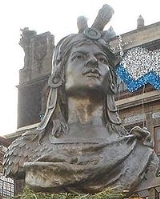
Indigenous peoples of Mexico

Encyclopedia
Mexico
, in the second article of its Constitution
, is defined as a "pluricultural" nation in recognition of the diverse ethnic groups that constitute it, and in which the indigenous peoples
are the original foundation. According to the National Commission for the Development of Indigenous Peoples
(Comisión Nacional para el Desarrollo de los Pueblos Indígenas or CDI in Spanish
) and the INEGI (official census institute), there are 10.1 million indigenous people in Mexico, of many different ethnic groups, which constitute 9.8% of the population in the country.
The indigenous peoples in Mexico have the right of free determination under the second article of the constitution. According to this article the indigenous peoples are granted:
amongst other rights. Also, the Law of Linguistic Rights of the Indigenous Languages recognizes 62 indigenous languages
as "national languages" which have the same validity as Spanish in all territories in which they are spoken. According to the National Institute of Statistics, Geography and Data Processing (INEGI), approximately 5.4% of the population speaks an indigenous language that is, approximately half of those identified as indigenous. The recognition of indigenous languages and the protection of indigenous cultures is granted not only to the ethnic groups indigenous to modern-day Mexican territory, but also to other North American indigenous groups that migrated to Mexico from the United States
in the nineteenth century and those who immigrated from Guatemala
in the 1980s.
, in reference to the cultural area in which several complex civilizations developed before the arrival of the Spanish
in the sixteenth century, and Aridoamerica
(or simply "The North") in reference to the arid region north of the Tropic of Cancer
in which few civilizations developed and was mostly inhabited by nomadic or semi-nomadic groups. Mesoamerica was densely populated by diverse indigenous ethnic groups which, although sharing common cultural characteristics, spoke different languages and developed unique civilizations.
One of the most influential civilizations that developed in Mesoamerica was the Olmec
civilization, sometimes referred to as the "Mother Culture of Mesoamerica". The later civilization in Teotihuacán
reached its peak around 600 AD, when the city became the sixth largest city in the world, whose cultural and theological systems influenced the Toltec
and Aztec
civilizations in later centuries. Evidence has been found on the existence of multiracial communities or neighborhoods in Teotihuacan (and other large urban areas like Tenochtitlan). The Maya civilization
, though also influenced by other Mesoamerican civilizations, developed a vast cultural region in south-east Mexico and northern Central America, while the Zapotec
and Mixtec
culture dominated the valley of Oaxaca
, and the Purepecha in western Mexico.
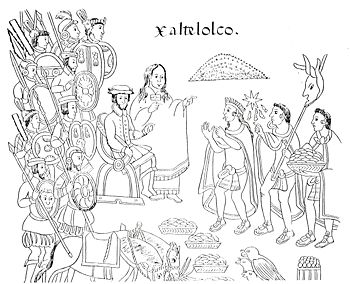 By the time of the arrival of the Spanish in Mesoamerica, many of the diverse ethnic civilizations (with the notable exception of the Tlaxcaltec
s and the Tarascan Kingdom of Michoacán
) were loosely joined under the Aztec empire, the last Nahua civilization to flourish in Central Mexico. The capital of the empire, Tenochtitlan, became one of the largest urban centers in the world, with an estimated population of 350,000 inhabitants. During the conquest of the Aztec Empire, the conquistadores, only a handful compared to the millions of indigenous peoples, used the ethnic diversity of the country and exploited the discontentment of the subjugated groups, making important alliances with rivals of the Aztecs. While the alliances were decisive to their victory, the indigenous peoples were soon subjugated by an equally impressive empire. Wars and forced labor were accompanied by the spread of European diseases previously unknown in the New World. Pandemics wrought havoc, killing between 90% and 95% of the pre-contact population according to some estimates.
At first, the colonial system imposed a system of castes, in which the indigenous peoples were marginalized. Nevertheless, a cultural symbiosis took place: the indigenous peoples adopted and syncretized Roman Catholicism, and a new ethnic group was born: the mestizo
, of mixed European and indigenous ancestry.
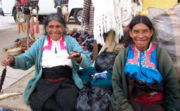 As the New Spain got independence from Spain, its citizens decided to name the new country after its capital city, Mexico City
. Mexico declared the abolition of slavery and the equality of all citizens under the law. Some indigenous individuals integrated into the Mexican society, like Benito Juárez
of Zapotec ethnicity, the first indigenous president of a country in the New World.
The greatest change, however, came about as a result of the Mexican Revolution
, a violent social and cultural movement that defined 20th century Mexico. The Revolution produced a national sentiment that the indigenous peoples were the foundation of Mexican society. Several prominent artists promoted the "Indigenous Sentiment" (sentimiento indigenista) of the country, including Frida Kahlo
, and Diego Rivera
. Throughout the twentieth century, the government established bilingual education in certain indigenous communities and published free bilingual textbooks. Some states of the federation appropriated an indigenous inheritance in order to reinforce their identity.
In spite of the official recognition of the indigenous peoples, the economic underdevelopment of the communities, accentuated by the crises of the 1980s and 1990s, has not allowed for the social and cultural development of most indigenous communities. Thousands of indigenous Mexicans have emigrated to urban centers in Mexico as well as in the United States
. In Los Angeles
, for example, the Mexican government has established electronic access to some of the consular services provided in Spanish as well as Zapotec
and Mixe. Some of the Maya peoples of Chiapas
have revolted, demanding better social and economic opportunities, requests voiced by the EZLN.
The government has made certain legislative changes to promote the development of the rural and indigenous communities and the preservation and promotion of their languages. The second article of the Constitution was modified to grant them the right of self-determination and requires state governments to promote and ensure the economic development of the indigenous communities as well as the preservation of their languages and traditions.

as "national languages" which have the same validity as Spanish in all territories in which they are spoken. According to the National Institute of Statistics, Geography and Data Processing (INEGI), approximately 5.4% of the population speaks an indigenous language that is, approximately half of those identified as indigenous. The recognition of indigenous languages and the protection of indigenous cultures is granted not only to the ethnic groups indigenous to modern-day Mexican territory, but also to other North American indigenous groups that migrated to Mexico from the United States
in the nineteenth century and those who immigrated from Guatemala
in the 1980s.
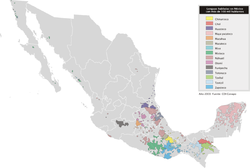
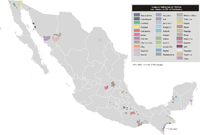
 According to the National Commission for the Development of the Indigenous Peoples (CDI) there are 9,854,301 indigenous people reported in Mexico in 2000, which constitute 9.54% of the population in the country. The CDI identifies 62 indigenous language groups in Mexico although certain languages have multiple dialects each of which is unique and may be mutually unintelligible. The majority of the indigenous population is concentrated in the central and southern states. According to the CDI, the states with the greatest percentage of indigenous population are:
¹Number of indigenous peoples that still speak their Indigenous language

1Number of indigenous peoples that still speak their Indigenous language
1Number of indigenous peoples that still speak their Indigenous language
Mexico
The United Mexican States , commonly known as Mexico , is a federal constitutional republic in North America. It is bordered on the north by the United States; on the south and west by the Pacific Ocean; on the southeast by Guatemala, Belize, and the Caribbean Sea; and on the east by the Gulf of...
, in the second article of its Constitution
Constitution of Mexico
The Political Constitution of the United Mexican States is the current constitution of Mexico. It was drafted in Santiago de Querétaro, in the State of Querétaro, by a constitutional convention, during the Mexican Revolution. It was approved by the Constitutional Congress on February 5, 1917...
, is defined as a "pluricultural" nation in recognition of the diverse ethnic groups that constitute it, and in which the indigenous peoples
Indigenous peoples
Indigenous peoples are ethnic groups that are defined as indigenous according to one of the various definitions of the term, there is no universally accepted definition but most of which carry connotations of being the "original inhabitants" of a territory....
are the original foundation. According to the National Commission for the Development of Indigenous Peoples
National Commission for the Development of Indigenous Peoples
The National Commission for the Development of Indigenous Peoples is a decentralized agency of the Mexican Federal Public Administration. It was founded in 2003 as a replacement for the National Indigenist Institute . It has its headquarters in Mexico City and, since 15 December 2006, has been...
(Comisión Nacional para el Desarrollo de los Pueblos Indígenas or CDI in Spanish
Spanish language
Spanish , also known as Castilian , is a Romance language in the Ibero-Romance group that evolved from several languages and dialects in central-northern Iberia around the 9th century and gradually spread with the expansion of the Kingdom of Castile into central and southern Iberia during the...
) and the INEGI (official census institute), there are 10.1 million indigenous people in Mexico, of many different ethnic groups, which constitute 9.8% of the population in the country.
The indigenous peoples in Mexico have the right of free determination under the second article of the constitution. According to this article the indigenous peoples are granted:
- the right to decide the internal forms of social, economic, political and cultural organization;
- the right to apply their own normative systems of regulation as long as human rights and gender equality are respected;
- the right to preserve and enrich their languages and cultures;
- the right to elect representatives before the municipal council in which their territories are located;
amongst other rights. Also, the Law of Linguistic Rights of the Indigenous Languages recognizes 62 indigenous languages
Languages of Mexico
The government of Mexico recognizes 68 distinct indigenous Amerindian languages as national languages in addition to Spanish. According to the Commission for the Development of Indigenous Peoples and National Institute of Indigenous Languages [INALI], while 10-14% of the population identifies as...
as "national languages" which have the same validity as Spanish in all territories in which they are spoken. According to the National Institute of Statistics, Geography and Data Processing (INEGI), approximately 5.4% of the population speaks an indigenous language that is, approximately half of those identified as indigenous. The recognition of indigenous languages and the protection of indigenous cultures is granted not only to the ethnic groups indigenous to modern-day Mexican territory, but also to other North American indigenous groups that migrated to Mexico from the United States
United States
The United States of America is a federal constitutional republic comprising fifty states and a federal district...
in the nineteenth century and those who immigrated from Guatemala
Guatemala
Guatemala is a country in Central America bordered by Mexico to the north and west, the Pacific Ocean to the southwest, Belize to the northeast, the Caribbean to the east, and Honduras and El Salvador to the southeast...
in the 1980s.
Pre-Columbian Civilizations
The pre-Columbian civilizations of what now is known as Mexico are usually divided in two regions: MesoamericaMesoamerica
Mesoamerica is a region and culture area in the Americas, extending approximately from central Mexico to Belize, Guatemala, El Salvador, Honduras, Nicaragua, and Costa Rica, within which a number of pre-Columbian societies flourished before the Spanish colonization of the Americas in the 15th and...
, in reference to the cultural area in which several complex civilizations developed before the arrival of the Spanish
Spanish people
The Spanish are citizens of the Kingdom of Spain. Within Spain, there are also a number of vigorous nationalisms and regionalisms, reflecting the country's complex history....
in the sixteenth century, and Aridoamerica
Aridoamerica
Aridoamerica, also known as the Gran Chichimeca, is a term used by Mexican archeologists to describe a region of the southwestern United States and the northern and central regions of Mexico, in contrast to Mesoamerica, which lies to the south and east...
(or simply "The North") in reference to the arid region north of the Tropic of Cancer
Tropic of Cancer
The Tropic of Cancer, also referred to as the Northern tropic, is the circle of latitude on the Earth that marks the most northerly position at which the Sun may appear directly overhead at its zenith...
in which few civilizations developed and was mostly inhabited by nomadic or semi-nomadic groups. Mesoamerica was densely populated by diverse indigenous ethnic groups which, although sharing common cultural characteristics, spoke different languages and developed unique civilizations.
One of the most influential civilizations that developed in Mesoamerica was the Olmec
Olmec
The Olmec were the first major Pre-Columbian civilization in Mexico. They lived in the tropical lowlands of south-central Mexico, in the modern-day states of Veracruz and Tabasco....
civilization, sometimes referred to as the "Mother Culture of Mesoamerica". The later civilization in Teotihuacán
Teotihuacán
Teotihuacan – also written Teotihuacán, with a Spanish orthographic accent on the last syllable – is an enormous archaeological site in the Basin of Mexico, just 30 miles northeast of Mexico City, containing some of the largest pyramidal structures built in the pre-Columbian Americas...
reached its peak around 600 AD, when the city became the sixth largest city in the world, whose cultural and theological systems influenced the Toltec
Toltec
The Toltec culture is an archaeological Mesoamerican culture that dominated a state centered in Tula, Hidalgo in the early post-classic period of Mesoamerican chronology...
and Aztec
Aztec
The Aztec people were certain ethnic groups of central Mexico, particularly those groups who spoke the Nahuatl language and who dominated large parts of Mesoamerica in the 14th, 15th and 16th centuries, a period referred to as the late post-classic period in Mesoamerican chronology.Aztec is the...
civilizations in later centuries. Evidence has been found on the existence of multiracial communities or neighborhoods in Teotihuacan (and other large urban areas like Tenochtitlan). The Maya civilization
Maya civilization
The Maya is a Mesoamerican civilization, noted for the only known fully developed written language of the pre-Columbian Americas, as well as for its art, architecture, and mathematical and astronomical systems. Initially established during the Pre-Classic period The Maya is a Mesoamerican...
, though also influenced by other Mesoamerican civilizations, developed a vast cultural region in south-east Mexico and northern Central America, while the Zapotec
Zapotec civilization
The Zapotec civilization was an indigenous pre-Columbian civilization that flourished in the Valley of Oaxaca of southern Mesoamerica. Archaeological evidence shows their culture goes back at least 2500 years...
and Mixtec
Mixtec
The Mixtec are indigenous Mesoamerican peoples inhabiting the Mexican states of Oaxaca, Guerrero and Puebla in a region known as La Mixteca. The Mixtecan languages form an important branch of the Otomanguean language family....
culture dominated the valley of Oaxaca
Valley of Oaxaca
The Valley of Oaxaca is a geographic region located within the modern day State of Oaxaca in southern Mexico. The valley, which is located within the Sierra Madre Mountains, is shaped like a distorted and almost upside-down “Y,” with each of its arms bearing specific names: the northwestern Etla...
, and the Purepecha in western Mexico.
Colonial Era
Tlaxcaltec
The Tlaxcalteca were an indigenous group of Nahua ethnicity that inhabited the Kingdom of Tlaxcala located in what is now the Mexican state of Tlaxcala.-Pre-hispanic history:...
s and the Tarascan Kingdom of Michoacán
Michoacán
Michoacán officially Estado Libre y Soberano de Michoacán de Ocampo is one of the 31 states which, with the Federal District, comprise the 32 Federal Entities of Mexico. It is divided in 113 municipalities and its capital city is Morelia...
) were loosely joined under the Aztec empire, the last Nahua civilization to flourish in Central Mexico. The capital of the empire, Tenochtitlan, became one of the largest urban centers in the world, with an estimated population of 350,000 inhabitants. During the conquest of the Aztec Empire, the conquistadores, only a handful compared to the millions of indigenous peoples, used the ethnic diversity of the country and exploited the discontentment of the subjugated groups, making important alliances with rivals of the Aztecs. While the alliances were decisive to their victory, the indigenous peoples were soon subjugated by an equally impressive empire. Wars and forced labor were accompanied by the spread of European diseases previously unknown in the New World. Pandemics wrought havoc, killing between 90% and 95% of the pre-contact population according to some estimates.
At first, the colonial system imposed a system of castes, in which the indigenous peoples were marginalized. Nevertheless, a cultural symbiosis took place: the indigenous peoples adopted and syncretized Roman Catholicism, and a new ethnic group was born: the mestizo
Mestizo
Mestizo is a term traditionally used in Latin America, Philippines and Spain for people of mixed European and Native American heritage or descent...
, of mixed European and indigenous ancestry.
Independence from Spain
Mexico City
Mexico City is the Federal District , capital of Mexico and seat of the federal powers of the Mexican Union. It is a federal entity within Mexico which is not part of any one of the 31 Mexican states but belongs to the federation as a whole...
. Mexico declared the abolition of slavery and the equality of all citizens under the law. Some indigenous individuals integrated into the Mexican society, like Benito Juárez
Benito Juárez
Benito Juárez born Benito Pablo Juárez García, was a Mexican lawyer and politician of Zapotec origin from Oaxaca who served five terms as president of Mexico: 1858–1861 as interim, 1861–1865, 1865–1867, 1867–1871 and 1871–1872...
of Zapotec ethnicity, the first indigenous president of a country in the New World.
The greatest change, however, came about as a result of the Mexican Revolution
Mexican Revolution
The Mexican Revolution was a major armed struggle that started in 1910, with an uprising led by Francisco I. Madero against longtime autocrat Porfirio Díaz. The Revolution was characterized by several socialist, liberal, anarchist, populist, and agrarianist movements. Over time the Revolution...
, a violent social and cultural movement that defined 20th century Mexico. The Revolution produced a national sentiment that the indigenous peoples were the foundation of Mexican society. Several prominent artists promoted the "Indigenous Sentiment" (sentimiento indigenista) of the country, including Frida Kahlo
Frida Kahlo
Frida Kahlo de Rivera was a Mexican painter, born in Coyoacán, and perhaps best known for her self-portraits....
, and Diego Rivera
Diego Rivera
Diego María de la Concepción Juan Nepomuceno Estanislao de la Rivera y Barrientos Acosta y Rodríguez was a prominent Mexican painter born in Guanajuato, Guanajuato, an active communist, and husband of Frida Kahlo . His large wall works in fresco helped establish the Mexican Mural Movement in...
. Throughout the twentieth century, the government established bilingual education in certain indigenous communities and published free bilingual textbooks. Some states of the federation appropriated an indigenous inheritance in order to reinforce their identity.
In spite of the official recognition of the indigenous peoples, the economic underdevelopment of the communities, accentuated by the crises of the 1980s and 1990s, has not allowed for the social and cultural development of most indigenous communities. Thousands of indigenous Mexicans have emigrated to urban centers in Mexico as well as in the United States
United States
The United States of America is a federal constitutional republic comprising fifty states and a federal district...
. In Los Angeles
Los Ángeles
Los Ángeles is the capital of the province of Biobío, in the commune of the same name, in Region VIII , in the center-south of Chile. It is located between the Laja and Biobío rivers. The population is 123,445 inhabitants...
, for example, the Mexican government has established electronic access to some of the consular services provided in Spanish as well as Zapotec
Zapotec language
The Zapotec language are a group of closely related indigenous Mesoamerican languages spoken by the Zapotec people from the southwestern-central highlands of Mexico. Present-day native speakers are estimated to number over half a million, with the majority inhabiting the state of Oaxaca....
and Mixe. Some of the Maya peoples of Chiapas
Chiapas
Chiapas officially Estado Libre y Soberano de Chiapas is one of the 31 states that, with the Federal District, comprise the 32 Federal Entities of Mexico. It is divided in 118 municipalities and its capital city is Tuxtla Gutierrez. Other important cites in Chiapas include San Cristóbal de las...
have revolted, demanding better social and economic opportunities, requests voiced by the EZLN.
The government has made certain legislative changes to promote the development of the rural and indigenous communities and the preservation and promotion of their languages. The second article of the Constitution was modified to grant them the right of self-determination and requires state governments to promote and ensure the economic development of the indigenous communities as well as the preservation of their languages and traditions.
Demographics
Definition
The number of indigenous Mexicans is judged using the political criteria found in the 2nd article of the Mexican constitution. The Mexican census does not report racial-ethnicity but only the political-ethnicity of indigenous communities who hold political autonomy and preserve their indigenous languages, traditions, beliefs, and cultures.Languages
The Law of Linguistic Rights of the Indigenous Languages recognizes 62 indigenous languagesLanguages of Mexico
The government of Mexico recognizes 68 distinct indigenous Amerindian languages as national languages in addition to Spanish. According to the Commission for the Development of Indigenous Peoples and National Institute of Indigenous Languages [INALI], while 10-14% of the population identifies as...
as "national languages" which have the same validity as Spanish in all territories in which they are spoken. According to the National Institute of Statistics, Geography and Data Processing (INEGI), approximately 5.4% of the population speaks an indigenous language that is, approximately half of those identified as indigenous. The recognition of indigenous languages and the protection of indigenous cultures is granted not only to the ethnic groups indigenous to modern-day Mexican territory, but also to other North American indigenous groups that migrated to Mexico from the United States
United States
The United States of America is a federal constitutional republic comprising fifty states and a federal district...
in the nineteenth century and those who immigrated from Guatemala
Guatemala
Guatemala is a country in Central America bordered by Mexico to the north and west, the Pacific Ocean to the southwest, Belize to the northeast, the Caribbean to the east, and Honduras and El Salvador to the southeast...
in the 1980s.
Statistics
- YucatánYucatánYucatán officially Estado Libre y Soberano de Yucatán is one of the 31 states which, with the Federal District, comprise the 32 Federal Entities of Mexico. It is divided in 106 municipalities and its capital city is Mérida....
, 59% - OaxacaOaxacaOaxaca , , officially Estado Libre y Soberano de Oaxaca is one of the 31 states which, along with the Federal District, comprise the 32 federative entities of Mexico. It is divided into 571 municipalities; of which 418 are governed by the system of customs and traditions...
, 48% - Quintana RooQuintana RooQuintana Roo officially Estado Libre y Soberano de Quintana Roo is one of the 31 states which, with the Federal District, comprise the 32 Federal Entities of Mexico. It is divided in 10 municipalities and its capital city is Chetumal....
, 39% - ChiapasChiapasChiapas officially Estado Libre y Soberano de Chiapas is one of the 31 states that, with the Federal District, comprise the 32 Federal Entities of Mexico. It is divided in 118 municipalities and its capital city is Tuxtla Gutierrez. Other important cites in Chiapas include San Cristóbal de las...
, 28% - CampecheCampecheCampeche is one of the 31 states which, with the Federal District, comprise the 32 Federal Entities of Mexico. Located in Southeast Mexico, it is bordered by the states of Yucatán to the north east, Quintana Roo to the east, and Tabasco to the south west...
, 27% - Hidalgo, 24%
- PueblaPueblaPuebla officially Estado Libre y Soberano de Puebla is one of the 31 states which, with the Federal District, comprise the 32 Federal Entities of Mexico. It is divided in 217 municipalities and its capital city is Puebla....
, 19% - GuerreroGuerreroGuerrero officially Estado Libre y Soberano de Guerrero is one of the 31 states which, with the Federal District, comprise the 32 Federal Entities of Mexico. It is divided in 81 municipalities and its capital city is Chilpancingo....
, 17% - San Luis PotosíSan Luis PotosíSan Luis Potosí officially Estado Libre y Soberano de San Luis Potosí is one of the 31 states which, with the Federal District, comprise the 32 Federal Entities of Mexico. It is divided in 58 municipalities and its capital city is San Luis Potosí....
, 15% - VeracruzVeracruzVeracruz, formally Veracruz de Ignacio de la Llave officially Estado Libre y Soberano de Veracruz de Ignacio de la Llave , is one of the 31 states that, along with the Federal District, comprise the 32 federative entities of Mexico. It is divided in 212 municipalities and its capital city is...
, 15%
Indigenous groups with a population of more than 100,000
| Indigenous peoples of Mexico | ||
| Group | Population | Speakers¹ |
|---|---|---|
| Nahuatl Nahuatl Nahuatl is thought to mean "a good, clear sound" This language name has several spellings, among them náhuatl , Naoatl, Nauatl, Nahuatl, Nawatl. In a back formation from the name of the language, the ethnic group of Nahuatl speakers are called Nahua... (Nawatlaka) |
2,445,969 | 1,659,029 |
| (Yucatec) Maya Maya peoples The Maya people constitute a diverse range of the Native American people of southern Mexico and northern Central America. The overarching term "Maya" is a collective designation to include the peoples of the region who share some degree of cultural and linguistic heritage; however, the term... (Maya’wiinik) |
2,475,575 | 892,723 |
| Zapotec (Binizaa) | 777,253 | 505,992 |
| Mixtec Mixtec The Mixtec are indigenous Mesoamerican peoples inhabiting the Mexican states of Oaxaca, Guerrero and Puebla in a region known as La Mixteca. The Mixtecan languages form an important branch of the Otomanguean language family.... (Tu'un savi) |
726,601 | 510,801 |
| Otomí Otomi people The Otomi people . Smaller Otomi populations exist in the states of Puebla, Mexico, Tlaxcala, Michoacán and Guanajuato. The Otomi language belonging to the Oto-Pamean branch of the Oto-Manguean language family is spoken in many different varieties some of which are not mutually intelligible.One of... (Hñähñü) |
646,875 | 327,319 |
| Totonac Totonac The Totonac people resided in the eastern coastal and mountainous regions of Mexico at the time of the Spanish arrival in 1519. Today they reside in the states of Veracruz, Puebla, and Hidalgo. They are one of the possible builders of the Pre-Columbian city of El Tajín, and further maintained... (Tachiwin) |
411,266 | 271,847 |
| Tzotzil (Batzil k'op) | 406,962 | 356,349 |
| Tzeltal Tzeltal people The Tzeltal people are the largest indigenous group mostly located in the highlands or Los Altos region of the Mexican state of Chiapas. They are one of many Mayan ethnic groups and they speak a a language which belongs to the Tzeltalan subgroup of Mayan languages... (K'op o winik atel) |
384,074 | 336,448 |
| Mazahua Mazahua The Mazahua are an indigenous people of Mexico, inhabiting the northwestern portion of the State of Mexico and northeastern area of Michoacán, with a presence also in the Federal District owing to recent migration... (Hñatho) |
326,660 | 151,897 |
| Mazateco (Ha shuta enima) | 305,836 | 246,198 |
| Huastec (Téenek) | 296,447 | 173,233 |
| Ch'ol (Winik) | 220,978 | 189,599 |
| Chinantec Chinantec The Chinantecs are an indigenous people that live in Oaxaca and Veracruz, Mexico, especially in the districts of Cuicatlán, Ixtlán de Juárez, Tuxtepec and Choapan.The Chinantec languages belong to the Chinantecan branch of the Oto-Manguean family... (Tsa jujmí) |
201,201 | 152,711 |
| Purépecha P'urhépecha The P'urhépecha, normally spelled Purépecha in Spanish and in English and traditionally referred to as Tarascans, are an indigenous people centered in the northwestern region of the Mexican state of Michoacán, principally in the area of the cities of Uruapan and Pátzcuaro... (P'urhépecha) |
202,884 | 136,388 |
| Mixe Mixe The Mixe or Mije is an indigenous group inhabiting the eastern highlands of the Mexican state of Oaxaca. They speak the Mixe languages which are classified in the Mixe–Zoque family, and are more culturally conservative than other indigenous groups of the region, maintaining their language to this... (Ayüükjä'äy) |
168,935 | 135,316 |
| Tlapanec Tlapanec people The Tlapanec people is an ethnic group indigenous to the Mexican state of Guerrero.Their language, Me'phaa, is a part of the Oto-Manguean language family. The now extinct Subtiaba language of Nicaragua was a closely related language... (Me'phaa) |
140,254 | 119,497 |
| Tarahumara Tarahumara The Rarámuri or Tarahumara are a Native American people of northwestern Mexico who are renowned for their long-distance running ability... (Rarámuri) |
121,835 | 87,721 |
| Source: CDI (2000) http://cdi.gob.mx/index.php?id_seccion=660 | ||
¹Number of indigenous peoples that still speak their Indigenous language
Indigenous groups with a population of more than 20,000 and less than 100,000
| Llengües indígenes de Mèxic | ||
| Group | Population | Speakers1 |
|---|---|---|
| Mayo Mayo people The Mayo are a Mexican indigenous people living in the states of Sonora and Sinaloa, originally living near the Mayo River in Sonora. In their own language they call themselves Yoreme.... (Yoreme) |
91,261 | 60,093 |
| Zoque Zoque The Zoque are an indigenous people of Mexico; they speak variants of the Zoque languages.This group consists of 41,609 people, according to the 2000 census... (O'de püt) |
86,589 | 34,770 |
| Chontal Maya (Yokot) | 79,438 | 43,850 |
| Popoluca Popoluca Popoluca is a Nahuatl term for various indigenous peoples of southeastern Veracruz and Oaxaca. Many of them speak languages of the Mixe–Zoque family... (Tuncápxe) |
62,306 | 44,237 |
| Chatino Chatino Chatino is the Spanish name of an indigenous people of southern central Mexico, and also of their language, the Chatino language. Chatino communities are located in the southeastern region of the state of Oaxaca. Speakers of Chatino are numbered around 23,000 , but ethnic Chatinos may number many... (Cha'cña) |
60,003 | 47,762 |
| Amuzgo Amuzgo Amuzgo is an Oto-Manguean language spoken in the Costa Chica region of the Mexican states of Guerrero and Oaxaca by about 44,000 speakers. Like other Oto-Manguean languages, Amuzgo is a tonal language. From syntactical point of view Amuzgo can be considered as an active language... (Tzañcue) |
57,666 | 48,843 |
| Tojolabal Tojolabal Tojolabal is an indigenous community in the southern part of the Mexican state of Chiapas. Tojolabales, which belongs to the Mayan group, consists of about 40,000 people concentrated near the city of Las Margaritas. They speak the Tojolabal language.... (Tojolwinik) |
54,505 | 44,531 |
| Huichol (Wixárika) | 43,929 | 36,856 |
| Tepehuan Tepehuán The Tepehuán are a Native American ethnic group in northwest Mexico, whose villages at the time of Spanish conquest spanned a large territory along the Sierra Madre Occidental from Chihuahua and Durango in the north to Jalisco in the south... (O'dami) |
37,548 | 30,339 |
| Triqui (Tinujéi) | 29,018 | 24,491 |
| Popoloca | 26,249 | 18,926 |
| Cora Cora people The Cora are an indigenous ethnic group of Western Central Mexico that live in the Sierra de Nayarit and in La Mesa de Nayar in the Mexican states of Jalisco and Nayarit. They call themselves náayarite , whence the name of the present day Mexican state of Nayarit... (Nayeeri) |
24,390 | 19,512 |
| Mame (Qyool) | 23,812 | 8,739 |
| Yaqui (Yoeme) | 23,411 | 15,053 |
| Cuicateco (Nduudu yu) | 22,984 | 15,078 |
| Huave Huave people The Huave are an indigenous people of Mexico. The autodenomination term used by the Huave themselves is Ikoots/Kunajts , or Mareños . They have inhabited the Isthmus of Tehuantepec for more than 3000 years, preceding the Zapotec people in settling the area... (Ikoods) |
20,528 | 16,135 |
| Source: CDI (2000) http://cdi.gob.mx/index.php?id_seccion=660 | ||
1Number of indigenous peoples that still speak their Indigenous language
Indigenous groups with a population of less than 20,000
| Llengües indígenes de Mèxic | ||
| Group | Population | Speakers1 |
|---|---|---|
| Tepehua (Hamasipini) | 16,051 | 10,625 |
| Kanjobal (K'anjobal) | 12,974 | 10,833 |
| Chontal de Oaxaca (Slijuala sihanuk) | 12,663 | 5,534 |
| Pame Pame The Pame are an indigenous people of central Mexico living in the state of San Luis Potosí. They call themselves Xi'úi. They speak the Pame language, which belongs to the Oto-Pamean group of the Oto-Manguean language family.... (Xigüe) |
12,572 | 9,768 |
| Chichimeca Jonaz Chichimeca Jonaz The Chichimeca Jonaz are a group of indigenous people living in Guanajuato and San Luis Potosí. In Guanajuato State the Chichimeca Jonaz people live in a community of San Luis de la Paz municipality. The settlement is 2,070 m above sea level... (Uza) |
3,169 | 1,987 |
| Guarijío (Makurawe) | 2,844 | 1,905 |
| Chuj Chuj people The Chuj are a Maya people in Guatemala and Mexico. Their indigenous language is also called Chuj and belongs to the Q'anjobalan–Chujean family of Mayan languages. In Guatemala, most Chuj live in the department of Huehuetenango in the municipalities of San Mateo Ixtatán and San Sebastián Coatán.... |
2,719 | 2,143 |
| Chocho Chocho people The Chochos are an indigenous people of the Mexican state of Oaxaca.-Language:Their traditional language, Chocho, is a member of the Popolocan branch of the Oto-Manguean language family. , it had 770 speakers. Chochos also speak Spanish, the dominant language of Mexico.The Chocho name for... (Runixa ngiigua) |
2,592 | 1,078 |
| Tacuate Tacuate The Tacuate are an indigenous people who live in the state of Oaxaca in Mexico.They speak a variant of the Mixtec language.As of 1992, there were about 6,000 speakers of the Tacuate dialect, of whom less than 20% were monolingual.... |
2,379 | 2,067 |
| Ocuiltec (Tlahuica) | 1,759 | 522 |
| Pima Bajo Pima Bajo Pima Bajo is a Mexican indigenous language of the Piman branch of the Uto-Aztecan language family, spoken by around 1000 speakers in northern Mexico. The language is called O'ob No'ok by its speakers... |
1,540 | 836 |
| Jacaltec Jakaltek language The Jakaltek language is a Mayan language of Guatemala spoken by around 90,000 Jakaltek people in the department of Huehuetenango and the adjoining part of Chiapas in southern Mexico... (Abxubal) |
1,478 | 584 |
| Kekchí Q'eqchi' people Q'eqchi are one of the Maya peoples in Guatemala and Belize, whose indigenous language is also called Q'eqchi'.... (K'ekchí) |
987 | 835 |
| Lacandon (Hach t'an) | 896 | 731 |
| Ixcatec | 816 | 406 |
| Seri (Comcáac) | 716 | 518 |
| K'iche' (Quiché, Q'iché) | 524 | 286 |
| Motocintleco (Qatok) | 692 | 186 |
| Kaqchikel (K'akchikel) | 675 | 230 |
| Paipai Paipai The Paipai are an aboriginal people of northern Baja California, Mexico. They occupied a territory lying between the Kiliwa on the south and the Kumeyaay and Cocopa on the north, and extending from San Vicente near the Pacific coast nearly to the Colorado River's delta in the east... (Akwa'ala) |
418 | 221 |
| Tohono O'odham Tohono O'odham The Tohono O'odham are a group of Native American people who reside primarily in the Sonoran Desert of the southeastern Arizona and northwest Mexico... (Papago) |
363 | 153 |
| Cucapá (Es péi) | 344 | 206 |
| Kumiai (Ti'pai) | 328 | 185 |
| Kikapú (Kikapooa) | 251 | 144 |
| Cochimi Cochimi The Cochimí are the aboriginal inhabitants of the central part of the Baja California peninsula, from El Rosario in the north to San Javier in the south.... (Laymón, mti'pá) |
226 | 96 |
| Ixil Ixil people Ixil is the name of a Mayan people in Guatemala. The Ixil live in three municipalities in the Cuchumatanes mountains in the northern part of the department El Quiché... |
224 | 108 |
| Kiliwa Kiliwa The Kiliwa are an aboriginal people of northern Baja California, Mexico. They occupied a territory lying between the Cochimí on the south and the Paipai on the north, and extending from San Felipe on the Gulf of California to San Quintín on the Pacific coast... (Ko'lew) |
107 | 55 |
| Aguacatec | 59 | 27 |
| Other groups2 | 728 | 337 |
2 Includes Opata, Soltec and Papabuco |
||
| Source: CDI (2000) http://cdi.gob.mx/index.php?id_seccion=660 | ||
1Number of indigenous peoples that still speak their Indigenous language
External links
- Comision Nacional para el Desarrollo de los Pueblos Indigenas
- Consejo Nacional de Poblacion
- Instituto Nacional de Estadistica y Geografia
- Mexico and Southwest USA – Native Y-DNA Project
- Archivo de Lenguas Indígenas de México (El Colegio de México)
- Virtual museum of the indigineous languages of Mexico