

Quinoa

Encyclopedia
Quinoa a species of goosefoot (Chenopodium
), is a grain-like crop
grown primarily for its edible seed
s. It is a pseudocereal
rather than a true cereal
, or grain, as it is not a member of the grass family
. As a chenopod
, quinoa is closely related to species such as beet
s, spinach
, and tumbleweed
s.
spelling of the Quechua
name kinwa or occasionally "Qin-wah", Quinoa originated in the Andean
region of Ecuador
, Bolivia
, Colombia
and Peru
before they were colonized and became nation-states, where it was successfully domesticated 3000 to 4000 years ago for human consumption, though archeological evidence shows a non-domesticated association with pastoral herding some 5200 to 7000 years ago.
Similar Chenopodium species, such as pitseed goosefoot (Chenopodium berlandieri
) and fat hen (Chenopodium album
), were grown and domesticated in North America as part of the Eastern Agricultural Complex
before maize
agriculture became popular. Fat hen, which has a widespread distribution in the Northern Hemisphere
, produces edible seeds and greens much like quinoa, but in smaller quantities.
The nutrient composition is very good compared with common cereals. Quinoa grains contain essential amino acids like lysine
and good quantities of calcium, phosphorus, and iron.
After harvest, the grains need to be processed to remove the coating containing the bitter-tasting saponin
s. Quinoa grains are in general cooked the same way as rice and can be used in a wide range of dishes. Quinoa leaves are also eaten as a leaf vegetable
, much like amaranth
, but the commercial availability of quinoa greens is limited.
, the Spanish colonists scorned quinoa as 'food for Indians', and even actively suppressed its cultivation, due to its status within indigenous non-Christian
ceremonies. In fact, the conquistadores forbade quinoa cultivation for a time and the Incas were forced to grow wheat instead.
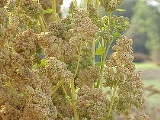
ous, annual plant usually about 1–2 m high. It has broad, generally pubescent, powdery, smooth (rarely) to lobed leafs normally arranged alternately. The woody central stem
is either branched or unbranched depending on the variety and may be green, red or purple. The panicles arise either from the top of the plant or from axils on the stem. The panicles have a central axis from which a secondary axis emerges either with flowers (amaranthiform), or bearing a tertiary axis carrying the flowers (glomeruliform). The green, hypogynous
flowers have a simple perianth
and are generally bisexual and self-fertilizing. The fruits are about 2 mm in diameter and of various colours — from white to red or black depending on the cultivar
.
It is grown from coastal regions (Chile) to over 4000 m (13,120 ft) in the Andes near the equator. However, most of the cultivars are grown between 2500 m and 4000 m.
Depending on the variety, Quinoa's optimal growing conditions are in cool climates with temperatures that range from 25°F/−3°C, during the night, to below 95°F/35°C, during the day. Some cultivars can also withstand lower temperatures without damage. Light frosts normally don’t affect the plants at any stage of development except during flowering. Mid-summer frosts often occurring in the Andes during flowering led to sterilization of the pollen. Rainfall conditions are highly variable between the different cultivars, ranging from 300 to 1000 mm during growing season. Optimal for Quinoa growth is well-distributed rainfall during early growth and development and dry conditions during seed maturation and harvesting.
The seedbed
must be well prepared and drained to avoid waterlogging. Normally in the Andes, Quinoa seeds are broadcast over land and raked into the soil. Sometimes it is sown in narrow, shallow soils.
N/acre are available. The addition of phosphorus does not improve yield. In eastern North America, it is susceptible to a leaf miner that may reduce crop success; this leaf miner
also affects the common weed and close relative Chenopodium album
, but C. album is much more resistant.
Handling involves threshing the seedheads and winnowing the seed to remove the husk
. Before storage, the seeds need to be dried in order to avoid germination
.
Andean civilizations, secondary only to the potato
, and was followed in importance by maize
. In contemporary times, this crop has become highly appreciated for its nutritional value, as its protein
content is very high (12%–18%). Unlike wheat
or rice
(which are low in lysine
), and like oats
, quinoa contains a balanced set of essential amino acid
s for humans, making it a complete protein
source, unusual among plant foods. It is a good source of dietary fiber
and phosphorus and is high in magnesium and iron. Quinoa is gluten
-free and considered easy to digest. Because of all these characteristics, quinoa is being considered a possible crop in NASA's Controlled Ecological Life Support System
for long-duration manned spaceflights.
s, making it unpalatable. Most quinoa sold commercially in North America has been processed to remove this coating. This bitterness has beneficial effects during cultivation, as the plant is unpopular with birds and thus requires minimal protection. There have been attempts to lower the saponin content of Quinoa through selective breeding to produce sweeter, more palatable varieties that have proven difficult due to cross pollination contamination.
The toxicity category rating
of Quinoa saponins are classified as a mild eye and respiratory irritant and a low gastrointestinal irritant. The saponin is a toxic glycoside
, a main contributor to its hemolytic
effects when combined directly with blood cells. In South America, Quinoa saponin has many uses outside of consumption, which includes detergent for clothing and washing, and as an antiseptic for skin injuries. High levels of oxalic acid
in the leaves and stems are found in all species of the Chenopodium
genus, but are also present in the related plant families of Polygonaceae
and Amaranthaceae
. The risks associated with quinoa are minimal, provided it is properly prepared and leaves are not eaten to excess.
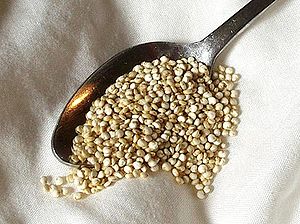 Quinoa has a light, fluffy texture when cooked, and its mild, slightly nutty flavor makes it an alternative to white rice
or couscous
.
Most boxed/pre-packaged quinoa has already been pre-rinsed for convenience, and cooking instructions therefore suggest only a brief rinse before cooking, if at all. If quinoa has not been pre-rinsed, the first step is to remove the saponin
s, a process that requires either soaking the grain in water for a few hours, then changing the water and resoaking, or rinsing the quinoa in ample running water for several minutes in either a fine strainer or a cheesecloth
. Removal of the saponin helps with digestion; the soapy nature of the compound makes it act as a laxative.
One cooking method is to treat quinoa much like rice, bringing two cups (or less) of water to a boil with one cup of grain, covering at a low simmer and cooking for 10–15 minutes or until the germ separates from the seed. The cooked germ looks like a tiny curl and should have a slight bite to it (like al dente
pasta). As an alternative, one can use a rice cooker
to prepare quinoa, treating it just like white rice (for both cooking cycle and water amounts).
Vegetables and seasonings can also be added to make a wide range of dishes. Chicken or vegetable stock can be substituted for water during cooking, adding flavor. It is also suited to vegetable pilaf
s, complementing bitter greens like kale
.
Quinoa can serve as a high-protein breakfast food
mixed with honey
, almonds, or berries; it is also sold as a dry product, much like corn flakes
. Quinoa flour can be used in wheat-based and gluten-free baking.
Quinoa may be germinated in its raw form to boost its nutritional value. Germination
activates its natural enzymes and multiplies its vitamin content. In fact, quinoa has a notably short germination period: Only 2–4 hours resting in a glass of clean water is enough to make it sprout and release gases, as opposed to, e.g., 12 hours with wheat. This process, besides its nutritional enhancements, softens the grains, making them suitable to be added to salads and other cold foods.
Chenopodium
Chenopodium is a genus of about 150 species of perennial or annual herbaceous flowering plants known as the goosefoots, which occur almost anywhere in the world. It is placed in the family Amaranthaceae in the APG II system; older classifications separate it and its relatives as Chenopodiaceae, but...
), is a grain-like crop
Agriculture
Agriculture is the cultivation of animals, plants, fungi and other life forms for food, fiber, and other products used to sustain life. Agriculture was the key implement in the rise of sedentary human civilization, whereby farming of domesticated species created food surpluses that nurtured the...
grown primarily for its edible seed
Seed
A seed is a small embryonic plant enclosed in a covering called the seed coat, usually with some stored food. It is the product of the ripened ovule of gymnosperm and angiosperm plants which occurs after fertilization and some growth within the mother plant...
s. It is a pseudocereal
Pseudocereal
Pseudocereals are broadleaf plants that are used in much the same way as cereals . Their seed can be ground into flour and otherwise used as cereals. Examples of pseudocereals are amaranth, Love-lies-bleeding, red amaranth, Prince-of-Wales-feather, quinoa, and buckwheat.- Pseudocereals :...
rather than a true cereal
Cereal
Cereals are grasses cultivated for the edible components of their grain , composed of the endosperm, germ, and bran...
, or grain, as it is not a member of the grass family
Poaceae
The Poaceae is a large and nearly ubiquitous family of flowering plants. Members of this family are commonly called grasses, although the term "grass" is also applied to plants that are not in the Poaceae lineage, including the rushes and sedges...
. As a chenopod
Chenopodioideae
The Chenopodioideae is a subfamily of the flowering plant family Amaranthaceae, formerly classified in family Chenopodiaceae.Food species include several Chenopodium species , Orache , and Spinach .-Genera:The subfamily includes about 25 genera.* Tribus Atripliceae C. A...
, quinoa is closely related to species such as beet
Beet
The beet is a plant in the Chenopodiaceae family which is now included in Amaranthaceae family. It is best known in its numerous cultivated varieties, the most well known of which is the purple root vegetable known as the beetroot or garden beet...
s, spinach
Spinach
Spinach is an edible flowering plant in the family of Amaranthaceae. It is native to central and southwestern Asia. It is an annual plant , which grows to a height of up to 30 cm. Spinach may survive over winter in temperate regions...
, and tumbleweed
Tumbleweed
A tumbleweed is the above-ground part of a plant that, once mature and dry, disengages from the root and tumbles away in the wind. Usually, the tumbleweed is the entire plant apart from the roots, but in a few species it is a flower cluster. The tumbleweed habit is most common in steppe and desert...
s.
Overview
Derived from the SpanishSpanish language
Spanish , also known as Castilian , is a Romance language in the Ibero-Romance group that evolved from several languages and dialects in central-northern Iberia around the 9th century and gradually spread with the expansion of the Kingdom of Castile into central and southern Iberia during the...
spelling of the Quechua
Quechua languages
Quechua is a Native South American language family and dialect cluster spoken primarily in the Andes of South America, derived from an original common ancestor language, Proto-Quechua. It is the most widely spoken language family of the indigenous peoples of the Americas, with a total of probably...
name kinwa or occasionally "Qin-wah", Quinoa originated in the Andean
Andes
The Andes is the world's longest continental mountain range. It is a continual range of highlands along the western coast of South America. This range is about long, about to wide , and of an average height of about .Along its length, the Andes is split into several ranges, which are separated...
region of Ecuador
Ecuador
Ecuador , officially the Republic of Ecuador is a representative democratic republic in South America, bordered by Colombia on the north, Peru on the east and south, and by the Pacific Ocean to the west. It is one of only two countries in South America, along with Chile, that do not have a border...
, Bolivia
Bolivia
Bolivia officially known as Plurinational State of Bolivia , is a landlocked country in central South America. It is the poorest country in South America...
, Colombia
Colombia
Colombia, officially the Republic of Colombia , is a unitary constitutional republic comprising thirty-two departments. The country is located in northwestern South America, bordered to the east by Venezuela and Brazil; to the south by Ecuador and Peru; to the north by the Caribbean Sea; to the...
and Peru
Peru
Peru , officially the Republic of Peru , is a country in western South America. It is bordered on the north by Ecuador and Colombia, on the east by Brazil, on the southeast by Bolivia, on the south by Chile, and on the west by the Pacific Ocean....
before they were colonized and became nation-states, where it was successfully domesticated 3000 to 4000 years ago for human consumption, though archeological evidence shows a non-domesticated association with pastoral herding some 5200 to 7000 years ago.
Similar Chenopodium species, such as pitseed goosefoot (Chenopodium berlandieri
Chenopodium berlandieri
Chenopodium berlandieri, also known by the common names pitseed goosefoot, huauzontle, and lambsquarters, is an annual herbaceous plant in the goosefoot family....
) and fat hen (Chenopodium album
Chenopodium album
Chenopodium album is a fast-growing weedy annual plant in the genus Chenopodium.Though cultivated in some regions, the plant is elsewhere considered a weed...
), were grown and domesticated in North America as part of the Eastern Agricultural Complex
Eastern Agricultural Complex
The Eastern Agricultural Complex describes the agricultural practices of the pre-historic Eastern Woodland Native Americans in the eastern United States and Canada. Native Americans domesticated and cultivated many indigenous crops as far west as the Great Plains.-Term:The term Eastern Agricultural...
before maize
Maize
Maize known in many English-speaking countries as corn or mielie/mealie, is a grain domesticated by indigenous peoples in Mesoamerica in prehistoric times. The leafy stalk produces ears which contain seeds called kernels. Though technically a grain, maize kernels are used in cooking as a vegetable...
agriculture became popular. Fat hen, which has a widespread distribution in the Northern Hemisphere
Northern Hemisphere
The Northern Hemisphere is the half of a planet that is north of its equator—the word hemisphere literally means “half sphere”. It is also that half of the celestial sphere north of the celestial equator...
, produces edible seeds and greens much like quinoa, but in smaller quantities.
The nutrient composition is very good compared with common cereals. Quinoa grains contain essential amino acids like lysine
Lysine
Lysine is an α-amino acid with the chemical formula HO2CCH4NH2. It is an essential amino acid, which means that the human body cannot synthesize it. Its codons are AAA and AAG....
and good quantities of calcium, phosphorus, and iron.
After harvest, the grains need to be processed to remove the coating containing the bitter-tasting saponin
Saponin
Saponins are a class of chemical compounds, one of many secondary metabolites found in natural sources, with saponins found in particular abundance in various plant species...
s. Quinoa grains are in general cooked the same way as rice and can be used in a wide range of dishes. Quinoa leaves are also eaten as a leaf vegetable
Leaf vegetable
Leaf vegetables, also called potherbs, green vegetables, greens, leafy greens or salad greens, are plant leaves eaten as a vegetable, sometimes accompanied by tender petioles and shoots...
, much like amaranth
Amaranth
Amaranthus, collectively known as amaranth, is a cosmopolitan genus of herbs. Approximately 60 species are recognized, with inflorescences and foliage ranging from purple and red to gold...
, but the commercial availability of quinoa greens is limited.
Natural distribution
Chenopodium quinoa (and a related species from Mexico, Chenopodium nuttalliae) is believed to have been domesticated in the Peruvian Andes from wild populations of Chenopodium quinoa. There are non-cultivated quinoa plants (Chenopodium quinoa var. melanospermum), which grow in the same area where it is cultivated; it is presumed that those are related to quinoa's wild predecessors, but they could instead be descendants of cultivated plants.History and culture
The Incas, who held the crop to be sacred, referred to quinoa as chisaya mama or 'mother of all grains', and it was the Inca emperor who would traditionally sow the first seeds of the season using 'golden implements'. During the European conquest of South AmericaConquistador
Conquistadors were Spanish soldiers, explorers, and adventurers who brought much of the Americas under the control of Spain in the 15th to 16th centuries, following Europe's discovery of the New World by Christopher Columbus in 1492...
, the Spanish colonists scorned quinoa as 'food for Indians', and even actively suppressed its cultivation, due to its status within indigenous non-Christian
Christian
A Christian is a person who adheres to Christianity, an Abrahamic, monotheistic religion based on the life and teachings of Jesus of Nazareth as recorded in the Canonical gospels and the letters of the New Testament...
ceremonies. In fact, the conquistadores forbade quinoa cultivation for a time and the Incas were forced to grow wheat instead.
Biology
Quinoa is a dicotyledonDicotyledon
The dicotyledons, also known as dicots, are a group of flowering plants whose seed typically has two embryonic leaves or cotyledons. There are around 199,350 species within this group...
ous, annual plant usually about 1–2 m high. It has broad, generally pubescent, powdery, smooth (rarely) to lobed leafs normally arranged alternately. The woody central stem
Plant stem
A stem is one of two main structural axes of a vascular plant. The stem is normally divided into nodes and internodes, the nodes hold buds which grow into one or more leaves, inflorescence , conifer cones, roots, other stems etc. The internodes distance one node from another...
is either branched or unbranched depending on the variety and may be green, red or purple. The panicles arise either from the top of the plant or from axils on the stem. The panicles have a central axis from which a secondary axis emerges either with flowers (amaranthiform), or bearing a tertiary axis carrying the flowers (glomeruliform). The green, hypogynous
Ovary (plants)
In the flowering plants, an ovary is a part of the female reproductive organ of the flower or gynoecium. Specifically, it is the part of the pistil which holds the ovule and is located above or below or at the point of connection with the base of the petals and sepals...
flowers have a simple perianth
Petal
Petals are modified leaves that surround the reproductive parts of flowers. They often are brightly colored or unusually shaped to attract pollinators. Together, all of the petals of a flower are called a corolla. Petals are usually accompanied by another set of special leaves called sepals lying...
and are generally bisexual and self-fertilizing. The fruits are about 2 mm in diameter and of various colours — from white to red or black depending on the cultivar
Cultivar
A cultivar'Cultivar has two meanings as explained under Formal definition. When used in reference to a taxon, the word does not apply to an individual plant but to all those plants sharing the unique characteristics that define the cultivar. is a plant or group of plants selected for desirable...
.
Climate requirements
Quinoa is highly variable due to a high complexity of different subspecies, varieties and landraces. However, in general it is undemanding and altitude-hardy.It is grown from coastal regions (Chile) to over 4000 m (13,120 ft) in the Andes near the equator. However, most of the cultivars are grown between 2500 m and 4000 m.
Depending on the variety, Quinoa's optimal growing conditions are in cool climates with temperatures that range from 25°F/−3°C, during the night, to below 95°F/35°C, during the day. Some cultivars can also withstand lower temperatures without damage. Light frosts normally don’t affect the plants at any stage of development except during flowering. Mid-summer frosts often occurring in the Andes during flowering led to sterilization of the pollen. Rainfall conditions are highly variable between the different cultivars, ranging from 300 to 1000 mm during growing season. Optimal for Quinoa growth is well-distributed rainfall during early growth and development and dry conditions during seed maturation and harvesting.
Soil requirements
Quinoa does best in sandy, well-drained soils with a low nutrient content, moderate salinity, and a soil pH of 6 to 8.5.Sowing
| World Quinoa Production – 2009 (thousand metric ton) |
|
|---|---|
| 40.0 | |
| 28.3 | |
| 0.7 | |
| World Total | 69.0 |
| Source: UN Food & Agriculture Organisation (FAO) Current figures from FAO | |
The seedbed
Seedbed
A seedbed or seedling bed is the local soil environment in which seeds are planted. Often it comprises not only the soil but also a specially prepared cold frame, hotbed or raised bed used to grow the seedlings in a controlled environment into larger young plants before transplanting them into a...
must be well prepared and drained to avoid waterlogging. Normally in the Andes, Quinoa seeds are broadcast over land and raked into the soil. Sometimes it is sown in narrow, shallow soils.
Cultivation management
Yields are maximised when 150 to 180 lbsPound (mass)
The pound or pound-mass is a unit of mass used in the Imperial, United States customary and other systems of measurement...
N/acre are available. The addition of phosphorus does not improve yield. In eastern North America, it is susceptible to a leaf miner that may reduce crop success; this leaf miner
Leaf miner
Leaf miner is a term used to describe the larvae of many different species of insect which live in and eat the leaf tissue of plants. The vast majority of leaf-mining insects are moths , sawflies and flies , though some beetles and wasps also exhibit this behavior.Like Woodboring beetles, leaf...
also affects the common weed and close relative Chenopodium album
Chenopodium album
Chenopodium album is a fast-growing weedy annual plant in the genus Chenopodium.Though cultivated in some regions, the plant is elsewhere considered a weed...
, but C. album is much more resistant.
Harvesting and handling
Harvesting is usually up until now mainly done by hand and rarely by machine, because of the extremely variable periods of maturity of native Quinoas, which increases difficulty of mechanization. So, an exact timing of harvest is important in order to avoid a high loss of grains due to shattering. However, the exact harvesting time is difficult to determine because panicles of the same plant mature at different times. The grain yield reaches comparable dimensions (often around 3 t/ha up to 5 t/ha) to wheat yields in the Andean areas.Handling involves threshing the seedheads and winnowing the seed to remove the husk
Husk
Husk in botany is the outer shell or coating of a seed. It often refers to the leafy outer covering of an ear of maize as it grows on the plant. Literally, a husk or hull includes the protective outer covering of a seed, fruit or vegetable...
. Before storage, the seeds need to be dried in order to avoid germination
Germination
Germination is the process in which a plant or fungus emerges from a seed or spore, respectively, and begins growth. The most common example of germination is the sprouting of a seedling from a seed of an angiosperm or gymnosperm. However the growth of a sporeling from a spore, for example the...
.
Nutritional value
Quinoa was of great nutritional importance in pre-ColumbianPre-Columbian era
The pre-Columbian era incorporates all period subdivisions in the history and prehistory of the Americas before the appearance of significant European influences on the American continents, spanning the time of the original settlement in the Upper Paleolithic period to European colonization during...
Andean civilizations, secondary only to the potato
Potato
The potato is a starchy, tuberous crop from the perennial Solanum tuberosum of the Solanaceae family . The word potato may refer to the plant itself as well as the edible tuber. In the region of the Andes, there are some other closely related cultivated potato species...
, and was followed in importance by maize
Maize
Maize known in many English-speaking countries as corn or mielie/mealie, is a grain domesticated by indigenous peoples in Mesoamerica in prehistoric times. The leafy stalk produces ears which contain seeds called kernels. Though technically a grain, maize kernels are used in cooking as a vegetable...
. In contemporary times, this crop has become highly appreciated for its nutritional value, as its protein
Protein
Proteins are biochemical compounds consisting of one or more polypeptides typically folded into a globular or fibrous form, facilitating a biological function. A polypeptide is a single linear polymer chain of amino acids bonded together by peptide bonds between the carboxyl and amino groups of...
content is very high (12%–18%). Unlike wheat
Wheat
Wheat is a cereal grain, originally from the Levant region of the Near East, but now cultivated worldwide. In 2007 world production of wheat was 607 million tons, making it the third most-produced cereal after maize and rice...
or rice
Rice
Rice is the seed of the monocot plants Oryza sativa or Oryza glaberrima . As a cereal grain, it is the most important staple food for a large part of the world's human population, especially in East Asia, Southeast Asia, South Asia, the Middle East, and the West Indies...
(which are low in lysine
Lysine
Lysine is an α-amino acid with the chemical formula HO2CCH4NH2. It is an essential amino acid, which means that the human body cannot synthesize it. Its codons are AAA and AAG....
), and like oats
OATS
OATS - Open Source Assistive Technology Software - is a source code repository or "forge" for assistive technology software. It was launched in 2006 with the goal to provide a one-stop “shop” for end users, clinicians and open-source developers to promote and develop open source assistive...
, quinoa contains a balanced set of essential amino acid
Essential amino acid
An essential amino acid or indispensable amino acid is an amino acid that cannot be synthesized de novo by the organism , and therefore must be supplied in the diet.-Essentiality vs. conditional essentiality in humans:...
s for humans, making it a complete protein
Complete protein
A complete protein is a source of protein that contains an adequate proportion of all nine of the essential amino acids necessary for the dietary needs of humans or other animals...
source, unusual among plant foods. It is a good source of dietary fiber
Dietary fiber
Dietary fiber, dietary fibre, or sometimes roughage is the indigestible portion of plant foods having two main components:* soluble fiber that is readily fermented in the colon into gases and physiologically active byproducts, and* insoluble fiber that is metabolically inert, absorbing water as it...
and phosphorus and is high in magnesium and iron. Quinoa is gluten
Gluten
Gluten is a protein composite found in foods processed from wheat and related grain species, including barley and rye...
-free and considered easy to digest. Because of all these characteristics, quinoa is being considered a possible crop in NASA's Controlled Ecological Life Support System
Controlled Ecological Life Support System
Controlled Ecological Life Support Systems are a type of scientific endeavor to create a self-supporting life support system for space stations and colonies typically through controlled closed ecological systems, such as the BioHome, BIOS-3 and Biosphere 2.-Original concept:CELSS was first...
for long-duration manned spaceflights.
Saponin content
Quinoa in its natural state has a coating of bitter-tasting saponinSaponin
Saponins are a class of chemical compounds, one of many secondary metabolites found in natural sources, with saponins found in particular abundance in various plant species...
s, making it unpalatable. Most quinoa sold commercially in North America has been processed to remove this coating. This bitterness has beneficial effects during cultivation, as the plant is unpopular with birds and thus requires minimal protection. There have been attempts to lower the saponin content of Quinoa through selective breeding to produce sweeter, more palatable varieties that have proven difficult due to cross pollination contamination.
The toxicity category rating
Toxicity category rating
Section 156.62 of Title 40 of the Code of Federal Regulations establishes four Toxicity Categories for acute hazards of pesticide products, Category I being the highest toxicity category. Most human hazard, precautionary statements, and human personal protective equipment statements are based upon...
of Quinoa saponins are classified as a mild eye and respiratory irritant and a low gastrointestinal irritant. The saponin is a toxic glycoside
Glycoside
In chemistry, a glycoside is a molecule in which a sugar is bound to a non-carbohydrate moiety, usually a small organic molecule. Glycosides play numerous important roles in living organisms. Many plants store chemicals in the form of inactive glycosides. These can be activated by enzyme...
, a main contributor to its hemolytic
Hemolysis
Hemolysis —from the Greek meaning "blood" and meaning a "loosing", "setting free" or "releasing"—is the rupturing of erythrocytes and the release of their contents into surrounding fluid...
effects when combined directly with blood cells. In South America, Quinoa saponin has many uses outside of consumption, which includes detergent for clothing and washing, and as an antiseptic for skin injuries. High levels of oxalic acid
Oxalic acid
Oxalic acid is an organic compound with the formula H2C2O4. This colourless solid is a dicarboxylic acid. In terms of acid strength, it is about 3,000 times stronger than acetic acid. Oxalic acid is a reducing agent and its conjugate base, known as oxalate , is a chelating agent for metal cations...
in the leaves and stems are found in all species of the Chenopodium
Chenopodium
Chenopodium is a genus of about 150 species of perennial or annual herbaceous flowering plants known as the goosefoots, which occur almost anywhere in the world. It is placed in the family Amaranthaceae in the APG II system; older classifications separate it and its relatives as Chenopodiaceae, but...
genus, but are also present in the related plant families of Polygonaceae
Polygonaceae
Polygonaceae is a family of flowering plants known informally as the "knotweed family" or "smartweed family"— "buckwheat family" in the United States. The name is based on the genus Polygonum and was first used by Antoine Laurent de Jussieu in 1789 in his book, Genera Plantarum. The name refers...
and Amaranthaceae
Amaranthaceae
The flowering plant family Amaranthaceae, the Amaranth family, contains about 176 genera and 2,400 species.- Description :Most of these species are herbs or subshrubs; very few are trees or climbers. Some species are succulent....
. The risks associated with quinoa are minimal, provided it is properly prepared and leaves are not eaten to excess.
Preparation
White rice
White rice is the name given to milled rice that has had its husk, bran, and germ removed. This alters the flavour, texture and appearance of the rice and helps prevent spoilage and extend its storage life. After milling, the rice is polished, resulting in a seed with a bright, white, shiny...
or couscous
Couscous
Couscous is a Berber dish of semolina traditionally served with a meat or vegetable stew spooned over it. Couscous is a staple food throughout Algeria, Morocco and Tunisia.-Etymology:...
.
Most boxed/pre-packaged quinoa has already been pre-rinsed for convenience, and cooking instructions therefore suggest only a brief rinse before cooking, if at all. If quinoa has not been pre-rinsed, the first step is to remove the saponin
Saponin
Saponins are a class of chemical compounds, one of many secondary metabolites found in natural sources, with saponins found in particular abundance in various plant species...
s, a process that requires either soaking the grain in water for a few hours, then changing the water and resoaking, or rinsing the quinoa in ample running water for several minutes in either a fine strainer or a cheesecloth
Cheesecloth
Cheesecloth is a loosewoven gauze-like cotton cloth used primarily in cheese making and cooking.Cheesecloth is available in at least seven different grades, from open to extra-fine weave. Grades are distinguished by the number of threads per inch in each direction.- Uses :The primary use of...
. Removal of the saponin helps with digestion; the soapy nature of the compound makes it act as a laxative.
One cooking method is to treat quinoa much like rice, bringing two cups (or less) of water to a boil with one cup of grain, covering at a low simmer and cooking for 10–15 minutes or until the germ separates from the seed. The cooked germ looks like a tiny curl and should have a slight bite to it (like al dente
Al dente
In cooking, the Italian expression al dente describes pasta and rice or beansthat have been cooked so as to be firm but not hard. "Al dente" also describes vegetables that are cooked to the "tender crisp" phase - still offering resistance to the bite, but cooked through...
pasta). As an alternative, one can use a rice cooker
Rice cooker
A rice cooker or rice steamer is a container or kitchen appliance dedicated to cooking rice. Rice can also be cooked in general-purpose saucepans.-Overview:...
to prepare quinoa, treating it just like white rice (for both cooking cycle and water amounts).
Vegetables and seasonings can also be added to make a wide range of dishes. Chicken or vegetable stock can be substituted for water during cooking, adding flavor. It is also suited to vegetable pilaf
Pilaf
Pilaf is a dish in which rice is cooked in a seasoned broth . In some cases, the rice may also attain its brown color by being stirred with bits of cooked onion, as well as a large mix of spices...
s, complementing bitter greens like kale
Kale
Kale is very high in beta carotene, vitamin K, vitamin C, lutein, zeaxanthin, and reasonably rich in calcium. Kale, as with broccoli and other brassicas, contains sulforaphane , a chemical with potent anti-cancer properties. Boiling decreases the level of sulforaphane; however, steaming,...
.
Quinoa can serve as a high-protein breakfast food
Breakfast cereal
A breakfast cereal is a food made from processed grains that is often, but not always, eaten with the first meal of the day. It is often eaten cold, usually mixed with milk , water, or yogurt, and sometimes fruit but sometimes eaten dry. Some cereals, such as oatmeal, may be served hot as porridge...
mixed with honey
Honey
Honey is a sweet food made by bees using nectar from flowers. The variety produced by honey bees is the one most commonly referred to and is the type of honey collected by beekeepers and consumed by humans...
, almonds, or berries; it is also sold as a dry product, much like corn flakes
Corn flakes
Corn flakes are a popular breakfast cereal originally manufactured by Kellogg's through the treatment of maize. A patent for the product was filed on May 31, 1895, and issued on April 14, 1896.-History:...
. Quinoa flour can be used in wheat-based and gluten-free baking.
Quinoa may be germinated in its raw form to boost its nutritional value. Germination
Germination
Germination is the process in which a plant or fungus emerges from a seed or spore, respectively, and begins growth. The most common example of germination is the sprouting of a seedling from a seed of an angiosperm or gymnosperm. However the growth of a sporeling from a spore, for example the...
activates its natural enzymes and multiplies its vitamin content. In fact, quinoa has a notably short germination period: Only 2–4 hours resting in a glass of clean water is enough to make it sprout and release gases, as opposed to, e.g., 12 hours with wheat. This process, besides its nutritional enhancements, softens the grains, making them suitable to be added to salads and other cold foods.
Name
This crop is known as quinoa in English and, according to Merriam–Webster, the primary pronunciation is with two syllables with the accent on the first (icon ). It may also be pronounced with three syllables, with the stress on either the first syllable (icon ) or on the second (icon ). In Spanish, the spelling and pronunciation vary by region. The accent may be on the first syllable, in which case it is usually spelled quinua ˈkinwa, with quínoa [ˈkinoa] being a variant; or on the second syllable: [kiˈnoa]), in which case it is spelled quinoa. The name derives from the Quechua kinwa, pronounced in the standard dialect [ˈkinwa]. There are multiple other native names in South America:- QuechuaQuechua languagesQuechua is a Native South American language family and dialect cluster spoken primarily in the Andes of South America, derived from an original common ancestor language, Proto-Quechua. It is the most widely spoken language family of the indigenous peoples of the Americas, with a total of probably...
: ayara, kiuna, kuchikinwa, achita, kinua, kinoa, chisaya mama - AymaraAymara languageAymara is an Aymaran language spoken by the Aymara people of the Andes. It is one of only a handful of Native American languages with over three million speakers. Aymara, along with Quechua and Spanish, is an official language of Peru and Bolivia...
: supha, jopa, jupha, juira, ära, qallapi, vocali - ChibchanChibchan languagesThe Chibchan languages make up a language family indigenous to the Isthmo-Colombian area, which extends from eastern Honduras to northern Colombia and includes populations of these countries as well as Nicaragua, Costa Rica, and Panama...
: SubaSuba (Bogotá)Suba is the 11th locality of the Capital District of the Colombian capital city, Bogotá. Suba is located north of the city, limiting to the north with the municipality of Chía in Cundinamarca Department, to the west with the municipality of Cota, to the east with the locality of Usaquén and to the...
, pasca - MapudungunMapudungunThe Mapuche language, Mapudungun is a language isolate spoken in south-central Chile and west central Argentina by the Mapuche people. It is also spelled Mapuzugun and sometimes called Mapudungu or Araucanian...
: dawe, sawe
External links
- The New York Times, article, march 2011: Quinoa’s Global Success Creates Quandary at Home
- The New York Times, Recipes for Health: Quinoa
- Quinoa Gluten Free Gluten Free Quinoa