


Dulce de leche

Encyclopedia
Dulce de leche (ˈdulse ðe ˈletʃe; , ˈdosi dʒi ˈlejtʃi) is a thick,creamy, caramel-like milk-based sauce or spread.
Literally translated, dulce de leche means "sweet
from milk
". It is prepared by slowly heating sweetened milk
to create a product that derives its taste from caramel
ised sugar. It is a popular sweet in Latin America, where it is known under a variety of names. In Chile, Ecuador and Panama it is known as manjar. In Peru, Colombia and Venezuela it is referred to as manjar blanco or arequipe, depending on regional variations. In Mexico and Nicaragua it is commonly called cajeta. It is also found in Brazil, known by its Portuguese
name doce de leite.
A French version, known as confiture de lait
, is very similar to the spreadable forms of dulce de leche. A Norwegian version, Hamar-pålegg ("Hamar spread"), better known as HaPå, is a relatively thick and not so sweet commercial variant.
and sugar
, stirring almost constantly, although other ingredients may be included to achieve special properties. Much of the water in the milk evaporates
and the mix thickens; the resulting dulce de leche is usually about a sixth of the volume of the milk used. The transformation that occurs in preparation is caused by a combination of two common browning reactions called caramelization
and the Maillard reaction
.
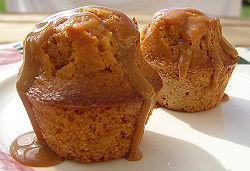 A home-made form of dulce de leche is sometimes made by boiling an unopened can of sweetened condensed milk
for 2 to 3 hours (or 30 to 45 minutes in a pressure cooker), particularly by those living in countries where it cannot be bought ready-made. It is dangerous to do this on a stove: if the pot is allowed to boil dry, the can will overheat and explode.
Dulce de leche is used to flavor candies or other sweet foods, such as cake
s, cookie
s (see alfajor
), or ice cream
s (Argentina
and recently introduced in Spain
and the USA), as well as crème caramel (flan in Spanish and Portuguese). It provides the "toffee
" part of English Banoffee pie
. It is also popular spread on pancakes and toast
. French confiture de lait
is commonly served with fromage blanc; a Dutch variety (really, a caramel paste), marketed as Bebogeen, is a children's favorite on bread.
A solid candy made out of dulce de leche, similar to the Polish
krówki
and named Vaquita (little cow), was manufactured by the Mu-Mu factory in Argentina until the company went out of business in 1984 (as a consequence of financial speculation by its owners). Subsequently, other brands began to manufacture similar candies, giving them names such as Vauquita and Vaquerita in an effort to link their products to the original.
In 1997, the ice cream
company Häagen-Dazs
introduced a dulce de leche-flavored ice cream; in the same year, Starbucks
began offering dulce de leche-flavored coffee products. In the early part of 2009, Girl Scouts of the USA
introduced dulce de leche flavored cookies as part of their annual cookie sales program.
A similar recipe is used to prepare basundi
in India. It is like a less condensed dulce de leche, flavoured with cardamom
and is eaten as dessert.
The Philippines also has dulce de leche, which is usually paired with cakes or breakfast rolls.
This is also known in Russia as boiled concentrated milk (such being the Russian equivalent of sweetened condensed milk).
Literally translated, dulce de leche means "sweet
Confectionery
Confectionery is the set of food items that are rich in sugar, any one or type of which is called a confection. Modern usage may include substances rich in artificial sweeteners as well...
from milk
Milk
Milk is a white liquid produced by the mammary glands of mammals. It is the primary source of nutrition for young mammals before they are able to digest other types of food. Early-lactation milk contains colostrum, which carries the mother's antibodies to the baby and can reduce the risk of many...
". It is prepared by slowly heating sweetened milk
Milk
Milk is a white liquid produced by the mammary glands of mammals. It is the primary source of nutrition for young mammals before they are able to digest other types of food. Early-lactation milk contains colostrum, which carries the mother's antibodies to the baby and can reduce the risk of many...
to create a product that derives its taste from caramel
Caramel
Caramel is a beige to dark-brown confection made by heating any of a variety of sugars. It is used as a flavoring in puddings and desserts, as a filling in bonbons, and as a topping for ice cream, custard and coffee....
ised sugar. It is a popular sweet in Latin America, where it is known under a variety of names. In Chile, Ecuador and Panama it is known as manjar. In Peru, Colombia and Venezuela it is referred to as manjar blanco or arequipe, depending on regional variations. In Mexico and Nicaragua it is commonly called cajeta. It is also found in Brazil, known by its Portuguese
Portuguese language
Portuguese is a Romance language that arose in the medieval Kingdom of Galicia, nowadays Galicia and Northern Portugal. The southern part of the Kingdom of Galicia became independent as the County of Portugal in 1095...
name doce de leite.
A French version, known as confiture de lait
Confiture de lait
Confiture de lait is a thick, sweet caramel sauce prepared from milk and sugar. It is a specialty of the Normandy region of France, but it can be found throughout the country...
, is very similar to the spreadable forms of dulce de leche. A Norwegian version, Hamar-pålegg ("Hamar spread"), better known as HaPå, is a relatively thick and not so sweet commercial variant.
Preparation and uses
The most basic recipe calls for slowly simmering milkMilk
Milk is a white liquid produced by the mammary glands of mammals. It is the primary source of nutrition for young mammals before they are able to digest other types of food. Early-lactation milk contains colostrum, which carries the mother's antibodies to the baby and can reduce the risk of many...
and sugar
Sugar
Sugar is a class of edible crystalline carbohydrates, mainly sucrose, lactose, and fructose, characterized by a sweet flavor.Sucrose in its refined form primarily comes from sugar cane and sugar beet...
, stirring almost constantly, although other ingredients may be included to achieve special properties. Much of the water in the milk evaporates
Evaporation
Evaporation is a type of vaporization of a liquid that occurs only on the surface of a liquid. The other type of vaporization is boiling, which, instead, occurs on the entire mass of the liquid....
and the mix thickens; the resulting dulce de leche is usually about a sixth of the volume of the milk used. The transformation that occurs in preparation is caused by a combination of two common browning reactions called caramelization
Caramelization
Caramelization is the browning of sugar, a process used extensively in cooking for the resulting nutty flavor and brown color. As the process occurs, volatile chemicals are released, producing the characteristic caramel flavor....
and the Maillard reaction
Maillard reaction
The Maillard reaction is a form of nonenzymatic browning similar to caramelization. It results from a chemical reaction between an amino acid and a reducing sugar, usually requiring heat....
.
Condensed milk
Condensed milk, also known as sweetened condensed milk, is cow's milk from which water has been removed and to which sugar has been added, yielding a very thick, sweet product which when canned can last for years without refrigeration if unopened. The two terms, condensed milk and sweetened...
for 2 to 3 hours (or 30 to 45 minutes in a pressure cooker), particularly by those living in countries where it cannot be bought ready-made. It is dangerous to do this on a stove: if the pot is allowed to boil dry, the can will overheat and explode.
Dulce de leche is used to flavor candies or other sweet foods, such as cake
Cake
Cake is a form of bread or bread-like food. In its modern forms, it is typically a sweet and enriched baked dessert. In its oldest forms, cakes were normally fried breads or cheesecakes, and normally had a disk shape...
s, cookie
Cookie
In the United States and Canada, a cookie is a small, flat, baked treat, usually containing fat, flour, eggs and sugar. In most English-speaking countries outside North America, the most common word for this is biscuit; in many regions both terms are used, while in others the two words have...
s (see alfajor
Alfajor
An alfajor or alajú is a traditional Arabic confection found in some regions of Spain and then made with variations in countries of Latin America including Argentina, Chile, Uruguay, Peru, and Mexico, after being taken there by the colonists. The archetypal alfajor entered Iberia during the period...
), or ice cream
Ice cream
Ice cream is a frozen dessert usually made from dairy products, such as milk and cream, and often combined with fruits or other ingredients and flavours. Most varieties contain sugar, although some are made with other sweeteners...
s (Argentina
Argentina
Argentina , officially the Argentine Republic , is the second largest country in South America by land area, after Brazil. It is constituted as a federation of 23 provinces and an autonomous city, Buenos Aires...
and recently introduced in Spain
Spain
Spain , officially the Kingdom of Spain languages]] under the European Charter for Regional or Minority Languages. In each of these, Spain's official name is as follows:;;;;;;), is a country and member state of the European Union located in southwestern Europe on the Iberian Peninsula...
and the USA), as well as crème caramel (flan in Spanish and Portuguese). It provides the "toffee
Toffee
Toffee is a confection made by caramelizing sugar or molasses along with butter, and occasionally flour. The mixture is heated until its temperature reaches the hard crack stage of 300 to 310 °F...
" part of English Banoffee pie
Banoffee pie
Banoffee pie is an English pastry-based dessert made from bananas, cream, toffee from boiled condensed milk , either on a pastry base or one made from crumbled biscuits and butter...
. It is also popular spread on pancakes and toast
Toast
Toast is bread that has been browned by exposure to radiant heat. This browning reaction is known as the Maillard reaction. Toasting warms the bread and makes it firmer, so it holds toppings more securely...
. French confiture de lait
Confiture de lait
Confiture de lait is a thick, sweet caramel sauce prepared from milk and sugar. It is a specialty of the Normandy region of France, but it can be found throughout the country...
is commonly served with fromage blanc; a Dutch variety (really, a caramel paste), marketed as Bebogeen, is a children's favorite on bread.
A solid candy made out of dulce de leche, similar to the Polish
Poland
Poland , officially the Republic of Poland , is a country in Central Europe bordered by Germany to the west; the Czech Republic and Slovakia to the south; Ukraine, Belarus and Lithuania to the east; and the Baltic Sea and Kaliningrad Oblast, a Russian exclave, to the north...
krówki
Krówki
Krówki , literally "little cows," are Polish fudge, semi-soft milk toffee candies.It is one of the most common Polish confectioneries, sold worldwide, and might be considered "dulce de Leche candy". Commercially, many brands are available; most of them have each individual candy wrapped in...
and named Vaquita (little cow), was manufactured by the Mu-Mu factory in Argentina until the company went out of business in 1984 (as a consequence of financial speculation by its owners). Subsequently, other brands began to manufacture similar candies, giving them names such as Vauquita and Vaquerita in an effort to link their products to the original.
In 1997, the ice cream
Ice cream
Ice cream is a frozen dessert usually made from dairy products, such as milk and cream, and often combined with fruits or other ingredients and flavours. Most varieties contain sugar, although some are made with other sweeteners...
company Häagen-Dazs
Häagen-Dazs
Häagen-Dazs is a brand of ice cream, established by Jewish-Polish immigrants Reuben and Rose Mattus in the Bronx, New York, in 1961. Starting with only three flavors: vanilla, chocolate, and coffee, the company opened its first retail store in Brooklyn, New York, on November 15, 1976...
introduced a dulce de leche-flavored ice cream; in the same year, Starbucks
Starbucks
Starbucks Corporation is an international coffee and coffeehouse chain based in Seattle, Washington. Starbucks is the largest coffeehouse company in the world, with 17,009 stores in 55 countries, including over 11,000 in the United States, over 1,000 in Canada, over 700 in the United Kingdom, and...
began offering dulce de leche-flavored coffee products. In the early part of 2009, Girl Scouts of the USA
Girl Scouts of the USA
The Girl Scouts of the United States of America is a youth organization for girls in the United States and American girls living abroad. It describes itself as "the world's preeminent organization dedicated solely to girls". It was founded by Juliette Gordon Low in 1912 and was organized after Low...
introduced dulce de leche flavored cookies as part of their annual cookie sales program.
A similar recipe is used to prepare basundi
Basundi
Basundi is an Indian dessert mostly in Bihar, Maharashtra, Gujarat and Karnataka. It is a sweetened dense milk made by boiling milk on low heat until the milk is reduced by half....
in India. It is like a less condensed dulce de leche, flavoured with cardamom
Cardamom
Cardamom refers to several plants of the genera Elettaria and Amomum in the ginger family Zingiberaceae. Both genera are native to India and Bhutan; they are recognised by their small seed pod, triangular in cross-section and spindle-shaped, with a thin papery outer shell and small black seeds...
and is eaten as dessert.
The Philippines also has dulce de leche, which is usually paired with cakes or breakfast rolls.
This is also known in Russia as boiled concentrated milk (such being the Russian equivalent of sweetened condensed milk).
See also
- Baked milkBaked milkBaked milk is a variety of boiled milk that has been particularly popular in Russia and Ukraine. It is made by simmering milk on low heat for eight hours or longer....
- Banoffee pieBanoffee pieBanoffee pie is an English pastry-based dessert made from bananas, cream, toffee from boiled condensed milk , either on a pastry base or one made from crumbled biscuits and butter...
- BasundiBasundiBasundi is an Indian dessert mostly in Bihar, Maharashtra, Gujarat and Karnataka. It is a sweetened dense milk made by boiling milk on low heat until the milk is reduced by half....
- BrunostBrunostBrunost , or mesost , mysuostur or myseost is a brown Scandinavian whey cheese. The Norwegian name brunost means brown cheese, and the others mean simply whey cheese...
- CajetaCajetaCajeta is a Mexican confection of thickened syrup usually made of sweetened caramelised milk.According to chef Rick Bayless, the name for cajeta came from the Spanish phrase al punto de cajeta, which means a liquid thickened to the point at which a spoon drawn through the liquid reveals the bottom...
- CaramelCaramelCaramel is a beige to dark-brown confection made by heating any of a variety of sugars. It is used as a flavoring in puddings and desserts, as a filling in bonbons, and as a topping for ice cream, custard and coffee....
- Caramel candy
- Confiture de laitConfiture de laitConfiture de lait is a thick, sweet caramel sauce prepared from milk and sugar. It is a specialty of the Normandy region of France, but it can be found throughout the country...
- Flan
- CustardCustardCustard is a variety of culinary preparations based on a cooked mixture of milk or cream and egg yolk. Depending on how much egg or thickener is used, custard may vary in consistency from a thin pouring sauce , to a thick pastry cream used to fill éclairs. The most common custards are used as...
- KaymakKaymakKaymak ; also kaymak, kajmak, kaimak or qeymağ, also geymar, gaimar, is a originally Serbian creamy dairy product, similar to clotted cream, made in Serbia, Turkey,...
- KrówkiKrówkiKrówki , literally "little cows," are Polish fudge, semi-soft milk toffee candies.It is one of the most common Polish confectioneries, sold worldwide, and might be considered "dulce de Leche candy". Commercially, many brands are available; most of them have each individual candy wrapped in...
- Maillard reactionMaillard reactionThe Maillard reaction is a form of nonenzymatic browning similar to caramelization. It results from a chemical reaction between an amino acid and a reducing sugar, usually requiring heat....
- Manjar blancoManjar BlancoManjar blanco is a term used to refer to a variety of delicacies in the Spanish-speaking world. In Spain the term refers to blancmange, a European delicacy found in various parts of the continent as well as the United Kingdom. In the Americas it refers to a sweet, white spread or pastry filling...
- PenuchePenuchePenuche is a fudge-like candy made from brown sugar, butter, and milk, using no flavorings except for vanilla. Penuche often has a tannish color to it and is lighter than regular fudge. It is formed by the caramelization of brown sugar, and thus its flavor is said to be reminiscent of caramel...
- Russian candyRussian candyRussian candy or Russian chocolate is a very sweet toffee-like dessert made by carefully heating equal amounts of cream and sugar. It is a traditional food in Nordic countries. Karl Fazer brought the first Russian candy recipe to Finland from St. Petersburg. It's a popular treat in Russia and...
- TejaTeja (confectionery)A teja is a popular dumpling-shaped confection from the Ica Region of Peru. It contains manjar blanco filling and either dry fruits or nuts...