


Black drink

Encyclopedia

Native Americans in the United States
Native Americans in the United States are the indigenous peoples in North America within the boundaries of the present-day continental United States, parts of Alaska, and the island state of Hawaii. They are composed of numerous, distinct tribes, states, and ethnic groups, many of which survive as...
in the Southeastern United States
Southeastern United States
The Southeastern United States, colloquially referred to as the Southeast, is the eastern portion of the Southern United States. It is one of the most populous regions in the United States of America....
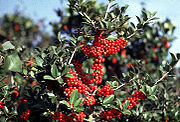
. It is thought to have been prepared from the roasted leaves and stems of the Yaupon Holly (Ilex vomitoria), native to the Atlantic and Gulf Coast
Gulf Coast of the United States
The Gulf Coast of the United States, sometimes referred to as the Gulf South, South Coast, or 3rd Coast, comprises the coasts of American states that are on the Gulf of Mexico, which includes Texas, Louisiana, Mississippi, Alabama, and Florida and are known as the Gulf States...
s, though it may also have been a concoction of other roots and herbs. The active ingredient in the Yaupon drink was caffeine
Caffeine
Caffeine is a bitter, white crystalline xanthine alkaloid that acts as a stimulant drug. Caffeine is found in varying quantities in the seeds, leaves, and fruit of some plants, where it acts as a natural pesticide that paralyzes and kills certain insects feeding on the plants...
and it was often used as a substitute for coffee
Coffee
Coffee is a brewed beverage with a dark,init brooo acidic flavor prepared from the roasted seeds of the coffee plant, colloquially called coffee beans. The beans are found in coffee cherries, which grow on trees cultivated in over 70 countries, primarily in equatorial Latin America, Southeast Asia,...
and tea
Tea
Tea is an aromatic beverage prepared by adding cured leaves of the Camellia sinensis plant to hot water. The term also refers to the plant itself. After water, tea is the most widely consumed beverage in the world...
by colonists under the name cassine or cassina. Black drink may also have had emetic properties.
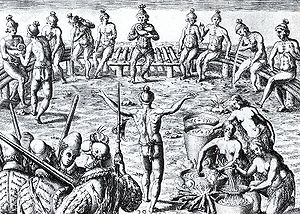
Prior to the 19th century, the black drink was consumed during the daily deliberations of the village councils and at all other important council meetings. Caddo
Caddo
The Caddo Nation is a confederacy of several Southeastern Native American tribes, who traditionally inhabited much of what is now East Texas, northern Louisiana and portions of southern Arkansas and Oklahoma. Today the Caddo Nation of Oklahoma is a cohesive tribe with its capital at Binger, Oklahoma...
, Creeks, Cherokees, Choctaws, and others believed it purified the drinker and purged him of anger and falsehoods. Black drink was prepared by special village officials and served in large communal cups, frequently made of whelk
Whelk
Whelk, also spelled welk or even "wilks", is a common name used to mean one or more kinds of sea snail. The species, genera and families referred to using this common name vary a great deal from one geographic area to another...
shell. The men in council were served in order of precedence, starting with important visitors. They consumed large quantities at a sitting. Afterward, they purged themselves by vomiting
Vomiting
Vomiting is the forceful expulsion of the contents of one's stomach through the mouth and sometimes the nose...
.
Preparation

Coffee
Coffee is a brewed beverage with a dark,init brooo acidic flavor prepared from the roasted seeds of the coffee plant, colloquially called coffee beans. The beans are found in coffee cherries, which grow on trees cultivated in over 70 countries, primarily in equatorial Latin America, Southeast Asia,...
is also roasted. After browning, they were boiled in large containers of water until the liquid reached a dark brown or black color, giving it its name. The liquid was then strained into containers to cool, until it was cool enough to not scald the skin, and drunk while still hot. Because caffeine is 30 times more soluble in boiling water than room temperature water, this heightened its effect. It was then consumed in a ritual manner. Its physiological effects are mainly those of massive doses of caffeine. Three to six cups of strong coffee is equal to 0.5 to 1.0 grams of caffeine; the black drink could have delivered at least this much and possibly up to 3.0 to 6.0 grams of caffeine.
Precolumbian use

Mississippian culture
The Mississippian culture was a mound-building Native American culture that flourished in what is now the Midwestern, Eastern, and Southeastern United States from approximately 800 CE to 1500 CE, varying regionally....
period, the presence of items associated with the black drink ceremony had spread over most of the south, with many hundreds of examples from Etowah
Etowah Indian Mounds
Etowah Indian Mounds is a archaeological site in Bartow County, Georgia south of Cartersville, in the United States. Built and occupied in three phases, from 1000–1550 CE, the prehistoric site is located on the north shore of the Etowah River. Etowah Indian Mounds Historic Site is a designated...
, Spiro
Spiro Mounds
Spiro Mounds is an important pre-Columbian Caddoan Mississippian culture archaeological site located in present-day eastern Oklahoma in the United States. The site is located seven miles north of Spiro, and is the only prehistoric Native American archaeological site in Oklahoma open to the public...
, Moundville
Moundville Archaeological Site
Moundville Archaeological Site, also known as the Moundville Archaeological Park, is a Mississippian site on the Black Warrior River in Hale County, near the town of Tuscaloosa, Alabama...
and Hiwassee Island.
Shell cups


Lightning whelk
The lightning whelk, scientific name Busycon contrarium, is an edible species of very large predatory sea snail or whelk, a marine gastropod mollusk in the family Buccinidae, the busycon whelks. This species has a left-handed or sinistral shell...
, emperor helmet, and the horse conch
Pleuroploca gigantea
Pleuroploca gigantea, common name the Florida horse conch, is a species of extremely large predatory subtropical and tropical sea snail, a marine gastropod mollusk in the family Fasciolariidae, the spindle snails, tulip snails and their allies....
. The most common was the lightning whelk, which has a left-handed or sinistral spiral. The left-handed spiral may have held religious significance because of its association with dance and ritual. The center columnella, which runs longitudinally down the shell, would be removed, and the rough edges sanded down to make a dipper like cup. The columnella would then be used as a pendant, a motif that shows up frequently in Southeastern Ceremonial Complex
Southeastern Ceremonial Complex
The Southeastern Ceremonial Complex is the name given to the regional stylistic similarity of artifacts, iconography, ceremonies, and mythology of the Mississippian culture that coincided with their adoption of maize agriculture and chiefdom-level complex social organization from...
designs. In the archaeological record columnella pendants are usually found in conjunction with bi-lobed arrows, stone maces, earspools, and necklace beads(all of which are motifs identified with the falcon dancer/warrior/chunkey player mythological figure). Artifacts made from these marine shells have been found as far north as Wisconsin
Wisconsin
Wisconsin is a U.S. state located in the north-central United States and is part of the Midwest. It is bordered by Minnesota to the west, Iowa to the southwest, Illinois to the south, Lake Michigan to the east, Michigan to the northeast, and Lake Superior to the north. Wisconsin's capital is...
and as far west as Oklahoma
Oklahoma
Oklahoma is a state located in the South Central region of the United States of America. With an estimated 3,751,351 residents as of the 2010 census and a land area of 68,667 square miles , Oklahoma is the 28th most populous and 20th-largest state...
. Several examples of cups from Moundville
Moundville Archaeological Site
Moundville Archaeological Site, also known as the Moundville Archaeological Park, is a Mississippian site on the Black Warrior River in Hale County, near the town of Tuscaloosa, Alabama...
and Spiro
Spiro Mounds
Spiro Mounds is an important pre-Columbian Caddoan Mississippian culture archaeological site located in present-day eastern Oklahoma in the United States. The site is located seven miles north of Spiro, and is the only prehistoric Native American archaeological site in Oklahoma open to the public...
have been found to have rings of black residue in the bottoms, suggesting they were used for black drink rituals. Many examples of shell cups found in Mississippian
Mississippian culture
The Mississippian culture was a mound-building Native American culture that flourished in what is now the Midwestern, Eastern, and Southeastern United States from approximately 800 CE to 1500 CE, varying regionally....
mounds are engraved with S.E.C.C.
Southeastern Ceremonial Complex
The Southeastern Ceremonial Complex is the name given to the regional stylistic similarity of artifacts, iconography, ceremonies, and mythology of the Mississippian culture that coincided with their adoption of maize agriculture and chiefdom-level complex social organization from...
imagery. A few examples portray what is theorized to be black drink rituals, including what may be vomit issuing from the mouths of mythological beings.
Post-European contact

Cherokee
The Cherokee are a Native American people historically settled in the Southeastern United States . Linguistically, they are part of the Iroquoian language family...
s, Choctaw
Choctaw
The Choctaw are a Native American people originally from the Southeastern United States...
s, Ais, Guale
Guale
Guale was an historic Native American chiefdom along the coast of present-day Georgia and the Sea Islands. Spanish Florida established its Roman Catholic missionary system in the chiefdom in the late 16th century. During the late 17th century and early 18th century, Guale society was shattered...
, Chickasaw
Chickasaw
The Chickasaw are Native American people originally from the region that would become the Southeastern United States...
s, Chitimacha
Chitimacha
The Chitimacha are a Native American federally recognized tribe that lives in the U.S. state of Louisiana, mainly in St. Mary Parish. They currently number about 720 people. The Chitimacha language is a language isolate.- History :The Chitimacha's historic home was the southern Louisiana coast...
and many others are documented users of the drink. Although rituals vary amongst the different tribes, there are common traits which span most of the tribal variations. Black drink was forbidden to women, and it is taboo
Taboo
A taboo is a strong social prohibition relating to any area of human activity or social custom that is sacred and or forbidden based on moral judgment, religious beliefs and or scientific consensus. Breaking the taboo is usually considered objectionable or abhorrent by society...
for them to even help in its preparation.
In some ceremonies the drink, after its preparation, is passed out to the highest status person first, then the next highest status, and so forth. During each persons turn to drink, ritual songs were sung (Yahola, the ritual name Asi Yahola or Black Drink Singer is corrupted into English
English language
English is a West Germanic language that arose in the Anglo-Saxon kingdoms of England and spread into what was to become south-east Scotland under the influence of the Anglian medieval kingdom of Northumbria...
as Osceola
Osceola
Osceola, also known as Billy Powell , became an influential leader with the Seminole in Florida. He was of Creek, Scots-Irish and English parentage, and had migrated to Florida with his mother after the defeat of the Creek in 1814.Osceola led a small band of warriors in the Seminole resistance...
).
The black drink is a purifier, that removes spiritual and physical contamination from the drinker, and as such is never taken casually, even when taken daily. Some tribes practice ritual vomiting after its consumption, possibly to heighten its purgative and purifying powers, by expelling contamination from the body. The sharing of tobacco
Tobacco
Tobacco is an agricultural product processed from the leaves of plants in the genus Nicotiana. It can be consumed, used as a pesticide and, in the form of nicotine tartrate, used in some medicines...
is also a part of the ritual.
Black drink among the Cherokee
Cherokee
The Cherokee are a Native American people historically settled in the Southeastern United States . Linguistically, they are part of the Iroquoian language family...
black drink is taken for purification and renewal at stomp dance
Stomp dance
The Stomp Dance is performed by various Eastern Woodland tribes and Native American communities, including the Muscogee, Yuchi, Cherokee, Chickasaw, Choctaw, Delaware, Miami, Caddo, Ottawa, Peoria, Shawnee, Seminole, Natchez, and Seneca-Cayuga tribes...
s, Green Corn ceremony
Green Corn Ceremony
The Green Corn Ceremony is an English term that refers to a general religious and social theme celebrated by a number of American Indian peoples of the Eastern Woodlands and the Southeastern tribes...
, and other ceremonies. Made with Ilex vomitoria, the Black Drink reportedly induces vomiting during Cherokee purification ceremonies but, as explained above, this behavior is deliberate or the result of the quantity imbibed, not due to the chemical properties of the drink itself. Other ritual medicinal beverages are also used in ceremonies in Oklahoma.
Cassina use by the Ais
In 1696, Jonathan DickinsonJonathan Dickinson
Jonathan Dickinson was a Quaker merchant from Port Royal, Jamaica who was shipwrecked on the southeast coast of Florida in 1696, along with his family and the other passengers and crew members of the ship....
witnessed the use of a beverage brewed from the Yaupon Holly
Yaupon Holly
Ilex vomitoria, commonly known as Yaupon or Yaupon Holly, is a species of holly that is native to southeastern North America. The word yaupon was derived from its Catawban name, yopún, which is a diminutive form of the word yop, meaning "tree". Another common name, Cassina, was borrowed from the...
among the Ais
Ais (tribe)
The Ais, or Ays were a tribe of Native Americans who inhabited the Atlantic Coast of Florida. They ranged from present day Cape Canaveral to the St. Lucie Inlet, in the present day counties of Brevard, Indian River, St. Lucie and northernmost Martin...
of Florida
Florida
Florida is a state in the southeastern United States, located on the nation's Atlantic and Gulf coasts. It is bordered to the west by the Gulf of Mexico, to the north by Alabama and Georgia and to the east by the Atlantic Ocean. With a population of 18,801,310 as measured by the 2010 census, it...
. Dickinson later learned that the Spanish
Spanish people
The Spanish are citizens of the Kingdom of Spain. Within Spain, there are also a number of vigorous nationalisms and regionalisms, reflecting the country's complex history....
called the plant "casseena". The Ais parched the leaves in a pot, and then boiled them. The resulting liquid was then transferred to a large bowl using a gourd
Gourd
A gourd is a plant of the family Cucurbitaceae. Gourd is occasionally used to describe crops like cucumbers, squash, luffas, and melons. The term 'gourd' however, can more specifically, refer to the plants of the two Cucurbitaceae genera Lagenaria and Cucurbita or also to their hollow dried out shell...
that had a long neck with a small hole at the top, and a 2 inches (50.8 mm) hole in the side. The gourd was slowly dipped into the brewing pot, which caused a whistling sound as air was forced out through the small hole at the top. The gourd was used to froth the liquid (Dickinson does not specify how). The brewed liquid was a deep brown in color. On the occasion Dickinson witnessed, he estimated that there was nearly three gallons of the beverage in the bowl. After the liquid had cooled, the chief was presented with a conch-shell of the beverage. The chief threw part of it on the ground and drank the rest. The chief's associates were then served in turn. Lower status men, women and children were not allowed to touch or taste the beverage. The chief and his associates sat drinking this brew, smoking and talking for most of the day. In the evening the bowl that had held the beverage was covered with a skin to make a drum. The Ais, accompanied by the drum and some rattles, sang and danced until the middle of the night. Dickinson makes no mention of purging or vomiting by the Ais after drinking this beverage.
See also
- Mississippian cultureMississippian cultureThe Mississippian culture was a mound-building Native American culture that flourished in what is now the Midwestern, Eastern, and Southeastern United States from approximately 800 CE to 1500 CE, varying regionally....
- Southeastern Ceremonial ComplexSoutheastern Ceremonial ComplexThe Southeastern Ceremonial Complex is the name given to the regional stylistic similarity of artifacts, iconography, ceremonies, and mythology of the Mississippian culture that coincided with their adoption of maize agriculture and chiefdom-level complex social organization from...