


Paleoethnobotany

Encyclopedia
Archaeology
Archaeology, or archeology , is the study of human society, primarily through the recovery and analysis of the material culture and environmental data that they have left behind, which includes artifacts, architecture, biofacts and cultural landscapes...
sub-field that studies plant
Plant
Plants are living organisms belonging to the kingdom Plantae. Precise definitions of the kingdom vary, but as the term is used here, plants include familiar organisms such as trees, flowers, herbs, bushes, grasses, vines, ferns, mosses, and green algae. The group is also called green plants or...
remains from archaeological sites. Basing on the recovery and identification of plant remains and the ecological and cultural information available for modern plants, the major research themes are the use of wild plants, the origins of agriculture and domestication
Domestication
Domestication or taming is the process whereby a population of animals or plants, through a process of selection, becomes accustomed to human provision and control. In the Convention on Biological Diversity a domesticated species is defined as a 'species in which the evolutionary process has been...
, and the co-evolution
Co-evolution
In biology, coevolution is "the change of a biological object triggered by the change of a related object." Coevolution can occur at many biological levels: it can be as microscopic as correlated mutations between amino acids in a protein, or as macroscopic as covarying traits between different...
of human-plant interactions.
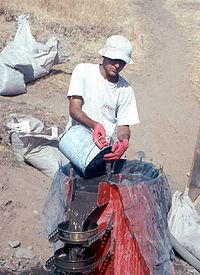
Paleoethnobotanists use a variety of methods to recover and identify plant remains. One method used to recover macroremains (objects larger than 100 µm, but smaller than 10 cm) is to sieve excavated material manually in a water bath in order to allow the organic material to float to the surface. This method is known as flotation. The matrix (the soil from a suspected archaeological feature
Feature (archaeology)
Feature in archaeology and especially excavation has several different but allied meanings. A feature is a collection of one or more contexts representing some human non-portable activity that generally has a vertical characteristic to it in relation to site stratigraphy. Examples of features are...
) is slowly added to agitated water. The soil, sand, and other heavy material, known as heavy fraction, will sink to the bottom. The less dense organic material such as charred seeds, wood and bone will tend to float to the surface. The material that floats to the top, called light fraction, is gathered with a sieve. The organic light fraction is then available for examination. Samples of the heavy fraction are also gathered for later analysis. Other types of flotation processes include machine-assisted flotation and froth flotation.
Identification of macroremains is then usually carried out under a stereomicroscope, using morphological
Morphology (biology)
In biology, morphology is a branch of bioscience dealing with the study of the form and structure of organisms and their specific structural features....
features such as shape and surface features in the case of seeds, or microanatomy
Histology
Histology is the study of the microscopic anatomy of cells and tissues of plants and animals. It is performed by examining cells and tissues commonly by sectioning and staining; followed by examination under a light microscope or electron microscope...
in the case of wood or charcoal. Identification literature as well as a comparative collection of modern plant materials are crucial for reliable results. Depending on the type of material, and its condition, also other methods such as thin section
Thin section
In optical mineralogy and petrography, a thin section is a laboratory preparation of a rock, mineral, soil, pottery, bones, or even metal sample for use with a polarizing petrographic microscope, electron microscope and electron microprobe. A thin sliver of rock is cut from the sample with a...
s or SEM
Scanning electron microscope
A scanning electron microscope is a type of electron microscope that images a sample by scanning it with a high-energy beam of electrons in a raster scan pattern...
are applied.
Paleoethnobotanists also recover and analyze microremains (such as phytoliths and pollen
Palynology
Palynology is the science that studies contemporary and fossil palynomorphs, including pollen, spores, orbicules, dinoflagellate cysts, acritarchs, chitinozoans and scolecodonts, together with particulate organic matter and kerogen found in sedimentary rocks and sediments...
), human and animal excrements (paleofeces
Paleofeces
Paleofeces are ancient human feces, often found as part of archaeological excavations or surveys. Intact feces of ancient people may be found in caves in arid climates and in certain other locations. They are studied to determine the diet and health of the people who produced them through the...
, sometimes called coprolite
Coprolite
A coprolite is fossilized animal dung. Coprolites are classified as trace fossils as opposed to body fossils, as they give evidence for the animal's behaviour rather than morphology. The name is derived from the Greek words κοπρος / kopros meaning 'dung' and λιθος / lithos meaning 'stone'. They...
s), or plant impressions in ceramic sherds and clay (such as in daub).
Palynology
Palynology
Palynology is the science that studies contemporary and fossil palynomorphs, including pollen, spores, orbicules, dinoflagellate cysts, acritarchs, chitinozoans and scolecodonts, together with particulate organic matter and kerogen found in sedimentary rocks and sediments...
is a mature and distinct scientific discipline that studies pollen
Pollen
Pollen is a fine to coarse powder containing the microgametophytes of seed plants, which produce the male gametes . Pollen grains have a hard coat that protects the sperm cells during the process of their movement from the stamens to the pistil of flowering plants or from the male cone to the...
, typically in the context of reconstructing past environments.
Dendrochronology
Dendrochronology
Dendrochronology or tree-ring dating is the scientific method of dating based on the analysis of patterns of tree-rings. Dendrochronology can date the time at which tree rings were formed, in many types of wood, to the exact calendar year...
, the study of growth rings on trees relating to study of past environments, is another scientific discipline useful to paleoethnobotanical study.
Research
The work done in paleoethnobotany can be divided into field work, collections management, systematic description of species, and theories into the origins of human and plant interaction. Some examples of this analysis:A paleoethnobotanist may find discrete concentrations of burned or dried remnants of seeds in an area of discolored soil (a possible hearth
Hearth
In common historic and modern usage, a hearth is a brick- or stone-lined fireplace or oven often used for cooking and/or heating. For centuries, the hearth was considered an integral part of a home, often its central or most important feature...
feature). If later analyses indicates that the remnants were of only mature wild seeds of a type of plant that grows locally, it could be inferred that the site was only visited seasonally. Such an inference could be supported by a lack of other features that would suggest that no permanent shelters were built at the site.
Alternatively, a paleoethnobotanist may find that a fire pit
feature contains concentrated remnants of a wide variety of edible
wild plants that mature throughout the year. An archaeologist may find
features at the site that indicate some sort of semi-permanent
dwellings (such as post holes and middens). The middens may have
concentrations of animal remains, identified by a zooarchaeologist
Zooarchaeology
Zooarchaeology, also known as Archaeozoology, is the study of animal remains from archaeological sites. The remains consist primarily of the hard parts of the body such as bones, teeth, and shells...
as those of wild game, with a variety of species-specific maturity levels. In that case, a more permanent settlement may be inferred, perhaps to the level of a village. Such an analysis of the archaeological features could suggest a society of hunter-gatherer
Hunter-gatherer
A hunter-gatherer or forage society is one in which most or all food is obtained from wild plants and animals, in contrast to agricultural societies which rely mainly on domesticated species. Hunting and gathering was the ancestral subsistence mode of Homo, and all modern humans were...
s who inhabited the site on a
more-or-less year-round basis.
A paleoethnobotanist may also find concentrated remains of plants
that typically are only grown through active cultivation
Tillage
Tillage is the agricultural preparation of the soil by mechanical agitation of various types, such as digging, stirring, and overturning. Examples of human-powered tilling methods using hand tools include shovelling, picking, mattock work, hoeing, and raking...
(such as cereals, legumes, and oilseeds). At the same site, an archaeologist might identify features such as stone walls surrounding enclosures arrayed in a pattern, and deep, layered middens with concentrations of domesticated animal remains such as goats or pigs. An analysis of the site, set within the context of the archaeological features and animal and plant remains, would suggest a settled agrarian
Agriculture
Agriculture is the cultivation of animals, plants, fungi and other life forms for food, fiber, and other products used to sustain life. Agriculture was the key implement in the rise of sedentary human civilization, whereby farming of domesticated species created food surpluses that nurtured the...
community.
Further reading
- Pearsall, Deborah M, Paleoethnobotany: A Handbook of Procedures, Second Edition, Academic Press, San Diego (2000), ISBN 0-12-548042-3.
- Christine A. Hastorf (Editor), Virginia S. Popper (Editor), Current Paleoethnobotany : Analytical Methods and Cultural Interpretations of Archaeological Plant Remains (Prehistoric Archeology and Ecology series), University of Chicago Press (January 15, 1989), ISBN 0-226-31893-1.
- Kristen J. Gremillion, People, Plants, and Landscapes: Studies in Paleoethnobotany, University of Alabama Press (February 1, 1997), ISBN 0-8173-0827-X.
- Miksicek, C.H., Formation Processes of the Archaeobotanical Record., In: M.B.Schiffer (ed.) Advances in Archaeological Method and Theory 10. Academic Press, New York, (1987) 211-247, ISBN 0-12-003110-8 .
See also
- Archaeobotany
- EthnobiologyEthnobiology]Ethnobiology is the scientific study of dynamic relationships between peoples, biota, and environments, from the distant past to the immediate present....
- EthnobotanyEthnobotanyEthnobotany is the scientific study of the relationships that exist between people and plants....
- PaleobotanyPaleobotanyPaleobotany, also spelled as palaeobotany , is the branch of paleontology or paleobiology dealing with the recovery and identification of plant remains from geological contexts, and their use for the biological reconstruction of past environments , and both the evolutionary history of plants, with a...
- List of paleoethnobotanists
External links
- Association of Environmental Archaeology
- Steve Archer, "About Phytoliths": http://research.history.org/Archaeological_Research/Collections/CollArchaeoBot/PhytoFAQs.cfm .
- Terry B. Ball, "Phytolith Literature Review": http://www.ou.edu/cas/botany-micro/ben/ben282.html .
- Paleoresearch Institute, "Guide to Archaeobotany": http://www.paleoresearch.com/ .