

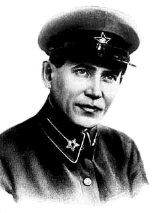
Nikolai Yezhov

Encyclopedia
Nikolai Ivanovich Yezhov or Ezhov (nʲɪkɐˈlaj jɪˈʐof; May 1, 1895 – February 4, 1940) was a senior figure in the NKVD
(the Soviet
secret police
) under Joseph Stalin
during the period of the Great Purge
. His reign is sometimes known as the "Yezhovshchina" , "the Yezhov era", a term that began to be used during the de-Stalinization
campaign of the 1950s. During the beginning of World War II
his status within the USSR became that of a political unperson.
, according to his official Soviet biography, though other records point to the possibility that he was born in Marijampolė
. In a form filled out in 1921, Yezhov claimed some ability to speak Polish and Lithuanian.
He completed only his elementary education. From 1909 to 1915, he worked as a tailor's assistant and factory worker. From 1915 until 1917, Yezhov served in the Imperial Russian Army
. He joined the Bolsheviks on May 5, 1917 in Vitebsk
, seven months before the October Revolution
. During the Russian Civil War
, 1919–1921, he fought in the Red Army
. After February 1922, he worked in the political system, mostly as a secretary of various regional committees of the Communist Party
. In 1927, he was transferred to the Accounting and Distribution Department of the Communist Party
where he worked as an instructor and acting head of the department. From 1929 to 1930, he was the Deputy People's Commissar for Agriculture. In November 1930, he was appointed to the Head of several departments of the Communist Party: department of special affairs, department of personnel and department of industry. In 1934, he was elected to the Central Committee of the Communist Party
; in the next year he became a secretary of the Central Committee. From February 1935 to March 1939, he was also the Chairman of the Central Commission for Party Control.
In the "Letter of an Old Bolshevik" (1936) there is this contemporary description of Yezhov:
Nadezhda Mandelstam
, in contrast, who met Yezhov at Sukhum in the early thirties, did not perceive anything ominous in his manner or appearance; her impression of him was that of a 'modest and rather agreeable person.'. Physically, Yezhov was short in stature, standing five feet, or 151 cm - and that, combined with his sadistic personality, led to his nickname 'The Poisonous Dwarf' or 'The Bloody Dwarf'.
Antonia Titova in 1919, but he later divorced her and married Yevgenia Feigenburg. Yezhov and Feigenburg had an adopted daughter, Natasha, an orphan from a children's home.
, and in 1935 he wrote a paper on Stalinism in which he argued that since political unorthodoxy
was impossible in a perfect Communist state (such as the USSR), any form of political opposition to Stalinist policies was actually evidence of conspiracy by "disloyal elements" to overthrow the Soviet state, thus requiring violence and state terrorism
to "root out" these "enemies of the People"; this became in part the ideological basis of the purges. He became People's Commissar for Internal Affairs (head of the NKVD
) and a member of the Central Committee on September 26, 1936, following the dismissal of Genrikh Yagoda
. This appointment did not at first seem to suggest an intensification of the terror: "Unlike Iagoda, Ezhov did not come out of the 'organs,' which was considered an advantage." Yezhov's first task from Stalin was to personally investigate and conduct the prosecution of his long-time Chekist mentor Yagoda, which he did with remorseless zeal. Ordered by Stalin to create a suitably grandiose plot for Yagoda's show trial, Yezhov ordered the NKVD to sprinkle mercury
on the curtains of his office so that the physical evidence could be collected and used to support the charge that Yagoda was a German spy, sent to assassinate Yezhov and Stalin with poison and restore capitalism. He also personally tortured both Yagoda and Marshal Mikhail Tukhachevsky
to extract their confessions. As a final insult for his former mentor, Yezhov ordered Yagoda to be stripped naked and severely beaten by the guards at the Lubyanka
before being dragged into the execution chamber and shot.
Yagoda was but the first of many to die by Yezhov's orders. Under Yezhov, the Great Purge
reached its height during 1937-1938, with between 50-75% of the members of the Supreme Soviet
and officers of the Soviet military being stripped of their positions and imprisoned, exiled to the Siberian gulags
or executed, along with a greater number of ordinary Soviet citizens, accused (usually on flimsy or nonexistent evidence) of disloyalty or "wrecking
" by local Chekist troikas in order to satisfy Stalin and Yezhov's arbitrary quotas for arrests and executions. Yezhov also conducted a thorough purge of the security organs, both NKVD and GRU
, removing and executing many officials who had been appointed by his predecessors Yagoda and Menzhinsky, but even his own appointees as well. He admitted that innocents were being falsely accused, but dismissed their lives as unimportant so long as the purge was successful: In 1937 and 1938 alone at least 1.3 million were arrested and 681,692 were shot for 'crimes against the state'. The Gulag population swelled by 685,201 under Yezhov, nearly tripling in size in just two years, with at least 140,000 of these prisoners (and likely many more) dying of malnutrition, exhaustion and the elements in the camps (or during transport to them).
The apex of Yezhov's career was reached on 20 December 1937, when the party hosted a giant gala to celebrate the 20th anniversary of the NKVD at the Bolshoi Theater. Enormous banners with portraits of Stalin hung side-by-side with those of Yezhov. On a stage crowded with flowers, Anastas Mikoyan
, dressed in a dark caucasian tunic and belt, praised Yezhov for his tireless work. "Learn the Stalin way to work", he said, "from Comrade Yezhov, just as he learned and will continue to learn from Comrade Stalin himself". When presented, Yezhov received an "uproarious greeting" of thunderous applause. He stood, one observer wrote, "eyes cast down and a sheepish grin on his face, as if he wasn't sure he deserved such a rapturous reception." Yezhov may well have also realized the danger he was in from such a lavish display of independent public praise; Stalin was always deeply suspicious of the public popularity and political ambitions of his immediate subordinates, and he was present at the event, observing the scene "silently and without expression" from his private box.
.
Contrary to Stalin's expectations, the vast number of party officials and military officers lost during Yezhov's purges had been only partially made good by replacement with trusted Stalinist functionaries, and he eventually correctly recognized that the disruption was severely affecting the country's ability to coordinate industrial production and defend its borders from the growing threat of Nazi Germany
. Yezhov had accomplished Stalin's intended task for the Great Purge: the public liquidation of the last of his Old Bolshevik
political rivals and the elimination of any possibility of "disloyal elements" or "fifth column
ists" within the Soviet military and government prior to the onset of war with Germany. From Stalin's perspective, Yezhov (like Yagoda) had served his purpose but had seen too much and wielded too much power for Stalin to allow him to live. The defection of the Far Eastern NKVD chief, G.S. Liushkov
to Japan on June 13, 1938, rightly worried Yezhov, who had protected him from the purges and feared he would be blamed.
, Yezhov's first deputy, was relocated from under his command into the Navy. Stalin's penchant for periodically executing and replacing his primary lieutenants was well known to Yezhov, as he had previously been the man most directly responsible for orchestrating such actions.
Well acquainted with the typical Stalinist bureaucratic precursors to eventual dismissal and arrest, Yezhov recognized Beria's increasing influence with Stalin as a sign his downfall was imminent, and plunged headlong into alcoholism
and despair. Already a heavy drinker, in the last weeks of his service he reportedly was disconsolate, slovenly, and drunk nearly all of his waking hours, rarely bothering to show up to work. As anticipated, Stalin and Vyacheslav Molotov
, in a report dated November 11, sharply criticized the work and methods of the NKVD during Yezhov's tenure as chief, thus creating the bureaucratic pretense necessary to remove him from power.
On November 14, another of Yezhov’s protegés, the Ukrainian NKVD chief A.I. Uspensky, disappeared after having been warned by Yezhov that he was in trouble; Stalin suspected that Yezhov was involved in the disappearance, and told Beria, not Yezhov, that Uspenskii must be caught (he was arrested on April 14, 1939). On November 19, his wife Evgenia committed suicide by taking an overdose of sleeping pills; she was particularly vulnerable because of her many lovers, and people close to her had been being arrested for months (Yezhov had told her on September 18 that he wanted a divorce, and she had begun writing increasingly despairing letters to Stalin, none of which were answered).
At his own request, Yezhov was officially relieved of his post as the People's Commissar for Internal Affairs on November 25, succeeded by Beria, who had been in complete control of the NKVD since the departure of Yezhov’s deputy Frinovskii on 8 September (Frinovskii was appointed People’s Commissar of the Navy). He attended his last Politburo meeting on January 29, 1939.
Stalin was evidently content to ignore Yezhov for several months, finally ordering Beria to denounce him at the annual Presidium of the Supreme Soviet
. On March 3, 1939 Yezhov was relieved of all his posts in the Central Committee of the Communist Party of the Soviet Union
, but retained his post as People’s Commissar of Water Transportation (his last working day was April 9, at which time the "People’s Commissariat was simply abolished by splitting it into two, the People’s Commissariats of the River Fleet and the Sea Fleet, with two new People’s Commissars, Z.A. Shashkov and S.S. Dukel’skii").
prison; the "arrest was painstakingly concealed, not only from the general public but also from most NKVD officers... It would not do to make a fuss about the arrest of 'the leader’s favorite,' and Stalin had no desire to arouse public interest in NKVD activity and the circumstances of the conduct of the Great Terror." Amongst his main accusations the former Narkom was accused in accordance with Article 154 of the Soviet Criminal Code ("sodomy, committed with violence or the use of the dependent status of the victim").
Yezhov supposedly broke quickly under torture, and confessed to the standard litany of state crimes necessary to firmly establish a Soviet political prisoner's status as an "enemy of the people
" prior to execution, including "wrecking
", official incompetence, theft of government funds and treason
ous collaboration with German spies and saboteurs, none of which were likely or supported by evidence. Apart from these unlikely political crimes, he also confessed to a humiliating history of sexual deviancy, both homosexual and heterosexual, that was (unusually, in contrast with other condemned Bolshevik officials) later corroborated by witness reports and deemed mostly true in post-Soviet examinations of the case.
Among the many people dragged down in Yezhov's fall was Isaak Babel: "In May 1939 Ezhov confessed that Babel’ had committed espionage together with [Yezhov's wife] Evgeniia. Within a week the writer was arrested; during interrogation he in his turn testified against the Ezhovs." However, Yezhov's first wife, Antonina Titova, his sister, Evdokiia, and his mother all survived.
tried Yezhov in Beria's office. Yezhov was nearly incoherent, and, like his predecessor Yagoda, mournfully maintained to the end his love for Stalin. Apparently still hoping for a show trial, Beria suggested once again that Yezhov confess to a plot to kill Stalin but was flatly refused, with Yezhov maintaining that "it is better to leave this earth as an honorable man."
Yezhov begged Beria on his knees for a few minutes with Stalin to explain himself, and was repeatedly ignored, finally vowing he would "die with Stalin's name on his lips". When the sentence of death was read, Yezhov fainted and had to be carried from the room.
On February 4, he was executed by the Chief Executioner and Commandant of Lubyanka, NKVD Major-General Vasili Blokhin
, probably in the basement of a small NKVD station on Varsonofevskii Lane in Moscow
. The main NKVD execution chamber in the basement of the Lubyanka
was deliberately avoided to ensure total secrecy.
His body was immediately cremated and his ashes dumped in a common grave
at Moscow's Donskoi Cemetery
. The execution remained secret, and as late as 1948, Time
reported that “[s]ome think he is still in an insane asylum.″
Yezhov's refusal to admit to a conspiracy against Stalin's life and his long, verifiable history as Stalin's primary inquisitor during the Great Purge made him too dangerous to risk at a public show trial where he might betray Stalin's secrets or successfully expose Stalin's orchestration of the Purge.
In addition, the scapegoating of Yezhov allowed Stalin to end the Great Purge while still retaining plausible deniability
of his direction over it. This was further reinforced by Stalin's decision to declare damnatio memoriae
on Yezhov, a fate normally reserved for only the highest-ranking and most prominent of Stalin's political enemies, and all evidence of his existence was quietly censored from State records and publications.
Though his daughter Natalia Khayutina has fought for a revision of the case, Yezhov has not been rehabilitated
(the Procuracy decided that because of the serious consequences of Yezhov’s activity as NKVD chief and the casualties he inflicted upon the country, he was not subject to rehabilitation, and the Military Collegium of the Supreme Court concurred on June 4, 1998).
NKVD
The People's Commissariat for Internal Affairs was the public and secret police organization of the Soviet Union that directly executed the rule of power of the Soviets, including political repression, during the era of Joseph Stalin....
(the Soviet
Soviet Union
The Soviet Union , officially the Union of Soviet Socialist Republics , was a constitutionally socialist state that existed in Eurasia between 1922 and 1991....
secret police
Secret police
Secret police are a police agency which operates in secrecy and beyond the law to protect the political power of an individual dictator or an authoritarian political regime....
) under Joseph Stalin
Joseph Stalin
Joseph Vissarionovich Stalin was the Premier of the Soviet Union from 6 May 1941 to 5 March 1953. He was among the Bolshevik revolutionaries who brought about the October Revolution and had held the position of first General Secretary of the Communist Party of the Soviet Union's Central Committee...
during the period of the Great Purge
Great Purge
The Great Purge was a series of campaigns of political repression and persecution in the Soviet Union orchestrated by Joseph Stalin from 1936 to 1938...
. His reign is sometimes known as the "Yezhovshchina" , "the Yezhov era", a term that began to be used during the de-Stalinization
De-Stalinization
De-Stalinization refers to the process of eliminating the cult of personality, Stalinist political system and the Gulag labour-camp system created by Soviet leader Joseph Stalin. Stalin was succeeded by a collective leadership after his death in March 1953...
campaign of the 1950s. During the beginning of World War II
World War II
World War II, or the Second World War , was a global conflict lasting from 1939 to 1945, involving most of the world's nations—including all of the great powers—eventually forming two opposing military alliances: the Allies and the Axis...
his status within the USSR became that of a political unperson.
Early life and career
Yezhov was born in Saint PetersburgSaint Petersburg
Saint Petersburg is a city and a federal subject of Russia located on the Neva River at the head of the Gulf of Finland on the Baltic Sea...
, according to his official Soviet biography, though other records point to the possibility that he was born in Marijampolė
Marijampole
Marijampolė is an industrial city and the capital of the Marijampolė County in the south of Lithuania, bordering Poland and Russian Kaliningrad oblast, and Lake Vištytis. The population of Marijampolė is 48,700...
. In a form filled out in 1921, Yezhov claimed some ability to speak Polish and Lithuanian.
He completed only his elementary education. From 1909 to 1915, he worked as a tailor's assistant and factory worker. From 1915 until 1917, Yezhov served in the Imperial Russian Army
Imperial Russian Army
The Imperial Russian Army was the land armed force of the Russian Empire, active from around 1721 to the Russian Revolution of 1917. In the early 1850s, the Russian army consisted of around 938,731 regular soldiers and 245,850 irregulars . Until the time of military reform of Dmitry Milyutin in...
. He joined the Bolsheviks on May 5, 1917 in Vitebsk
Vitebsk
Vitebsk, also known as Viciebsk or Vitsyebsk , is a city in Belarus, near the border with Russia. The capital of the Vitebsk Oblast, in 2004 it had 342,381 inhabitants, making it the country's fourth largest city...
, seven months before the October Revolution
October Revolution
The October Revolution , also known as the Great October Socialist Revolution , Red October, the October Uprising or the Bolshevik Revolution, was a political revolution and a part of the Russian Revolution of 1917...
. During the Russian Civil War
Russian Civil War
The Russian Civil War was a multi-party war that occurred within the former Russian Empire after the Russian provisional government collapsed to the Soviets, under the domination of the Bolshevik party. Soviet forces first assumed power in Petrograd The Russian Civil War (1917–1923) was a...
, 1919–1921, he fought in the Red Army
Red Army
The Workers' and Peasants' Red Army started out as the Soviet Union's revolutionary communist combat groups during the Russian Civil War of 1918-1922. It grew into the national army of the Soviet Union. By the 1930s the Red Army was among the largest armies in history.The "Red Army" name refers to...
. After February 1922, he worked in the political system, mostly as a secretary of various regional committees of the Communist Party
Communist Party of the Soviet Union
The Communist Party of the Soviet Union was the only legal, ruling political party in the Soviet Union and one of the largest communist organizations in the world...
. In 1927, he was transferred to the Accounting and Distribution Department of the Communist Party
Communist Party of the Soviet Union
The Communist Party of the Soviet Union was the only legal, ruling political party in the Soviet Union and one of the largest communist organizations in the world...
where he worked as an instructor and acting head of the department. From 1929 to 1930, he was the Deputy People's Commissar for Agriculture. In November 1930, he was appointed to the Head of several departments of the Communist Party: department of special affairs, department of personnel and department of industry. In 1934, he was elected to the Central Committee of the Communist Party
Central Committee of the Communist Party of the Soviet Union
The Central Committee of the Communist Party of the Soviet Union , abbreviated in Russian as ЦК, "Tse-ka", earlier was also called as the Central Committee of the All-Union Communist Party ...
; in the next year he became a secretary of the Central Committee. From February 1935 to March 1939, he was also the Chairman of the Central Commission for Party Control.
In the "Letter of an Old Bolshevik" (1936) there is this contemporary description of Yezhov:
Nadezhda Mandelstam
Nadezhda Mandelstam
Nadezhda Yakovlevna Mandelstam was a Russian writer and educator, and the wife of the poet Osip Mandelstam, who died in 1938 in a transit camp to the gulag of Siberia...
, in contrast, who met Yezhov at Sukhum in the early thirties, did not perceive anything ominous in his manner or appearance; her impression of him was that of a 'modest and rather agreeable person.'. Physically, Yezhov was short in stature, standing five feet, or 151 cm - and that, combined with his sadistic personality, led to his nickname 'The Poisonous Dwarf' or 'The Bloody Dwarf'.
Personal life
Yezhov had married the educated and sincerely MarxistMarxism
Marxism is an economic and sociopolitical worldview and method of socioeconomic inquiry that centers upon a materialist interpretation of history, a dialectical view of social change, and an analysis and critique of the development of capitalism. Marxism was pioneered in the early to mid 19th...
Antonia Titova in 1919, but he later divorced her and married Yevgenia Feigenburg. Yezhov and Feigenburg had an adopted daughter, Natasha, an orphan from a children's home.
Head of the NKVD
Yezhov was known as a devout Bolshevik and loyalist of Joseph StalinJoseph Stalin
Joseph Vissarionovich Stalin was the Premier of the Soviet Union from 6 May 1941 to 5 March 1953. He was among the Bolshevik revolutionaries who brought about the October Revolution and had held the position of first General Secretary of the Communist Party of the Soviet Union's Central Committee...
, and in 1935 he wrote a paper on Stalinism in which he argued that since political unorthodoxy
Orthodoxy
The word orthodox, from Greek orthos + doxa , is generally used to mean the adherence to accepted norms, more specifically to creeds, especially in religion...
was impossible in a perfect Communist state (such as the USSR), any form of political opposition to Stalinist policies was actually evidence of conspiracy by "disloyal elements" to overthrow the Soviet state, thus requiring violence and state terrorism
State terrorism
State terrorism may refer to acts of terrorism conducted by a state against a foreign state or people. It can also refer to acts of violence by a state against its own people.-Definition:...
to "root out" these "enemies of the People"; this became in part the ideological basis of the purges. He became People's Commissar for Internal Affairs (head of the NKVD
NKVD
The People's Commissariat for Internal Affairs was the public and secret police organization of the Soviet Union that directly executed the rule of power of the Soviets, including political repression, during the era of Joseph Stalin....
) and a member of the Central Committee on September 26, 1936, following the dismissal of Genrikh Yagoda
Genrikh Yagoda
Genrikh Grigoryevich Yagoda , born Enokh Gershevich Ieguda , was a Soviet state security official who served as director of the NKVD, the Soviet Union's Stalin-era security and intelligence agency, from 1934 to 1936...
. This appointment did not at first seem to suggest an intensification of the terror: "Unlike Iagoda, Ezhov did not come out of the 'organs,' which was considered an advantage." Yezhov's first task from Stalin was to personally investigate and conduct the prosecution of his long-time Chekist mentor Yagoda, which he did with remorseless zeal. Ordered by Stalin to create a suitably grandiose plot for Yagoda's show trial, Yezhov ordered the NKVD to sprinkle mercury
Mercury (element)
Mercury is a chemical element with the symbol Hg and atomic number 80. It is also known as quicksilver or hydrargyrum...
on the curtains of his office so that the physical evidence could be collected and used to support the charge that Yagoda was a German spy, sent to assassinate Yezhov and Stalin with poison and restore capitalism. He also personally tortured both Yagoda and Marshal Mikhail Tukhachevsky
Mikhail Tukhachevsky
Mikhail Nikolayevich Tukhachevsky was a Marshal of the Soviet Union, commander in chief of the Red Army , and one of the most prominent victims of Joseph Stalin's Great Purge.-Early life:...
to extract their confessions. As a final insult for his former mentor, Yezhov ordered Yagoda to be stripped naked and severely beaten by the guards at the Lubyanka
Lubyanka
Lubyanka or Lubianka may refer to:*Lubyanka Square, Moscow*Bolshaya Lubyanka Street, Moscow*Lubyanka Building, former KGB headquarters and prison at Lubyanka Square, Moscow*Lubyanka , a metro station in MoscowPlaces in Poland called Lubianka...
before being dragged into the execution chamber and shot.
Yagoda was but the first of many to die by Yezhov's orders. Under Yezhov, the Great Purge
Great Purge
The Great Purge was a series of campaigns of political repression and persecution in the Soviet Union orchestrated by Joseph Stalin from 1936 to 1938...
reached its height during 1937-1938, with between 50-75% of the members of the Supreme Soviet
Supreme Soviet
The Supreme Soviet of the Soviet Union was the Supreme Soviet in the Soviet Union and the only one with the power to pass constitutional amendments...
and officers of the Soviet military being stripped of their positions and imprisoned, exiled to the Siberian gulags
Gulag
The Gulag was the government agency that administered the main Soviet forced labor camp systems. While the camps housed a wide range of convicts, from petty criminals to political prisoners, large numbers were convicted by simplified procedures, such as NKVD troikas and other instruments of...
or executed, along with a greater number of ordinary Soviet citizens, accused (usually on flimsy or nonexistent evidence) of disloyalty or "wrecking
Wrecking (Soviet crime)
Wrecking , was a crime specified in the criminal code of the Soviet Union in the Stalin era. It is often translated as "sabotage"; however "wrecking" and "diversionist acts" and "counter-revolutionary sabotage" were distinct sub-articles of Article 58 , and the meaning of "wrecking" is closer to...
" by local Chekist troikas in order to satisfy Stalin and Yezhov's arbitrary quotas for arrests and executions. Yezhov also conducted a thorough purge of the security organs, both NKVD and GRU
GRU
GRU or Glavnoye Razvedyvatel'noye Upravleniye is the foreign military intelligence directorate of the General Staff of the Armed Forces of the Russian Federation...
, removing and executing many officials who had been appointed by his predecessors Yagoda and Menzhinsky, but even his own appointees as well. He admitted that innocents were being falsely accused, but dismissed their lives as unimportant so long as the purge was successful: In 1937 and 1938 alone at least 1.3 million were arrested and 681,692 were shot for 'crimes against the state'. The Gulag population swelled by 685,201 under Yezhov, nearly tripling in size in just two years, with at least 140,000 of these prisoners (and likely many more) dying of malnutrition, exhaustion and the elements in the camps (or during transport to them).
The apex of Yezhov's career was reached on 20 December 1937, when the party hosted a giant gala to celebrate the 20th anniversary of the NKVD at the Bolshoi Theater. Enormous banners with portraits of Stalin hung side-by-side with those of Yezhov. On a stage crowded with flowers, Anastas Mikoyan
Anastas Mikoyan
Anastas Ivanovich Mikoyan was an Armenian Old Bolshevik and Soviet statesman during the rules of Vladimir Lenin, Joseph Stalin, Nikita Khrushchev, and Leonid Brezhnev....
, dressed in a dark caucasian tunic and belt, praised Yezhov for his tireless work. "Learn the Stalin way to work", he said, "from Comrade Yezhov, just as he learned and will continue to learn from Comrade Stalin himself". When presented, Yezhov received an "uproarious greeting" of thunderous applause. He stood, one observer wrote, "eyes cast down and a sheepish grin on his face, as if he wasn't sure he deserved such a rapturous reception." Yezhov may well have also realized the danger he was in from such a lavish display of independent public praise; Stalin was always deeply suspicious of the public popularity and political ambitions of his immediate subordinates, and he was present at the event, observing the scene "silently and without expression" from his private box.
Fall from power
Yezhov was appointed to the post of People's Commissar for Water Transport on April 6, 1938. Though he retained his other posts, his role as grand inquisitor and extractor of confessions gradually diminished as Stalin retreated from the worst excesses of the Great PurgeGreat Purge
The Great Purge was a series of campaigns of political repression and persecution in the Soviet Union orchestrated by Joseph Stalin from 1936 to 1938...
.
By charging him with the extra job, Stalin killed two birds with one stone: Yezhov could correct the water transportation situation with tough Chekist methods, and his transfer to the terra incognita of economic tasks would leave him less time for the NKVD and weaken his position there, thus creating the possibility that in due course he could be removed from the leadership of the punitive apparatus and replaced by fresh people.
Contrary to Stalin's expectations, the vast number of party officials and military officers lost during Yezhov's purges had been only partially made good by replacement with trusted Stalinist functionaries, and he eventually correctly recognized that the disruption was severely affecting the country's ability to coordinate industrial production and defend its borders from the growing threat of Nazi Germany
Nazi Germany
Nazi Germany , also known as the Third Reich , but officially called German Reich from 1933 to 1943 and Greater German Reich from 26 June 1943 onward, is the name commonly used to refer to the state of Germany from 1933 to 1945, when it was a totalitarian dictatorship ruled by...
. Yezhov had accomplished Stalin's intended task for the Great Purge: the public liquidation of the last of his Old Bolshevik
Old Bolshevik
Old Bolshevik , also Old Bolshevik Guard or Old Party Guard, was an unofficial designation for those who were members of the Bolshevik party before the Russian Revolution of 1917, many of whom were either tried and executed by the NKVD during Stalin era purges or died under suspicious...
political rivals and the elimination of any possibility of "disloyal elements" or "fifth column
Fifth column
A fifth column is a group of people who clandestinely undermine a larger group such as a nation from within.-Origin:The term originated with a 1936 radio address by Emilio Mola, a Nationalist General during the 1936–39 Spanish Civil War...
ists" within the Soviet military and government prior to the onset of war with Germany. From Stalin's perspective, Yezhov (like Yagoda) had served his purpose but had seen too much and wielded too much power for Stalin to allow him to live. The defection of the Far Eastern NKVD chief, G.S. Liushkov
Genrikh Lyushkov
Genrikh Samoilovich Lyushkov was an officer in the Soviet secret police and its highest-ranking defector....
to Japan on June 13, 1938, rightly worried Yezhov, who had protected him from the purges and feared he would be blamed.
Final days
On August 22, 1938 Georgian NKVD leader Lavrenty Beria was named as Yezhov's deputy. Over the following months, Beria (with Stalin's approval) began increasingly to usurp Yezhov's governance of the Commissariat for Internal Affairs. As early as September 8, Mikhail FrinovskyMikhail Frinovsky
Mikhail Petrovich Frinovsky served as a deputy head of the NKVD in the years of the Great Purge and, along with Nikolai Yezhov was responsible for setting in motion the Great Purge.-Biography:...
, Yezhov's first deputy, was relocated from under his command into the Navy. Stalin's penchant for periodically executing and replacing his primary lieutenants was well known to Yezhov, as he had previously been the man most directly responsible for orchestrating such actions.
Well acquainted with the typical Stalinist bureaucratic precursors to eventual dismissal and arrest, Yezhov recognized Beria's increasing influence with Stalin as a sign his downfall was imminent, and plunged headlong into alcoholism
Alcoholism
Alcoholism is a broad term for problems with alcohol, and is generally used to mean compulsive and uncontrolled consumption of alcoholic beverages, usually to the detriment of the drinker's health, personal relationships, and social standing...
and despair. Already a heavy drinker, in the last weeks of his service he reportedly was disconsolate, slovenly, and drunk nearly all of his waking hours, rarely bothering to show up to work. As anticipated, Stalin and Vyacheslav Molotov
Vyacheslav Molotov
Vyacheslav Mikhailovich Molotov was a Soviet politician and diplomat, an Old Bolshevik and a leading figure in the Soviet government from the 1920s, when he rose to power as a protégé of Joseph Stalin, to 1957, when he was dismissed from the Presidium of the Central Committee by Nikita Khrushchev...
, in a report dated November 11, sharply criticized the work and methods of the NKVD during Yezhov's tenure as chief, thus creating the bureaucratic pretense necessary to remove him from power.
On November 14, another of Yezhov’s protegés, the Ukrainian NKVD chief A.I. Uspensky, disappeared after having been warned by Yezhov that he was in trouble; Stalin suspected that Yezhov was involved in the disappearance, and told Beria, not Yezhov, that Uspenskii must be caught (he was arrested on April 14, 1939). On November 19, his wife Evgenia committed suicide by taking an overdose of sleeping pills; she was particularly vulnerable because of her many lovers, and people close to her had been being arrested for months (Yezhov had told her on September 18 that he wanted a divorce, and she had begun writing increasingly despairing letters to Stalin, none of which were answered).
At his own request, Yezhov was officially relieved of his post as the People's Commissar for Internal Affairs on November 25, succeeded by Beria, who had been in complete control of the NKVD since the departure of Yezhov’s deputy Frinovskii on 8 September (Frinovskii was appointed People’s Commissar of the Navy). He attended his last Politburo meeting on January 29, 1939.
Stalin was evidently content to ignore Yezhov for several months, finally ordering Beria to denounce him at the annual Presidium of the Supreme Soviet
Presidium of the Supreme Soviet
The Presidium of the Supreme Soviet was a Soviet governmental institution – a permanent body of the Supreme Soviets . This body was of the all-Union level , as well as in all Soviet republics and autonomous republics...
. On March 3, 1939 Yezhov was relieved of all his posts in the Central Committee of the Communist Party of the Soviet Union
Central Committee of the Communist Party of the Soviet Union
The Central Committee of the Communist Party of the Soviet Union , abbreviated in Russian as ЦК, "Tse-ka", earlier was also called as the Central Committee of the All-Union Communist Party ...
, but retained his post as People’s Commissar of Water Transportation (his last working day was April 9, at which time the "People’s Commissariat was simply abolished by splitting it into two, the People’s Commissariats of the River Fleet and the Sea Fleet, with two new People’s Commissars, Z.A. Shashkov and S.S. Dukel’skii").
Arrest
On April 10, he was arrested and imprisoned at the SukhanovkaSukhanovka
Sukhanovka, short for Sukhanovskaya osoborezhimnaya tyur'ma 'Sukhanovo special-regime prison,' was a prison established by the NKVD in 1938 for "particularly dangerous enemies of the people" on the grounds of the old Ekaterinskaia Pustyn' Monastery near Vidnoye, just south of Moscow...
prison; the "arrest was painstakingly concealed, not only from the general public but also from most NKVD officers... It would not do to make a fuss about the arrest of 'the leader’s favorite,' and Stalin had no desire to arouse public interest in NKVD activity and the circumstances of the conduct of the Great Terror." Amongst his main accusations the former Narkom was accused in accordance with Article 154 of the Soviet Criminal Code ("sodomy, committed with violence or the use of the dependent status of the victim").
Yezhov supposedly broke quickly under torture, and confessed to the standard litany of state crimes necessary to firmly establish a Soviet political prisoner's status as an "enemy of the people
Enemy of the people
The term enemy of the people is a fluid designation of political or class opponents of the group using the term. The term implies that the "enemies" in question are acting against society as a whole. It is similar to the notion of "enemy of the state". The term originated in Roman times as ,...
" prior to execution, including "wrecking
Wrecking (Soviet crime)
Wrecking , was a crime specified in the criminal code of the Soviet Union in the Stalin era. It is often translated as "sabotage"; however "wrecking" and "diversionist acts" and "counter-revolutionary sabotage" were distinct sub-articles of Article 58 , and the meaning of "wrecking" is closer to...
", official incompetence, theft of government funds and treason
Treason
In law, treason is the crime that covers some of the more extreme acts against one's sovereign or nation. Historically, treason also covered the murder of specific social superiors, such as the murder of a husband by his wife. Treason against the king was known as high treason and treason against a...
ous collaboration with German spies and saboteurs, none of which were likely or supported by evidence. Apart from these unlikely political crimes, he also confessed to a humiliating history of sexual deviancy, both homosexual and heterosexual, that was (unusually, in contrast with other condemned Bolshevik officials) later corroborated by witness reports and deemed mostly true in post-Soviet examinations of the case.
Among the many people dragged down in Yezhov's fall was Isaak Babel: "In May 1939 Ezhov confessed that Babel’ had committed espionage together with [Yezhov's wife] Evgeniia. Within a week the writer was arrested; during interrogation he in his turn testified against the Ezhovs." However, Yezhov's first wife, Antonina Titova, his sister, Evdokiia, and his mother all survived.
Trial
On February 2, 1940, Soviet judge Vasili UlrikhVasili Ulrikh
Vasiliy Vasilievich Ulrikh was a senior judge of the Soviet Union during most of the regime of Joseph Stalin. In this capacity, Ulrikh served as the presiding judge at many of the major show trials of the Great Purges in the Soviet Union.-Early life:Vasili Ulrikh was born in Riga, Latvia, then a...
tried Yezhov in Beria's office. Yezhov was nearly incoherent, and, like his predecessor Yagoda, mournfully maintained to the end his love for Stalin. Apparently still hoping for a show trial, Beria suggested once again that Yezhov confess to a plot to kill Stalin but was flatly refused, with Yezhov maintaining that "it is better to leave this earth as an honorable man."
Yezhov begged Beria on his knees for a few minutes with Stalin to explain himself, and was repeatedly ignored, finally vowing he would "die with Stalin's name on his lips". When the sentence of death was read, Yezhov fainted and had to be carried from the room.
Execution
Just before the execution, Yezhov was ordered to undress himself and then was brutally beaten by guards at the order of Beria, the new NKVD Chief, just as Yezhov had ordered the guards to beat and humiliate his predecessor Yagoda before his execution only two years prior. Yezhov had to be carried into the execution chamber semi-conscious, hiccupping and weeping uncontrollably.On February 4, he was executed by the Chief Executioner and Commandant of Lubyanka, NKVD Major-General Vasili Blokhin
Vasili Blokhin
Vasili Mikhailovich Blokhin was a Soviet Major-General who served as the chief executioner of the Stalinist NKVD under the administrations of Genrikh Yagoda, Nikolai Yezhov and Lavrenty Beria...
, probably in the basement of a small NKVD station on Varsonofevskii Lane in Moscow
Moscow
Moscow is the capital, the most populous city, and the most populous federal subject of Russia. The city is a major political, economic, cultural, scientific, religious, financial, educational, and transportation centre of Russia and the continent...
. The main NKVD execution chamber in the basement of the Lubyanka
Lubyanka (KGB)
The Lubyanka is the popular name for the headquarters of the KGB and affiliated prison on Lubyanka Square in Moscow. It is a large building with a facade of yellow brick, designed by Alexander V...
was deliberately avoided to ensure total secrecy.
His body was immediately cremated and his ashes dumped in a common grave
Mass graves in the Soviet Union
This page discusses mass graves in the Soviet Union.-Soviet repression and terror:The government of the USSR under Stalin murdered many of its own citizens and foreigners. These mass killings were carried out by the security organisations, such as the NKVD, and reached their peak in the Great Purge...
at Moscow's Donskoi Cemetery
Donskoy Monastery
Donskoy Monastery is a major monastery in Moscow, founded in 1591 in commemoration of Moscow's deliverance from an imminent threat of Khan Kazy-Girey’s invasion...
. The execution remained secret, and as late as 1948, Time
Time Inc.
Time Inc. is a subsidiary of the media conglomerate Time Warner, the company formed by the 1990 merger of the original Time Inc. and Warner Communications. It publishes 130 magazines, most notably its namesake, Time...
reported that “[s]ome think he is still in an insane asylum.″
Yezhov's refusal to admit to a conspiracy against Stalin's life and his long, verifiable history as Stalin's primary inquisitor during the Great Purge made him too dangerous to risk at a public show trial where he might betray Stalin's secrets or successfully expose Stalin's orchestration of the Purge.
In addition, the scapegoating of Yezhov allowed Stalin to end the Great Purge while still retaining plausible deniability
Plausible deniability
Plausible deniability is, at root, credible ability to deny a fact or allegation, or to deny previous knowledge of a fact. The term most often refers to the denial of blame in chains of command, where upper rungs quarantine the blame to the lower rungs, and the lower rungs are often inaccessible,...
of his direction over it. This was further reinforced by Stalin's decision to declare damnatio memoriae
Damnatio memoriae
Damnatio memoriae is the Latin phrase literally meaning "condemnation of memory" in the sense of a judgment that a person must not be remembered. It was a form of dishonor that could be passed by the Roman Senate upon traitors or others who brought discredit to the Roman State...
on Yezhov, a fate normally reserved for only the highest-ranking and most prominent of Stalin's political enemies, and all evidence of his existence was quietly censored from State records and publications.
Though his daughter Natalia Khayutina has fought for a revision of the case, Yezhov has not been rehabilitated
Rehabilitation (Soviet)
Rehabilitation in the context of the former Soviet Union, and the Post-Soviet states, was the restoration of a person who was criminally prosecuted without due basis, to the state of acquittal...
(the Procuracy decided that because of the serious consequences of Yezhov’s activity as NKVD chief and the casualties he inflicted upon the country, he was not subject to rehabilitation, and the Military Collegium of the Supreme Court concurred on June 4, 1998).
Popular culture
- The following "paean of praise" by the Kazakh people's poetAkynAkyns or aqyns are improvising poets and singers in the Kazakh and Kyrgyz cultures. Akyns differs from the so-called zhiraus, who are epic storytellers and a song performers. Akyns improvise in the form of a song-like recitative to the accompaniment of a dombra or a qomuz...
Jambyl Jabayev was translated by K. Altaysky and published in Pionerskaya Pravda (Pioneer's Truth, #171) on December 20, 1937:
Narkom Yezhov
The million-voiced sonorous word
flies from the peoples to batyrBaghaturBaghatur is a historical Turco-Mongol honorific title, in origin a term for "hero" or "valiant warrior".The term was first used by the steppe peoples to the north and west of China as early as the 7th century as evidenced in Sui dynasty records...
Yezhov:
"Thanks, Yezhov, for raising the alarm,
You stand on the guard for the country and its leader!" ..
...
Here, everybody loves you, Comrade Yezhov!
And the people repeat, gathering around:
"Greetings to you, Stalin's faithful friend!" ...
Нарком Ежов
Мильонноголосое звонкое слово
Летит от народов к батыру Ежову:
- Спасибо, Ежов, что, тревогу будя,
Стоишь ты на страже страны и вождя!..
...
Здесь все тебя любят, товарищ Ежов!
И вторит народ, собираясь вокруг:
- Привет тебе, Сталина преданный друг!...
----
- Anna AkhmatovaAnna AkhmatovaAnna Andreyevna Gorenko , better known by the pen name Anna Akhmatova , was a Russian and Soviet modernist poet, one of the most acclaimed writers in the Russian canon.Harrington p11...
's poem "Requiem" begins with this line "instead of a preface": "In the terrible years of the Yezhovshchina, I spent seventeen months waiting in line at prison in Leningrad".
Honours and awards
- Order of LeninOrder of LeninThe Order of Lenin , named after the leader of the Russian October Revolution, was the highest decoration bestowed by the Soviet Union...
- Order of the Red Banner (Mongolia)
- Badge of "Honorary security officer"
A decree of the Presidium of the Supreme SovietPresidium of the Supreme SovietThe Presidium of the Supreme Soviet was a Soviet governmental institution – a permanent body of the Supreme Soviets . This body was of the all-Union level , as well as in all Soviet republics and autonomous republics...
on 24 January, 1941 deprived Yezhov of all state and special awards.
External links
- Nikita Petrov, Marc Jansen: Stalin's Loyal Executioner: People's Commissar Nikolai Ezhov, 1895-1940 (full text in PDF)
- Interrogations of Nikolai Ezhov, former People's Commissar for Internal Affairs
- Anna Akhmatova