
All Topics  
Aleksandr Solzhenitsyn

 
Aleksandr Solzhenitsyn

   Email Print
   Bookmark   Link


Aleksandr Solzhenitsyn


Aleksandr Isayevich Solzhenitsyn ( , ) (December 11, 1918 – August 3, 2008) was a Russian
Russians

The Russian people are an East Slavs ethnic group, primarily living in Russia and neighboring countries.The English language term Russians is used to refer to the citizens of Russia, regardless of their ethnicity ; in Russian language, the demonym Russian is translated as Rossiyanin ....
 novelist, dramatist and historian
Historian

A historian is an individual who studies and writes about history, and is regarded as an authority on it. Historians are concerned with the continuous, systematic narrative and research of past events as relating to the human race; as well as the study of all events in time....
. Through his writings, he made the world aware of the Gulag
Gulag

The Gulag was the government agency that administered the penal labor camps of the Soviet Union. Gulag is the Russian acronym for The Chief Administration of Corrective Labor Camps and Colonies of the NKVD....
, the Soviet Union
Soviet Union

The Union of Soviet Socialist Republics was a Constitution of the Soviet Union socialist state that existed in Eurasia from 1922 to 1991.The name is a translation of the , romanization of Russian Soyuz Sovetskikh Sotsialisticheskikh Respublik, abbreviated ????, SSSR....
's forced labour camp system, and for these efforts Solzhenitsyn was exiled from the Soviet Union in 1974. He was awarded the Nobel Prize in Literature
Nobel Prize in Literature

The Nobel Prize in Literature is awarded annually, since 1901, to an author from any country who has, in the words from the will of Alfred Nobel, produced "in the field of literature the most outstanding work in an ideal direction" ....
 in 1970. He returned to Russia
Russia

Russia , or the Russian Federation , is a list of countries spanning more than one continent country extending over much of northern Eurasia....
 in 1994. He was the father of Ignat Solzhenitsyn
Ignat Solzhenitsyn

Ignat Aleksandrovich Solzhenitsyn is a Russian-United States conductor and pianist who is the music director of the Chamber Orchestra of Philadelphia and the principal guest conductor of the Moscow Symphony Orchestra....
, a conductor and pianist
Pianist

A pianist is a musician who plays the piano. A professional pianist can perform solo pieces, play with an musical ensemble or orchestra, or accompany one or more singers, solo instrumentalists, or other performers....
.

sandr Solzhenitsyn was born in Kislovodsk
Kislovodsk

Kislovodsk is a types of inhabited localities in Russia in Stavropol Krai, Russia. It lies in the North Caucasian region of Russia, between the Black Sea and Caspian Sea seas....
, RSFSR (now in Stavropol Krai
Stavropol Krai

Stavropol Krai is a federal subjects of Russia of Russia . Its administrative center is the types of inhabited localities in Russia of Stavropol....
, Russia
Russia

Russia , or the Russian Federation , is a list of countries spanning more than one continent country extending over much of northern Eurasia....
) to a young widow, Taisiya Solzhenitsyna (née Shcherbak), whose father had risen, it seems, from humble beginnings, much of a self-made man, and acquired a large estate in the Kuban
Kuban

Kuban is a geographic region of Southern Russia surrounding the Kuban River, on the Black Sea between the Don Steppe, Volga Delta and the Caucasus....
 region by the northern foothills of the Caucasus
Caucasus

The Caucasus or Caucas is a geopolitical region located between Europe, Asia, and the Middle East. It is home to Europe's highest mountain ....
.


Discussion
Ask a question about 'Aleksandr Solzhenitsyn'
Start a new discussion about 'Aleksandr Solzhenitsyn'
Answer questions from other users
Full Discussion Forum


Quotations


Hastiness and superficiality are the psychic diseases of the twentieth century, and more than anywhere else this disease is reflected in the press.

I can't see difference between NATO and Hitler.

Shulubin, in Ward (1968) Pt. 2, Ch. 10

I was in a state of witless shock, as though flames had suddenly enwrapped and paralyzed me so that for a moment I had no mind, no memory.

In our country the lie has become not just a moral category but a pillar of the State.

As quoted in The Observer (29 December 1974)

For us in Russia, communism is a dead dog, while, for many people in the West, it is still a living lion.

BBC Radio broadcast, Russian service, as quoted in The Listener (15 February 1979)

You only have power over people so long as you dont take everything away from them. But when youve robbed a man of everything hes no longer in your power — hes free again.

Bobynin, in Ch. 17


Encyclopedia


Aleksandr Isayevich Solzhenitsyn ( , ) (December 11, 1918 – August 3, 2008) was a Russian
Russians

The Russian people are an East Slavs ethnic group, primarily living in Russia and neighboring countries.The English language term Russians is used to refer to the citizens of Russia, regardless of their ethnicity ; in Russian language, the demonym Russian is translated as Rossiyanin ....
 novelist, dramatist and historian
Historian

A historian is an individual who studies and writes about history, and is regarded as an authority on it. Historians are concerned with the continuous, systematic narrative and research of past events as relating to the human race; as well as the study of all events in time....
. Through his writings, he made the world aware of the Gulag
Gulag

The Gulag was the government agency that administered the penal labor camps of the Soviet Union. Gulag is the Russian acronym for The Chief Administration of Corrective Labor Camps and Colonies of the NKVD....
, the Soviet Union
Soviet Union

The Union of Soviet Socialist Republics was a Constitution of the Soviet Union socialist state that existed in Eurasia from 1922 to 1991.The name is a translation of the , romanization of Russian Soyuz Sovetskikh Sotsialisticheskikh Respublik, abbreviated ????, SSSR....
's forced labour camp system, and for these efforts Solzhenitsyn was exiled from the Soviet Union in 1974. He was awarded the Nobel Prize in Literature
Nobel Prize in Literature

The Nobel Prize in Literature is awarded annually, since 1901, to an author from any country who has, in the words from the will of Alfred Nobel, produced "in the field of literature the most outstanding work in an ideal direction" ....
 in 1970. He returned to Russia
Russia

Russia , or the Russian Federation , is a list of countries spanning more than one continent country extending over much of northern Eurasia....
 in 1994. He was the father of Ignat Solzhenitsyn
Ignat Solzhenitsyn

Ignat Aleksandrovich Solzhenitsyn is a Russian-United States conductor and pianist who is the music director of the Chamber Orchestra of Philadelphia and the principal guest conductor of the Moscow Symphony Orchestra....
, a conductor and pianist
Pianist

A pianist is a musician who plays the piano. A professional pianist can perform solo pieces, play with an musical ensemble or orchestra, or accompany one or more singers, solo instrumentalists, or other performers....
.

Biography


In the Soviet Union


Early Years
Aleksandr Solzhenitsyn was born in Kislovodsk
Kislovodsk

Kislovodsk is a types of inhabited localities in Russia in Stavropol Krai, Russia. It lies in the North Caucasian region of Russia, between the Black Sea and Caspian Sea seas....
, RSFSR (now in Stavropol Krai
Stavropol Krai

Stavropol Krai is a federal subjects of Russia of Russia . Its administrative center is the types of inhabited localities in Russia of Stavropol....
, Russia
Russia

Russia , or the Russian Federation , is a list of countries spanning more than one continent country extending over much of northern Eurasia....
) to a young widow, Taisiya Solzhenitsyna (née Shcherbak), whose father had risen, it seems, from humble beginnings, much of a self-made man, and acquired a large estate in the Kuban
Kuban

Kuban is a geographic region of Southern Russia surrounding the Kuban River, on the Black Sea between the Don Steppe, Volga Delta and the Caucasus....
 region by the northern foothills of the Caucasus
Caucasus

The Caucasus or Caucas is a geopolitical region located between Europe, Asia, and the Middle East. It is home to Europe's highest mountain ....
. During World War I
World War I

World War I, or the First World War , was a global military conflict which involved the Great powers, organized into two opposing military alliances: the Allies of World War I and the Central Powers....
, Taisiya went to Moscow to study. While there she met Isaakiy Solzhenitsyn, a young army officer, also from the Caucasus region (the family background of his parents is vividly brought alive in the opening chapters of August 1914, and later on in the Red Wheel
The Red Wheel

The Red Wheel is a Literature cycle of novels by Aleksandr Solzhenitsyn, retelling and exploring the passing of Imperial Russia and the birth-pangs of the Soviet Union....
 novel cycle).

In 1918, Taisia became pregnant with Aleksandr. Shortly after this was confirmed, Isaakiy was killed in a hunting accident. Aleksandr was raised by his widowed mother and aunt in lowly circumstances; his earliest years coincided with the Russian Civil War
Russian Civil War

The Russian Civil War was a multi-party war that occurred within the former Russian Empire after the Russian provisional government collapsed and the Bolshevik party assumed power in Saint Petersburg....
; by 1930 the family property had been turned into a collective farm
Kolkhoz

A kolkhoz , plural kolkhozy, was a form of collective farming in the Soviet Union that existed along with state farms . The word is a contraction of ????????????? ??????????, or "collective farm", while sovkhoz is a contraction of ????????? ????????? ....
. Solzhenitsyn stated his mother was fighting for survival and they had to keep his father's background in the old Imperial Army a secret. His educated mother (who never remarried) encouraged his literary and scientific learnings and raised him in the Russian Orthodox
Russian Orthodox Church

The Russian Orthodox Church ; or The Moscow Patriarchate , also known as the Orthodox Christian Church of Russia, is a body of Christianity who constitute an Autocephaly Eastern Orthodox Church under the jurisdiction of the List of Metropolitans and Patriarchs of Moscow, in full communion with the other Eastern Orthodox Churches....
 faith; she died in 1944.

Solzhenitsyn studied mathematics
Mathematics

Mathematics is the study of quantity, structure, space, change, and related topics of pattern and form. Mathematicians seek out patterns whether found in numbers, space, natural science, computers, imaginary abstractions, or elsewhere....
 at Rostov State University, while at the same time taking correspondence courses from the Moscow
Moscow

Moscow is the capital and the largest types of inhabited localities in Russia of the Russian Federation. It is also the largest European cities and metropolitan areas, with the Moscow metropolitan area ranking among the largest urban areas in the world....
 Institute of Philosophy, Literature and History (at this time heavily ideological in scope; as he himself makes clear, he did not question the state ideology or the superiority of the Soviet Union before he had spent some time in the camps). On April 7, 1940, while at the university, Solzhenitsyn married a chemistry student Natalia Alekseevna Reshetovskaya. They divorced in 1952 (a year before his release from the Gulag
Gulag

The Gulag was the government agency that administered the penal labor camps of the Soviet Union. Gulag is the Russian acronym for The Chief Administration of Corrective Labor Camps and Colonies of the NKVD....
); he remarried her in 1957 and they divorced again in 1972. The following year he married his second wife, Natalia Dmitrievna Svetlova, a mathematician who had a son from a brief prior marriage. He and Svetlova (b. 1939) had three sons: Yermolai (1970), Ignat (1972) and Stepan (1973).

WWII

During World War II
World War II

World War II, or the Second World War , was a global military conflict which involved a Participants in World War II, including all of the great powers, organised into two opposing military alliances: the Allies of World War II and the Axis powers....
 Solzhenitsyn served as the commander of a sound-ranging battery in the Red Army
Red Army

The Red Army was the armed force first organized by the Bolsheviks during the Russian Civil War in 1918 and, in 1922, became the army of the Soviet Union....
, was involved in major action at the front, and twice decorated.

Imprisonment

In February 1945, while serving in East Prussia
East Prussia

East Prussia refers to the main part of the Prussia along the southeastern Baltic Sea from the 13th century to 1945. From 1772?1829 and 1878?1945, the Province of East Prussia was a province of the Germany state of Prussia....
, Solzhenitsyn was arrested for writing derogatory comments in letters to a friend, Nikolai Vitkevich, about the conduct of the war by Joseph Stalin
Joseph Stalin

Joseph Stalin was the General Secretary of the Communist Party of the Soviet Union's Central Committee of the Communist Party of the Soviet Union from 1922 until his death in 1953....
, whom he called "the whiskered one," "Khozyain
Khozyain

Khozyain is a Russian language term often used to describe a certain type of political leader.The term's applicability to the politicians originates from the Russian word khozyain , usually usually the oldest male entrusted with the welfare of the family....
" ("the master") and "Balabos", (Odessa Yiddish
Yiddish dialects

Yiddish dialects are subsets of the major regional branches of the Yiddish language: Western Yiddish and Eastern Yiddish. Eastern Yiddish, the branch almost exclusively encountered in the contemporary speech community, includes three major dialects: Northeastern , Mideastern or Poylish , and Southeastern or Ukrainish ....
 for "the master"). He was accused of anti-Soviet propaganda under Article 58 paragraph 10 of the Soviet criminal code, and of "founding a hostile organization" under paragraph 11. Solzhenitsyn was taken to the Lubyanka
Lubyanka

Lubyanka or Lubianka may refer to:*Lubyanka Square, Moscow*Lubyanka , former KGB headquarters and prison at Lubyanka Square, Moscow*Lubyanka , a metro station in Moscow...
 prison in Moscow, where he was beaten and interrogated. On July 7, 1945, he was sentenced in his absence by Special Council of the NKVD
Special Council of the NKVD

Special Council of the USSR NKVD was created by the same decree of Sovnarkom of July 10, 1934 that introduced the NKVD itself. By the decree, the Special Council was endowed with the rights to apply punishments "by administrative means," i.e., without trial....
 to an eight-year term in a labour camp. This was the normal sentence for most crimes under Article 58 at the time.

The first part of Solzhenitsyn's sentence was served in several different work camps; the "middle phase," as he later referred to it, was spent in a sharashka
Sharashka

Sharashka was an informal name for secret research and development laboratories in the Soviet Union Gulag labor camp system. Etymologically, the word sharashka is derived from a Russian slang expression sharashkina kontora , an ironic, derogatory term to denote a poorly organized, impromptu, or bluffing organization....
, special scientific research facilities run by Ministry of State Security, where he met Lev Kopelev
Lev Kopelev

Lev Zalmanovich Kopelev was a Soviet author and a dissident.Kopelev was born in Kiev, Ukraine, to a middle-class Jewish family. In 1926, his family moved to Kharkov....
, upon whom he based the character of Lev Rubin in his book The First Circle
The First Circle

The First Circle is a novel by Aleksandr Solzhenitsyn released in 1968.The novel details the life of the occupants of a gulag prison camp located in the Moscow suburbs, the Marfino sharashka....
, published in the West in 1968. In 1950, he was sent to a "Special Camp" for political prisoners. During his imprisonment at the camp in the town of Ekibastuz
Ekibastuz

Ekibastuz is a town in Pavlodar Province, northeastern Kazakhstan. It has a population of 127,200 . It is served by Ekibastuz Airport....
 in Kazakhstan
Kazakhstan

Kazakhstan, also Kazakstan , officially the Republic of Kazakhstan, is a large Eurasian country in Central Asia and Eastern Europe. Ranked as the List of countries by area as well as the world's largest landlocked country, it has a territory of 2,727,300 km? ....
, he worked as a miner
Miner

A miner is a person whose work or business it is to extract ore or minerals from the earth. It is considered one of the most dangerous trades in the world....
, bricklayer
Bricklayer

A bricklayer or mason is a tradesman who lays bricks to construct brickwork. The term also refers to personnel who use Cinder block to construct blockwork walls and other forms of masonry....
 and foundry
Foundry

A foundry is a factory which produces metal castings from either ferrous or non-ferrous metals alloys. Metals are turned into parts by melting the metal into a liquid, pouring the metal in a mold, and then removing the mold material or casting....
 foreman. His experiences at Ekibastuz formed the basis for the book One Day in the Life of Ivan Denisovich
One Day in the Life of Ivan Denisovich

One Day in the Life of Ivan Denisovich is a novel written by Aleksandr Solzhenitsyn, first published in November 1962 in the Soviet Union literary magazine Novy Mir ....
. While there he had a tumor removed, although his cancer
Cancer

Cancer is a class of diseases in which a group of cell display uncontrolled growth , invasion , and sometimes metastasis . These three malignant properties of cancers differentiate them from benign tumors, which are self-limited, do not invade or metastasize....
 was not then diagnosed.

In March 1953 after the expiry of Solzhenitsyn's sentence, he was sent to internal exile for life at Kok-Terek in southern Kazakhstan
Kazakhstan

Kazakhstan, also Kazakstan , officially the Republic of Kazakhstan, is a large Eurasian country in Central Asia and Eastern Europe. Ranked as the List of countries by area as well as the world's largest landlocked country, it has a territory of 2,727,300 km? ....
, as was common for political prisoners. His undiagnosed cancer spread, until, by the end of the year, he was close to death. However, in 1954, he was permitted to be treated in a hospital in Tashkent
Tashkent

Tashkent is the Capital of Uzbekistan and also of the Tashkent Province. The officially registered population of the city in 2008 was 2.18 million....
, where his tumor went into remission. These experiences became the basis of his novel Cancer Ward and also found an echo in the short story "The right hand." It was during this decade of imprisonment and exile that Solzhenitsyn abandoned Marxism
Marxism

Marxism is the political philosophy and practice derived from the work of Karl Marx and Friedrich Engels. Marxism holds at its core a Marxist analysis of Critique of capitalism and a theory of social change....
 and developed the philosophical and religious positions of his later life; this turn has some interesting parallels to Dostoevsky's time in Siberia and his quest for faith a hundred years earlier. Solzhenitsyn gradually turned into a philosophically-minded man in prison. He repented for what he did as a Red Army captain and in prison compared himself with the perpetrators of the Gulag: "I remember myself in my captain's shoulder boards and the forward march of my battery through East Prussia, enshrouded in fire, and I say: 'So were we any better?'" His transformation is described at some length in the fourth part of The Gulag Archipelago
The Gulag Archipelago

The Gulag Archipelago is a book by Aleksandr Solzhenitsyn based on the Soviet forced labor and concentration camp system. The three-volume book is a massive narrative relying on eyewitness testimony and primary research material, as well as the author's own experiences as a prisoner in a GULAG labor camp....
 ("The Soul and Barbed Wire").

After Liberation

After Khrushchev's Secret Speech in 1956 Solzhenitsyn was freed from exile and exonerated. After his return to European Russia, Solzhenitsyn was, while teaching at a secondary school during the day, spending his nights secretly engaged in writing. In his Nobel Prize acceptance speech he wrote, "during all the years until 1961, not only was I convinced I should never see a single line of mine in print in my lifetime, but, also, I scarcely dared allow any of my close acquaintances to read anything I had written because I feared this would become known."

Finally, when he was 42 years old, he approached Alexander Tvardovsky, a poet and the chief editor of the Noviy Mir magazine, with the manuscript of One Day in the Life of Ivan Denisovich. It was published in edited form in 1962, with the explicit approval of Nikita Khrushchev
Nikita Khrushchev

Nikita Sergeyevich Khrushchev served as General Secretary of the Communist Party of the Soviet Union of the Communist Party of the Soviet Union from 1953 to 1964, following the death of Joseph Stalin, and Premier of the Soviet Union from 1958 to 1964....
, who defended it and declared at the presidium of the Politburo hearing on whether to allow its publishing, "There’s a Stalinist in each of you; there’s even a Stalinist in me. We must root out this evil". The book became an instant hit and sold-out everywhere. During Khruschev's tenure, One Day in the Life of Ivan Denisovich was studied in schools in the Soviet Union and three more novella
Novella

A novella is a writing, fictional, prose narrative longer than a novelette but shorter than a novel. While there is disagreement as to what length defines a novella, the Science Fiction and Fantasy Writers of America Nebula Awards for science fiction define the novella as having a word count between 17,500 and 40,000....
s of Solzhenitsyn's were published in 1963. These would be the last of his works published in the Soviet Union until 1990.

One Day in the Life of Ivan Denisovich brought the Soviet system of prison labour to the attention of the West. It caused as much a sensation in the Soviet Union as it did the West—not only by its striking realism and candour, but also because it was the first major piece of Soviet literature since the twenties on a politically charged theme, written by a non-party member, even by a man who had been to Siberia for "libelous speech" about the leaders, and still it had not been censored. In this sense, the publication of Solzhenitsyn's story was an almost unheard of instance of free, unrestrained discussion of politics through literature. Most Soviet readers realized this, but after Khrushchev had been ousted from power in 1964, the time for such raw exposing works came quietly, but perceptibly, to a close.

Controversy
Solzhenitsyn's work and political views provoked controversy in some countries. In response to the publishing of "Gulag Archipelago", critics in Russia called Solzhenitsyn a literary Vlasovite and accused him of having sided with Vlasov's men.

In his literature, Solzhenitsyn was accused of having been a remained a sympathizer with Russia's enemies. Critics charged that in the book August 1914, Solzhenitsyn shows regret that the Germans failed to conquer Russia. According to critics, Solzhenitsyn shows admiration and kneeling before German militarism. The Polish journalist E. Romanowski wrote, "Having consigned history to oblivion, the author turns everything upside down, while what he has written coincides with the paeans to the battle of Tannenberg sung in Nazi Germany... Solzhenitsyn’s words have a terrible and blasphemous ring. If only they could be heard by the Polish and Soviet soldiers who are buried in this soil and who gave their lives to crush forever the “Drang nach Osten”. On the pages of his book, Solzhenitsyn attempts to refight the past wars."

In a Bulgarian newspaper "Otechestvenen Front", a lengthy article by N. Pavlov said that Solzhenitsyn engaged in apologia of German militarism: "It is common knowledge that the author has a regrettable penchant for extolling everything connected with Kaiser Germany... Having revived the corpse of the “Russo-German party"—an object of hatred among Slavs—which tried to force a great country to its knees before German imperialism, Solzhenitsyn gladly adopts its arguments too."

Persecutions
Solzhenitsyn did not give in but tried, with the help of Tvardovsky, to get his novel, The Cancer Ward, legally published in the Soviet Union. This had to get the approval of the Union of Writers, and though some there appreciated it, the work ultimately was denied publication unless it was to be revised and cleaned of suspect statements and anti-Soviet insinuations (this episode is recounted and documented in The Oak and the Calf
The Oak and the Calf

File:The Oak and the Calf.jpgThe Oak and the Calf, subtitled Sketches of Literary Life in the Soviet Union, is a memoir by Aleksandr Solzhenitsyn about his attempts to have his work published in his own Soviet Union....
).

The publishing of his work quickly stopped; as a writer, he became a non-person, and, by 1965, the KGB
KGB

KGB is the Russian language abbreviation of Committee for State Security , which was the official name of the umbrella organization serving as the Soviet Union's premier security agency, secret police, and intelligence agency, from 1954 to 1991....
 had seized some of his papers, including the manuscript of The First Circle. Meanwhile Solzhenitsyn continued to secretly and feverishly work upon the most subversive of all his writings, the monumental Gulag Archipelago. The seizing of his novel manuscript first made him desperate and frightened, but gradually he realized that it had set him free from the pretenses and trappings of being an "officially acclaimed" writer, something which had come close to second nature, but which was becoming increasingly irrelevant (the circumstances of how he actually survived in this period without any income from his books are obscure; he had quit his teaching post when he broke through as a writer).

After the KGB had confiscated Solzhenitsyn's materials in Moscow, during 1965-1967 the preparatory drafts of The Gulag Archipelago
The Gulag Archipelago

The Gulag Archipelago is a book by Aleksandr Solzhenitsyn based on the Soviet forced labor and concentration camp system. The three-volume book is a massive narrative relying on eyewitness testimony and primary research material, as well as the author's own experiences as a prisoner in a GULAG labor camp....
 were turned into finished typescript in hiding at his friends homes in Estonia
Estonia

Estonia , officially the Republic of Estonia is a country in the Baltic region of Northern Europe. It is bordered to the north by Finland across the Gulf of Finland, to the west by Sweden across the Baltic Sea, to the south by Latvia , and to the east by the Russia ....
. Aleksandr Solzhenitsyn had befriended Arnold Susi
Arnold Susi

Arnold Susi was a lawyer and the Minister of Education in the Estonian Otto Tief's government established on 18 September 1944 during Estonia in World War II. He befriended with Aleksandr Solzhenitsyn in Soviet prison. ...
, a lawyer and former Estonian Minister of Education in a Lubyanka
Lubyanka

Lubyanka or Lubianka may refer to:*Lubyanka Square, Moscow*Lubyanka , former KGB headquarters and prison at Lubyanka Square, Moscow*Lubyanka , a metro station in Moscow...
 Prison cell. After completion the original Solzhenitsyn's handwritten script was kept hidden from the KGB in Estonia by Arnold Susi's daughter Heli Susi until the collapse of the Soviet Union.

In 1969 Solzhenitsyn was expelled from the Union of Writers. In 1970, Solzhenitsyn was awarded the Nobel Prize in Literature
Nobel Prize in Literature

The Nobel Prize in Literature is awarded annually, since 1901, to an author from any country who has, in the words from the will of Alfred Nobel, produced "in the field of literature the most outstanding work in an ideal direction" ....
. He could not receive the prize personally in Stockholm
Stockholm

is the capital and largest city of Sweden. It is the site of the national Swedish Government of Sweden, the Parliament of Sweden, and the official residence of the Swedish Monarchy of Sweden....
 at that time, since he was afraid he would not be let back into the Soviet Union. Instead, it was suggested he should receive the prize in a special ceremony at the Swedish
Sweden

Sweden , officially the Kingdom of Sweden , is a Nordic countries on the Scandinavian Peninsula in Northern Europe. Sweden has land borders with Norway to the west and Finland to the northeast, and it is connected to Denmark by the ?resund Bridge in the south....
 embassy in Moscow
Moscow

Moscow is the capital and the largest types of inhabited localities in Russia of the Russian Federation. It is also the largest European cities and metropolitan areas, with the Moscow metropolitan area ranking among the largest urban areas in the world....
. The Swedish government refused to accept this solution, since such a ceremony and the ensuing media coverage might upset the Soviet Union
Soviet Union

The Union of Soviet Socialist Republics was a Constitution of the Soviet Union socialist state that existed in Eurasia from 1922 to 1991.The name is a translation of the , romanization of Russian Soyuz Sovetskikh Sotsialisticheskikh Respublik, abbreviated ????, SSSR....
 and damage Sweden's relations with the superpower. Instead, Solzhenitsyn received his prize at the 1974 ceremony after he had been deported from the Soviet Union.

The Gulag Archipelago was a three-volume work on the Soviet prison camp system. It was based upon Solzhenitsyn's own experience as well as the testimony of 227 former prisoners and Solzhenitsyn's own research into the history of the penal system. It discussed the system's origins from the founding of the Communist regime, with Lenin himself having responsibility, detailing interrogation procedures, prisoner transports, prison camp culture, prisoner uprisings and revolts
Kengir uprising

The Kengir uprising was a prisoner uprising that took place in the Soviet Union prison labor camp Kengir in May and June 1954. Its duration and intensity distinguished it from other Gulag uprisings in the same period ....
, and the practice of internal exile
Internal Exile

Internal Exile was Fish 's second solo album after leaving Marillion in 1988. The album, released 28 October1991, was inspired by the singer's past, his own personal problems and his troubled experiences with his previous record label EMI....
. The appearance of the book in the West put the word gulag
Gulag

The Gulag was the government agency that administered the penal labor camps of the Soviet Union. Gulag is the Russian acronym for The Chief Administration of Corrective Labor Camps and Colonies of the NKVD....
 into the Western political vocabulary and guaranteed swift retribution from the Soviet authorities.

During this period, he was sheltered by the cellist Mstislav Rostropovich
Mstislav Rostropovich

Mstislav Leopoldovich Rostropovich Knight Commander of the Order of the British Empire , , known to close friends as ?Slava,? was a Russians cellist and conducting....
, who suffered considerably for his support of Solzhenitsyn and was eventually forced into exile himself.

In the West


On February 12, 1974, Solzhenitsyn was arrested and on the next day he was deported from the Soviet Union to Frankfurt
Frankfurt

is the largest city in the German States of Germany of Hesse and the List of cities in Germany with more than 100,000 inhabitants in Germany, with a 2008 population of 670,000....
, West Germany
West Germany

West Germany was the common English name for the Germany , from its formation in May 1949 to German reunification in October 1990, when East Germany was dissolved and its States of Germany became part of the Federal Republic, ending the more than 40-year division of Germany....
 and stripped of his Soviet citizenship. The KGB had found the manuscript for the first part of The Gulag Archipelago and, less than a week later, Yevgeny Yevtushenko
Yevgeny Yevtushenko

Yevgeny Aleksandrovich Yevtushenko is a Russian language List of poets. He was also a novelist, essayist, dramatist, screenwriter, actor, and editor....
 suffered reprisals for his support of Solzhenitsyn.

U.S. military attache William Odom managed to smuggle out a large portion of Solzhenitsyn's archive, including the author's membership card for the Writers' Union and Second World War military citations; Solzhenitsyn subsequently paid tribute to Odom's role in his memoir "Invisible Allies" (1995).

In Germany, Solzhenitsyn lived in Heinrich Böll
Heinrich Böll

Heinrich Theodor B?ll was one of Germany's foremost post-World War II writers. B?ll was awarded the Georg B?chner Prize in 1967 and the Nobel Prize for Literature in 1972....
's house in Cologne
Cologne

Cologne is Germany's fourth-largest city , and is the largest city both in the German Federal State of North Rhine-Westphalia and within the Rhine-Ruhr, one of the major European metropolitan areas with more than ten million inhabitants....
. He then moved to Zurich, Switzerland
Switzerland

Switzerland is a landlocked Swiss Alps country of roughly 7.7 million people in Western Europe with an area of 41,285 km?. Switzerland is a federal republic consisting of 26 states called Cantons of Switzerland....
 before Stanford University
Stanford University

Leland Stanford Junior University, commonly referred to as Stanford University or Stanford, is a private university research university located in Stanford, California, California, United States....
 invited him to stay in the United States
United States

The United States of America is a Federal government constitutional republic comprising U.S. state and a federal district. The country is situated mostly in central North America, where its Contiguous United States and Washington, D.C., the Capital districts and territories, lie between the Pacific Ocean and Atlantic Oceans, Borders of the U...
 to "facilitate your work, and to accommodate you and your family." He stayed on the 11th floor of the Hoover Tower
Hoover Tower

Hoover Tower is a structure on the campus of Stanford University in Stanford, California. The tower is part of the Hoover Institution, a research center founded by former United States president Herbert Hoover....
, part of the Hoover Institution
Hoover Institution

The Hoover Institution on War, Revolution and Peace is a public policy think tank and library founded in 1919 by future U.S. president Herbert Hoover....
, before moving to Cavendish, Vermont
Cavendish, Vermont

Cavendish is a town in Windsor County, Vermont, Vermont, United States. The population was 1,470 at the 2000 United States Census. The town of Cavendish includes the village of Proctorsville....
 in 1976. He was given an honorary Literary Degree from Harvard University
Harvard University

Harvard University is a private university in Cambridge, Massachusetts, Massachusetts, United States, and a member of the Ivy League. Founded in 1636 by the colonial Massachusetts legislature, Harvard is the Colonial Colleges institution of higher learning in the United States....
 in 1978 and on Thursday, June 8, 1978 he gave his condemning, among other things, materialism in modern western culture.

Over the next 17 years, Solzhenitsyn worked on his cyclical history of the Russian Revolution of 1917
Russian Revolution of 1917

The Russian Revolution is the series of revolutions in Russia in 1917, which destroyed the Tsarist autocracy and led to the creation of the Soviet Union....
, The Red Wheel
The Red Wheel

The Red Wheel is a Literature cycle of novels by Aleksandr Solzhenitsyn, retelling and exploring the passing of Imperial Russia and the birth-pangs of the Soviet Union....
. By 1992, four "knots" (parts) had been completed and he had also written several shorter works. Despite an enthusiastic welcome on his first arrival in America, followed by respect for his privacy, he had never been comfortable outside his homeland.

Despite spending two decades in the United States, Solzhenitsyn did not become fluent in spoken English. He had, however, been reading English-language literature since his teens, encouraged by his mother. More important, he resented the idea of becoming a media star and of tempering his ideas or ways of talking in order to suit television. Solzhenitsyn's warnings about the dangers of Communist aggression and the weakening of the moral fiber of the West were generally well received in Western conservative circles, alongside the tougher foreign policy pursued by U.S. President Ronald Reagan
Ronald Reagan

Ronald Wilson Reagan was the List of Presidents of the United States President of the United States and the 33rd Governor of California . Born in Illinois, Reagan moved to Los Angeles, California in the 1930s, where he was an actor, president of the Screen Actors Guild , and a spokesman for General Electric ....
. At the same time, liberal
Liberalism

Liberalism is a broad class of political philosophy that considers individualism liberty and equality to be the most important political goals....
s and secularist
Secularism

Secularism is the assertion that governmental practices or institutions should exist separately from religion and/or religious beliefs.In one sense, secularism may assert the right to be free from religious rule and teachings, and freedom from the government imposition of religion upon the people, within a state that is neutral on matters...
s became increasingly critical of what they perceived as his reactionary
Reactionary

Reactionary refers to any movement or ideology that opposes change or progress in society, and which seeks a return to a previous state . The term originated in the French Revolution, to denote the Counter-revolutionary who wanted to restore the real or imagined conditions of the Monarchy Ancien R?gime....
 preference for Russia
Russia

Russia , or the Russian Federation , is a list of countries spanning more than one continent country extending over much of northern Eurasia....
n patriotism and the Russian Orthodox
Russian Orthodox Church

The Russian Orthodox Church ; or The Moscow Patriarchate , also known as the Orthodox Christian Church of Russia, is a body of Christianity who constitute an Autocephaly Eastern Orthodox Church under the jurisdiction of the List of Metropolitans and Patriarchs of Moscow, in full communion with the other Eastern Orthodox Churches....
 religion. Solzhenitsyn also harshly criticised what he saw as the ugliness and spiritual vapidity of the dominant pop culture of the modern West, including television and rock music: "...the human soul longs for things higher, warmer, and purer than those offered by today's mass living habits ... by TV stupor and by intolerable music."

Return to Russia


In 1990, his Soviet citizenship was restored, and, in 1994, he returned to Russia with his wife, Natalia, who had become a United States citizen. Their sons stayed behind in the United States (later, his oldest son Yermolai returned to Russia to work for the Moscow office of a leading management consultancy firm). From then until his death, he lived with his wife in a dacha
Dacha

Dacha is a Russian word for seasonal or year-round second homes located in the exurbs of Soviet and Russian cities. In some cases it is occupied part of the year by its owner or rented out to urban residents as a summer retreat....
 in Troitse-Lykovo (??????-??????) in west Moscow
Moscow

Moscow is the capital and the largest types of inhabited localities in Russia of the Russian Federation. It is also the largest European cities and metropolitan areas, with the Moscow metropolitan area ranking among the largest urban areas in the world....
 between the dachas once occupied by Soviet leaders Mikhail Suslov
Mikhail Suslov

Mikhail Andreyevich Suslov was a Soviet Union statesman, communism theoretician and ideologist, and a member of the Politburo of the Central Committee of the Communist Party of the Soviet Union and Secretariat of the CPSU Central Committee of the Communist Party of the Soviet Union....
 and Konstantin Chernenko
Konstantin Chernenko

Konstantin Ustinovich Chernenko was a Soviet Union politician and General Secretary of the Communist Party of the Soviet Union of the Communist Party of the Soviet Union....
.

The writer, however, deplored what he considered Russia's spiritual decline, increasingly adopting Western materialistic values, but in the last years of his life he praised President Vladimir Putin for Russia's revival.

After returning to Russia in 1994, Solzhenitsyn published eight two-part short stories, a series of contemplative "miniatures" or prose poems, a literary memoir on his years in the West (The Grain Between the Millstones).

All of Solzhenitsyn's sons became U.S. citizens. One, Ignat
Ignat Solzhenitsyn

Ignat Aleksandrovich Solzhenitsyn is a Russian-United States conductor and pianist who is the music director of the Chamber Orchestra of Philadelphia and the principal guest conductor of the Moscow Symphony Orchestra....
, has achieved acclaim as a pianist
Pianist

A pianist is a musician who plays the piano. A professional pianist can perform solo pieces, play with an musical ensemble or orchestra, or accompany one or more singers, solo instrumentalists, or other performers....
 and conductor in the United States.

Death

Solzhenitsyn died of heart failure near Moscow on August 3, 2008, at the age of 89. A burial
Burial

Burial, also called interment and inhumation, is the act of placing a person or object into the ground. This is accomplished by excavating a pit or trench, placing an object in it, and covering it over....
 service was held at Donskoy Monastery
Donskoy Monastery

Donskoy Monastery is a major monastery in Moscow, founded in 1591. in commemoration of Moscow's deliverance from an imminent threat of Khan Kazy-Girey?s invasion....
, Moscow
Moscow

Moscow is the capital and the largest types of inhabited localities in Russia of the Russian Federation. It is also the largest European cities and metropolitan areas, with the Moscow metropolitan area ranking among the largest urban areas in the world....
, on Wednesday, August 6, 2008. He was buried on the same date at the place chosen by him in Donskoy necropolis. Russian and world leaders paid tribute to Solzhenitsyn following his death.

Legacy

The most complete 30-volume edition of Solzhenitsyn’s collected works is soon to be published in Russia. The presentation of its first three volumes, already in print, recently took place in Moscow
Moscow

Moscow is the capital and the largest types of inhabited localities in Russia of the Russian Federation. It is also the largest European cities and metropolitan areas, with the Moscow metropolitan area ranking among the largest urban areas in the world....
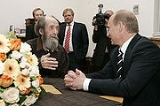
. On June 5, 2007 then Russian President Vladimir Putin
Vladimir Putin

Vladimir Vladimirovich Putin was the second President of Russia and is the current Prime Minister of Russia as well as chairman of United Russia and Chairman of the Council of Ministers of the Union of Russia and Belarus....
 signed a decree conferring on Solzhenitsyn the State Prize of the Russian Federation
State Prize of the Russian Federation

State Prize of the Russian Federation is a state honorary prize established in 1992 as the substitute for the USSR State Prize. In 2004 the rules for selection of laureates and the status of the award was significantly changed making them closer to such awards as Nobel Prize or the Soviet Lenin Prize ...
 for his humanitarian work. Putin personally visited the writer at his home on June 12, 2007 to present him with the award. Like his father, Yermolai Solzhenitsyn is an author and has translated some of his father's works. Stephan Solzhenitsyn is an urban planner in New York
New York (disambiguation)

New York is a state in the United States of America.New York City is the largest city in the United States.New York may also refer to:...
. Ignat Solzhenitsyn
Ignat Solzhenitsyn

Ignat Aleksandrovich Solzhenitsyn is a Russian-United States conductor and pianist who is the music director of the Chamber Orchestra of Philadelphia and the principal guest conductor of the Moscow Symphony Orchestra....
 is the music director of The Chamber Orchestra of Philadelphia.

Accusations of arranging his own arrest


Solzhenitsyn has been accused of staging his own arrest and eventual imprisonment in order to avoid active duty, based on his awareness of total perlustration of all mail by the military censorship.

Accusations of collaboration with NKVD

In his book The Gulag Archipelago
The Gulag Archipelago

The Gulag Archipelago is a book by Aleksandr Solzhenitsyn based on the Soviet forced labor and concentration camp system. The three-volume book is a massive narrative relying on eyewitness testimony and primary research material, as well as the author's own experiences as a prisoner in a GULAG labor camp....
 Solzhenitsyn states that he was recruited to report to the NKVD on fellow inmates and was given a code-name Vetrov, but due to his transfer to another camp he was able to elude this duty and never produced a single such report.

In 1976, after Solzhenitsyn was expelled from the Soviet Union
Soviet Union

The Union of Soviet Socialist Republics was a Constitution of the Soviet Union socialist state that existed in Eurasia from 1922 to 1991.The name is a translation of the , romanization of Russian Soyuz Sovetskikh Sotsialisticheskikh Respublik, abbreviated ????, SSSR....
 a report signed by Vetrov surfaced. After a copy of the report was obtained by Solzhenitsyn he published it together with a refutation in the Los Angeles Times
Los Angeles Times

The Los Angeles Times is a daily newspaper published in Los Angeles, California and distributed throughout the Western United States. It is the second-largest metropolitan newspaper in the United States and the fourth-most widely distributed newspaper in the United States....
 (published 24 May 1976). In 1978 the same report was published by journalist Frank Arnau
Frank Arnau

Frank Arnau was the pseudonym of a Germany crime fiction writer, born as Heinrich Schmitt....
 in a socialist Western German
Western Germany

The geographic term Western Germany is used to describe a region in the west of Germany. The exact area defined by the term is not constant, but it usually includes, but does not have the borders of, North Rhine-Westphalia and Hesse....
 magazine Neue Politik. According to Arnau the report was used in prosecution and death sentence of a group of Ukrainian nationalists incarcerated at Ekibastuz..

However, according to Solzhenitsyn the report is a falsification by the KGB
KGB

KGB is the Russian language abbreviation of Committee for State Security , which was the official name of the umbrella organization serving as the Soviet Union's premier security agency, secret police, and intelligence agency, from 1954 to 1991....
. He claimed that the report is dated 20 January 1952 while all Ukrainians were transferred to a separate camp on January 6 and they had no relation to the uprising in Solzhenitsyn's camp on January 22. He also pointed out that the only people who might in 1976 have access to a "secret KGB archive" were KGB agents themselves. Solzhenitsyn also requested Arnau to put the alleged document to a graphology test but Arnau refused.

In 1990 the report was reproduced in Soviet Voyenno-Istoricheskiy Zhurnal among the memoirs of L.A. Samutin, a former ROA
ROA

ROA can refer to:*Rehabilitation of Offenders Act 1974, in the United Kingdom*Removable Orthodontic Appliance, a type of tooth-straightening device...
 soldier and GULAG inmate who was an erstwhile supporter of Solzhenitsyn, but later became his critic. According to Solzhenitzyn publishing of the memoirs was canceled at the request of Samutin's widow who stated that the memoirs were in fact dictated by the KGB). However, other sources say that the Samutin memoirs (partially published actually) were not published in their entirety due to conflicts among Samutin's heirs over the control over the publication.

There are sources indicating that the report clearly demonstrates Solzhenitsyn's own writing style and his unique vocabulary and syntax.

Historical and political views


Historical views

During his years in the west, Solzhenitsyn was very active in the historical debate, discussing the history of Russia
Russia

Russia , or the Russian Federation , is a list of countries spanning more than one continent country extending over much of northern Eurasia....
, the Soviet Union
Soviet Union

The Union of Soviet Socialist Republics was a Constitution of the Soviet Union socialist state that existed in Eurasia from 1922 to 1991.The name is a translation of the , romanization of Russian Soyuz Sovetskikh Sotsialisticheskikh Respublik, abbreviated ????, SSSR....
 and communism
Communism

Communism is a socioeconomic structure and political ideology that promotes the establishment of an egalitarianism, classlessness, stateless society based on common ownership and control of the means of production and property in general....
. He tried to correct what he considered to be western misconceptions.

Accusations of Antisemitism
Solzhenitsyn also published a two-volume work on the history of Russian-Jewish relations (Two Hundred Years Together 2001, 2002). This book stirred controversy and some viewed it as antisemitic. Another Russian dissident writer, Vladimir Voinovich
Vladimir Voinovich

Vladimir Nikolayevich Voinovich is a prominent Russian writer and a dissident. He is a member of the Serbian Academy of Sciences and Arts in Department of Language and Literature....
, wrote a polemical study A Portrait Against the Background of a Myth ("??????? ?? ???? ????", 2002.), in which he paints Solzhenitsyn as flawed by egoism, anti-Semitism, and poor writing craftsmanship, describing Two Hundred Years Together as a work that is "long, tedious, and slanderous." Voinovich had previously parodied Solzhenitsyn in his novel Moscow 2042
Moscow 2042

Moscow 2042 is a 1986 novel by Vladimir Voinovich . In this book, the alter ego of the author travels to the future, where he sees how communism has been built up in Moscow: at first, it seems the government has actually been successful in doing so....
 through the self-centered egomaniacal character, Sim Simych Karnavalov, an extreme and brutal dictatorial writer who tries to destroy the Soviet Union and, eventually, to become the king of Russia.

On new Russian "democracy"
In his recent political writings, such as Rebuilding Russia (1990) and Russia in Collapse (1998), Solzhenitsyn criticized the oligarchic excesses of the new Russian 'democracy,' while opposing any nostalgia for Soviet communism. He defended moderate and self-critical patriotism (as opposed to extreme nationalism), argued for the indispensability of local self-government to a free Russia, and expressed concerns for the fate of the 25 million ethnic Russians in the "near abroad
Near abroad

The 'near abroad' is a term used in Russia and some other Post-Soviet states to describe the Post-Soviet states .The term is used since the early 1990s, usually to assert Russia's right to have major influence in the region,...
" of the former Soviet Union. He also sought to "protect" the national character of the Russian Orthodox church and fought against the admission of Catholic priests and Protestant pastors to Russia from other countries. For a brief period, he had his own TV show, where he freely expressed his views. The show was cancelled because of low ratings, but Solzhenitsyn continued to maintain a relatively high profile in the media.

The West
Delivering the commencement address at Harvard in 1978, he called the United States spiritually weak and mired in vulgar materialism. Americans, he said, speaking in Russian through a translator, suffered from a "decline in courage" and a "lack of manliness
Masculinity

Masculinity is manly character. It specifically describes men and boys , that is personal and human, unlike male which can also be used to describe animals, or masculine which can also be used to describe noun classes....
." Few were willing to die for their ideals, he said. He condemned both the United States government and American society for its “hasty” capitulation in Vietnam. He criticized the country’s music as intolerable and attacked its unfettered press, accusing it of violations of privacy. He said that the West erred in measuring other civilizations by its own model. While faulting Soviet society for denying fair legal treatment of people, he also faulted the West for being too legalistic: "A society which is based on the letter of the law and never reaches any higher is taking very scarce advantage of the high level of human possibilities."

Shortly after his death, professor Richard Pipes
Richard Pipes

Richard Edgar Pipes is an American historian who specializes in Russian history, particularly with respect to the history of the Soviet Union....
 wrote of him: "Solzhenitsyn blamed the evils of Soviet communism on the West. He rightly stressed the European origins of Marxism, but he never asked himself why Marxism in other European countries led not to the gulag but to the welfare state. He reacted with white fury to any suggestion that the roots of Leninism and Stalinism could be found in Russia’s past. His knowledge of Russian history was very superficial and laced with a romantic sentimentalism. While accusing the West of imperialism, he seemed quite unaware of the extraordinary expansion of his own country into regions inhabited by non-Russians. He also denied that Imperial Russia practiced censorship or condemned political prisoners to hard labor, which, of course, was absurd." While alive, Solzhenitsyn accused Pipes, who is of descent, of advancing "the Polish version of Russian history".

Russian culture
In his 1978 Harvard address, Solzhenitsyn argued over Russian culture, that the West erred in "denying its autonomous character and therefore never understood it "

Communism, Russia and nationalism
It is a popular view that the October revolution of 1917 resulting in a violent totalitarian regime was closely connected to Russia's earlier history of tsarism and culture, especially that of Ivan the Terrible
Ivan IV of Russia

Ivan IV Vasilyevich , known in English language as Ivan the Terrible was Grand Duchy of Moscow from 1533. The epithet "Grozny" is associated with might, power and strictness, rather than poor performance, horror or cruelty....
 and Peter the Great
Peter I of Russia

Peter I the Great or Pyotr Alexeyevich Romanov ruled Russia and later the Russian Empire from until his death, jointly ruling before 1696 with his weak and sickly half-brother, Ivan V of Russia....
. Solzhenitsyn claims this is fundamentally wrong and famously denounced the work of Richard Pipes
Richard Pipes

Richard Edgar Pipes is an American historian who specializes in Russian history, particularly with respect to the history of the Soviet Union....
 as "the Polish version of Russian history". Solzhenitsyn argues Tsarist Russia did not have the same violent tendencies as the Soviet Union. For instance, in Solzhenitsyn's view, Imperial Russia did not practise censorship
Censorship

Censorship is the suppression of freedom of speech or deletion of communicative material which may be considered objectionable, harmful or sensitive, as determined by a censor....
 (while it in fact did); political prisoners were not forced into labour camps (although Communist state transformed the punitive labor (katorga
Katorga

Katorga was the precursor to the Gulag system. It was a system of penal servitude of the prison farm type in Imperial Russia. Prisoners were sent to remote camps in vast uninhabited areas of Siberia—where voluntary labourers were never available in satisfactory numbers—and forced to perform hard manual labour....
) system of prerevolutionary Russia into Gulag ) and the number of political prisoners was only one ten-thousandth of those in the Soviet Union; the Tsar's secret service was only present in the three largest cities, and not at all in the army (it was in fact onmipresent). The violence of the Communist regime in Solzhenitsyn's view was in no way comparable to the violence of the Tsarist regime.

He considered it far-fetched to blame the catastrophes of the 20th century on one 16th century and one 18th century czar, when there were many other examples of violence which could have inspired the Bolshevik
Bolshevik

Bolsheviks, originally also Bolshevists were a faction of the Marxism Russian Social Democratic Labour Party which split apart from the Menshevik faction at the 2nd Congress of the RSDLP in 1903 and ultimately became the Communist Party of the Soviet Union....
 in other countries earlier in time, especially mentioning similarities with the Jacobins
Jacobin Club

The Jacobin Club was the largest and most powerful political club of the French Revolution. It originated as the Club Benthorn, formed at Versailles as a group of Brittany deputies to the Estates-General of 1789 of 1789....
 of the Reign of Terror
Reign of Terror

The Reign of Terror or simply The Terror was a period of violence that occurred fifteen months after the onset of the French Revolution, incited by conflict between rival political factions, the Girondins and the Jacobin Club, and marked by mass executions of "enemies of the revolution." Estimates vary widely as to how many were kil...
 of France
France

France , officially the French Republic , is a country whose Metropolitan France is located in Western Europe and that also comprises various Overseas departments and territories of France....
.

Instead of blaming Russian conditions, he blamed the teachings of Karl Marx
Karl Marx

Karl Heinrich Marx was a Germanphilosophy, political economy, historian, sociologist, humanism, political theorist and revolutionary credited as the founder of communism....
 and Friedrich Engels
Friedrich Engels

Friedrich Engels was a German Social science and Philosophy, who developed Communism alongside his better-known collaborator, Karl Marx, co-authoring The Communist Manifesto ....
, arguing Marxism
Marxism

Marxism is the political philosophy and practice derived from the work of Karl Marx and Friedrich Engels. Marxism holds at its core a Marxist analysis of Critique of capitalism and a theory of social change....
 itself is violent. His conclusion is Communism
Communism

Communism is a socioeconomic structure and political ideology that promotes the establishment of an egalitarianism, classlessness, stateless society based on common ownership and control of the means of production and property in general....
 will always be totalitarian and violent, wherever it is practiced. There was nothing special in the Russian conditions which affected the outcome.

He also criticized the view that the Soviet Union was Russian in any way. He argued Communism was international
International

International or internationally most often describes interaction between nations, or encompassing two or more nations, constituting a group or association having members in two or more nations, or generally reaching beyond national boundaries....
 and only cared for nationalism
Nationalism

Nationalism refers to an ideology, a feeling, a form of culture, or a social movement that focuses on the nation. While there is significant debate over the historical origins of nations, nearly all Expert accept that nationalism, at least as an ideology and social movement, is a Modernity phenomenon originating in Europe....
 as a tool to use when getting into power, or for fooling the people. Once in power, Communism tried to wipe clean every nation, destroying its culture and oppressing its people.

According to Solzhenitsyn, the Russian culture and people were not the ruling national culture in the Soviet Union. In fact, there was no ruling national culture. All national cultures were oppressed in favour of an atheistic Soviet culture. In Solzhenitsyn's opinion, Russian culture was even more oppressed than the smaller minority cultures, since the regime was more afraid of ethnic uprisings among Russians than among other peoples. Therefore, Solzhenitsyn argued, Russian nationalism
Nationalism

Nationalism refers to an ideology, a feeling, a form of culture, or a social movement that focuses on the nation. While there is significant debate over the historical origins of nations, nearly all Expert accept that nationalism, at least as an ideology and social movement, is a Modernity phenomenon originating in Europe....
 and the Orthodox Church
Russian Orthodox Church

The Russian Orthodox Church ; or The Moscow Patriarchate , also known as the Orthodox Christian Church of Russia, is a body of Christianity who constitute an Autocephaly Eastern Orthodox Church under the jurisdiction of the List of Metropolitans and Patriarchs of Moscow, in full communion with the other Eastern Orthodox Churches....
 should not be regarded as a threat by the West but rather as allies.

In 1994, Solzhenitsyn said that many American politicians and publicists are frozen in a mode of thought they developed a long time ago. With unchanging blindness and stubbornness they keep repeating and repeating this theory about the supposed age-old aggressiveness of Russia, without taking into consideration today's reality.

Solzhenitsyn said that for every country, great power status deforms and harms the national character and that he has never wished great power status for Russia. He rejected the view that the USA and Russia are natural rivals, saying that before the [Russian] revolution, they were natural allies and that during the American Civil War, Russia supported Lincoln and the North [in contrast to Britain and France, which supported the Confederacy], and then they were allies in the First World War. But beginning with communism, Russia ceased to exist and the confrontation was not at all with Russia but with the Communist U.S.S.R.

World War II
Solzhenitsyn criticized the Allies
Allies of World War II

The Allies of World War II were the countries officially opposed to the Axis powers of World War II during the World War II. Within the ranks of the Allies powers, the British Empire, the Soviet Union, and the United States of America were known as "The Big Three"....
 for not opening a new front against Nazi Germany
Germany

Germany , officially the Federal Republic of Germany , is a country in Central Europe. It is bordered to the north by the North Sea, Denmark, and the Baltic Sea; to the east by Poland and the Czech Republic; to the south by Austria and Switzerland; and to the west by France, Luxembourg, Belgium, and the Netherlands....
 in the west earlier in World War II
World War II

World War II, or the Second World War , was a global military conflict which involved a Participants in World War II, including all of the great powers, organised into two opposing military alliances: the Allies of World War II and the Axis powers....
. This resulted in Soviet domination and oppression of the nations of Eastern Europe
Eastern Europe

Eastern Europe is a term that applies to the geopolitical region encompassing the easternmost part of the Europe. Throughout history and to a lesser extent today, parts of Eastern Europe has been distinguishable from Western Europe and other regions due to cultural, religious, economic, and historical reasons, even though there i...
. Solzhenitsyn claimed the western democracies apparently cared little about how many died in the east, as long as they could end the war quickly and painlessly for themselves in the west. While stationed in East Prussia as an artillery officer, Solzhenitsyn witnessed war crimes against the civilian German population by Soviet "liberators" as the elderly were robbed of their meager possessions and women were gang-raped to death. He wrote a poem entitled "Prussian Nights
Prussian Nights

Prussian Nights is a long poem by Aleksandr Solzhenitsyn, a Captain in the Soviet Red Army during the Second World War. Prussian Nights describes the Red Army's march across East Prussia, and focuses on the traumatic Red Army atrocities that Solzhenitsyn witnessed as a participant in that march....
" about these incidents. In it, the first-person narrator seems to approve of the troops' crimes as revenge for German atrocities, expressing his desire to take part in the plunder himself. The poem describes the rape of a Polish woman whom the Red Army soldiers mistakenly thought to be a German.

Stalinism
He also rejected the view that Stalin created the totalitarian state, while Lenin (and Trotsky) had been "true communists." He argued Lenin started the mass executions, wrecked the economy, founded the Cheka
Cheka

The Cheka was the first of a succession of Soviet Union state security organizations. It was created by a decree issued on December 20, 1917, by Vladimir Lenin and subsequently led by an aristocrat turned communist Felix Dzerzhinsky....
 which would later be turned into the KGB
KGB

KGB is the Russian language abbreviation of Committee for State Security , which was the official name of the umbrella organization serving as the Soviet Union's premier security agency, secret police, and intelligence agency, from 1954 to 1991....
, and started the Gulag
Gulag

The Gulag was the government agency that administered the penal labor camps of the Soviet Union. Gulag is the Russian acronym for The Chief Administration of Corrective Labor Camps and Colonies of the NKVD....
 even though it did not have the same name at that time.

Mikhail Sholokhov
Solzhenitsyn was the most prominent of the Nobel Laureate Mikhail Sholokhov's many detractors. He believed that the work which made Sholokhov's international reputation, And Quiet Flows the Don
And Quiet Flows the Don

And Quiet Flows the Don or Quietly Flows the Don is the first part of the great Don River epic written by Michail Aleksandrovich Sholokhov....
 was written by Fyodor Kryukov
Fyodor Kryukov

Fyodor Dmitrievich Kryukov was a Cossack writer and soldier in the White Army, died in 1920 of Typhoid fever. Various literary critics, most notably Aleksandr Solzhenitsyn and I....
, a Cossack
Cossack

The term Cossacks is applied to specific militaristic communities of various ethnicities living in the southern steppe regions of Ukraine and Russia....
 and Anti-Bolshevik, who died in 1920. According to his critics, Sholokhov found the manuscript and published it under his own name. The controversy has raged for years; however the discovery of Sholokhov's drafts and notes demonstrate that Sholokhov did in fact write the book.

The Sino-Soviet Conflict
In 1973, near the height of the Sino-Soviet conflict
Sino-Soviet split

Sino-Soviet split was a gradual worsening of relations between the People's Republic of China and the Soviet Union during the Cold War. There is no particular date or event which marked the onset of the split, for tensions had plagued the Sino-Soviet alliance even at its best, but there was growing divergence between the two countries sinc...
, Solzhenitsyn sent a Letter to the Soviet Leaders to a limited number of upper echelon Soviet officials. This work, which was published for the general public in the Western world a year after it was sent to its intended audience, beseeched the Soviet Union's authorities to
Give them their ideology! Let the Chinese leaders glory in it for a while. And for that matter, let them shoulder the whole sackful of unfulfillable international obligations, let them grunt and heave and instruct humanity, and foot all the bills for their absurd economics (a million a day just to Cuba), and let them support terrorists and guerrillas in the Southern Hemisphere too if they like. The main source of the savage feuding between us will then melt away, a great many points of today's contention and conflict all over the world will also melt away, and a military clash will become a much remoter possibility and perhaps won't take place at all [author's emphasis].


Vietnam war
Once in America, Solzhenitsyn urged the United States to continue its involvement in the Vietnam War
Vietnam War

The Vietnam War, also known as the Second Indochina Wars, the Vietnam Conflict, or often in Vietnam the American War occurred in Vietnam, Laos and Cambodia from 1959 to April 30, 1975....
.

In his commencement address at Harvard University in 1978 (A World Split Apart), Solzhenitsyn alleged that many in the U.S. did not understand the Vietnam War
Vietnam War

The Vietnam War, also known as the Second Indochina Wars, the Vietnam Conflict, or often in Vietnam the American War occurred in Vietnam, Laos and Cambodia from 1959 to April 30, 1975....
. He rhetorically asks if the American antiwar proponents now realize the effects their actions had on Vietnam: "But members of the U.S. antiwar movement wound up being involved in the betrayal of Far Eastern nations, in a genocide and in the suffering today imposed on 30 million people there. Do those convinced pacifists hear the moans coming from there?"

During his time in the West, Solzhenitsyn made a few controversial public statements: notably, he characterized Daniel Ellsberg
Daniel Ellsberg

Daniel Ellsberg is a former American military analyst employed by the RAND Corporation who precipitated a national political controversy in 1971 when he released the Pentagon Papers, a Classified information The Pentagon study of government decision-making about the Vietnam War, to The New York Times and other newspapers....
 as a traitor.

Kosovo War
Solzhenitsyn strongly condemned the bombing of Yugoslavia during the Kosovo War
Kosovo War

Kosovo War occurred after the Rambouillet Agreement failed in February 1999. The term Kosovo War or Kosovo Conflict is used to describe two sequential and at times parallel armed conflicts in Kosovo:...
, saying "there is no difference whatsoever between NATO
NATO

The North Atlantic Treaty Organization , also called the Atlantic Alliance, is a military alliance established by the signing of the North Atlantic Treaty on 4 April 1949....
 and Hitler
Adolf Hitler

Adolf Hitler was an Austrian-born Germany politician and the leader of the National Socialist German Workers Party , popularly known as the Nazi Party....
."

The Holodomor
Solzhenitsyn said that Ukrainian efforts to have the 1930s famine, the Holodomor
Holodomor

The Holodomor refers to the famine of 1932?1933 in the Ukrainian SSR during which millions of people were starved to death because of the Soviet policies that forced farmers into Collectivization in the Soviet Unions....
, recognised as a Russian genocide against Ukraine is an act of historical revisionism
Historical revisionism

Within historiography, that is the academic field of history, historical revisionism is the reinterpretation of orthodox views on evidence, motivations and decision-making processes surrounding an historical event....
.

In an interview with the newspaper Izvestia, he explained that the famine was caused by the corrupt ideals of the Communist regime, under which all suffered equally. It was not an assault by the Russian people against the people of Ukraine, and that the wish to view it as such is only a recent development.

This provocative outcry of genocide was voiced only decades later. At first, it thrived secretly in the stale chauvinist minds opposing the "bloody Russians". Now it has got hold of political minds in modern Ukraine. It seems they've surpassed the wild suggestions of the Bolshevik propaganda machine. "To the parliaments of the world" - a nice teaser for the Western ears. They have never cared about our history. All they need is a fable, no matter how loony it appears.


Western culture

...there also exists another alliance — at first glance a strange one, a surprising one—but if you think about it, in fact, one which is well — grounded and easy to understand. This is the alliance between our Communist leaders and your capitalists. This alliance is not new. The very famous Armand Hammer
Armand Hammer

Armand Hammer was a flamboyant United States business tycoon most closely associated with Occidental Petroleum, a company he ran for decades, though he was known as well as for his art collection, his philanthropy, and for his close ties to the Soviet Union....
, who is flourishing here today, laid the basis for this when he made the first exploratory trip into Russia, still in Lenin's time, in the very first years of the Revolution.


And if today the Soviet Union has powerful military and police forces—in a country which is by contemporary standards poor—they are used to crush our movement for freedom in the Soviet Union—and we have western capital to thank for this also.


Testimony to the U.S. Congress, July 8, 1975.

Until I came to the West myself and spent two years looking around, I could never have imagined to what an extreme degree the West had actually become a world without a will, a world gradually petrifying in the face of the danger confronting it...All of us are standing on the brink of a great historical cataclysm, a flood that swallows up civilization and changes whole epochs.


Modern world

He described the problems of both East and West as "a disaster" rooted in atheism
Atheism

Atheism is the absence or rejection of belief in deity, or the explicit view that Existence of God.Many list of atheists are Skepticism of all supernatural beings and cite a lack of empiricism evidence for the existence of deities....
 and Dechristianisation. He referred to it as "the calamity of an autonomous, irreligious humanistic consciousness."

It has made man the measure of all things on earth—imperfect man, who is never free of pride, self-interest, envy, vanity, and dozens of other defects. We are now paying for the mistakes which were not properly appraised at the beginning of the journey. On the way from the Renaissance to our days we have enriched our experience, but we have lost the concept of a Supreme Complete Entity which used to restrain our passions and our irresponsibility.


Published works and speeches

  • One Day in the Life of Ivan Denisovich
    One Day in the Life of Ivan Denisovich

    One Day in the Life of Ivan Denisovich is a novel written by Aleksandr Solzhenitsyn, first published in November 1962 in the Soviet Union literary magazine Novy Mir ....
     (1962; novella
    Novella

    A novella is a writing, fictional, prose narrative longer than a novelette but shorter than a novel. While there is disagreement as to what length defines a novella, the Science Fiction and Fantasy Writers of America Nebula Awards for science fiction define the novella as having a word count between 17,500 and 40,000....
    )
  • An Incident at Krechetovka Station (1963; novella
    Novella

    A novella is a writing, fictional, prose narrative longer than a novelette but shorter than a novel. While there is disagreement as to what length defines a novella, the Science Fiction and Fantasy Writers of America Nebula Awards for science fiction define the novella as having a word count between 17,500 and 40,000....
    )
  • Matryona's Place (1963; novella
    Novella

    A novella is a writing, fictional, prose narrative longer than a novelette but shorter than a novel. While there is disagreement as to what length defines a novella, the Science Fiction and Fantasy Writers of America Nebula Awards for science fiction define the novella as having a word count between 17,500 and 40,000....
    )
  • For the Good of the Cause (1964; novella
    Novella

    A novella is a writing, fictional, prose narrative longer than a novelette but shorter than a novel. While there is disagreement as to what length defines a novella, the Science Fiction and Fantasy Writers of America Nebula Awards for science fiction define the novella as having a word count between 17,500 and 40,000....
    )
  • The First Circle
    The First Circle

    The First Circle is a novel by Aleksandr Solzhenitsyn released in 1968.The novel details the life of the occupants of a gulag prison camp located in the Moscow suburbs, the Marfino sharashka....
     (1968; novel)
  • Cancer Ward (1968; novel
    Novel

    File:2009 stapelweise Neuerscheinungen im Buchladen.JPGA novel is today a long narrative in literary prose. The genre has historical roots both in the fields of the medieval and early modern Romance and in the tradition of the novella....
    )
  • The Love-Girl and the Innocent
    The Love-Girl and the Innocent

    The Love-Girl and the Innocent is a play in four acts by Russians author Aleksandr Solzhenitsyn. It is set over the course of about one week in 1945 in a Stalin-era Soviet prison camp....
     (1969; play), aka The Prisoner and the Camp Hooker or The Tenderfoot and the Tart.
  • Nobel Prize (1970)The speech was delivered to the Swedish Academy
    Swedish Academy

    The Swedish Academy , founded in 1786 by King Gustav III of Sweden, is one of the Swedish Royal Academies of Sweden. Modelled after the Acad?mie fran?aise, it has 18 members....
     in writing and not actually given as a lecture.
  • August 1914 (1971). The beginning of a history of the birth of the USSR in an historical novel
    Historical novel

    A historical novel is a novel in which the story is set among historical events, or more generally, in which the time of the action predates the lifetime of the author....
    . The novel centers on the disastrous loss in the Battle of Tannenberg (1914)
    Battle of Tannenberg (1914)

    The Battle of Tannenberg was a decisive engagement between the Russian Empire and the German Empire in the first days of World War I, fought by the Russian First Army and Second Army |Second Armies and the Eighth Army between 23 August and 2 September 1914....
     in August, 1914, and the ineptitude of the military leadership. Other works, similarly titled, follow the story: see The Red Wheel
    The Red Wheel

    The Red Wheel is a Literature cycle of novels by Aleksandr Solzhenitsyn, retelling and exploring the passing of Imperial Russia and the birth-pangs of the Soviet Union....
     (overall title).
  • The Gulag Archipelago
    The Gulag Archipelago

    The Gulag Archipelago is a book by Aleksandr Solzhenitsyn based on the Soviet forced labor and concentration camp system. The three-volume book is a massive narrative relying on eyewitness testimony and primary research material, as well as the author's own experiences as a prisoner in a GULAG labor camp....
    (three volumes) (1973–1978), not a memoir, but a history of the entire process of developing and administering a police state
    Police state

    The term police state describes a state in which the government exercises rigid and repressive controls over the social, economic and political life of the population....
     in the Soviet Union.
  • Prussian Nights
    Prussian Nights

    Prussian Nights is a long poem by Aleksandr Solzhenitsyn, a Captain in the Soviet Red Army during the Second World War. Prussian Nights describes the Red Army's march across East Prussia, and focuses on the traumatic Red Army atrocities that Solzhenitsyn witnessed as a participant in that march....
    (Finished in 1951, first published in 1974; poetry)
  • Aleksandr Solzhenitsyn's at the Nobel Banquet at the City Hall in Stockholm, December 10, 1974
  • Aleksandr Isaevich Solzhenitsyn, A Letter to the Soviet leaders, Collins: Harvill Press (1974), ISBN 0-06-013913-7
  • The Oak and the Calf
    The Oak and the Calf

    File:The Oak and the Calf.jpgThe Oak and the Calf, subtitled Sketches of Literary Life in the Soviet Union, is a memoir by Aleksandr Solzhenitsyn about his attempts to have his work published in his own Soviet Union....
     (1975)
  • Lenin in Zürich (1976; separate publication of chapters on Lenin, none of them published before this point, from The Red Wheel
    The Red Wheel

    The Red Wheel is a Literature cycle of novels by Aleksandr Solzhenitsyn, retelling and exploring the passing of Imperial Russia and the birth-pangs of the Soviet Union....
    . They were later incorporated into the 1984 edition of the expanded August, 1914.)
  • Warning to the West (1976; 5 speeches (translated to English), 3 to the Americans in 1975 and 2 to the British in 1976)
  • Harvard Commencement Address (1978)
  • The Mortal Danger: Misconceptions about Soviet Russia and the Threat to America (1980)
  • Pluralists (1983; political pamphlet)
  • November 1916 (1983; novel)
  • Victory Celebration (1983)
  • Prisoners (1983)
  • Godlessness, the First Step to the Gulag. Templeton Prize Address, London, May 10 (1983)
  • August 1914 (1984; novel, much-expanded edition)
  • Rebuilding Russia (1990)
  • March 1917 (1990)
  • April 1917
  • The Russian Question (1995)
  • Russia under Avalanche (?????? ? ??????,1998; political pamphlet)
  • Two Hundred Years Together
    Two Hundred Years Together

    "Two hundred years together" is a historical book by Aleksandr Solzhenitsyn.Solzhenitsyn published this two-volume work on the history of Russian-Jewish relations in 2001 and 2002....
     (2003) on Russian-Jewish relations since 1772, aroused ambiguous public response. ( )


See also

  • Alexander Dolgun
    Alexander Dolgun

    Alexander Dolgun was a survivor of the Soviet Gulag who wrote up his experiences in 1975 after being allowed to leave the Soviet Union and return to his native United States....
  • Alexander Galich
    Alexander Galich

    Alexander Galich , was a Russian poet, screenwriter, playwright, and singer-songwriter. Galich is a pen name, a sort of acronym of his last name, first name, and patronymic: Ginzburg Alexander Arkadievich....
  • Mask of Sorrow
    Mask of Sorrow

    The Mask of Sorrow is a monument perched on a hill above Magadan, Russia , commemorating the many prisoners who suffered and died in the Gulag prison camps in the Kolyma region of the Soviet Union during the 1930s, 40s, and 50s....
  • Mikhail Sholokhov
  • Lydia Chukovskaya
    Lydia Chukovskaya

    Lydia Korneievna Chukovskaya was a Russian writer and poet. Her deeply personal writings reflect the human cost of Soviet totalitarianism, and she devoted much of her career to defending dissidents such as Aleksandr Solzhenitsyn and Andrei Sakharov....


Bibliography

  • Björkegren, Hans, and Kaarina Eneberg Aleksandr Solzhenitsyn: A Biography, Henley-on-Thames: Aiden Ellis, 1973. ISBN 0-85628-005-4.
  • Daprà Veronika: "A.I. Solzhenitsyn: The Political Writings." Università degli Studi di Venezia, 1991; Prof.Vittorio Strada, Dott.Julija Dobrovol'skaja;
  • Guardian (London). August 3, 2008.
  • Moody, Christopher. Solzhenitsyn. Edinburgh: Oliver & Boyd, 1973. ISBN 0-05-002600-3.
  • Scammell, Michael Solzhenitsyn: A Biography. London: Paladin, 1986. ISBN 0-586-08538-6.
  • Thomas, D.M.: Alexander Solzhenitsyn: A Century in his Life. New York 1998, St. Martin’s Press. ISBN 0312180365


External links

  • : Solzhenitsyn's 1978 Commencement Address to the graduating class at Harvard University
  • Moscow News May 2, 2006
  • Der Spiegel July 23, 2007
  • Richard Svec, Town Manager of Cavendish, VT, speaks of Solzhenitsyn. Audio. August 5, 2008