

First Chief Directorate

Encyclopedia
KGB
The KGB was the commonly used acronym for the . It was the national security agency of the Soviet Union from 1954 until 1991, and was the premier internal security, intelligence, and secret police organization during that time.The State Security Agency of the Republic of Belarus currently uses the...
(KGB), was the organization responsible for foreign operations and intelligence collection activities by the training and management of the covert agents, intelligence collection management, and the collection of political, scientific and technical intelligence. It was formed within KGB structures in 1954, and after the collapse of the Soviet Union
Soviet Union
The Soviet Union , officially the Union of Soviet Socialist Republics , was a constitutionally socialist state that existed in Eurasia between 1922 and 1991....
, it changed into the Central Intelligence Service, and was later renamed the Foreign Intelligence Service
Foreign Intelligence Service (Russia)
The Russian Foreign Intelligence Service is Russia's primary external intelligence agency. The SVR is the successor of the First Chief Directorate of the KGB since December 1991...
(SVR).
History of foreign intelligence in the Soviet Union
From the beginning, foreign intelligence played an important role in the Sovietforeign policy. In the Soviet Union, foreign intelligence was formally formed in 1920, as a foreign department of ChekaCheka
Cheka was the first of a succession of Soviet state security organizations. It was created by a decree issued on December 20, 1917, by Vladimir Lenin and subsequently led by aristocrat-turned-communist Felix Dzerzhinsky...
(Inostrannyj Otdiel—INO). Soviet intelligence services were formed during the Russian Civil War
Russian Civil War
The Russian Civil War was a multi-party war that occurred within the former Russian Empire after the Russian provisional government collapsed to the Soviets, under the domination of the Bolshevik party. Soviet forces first assumed power in Petrograd The Russian Civil War (1917–1923) was a...
of 1918–1920. On December 19, 1918, the Central Committee Bureau of the Russian Communist Party (Bolshevik)
Communist Party of the Soviet Union
The Communist Party of the Soviet Union was the only legal, ruling political party in the Soviet Union and one of the largest communist organizations in the world...
had decided to combine front formations of Cheka and the Military Control Units, which were controlled by the Military Revolutionary Committee
Military Revolutionary Committee
The Military Revolutionary Committee also known as the Milrevcom was the name for military organs under the soviets during the period of the Russian Revolution and Russian Civil War. The most notable ones were those of the Petrograd Soviet, the Moscow Soviet, and at Stavka.These committees were...
, and responsible for counter-intelligence
Counter-intelligence
Counterintelligence or counter-intelligence refers to efforts made by intelligence organizations to prevent hostile or enemy intelligence organizations from successfully gathering and collecting intelligence against them. National intelligence programs, and, by extension, the overall defenses of...
activities, into one organ which was named Special Section (department) of Cheka. The head of the Special Section (department) was Mikhail Sergeyevich Kedrov. The task of the Special Section was to run human intelligence: to gather political and military intelligence behind enemy lines, and expose and neutralize counter-revolutionary elements in the Red Army
Red Army
The Workers' and Peasants' Red Army started out as the Soviet Union's revolutionary communist combat groups during the Russian Civil War of 1918-1922. It grew into the national army of the Soviet Union. By the 1930s the Red Army was among the largest armies in history.The "Red Army" name refers to...
. At the beginning of 1920, in Cheka's Special Section there was an under section named War Information Bureau (WIB) which conducted political, military, scientific and technical intelligence in surrounding countries. WIB headquarter was located in Kharkiv
Kharkiv
Kharkiv or Kharkov is the second-largest city in Ukraine.The city was founded in 1654 and was a major centre of Ukrainian culture in the Russian Empire. Kharkiv became the first city in Ukraine where the Ukrainian Soviet Socialist Republic was proclaimed in December 1917 and Soviet government was...
and was divided in two sections: Western and Southern. Each section had six groups: 1st—registration; 2nd—personal; 3rd—technical; 4th—finance; 5th—law; and 6th—organization. WIB had its own internal stations, one in Kiev
Kiev
Kiev or Kyiv is the capital and the largest city of Ukraine, located in the north central part of the country on the Dnieper River. The population as of the 2001 census was 2,611,300. However, higher numbers have been cited in the press....
and one in Odessa
Odessa
Odessa or Odesa is the administrative center of the Odessa Oblast located in southern Ukraine. The city is a major seaport located on the northwest shore of the Black Sea and the fourth largest city in Ukraine with a population of 1,029,000 .The predecessor of Odessa, a small Tatar settlement,...
. The first one had the so called national section—Polish
Poland
Poland , officially the Republic of Poland , is a country in Central Europe bordered by Germany to the west; the Czech Republic and Slovakia to the south; Ukraine, Belarus and Lithuania to the east; and the Baltic Sea and Kaliningrad Oblast, a Russian exclave, to the north...
, Jewish, German
Germany
Germany , officially the Federal Republic of Germany , is a federal parliamentary republic in Europe. The country consists of 16 states while the capital and largest city is Berlin. Germany covers an area of 357,021 km2 and has a largely temperate seasonal climate...
and Czech Republic
Czech Republic
The Czech Republic is a landlocked country in Central Europe. The country is bordered by Poland to the northeast, Slovakia to the east, Austria to the south, and Germany to the west and northwest....
.
The Soviet defeat in the Polish-Bolshevik War was the main reason for the formation of a large independent intelligence department in Cheka structures. On December 20, 1920, Felix Edmundovich Dzerzhinsky
Felix Edmundovich Dzerzhinsky
Felix Edmundovich Dzerzhinsky was a Communist revolutionary, famous as the first director of the Bolshevik secret police, the Cheka, known later by many names during the history of the Soviet Union...
created the Foreign Department (Innostranny Otdel—INO), made up of the Management office (INO chief and two deputies), chancellery, agents department, visas bureau and foreign sections. In 1922, after the creation of the State Political Directorate
State Political Directorate
The State Political Directorate was the secret police of the Russian Soviet Federative Socialist Republic and the Soviet Union from 1922 until 1934...
(GPU) and connecting it with People's Commisariat for Internal Affairs (NKVD
NKVD
The People's Commissariat for Internal Affairs was the public and secret police organization of the Soviet Union that directly executed the rule of power of the Soviets, including political repression, during the era of Joseph Stalin....
) of the Russian SFSR, foreign intelligence was conducted by the GPU Foreign Department, and between December 1923 and July 1934 by the Foreign Department of Joint State Political Directorate
State Political Directorate
The State Political Directorate was the secret police of the Russian Soviet Federative Socialist Republic and the Soviet Union from 1922 until 1934...
or OGPU. In July 1934, OGPU was reincorporated into NKVD of the Soviet Union, and renamed the Main Directorate of State Security (GUGB). Until October 9, 1936, INO was operated inside the GUGB organization as a one of its departments. Then, for conspiracy purposes, People's Commissar of Internal Affairs Nikolai Yezhov
Nikolai Yezhov
Nikolai Ivanovich Yezhov or Ezhov was a senior figure in the NKVD under Joseph Stalin during the period of the Great Purge. His reign is sometimes known as the "Yezhovshchina" , "the Yezhov era", a term that began to be used during the de-Stalinization campaign of the 1950s...
, in his order #00362 had introduced a numeration of departments in the GUGB organization, hence Foreign Department or INO of the GUGB became GUGB's Department 7, and later Department 5. By 1941, foreign intelligence was given the highest status and from department it was enlarged to directorate. The name too was changed from INO (Innostranny Otdiel), to INU—Inostrannoye Upravleniye, Foreign Directorate. During the following years, Soviet security and intelligence organs went through frequent organizational changes. From February to July 1941, foreign intelligence was the responsibility of the recently created new administration the People's Commissariat of State Security (NKGB) and was working in its structure as a 1st Directorate and, after the July 1941 organizational changes, as a 1st Directorate of the People's Commisariat for Internal Affairs (NKVD).
It then returned to its former state. Already in April 1943, NKGB dealt with foreign intelligence as a 1st Directorate of NKGB. That state remained until 1946, when all People's Commissariats were renamed Ministries; NKVD was renamed Ministry of Internal Affairs (MVD), and the NKGB was renamed into Ministry of State Security (MGB). From 1946 to 1947, the 1st Directorate of the MGB was conducting foreign intelligence. In 1947, the GRU
GRU
GRU or Glavnoye Razvedyvatel'noye Upravleniye is the foreign military intelligence directorate of the General Staff of the Armed Forces of the Russian Federation...
(military intelligence) and MGB's 1st Directorate was moved to the recently created foreign intelligence agency called the Committee of Information (KI). In the summer of 1948, the military personnel in KI were returned to the Soviet military to reconstitute a foreign military intelligence arm of the GRU. KI sections dealing with the new East Bloc and Soviet émigrés were returned to the MGB in late 1948. In 1951, the KI returned to the MGB, as a First Chief Directorate of the Ministry of State Security.
After the death of long time Soviet leader Joseph Stalin
Joseph Stalin
Joseph Vissarionovich Stalin was the Premier of the Soviet Union from 6 May 1941 to 5 March 1953. He was among the Bolshevik revolutionaries who brought about the October Revolution and had held the position of first General Secretary of the Communist Party of the Soviet Union's Central Committee...
in March 1953, Lavrenty Beria took over control of the security and intelligence organs, disbanded the MGB and its existing tasks were given to the Ministry of Internal Affairs (MVD) which he was in control of. In the MVD, the foreign intelligence was conducted by the Second Chief Directorate and following the creation of KGB foreign intelligence was conduct by the First Chief Directorate of the Committee for State Security or KGB.
Chiefs of foreign intelligence
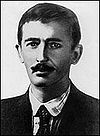
Yakov Davydov
Yakov Khristoforovich Davydov was, as head of the Cheka's Foreign Department from 1921 to 1922, the first head of Soviet foreign intelligence....
. He headed the foreign department until late 1921, when he was replaced by long time revolutionary Solomon Mogilevsky
Solomon Mogilevsky
Solomon Grigorevich Mogilevsky headed the Soviet foreign intelligence service, the INO of the GPU, from 1921 until May 1922, when he was sent to head the GPU in the South Caucasus region where had been involved in the suppression of the 1924 August Uprising in the Georgian SSR...
. He led INO only for few months, as in 1925 he died in a plane crash.
He was replaced by Mikhail Trilisser
Mikhail Trilisser
Mikhail Abramovich Trilisser-Moskvin was a Soviet OGPU chief of the Foreign Department of the Cheka and the OGPU. Later, he worked for the NKVD as a covert bureau chief and Comintern leader.-Career:...
, also a revolutionary. Trilisser specialized in tracing secret enemy informers and political spies inside the Bolshevik party. Before becoming INO chief, he led its Section of Western and Eastern Europe. Under Trilisser's management, foreign intelligence had become big professionally and respected by their opponent's services. This period characterized the enlisting of foreign agents, wide use of emigrants for intelligence tasks and organization of a network of independent agents. Trilisser himself was very active, personally traveling to Berlin
Berlin
Berlin is the capital city of Germany and is one of the 16 states of Germany. With a population of 3.45 million people, Berlin is Germany's largest city. It is the second most populous city proper and the seventh most populous urban area in the European Union...
and Paris
Paris
Paris is the capital and largest city in France, situated on the river Seine, in northern France, at the heart of the Île-de-France region...
for meetings with important agents.
Trilisser left his position in 1930, and was replaced by Artur Artuzov
Artur Artuzov
Artur Khristyanovich Artuzov Артур Христианович Артузов , headed the Soviet foreign intelligence service INO, part of OGPU, later the NKVD, from August 1931 to May 1935...
, the former chief of department of counter-intelligence (KRO) and main initiator of the Trust Operation
Trust Operation
Operation Trust was a counterintelligence operation of the State Political Directorate of the Soviet Union. The operation, which ran from 1921-1926, set up a fake anti-Bolshevik underground organization, "Monarchist Union of Central Russia", MUCR , in order to help the OGPU identify real...
. In 1936, Artuzov was replaced by then State Security Commissar 2nd rank Abram Slutsky
Abram Slutsky
Abram Aronovich Slutsky headed the Soviet foreign intelligence service , then part of the NKVD, from May 1935 to February 1938.-Biography:...
. Slutsky was an active participant of the October Revolution
October Revolution
The October Revolution , also known as the Great October Socialist Revolution , Red October, the October Uprising or the Bolshevik Revolution, was a political revolution and a part of the Russian Revolution of 1917...
and Russian Civil War
Russian Civil War
The Russian Civil War was a multi-party war that occurred within the former Russian Empire after the Russian provisional government collapsed to the Soviets, under the domination of the Bolshevik party. Soviet forces first assumed power in Petrograd The Russian Civil War (1917–1923) was a...
. He had started work in security organs in 1920 by joining Cheka and later working in OGPU, Economic Department. Then in 1931, he went to serve in OGPU's Foreign Department (INO), and often left the country for Germany
Germany
Germany , officially the Federal Republic of Germany , is a federal parliamentary republic in Europe. The country consists of 16 states while the capital and largest city is Berlin. Germany covers an area of 357,021 km2 and has a largely temperate seasonal climate...
, France
France
The French Republic , The French Republic , The French Republic , (commonly known as France , is a unitary semi-presidential republic in Western Europe with several overseas territories and islands located on other continents and in the Indian, Pacific, and Atlantic oceans. Metropolitan France...
and Spain
Spain
Spain , officially the Kingdom of Spain languages]] under the European Charter for Regional or Minority Languages. In each of these, Spain's official name is as follows:;;;;;;), is a country and member state of the European Union located in southwestern Europe on the Iberian Peninsula...
, where he participated in the Spanish Civil War
Spanish Civil War
The Spanish Civil WarAlso known as The Crusade among Nationalists, the Fourth Carlist War among Carlists, and The Rebellion or Uprising among Republicans. was a major conflict fought in Spain from 17 July 1936 to 1 April 1939...
. In February 1938, Slutsky was invited to the office of GUGB head komkor Mikhail Frinovsky
Mikhail Frinovsky
Mikhail Petrovich Frinovsky served as a deputy head of the NKVD in the years of the Great Purge and, along with Nikolai Yezhov was responsible for setting in motion the Great Purge.-Biography:...
, where he was poisoned and died.
Slutsky was replaced by Zelman Passov
Zelman Passov
Zelman Isaevich Passov Зельман Исаевич Пассов headed the Soviet foreign intelligence service, then part of the NKVD from June to November 1938, when he was arrested. He was executed a year and a half later....
, but soon he was arrested and murdered, his successor Sergey Spigelglas
Sergey Spigelglas
Sergey Mikhailovich Spigelglas or Spiegelglass or Shpigelglas was acting head of the Soviet foreign intelligence service, then part of the NKVD, from February to June 1938....
had met with the same fate, and by the end of 1938, he was arrested and murdered. The next chief (acting) of Foreign Department for only three weeks was the experienced NKVD officer Pavel Sudoplatov
Pavel Sudoplatov
Lieutenant General Pavel Anatolyevich Sudoplatov was a member of the intelligence services of the Soviet Union who rose to the rank of lieutenant general...
. Before he become INO head in May, 1938, on Stalin's direct order, he personally assassinated the Ukrainian
Ukraine
Ukraine is a country in Eastern Europe. It has an area of 603,628 km², making it the second largest contiguous country on the European continent, after Russia...
nationalist leader Yavhen Konovalets.
Later in June 1941, Sudoplatov was placed in charge of the NKVD's Special Missions Directorate, whose principal task was to carry out sabotage operations behind enemy lines in wartime (both it and the Foreign Department had also been used to carry out assassinations abroad). During World War II
World War II
World War II, or the Second World War , was a global conflict lasting from 1939 to 1945, involving most of the world's nations—including all of the great powers—eventually forming two opposing military alliances: the Allies and the Axis...
, his unit helped organize guerrilla bands, and other secret behind-the-lines units for sabotage and assassinations, to fight the Nazis
Nazism
Nazism, the common short form name of National Socialism was the ideology and practice of the Nazi Party and of Nazi Germany...
. In February, 1944, Lavrenty Beria (head of NKVD) named Pavel Sudoplatov
Pavel Sudoplatov
Lieutenant General Pavel Anatolyevich Sudoplatov was a member of the intelligence services of the Soviet Union who rose to the rank of lieutenant general...
to also head the newly-formed Department S, which united both GRU and NKVD intelligence work on the atomic bomb; he was also given a management role in the Soviet atomic effort, to help with coordination.
After Sudoplatov left his post, he was replaced by Vladimir Dekanozov
Vladimir Dekanozov
Vladimir Georgievich Dekanozov ) was a Soviet senior state security operative and diplomat.-Before Second World War:...
, before becoming INO head, Dekanozov was Deputy Chairman of the Georgian Council of People's Commissars and after he left his post in 1939 and became the Soviet ambassador in Berlin
Berlin
Berlin is the capital city of Germany and is one of the 16 states of Germany. With a population of 3.45 million people, Berlin is Germany's largest city. It is the second most populous city proper and the seventh most populous urban area in the European Union...
.
For the next seven years, from 1939 to 1946, the chief of the foreign intelligence department (then 5th Department of the GUGB/NKVD) was a very young NKVD officer and graduate of the first official intelligence school (SHON), Major of State Security Pavel Fitin
Pavel Fitin
Lieutenant General Pavel Mikhailovich Fitin was a Soviet intelligence officer and was the director of Soviet intelligence during World War II, identified in the Venona cables under the code name "Viktor."- Education :Fitin graduated from a program in agricultural...
. Fitin graduated from a program in engineering studies at the Timiryazev Agricultural Academy in 1932 after which he served in the Red Army
Red Army
The Workers' and Peasants' Red Army started out as the Soviet Union's revolutionary communist combat groups during the Russian Civil War of 1918-1922. It grew into the national army of the Soviet Union. By the 1930s the Red Army was among the largest armies in history.The "Red Army" name refers to...
, then became an editor for the State Publishing House of Agricultural Literature. The All-Union Communist Party
Communist Party of the Soviet Union
The Communist Party of the Soviet Union was the only legal, ruling political party in the Soviet Union and one of the largest communist organizations in the world...
(CPSU) selected him for a special course in foreign intelligence.
Fitin became deputy chief of the NKVD's foreign intelligence in 1938, then a year later at the age of thirty-one became chief. The Russian Foreign Intelligence Service
Foreign Intelligence Service (Russia)
The Russian Foreign Intelligence Service is Russia's primary external intelligence agency. The SVR is the successor of the First Chief Directorate of the KGB since December 1991...
credits Fitin with rebuilding the depleted foreign intelligence department after Stalin's Great Terror
Great Terror
Great Terror may refer to:* Reign of Terror , a period of extreme violence during the French Revolution, last weeks of which are sometimes referred to as the Red Terror or Great Terror...
. Fitin also is credited with providing ample warning of the German Invasion
Operation Barbarossa
Operation Barbarossa was the code name for Germany's invasion of the Soviet Union during World War II that began on 22 June 1941. Over 4.5 million troops of the Axis powers invaded the USSR along a front., the largest invasion in the history of warfare...
of 22 June 1941 that began the Great Patriotic War. Only the actual invasion saved Fitin from execution for providing the head of the NKVD, Lavrenty Beria, with information General Secretary of the CPSU, Joseph Stalin
Joseph Stalin
Joseph Vissarionovich Stalin was the Premier of the Soviet Union from 6 May 1941 to 5 March 1953. He was among the Bolshevik revolutionaries who brought about the October Revolution and had held the position of first General Secretary of the Communist Party of the Soviet Union's Central Committee...
did not want to believe. Beria retained Fitin as chief of foreign intelligence until the war ended but demoted him.
From June to September 1946, the head of foreign intelligence (MGB 1st directorate), was Lieutenant General
Lieutenant General
Lieutenant General is a military rank used in many countries. The rank traces its origins to the Middle Ages where the title of Lieutenant General was held by the second in command on the battlefield, who was normally subordinate to a Captain General....
Pyotr Kubatkin(born in 1907), when he was replaced by then Lieutenant General
Lieutenant General
Lieutenant General is a military rank used in many countries. The rank traces its origins to the Middle Ages where the title of Lieutenant General was held by the second in command on the battlefield, who was normally subordinate to a Captain General....
Pyotr Fedotov(born in 1900). Before he became head of foreign intelligence, he was working in OGPU/GUGB counter-intelligence and 'Secret Political departments and then he headed the NKVD's counter-intelligence department. From 1949 to 1951, the head of intelligence in the Committee of Information was Sergey Savchenko. Savchenko was born in 1904 and at first he was working as a security guard. He joined Soviet security organs in 1922 and in the 1940s was a top NKVD man in Ukrainian SSR
Ukrainian SSR
The Ukrainian Soviet Socialist Republic or in short, the Ukrainian SSR was a sovereign Soviet Socialist state and one of the fifteen constituent republics of the Soviet Union lasting from its inception in 1922 to the breakup in 1991...
. When Andrey Vyshinsky
Andrey Vyshinsky
Andrey Januaryevich Vyshinsky – 22 November 1954) was a Soviet politician, jurist and diplomat.He is known as a state prosecutor of Joseph Stalin's Moscow trials and in the Nuremberg trials. He was the Soviet Foreign Minister from 1949 to 1953, after having served as Deputy Foreign...
became Minister for Foreign Affairs and the head of Committee of Information, Savchenko was his deputy and head of foreign intelligence. In 1951, he was replaced by Lt. Gen. Yevgeny Petrovich Pitovranov, long time secret service worker. Between 1950 and 1951, he was the deputy of MGB head Viktor Abakumov
Viktor Abakumov
Viktor Semyonovich Abakumov , was a high level Soviet security organs official, from 1943 to 1946 the head of SMERSH in the USSR People's Commissariat of Defense, and from 1946 to 1951 Minister of State Security or MGB . Abakumov was a notoriously brutal official who was known to torture prisoners...
.
On March 5, 1953, MVD and MGB were merged into the MVD by Lavrenty Beria and his people took over all high positions. The foreign intelligence (2nd Chief Directorate of the MVD), was given to Vasili Ryasnoy. After Lavrenty Beria was arrested, along with his people in MVD, Aleksandr Panyushkin
Aleksandr Panyushkin
Aleksandr Semyonovich Panyushkin was Soviet ambassador to the United States from 1947, transferring in July 1952 to ambassador to China. He headed the First Chief Directorate of the KGB from July 1953 to June 1955....
became the head of foreign intelligence.
Early operations
In the first years of existence, Soviet Russia did not have many foreign missions that could provide official camouflage for legal outpost of intelligence called residentura, so, foreign department (INO) relied mainly on illegals, officers assigned to foreign countries under false identities. Later when official Soviet embassies, diplomatic offices and foreign missions had been created in major cities around the world, they were used to build legal intelligence post called residentura. It was led by a resident whose real identity was known only to the ambassadorAmbassador
An ambassador is the highest ranking diplomat who represents a nation and is usually accredited to a foreign sovereign or government, or to an international organization....
.
The first operations of the Soviet intelligence concentrated mainly on Russian military and political emigration organizations. According to Vladimir Lenin
Vladimir Lenin
Vladimir Ilyich Lenin was a Russian Marxist revolutionary and communist politician who led the October Revolution of 1917. As leader of the Bolsheviks, he headed the Soviet state during its initial years , as it fought to establish control of Russia in the Russian Civil War and worked to create a...
's directions, the foreign intelligence department had chosen as his main target the White Guard people (White movement
White movement
The White movement and its military arm the White Army - known as the White Guard or the Whites - was a loose confederation of Anti-Communist forces.The movement comprised one of the politico-military Russian forces who fought...
), of which the largest groups were in Berlin, Paris
Paris
Paris is the capital and largest city in France, situated on the river Seine, in northern France, at the heart of the Île-de-France region...
and Warsaw
Warsaw
Warsaw is the capital and largest city of Poland. It is located on the Vistula River, roughly from the Baltic Sea and from the Carpathian Mountains. Its population in 2010 was estimated at 1,716,855 residents with a greater metropolitan area of 2,631,902 residents, making Warsaw the 10th most...
. The intelligence and counter-intelligence department led long so called intelligence games against Russian emigration. As a result of those games, the main representatives of Russian emigration like Boris Savinkov
Boris Savinkov
Boris Viktorovich Savinkov was a Russian writer and revolutionary terrorist...
were arrested and sent for many years to prison. Another well known action against a Russian emigration conducted in the 1920s was Operation Trust (Trust Operation). "Trust" was an operation to set up a fake anti-Bolshevik
Bolshevik
The Bolsheviks, originally also Bolshevists , derived from bol'shinstvo, "majority") were a faction of the Marxist Russian Social Democratic Labour Party which split apart from the Menshevik faction at the Second Party Congress in 1903....
underground
Underground resistance
Underground resistance may refer to*Underground Resistance , a musical collective from Detroit, Michigan*Underground resistance during World War II, the inhabitants of various locales resisting the rule of the Nazis, the Empire of Japan, and Mussolini...
organization, "Monarchist Union of Central Russia", MUCR (Монархическое объединение Центральной России, МОЦР). The "head" of the MUCR was Alexander Yakushev (Александр Александрович Якушев), a former bureaucrat
Bureaucrat
A bureaucrat is a member of a bureaucracy and can comprise the administration of any organization of any size, though the term usually connotes someone within an institution of a government or corporation...
of the Ministry of Communications of Imperial Russia, who after the Russian Revolution
Russian Revolution of 1917
The Russian Revolution is the collective term for a series of revolutions in Russia in 1917, which destroyed the Tsarist autocracy and led to the creation of the Soviet Union. The Tsar was deposed and replaced by a provisional government in the first revolution of February 1917...
joined the Narkomat of External Trade (Наркомат внешней торговли), when the Soviets had to allow the former specialists (called "specs", "спецы") to take positions of their expertise. This position allowed him to travel abroad and contact Russian emigrants. MUCR kept the monarchist general Alexander Kutepov
Alexander Kutepov
Alexander Pavlovich Kutepov was a leader of the anti-communist Volunteer Army during the Russian Civil War....
(Александр Кутепов), head of a major emigrant force, Russian All-Military Union
Russian All-Military Union
The Russian All-Military Union was founded by White Army General Pyotr Wrangel in the Kingdom of Serbs, Croats and Slovenes on September 1, 1924...
(Русский общевоинский союз), from active actions and who was convinced to wait for the development of the internal anti-Bolshevik forces.
Among the successes of "Trust" was the luring of Boris Savinkov
Boris Savinkov
Boris Viktorovich Savinkov was a Russian writer and revolutionary terrorist...
and Sidney Reilly
Sidney Reilly
Lieutenant Sidney George Reilly, MC , famously known as the Ace of Spies, was a Jewish Russian-born adventurer and secret agent employed by Scotland Yard, the British Secret Service Bureau and later the Secret Intelligence Service . He is alleged to have spied for at least four nations...
into the Soviet Union to be arrested. In Soviet intelligence history, the 1930s have proceeded as a so called Era of the Great Illegals. Among others Arnold Deutsch
Arnold Deutsch
Dr. Arnold Deutsch , variously described as Austrian, Czech, or Hungarian, was an academic who worked as a Soviet spy, most well known for having recruited Kim Philby. Much of his life remains unknown or disputed.-Early life:...
and Yuri Modin
Yuri Modin
Yuri Modin was the KGB controller for the "Cambridge Five" from 1944 to 1955, during which period Donald MacLean was said to have passed atomic secrets to the Soviets. In 1951 Modin arranged the defections of Maclean and Guy Burgess...
were officers leading the Cambridge Five
Cambridge Five
The Cambridge Five was a ring of spies, recruited in part by Russian talent spotter Arnold Deutsch in the United Kingdom, who passed information to the Soviet Union during World War II and at least into the early 1950s...
case.
One of the biggest successes of Soviet foreign intelligence was the penetration of the American Manhattan Project,which was the code name for the effort during World War II to develop the first nuclear weapons of the United States with assistance from the United Kingdom and Canada. Information gathered in the United States, Great Britain and Canada, especially in USA, by NKVD and NKGB agents then supplied to Soviet physicists, allowed them to carry out the first Soviet nuclear explosion already in 1949.
First Chief Directorate
In March 1954, Soviet state security underwent its last major postwar reorganization. The MGB was once again removed from the MVD, but downgraded from a ministry to the Committee for State Security (KGB), and formally attached to the Council of Ministers in an attempt to keep it under political control. The body responsible for foreign operations and intelligence collection activities was First Chief Directorate (FCD).The first head of FCD was Aleksandr Panyushkin
Aleksandr Panyushkin
Aleksandr Semyonovich Panyushkin was Soviet ambassador to the United States from 1947, transferring in July 1952 to ambassador to China. He headed the First Chief Directorate of the KGB from July 1953 to June 1955....
, the former ambassador to the United States
United States
The United States of America is a federal constitutional republic comprising fifty states and a federal district...
and China
China
Chinese civilization may refer to:* China for more general discussion of the country.* Chinese culture* Greater China, the transnational community of ethnic Chinese.* History of China* Sinosphere, the area historically affected by Chinese culture...
and former head of Second Chief Directorate in MVD responsible for foreign intelligence. Panyushkin's doplomatic background, however, did not imply any softening in MVD/KGB operational methods abroad. Indeed, one of the first foreign operations personally supervised by Panyushkin was Operation Rhine, the attempted assassination of a Ukrainian émigré leader in West Germany
West Germany
West Germany is the common English, but not official, name for the Federal Republic of Germany or FRG in the period between its creation in May 1949 to German reunification on 3 October 1990....
.
In 1956, Panyushkin was succeeded by his former deputy Aleksandr Sakharovsky, who was to remain head of FCD for record period of 15 years. He was remembered in the FCD chiefly as an efficient, energetic administrator. Sakharovsky had, however, no firsthand experience of the West. Having joined the NKVD in 1939 at the age of thirty, he had made his postwar reputation as an MGB adviser in Eastern Europe
Eastern Europe
Eastern Europe is the eastern part of Europe. The term has widely disparate geopolitical, geographical, cultural and socioeconomic readings, which makes it highly context-dependent and even volatile, and there are "almost as many definitions of Eastern Europe as there are scholars of the region"...
, serving mainly in Romania
Romania
Romania is a country located at the crossroads of Central and Southeastern Europe, on the Lower Danube, within and outside the Carpathian arch, bordering on the Black Sea...
.
In 1971, Sakharovsky was succeeded by his 53 year old former deputy Fyodor Mortin, a career KGB officer who had risen steadily through the ranks as a loyal protege of Sakharovsky. Mortin was on top the FCD only for two years, when, in 1974, he was succeeded by the 50 year old Vladimir Kryuchkov
Vladimir Kryuchkov
Vladimir Alexandrovich Kryuchkov was a former Soviet politician and Communist Party member, having been in the organization from 1944 until he was dismissed in 1991...
, who was almost to equal Sakharovsky's record term as head of the FCD. After 14 years in FCD Hq, he was to become chairman of the KGB in 1988. Kryuchkov joined the Soviet diplomatic service, stationed in Hungary
Hungary
Hungary , officially the Republic of Hungary , is a landlocked country in Central Europe. It is situated in the Carpathian Basin and is bordered by Slovakia to the north, Ukraine and Romania to the east, Serbia and Croatia to the south, Slovenia to the southwest and Austria to the west. The...
until 1959. He then worked for the Communist Party headquarters in Ukraine
Ukraine
Ukraine is a country in Eastern Europe. It has an area of 603,628 km², making it the second largest contiguous country on the European continent, after Russia...
for eight years before joining the KGB in 1967. In 1988 he was promoted to General of the Army rank and became KGB Chairman. In 1989-1990, he was a member of Politburo. The next and last head of FCD was born on March 24, 1935 in Moscow Leonid Shebarshin
Leonid Shebarshin
Leonid Vladimirovich Shebarshin became head of the First Chief Directorate of the KGB in January 1989, when the former FCD chief, Vladimir Kryuchkov, was promoted to KGB chief...
.
Active measures and assassinations
"Active measuresActive measures
Active Measures were a form of political warfare conducted by the Soviet security services to influence the course of world events, "in addition to collecting intelligence and producing politically correct assessment of it". Active measures ranged "from media manipulations to special actions...
" were a form of political warfare conducted by the Soviet security services to influence the course of world events, "in addition to collecting intelligence and producing politically correct assessment of it". Active measures ranged "from media manipulations to special actions involving various degree of violence". They were used both abroad and domestically. They included disinformation
Disinformation
Disinformation is intentionally false or inaccurate information that is spread deliberately. For this reason, it is synonymous with and sometimes called black propaganda. It is an act of deception and false statements to convince someone of untruth...
, propaganda
Propaganda
Propaganda is a form of communication that is aimed at influencing the attitude of a community toward some cause or position so as to benefit oneself or one's group....
, forgery
Forgery
Forgery is the process of making, adapting, or imitating objects, statistics, or documents with the intent to deceive. Copies, studio replicas, and reproductions are not considered forgeries, though they may later become forgeries through knowing and willful misrepresentations. Forging money or...
of official documents.
Active measures included the establishment and support of international front organizations (e.g., the World Peace Council
World Peace Council
The World Peace Council is an international organization that advocates universal disarmament, sovereignty and independence and peaceful co-existence, and campaigns against imperialism, weapons of mass destruction and all forms of discrimination...
); foreign communist, socialist and opposition parties; wars of national liberation
Wars of national liberation
In Marxist terminology, wars of national liberation or national liberation revolutions are conflicts fought by oppressed nationalities against imperial powers to establish separate sovereign states for the subjugated nationality. From a Western point of view, these same wars are called insurgencies...
in the Third World
Third World
The term Third World arose during the Cold War to define countries that remained non-aligned with either capitalism and NATO , or communism and the Soviet Union...
; and underground, revolutionary, insurgency
Insurgency
An insurgency is an armed rebellion against a constituted authority when those taking part in the rebellion are not recognized as belligerents...
, criminal, and terrorist
Terrorism
Terrorism is the systematic use of terror, especially as a means of coercion. In the international community, however, terrorism has no universally agreed, legally binding, criminal law definition...
groups. The intelligence agencies of Eastern Bloc
Eastern bloc
The term Eastern Bloc or Communist Bloc refers to the former communist states of Eastern and Central Europe, generally the Soviet Union and the countries of the Warsaw Pact...
and other communist states also contributed in the past to the program, providing operatives and intelligence for assassinations and other types of covert operations.
Occasionally, KGB assassinated the enemies of the USSR abroad—principally Soviet Bloc defectors, either directly or by aiding Communist country secret services— The killings of Organization of Ukrainian Nationalists
Organization of Ukrainian Nationalists
The Organization of Ukrainian Nationalists is a Ukrainian political organization which as a movement originally was created in 1929 in Western Ukraine . The OUN accepted violence as an acceptable tool in the fight against foreign and domestic enemies particularly Poland and Russia...
members Lev Rebet
Lev Rebet
Lev Rebet was a Ukrainian political writer and anti-communist during World War II. He was a key cabinet member in the Ukrainian government which proclaimed independence on June 30, 1941...
and Stepan Bandera
Stepan Bandera
Stepan Andriyovych Bandera was a Ukrainian politician and one of the leaders of Ukrainian national movement in Western Ukraine , who headed the Organization of Ukrainian Nationalists...
by Bohdan Stashynsky
Bohdan Stashynsky
Bohdan Stashynsky is the KGB assassin of Ukrainian nationalist leaders Lev Rebet and Stepan Bandera who were killed in the late 1950s.-Early biography :...
in Munich in 1957 and 1959, as well as the unrelated slayings of emigre dissidents like Abdurahman Fatalibeyli
Abdurahman Fatalibeyli
Abdurrahman Fatalibeyli Abdurrahman Fatalibeyli Abdurrahman Fatalibeyli (birth surname Dudanginski, or Abo Alioglu Fatalibeyli-Dudanginsky (Або Алиевич Дудангинский / Əbo Əliyeviç Düdənginski), born Abo Dudanginski (June 12, 1908, Dudangi – November 1954, Munich) was a Soviet army major who...
; the surreptitious ricin
Ricin
Ricin , from the castor oil plant Ricinus communis, is a highly toxic, naturally occurring protein. A dose as small as a few grains of salt can kill an adult. The LD50 of ricin is around 22 micrograms per kilogram Ricin , from the castor oil plant Ricinus communis, is a highly toxic, naturally...
poisoning of the Bulgarian émigré Georgi Markov
Georgi Markov
Georgi Ivanov Markov was a Bulgarian dissident writer.Markov originally worked as a novelist and playwright, but in 1969 he defected from Bulgaria, then governed by President Todor Zhivkov...
, shot with an umbrella-gun of KGB design, in 1978; The defection of assassins like Nikolai Khokhlov and Bohdan Stashynsky
Bohdan Stashynsky
Bohdan Stashynsky is the KGB assassin of Ukrainian nationalist leaders Lev Rebet and Stepan Bandera who were killed in the late 1950s.-Early biography :...
severely curtailed such activities however, and the KGB largely gave up assassinations abroad after Stashynsky's defection, although they continued assisting the Eastern European sister services in doing so.
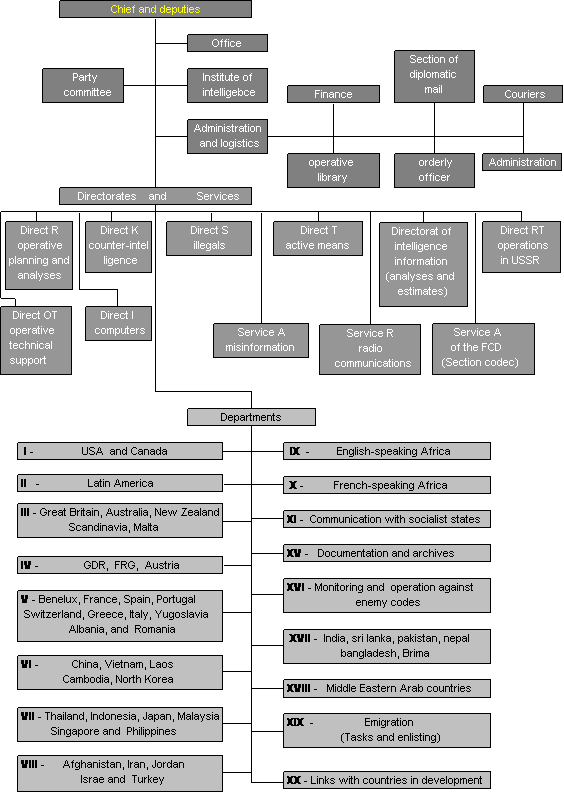
First Chief Directorate organization
KGB residents in the United States
Washington, DC- Vasili Zarubin (alias Zubilin): 1942 – 1944
- Grigori Dolbin: 1946 – 1948 no refs
- Georgi Sokolov: 1948 – 1949 no refs
- Aleksandr PanyushkinAleksandr PanyushkinAleksandr Semyonovich Panyushkin was Soviet ambassador to the United States from 1947, transferring in July 1952 to ambassador to China. He headed the First Chief Directorate of the KGB from July 1953 to June 1955....
(also Soviet ambassador): 1949 – 1950 - Nikolai Vladykin: 1950 – 1954 no refs
- Alexandre FeklisovAlexandre FeklisovAleksandr Semyonovich Feklisov was a Soviet spy, the NKGB Case Officer who received information from Julius Rosenberg and Klaus Fuchs, among others.-Biography:...
(alias Fomin): 1960 – 1964 - Pavel Lukyanov: 1964 – 1965
- Boris Solomatin: 1966 – 1968
- Mikhail Polonik: 1968 – 1975
- Dmitri Yakushkin: 1975 – 1982
- Stanislav Androsov: 1982 – 1986
- Ivan Gromakov: 1987
FCD residency organization
KGB's First Chief Directorate residency, was the equivalent of the U.S. Central Intelligence AgencyCentral Intelligence Agency
The Central Intelligence Agency is a civilian intelligence agency of the United States government. It is an executive agency and reports directly to the Director of National Intelligence, responsible for providing national security intelligence assessment to senior United States policymakers...
's (CIA) station. The chief of residency (resident) was the equivalent of the CIA's Chief of Station.
So-called legal resident is a spy
SPY
SPY is a three-letter acronym that may refer to:* SPY , ticker symbol for Standard & Poor's Depositary Receipts* SPY , a satirical monthly, trademarked all-caps* SPY , airport code for San Pédro, Côte d'Ivoire...
who operates in a foreign country under diplomatic cover
Official cover
Official cover is a term used in espionage to refer to operatives who assume positions in organizations with diplomatic ties to the government for which they work....
(e.g., from his country's embassy). He is an official member of the consular staff, such as a commercial, cultural or military attaché. Thus he has diplomatic immunity
Diplomatic immunity
Diplomatic immunity is a form of legal immunity and a policy held between governments that ensures that diplomats are given safe passage and are considered not susceptible to lawsuit or prosecution under the host country's laws...
from prosecution and cannot be arrested by the host country if suspected of espionage
Espionage
Espionage or spying involves an individual obtaining information that is considered secret or confidential without the permission of the holder of the information. Espionage is inherently clandestine, lest the legitimate holder of the information change plans or take other countermeasures once it...
. The most the host country can do is send him back to his home country. And hi is in charge of the residency and the personnel. He is also un official contact who well-known people in government for contact that is use in times of crisis.
During the Cuban missile crisis
Cuban Missile Crisis
The Cuban Missile Crisis was a confrontation among the Soviet Union, Cuba and the United States in October 1962, during the Cold War...
KGB resident in Washington, D.C.
Washington, D.C.
Washington, D.C., formally the District of Columbia and commonly referred to as Washington, "the District", or simply D.C., is the capital of the United States. On July 16, 1790, the United States Congress approved the creation of a permanent national capital as permitted by the U.S. Constitution....
Aleksandr Fomin (real name Alexander Feklisov) he played a huge role in resolving this conflict.
The residency was divided into lines (sections) each line was responsible for its assigned task of gathering intelligence, and one of the line's (section) was responsible for counterintelligence.
Counterintelligence line played a big role in the residency of the KGB, was responsible for counterintelligence and security of residency consulate and the embassy that housed the residency. This responsibility fell on KR Line (KR - shortcut from the kontrazvietka counter-intel). Mainly it used so-called "defensive counterintelligence" tactics. Which meant that KR Line attention and force was used for the internal security of the residency and the embassy. Operational control over residency personnel, surveillance
Surveillance
Surveillance is the monitoring of the behavior, activities, or other changing information, usually of people. It is sometimes done in a surreptitious manner...
, establishment of any suspicious contacts of residency personnel with citizens of the country where they are staying, and they had not reported, checking their personal mail etc. KR Line was using such tactics to make sure if anyone from residency or the embassy was recruited by the enemy such as the U.S. Federal Bureau of Investigation
Federal Bureau of Investigation
The Federal Bureau of Investigation is an agency of the United States Department of Justice that serves as both a federal criminal investigative body and an internal intelligence agency . The FBI has investigative jurisdiction over violations of more than 200 categories of federal crime...
(FBI), or if anyone is planning to do so.
The role of the KR Line has increased in 1985, considerably after the CIA counterintelligence officer Aldrich Ames
Aldrich Ames
Aldrich Hazen Ames is a former Central Intelligence Agency counter-intelligence officer and analyst, who, in 1994, was convicted of spying for the Soviet Union and Russia...
and FBI counterintelligence special agent Robert Hanssen
Robert Hanssen
Robert Philip Hanssen is a former American FBI agent who spied for Soviet and Russian intelligence services against the United States for 22 years from 1979 to 2001...
volunteered their services to the KGB residency in Washington DC.
In return for the money they gave the KGB the names of officers of the KGB residency in Washington DC (not only), who cooperated with the FBI and the CIA. Officers of Line KR immediately arrested persons identified, they were Vitaly Yurchenko
Vitaly Yurchenko
Vitaly Yurchenko is a former high-ranking KGB officer in the Soviet Union. In 1985, after 25 years of service in the KGB, he made a fake defection to the United States during an assignment in Rome. After providing the names of two U.S. intelligence officers who were KGB agents, Yurchenko slipped...
, Major General
Major General
Major general or major-general is a military rank used in many countries. It is derived from the older rank of sergeant major general. A major general is a high-ranking officer, normally subordinate to the rank of lieutenant general and senior to the ranks of brigadier and brigadier general...
, Dmitri Polyakov
Dmitri Polyakov
Dmitri Fyodorovich Polyakov was a Soviet Major General, a high-ranking GRU officer, and a prominent Cold War spy who revealed Soviet secrets to the Central Intelligence Agency...
high ranking officer from Soviet military intelligence, the GRU
GRU
GRU or Glavnoye Razvedyvatel'noye Upravleniye is the foreign military intelligence directorate of the General Staff of the Armed Forces of the Russian Federation...
. He was cooperating with the CIA and FBI. Ames gave the Colonel Oleg Gordievsky
Oleg Gordievsky
Oleg Antonovich Gordievsky , CMG , is a former Colonel of the KGB and KGB Resident-designate and bureau chief in London, who was a secret agent of the British Secret Intelligence Service from 1974 to 1985.-Early career:Oleg Gordievsky attended the Moscow State Institute of International...
was the head of the London
London
London is the capital city of :England and the :United Kingdom, the largest metropolitan area in the United Kingdom, and the largest urban zone in the European Union by most measures. Located on the River Thames, London has been a major settlement for two millennia, its history going back to its...
residency, (resident) he spied for the Secret Intelligence Service
Secret Intelligence Service
The Secret Intelligence Service is responsible for supplying the British Government with foreign intelligence. Alongside the internal Security Service , the Government Communications Headquarters and the Defence Intelligence , it operates under the formal direction of the Joint Intelligence...
(SIS or MI6). And many others who were arrested by the officers from KR Line and taken to Moscow. There they were passed into the hands of KGB's II Chief Directorate counterintelligence.
After a quick secret processes, they were sentenced to death. The death sentences carried out in the Lubyanka prison. Later they were buried face down in unmarked graves. Only Oleg Gordievsky
Oleg Gordievsky
Oleg Antonovich Gordievsky , CMG , is a former Colonel of the KGB and KGB Resident-designate and bureau chief in London, who was a secret agent of the British Secret Intelligence Service from 1974 to 1985.-Early career:Oleg Gordievsky attended the Moscow State Institute of International...
was able to escape from USSR with the help of MI6.
Officers of the KR Line did not want to immediately arrest all identified by Ames and Hanssen. Because they knew that draw the attention of the CIA and FBI (with it did). They wanted to run a game of disinformation. But Stanislav Androsov the resident wishing to demonstrate their effectiveness to his superiors and ordered to immediately arrest all.
After those incidents, the security of residencies have been enlarged, and the KR Line was assigned more security officers, especially in countries like USA and England.
The KGB's FCD residency was divided in two parts Operational Staff and Support Staff
- KGB Resident
-
- Operational staff
- PR Line - collects information about political, economic, and military strategic intelligence, also active measures
- Operational staff
- KR Line - Counterintelligence and Security
- Line X -
- Line N -
- Line EM -
- Special Reservists
Heads of Intelligence
| INO/INU/FCD Head | Service | 1920 – 1991 |
|---|---|---|
| Yakov Davydov Yakov Davydov Yakov Khristoforovich Davydov was, as head of the Cheka's Foreign Department from 1921 to 1922, the first head of Soviet foreign intelligence.... |
foreign department of Cheka | 1920 – 1921 |
| Solomon Mogilevsky Solomon Mogilevsky Solomon Grigorevich Mogilevsky headed the Soviet foreign intelligence service, the INO of the GPU, from 1921 until May 1922, when he was sent to head the GPU in the South Caucasus region where had been involved in the suppression of the 1924 August Uprising in the Georgian SSR... |
foreign department of Cheka | 1921 – ? |
| Mikhail Trilisser Mikhail Trilisser Mikhail Abramovich Trilisser-Moskvin was a Soviet OGPU chief of the Foreign Department of the Cheka and the OGPU. Later, he worked for the NKVD as a covert bureau chief and Comintern leader.-Career:... |
foreign department of GPU/OGPU | 1921 – 1930 |
| Artur Artuzov Artur Artuzov Artur Khristyanovich Artuzov Артур Христианович Артузов , headed the Soviet foreign intelligence service INO, part of OGPU, later the NKVD, from August 1931 to May 1935... |
foreign department of OGPU/GUGB-NKVD | 1930 – 1936 |
| Abram Slutsky Abram Slutsky Abram Aronovich Slutsky headed the Soviet foreign intelligence service , then part of the NKVD, from May 1935 to February 1938.-Biography:... |
7th Department of GUGB-NKVD | 1936 – 1938 |
| Zelman Passov Zelman Passov Zelman Isaevich Passov Зельман Исаевич Пассов headed the Soviet foreign intelligence service, then part of the NKVD from June to November 1938, when he was arrested. He was executed a year and a half later.... |
5th Department of NKVD 1st Directorate (UGB) | 1938 June–September |
| acting Sergey Spigelglas Sergey Spigelglas Sergey Mikhailovich Spigelglas or Spiegelglass or Shpigelglas was acting head of the Soviet foreign intelligence service, then part of the NKVD, from February to June 1938.... |
5th Department of GUGB-NKVD | 1938 – 6 of November 1938 |
| Pavel Sudoplatov Pavel Sudoplatov Lieutenant General Pavel Anatolyevich Sudoplatov was a member of the intelligence services of the Soviet Union who rose to the rank of lieutenant general... |
5th Department of GUGB-NKVD | 6 of November 1938 – 1938 |
| Vladimir Dekanozov Vladimir Dekanozov Vladimir Georgievich Dekanozov ) was a Soviet senior state security operative and diplomat.-Before Second World War:... |
5th Department of GUGB-NKVD | 28 of November 1938 – 1939 |
| Pavel Fitin Pavel Fitin Lieutenant General Pavel Mikhailovich Fitin was a Soviet intelligence officer and was the director of Soviet intelligence during World War II, identified in the Venona cables under the code name "Viktor."- Education :Fitin graduated from a program in agricultural... |
5th Department of GUGB-NKVD/ 1st Directorate of NKVD/NKGB/MGB | 1939 – 1946 |
| Pyotr Kubatkin | 1st Directorate of MGB | 1946 |
| Pyotr Fedotov Pyotr Fedotov Pyotr Vasileevich Fedotov was long time Soviet security and intelligence officer, head of counterintelligence in NKVD/NKGB and head of foreign intelligence as the deputy chairman of the Committee of Information.... |
1st Directorate of MGB/Committee of Information | 1946 – 1949 |
| Sergey Savchenko | Committee of Information | 1949 – 1951 |
| Yevgeny Pitovranov | 1st Chief Directorate of MGB | 1952 – 1953 |
| Vasili Ryasnoy | 2nd Chief Directorate of the MVD | 1953 |
| Aleksandr Panyushkin Aleksandr Panyushkin Aleksandr Semyonovich Panyushkin was Soviet ambassador to the United States from 1947, transferring in July 1952 to ambassador to China. He headed the First Chief Directorate of the KGB from July 1953 to June 1955.... |
2nd Chief Directorate of the MVD/1st Chief Directorate of KGB | 1953 – 1955 |
| Aleksandr Sakharovsky | 1st Chief Directorate of KGB | 1956 – 1971 |
| Fyodor Mortin | 1st Chief Directorate of KGB | 1971 – 1974 |
| Vladimir Kryuchkov Vladimir Kryuchkov Vladimir Alexandrovich Kryuchkov was a former Soviet politician and Communist Party member, having been in the organization from 1944 until he was dismissed in 1991... |
1st Chief Directorate of KGB | 1974 – 1988 |
| Leonid Shebarshin Leonid Shebarshin Leonid Vladimirovich Shebarshin became head of the First Chief Directorate of the KGB in January 1989, when the former FCD chief, Vladimir Kryuchkov, was promoted to KGB chief... |
1st Chief Directorate of KGB | 1988 – 1991 |
See also
- Mitrokhin ArchiveMitrokhin ArchiveThe Mitrokhin Archive is a collection of notes made secretly by KGB Major Vasili Mitrokhin during his thirty years as a KGB archivist in the foreign intelligence service and the First Chief Directorate...
- Vasili MitrokhinVasili MitrokhinVasili Nikitich Mitrokhin was a Major and senior archivist for the Soviet Union's foreign intelligence service, the First Chief Directorate of the KGB, and co-author with Christopher Andrew of The Mitrokhin Archive: The KGB in Europe and the West, a massive account of Soviet intelligence...