


Heavy cavalry

Encyclopedia
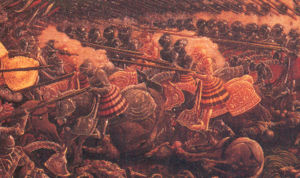
Cavalry
Cavalry or horsemen were soldiers or warriors who fought mounted on horseback. Cavalry were historically the third oldest and the most mobile of the combat arms...
whose primary role was to engage in direct combat with enemy forces (shock troops). Although their equipment differed greatly depending on the region and historical period, they were generally mounted on large powerful horses, and were often equipped with some form of scale, plated
Plated mail
Plated mail is a type of mail with embedded plates. Armour of this type has been used in the Middle East, Japan, China, Korea, Central Asia, Greater Iran, India, Eastern Europe, and by the Moors.-Types of plated mail:In Russia there are three known varieties of this armour...
, chainmail
Chainmail
Mail is a type of armour consisting of small metal rings linked together in a pattern to form a mesh.-History:Mail was a highly successful type of armour and was used by nearly every metalworking culture....
or lamellar
Lamellar armour
Lamellar armour was one of three early body armour types made from armour plates. The other two types are scale armour and laminar armour.-Description:...
armor as well as either sword
Sword
A sword is a bladed weapon used primarily for cutting or thrusting. The precise definition of the term varies with the historical epoch or the geographical region under consideration...
s, maces, lance
Lance
A Lance is a pole weapon or spear designed to be used by a mounted warrior. The lance is longer, stout and heavier than an infantry spear, and unsuited for throwing, or for rapid thrusting. Lances did not have tips designed to intentionally break off or bend, unlike many throwing weapons of the...
s, or battle axe
Battle axe
A battle axe is an axe specifically designed for combat. Battle axes were specialized versions of utility axes...
s.
Antiquity
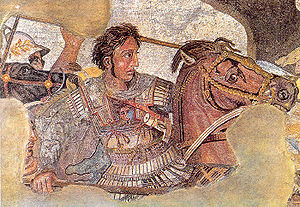
Mesopotamia
Mesopotamia is a toponym for the area of the Tigris–Euphrates river system, largely corresponding to modern-day Iraq, northeastern Syria, southeastern Turkey and southwestern Iran.Widely considered to be the cradle of civilization, Bronze Age Mesopotamia included Sumer and the...
since 3000 BC, the chariot
Chariot
The chariot is a type of horse carriage used in both peace and war as the chief vehicle of many ancient peoples. Ox carts, proto-chariots, were built by the Proto-Indo-Europeans and also built in Mesopotamia as early as 3000 BC. The original horse chariot was a fast, light, open, two wheeled...
was the predominant mobile striking force in most armies in the region. By 600 BC armoured cavalry began seeing use, though it was not until the later ancient Greek era that true heavy cavalry emerged. Assyrian cavalry during the reign of Ashurbanipal
Ashurbanipal
Ashurbanipal |Ashur]] is creator of an heir"; 685 BC – c. 627 BC), also spelled Assurbanipal or Ashshurbanipal, was an Assyrian king, the son of Esarhaddon and the last great king of the Neo-Assyrian Empire...
was known to have used metal helmet and breastplate, fought with thrusting spears in conjunction with bows and arrows, and rode on horses covered with textille barding
Barding
Barding is armour for horses. During the late Middle Ages as armour protection for knights became more effective, their mounts became targets...
, however it's unclear how this early heavy cavalry operated and performed.
Persians
Iranian tribes such as the MassagetaeMassagetae
The Massageteans or Massagetaeans were an Iranian nomadic confederation in antiquity known primarily from the writings of Herodotus. Their name was probably akin to Thyssagetae.-Name:...
were believed to be the originator of the class of heavy cavalry known as cataphract
Cataphract
A cataphract was a form of armored heavy cavalry utilised in ancient warfare by a number of peoples in Western Eurasia and the Eurasian Steppe....
. During the time of Achaemenid Persia
Achaemenid Empire
The Achaemenid Empire , sometimes known as First Persian Empire and/or Persian Empire, was founded in the 6th century BCE by Cyrus the Great who overthrew the Median confederation...
cavalry was the elite arm of service (as was the case in most civilizations), and many Persian horsemen such as the bodyguard unit of Cyrus the younger
Cyrus the Younger
Cyrus the Younger, son of Darius II of Persia and Parysatis, was a Persian prince and general. The time of his birth is unknown, but he died in 401 B.C. The history of Cyrus and of the retreat of the Greeks is told by Xenophon in his Anabasis. Another account, probably from Sophaenetus of...
were rather heavily armored by ancient standard. By the time of Alexander's invasion cataphract units with both men and beasts being fully encased in armor were already in use by the Persians, however they seemed overall to be inferior compared to the Macedonian Hetairoi
Companion cavalry
The Companions were the elite cavalry of the Macedonian army from the time of king Philip II of Macedon and reached the most prestige under Alexander the Great, and have been regarded as the best cavalry in the ancient world and the first shock cavalry...
due to their lack of long lances and Alexander's superior tactics.
The Parthian Empire
Parthian Empire
The Parthian Empire , also known as the Arsacid Empire , was a major Iranian political and cultural power in ancient Persia...
of Ancient Iran marks an early recorded utilization of armored cavalry in warfare, and are specifically believed to have given rise to the tradition of very heavily armored Cataphract
Cataphract
A cataphract was a form of armored heavy cavalry utilised in ancient warfare by a number of peoples in Western Eurasia and the Eurasian Steppe....
lancer
Lancer
A lancer was a type of cavalryman who fought with a lance. Lances were used in mounted warfare by the Assyrians as early as and subsequently by Greek, Persian, Gallic, Han-Chinese, nomadic and Roman horsemen...
s. These had a distinct role from ordinary heavy cavalry and were primarily used as an elite assault force, to pummel infantry formations into submission, or even acted in a dual-purpose role as horse archers and cataphracts.
Ammianus Marcellinus
Ammianus Marcellinus
Ammianus Marcellinus was a fourth-century Roman historian. He wrote the penultimate major historical account surviving from Antiquity...
, a Roman
Roman Empire
The Roman Empire was the post-Republican period of the ancient Roman civilization, characterised by an autocratic form of government and large territorial holdings in Europe and around the Mediterranean....
general and historian, who served in the army of Constantius II
Constantius II
Constantius II , was Roman Emperor from 337 to 361. The second son of Constantine I and Fausta, he ascended to the throne with his brothers Constantine II and Constans upon their father's death....
in Gaul
Gaul
Gaul was a region of Western Europe during the Iron Age and Roman era, encompassing present day France, Luxembourg and Belgium, most of Switzerland, the western part of Northern Italy, as well as the parts of the Netherlands and Germany on the left bank of the Rhine. The Gauls were the speakers of...
and Persia, fought against the Persians under Julian the Apostate
Julian the Apostate
Julian "the Apostate" , commonly known as Julian, or also Julian the Philosopher, was Roman Emperor from 361 to 363 and a noted philosopher and Greek writer....
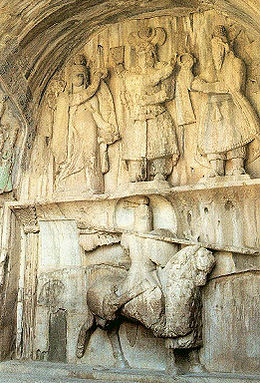
and took part in the retreat of his successor, Jovian. He describes the Persian knight
Knight
A knight was a member of a class of lower nobility in the High Middle Ages.By the Late Middle Ages, the rank had become associated with the ideals of chivalry, a code of conduct for the perfect courtly Christian warrior....
as:
-
- "All their companies clad in iron, and all parts of their bodies were covered with thick plates, so fitted that the stiff joints conformed with those of their limbs; and forms of the human faces were so skillfully fitted to their heads, that since their entire bodies were covered with metal, arrows that fell upon them could lodge only where they could see a little through tiny openings opposite the pupil of the eye, or where through the tips of their noses they were able to get a little breath."
-
- "The Persians opposed us serried bands of mail-clad horsemen in such close order that the gleam of moving bodies covered with closely fitting plates of iron dazzled the eyes of those who looked upon them, while the whole throng of horses was protected by coverings of leather. "
Greeks
The ancient Greeks called armored cavalry KataphraktosCataphract
A cataphract was a form of armored heavy cavalry utilised in ancient warfare by a number of peoples in Western Eurasia and the Eurasian Steppe....
(pl. Kataphraktoi) which translated means roughly "covered, protected" or "armored". The term was later borrowed by the Romans (the Latin
Latin
Latin is an Italic language originally spoken in Latium and Ancient Rome. It, along with most European languages, is a descendant of the ancient Proto-Indo-European language. Although it is considered a dead language, a number of scholars and members of the Christian clergy speak it fluently, and...
variant in the Roman Empire
Roman Empire
The Roman Empire was the post-Republican period of the ancient Roman civilization, characterised by an autocratic form of government and large territorial holdings in Europe and around the Mediterranean....
being Cataphractarii) and until the Middle Ages in Europe, continued to be used to designate armored cavalry. However as with other types of cavalry, heavy cavalry was not employed in any significant capacity in wars between the Greek city states until later, mainly due to the prevalence of hoplite
Hoplite
A hoplite was a citizen-soldier of the Ancient Greek city-states. Hoplites were primarily armed as spearmen and fought in a phalanx formation. The word "hoplite" derives from "hoplon" , the type of the shield used by the soldiers, although, as a word, "hopla" could also denote weapons held or even...
warfare as well as the mountainous terrain of Central Greece
Central Greece
Continental Greece or Central Greece , colloquially known as Roúmeli , is a geographical region of Greece. Its territory is divided into the administrative regions of Central Greece, Attica, and part of West Greece...
. The lack of suitable grassland and excess grain supply necessary for the production of good cavalry mounts was also crippling to the establishment of an effective cavalry force, the noted Greek mercenary and writer Xenophon
Xenophon
Xenophon , son of Gryllus, of the deme Erchia of Athens, also known as Xenophon of Athens, was a Greek historian, soldier, mercenary, philosopher and a contemporary and admirer of Socrates...
once saying that a horse farm was the most expensive type of establishment to keep running.
The exception was in Northern Greece, where large flat areas of grassland made cavalry much more practical. Eventually, encounters with Persian cavalry led the Greeks to create their own cavalry arm, the Hippeis
Hippeis
Hippeis was the Greek term for cavalry. The Hippeus was the second highest of the four Athenian social classes, made of men who could afford to maintain a war horse in the service of the state. The rank may be compared to Roman Equestrians and medieval knights. Among the Athenians, it referred to...
, composed mostly of upper-class citizens who could afford to maintain a horse. While cavalry played an increasingly greater part in Greek warfare, its roles were generally restricted to scouting, skirmishing and pursuit. By the end of the Pelopponesian War however, heavy cavalry charges has started to play an increasingly important part in Ancient Greek warfare, with the Battle of Delium
Battle of Delium
The Battle of Delium or of Delion took place in 424 BC between the Athenians and the Boeotians, and ended with the siege of Delium in the following weeks.-Prelude:...
showing how their intervention could turn the tide of a battle. The city state of Thebes
Ancient Thebes (Boeotia)
See Thebes, Greece for the modern city built on the ancient ruins.Ancient Thebes was a Boeotian city-state , situated to the north of the Cithaeron range, which divides Boeotia from Attica, and on the southern edge of the Boeotian plain...
was particularly famous for its cavalry, with the famed Theban commander Epaminondas
Epaminondas
Epaminondas , or Epameinondas, was a Theban general and statesman of the 4th century BC who transformed the Ancient Greek city-state of Thebes, leading it out of Spartan subjugation into a preeminent position in Greek politics...
using his heavy horse to great effect both at Leuctra
Battle of Leuctra
The Battle of Leuctra was a battle fought on July 6, 371 BC, between the Boeotians led by Thebans and the Spartans along with their allies amidst the post-Corinthian War conflict. The battle took place in the neighbourhood of Leuctra, a village in Boeotia in the territory of Thespiae...
as well as Mantineia
Battle of Mantinea (362 BC)
The Battle of Mantinea was fought on July 4 362 BC between the Thebans, led by Epaminondas and supported by the Arcadians and the Boeotian league against the Spartans, led by King Agesilaus II and supported by the Eleans, Athenians, and Mantineans...
to rout the Spartan cavalry, and in the process disrupting the legendary Spartan phalanx
Phalanx formation
The phalanx is a rectangular mass military formation, usually composed entirely of heavy infantry armed with spears, pikes, sarissas, or similar weapons...
as well, helping his own to win the day. It's likely that Phillip of Macedon organized his famed Companions
Companion cavalry
The Companions were the elite cavalry of the Macedonian army from the time of king Philip II of Macedon and reached the most prestige under Alexander the Great, and have been regarded as the best cavalry in the ancient world and the first shock cavalry...
after the Theban model, since he spent his youth in the house of Epaminondas as a hostage.
The development of the saddle
Saddle
A saddle is a supportive structure for a rider or other load, fastened to an animal's back by a girth. The most common type is the equestrian saddle designed for a horse, but specialized saddles have been created for camels and other creatures...
as well as increasingly larger horse breeds led to creation of the Macedonian Companion cavalry
Companion cavalry
The Companions were the elite cavalry of the Macedonian army from the time of king Philip II of Macedon and reached the most prestige under Alexander the Great, and have been regarded as the best cavalry in the ancient world and the first shock cavalry...
, developed during the reign of Philip II of Macedon
Philip II of Macedon
Philip II of Macedon "friend" + ἵππος "horse" — transliterated ; 382 – 336 BC), was a king of Macedon from 359 BC until his assassination in 336 BC. He was the father of Alexander the Great and Philip III.-Biography:...
and later used with great effect by his son, Alexander the Great, in cavalry charges on enemy flanks. In both role and equipment, the Companions was the first cavalry force that was known to represent archetypal heavy cavalry. The Companion cavalry, or Hetairoi, were the elite arm of the Macedonian army, and have been regarded as the best cavalry in the ancient world.
In the aftermath of the Macedonian Empire, the Diadochi
Diadochi
The Diadochi were the rival generals, family and friends of Alexander the Great who fought for the control of Alexander's empire after his death in 323 BC...
, successor states created by Alexander the Great's generals, continued the usage of heavy cavalry in their own forces. The Seleucids
Seleucid Empire
The Seleucid Empire was a Greek-Macedonian state that was created out of the eastern conquests of Alexander the Great. At the height of its power, it included central Anatolia, the Levant, Mesopotamia, Persia, today's Turkmenistan, Pamir and parts of Pakistan.The Seleucid Empire was a major centre...
in particular introduced the use of cataphract
Cataphract
A cataphract was a form of armored heavy cavalry utilised in ancient warfare by a number of peoples in Western Eurasia and the Eurasian Steppe....
into the Western warfare, having learned the practice of completely armoring both man and horse from Iranian tribes encountered during Alexander's anabasis
Sarmatians
Up to the 5th century, SarmatiansSarmatians
The Iron Age Sarmatians were an Iranian people in Classical Antiquity, flourishing from about the 5th century BC to the 4th century AD....
cavalry units were stationed in Britain
Roman Britain
Roman Britain was the part of the island of Great Britain controlled by the Roman Empire from AD 43 until ca. AD 410.The Romans referred to the imperial province as Britannia, which eventually comprised all of the island of Great Britain south of the fluid frontier with Caledonia...
as part of the Roman army (see End of Roman rule in Britain), allowing for a direct influence of Roman cataphracts on Migration Period
Migration Period
The Migration Period, also called the Barbarian Invasions , was a period of intensified human migration in Europe that occurred from c. 400 to 800 CE. This period marked the transition from Late Antiquity to the Early Middle Ages...
Europe. According to a theory of Littleton and Thomas (1978), the legend of King Arthur
King Arthur
King Arthur is a legendary British leader of the late 5th and early 6th centuries, who, according to Medieval histories and romances, led the defence of Britain against Saxon invaders in the early 6th century. The details of Arthur's story are mainly composed of folklore and literary invention, and...
, the prototypical knight of High Medieval literature, was directly inspired by these Sarmatian troops (however, it is most likely that the only reason we view Arthur and his retainers as knights was simply because the Arthurian Cycle became popular in a time in which knighthood was predominant); and Sir Thomas Malory
Thomas Malory
Sir Thomas Malory was an English writer, the author or compiler of Le Morte d'Arthur. The antiquary John Leland as well as John Bale believed him to be Welsh, but most modern scholars, beginning with G. L...
's descriptions reflect his own time, in which the plate-wearing tournament knight was again prevalent.
Middle Ages
Byzantines
ByzantineByzantine
Byzantine usually refers to the Roman Empire during the Middle Ages.Byzantine may also refer to:* A citizen of the Byzantine Empire, or native Greek during the Middle Ages...
cataphracts were a much feared force in their heyday. The army of Emperor Nicephorus II, the 'Pale Death of the Saracens' himself, relied on its cataphracts as its nucleus, coupling cataphract archers with cataphract lancers to create a self-perpetuating 'hammer blow' tactic where the cataphract lancers would charge again and again until the enemy broke, all the while supported by cataphract archers.
Contemporary depictions however imply that they were not as completely armoured as earlier Roman and Sassanid types — horse armour is noticeably absent. Byzantine cataphracts of the 10th century were drawn from the ranks of the middle class landowners through the theme system, providing the Byzantine Empire
Byzantine Empire
The Byzantine Empire was the Eastern Roman Empire during the periods of Late Antiquity and the Middle Ages, centred on the capital of Constantinople. Known simply as the Roman Empire or Romania to its inhabitants and neighbours, the Empire was the direct continuation of the Ancient Roman State...
with a motivated and professional force. An experimental type of cataphract was brought to the fore in the 10th and 11th centuries known as the klibanaphoros, "bearer of klibanion
Lamellar armour
Lamellar armour was one of three early body armour types made from armour plates. The other two types are scale armour and laminar armour.-Description:...
" — named after the clibanarius and a throwback to the very heavily armoured cavalry of earlier days. However, the traditional view is that after the loss of prestige, men and material and the horse-rearing plains of Anatolia
Anatolia
Anatolia is a geographic and historical term denoting the westernmost protrusion of Asia, comprising the majority of the Republic of Turkey...
after they lost the decisive Battle of Manzikert
Battle of Manzikert
The Battle of Manzikert , was fought between the Byzantine Empire and Seljuq Turks led by Alp Arslan on August 26, 1071 near Manzikert...
to lighter Turk
Turkish people
Turkish people, also known as the "Turks" , are an ethnic group primarily living in Turkey and in the former lands of the Ottoman Empire where Turkish minorities had been established in Bulgaria, Cyprus, Bosnia and Herzegovina, Georgia, Greece, Kosovo, Macedonia, and Romania...
cavalry, they slowly dropped out of use.
But according to J. Birkenmeier in "The development of the Komnenian army: 1081-1180", units of 'Kataphraktoi' (cataphracts) were still being used during the 12th century. The Komnenian restoration
Komnenian restoration
The Komnenian restoration is the term used by historians to describe the military, financial and territorial recovery of the Byzantine Empire under the Komnenian dynasty, from the accession of Alexios I Komnenos in 1081, to the death of Manuel I Komnenos in 1180. The Komnenian restoration is also...
of the Byzantine Empire during that century created a new kind of Byzantine army, which is known as the Komnenian army
Komnenian army
The Komnenian Byzantine army or Komnenian army was the force established by Byzantine emperor Alexios I Komnenos during the late 11th/early 12th century, and perfected by his successors John II Komnenos and Manuel I Komnenos during the 12th century. Alexios constructed a new army from the ground...
. Yet it seems that the cataphract was eventually superseded by other types of armoured cavalry. The emperor Manuel I Komnenos
Manuel I Komnenos
Manuel I Komnenos was a Byzantine Emperor of the 12th century who reigned over a crucial turning point in the history of Byzantium and the Mediterranean....
, for example, re-equipped his elite cavalry in the style of western knights.
It is difficult to determine when exactly the cataphract saw his final day. After all, cataphracts and knights both fulfilled a similar role on the medieval battlefield, and the armoured knight survived well into the modern age. The Byzantines called all heavy shock cavalry as kataphraktoi.
The Byzantine army maintained units of heavily armoured cavalrymen up to its last years, while neighbouring Bulgars
Medieval Bulgarian Army
The medieval Bulgarian army was the primary military body of the First and the Second Bulgarian Empires. During the first decades after the foundation of the country, the army consisted of a Bulgar cavalry and a Slavic infantry. The core of the Bulgarian army was the heavy cavalry, which consisted...
, Serbs, Russian states and other eastern European peoples emulated Byzantine military equipment.
Knights
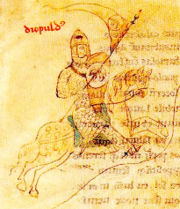
Carolingian
The Carolingian dynasty was a Frankish noble family with origins in the Arnulfing and Pippinid clans of the 7th century AD. The name "Carolingian", Medieval Latin karolingi, an altered form of an unattested Old High German *karling, kerling The Carolingian dynasty (known variously as the...
France (10th century) persons occupying this role were known by the Latin term miles
Milites
Milites were the trained private footsoldiers of Rome. These men were the non-specialist regular soldiers that made up the bulk of a Legion's numbers. Alongside soldiering, they also performed guard duties, labour work, building and other non-combat roles...
(plur. milites). This term designated a professional fighting man in the emerging feudal system. Many were as poor as the peasant class. However, over time, as this class of fighter became more prominent in post-Carolingian France, they became wealthier and began to hold and inherit land. Eventually fighting on horseback became synonymous with the elite warrior caste.
From the 12th century on, the term became associated to cavalry
Cavalry
Cavalry or horsemen were soldiers or warriors who fought mounted on horseback. Cavalry were historically the third oldest and the most mobile of the combat arms...
and nobility
Nobility
Nobility is a social class which possesses more acknowledged privileges or eminence than members of most other classes in a society, membership therein typically being hereditary. The privileges associated with nobility may constitute substantial advantages over or relative to non-nobles, or may be...
in general, and thus to the earlier Roman
Rome
Rome is the capital of Italy and the country's largest and most populated city and comune, with over 2.7 million residents in . The city is located in the central-western portion of the Italian Peninsula, on the Tiber River within the Lazio region of Italy.Rome's history spans two and a half...
equestrian
Equestrian (Roman)
The Roman equestrian order constituted the lower of the two aristocratic classes of ancient Rome, ranking below the patricians , a hereditary caste that monopolised political power during the regal era and during the early Republic . A member of the equestrian order was known as an eques...
class (see esquire
Esquire
Esquire is a term of West European origin . Depending on the country, the term has different meanings...
) as well as the Greek Hippei
Hippeis
Hippeis was the Greek term for cavalry. The Hippeus was the second highest of the four Athenian social classes, made of men who could afford to maintain a war horse in the service of the state. The rank may be compared to Roman Equestrians and medieval knights. Among the Athenians, it referred to...
class. As the expense of equipping and maintaining a knight's equipment was beyond the ability of the primitive medieval state
State (polity)
A state is an organized political community, living under a government. States may be sovereign and may enjoy a monopoly on the legal initiation of force and are not dependent on, or subject to any other power or state. Many states are federated states which participate in a federal union...
to support, the feudal system became more important as a means of securing the loyalty of knights to the king
King
- Centers of population :* King, Ontario, CanadaIn USA:* King, Indiana* King, North Carolina* King, Lincoln County, Wisconsin* King, Waupaca County, Wisconsin* King County, Washington- Moving-image works :Television:...
.
Knighthood was a hereditary title
Hereditary Title
Hereditary titles, in a general sense, are titles, positions or styles that are hereditary and thus tend or are bound to remain in particular families....
, and was usually passed on by a father to his eldest son. All prospective knights were trained from childhood in the knightly traditions of chivalry
Chivalry
Chivalry is a term related to the medieval institution of knighthood which has an aristocratic military origin of individual training and service to others. Chivalry was also the term used to refer to a group of mounted men-at-arms as well as to martial valour...
as well as war. At the age of six, they first became a servant, or page
Page (servant)
A page or page boy is a traditionally young male servant, a messenger at the service of a nobleman or royal.-The medieval page:In medieval times, a page was an attendant to a knight; an apprentice squire...
, in another knight's or lord's household, where they learned etiquette as well as basic combat, and after a few years they became a squire
Squire
The English word squire is a shortened version of the word Esquire, from the Old French , itself derived from the Late Latin , in medieval or Old English a scutifer. The Classical Latin equivalent was , "arms bearer"...
, an apprentice and personal assistant to a fully fledged knight, responsible for maintaining the knight's horse and equipment, as well as arming him for battle. At this point he may choose to remain a squire or become a knight, though many remained a squire due to the restrictions and expense of becoming a knight. A squire was made a knight through a ceremony known as "dubbing
Accolade
In the Middle Ages, the accolade was the central act in the rite-of-passage ceremonies conferring knighthood.-Ceremony:...
" by their superior lord or king, swearing allegiance to his feudal masters, charity, and protection of other Christians, as well as respecting the law of the land.
Unlike other forms of heavy cavalry, the medieval knights did not operate as a true military unit. Their mode of fighting (with the exception of chivalric orders such as the knights Templar and the knights of St. John) was essentially a 'free for all' of individual warriors.
Africa and Asia
The Mongol light cavalry using bows were an unstoppable force across Asia and Eastern Europe until the armoured cavalry of the EgyptEgypt
Egypt , officially the Arab Republic of Egypt, Arabic: , is a country mainly in North Africa, with the Sinai Peninsula forming a land bridge in Southwest Asia. Egypt is thus a transcontinental country, and a major power in Africa, the Mediterranean Basin, the Middle East and the Muslim world...
ian Mamelukes decisively defeated them at the Battle of Ain Jalut
Battle of Ain Jalut
The Battle of Ain Jalut took place on 3 September 1260 between Mamluks and the Mongols in eastern Galilee, in the Jezreel Valley, not far from Ein Harod....
in 1260. The war between Mamlukes and Mongols ended in a treaty between both forces with each winning and losing battles.
Muslim
Muslim
A Muslim, also spelled Moslem, is an adherent of Islam, a monotheistic, Abrahamic religion based on the Quran, which Muslims consider the verbatim word of God as revealed to prophet Muhammad. "Muslim" is the Arabic term for "submitter" .Muslims believe that God is one and incomparable...
military advances in Sub-Saharan Africa relied heavily on armoured cavalry, playing a similar role to that in Medieval Europe.
In China, heavy cavalry has been a part of the military since the Qin and Han Dynasties. Armoured cavalry, in which both soldier and steed are clad in complete armour, were employed since late Han Dynasty, and became widespread in the 4th century A.D., where it was the main power of the armies of the northern dynasties of China, 4th century to 6th century. During the Tang dynasty, as the importance of lighter-armed cavalry and infantry increased and that of the armoured cavalry decreased, the horse-armours were seldom used. However, armoured cavalry were again used by the Song dynasty
Song Dynasty
The Song Dynasty was a ruling dynasty in China between 960 and 1279; it succeeded the Five Dynasties and Ten Kingdoms Period, and was followed by the Yuan Dynasty. It was the first government in world history to issue banknotes or paper money, and the first Chinese government to establish a...
and its enemies including Jin, Xixia
Xixia
Xixia may refer to:*Xixia County, county in Henan, China*Xixia District, in Yinchuan, Ningxia, China*Western Xia kingdom in China, 1038–1227...
, Mongols
Mongols
Mongols ) are a Central-East Asian ethnic group that lives mainly in the countries of Mongolia, China, and Russia. In China, ethnic Mongols can be found mainly in the central north region of China such as Inner Mongolia...
, Khitans.
In Korea, the earliest evidence of armoured cavalry is a mural painting drawn in the mid-4th century A.D., Koguryo. Lamellar armours were used for both men and horses, with the soldiers carrying lances. Another mural painting of Koguryo shows an armoured cavalryman wielding his lance using both hands, unlike the couched-lance used by medieval European knights. During the Koryo
Koryo
Koryo may refer to:*The Goryeo Dynasty of Korea. It is spelt Koryŏ in McCune-Reischauer Romanization.*Koryo, a pumsae in Taekwondo.*Kōryō, Nara, a town in Japan.*Air Koryo, a North Korean airline company....
dynasty bardings was still used, but how many barded heavy horsemen existed remains unknown. In the Chosun
Joseon Dynasty
Joseon , was a Korean state founded by Taejo Yi Seong-gye that lasted for approximately five centuries. It was founded in the aftermath of the overthrow of the Goryeo at what is today the city of Kaesong. Early on, Korea was retitled and the capital was relocated to modern-day Seoul...
dynasty bardings were no more used, and the horsemen's main weapon was the bow. Lances and other close-combat weapons were seldom used effectively. However, starting from the 17th century at least, the Korean cavalry began to carry two-handed flails along with bows.
Renaissance to 20th century
Armoured cavalry, in the form of the GendarmeGendarme (historical)
A gendarme was a heavy cavalryman of noble birth, primarily serving in the French army from the Late Medieval to the Early Modern periods of European History...
, was at its highest as a proportion of the total number of combatants, in many Renaissance armies, especially in France
France
The French Republic , The French Republic , The French Republic , (commonly known as France , is a unitary semi-presidential republic in Western Europe with several overseas territories and islands located on other continents and in the Indian, Pacific, and Atlantic oceans. Metropolitan France...
.
North-Central and Eastern Europe saw the emergence of winged hussars
Polish Hussars
The Polish Hussars were the main type of cavalry of the first Polish Army, later also introduced into the Army of the Grand Duchy of Lithuania, between the 16th and 18th centuries...
that proved a decisive factor in territorial gains of Polish-Lithuanian Commonwealth
Polish-Lithuanian Commonwealth
The Polish–Lithuanian Commonwealth was a dualistic state of Poland and Lithuania ruled by a common monarch. It was the largest and one of the most populous countries of 16th- and 17th‑century Europe with some and a multi-ethnic population of 11 million at its peak in the early 17th century...
and its wars with Sweden
Sweden
Sweden , officially the Kingdom of Sweden , is a Nordic country on the Scandinavian Peninsula in Northern Europe. Sweden borders with Norway and Finland and is connected to Denmark by a bridge-tunnel across the Öresund....
, Muscovy and Ottoman Turks
Ottoman Empire
The Ottoman EmpireIt was usually referred to as the "Ottoman Empire", the "Turkish Empire", the "Ottoman Caliphate" or more commonly "Turkey" by its contemporaries...
.
Later, the Cuirassier
Cuirassier
Cuirassiers were mounted cavalry soldiers equipped with armour and firearms, first appearing in late 15th-century Europe. They were the successors of the medieval armoured knights...
was the main form, beginning in 1484 with the 100-man strong regiments of Austria
Austria
Austria , officially the Republic of Austria , is a landlocked country of roughly 8.4 million people in Central Europe. It is bordered by the Czech Republic and Germany to the north, Slovakia and Hungary to the east, Slovenia and Italy to the south, and Switzerland and Liechtenstein to the...
n kyrissers for the Holy Roman Emperor
Holy Roman Emperor
The Holy Roman Emperor is a term used by historians to denote a medieval ruler who, as German King, had also received the title of "Emperor of the Romans" from the Pope...
Maximilian
Maximilian I, Holy Roman Emperor
Maximilian I , the son of Frederick III, Holy Roman Emperor and Eleanor of Portugal, was King of the Romans from 1486 and Holy Roman Emperor from 1493 until his death, though he was never in fact crowned by the Pope, the journey to Rome always being too risky...
. In the early 16th century heavy cavalry in the European armies was principally remodeled after Albanian stratioti
Stratioti
The Stratioti or Stradioti , were mercenary units from the Balkans recruited mainly by states of southern and central Europe from the 15th until the middle of the 18th century.-Name:The Greek term "στρατιώτης/-αι" and its various latinized forms, were in use since classical antiquity with...
of the Venetian army, Hungarian hussars German mercenary cavalry units. A 1551 Venetian document describes that part of the English cavalry was armed in the Albanian fashion.
Thirty Years War

Duchy of Savoy
From 1416 to 1847, the House of Savoy ruled the eponymous Duchy of Savoy . The Duchy was a state in the northern part of the Italian Peninsula, with some territories that are now in France. It was a continuation of the County of Savoy...
. This soldier represented the last gasp of full plate armor on the battlefield. He would have worn very distinctive plate armor, which typically featured very long and wide tassets
Tassets
Tassets are a piece of plate armour designed to protect the upper legs. They take the form of separate plates hanging from the breastplate or faulds. They may be made from a single piece or segmented...
, articulated leg protectors which would extend all the way from the breastplate down to the knees. His head would typically have been protected by a fully enclosed burgonet
Burgonet
The burgonet helmet was a Renaissance-era and Early modern combat helmet. It was the successor of the sallet....
, of which the "Savoyard" style was one notable type. This rounded helmet, frequently featuring a stylized or grotesque face mask, was nicknamed "Totenkopf" or "Death's Head" by the German soldiers who encountered cuirassiers so equipped. The cuirassier's armor would have been exceptionally heavy and thick - sometimes up to eighty pounds - and would be expected to stop a bullet. A regiment of cuirassiers killed the Swedish king Gustavus Adolphus at the 1632 Battle of Lützen
Battle of Lützen (1632)
The Battle of Lützen was one of the most decisive battles of the Thirty Years' War. It was a Protestant victory, but cost the life of one of the most important leaders of the Protestant alliance, Gustavus Adolphus of Sweden, which caused the Protestant campaign to lose direction.- Prelude to the...
. The French
France
The French Republic , The French Republic , The French Republic , (commonly known as France , is a unitary semi-presidential republic in Western Europe with several overseas territories and islands located on other continents and in the Indian, Pacific, and Atlantic oceans. Metropolitan France...
introduced their own cuirassiers in 1666. However, the amount of armour worn by the Cavalry of the European armies in battle had been substantially reduced, with even the cuirass
Cuirass
A cuirass is a piece of armour, formed of a single or multiple pieces of metal or other rigid material, which covers the front of the torso...
often worn only to the front.
Apache Wars
From roughly 1650 to 1820, SpanishSpain
Spain , officially the Kingdom of Spain languages]] under the European Charter for Regional or Minority Languages. In each of these, Spain's official name is as follows:;;;;;;), is a country and member state of the European Union located in southwestern Europe on the Iberian Peninsula...
heavy cavalry fought Apache
Apache
Apache is the collective term for several culturally related groups of Native Americans in the United States originally from the Southwest United States. These indigenous peoples of North America speak a Southern Athabaskan language, which is related linguistically to the languages of Athabaskan...
warriors in North America
North America
North America is a continent wholly within the Northern Hemisphere and almost wholly within the Western Hemisphere. It is also considered a northern subcontinent of the Americas...
. Several small battles occurred; most of the time the Spanish lancers were outnumbered severely but still managed to defeat Apache armies, hundreds of men strong. The climax of these conflicts occurred in the present day Tucson, Arizona
Tucson, Arizona
Tucson is a city in and the county seat of Pima County, Arizona, United States. The city is located 118 miles southeast of Phoenix and 60 miles north of the U.S.-Mexico border. The 2010 United States Census puts the city's population at 520,116 with a metropolitan area population at 1,020,200...
region of the United States
United States
The United States of America is a federal constitutional republic comprising fifty states and a federal district...
in the late 18th century, during the Spanish period of Arizona
Spanish period of Arizona
In the late 18th century, colonists began steadily entering the region of northern New Spain that is the modern-day U.S. state of Arizona. They were attracted by reports of the discovery of deposits of silver around the Arizonac mining camp...
.
Afterwards
By 1705, the Holy Roman Emperor's personal forces in Austria included twenty cuirassier regiments. Imperial RussiaRussia
Russia or , officially known as both Russia and the Russian Federation , is a country in northern Eurasia. It is a federal semi-presidential republic, comprising 83 federal subjects...
formed its own cuirassier regiments in 1732, including a Leib Guards regiment. The Russian cuirassier units took part in the Russo-Turkish War
Russo-Turkish War, 1735-1739
Russo–Turkish War of 1735–1739, a war between Russia and the Ottoman Empire, caused by intensified contradictions over the results of the War of the Polish Succession of 1733–1735 and endless raids by the Crimean Tatars...
.
Cuirassiers played a prominent role in the armies of Frederick the Great of Prussia
Prussia
Prussia was a German kingdom and historic state originating out of the Duchy of Prussia and the Margraviate of Brandenburg. For centuries, the House of Hohenzollern ruled Prussia, successfully expanding its size by way of an unusually well-organized and effective army. Prussia shaped the history...
and of Napoleon I of France
Napoleon I of France
Napoleon Bonaparte was a French military and political leader during the latter stages of the French Revolution.As Napoleon I, he was Emperor of the French from 1804 to 1815...
. The latter increased the number of French cuirassier regiments to fourteen by the end of his reign, although they gradually declined in importance as the firepower and accuracy of the muskets and rifles of the infantry
Infantry
Infantrymen are soldiers who are specifically trained for the role of fighting on foot to engage the enemy face to face and have historically borne the brunt of the casualties of combat in wars. As the oldest branch of combat arms, they are the backbone of armies...
men increased. The cavalry still remained battle-deciders though, with Napoleon maintaining several reserve cavalry corps to be employed at the decisive moment in battle to finally break the enemy formations with a devastating charge.
The last time cavalry wore a cuirass in battle was during the Franco-Prussian War
Franco-Prussian War
The Franco-Prussian War or Franco-German War, often referred to in France as the 1870 War was a conflict between the Second French Empire and the Kingdom of Prussia. Prussia was aided by the North German Confederation, of which it was a member, and the South German states of Baden, Württemberg and...
of 1871, and although the regiments have remained into the 21st century, their large mounts are today used solely for ceremonial duties, such as those of the Household Cavalry
Household Cavalry
The term Household Cavalry is used across the Commonwealth to describe the cavalry of the Household Divisions, a country’s most elite or historically senior military groupings or those military groupings that provide functions associated directly with the Head of state.Canada's Governor General's...
in United Kingdom.
See also
- Cataphracts
- LancerLancerA lancer was a type of cavalryman who fought with a lance. Lances were used in mounted warfare by the Assyrians as early as and subsequently by Greek, Persian, Gallic, Han-Chinese, nomadic and Roman horsemen...
- ClibanariiClibanariiThe Clibanarii or Klibanophoroi were a Sassanid Persian, late Roman and Byzantine military unit of heavy armored horsemen. Similar to the cataphracti, the horsemen themselves and their horses were fully armoured...
- Horses in warfareHorses in warfareThe first use of horses in warfare occurred over 5,000 years ago. The earliest evidence of horses ridden in warfare dates from Eurasia between 4000 and 3000 BC. A Sumerian illustration of warfare from 2500 BC depicts some type of equine pulling wagons...
- Light cavalryLight cavalryLight cavalry refers to lightly armed and lightly armored troops mounted on horses, as opposed to heavy cavalry, where the riders are heavily armored...
Sources
- Weigand, Rudolf Kilian, Halbritter und Schildknechte. Zur Kategorisierung und Illustrierung sozialer Randgruppen im ›Renner‹ Hugos von Trimberg. In: Die Präsenz des Mittelalters in seinen Handschriften. Ergebnisse der Berliner Tagung in der Staatsbibliothek zu Berlin - Preußischer Kulturbesitz, 06. - 08. April 2000, edited by H.-J. Schiewer and K. Stackmann, Tübingen 2002
- Lynn, John Albert, Giant of the Grand Siècle: The French Army, 1610-1715, Cambridge University Press, 1997
- Roemer, JeanJean RoemerJean Roemer was a Dutch soldier and a United States professor of French language and literature at the City College of New York.-Biography:...
, Cavalry: Its History, Management, and Uses in War, D. Van Nostrand, New York, 1863