|
|
|
|
Wars of Alexander the Great
|
| |
|
| |
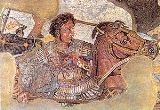
The Wars of Alexander the Great were fought by King Alexander III ("The Great") of Macedon, first against the Achaemenid Persian Empire, under its "King of Kings" Darius III, and then against local chieftains and warlords as far east as Punjab, India. Alexander the Great was one of the most successful military commanders of all time and is presumed undefeated in battle. By the time of his death, he had conquered most of the world known to the ancient Greeks.
Alexander assumed the kingship of Macedon following the death of his father Philip II, who had unified most of the city-states of mainland Greece under Macedonian hegemony in a federation called the League of Corinth.

Discussion
Ask a question about 'Wars of Alexander the Great'
Start a new discussion about 'Wars of Alexander the Great'
Answer questions from other users
|
Encyclopedia
The Wars of Alexander the Great were fought by King Alexander III ("The Great") of Macedon, first against the Achaemenid Persian Empire, under its "King of Kings" Darius III, and then against local chieftains and warlords as far east as Punjab, India. Alexander the Great was one of the most successful military commanders of all time and is presumed undefeated in battle. By the time of his death, he had conquered most of the world known to the ancient Greeks.
Alexander assumed the kingship of Macedon following the death of his father Philip II, who had unified most of the city-states of mainland Greece under Macedonian hegemony in a federation called the League of Corinth. After reconfirming Macedonian rule by quashing a rebellion of southern Greek city-states and staging a short but bloody excursion against Macedon's northern neighbors, Alexander set out east against the Achaemenid Persian Empire, under its "King of Kings" (the title all Achaemenid kings went by), Darius III, which he defeated and overthrew. His conquests included Anatolia, Syria, Phoenicia, Judea, Gaza, Egypt, Bactria and Mesopotamia, and he extended the boundaries of his own empire as far as Punjab, India.
Alexander had already made plans prior to his death for military and mercantile expansions into the Arabian peninsula, after which he was to turn his armies to the west (Carthage, Rome and the Iberian Peninsula). His original vision, however, had been to the east, to the ends of the world and the Great Outer Sea, as is described by his boyhood tutor and mentor Aristotle. Alexander died after twelve years of constant military campaigning, possibly a result of malaria, poisoning, typhoid fever, viral encephalitis or the consequences of alcoholism. The legacy of his wars lived on long after him and ushered in centuries of Greek settlement and cultural influence over distant areas. This period is known as the Hellenistic period, which featured a combination of Greek, Middle Eastern and Indian culture. His wars inspired a literary tradition in which he appeared as a legendary hero in the tradition of Achilles. The historical impact of his wars are beyond calculation, and include everything from the spread of Greek democracy, to the spread of the Greek language, which was used as the one universal language by early Christians.
Early life of Alexander
Born in Pella, the capital of Macedon, Alexander was the son of King Philip II of Macedon and his fourth wife Olympias, an Epirote princess. Although Philip had either seven or eight wives, Olympias was his principal wife for a time. According to Plutarch, Alexander's father was descended from Heracles through Caranus of Macedon and his mother from Aeacus through Neoptolemus and Achilles. Philip was away in Potidaea (which he had just seized) when Alexander was born. The king was thus brought three pleasant messages on the very same day the first of Parmenion's great triumph over the Illyrians, the second of his racehorse's win at the Olympics and the third of the birth of his son. He was naturally overcome, especially after the prophets' assurance that a man whose birth coincided with three victories would prove himself invincible.
In 340 BC, Philip led an attack on Byzantium, leaving Alexander, now sixteen, to act as regent of Macedon. In 338 BC, Alexander fought under his father at the decisive Battle of Chaeronea against the mainland city-states of Athens and Thebes. Phillip entrusted Alexander with the left wing of his army, which entailed facing the Sacred Band of Thebes, an elite hoplite corps thitherto thought invincible. Although few details of the battle survive, what is known is that Alexander annihilated the Band; according to legend, indeed, he was the first to charge it. He went on to draw up and present a peace plan, which the assembled Athenian army voted on and approved. Philip was content to deprive Thebes of its dominion over Boeotia and leave a Macedonian garrison in the citadel. A few months later, the League of Corinth was formed and Philip acclaimed Hegemon of the Hellenes.
In 336 BC, Philip was assassinated at the wedding of his daughter Cleopatra to her uncle King Alexander of Epirus. Theories abound regarding the motives for the killing, but a common story presents the assassin as a disgraced former lover of the king—the young nobleman Pausanias of Orestis, who held a grudge against Philip because the king had ignored his advisors regarding an outrage on his person. Others thought (and many still think) that Philip's murder was planned with the knowledge and involvement of Alexander, Olympias or both. Some have suggested that, as a result of Philip's authoritarian parenting style and successful military career, as well as Olympias' overbearing nature and reported beauty, that Alexander might have suffered from an Oedipus complex, resulting in a subconscious desire to kill his father and marry his mother. Still more theories point to Darius III, the recently crowned King of Persia. Regardless, the army proclaimed Alexander, then twenty-two, the new king of Macedon.
Alexander's pacification of Greece Greek cities like Athens and Thebes, which had been forced to pledge allegiance to Philip, saw in the relatively untested new king an opportunity to regain full independence. Demosthenes, who had opposed Philip, began plotting against him. Meanwhile, King Darius of Persia was convinced that Alexander was preparing for a war against Persia, and so he sent envoys to the various cities in Greece and Asia Minor with large bags of gold for the purpose of bribing any and all who could be bribed. Alexander moved swiftly, however, and Thebes, which was most active against him, submitted immediately as he appeared at its gates. The assembled Greeks at the Isthmus of Corinth, with the exception of the Spartans, elected him Capitan-General of the Hellenes against Persia, a title previously bestowed upon his father. After the meeting, he paid a visit to the famous cynic, Diogenes of Sinope, who lived in a large clay tub. Alexander found Diogenes sunning himself in his tub, naked except for a loin cloth. The philosopher stared, silent. Alexander, unsure of what to say, asked Diogenes if there was anything he could do for him. Diogenes responded, "Yes, stand aside. You're keeping the sun off me". Afterwards, Alexander's troops tried to make a joke of the incident, only to have Alexander respond that if he were not Alexander, he would be Diogenes. Alexander, who wanted to conquer the world, died (at 32) on the same day as did Diogenes (at 90), who wanted nothing to do with it. (Green)
The following year (335 BC), Alexander felt free to engage the Thracians and Illyrians in order to secure the Danube as the northern boundary of the Macedonian kingdom. He needed the financial support of Greece until he could secure the huge Persian treasury, so he needed to ensure peace at home. Against the Thracians, Alexander lulled them into a false sense of safety by sending out his slingers and archers, apparently alone. The Thracians, who thought they faced nothing besides rocks and arrows, came out, only to be cut down when Alexander sent out his regular infantry. The remaining Thracians capitulated to Alexander.(Green) Against the Illyrians (Dio Cassius, once governor of that country in the 3rd century AD, described it as especially barbarous) Alexander miscalculated, and found himself cut off from the rest of his army. In response, Alexander paraded his troops in front of the enemy, apparently oblivious to them, and in total silence. Like a giant metal porcupine, they moved their long spears in a synchronized formation, up and down, left and right, all while marching in perfect formation, executing a series of intricate maneuvers as though on the parade ground. The Illyrians, who had never seen such a weird ritual, could not believe what they were watching. Alexander, at a precise moment, ordered his cavalry to charge the Illyrians, while the infantry broke out into a deafening noise, hitting their swords against their shields and chanting the Macedonian war cry. This sudden shattering explosion of sound, especially after what had been dead silence, shocked the Illyrians. The fled back to their fortress in complete chaos, as Alexander brought in his siege catapults. They were quickly routed by Alexander. Then, in an echo of the Trojan War, Alexander's troops marched away. The Illyrians thought Alexander would not return, and so when Alexander's scouts came back, they found that the Illyrians had left their camp unguarded. Alexander's army came back, under cover of darkness, and massacred the Illyrians to a man.(Green)
While he was triumphantly campaigning north, the Thebans and Athenians rebelled once more. Darius had been channeling bribes into Greece, while the Thebans were planning an uprising with the backing of Demosthenes. The Athenians were unsure whether to maintain support for Alexander, while the Spartans never liked Alexander in the first place. Greece was ready to explode in open warfare at any moment. Alexander realized that he needed to make an abject lesson of someone. Alexander decided that he should make Thebes that lesson. Alexander did not want to waste his time fighting Greeks, so he probably would have met the Thebans half way if they had wished. He asked them to hand over the leaders of the resistance, but they refused, declared that they would fight for their freedom from Macedon, and called Alexander a tyrant for good measure. According to Diodorus, Alexander reacted by destroying the city utterly. The end of Thebes cowed Athens into submission. Though bribes continued to pour in from Darius, Alexander decided that with Greece pacified, the time to attack Persia was now.
Alexander Enters Persia In 334 BC, Alexander crossed the Hellespont into Asia. Even though it took over one hundred triremes (boats with oars) to transport the entire Macedonian army, the Persians decided to ignore the movement. Had Darius attempted to contest the crossing, he may well have been able to end the war before it even began. The Persians, who were never known for strategy but instead usually relied on sheer numbers, appeared to take the Macedonian threat too lightly early in the war. Alexander believed Darius, who was known to surround himself with eunuchs and concubines, to be a weak man. As such, he repeatedly counted on Darius to miscalculate and never use the full potential of his army against him. If Darius had ever decided to use his entire army to put down Alexander, he may well have been able to stop Alexander. As Alexander advanced through Asia Minor (modern Turkey), he liberated several Greek towns that had been placed under the Persian yoke. They capitulated, one by one, with little or no resistance.
In these early months, Darius still refused to take Alexander seriously or mount a serious challenge to Alexander's movements. Memnon of Rhodes, the Greek mercenary who aligned himself with the Persians, advocated a scorched Earth strategy. He wanted the Persians to destroy the land in front of Alexander, which he hoped would force Alexander's army to starve, and then to turn back. According to Green, the reason the Persians did not listen to Memnon was likely because they had vast estates with hoards of slaves, and they wanted to continue their easy living. Eventually, however, with Alexander advancing deeper into Persian territory, Darius put Memnon in control of an army, and told him to finally confront Alexander.
Battle of the Granicus River
The Battle of the Granicus River in May 334 BC was fought in Northwestern Asia Minor (modern-day Turkey), near the site of Troy. After crossing the Hellespont, Alexander advanced up the road to the capital of the Satrapy of Phrygia. The various satraps of the Persian empire gathered with their forces at the town of Zelea and offered battle on the banks of the Granicus River. Alexander ultimately fought many of his battles on a river bank. By doing so, he was able to minimize the advantage the Persians had in numbers. In addition, the deadly Persian chariots were useless on a cramped, muddy river bank.
Arrian, Diodorus, and Plutarch all mention the battle, with Arrian providing the most detail. The Persians placed their cavalry in front of their infantry, and drew up on the right (east) bank of the river. The Macedonian line was arrayed with the heavy Phalanxes in the middle, and cavalry on either side. The Persians expected the main assault to come from Alexander's position and moved units from their center to that flank.
Alexander's second-in-command, Parmenion, suggested crossing the river upstream and attacking at dawn the next day, but Alexander attacked immediately. This tactic caught the Persians off guard. The battle started with a cavalry and light infantry attack from the Macedonian left, so the Persians heavily reinforced that side. However, by this point, Alexander led the horse companions in their classic wedge-shaped charge, and smashed into the center of the Persian line. Several high-ranking Persian nobles were killed by Alexander himself or his bodyguards, although Alexander was stunned by an axe-blow from a Persian nobleman named Spithridates. Before the noble could deal a death-blow, however, he was himself killed by Black Cleitus. Alexander's horse was killed, although he was not at the time riding his beloved Bucephalus, either because Bucephalus was lame or because Alexander believed this battle to be too dangerous for Bucephalus. The Macedonian cavalry opened a hole in the Persian line, and the Macedonian infantry charged through to engage the poor quality Persian infantry in the rear. At this, and with many of their leaders already dead, both flanks of the Persian cavalry retreated, and the infantry was cut down as it fled. Alexander came close to dying in the battle.
Alexander consolidates his support in Asia Minor After the battle, Alexander buried the dead (both Greeks and Persians), and sent the captured Greek mercenaries back to Greece to work in the mines, as an abject lesson for any Greek who decided to fight for the Persians. He sent some of the spoils back to Greece, including three hundred panoplies (complete Persian suits of armor) back to Athens to be dedicated in the Parthenon with the inscription “Alexander, son of Philip and the Greeks, Lacedaemonians (Spartans) excepted, these spoils from the barbarians who dwell in Asia”.
Antipater, whom Alexander had left in charge of Macedon in his absence, had been given a free hand to install dictators and tyrants wherever he saw fit in order to minimize the risk of a rebellion. As he moved deeper into Persia, however, the threat of trouble seemed to grow. Many of these towns had been ruled for generations by heavy handed tyrants, so in these Persian towns, he did the opposite of what he did in Greece. Wanting to appear to be a liberator, he freed the population and allowed self government. As he continued marching into Persia, he saw that the his victory at Granicus had been lost on no one. Town after town seemed to surrender to him. The satrap at Sardis, as well as his garrison, was among the first of many satraps to capitulate.
As these satraps gave up, Alexander appointed new ones to replace them, and claimed to distrust the accumulation of absolute power into anyone’s hands. There appeared to be little change from the old system. Alexander, however, appointed independent boards to collect tribute and taxes from the satrapies, which appeared to do nothing more than improve the efficiency of government. The true effect, however, was to separate the civil from the financial function of these satrapies, thus ensuring that these governments, while technically independent of him, never truly were. Otherwise, he allowed the inhabitants of these towns to continue as they always had, and made no attempt to impose Greek customs on them. Meanwhile, ambassadors from other Greek cities in Asia Minor came to Alexander, offering submission if he allowed their 'democracies' to continue. Alexander granted their wish, and allowed them to stop paying taxes to Persia, but only if they joined League of Corinth. By doing so, they promised to provide monetary support to Alexander.
Siege of Halicarnassus
The Siege of Halicarnassus was fought in 334 BC. Alexander, who had no navy, was constantly being threatened by the Persian navy. It continuously attempted to provoke an engagement with Alexander, who would have none of it. Eventually, the Persian fleet sailed to Halicarnassus, in order to establish a new defense. Ada of Caria, the former queen of Halicarnassus, had been driven from her throne by a usurping relative. When that relative died, Darius had appointed Orontobates satrap of Caria, which included Halicarnassus in its jurisdiction. On the approach of Alexander in 334 BC, Ada, who was in possession of the fortress of Alinda, surrendered the fortress to him. Alexander and Ada appear to have formed an emotional connection. He called her "mother", finding her more amicable than his megalomaniacal snake-worshiping mother Olympias. In return for his support, Ada gave Alexander gifts, and even sent him some of the best cooks in Asia Minor, realizing that Alexander had a sweet tooth. In the past, Alexander had referred to his biological father, Philip, as his "so-called" father, and preferred to think of the deity Amon Zeus as his actual father. Thus, he had finally managed to divorce himself from both of his biological parents.
Orontobates and Memnon of Rhodes entrenched themselves in Halicarnassus. Alexander had sent spies to meet with dissidents inside the city, who had promised to open the gates and allow Alexander to enter. When his spies arrived, however, the dissidents were nowhere to be found. A small battle resulted, and Alexander's army managed to break through the city walls. Memnon, however, now deployed his catapults, and Alexander's army fell back. Memnon then deployed his infantry, and shortly before Alexander would have received his first (and only) defeat, his infantry managed to break through the city walls, surprising the Persian forces and killing Orontobates. Memnon, realizing the city was lost, set fire to it and withdrew with his army. A strong wind caused the fire to destroy much of the city. Alexander then committed the government of Caria to Ada; and she, in turn, formally adopted Alexander as her son, ensuring that the rule of Caria passed unconditionally to him upon her eventual death.
Alexander marches deeper into Persia Shortly after the battle, Memnon died. His replacement was an Athenian named Karademas. Darius' generals wanted Darius to personally command the army during a major battle against Alexander. Karademas, who thought that this would be too reckless, got into an argument with Darius' generals. He implied that he should lead the army because, as a Greek, he was a better general than any of the Persians. An argument resulted, Karademas made some uncomplimentary comments about Persian culture, and Darius ordered Karademas executed. Shortly thereafter, Darius realized that he had made a mistake, because he had just executed the only competent general he had left. He decided to take his army, and leave Babylon in order to intercept Alexander.
Alexander marched his army east through Cappadocia, where, for a stretch of nearly 100 miles, there was no water. As his army approached Mount Taurus, they found only one route through which to pass, which was a narrow defile called "The Gates". The defile was very narrow, and could have been easily defended. However, the Persian satrap of Cappadocia had an inflated view of his own abilities. He had been at the Battle of the Granicus River, and had believed that Memnon's scorched Earth strategy would work here. He didn't realize that the different circumstances of the terrain made that strategy useless. Had he mounted a credible defense of the defile, Alexander would have been easily repulsed. He left only a small contingent to guard the defile, and took his entire army to destroy the plain that lay ahead of Alexander's army. The Persian contingent that was supposed to guard the defile soon abandoned it, and Alexander passed through without any problems. Alexander supposedly said after this incident that he had never been so lucky in his entire career.
After reaching Mount Taurus, Alexander's army found a stream that flowed from the mountain with water that was ice cold. Not thinking, Alexander jumped into the stream, suffered a cramp and then a convulsion, and was pulled out nearly dead. He quickly developed pneumonia, but none of his physicians would treat him, because they feared that, if he died, they would be held responsible. One physician named Philip, who had treated Alexander since he was a child, agreed to treat him. Although he soon fell into a coma, he eventually recovered.
Battle of Issus
After Alexander's forces successfully defeated the Persians at the Battle of the Granicus, Darius took personal charge of his army, gathered a large army from the depths of the empire, and maneuvered to cut the Greek line of supply, requiring Alexander to countermarch his forces, setting the stage for the battle near the mouth of the Pinarus River and south of the village of Issus. Darius was apparently unaware that, by deciding to stage the battle on a river bank, he was minimizing the numerical advantage his army had over Alexander's.
Initially, Alexander chose what was apparently unfavorable ground. This surprised Darius who mistakenly elected to hold the wrong position while Alexander instructed his infantry to take up a defensive posture. Alexander personally led the more elite Greek Companion cavalry against the Persian left up against the hills, and cut up the enemy on the less encumbering terrain generating a quick rout. After achieving a breakthrough, Alexander demonstrated he could do the difficult and held the cavalry successfully in check after it broke the Persian right. Alexander then mounted his beloved horse Bucephalus at the head of his Companion cavalry and led a direct assault against Darius. The horses that were pulling Darius' chariot were injured, and began tossing at the yoke. Darius, about to fall off his chariot, instead jumped off. He tossed off his royal diadem, mounted a horse, and fled the scene. The Persian troops, realizing they had lost, either surrendered or fled with their hapless king. The Macedonian cavalry pursued the fleeing Persians for as long as there was light. As with most ancient battles, significant carnage occurred after the battle as pursuing Macedonians slaughtered their crowded, disorganized foe.
The Battle of Issus occurred in southern Anatolia, in November 333 BC. The invading troops led by Alexander, were outnumbered more than 2:1, defeated the army personally led by Darius III of Achaemenid Persia.The battle was a decisive Macedonian victory and it marked the beginning of the end of Persian power. It was the first time the Persian army had been defeated with the King (Darius III at the time) present. Darius left his wife and an enormous amount of treasure behind as his army fled. The greed of the Macedonians helped to persuade them to keep going, as did the large number of Persian concubines and prostitutes they picked up in the battle. Darius, by now fearing for both his throne and his life, sent a letter to Alexander where he promised to pay him a substantial ransom in exchange for his prisoners of war, agreed to sign a treaty of alliance with Alexander, and agreed to give to Alexander half of his empire. Darius received a response from Alexander, which began "King Alexander to Darius". In the letter, Alexander blamed Darius for his father's death and claimed Darius to be a vulgar usurper who planned to take Macedonia. He agreed to return the prisoners without ransom, but told Darius that he and Alexander were not equals, and that Darius was to address Alexander as "King of all Asia". He also told Darius that, if he wanted to dispute Alexander's claim to the Achaemenid throne, that he would have to stand and fight Alexander, but if he fled, Alexander would pursue and kill him. By this, Alexander revealed for the first time that his plan was to conquer the entire Persian Empire.
Siege of Tyre
The Siege of Tyre occurred in 332 BC when Alexander set out to conquer Tyre, a strategic coastal base. Tyre was the site of the only remaining Persian port that did not capitulate to Alexander. Even by this point in the war, the Persian navy still posed a major threat to Alexander. Tyre, the largest and most important city-state of Phoenicia, was located both on the Mediterranean coast as well as a nearby Island with two natural harbors on the landward side. At the time of the siege, the city held approximately 40,000 people, though the women and children were evacuated to Carthage, an ancient Phoenician colony.
Alexander sent an envoy to Tyre, proposing a peace treaty, and asked to visit their city and offer sacrifices to their God Melqart. The Tyrians politely told Alexander that their town was neutral in the war, and that allowing him to offer sacrifices to Melqart would be tantamount to recognizing him as their king. Alexander considered building a causeway that would allow his army to take the town by force. His engineers didn't believe it would be possible to successfully build such a massive structure, and so Alexander sent peace envoys once more to propose an alliance. The Tyrians believed this to be a sign of weakness, and so they killed the envoys and threw their bodies over the city wall. The dissent against Alexander's plans to take the city by force disappeared, and his engineers began to design the structure. Alexander began with an engineering feat that shows the true extent of his brilliance; as he could not attack the city from sea, he built a kilometer-long causeway stretching out to the island on a natural land bridge no more than two meters deep. Alexander then constructed two towers 150 feet high and moved them to the end of the causeway. The Tyrians, however, quickly devised a counterattack. They used an old horse transport ship, filling it with dried branches, pitch, sulfur, and various other combustibles. They then lit it on fire, creating what we might call a primitive form of napalm, and ran it up onto the causeway. The fire spread quickly, engulfing both towers and other siege equipment that had been brought up.
This convinced Alexander that he would be unable to take Tyre without a navy. Fate would soon provide him with one. Presently, the Persian navy returned to find their home cities under Alexander’s control. Since their allegiance was to their city, they were therefore Alexander’s. He now had eighty ships. This coincided with the arrival of another hundred and twenty from Cyprus, which had heard of his victories and wished to join him. Alexander then sailed on Tyre and quickly blockaded both ports with his superior numbers. He had several of the slower galleys, and a few barges, refit with battering rams, the only known case of battering rams being used on ships. Alexander started testing the wall at various points with his rams, until he made a small breach in the south end of the island. He then coordinated an attack across the breach with a bombardment from all sides by his navy. Once his troops forced their way into the city, they easily overtook the garrison, and quickly captured the city. Those citizens that took shelter in the temple of Heracles were pardoned by Alexander. It is said that Alexander was so enraged at the Tyrians' defense and the loss of his men that he destroyed half the city. Alexander granted pardon to the king and his family, whilst 30,000 residents and foreigners taken were sold into slavery.
Siege of Gaza
When Alexander destroyed Tyre, most of the towns on the way to Egypt quickly capitulated to Alexander. The one exception was Gaza. At the beginning of the Siege of Gaza, Alexander utilized the engines he had employed against Tyre. The stronghold at Gaza was built on a hill and was heavily fortified. The inhabitants of Gaza and their Nabataean allies did not want to lose the lucrative trade which was controlled by Gaza.
Batis, the commander of the fortress of Gaza, refused to surrender to Alexander. Though an eunuch, Batis was physically imposing and ruthless. After three unsuccessful assaults, the stronghold was finally taken by force
, but not before Alexander received a serious shoulder wound. When Gaza was taken, the male population was put to the sword and the women and children were sold into slavery. According to the Roman historian Quintus Curtius Rufus, Batis was killed by Alexander in imitation of Achilles' treatment of the fallen Hector. A rope was forced through Batis's ankles, probably between the ankle bone and the Achilles tendon, and Batis was dragged alive by chariot beneath the walls of the city. Alexander, who admired courage in his enemies and might have been inclined to show mercy to the brave Persian general, was infuriated at Batis's refusal to kneel and by the enemy commander's haughty silence and contemptuous manner.
With Gaza taken, Alexander marched into Egypt. The Egyptians hated the Persians, in part because Persia considered Egypt as nothing more than one big bread basket. They welcomed Alexander as their king, placed him on the throne of the Pharaohs, giving him the crown of Upper and Lower Egypt, and named him the incarnation of Ra and Osiris. He set in motion plans to build Alexandria, and, though future tax revenues would be channeled to him, he left Egypt under the management of Egyptians, which helped to win him their support.
Battle of Gaugamela The Battle of Gaugamela took place in 331 BC in what is now northern Iraq, possibly near Mosul, and resulted in a decisive victory for the Macedonians. After the Siege of Gaza, Alexander advanced from Syria towards the heart of the Persian empire, crossing both the Euphrates and the Tigris rivers without any opposition. Darius was building up a massive army, drawing men from the far reaches of his empire, and planned to use sheer numbers to crush Alexander. While Darius had a significant advantage in numbers, most of his troops were of a lower quality than Alexander's.
The battle began with the Persians already present at the battlefield. Darius had recruited the finest cavalry from his eastern satrapies. Darius placed himself in the center with his best infantry as was the tradition among Persian kings. The Macedonians were divided into two, with the right side of the army falling under the direct command of Alexander, and the left to Parmenion. Alexander began by ordering his infantry to march in phalanx formation towards the center of the enemy line. Darius now launched his chariots, which were intercepted by the Agrianians, and quickly rendered useless. Alexander, while leading the charge, formed his units into a giant wedge, which quickly smashed right into the weakened Persian center. Darius' charioteer was killed by a spear, and chaos rang out as everyone (incorrectly) thought it was Darius who had been killed. The Persian line then collapsed, and Darius fled. Darius escaped with a small core of his forces remaining intact, although the Bactrian cavalry and Bessus soon caught up with him. The remaining Persian resistance was quickly put down. In all, the Battle of Gaugamela was a disastrous defeat for the Persians, and possibly one of Alexander's finest victories.
The end of the Achaemenid Persian Empire After the battle, Parmenion rounded up the Persian baggage train while Alexander and his own bodyguard chased after Darius in hopes of catching up. Substantial amounts of loot were gained following the battle, with 4,000 talents captured, as well as the King's personal chariot and bow. Darius planned to head further east, and raise another army to face Alexander while he and the Macedonians headed to one of the Persian capitals, Babylon, and then to another, Susa. There, Alexander found wealth that even he had never imagined possible. He paid his troops, and sent a sum of money six times the annual income of Athens to Greece, in order to put down a Spartan rebellion. Darius, meanwhile, dispatched letters to his eastern satrapies asking them to remain loyal. The satrapies, however, had other intentions, and quickly capitulated to Alexander.
Darius' end was pathetic. Bessus fatally stabbed Darius, before fleeing eastwards. Darius was found by one of Alexander's scouts, moaning in pain. Darius, dying and chained to a baggage train being pulled by an Ox, was laying next to a lone dog and royal robes covered in blood. He asked for water, and then, clutching the Macedonian soldier's hand, said that he was thankful that he would not die utterly alone and abandoned. Alexander, who may have felt genuinely saddened at Darius' death, buried Darius next to his Achaemenid predecessors in a full military funeral. Alexander claimed that, while dying, Darius had named Alexander as his successor to the Achaemenid throne and had asked Alexander to avenge his death, a striking irony since it was Alexander who had pursued him to his death. The Achaemenid Persian Empire is considered to have fallen with the death of Darius.
Alexander, viewing himself as the legitimate Achaemenid successor to Darius, viewed Bessus as a usurper to the Achaemenid throne, and eventually found and executed this 'usurper'. The majority of the existing satraps were to give their loyalty to Alexander, and be allowed to keep their positions. Alexander’s troops now thought the war was over. Alexander was unsure how to deal with this, so he decided to scare them into submission. He gave a speech, arguing that their conquests were not secure, that the Persians did not want the Greeks to remain in their country, and that only the strength of Macedon could secure the country. The speech worked, and Alexander's troops agreed to remain with him. Alexander, now the Persian "King of Kings", adopted Persian dress and mannerisms, which, in time, the Greeks began to view as decadent and autocratic. They began to fear that Alexander, the king they had hero-worshiped, was turning into an eastern despot, although a young eunuch was eventually introduced to Alexander, and helped to keep his decadence in check.
Battle of the Persian Gate In the winter of 330 BC, at the Battle of the Persian Gate northeast of today's Yasuj in Iran, the Persian satrap Ariobarzanes led a last stand of the Persian forces. After the Battle of Gaugamela, Alexander had advanced to Babylon and Susa. A Royal Road connected Susa with the more eastern capitals of Persepolis and Pasargadae in Persis (the Persian Empire had several "capitals"), and was the natural venue for Alexander's continued campaign. After the conquest of Susa, Alexander split the Macedonian army into two parts. Alexander's general, Parmenion, took one half along the Royal Road, and Alexander himself took the route towards Persis. Passing into Persis required traversing the Persian Gates, a narrow mountain pass that lent itself easily to ambush.
Believing that, after his victory over the Uxians, he would not encounter any more enemy forces during his march, Alexander neglected to send scouts ahead of his vanguard, and thus walked into Ariobarzanes' ambush. Once the Macedonian army had advanced sufficiently into the narrow pass, the Persians rained down boulders on them from the northern slopes. From the southern slope, Persian archers and catapults launched their projectiles. Alexander's army initially suffered heavy casualties, losing entire platoons at a time. Ariobarzanes had hoped that defeating Alexander at the Persian Gates would allow the Persians more time to field another army, and possibly stop the Macedonian invasion altogether.
Ariobarzanes held the pass for a month, but Alexander succeeded in encircling the Persian army and broke through the Persian defenses. The defeat of Ariobarzanes's forces at the Persian Gate removed the last military obstacle between Alexander and Persepolis. Upon his arrival at the city of Persepolis, Alexander appointed a general named Phrasaortes as successor of Ariobarzanes. Four months later, Alexander allowed the troops to loot Persepolis. A fire broke out and spread to the rest of the city. It is not clear if it had been a drunken accident, or a deliberate act of revenge for the burning of the Acropolis of Athens during the Second Greco-Persian War.
Siege of the Sogdian Rock
After Alexander defeated the last of the Achaemenid Empire's forces 328 BC, he began a new campaign against the various Indian kings in 327 BC. He wanted to conquer the entire known world, which in Alexander's day, ended on the eastern end of India. Greeks of Alexander's day knew nothing of China, or any other lands east of India. The Siege of the Sogdian Rock, a fortress located north of Bactria in Sogdiana, occurred in 327 BC. Oxyartes of Bactria had sent his wife and daughters, one of whom was Roxana, to take refuge in the fortress, as it was thought to be impregnable, and was provisioned for a long siege. When Alexander asked the defenders to surrender, they refused, telling him that he would need "men with wings" to capture it. Alexander asked for volunteers, whom he would reward if they could climb the cliffs under the fortress. There were some 300 men who from previous sieges had gained experience in rock-climbing. Using tent-pegs and strong flaxen lines, they climbed the cliff face at night, losing about 30 of their number during the ascent. In accordance with Alexander's orders, they signaled their success to the troops below by waving bits of linen, and Alexander sent a herald to shout the news to the enemy's advanced posts that they might now surrender without further delay. The defenders were so surprised and demoralized by this that they surrendered. Alexander fell in love with Roxana, whom ancient historians call the "most beautiful woman in the world" (not an uncommon claim for an ancient queen) on sight and eventually married her. The story of the siege is told by the Roman historian Arrian of Nicomedia, in Anabasis (section 4.18.4-19.6).
Siege of Aornos
The Siege of Aornos took place in the modern city of Swat, Pakistan, and was Alexander's last siege, "the climax to Alexander's career as the greatest besieger in history" according to Alexander's biographer Robin Lane Fox (Fox 1973 p343). The siege took place in the winter of 327–326 BC. It offered the last threat to Alexander's supply line, which stretched, dangerously vulnerable, over the Hindu Kush back to Balkh, though Arrian credits Alexander's heroic desire to outdo his kinsman Heracles, who allegedly had proved unable to take the place Pir-Sar, which the Greeks called Aornis. The site lies north of Attock in Punjab, on a strongly reinforced mountain spur above the narrow gorges in a bend of the upper Indus. Neighboring tribesmen who surrendered to Alexander offered to lead him to the best point of access.
At the vulnerable north side leading to the fort, Alexander and his catapults were stopped by a deep ravine. To bring the siege engines within reach, an earthwork mound was constructed to bridge the ravine. A low hill connected to the nearest tip of Pir-Sar was soon within reach and taken. Alexander's troops were at first repelled by boulders rolled down from above. Three days of drumbeats marked the defenders' celebration of the initial repulse, followed by a surprise retreat. Alexander hauled himself up the last rockface on a rope. Alexander cleared the summit, slaying some fugitives (Fox) —inflated by Arrian to a massacre—and erected altars to Athena Nike, Athena of Victory, traces of which were identified by Stein (Fox 1973, Arrian).
Battle of the Hydaspes River
The Battle of the Hydaspes River was fought by Alexander in May 325 BC against the Indian king Porus at Kshatriya on the Hydaspes River in the Punjab region of ancient India, near Bhera now in Pakistan. The Hydaspes was the last major battle fought by Alexander. The main train went into modern day Pakistan through the Khyber Pass, but a smaller force under the personal command of Alexander went through the northern route, resulting in the Siege of Aornos along the way. In early spring of the next year, he combined his forces and allied with Taxiles (also Ambhi), the King of Taxila, against his neighbor, the King of Hydaspes.
Porus drew up on the south bank of the Jhelum River, and was set to repel any crossings. The Jhelum River was deep and fast enough that any opposed crossing would probably doom the entire attacking force. Alexander knew that a direct crossing would fail, so he found a suitable crossing, about 17 miles upstream of his camp. Alexander left his general Craterus behind with most of the army while he crossed the river upstream with a strong part of his army. Porus sent a small cavalry and chariot force under his son to the crossing. The force was easily routed, and Porus' son was killed. Porus now saw that the crossing force was larger, and decided to face it with the bulk of his army. The Indians were poised with cavalry on both flanks, the war elephants in front, and infantry behind the elephants. These war elephants presented an especially difficult situation for Alexander, as they scared the Macedonian horses.
Alexander started the battle by sending horse archers to shower the Indian left cavalry wing, and then used his cavalry to destroy the Indian cavalry. Meanwhile, the Macedonian phalanxes had advanced to engage the charge of the war elephants. The Macedonians eventually surrounded the Indian force, which amounted to a mass surrender. Porus was one of many Indians who impressed Alexander. Wounded in his shoulder, standing at seven feet tall, but still on his feet, he was asked by Alexander how he wished to be treated. "Treat me, O Alexander, like a king" Porus responded. The bravery and war skills of Porus impressed Alexander. Alexander spared the life of Porus, although he had been defeated, and let him rule Hydaspes in Alexander's name. Afterwards, Alexander founded Alexandria Nikaia (Victory), located at the battle site, to commemorate his triumph. He also founded Alexandria Bucephalus on the opposite bank of the river. Alexander did this in memory of his much cherished horse, Bucephalus, who died during this battle, reportedly due to old age.
The end of the war This was as far as Alexander's army would go. At this time, the Magadha Empire further east on the Gangetic plain had 6,000 war elephants. These numbers of war elephants were many times larger than the numbers employed by the Persians and Greeks, which was discouraging for Alexander's men and stayed further progress into India. Alexander, using the incorrect maps of the Greeks, thought that the world ended a mere 600 miles away, at the edge of India. He was unaware of China, Malaysia, as well as the other lands east of India. Although he viewed the decision to turn back, which had been forced upon him by his troops, as a defeat, it was probably for the better.
Alexander's men had marched over 11,000 miles in eight years, and killed at least 750,000 Asians. Ultimately, it was the weather that forced his army to give up. Plains had turned into swamps, their armor was corroded, their rations rotted as mildew ruined their grain. Their boots leaked, and their swords turned green as soon as they had been polished. The rivers were fast and violent, torrential rains had brought into their tents snakes and scorpions of a size no Greek had ever before seen. Before deciding to turn back, Alexander gave a speech, in which he pled with his men that they continue marching east. One soldier, who was dying anyway, gave a speech, which he ended by telling Alexander that the one thing all successful men should know is when to stop. Alexander, facing his first ever defeat, called his priests, who told him that, for the first time, the Gods were against him. Claiming to bow to the will of the Gods–certainly not to the will of his men–he finally announced that they were going home.
In the fall of 326 BC, Alexander's army began marching back home. For Alexander, "home" was Babylon, although for the rest of his troops, it was Macedon. They met a flotilla at the Jhelum River, which had been intended to carry the army east. Instead, it brought supplies and helped in the westward march. The flotilla had trouble moving against the currents, and the ship carrying Alexander, who could not swim, almost sank. The violent rivers snapped the oars of Alexander's ships, Indian tribesman kept threatening the army, and the priests began warning that the Gods had turned against them. Alexander intended to capture one threatening citadel, but none of his men would follow him. He personally led the charge, being the first to scale the citadel. His troops behind him rushed up, but the rungs of the ladder collapsed and several soldiers died. Alexander was alone with three of this soldiers inside the citadel, where they fought the Indians. Alexander was hit with an arrow in the chest, and was pulled out nearly dead. Rumors began circling that he was dead, and the Indians grew so enthusiastic that they began attacking with renewed vigor. Eventually, though, Alexander recovered from his wound.
As the army made its way down the Indus River, some Indian tribes surrendered, while others fought. Alexander split his army into two forces, and personally led the larger force through the Makran desert. Soon, his army was out of water, and the soldiers were suffering from heat stroke. When they were able to find water, some soldiers died of over-drinking. As they went through sand dunes and sand storms, the axles of their wagons sank into the sand. Poisonous plants and animals were all around, some of which caused blindness, while others caused their animals to foam at the mouth and die. Flash floods plagued them, and one even killed most of the women and children that were with the army, leaving the soldiers with nothing but the clothes on their backs. It took them two months to emerge from the Makran. About 85,000 people had entered the desert, and only 25,000 survived. The flotilla, after battling angry tribesman, surviving a school of whales, and being forced to eat their camels, returned in December of 325 BC. Alexander celebrated by staging days of celebrations to thank the Gods for the return of his fleet. His army returned to Greece, and he returned to his throne in Babylon, where he would live until his death in June 323 BC.
Further reading
- Alexander the Great in Fact and Fiction, edited by A.B. Bosworth, E.J. Baynham. New York: Oxford University Press (USA), 2002 (Paperback, ISBN 0-19-925275-0).
- Baynham, Elizabeth. Alexander the Great: The Unique History of Quintus Curtius. Ann Arbor: University of Michigan Press, 1998 (hardcover, ISBN 0-472-10858-1); 2004 (paperback, ISBN 0-472-03081-7).
- Brill's Companion to Alexander the Great by Joseph Roisman (editor). Leiden: Brill Academic Publishers, 2003.
- Cartledge, Paul. Alexander the Great: The Hunt for a New Past. Woodstock, NY; New York: The Overlook Press, 2004 (hardcover, ISBN 1-58567-565-2); London: PanMacmillan, 2004 (hardcover, ISBN 1-4050-3292-8); New York: Vintage, 2005 (paperback, ISBN 1-4000-7919-5).
- Dahmen, Karsten. The Legend of Alexander the Great on Greek and Roman Coins. Oxford: Routledge, 2006 (hardcover, ISBN 0-415-39451-1; paperback, ISBN 0-415-39452-X).
- De Santis, Marc G. “At The Crossroads of Conquest.” Military Heritage, December 2001. Volume 3, No. 3: 46–55, 97 (Alexander the Great, his military, his strategy at the Battle of Gaugamela and his defeat of Darius making Alexander the King of Kings).
- Fuller, J.F. C; A Military History of the Western World: From the earliest times to the Battle of Lepanto; New York: Da Capo Press, Inc., 1987 and 1988. ISBN 0-306-80304-6
- Gergel, Tania Editor Alexander the Great (2004) published by the Penguin Group, London ISBN 0-14-200140-6 Brief collection of ancient accounts translated into English
- Larsen, Jakob A. O. "Alexander at the Oracle of Ammon", Classical Philology, Vol. 27, No. 1. (Jan., 1932), pp. 70–75.
- Lonsdale, David. Alexander the Great, Killer of Men: History's Greatest Conqueror and the Macedonian Way of War, New York, Carroll & Graf, 2004, ISBN 0786714298
- Pearson, Lionel Ignacius Cusack. The Lost Histories of Alexander the Great. Chicago Ridge, IL: Ares Publishers, 2004 (paperback, ISBN 0-89005-590-4).
- Thomas, Carol G. Alexander the Great in his World (Blackwell Ancient Lives). Oxford: Blackwell Publishers, 2006 (hardcover, ISBN 0631232451; paperback, ISBN 063123246X).
Non-Greek/Latin perspectives
- A. Shapur Shahbazi, "Iranians and Alexander", American Journal of Ancient History n.s. 2 (2003), 5–38: the Persian side of the story.
- R.J. van der Spek, "Darius III, Alexander the Great and Babylonian scholarship" in: Achaemenid History 13 (2003), 289–346: an overview of several Babylonian sources
- Two chapters of Jona Lendering's Dutch book Alexander de Grote, which uses the cuneiform sources, are available in translation. In , he argues that at Gaugamela, Alexander attacked a Persian army that was looking for an excuse to run away; and in , he offers a Babylonian perspective on Alexander's final days.
External links
Primary Sources
-
-
- from Livius.org
- Wiki Classical Dictionary, and
Other
- by Waldemar Heckel
- , entry in historical sourcebook by Mahlon H. Smith
- , a comprehensive directory of some 1,000 sites
- , a project by John J. Popovic
- , photos of all sites Alexander visited
- , a site depicting Alexander's coins and later coins featuring Alexander's image
|
| |
|
|