
See Also

Chainmail

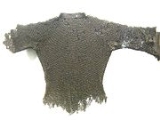
Mail is a type of armour Armour

Armour or armor is protective clothing intended to defend its wearer from intentional harm in combat [i] ... 

 or jewelry that consists of small metal rings linked together in a pattern to form a mesh. Mail can sometimes be punctured by a spear Spear

A spear is an ancient weapon [i] used for hunting [i] and war [i], consisting of a shaft, usually of wood [i] ... 

 or shorn by the blow from a heavy axe Axe

The axe is an ancient and ubiquitous tool [i] that has been used for millennia [i] to shape, split and c ... 

 or sword Sword

Sword is a term for a long edged weapon, used by various civilizations throughout Eurasia [i] and North Africa [i] ... 

 and its flexibility means that its wearer is still somewhat vulnerable to blunt weapons. Nevertheless, it was an effective and popular defense for its ability to stop cutting weapons from piercing the skin. Medieval physicians Medieval medicine

Medieval medicine was an evolving mixture of the scientific [i] and the spiritual. ... 

 could usually set broken bones, but when it came to preventing infection they were woefully inadequate.

Discussions

  Discussion Features

   Ask a question about 'Chainmail'

   Start a new discussion about 'Chainmail'

   Answer questions about 'Chainmail'

   'Chainmail' discussion forum


Encyclopedia


Mail is a type of armour Armour

Armour or armor is protective clothing intended to defend its wearer from intentional harm in combat [i] ... 

 or jewelry that consists of small metal rings linked together in a pattern to form a mesh. Mail can sometimes be punctured by a spear Spear

A spear is an ancient weapon [i] used for hunting [i] and war [i], consisting of a shaft, usually of wood [i] ... 

 or shorn by the blow from a heavy axe Axe

The axe is an ancient and ubiquitous tool [i] that has been used for millennia [i] to shape, split and c ... 

 or sword Sword

Sword is a term for a long edged weapon, used by various civilizations throughout Eurasia [i] and North Africa [i]... 

 and its flexibility means that its wearer is still somewhat vulnerable to blunt weapons. Nevertheless, it was an effective and popular defense for its ability to stop cutting weapons from piercing the skin. Medieval physicians Medieval medicine

Medieval medicine was an evolving mixture of the scientific [i] and the spiritual. ... 

 could usually set broken bones, but when it came to preventing infection they were woefully inadequate. Thus the mail was weak in defending against wounds which could be more easily mended but strong against those to which the soldier was most vulnerable. The word chainmail is of relatively recent coinage, having been in use only since the 1700s, prior to this it was referred to simply as mail .

The word itself refers to the armour material, not the garment made from it. A shirt made from mail is a hauberk Hauberk

A hauberk is a shirt of mail [i] armour [i]. ... 

or byrnie, if knee-length; haubergeon Hauberk

A hauberk is a shirt of mail [i] armour [i]. ... 

if waist-length. Mail leggings are called chausses Chausses

Chausses are armor for the legs, usually made from chainmail [i]. ... 

, mail hoods coif and mail mittens mitons. A mail collar hanging from a helmet is camail or aventail. A mail collar worn strapped around the neck was called a pixane or standard.

History


Mail was invented some time in the mid 1st millennium BC, but it is unknown where and by whom it was first used. It may have been invented independently in Japan Japan

is an island country [i] in East Asia [i]. ... 

 and in Europe Europe

Europe is one of the seven traditional continent [i]s of the Earth [i]. ... 

. The earliest finds are from a 5th century BC Celt Celt

The term Celt, normally pronounced // , refers to a member of any of a number of peoples in Europe u... 

ic chieftain's burial located in Ciumesti, Romania. The Greek term, cataphract Cataphract

The word cataphract was what Greek- and later Latin [i]-speaking peoples used to desc ... 

, came to be associated with heavy cavalry Cavalry

Soldiers or warriors who fought mounted on horseback are commonly known as cavalry .... 

 . The Roman Republic Roman Republic

The Roman Republic was a phase of the ancient Roman civilization [i] characterized by a republic [i]... 

 first came into contact with mail fighting the Gauls in Cisalpine Gaul, now Northern Italy. The Roman army adopted the technology for their troops in the form of the lorica hamata Lorica hamata

The lorica hamata is a type of mail [i] armour used during the Roman Republic [i] at late peri ... 

 which was used as a primary form of armour, through the Imperial period where it was used alongside the lorica segmentata Lorica segmentata

The lorica segmentata was a type of armour [i] primarily used in the Roman Empire [i], but the Latin [i] ... 

.

The use of mail was prominent throughout the High Middle Ages Middle Ages

The Middle Ages formed the middle period in a traditional schematic division of European history [i] ... 

, and reached its apex in the 13th century 13th century

As a means of recording the passage of time [i], the 13th century was that century [i] which lasted from ... 

, when full body suits of mail armour were developed.

In the 14th century 14th century

As a means of recording the passage of time [i], the 14th century was that century [i] which lasted from ... 

, plate armour Plate armour

Plate armour is personal armour [i] made from large metal [i] plates, worn on the chest [i] and sometime ... 

 began to supplement mail. Eventually mail was supplanted by plate for the most part. However, mail was still widely used by many soldiers as well as brignadines and padded jacks. These three types of armour made up the bulk of the equipment used by soldiers with mail being the most expensive. It was quite often more expensive than plate armour.

Extant mail is common, but it is not proportionately represented in museum collections.

The Japanese used chainmail in a limited fashion in armor beginning during the Nambokucho period . Two primary weave methods were used: a square 4-in-1 pattern and a hexagonal 6-in-1 pattern . Kusari was typically made with rings that were much smaller than their European counterparts, and on a much smaller scale - rather than creating full garments of mail, small sections were used to link together plates and to drape over vulnerable areas such as the underarm. The rings were not welded shut, though some pieces were constructed of rings that consisted of two or more turns, similar to the modern split ring commonly used on keychains. The rings were lacquered to prevent rusting, and was always stitched onto a backing of cloth or leather. The kusari was sometimes concealed entirely between layers of cloth or leather.

Etymology

The word chainmail is a pleonasm and a neologism: in the Middle Ages Middle Ages

The Middle Ages formed the middle period in a traditional schematic division of European history [i] ... 

 and Renaissance Renaissance

In the traditional view, the Renaissance was understood as a historical age in Europe [i] that follo ... 

, "mail", "mayle" or chain was the English English language

English is a widely distributed language that originated in England [i] but is now the primary language ... 

 name for it, while maille was the common French French language

French is the third-largest of the Romance languages [i] in terms of number of native speakers, after Spanish [i] ... 

 name for it. This—and the alternative spellings "maile" and "maille"—derive through the Italian Italian language

Italian is a Romance language [i] spoken by about 70 million people, primarily in Italy [i] ... 

 maglia, from the Latin Latin

Latin is an ancient Indo-European language [i] originally spoken in Latium [i], ... 

 macula, meaning "mesh of a net".

Many modern chainmaillers prefer the French spelling "Maille" in order to avoid confusion with the term chain letter.

Manufacture

Several patterns of linking the rings together have been known since ancient times, with the most common being the 1-to-4 pattern . In Europe Europe

Europe is one of the seven traditional continent [i]s of the Earth [i]. ... 

, the 1-to-4 pattern was completely dominant. Mail was also common In East Asia East Asia

East Asia is a subregion [i] of Asia [i] that can be defined in either geographical [i] or cul ... 

, primarily Japan Japan

is an island country [i] in East Asia [i]. ... 

, but here several more patterns were utilized and an entire nomenclature developed around them. 1-to-4 is commonly referred to as 4 in 1, or 4-1.

Historically, in Europe, from the pre-Roman period on, the rings composing a piece of mail would be riveted shut, to reduce the chance of the rings splitting open when subjected to a thrusting attack or a hit by an arrow. Due to the triangular points of the rivet heads, many armorers designed their mail with the pointed sides out, thus creating a very distinct "inside" and "outside".

Up until the 14th century mail was made of alternating rows of both riveted rings and solid rings. Both would have been made using wrought iron. Wire for the riveted rings was formed by either of two methods. One was to hammer out wrought iron to roughly the correct size. The other, more labor-intensive method was to draw Drawing

Drawing is a means of making an using any of a wide variety of tools and techniques.... 

 a thin piece of it through a metal cone, reducing it in diameter, lengthening it, and forming it into a round shape. This was done repeatedly until the desired gauge was achieved. The solid links would have been made by punching from a sheet. Forge welding was also used to create solid links, but the only known example from Europe is that of the 7th century Coppergate mail drape. Outside of Europe this practice was more common such as the well known "theta" links from India.

In modern re-enactment societies and live action role-playing game Live action role-playing game

A live action role-playing game is a form of role-playing game [i] where the participants perform some ... 

s , suits of mail and mail jewelry are handmade from rings of wire. They may or may not be welded or soldered but are rarely riveted. They may also be made of split sprung steel washers. Usually two pairs of pliers are used to bend the washers open and closed while "knitting" the mail. Many makers may have an apprentice, or in a more modern term, a ringmonkey, to pre-open or close rings for faster and easier weaving. The resulting mail is usually heavier than traditional wire-wound mail, but very durable. When not used for combat, aluminium is sometimes used to reduce the garment's weight by as much two thirds, with a proportional decrease in strength.

Modern mail makers often refer to the size of rings they are working with by the inner diameter, which is approximately equal to the diameter of the rod around which the wire was wrapped to create the rings. Wire thickness is measured in either American Wire Gauge or Standard Wire Gauge, or in decimals of an inch to avoid confusion. In modern mail-makers' terms, mail made of rings with an inner diameter larger than about 3/8" are known as "macromaille," whereas mail with rings with an inner diameter smaller than 1/8" are known as "micromaille."

Probably the easiest means of producing maille is to wrap wire around a rod, also called a mandrel Mandrel

A mandrel is either an object used to shape machined work [i]; a tool [i] component [i] th ... 

, to produce a coil of uniform size and shape. The mandrel may be turned by hand or driven by a power tool, such as a drill Drill

A drill is a tool [i] with a rotating drill bit [i] used for drilling [i] holes i ... 

. The coil is then cut into rings. Depending on the material, rings may be cut with a jeweler's saw, a rotary tool with a cut-off blade, mini-bolt cutters, diagonal cutters Diagonal pliers

Diagonal pliers or wire cutters are wire [i]-cutting pliers [i].... 

, aviation or tin snips Tin snips

Tin snips are tools used to cut thin sheet metal.... 

, or a hack saw Hacksaw

A hacksaw is a saw [i] for cutting [i] metal [i] or bones [i]. ... 

. Stretching the coil slightly before cutting is an easy means of opening a gap in the rings for assembly.

Protective mail for industrial or other practical applications is knit and welded by machine from wire.

Modern uses


Practical uses

Mail is now used in protective clothing for butchers , scuba divers and animal control officers . The British police Policing in the United Kingdom

The United Kingdom is a unitary [i] state, and police forces, generally speaking, are organised... 

 use mail gloves for dealing with knife-armed aggressors. The military also uses mail vests for the same reason. Modern re-enactors of medieval battles and living history also use mail in combat.

During World War I World War I

World War I, also known as the First World War, the Great War and "The War to End All War... 

, mail was evaluated as a material for bullet proof vest Bulletproof vest

A bullet-resistant vest - is an article of protective clothing [i] that works as a form of armor [i] ... 

s, but results were unsatisfactory as the rings would fragment and further aggravate the damage. A mail fringe, designed by Captain Cruise of the British Infantry, was added to helmets to protect the face but this proved unpopular with soldiers, in spite of being proven to defend against a three-ounce shrapnel Shrapnel

Shrapnel is the term used to describe the spherical shot or musket balls dispersed when a shrapnel shell... 

 round fired at a distance of one hundred yards .

Mail suits are also used as protection from high voltages - they form a faraday cage Faraday cage

A Faraday cage or Faraday shield is an enclosure formed by conducting material [i] ... 

 around the wearer.

There is to suggest that mail is a viable alternative to heavy leather for protecting motorcyclists from injury should they be thrown from their motorcycles.

Decorative uses

Chainmail remained in use as a decorative and possibly high-status symbol with military overtones long after its practical usefulness had passed. It was frequently used for the epaulet Epaulette

Epaulette , a French [i] word meaning "little shoulders", originally meant only one ... 

s of military uniforms. It is still used in this form by the British Territorial Army.

Mail also has applications in sculpture and jewelry, especially when made out of precious metals or colorful anodized Anodising

Anodising, or anodizing, is a technique used to modify the surface of a metal.... 

 metals. Recent trends in mail artwork include headdresses, Christmas ornaments, chess sets, and all manner of jewelry. For these non-traditional applications, hundreds of new weaves or patterns have been invented.

In film

In many film Film

Film is a term that encompasses motion pictures as individual projects, as well as the field in general.... 

s, knitted string spray-painted with a metallic paint is used instead of actual mail in order to cut down on cost . Films more dedicated to costume Costume

The term costume can refer to wardrobe [i] and dress [i] in general, or to the distinctive style of dres... 

 accuracy often use ABS plastic Acrylonitrile butadiene styrene

Acrylonitrile butadiene styrene, or ABS, is a common thermoplastic [i] used to make light, rigid, ... 

 rings, for the lower cost and weight. Thousands of such ABS mail coats were made for the film of The Lord of the Rings The Lord of the Rings

The Lord of the Rings is an epic high fantasy [i] novel written by J. R. R. Tolkien [i].... 

, in addition to many metal coats. The metal coats were used rarely because of their weight, except in close-up filming where the appearance of ABS rings would have been clearly distinguishable. In Mad Max Beyond Thunderdome, Tina Turner Tina Turner

Tina Turner is a Grammy Award [i]-winning American [i] pop [i]/rock [i] ... 

 wore a real metal mail shirt.

External links


  • Construction tips