
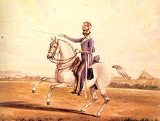
Light cavalry refers to lightly-armed and armored troops mounted on horses, as opposed to
heavy cavalryHeavy cavalry is a class of cavalry whose primary role was to engage in direct combat with enemy forces . Although their equipment differed greatly depending on the region and historical period, they were generally mounted on large powerful horses, and were often equipped with some form of scale,...
, where the riders (and sometimes the horses) are heavily armored. The missions of the light cavalry were primarily
reconnaissanceReconnaissance is a military and medical term denoting exploration conducted to gain information. Militarily, its shorthand Canadian and British form is recce , its American usage form is recon...
,
screeningOne meaning of screening is the investigation of a great number of something looking for those with a particular problem or feature. For example at an airport many bags are screened by x-ray to try to detect any which may contain weapons or explosives, and people are screened by passing through a...
, skirmishing,
raidingA raid is a military tactic or operational warfare mission which requires the execution of a plan where surprise is the principal desired outcome of the attack....
, and most importantly, communications, and were usually armed with
spearA spear is a pole weapon consisting of a shaft, usually of wood, with a sharpened head. The head may be simply the sharpened end of the shaft itself, as is the case with bamboo spears, or it may be of another material fastened to the shaft, such as obsidian, iron or bronze...
s,
swordA sword is a long, edged piece of metal, used in many civilizations throughout the world, primarily as a cutting or thrusting weapon and occasionally for clubbing...
s,
bowA bow is a weapon that projects arrows powered by the elasticity of the bow. Essentially, it is a form of spring. As the bow is drawn, energy is stored in the limbs of the bow and transformed into rapid motion when the string is released, with the string transferring this force to the arrow...
s and later pistols.
Light cavalry was used infrequently by the
GreeksAncient Greece is the civilisation belonging to the period of Greek history lasting from the Greek Dark Ages ca. 1100 BC and the Dorian invasion, to 146 BC and the Roman conquest of Greece after the Battle of Corinth. It is generally considered to be the seminal culture which provided the...
and
RomansAncient Rome was a civilization that grew out of a small agricultural community founded on the Italian Peninsula as early as the 10th century BC. Located along the Mediterranean Sea, it became one of the largest empires in the ancient world....
(though Roman
auxiliariesAuxiliaries formed the standing non-citizen corps of the Roman army of the Principate , alongside the citizen legions...
were often mounted), but were popular among the armies and
hordesHordes may refer to:*Social and military structures of nomadic Turkic peoples in the Middle Ages; see:**Golden Horde**Tatar invasions*The miniature war game HORDES-See also:* Horney guy*Hordes is deduced from the bosnian name Hodžić:**Hodžić...
of
Central AsiaAsia is a region of Asia from the Caspian Sea in the west to central China in the east, and from southern Russia in the north to northern India in the south. It is also sometimes known as Middle Asia or Inner Asia, and is within the scope of the wider Eurasian continent.Various definitions of its...
. The
HunsThe Huns were a group of nomadic pastoral people who, appearing from beyond the Volga, migrated into Europe c.AD 370 and built up an enormous empire in Europe. They were possibly the descendants of the Xiongnu who had been northern neighbours of China three hundred years before and may be the first...
,
TurksThe Turkic peoples are Eurasian peoples residing in northern, central and western Eurasia. They speak languages belonging to the Turkic language family. They share, to varying degrees, certain cultural traits and historical backgrounds...
,
MongolsThe name Mongol specifies one or several ethnic groups, now mainly located in Mongolia, China, and Russia.-Definition:...
and
HungariansHungarians are an ethnic group primarily associated with Hungary. There are around 10 million Hungarians in Hungary . Hungarians were the main inhabitants of the Kingdom of Hungary that existed through most of the second millennium...
were all adept light cavalrymen and horse archers.
With the decline of
feudalismFeudalism is a decentralized sociopolitical structure in which a weak monarchy attempts to control the lands of the realm through reciprocal agreements with regional leaders...
and
knightA knight was a "gentleman soldier" or member of the warrior class of the Middle Ages in Europe. In other Indo-European languages, cognates of cavalier or rider are more prevalent suggesting a connection to the knight's mode of transport...
hood in
EuropeEurope is, by convention, one of the world's seven continents. Comprising the westernmost peninsula of Eurasia, Europe is generally divided from Asia to its east by the water divide of the Ural Mountains, the Ural River, the Caspian Sea, the Caucasus Mountains , and the Black Sea to the southeast...
, light cavalry became more prominent in the armies of the continent. Many were equipped with firearms, as their predecessors had been with bows. European examples of light cavalry included stradiots,
hobelarHobelars were a type of light cavalry, or mounted infantry during the Middle Ages, used for skirmishing. They originated in 13th century Ireland, and generally rode hobbies, a type of light and agile horse.-Origins:...
s,
hussarHussar refers to a number of types of light cavalry created in Hungary in the 15th century and used throughout Europe and in Latin America since the 18th century...
s, chasseurs à cheval, cossacks,
chevau-légersThe Chevau-légers was a generic French name for several units of light cavalry, roughly similar to lancers in the armies of other states during the Napoleonic Wars. Perhaps the most famous of all such units were the Polish 1st Light Cavalry Regiment of the Guards and the French 2nd Light Cavalry...
and some
dragoonDragoons were originally infantrymen deployed by horse, but later became cavalry. They were therefore trained in horse riding as well as infantry fighting skills. Dragoon regiments were established in most European armies during the late 17th and early 18th centuries...
s.
Historical use
Armies of the ancient
Roman-Germanic warsThe Germanic Wars is a name given to a series of wars between the Romans and various Germanic tribes between 113 BC and 439 A.D. The nature of these wars varied through time between Roman conquest, Germanic uprisings and later Germanic invasions in the Roman Empire that started in the late 2nd...
made use of Light Cavalry as patrolling squads, or armed scouts, and often had them in the front lines during regional battles.
During the Punic Wars, one of Carthage's main advantages over Roman armies were its extensive use of Numidian Light Cavalry. Partly because of this, the Roman General
Scipio AfricanusPublius Cornelius Scipio Africanus also known as Scipio Africanus, Scipio the Elder, and Africanus the Elder was a general in the Second Punic War and statesman of the Roman Republic...
recruited his own cavalry from Sicily before his invasion of Tunisia during the Second Punic War.
During the
CrusadesThe Crusades were a series of religiously-sanctioned military campaigns waged by much of Latin Christian Europe, particularly the Franks of France and the Holy Roman Empire. The specific crusades to restore Christian control of the Holy Land were fought over a period of nearly 200 years, between...
between the Arabians and the Europeans, Light Cavalry were often used as foot-troops; the first of the military lines to charge into the conflict. The purpose of this was to establish room for the heavier warriors to attack and to provide tactical benefit.
See also
- Cavalry
Cavalry were soldiers or warriors who fought mounted on horseback in combat. Cavalry were historically the second oldest and most mobile of the combat arms...
- Irish hobelar
- Heavy cavalry
Heavy cavalry is a class of cavalry whose primary role was to engage in direct combat with enemy forces . Although their equipment differed greatly depending on the region and historical period, they were generally mounted on large powerful horses, and were often equipped with some form of scale,...
- Horse archer
- Horses in warfare
The first use of horses in warfare occurred over 5000 years ago. The earliest evidence of horses ridden in warfare dates from Eurasia between 4000 and 3000 BC. A Sumerian illustration of warfare from 2500 BC depicts some type of equine pulling wagons...
- Hussar
Hussar refers to a number of types of light cavalry created in Hungary in the 15th century and used throughout Europe and in Latin America since the 18th century...
- Waler horse
The Waler is an Australian breed of riding horses that developed from the horses that were brought to the Australian colonies in the 1800s. The name comes from their early breeding origins in New South Wales, they were originally known as New South Walers.-Origins and characteristics:The Waler...