
|
|
|
|
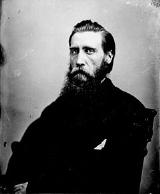
John Bell Hood
|
| |
|
| |
John Bell Hood (June 1 or June 29, 1831 – August 30, 1879) was a Confederate general during the American Civil War. Hood had a reputation for bravery and aggressiveness that sometimes bordered on recklessness. Arguably one of the best brigade and division commanders in the Confederate States Army, Hood became increasingly ineffective as he was promoted to lead larger, independent commands late in the war, and his career was marred by his decisive defeats leading an army in the Atlanta Campaign and the Franklin-Nashville Campaign.
was born in Owingsville, Kentucky, the son of John W.

Discussion
Ask a question about 'John Bell Hood'
Start a new discussion about 'John Bell Hood'
Answer questions from other users
|
Encyclopedia
John Bell Hood (June 1 or June 29, 1831 – August 30, 1879) was a Confederate general during the American Civil War. Hood had a reputation for bravery and aggressiveness that sometimes bordered on recklessness. Arguably one of the best brigade and division commanders in the Confederate States Army, Hood became increasingly ineffective as he was promoted to lead larger, independent commands late in the war, and his career was marred by his decisive defeats leading an army in the Atlanta Campaign and the Franklin-Nashville Campaign.
Early life
Hood was born in Owingsville, Kentucky, the son of John W. Hood, a doctor, and Theodosia French Hood. He was the cousin of future Confederate general G. W. Smith and the nephew of U.S. Representative Richard French. French obtained an appointment for Hood at the United States Military Academy, despite his father's reluctance to support a military career for his son. Hood graduated in 1853, ranked 44th in a class of 52 that originally numbered 96, after a near-expulsion in his final year for excessive demerits. Notwithstanding his modest record at West Point, in 1860 he was appointed chief instructor of cavalry at West Point, a position that he declined, citing his desire to remain with his active field regiment and to retain all of his options in light of the impending war. At West Point and in later Army years, he was known to friends as "Sam". His classmates included James B. McPherson and John M. Schofield; he received instruction in artillery from George H. Thomas. These three men became Union Army generals who opposed Hood in battle.
Hood was commissioned a second lieutenant in the 4th U.S. Infantry, served in California, and later transferred to the 2nd U.S. Cavalry in Texas, where he was commanded by Col. Albert Sidney Johnston and Lt. Col. Robert E. Lee. While commanding a reconnaissance patrol from Fort Mason, Hood sustained one of the many wounds that marked his lifetime in military service&mdash, an arrow through his left hand during action against the Comanches at Devil's River, Texas.
Civil War
Brigade and division command
Hood resigned from the United States Army immediately after Fort Sumter and, dissatisfied with the neutrality of his native Kentucky, decided to serve his adopted state of Texas. He joined the Confederate army as a cavalry captain, but by September 30, 1861, was promoted to be colonel in command of the 4th Texas Infantry.
Hood became the brigade commander of the unit that was henceforth known as Hood's Texas Brigade on February 20, 1862, part of the Confederate Army of the Potomac, and was promoted to brigadier general on March 3, 1862. Leading the Texas brigade as part of the Army of Northern Virginia in the Peninsula Campaign, he established his reputation as an aggressive commander, eager to lead his troops personally into battle. At the Battle of Gaines' Mill on June 27, he distinguished himself by leading his brigade in a charge that broke the Union line, which was the most successful Confederate performance in the Seven Days Battles. While Hood escaped the battle without an injury, every officer in his brigade was killed or wounded.
Because of his success on the Peninsula, Hood was given command of a division in Maj. Gen. James Longstreet's First Corps of the Army of Northern Virginia. He led the division in the Northern Virginia Campaign and added to his reputation as the premier leader of shock troops during Longstreet's massive assault on John Pope's left flank at the Second Battle of Bull Run, which nearly destroyed the Union army. In the pursuit of Union forces, Hood was involved in a dispute over captured ambulances with a superior officer. Longstreet had Hood arrested and ordered him to leave the army, but Gen. Lee intervened and retained him in service. During the Maryland Campaign, just before the Battle of South Mountain, Hood was in the rear, still in virtual arrest. His Texas troops shouted to General Lee, "Give us Hood!" Lee restored Hood to command, despite Hood's refusal to apologize for his conduct.
During the Battle of Antietam, Hood's division came to the relief of Stonewall Jackson's corps on the Confederate left flank. Jackson was impressed with Hood's performance and recommended his promotion to major general, which occurred on October 10, 1862.
In the Battle of Fredericksburg in December, Hood's division saw little action. And in the spring of 1863, he missed the great victory of the Battle of Chancellorsville because most of Longstreet's First Corps was on detached duty in Suffolk, Virginia.
Gettysburg
At the Battle of Gettysburg, Longstreet's Corps arrived late on the first day, July 1, 1863. General Lee planned an assault for the second day that would feature Longstreet's Corps attacking northeast up the Emmitsburg Road into the Union left flank. Hood was dissatisfied with his assignment in the assault because it would face difficult terrain in the boulder-strewn area known as the Devil's Den. He requested permission from Longstreet to move around the left flank of the Union army, beyond the mountain known as [Big] Round Top, to strike the Union in their rear area. Longstreet refused permission, citing Lee's orders, despite repeated protests from Hood. Yielding to the inevitable, Hood's division stepped off around 4 p.m. on July 2, but a variety of factors caused it to veer to the east, away from its intended direction, where it would eventually meet with Union forces at Little Round Top. Just as the attack started, however, Hood was the victim of an artillery shell exploding overhead, severely damaging his left arm, which incapacitated him. (Although the arm was not amputated, he was unable to make use of it for the rest of his life.) His ranking brigade commander, Brig. Gen. Evander M. Law, assumed command of the division, but confusion as to orders and command status dissipated the direction and strength of the Confederate attack, significantly affecting the outcome of the battle.
Hood recuperated in Richmond, Virginia, where he made a social impression on the ladies of the Confederacy. In August 1863, famous diarist Mary Chesnut wrote of Hood:
Chickamauga
Meanwhile, in the Western Theater, the Confederate army under General Braxton Bragg was faring poorly. Lee dispatched Longstreet's Corps to Tennessee, and Hood was able to rejoin his men on September 18. At the Battle of Chickamauga, Hood led Longstreet's assault that exploited a gap in the Federal line, which led to the defeat of Maj. Gen. William Rosecrans's Union Army of the Cumberland. However, Hood was once again wounded severely, and his right leg was amputated four inches below the hip. Hood's condition was so grave that the surgeon sent the severed leg along with him in the ambulance, assuming that they would be buried together. Because of Hood's bravery at Chickamauga, Longstreet recommended that he be promoted to lieutenant general as of that date, September 20, 1863.
During Hood's second recuperation in Richmond that fall, he befriended Confederate President Jefferson Davis, who would subsequently promote him to a more important role.
Commander, Army of Tennessee
In the spring of 1864, the Confederate Army of Tennessee, under Gen. Joseph E. Johnston, was engaged in a campaign of maneuver against William T. Sherman, who was driving from Chattanooga toward Atlanta. During the campaign, Hood sent the government in Richmond letters very critical of Johnston's conduct (actions that were considered highly improper for a man in his position). On July 17, 1864, just before the Battle of Peachtree Creek, Jefferson Davis, who remembered all too well Johnston's preference for a strategy of withdrawals instead of offensives (such as during the Peninsula Campaign of 1862) and lack of communication (after First Bull Run), lost patience with Johnston and relieved him. Hood, commanding a corps under Johnston, was promoted to the temporary rank of full general on July 18, and given command of the army just outside the gates of Atlanta. (Hood's temporary appointment as a full general was never confirmed by the Senate. His commission as a lieutenant general resumed on January 23, 1865.) At 33, Hood was the youngest man on either side to be given command of an army. Robert E. Lee gave an ambiguous reply to Jefferson Davis's request for his opinion about the promotion, calling Hood "a bold fighter, very industrious on the battlefield, careless off," but he could not say whether Hood possessed all of the qualities necessary to command an army in the field.
Hood conducted the remainder of the Atlanta Campaign with the strong aggressive actions for which he was famous. He launched four major offensives that summer in an attempt to break Sherman's siege of Atlanta, starting almost immediately with an attack along Peachtree Creek. All of the offensives failed, with significant Confederate casualties. Finally, on September 2, 1864, Hood evacuated the city of Atlanta, burning as many military supplies and installations as possible.
As Sherman regrouped in Atlanta, preparing for his March to the Sea, Hood and Jefferson Davis attempted to devise a strategy to defeat him. Their plan was to attack Sherman's lines of communications between Chattanooga and Atlanta, and to move north through Alabama and into central Tennessee, assuming that Sherman would be threatened and follow. Hood's ambitious hope was that he could maneuver Sherman into a decisive battle, defeat him, recruit additional forces in Tennessee and Kentucky, and pass through the Cumberland Gap to come to the aid of Robert E. Lee, who was besieged at Petersburg. Sherman did not cooperate, however. Instead of pursuing Hood with his army, he sent Maj. Gen. George H. Thomas to take control of the Union forces in Tennessee and coordinate the defense against Hood, while the bulk of Sherman's forces prepared to march toward Savannah.
Hood's Tennessee Campaign lasted from September to December 1864, comprising seven battles and hundreds of miles of marching. He attempted to trap a large part of the Union Army of the Ohio under Maj. Gen. John M. Schofield at Spring Hill, Tennessee, before it could link up with Thomas in Nashville, but command failures and misunderstandings allowed Schofield's men to safely pass by Hood's army in the night. The next day at the Battle of Franklin, Hood rashly sent his men across nearly two miles of open ground without the support of artillery. His troops were unsuccessful in their attempt to breach the Union breastworks, suffering severe casualties in an assault that is sometimes called the "Pickett's Charge of the West". Historian Wiley Sword wrote that there is "evidence Hood expressed his displeasure over yesterday's fiasco [at Spring Hill] and may have suggested to ... his officers that he was concerned about their willingness to manfully fight on an open battlefield. ... If not outright punishment for their behavior on November 29th, the assault at Franklin would be a severe corrective lesson in what he would demand in aggressive behavior." Those officers that he deemed most responsible for the oversights at Spring Hill were assigned prominent roles in the frontal assault against the enemy fortifications. Hood's exhausted army was unable to interfere as the Union force withdrew into Nashville.
Unwilling to abandon his original plan, Hood stumbled toward the heavily fortified capital of Tennessee, and laid siege with inferior forces, which endured the beginning of a severe winter. Two weeks later, George Thomas completely defeated Hood at the Battle of Nashville, in which most of the Army of Tennessee was effectively dispersed, the remnants retreating into Mississippi.
Near the end of the war, Jefferson Davis ordered Hood to travel to Texas to raise another army. Before he could arrive, however, General Edmund Kirby Smith surrendered his Texas forces, and Hood surrendered himself in Natchez, Mississippi, where he was paroled on May 31, 1865.
Postbellum career
After the war, Hood moved to Louisiana and became a cotton broker and worked as a President of the Life Association of America, an insurance business. In 1868, he married New Orleans native Anna Marie Hennen, with whom he would father eleven children over ten years, including three pairs of twins. He also served the community in numerous philanthropic endeavors, as he assisted in fund raising for orphans, widows, and wounded soldiers. His insurance business was ruined by a yellow fever epidemic in New Orleans during the winter of 1878 – 79 and he succumbed to the disease himself, dying just days after his wife and oldest child, leaving ten destitute orphans, who were adopted by families in Louisiana, Mississippi, Georgia, Kentucky, and New York.
In memoriam
John Bell Hood is buried in the Hennen family tomb at Metairie Cemetery, New Orleans. He is memorialized by Hood County, Texas, and the U.S. Army installation, Fort Hood, Texas.
Stephen Vincent Benét's poem included a poignant passage about Hood:
- Yellow-haired Hood with his wounds and his empty sleeve,
- Leading his Texans, a Viking shape of a man,
- With the thrust and lack of craft of a berserk sword,
- All lion, none of the fox.
- When he supersedes
- Joe Johnston, he is lost, and his army with him,
- But he could lead forlorn hopes with the ghost of Ney.
- His bigboned Texans follow him into the mist.
- Who follows them?
After the defeats in the Franklin-Nashville Campaign, Hood's troops sang with wry humor a verse about him as part of the song The Yellow Rose of Texas:
- My feet are torn and bloody,
- My heart is full of woe,
- I'm going back to Georgia
- To find my uncle Joe.
- You may talk about your Beauregard,
- You may sing of Bobby Lee,
- But the gallant Hood of Texas
- He played hell in Tennessee.
In popular culture
In the movies Gods and Generals and Gettysburg, Hood was portrayed by actor Patrick Gorman, a man considerably older looking than Hood, who was only 32 years old at the time.
Actor Levon Helm portrays an older Hood in the 2008 movie In the Electric Mist.
The basic premise of the 1988 alternate history novel Grey Victory by Robert Skimin is that Hood's decision to leave the defenses of Atlanta and make a disastrous attack upon the Union forces had cost the South its last chance to win the war. In Skimin's opinion, had the "plodding" Joseph E. Johnston remained in command, kept his soldiers inside the fortifications and fought a long-drawn out siege war of attrition until the time of the Northern elections in November 1864, the war-weary Northern voters would have replaced Abraham Lincoln with George B. McClellan as President, ending the war by recognizing the South.
See also
External links
- from the published 1880, hosted by the
- a Primary Source Adventure, a lesson plan hosted by
|
| |
|
|